We still may be some time away from sending humans to distant reaches of the solar system, but you can send your name to Saturn's moon Titan, which has the ingredients of life on its surface thanks to NASA's Dragonfly mission.
Dragonfly is an SUV-sized nuclear-powered rotorcraft that NASA aims to launch towards Titan in 2028. The agency opened a special events page in late October to allow members of the public to put their name on the spacecraft. The names will be put upon a chip on Dragonfly during the spacecraft's assembly, and all names must be submitted before Jan. 15, 2027.
The agency says that the mission has no "ordinary itinerary," as Dragonfly aims to between areas miles (or kilometers) apart after arriving on the surface in 2034. "Nearly a billion miles away, an extraordinary destination awaits. Titan has an atmosphere, rivers and lakes, seasons, sweeping dunes and a landscape rich in organic material," NASA officials wrote in the event page. "Upon arrival in 2034, Dragonfly will fly from place to place on this intriguing world to uncover clues about this remarkable moon, and the chemistry that could help us understand the ingredients for life."
Dragonfly will be one of just a few flying crafts on another world, with the first being NASA's plucky Ingenuity mini-helicopter that arrived on Mars along with the still-running Perseverance rover in 2021. Ingenuity was only designed to make five flights, but made it to 72 until its blades were damaged during a landing on Jan. 18, 2024.
NASA is now planning a SkyFall mission on Mars that would use three helicopters, and which may launch as soon as late 2028 for the Red Planet.
Dragonfly, however, is not the first mission to Titan: that would be Huygens, which operated for just a few hours on Jan. 14, 2005 after deploying from the Cassini spacecraft. Huygens was the first lander on an outer solar system world, and measured Titan's atmosphere and took data from the surface.
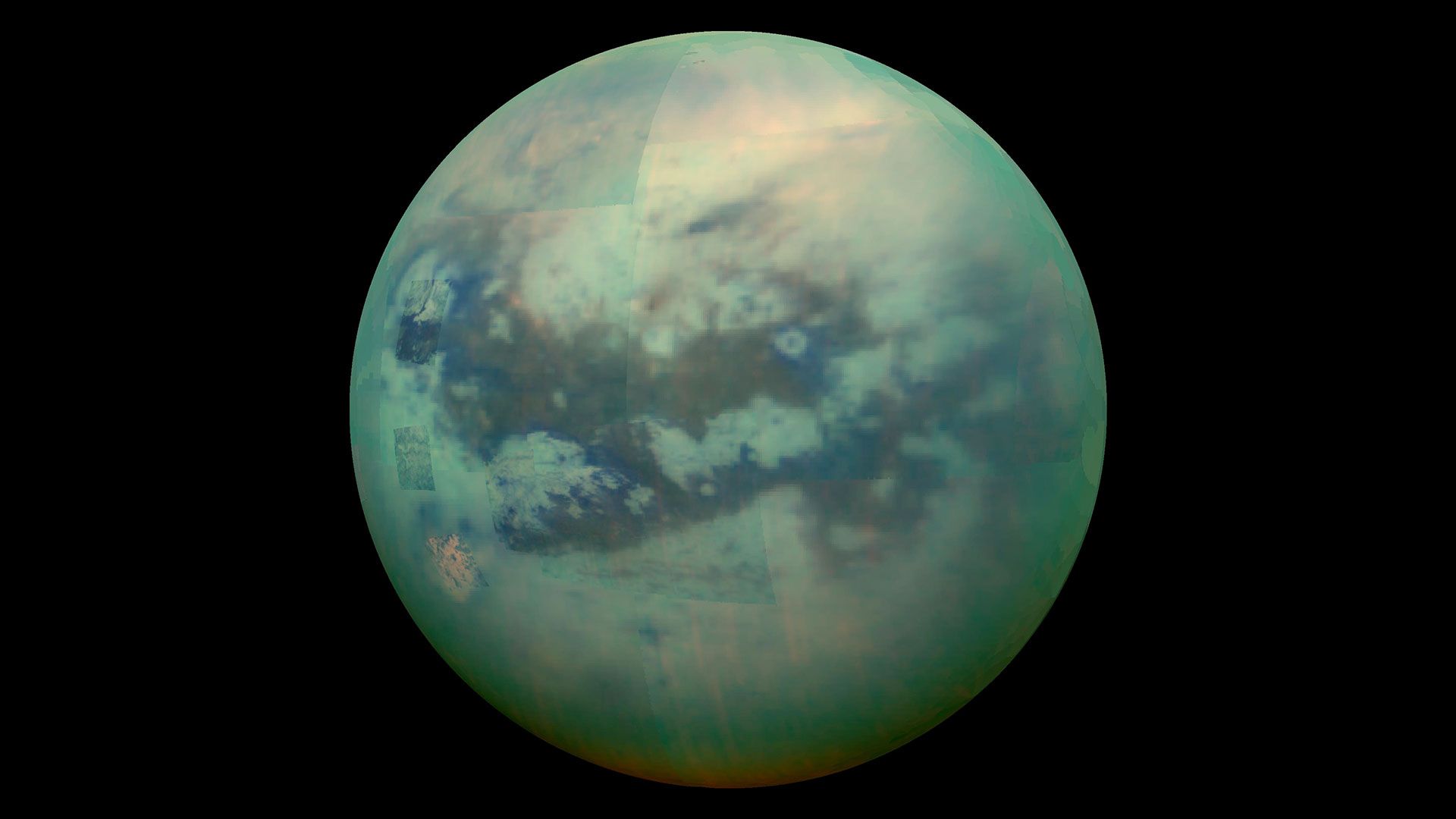
A mosaic image of Saturn's moon Titan composed of images produced by the Cassini spacecraft. (Image credit: NASA/JPL/University of Arizona/University of Idaho)
For its part, Cassini flew by Titan more than 100 times before the mission concluded in September 2017, providing valuable long-term data about the moon from above. Dragonfly aims to show the moon from up close for about 3.3 Earth years. Its destinations will include dunes and a young impact crater called Selk, according to NASA.
"Dragonfly is expected to make one flight every one to two Titan days, which is called a Tsol and lasts about 16 Earth days," NASA officials added of the mission. Dragonfly will stop at a variety of geologic sites, where it will collect samples of surface material for analysis inside the rotorcraft by a suite of scientific instruments."
Dragonfly's goals include learning more about prebiotic chemistry, or the conditions prior to life arising in a location; figuring out if Titan had habitable conditions in the past; and looking for "chemical indicators" of life based on water or hydrocarbons.
Voyager, 1, humanity's most distant spacecraft, is back in contact after briefly losing touch with Earth last month.
The spacecraft stopped phoning home for about 48 hours between Oct. 18 and 20 due to a communications glitch that Voyager 1 resolved on its own, before engineers could send the long-running spacecraft a remote fix.
"This is the first time we've seen the spacecraft do something like this, but we are also at a point in the mission where we have to expect the unexpected," Kareem Badaruddin, Voyager mission manager at NASA's Jet Propulsion Laboratory (JPL), said in an agency statement about the incident on Oct. 29.
Voyager 1 is almost one light-day from Earth, meaning that a command takes nearly a day to reach the spacecraft and a response takes another day to come back to our planet. The spacecraft will reach the light-day milestone on Nov. 18, at 16.09 billion miles (25.89 billion kilometers) from Earth.
NASA's Deep Space Network of three antennas does check-ins to make sure the spacecraft is doing well. On Oct. 18 and 19, Voyager 1 did not respond. Its signal fortunately reappeared on Oct. 20.
"Engineers still are investigating what caused the communication loss," JPL added in the statement, but said it appears Voyager 1 went into a sort of safe mode. "The team has so far determined that one group of thrusters went offline and their backups turned on. Such a swap is programmed to occur automatically if the spacecraft computers detect something amiss with the active thrusters."
Voyager 1 and its still-operational twin, Voyager 2, both launched in 1977 on an initial mission to explore planets in the solar system. The two spacecraft took advantage of a rare alignment that allowed them to swing from Jupiter to Saturn to Uranus and Neptune using a minimum of fuel, although funding to explore the more distant planets and moons was not guaranteed at launch.
The spacecraft duly swung by Jupiter's and Saturn's systems (some months apart from each other) to great acclaim before parting pathways. Voyager 1's close-up view of Saturn's rings as well as the moon Titan — which may have prebiotic or pre-life chemistry — altered the spacecraft's trajectory to put it high above the plane of the solar system. Meanwhile, Voyager 2 flew on to Uranus and Neptune in 1986 and 1989, respectively, providing the only up-close view of these planetary systems to date.
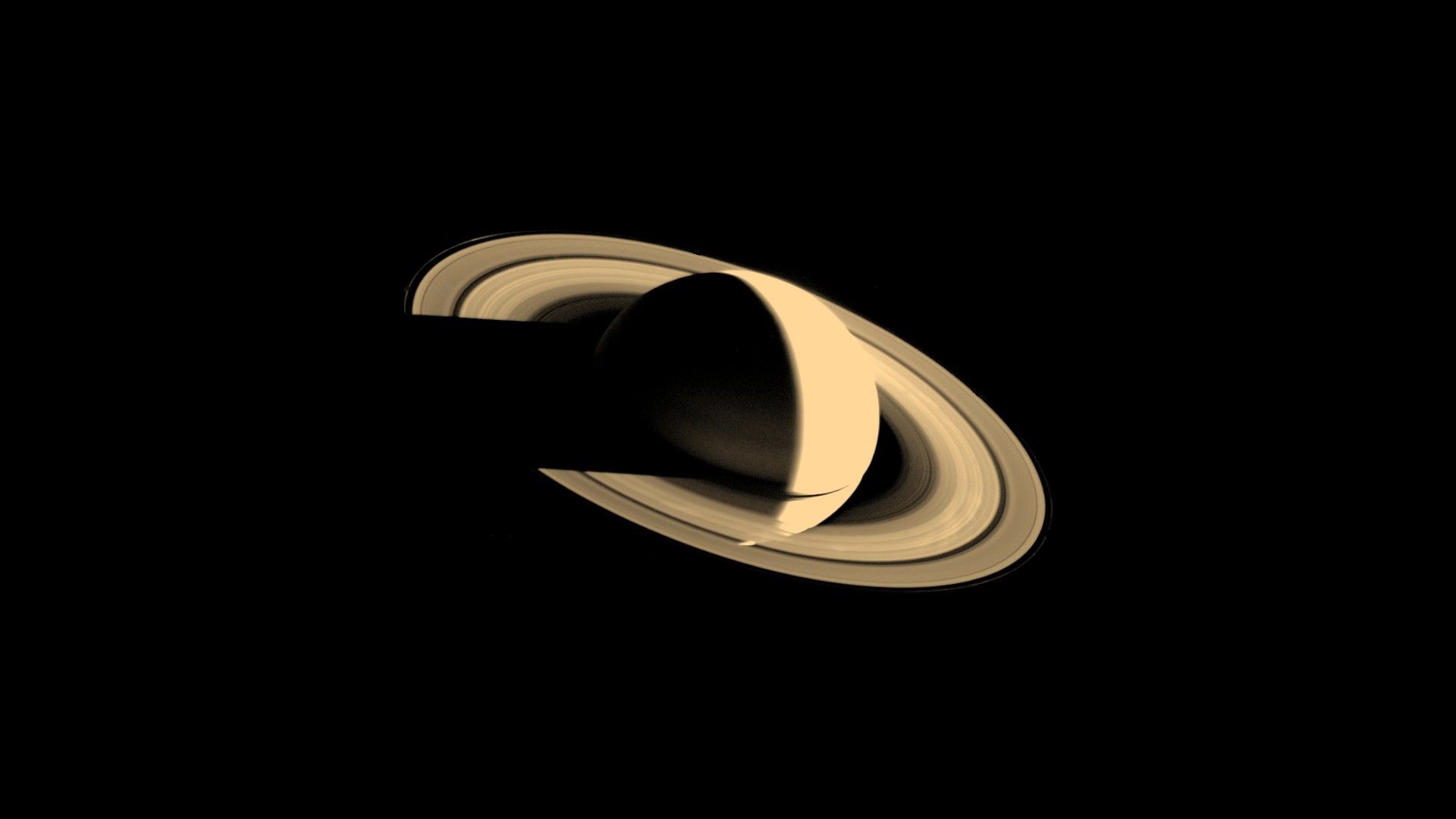
An image of Saturn taken by Voyager 1 on Nov. 16, 1980, four days after the spacecraft flew past the planet. (Image credit: NASA/JPL)
Running on nuclear power, and continuing to deliver valuable science from deep space, the Voyagers saw their missions extended repeatedly. Both crossed into interstellar space a few years ago, and are still operational.
But with age comes a cost: the plutonium power sources on both spacecraft are diminishing, requiring engineers to periodically shut off instruments or come up with other clever ways of saving power. Voyager 1 just underwent one of those power adjustments, nicknamed the "Big Bang" because it reconfigured a number of spacecraft instruments.
"In early September, engineers successfully turned off three devices on the Voyager 1 spacecraft and substituted them with three lower-power alternatives," JPL wrote of the effort, noting that Voyager 2 also had a "Big Bang" about six weeks previous to that.
JPL did not provide an estimate for how long the missions could keep running, but noted each spacecraft loses four watts of power a year — each launched with 470 watts — and that the spacecraft could continue operating science instruments "longer than previously anticipated" due to the Big Bang. On Voyager 1, for example, the falling power would have otherwise meant switching off another instrument possibly as soon as next summer.
In 2022, Suzanne Dodd, project manager for Voyager at JPL, stated the hope was the mission would continue to operate into the 2030s.
NASA is reviving discussions to rescue the Hubble Space Telescope, which is operating well but is on track to reenter Earth's atmosphere about six years from now.
The agency issued a request for information (RFI) on Oct. 29 for "in-space servicing" capabilities, which could include boosting Hubble's orbit (which is naturally degrading due to atmospheric drag), or even a mission to "enhance its capabilities" in some way.
Hubble, which launched in April 1990 in partnership with the European Space Agency, was serviced five times by astronauts on space shuttle missions, the most recent being in 2009. The observatory's groundbreaking achievements include helping to show that the expansion of the universe is accelerating — a discovery that won the Nobel Prize — as well as a swath of finds about planets, galaxies, stars and other parts of the universe.
Hubble also regularly teams up with other telescopes for science work, and its observations have led to the publication of at least 23,000 scientific papers, NASA figures suggest. And, despite its age, Hubble remains in high demand. "Astronomers request about seven times as much observing time as is available each year," the agency stated in September.
Hubble is also widely appreciated by the public. People have long enjoyed and celebrated its iconic images, such as the Eagle Nebula's "Pillars of Creation," a gorgeous shot that has been revisited several times over the decades. As such, this is not the first time in recent years that discussions have opened about keeping the famed observatory running for a while longer.
In 2022, for example, billionaire tech entrepreneur Jared Isaacman proposed using SpaceX hardware to mount a Hubble-servicing mission. (Isaacman also purchased and commanded two crewed SpaceX missions to Earth orbit, which flew in September 2021 and September 2024.) NASA declined, however, citing possible risks to the healthy observatory.
But things have changed, apparently. Isaacman, who in December 2025 became NASA administrator, said in an Oct. 30 agency statement that Hubble's science return means the agency should "be looking at every reasonable opportunity to keep it delivering for as long as possible" — especially if doing so would be a cost savings compared with launching another mission.
In an Oct. 30 post on X, Isaacman added that it's "still worth exploring the options" and noted that NASA had previously considered "a far lower-cost solution" to keep the observatory flying. "That was then. Still worth the effort — Hubble deserves it," he added.
The new RFI also allows for alternative scenarios, however, which could include a "safe, controlled reentry into Earth's atmosphere or orbital disposal at the end of Hubble's mission."
Hubble will naturally enter the atmosphere in 2033 or 2034 due to orbital drag, so any attempt to service it would have to be in 2032, the agency stated.
Earlier this year, NASA worked with Katalyst Space Technologies on a $30 million mission that aimed to boost the orbit of the Neil Gehrels Swift Observatory, which is also falling back to Earth due to orbital drag.
That long-shot rescue mission — which was developed quickly to race against accelerated solar activity, which ballooned Earth's atmosphere and increased drag — launched successfully this summer. But control issues prevented Katalyst's LINK spacecraft from meeting up with Swift. Swift is expected to reenter Earth's atmosphere tomorrow (Nov. 4) after 22 years of operations — far past its two-year design lifetime.
The next International Space Station (ISS) spacewalk will have more maple-leaf flavor than usual, as a Canadian astronaut will become the first to go outside the orbiting complex in seven years.
Canadian Space Agency (CSA) astronaut Joshua Kutryk, who's also a colonel in the Royal Canadian Air Force, will help the ISS boost its power supply during his first-ever spacewalk on Thursday (Oct. 29). Kutryk will be joined by NASA astronaut Anil Menon, who has done three spacewalks already and also serves as a colonel with the U.S. Space Force.
The duo are scheduled to venture outside the orbiting lab at 8 a.m. EDT (1200 GMT), kicking off a spacewalk that will last roughly 6 hours and 45 minutes. You can watch it live here at Space.com, courtesy of NASA, beginning at 6:30 a.m. EDT (1030 GMT).
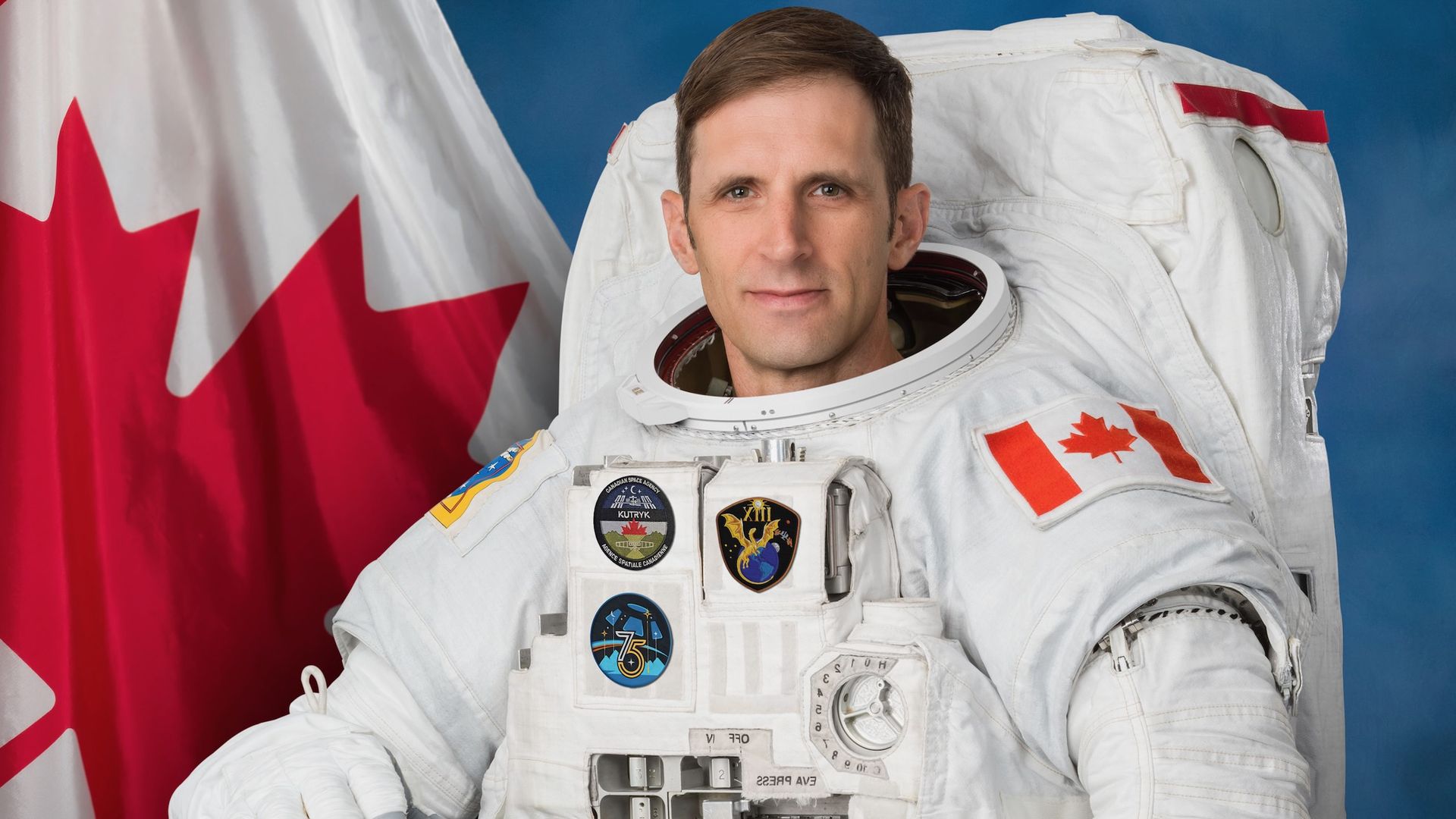
Official photo of Canadian Space Agency astronaut Joshua Kutryk. (Image credit: Canadian Space Agency)
It will be the first of two extravehicular activities (EVAs) for Menon and Kutryk, with the second expected to occur no sooner than Nov. 5. During the two spacewalks, the astronauts will deploy the seventh and eighth International Space Station Roll-Out Solar Arrays (iROSAs).
iROSAs lie on top of the existing, decades-old arrays on ISS, which are naturally degrading with age. The first iROSA rolled out in 2021. Once all eight are installed and running, the station will see its power supply rise from 160 kilowatts to about 215 kilowatts — a boost of roughly 30%.
A Canadian capcom, too
The capcom (capsule communicator) for both spacewalks will be CSA astronaut Jenni Gibbons. She has experience in this role already, serving as a capcom on NASA's Artemis II mission around the moon this past April. And she'll serve as lead capcom for Artemis III, which will test crewed lunar landers in Earth orbit next summer, if all goes to plan.
Also helping Kutryk and Menon will be Canadian space technology, specifically Canadarm2 — the ISS robotic arm tasked for spacewalk support, among other maintenance duties.
"It's been busy preparing for the upcoming spacewalks," Menon said about Canadarm2 in a Saturday (Oct. 24) X post. Ground controllers recently moved the arm over to the "trunk" or storage area of a SpaceX Dragon cargo spacecraft, which brought the two iROSA arrays up earlier this month.Canadarm2 picked up the IROSAs and moved them to a transporter for the astronauts. "It even loosened bolts for us before the spacewalks … I'm grateful for the help," Menon added.
During the Oct. 29 spacewalk, Canadarm2 will do even more. Kutryk and Menon will slide an array off its transport rail and then have Menon get onto a Canadarm2 platform, to put the array into his hands. From inside the ISS, NASA astronauts Luke Delaney and Jessica Watkins will carefully move Canadarm2 to put Menon and the array at the ISS port-installation site, supporting the 2A electrical-power channel.
Each array is about 10 feet (3 meters) long when folded up and weighs 750 pounds (340 kilograms) here on Earth, according to Garrett Hehn, NASA's spacewalk flight director. The agency therefore knows the iROSAs are "a lot to handle," he said during a press conference on Oct. 20 that previewed the two upcoming spacewalks.
As such, NASA looked at how previous iROSA spacewalks were performed and created a new "elegant series of maneuvers, where we've tried to rotate around the actual center of mass of the arrays, rather than the crew member," Hehn added. "It was a lesson learned from previous EVAs, of how we thought we could make it a little less tiring on Anil."
Kutryk will move over to the installation location, hand-over-hand, to join Menon. There, the two will place the IROSA onto the older solar array, using a "mod kit" placed on a previous spacewalk. "We've got a series of bolts to structurally attach it [the IROSA] and release, in order for this folded-up configuration to fold open, and basically go from about 10 feet long to around 20 feet [6 m] long," Hehn explained.
"These arrays," he added, "I kind of think of them like a snap bracelet … They basically have a series of magnets up the side, where they deploy with enough energy that it just continues rolling out steadily. That process will take about 10 minutes on the day of the EVA."
Following that, the astronauts need to access power cables at a time when that area of the ISS is not in sunlight; the station will be (as always) moving through its orbit, circling the Earth every 90 minutes, so timing will be important.
"We can't have any sun on the arrays, whenever we're handling those hot cables," Hehn said. "Basically, we'll use a jumper to bring together both the legacy arrays' power, and this new rollout solar arrays' power, in order to have a pretty substantial gain to our power-generation capability."
The Nov. 5 EVA will essentially have the astronauts do the same installation procedure with another array, this time heading to the starboard side of the space station. The last IROSA installation, however, will take place a little farther from the station, beyond Canadarm2's reach. So the astronauts will do a "leapfrog" to get out there.
After Menon, the array and Canadarm2 are brought to the installation location, Hehn said, Kutryk — moving to the same location by himself, hand over hand — will go into another platform installed on the station truss, and take the IROSA from Menon's hands. As Kutryk waits in place, Menon will exit the robotics platform, move it from the Canadarm2 to another spot on the space station's truss, and then get back on to the platform to hold the IROSA securely for installation for the 3B electrical-power channel.
"This is the way that we close that final distance that the robotic arm is unable to do on its own," Hehn said.
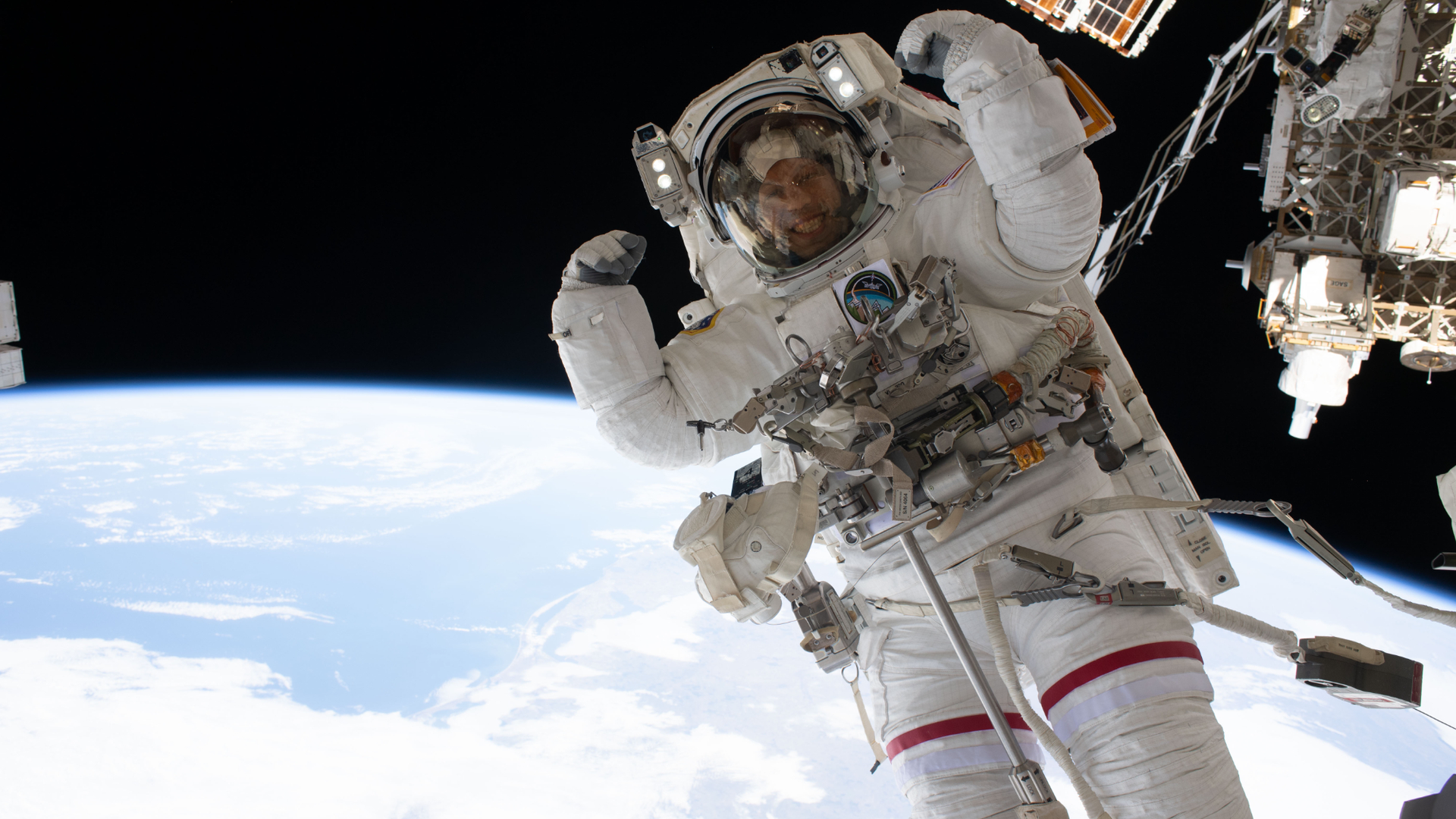
NASA astronaut Chris Williams flexes his muscles while on a spacewalk. (Image credit: NASA/Jessica Meir)
Canadian robots, support teams — and new funding
The CSA's last spacewalk was during the agency's previous mission seven years ago, which involved astronaut David Saint-Jacques. On April 8, 2019, Saint-Jacques successfully fought difficult equipment during a busy excursion alongside NASA astronaut Anne McClain.
CSA has a 2.3% contribution to ISS, usually working out to a flight every five or six years. However, Kutryk's slot was delayed two years, from 2024 to 2026, because he was originally assigned to fly up on Boeing's Starliner capsule, which needs more flight testing following numerous issues that cropped up during its crewed demonstration flight in 2024.
Kutryk, who launched Oct. 1 aboard a SpaceX Crew Dragon with three other astronauts, has generated a lot of political and industry excitement in Canada. His mission marks a rare pair of CSA astronaut launches in a single year, as Artemis II astronaut Jeremy Hansen just launched in April. (The last time this happened was in 2009, when Robert Thirsk was doing a long-duration station excursion and Julie Payette visited during a two-week space shuttle mission.)
Canadian astronaut missions are unusual, even when including private missions — or non-CSA government astronauts, like now-retired NASA astronaut Andrew Feustel, who has dual U.S.-Canadian citizenship. Canada is therefore using the new CSA mission as a catalyst. In recent weeks, Canada announced several government and industry commitments to keep the momentum going even after Kutryk returns next spring.
For example, Canada just announced its first bipartisan space caucus, named Hansen a space advisor to the prime minister, pledged to soon give CSA its first space strategy since 2019, and promised, if at all possible, to announce a mission assignment for Gibbons within the next year. (The latter may depend on factors such as NASA's availability for missions, as Canada does not launch astronauts on its own.)
On the industry side, Canada's defense department last week promised the launch company NordSpace $20 million CDN ($14 million USD) for a 10-year launch pad access agreement at the company's young spaceport in the province Newfoundland and Labrador; additional mission costs will be paid when those are ordered. Canada also recently promised $200 million CDN ($140 million USD) to Maritime Launch Services over 10 years, committing to a launch pad at the company's emerging spaceport in Nova Scotia.
Reentry and orbital-manufacturing provider Varda Space Industries is operating two spacecraft in orbit right now, with another expected to launch "in the coming days" and seven more next year.
The Los Angeles-area startup, which bills itself as one of just two companies that can currently do commercial reentry from space, successfully launched its latest two refrigerator-sized spacecraft aboard SpaceX's Transporter-18 rideshare mission on Oct. 1.
"It's humanity's first time launching multiple commercial reentry vehicles simultaneously," Varda CEO Will Bruey told Space.com on Tuesday (Oct. 7) of the Transporter-18 launch.
The payloads on the Transporter-18 Varda craft ranged from pharmaceuticals to demo navigation systems to exterior thermal-protection materials. The company bills its spacecraft as mini-factories, which can host the orbital production of valuable goods such as pharmaceuticals and then bring them safely down to Earth.
Another Varda vehicle is scheduled to follow them into space later this month. Assuming the third spacecraft launches nominally, all three will come down before Christmas in the Koonibba Test Range in the South Australian Outback, through coordination with Varda's long-time space-mission service provider, Southern Launch. And things are scheduled to ramp up quickly: Varda aims to fly seven more missions in 2027: two in Quarter 1 (Q1), two in Q2 and three in Q3 (the latter three being all on the same rocket).
"As we scale up, we care about our ability to fly and fly regularly," Bruey said, emphasizing that the company is now treating its missions less as one-offs and more as a series. "It is, first and foremost, taking that unique [spacecraft] technology and moving into a fleet mentality, rather than a space mission mentality."
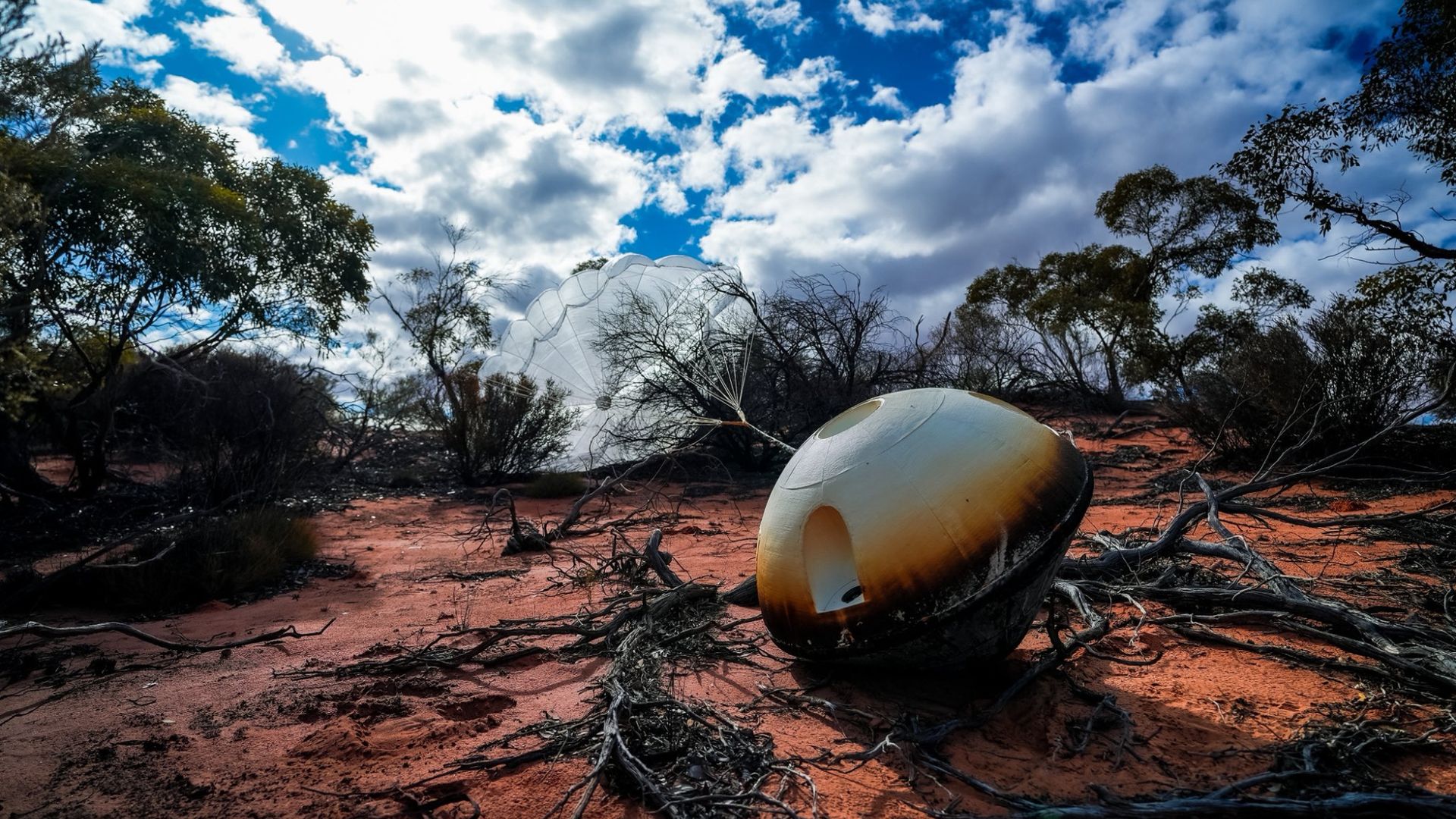
One of Varda's reentry capsules is seen shortly after its touchdown in the Australian Outback. (Image credit: Varda Space/Rocket Lab)
Like any startup finding its footing, Varda's challenges in the coming months will be scaling safely and efficiently. But the company says it is well-capitalized to do so, and has a big hiring campaign underway. It also has been spending money on slight upgrades and improvements to its vehicles, as well as mission operations and other infrastructure to run several missions at the same time, with more funds having just arrived.
In September, Varda announced it had raised $251 million in "Series D" investment funding and will be hiring 100 people by the end of 2027, boosting its current 286-employee base by more than a third. Most of the employees work out of El Segundo, California, with a few in sales offices in Washington, D.C. and Huntsville, Alabama (where U.S. Space Command is gradually moving, along with some defense contractors, from Colorado Springs).
In the further future, Bruey said, the goal is to fly Varda vehicles into space daily, using a "standardized product" that would be put together on an assembly line. But to get to that point, like other companies in the industry, Varda will need to get through an anticipated rocket shortage beginning in about 2029.
SpaceX is by far the most active launcher these days, and it has been the dominant provider for companies like Varda via its Transporter and Bandwagon rideshare programs. But SpaceX is readying to retire its Falcon 9 rocket as it transitions more resources into Starship, the fully reusable megarocket the company sees as its workhorse of the future. Media reports suggest that SpaceX is pretty much out of capacity for Falcon 9 rockets flying through the end of service in 2028 or 2029, although slots are still available through third-party bookers.
There are a slew of newer rockets under production (such as Blue Origin's New Glenn and Relativity Space's Terran R), though they are far less mature and in some cases, even unflown. This is creating uncertainty about how much capacity there will be in the industry in the short term, but Varda said it is planning well ahead for that moment — and so too are its customers.
"We're stacked with launches from now through that 2029 time frame," Bruey said. The company's current generation of vehicles is "launch-agnostic," although the next generation is aiming to be even more so to nab opportunities from small rockets up to Starship.
The company said that, as long as Varda and its customers have access to microgravity, the shipping methodology — much like shipping on Earth — should not matter, and Varda aims to make the experience that seamless for its customers. But in the meantime, the company says it will fly as much as possible and (like everyone else) do what it can to secure slots on launching rockets after Falcon 9 retires.
NASA is asking for ideas to stop static electricity from zapping astronauts or critical hardware during moon missions.
The agency opened a "Lunar Grounding Challenge" to avoid situations where an astronaut on the moon could become "a walking, high voltage capacitor." Submissions for the $150,000 competition are due Jan. 15 and you can see the requirements here.
NASA is hoping to put astronaut boots at the lunar south pole in 2028 during the Artemis 4 or 5 missions, on the first landing mission since NASA's Apollo 17 in 1972. But simulations suggest that both "tribocharging" (electric-charge transfer between two objects) and plasma charging (from ambient gas in the region) could build up electric charge on spacesuits. "This problem is severely compounded when entering lunar shadows and permanently shadowed regions," the agency wrote, referring to deeply cratered areas where the sun does not touch the lunar surface.
The concern is that astronauts' spacesuits could become electrically charged, as there would be an excess of electrons (negatively charged particles) compared with ions (positively charged) in these areas.
"The risk occurs when an astronaut returns to the spacecraft," the agency added. The lander would have a slight positive charge, producing an issue once the "highly negatively-charged astronaut approaches the vehicle."
NASA has asked industry partners for ideas that can help an astronaut avoid "becoming a walking, high voltage capacitor", including issues such as an electrical arc that could damage spacesuits, spark fires in the oxygen atmosphere of a spacecraft, or create electrical shocks. (A Mars simulation in 2018 was reportedly derailed due to a crew experiencing electrical issues, so this problem is not unprecedented.)
The challenge aims to create designs that would safely discharge the astronaut and their spacesuit before an astronaut touches the lander. Among the technical requirements, NASA is looking for something small (in terms of mass, volume and power) that would be able to operate even in the extreme temperature swings of the lunar surface. The technology must also be able to help as many as four extra-vehicular activities (moonwalks) that take place over as long as 10 days.
"In addition, the suspended lunar dust and heavy dust buildup on a suit in these environments significantly increases arcing lengths, allowing sparks to jump across larger gaps than they would in a clean vacuum. Therefore, the solution must aim to avoid a sudden arc that may come into contact with the outer pressure garment — suit — or the lander," NASA wrote in the challenge description.
The challenge will include multiple phases, including a concept design, concept refinement after chatting with reviewers, and then a final selection. NASA did not release a target date in its press release for when the tech would be available for astronauts, but the agency is planning on a long-term moon base for astronaut missions that would be largely ready to go in the 2030s if schedules hold.
Could we find alien technology embedded in moon dust?
The bold idea, not yet peer-reviewed, suggests checking out the lunar surface for "microscopic technosignatures." The SETI Institute — or the Search for Extraterrestrial Intelligence Institute — describes these technosignatures as "tiny engineered particles" that may have come from interstellar space before settling on the moon.
The institute recently highlighted a paper on the topic, published on arxiv in August, and added the research is undergoing peer review for consideration in the International Journal of Astrobiology. The study is led by SETI Institute Affiliate Scientist Lewis Pinault.
"The moon has been quietly accumulating material from space for billions of years, much of it likely billions of years older than the moon itself," said Pinault in a statement. "We're asking whether that ancient collection might contain microscopic traces of technologies that existed long before humans ever looked up at the sky."
Even if no aliens turn out to be there, the search could help advance models of how dust goes through interstellar space, as well as effects on lunar geology or impact science, the institute added.
"The study reports no evidence of extraterrestrial technology," the institute added in the statement. "Instead, it demonstrates that searching for these microscopic technosignatures is now scientifically testable."
That's in large part because the NASA-led Artemis program, which will ultimately bring astronauts to the moon, as well as China's Chang'e robotic series, would provide opportunities to return samples, the institute said. (China is also eyeing bringing its taikonauts to the moon by 2030.)
SETI is best known for looking for artificial radio signatures in space that may have come from extraterrestrials. This new study, the institute added, is focusing more on past alien communities that may have preserved their knowledge in "durable particles," even if the communities are no longer in existence.
The study examines how these particles could (in theory) move from star to star, stay viable over long distances and periods, embed themselves in the lunar surface and then — if humans could find them — use AI-assisted imaging, materials analysis and microscopy to take a closer look, among other techniques.
Helping in that search is the environment of the moon itself, which — compared with Earth, at least — has slow-moving geology. As the institute points out, the surface has no flowing water or substantial atmosphere like our planet does. What's more, the moon has picked up dust in its environment for about four billion years (from not long after the solar system was formed 4.5 billion years ago), presenting a potential archive of dust in the solar system and interstellar space.
"The researchers argue that if advanced civilizations produce durable microscopic debris — whether intentionally or as a byproduct of space exploration or large-scale engineering — a tiny fraction of those particles could eventually become embedded in the lunar regolith," the institute stated.
The goal is to start these studies with about 35 cubic feet (one cubic meter) of lunar regolith, which is maybe the equivalent size of a fridge. Researchers would try out a series of careful investigations using multiple tools to "begin placing meaningful limits on the amount of durable artificial material produced by technological civilizations over the history of the Milky Way."
And as mentioned, even if this small sample doesn't turn up technosignatures, the researchers say the work is still important. It's another way to search for "extraterrestrial artifacts," to look at various aspects of solar system science, and to try out newer tools for examining moon samples that weren't available in the Apollo years.
"This is a novel addition to the search methodologies applied to seeking evidence of technology as a proxy for life and intelligence beyond our solar system and we are excited at the prospect of bringing this to fruition," stated Bill Diamond, SETI Institute president and CEO.
NASA astronaut Jessica Meir just shared some tips for controlling curls in the tough environment of microgravity — and it was a big deal for curly-haired people like me.
Meir's hair-care advice came Wednesday (Sept. 9) in a 5.5-minute video she posted to X from the International Space Station (ISS), where everything floats and "where curls are even more free to be what they want to be," the Expedition 75 astronaut wrote.
And if you think all this talk about hair care sounds frivolous, take it from a fellow curly: the representation matters. More on that in a moment, but first, let's see how Meir takes care of her curly hair in microgravity.
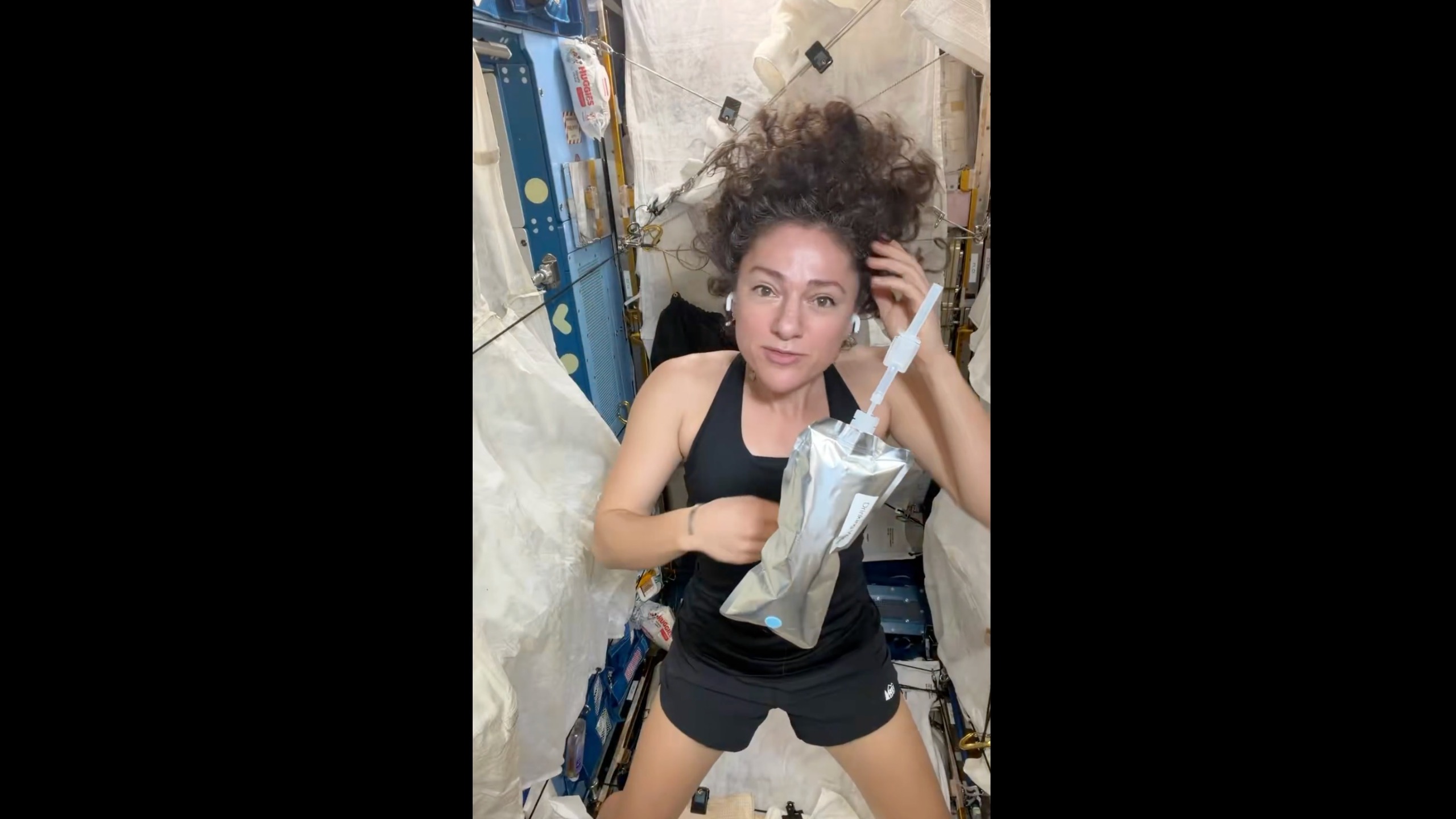
In a video she posted to X on Sept. 9, 2026, NASA astronaut Jessica Meir provided tips for caring for curly hair in space. (Image credit: Jessica Meir/NASA)
According to Meir, washing in orbit requires no-rinse shampoo, especially focusing on the scalp, where sweat and salt build up. She has less access to hair products than we do here on Earth, as you would imagine, so she keeps it simple: a careful squeeze of her pouch of water, then working the expelled water along her hair roots, and also rubbing it on the scalp. Meir then uses a "dedicated T-shirt" to dry her hair, which she described as thick as well as curly.
In between treatments, Meir avoids brushes (for pretty obvious reasons of frizz) and uses her hands and fingers instead to "work" her hair. Luckily, humidity is not much of an issue on the ISS, but she does use leave-in conditioner: "My Earthly 3a curls become more like 3c," she said. Meir has been on the ISS since February, and she said she's looking forward to having an actual shower when she gets back home to Earth.
OK, so about that representation. My editor asked me to talk not only about Meir's video but also my own connections to her words, which brings up some teenage angst. In the 1990s, I was (then, as now) a curly-haired person who was just (bitterly) old enough to remember all the curly rock stars of my childhood in the '80s. But dare to wear curls in my school in like, 1994? As if! Lame!
All the young women around me were rocking the flat-haired "Rachel from 'Friends'" lookthat would take thick-haired curlies like me forever to achieve. I couldn't be bothered — I like sleep! Which apparently was enough for my classmates (of any gender) to deliver unprintable and sometimes racist insults, or to hide their faces from me because I was "ugly," or to spread rumors that I carried hair lice, and so forth. I couldn't believe it; other kids were sporting awesome and stand-out 'dos like mullets and mushroom cuts, so what was wrong with curls?
To be clear, as a 40-something I now have perspective: I later learned that some of my classmates had complex (even tragic) issues of their own contributing to the bullying, and I have no idea how other kids in my classes fared with their hairdos. The real lesson learned is that representation matters, inclusivity is possible and inclusivity matters across multiple dimensions. While looks may not sound important, at first glance, they really are: curly hair is a dimension of diversity. (I know I am just one female voice, with white U.K. ancestry; other people with curly hair will have different perspectives.)
So, back to the curly-hair-space-care routine: as a fellow curly, can I confirm that it stands up? Yes it does. While I'm no astronaut like Meir, I can offer you an analog: the two weeks I spent in 2014 at the Mars Society's Mars Desert Research Station in rural Utah, during which my crew was able to shower every two days, if we were lucky.
On that simulated Red Planet mission, I also used no-rinse shampoo to save on water, only combed(never brushed) my hair when it was wet, and mostly wore it bun-style to protect the curls in the meantime. While it took me two showers to feel normal when I at last reached a hotel room with running water, my hair bounced — so to speak — back quickly. That shows my curls are resilient, and since my 20s I've felt lucky to have them; my hair takes me a minimum of work or styling besides a quick wash and comb, and — as long as I don't touch my hair after it's wet — it's happy.
And to all those kids teasing me back in the day, allow me a moment of moon joy: NASA's Christina Koch sported curly hair during NASA's Artemis II lunar mission earlier this year. Koch herself, by the way, later spoke about her moon-mission braids at an event in my literal city in Canada (as, speaking of representation, I'm Canadian). Yes, of course there was more to this historic mission than hair: I covered Artemis II's science and activities at numerous in-person events for three-plus years, and some of its crew members for 17 years. But to see curls on a person looping around the moon? Bonus.
Every curly-haired person's experience is different, however, so I'd like to hear from you. There's a comment section with this article to chat about microgravity (or analog) curly-hair care, other curly-haired astronauts, or similar topics. Let us know your thoughts.
Three of NASA's Artemis II astronauts are starting off the school year with new assignments.
Artemis II commander Reid Wiseman and pilot Victor Glover, both NASA astronauts, will transition into "emeritus status" in September, the space agency announced on Wednesday (Sept. 9). Meanwhile, Canadian mission specialist Jeremy Hansen shared a video on X on Tuesday (Sept. 8) concerning his already-announced transfer from active duty to reserve status in the Canadian military.
The fourth Artemis II astronaut, NASA mission specialist Christina Koch, appears to still be on active duty, as no announcements have been made saying otherwise.
The Artemis II quartet flew around the moon in April, becoming the first people to go beyond low Earth orbit since 1972. The historic journey was widely expected to be the last step in active astronaut duty for at least some of the mission's four astronauts, especially Hansen, who had waited for a flight assignment for 17 years in part due to how Canadian Space Agency funding is allocated. (Robotics provided by the CSA form a minority share of international space partnerships with NASA, and astronaut flight rates are tied to funding.)
The Artemis II astronauts made a series of public appearances together this summer, culminating on Aug. 28 when President Trump awarded them the Congressional Space Medal of Honor. Hansen was only the second non-American to receive the award, which had previously been given to just 30 astronauts total.
While NASA's Wednesday announcement about Glover and Wiseman did not explicitly state that the duo are exiting active astronaut duty, their new role is described as allowing the astronauts to assist NASA as consultants and "individuals with a high degree of technical and professional knowledge," while allowing them to do other things.
The two astronauts are expected to help NASA plan future Artemis program missions. "I'm grateful they will continue sharing what they learned with our astronauts, flight controllers and engineers as we prepare for Artemis III in 2027 and the missions that follow," NASA administrator Jared Isaacman said in the statement.
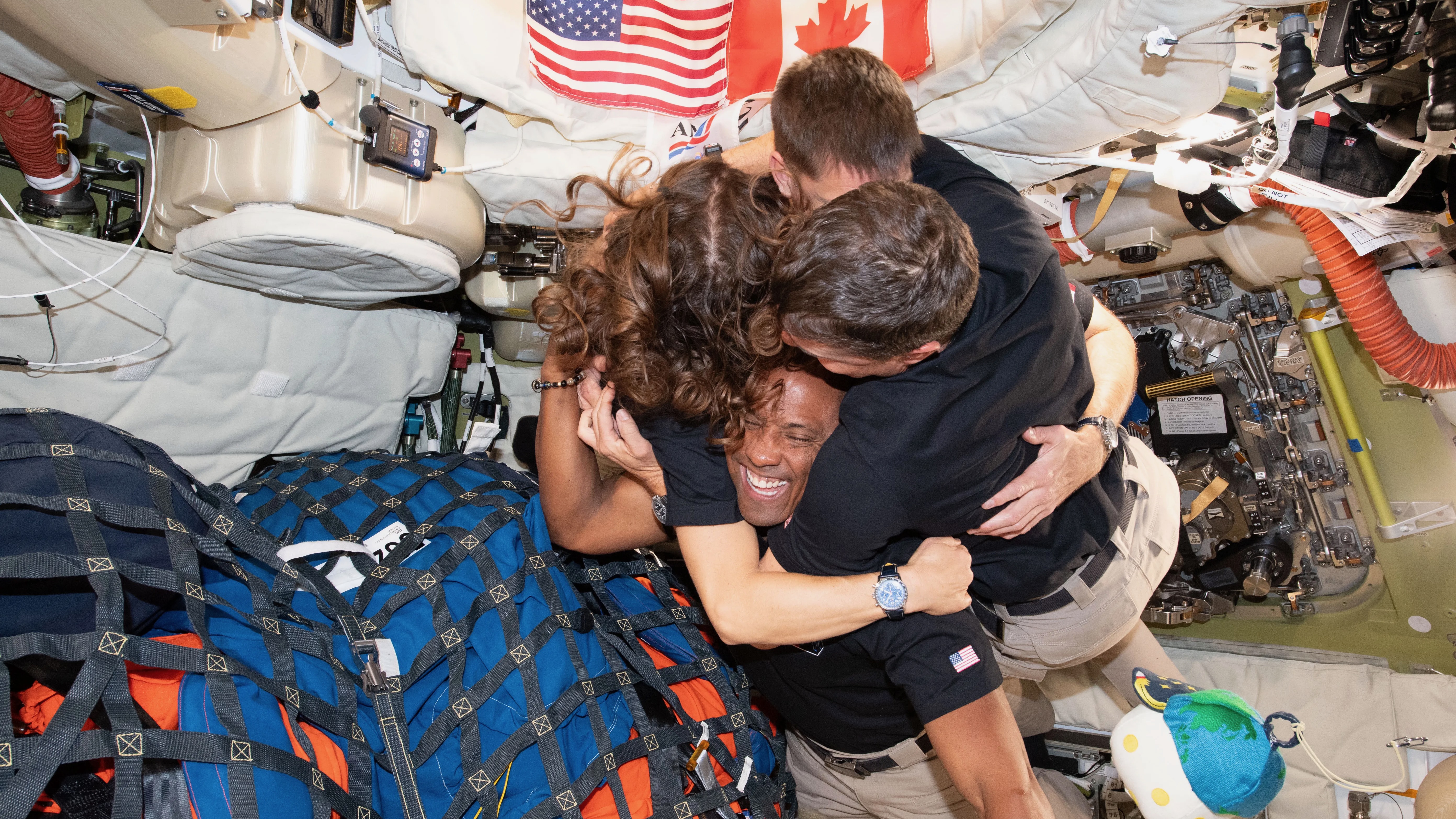
From left: The Artemis II crew — NASA astronaut Christina Koch, Canadian Space Agency astronaut Jeremy Hansen, and NASA astronauts Reid Wiseman and Victor Glover — take time out for a group hug inside the Orion spacecraft on April 6, 2026. (Image credit: NASA)
Glover, who also retired from the U.S. Navy recently, will now assume a full-time role at his alma mater, California Polytechnic State University in San Luis Obispo, which has aerospace and space programs. The news was announced by the university on Wednesday, but the position took effect on Sept. 1. Glover will be an administrative leader providing advice to senior leadership on education, research and workforce strategies, according to Cal Poly.
"The most meaningful moments of my NASA career were supporting astronauts and their families through missions, and mentoring interns and new hires as they began their own journeys in technical and public service," Glover wrote Wednesday in a post on X about the career change.
Wiseman did not share any specific updates about his career plans on social media. The astronaut also exited active astronaut duty temporarily between 2020 and 2022 when he was chief of the astronaut office for NASA, a role that precludes flying in space as the chief is involved in flight assignments. Wiseman left that role and resumed active astronaut duty before being assigned to Artemis 2, which occurred shortly before the public announcement of the mission's crew in April 2023.
"NASA gave me tremendous responsibility, supported me through two space missions — and my time as chief astronaut — and was always there for my family when we needed it most," Wiseman said in the NASA statement about his career change. "I'm thrilled to continue serving future missions and programs through the emeritus program."
Hansen's Artemis 2 duties officially concluded on Sept. 2, according to his X account, and the astronaut — who has been based out of Houston since 2009 — posted a new video of himself Wednesday walking in the woods in Canada. Hansen said he has retired as a colonel with the Royal Canadian Air Force and is now a reservist working with 3 Canadian Space Division, which is essentially Canada's Space Force.
"The intention of that is to continue to serve Canada and government — the Canadian Space Agency — when it makes sense, to help us take advantage of some of the extraordinary opportunities that are before us right now," Hansen said in the video, adding that he will divulge more details about that work shortly.
Hansen also said he accepted a role as honorary national president with the Canadian military's Air Cadet League of Canada, which the astronaut has often said helped equip him with both flying and leadership skills when Hansen was growing up.
Additionally, Hansen pledged to "continue to share the moon joy" both as an individual and with his crew. For example, he recently joined a Canadian keynote-speakers bureau in which he plans to speak about how to accomplish personal "moonshots." In October, Hansen will also co-release "Earthrise: A Canadian Astronaut's Journey Into Deep Space" (HarperCollins Publishers, 2026) — a book that discusses his career and Artemis 2 — which he co-wrote with Canadian author John Larsen.
NASA's long-distance spacecraft-calling network just got a boost.
The Deep Space Network (DSN), best known for communicating with distant spacecraft such as Voyager 1, Voyager 2 and New Horizons, added a 114-foot (34-meter) radio-frequency antenna in California, boosting capacity on the increasingly crowded network.
More than 40 spacecraft exploring the solar system and interstellar space use DSN, which has struggled to keep pace with growing demand. Communications with the uncrewed Artemis 1 mission in 2022 and the crewed Artemis 2 mission in 2026 took priority as they traveled around the moon, substantially reducing the network's capacity to support other missions.
At least as early as 2021, managers were warning that despite ongoing efforts to add new antennas to DSN, the agency cannot reach all deep-space missions at once.
"We're trying to add capacity and more antennas, but we can't keep up with the demand that's currently out there, so missions should expect to be getting less availability," Brad Arnold, DSN manager at NASA's Jet Propulsion Laboratory (JPL), said during a presentation attended by Space News. Arnold also warned that the Artemis moon program would be "the gorilla in the room," because the astronauts by default have to be prioritized over robotic spacecraft: "That ultimately will affect our ability to service the rest of the missions."
That's because the DSN is designed to serve both human and robotic deep-space spacecraft. While JPL (then under contract to the U.S. Army) had three spacecraft radio-tracking stations in Nigeria, Singapore, and California ready for the early space program in 1958, the DSN with more powerful dishes was established in December 1963 as "the de facto network for missions into deep space," state JPL materials from the 50th anniversary celebration in 2013.
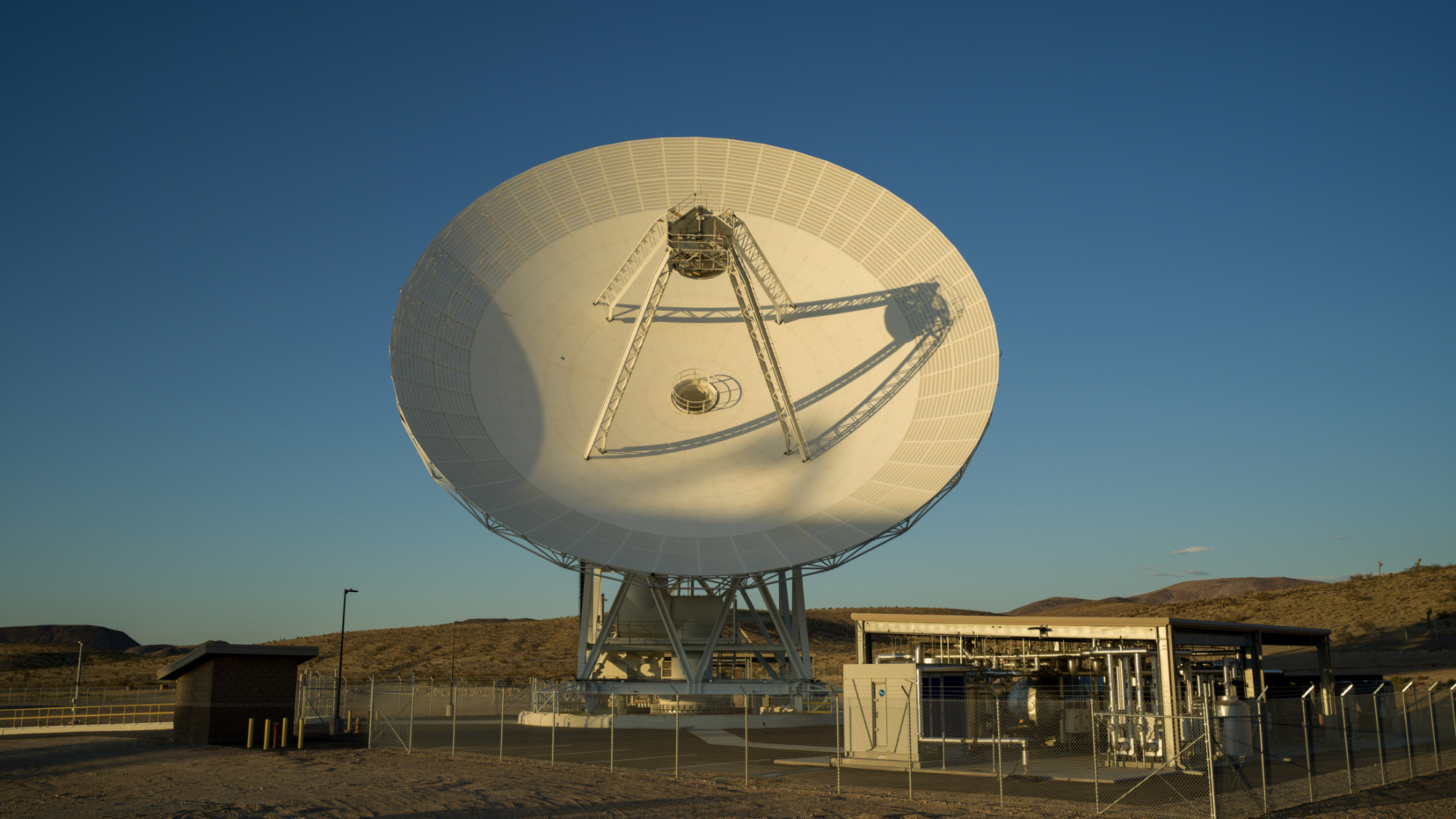
The recently completed Deep Space Station 23 at the Deep Space Network's Goldstone complex near Barstow, California. (Image credit: NASA/JPL-Caltech)
The DSN helped relay communications from Apollo 11's historic moonwalk by NASA astronaut Neil Armstrong's on July 20, 1969, and has since supported countless milestones. This includes images from Mars rovers starting in the 1990s and data showing that both Voyager 1 and Voyager 2 crossed into interstellar space in the 2010s.
These days, Artemis isn't the only extra demand on DSN; other space agencies also use the network for their own spacecraft, to a much greater degree than 50 years ago as space exploration has matured. NASA is also planning a permanent Moon Base near the lunar south pole as soon as the 2030s, although the agency does promise the base will, in its third phase, include "a coordinated lunar network supporting communications across Moon Base assets."
The DSN operates three complexes — at Goldstone in California, near Madrid in Spain and Canberra in Australia — each of which includes a large 230-ft (70m) antenna alongside several smaller dishes. The new antenna is about half that size and is co-located at Goldstone. It came online on Aug. 3, tracking NASA's Chandra X-ray Observatory.
DSS-23 is the fifth of six new 34-meter antennas planned under the DSN's Aperture Enhancement Project, which began in 2009. The project is expected to be completed when the sixth antenna, DSS-33, comes online at the Canberra complex in 2029.
The expansion has also taken longer and cost more than originally planned. A 2015 NASA Office of Inspector General report estimated the project at $362.4 million, but by the start of fiscal year 2023, expected costs had risen by 68% to $706 million and the project was nearly five years behind schedule. NASA now expects the final enhancement antenna to come online in 2029.