Early morning risers heading to work or school before sunrise are likely to notice a very bright, star-like object appearing low in the east-southeast sky just before sunrise. What is somewhat amazing is that just a couple of weeks ago this object wasn't there at all, but now it literally stands out with such brilliance as to almost command the attention of commuters who might be traveling in an easterly direction to "Look at me!"
The object in question is, of course, the planet Venus, which is currently amid one of its most spectacular forays into the morning sky, literally "vaulting up" into prominence.
On Oct. 24, Venus came to inferior conjunction, passing between the Earth and sun and shifting from the evening into the morning sky. And the view is only going to get better in the days and weeks to come!
Ascending in the morning
In terms of morning visibility, Venus is now in a literal and figurative sense "rising to the occasion." It's now rising before the break of dawn, more than 90 minutes before sunrise. From here on, it will rise three minutes earlier each day, so that by Dec. 17 it will rise 3 hours and 50 minutes before sunrise and blaze in a completely dark sky for more than two hours before the first vestige of morning twilight.
It will reach peak brilliance on Nov. 29, when it will shine at an eye-popping magnitude of -4.9. That's 12 times brighter than its nearest planetary competitor, Jupiter and a full 25 times more dazzling than Sirius, the brightest of all stars. If you live in a rural location with no light pollution to interfere, you might be able to make out that it is casting a visible shadow and if you follow it right on through sunrise, it will be evident to your naked eye in full daylight: a tiny white speck plainly evident against the blue daytime sky.
In a way, we could even regard Venus as this year's version of a "Christmas Star," glowing with stunning radiance ". . . in the east" like the biblical quote mentioned in St. Matthew.
What goes up, must come down
After reaching its high point in terms of morning visibility in mid-December, Venus will start a long, slow slide back toward the sun, rising about 1½ minutes later each morning from New Year's Day through late March. By then, Venus will be coming up as dawn is breaking, roughly 100 minutes before sunrise. Venus will continue to get gradually lower and rise progressively later during the spring and by late June it will be coming up less than an hour before sunrise, ultimately vanishing into the bright dawn twilight by July. Venus will then go on a "summer sabbatical" of sorts and will not reappear again until about this time next year when it will begin a very fine evening apparition.
So, if any of your friends or relatives remark to you that they saw a "strange UFO" on the way to work or school recently, you now can set them straight.
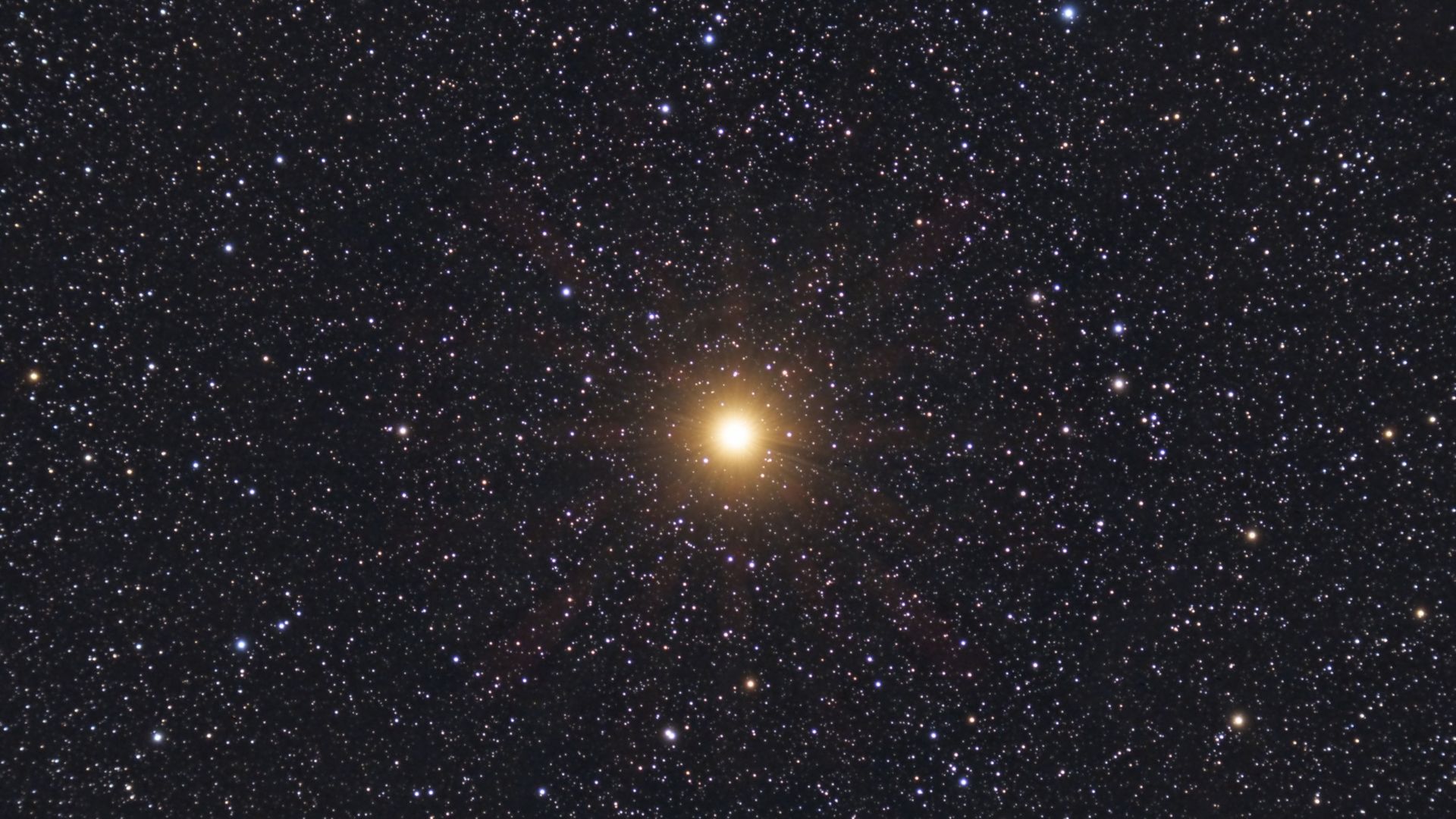
Betelguese, one of the brightest stars in the night sky, has been putting on quite a show lately — but not in the way you might expect.
The famous red supergiant in the constellation Orion has been growing noticeably fainter in recent months.
Of the 21 brightest stars in the night sky, Betelgeuse is perhaps the most enigmatic. Its changing brightness poses a puzzle: how do the star's pulsations, dust eruptions, and a possible companion contribute to its fading?
A giant star with a puzzling name
Even the translation of Betelgeuse's name is contentious. For a long time, it was thought to be a corruption of three Arabic words, usually translated as "The Armpit of the Giant." However, other experts in star nomenclature now dispute that interpretation, proposing instead "The Hand of al-Jauzā," with al-Jauzā referring to Orion.
Although classified as a red supergiant, Betelgeuse usually appears more orange than red— golden orange or deep topaz. It is one of the most famous stars in its class. Henry M. Neely (1877-1963), for many years a popular lecturer at New York's Hayden Planetarium, described its restless behavior in his book A Primer for Stargazers:
"(Betelgeuse) expands and contracts spasmodically, like an old man with his strength almost entirely spent, panting in the asthmatic decrepitude of old age."
The rhythms of a changing star
Betelgeuse naturally expands and contracts like a beating heart. As an aging red supergiant, it has a regular pulsation cycle of roughly 430 days: when it expands, its outer layers cool and it dims; when it contracts, they heat up and it brightens. Among first-magnitude stars — the brightest category of stars in the night sky — it is the only marked variable. Its scale is equally remarkable: located 650 light-years away, Betelgeuse is among the largest and most luminous stars of its class, with a luminosity of about 14,000 suns at maximum and 7,600 suns at minimum. Only a few such objects have been identified in our galaxy.
British astronomer Sir John Herschel (1792-1871) first noticed Betelgeuse's variability beginning in 1836. Astronomers describe apparent brightness using magnitude: lower numbers mean brighter stars. In April 2023, Betelgeuse reached magnitude 0.0 — as bright as Vega, the fifth brightest star. At minimum brightness, such as in 1927 and 1941, its magnitude may fall to +1.2, making it appear about three times fainter.
Three threads run through this mystery: Betelgeuse's roughly 430-day pulsation, its much longer recurring dimming cycle, and the exceptional Great Dimming of 2019—2020. Keeping them, separate helps explain why one cause need not account for every change in brightness.
Betelgeuse shines in the constellation Orion. (Image credit: Franco Tognarini via Getty Images)
A longer cycle and a possible companion
Alongside its roughly 430-day pulsation, Betelgeuse shows a mysterious 2,100-day (5.75-year) dimming cycle. Known as a "Long Secondary Period," this longer cycle puzzled astronomers for a century. Some suggested that one or more stars might orbit Betelgeuse; others found no evidence for such companions or actively refuted their existence.
At long last, in January 2026, researchers using the European Southern Observatory's Very Large Telescope (ESO's VLT) located in on Cerro Paranal in the Atacama Desert of northern Chile and NASA's Hubble Space Telescope, published the clearest images and direct evidence of a faint companion star orbiting the red supergiant. Formally named Alpha Ori B, Jared Goldberg, an astrophysicist researching the phenomenon, nicknamed the companion star "Betelbuddy," though in deference to the new definition of Betelgeuse's name meaning "the hand of al-Jawzā," the name Siwarha was ultimately chosen for the probable companion star, which means her bracelet in Arabic.
In this explanation, Siwarha orbits deep within Betelgeuse's outer chromosphere, a layer of its atmosphere, circling about every six years. As it moves through gas and dust ejected by the supergiant, its gravity creates a dense wake of gas, with ripples and shockwaves that disrupt stellar winds and mass loss. When the concentrated dust trail passes between Earth and Betelgeuse, it can make the main star appear decidedly dimmer.
Compare Betelgeuse with Aldebaran
Betelgeuse recently experienced another sharp drop in brightness. Since this past August, it has faded from magnitude +0.5 to +0.95 and now appears just a trifle dimmer than the similarly hued orange star Aldebaran in Taurus the Bull. This decline may be another example of the dimming described above, although the brightness change alone does not establish its cause.
Aldebaran can be used as a comparison to Betelgeuse, since they both happen to be in the general vicinity of each other. If you want to make such a determination yourself, keep in mind that Aldebaran currently rises in the east-northeast before 7 p.m. local standard time, followed about 90 minutes later by Betelgeuse, which will emerge from beyond the eastern horizon. By 11:30 p.m., both stars will be well placed for viewing in the east-southeast part of the sky.
Betelgeuse marks Orion's right shoulder. To locate Aldebaran, look for the three bright, evenly spaced stars that form Orion's belt. Draw an imaginary line through the three belt stars and extend it upwards and to the right. Follow that line for about two fists' width at arm's length (roughly 22 degrees) until you hit a sideways, V-shaped cluster of stars known as the Hyades, which forms the face of Taurus. Aldebaran sits right at one end of that V-shape, glowing with a distinct orange-red color as the "angry eye" of the bull charging toward Orion.
View them late tonight; which star appears brighter?
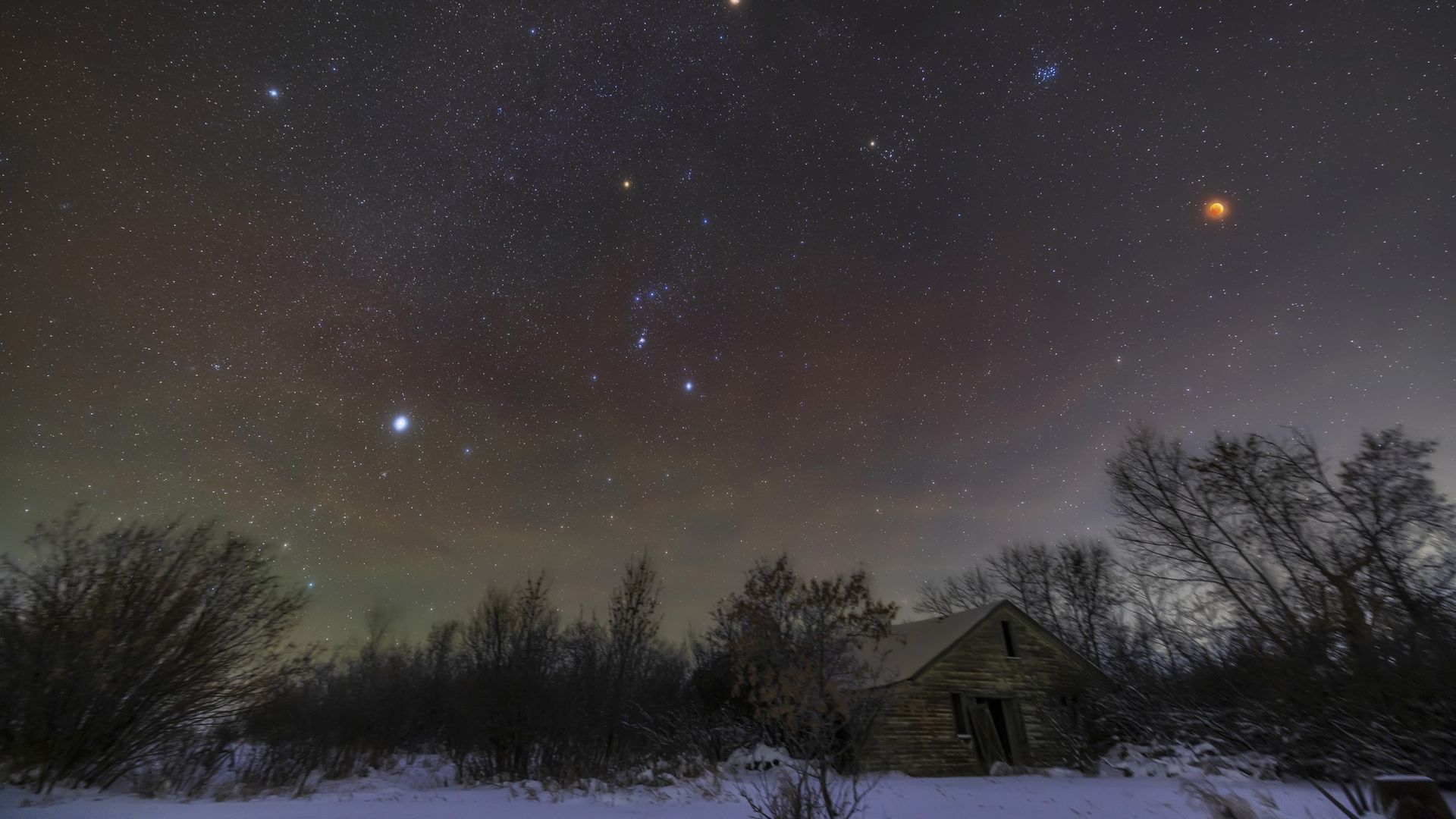
The red supergiant Betelgeuse shines in the constellation Orion, left of center, while the reddish star Aldebaran glows in Taurus, near the Pleiades star cluster, in this view from Alberta, Canada. The image also captures Mars and the red "Blood Moon" during the total lunar eclipse of Nov. 8, 2022. (Image credit: Alan Dyer/Stocktrek Images via Getty Images)
The Great Dimming of 2019—2020
The changes visible now invite comparison with a far more dramatic episode: The Great Dimming Event of 2019—2020.
Between October 2019 and February 2020, Betelgeuse experienced an unprecedented, dramatic plunge in brightness — losing over two-thirds of its luster, falling from magnitude +0.5 to +1.7; the rank of a second magnitude star. It then returned to a more normal brightness, reaching an unusually bright peak of 0.0 by the spring of 2023. While the sudden dimming caused internet and media speculation that Betelgeuse was about to die as a spectacular supernova, infrared structural and chemical models showed no significant change in the star's luminosity; Betelgeuse was still firmly in its helium-burning phase and is expected to live for another 100,000 to perhaps many hundreds of thousands of years before it explodes.
So, what caused The Great Dimming? The mystery was ultimately solved by compiling data from the Hubble Space Telescope and ground observatories.
Apparently, Betelgeuse "sneezed."
A massive bubble of superhot plasma rose from a giant convection cell inside the star and blasted into space. As this ejected gas moved millions of miles away from the star, it cooled rapidly and condensed into solid silicon monoxide dust. This giant stardust cloud acted like a literal screen, blocking a substantial portion of the star's light from our viewpoint. This event was exacerbated because the massive eruption perfectly aligned with the lowest point of the star's 430-day pulsation cycle as well as the orbital interference of the companion star Siwarha.
From the standpoint of producing the absolute maximum possible dimming of Betelgeuse, this cosmic trifecta was the perfect storm!
Untangling the mystery
Betelgeuse has long been known as a variable star, and recent breakthroughs are helping astronomers untangle its erratic behavior. Internal pulsations and massive dust eruptions contribute to its changing brightness, while gravitational interactions with the newly reported, probable companion explain the longer dimming cycle. Together, these mechanisms paint a richer picture of why Orion's giant star fades and brightens.
This is a great month for planet watching, either in the evenings or mornings. During convenient evening hours, the planet of choice is Saturn, visible well up in the southern sky during mid-to-late evening hours. Telescopically, the southern side of its famous ring system is currently tilted about 6½ degrees to our line of sight.
Around the middle of the night, Mars and Jupiter come into view above the east-northeast horizon and just before the break of dawn are in excellent position, soaring high in the southern sky in the vicinity of the Sickle of Leo the Lion. Watch how Mars approaches Jupiter early in the month, passes it on Nov. 16, then spends the rest of the month sailing away to the east.
Meanwhile, in the predawn morning sky, Venus literally vaults into prominence as the month progresses. And from midmonth on through the end of November, Mercury asserts itself, appearing as a very bright "star" to the far lower left of Venus.
In our schedule, remember that when measuring the angular separation between two celestial objects, your clenched fist held at arm's length measures roughly 10 degrees. Here, we present a schedule below which provides some of the best planet viewing times as well directing you as to where to look to see them
Reminder: On Nov. 1 — where applicable — change clocks back one hour from Daylight Saving Time. On this date, the clock hour from 1 to 2:00 a.m. is repeated, thus making this day the longest of the year: 25 hours long. The mnemonic is: "Spring Ahead, Fall Back."
Mercury
Mercury, hidden during inferior conjunction with the sun on Nov. 4, will emerge in the eastern morning sky after the second week of the month to undergo an excellent morning apparition for the Northern Hemisphere. This rocky little world arrives at its greatest western elongation (20 degrees) from the sun on Nov. 20; its most favorable morning apparition of the year for mid-northern observers. From Nov. 16 to Nov. 26 speedy Mercury will rise in the east-southeast before the beginning of astronomical twilight, more than 95 minutes before sunrise.
Venus
Venus is a good reason to be up at the crack of dawn in November; it's a silvery lamp that rises above the east-southeast horizon. Venus was at inferior conjunction on Oct. 24. But the steep angle of the ecliptic at dawn in late autumn helps Venus vault noticeably higher with each passing day for observers at mid-northern latitudes. On Nov. 1, it rises 55 minutes before the sun. But just several days later on Nov. 5, viewers around 40 degrees north latitude can see Venus come up one hour and 25 minutes before the sun and shine 15 degrees above the horizon at sunrise. As November ends, Venus rises nearly 3½ hours before the sun and hangs nearly 35 degrees up at sunrise.
All month Venus brightens impressively and on the penultimate day of the month it will reach the pinnacle of its magnificent brightness, shining at magnitude -4.9, rising almost 3½ hours before the sun. If there's snow on the ground, check for shadows made by Venus's light. Through a telescope, the phase of the planet looks most remarkable early in the month. That's when you may be able to glimpse Venus when it's only a few percent illuminated, a hairline crescent close to an arcminute long; about 1/30 the apparent diameter of the moon. Venus is not alone in the dawn sky.
Its leap takes it up into the proximity of the bluish 1st-magnitude star Spica in Virgo on the morning of Nov. 3. The star will be sitting 2.4 degrees to the upper right of Venus. During this month, Venus seems to perform a dos-à-dos with Spica and at first seems destined to soar up and catch it. Instead, the closest it gets to this star is 1.8 degrees to its upper left early on the morning of Nov. 19.
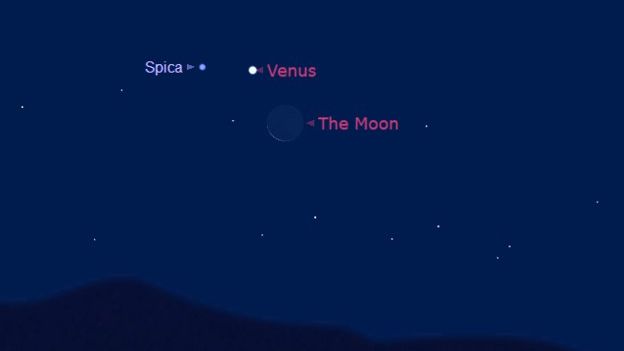
On the morning of Nov. 7, a striking array of a waning crescent moon, brilliant Venus and Spica awaits early risers low in the east-southeast sky about an hour before sunrise. The trio will be bunched together inside of a circle measuring only about 2½ degrees in diameter.
This is a view, low in the east-southeast sky, about 75 minutes before sunrise on Nov. 7, showing a tight gathering of the crescent moon, Venus and the bright star Spica. (Image credit: Joe Rao using Starry Night Pro 8.0.)
Mars
Mars, shining at magnitude +0.9, is in Leo in the morning sky and is easily found on the morning of Nov. 2, using the moon as a guide. That day it sits a couple of degrees to the left of the moon. In addition, on that date, Mars is positioned 5 degrees to the upper right of much brighter Jupiter.
Mars has been hiding in the glare of the sun, or in the dead of the early morning hours, for the last year and a quarter. Now it finally rises in the east before midnight. Each night, watch the orange-yellow planet move a little closer to Jupiter. They'll be in conjunction on Nov. 16 (See Jupiter below).
On the morning of Nov. 26, Mars, having brightened to magnitude +0.6, passes 1.7 degrees to the upper left of the first magnitude star Regulus in Leo. The color contrast between the orange-yellow planet and blue-white star is striking, especially in binoculars.
Jupiter
Jupiter is high enough for a steady telescopic view by 3 a.m. But its dusky cloud belts and Red Spot can be seen more clearly when the planet is highest in the southeast soon after dawn breaks.
On Nov. 3, shortly after 1 a.m. local time, look low toward the east-northeast horizon to watch the moon slowly ascend the sky. The 1st magnitude star Regulus will be evident sitting a degree to the moon's left. And sitting about 5 degrees above the moon will be Jupiter, appearing as a brilliant "star" shining with a steady, silvery light.
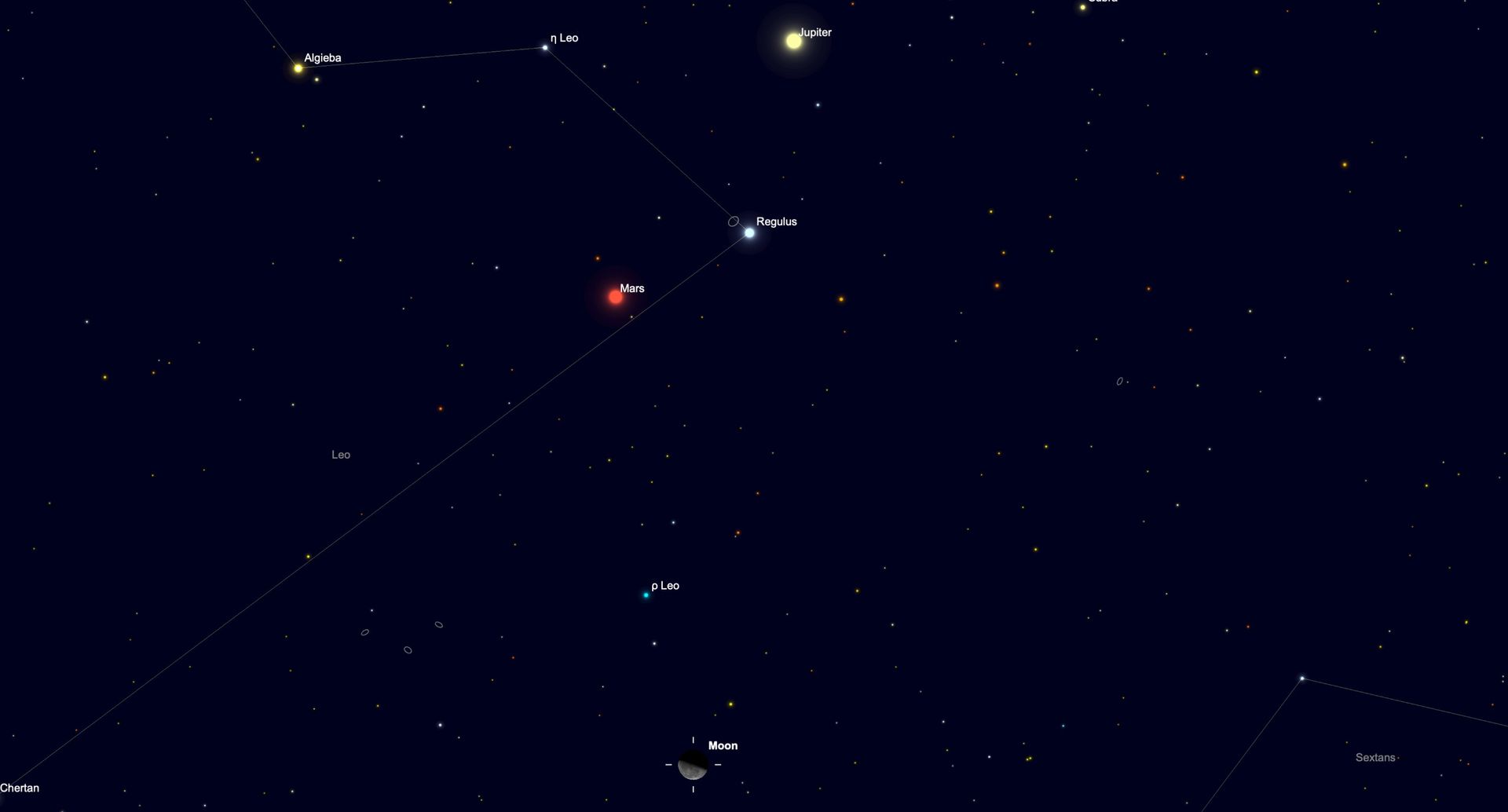
Mars passes 1.2 degrees to the upper left of Jupiter on Nov. 16; the giant planet outshining the red planet 13-fold. Late on Nov. 29 and into the early hours of Nov. 30, look low toward the east-northeast horizon for a gathering of the waning gibbous moon, with Jupiter, Regulus and Mars. These four celestial bodies cover an expanse of roughly 7 degrees going from right to left. Best views will come around the time of the break of dawn when they'll appear to soar high in the southern sky.
Don't miss the planetary gathering of Mars and Jupiter above the moon. (Image credit: Jules-Pierre Malartre/Starry Night )
Saturn
Saturn is situated in the northeast corner of the non-zodiacal constellation of Cetus the Whale (or Sea Monster). It crosses the southern meridian around 9:45 p.m. at the beginning of November and about two hours earlier at the month's end. All evening, it is excellently placed for telescopic viewing of its glorious ball and rings. At magnitude +0.6, Saturn is easily the brightest point of light in its section of the heavens. It can also be told from the stars by its steady, yellowish light.
On the evening of Nov. 18, take note of Saturn mimicking a bright "star" shining about 6 degrees below the waxing gibbous moon.
There could be more than just ghosts and ghouls lurking in the skies this Halloween! From Saturn's spectacular rings to shooting stars and even a space station flyover, the night sky has a few treats of its own in store for U.S. skywatchers on Oct. 31.
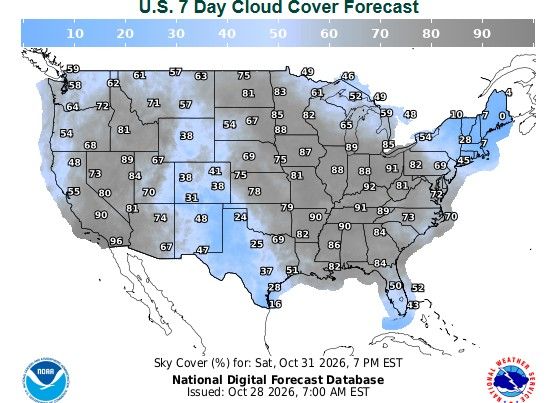
Based on the latest national forecast, skies will be mainly clear on Saturday evening over most of New York State, northeast Pennsylvania, northern New Jersey and New England as well as a swath of the southern and central Great Plains, central Rockies, a portion of the Pacific Northwest and central and south Florida, as costumed kids arrive at the door looking for candy or some other Halloween treat.
Temperatures will be mostly in the chilly 40s across the Northeast US, upper 50s and 60s for the nation's midsection, warm 70s to near 80 for the southern US, including Florida and the Gulf Coast, and 40s for much of the western US. Unfortunately, a storm moving across the nation's heartland may spell rainy skies for parts of Iowa and Nebraska, south to the Gulf Coast.
For those blessed with a generally fair evening, there will be views of mid-autumn stars and constellations plus a bright planet shining prominently in the early evening sky. If you plan to accompany children around your neighborhood, you might want to enlighten them by pointing out some of those objects that will be visible in the sky. Better yet, if you have a telescope, give your visitors a treat of a different kind: Give them a close-up view of some of those celestial sights.
A NOAA map of the contiguous U.S. depicting cloud cover percentages, valid for 7 p.m. EDT on Oct. 31. About 40%of the nation should have clear-to-partly cloudy skies for viewing the evening sky. (Image credit: NOAA/National Weather Service)
At the top of the viewing list: The lord of the rings
At around 7 p.m. local time, tell your young audience to make a clenched fist with their hands and then hold them out at arm's length. Now, tell them to go "two fists" up from the east-southeast horizon and they will see a bright star, shining with a yellow-white hue. Now, direct your telescope toward that "star" and when you gaze through the eyepiece, you will not be looking at a star at all . . . but a planet!
Saturn.
This sixth planet out from the sun, just might be the most beautiful of all. Its rings are still readily evident, although currently they appear somewhat edge-on with the south face tilted only about 6 and a half degrees to our line of sight. A telescope magnifying 30-power will bring them out; they appear to bisect the ball of the planet. While this is far from their appearance compared to other years, the view should still look impressive to those who have never seen the ringed planet for themselves.
And watch out for fireballs!
Because they are active over Halloween, the Taurid meteor shower is sometimes called the "Halloween Fireballs." The bits of debris that make up the Taurids are a little larger than average, so they can result in brighter meteors and even fireballs, or exploding meteors (called bolides), that streak across the sky and leave incandescent trains in their wake. While they are most active during the second week of November, a few forerunners can show up on Halloween night, darting from out of the east-northeast part of the sky. So, if you or your young visitors see something resembling a flare from a Roman candle sweeping majestically across the evening sky, it may very well be a Taurid meteor.
And for those in the Northeast U.S., a space station!
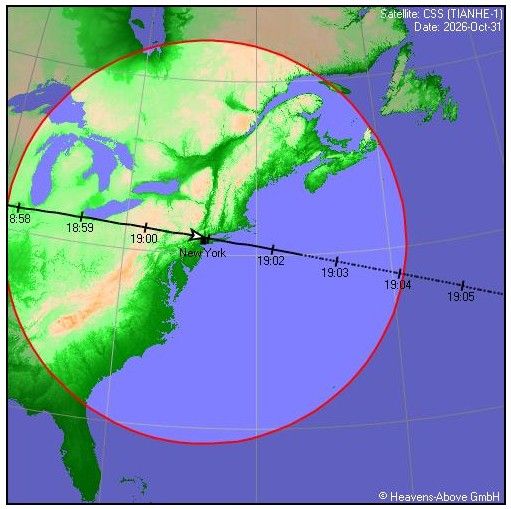
Courtesy of the Heavens-Above.com website is shown the ground track of the Chinese Tianhe-1 module, passing above the Northeast U.S. on Halloween evening. Military time is used. 19:00 = 7 p.m. EDT. This space vehicle will appear as a very bright "star" moving across the sky. (Image credit: Chris Peat, Heavens-Above.com)
Not the International Space Station, but the Tianhe-1 core module, the first module to launch of the Tiangong space station. It was launched into orbit on 29 April 2021, as the first launch of the final phase of the Tiangong program, part of the China Manned Space Program (Project 921).On Halloween evening, Tianhe-1 will be following a track from Chicago to New York at an altitude of 240 miles (385 km) and should be readily visible to the naked eye across the Northeast US within a few minutes of 7 p.m. EDT, wherever skies are reasonably clear.
The Tiangong Space Station should appear to resemble a very bright star moving across the sky on a general west-to-east course. For places near and along the flight path, the Space Station will appear to pass almost directly overhead. For those situated south of the track, Tiangong will reach its highest point above the northern horizon; those situated north of the track will see the station peak high in the south.
If you see it, tell your young viewers that three astronauts are currently living and working aboard the Tiangong Space Station, of which the Tianhe core module serves as the main living quarters. If you would like specific details on when and where to see the Space Station from your hometown, check out Heavens-Above, a non-profit website and mobile application that tracks satellites, the International Space Station (ISS), comets, and astronomical events in real time.
Another website that provides live information, including an orbit map on Tianhe-1, is NY2O.com. Check its menu list on the right side of the page and look for the blue box: "10-Day Predictions for CSS (Tianhe-1)."
Helpful hints for young telescope viewers
In the September 2019 issue of The Astronomical League Magazine "Reflector," author Richard W. Schmude Jr., offered some tips for those who plan to do public outreach for astronomy on Halloween:
"Firstly, children sometimes grab or touch the eyepiece, so use an inexpensive one. I gently warn children not to touch the telescope. In my area, parents have learned to tell their children not to touch the telescope. In some cases, a child will grab the eyepiece, causing the telescope to shift. For this reason, a Dobsonian telescope with a good finderscope is a good choice for Halloween outreach. A small stool or booster ladder may help very small viewers. Sometimes, parents hold their children up to look through the eyepiece. One may also place a monitor-connected video camera in the telescope and people can easily see the object on a screen." "Finally," adds Mr. Schmude, "I have my bag of goodies next to my telescope so that the children get two treats!"
Whatever your weather, Happy Halloween from all of us at Space.com!
If you love watching meteors, 2026 has given you plenty to enjoy. This summer, the annual Perseid meteor shower peaked on the day of a new moon — and a solar eclipse — so moonlight stayed out of the way. And there's more to look forward to: in December, the Geminids, the year's most prolific shower, will peak after a waxing crescent moon sets early in the evening, opening the door to excellent viewing.
Right between those two headline showers, the dependable Orionids take their turn, reaching peak activity around Oct. 21-22.
So, when and where can you catch the show?
When and where to watch
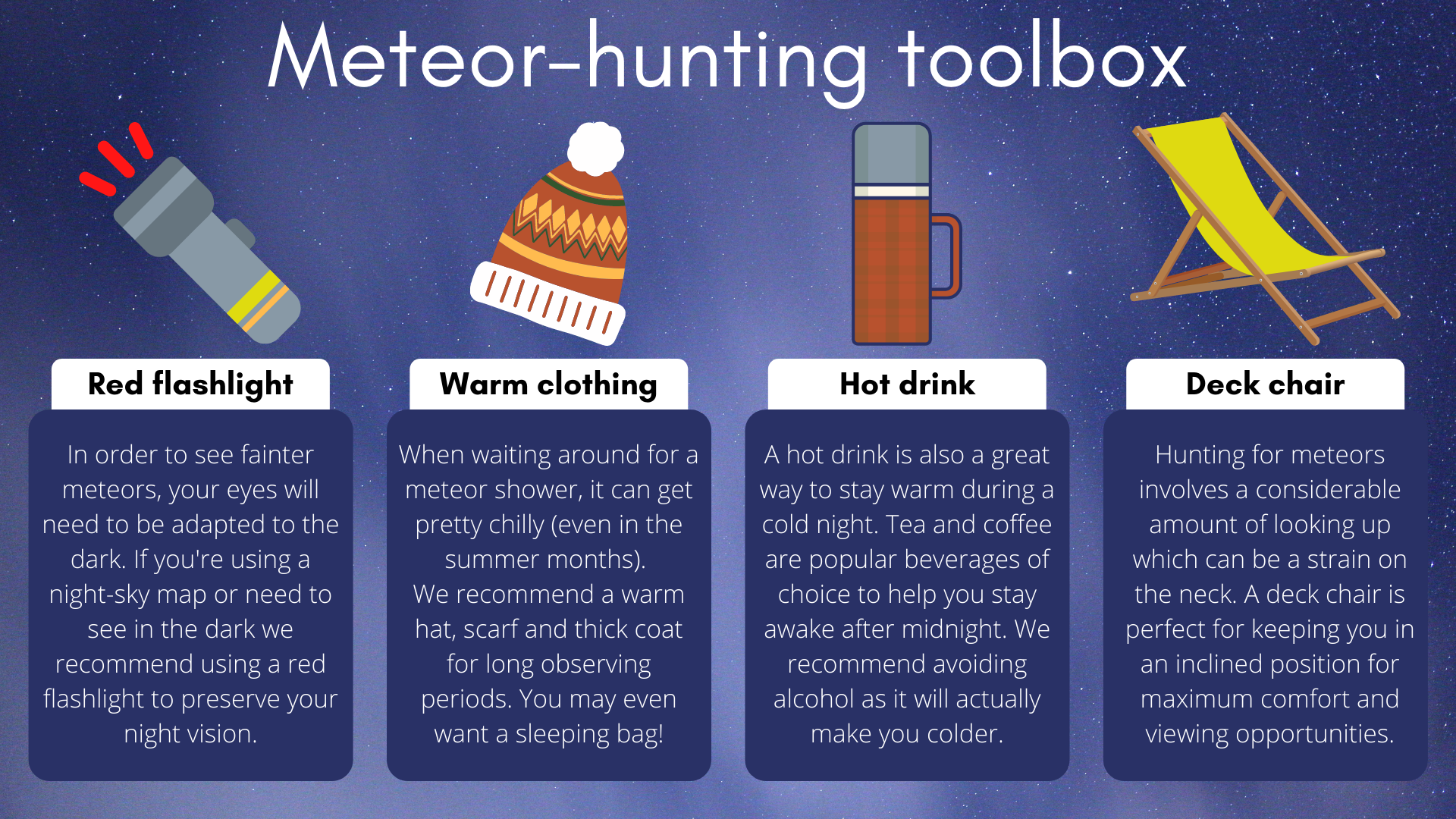
Make sure you wrap up warm for a night of Orionid hunting. (Image credit: Created in Canva by Daisy Dobrijevic)
The Orionids take their name from the spot where they seem to fan out: Orion's raised club, just above and to the left of the reddish star Betelgeuse. Orion is usually a winter favorite, so in early autumn the mighty hunter doesn't fully clear the eastern horizon until after 11 p.m. local daylight time. Don't rush outside just yet though. Wait until around 2 a.m., when Orion is well above the horizon. By about 5 a.m., just before dawn, Orion reaches its highest point in the southern sky — and the view should be at its best.
Orionid meteors tend to be faint, so city lights can easily wash them out. If you can, head to a safe, dark rural spot. Get comfortable in a reclining lawn chair or sleeping bag, give your eyes time to adjust, and enjoy the view overhead and toward the southern sky.
Why the moon won't spoil the show
And what about the moon? A full moon arrives October 25-26, but there's still a welcome stretch of dark sky for several mornings before Wednesday.
By Oct. 21-22, the waxing gibbous moon will be resting among the dim stars of Capricornus, reaching its highest point around 8:45 p.m. local daylight time. Here's the good news: it will set shortly after 2 a.m., leaving roughly 3½ hours of dark sky before dawn. In that window, one observer may spot as many as 15 to 20 Orionids per hour. Because those hours line up with the shower's peak, the moon shouldn't steal the show this year.
Meteoroids are tiny leftovers from a comet's nucleus. As a comet nears the sun, frozen material on its surface turns directly into gas, a process known as sublimation. The comet becomes a kind of cosmic litterbug, sprinkling dust and debris along its orbit. Those pieces are tiny and brittle, with the consistency of cigar ash, and every swing past the sun leaves more behind.
Comets are among the solar system's oldest and most fascinating objects. They formed alongside the sun and planets about 4.6 billion years ago, yet they have changed remarkably little. Think of them as time capsules from the solar system's childhood. Far beyond the outer planets, they spend most of their time in a deep freeze, where temperatures hover just above absolute zero, -459.67°F (-273.15°C). In that extreme cold, chemical reactions largely stop, helping comets preserve material from those earliest days.
Over the past 100,000 years, Halley's Comet has probably circled the sun well over a thousand times, leaving a fresh trail of debris on every visit. Each October and May, Earth brushes close to Halley's orbit. Some of that dust meets our atmosphere at a breathtaking 41 miles (66 km) per second, lighting up as the streaks we call "shooting stars."
The Orionids have another lovely feature: about half of these meteors leave glowing trails that linger longer than those of equally bright meteors. Halley's composition may be the reason. The particles begin burning up about 80 miles (130 km) above Earth, perhaps because they're made of lightweight material from the comet's diffuse surface rather than its core.
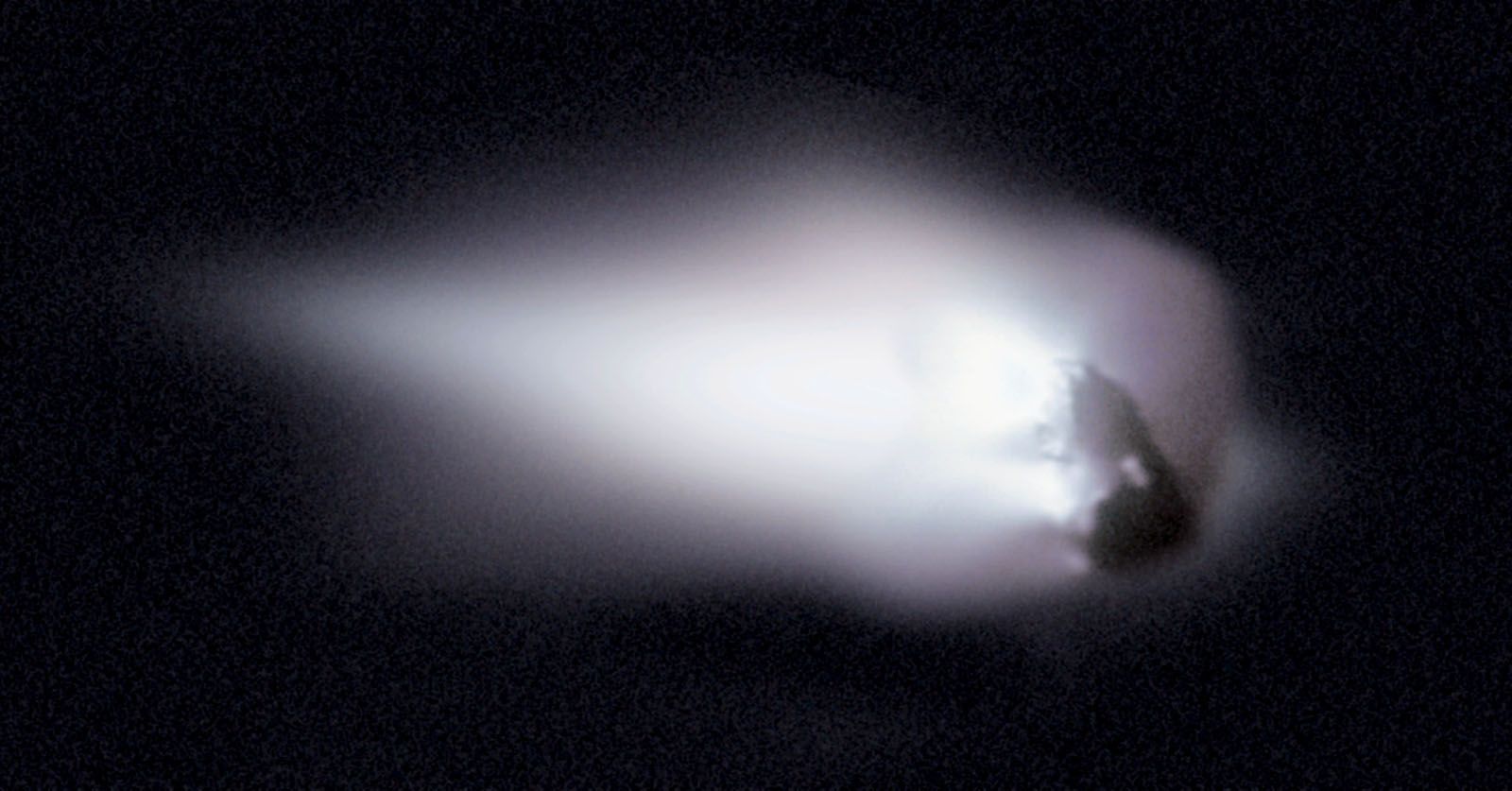
Close-up view of Halley's Comet captured by the Giotto spacecraft in 1986. (Image credit: ESA. Courtesy of MPAe, Lindau)
Looking backward . . . and forward
Perhaps you remember seeing Halley's Comet when it last swept through the inner solar system in late winter and early spring of 1986. With an orbital period of 75.4 years, this celebrated visitor is due back in late July or early August 2061.
For a little perspective, average life expectancy is 79.5 years in the United States, 82.2 years in the United Kingdom, and 83.4 years in Canada. So, if you were born after 1980, there's a fair chance you'll be here to welcome the "mother of all Orionids" home in 2061.
As for me, I saw Halley in 1986 at the "advanced age" of 30. The odds of another reunion are pretty long — you can do the math.
Until then, I'll be more than happy to step outside early on Wednesday morning and greet a few of "Halley's children." I hope you'll join me.
This year, 2026, marks the 40th anniversary of the most recent appearance of Halley's Comet, the most famous comet in the solar system.
Roughly every 76 years, Halley punctuates history like an exclamation mark in the night sky. As writer Guy Ottewell has said, it is the "wildest of the tame comets."
It is a tame comet because it can be anticipated. It is wild because it is still fresh and bright; the brightest of all the recurring comets. It is the only one that periodically becomes conspicuous to the naked eye.
Halley through history
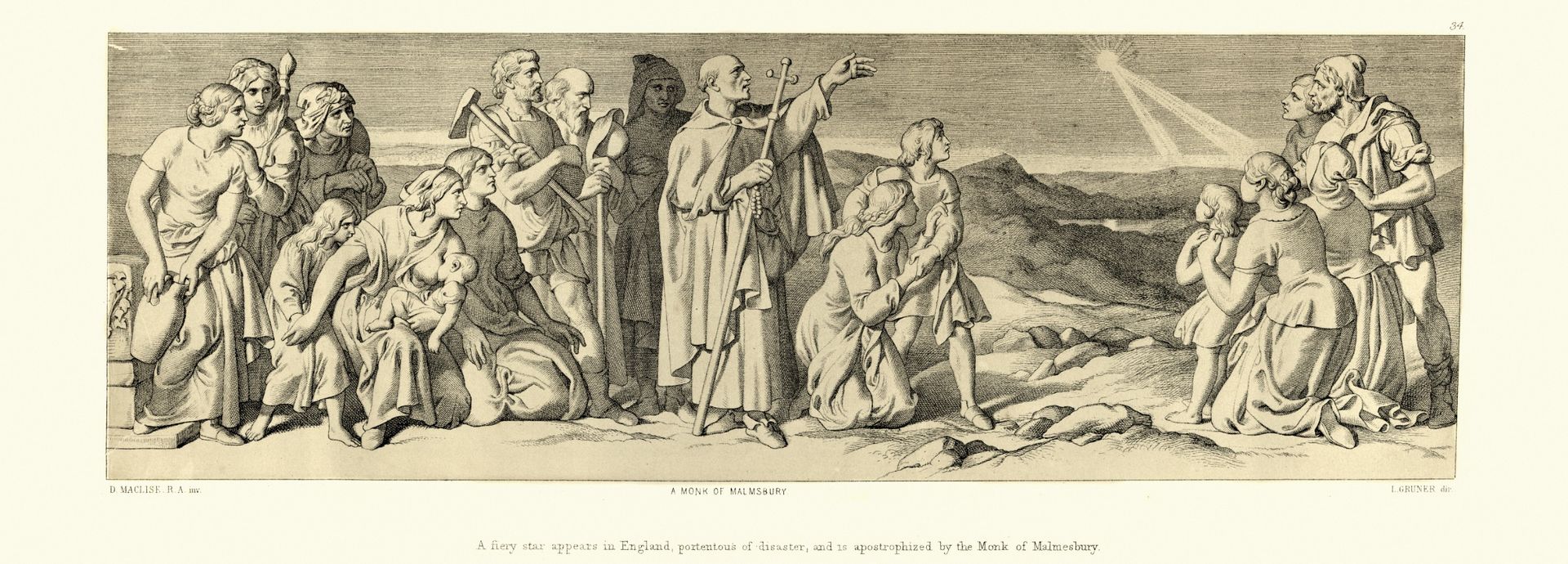
Before 1986, Halley had been seen and recorded on 29 occasions. In A.D. 66, observers described it as a sword in the skies above Jerusalem. In 1066, its image was woven into the strip of linen now known as the Bayeux Tapestry, where an agitated crowd of Saxons points toward a fiery comet we know to be Halley. In 1301, the Florentine painter Giotto di Bondone witnessed the comet and was so impressed that, a few years later, he depicted a comet as the star that led the Magi to Bethlehem in one of his magnificent frescoes in Padua's Scrovegni Chapel.
More recently, Halley passed unusually close to Earth in 1910. As the 1986 return approached, people who remembered that earlier appearance likely told their children and grandchildren about being awakened before dawn and taken outside to see a huge, ghostly, gleaming object in the sky.
Halley's earlier appearances suggested that each return to the inner solar system might produce a magnificent display. Little wonder, then, that the public expected great things in 1986.
Vintage engraving A fiery star appears in England, portentous of disaster and is apostrophized by the Monk of Malmesbury. (Image credit: Getty Images)
The great disappointment of 1986
Halley's 1986 return therefore became two very different stories: a frustrating spectacle for much of the public and an unprecedented scientific opportunity for astronomers.
But for many who saw it — or tried to — in 1986, Halley is remembered as a tremendous disappointment. Heavily promoted as the most anticipated celestial event of the second half of the 20th century, the comet proved to be an underwhelming sight that belied promises of a spectacle never to be seen again.
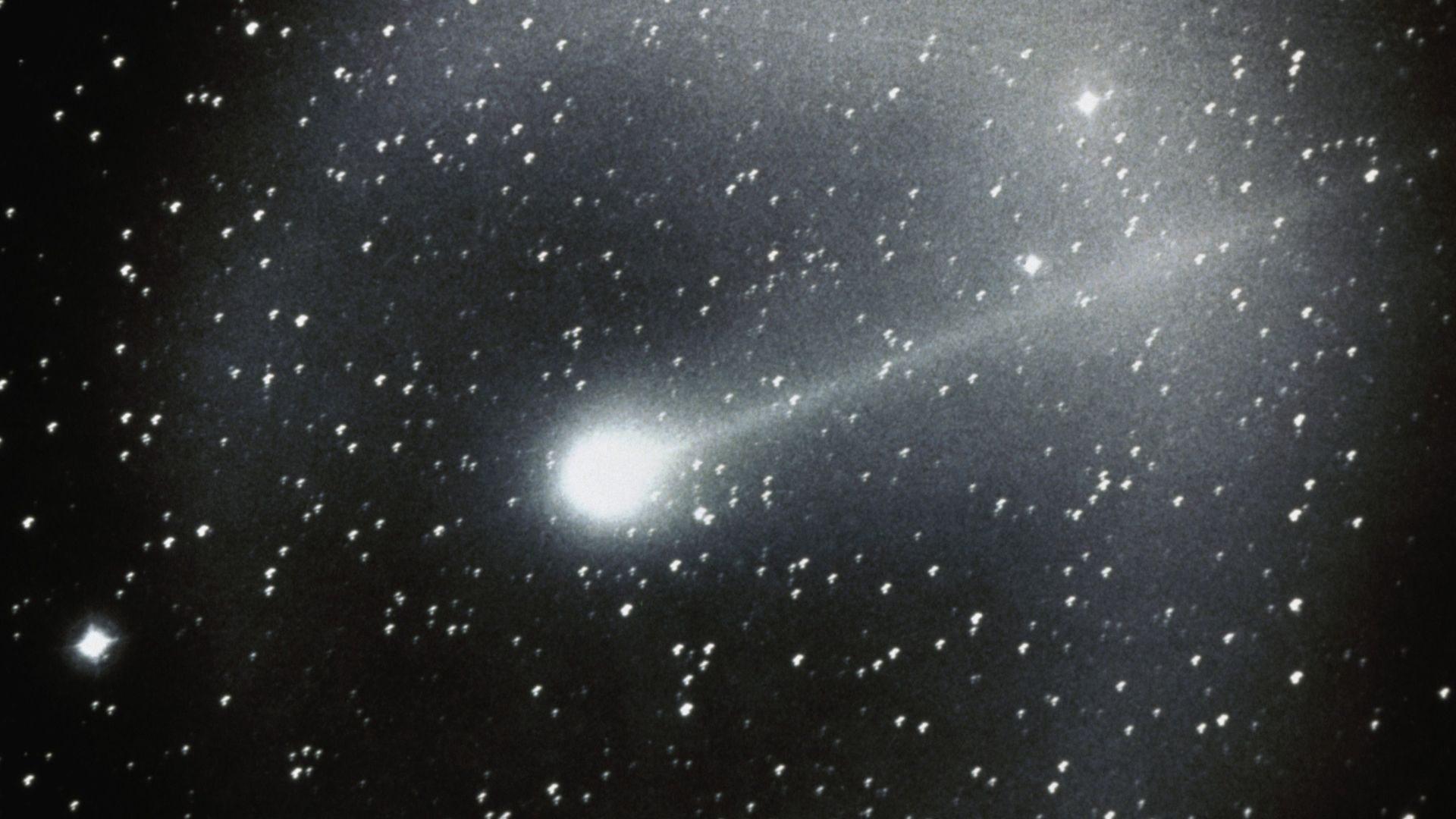
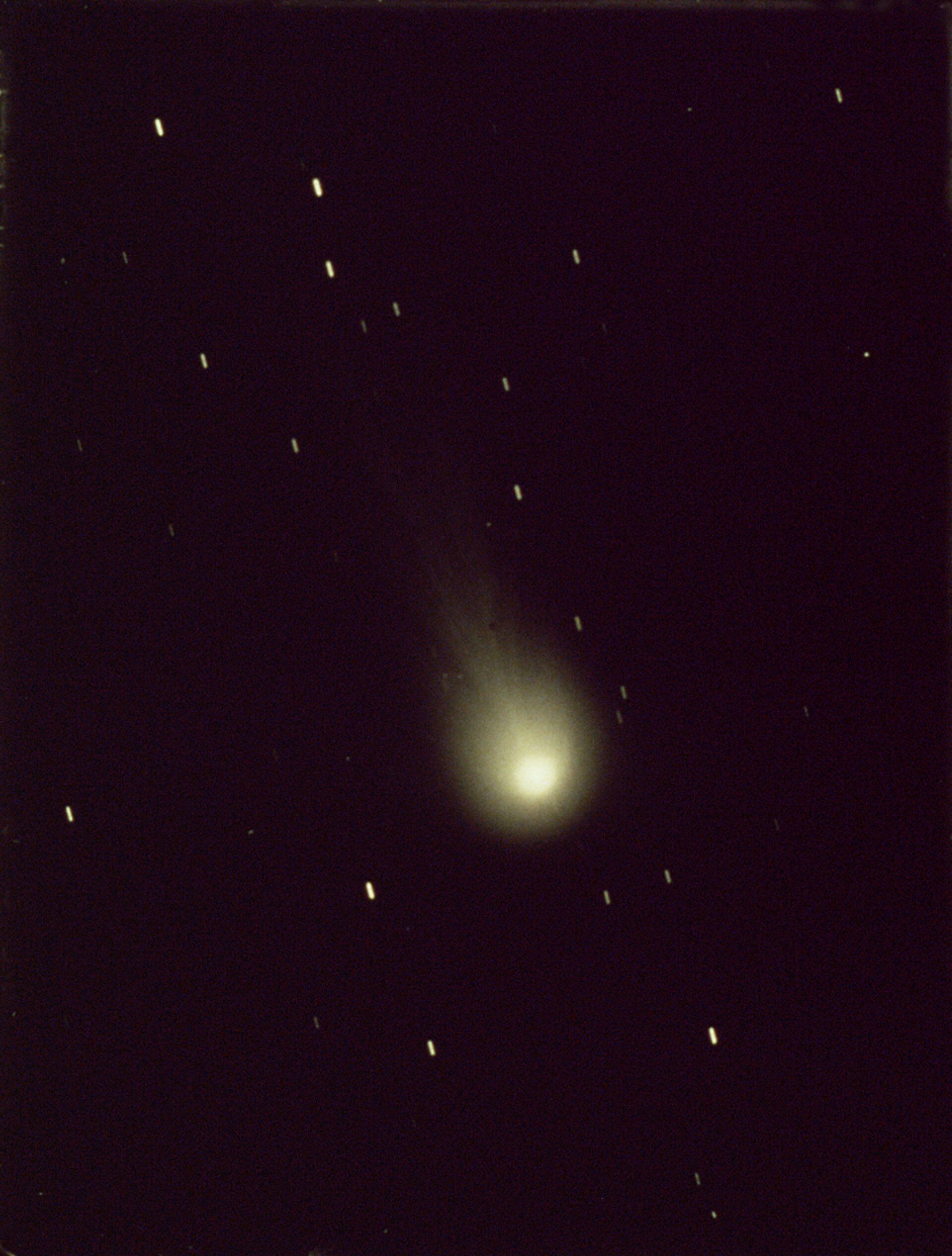
Halley's Comet captured from the Ford Observatory in 1986. (Image credit: Bettmann / Contributor via Getty Images)
In all fairness, Halley's subpar performance was not unexpected. During the mid-1970's, comet experts had warned that the comet would likely disappoint much of the general public. Despite that, the comet's impending arrival was accompanied by a frenzy of T-shirts, commemorative comet medals, bumper stickers, and specially marketed telescopes. Halley logos could be found on warm-up jackets, cocktail glasses, cereal boxes, and just about everything in sight. Caught up in the grip of Halley-mania, the mainstream media emphasized that the comet would be a "once-in-a-lifetime spectacle."
One of the main problems for many trying to see the comet that year was light pollution; the total outdoor illumination in the United States had increased tremendously since Halley's previous visit in 1910. Indeed, in 1986, many of the largest cities were bathed in permanent twilight, with only the brightest stars and planets visible from near city centers and with astronomically unacceptable conditions up to 50 miles (80 km) away.
On the evening of Jan. 11, in New York City, thousands gathered at four city parks to get a view of Halley's Comet. Mayor Ed Koch and Parks Commissioner Henry J. Stern arranged to have the lights turned off at four public parks, where telescopes were set up. The comet itself was not overly impressive, but many were still happy just to get a glimpse of it. As Stern put it: "Those who came for the comet saw the comet — the cynics didn't — but it was there."
When Halley passed through perihelion — its closest point to the sun — on Feb. 9, it lay on the far side of the sun as viewed from Earth and was hidden in the solar glare. During much of March, it brightened only to third magnitude and displayed a tail about a dozen degrees long, merely one-tenth the extent of its 1910 splendor. At the same time, it moved southward through the stars of Sagittarius, Scorpius, and Centaurus. Because those constellations appear low above the southern horizon, the comet was difficult to see from Canada, Europe, and the northern United States.
The 1986 apparition was, in fact, described as the comet's worst in 2,000 years. And as one would expect, the public wasn't impressed. Having read that he'd need binoculars and a star map just to find the comet, taxi driver David A. Gittelman penned a New York Times opinion piece entitled "Who Cares About Halley's Comet Anyway?" In it he wrote:
"I was devastated. How could such an injustice be allowed to prevail? All my life I'd been waiting — all my life. What happened to the cosmic leviathan of my childhood dreams?"
What happened was that at its closest approach to Earth on April 10, Halley was nearly three times farther away than at its minimum distance in 1910. And it had arrived at this point a full two months after perihelion (instead of two weeks as in 1910) — long after its brightest phase had passed. Even those living or traveling to the Southern Hemisphere (as I did), where the comet was well placed, didn't witness a true showstopper. To make matters worse, Halley's tail suddenly ebbed at the beginning of April, leaving behind a small, condensed, nebulous mass with a stubby, fan-shaped appendage.
The leviathan turned out to be a mere tadpole!
A scientific gold mine
Reproduction of original plates of Comet Halley 25 May 1910 (Image credit: ESA)
But while Halley disappointed the public, it proved to be an astronomical gold mine for astronomers. Within three weeks in March 1986, an international armada of spacecraft studied the comet: Japan launched Sakigake and Suisei; the Soviet Union sent VEGA 1 and VEGA 2; NASA contributed the International Cometary Explorer (ICE); and the European Space Agency, then a consortium of 11 countries, launched Giotto.
VEGA 1 and 2 and Giotto plunged deep into Halley's coma — the fuzzy, glowing cloud of gas and dust that surrounds the nucleus when it travels close to the sun — and revealed it to be an active, sputtering mass that responds violently to heating by the sun. Jets of dust were expelled from the nucleus with explosive intensity. And we discovered that the nucleus is encrusted in a dark shroud of its own debris and is as black as coal or velvet. Each VEGA spacecraft came to within about 5,300 miles (8,500 km) of Halley.
Giotto passed within just 375 miles (600 km) of the nucleus. More than 2,000 returned images showed that Halley's nucleus was larger than expected and shaped like a peanut or potato, measuring 9 miles (14 km) long and 5 miles (8 km) wide. The nucleus spins on its longest axis every 7.4 days, while the entire body appears to wobble in half that time. The images also revealed three "active regions," areas where volatile gases and dust escape when sunlight heats the surface. As the comet rotates, fresh ice enters the sunlight and sublimates; the escaping gas then drags entrained dust particles away from the nucleus.
Halley's Comet nucleaus captured by Giotto in 1986. (Image credit: Halley Multicolor Camera Team, Giotto Project, ESA)
So, from this tiny, jet-black, dust-encrusted nucleus came all the ingredients necessary to form the bright comet head and tail that branded it as a historically magnificent and awe-inspiring spectacle.
The spacecraft encounters transformed a disappointing naked-eye apparition into a landmark scientific campaign. Yet Halley's story did not end when the probes passed through its coma.
Surprises beyond 1986
Long after 1986, a receding Halley's Comet showed that it could still provide some surprises. On Feb. 12, 1991, between the orbits of Saturn and Uranus at 1.329 billion miles (2.138 billion km) from the sun, Halley was photographed from the European Southern Observatory in Chile by two Belgian astronomers. They had expected to find the comet appearing as nothing more than a faint speck of light. Instead, it appeared as a monstrous nebula 300 times brighter than expected; a massive outburst.
The cause of the dramatic flare-up remains a mystery. An unknown body may have collided with the comet. Another possibility is that the nucleus released a large amount of latent internal energy, although such a release would be unlikely so far from the sun. Highly energetic particles in the solar wind may also have reached the comet in sufficient numbers to heat its surface.
Halley is expected to return in the summer of 2061, in circumstances that will largely mirror those of 1986 — but with one crucial difference. This time the comet will be fully visible on the same side of the sun as Earth and should appear at least 10 times brighter. In the morning sky, it will reach its northernmost position on July 24. It will then move rapidly southward as it enters the evening sky, gradually favoring more southerly locations. Even so, viewers at mid-northern latitudes should see an eye-catching object low in the west-northwest sky in early August.
And we don't have to wait until 2061 to experience Halley.
Like all comets, Halley's is a cosmic litterbug and, as such, it leaves behind in its wake a trail of — for lack of a better term — garbage, composed of tiny bits and crumbs of space debris that can produce beautiful incandescent trails upon impacting our atmosphere. Because they emanate from the constellation Orion, we call them the Orionid meteors, which will reach their peak on Oct. 21.
In a way, I guess you can call them "rock stars," but eventually, they fall down to Earth.
October offers many North American stargazers an unusually favorable combination: clear, transparent skies, comfortable temperatures, and views of both summer and winter constellations — before cloudier November weather arrives.
Why October skies stand out
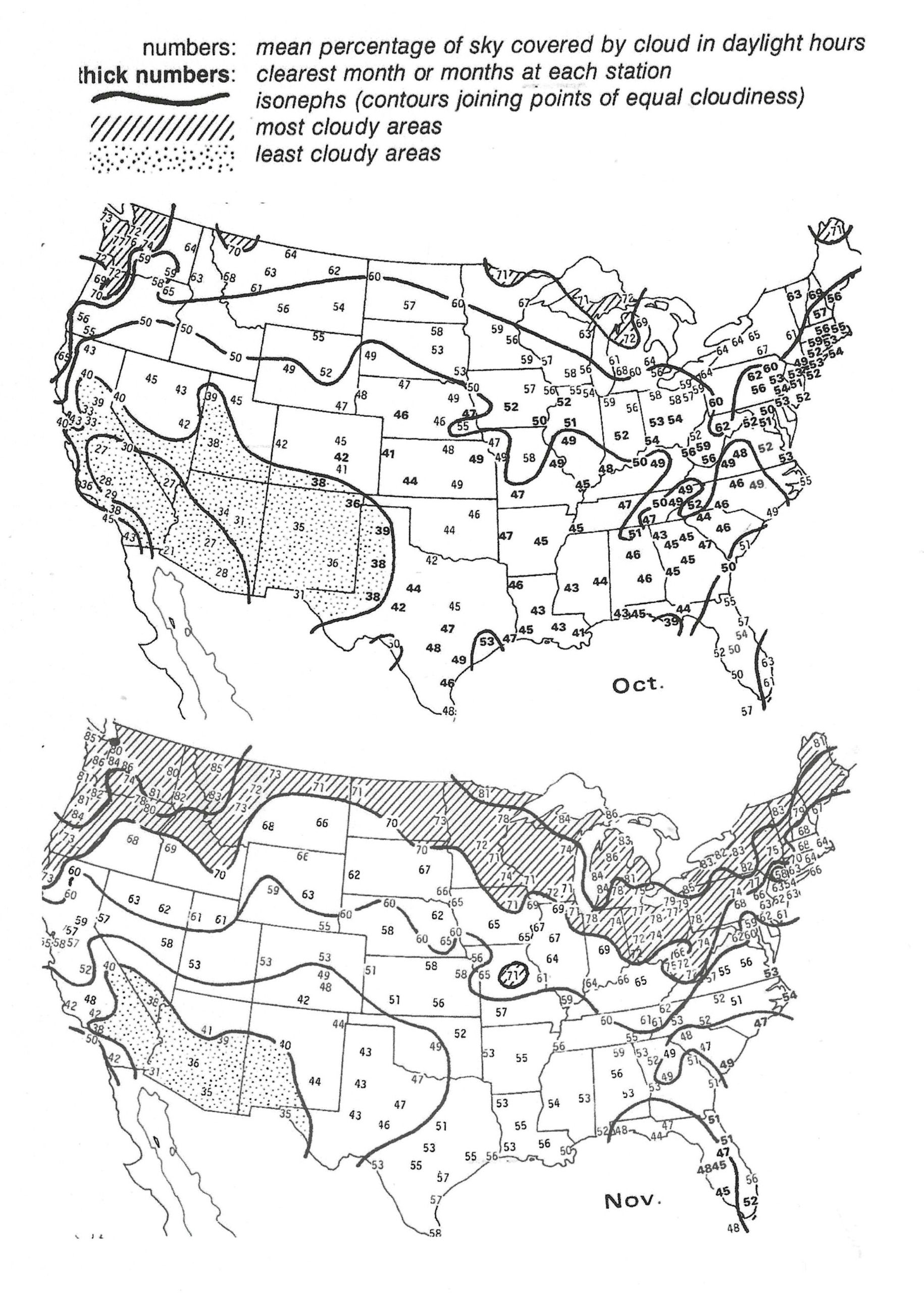
October is the clearest month of the year for many locations in the eastern and central US, based on maps issued by the National Climatic Center in Ashville, North Carolina. But only a month later, in November, sky conditions have dramatically deteriorated for much of Great Lakes, Ohio Valley and Northeast US. (Image credit: Guy Ottewell, The Astronomical Companion. )
What month offers the clearest skies for stargazing? In the Pacific Northwest, the answer is generally July; in the Midwest, August; and across the Great Plains, conditions vary from July through October. The most striking pattern, however, appears across the broad region extending from New England south and west to the Gulf States and Texas, where long-term climatological records identify October as the clearest month by a wide margin. New York City, for example, typically records 12 clear days in October — more than in any other month. Eastern observers can thank high-pressure systems that migrate from the west and tend to stall and spread out near West Virginia during October.
But October offers more than clear skies. Its exceptional transparency can reveal faint stars near the threshold of naked-eye visibility. Strong cold fronts periodically dropping south out of Canada cleanse the atmosphere with showers before their arrival; after they pass, crisp, dry, clean air can bring several days of superb transparency. In contrast to the hazy skies of late summer, October often presents a richer, deeper blue by day and some of the year's finest observing conditions after dark.
October's nighttime temperatures are also relatively comfortable. Some evenings may feel chilly, but they are far more inviting than the near- or subfreezing conditions observers can expect a month or two later.
From summer stars to winter constellations
October is a good month to photograph the Milky Way. (Image credit: Hima Jasti / 500px via Getty Images)
Moreover, October provides the best of both worlds: the summer sky remains on display after sundown, while the approach of dawn offers a preview of winter.
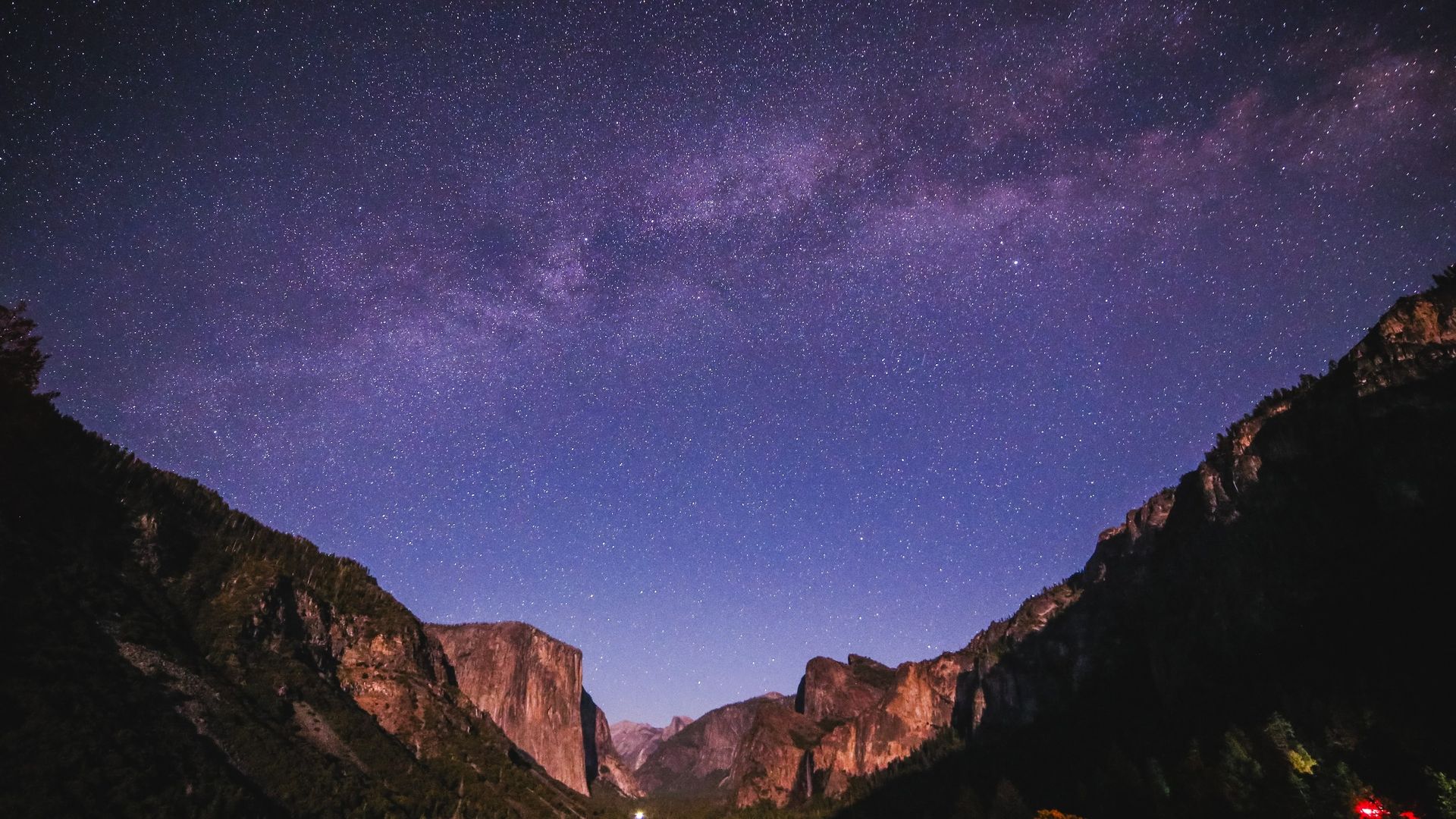
Right after sundown, the summer Milky Way still stretches from nearly overhead toward the southwestern horizon. With binoculars, observers can sweep through the glittering star fields of Cygnus, the Swan, and continue down to the dazzling star clouds surrounding the center of our galaxy in Sagittarius, the Archer.
If you are awake before dawn, you can enjoy a preview of the midwinter sky. Orion, the Hunter, appears with Taurus, the Bull, Gemini, the Twins, blue-white Sirius—the brightest of all stars — and yellow-white Capella, glowing almost directly overhead. Binoculars reveal the beautiful Pleiades and Hyades star clusters, while a telescope can show what many observers consider the sky's showpiece: the Great Orion Nebula, a vast cloud of glowing gas often described in stargazing guides as "one of the most wonderful telescopic objects in the heavens."
When November clouds move in
These views offer ample reason to dust off a telescope and spend time under the October sky. The contrast becomes even clearer when October gives way to November.
The 19th-century English poet Thomas Hood captured the character of November in his poem "November":
No sun - no moon! No morn - no noon - No dawn - no dusk - no proper time of day. No warmth, no cheerfulness, no healthful ease, No comfortable feel in any member - No shade, no shine, no butterflies, no bees, No fruits, no flowers, no leaves, no birds! - November!
Hood's gloomy portrait is literary, but the climatological record supports its central contrast with October.
For stargazers, Hood's words capture a real decline in observing conditions. Across much of North America, clear-sky coverage drops rapidly as October gives way to November, beginning a prolonged period of widespread cloud cover.
According to NOAA's Local Climatological Data for the United States, 98% of weather stations sampled have their cloudiest month fall between November and May.
Put another way, from November through April, roughly 25 to 35 percent of the United States experiences more than 70 percent cloud coverage during various months. In October, by contrast, such conditions are largely confined to small portions of Maine and the Pacific Northwest.
October's atmospheric downside
Even October, however, can occasionally be unkind to stargazers.
Unfortunately, the same cells of fair-weather high pressure that predominate during early fall in the East can sometimes work against stargazers. They tend to produce light winds which, combined with waning solar heating, can create a temperature inversion. A layer of stagnant warm air aloft then acts as a lid over the lower atmosphere, preventing man-made pollutants from dispersing upward and allowing smog to thicken during the late-night and early-morning hours. Just such an October weather pattern occurred 61 years ago, obscuring predawn views of the spectacular Comet Ikeya-Seki for most observers east of the Mississippi — an ironic fate for the most brilliant comet of the 20th century.
On clear September evenings, I often find myself looking up just after dusk, expecting the sky to feel a little less like summer. Yet there, still commanding the overhead darkness, are Vega,Altair, and Deneb — the three brilliant stars of the famous Summer Triangle.
Their familiar pattern can make the season feel as though it is lingering above us, even as cooler nights and earlier sunsets suggest otherwise. In fact, even as late as mid-November, the Triangle is still nearly overhead soon after sunset at dusk. That contrast raises a simple but intriguing question: if this bright celestial landmark remains so prominent well into autumn, why do we still call it the Summer Triangle?
Why not simply call it the Autumn Triangle?
Why it belongs to summer
The answer lies not in the calendar, but in how the Triangle moves across the sky over the course of a summer night. The chief reason is that, at this time of year, the Triangle does not remain visible all night. By dawn, it has begun to drop beyond the west-northwest horizon. During summer, by contrast, it remains with us from dusk until dawn: already evident in the east-northeast at nightfall, near overhead around the middle of the night, and descending in the west-northwest as daybreak approaches.
A matter of distance and brightness
The stars that compose the Triangle — Vega, Altair, and Deneb — lie at very unequal distances from us, so their apparent brightness can give a misleading impression of their true luminosity.
The closest of the three is Altair, 16.7 light-years away, followed by Vega at 25 light-years. Deneb, however, is vastly farther off, at roughly 1,600 light-years, though various sources place it between 1,400 and 2,600 light-years. Even though we see Deneb by light that may have begun its journey during the last days of the Roman Empire, it still shines at first magnitude (+1.3, to be exact) because it is a brilliant blue supergiant, at least 55,000 times brighter than the sun.
But their apparent superiority is largely a consequence of distance: Vega and Altair are only a few dozen light-years away, while Deneb lies well over a thousand light-years from Earth. Compared with the stellar lighthouse of Deneb, Vega and Altair are, comparatively speaking, penlight flashlights.
How to say "Vega"
Before continuing with this discussion about the Summer Triangle, it is worth pausing briefly on the pronunciation of Vega, a point that became especially noticeable after the 1997 science fiction drama Contact. Based on Carl Sagan's 1985 novel, the film follows astronomer Dr. Ellie Arroway, played by actress Jodie Foster, as she discovers a radio signal from Vega containing a sequence of prime numbers.
Throughout the film, the star is pronounced "Vey-gah," perhaps echoing Chevrolet's Vega, the subcompact automobile sold in the 1970s. Astronomers, however, generally use a different pronunciation.
The traditional astronomical pronunciationis Vē-ga, with the stress on the first syllable. In professional astronomical usage, Dr. Arroway and her colleagues would almost certainly have said "Vee-ga," not "Vey-gah." George Lovi (1939—1993), who was widely respected for his knowledge of star nomenclature, often reminded audiences that "Vee-ga is a star and Vey-gah is a car."
Who named the Summer Triangle?
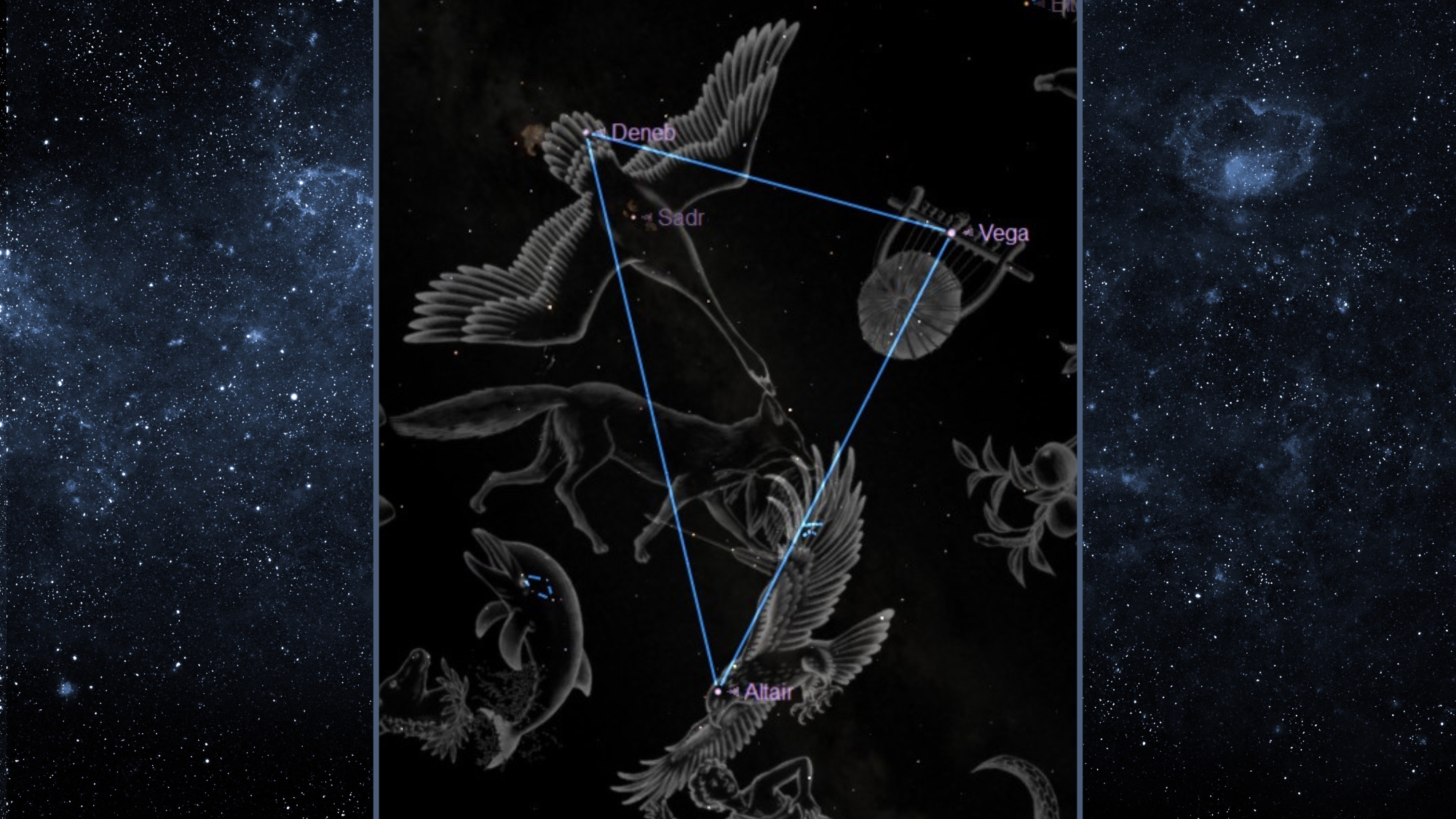
The Summer Triangle and the allegorical figures (Cygnus, Lyra and Aquila) attributed to the three constellations it belongs to, at around 9 p.m. in mid-September. (Image credit: Starry Night Pro 8.0, background added in Canva Pro.)
There has long been debate over who first christened the bright stellar trio of Vega, Deneb, and Altair as the Summer Triangle. Some credit the legendary British astronomer Sir Patrick Moore (1923—2012), who wrote, "During a 1958 television broadcast on the BBC, I introduced the nickname of the Summer Triangle, and everyone now seems to use the term, even though it is completely unofficial." Yet several years earlier, in his 1952 sky guide, The Stars — A New Way to See Them, H.A. Rey (1898—1977) referred to the three stars as a "right triangle," and in his 1954 children's book, Find the Constellations, Rey used the Summer Triangle moniker.
Still others believe the term was popularized through U.S. navigator training manuals during World War II. Interestingly, astronomer Oswald Thomas (1882—1963) described Vega, Altair, and Deneb as "Grosses Dreieck" ("Great Triangle") in the late 1920s and as "Sommerliches Dreieck" ("Summerly Triangle") in 1934.
Today (Sept. 8), skywatchers can first catch a striking predawn pairing of the crescent moon and Jupiter, then — where conditions and location allow — attempt the much harder daytime occultation, when the moon hides the planet from view.
Before sunrise: Find the moon and Jupiter
Set your alarm for 5 a.m. local time on Tuesday and look low toward the east-northeast sky. Check in advance for tall obstructions that could block your view of this delicate predawn tableau. A slender waning crescent moon — just under 10% illuminated and resembling a "celestial smile" — will be immediately apparent. About 5 degrees below it, roughly half the width of your clenched fist held at arm's length, will be brilliant Jupiter.
Jupiter rises in the east-northeast shortly before 4 a.m. local daylight time, but it does not climb fairly high until just before dawn's first light. The planet is in the dim zodiacal constellation Cancer; one of my astronomy mentors at New York's Hayden Planetarium, Dr. Ken Franklin, used to call Cancer "the empty space between the Sickle of Leo and the Gemini Twins." If you set up a telescope before dawn, you can be among the first to see what became of Jupiter's tumultuous cloud belts while the planet was hidden in the sun's glare from early July through mid-August.
Later in the day: The daytime occultation
Another moon-Jupiter show awaits later in the day: a daytime occultation, when the thin waning crescent moon will hide Jupiter from much of North America. Unfortunately, a swath of the western United States — anywhere west and south of a line running roughly from Bellingham, Washington, to Rockport, Texas — falls outside the occultation's visibility zone.
The occultation occurs during the afternoon, when the moon and Jupiter will appear somewhat lower than the sun and well off to its right. Jupiter will disappear behind the moon's sunlit limb, with the moon taking roughly a minute or more to inch across the giant planet's face. Approximately 50 minutes later (give or take ten minutes), Jupiter will gradually reappear from behind the moon's dark edge.
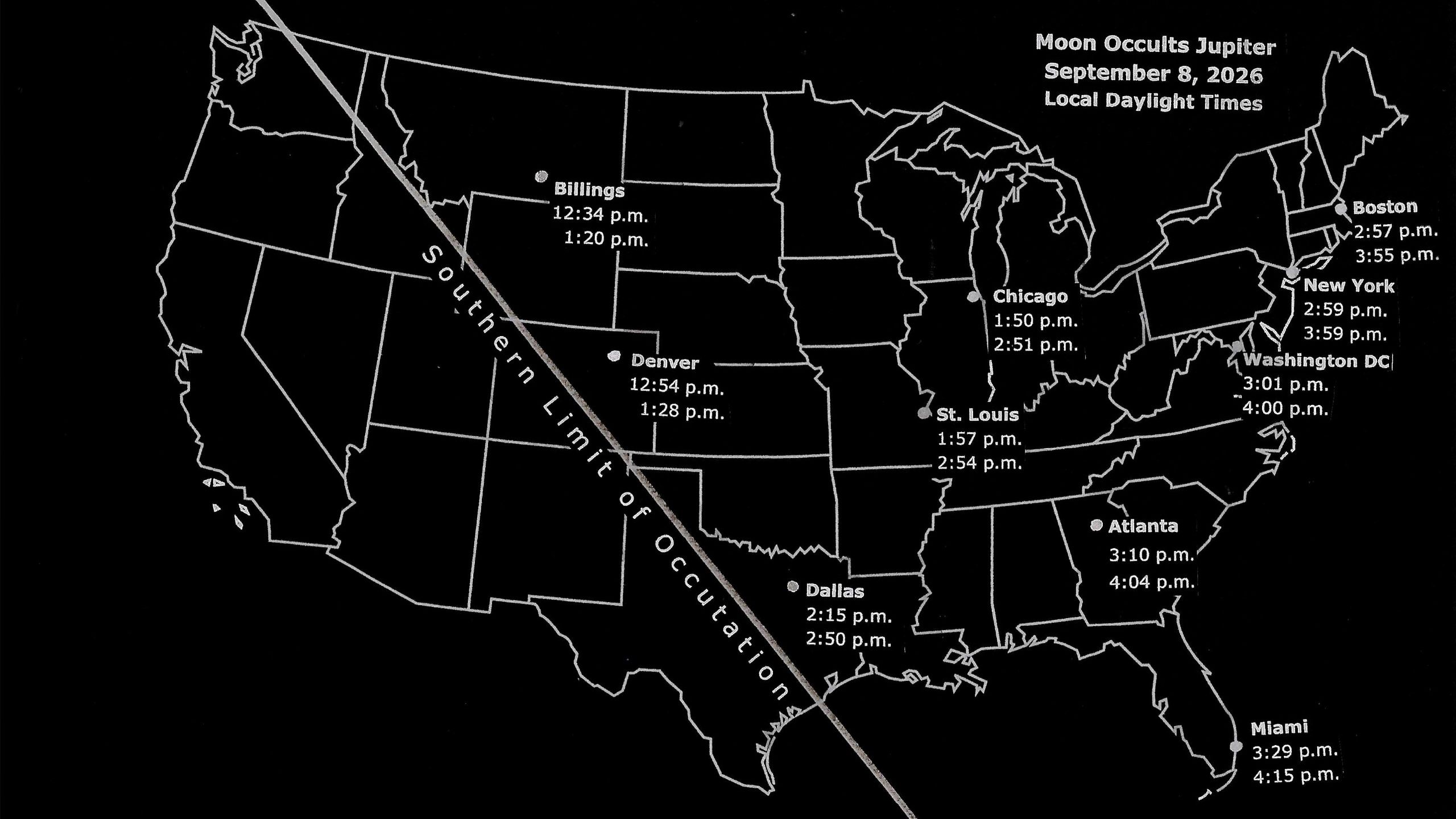
Jupiter will vanish (going from north to south) between 2:55 and 3:30 p.m. for those in the Eastern Time Zone, 1:45 to 2:20 p.m. for the Central Time Zone, and 12:30 to 1:00 p.m. in the Mountain Time Zone.
To find out when these events occur at your location, use the accompanying map. Interpolate between the ten selected cities to find the local daylight time of Jupiter's disappearance (top) and reappearance (bottom) for your site.
(Image credit: Joe Rao)
How to find them in daylight
The chief challenge will be finding the moon and Jupiter at all, so give yourself plenty of time. The easiest method is to locate the pair before sunrise and track them into daylight. Much will depend on the transparency of your local sky — how deep its blue color is. If the day is hazy, the search will be harder.
Start before sunrise, when the crescent moon and Jupiter are easiest to identify.
As daylight strengthens, keep tracking the pair or return to the same region of sky about 30 degrees — roughly four fist-widths at arm's length—from the sun, mostly to the right and, for most locations, somewhat lower.
Sweep the area with a finderscope or binoculars, remembering that the crescent moon's low surface brightness may make it hard to distinguish from the blue sky.
Once you have the moon, the next challenge is Jupiter. In a telescope, it will appear far smaller than the moon — about one-sixtieth of the moon's diameter — and it will have an even lower surface brightness. Watch for Jupiter to return along the moon's dark limb, a captivating sight as the planet seems to emerge literally from out of the blue.
If you miss it
Sighting the moon and Jupiter in daytime will be challenging, so do not despair if you fail to find them. In less than a month, on the morning of Tuesday, Oct. 6, the moon and Jupiter will have another interaction, but this time about eight hours earlier, before sunrise in a dark or twilight sky. That resultant event should be a spectacular sight, easily visible with the naked eye, binoculars, or a telescope. Space.com will provide details as the date approaches, so stay tuned!
Soon, the sky's most glamorous evening performer will take its leave.
Since late March, Venus has been the unmistakable "Evening Star," gleaming shortly after sunset and stealing attention from nearly everything else in the twilight. In June, it helped stage a striking three-planet lineup after sundown, outshining both Jupiter and Mercury.
Now the curtain is beginning to fall: Venus is sinking night by night and will trade its evening role for a morning one before October is over.
A familiar dance around the sun
Venus moves to a remarkably regular beat. Our nearest planetary neighbor circles the sun in an almost perfect path, completing 13 orbits in 8 Earth years. From Earth, that rhythm makes Venus appear to trace five great loops across the sky in the same span. It is a long cycle noticed by skywatchers — and important to the ancient Aztec and Mayan civilizations — and it gives each Venus year its own recognizable personality. In 2026, the pattern closely echoes 2018, differing by only about two days.
Key dates this month
Venus is about to blaze at peak brilliance, but this farewell performance comes with a challenge. All month long, the planet will slide lower in the southwest after sunset, shortening the window for a good view. If the horizon is clear and the weather cooperates, these are the evenings to circle on your skywatching calendar.
Sept. 7: On Labor Day, Venus sets about 1¼ hours after sunset.
Sept. 14: Look low in the west-southwest 30 to 45 minutes after sunset, when a waxing crescent moon appears around 5½ degrees to the left of Venus.
Late September: The planet slips quickly from view, setting just 35 minutes after sundown by month's end.
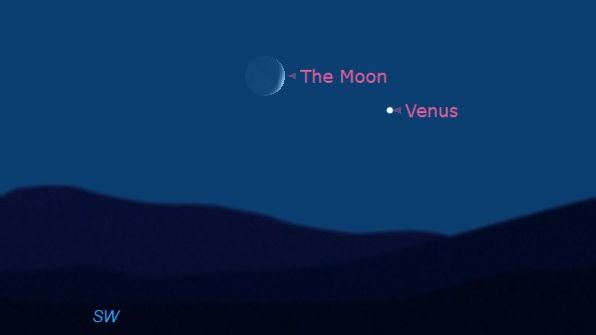
Venus shines near a waxing crescent moon very low in the southwestern sky, 45 minutes after sunset on Sept. 14. (Image credit: Starry Night Pro 8.0)
Why this farewell is so low-key
Ordinarily, the weeks between greatest elongation and greatest brilliancy are prime time for Venus watchers. Not this year. For evening observers, this apparition has been more frustrating than triumphant, with Venus lingering low in the glow of twilight instead of climbing into a commanding position.
The best views came back in June, when Venus lingered until around 11 p.m. Since then, it has been ducking out earlier each night. By Aug. 15, the evening of greatest elongation — when Venus reached its greatest apparent distance east of the sun — it was already setting just as evening twilight faded.
For observers at mid-northern latitudes, the finale is especially low to the horizon. Around 40 degrees north latitude, Venus will stand only about 5½ degrees above the southwest horizon at sunset by the end of September. That is barely more than half the width of your clenched fist held at arm's length — a beautiful but fleeting target in the fading light.
A crescent world in the twilight
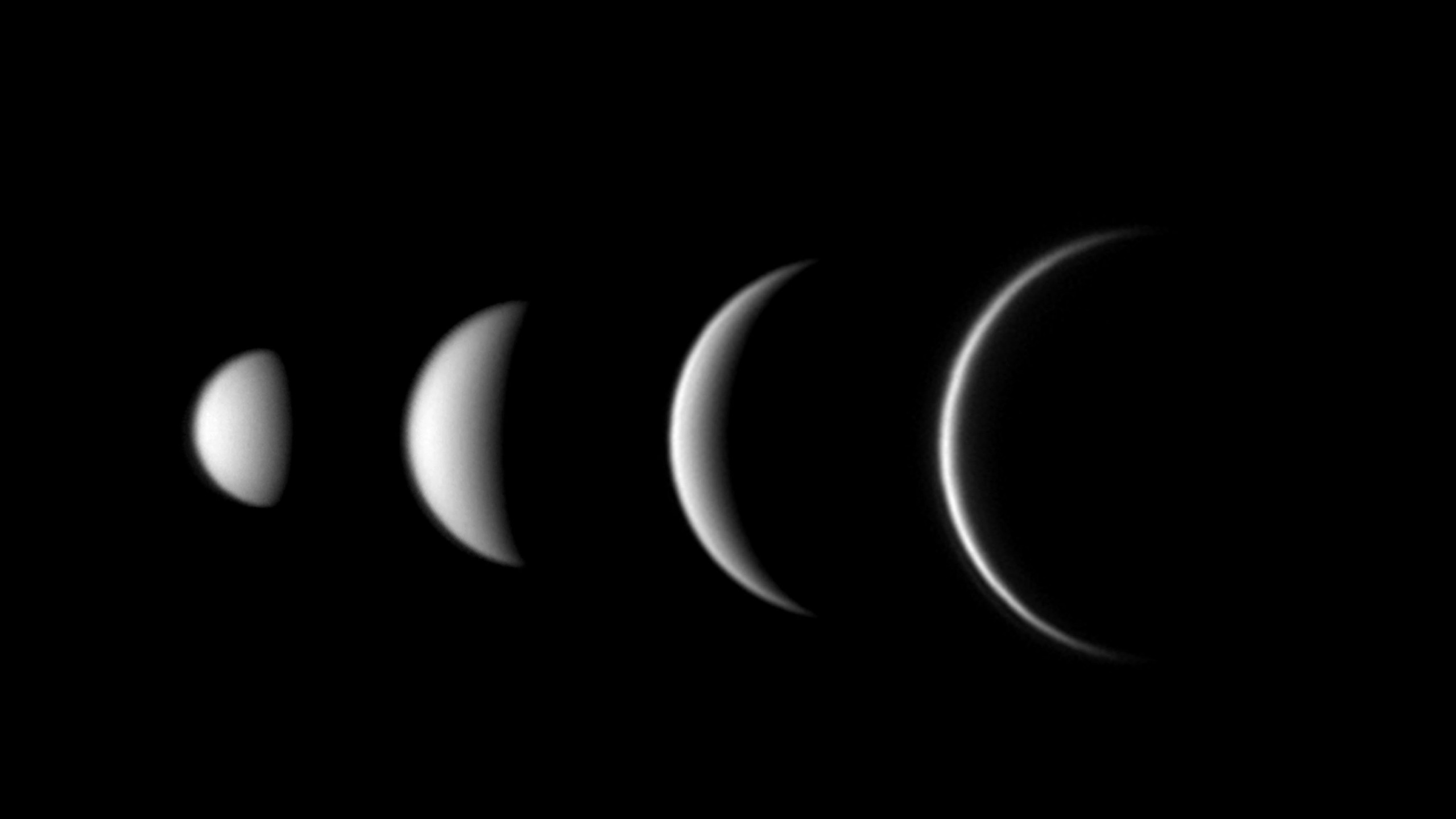
Through a telescope, Venus now shows one of its most striking faces: a narrowing crescent. As its sunlit side turns farther away from Earth, that crescent grows thinner and longer, becoming a delicate arc of brilliant light. With very steady binoculars, you may even glimpse the shape during the next couple of weeks, though the planet's low altitude will make the view shimmer and blur.
Set of images taken in 2004 show the phases and relative size of Venus as seen from Earth as it moves around the Sun. (Image credit: Photograph by Jamie Cooper. (Photo by SSPL/Getty Images))
The morning star returns
By the end of the first week of October, Venus will have slipped from the evening sky altogether. It reaches inferior conjunction on Oct. 24, passing about 6 degrees south of the sun. Around that time, spotting it on nearby evenings or mornings will be extremely difficult.
But Venus never stays away for long. In November, it reappears before dawn, opening a brilliant new morning apparition. By the winter holidays, it will shine high in the eastern sky as a fitting "Christmas Star," rising more than two hours before daybreak — and nearly four hours before the sun.