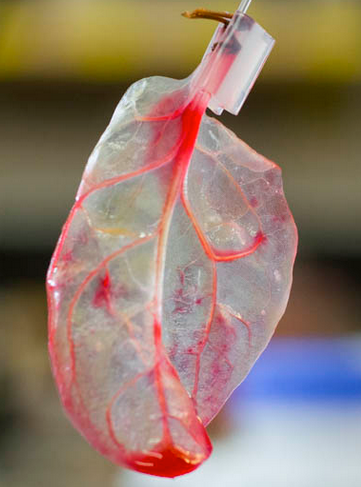
Scientists grow beating heart tissue on spinach leaves

(credit: Worcester Polytechnic Institute)

A research team headed by Worcester Polytechnic Institute (WPI) scientists* has solved a major tissue engineering problem holding back the regeneration of damaged human tissues and organs: how to grow small, delicate blood vessels, which are beyond the capabilities of 3D printing.**

The researchers used plant leaves as scaffolds (structures) in an attempt to create the branching network of blood vessels — down to the capillary scale — required to deliver the oxygen, nutrients, and essential molecules required for proper tissue growth.

In a series of unconventional experiments, the team cultured beating human heart cells on spinach leaves that were stripped of plant cells.*** The researchers first decellularized spinach leaves (removed cells, leaving only the veins) by perfusing (flowing) a detergent solution through the leaves’ veins. What remained was a framework made up primarily of biocompatible cellulose, which is already used in a wide variety of regenerative medicine applications, such as cartilage tissue engineering, bone tissue engineering, and wound healing.
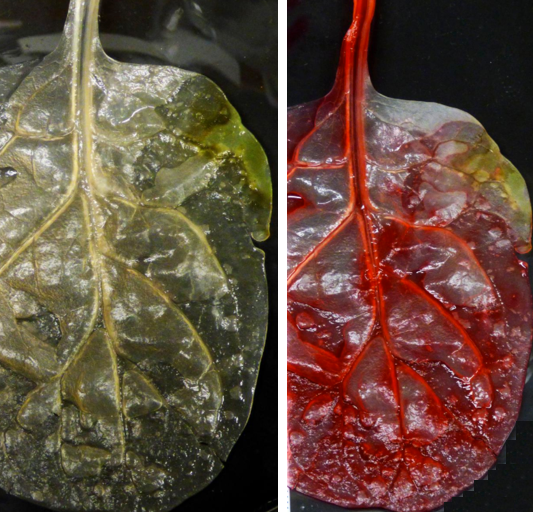
A spinach leaf (left) was decellularized in 7 days, leaving only the scaffold (right), which served as an intact vascular network. As a test, red dye was pumped through its veins, simulating blood, oxygen, and nutrients. Cardiomyocytes (cardiac muscle cells) derived from human pluripotent stem cells were then seeded onto the surface of the leaf scaffold, forming cell clusters that demonstrated cardiac contractile function and calcium-handling capabilities for 21 days. (credit: Worcester Polytechnic Institute)

After testing the spinach vascular (leaf vessel structure) system mechanically by flowing fluids and microbeads similar in size to human blood cells through it, the researchers seeded the vasculature with human umbilical vein endothelial cells (HUVECs) to grow endothelial cells (which line blood vessels).

Human mesenchymal stem cells (hMSC) and human pluripotent stem-cell-derived cardiomyocytes (cardiac muscle cells) (hPS-CM) were then seeded to the outer surfaces of  the plant scaffolds. The cardiomyocytes spontaneously demonstrated cardiac contractile function (beating) and calcium-handling capabilities over the course of 21 days.
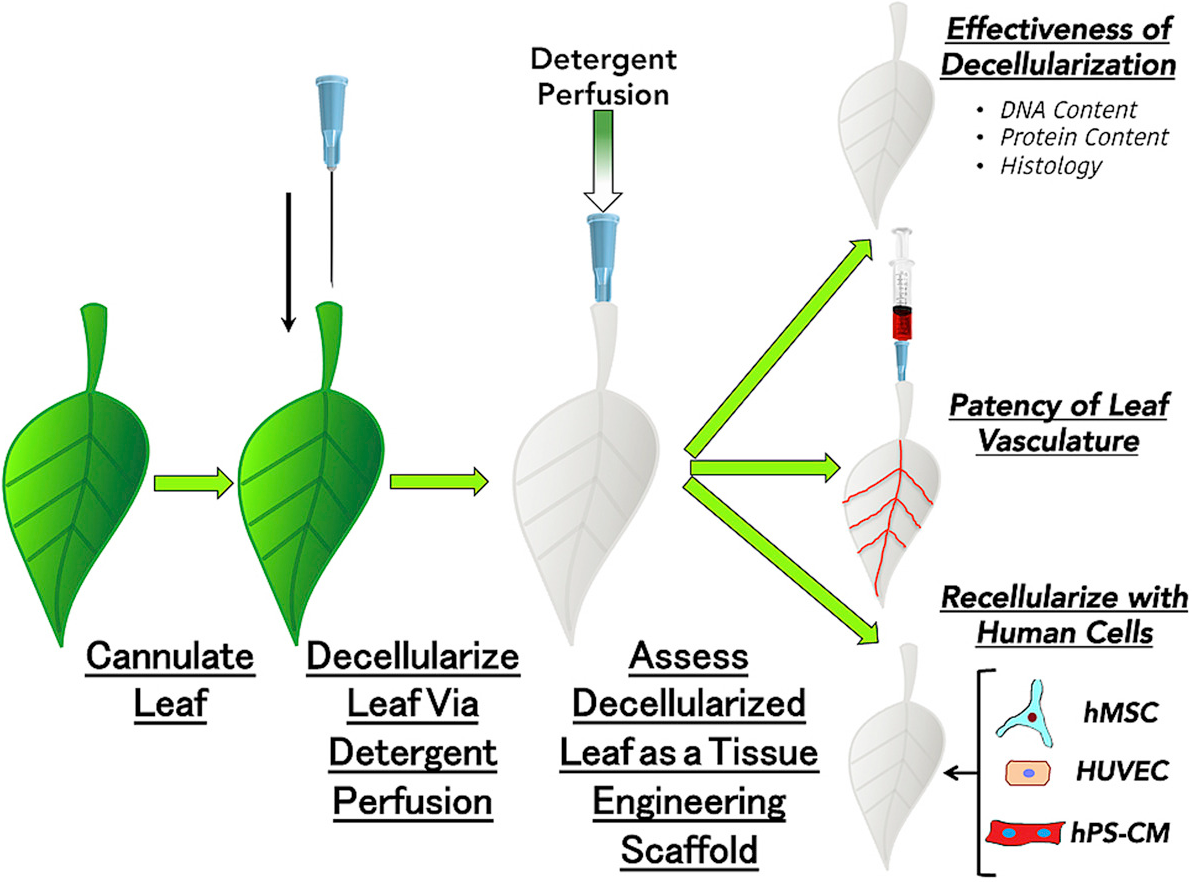
The decellurize-recellurize process (credit: Joshua R. Gershlak et al./Biomaterials)

The future of ”crossing kingdoms”

These proof-of-concept studies may open the door to using multiple spinach leaves to grow layers of healthy heart muscle, and a potential tissue engineered graft based upon the plant scaffolds could use multiple leaves, where some act as arterial support and some act as venous return of blood and fluids from human tissue, say the researchers.

“Our goal is always to develop new therapies that can treat myocardial infarction, or heart attacks,” said Glenn Gaudette, PhD, professor of biomedical engineering at WPI and corresponding author of an open-access paper in the journal Biomaterials, published online in advance of the May 2017 issue.

“Unfortunately, we are not doing a very good job of treating them today. We need to improve that. We have a lot more work to do, but so far this is very promising.”

Currently, it’s not clear how the plant vasculature would be integrated into the native human vasculature and whether there would be an immune response, the authors advise.

The researchers are also now optimizing the decellularization process and seeing how well various human cell types grow while they are attached to (and potentially nourished by) various plant-based scaffolds that could be adapted for specialized tissue regeneration studies. “The cylindrical hollow structure of the stem of Impatiens capensis might better suit an arterial graft,” the authors note. “Conversely, the vascular columns of wood might be useful in bone engineering due to their relative strength and geometries.”

Other types of plants could also provide the framework for a wide range of other tissue engineering technologies, the authors suggest.****

The authors conclude that “development of decellularized plants for scaffolding opens up the potential for a new branch of science that investigates the mimicry between kingdoms, e.g., between plant and animal. Although further investigation is needed to understand future applications of this new technology, we believe it has the potential to develop into a ‘green’ solution pertinent to a myriad of regenerative medicine applications.”

* The research team also includes human stem cell and plant biology researchers at the University of Wisconsin-Madison, and Arkansas State University-Jonesboro.

** The research is driven by the pressing need for organs and tissues available for transplantation, which far exceeds their availability. More than 100,000 patients are on the donor waiting list at any given time and an average of 22 people die each day while waiting for a donor organ or tissue to become available, according to a 2016 paper in the American Journal of Transplantation

*** In addition to spinach leaves, the team successfully removed cells from parsley, Artemesia annua (sweet wormwood), and peanut hairy roots.

**** “Tissue engineered scaffolds are typically produced either from animal-derived or synthetic biomaterials, both of which have a large cost and large environmental impact. Animal-derived biomaterials used extensively as scaffold materials for tissue engineering include native [extracellular matrix]  proteins such as collagen I or fibronectin and whole animal tissues and organs. Annually, 115 million animals are estimated to be used in research. Due to this large number, a lot of energy is necessary for the upkeep and feeding of such animals as well as to dispose of the large amount of waste that is generated. Along with this environmental impact, animal research also has a plethora of ethical considerations, which could be alleviated by forgoing animal models in favor of more biologically relevant in vitro human tissue models,” the authors advise.

Worcester Polytechnic Institute | Spinach leaves can carry blood to grow human tissues

 

Global night-time lights provide unfiltered data on human activities and socio-economic factors

Night-time lights seen from space correlate to everything from electricity consumption and CO2 emissions, to gross domestic product, population and poverty. (credit: NASA)

Researchers from the Harvard John A. Paulson School of Engineering and Applied Sciences (SEAS) and the Environmental Defense Fund (EDF) have developed an online tool that incorporates 21 years of night-time lights data to understand and compare changes in human activities in countries around the world.

The research is published in PLOS One.

The tool compares the brightness of a country’s night-time lights with the corresponding electricity consumption, GDP, population, poverty, and emissions of CO2, CH4, N2O, and F-gases since 1992, without relying on national statistics with often differing methodologies and motivations by those collecting them.

Consistent with previous research, the team found the highest correlations between night-time lights and GDP, electricity consumption, and CO2 emissions. Correlations with population, N2O, and CH4 emissions were still slightly less pronounced and, as expected, there was an inverse correlation between the brightness of lights and of poverty.

“This is the most comprehensive tool to date to look at the relationship between night-time lights and a series of socio-economic indicators,” said Gernot Wagner, a research associate at SEAS and coauthor of the paper.

The data source is the Defense Meteorological Satellite Program (DMSP) dataset, providing 21 years worth of night-time data. The researchers also use Google Earth Engine (GEE), a platform recently made available to researchers that allows them to explore more comprehensive global aggregate relationships at national scales between DMSP and a series of economic and environmental variables.


Abstract of Night-time lights: A global, long term look at links to socio-economic trends

We use a parallelized spatial analytics platform to process the twenty-one year totality of the longest-running time series of night-time lights data—the Defense Meteorological Satellite Program (DMSP) dataset—surpassing the narrower scope of prior studies to assess changes in area lit of countries globally. Doing so allows a retrospective look at the global, long-term relationships between night-time lights and a series of socio-economic indicators. We find the strongest correlations with electricity consumption, CO2 emissions, and GDP, followed by population, CH4 emissions, N2O emissions, poverty (inverse) and F-gas emissions. Relating area lit to electricity consumption shows that while a basic linear model provides a good statistical fit, regional and temporal trends are found to have a significant impact.

Graphene-based neural probe detects brain activity at high resolution and signal quality

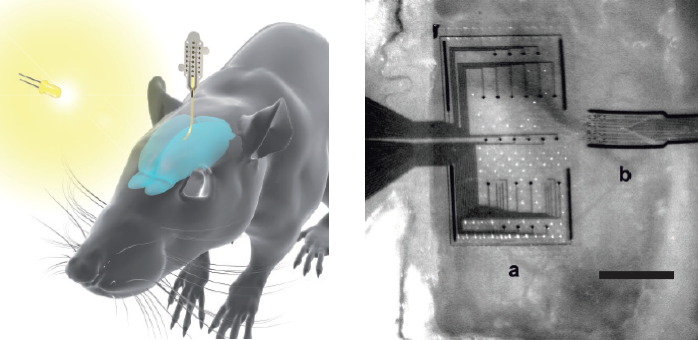
16 flexible graphene transistors (inset) integrated into a flexible neural probe enable electrical signals from neurons to be measured at high resolution and signal quality. (credit: ICN2)

Researchers from the European Graphene Flagship* have developed a new microelectrode array neural probe based on graphene field-effect transistors (FETs) for recording brain activity at high resolution while maintaining excellent signal-to-noise ratio (quality).

The new neural probe could lay the foundation for a future generation of in vivo neural recording implants, for patients with epilepsy, for example, and for disorders that affect brain function and motor control, the researchers suggest. It could possibly play a role in Elon Musk’s just-announced Neuralink “neural lace” research project.

Measuring neural activity with high precision

(Left) Representation of the graphene implant placed on the surface of the rat’s brain. (Right) microscope image of a multielectrode array with conventional platinum electrodes (a) vs. the miniature graphene device next to it (b). Scale bar is 1.25 mm. (credit:  Benno M. Blaschke et al./ 2D Mater.)

Neural activity is measured by detecting the electric fields generated when neurons fire. These fields are highly localized, so ultra-small measuring devices that can be densely packed are required for accurate brain readings.

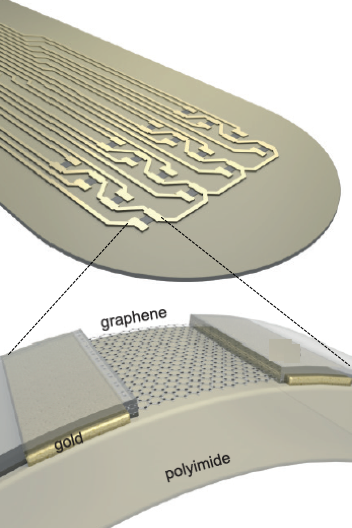
The new device has an microelectrode array of 16 graphene-based transistors arranged on a flexible substrate that can conform to the brain’s surface. Graphene provides biocompatibility, chemical stability, flexibility, and excellent electrical properties, which make it attractive for use in medical devices, especially for brain activity, the researchers suggest.**

(For a state-of-the-art example of microelectrode array use in the brain, see “Brain-computer interface advance allows paralyzed people to type almost as fast as some smartphone users.”)

Schematic of the head of a graphene implant showing a graphene transistor array and feed lines. (Inset): cross section of a graphene transistor with graphene between the source and drain contacts, which are covered by an insulating polyimide photoresist. (credit:  Benno M. Blaschke et al./ 2D Mater.)

In an experiment with rats, the researchers used the new devices to record brain activity during sleep and in response to visual light stimulation.

The graphene transistor probes showed good spatial discrimination (identifying specific locations) of the brain activity and outperformed state-of-the-art platinum electrode arrays, with higher signal amplification and a better signal-to-noise performance when scaled down to very small sizes.

That means the graphene transistor probes can be more densely packed and at higher resolution, features that are vital for precision mapping of brain activity. And since the probes have transistor amplifiers built in, they remove the need for the separate pre-amplification required with metal electrodes.

Neural probes are placed directly on the surface of the brain, so safety is important. The researchers determined that the flexible graphene-based probes are non-toxic, did not induce any significant inflammation, and are long-lasting.

“Graphene neural interfaces have shown already a great potential, but we have to improve on the yield and homogeneity of the device production in order to advance towards a real technology,” said Jose Antonio Garrido, who led the research at the Catalan Institute of Nanoscience and Nanotechnology in Spain.

“Once we have demonstrated the proof of concept in animal studies, the next goal will be to work towards the first human clinical trial with graphene devices during intraoperative mapping of the brain. This means addressing all regulatory issues associated to medical devices such as safety, biocompatibility, etc.”

The research was published in the journal 2D Materials.

* With a budget of €1 billion, the Graphene Flagship consortium consists of more than 150 academic and industrial research groups in 23 countries. Launched in 2013, the goal is to take graphene from the realm of academic laboratories into European society within 10 years. The research was a collaborative effort involving Flagship partners Technical University of Munich (TU Munich. Germany), Institut d’Investigacions Biomèdiques August Pi i Sunyer (IDIBAPS, Spain), Spanish National Research Council (CSIC, Spain), The Biomedical Research Networking Center in Bioengineering, Biomaterials and Nanomedicine (CIBER-BBN, Spain) and the Catalan Institute of Nanoscience and Nanotechnology (ICN2, Spain).

** “Using multielectrode arrays for high-density recordings presents important drawbacks. Since the electrode impedance and noise are inversely proportional to the electrode size, a trade-off between spatial resolution and signal-to-noise ratio has to be made. Further, the very small voltages of the recorded signals are highly susceptible to noise in the standard electrode configuration. [That requires preamplification, which means] the fabrication complexity is significantly increased and the additional electrical components required for the voltage-to-current conversion limit the integration density. … Metal-oxide-semiconductor field-effect transistors (MOSFETs) where the gate metal is replaced with an electrolyte and an electrode, referred to as “solution-gated field-effect transistors (SGFETs) or electrolyte-gated field-effect transistors, can be exposed directly to neurons and be used to record action potentials with high fidelity. … Although the potential of graphene-based SGFET technology has been suggested in in vitro studies, so far no in vivo confirmation has been demonstrated. Here we present the fabrication of flexible arrays of graphene SGFETs and demonstrate in vivo mapping of spontaneous slow waves, as well as visually evoked and pre-epileptic activity in the rat.” — Benno M. Blaschke et al./2D Mater.


Abstract of Mapping brain activity with flexible graphene micro-transistors

Establishing a reliable communication interface between the brain and electronic devices is of paramount importance for exploiting the full potential of neural prostheses. Current microelectrode technologies for recording electrical activity, however, evidence important shortcomings, e.g. challenging high density integration. Solution-gated field-effect transistors (SGFETs), on the other hand, could overcome these shortcomings if a suitable transistor material were available. Graphene is particularly attractive due to its biocompatibility, chemical stability, flexibility, low intrinsic electronic noise and high charge carrier mobilities. Here, we report on the use of an array of flexible graphene SGFETs for recording spontaneous slow waves, as well as visually evoked and also pre-epileptic activity in vivo in rats. The flexible array of graphene SGFETs allows mapping brain electrical activity with excellent signal-to-noise ratio (SNR), suggesting that this technology could lay the foundation for a future generation of in vivo recording implants.

Musk launches company to pursue ‘neural lace’ brain-interface technology

image credit | Bloomberg

Elon Musk has launched a California-based company called Neuralink Corp., The Wall Street Journal reported today (Monday, March 27, 2017), citing people familiar with the matter, to pursue “neural lace” brain-interface technology.

Neural lace would help prevent humans from becoming “house cats” to AI, he suggests. “I think one of the solutions that seems maybe the best is to add an AI layer,” Musk hinted at the Code Conference last year. It would be a “digital layer above the cortex that could work well and symbiotically with you.

“We are already a cyborg,” he added. “You have a digital version of yourself online in form of emails and social media. … But the constraint is input/output — we’re I/O bound … particularly output. … Merging with digital intelligence revolves around … some sort of interface with your cortical neurons.”

Reflecting concepts that have been proposed by Ray Kurzweil, “over time I think we will probably see a closer merger of biological intelligence and digital intelligence,” Musk said at the recent World Government Summit in Dubai.

Musk suggested the neural lace interface could be inserted via veins and arteries.

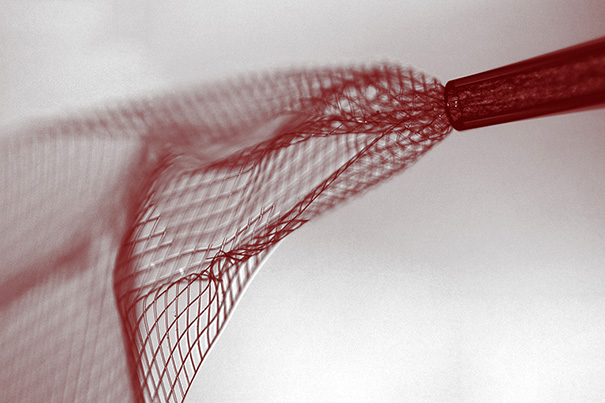
Image showing mesh electronics being injected through sub-100 micrometer inner diameter glass needle into aqueous solution. (credit: Lieber Research Group, Harvard University)

KurzweilAI reported on one approach to a neural-lace-like brain interface in 2015. A “syringe-injectable electronics” concept was invented by researchers in Charles Lieber’s lab at Harvard University and the National Center for Nanoscience and Technology in Beijing. It would involve injecting a biocompatible polymer scaffold mesh with attached microelectronic devices into the brain via syringe.

The process for fabricating the scaffold is similar to that used to etch microchips, and begins with a dissolvable layer deposited on a biocompatible nanoscale polymer mesh substrate, with embedded nanowires, transistors, and other microelectronic devices attached. The mesh is then tightly rolled up, allowing it to be sucked up into a syringe via a thin (100 micrometers internal diameter) glass needle. The mesh can then be injected into brain tissue by the syringe.

The input-output connection of the mesh electronics can be connected to standard electronics devices (for voltage insertion or measurement, for example), allowing the mesh-embedded devices to be individually addressed and used to precisely stimulate or record individual neural activity.

A schematic showing in vivo stereotaxic injection of mesh electronics into a mouse brain (credit: Jia Liu et al./Nature Nanotechnology)

Lieber’s team has demonstrated this in live mice and verified continuous monitoring and recordings of brain signals on 16 channels. “We have shown that mesh electronics with widths more than 30 times the needle ID can be injected and maintain a high yield of active electronic devices … little chronic immunoreactivity,” the researchers said in a June 8, 2015 paper in Nature Nanotechnology. “In the future, our new approach and results could be extended in several directions, including the incorporation of multifunctional electronic devices and/or wireless interfaces to further increase the complexity of the injected electronics.”

This technology would require surgery, but would not have the accessibility limitation of the blood-brain barrier with Musk’s preliminary concept. For direct delivery via the bloodstream, it’s possible that the nanorobots conceived by Robert A. Freitas, Jr. (and extended to interface with the cloud, as Ray Kurzweil has suggested) might be appropriate at some point in the future.

“Neuralink has reportedly already hired several high profile academics in the field of neuroscience: flexible electrodes and nano technology expert  Venessa Tolosa, PhD; UCSF professor Philip Sabes, PhD, who also participated in the Musk-sponsored Beneficial AI conference; and Boston University professor Timothy Gardner, PhD, who studies neural pathways in the brains of songbirds,” Engadget reports.

UPDATE Mar. 28, 2017:


Recode | We are already cyborgs | Elon Musk | Code Conference 2016

Travelers to Mars risk leukemia cancer, weakened immune function from radiation, NASA-funded study finds

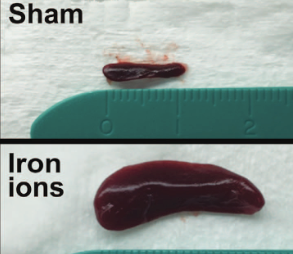
The spleen from a mouse exposed to a mission-relevant dose (20 cGy, 1 GeV/n) of iron ions (bottom) was ~ 30 times the normal volume compared with the spleen from a control mouse (top). (credit: C Rodman et al./Leukemia)

Radiation encountered in deep space travel may increase the risk of leukemia cancer in humans traveling to Mars, NASA-funded researchers at the Wake Forest Institute for Regenerative Medicine and colleagues have found, using mice transplanted with human stem cells.

“Our results are troubling because they show radiation exposure could potentially increase the risk of leukemia,” said Christopher Porada, Ph.D., associate professor of regenerative medicine and senior researcher on the project.

Radiation exposure is believed to be one of the most dangerous aspects of traveling to Mars, according to NASA. The average distance to Mars is 140 million miles, and a round trip could take three years.

The goal of the study, published in the journal Leukemia, was to assess the direct effects of simulated solar energetic particles (SEP) and galactic cosmic ray (GCR) radiation on human hematopoietic stem cells (HSCs). These stem cells comprise less than 0.1% of the bone marrow of adults, but produce the many types of blood cells that circulate through the body and work to transport oxygen, fight infection, and eliminate any malignant cells that arise.

For the study, human HSCs from healthy donors of typical astronaut age (30–55 years) were exposed to Mars mission-relevant doses of protons and iron ions — the same types of radiation that astronauts would be exposed to in deep space, followed by laboratory and animal studies to define the impact of the exposure.

“Radiation exposure at these levels was highly deleterious to HSC function, reducing their ability to produce almost all types of blood cells, often by 60–80 percent,” said Porada. “This could translate into a severely weakened immune system and anemia during prolonged missions in deep space.”

The radiation also caused mutations in genes involved in the hematopoietic process and dramatically reduced the ability of HSCs to give rise to mature blood cells.

Previous studies had already demonstrated that exposure to high doses of radiation, such as from X-rays, can have harmful (even life-threatening) effects on the body’s ability to make blood cells, and can significantly increase the likelihood of cancers, especially leukemias. However, the current study was the first to show a damaging effect of lower, mission-relevant doses of space radiation.

Mice develop T-cell acute lymphoblastic leukemia, weakened immune function

The next step was to assess how the cells would function in the human body. For that purpose, mice were transplanted with GCR-irradiated human HSCs, essentially “humanizing” the animals. The mice developed what appeared to be T-cell acute lymphoblastic leukemia — the first demonstration that exposure to space radiation may increase the risk of leukemia in humans.

“Our results show radiation exposure could potentially increase the risk of leukemia in two ways,” said Porada. “We found that genetic damage to HSCs directly led to leukemia. Secondly, radiation also altered the ability of HSCs to generate T and B cells, types of white blood cells involved in fighting foreign ‘invaders’ like infections or tumor cells. This may reduce the ability of the astronaut’s immune system to eliminate malignant cells that arise as a result of radiation-induced mutations.”

Porada said the findings are particularly troubling given previous work showing that conditions of weightlessness/microgravity present during spaceflight can also cause marked alterations in astronaut’s immune function, even after short duration missions in low-earth orbit, where they are largely protected from cosmic radiation.

Taken together, the results indicate that the combined exposure to microgravity and SEP/GCR radiation that would occur during extended deep space missions, such as to Mars, could potentially exacerbate the risk of immune-dysfunction and cancer,

NASA’s Human Research Program is also exploring conditions of microgravity, isolation and confinement, hostile and closed environments, and distance from Earth. The ultimate goal of the research is to make space missions as safe as possible.

Researchers at Wake Forest Baptist Medical Center, Brookhaven National Laboratory, and the University of California Davis Comprehensive Cancer Center were also involved in the study.


Abstract of In vitro and in vivo assessment of direct effects of simulated solar and galactic cosmic radiation on human hematopoietic stem/progenitor cells

Future deep space missions to Mars and near-Earth asteroids will expose astronauts to chronic solar energetic particles (SEP) and galactic cosmic ray (GCR) radiation, and likely one or more solar particle events (SPEs). Given the inherent radiosensitivity of hematopoietic cells and short latency period of leukemias, space radiation-induced hematopoietic damage poses a particular threat to astronauts on extended missions. We show that exposing human hematopoietic stem/progenitor cells (HSC) to extended mission-relevant doses of accelerated high-energy protons and iron ions leads to the following: (1) introduces mutations that are frequently located within genes involved in hematopoiesis and are distinct from those induced by γ-radiation; (2) markedly reduces in vitro colony formation; (3) markedly alters engraftment and lineage commitment in vivo; and (4) leads to the development, in vivo, of what appears to be T-ALL. Sequential exposure to protons and iron ions (as typically occurs in deep space) proved far more deleterious to HSC genome integrity and function than either particle species alone. Our results represent a critical step for more accurately estimating risks to the human hematopoietic system from space radiation, identifying and better defining molecular mechanisms by which space radiation impairs hematopoiesis and induces leukemogenesis, as well as for developing appropriately targeted countermeasures.

Scientists reverse aging in mice by repairing damaged DNA

A research team led by Harvard Medical School professor of genetics David Sinclair, PhD, has made a discovery that could lead to a revolutionary new drug that allows cells to repair DNA damaged by aging, cancer, and radiation.

In a paper published in the journal Science on Friday (March 24), the scientists identified a critical step in the molecular process related to DNA damage.

The researchers found that a compound known as NAD (nicotinamide adenine dinucleotide), which is naturally present in every cell of our body, has a key role as a regulator in protein-to-protein interactions that control DNA repair. In an experiment, they found that treating mice with a NAD+ precursor called NMN (nicotinamide mononucleotide) improved their cells’ ability to repair DNA damage.

“The cells of the old mice were indistinguishable from the young mice, after just one week of treatment,” said senior author Sinclair.

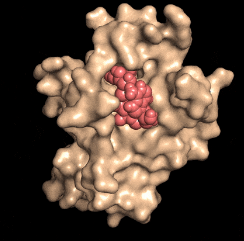
Disarming a rogue agent: When the NAD molecule (red) binds to the DBC1 protein (beige), it prevents DBC1 from attaching to and incapacitating a protein (PARP1) that is critical for DNA repair. (credit: David Sinclair)

Human trials of NMN therapy will begin within the next few months to “see if these results translate to people,” he said. A safe and effective anti-aging drug is “perhaps only three to five years away from being on the market if the trials go well.”

What it means for astronauts, childhood cancer survivors, and the rest of us

The researchers say that in addition to reversing aging, the DNA-repair research has attracted the attention of NASA. The treatment could help deal with radiation damage to astronauts in its Mars mission, which could cause muscle weakness, memory loss, and other symptoms (see “Mars-bound astronauts face brain damage from galactic cosmic ray exposure, says NASA-funded study“), and more seriously, leukemia cancer and weakened immune function (see “Travelers to Mars risk leukemia cancer, weakend immune function from radiation, NASA-funded study finds“).

The treatment could also help travelers aboard aircraft flying across the poles. A 2011 NASA study showed that passengers on polar flights receive about 12 percent of the annual radiation limit recommended by the International Committee on Radiological Protection.

The other group that could benefit from this work is survivors of childhood cancers, who are likely to suffer a chronic illness by age 45, leading to accelerated aging, including cardiovascular disease, Type 2 diabetes, Alzheimer’s disease, and cancers unrelated to the original cancer, the researchers noted.

For the past four years, Sinclair’s team has been working with spinoff MetroBiotech on developing NMN as a drug. Sinclair previously made a link between the anti-aging enzyme SIRT1 and resveratrol. “While resveratrol activates SIRT1 alone, NAD boosters [like NMN] activate all seven sirtuins, SIRT1-7, and should have an even greater impact on health and longevity,” he says.

Sinclair is also a professor at the University of New South Wales School of Medicine in Sydney, Australia.


Abstract of A conserved NAD+ binding pocket that regulates protein-protein interactions during aging

DNA repair is essential for life, yet its efficiency declines with age for reasons that are unclear. Numerous proteins possess Nudix homology domains (NHDs) that have no known function. We show that NHDs are NAD+ (oxidized form of nicotinamide adenine dinucleotide) binding domains that regulate protein-protein interactions. The binding of NAD+ to the NHD domain of DBC1 (deleted in breast cancer 1) prevents it from inhibiting PARP1 [poly(adenosine diphosphate–ribose) polymerase], a critical DNA repair protein. As mice age and NAD+ concentrations decline, DBC1 is increasingly bound to PARP1, causing DNA damage to accumulate, a process rapidly reversed by restoring the abundance of NAD+. Thus, NAD+ directly regulates protein-protein interactions, the modulation of which may protect against cancer, radiation, and aging.

A printable, sensor-laden ‘skin’ for robots (or an airplane)

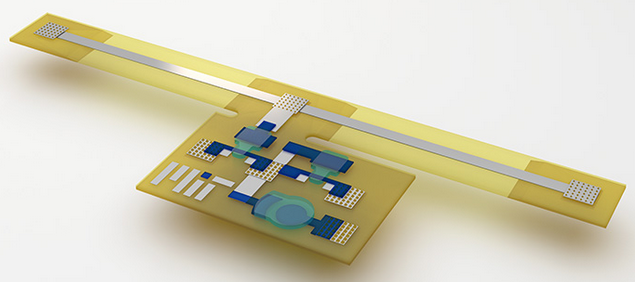
Illustration of 3D-printed sensory composite (credit: Subramanian Sundaram)

MIT researchers have designed a radical new method of creating flexible, printable electronics that combine sensors and processing circuitry.

Covering a robot — or an airplane or a bridge, for example — with sensors will require a technology that is both flexible and cost-effective to manufacture in bulk. To demonstrate the feasibility of their new method, the researchers at MIT’s Computer Science and Artificial Intelligence Laboratory have designed and built a 3D-printed device that responds to mechanical stresses by changing the color of a spot on its surface.

Sensorimotor pathways

“In nature, networks of sensors and interconnects [such as the human nervous system] are called sensorimotor pathways,” says Subramanian Sundaram, an MIT graduate student in electrical engineering and computer science (EECS), who led the project. “We were trying to see whether we could replicate sensorimotor pathways inside a 3-D-printed object. So we considered the simplest organism we could find” — the golden tortoise beetle, or “goldbug,” an insect whose exterior usually appears golden but turns reddish orange if the insect is poked or prodded, that is, mechanically stressed.

The researchers present their new design in the latest issue of the journal Advanced Materials Technologies.

The key innovation was to 3D-print directly on the plastic substrate (support structure) instead of placing components on top. That greatly increases the range of devices that can be created; a printed substrate could consist of many materials, interlocked in intricate but regular patterns, which broadens the range of functional materials that printable electronics can use.*

Printed substrates also open the possibility of devices that, although printed as flat sheets, can fold themselves up into more complex, three-dimensional shapes. Printable robots that spontaneously self-assemble when heated, for instance (see “Self-assembling printable robotic components“), are a  topic of ongoing research at the CSAIL Distributed Robotics Laboratory, led by Daniela Rus, the Andrew and Erna Viterbi Professor of Electrical Engineering and Computer Science at MIT.

3D-printed sensory composite

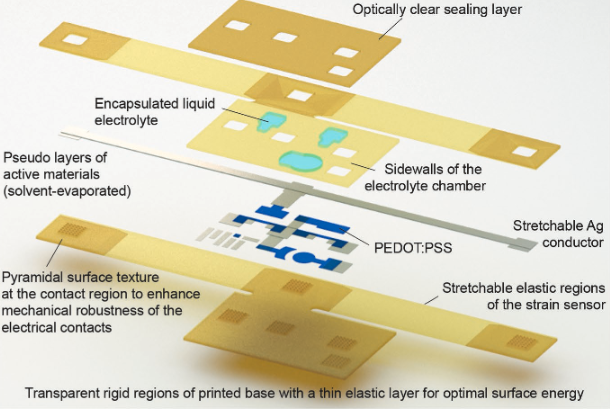
The sensory composite is grouped into 4 sets of functional layers: a base with spatially varying mechanical stiffness and surface energy, electrical materials, electrolyte, and capping layers. All these materials are 3D-printed. (credit: Subramanian Sundaram et al./ Advanced Materials Technologies)

The MIT researchers’ new device is approximately T-shaped, but with a wide, squat base and an elongated crossbar. The crossbar is made from an elastic plastic, with a strip of silver running its length; in the researchers’ experiments, electrodes were connected to the crossbar’s ends. The base of the T is made from a more rigid plastic. It includes two printed transistors and what the researchers call a “pixel,” a circle of semiconducting polymer whose color changes when the crossbars stretch, modifying the electrical resistance of the silver strip.**

A transistor consists of semiconductor channel on top of which sits a “gate,” a metal wire that, when charged, generates an electric field that switches the semiconductor between its electrically conductive and nonconductive states. In a standard transistor, there’s an insulator between the gate and the semiconductor, to prevent the gate current from leaking into the semiconductor channel.

The transistors in the MIT researchers’ device instead separate the gate and the semiconductor with an electrolyte — a layer of water containing  potassium chloride mixed with glycerol. Charging the gate drives potassium ions into the semiconductor, changing its conductivity.***

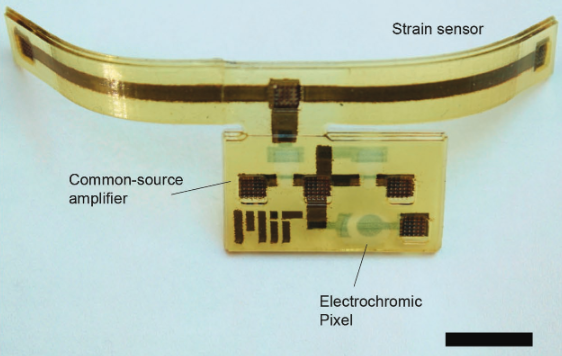
Photograph of the fully 3D-printed sensory composite shows a strain sensor (top) linked to an electrical amplifier that modulates the transparency of the electrochromic pixel (scale bar is 10mm). (credit: Subramanian Sundaram et al./ Advanced Materials Technologies)

“I am very impressed with both the concept and the realization of the system,” says Hagen Klauk, who leads the Organic Electronic Research Group at the Max Planck Institute for Solid State Research, in Stuttgart, Germany. “The approach of printing an entire optoelectronic system — including the substrate and all the components — by depositing all the materials, including solids and liquids, by 3-D printing is certainly novel, interesting, and useful, and the demonstration of the functional system confirms that the approach is also doable. By fabricating the substrate on the fly, the approach is particularly useful for improvised manufacturing environments where dedicated substrate materials may not be available.”

The work was supported by the DARPA SIMPLEX program through SPAWAR.

* To build the device, the researchers used the MultiFab, a custom 3-D printer developed MIT. The MultiFab already included two different “print heads,” one for emitting hot materials and one for cool, and an array of ultraviolet light-emitting diodes. Using ultraviolet radiation to “cure” fluids deposited by the print heads produces the device’s substrate.

** Sundaram added a copper-and-ceramic heater, which was necessary to deposit the semiconducting plastic: The plastic is suspended in a fluid that’s sprayed onto the device surface, and the heater evaporates the fluid, leaving behind a layer of plastic only 200 nanometers thick. The layer of saltwater lowers the device’s operational voltage, so that it can be powered with an ordinary 1.5-volt battery.

*** But it does render the device less durable. “I think we can probably get it to work stably for two months, maybe,” Sundaram says. “One option is to replace that liquid with something between a solid and a liquid, like a hydrogel, perhaps. But that’s something we would work on later. This is an initial demonstration.”


Abstract of 3D-Printed Autonomous Sensory Composites

A method for 3D-printing autonomous sensory composites requiring no external processing is presented. The composite operates at 1.5 V, locally performs active signal transduction with embedded electrical gain, and responds to stimuli, reversibly transducing mechanical strain into a transparency change. Digital assembly of spatially tailored solids and thin films, with encapsulated liquids, provides a route for realizing complex autonomous systems.

Mayo Clinic discovers high-intensity aerobic training can reverse aging

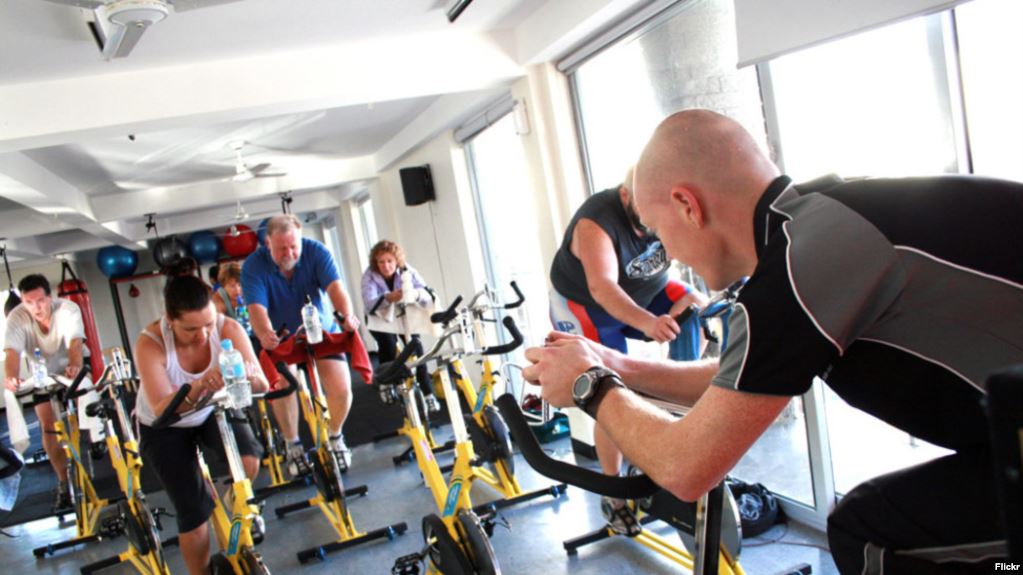
Mayo Clinic study finds high-intensity aerobic exercise may reverse aging (credit: Flickr user Global Panorama via Creative Commons license)

A Mayo Clinic study says the best training for adults is high-intensity aerobic exercise, which they believe can reverse some cellular aspects of aging.

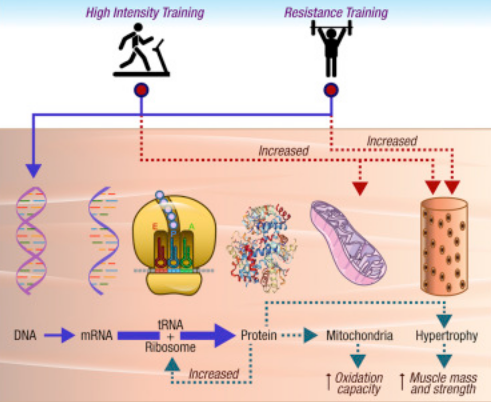
Mayo researchers compared 12 weeks of high-intensity interval training (workouts in which you alternate periods of high-intensity exercise with low-intensity recovery periods), resistance training, and combined training. While all three enhanced insulin sensitivity and lean mass, only high-intensity interval training and combined training improved aerobic capacity and skeletal muscle mitochondrial respiration. (Decline in mitochondrial content and function are common in older adults.)

High-intensity intervals also improved muscle protein content, which enhanced energetic functions and also caused muscle enlargement, especially in older adults. The researchers said exercise training significantly enhanced the cellular machinery responsible for making new proteins. That contributes to protein synthesis, thus reversing a major adverse effect of aging.

12 weeks exercise training in younger and older people (credit: Mayo Clinic)

“We encourage everyone to exercise regularly, but the take-home message for aging adults is that supervised high-intensity training is probably best, because, both metabolically and at the molecular level, it confers the most benefits,” says K. Sreekumaran Nair, M.D., Ph.D., a Mayo Clinic endocrinologist and senior researcher on the study.

He says the high-intensity training reversed some manifestations of aging in the body’s protein function, but noted that increasing muscle strength requires resistance training a couple of days a week.

Other findings

In the study, researchers tracked metabolic and molecular changes in a group of young and older adults over 12 weeks, gathering data 72 hours after individuals in randomized groups completed each type of exercise. General findings showed:

  • Cardio respiratory health, muscle mass, and insulin sensitivity improved with all training.
  • Mitochondrial cellular function declined with age but improved with training.
  • Increase in muscle strength occurred only modestly with high-intensity interval training, but occurred with resistance training alone or when added to the aerobic training.
  • Exercise improves skeletal muscle gene expression independent of age.
  • Exercise substantially enhanced the ribosomal proteins responsible for synthesizing new proteins, which is mainly responsible for enhanced mitochondrial function.
  • Training has no significant effect on skeletal muscle DNA epigenetic changes but promotes skeletal muscle protein expression with maximum effect in older adults.

The research findings appear in Cell Metabolism. The research was supported by the National Institutes of Health, Mayo Clinic, the Robert and Arlene Kogod Center on Aging, and the Murdock-Dole Professorship.


Abstract of Enhanced Protein Translation Underlies Improved Metabolic and Physical Adaptations to Different Exercise Training Modes in Young and Old Humans

The molecular transducers of benefits from different exercise modalities remain incompletely defined. Here we report that 12 weeks of high-intensity aerobic interval (HIIT), resistance (RT), and combined exercise training enhanced insulin sensitivity and lean mass, but only HIIT and combined training improved aerobic capacity and skeletal muscle mitochondrial respiration. HIIT revealed a more robust increase in gene transcripts than other exercise modalities, particularly in older adults, although little overlap with corresponding individual protein abundance was noted. HIIT reversed many age-related differences in the proteome, particularly of mitochondrial proteins in concert with increased mitochondrial protein synthesis. Both RT and HIIT enhanced proteins involved in translational machinery irrespective of age. Only small changes of methylation of DNA promoter regions were observed. We provide evidence for predominant exercise regulation at the translational level, enhancing translational capacity and proteome abundance to explain phenotypic gains in muscle mitochondrial function and hypertrophy in all ages.

Infrared-light-based Wi-Fi network is 100 times faster

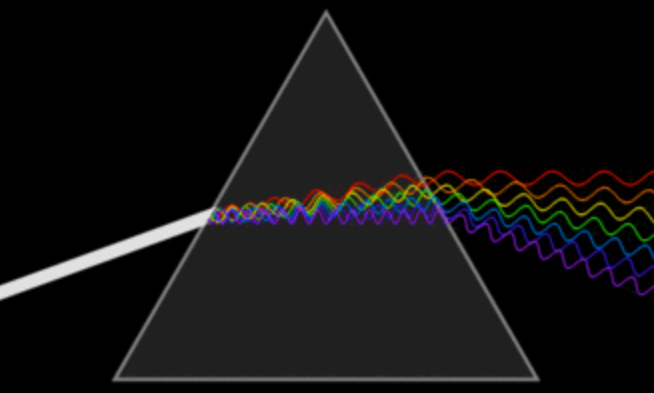
Schematic of a beam of white light being dispersed by a prism into different wavelengths, similar in prinicple to how a new near-infrared WiFi system works (credit: Lucas V. Barbosa/CC)

A new infrared-light WiFi network can provide more than 40 gigabits per second (Gbps) for each user* — about 100 times faster than current WiFi systems — say researchers at Eindhoven University of Technology (TU/e) in the Netherlands.

The TU/e WiFi design was inspired by experimental systems using ceiling LED lights (such as Oregon State University’s experimental WiFiFO, or WiFi Free space Optic, system), which can increase the total per-user speed of WiFi systems and extend the range to multiple rooms, while avoiding interference from neighboring WiFi systems. (However, WiFiFo is limited to 100 Mbps.)

Experimental Oregon State University system uses LED lighting to boost the bandwidth of Wi-Fi systems and extend range (credit: Thinh Nguyen/Oregon State University)

Near-infrared light

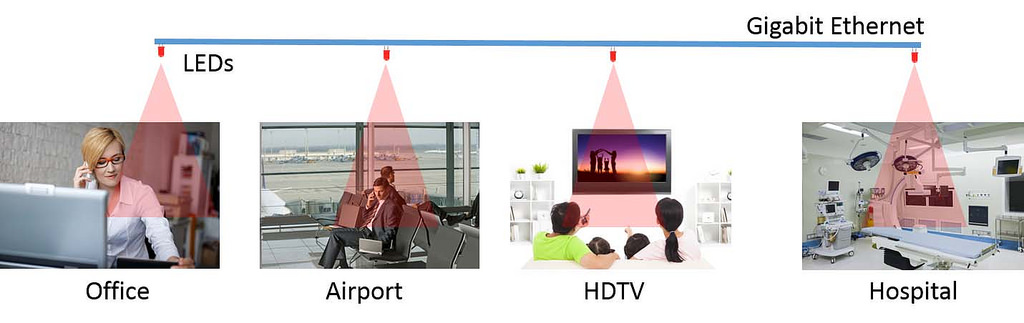
Instead of visible light, the TU/e system uses invisible near-infrared light.** Supplied by a fiber optic cable, a few central “light antennas” (mounted on the ceiling, for instance) each use a pair of ”passive diffraction gratings” that radiate light rays of different wavelengths at different angles.

That allows for directing the light beams to specific users. The network tracks the precise location of every wireless device, using a radio signal transmitted in the return direction.***

The TU/e system uses infrared light with a wavelength of 1500 nanometers (a frequency of 200 terahertz, or 40,000 times higher than 5GHz), allowing for significantly increased capacity. The system has so far used the light rays only for downloading; uploads are still done using WiFi radio signals, since much less capacity is usually needed for uploading.

The researchers expect it will take five years or more for the new technology to be commercially available. The first devices to be connected will likely be high-data devices like video monitors, laptops, and tablets.

* That speed is 67 times higher than the current 802.11n WiFi system’s max theoretical speed of 600Mbps capacity — which has to be shared between users, so the ratio is actually about 100 times, according to TU/e researchers. That speed is also 16 times higher than the 2.5 Gbps performance with the best (802.11ac) Wi-Fi system — which also has to be shared (so actually lower) — and in addition, uses the 5GHz wireless band, which has limited range. “The theoretical max speed of 802.11ac is eight 160MHz 256-QAM channels, each of which are capable of 866.7Mbps, for a total of 6,933Mbps, or just shy of 7Gbps,” notes Extreme Tech. “In the real world, thanks to channel contention, you probably won’t get more than two or three 160MHz channels, so the max speed comes down to somewhere between 1.7Gbps and 2.5Gbps. Compare this with 802.11n’s max theoretical speed, which is 600Mbps.”

** The TU/e system was designed by Joanne Oh as a doctoral thesis and part of the wider BROWSE project headed up by professor of broadband communication technology Ton Koonen, with funding from the European Research Council, under the auspices of the noted TU/e Institute for Photonic Integration.

*** According to TU/e researchers, a few other groups are investigating network concepts in which infrared-light rays are directed using movable mirrors. The disadvantage here is that this requires active control of the mirrors and therefore energy, and each mirror is only capable of handling one ray of light at a time. The grating used the and Oh can cope with many rays of light and, therefore, devices at the same time.


Do-it-yourself robotics kit gives science, tech, engineering, math students tools to automate biology and chemistry experiments

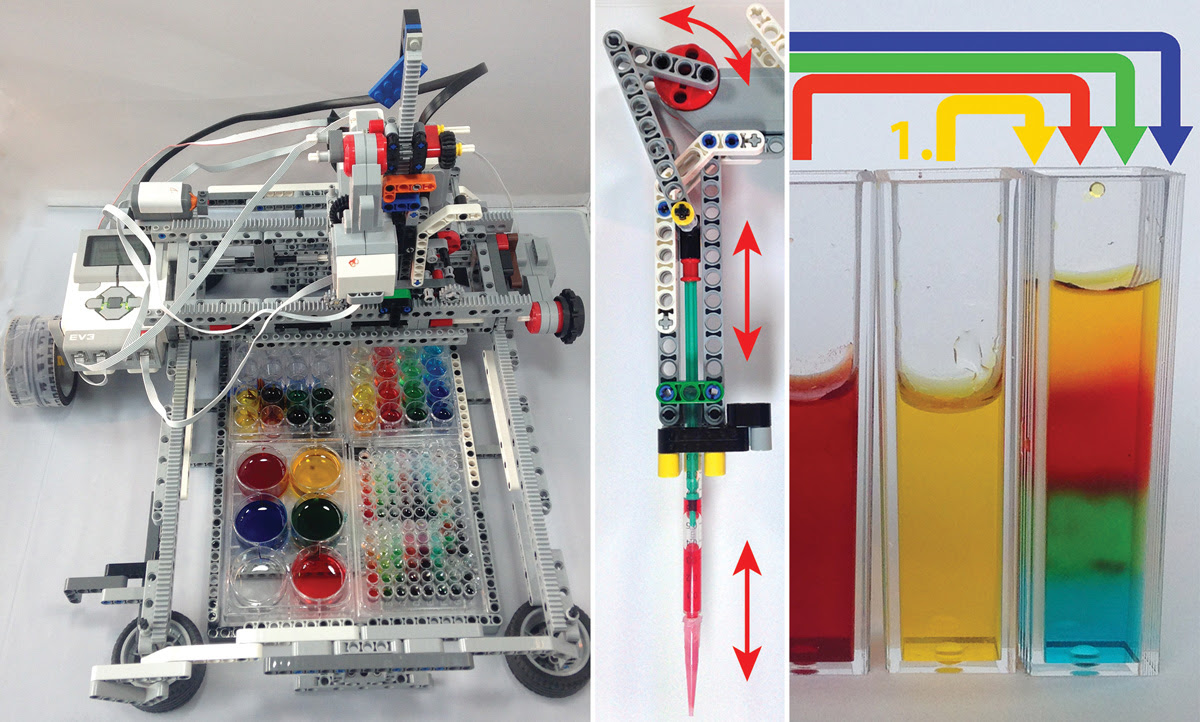
Bioengineers combined a Lego Mindstorms system (left) with a motorized pipette (center) for dropping fluids, allowing for simple experiments like showing how liquids of different salt densities can be layered. (credit: Riedel-Kruse Lab)

Stanford bioengineers have developed liquid-handling robots to allow students to modify and create their own robotic systems that can transfer precise amounts of fluids between flasks, test tubes, and experimental dishes.

The bioengineers combined a Lego Mindstorms robotics kit with a cheap and easy-to-find plastic syringe to create robots that approach the performance of the far more costly automation systems found at universities and biotech labs.

Step-by-step DIY plans

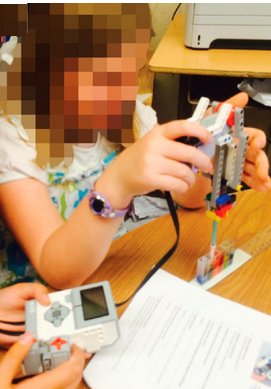
Children 10–13 years old built and explored the functionality of these robots by performing experiments (credit: Lukas C. Gerber et al./PloS Biology)

The idea is to enable students to learn the basics of robotics and the wet sciences in an integrated way. Students learn STEM skills like mechanical engineering, computer programming, and collaboration while gaining a deeper appreciation of the value of robots in life-sciences experiments.

“We really want kids to learn by doing,” said Ingmar Riedel-Kruse, assistant professor of bioengineering and a member of Stanford Bio-X, who led the team. “We show that with a few relatively inexpensive parts, a little training and some imagination, students can create their own liquid-handling robots and then run experiments on it — so they learn about engineering, coding, and the wet sciences at the same time.”

In an open-access paper in the journal PLoS Biology and on Riedel-Kruse’s lab website, the team offers step-by-step building plans and several fundamental experiments targeted to elementary, middle and high school students. They also offer experiments that students can conduct using common household consumables like food coloring, yeast or sugar.

In one experiment, colored liquids with distinct salt concentrations are layered atop one another to teach about liquid density. Other tests measure whether liquids are acids like vinegar or bases like baking soda, or which sugar concentration is best for yeast.

Funding was provided by grants from the National Science Foundation (Cyberlearning and National Robotics Initiative).


Stanford University School of Engineering | SFENG Robots Riedel Kruse v4


Abstract of Liquid-handling Lego robots and experiments for STEM education and research

Liquid-handling robots have many applications for biotechnology and the life sciences, with increasing impact on everyday life. While playful robotics such as Lego Mindstorms significantly support education initiatives in mechatronics and programming, equivalent connections to the life sciences do not currently exist. To close this gap, we developed Lego-based pipetting robots that reliably handle liquid volumes from 1 ml down to the sub-μl range and that operate on standard laboratory plasticware, such as cuvettes and multiwell plates. These robots can support a range of science and chemistry experiments for education and even research. Using standard, low-cost household consumables, programming pipetting routines, and modifying robot designs, we enabled a rich activity space. We successfully tested these activities in afterschool settings with elementary, middle, and high school students. The simplest robot can be directly built from the widely used Lego Education EV3 core set alone, and this publication includes building and experiment instructions to set the stage for dissemination and further development in education and research.