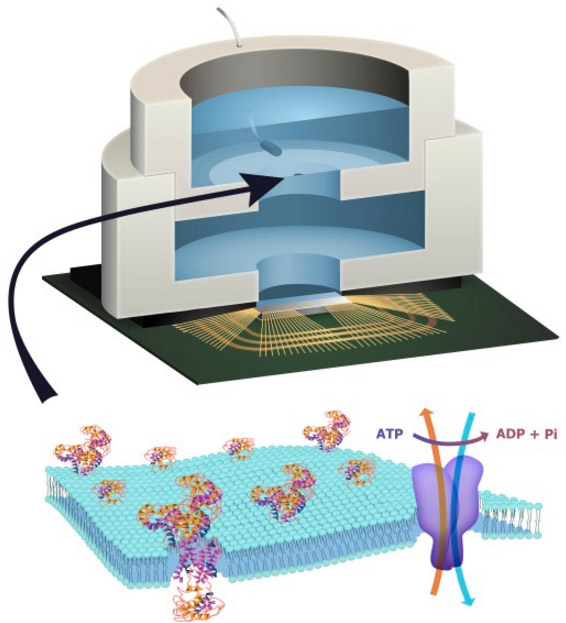
Hybrid solid-state chips and biological cells integrated at molecular level

Illustration depicting a biocell attached to a CMOS integrated circuit with a membrane containing sodium-potassium pumps in pores. Energy is stored chemically in ATP molecules. When the energy is released as charged ions (which are then converted to electrons to power the chip at the bottom of the experimental device), the ATP is converted to ADP + inorganic phosphate. (credit: Trevor Finney and Jared Roseman/Columbia Engineering)

Columbia Engineering researchers have combined biological and solid-state components for the first time, opening the door to creating entirely new artificial biosystems.

In this experiment, they used a biological cell to power a conventional solid-state complementary metal-oxide-semiconductor (CMOS) integrated circuit. An artificial lipid bilayer membrane containing adenosine triphosphate (ATP)-powered ion pumps (which provide energy for cells) was used as a source of ions (which were converted to electrons to power the chip).

The study, led by Ken Shepard, Lau Family Professor of Electrical Engineering and professor of biomedical engineering at Columbia Engineering, was published online today (Dec. 7, 2015) in an open-access paper in Nature Communications.

How to build a hybrid biochip

Living systems achieve this functionality with their own version of electronics based on lipid membranes and ion channels and pumps, which act as a kind of “biological transistor.” Charge in the form of ions carry energy and information, and ion channels control the flow of ions across cell membranes.

Solid-state systems, such as those in computers and communication devices, use electrons; their electronic signaling and power are controlled by field-effect transistors.

To build a prototype of their hybrid system, Shepard’s team packaged a CMOS integrated circuit (IC) with an ATP-harvesting “biocell.” In the presence of ATP, the system pumped ions across the membrane, producing an electrical potential (voltage)* that was harvested by the integrated circuit.

“We made a macroscale version of this system, at the scale of several millimeters, to see if it worked,” Shepard notes. “Our results provide new insight into a generalized circuit model, enabling us to determine the conditions to maximize the efficiency of harnessing chemical energy through the action of these ion pumps. We will now be looking at how to scale the system down.”

While other groups have harvested energy from living systems, Shepard and his team are exploring how to do this at the molecular level, isolating just the desired function and interfacing this with electronics. “We don’t need the whole cell,” he explains. “We just grab the component of the cell that’s doing what we want. For this project, we isolated the ATPases because they were the proteins that allowed us to extract energy from ATP.”

The capability of a bomb-sniffing dog, no Alpo required

Next, the researchers plan to go much further, such as recognizing specific molecules and giving chips the potential to taste and smell.

The ability to build a system that combines the power of solid-state electronics with the capabilities of biological components has great promise, they believe. “You need a bomb-sniffing dog now, but if you can take just the part of the dog that is useful — the molecules that are doing the sensing — we wouldn’t need the whole animal,” says Shepard.

The technology could also provide a power source for implanted electronic devices in ATP-rich environments such as inside living cells, the researchers suggest.

*  “In general, integrated circuits, even when operated at the point of minimum energy in subthreshold, consume on the order of 10−2 W mm−2 (or assuming a typical silicon chip thickness of 250 μm, 4 × 10⁻² W mm−3). Typical cells, in contrast, consume on the order of 4 × 10⁻⁶ W mm−3. In the experiment, a typical active power dissipation for the IC circuit was 92.3 nW, and the active average harvesting power was 71.4 fW for the biocell (the discrepancy is managed through duty-cycled operation of the IC).” — Jared M. Roseman et al./Nature Communications


These are the thinnest, strongest plates that can be picked up by hand

Even though they are less than 100 nanometers thick, the researchers’ plates are strong enough to be picked up by hand and retain their shape after being bent and squeezed. (credit: University of Pennsylvania)

Researchers at the University of Pennsylvania have created the thinnest plates that can be picked up and manipulated by hand, using corrugated plates of aluminum oxide. They are thousands of times thinner than a sheet of paper and hundreds of times thinner than household cling wrap, but they spring back to their original shape after being bent and twisted.

Like cling wrap, comparably thin materials immediately curl up on themselves and get stuck in deformed shapes if they are not stretched on a frame or backed by another material. Graphene is even thinner, but it also curls up.

Being able to stay in shape without additional support would allow this material, and others designed on its principles, to be used in aviation and other structural applications where low weight is at a premium.

The plates’ corrugation allow them to remain stiff and stable without the addition of a heavy frame or backing. (credit: University of Pennsylvania)

Mechanical metamaterials

The innovation was to use corrugation (like corrugated cardboard) instead of a frame to keep the material rigid and freestanding. The researchers’ plates are between 25 and 100 nanometers thick and are made of aluminum oxide, which is deposited one atomic layer at a time to achieve precise control of thickness and their distinctive honeycomb shape.

“Aluminum oxide is actually a ceramic, so something that is ordinarily pretty brittle,”  said Igor Bargatin, Assistant Professor of Mechanical Engineering and Applied Mechanics. “You would expect it, from daily experience, to crack very easily. But the plates bend, twist, deform and recover their shape in such a way that you would think they are made out of plastic. The first time we saw it, I could hardly believe it.”

The hexagonal corrugation of the plates is responsible for their stiffness and strength. (credit: University of Pennsylvania)

The plates’ corrugation provides enhanced stiffness. When held from one end, similarly thin films would readily bend or sag, while the honeycomb plates remain rigid. This guards against the common flaw in un-patterned thin films, where they curl up on themselves.

This ease of deformation is tied to another behavior that makes ultra-thin films hard to use outside controlled conditions: they have the tendency to conform to the shape of any surface and stick to it due to Van der Waals forces. Once stuck, they are hard to remove without damaging them. Totally flat films are also particularly susceptible to tears or cracks, which can quickly propagate across the entire material.

The corrugated pattern of the plates is an example of a relatively new field of research: mechanical metamaterials. Like their electromagnetic counterparts, mechanical metamaterials achieve otherwise impossible properties from the careful arrangement of nanoscale features. With mechanical metamaterials, these properties are things like stiffness and strength, rather than their ability to manipulate electromagnetic waves.

A Solara 50 solar-powered drone by Google-owned Titan Aerospace (credit: Titan Aerospace)

That combination of traits could be used to make wings for insect-inspired flying robots or solar-powered drones for beaming the Internet down to Earth that are being explored by Google and Facebook.

“The wings of insects are a few microns thick, and can’t thinner because they’re made of cells,” Bargatin said. “The thinnest man-made wing material I know of is made by depositing a Mylar film on a frame, and it’s about half a micron thick. Our plates can be ten or more times thinner than that, and don’t need a frame at all. As a result, they weigh as little as than a tenth of a gram per square meter.”

The research was published in an open-access paper in the journal Nature Communications.


Abstract of Ultralight shape-recovering plate mechanical metamaterials

Unusual mechanical properties of mechanical metamaterials are determined by their carefully designed and tightly controlled geometry at the macro- or nanoscale. We introduce a class of nanoscale mechanical metamaterials created by forming continuous corrugated plates out of ultrathin films. Using a periodic three-dimensional architecture characteristic of mechanical metamaterials, we fabricate free-standing plates up to 2 cm in size out of aluminium oxide films as thin as 25 nm. The plates are formed by atomic layer deposition of ultrathin alumina films on a lithographically patterned silicon wafer, followed by complete removal of the silicon substrate. Unlike unpatterned ultrathin films, which tend to warp or even roll up because of residual stress gradients, our plate metamaterials can be engineered to be extremely flat. They weigh as little as 0.1 g cm−2 and have the ability to ‘pop-back’ to their original shape without damage even after undergoing multiple sharp bends of more than 90°.

Possible biochemical mechanism underlying long-term memories identified

It’s a nagging question: why do some of our memories fade away, while others last forever? Now scientists at the Stowers Institute for Medical Research have identified a possible biochemical mechanism: a specific synaptic protein called Orb2 can either block or maintain neural synapses (connections between neurons), which create and maintain long-term memories.

So for a memory to persist, the synaptic connections must be kept strong. But how? The researchers previously identified a synaptic protein called CPEB that is responsible for maintaining the strength of such connections in the sea slug (a model organism used in memory research). Recently, they identified a similar protein, called Orb2, in the fruit fly.

Now, using a fruit fly model system, they found that the synaptic connections are kept strong by the transformation of Orb2 from one molecular state to another. And that transformation causes Orb2 molecules to solidify and strengthen the memory connections in the brain.

The authors conclude their paper, published in the current issue of the journal Cell, with several questions. How and what triggers this transformation, how long does it persist? Is the continued presence of a prion-like state necessary for the persistence of memory, and is it correlated with or predictive of long-lasting memory? And most interestingly: can a transient memory about to be forgotten be stabilized by artificial recruitment of the prion-like state (perhaps by a neurotropic compound)?

And what about that ironic link with prions, associated with neurodegenerative disorders? Are prions some twisted form of memory that could one day even have value? We’ll be keeping an eye on where this fascinating research leads.

Technical details: the memory switch

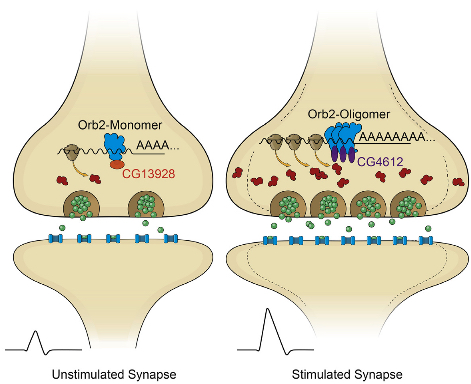
In their latest study, the researchers determined that Orb2 exists in two distinct physical states: monomeric (a single molecule that can bind to other molecules) and oligomeric (a molecular complex).

Like CPEB, oligomeric Orb2 is prion-like — that is, it’s a self-copying cluster. (But unlike prions, oligomeric Orb2 and CPEB are not toxic.) Monomeric Orb2 represses, and oligomeric Orb2 activates a crucial step in the complex cellular process that leads to protein synthesis.

During this crucial step, messenger RNA (mRNA), which is an RNA copy of a gene’s recipe for a protein, is translated by the cell’s ribosome into the sequence of amino acids that will make up a newly synthesized protein. The monomeric form of Orb2 binds to the target mRNA, keeping it in a repressed state.

The Stowers scientists also determined that prion-like Orb2 not only activates translation into amino acids but imparts its translational state to nearby monomer forms of Orb2. As a result, monomeric Orb2 is transformed into prion-like Orb2, so its role in translation switches from repression to activation.

Self-sustaining activation maintains synaptic activity

Stowers Associate Investigator Kausik Si, Ph.D. thinks this switch is the possible mechanism by which fleeting experiences create an enduring memory. “Because of the self-sustaining nature of the prion-like state, this creates a local and self-sustaining translation activation of Orb2-target mRNA, which maintains the changed state of synaptic activity over time,” says Si.

The discovery that the two distinct states of Orb2 have opposing roles in the translation process provides “for the first time a biochemical mechanism of synapse-specific persistent translation and long-lasting memory,” he states.

“To our knowledge, this is the first example of a prion-based protein switch that turns a repressor into an activator,” Si adds. “The recruitment of distinct protein complexes at the non-prion and prion-like forms to create altered activity states indicates the prion-like behavior is in essence a protein conformation-based switch.

“Through this switch, a protein can lose or gain a function that can be maintained over time in the absence of the original stimuli. Although such a possibility has been anticipated prior to this study, there was no direct evidence.”

The research builds upon previous studies by Si and Eric Kandel, M.D., of Columbia University and other scientists. These studies revealed that both short-term and long-term memories are created in synapses.


Abstract of Amyloidogenic Oligomerization Transforms Drosophila Orb2 from a Translation Repressor to an Activator

Memories are thought to be formed in response to transient experiences, in part through changes in local protein synthesis at synapses. In Drosophila, the amyloidogenic (prion-like) state of the RNA binding protein Orb2 has been implicated in long-term memory, but how conformational conversion of Orb2 promotes memory formation is unclear. Combining in vitro and in vivo studies, we find that the monomeric form of Orb2 represses translation and removes mRNA poly(A) tails, while the oligomeric form enhances translation and elongates the poly(A) tails and imparts its translational state to the monomer. The CG13928 protein, which binds only to monomeric Orb2, promotes deadenylation, whereas the putative poly(A) binding protein CG4612 promotes oligomeric Orb2-dependent translation. Our data support a model in which monomeric Orb2 keeps target mRNA in a translationally dormant state and experience-dependent conversion to the amyloidogenic state activates translation, resulting in persistent alteration of synaptic activity and stabilization of memory.

First direct evidence for synaptic plasticity in fruit fly brain

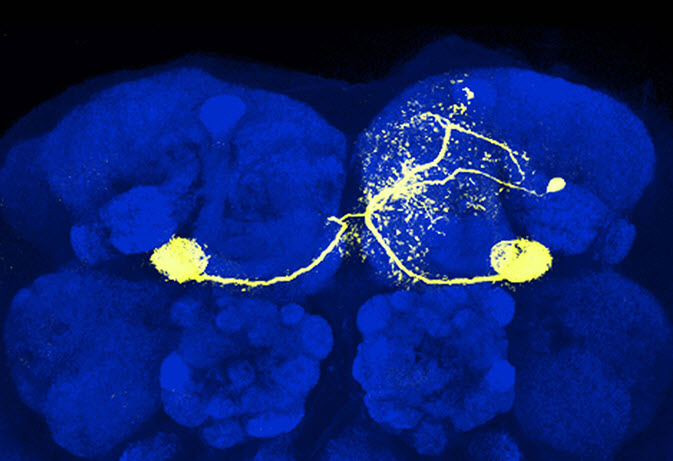
A singe dopamine neuron (yellow) in the mushroom body of the fruit fly Drosophila. Glenn Turner and colleagues trained flies to avoid certain odors by pairing them with stimulations of dopamine neurons signaling punishment. They found that this form of associative learning is driven by changes in synaptic strength between mushroom body neurons that process odors and downstream neurons that generate behavioral responses. (credit: Turner Lab, CSHL)

Scientists at Cold Spring Harbor Laboratory  (CSHL) have resolved a decades-long debate about how the brain is modified when an animal learns.

Using newly developed tools for manipulating specific populations of neurons, the researchers have for the first time observed direct evidence of synaptic plasticity — changes in the strength of synapse connections between neurons — in the fruit fly brain while flies are learning.

Due to the relative simplicity of fruit fly neural anatomy — there are just two synapses separating odor-detecting antenna from an olfactory-memory brain center called the mushroom body — the flies have provided a powerful model organism for studying learning.

Historically, researchers have monitored neurons in the mushroom body, as well as others to which they send signals, using a technique called calcium imaging. This approach enabled previous researchers to observe changes in neural activity that accompany learning. However this technique doesn’t reveal precisely how the electrical activity of the neurons is modified, since calcium is not the only ion involved in neuronal signaling.

Additionally, it was unclear how the changes that had been seen were related to the behavior of the animal.

CSHL Associate Professor Glenn Turner and colleagues at CSHL and the Howard Hughes Medical Institute’s Janelia Research Campus were able to make electrophysiological recordings to directly examine changes in synaptic strength at this site before and after learning for the first time.

Technical details: the experiment

The researchers exposed fruit flies to a specific test odor and a very short time later subjected them to an artificial aversive cue. To do so they fired tiny beams of laser light at dopamine-releasing neurons in the mushroom body that were genetically engineered to become active in response to the light. Just like our own neurons, dopamine-releasing neurons in the fly are involved in reward and punishment. “Presenting the smell of cherries, for example, which is normally an attractive odor to flies, while at the same time stimulating a particular dopamine neuron, trains the fly to avoid cherry odor,” Turner explains.

In addition to the dopamine neurons, the team identified neurons that represented the test odor and neurons that represented the flies’ behavioral response to that odor. These neurons are connected to each other, while the dopamine neurons, which represent the punishment signal, modulate that connection. The team then made recordings of the neurons representing the behavior. This enabled them to discover any changes to the synaptic inputs those neurons received from the odor-representing neurons before and after learning.

Strikingly, the team found a dramatic reduction in the synaptic inputs upon subsequent presentations of the test odor, but not control odors. This drop reflected the decrease in the attractiveness of the odor that resulted from the learning. “The average drop in synaptic strength was around 80 percent—that’s huge,” says Turner.

In future studies, Turner plans to exploit powerful tools available for studying fruit fly genetics to better understand the genetic components of learning. “We now have a way of investigating synaptic changes with genetic tools to identify molecules involved in learning and really understand the phenomenon at a level that bridges molecular and physiological mechanisms,” he says.

“That mechanistic level of understanding is going to be really important,” he adds. “It’s often at the level of molecules that you see really strong connections between Drosophila and other species, including humans.”

The results appeared online last week in the journal Neuron.


Abstract of Heterosynaptic Plasticity Underlies Aversive Olfactory Learning in Drosophila

Although associative learning has been localized to specific brain areas in many animals, identifying the underlying synaptic processes in vivo has been difficult. Here, we provide the first demonstration of long-term synaptic plasticity at the output site of the Drosophilamushroom body. Pairing an odor with activation of specific dopamine neurons induces both learning and odor-specific synaptic depression. The plasticity induction strictly depends on the temporal order of the two stimuli, replicating the logical requirement for associative learning. Furthermore, we reveal that dopamine action is confined to and distinct across different anatomical compartments of the mushroom body lobes. Finally, we find that overlap between sparse representations of different odors defines both stimulus specificity of the plasticity and generalizability of associative memories across odors. Thus, the plasticity we find here not only manifests important features of associative learning but also provides general insights into how a sparse sensory code is read out.

Recyclable, sustainable petroleum-free bioplastics

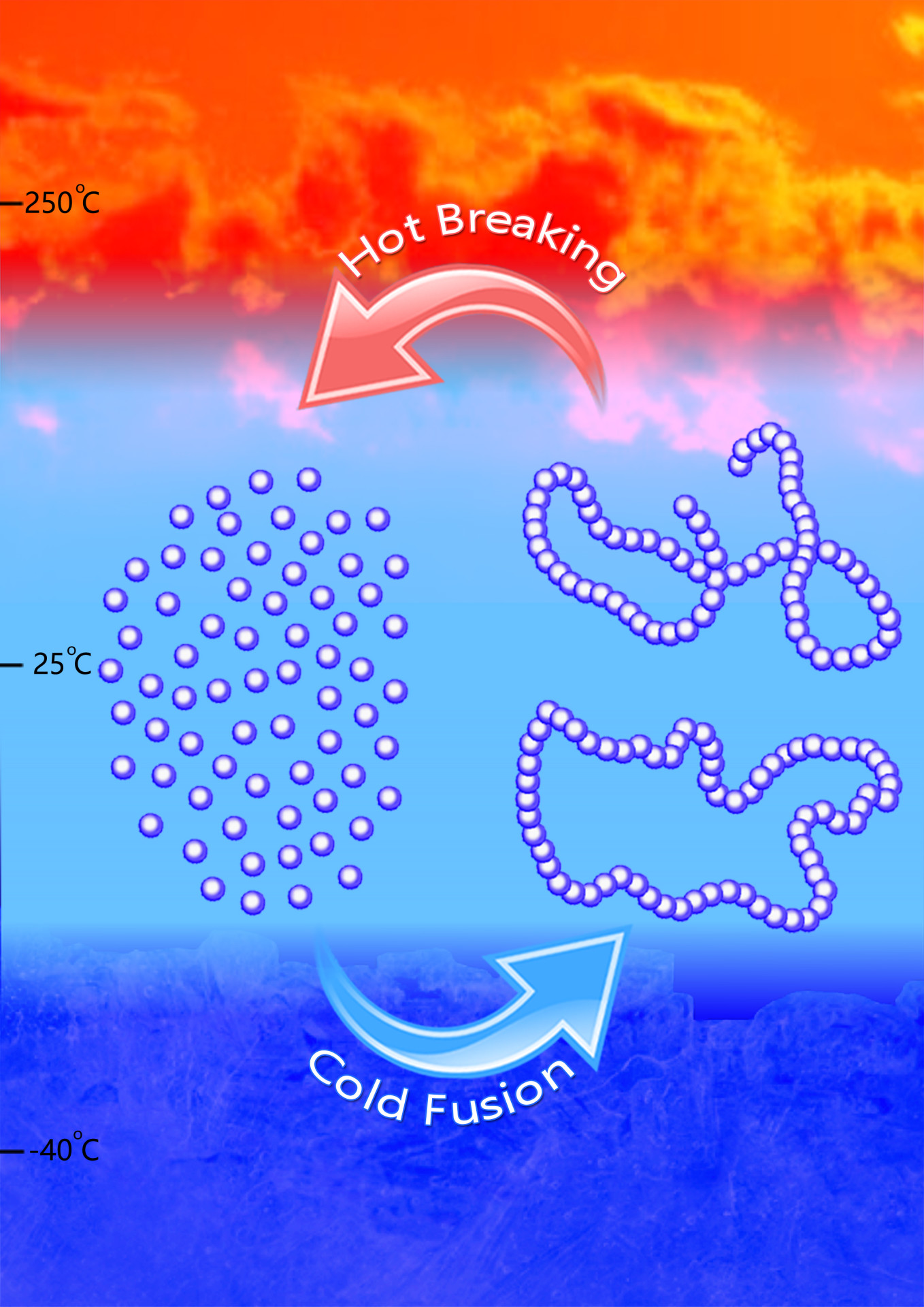
The new polymer synthesis process. The single molecules (monomers) are cooled to polymerize; to cycle back, heat is applied. (credit: Jing Tang/Chen lab)

The textbooks and journals (and especially the oil companies) said making a completely recyclable, biodegradable, petroleum-free polymer couldn’t be done.

But Colorado State University chemists have done it — paving a potential new road to truly sustainable, petroleum-free plastics. Just reheat is for an hour and it converts back to its original molecular state, ready for reuse.

Their starting feedstock: a biorenewable monomer that textbooks and journal papers had declared non-polymerizable, meaning it could not be bonded into the large molecules (polymers) typically required for use as a material.

Renewable plastics

Plastics are the most common type of manmade polymer, which is the chemical term for a long chain of repeating small molecules, or monomers. Petroleum-based polymers like polyethylene and polystyrene have come under fire for piling up in landfills and even in oceans.

“More than 200 pounds of synthetic polymers are consumed per person each year — plastics probably the most in terms of production volume. And most of these polymers are not biorenewable,” said Colorado State professor of chemistry Eugene Chen. “The big drive now is to produce biorenewable and biodegradable polymers or plastics. That is, however, only one part of the solution, as biodegradable polymers are not necessarily recyclable, in terms of feedstock recycling.”

There are several biodegradable plastics on the market today, chief among them a starch-based material made from polylactic acid, or PLA. Compostable cups, cutlery and packaging in dining halls are made from PLA. They’re biodegradable, but they’re not truly recyclable — once made, they can’t be completely reconstituted into their original monomeric states without forming other, unwanted byproducts.

Sustainable biomass source

The researchers’ starting monomer is gamma-butyrolactone, or GBL. It is a colorless liquid and common chemical reagent, derived from a biomass compound best suited to replace petrochemicals, according to the Department of Energy. Textbooks and scientific literature had described these small molecules as thermally stable in their monomeric chemical states could not polymerize.

But Chen and Hong figured out how to get this material to take different shapes, such as linear or cyclic, based on the catalysts and conditions they selected. They used both metal-based and metal-free catalysts to synthesize the polymer, called poly(GBL), which is chemically equivalent to a commercial biomaterial called poly(4-hydroxybutyrate), or P4HB.

To convert the polymer back into the original monomer, demonstrating the thermal recyclability of the polymer, they employed specifically designed reaction conditions, including low temperature, to make the polymer, along with heat between 220–300 degrees Celsius.

P4HB is derived from bacteria, which is a more expensive, complex process than how most plastics are made. Instead, by starting with the readily available GBL and ending up with a replacement material for P4HB, Chen’s discovery has promising market potential, and a provisional patent has been filed with the help of CSU Ventures.


Abstract of Completely recyclable biopolymers with linear and cyclic topologies via ring-opening polymerization of γ-butyrolactone

Ring-opening polymerization (ROP) is a powerful synthetic methodology for the chemical synthesis of technologically important biodegradable aliphatic polyesters from cyclic esters or lactones. However, the bioderived five-membered γ-butyrolactone (γ-BL) is commonly referred as ‘non-polymerizable’ because of its low strain energy. The chemical synthesis of poly(γ-butyrolactone) (PγBL) through the ROP process has been realized only under ultrahigh pressure (20,000 atm, 160 °C) and only produces oligomers. Here we report that the ROP of γ-BL can, with a suitable catalyst, proceed smoothly to high conversions (90%) under ambient pressure to produce PγBL materials with a number-average molecular weight up to 30 kg mol–1 and with controlled linear and/or cyclic topologies. Remarkably, both linear and cyclic PγBLs can be recycled back into the monomer in quantitative yield by simply heating the bulk materials at 220 °C (linear polymer) or 300 °C (cyclic polymer) for one hour, which thereby demonstrates the complete recyclability of PγBL.

White graphene + graphene –> super-thin, cooler, more flexible electronics

Growth and transfer of 2-D material such as hexagonal boron nitride and graphene was performed by a team that included Yijing Stehle of Oak Ridge National Laboratory. (credit: ORNL)

A new era of electronics and even quantum devices could be ushered in with the fabrication of a virtually perfect single layer of “white graphene,” according to researchers at the Department of Energy’s Oak Ridge National Laboratory.

The material is technically known as hexagonal boron nitride (see “New inventions track greenhouse gas, remediate oil spills“). It is an insulator (instead of a conductor of electricity as with graphene), so it could serve as a 2-D dielectric (insulating material) in electronic devices such as thin-film capacitors.

It also has even better transparency than graphene, making it useful as a substrate and the foundation for the electronics in cell phones, laptops, tablets and many other devices.

“As thin as a piece of paper”

ORNL’s Yijing Stehle, postdoctoral associate and lead author of a paper published in Chemistry of Materials and colleagues are working on combining graphene and boron nitride in a 2-D capacitor and fuel cell prototype that are “super thin” and also transparent.

With their recipe for white graphene, ORNL researchers hope to unleash the full potential of graphene as a conductor. By combining it with white graphene as a substrate, researchers believe they can make thinner, more-flexible multilayer electronic devices.

“Imagine batteries, capacitors, solar cells, video screens and fuel cells as thin as a piece of paper,” she said.

For its part, graphene on a white-graphene substrate also has several thousand times higher electron mobility than using graphene on other substrates. That feature could enable data transfers that are much faster than what is available today.

Cool electronics

A recent theoretical study led by Rice University proposed the use of white graphene to cool electronics (see “Why ‘white graphene’ structures are cool“). Stehle and colleagues have made high-quality layers of hexagonal boron nitride that support that study; they believe the material can be cost-effectively scaled up to large production volumes.

The Rice process consists of standard atmospheric pressure chemical vapor deposition with a similar furnace, temperature and time. But Stehle describes “a more gentle, controllable way to release the reactant into the furnace and figuring out how to take advantage of inner furnace conditions.”

New Mexico State University researchers were also involved in the study, which was supported by the DOE’s Office of Science.


Abstract of Synthesis of Hexagonal Boron Nitride Monolayer: Control of Nucleation and Crystal Morphology

Monolayer hexagonal boron nitride (hBN) attracts significant attention due to the potential to be used as a complementary two-dimensional dielectric in fabrication of functional 2D heterostructures. Here we investigate the growth stages of the hBN single crystals and show that hBN crystals change their shape from triangular to truncated triangular and further to hexagonal depending on copper substrate distance from the precursor. We suggest that the observed hBN crystal shape variation is affected by the ratio of boron to nitrogen active species concentrations on the copper surface inside the CVD reactor. Strong temperature dependence reveals the activation energies for the hBN nucleation process of ∼5 eV and crystal growth of ∼3.5 eV. We also show that the resulting h-BN film morphology is strongly affected by the heating method of borazane precursor and the buffer gas. Elucidation of these details facilitated synthesis of high quality large area monolayer hexagonal boron nitride by atmospheric pressure chemical vapor deposition on copper using borazane as a precursor.

Evidence that our Sun could release ‘superflares’ 1000x greater than previously recorded

What the Sun might look like if it were to produce a superflare. A large flaring coronal loop structure is shown towering over a solar active region. (credit: University of Warwick/Ronald Warmington)

Astrophysicists have discovered a stellar “superflare” on a star observed by NASA’s Kepler space telescope with wave patterns similar to those that have been observed in the Sun’s solar flares. (Superflares are flares that are thousands of times more powerful than those ever recorded on the Sun, and are frequently observed on some stars.)

The scientists found the evidence in the star KIC9655129 in the Milky Way. They suggest there are similarities between the superflare on KIC9655129 and the Sun’s solar flares, so the underlying physics of the flares might be the same.

Disastrous for life on Earth

Typical solar flares can have energies equivalent to a 100 million megaton bombs, but a superflare on our Sun could release energy equivalent to 100 billion megaton bombs, the scientists say.

The effects on the power grid in the U.S. would be similar to those resulting from a major cyberattack on America’s power grid, as described in the just-published book, Lights Out: A Cyberattack, A Nation Unprepared, Surviving the Aftermath.

The Earth’s communications and energy systems could be at serious risk of failing, the scientists note, and disastrous for life on Earth. Our GPS and radio communication systems could be severely disrupted and there could be large-scale power blackouts as a result of strong electrical currents being induced in power grids.

The evidence

Research co-author Anne-Marie Broomhall, PhD, from the University of Warwick explains: “When a flare occurs, we typically see a rapid increase in intensity followed by a gradual decline. Usually the decline phase is relatively smooth but occasionally there are noticeable bumps, which are termed ‘quasi-periodic pulsations’ or QPPs.”

The scientists used techniques called wavelet analysis and Monte Carlo modeling to assess the periodicity and statistical significance of these QPPs. The analysis revealed two significant periodicities, with less than a 1% probability that these pulsations would be observed by chance. The most plausible explanation for the presence of two independent periodicities: the QPPs were caused by magnetohydrodynamic (MHD) oscillations, which are also frequently observed in solar flares, the scientists say.

“This result is, therefore, an indication that the same physical processes are involved in both solar flares and stellar superflares. The latter finding supports the hypothesis that the Sun is able to produce a potentially devastating superflare.”

(Also see previous KurzweilAI coverage of this subject.)

The research is published by The Astrophysical Journal Letters and was funded by the European Research Council.


Abstract for A Multi-Period Oscillation In A Stellar Superflare

Flares that are orders of magnitude larger than the most energetic solar flares are routinely observed on Sun-like stars, raising the question of whether the same physical processes are responsible for both solar and stellar flares. In this Letter, we present a white-light stellar superflare on the star KIC 9655129, observed by NASA’s Kepler mission, with a rare multi-period quasi-periodic pulsation (QPP) pattern. Two significant periodic processes were detected using the wavelet and autocorrelation techniques, with periods of 78 ± 12 minutes and 32 ± 2 minutes. By comparing the phases and decay times of the two periodicities, the QPP signal was found to most likely be linear, suggesting that the two periodicities are independent, possibly corresponding either to different magnetohydrodynamic (MHD) modes of the flaring region or different spatial harmonics of the same mode. The presence of multiple periodicities is a good indication that the QPPs were caused by MHD oscillations and suggests that the physical processes in operation during stellar flares could be the same as those in solar flares.

How to make diamond objects with a laser at room temperature

A scanning electron microscopy image of microdiamonds made using the new technique (credit: Jagdish Narayan, Anagh Bhaumik/APL Materials)

Researchers from North Carolina State University have discovered a new phase of solid carbon, called Q-carbon, that is distinct from the known phases of graphite and diamond. They have also developed a technique for using Q-carbon to make diamond-related structures at room temperature and at ambient atmospheric pressure in air.*

Phases are distinct forms of the same material. Graphite is one of the solid phases of carbon; diamond is another.

“We’ve now created a third solid phase of carbon,” says Jay Narayan, the John C. Fan Distinguished Chair Professor of Materials Science and Engineering at NC State and lead author of three papers describing the work. “The only place it may be found in the natural world would be possibly in the core of some planets.”

Q-carbon has some unusual characteristics:

  • It’s ferromagnetic, which other solid forms of carbon are not.
  • It’s harder than diamond, and glows when exposed to even low levels of energy. “Q-carbon’s strength and low work-function — its willingness to release electrons — make it very promising for developing new electronic display technologies,” Narayan says.
  • It can be used to create a variety of single-crystal diamond objects. “We can create diamond nanoneedles or microneedles, nanodots, or large-area diamond films, with applications for drug delivery, industrial processes and for creating high-temperature switches and power electronics,” Narayan says. “These diamond objects have a single-crystalline structure, making them stronger than polycrystalline materials. And it is all done at room temperature and at ambient atmosphere — we’re basically using a laser like the ones used for laser eye surgery. So, not only does this allow us to develop new applications, but the process itself is relatively inexpensive.”

Coming soon: Q-carbon nanodots

“We can make Q-carbon films, and we’re learning its properties, but we are still in the early stages of understanding how to manipulate it,” Narayan says. “We know a lot about diamond, so we can make diamond nanodots. We don’t yet know how to make Q-carbon nanodots or microneedles. That’s something we’re working on.”

NC State has filed two provisional patents on the Q-carbon and diamond creation techniques.

The work is described in two papers, one to be published online Nov. 30 in the Journal of Applied Physics and another was published in an open-access paper, Oct. 7 in the journal APL Materials. The work was supported in part by the National Science Foundation.

* Researchers start with a substrate, such as such as sapphire, glass or a plastic polymer. The substrate is then coated with amorphous carbon — elemental carbon that, unlike graphite or diamond, does not have a regular, well-defined crystalline structure. The carbon is then hit with a single laser pulse lasting approximately 200 nanoseconds. During this pulse, the temperature of the carbon is raised to 4,000 Kelvin (or around 3,727 degrees Celsius) and then rapidly cooled. This operation takes place at one atmosphere — the same pressure as the surrounding air.

The end result is a film of Q-carbon, and researchers can control the process to make films between 20 nanometers and 500 nanometers thick. By using different substrates and changing the duration of the laser pulse, the researchers can also control how quickly the carbon cools. By changing the rate of cooling, they are able to create diamond structures within the Q-carbon.


Abstract of Research Update: Direct conversion of amorphous carbon into diamond at ambient pressures and temperatures in air

We report on fundamental discovery of conversion of amorphous carbon into diamond by irradiating amorphous carbon films with nanosecond lasers at room-temperature in air at atmospheric pressure. We can create diamond in the form of nanodiamond (size range <100 nm) and microdiamond (>100 nm). Nanosecond laser pulses are used to melt amorphousdiamondlike carbon and create a highly undercooled state, from which various forms ofdiamond can be formed upon cooling. The quenching from the super undercooled state results in nucleation of nanodiamond. It is found that microdiamonds grow out of highly undercooled state of carbon, with nanodiamond acting as seed crystals.


Abstract of Novel Phase of Carbon, Ferromagnetism and Conversion into Diamond

We report the discovery of new phase of carbon (referred to as Q-carbon) and address fundamental issues related to direct conversion of carbon into diamond at ambient temperatures and pressures in air without any need for catalyst and presence of hydrogen. The Q-carbon is formed as result of quenching from super undercooled state by using high-power nanosecond laser pulses. We discuss the equilibrium phase diagram (P vs. T) of carbon, and show that by rapid quenching kinetics can shift thermodynamic graphite/diamond/ liquid carbon triple point from 5000K/12GPa to super undercooled carbon at atmospheric pressure in air. It is shown that nanosecond laser heating of diamondlike amorphous carbon on sapphire, glass and polymer substrates can be confined to melt carbon in a super undercooled state. By quenching the carbon from the super undercooled state, we have created a new state of carbon (Q-carbon) from which nanodiamond, microdiamond, microneedles and thin films are formed depending upon the nucleation and growth times allowed for diamond formation. The Q-carbon quenched from liquid is a new state of solid carbon with a higher mass density than amorphous carbon and a mixture of mostly four-fold sp3 (75-85%) and the rest three-fold sp2 bonded carbon (with distinct entropy). It is expected to have new and improved mechanical hardness, electrical conductivity, chemical and physical properties, including room-temperature ferromagnetism (RTFM) and enhanced field emission. Here we present interesting results on RTFM, enhanced electrical conductivity, and surface potential of Q-carbon to emphasize its unique properties. The Q-carbon exhibits robust bulk ferromagnetism with estimated Curie temperature of about 500K and saturation magnetization value of 20 emu g-1. From the Q-carbon, diamond phase is nucleated and a variety of micro- and nanostructures, and large-area single-crystal diamond sheets are grown by allowing growth times as needed. Subsequent laser pulses can be used to grow nanodiamond into microdiamond and nucleate other nanostructures of diamond on the top of existing microdiamond and create novel nanostructured materials. The microstructural details provide insights into the mechanism of nanodiamond and microdiamond formation. This process allows carbon to diamond conversion and formation of useful nanostructures and microstructures at ambient temperatures in air at atmospheric pressure on practical and heat-sensitive substrates in a controlled way without need for any catalysts and hydrogen to stabilize sp3 bonding for diamond formation.

Supermassive black-hole-eating star ejects high-speed flare

Artist’s conception of a star being drawn toward a black hole and destroyed (left), and the black hole later emitting a “jet” of plasma composed of the debris left from the star’s destruction (credit: modified from an original image by Amadeo Bachar)

An international team of astrophysicists has for the first time witnessed a black hole swallowing a star and ejecting a flare of matter moving at nearly the speed of light.

The finding, reported in the journal Science, tracks the star — about the size of our sun — as it shifts from its customary path, slips into the gravitational pull of a supermassive black hole and is sucked in, said Sjoert van Velzen, a Hubble fellow at Johns Hopkins University.

Jet escapes from near the event horizon

“These events are extremely rare,” van Velzen said. “It’s the first time we see everything from the stellar destruction followed by the launch of a conical outflow, also called a jet, and we watched it unfold over several months.”

The astrophysicists had predicted that when a black hole is force-fed a large amount of gas, in this case a whole star, a fast-moving jet of plasma — elementary particles in a magnetic field — can escape from near the black hole rim, or “event horizon.” This study suggests this prediction was correct, the scientists said.

“Previous efforts to find evidence for these jets, including my own, were late to the game,” said van Velzen, who led the analysis and coordinated the efforts of 13 other scientists in the United States, the Netherlands, Great Britain and Australia.

Supermassive black holes, the largest of black holes, are believed to exist at the center of most massive galaxies. This particular one lies at the lighter end of the supermassive black hole spectrum, at only about a million times the mass of our sun, but still packing the force to gobble a star.

Witnessing a star destruction

The first observation of the star being destroyed was made by a team at The Ohio State University, using an optical telescope in Hawaii. That team announced its discovery on Twitter in early December 2014.

After reading about the event, van Velzen contacted an astrophysics team led by Rob Fender at the University of Oxford in Great Britain. That group used radio telescopes to follow up as fast as possible. They were just in time to catch the action.

By the time it was done, the international team had data from satellites and ground-based telescopes that gathered X-ray, radio and optical signals, providing a stunning “multi-wavelength” portrait of this event.

It helped that the galaxy in question is closer to Earth than those studied previously in hopes of tracking a jet emerging after the destruction of a star. This galaxy is about 300 million light years away, while the others were at least three times farther away. One light year is 5.88 trillion miles.

The first step for the international team was to rule out the possibility that the light was from a pre-existing expansive swirling mass called an “accretion disk” that forms when a black hole is sucking in matter from space. That helped to confirm that the sudden increase of light from the galaxy was due to a newly trapped star.

“The destruction of a star by a black hole is beautifully complicated, and far from understood,” van Velzen said. “From our observations, we learn the streams of stellar debris can organize and make a jet rather quickly, which is valuable input for constructing a complete theory of these events.”


Abstract of A radio jet from the optical and X-ray bright stellar tidal disruption flare ASASSN-14li

The tidal disruption of a star by a supermassive black hole leads to a short-lived thermal flare. Despite extensive searches, radio follow-up observations of known thermal stellar tidal disruption flares (TDFs) have not yet produced a conclusive detection. We present a detection of variable radio emission from a thermal TDF, which we interpret as originating from a newly-launched jet. The multi-wavelength properties of the source present a natural analogy with accretion state changes of stellar mass black holes, suggesting all TDFs could be accompanied by a jet. In the rest frame of the TDF, our radio observations are an order of magnitude more sensitive than nearly all previous upper limits, explaining how these jets, if common, could thus far have escaped detection.

Do fish have emotions and consciousness?

Zebrafish (credit: Azul/CC)

Researchers in Spain and the U.K. have made the first observations infish of an increase in body temperature of 2–4 ºC when zebrafish were subjected to a stressful situation (they were confined in a net inside the tank at an uncomforable 27ºC for 15 minutes).*

This phenomenon is called “emotional fever” because it’s related to the emotions that animals feel in the face of an external stimulus, which been linked, controversially, with their consciousness. Until now, emotional fever had been observed in mammals, birds and certain reptiles, but never in fish, which is why fish have been regarded as animals without emotions or consciousness.

Does consciousness require a cerebral cortex?

Scientists differ on the degree to which fish can have consciousness. Some researchers argue that they cannot have consciousness as their brain is simple, lacking a cerebral cortex, and they have little capacity for learning and memory, a very simple behavioral repertoire, and no ability to experience suffering.

Others contest this view, pointing out that, despite the small size of the fish brain, detailed morphological and behavioral analyses have highlighted similarities between some fish brain structures and those seen in other vertebrates, such as the hippocampus (linked to learning and spatial memory) and the amygdala (linked to emotions) of mammals.

The research was published in an open-access paper recently in Proceedings of the Royal Society of London, Biological Sciences. It began three years ago at the Universitat Autònoma de Barcelona. Scientists from Stirling and Bristol universities helped with statistical analysis of the data.

* The researchers divided 72 zebrafish into two groups of 36 and placed them in a large tank with different interconnected compartments with temperatures ranging from 18ºC to 35ºC. The fish in one of these groups — the control group — were left undisturbed in the area where the temperature was at the level they prefer: 28ºC. The other group was subjected to a stressful situation: they were confined in a net inside the tank at 27ºC for 15 minutes. After this period the group was released.

While the control fish mainly stayed in the compartments at around 28ºC, the fish subjected to stress tended to move towards the compartments with a higher temperature, increasing their body temperature by two to four degrees. The researchers point to this as proof that these fish were displaying emotional fever.


Abstract of Fish can show emotional fever: stress-induced hyperthermia in zebrafish

Whether fishes are sentient beings remains an unresolved and controversial question. Among characteristics thought to reflect a low level of sentience in fishes is an inability to show stress-induced hyperthermia (SIH), a transient rise in body temperature shown in response to a variety of stressors. This is a real fever response, so is often referred to as ‘emotional fever’. It has been suggested that the capacity for emotional fever evolved only in amniotes (mammals, birds and reptiles), in association with the evolution of consciousness in these groups. According to this view, lack of emotional fever in fishes reflects a lack of consciousness. We report here on a study in which six zebrafish groups with access to a temperature gradient were either left as undisturbed controls or subjected to a short period of confinement. The results were striking: compared to controls, stressed zebrafish spent significantly more time at higher temperatures, achieving an estimated rise in body temperature of about 2–4°C. Thus, zebrafish clearly have the capacity to show emotional fever. While the link between emotion and consciousness is still debated, this finding removes a key argument for lack of consciousness in fishes.