
New ‘stealth dark matter’ theory may explain mystery of the universe’s missing mass

This 3D map illustrates the large-scale distribution of dark matter, reconstructed from measurements of weak gravitational lensing by using the Hubble Space Telescope (credit: image courtesy of DOE/Lawrence Livermore National Laboratory)

A new theory that may explain why dark matter has evaded direct detection in Earth-based experiments has been developed by team of Lawrence Livermore National Laboratory (LLNL) particle physicists known as the Lattice Strong Dynamics Collaboration.

The group has combined theoretical and computational physics techniques and used the Laboratory’s massively parallel 2-petaflop Vulcan supercomputer to devise a new model of dark matter. The model identifies today’s dark matter as naturally “stealthy.” But in the extremely high-temperature plasma conditions that pervaded the early universe, it would have been easy to see dark matter via interactions with ordinary matter, the model shows.

A balancing act in the early universe

“These interactions in the early universe are important because ordinary and dark matter abundances today are strikingly similar in size, suggesting this occurred because of a balancing act performed between the two before the universe cooled,” said Pavlos Vranas of LLNL, one of the authors of a paper in an upcoming edition of the journal Physical Review Letters.

Dark matter makes up 83 percent of all matter in the universe and does not interact directly with electromagnetic or strong and weak nuclear forces. Light does not bounce off of it, and ordinary matter goes through it with only the feeblest of interactions. It is essentially invisible, yet its interactions with gravity produce striking effects on the movement of galaxies and galactic clusters, leaving little doubt of its existence.

The key to stealth dark matter’s split personality is its compositeness and the miracle of confinement. Like quarks in a neutron, at high temperatures these electrically charged constituents interact with nearly everything. But at lower temperatures, they bind together to form an electrically neutral composite particle. Unlike a neutron, which is bound by the ordinary strong interaction of quantum chromodynamics (QCD), the stealthy neutron would have to be bound by a new and yet-unobserved strong interaction, a dark form of QCD.

CERN experiments may test the stealth dark matter theory

“It is remarkable that a dark matter candidate just several hundred times heavier than the proton could be a composite of electrically charged constituents and yet have evaded direct detection so far,” Vranas said.

Similar to protons, stealth dark matter is stable and does not decay over cosmic times. However, like QCD, it produces a large number of other nuclear particles that decay shortly after their creation. These particles can have net electric charge but would have decayed away a long time ago. In a particle collider with sufficiently high energy (such as the Large Hadron Collider in Switzerland), these particles can be produced again for the first time since the early universe. They could generate unique signatures in the particle detectors because they could be electrically charged.

“Underground direct detection experiments or experiments at the Large Hadron Collider may soon find evidence of (or rule out) this new stealth dark matter theory,” Vranas said.

Other collaborators include researchers from Yale University, Boston University, Institute for Nuclear Theory, Argonne Leadership Computing Facility, University of California, Davis, University of Oregon, University of Colorado, Brookhaven National Laboratory, and Syracuse University. The DOE Office of Science High Energy Theory and the High Energy Physics Lattice SciDAC program supported this research.


Abstract of Direct Detection of Stealth Dark Matter through Electromagnetic Polarizability

We calculate the spin-independent scattering cross section for direct detection that results from the electromagnetic polarizability of a composite scalar baryon dark matter candidate — “Stealth Dark Matter”, that is based on a dark SU(4) confining gauge theory. In the nonrelativistic limit, electromagnetic polarizability proceeds through a dimension-7 interaction leading to a very small scattering cross section for dark matter with weak scale masses. This represents a lower bound on the scattering cross section for composite dark matter theories with electromagnetically charged constituents. We carry out lattice calculations of the polarizability for the lightest baryons in SU(3) and SU(4) gauge theories using the background field method on quenched configurations. We find the polarizabilities of SU(3) and SU(4) to be comparable (within about 50%) normalized to the baryon mass, which is suggestive for extensions to larger SU(N) groups. The resulting scattering cross sections with a xenon target are shown to be potentially detectable in the dark matter mass range of about 200-700 GeV, where the lower bound is from the existing LUX constraint while the upper bound is the coherent neutrino background. Significant uncertainties in the cross section remain due to the more complicated interaction of the polarizablity operator with nuclear structure, however the steep dependence on the dark matter mass, 1/m_B^6, suggests the observable dark matter mass range is not appreciably modified. We briefly highlight collider searches for the mesons in the theory as well as the indirect astrophysical effects that may also provide excellent probes of stealth dark matter.
First brain-to-brain ‘telepathy’ communication via the Internet

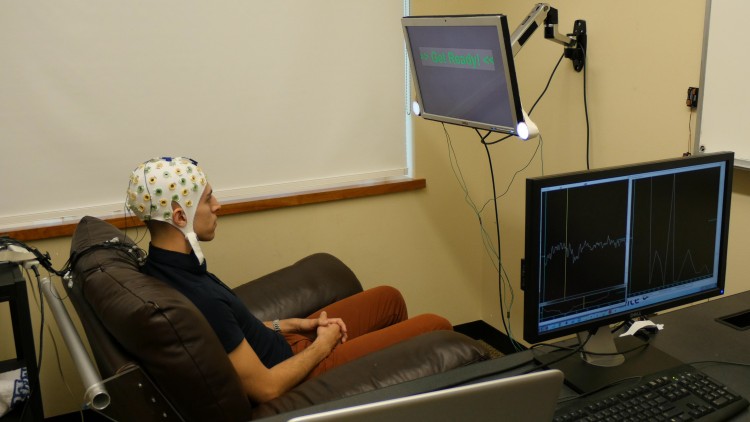
University of Washington graduate student Jose Ceballos wears an electroencephalography (EEG) cap that records brain activity and sends a response to a second participant over the Internet (credit: University of Washington)

The first brain-to-brain telepathy-like communication between two participants via the Internet has been performed by University of Washington researchers.*

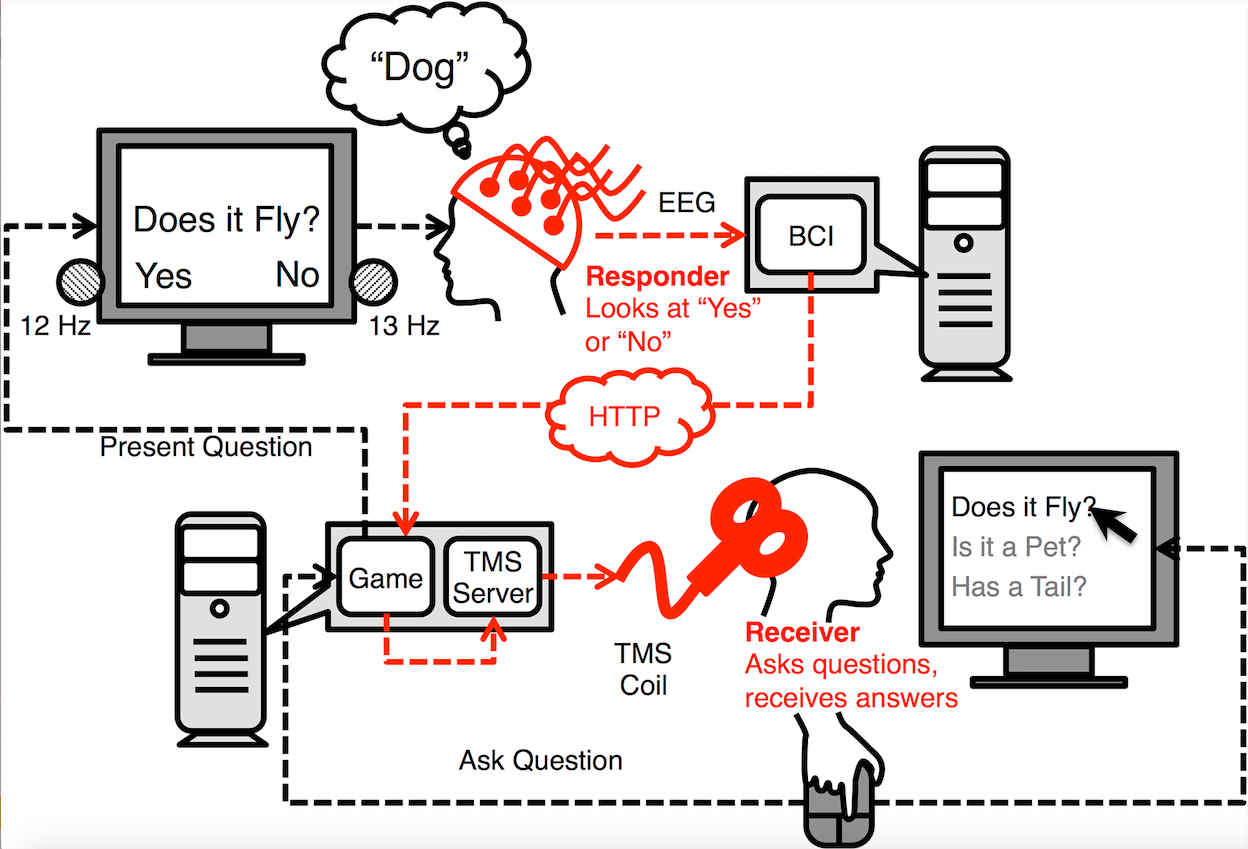
The experiment used a question-and-answer game. The goal is for the “inquirer” to determine which object the “respondent” is looking at from a list of possible objects. The inquirer sends a question (e.g., “Does it fly?) to the respondent, who answers “yes” or “no” by mentally focusing on one of two flashing LED lights attached to the monitor. The respondent is wearing an electroencephalography (EEG) helmet.

By focusing on the “yes” light, the EEG device generates send a signal to the inquirer via the Internet to activate a magnetic coil positioned behind the inquirer’s head, which stimulates the visual cortex and causes the inquirer to see a flash of light (known as a “phosphene”). A “no” signal works the same way, but is not strong enough to activate the coil.

Remote brain-to-brain communication process (credit: A. Stocco et al./PLoS ONE)

The experiment, detailed today in an open access paper in PLoS ONE, is the first to show that two brains can be directly linked to allow one person to guess what’s on another person’s mind. It is “the most complex brain-to-brain experiment, I think, that’s been done to date in humans,” said lead author Andrea Stocco, an assistant professor of psychology and researcher at UW’s Institute for Learning & Brain Sciences.

The experiment was carried out in dark rooms in two UW labs located almost a mile apart and involved five pairs of participants, who played 20 rounds of the question-and-answer game. Each game had eight objects and three questions. The sessions were a random mixture of 10 real games and 10 control games that were structured the same way.*

Participants were able to guess the correct object in 72 percent of the real games, compared with just 18 percent of the control rounds. Incorrect guesses in the real games could be caused by several factors, the most likely being uncertainty about whether a phosphene had appeared.

uw_brain2brain_interface_1

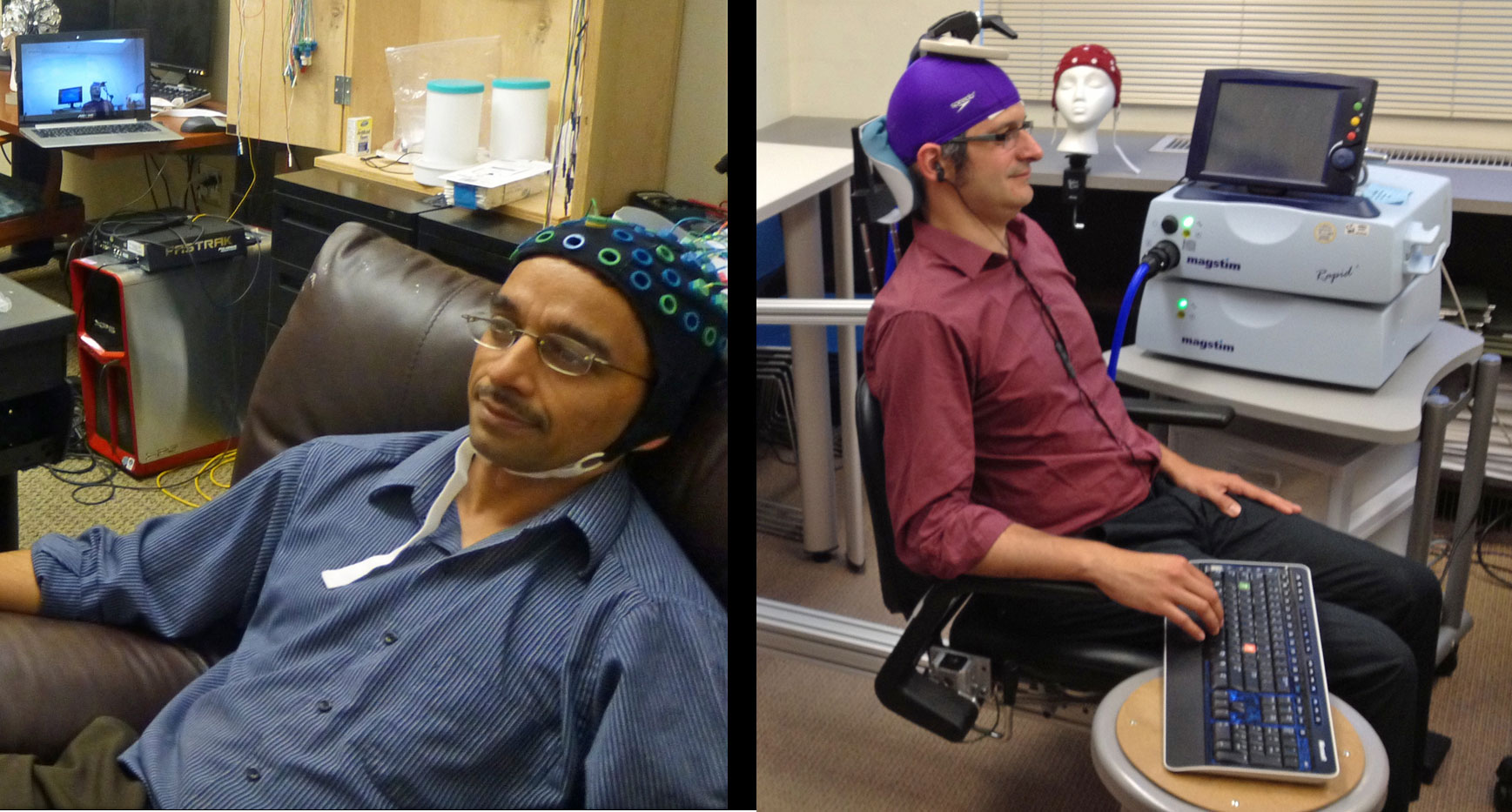
UW team’s initial experiment in 2013: University of Washington researcher Rajesh Rao, left, plays a computer game with his mind. Across campus, researcher Andrea Stocco, right, wears a magnetic stimulation coil over the left motor cortex region of his brain. Stocco’s right index finger moved involuntarily to hit the “fire” button as part of the first human brain-to-brain interface demonstration. (credit: University of Washington)

The study builds on the UW team’s initial experiment in 2013, which was the first to demonstrate a direct brain-to-brain connection between humans, using noninvasive technology to send a person’s brain signals over the Internet to control the hand motions of another person. Other scientists had previously connected the brains of rats and monkeys, and transmitted brain signals from a human to a rat, using electrodes inserted into animals’ brains.

The new experiment evolved out of research by co-author Rajesh Rao, a UW professor of computer science and engineering, on brain-computer interfaces that enable people to activate devices with their minds. In 2011, Rao began collaborating with Stocco and Prat to determine how to link two human brains together.


University of Washington | Team links two human brains for question-and-answer experiment

“Brain tutoring” next

In 2014, the researchers received a $1 million grant from the W.M. Keck Foundation that allowed them to broaden their experiments to decode more complex interactions and brain processes. They are now exploring the possibility of “brain tutoring,” transferring signals directly from healthy brains to ones that are developmentally impaired or impacted by external factors such as a stroke or accident, or simply to transfer knowledge from teacher to pupil.

The team is also working on transmitting brain states — for example, sending signals from an alert person to a sleepy one, or from a focused student to one who has attention deficit hyperactivity disorder, or ADHD.

“Imagine having someone with ADHD and a neurotypical student,” Prat said. “When the non-ADHD student is paying attention, the ADHD student’s brain gets put into a state of greater attention automatically.”

“Evolution has spent a colossal amount of time to find ways for us and other animals to take information out of our brains and communicate it to other animals in the forms of behavior, speech and so on,” Stocco said. “But it requires a translation. We can only communicate part of whatever our brain processes.

“What we are doing is kind of reversing the process a step at a time by opening up this box and taking signals from the brain and with minimal translation, putting them back in another person’s brain,” he said.

* “Telepathy-like” is KurzweilAI’s wording, meaning that no action by the subject outside of the brain were required in the communication. As noted above, the first experiment (known to KurzweilAI) to demonstrate a direct brain-to-brain connection between humans via the Internet, the UW team’s initial experiment in 2013, used involuntary finger movements on a keyboard. Proponents of “telepathy” or “psychic” experiments using the Internet as a link, if any, might counter this.

The researchers took steps to ensure participants couldn’t use clues other than direct brain communication to complete the game. Inquirers wore earplugs so they couldn’t hear the different sounds produced by the varying stimulation intensities of the “yes” and “no” responses. Since noise travels through the skull bone, the researchers also changed the stimulation intensities slightly from game to game and randomly used three different intensities each for “yes” and “no” answers to further reduce the chance that sound could provide clues.

The researchers also repositioned the coil on the inquirer’s head at the start of each game, but for the control games, added a plastic spacer undetectable to the participant that weakened the magnetic field enough to prevent the generation of phosphenes. Inquirers were not told whether they had correctly identified the items, and only the researcher on the respondent end knew whether each game was real or a control round.

UPDATE Sept. 9, 2015: Footnote expanded to clarify “telepathy-like.”

A new class of anti-obesity compounds with potential anti-diabetic properties

Prevalence of Self-Reported Obesity Among U.S. Adults by State and Territory, BRFSS, 2014 (credit: Behavorial Risk Factor Surveillance System/CDC)

A molecule known as MnTBAP* has rapidly reversed obesity in mice and could be effective for humans in the future, according to researchers from Skidmore College and the Perelman School of Medicine at the University of Pennsylvania.

“In the span of a month, mice with pre-existing obesity lost 20 percent of their body weight and about 50 percent of their fat mass,” said Thomas H. Reynolds, PhD., an associate professor of Health and Exercise Sciences at Skidmore College. The weight loss is explained partly by a decrease in food consumption, but other mechanisms are also at play, according to the study published Wednesday (Sept. 23, 2015) in an open-access paper in PLOS One.

The authors report that MnTBAP also has beneficial effects on type 2 diabetes by improving insulin action in muscle and fat. Insulin is the hormone that allows tissues to take up glucose. “In type 2 diabetics, insulin action is impaired, causing the pancreas to go into overdrive in an attempt to maintain normal blood glucose levels.

“Over time, the pancreas becomes exhausted and can’t keep up, leading to rising blood glucose levels and the development of diabetes,” Jonathan Brestoff, the study’s first author, said in an exclusive interview with KurzweilAI. Brestoff is now at the Perelman School of Medicine at the University of Pennsylvania.

He said this molecule represents “a new class of anti-obesity compounds with potential anti-diabetic properties.” He has co-founded the biotech company Symmetry Therapeutics, Inc. to translate the team’s science into clinical applications to treat obesity via an anti-obesity compound called SYM401.

Symmetry is taking an unusual approach with its drug development by crowdfunding part of its research on the platform IndieGoGo. Brestoff said their efforts have gained international attention for attempting to add transparency to an otherwise secretive industry, and have attracted donations and private investors. Their campaign ends October 6, 2015.

On Monday Sept. 21, the CDC published new statistics on obesity in the United States indicating that it remains one of the biggest public health problems facing this country.

* Also known as Manganese [III] 5,10,15,20-tetrakis benzoic acid porphyrin.


Abstract of Manganese [III] Tetrakis [5,10,15,20]-Benzoic Acid Porphyrin Reduces Adiposity and Improves Insulin Action in Mice with Pre-Existing Obesity

The superoxide dismutase mimetic manganese [III] tetrakis [5,10,15,20]-benzoic acid porphyrin (MnTBAP) is a potent antioxidant compound that has been shown to limit weight gain during short-term high fat feeding without preventing insulin resistance. However, whether MnTBAP has therapeutic potential to treat pre-existing obesity and insulin resistance remains unknown. To investigate this, mice were treated with MnTBAP or vehicle during the last five weeks of a 24-week high fat diet (HFD) regimen. MnTBAP treatment significantly decreased body weight and reduced white adipose tissue (WAT) mass in mice fed a HFD and a low fat diet (LFD). The reduction in adiposity was associated with decreased caloric intake without significantly altering energy expenditure, indicating that MnTBAP decreases adiposity in part by modulating energy balance. MnTBAP treatment also improved insulin action in HFD-fed mice, a physiologic response that was associated with increased protein kinase B (PKB) phosphorylation and expression in muscle and WAT. Since MnTBAP is a metalloporphyrin molecule, we hypothesized that its ability to promote weight loss and improve insulin sensitivity was regulated by heme oxygenase-1 (HO-1), in a similar fashion as cobalt protoporphyrins. Despite MnTBAP treatment increasing HO-1 expression, administration of the potent HO-1 inhibitor tin mesoporphyrin (SnMP) did not block the ability of MnTBAP to alter caloric intake, adiposity, or insulin action, suggesting that MnTBAP influences these metabolic processes independent of HO-1. These data demonstrate that MnTBAP can ameliorate pre-existing obesity and improve insulin action by reducing caloric intake and increasing PKB phosphorylation and expression.

A new distance record for quantum teleportation via photons

This graphic describes how researchers at the National Institute of Standards and Technology (NIST) have “teleported” or transferred quantum information carried in light particles over 100 kilometers (km) of optical fiber, four times farther than the previous record. (credit: K. Irvine/NIST)

Researchers at the National Institute of Standards and Technology (NIST) have “teleported” (transferred) quantum information carried in photons over 100 kilometers (km) of optical fiber — four times farther than the previous record.

The experiment confirmed that quantum communication is feasible over long distances in fiber, according to the researchers. Other research groups have teleported quantum information over longer distances in free space (wirelessly), but fiber-optic cables offer more options for network design, the NIST researchers note.

Teleportation is useful in both quantum communications and quantum computing, which allow advancements in unbreakable encryption and code-breaking, respectively.

The new record, described in an open-access paper in Optica, involved the transfer of quantum information from one photon (its specific time slot in a sequence) to another photon* over 102 km of spooled fiber in a NIST laboratory in Colorado.

The achievement was made possible by NIST’s advanced single-photon detectors.

“Only about 1 percent of photons make it all the way through 100 km of fiber,” NIST’s Marty Stevens says. “We never could have done this experiment without these new detectors, which can measure this incredibly weak signal.”

Quantum internet

The new NTT/NIST teleportation technique could be used to make devices called quantum repeaters that could resend data periodically, extending network reach, perhaps enough to eventually build a “quantum internet.”

Previously, researchers thought quantum repeaters might need to rely on atoms or other matter, instead of light, a difficult engineering challenge that would also slow down transmission.*

* Various quantum states can be used to carry information; the NTT/NIST experiment used quantum states that indicate when in a sequence of time slots a single photon arrives. That teleportation method is novel in that four of NIST’s photon detectors were positioned to filter out specific quantum states. (See graphic for an overview of how the teleportation process works.) The detectors rely on superconducting nanowires made of molybdenum silicide. They can record more than 80 percent of arriving photons, revealing whether they are in the same or different time slots each just 1 nanosecond long. The experiments were performed at wavelengths commonly used in telecommunications.

Because the experiment filtered out and focused on a limited combination of quantum states, teleportation could be successful in only 25 percent of the transmissions at best. Thanks to the efficient detectors, researchers successfully teleported the desired quantum state in 83 percent of the maximum possible successful transmissions, on average. All experimental runs with different starting properties exceeded the mathematically significant 66.7 percent threshold for proving the quantum nature of the teleportation process.


Abstract of Quantum teleportation over 100  km of fiber using highly efficient superconducting nanowire single-photon detectors

Quantum teleportation is an essential quantum operation by which we can transfer an unknown quantum state to a remote location with the help of quantum entanglement and classical communication. Since the first experimental demonstrations using photonic qubits and continuous variables, the distance of photonic quantum teleportation over free-space channels has continued to increase and has reached >100  km. On the other hand, quantum teleportation over optical fiber has been challenging, mainly because the multifold photon detection that inevitably accompanies quantum teleportation experiments has been very inefficient due to the relatively low detection efficiencies of typical telecom-band single-photon detectors. Here, we report on quantum teleportation over optical fiber using four high-detection-efficiency superconducting nanowire single-photon detectors (SNSPDs). These SNSPDs make it possible to perform highly efficient multifold photon measurements, allowing us to confirm that the quantum states of input photons were successfully teleported over 100 km of fiber with an average fidelity of 83.7±2.0%.

’4-D’ printing technology allows self-folding of complex ‘transformer’ objects, using smart shape-memory materials

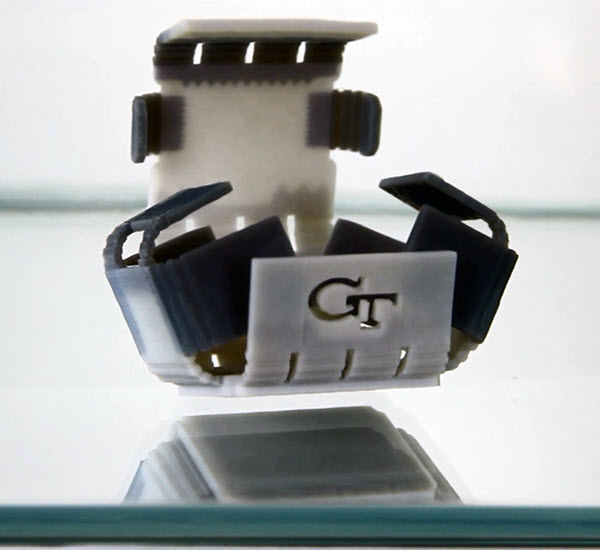
This image shows the self-folding process of smart shape-memory materials with slightly different responses to heat. Using materials that fold at slightly different rates ensures that the components do not interfere with one another during the process. (credit: Qi Laboratory)

Using components made from smart shape-memory materials (which can return to their original shape) with slightly different responses to heat, researchers have demonstrated a “four-dimensional” printing technology that allows for creating complex, self-folding structures.

The technology, developed by researchers at the Georgia Institute of Technology and the Singapore University of Technology and Design (SUTD), could be used to create 3-D structures that sequentially fold themselves from components that had been flat or rolled into a tube for shipment. To achieve that, the components could be designed to respond to stimuli such as temperature, moisture or light in a way that is precisely timed to create space structures, deployable medical devices, robots, toys, and a range of other structures.

Shape memory polymers

The researchers used smart shape memory polymers (SMPs) with the ability to remember one shape and change to another programmed shape when uniform heat is applied. Creating objects that change shape in a controlled sequence over time is enabled by printing multiple materials with different dynamic mechanical properties in prescribed patterns throughout the 3-D object.

When these components are then heated, each SMP responds at a different rate to change its shape, depending on its own internal clock. By carefully timing these changes, 3-D objects can be programmed to self-assemble in desired ways.

The research creates self-folding structures from 3-D printed patterns containing varying amounts of different smart shape-memory polymers. The patterning, done with a 3-D printer, allows the resulting flat components to have varying temporal response to the same stimuli.*

The team demonstrated the approach with a series of examples, including a mechanism that can be switched from a flat strip into a locked configuration as one end and controllably bends and threads itself through a keyhole. They also demonstrated a flat sheet that can fold itself into a 3-D box with interlocking flaps. These examples all require precise control of the folding sequence of different parts of the structure to avoid collisions of the components during folding.**

Using a 3-D printer, researchers produce smart shape-memory materials with slightly different responses to heat. Heat from water in a tank activates the materials and begins the self-folding process. (Credit: Qi Laboratory, Georgia Tech)

“We have exploited the ability to 3-D print smart polymers and integrate as many as ten different materials precisely into a 3-D structure,” said Martin L. Dunn, a professor at Singapore University of Technology and Design who is also the director of the SUTD Digital Manufacturing and Design Centre. “We are now extending this concept of digital SMPs to enable printing of SMPs with dynamic mechanical properties that vary continuously in 3-D space.”

Morphing aircraft

The research team envisions a broad range of applications for their technology. For example, an unmanned air vehicle might change shape from one designed for a cruise mission to one designed for a dive. Also possible would be 3-D components designed to fold flat or be rolled up into tubes so they could be easily transported, and then later deformed into their intended 3D configuration for use.

The research was reported September 8 in an open-access paper in the journal Scientific Reports. The work is funded by the U.S. Air Force Office of Scientific Research, the U.S. National Science Foundation, and the Singapore National Research Foundation.

* “Previous efforts to create sequential shape changing components involved placing multiple heaters at specific regions in a component and then controlling the on-and-off time of individual heaters,” explained Jerry Qi, a professor in the George W. Woodruff School of Mechanical Engineering at Georgia Tech. “This earlier approach essentially requires controlling the heat applied throughout the component in both space and time and is complicated. We turned this approach around and used a spatially uniform temperature which is easier to apply and then exploited the ability of different materials to internally control their rate of shape change through their molecular design.”

** The team used companion finite element simulations to predict the responses of the 3-D printed components, which were made from varying ratios of two different commercially available shape-memory polymers. A simplified reduced-order model was also developed to rapidly and accurately describe the physics of the self-folding process. “An important aspect of self-folding is the management of self-collisions, where different portions of the folding structure contact and then block further folding,” the researchers said in their paper. “A metric is developed to predict collisions and is used together with the reduced-order model to design self-folding structures that lock themselves into stable desired configurations.”


Abstract of Sequential Self-Folding Structures by 3D Printed Digital Shape Memory Polymers

Folding is ubiquitous in nature with examples ranging from the formation of cellular components to winged insects. It finds technological applications including packaging of solar cells and space structures, deployable biomedical devices, and self-assembling robots and airbags. Here we demonstrate sequential self-folding structures realized by thermal activation of spatially-variable patterns that are 3D printed with digital shape memory polymers, which are digital materials with different shape memory behaviors. The time-dependent behavior of each polymer allows the temporal sequencing of activation when the structure is subjected to a uniform temperature. This is demonstrated via a series of 3D printed structures that respond rapidly to a thermal stimulus, and self-fold to specified shapes in controlled shape changing sequences. Measurements of the spatial and temporal nature of self-folding structures are in good agreement with the companion finite element simulations. A simplified reduced-order model is also developed to rapidly and accurately describe the self-folding physics. An important aspect of self-folding is the management of self-collisions, where different portions of the folding structure contact and then block further folding. A metric is developed to predict collisions and is used together with the reduced-order model to design self-folding structures that lock themselves into stable desired configurations.

Smart robot accelerates cancer treatment research by finding optimal treatment combinations

Iterative search for anti-cancer drug combinations. The procedure starts by generating an initial generation (population) of drug combinations randomly or guided by biological prior knowledge and assumptions. In each iteration the aim is to propose a new generation of drug combinations based on the results obtained so far. The procedure iterates through a number of generations until a stop criterion for a predefined fitness function is satisfied. (credit: M. Kashif et al./Scientific Reports)

A new smart research system developed at Uppsala University accelerates research on cancer treatments by finding optimal treatment drug combinations. It was developed by a research group led by Mats Gustafsson, Professor of Medical Bioinformatics.

The “lab robot” system plans and conducts experiments with many substances, and draws its own conclusions from the results. The idea is to gradually refine combinations of substances so that they kill cancer cells without harming healthy cells.

Instead of just combining a couple of substances at a time, the new lab robot can handle about a dozen drugs simultaneously. The future aim is to handle many more, preferably hundreds.

There are a few such laboratories in the world with this type of lab robot, but researchers “have only used the systems to look for combinations that kill the cancer cells, not taking the side effects into account,” says Gustafsson.

The next step: make the robot system more automated and smarter. The scientists also want to build more knowledge into the guiding algorithm of the robot, such as prior knowledge about drug targets and disease pathways.

For patients with the same cancer type returning multiple times, sometimes the cancer cells develop resistance against the pharmacotherapy used. The new robot systems may also become important in the efforts to find new drug compounds that make these resistant cells sensitive again.

The research is described in an open-access article published Tuesday (Sept. 22, 2015) in Scientific Reports.


Abstract of In vitro discovery of promising anti-cancer drug combinations using iterative maximisation of a therapeutic index

In vitro-based search for promising anti-cancer drug combinations may provide important leads to improved cancer therapies. Currently there are no integrated computational-experimental methods specifically designed to search for combinations, maximizing a predefined therapeutic index (TI) defined in terms of appropriate model systems. Here, such a pipeline is presented allowing the search for optimal combinations among an arbitrary number of drugs while also taking experimental variability into account. The TI optimized is the cytotoxicity difference (in vitro) between a target model and an adverse side effect model. Focusing on colorectal carcinoma (CRC), the pipeline provided several combinations that are effective in six different CRC models with limited cytotoxicity in normal cell models. Herein we describe the identification of the combination (Trichostatin A, Afungin, 17-AAG) and present results from subsequent characterisations, including efficacy in primary cultures of tumour cells from CRC patients. We hypothesize that its effect derives from potentiation of the proteotoxic action of 17-AAG by Trichostatin A and Afungin. The discovered drug combinations against CRC are significant findings themselves and also indicate that the proposed strategy has great potential for suggesting drug combination treatments suitable for other cancer types as well as for other complex diseases.

First all-optical chip memory

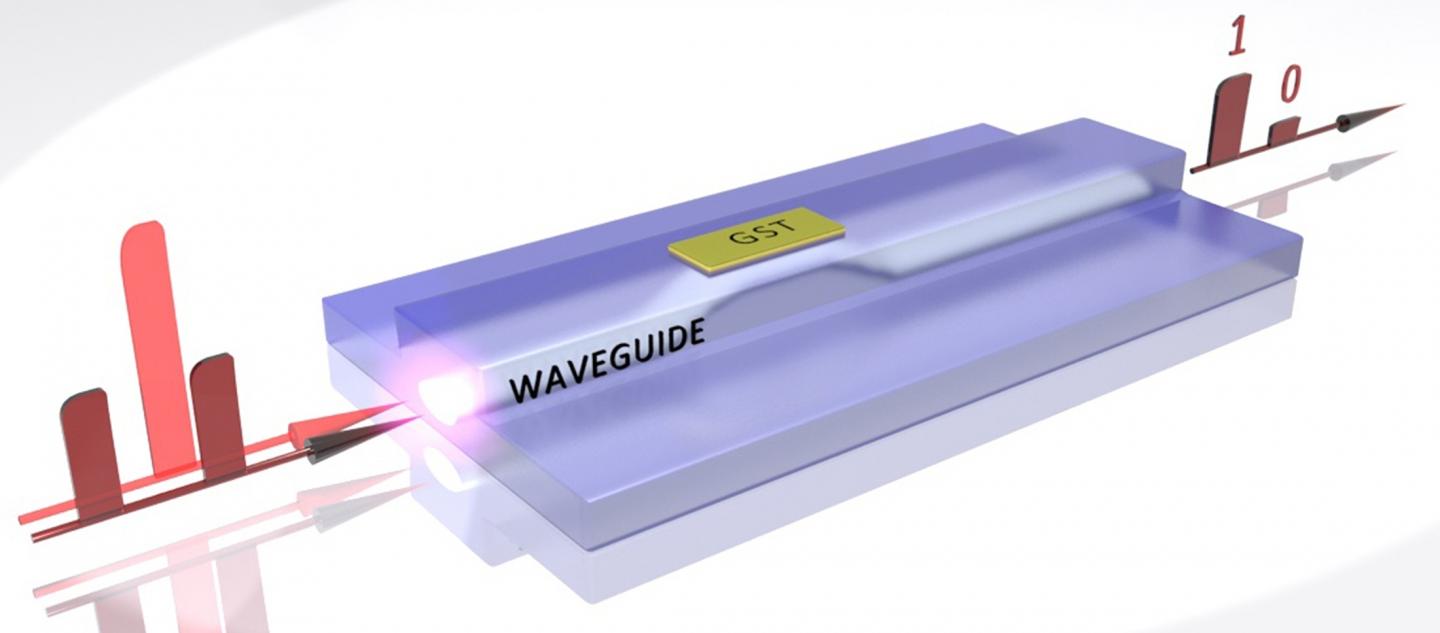
Illustration of all-optical data memory: ultra-short light pulses (left) make a bit in the Ge2Sb2Te5 (GST) material change from crystalline to amorphous (or the reverse), and weak light pulses (right) read out the data (credit: C. Rios/Oxford University)

The first all-optical chip memory has been developed by an international team of scientists. It is capable of writing data to memory at a speed of up to a gigahertz or more and may allow computers to work more rapidly and more efficiently.

The memory is non-volatile (similar to flash memory), and the new memory can store data even when the power is removed, and may persist for decades, the researchers believe.

The scientists, from Oxford, Exeter, Karlsruhe and Münster universities, used a “phase-change material,” Ge2Sb2Te5 (GST). Phase-change materials radically change their optical properties depending on their phase state (arrangement of the atoms) — crystalline (regular) or amorphous (irregular) — initiated by ultrashort light pulses. For reading out the data, weak light pulses are used.

Light is ideally suited for ultra-fast high-bandwidth data transfer (via optical-fiber cables), but until now, it has not been possible to store large quantities of optical data directly on integrated chips. The memory is also compatible with latest processors, the researchers note.

Permanent all-optical on-chip memories promise to considerably increase the speed of computers and reduce their energy consumption. Together with all-optical connections, on-chip memories might also reduce latencies (transmission delays, which can make long-distance two-way communication difficult, for example). In addition, energy-intensive conversion of optical signals into electronic signals and vice versa would no longer be required, reducing bulk and cost.

The research is published in Nature Photonics.


Abstract of Integrated all-photonic non-volatile multi-level memory

Implementing on-chip non-volatile photonic memories has been a long-term, yet elusive goal. Photonic data storage would dramatically improve performance in existing computing architectures by reducing the latencies associated with electrical memories and potentially eliminating optoelectronic conversions. Furthermore, multi-level photonic memories with random access would allow for leveraging even greater computational capability. However, photonic memories have thus far been volatile. Here, we demonstrate a robust, non-volatile, all-photonic memory based on phase-change materials. By using optical near-field effects, we realize bit storage of up to eight levels in a single device that readily switches between intermediate states. Our on-chip memory cells feature single-shot readout and switching energies as low as 13.4 pJ at speeds approaching 1 GHz. We show that individual memory elements can be addressed using a wavelength multiplexing scheme. Our multi-level, multi-bit devices provide a pathway towards eliminating the von Neumann bottleneck and portend a new paradigm in all-photonic memory and non-conventional computing.

AI system solves SAT geometry questions as well as average American 11th-grade student

Examples of questions (left column) and interpretations (right column) derived by GEOS (credit: Minjoon Seo et al./Proceedings of EMNLP)

An AI system that can solve SAT geometry questions as well as the average American 11th-grade student has been developed by researchers at the Allen Institute for Artificial Intelligence (AI2) and University of Washington.

This system, called GeoS, uses a combination of computer vision to interpret diagrams, natural language processing to read and understand text, and a geometric solver, achieving 49 percent accuracy on official SAT test questions.

If these results were extrapolated to the entire Math SAT test, the computer roughly achieved an SAT score of 500 (out of 800), the average test score for 2015.

These results, presented at the 2015 Conference on Empirical Methods in Natural Language Processing (EMNLP) in Lisbon, Portugal, were achieved by GeoS solving unaltered SAT questions that it had never seen before and that required an understanding of implicit relationships, ambiguous references, and the relationships between diagrams and natural-language text.

The best-known current test of an AI’s intelligence is the Turing test, which involves fooling a human in a blind conversation. “Unlike the Turing Test, standardized tests such as the SAT provide us today with a way to measure a machine’s ability to reason and to compare its abilities with that of a human,” said Oren Etzioni, CEO of AI2. “Much of what we understand from text and graphics is not explicitly stated, and requires far more knowledge than we appreciate.”

How GeoS Works

GeoS is the first end-to-end system that solves SAT plane geometry problems. It does this by first interpreting a geometry question by using the diagram and text in concert to generate the best possible logical expressions of the problem, which it sends to a geometric solver to solve. Then it compares that answer to the multiple-choice answers for that question.

This process is complicated by the fact that SAT questions contain many unstated assumptions. For example, in top example in the SAT problem above, there are several unstated assumptions, such as the fact that lines BD and AC intersect at E.

GeoS had a 96 percent accuracy rate on questions it was confident enough to answer. AI2 researchers said they are moving to solve the full set of SAT math questions in the next three years.

An open-access paper outlining the research, “Solving Geometry Problems: Combining Text and Diagram Interpretation,” and a demonstration of the system’s problem-solving are available. All data sets and software are also available for other researchers to use.

The researchers say they are also building systems that can tackle science tests, which require a knowledge base that includes elements of the unstated, common-sense knowledge that humans generate over their lives. This Aristo project is described here.


Abstract of Solving geometry problems: Combining text and diagram interpretation

This paper introduces GeoS, the first automated system to solve unaltered SAT geometry questions by combining text understanding and diagram interpretation. We model the problem of understanding geometry questions as submodular optimization, and identify a formal problem description likely to be compatible with both the question text and diagram. GeoS then feeds the description to a geometric solver that attempts to determine the correct answer. In our experiments, GeoS achieves a 49% score on official SAT questions, and a score of 61% on practice questions. Finally, we show that by integrating textual and visual information, GeoS boosts the accuracy of dependency and semantic parsing of the question text.

DNA-guided 3-D printing of human tissue

Reconstituting epithelial (skin) microtissues with programmed size, shape, composition, spatial heterogeneity, and embedding extracellular matrix. Scheme and images of fully embedded aggregates of human luminal and myoepithelial cells. (credit: Michael E Todhunter et al./Nature Methods)

A new technique developed by UCSF scientists for building organoids (tiny models of human tissues) more precisely turns human cells into the biological equivalent of LEGO bricks. Called DNA Programmed Assembly of Cells (DPAC), it allows researchers in hours to create arrays of thousands of custom-designed organoids, such as models of human mammary glands containing several hundred cells each.

These mini-tissues in a dish can be used to study how particular structural features of tissue affect normal growth or go awry in cancer. They could be used for therapeutic drug screening and to help teach researchers how to grow whole human organs.

The new technique, reported in an open-the journal Nature Methods on Aug. 31, allows for researchers to “take any cell type we want and program just where it goes,” said  Zev Gartner, PhD, the paper’s senior author and an associate professor of pharmaceutical chemistry at UCSF. “We can precisely control who’s talking to whom and who’s touching whom at the earliest stages.”

There are very few limits to the tissues this technology can mimic, he said. “One potential application would be that within the next couple of years, we could be taking samples of different components of a cancer patient’s mammary gland and building a model of their tissue to use as a personalized drug screening platform. Another is to use the rules of tissue growth we learn with these models to one day grow complete organs.”

Studying how the cells of complex tissues like the mammary gland self-organize, make decisions as groups, and break down in disease has been a challenge to researchers. The living organism is often too complex to identify the specific causes of a particular cellular behavior. On the other hand, cells in a dish lack the critical element of realistic 3-D structure.

DNA as molecular Velcro and bar code

To specify the 3-D structure of their organoids, the researchers incubate cells with tiny snippets of single-stranded DNA engineered to slip into the cells’ outer membranes, covering each cell like the hairs on a tennis ball. These DNA strands act both as a sort of molecular Velcro and as a bar code that specifies where each cell belongs within the organoid. When two cells incubated with complementary DNA strands come in contact, they stick fast. If the DNA sequences don’t match, the cells float on by. Cells can be incubated with several sets of DNA bar codes to specify multiple allowable partners.

A whole-mount image of a digitized mouse mammary fat pad (reproduced with permission of W. Muller) used to print a pattern of DNA spots, and rendered as a 1.6-cm-long pattern of single cells fully embedded in gelatinous protein mixture (credit: Michael E Todhunter et al./Nature Methods)

To turn these cellular LEGOs into arrays of organoids that can be used for research, Gartner’s team lays down the cells in layers, with multiple sets of cells designed to stick to particular partners. This lets them build up complex tissue components like the mammary gland. It also lets them experiment with specifically adding in a single cell with a known cancer mutation to different parts of the organoid to observe its effects.

To demonstrate the precision of the technique and its ability to generalize to many different human tissue types, the research team created several proof-of-principle organoid arrays mimicking human tissues such as branching vasculature and mammary glands.

In one experiment, the researchers created arrays of mammary epithelial cells and asked how adding one or more cells expressing low levels of the cancer gene RasG12V affected the cells around them. They found that normal cells grow faster when in an organoid with cells expressing RasG12V at low levels, but required more than one mutant cell to kick-start this abnormal growth. They also found that placing cells with low RasG12V expression at the end of a tube of normal cells allowed the mutant cells to branch and grow, drawing normal cells behind them like a bud at the tip of a growing tree branch.

Gartner’s group plans to use the technique to investigate what cellular or structural changes in mammary glands can lead to the breakdown of tissue architecture associated with tumors that metastasize, invading other parts of the body and threatening the life of the patient. They also hope to use what they learn from simple models of different tissue types to ultimately build functional human tissues like lung and kidney and neural circuits using larger-scale techniques.


Abstract of Programmed synthesis of three-dimensional tissues

Reconstituting tissues from their cellular building blocks facilitates the modeling of morphogenesis, homeostasis and disease in vitro. Here we describe DNA-programmed assembly of cells (DPAC), a method to reconstitute the multicellular organization of organoid-like tissues having programmed size, shape, composition and spatial heterogeneity. DPAC uses dissociated cells that are chemically functionalized with degradable oligonucleotide ‘Velcro’, allowing rapid, specific and reversible cell adhesion to other surfaces coated with complementary DNA sequences. DNA-patterned substrates function as removable and adhesive templates, and layer-by-layer DNA-programmed assembly builds arrays of tissues into the third dimension above the template. DNase releases completed arrays of organoid-like microtissues from the template concomitant with full embedding in a variety of extracellular matrix (ECM) gels. DPAC positions subpopulations of cells with single-cell spatial resolution and generates cultures several centimeters long. We used DPAC to explore the impact of ECM composition, heterotypic cell-cell interactions and patterns of signaling heterogeneity on collective cell behaviors.

3-D printing lightweight, flexible multiple materials in real time, including electronic circuits

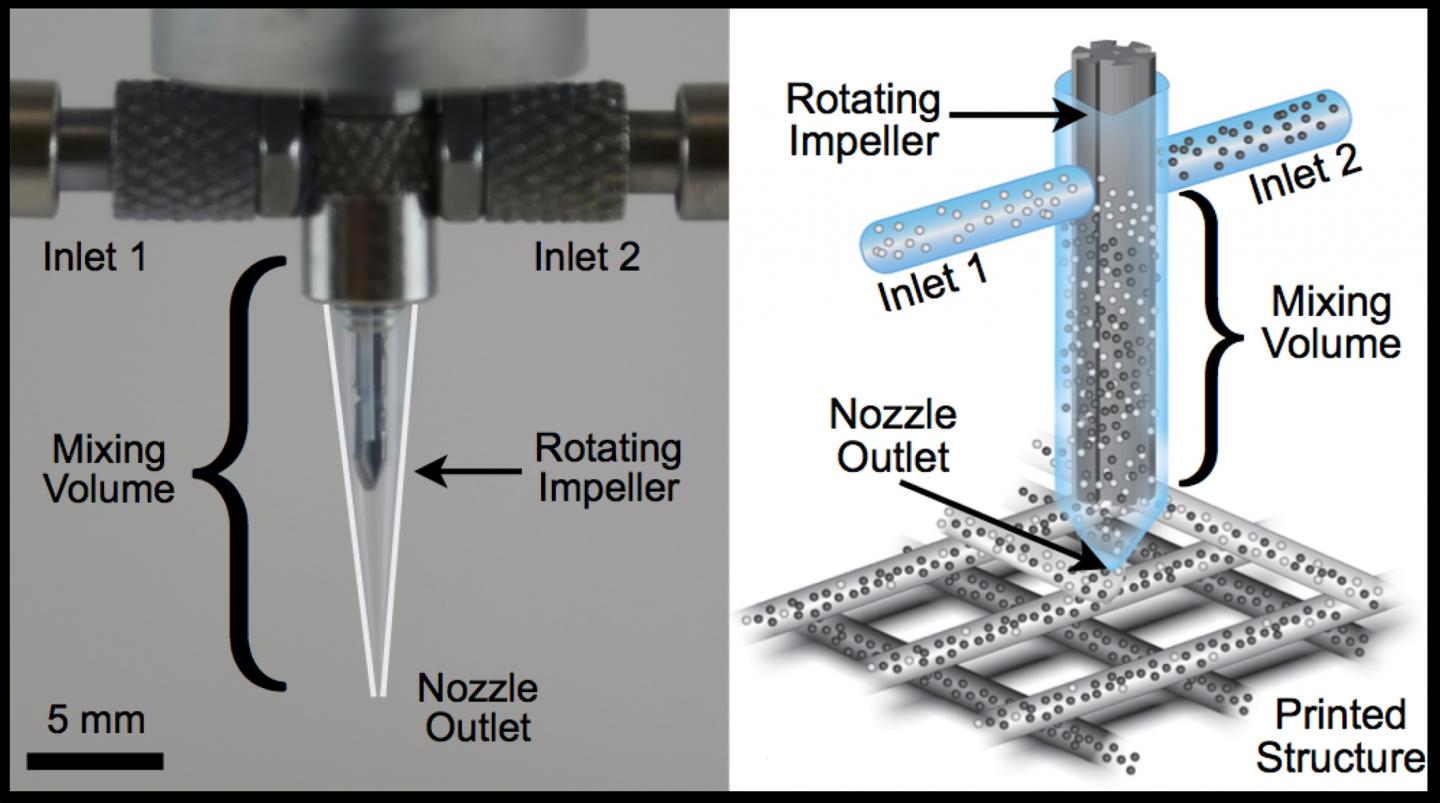
Multiple-materials printer. Each fluid enters the mixing chamber through a separate inlet and is mixed in a narrow gap by an impeller rotating at a constant rate. Optical image (left) and schematic illustration (right) of impeller-based mixing nozzle. (credit: Thomas Ober, Harvard SEAS/Wyss Institute)

Harvard researchers have designed new printheads for 3-D printers that can simultaneously handle multiple materials with different properties, allowing for 3-D printing wearable devices, flexible electronics, and soft robots.

To print a flexible device, including the electronics, a 3-D printer must be able to seamlessly transition from a flexible material that moves with the wearer’s joints for wearable applications, to a rigid material that accommodates the electronic components. It would also need to be able to embed electrical circuitry using multiple inks of varying conductivity and resistivity, and precisely switching between them while changing composition and geometry.  And do it all in real time.

How this will change 3-D printing

The researchers say they have designed a new multimaterial printhead that do all of the above. It can handle a wide range of complex fluids by using a rotating impeller inside a microscale nozzle, seamlessly printing combinations of materials and processes that were not formerly possible:

  • Mixed conductive and resistive inks to embed electrical circuitry inside 3D printed objects.
  • Multiple inks within a single nozzle, eliminating the structural defects that often occur during the start-and-stop process of switching materials.
  • Silicone elastomers, with gradient architectures composed of soft and rigid regions.
  • Reactive materials, such as two-part epoxies, which typically harden quickly when the two parts are combined (think: Krazy glue).

The research was led by Jennifer A. Lewis, the Hansjörg Wyss Professor of Biologically Inspired Engineering at the Harvard John A. Paulson School of Engineering and Applied Sciences (SEAS) and a Core Faculty Member at the Wyss Institute for Biologically Inspired Engineering at Harvard. The work was published in an open-access paper in Proceedings of the National Academy of Sciences (PNAS). It was supported by the Department of Energy Energy Frontier Research Center on Light-Material Interactions in Energy Conversion, the Intelligence Community Postdoctoral Fellowship program, and the Society in Science Branco-Weiss Foundation.

“The recent work by the Lewis Group is a significant advancement to the field of additive manufacturing,” said Christopher Spadaccini, Director of the Center for Engineered Materials, Manufacturing and Optimization at Lawrence Livermore National Lab. “By allowing for the mixing of two highly viscous materials on the fly, the promise of mixed material systems with disparate mechanical and functional properties becomes much more realistic.  Before, this was really only a concept.  This work will be foundational for applications which [require] integrated electrical and structural materials.”


Abstract of Active mixing of complex fluids at the microscale

Mixing of complex fluids at low Reynolds number is fundamental for a broad range of applications, including materials assembly, microfluidics, and biomedical devices. Of these materials, yield stress fluids (and gels) pose the most significant challenges, especially when they must be mixed in low volumes over short timescales. New scaling relationships between mixer dimensions and operating conditions are derived and experimentally verified to create a framework for designing active microfluidic mixers that can efficiently homogenize a wide range of complex fluids. Active mixing printheads are then designed and implemented for multimaterial 3D printing of viscoelastic inks with programmable control of local composition.