A high-efficiency, sustainable process using solar and carbon dioxide to produce methane for natural gas

Artificial photosynthesis provides electrical current to produce hydrogen gas from water; the hydrogen then synthesizes carbon dioxide (via microbes) into methane (CH4) (credit: Berkeley Lab)

A team of researchers at the U.S. Department of Energy (DOE)’s Lawrence Berkeley National Laboratory (Berkeley Lab) has developed a hybrid system that produces hydrogen and uses it (via microbes) to synthesize carbon dioxide into methane, the primary constituent of natural gas.

“We can expect an electrical-to-chemical efficiency of better than 50 percent and a solar-to-chemical energy conversion efficiency of 10 percent if our system is coupled with state-of-art solar panel and electrolyzer,” says Peidong Yang, a chemist with Berkeley Lab’s Materials Sciences Division and one of the leaders of this study.

“Natural photosynthesis, a solar-to-chemical energy conversion process that combines light, water, and CO2 to make biomass, operates at less than 1% efficiency,” UC Berkeley prof. Chris Chang explained to KurzweilAI. “We have now done a order of magnitude better than nature in this artificial photosynthesis system, albeit in one prototype system where we make methane,” he said. “The advance is that most artificial photosynthesis systems only use light and water, and operate at lower efficiencies to boot. The ability to incorporate CO2 fixation is also a big advance.”

Yang, who also holds appointments with UC Berkeley and the Kavli Energy NanoScience Institute (Kavli-ENSI) at Berkeley, is one of three corresponding authors of a paper describing this research in the Proceedings of the National Academy of Sciences (PNAS). 

Sustainable, efficient

Solar energy, a sustainable source of energy, is used to generate hydrogen from water via the hydrogen evolution reaction (HER). The HER is catalyzed by earth-abundant nickel sulfide nanoparticles that operate effectively under biologically compatible conditions.

“Water is the most sustainable starting feedstock for hydrogen,” Chang said. In comparison, “most hydrogen now comes from hydrocarbons, which gives off CO2.”

“We selected methane as an initial target owing to the ease of product separation, the potential for integration into existing infrastructures for the delivery and use of natural gas, and the fact that direct conversion of carbon dioxide to methane with synthetic catalysts has proven to be a formidable challenge,” said Chang.

“Since we still get the majority of our methane from natural gas, a fossil fuel, often from fracking, the ability to generate methane from a renewable hydrogen source (solar) is another important advance.”


Abstract of Hybrid bioinorganic approach to solar-to-chemical conversion

Natural photosynthesis harnesses solar energy to convert CO2 and water to value-added chemical products for sustaining life. We present a hybrid bioinorganic approach to solar-to-chemical conversion in which sustainable electrical and/or solar input drives production of hydrogen from water splitting using biocompatible inorganic catalysts. The hydrogen is then used by living cells as a source of reducing equivalents for conversion of CO2 to the value-added chemical product methane. Using platinum or an earth-abundant substitute, α-NiS, as biocompatible hydrogen evolution reaction (HER) electrocatalysts and Methanosarcina barkeri as a biocatalyst for CO2 fixation, we demonstrate robust and efficient electrochemical CO2 to CH4 conversion at up to 86% overall Faradaic efficiency for ≥7 d. Introduction of indium phosphide photocathodes and titanium dioxide photoanodes affords a fully solar-driven system for methane generation from water and CO2, establishing that compatible inorganic and biological components can synergistically couple light-harvesting and catalytic functions for solar-to-chemical conversion.

Older people in Germany and England getting smarter, but not fitter

(credit: iStock)

People over age 50 are scoring better on cognitive tests than people of the same age did in the past — a trend that could be linked to higher education rates and increased use of technology in our daily lives, according to a new study published in an open-access paper in the journal PLOS ONE. But the study also showed that average physical health of the older population has declined.

The study, by researchers at the International Institute for Applied Systems Analysis (IIASA) in Austria, relied on representative survey data from Germany that measured cognitive processing speed, physical fitness, and mental health in 2006 and again in 2012.

It found that cognitive test scores increased significantly within the six-year period (for men and women and at all ages from 50 to 90 years), while physical functioning and mental health declined, especially for low-educated men aged 50–64. The survey data was representative of the non-institutionalized German population, mentally and physically able to participate in the tests.

Cognition normally begins to decline with age, and is one key characteristic that demographers use to understand how different population groups age more successfully than others, according to IIASA population experts.

Changing lifestyles

Previous studies have found elderly people to be in increasingly good health — “younger” in many ways than previous generations at the same chronological age — with physical and cognitive measures all showing improvement over time. The new study is the first to show divergent trends over time between cognitive and physical function.

“We think that these divergent results can be explained by changing lifestyles,” says IIASA World Population Program researcher Nadia Steiber, author of the PLOS ONE study. “Life has become cognitively more demanding, with increasing use of communication and information technology also by older people, and people working longer in intellectually demanding jobs. At the same time, we are seeing a decline in physical activity and rising levels of obesity.”

A second study from IIASA population researchers, published last week in the journal Intelligence found similar results, suggesting that older people have also become smarter in England.

“On average, test scores of people aged 50+ today correspond to test scores from people 4–8 years younger and tested 6 years earlier,” says Valeria Bordone, a researcher at IIASA and the affiliated Wittgenstein Centre for Demography and Global Human Capital.

The studies both provide confirmation of the “Flynn effect” — a trend in rising performance in standard IQ tests from generation to generation. The studies show that changes in education levels in the population can explain part, but not all of the effect.

“We show for the first time that although compositional changes of the older population in terms of education partly explain the Flynn effect, the increasing use of modern technology such as computers and mobile phones in the first decade of the 2000s also contributes considerably to its explanation,” says Bordone.

The researchers note that while the findings apply to Germany and England, future research may provide evidence on other countries.


IIASA | Rethinking population aging


Abstract of Population Aging at Cross-Roads: Diverging Secular Trends in Average Cognitive Functioning and Physical Health in the Older Population of Germany

This paper uses individual-level data from the German Socio-Economic Panel to model trends in population health in terms of cognition, physical fitness, and mental health between 2006 and 2012. The focus is on the population aged 50–90. We use a repeated population-based cross-sectional design. As outcome measures, we use SF-12 measures of physical and mental health and the Symbol-Digit Test (SDT) that captures cognitive processing speed. In line with previous research we find a highly significant Flynn effect on cognition; i.e., SDT scores are higher among those who were tested more recently (at the same age). This result holds for men and women, all age groups, and across all levels of education. While we observe a secular improvement in terms of cognitive functioning, at the same time, average physical and mental health has declined. The decline in average physical health is shown to be stronger for men than for women and found to be strongest for low-educated, young-old men aged 50–64: the decline over the 6-year interval in average physical health is estimated to amount to about 0.37 SD, whereas average fluid cognition improved by about 0.29 SD. This pattern of results at the population-level (trends in average population health) stands in interesting contrast to the positive association of physical health and cognitive functioning at the individual-level. The findings underscore the multi-dimensionality of health and the aging process.


Abstract of Smarter every day: The deceleration of population ageing in terms of cognition

Cognitive decline correlates with age-associated health risks and has been shown to be a good predictor of future morbidity and mortality. Cognitive functioning can therefore be considered an important measure of differential aging across cohorts and population groups. Here, we investigate if and why individuals aged 50+ born into more recent cohorts perform better in terms of cognition than their counterparts of the same age born into earlier cohorts (Flynn effect). Based on two waves of English and German survey data, we show that cognitive test scores of participants aged 50+ in the later wave are higher compared with those of participants aged 50+ in the earlier wave. The mean scores in the later wave correspond to the mean scores in the earlier wave obtained by participants who were on average 4–8 years younger. The use of a repeat cross-sectional design overcomes potential bias from retest effects. We show for the first time that although compositional changes of the older population in terms of education partly explain the Flynn effect, the increasing use of modern technology (i.e., computers and mobile phones) in the first decade of the 2000s also contributes to its explanation.

How mass extinctions can accelerate robot evolution

At the start of the simulation, a biped robot controlled by a computationally evolved brain stands upright on a 16 meter by 16 meter surface. The simulation proceeds until the robot falls or until 15 seconds have elapsed. (credit: Joel Lehman)

Robots evolve more quickly and efficiently after a virtual mass extinction modeled after real-life disasters, such as the one that killed off the dinosaurs, computer scientists at The University of Texas at Austin have found.

Mass extinctions speed up evolution by unleashing new creativity in adaptations.

Computer scientists Risto Miikkulainen and Joel Lehman co-authored the study published in an open-access paper in the journal PLOS One.

“Focused destruction can lead to surprising outcomes,” said Miikkulainen, a professor of computer science at UT Austin. “Sometimes you have to develop something that seems objectively worse in order to develop the tools you need to get better.”

Survival of the evolvable

In biology, mass extinctions are known for being highly destructive, erasing a lot of genetic material from the tree of life. But some evolutionary biologists hypothesize that extinction events actually accelerate evolution by promoting those lineages that are the most evolvable, meaning ones that can quickly create useful new features and abilities.

Miikkulainen and Lehman found that, at least with robots, this is the case.

For years, computer scientists have used computer algorithms inspired by evolution to train simulated robot brains, called neural networks, to improve at a task from one generation to the next. But could mass destruction speed things up?

To find out, they connected neural networks to simulated robotic legs with the goal of evolving a robot that could walk smoothly and stably. As with real evolution, random mutations were introduced through the computational evolution process. The scientists created many different niches so that a wide range of novel features and abilities would come about.

Pruning to achieve super-robots

After hundreds of generations, a wide range of robotic behaviors had evolved to fill these niches, many of which were not directly useful for walking. Then the researchers randomly killed off the robots in 90 percent of the niches, mimicking a mass extinction.

After several such cycles of evolution and extinction, they discovered that the lineages that survived were the most evolvable and, therefore, had the greatest potential to produce new behaviors. Not only that, but overall, better solutions to the task of walking were evolved in simulations with mass extinctions, compared with simulations without them.

Practical applications of the research could include the development of robots that can better overcome obstacles (such as robots searching for survivors in earthquake rubble, exploring Mars or navigating a minefield) and human-like game agents.

“This is a good example of how evolution produces great things in indirect, meandering ways,” explains Lehman, a former postdoctoral researcher in Miikkulainen’s lab, now at the IT University of Copenhagen. He and a former student of Miikkulainen’s at UT Austin, Kenneth Stanley, recently published a popular science book about evolutionary meandering, The Myth of the Objective: Why Greatness Cannot Be Planned. “Even destruction can be leveraged for evolutionary creativity,” Lehman says.

This research was funded by the National Science Foundation (NSF), National Institutes of Health and UT Austin’s Freshman Research Initiative. Funding from NSF was provided through grants to BEACON, a multi-university center established to study evolution in action in natural and virtual settings. The University of Texas at Austin is a member of BEACON. Evolutionary biologists in BEACON assisted Miikkulainen and Lehman in designing the research project and interpreting the results.


Abstract of Extinction Events Can Accelerate Evolution

Extinction events impact the trajectory of biological evolution significantly. They are often viewed as upheavals to the evolutionary process. In contrast, this paper supports the hypothesis that although they are unpredictably destructive, extinction events may in the long term accelerate evolution by increasing evolvability. In particular, if extinction events extinguish indiscriminately many ways of life, indirectly they may select for the ability to expand rapidly through vacated niches. Lineages with such an ability are more likely to persist through multiple extinctions. Lending computational support for this hypothesis, this paper shows how increased evolvability will result from simulated extinction events in two computational models of evolved behavior. The conclusion is that although they are destructive in the short term, extinction events may make evolution more prolific in the long term.

Soaking up carbon dioxide and turning it into valuable products

Conceptual model showing how porphyrin COFs could be used to split CO2 into CO and oxygen (credit: Omar Yaghi, Berkeley Lab/UC Berkeley)

Researchers with the U.S. Department of Energy (DOE)’s Lawrence Berkeley National Laboratory (Berkeley Lab) have developed a system that absorbs carbon dioxide and also selectively reduces it to carbon monoxide (which serves as a primary building block for a wide range of chemical products including fuels, pharmaceuticals and plastics).

The trick: they’ve incorporated molecules of carbon dioxide reduction catalysts into the sponge-like crystals of covalent organic frameworks (COFs).

How to soak up carbon dioxide in the area of a football field

With the reduction of atmospheric carbon dioxide emissions in mind, Yaghi and his research group at the University of Michigan in 2005 designed and developed the first COFs as a means of separating carbon dioxide from flue gases. A COF is a porous three-dimensional crystal consisting of a tightly folded, compact framework that features an extraordinarily large internal surface area — a COF the size of a sugar cube were it to be opened and unfolded would blanket a football field. The sponge-like quality of a COF’s vast internal surface area enables the system to absorb and store enormous quantities of targeted molecules, such as carbon dioxide.

Structural model showing a covalent organic framework (COF) embedded with a cobalt porphyrin (credit: UC Berkeley)

“There have been many attempts to develop homogeneous or heterogeneous catalysts for carbon dioxide, but the beauty of using COFs is that we can mix-and-match the best of both worlds, meaning we have molecular control by choice of catalysts plus the robust crystalline nature of the COF,” says Christopher Chang, a chemist with Berkeley Lab’s Chemical Sciences Division, and a co-leader of this study.

“To date, such porous materials have mainly been used for carbon capture and separation, but in showing they can also be used for carbon dioxide catalysis, our results open up a huge range of potential applications in catalysis and energy.”

Chang and Omar Yaghi, a chemist with Berkeley Lab’s Materials Sciences Division who invented COFs, are the corresponding authors of a paper in Science that describes this research.

Chang and Yaghi both hold appointments with the University of California (UC) Berkeley. Chang is also a Howard Hughes Medical Institute (HHMI) investigator. Yaghi is co-director of the Kavli Energy NanoScience Institute (Kavli-ENSI) at UC Berkeley.

The notoriety of carbon dioxide for its impact on the atmosphere and global climate change has overshadowed its value as an abundant, renewable, nontoxic and nonflammable source of carbon for the manufacturing of widely used chemical products, the researchers point out.

Now, through another technique developed by Yaghi, called “reticular chemistry,” which enables molecular systems to be “stitched” into netlike structures that are held together by strong chemical bonds, the Berkeley Lab researchers were able to embed the molecular backbone of COFs with a porphyrin catalyst, a ring-shaped organic molecule with a cobalt atom at its core. Porphyrins are electrical conductors that are especially proficient at transporting electrons to carbon dioxide.

Among most efficient CO2 reduction agents

“A key feature of COFs is the ability to modify chemically active sites at will with molecular-level control by tuning the building blocks constituting a COF’s framework,” Yaghi says. “This affords a significant advantage over other solid-state catalysts where tuning the catalytic properties with that level of rational design remains a major challenge. Because the porphyrin COFs are stable in water, they can operate in aqueous electrolyte with high selectivity over competing water reduction reactions, an essential requirement for working with flue gas emissions.”

In performance tests, the porphyrin COFs displayed exceptionally high catalytic activity — a turnover number up to 290,000, meaning one porphyrin COF can reduce 290,000 molecules of carbon dioxide to carbon monoxide every second. This represents a 26-fold increase over the catalytic activity of molecular cobalt porphyrin catalyst and places porphyrin COFs among the fastest and most efficient catalysts of all known carbon dioxide reduction agents. Furthermore, the research team believes there’s plenty of room for further improving porphyrin COF performances.

“We’re now seeking to increase the number of electroactive cobalt centers and achieve lower over-potentials while maintaining high activity and selectivity for carbon dioxide reduction over proton reduction,” Chang says. “In addition we are working towards expanding the types of value-added carbon products that can be made using COFs and related frameworks.”

This research was supported by the DOE Office of Science in part through its Energy Frontier Research Center (EFRC) program. The porphyrin COFs were characterized through X-ray absorption measurements performed at Berkeley Lab’s Advanced Light Source, a DOE Office of Science User Facility.


Abstract of Covalent organic frameworks comprising cobalt porphyrins for catalytic CO2 reduction in water

Conversion of carbon dioxide to carbon monoxide and other value-added carbon products is an important challenge for clean energy research. Here, we report modular optimization of covalent organic frameworks (COFs), in which the building units are cobalt porphyrin catalysts linked by organic struts through imine bonds, to prepare a catalytic material for aqueous electrochemical reduction of CO2 to CO. The catalysts exhibit high Faradaic efficiency (90%) and turnover numbers (up to 290,000 with initial turnover frequency 9400 hours−1) at pH 7 with an overpotential of –0.55 V, equivalent to a 60-fold improvement in activity compared to the molecular cobalt complex, with no degradation over 24 hours. X-ray absorption data reveal the influence of the COF environment on the electronic structure of the catalytic cobalt centers.

Engineered bacteria form multicellular circuit to control protein expression

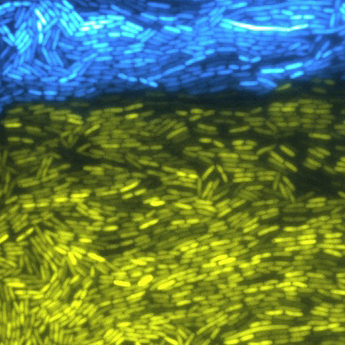
Two strains of synthetically engineered bacteria cooperate to create multicellular phenomena. Their fluorescence indicates the engineered capabilities have been activated. (credit: Bennett Lab/Rice University)

Rice University scientists and associates have created a biological equivalent to a computer circuit using multiple types of bacteria that change protein expression. The goal is to modify biological systems by controlling how bacteria influence each other. This could lead to bacteria that, for instance, beneficially alter the gut microbiome (collection of microorganisms) in humans.

The research is published in the journal Science.

Humans’ stomachs have a lot of different kinds of bacteria contained in the microbiome. “They naturally form a large consortium,” said Rice synthetic biologist Matthew Bennett. The idea is to engineer bacteria to be part of a consortium. “Working together allows them to effect more change than if they worked in isolation.”

In the proof-of-concept study, Bennett and his team created two strains of genetically engineered bacteria that regulate the production of proteins essential to intercellular signaling pathways, which allow cells to coordinate their efforts, generally in beneficial ways.

The synthetic microbial consortium oscillator yo-yo

The activator strain up-regulates genes in both strains; the repressor strain down-regulates genes in both strains, generating an oscillation of gene transcription in the bacterial population (credit: Ye Chen et al.)

“The main push in synthetic biology has been to engineer single cells,” Bennett said. “But now we’re moving toward multicellular systems. We want cells to coordinate their behaviors in order to elicit a populational response, just the way our bodies do.”

Bennett and his colleagues achieved their goal by engineering common Escherichia coli bacteria. By creating and mixing two genetically distinct populations, they prompted the bacteria to form a consortium.

The bacteria worked together by doing opposite tasks: One was an activator that up-regulated the expression of targeted genes; the other was a repressor that down-regulated specific genes. Together, they created oscillations of gene transcription in the bacterial population.

The two novel strains of bacteria sent out intercellular signaling molecules and created linked positive and negative feedback loops that affected gene production in the entire population. Both strains were engineered to make fluorescent reporter genes so their activities could be monitored. The bacteria were confined to microfluidic devices in the lab, where they could be monitored easily during each hours-long experiment.

When the bacteria were cultured in isolation, the protein oscillations did not appear, the researchers wrote.

Programmed yogurt, anyone?

Bennett said his lab’s work will help researchers understand how cells communicate, an important factor in fighting disease. “We have many different types of cells in our bodies, from skin cells to liver cells to pancreatic cells, and they all coordinate their behaviors to make us work properly,” he said. “To do this, they often send out small signaling molecules that are produced in one cell type and effect change in another cell type.

“We take that principle and engineer it into these very simple organisms to see if we can understand and build multicellular systems from the ground up.”

Ultimately, people might ingest the equivalent of biological computers that can be programmed through one’s diet, Bennett said. “One idea is to create a yogurt using engineered bacteria,” he said. “The patient eats it and the physician controls the bacteria through the patient’s diet. Certain combinations of molecules in your food can turn systems within the synthetic bacteria on and off, and then these systems can communicate with each other to effect change within your gut.”

KAIST and University of Houston scientists were also involved in the research. The National Institutes of Health, the Robert A. Welch Foundation, the Hamill Foundation, the National Science Foundation, and the China Scholarship Council supported the research.


Abstract of Emergent genetic oscillations in a synthetic microbial consortium

A challenge of synthetic biology is the creation of cooperative microbial systems that exhibit population-level behaviors. Such systems use cellular signaling mechanisms to regulate gene expression across multiple cell types. We describe the construction of a synthetic microbial consortium consisting of two distinct cell types—an “activator” strain and a “repressor” strain. These strains produced two orthogonal cell-signaling molecules that regulate gene expression within a synthetic circuit spanning both strains. The two strains generated emergent, population-level oscillations only when cultured together. Certain network topologies of the two-strain circuit were better at maintaining robust oscillations than others. The ability to program population-level dynamics through the genetic engineering of multiple cooperative strains points the way toward engineering complex synthetic tissues and organs with multiple cell types.

‘Artificial leaf’ harnesses sunlight for efficient, safe hydrogen fuel production

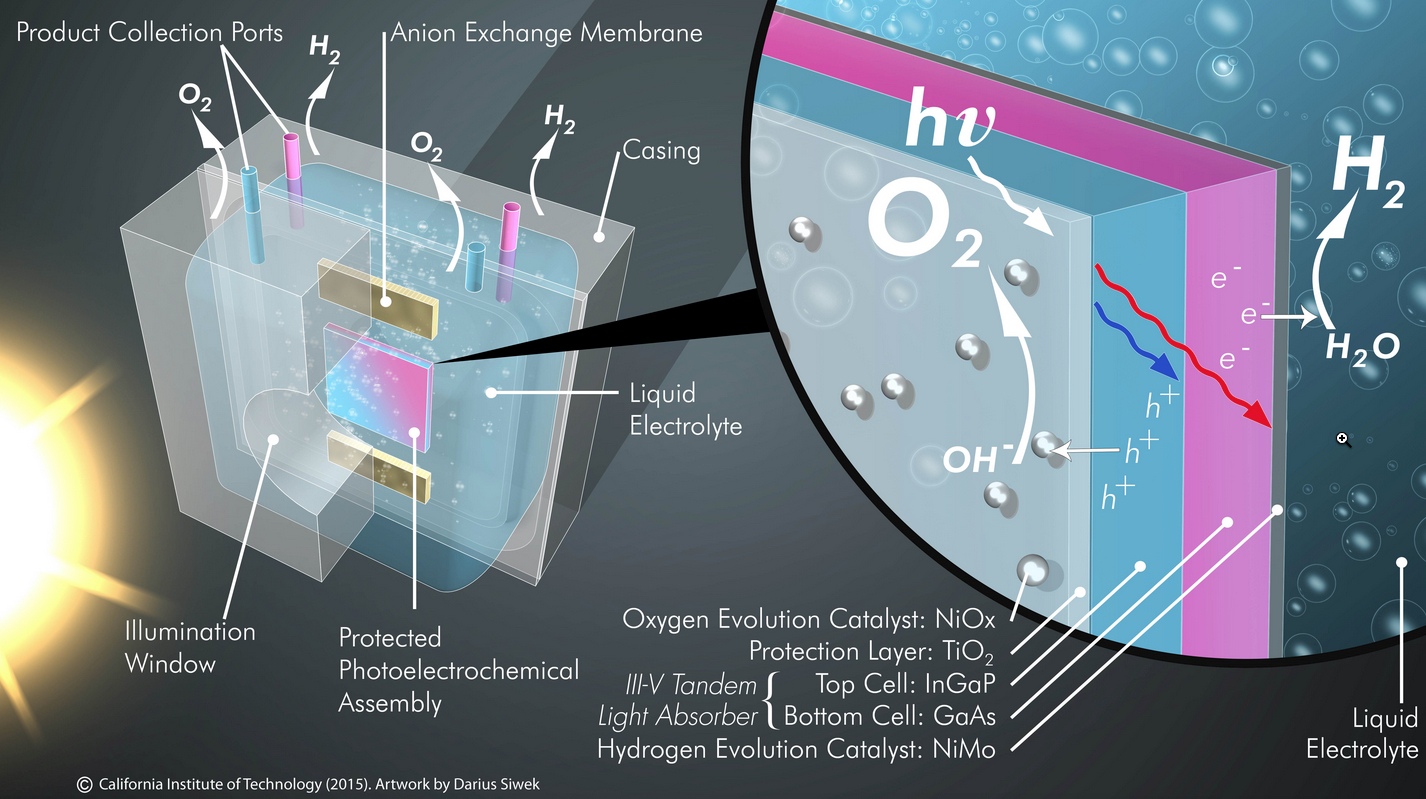
Illustration of an efficient, robust and integrated solar-driven prototype featuring protected photoelectrochemical assembly coupled with oxygen and hydrogen evolution reaction catalysts (credit: Image, Joint Center for Artificial Photosynthesis; artwork, Darius Siwek)

The first complete, efficient, safe, integrated solar-driven system for splitting water to create hydrogen fuels has been developed by the Joint Center for Artificial Photosynthesis (JCAP) at Caltech, according to Caltech’s Nate Lewis, George L. Argyros Professor and professor of chemistry, and the JCAP scientific director.

The new solar fuel generation system, or “artificial leaf,” is described in the August 27 online issue of the journal Energy and Environmental Science. The work was done by researchers in the laboratories of Lewis and Harry Atwater, director of JCAP and Howard Hughes Professor of Applied Physics and Materials Science.

A highly efficient photoelectrochemical (PEC) device uses the power of the sun to split water into hydrogen and oxygen. The stand-alone prototype includes two chambers separated by a semi-permeable membrane that allows collection of both gas products. (credit: Lance Hayashida/Caltech)

The new system consists of three main components: two electrodes (photoanode and photocathode) and a membrane.

  • The photoanode uses sunlight to oxidize water molecules, generating protons and electrons as well as oxygen gas.
  • The photocathode recombines the protons and electrons to form hydrogen gas.
  • A plastic membrane keeps the oxygen and hydrogen gases separate. (If the two gases are allowed to mix and are accidentally ignited, an explosion can occur; the membrane lets the hydrogen fuel be separately collected under pressure and safely pushed into a pipeline.)

Preventing corrosion 

Semiconductors such as silicon or gallium arsenide absorb light efficiently and are therefore used in solar panels. However, these materials also oxidize (or rust) on the surface when exposed to water, so cannot be used to directly generate fuel. A major advance that allowed the integrated system to be developed was previous work in Lewis’s laboratory, which showed that adding a nanometers-thick layer of titanium dioxide (TiO2) onto the electrodes could prevent them from corroding while still allowing light and electrons to pass through.

The new complete solar fuel generation system developed by Lewis and colleagues uses such a 62.5-nanometer-thick TiO2 layer to effectively prevent corrosion and improve the stability of a gallium arsenide–based photoelectrode.

Inexpensive catalysts

Another key advance is the use of active, inexpensive catalysts for fuel production. The photoanode requires a catalyst to drive the essential water-splitting reaction. Rare and expensive metals such as platinum can serve as effective catalysts, but in its work the team discovered that it could create a much cheaper, active catalyst by adding a 2-nanometer-thick layer of nickel to the surface of the TiO2. This catalyst is among the most active known catalysts for splitting water molecules into oxygen, protons, and electrons and is a key to the high efficiency displayed by the device.

The photoanode was grown onto a photocathode, which also contains a highly active, inexpensive, nickel-molybdenum catalyst, to create a fully integrated single material that serves as a complete solar-driven water-splitting system.

The demonstration system is approximately one square centimeter in area, converts 10 percent of the energy in sunlight into stored energy in the chemical fuel, and can operate for more than 40 hours continuously.

“This new system shatters all of the combined safety, performance, and stability records for artificial leaf technology by factors of 5 to 10 or more,” Lewis says.

“Our work shows that it is indeed possible to produce fuels from sunlight safely and efficiently in an integrated system with inexpensive components,” Lewis adds, “Of course, we still have work to do to extend the lifetime of the system and to develop methods for cost-effectively manufacturing full systems, both of which are in progress.”


Caltech | Solar Fuels Prototype in Operation


Abstract of A monolithically integrated, intrinsically safe, 10% efficient, solar-driven water-splitting system based on active, stable earth-abundant electrocatalysts in conjunction with tandem III–V light absorbers protected by amorphous TiO2 films

A monolithically integrated device consisting of a tandem-junction GaAs/InGaP photoanode coated by an amorphous TiO2 stabilization layer, in conjunction with Ni-based, earth-abundant active electrocatalysts for the hydrogen-evolution and oxygen-evolution reactions, was used to effect unassisted, solar-driven water splitting in 1.0 M KOH(aq). When connected to a Ni–Mo-coated counterelectrode in a two-electrode cell configuration, the TiO2-protected III–V tandem device exhibited a solar-to-hydrogen conversion efficiency, ηSTH, of 10.5% under 1 sun illumination, with stable performance for >40 h of continuous operation at an efficiency of ηSTH > 10%. The protected tandem device also formed the basis for a monolithically integrated, intrinsically safe solar-hydrogen prototype system (1 cm2) driven by a NiMo/GaAs/InGaP/TiO2/Ni structure. The intrinsically safe system exhibited a hydrogen production rate of 0.81 μL s−1 and a solar-to-hydrogen conversion efficiency of 8.6% under 1 sun illumination in 1.0 M KOH(aq), with minimal product gas crossover while allowing for beneficial collection of separate streams of H2(g) and O2(g).

Light-speed interconnects may lead to ultra-high-speed computers

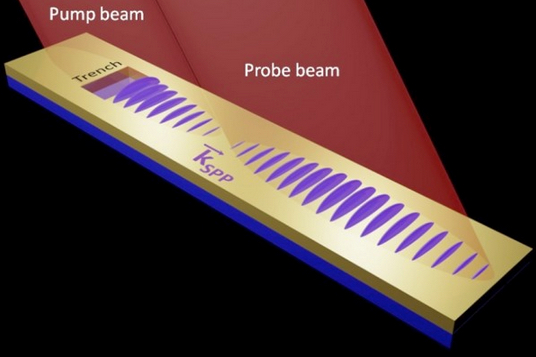
Specially designed, extremely small metal structures can trap light. Once trapped, the light becomes a confined wave known as surface plasmons. The surface plasmons are represented here by the blue waves, which begin at the pump beam and are detected 250 micrometers away by the probe beam, traveling at almost as fast as light through the air. (credit: Hess et al./Nano Lett.)

Light waves trapped on a metal’s surface (surface plasmons) travel farther than expected, up to 250 micrometers from the source — which may be far enough to create ultra-fast nanoelectronic circuits, researchers at Pacific Northwest National Laboratory have discovered.

Future computer circuits could use this phenomenon as interconnects between nanocircuits. Because a surface plasmon travels at near the speed of light, computer circuits with this technology could operate at much faster speeds than current electronics, which use copper wires.

In their experiments, the team applied two laser pulses to a gold sample surface: the first laser pulse, the “pump,” generates the surface plasmon; the second pulse, the “probe,” detects the surface plasmon after a short time delay.

By continuously tuning the time delay between the pump and probe pulses, the team monitored the motion of the plasmon on the gold surface. They captured the confined waves propagating on video, helping to directly extract details such as wavelength and speed. They also determined that a propagating plasmon can be detected at least 250 micrometers (millionths of a meter) away from the generation source — far enough to be useful in electronic circuits.

This finding may lead to ultra-fast computers and devices in the biological, health, and energy arenas.


Abstract of Ultrafast Imaging of Surface Plasmons Propagating on a Gold Surface

We record time-resolved nonlinear photoemission electron microscopy (tr-PEEM) images of propagating surface plasmons (PSPs) launched from a lithographically patterned rectangular trench on a flat gold surface. Our tr-PEEM scheme involves a pair of identical, spatially separated, and interferometrically locked femtosecond laser pulses. Power-dependent PEEM images provide experimental evidence for a sequential coherent nonlinear photoemission process, in which one laser source launches a PSP through a linear interaction, and the second subsequently probes the PSP via two-photon photoemission. The recorded time-resolved movies of a PSP allow us to directly measure various properties of the surface-bound wave packet, including its carrier wavelength (783 nm) and group velocity (0.95c). In addition, tr-PEEM images reveal that the launched PSP may be detected at least 250 μm away from the coupling trench structure.

How to capture and convert CO2 from a smokestack in a single step

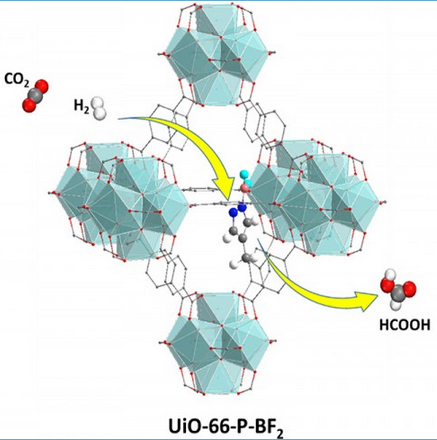
Using a novel catalyst, a single chemical assembly (UiO-66-P-BF2) could capture CO2 and also transform it and hydrogen into formic acid (HCOOH) via a two-step (yellow arrows) reaction (credit: Ye and Johnson/ACS Catalysis)

University of Pittsburgh researchers have invented (in computations) a cheap, efficient catalyst that would capture carbon dioxide (CO2) from coal-burning power plants before it reaches the atmosphere and converts the CO2  into formic acid — a valuable chemical that would create a revenue return. 

One current method for capturing CO2 uses Metal–organic frameworks (MOFs), which have a porous, cage-like structure that can absorb CO2, but require expensive catalysts, like platinum.

Instead, the researchers looked for lower-cost non-metallic catalysts, and found that a compound known as UiO-66-PBF2 would do the job.

The method is similar to one developed by Rice University using a combination of amine-rich compounds and carbon-60 molecules.

Those methods both differ from the “diamonds from the sky” approach, which turns CO2 from the air into carbon nanofibers, by capturing the CO2 before it leaves a smokestack. It will be interesting to compare these approaches in terms of CO2 capture efficiency, energy cost, and revenue return.

All three of these methods avoid the costs and energy expenditures from transporting and depositing CO2 at a storage site, required in carbon sequestration.


Abstract of Design of Lewis Pair-Functionalized Metal Organic Frameworks for CO2 Hydrogenation

Efficient catalytic reduction of CO2 is critical for the large-scale utilization of this greenhouse gas. We have used density functional electronic structure methods to design a catalyst for producing formic acid from CO2 and H2 via a two-step pathway having low reaction barriers. The catalyst consists of a microporous metal organic framework that is functionalized with Lewis pair moieties. These functional groups are capable of chemically binding CO2 and heterolytically dissociating H2. Our calculations indicate that the porous framework remains stable after functionalization and chemisorption of CO2 and H2. We have identified a low barrier pathway for simultaneous addition of hydridic and protic hydrogens to carbon and oxygen of CO2, respectively, producing a physisorbed HCOOH product in the pore. We find that activating H2 by dissociative adsorption leads to a much lower energy pathway for hydrogenating CO2 than reacting H2 with chemisorbed CO2. Our calculations provide design strategies for efficient catalysts for CO2 reduction.

Speech-classifier program is better at predicting psychosis than psychiatrists

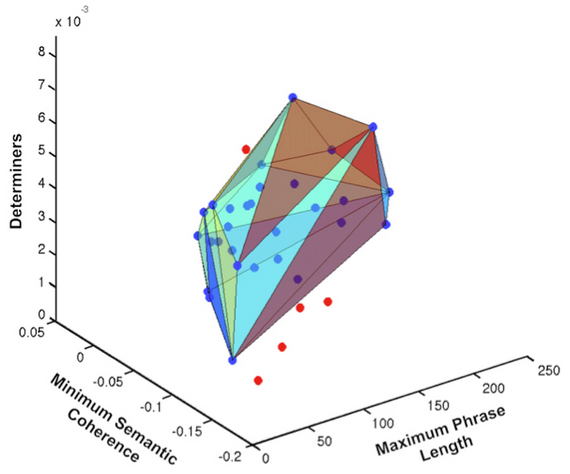
This image shows discrimination between at-risk youths who transitioned to psychosis (red) and those who did not (blue). The polyhedron contains all the at-risk youth who did NOT develop psychosis (blue). All of the at-risk youth who DID later develop psychosis (red) are outside the polyhedron. Thus the speech classifier had 100 percent discrimination or accuracy. The speech classifier consisted of “minimum semantic coherence” (the flow of meaning from one sentence to the next), and indices of reduced complexity of speech, including phrase length and decreased use of “determiner” pronouns (“that,” “what,” “whatever,” “which,” and “whichever”). (credit: Cheryl Corcoran et al./NPJ Schizophrenia/Columbia University Medical Center)

An automated speech analysis program correctly differentiated between at-risk young people who developed psychosis over a later two-and-a-half year period and those who did not.

In a proof-of-principle study, researchers at Columbia University Medical Center, New York State Psychiatric Institute, and the IBM T. J. Watson Research Center found that the computerized analysis provided a more accurate classification than clinical ratings.  The study was published Wednesday Aug. 26 in an open-access paper in NPJ-Schizophrenia.

About one percent of the population between the ages of 14 and 27 is considered to be at clinical high risk (CHR) for psychosis. CHR individuals have symptoms such as unusual or tangential thinking, perceptual changes, and suspiciousness. About 20% will go on to experience a full-blown psychotic episode. Identifying who falls in that 20% category before psychosis occurs has been an elusive goal. Early identification could lead to intervention and support that could delay, mitigate or even prevent the onset of serious mental illness.

Measuring psychosis

Speech provides a unique window into the mind, giving important clues about what people are thinking and feeling. Participants in the study took part in an open-ended, narrative interview in which they described their subjective experiences. These interviews were transcribed and then analyzed by computer for patterns of speech, including semantics (meaning) and syntax (structure).

The analysis established each patient’s semantic coherence (how well he or she stayed on topic), and syntactic structure, such as phrase length and use of determiner words that link the phrases. A clinical psychiatrist may intuitively recognize these signs of disorganized thoughts in a traditional interview, but a machine can augment what is heard by precisely measuring the variables. The participants were then followed for two and a half years.

The speech features that predicted psychosis onset included breaks in the flow of meaning from one sentence to the next, and speech that was characterized by shorter phrases with less elaboration.

Speech classifier: 100% accurate

The speech classifier tool developed in this study to mechanically sort these specific, symptom-related features is striking for achieving 100% accuracy.  The computer analysis correctly differentiated between the five individuals who later experienced a psychotic episode and the 29 who did not.

These results suggest that this method may be able to identify thought disorder in its earliest, most subtle form, years before the onset of psychosis. Thought disorder is a key component of schizophrenia, but quantifying it has proved difficult.

For the field of schizophrenia research, and for psychiatry more broadly, this opens the possibility that new technology can aid in prognosis and diagnosis of severe mental disorders, and track treatment response. Automated speech analysis is inexpensive, portable, fast, and non-invasive. It has the potential to be a powerful tool that can complement clinical interviews and ratings.

Further research with a second, larger group of at-risk individuals is needed to see if this automated capacity to predict psychosis onset is both robust and reliable. Automated speech analysis used in conjunction with neuroimaging may also be useful in reaching a better understanding of early thought disorder, and the paths to develop treatments for it.


Abstract of Automated analysis of free speech predicts psychosis onset in high-risk youths

Background/Objectives: Psychiatry lacks the objective clinical tests routinely used in other specializations. Novel computerized methods to characterize complex behaviors such as speech could be used to identify and predict psychiatric illness in individuals.

AIMS: In this proof-of-principle study, our aim was to test automated speech analyses combined with Machine Learning to predict later psychosis onset in youths at clinical high-risk (CHR) for psychosis.

Methods: Thirty-four CHR youths (11 females) had baseline interviews and were assessed quarterly for up to 2.5 years; five transitioned to psychosis. Using automated analysis, transcripts of interviews were evaluated for semantic and syntactic features predicting later psychosis onset. Speech features were fed into a convex hull classification algorithm with leave-one-subject-out cross-validation to assess their predictive value for psychosis outcome. The canonical correlation between the speech features and prodromal symptom ratings was computed.

Results: Derived speech features included a Latent Semantic Analysis measure of semantic coherence and two syntactic markers of speech complexity: maximum phrase length and use of determiners (e.g., which). These speech features predicted later psychosis development with 100% accuracy, outperforming classification from clinical interviews. Speech features were significantly correlated with prodromal symptoms.

Conclusions: Findings support the utility of automated speech analysis to measure subtle, clinically relevant mental state changes in emergent psychosis. Recent developments in computer science, including natural language processing, could provide the foundation for future development of objective clinical tests for psychiatry.

Hawking offers new solution to ‘black hole information paradox’

Nobel physics laureate Gerard ‘t Hooft of Utrecht University, the Netherlands, confers with Stephen Hawking at a week-long conference at KTH Royal Institute of Technology on the information loss paradox (photo credit: Håkan Lindgren)

Addressing a current controversy in physics about information in black holes, “I propose that the information is stored not in the interior of the black hole as one might expect, but on its boundary, the event horizon.”

The event horizon is a boundary around a black hole beyond which events cannot affect an outside observer, also known as “the point of no return” — where gravitational pull becomes so great as to make escape impossible.

Hawking is now suggesting that the information about any incoming particles passing through this event horizon is translated into a 2D hologram. “The idea is the super-translations are a hologram of the ingoing particles,” he said. “Thus they contain all the information that would otherwise be lost.”

That provides a new solution for the “black hole information paradox“: what happens to the information about the physical state of things that are swallowed up by black holes? Is it destroyed, as our understanding of general relativity would predict? If so, that would violate the laws of quantum mechanics.


KTH Royal Institute of Technology | Hawking presents new idea on how information could escape black holes

Hawking said that also offers hope (at least for the information that represents you) if you happen to have fallen into a black hole — supporting the premise of the movie Interstellar. If the hole was large and rotating, “it might have a passage to another universe” via Hawking radiation.

“But you couldn’t come back to our universe. So although I’m keen on space flight, I’m not going to try that.”

Model of a black hole for the movie Interstellar (credit: Warner Bros. Pictures International )

The conference is co-sponsored by Nordita, the University of North Carolina (UNC), and the Julian Schwinger Foundation. UNC physicist Laura Mersini-Houghton was instrumental in assembling 32 of the world’s leading physicists to tackle the problem, which stems from contradictions between quantum mechanics and general relativity.