NASA’s Oldest Martian Spacecraft Have Been Running for Decades. Here’s How
Two orbiters have long outlasted their expected lifespans and completely reshaped our understanding of the Red Planet, all while operating 140 million miles from Earth.

Science and reality
NASA's DART mission made a cosmic mess four years ago — and now a new spacecraft is ready to scout out exactly what the first-of-its-kind collision accomplished.
The Double Asteroid Redirection Test (DART) spacecraft slammed into a small space rock called Dimorphos on Sept. 26, 2022, in humanity's first test of planetary defense. That's the field dedicated to protecting Earth from the possibility of a calamitous asteroid impact, and DART mimicked how humans could change the orbit of a threatening space rock, taking it off its collision course.
The mission definitely succeeded, shortening the little asteroid's orbit around a larger rock called Didymos by about 33 minutes. But in order to make the most of the experiment, scientists ensured a second spacecraft would follow DART at a more leisurely pace. That decision will pay off this month with the arrival of a European Space Agency (ESA) spacecraft dubbed Hera, which launched in October 2024, two years after DART's impact.
"Hera wants to be the detective, like Inspector Colombo, going back to the crash scene," said Patrick Michel, a planetary scientist at the French National Centre for Scientific Research (CNRS) and principal investigator of the Hera mission.
Scientists have been able to do limited monitoring of the Didymos system over the years with telescopes both on the ground and in space. That's how they calculated the basic change to the orbit, and they've built a basic sketch of what happened.
"We know that there was a lot of material kicked up," said Angela Stickle, a planetary scientist at Johns Hopkins University's Applied Physics Laboratory affiliated with both missions. "We know that we probably left a pretty significant mark on Dimorphos."
But the story isn't over and scientists are far from satisfied. No one knows how big a crater the impact left, or whether it completely rearranged all the asteroid's boulders. There are hints Dimorphos is now tumbling, and material may have moved between it and the larger Didymos.
Even the change to the orbit is complicated, said Cristina Thomas, a planetary astronomer at Northern Arizona University affiliated with both missions: The time Dimorphos took to circle Didymos was still changing some six months after impact, for reasons that aren't clear. "This thing that we thought was going to be very cut and dry turned out to be really interesting and complicated," Thomas said.
That's where Hera comes in, with its first arrival maneuver scheduled for Oct. 15. During three careful braking maneuvers, the spacecraft will slow down and approach the space rocks. Assuming everything goes smoothly, by early November, the spacecraft will come within 20 miles (30 kilometers) of the two rocks and begin its early science observations, then move even closer in early December.
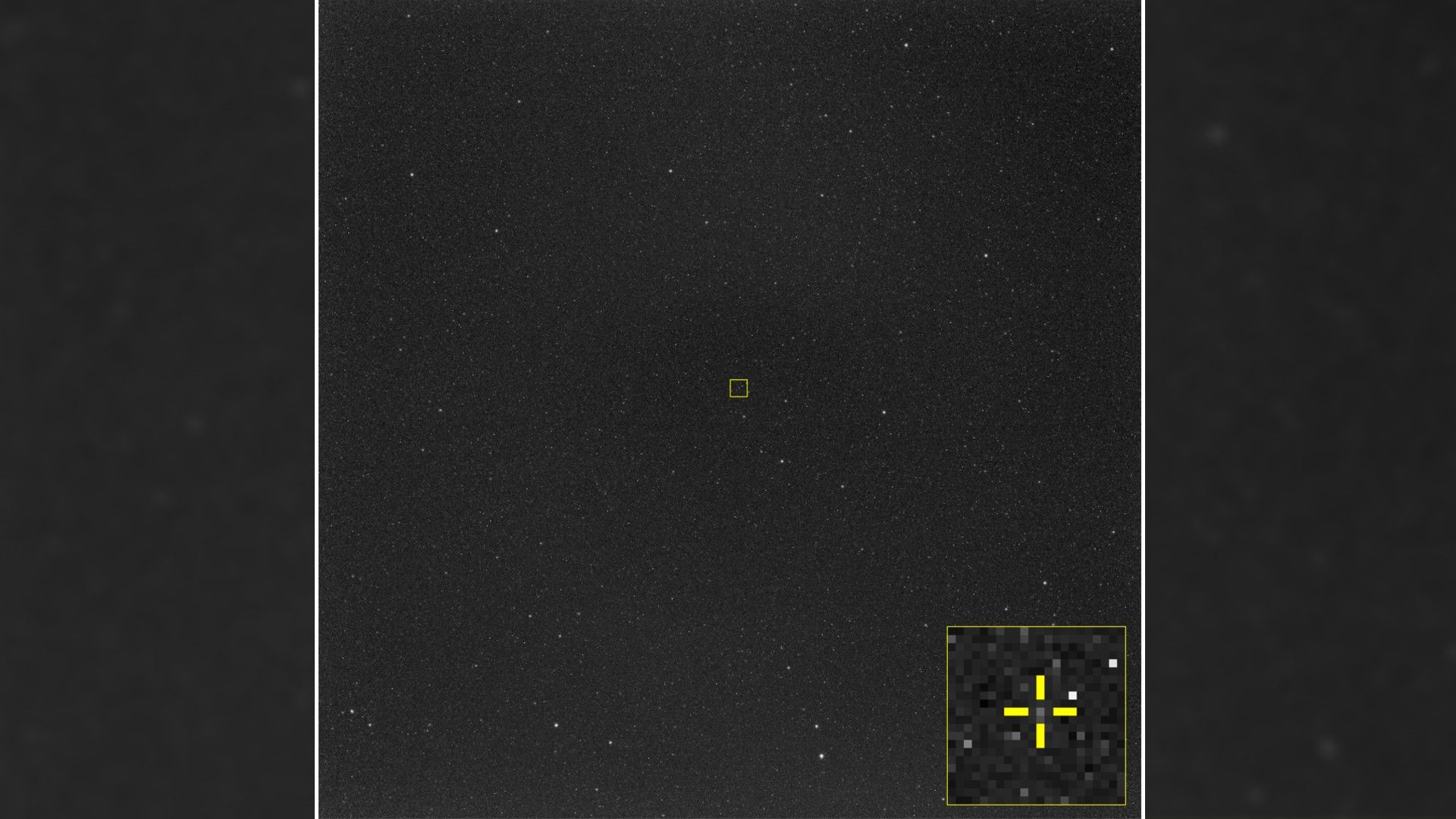
Mission personnel can't wait for their first glimpses of Dimorphos — the first time scientists will visit someplace they've seen before without knowing what they'll find. "For us, it's like a new world," Michel said. "The new image won't have anything to do with the previous one, so that's really exciting."
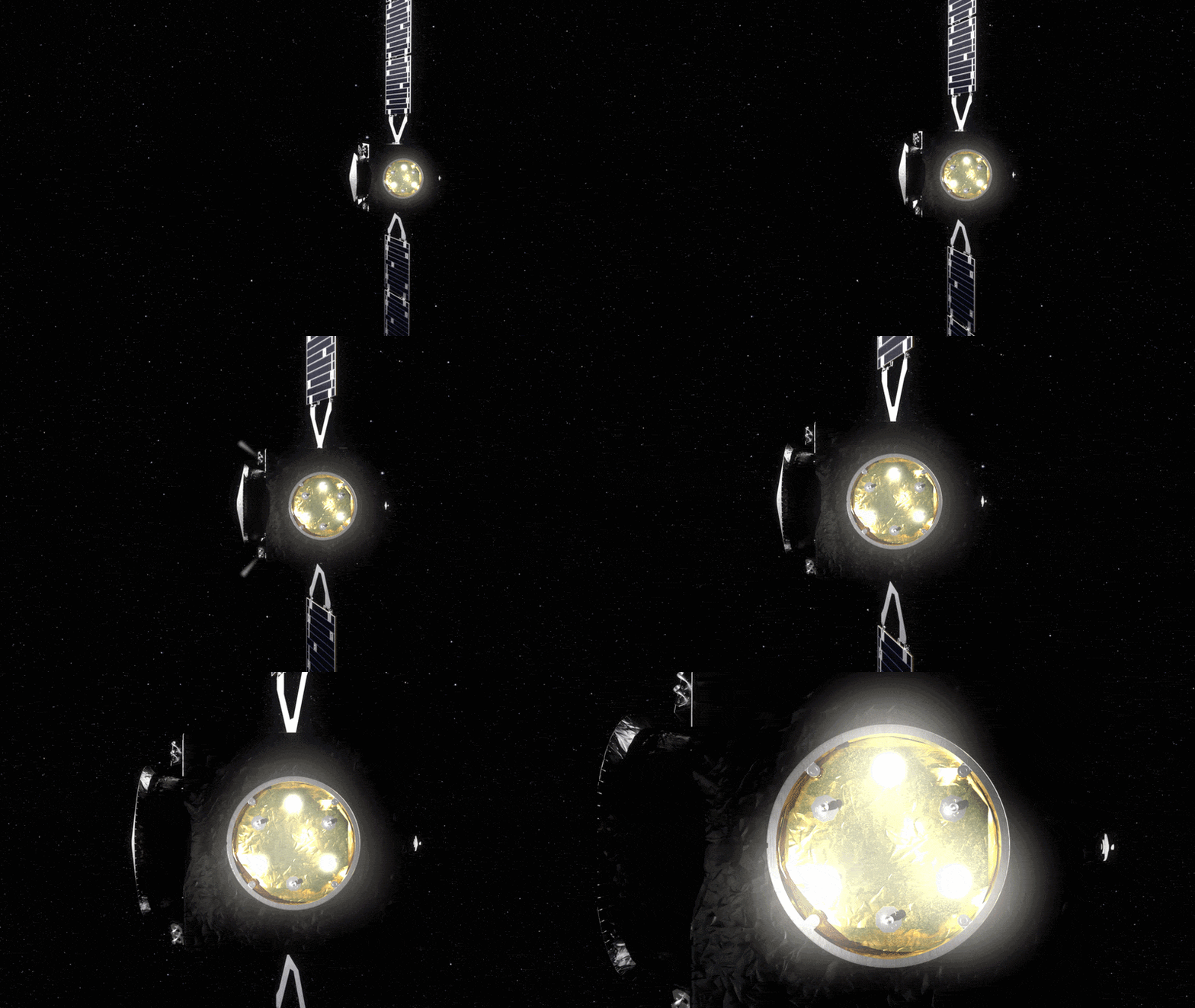
In addition to mapping the two asteroids and seeing what kind of crater the impact left, scientists will also have their eyes peeled for any pieces of the DART spacecraft, although they don't expect to find anything. "We were coming in really fast, so typically, the whole spacecraft you would expect to just kind of shatter or melt," Stickle said. The only sliver of possibility is that part of the two long solar panels stretching off the spacecraft may have snapped off and survived. (The appendages may also have turned the crater shape into an oval.)
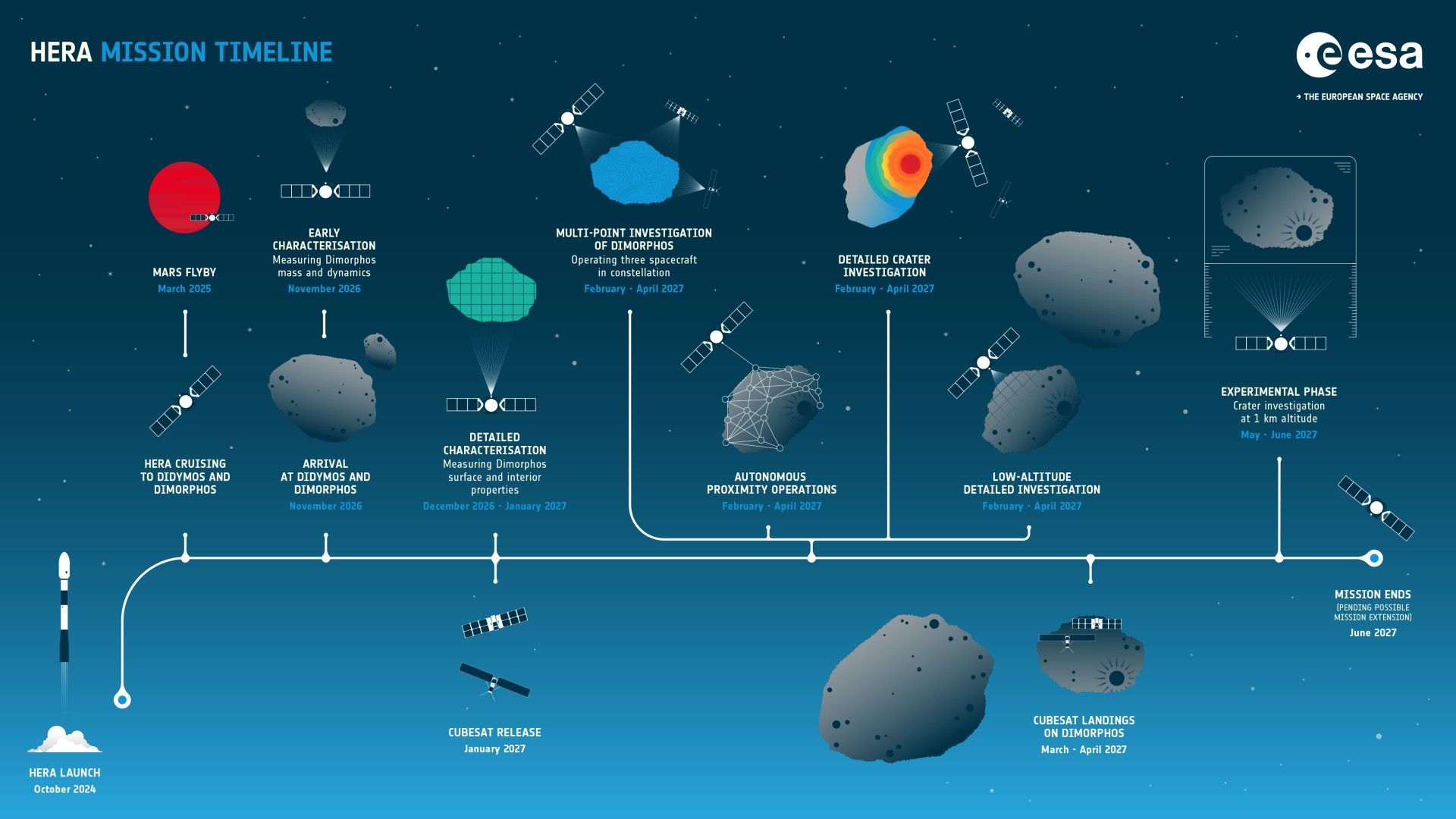
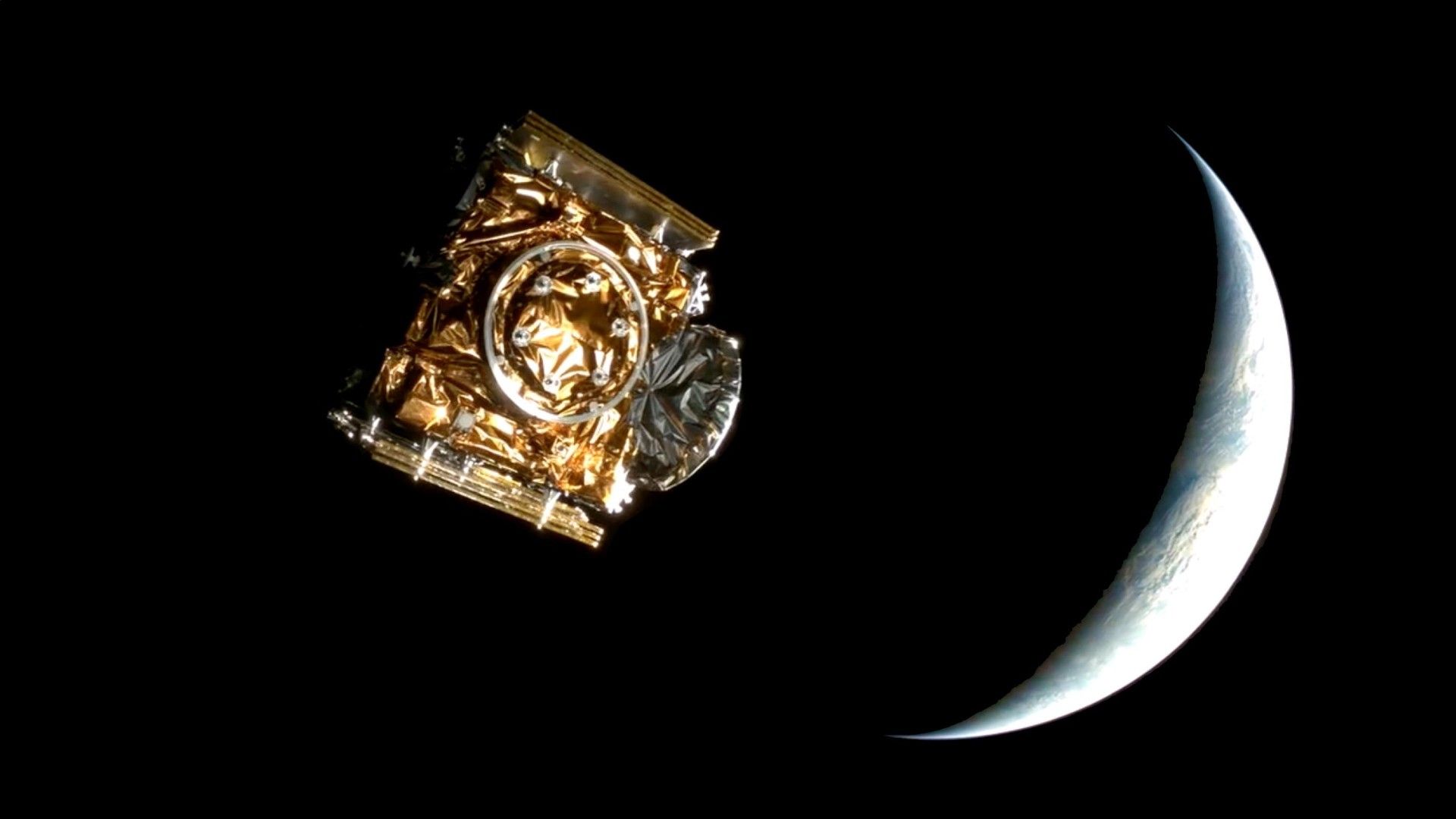
In January, once Hera has settled in, it will release two tiny companions that have piggybacked out to Dimorphos. One, called Milani, will identify the composition of materials on and around Dimorphos. The other, Juventas, will use radar to peer inside Dimorphos — the first time scientists have ever been able to study the interior of a space rock directly. Juventas will end its mission by landing on the small asteroid, and Milani may attempt a landing as well.

The trio of spacecraft will operate in tandem throughout early 2027, and the main spacecraft will operate at least through September 2027. All told, they will give scientists an unprecedented look at the pair of asteroids — the first binary asteroid a spacecraft has ever studied in detail. And the Didymos–Dimorphos duo is a good one to visit first. "It's very ordinary, and I mean that in the best possible way," Thomas said.
Ordinary except, of course, for that time humans punched it, opening the door for the Hera mission to explore the previously unremarkable rocks. And finally, that moment is just around the corner.
"Nothing really worries me," Michel said of the spacecraft's arrival. "It's really just excitement now."
Mercury, the tiniest and least-explored planet in the inner solar system, is hiding mysteries far larger than itself — and finally, scientists will soon be getting not one but two spacecraft designed to decode the strange world.
That's thanks to the BepiColombo mission, a joint project of the European Space Agency (ESA) and Japan Aerospace Exploration Agency (JAXA) that launched in October 2018. After a harrowing journey through the inner solar system, the mission is tackling a crucial maneuver on Thursday (Sept. 3): separating its science equipment from the transport that carried it all that way. By April 2027, scientists hope the mission's two instrument-heavy probes will be gathering a slew of observations that could help solve puzzles about Mercury — and maybe even the solar system we call home.
"I think being able to see new data come out about Mercury is going to be so fantastic," Rachel Klima, a planetary geologist at the Johns Hopkins University Applied Physics Laboratory, told Space.com. The planet, she says, is "just so weird and beautiful and interesting."
For now, Mercury holds the dubious honor of being the least-explored planet in the inner solar system, visited by only two missions to date. NASA's Mariner 10 spacecraft made a trio of zippy flybys in 1974 and 1975, giving scientists their first glimpses of the planet's cracked and cratered surface, as well as confirming the world has both a very tenuous atmosphere and a magnetic field.
"It really gave us our first close-up view of Mercury," Sean Solomon, a planetary scientist at Columbia University, told Space.com. "But it left a lot of pages blank."
And for decades, that was it. Scientists didn't return to Mercury until 2011, when NASA's MESSENGER spacecraft, with Solomon as its principal investigator, arrived at the tiny world. (Mercury has a radius of 1,516 miles, or 2,440 kilometers, meaning its width is just over a third of Earth's.) The spacecraft was packed with tools tailored to the job, such as spectrometers tuned to gamma-rays, X-rays and neutrons, and instruments to sniff out the atmosphere and measure the magnetic field, and it was there to stay. Four years of observations with MESSENGER showed scientists Mercury's complete surface for the first time, and by late in its mission, the spacecraft was passing just 15.5 miles (24.9 km) above the planet's surface.
But even MESSENGER wasn't sophisticated enough to crack Mercury's puzzles or unveil the strange planet's beginnings. "I think the jury's still out on exactly how Mercury got assembled," Solomon said.
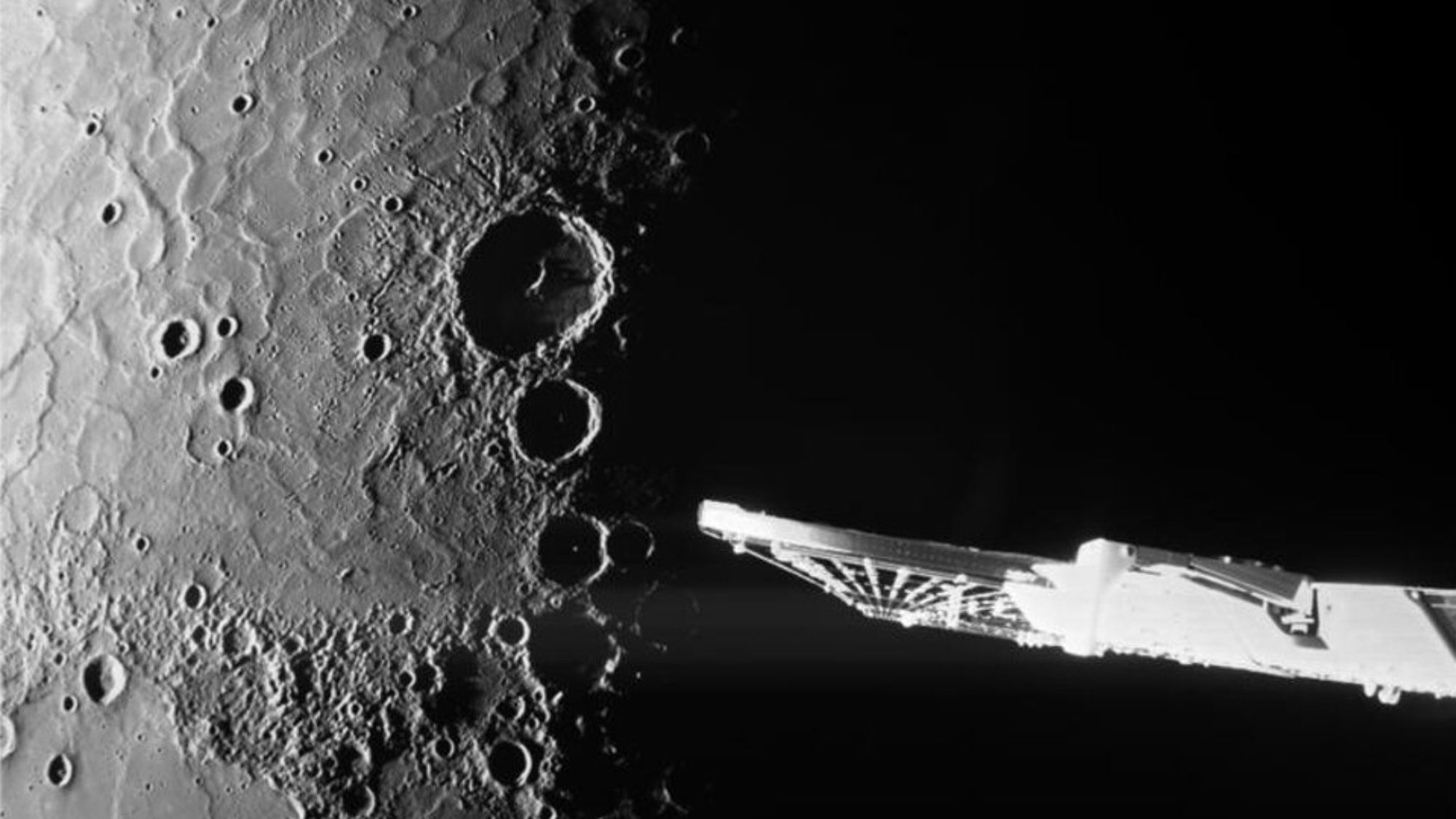
MESSENGER opened up some smaller mysteries, too. It discovered bright, steep-sided pits that scientists dubbed "hollows." It found a suite of elements — that planetary scientists call "volatiles" for their tendency to slip free of rock — somehow more prevalent in Mercury's surface than Earth's. It calculated that the center of the planet's magnetic field is wildly offset from the planet's core. Plus, MESSENGER's tricky orbit also meant the spacecraft never saw the southern half of the planet as sharply as the northern half, leaving one side shadowed in doubt.
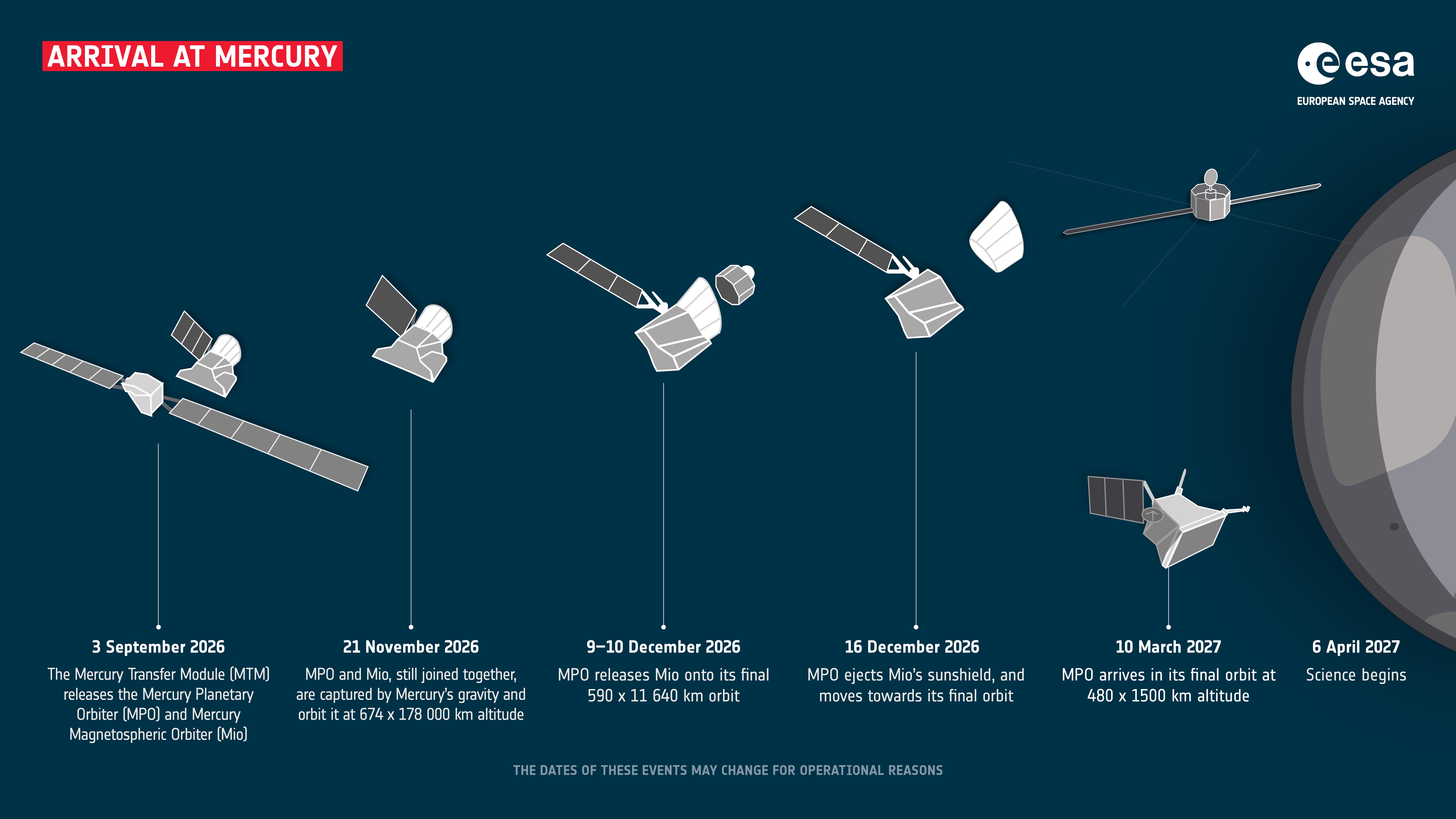
It's these mysteries that the ambitious BepiColombo mission hopes to tackle. By April, if all goes well, the mission will consist of two separate spacecraft gathering independent but coordinated data about Mercury.
Europe's Mercury Planetary Orbiter, or MPO, will focus on the planet proper. It's packed with 11 science instruments that will map the terrain, minerals in the crust, and the gravity field, investigate the hollows and volcanic deposits, and observe how the barrage of charged particles from the sun affects this innermost planet.
Japan's Mercury Magnetospheric Orbiter, or Mio, meanwhile, will focus on the planet's surroundings — its magnetosphere and wispy atmosphere, as well as the dust cluttering up its neighborhood.
Both spacecraft also carry instruments to measure the planet's magnetic field, offering simultaneous observations of different parts of the field to scientists who typically make do with data gathered from just one location at a time.
In fact, some of these instruments have been able to gather observations during BepiColombo's long trek to Mercury and its six quick flybys of the planet so far. But because of how the spacecraft were configured for the journey, most of the instruments have not — and will not — get to work until after MPO and Mio have separated. That is expected to happen in December.
The mission's science, then, has begun only in dribbles, while the bulk of its promise still lies ahead. "There is a growing literature of new results that have come from the BepiColombo flybys, but I expect that will explode once they go into orbit," Solomon said.
He's especially excited to see the spacecraft's sharp views of the southern hemisphere, and particularly find hidden deposits of water ice across the area. These deposits would exist in deep craters that never feel the sun's heat. In examining this region of the planet, scientists will be able to reduce the northerly bias of MESSENGER's data and better see Mercury's complete picture.
Meanwhile, Klima is most eagerly awaiting MPO's work to map elements and minerals in the planet's surface. This work eluded MESSENGER, which used a technique that relied on these rocks being rich in iron and similar materials — but as it turned out, those elements were absent, leaving scientists stymied. MPO carries different technology that will be able to read rocks on the world even without iron, which Klima said could help reveal how Mercury — and our whole solar system, as a matter of fact — formed.
Klima says she hopes BepiColombo can get people excited about Mercury, the overlooked terrestrial planet of the solar system: "It certainly doesn't get the love and attention that Mars and Venus and everywhere else gets."