
NASA closes the book on epic OSIRIS-REx asteroid-sampling mission: ‘I am immensely proud of what we did’

On Sept. 30, NASA formally concluded OSIRIS-REx, the historic first U.S. mission to pluck a pristine piece of an asteroid and deliver it safely back to Earth.

The van-sized OSIRIS-REx spacecraft — whose name is short for Origins, Spectral Interpretation, Resource Identification, Security-Regolith Explorer — visited and sampled Bennu, an ancient space rock holding pristine remnants from the dawn of our solar system more than 4.5 billion years ago. Among those cosmic relics are raw organic building blocks, the kind that may have seeded life on Earth.

"I have known this day was coming for a long time, but it is still difficult to see it arrive," OSIRIS-REx Principal Investigator Dante Lauretta, who's based at the University of Arizona, said in a post on LinkedIn. "I feel enormous pride in what we accomplished together, and real sadness that this journey has come to an end."

For the mission team, the farewell capped a decade of high-stakes engineering, on-the-fly troubleshooting and nail-biting close calls that ultimately delivered to Earth the largest asteroid sample ever collected in space, one that held secrets from the early solar system.

Long before launch, the team faced obstacles that nearly thwarted the endeavor — chiefly, two rejections from NASA — before finally securing the green light for the $1 billion project under the New Frontiers Program in 2011.

When OSIRIS-REx launched on Sept. 8, 2016, on a two-year journey across the inner solar system, Bennu was little more than a point of light in telescopes. Scientists expected the asteroid’s surface to be a smooth, sandy sphere where OSIRIS-REx could seamlessly touch down. Much to their surprise, however, when the probe arrived at the asteroid in late 2018, it revealed Bennu to be a treacherous, loosely bound amalgamation of jagged boulders.

"Our expectations about the asteroid's surface were completely wrong," Lauretta said in an Oct. 7 statement from the University of Arizona. "There was no obvious place to collect a sample anywhere."

When OSIRIS-REx touched down on a small crater named Nightingale, Bennu offered so little structural resistance that scientists said its surface reacted more like fluid than a hard, rocky shell. The spacecraft's sampling head sank directly into the asteroid, stopping after burrowing 20 inches (51 centimeters) deep by firing its thrusters at the right time to pull away, with the precious sample in hand.
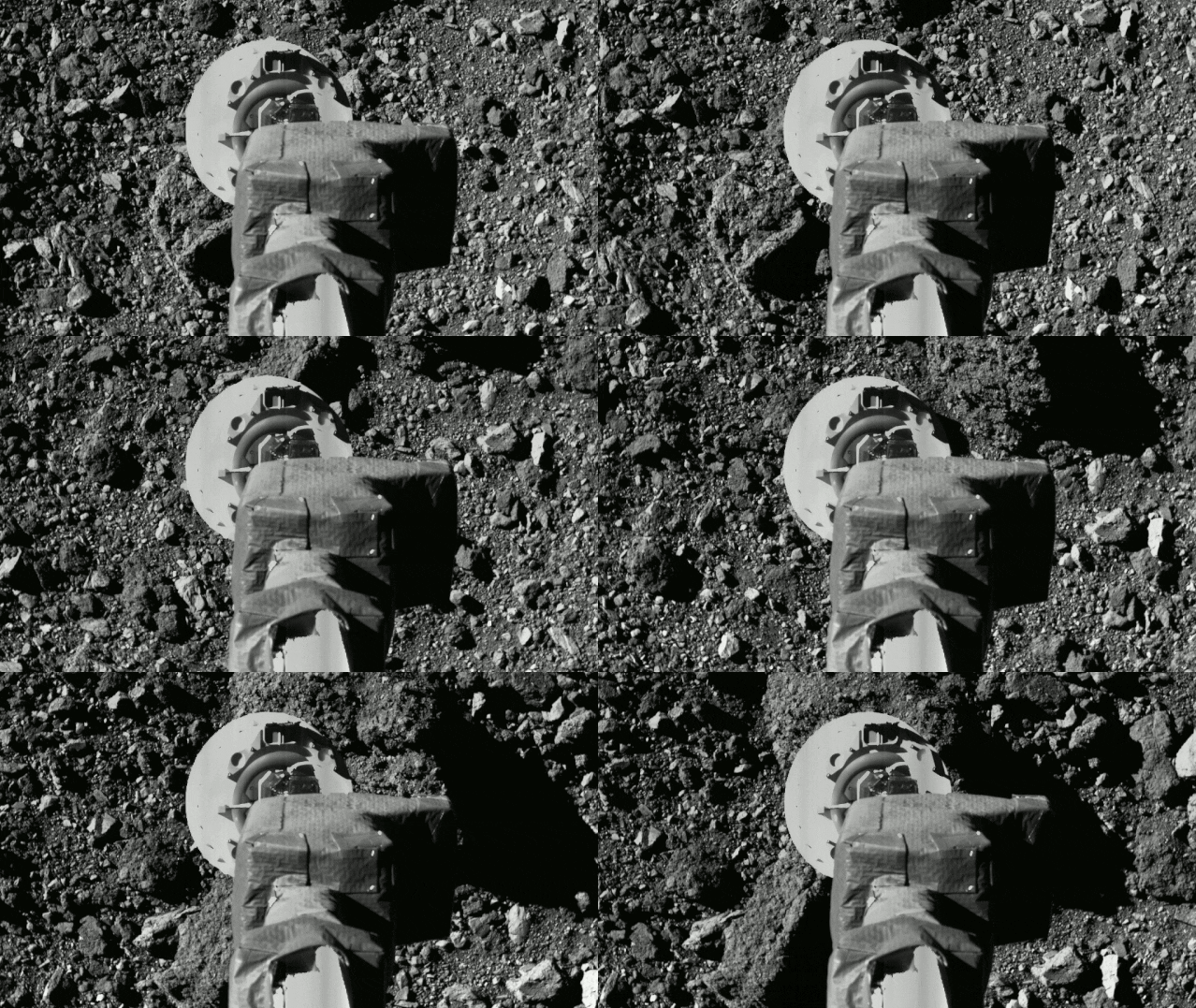
A spacecraft's arm above a moving ground. It's black and white and the ground looks pebbled and rocky.

NASA's OSIRIS-REx spacecraft captured this series of images of asteroid Bennu on April 14, 2020, during the first rehearsal of the mission's sample collection event. The actual sample retrieval was extremely close to the way this looks. (Image credit: NASA/Goddard/University of Arizona)

Then came another nail-biting moment: The sample collector lid got jammed in a partially open position because so much material was scooped up, allowing fragments of the precious cargo to escape. In a race against time to prevent further loss, the mission team quickly stowed the sampler head directly inside the return capsule, securing the cosmic treasure for its journey back to Earth.

Even the final return to Earth, on Sept. 24, 2023, kept the team on edge: A parachute failed to deploy properly during reentry, forcing a tense but ultimately safe landing in the Utah desert.

"Successful exploration missions are not those that avoid surprises; they are those that are deliberately designed to adapt to them," Lauretta said in the statement, quoting a line from the mission's final report to NASA.

"That certainly describes OSIRIS-REx," he said. "Again and again, the mission presented us with circumstances we had not expected, and again and again, this team found a way forward."

The mission's triumphs began long before the samples reached Earth. For example, the probe set a Guinness World Record when it slid into orbit around the 1,610-foot-wide (490 meters) Bennu, which became the smallest object ever circled by a spacecraft.

The scientific payoff that followed included remote-sensing work that confirmed Bennu's surface is coated in carbon-bearing compounds. Those observations also revealed that Bennu was once part of a much larger, water-rich parent asteroid that shattered in a catastrophic collision in the main asteroid belt between Mars and Jupiter.

The returned sample — which weighs 4.29 ounces (121.6 grams) here on Earth, more than twice the mission's requirement — continues to thrill and occupy scientists.

A wave of research papers, now topping 200, continues to piece together the composition and history of the ancient space rock. Among other findings, Bennu's pristine material has revealed amino acids and sugars that, on Earth, are essential for life, alongside a history of exposure to liquid water that could have served as the "broth" for these compounds to interact.

More discoveries are likely to come. Most of the returned Bennu sample is being preserved for future generations of scientists, who will study it "with questions and instruments we cannot yet anticipate," Lauretta said in the statement.

Though its OSIRIS-REx chapter is closed, the spacecraft itself is far from retired. Renamed OSIRIS-APEX (OSIRIS-APophis EXplorer), the probe is using its remaining propellant to head toward Apophis, another near-Earth asteroid and a different type of space rock from Bennu. It is scheduled to arrive in 2029.
Astronomers want your help finding ‘missing’ black holes in the Milky Way

Astronomers estimate that our home galaxy, the Milky Way, has churned out more than 10 million black holes over its 13-billion-year history. Yet so far, they have found only 70.

Now, a group of astronomers in the U.K. is trying to close that vast gap by enlisting the public. Their project, called Black Hole Hunters, is looking for volunteers with a computer and a few spare minutes to sift through troves of data gathered by a NASA space telescope. By flagging recognizable patterns that could point to a "missing" black hole, volunteers can help fast-track a search that would otherwise take years, the team says.

"You'll be narrowing down precisely where we need to point our telescopes next," project co-lead Adam McMaster, an astronomer at the University of Southampton in the U.K., said in a statement, "and you might be the one to discover a black hole."

Cosmic magnifying glasses

Black holes form when massive stars roughly 20 times heavier than our sun run out of fuel and collapse, leaving behind an abyss with gravity so immense that even light cannot escape. While invisible themselves, these cosmic behemoths reveal their presence by bending the light of nearby objects, and the Black Hole Hunters project is searching for one specific manifestation of this effect.

It happens thanks to the fact that massive stars often form in pairs, and a star can sometimes survive the violent supernova explosion that turns its companion into a black hole. When that happens, the two bodies continue to orbit each other. If such a duo aligns just right with Earth, the black hole will periodically pass directly between its companion star and our planet. And when it does, the black hole's gravity acts like a cosmic magnifying glass, bending and magnifying the star's light, causing it to briefly appear brighter to watchful telescopes.

To find these hidden giants, the project relies on data from NASA's Transiting Exoplanet Survey Satellite, or TESS. Although the satellite's primary mission is to hunt for planets beyond our solar system, its method of data collection — tracking tiny, continuous changes in a star's brightness over time — is ideally suited for identifying black hole magnification events, the project description notes.

"It's a simple task with no expertise required," McMaster said in the statement. "We will show volunteers examples of what to look for so all they have to do is recognise the right patterns."

Automated algorithms conduct a preliminary sweep of the TESS data, screening millions of potential stars for the most obvious black hole candidate locations, according to the project description. But, the researchers say, artificial intelligence struggles with the messy realities of the cosmos, such as stellar flares and the natural pulsations of stars that can trick the algorithms into false positives.

The human touch

That makes human volunteers a key part of the search. To keep errors in check, each graph is shown to multiple volunteers, and their answers are combined so that individual mistakes average out, according to the project's website.

"I can search for black holes on my laptop from my bedroom — and could make a real impact on real space science," Grace Clarke, an undergraduate student of physics and astronomy at the University of Southampton who's involved with the project, said in the same statement. "The data's easy to understand — it's just pattern recognition — and you don't need a degree in astronomy to read it."

The crowdsourced shortlist of promising signals lets astronomers aim follow-up observations at specific stars, such as precise measurements of whether a star is being tugged at by an unseen companion. Those measurements take time and are expensive, so a good shortlist helps researchers spend scarce telescope time wisely, the team says.

Since launching on the Zooniverse platform in October 2021, the project has attracted nearly 23,000 volunteers, who have completed more than 12 million classifications, according to its website.

Before turning to TESS, the team ran a similar search using data from SuperWASP, a ground-based survey that, like TESS, monitored stars for signs of planets from 2004 to 2016. Those results are still being analyzed and are expected to be published soon.

The team also plans to widen its search with observations from other instruments, including the European Space Agency's Euclid mission and NASA's recently launched Nancy Grace Roman Space Telescope.

"With potentially thousands of new discoveries, we need all the help we can get," McMaster said in the statement.

UAE unveils lander for bold 7-asteroid mission set to launch in 2028 (photos)

The United Arab Emirates (UAE) has moved a step closer to launching its second-ever interplanetary mission — an ambitious, eight-year exploration of seven asteroids between Mars and Jupiter that will culminate with a landing on the mysteriously red asteroid 269 Justitia.

The mission team unveiled a half-scale model of the homegrown probe that will make that landing during an Oct. 1 press conference in Abu Dhabi, the capital of the UAE. The autonomous craft will ride attached to the main spacecraft MBR Explorer, named after Sheikh Mohammed bin Rashid al-Maktoum, the ruler of Dubai and the UAE's prime minister.

The flight-ready lander is being kept pristine in a vacuum chamber in the capital before being transported to Colorado by Etihad Airways, officials said, where it will be integrated with the main spacecraft, which was developed by the UAE Space Agency.

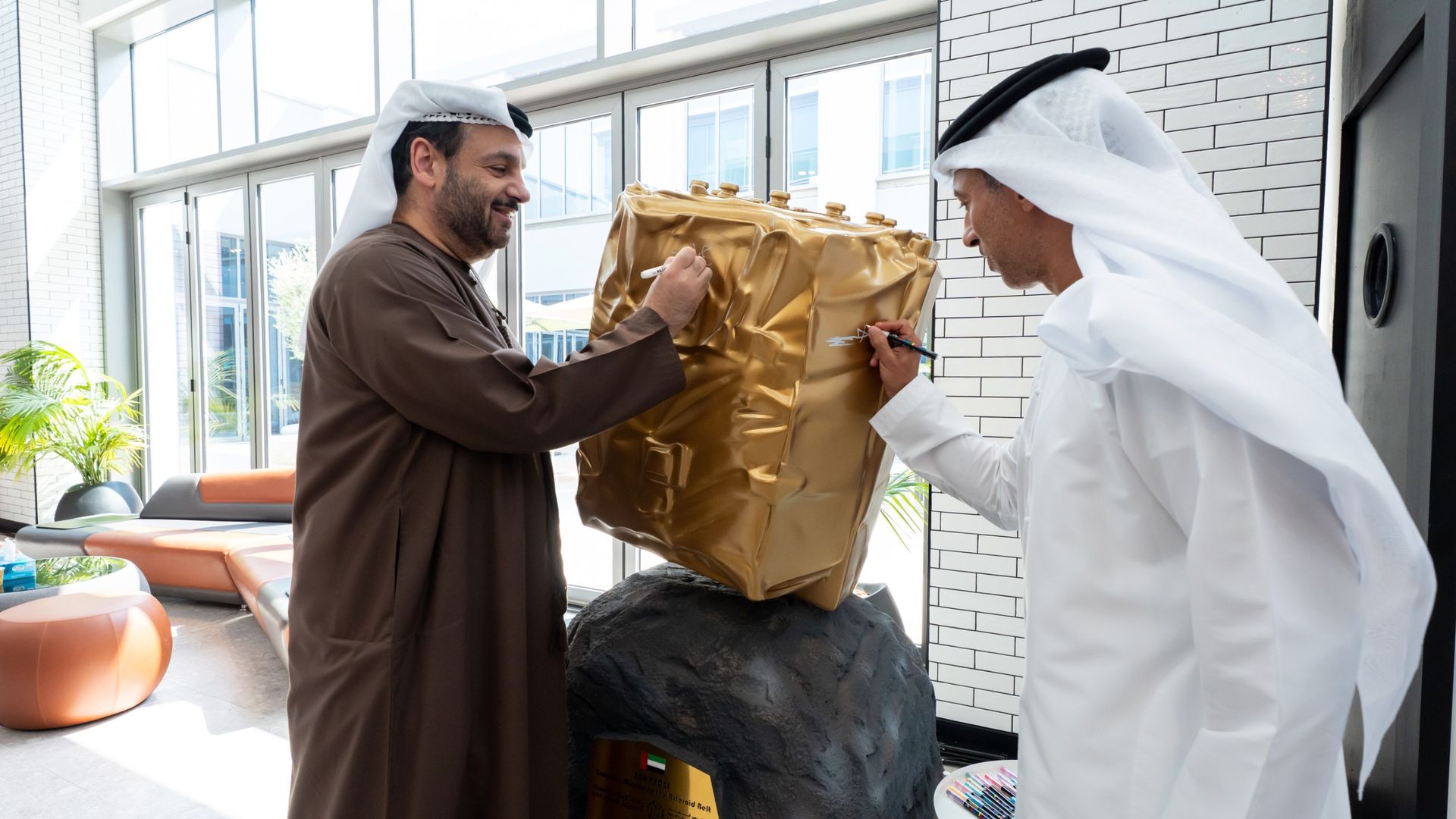
two men in long, flowing robes sign a model of a small golden spacecraft in a well-lit room

Faisal Al Bannai, secretary-general of the Advanced Technology Research Council, and Ahmad Belhoul Al Falasi (left), chairman of the UAE Space Agency, sign a model of the lander that will fly on the Emirates Mission to the Asteroid Belt, which is scheduled to launch in March 2028. (Image credit: TII)

If all goes to plan, the mission will lift off from Japan in March 2028, kicking off the Emirates Mission to the Asteroid Belt (EMA). The project is an ambitious follow-up to the UAE Space Agency's Hope Mars orbiter, which has been studying the Red Planet since 2021.

"It's a proud moment for us here at the UAE," said Faisal al-Bannai, the secretary general of the Advanced Technology Research Council in Abu Dhabi.

'We don't know what we're going to find'

EMA will conduct high-speed flybys of six asteroids before reaching and orbiting 269 Justitia. It will travel a total of about 3 billion miles (5 billion kilometers), which is equivalent to circling Earth roughly 125,000 times, said Najwa Aaraj, the CEO of the Technology Innovation Institute (TII) in Abu Dhabi, which designed, built and tested the mission's lander.

Along the way, the MBR Explorer will utilize gravity assists from Venus and then Earth to swing deeper into space, zipping past its first three asteroid targets: 10253 Westerwald, 623 Chimaera and 13294 Rockox. A subsequent gravity assist from Mars will fling the spacecraft even farther out, guiding it past three more space rocks: 88055 Ghaf, 23871 Ousha and 59980 Moza.

By 2036, the spacecraft is scheduled to rendezvous with its final and most intriguing target, 269 Justitia. A roughly 30-mile-wide (50 km) object in the middle of the asteroid belt, 269 Justitia is unusual for its remarkably crimson hue.

Its distinct color more closely resembles icy objects in the Kuiper Belt beyond Neptune than its immediate main-belt neighbors. This unique trait has led planetary scientists to hypothesize that the asteroid formed in the frigid outer solar system and migrated inward early in the solar system's history. If true, visiting 269 Justitia would offer a rare, close-up look at pristine material from the distant outer solar system via a much shorter journey.

Scientists are particularly excited that the asteroid may still hold water-related minerals and organic compounds preserved from its origins. Studying its surface could therefore offer clues to how water and organic material were distributed as planets began to form, Elias Tsoutsanis, a chief researcher at TII's propulsion and space research center, said during the press briefing.

"We don't know what we're going to find — that's exploration," Tsoutsanis told reporters. "We're really excited."

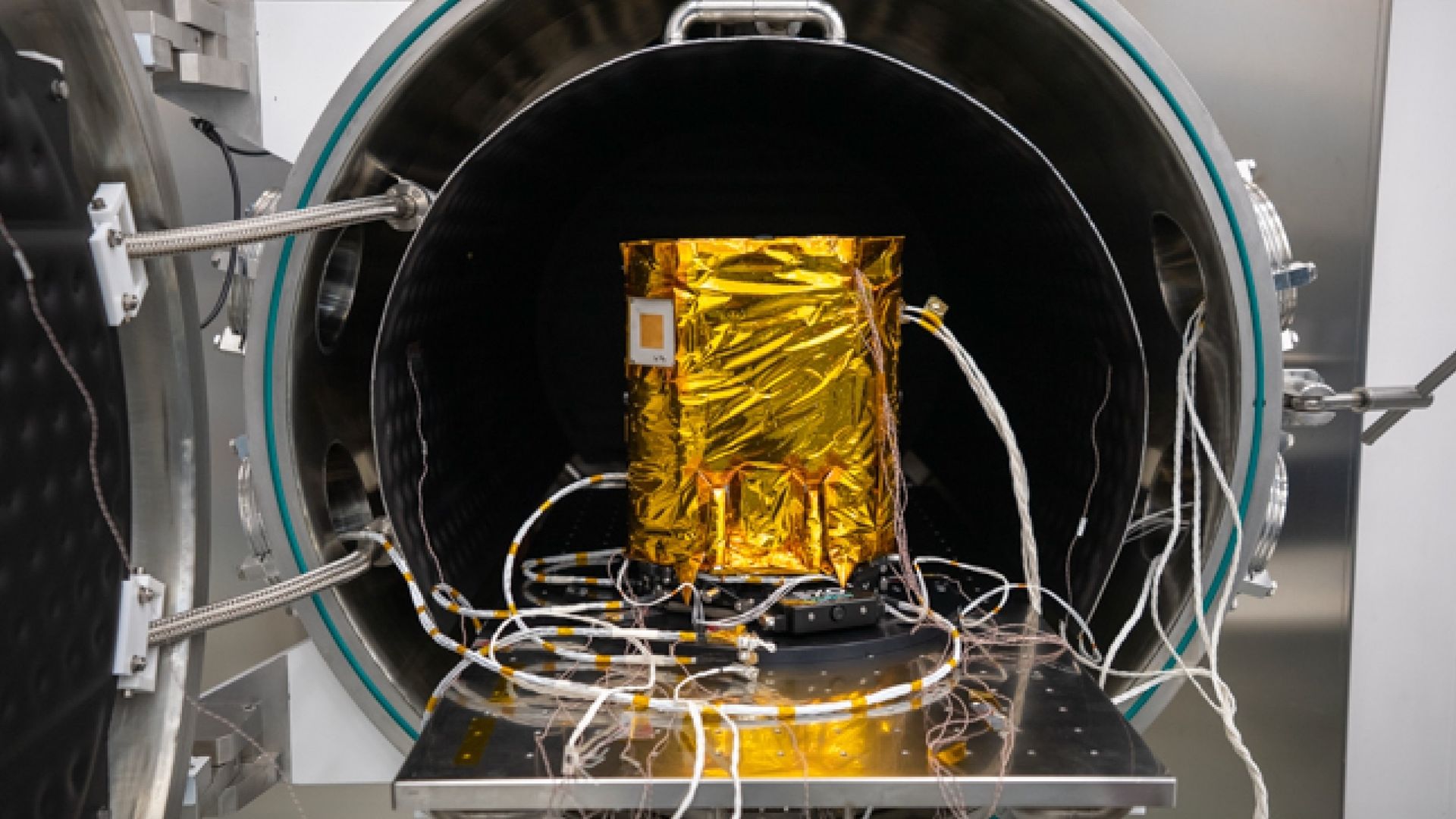
closeup of a rectangular golden spacecraft with lots of wires running from it

Another look at the lander for the Emirates Mission to the Asteroid Belt. (Image credit: TII)

According to the mission plan, the MBR Explorer will spend roughly seven months studying 269 Justitia from orbit. Beginning at an altitude of 155 miles (250 km), the spacecraft will gradually lower its path before releasing the lander. The smaller probe will then head toward the asteroid's surface, a descent that should take two to three hours depending on 269 Justitia's precise gravity, which remains unknown.

Although TII describes the mission ending with a landing on the surface of 269 Justitia, the engineering details suggest a more violent endgame. Cruising toward the asteroid's surface at 15 to 27 meters per second (34 to 60 mph) with no meaningful way to slow down, the probe will function less like a traditional lander and more like a planned impactor.

"We don't expect that the probe will survive the touchdown," said Mariam Alhammadi, a researcher in TII leading the mission's electric propulsion.

To ensure its two onboard cameras capture essential imagery during the descent, the probe will rely on an attitude-control system to counteract any post-separation spin, Alhammadi said. Should the probe unexpectedly survive the hard landing, she added, its battery is built to last 20 to 50 minutes, providing a narrow but crucial window for it to beam close-ups of the asteroid's surface back to Earth.

The high-velocity impact is also expected to dig a small crater on 269 Justitia, possibly exposing pristine subsurface material. Because this material cannot be imaged from orbit, the team expects the probe's final images to be among the most valuable of the entire mission.

Zero margin for error

Back on Earth, the team faces an unforgiving timeline. To execute the planned flybys, the mission must launch during a narrow three-week window that opens in early March 2028.

"God forbid we miss that — we basically don't have a mission," Mohsen al-Awadhi, the mission director at the UAE Space Agency, told reporters at the press conference. The orbital mechanics are so rigid that another comparable opportunity will not arise for at least 100 years, prompting al-Awadhi to add that he is devoting no time and energy to a backup plan.

Meeting the launch window is just the first hurdle, however. Once deployed in deep space, the lander must operate with absolute autonomy, receiving no commands from Earth or the main MBR Explorer spacecraft, the team says.

"In these eight years, I have no control to call it back — so nothing can go wrong," said Aaraj.

The team is confident that rigorous engineering and testing have produced a probe that can essentially "think for itself." Equipped with AI, it is designed to decide on its own when to capture images and how to filter and rank the most valuable data. Rather than waiting until it reaches its destination, the lander will take images throughout its eight-year cruise and send the best ones back to Earth roughly every six months, according to a TII statement.

Officials declined to disclose the mission's overall cost or say whether it has stayed on budget. The United States' ongoing war in Iran has sparked missile and drone attacks across the UAE, but the mission team has persevered: WIRED reported that they pressed on even as missiles were intercepted overhead.

Looking ahead

Beyond the immediate scientific return, officials said a central pillar of this mission is accelerating the UAE's sovereign deep-space capabilities and fostering its domestic space economy.

The UAE Space Agency, established in 2014, has steadily expanded its portfolio from satellite launches to a Martian orbiter and sending two astronauts to the International Space Station. The EMA probe represents a developmental leap, designed and built in just under two years by a team of roughly 50 local engineers and scientists, many of whom began their careers as entry-level technicians on the Hope Mars mission.

"I don't want to call them my kids — there's a lot of them — but that's how attached I feel to them," al-Awadhi said during the briefing.

The UAE aims to position itself among the world's 10 largest space economies by 2031, targeting a massive expansion of a sector currently valued at about $12 billion. According to al-Bannai, the EMA project is designed to be one of many programs to come. By the time the lander impacts 269 Justitia in 2036, the technology matured during this journey will already be driving the next generation of Emirati spacecraft, he said.

"That's the journey we're on today."