Shoebox-sized ‘detector satellites’ could sniff out a nuclear bomb in space

A constellation of cubesats fitted with special detectors could sniff out nuclear weapons hidden on satellites launched by adversary nations, according to a new study.

In 2024, rumors began to swirl in military circles that Russia might be developing a space-borne nuclear weapon. At that time, two years into the war in Ukraine, Russia was well aware of how big a lifeline SpaceX's Starlink broadband constellation had been for the Ukrainians. Starlink has not only provided connectivity to ravaged cities and frontline troops but also helped Ukrainians counter-attack the Russian invaders more effectively.

Drones fitted with Starlink terminals could reach much more distant targets than those controlled via conventional radio links. As the Starlink signal is almost impossible to disrupt by jamming, the idea that Russia might consider wiping the megaconstellation out by brute force didn't seem impossible.

Researchers know that a nuclear detonation in orbit would flood the space around Earth with fast, energetic electrons. These particles would destroy most unhardened satellites within range, which would extend to orbits even hundreds of miles away from the explosion.

"It would make the low Earth orbit and very low Earth orbit — where the Starlink satellites are, where many reconnaissance and communications satellites are, and where the International Space Station is — uninhabitable for a long period of time," Areg Danagoulian, an associate professor of nuclear science and engineering at the Massachusetts Institute of Technology and the author of the new paper describing the proposed detection method, told Space.com.

"We would essentially not only lose the satellites in those orbits, we would lose those orbits for a few years," he added.

Humankind has already seen the effects of a nuclear explosion in space. In 1962, the U.S. detonated a 1.4-megaton hydrogen bomb at an altitude of 240 miles (400 kilometers) above the Pacific Ocean. Radiation from the explosion, known as the Starfish Prime test, destroyed one-third of all satellites in orbit at that time. Admittedly, there weren't that many up there — fewer than 100 — but the impact was far-reaching.

Today, a nuclear detonation in space would be a catastrophe. It would knock out internet-beaming constellations such as Starlink and Amazon Leo, as well as hundreds of Earth-observing satellites that keep an eye on the activity of adversary nations, the changing climate and areas struck by natural disasters.
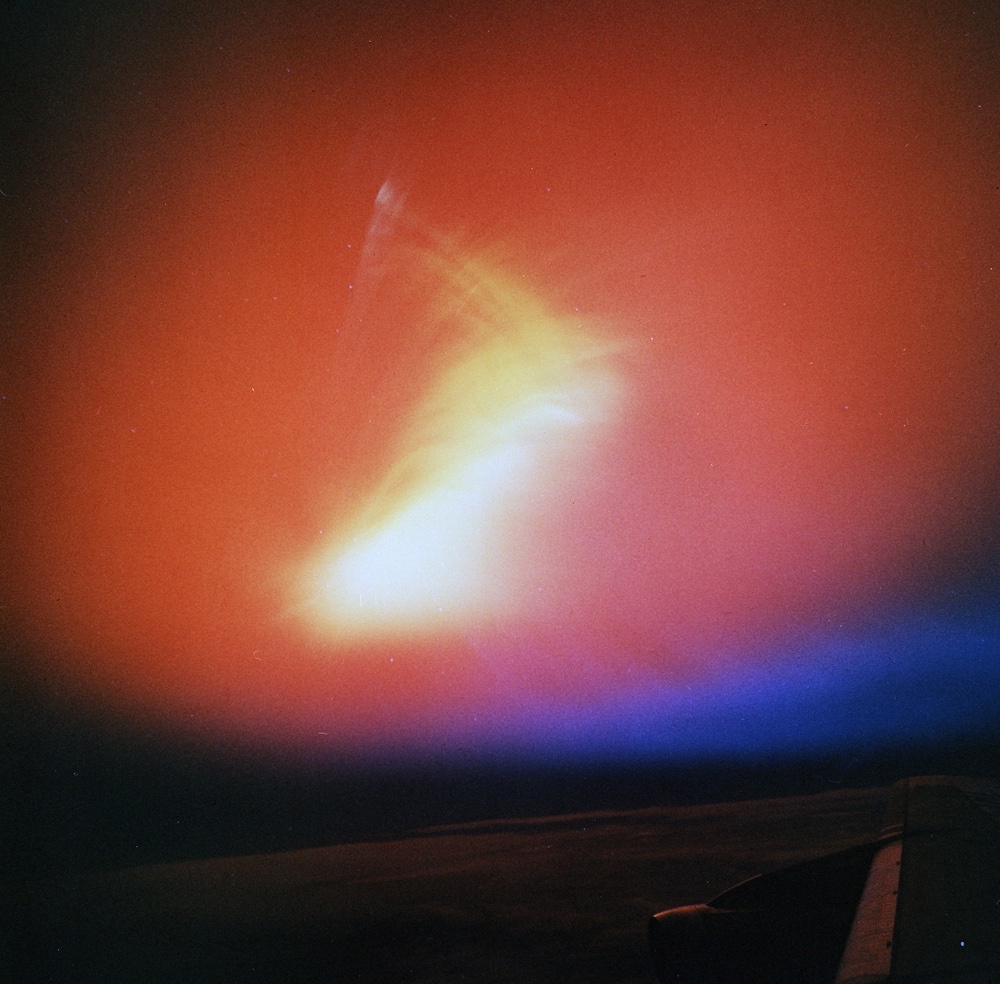
Photograph of an aurora caused by the Starfish Prime high-altitude nuclear test explosion on July 9, 1962. (Image credit: Public Domain)

No reliable way currently exists to detect and defuse a nuclear bomb in space. Danagoulian proposes a constellation of small "9U" cubesats, each one about the size of a large shoebox and each carrying a special detector capable of sensing radiation emitted by unexploded nulear bombs.

He explores a scenario in which Russia launches a suspected space nuke into an orbit with an altitude of 1,200 miles (2,000 km). That number is not random. In 2022, Russia's Kosmos 2553 satellite, orbiting at that exact altitude, triggered suspicions it might be testing components for a future orbital nuclear weapon.

Russia claims the satellite just observes Earth. At that altitude, the satellite passes through the Van Allen belt, a region of intense cosmic radiation trapped by Earth's magnetic field. Most of the belt stretches between altitudes of around 600 miles (1,000 km) to tens of thousands of miles, but in some areas the radiation can reach much closer to Earth's surface.

The interaction between the fissile material inside the nuke and the energetic particles from the radiation belt would create distinct signatures, Danagoulian said, which could help confirm whether a suspicious satellite carries a nuke or not.

"The thermonuclear weapon would contain a significant amount of uranium," Danagoulian said. "The high-energy protons [in the uranium] would break up when another proton is coming in and shred the nuclei. That would knock out a large number of neutrons. This interaction turns that device into a very intense neutron source that otherwise would not be there."

The process is known as proton-induced neutron spallation, which essentially means the ejection of fragments from material triggered by impacts of protons.
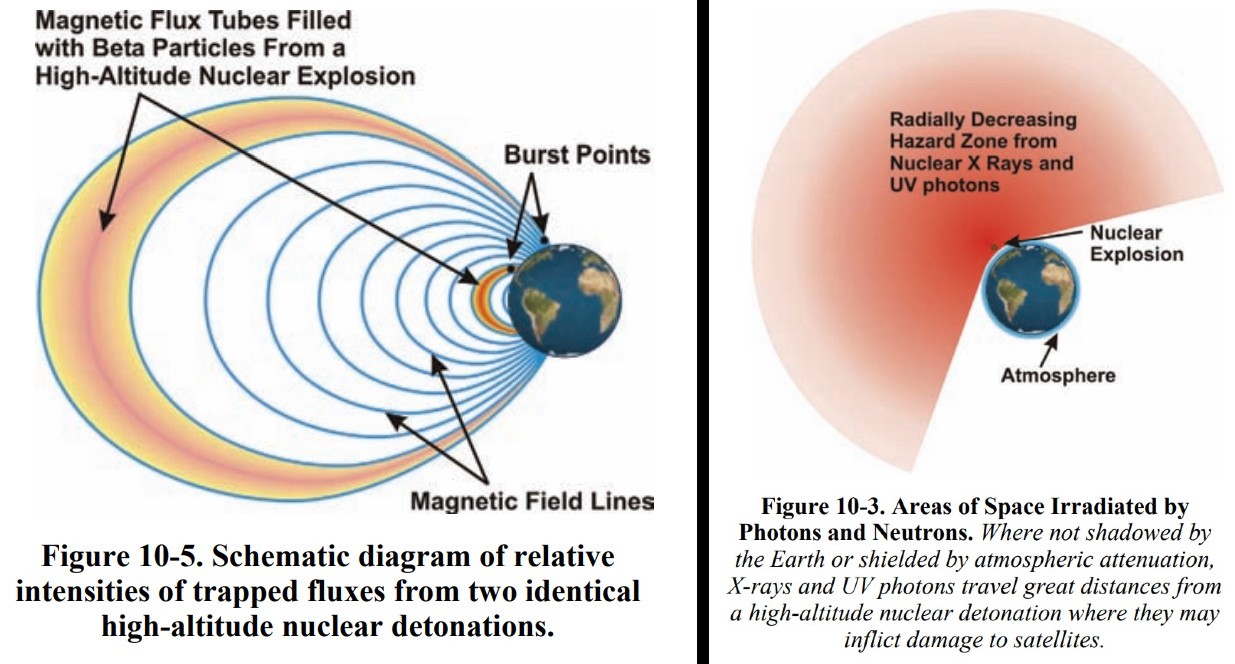
Two figures from the 2008 "Report of the Commission to Assess the Threat to the United States from Electromagnetic Pulse (EMP) Attack" illustrating the effects of a high-altitude nuclear explosion in Earth's atmosphere and how Earth's natural radiation belts can trap radiation released by nuclear detonations in or near space. (Image credit: U.S. Dept. of Defense)

The detector satellite Danagoulian proposes would have to be able to get quite close to the suspect spacecraft — a few kilometers. The inspector spacecraft would carry a sensor combining two types of detectors. At the heart of the device is a neutron scintillator, which detects all incoming neutrons and protons. Around it is a "cage of diamond" detector that detects only neutrons — not protons. Such a set-up helps filter out the particles present in the environment naturally, said Danagoulian. In addition, by using two "planes of neutron detectors," the sensor can determine the direction from which the neutrons arrived.

"If the external diamond detector triggers and gives a signal, you can ignore the particle, because it's most likely a proton and not a neutron," said Danagoulian. "Once you identify those neutrons, by having those two detections, you can back project and find out where the neutron came from."

Danagoulian says such a nuke sniffer would have to be launched into an orbit aligned with that of the suspicious satellite and creep up as close as 2.5 miles (4 km) from it. It would then take about a week to gather enough measurements to confirm whether the object is hiding a nuke or not. A constellation of 10 such satellites could reduce the process to mere hours, Danagoulian said.

If a nuke were detected, the military could then try to jam the satellite's communications link from the ground, making it impossible for the adversary to remotely detonate the bomb. There is currently no technology available to safely defuse a nuclear weapon in space.

The United Nations Outer Space Treaty, which provides the legal foundation for humankind's use of outer space, bans the use of nuclear weapons in orbit. However, the treaty has no means to ensure compliance.

Other approaches to nuke detection in space have been explored, including maneuverable X-ray satellites, but those would be quite a bit more complex and expensive.

Danagoulian also suggests that high-grade radiation hardening could improve satellites' chances of surviving a nuclear winter in space.

The paper was published online in the journal Nature today (July 8).

‘This is the future of spatial intelligence’: Vantor unveils stunning 3D satellite views of Earth (photos)

The American Earth-observation company Vantor maps Earth from space in 3D. The images are available in near-real time, revealing immediate effects of natural disasters and armed conflict. What is more, the images are also absolutely stunning.

Vantor, which operates a fleet of 10 satellites that image the surface of the planet with a resolution of 12 inches (30 centimetres), released the first set of its 3D shots from space on July 1. The images capture a variety of targets, all in amazing detail.

For example, there are shots of iconic landmarks in Paris; the Eiffel Tower, the Arc de Triomphe and the modernist quarter La Défense emerge in the images as if seen from a landing plane. Other image sets track the progress of ship-building activity at China's Yulin Naval Base and decreasing water levels at Arizona's Hoover Dam.

satellite photo showing the eiffel tower, with a river just to its left

The Eiffel Tower, captured by a satellite operated by the Earth-observation company Vantor. (Image credit: Vantor)

the standard resolution of 20 inches (50 cm) with an accuracy of 13 feet (4 meters) in all directions, and the HD version with a 6-inch (15 cm) resolution and a 10-foot (3 m) accuracy in all dimensions.

The 3D views are created by combining multiple satellite images taken from different angles and are updated every 24 hours or less to track even the most rapidly occurring changes in the landscape. The images form a basis for 3D maps that could, for example, help autonomous drones navigate in areas hit by GPS jamming.

The satellite fleet's ability to rapidly update the imagery is a unique feature that was impossible to achieve by other 3D mapping technologies. Most commonly, mapmakers and organizations would have to conduct costly imaging campaigns from aboard aircraft or using remotely controlled drones. Neither of these approaches, however, allows such regular and frequent revisits, according to Vantor. On top of that, drones and planes may not be able to safely access and map areas controlled by unfriendly nations.

satellite photo of a large arch, which is surrounded by diagonal tree-lined streets leading to it

The Arc de Triomphe in Paris, captured by a satellite operated by the Earth-observation company Vantor. (Image credit: Vantor)

"From command and control to autonomous systems operating in GPS-denied environments, many of today's most complex missions require current, accurate 3D terrain," Peter Wilczynski, chief product officer at Vantor, said in a statement.

"With WorldView 3D, customers can update the specific areas they care about, including remote and contested areas where traditional aircraft collection is limited, with unmatched speed and scale," Wilczynski added. "This is the future of spatial intelligence."

‘Acceleration without fuel:’ Revolutionary superconducting device harnesses Earth’s magnetic field to move a spacecraft

New Zealand company Zenno Astronautics has tested a first-of-its-kind torquer based on superconducting magnets to maintain the position of a satellite in space.

Superconducting magnets can convert solar energy directly into momentum in space and provide a source of acceleration that needs no fuel, but until recently, the technology was too large and complex to fit on a satellite. That's no longer the case.

Zenno Astronautics, a spin-off from the University of Auckland, has flown its new "Supertorquer" system on the Mira satellite built by California-based start-up Impulse Space. The tests began shortly after Mira's launch in November last year aboard the SpaceX Transporter 12 mission and saw the shoebox-size device perform with flying colors, Zenno Astronautics CEO and founder Max Arshavsky, told Space.com.

"It's a technology that allows a spacecraft to not tumble violently in space and point in the right direction," Arshavsky said. "The unit has multiple super-conducting magnets that are positioned in different axes. When we power up the magnets, they generate a magnetic field, which interacts with Earth's magnetic field, and because we can control the magnetic field on the satellite, we can control the way in which it turns with respect to Earth."

Superconducting magnets are made of coils of superconducting wire that have zero electrical resistance and can therefore conduct much larger currents than normal wires. That larger current translates into a greater magnetic force. There is, however, a catch: Superconducting materials need to be cooled to extremely low temperatures to gain their wonder properties.

In labs on Earth, the cooling requires tanks of cryogenic liquids like liquid helium or liquid nitrogen. Those cannot be used aboard a satellite. Instead the system must expel all heat from its surroundings into outer space.

"The magnets need to operate at minus 200 degrees Celsius [minus 328 degrees Fahrenheit]," Arshavsky said. "But even though space is cold, the satellite is actually not. It's about 20 degrees C, pretty warm, because we are pointing at the sun."

The unit housing the superconducting magnets is wrapped in layers of insulation and fitted with a heat pump that removes all the excess heat from the system. Every time the satellite needs a push, the superconducting coils power up, drawing energy from a battery charged by the satellite's solar panels.

"It's converting solar energy straight into useful work," Arshavsky said. "Energy is the one thing that is abundant in space, and you can use it to energize the magnet to create a magnetic acceleration device. It gives you acceleration without fuel."

In the future, Zenno Astronautics plans to launch larger systems that could enable spacecraft to dock in space or conduct close proximity operations using just the power of their solar-powered superconducting magnets. Arshavsky envisions powerful magnets that could someday propel spacecraft on missions to the moon and Mars using only solar power.

"Once you have super-conducting technology available in space, you can then create very strong magnetic fields, and you can use them for various use cases," he said. "You can accelerate things in space very fast or change the trajectory of a satellite completely without fuel."

"We are essentially looking to remove all reliance on Earth's resources so that we can build a sustainable industry in space," Arshavsky said.

Powerful superconducting magnets could also provide a solution to the problem of cancer-causing cosmic radiation that explorers will encounter during stays on the moon or trips deeper into space.

"When we go to space, we get hurt by radiation, and these superconducting magnets can create umbrellas of magnetic fields around the spacecraft to protect the interior," said Arshavsky. "So we can shield people in space from that radiation."

Zenno Astronautics company plans to fly a larger demonstrator on an undisclosed mission later this year.

Editor's note: The original version of this story referred to the newly tested device as a thruster. That wording is not technically correct and, at 11 a.m. ET on July 10, was therefore changed to "torquer."

The growing number of satellites in orbit could soon make telescopes obsolete. ‘For astronomy, this would obviously be catastrophic’

If the number of satellites in Earth's orbit exceeds 100,000, humanity may lose its ability to study the universe from the planet's surface.

That's the conclusion of a study conducted by astronomers from the European Southern Observatory (ESO) which warns that if existing plans to deploy a million orbiting data centers and tens of thousands sun-reflecting mirrors were to come to fruition, the world's most cutting-edge astronomical telescopes may as well be mothballed.

"We can reach conditions where basically, there is no point in operating the telescopes anymore because all the data will be corrupted. All. 100 percent," Olivier Hainaut, the director of operations at ESO and lead author of the study, told Space.com.

Hainaut used computer modelling to understand the effect of varying numbers of satellites of different brightness levels on astronomical observations. The modelling showed that if 100,000 satellites were to orbit the planet and all were barely visible to the naked eye, astronomy could cope. If those satellites were brighter, however, around magnitude 7 or below in astronomical terms, astronomical research would become more difficult and costly.

Satellites affect the sky in two ways. Firstly, the sunlight they reflect increases the overall brightness of the sky, creating light pollution. Second, brighter satellites also create streaks in telescope images that mar observations.

"If you increase the light pollution, it means that you will see fewer natural stars and you will see more of these satellites," said Hainaut . "For telescopes that means increasing exposure times. If you have a 10 percent increase in light pollution, you have to increase all the exposure times by 10 percent. It scales directly. For a 100 percent increase in light pollution, you have to increase all the exposures by 100 percent."

The exposure time increases mean that less science gets done and every observation becomes more expensive. The International Astronomical Union says that an increase in light pollution by more than 10 percent compared to natural dark sky conditions is an astronomy killer.

As light pollution has spread with urban development over the past two centuries, astronomers have increasingly been retreating into ever more remote locations. Many of the world's most expensive telescopes, including the Vera C. Rubin Observatory and the ESO's Very Large Telescope and Extremely Large Telescope, are located in Chile's Atacama Desert where the night sky is still nearly perfectly dark.

But while it is possible to retreat from the city lights, there will be no escape from satellite light pollution, Hainaut warns. You may be visiting a tiny village in Africa, camping in the Australian outback, or on an expedition to Antarctica or the Amazon rain forest, and your sky would still be brightened by the satellites.

a circle completely covered in dots of various colors

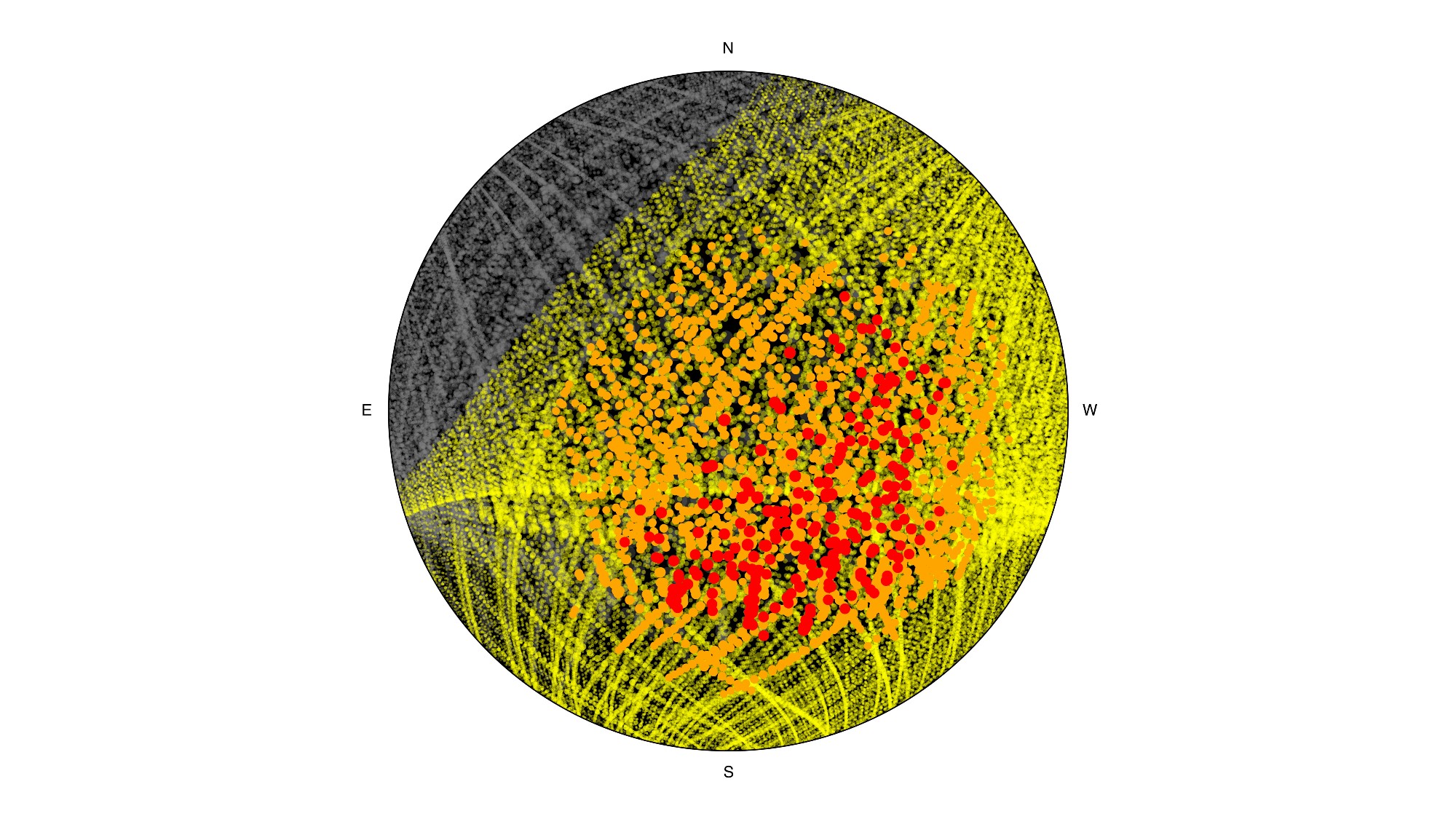
This diagram shows the number of satellites that would be visible above ESO's Very Large Telescope (VLT) if SpaceX launches their planned constellation of 1 million satellites. (Image credit: ESO/O. Hainaut)

"What they propose would make our observations close to impossible"

What is worse, if plans to launch thousands of sun-reflecting mirrors, as proposed by the U.S. company Reflect Orbital, were to come to fruition, the sky would transform completely.

Headquartered in Hawthorne, California, Reflect Orbital's vision is to deliver light on demand to solar power plants at night and to illuminate warzones and areas struck by natural disasters. The company has applied to the Federal Communications Commission (FCC) to launch a demonstration space mirror into orbit later this year.

The satellite, called Eärendil-1, is 59 by 59 feet (18 by 18 meters) in size, and should be the first in a constellation of 50,000, if things were to go according to Reflect Orbital's plan. "Reflect Orbital is really bad," said Hainaut.

"What they propose would make our observations close to impossible.
These are super bright satellites."

Astronomers have calculated that each Reflect Orbital space mirror would be brighter than the full moon if observed from the area where its beam is aiming. But the satellites would be visible regardless of where their beams are aiming to everybody around the world.

"Even outside the beam, the satellite will appear brighter than the planet Venus, which is the brightest object in the night sky after the moon," said Hainaut. "If they were to launch 50,000 of these space mirrors, there would be many hundred or even a few thousand of these super bright objects visible to observers anywhere on Earth."

Reflect Orbital, meanwhile, says that they have been engaging with the astronomy community throughout the company's development and that the company is currently commissioning independent, third-party research on the impacts of their satellites.

"Every spot of light we deliver will be requested, approved and contained," a company spokesperson told Space.com. "We will only provide redirected sunlight when it is signed off by the appropriate authorities in the relevant jurisdiction."

two images showing the night sky through a round aperture. one shows thousands of stars in the sky, the other is washed out by white light, significantly reducing the number of visible stars

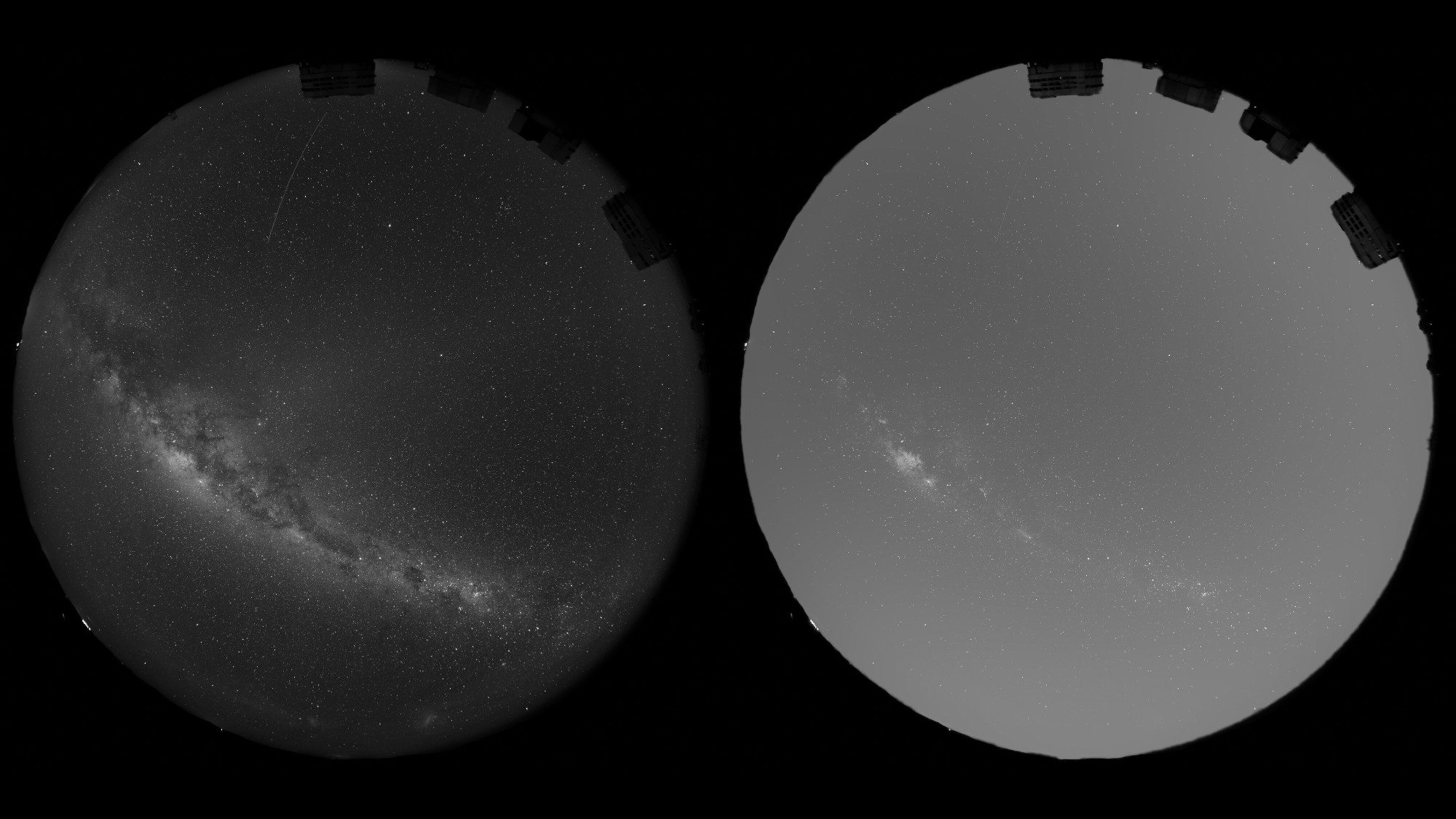
An image illustrating how sunlight scattered by Reflect Orbital’s space mirrors would increase the overall brightness of the sky above ESO’s Very Large Telescope (VLT). (Image credit: ESO/O. Hainaut)

Today, in areas with relatively low levels of light pollution, one can only see a few hundred bright stars in the sky. That means there would be more satellites than stars visible in the sky anywhere in the world with the full Reflect Orbital constellation in orbit. The constellation would also brighten the night sky by up to 300 percent, Hanuit calculated.

"If you increase the light pollution, it means that you will see fewer natural stars," said Hainaut. "And you will see more of these satellites."

Hainaut said that SpaceX's planned orbital data centers, despite the fact that they feature 230-foot-wide (70 m) solar panels, would be much dimmer and about as visible as Starlink satellites.

"From the available information, we see that these satellites have been optimized to minimize the impact as seen from the ground," Hainaut said. "The reflective surfaces are tilted away from Earth and the satellite itself is very narrow, pointing to Earth with its small end."

Still, overall, satellites operated by all operators around the world should remain below 100,000 satellites combined if astronomy is not to suffer, scientists caution. SpaceX is currently awaiting FCC's decision on its application to launch one million orbital data centers.

Currently, some 14,000 satellites orbit the planet.

a photograph of the night sky, showing streaks of light crisscrossing in front of stars

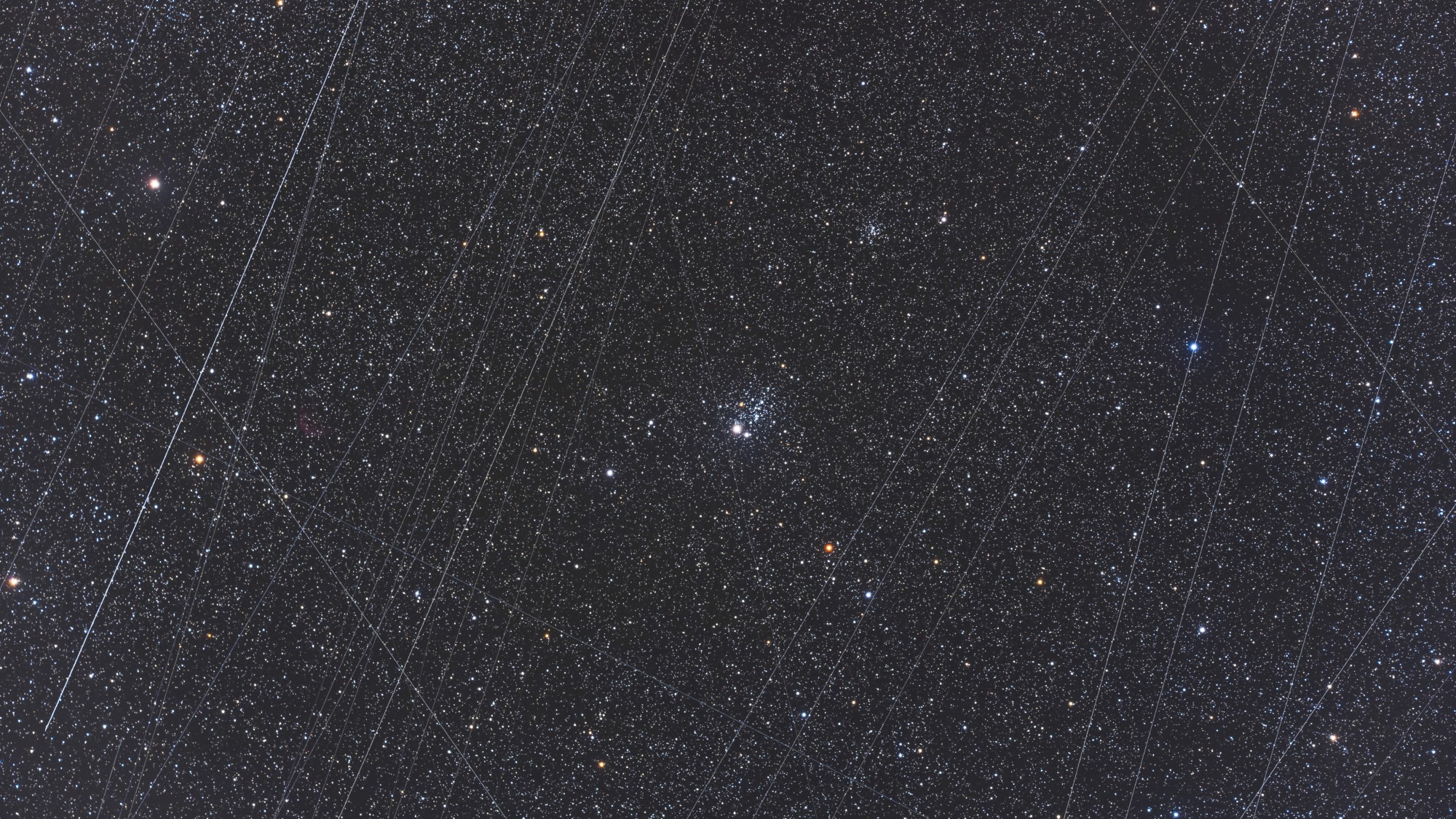
NGC 457, the Owl Cluster in Cassiopeia, in a stack of images showing the total number of satellite trails recorded over 36 minutes of total exposure in October 2022. (Image credit: Alan Dyer/VW Pics/Universal Images Group via Getty Images)

"For astronomy, this would obviously be catastrophic."

Robert Massey, the Deputy Executive Director of the Royal Astronomical Society, said Hainaut's findings were "not hugely surprising."

"For astronomy, this would obviously be catastrophic," Massey told Space.com. "It's very difficult to imagine how you could mitigate that on this scale. But I am also concerned about the public impact. The public has not signed up for having an entirely transformed sky."

Massey pointed out that based on the international law governing space activities, it is perfectly legal for a U.S. organization to be single-handedly deciding on something that would impact the entire world.

"If it's agreed by the FCC, this will be deeply regrettable," Massey said. "This will say that we are in a world where large corporations can determine the view of the sky above our heads, just as they can transform the environment on Earth. But the transformation of the environment on Earth is subject to pretty tight regulations."

The Trump administration has been taking steps to reduce the burden for satellite operators to prove their projects will have no negative environmental impacts. Currently, no environmental review has to be undertaken by the FCC or private companies before satellite applications go for approval.

Betty Kioko, an institutional affairs adviser at ESO, said the United Nations Outer Space Treaty, signed in 1967, states that the responsibility for space launches is with the nation states where those space objects are registered. She, however, added that the Treaty requires states to use space "for the common good of humankind."

"We now have to wait for the FCC to decide, because ultimately, the Outer Space Treaty was written at a time before we envisioned access to space by private entities."

ESO is among hundreds of organizations from around the world that have filed objections to the SpaceX and Reflect Orbital applications.

The study has been published in the journal Astronomy & Astrophysics.

Editor's note: This story was updated on July 2 to include comments from a Reflect Orbital spokesperson.