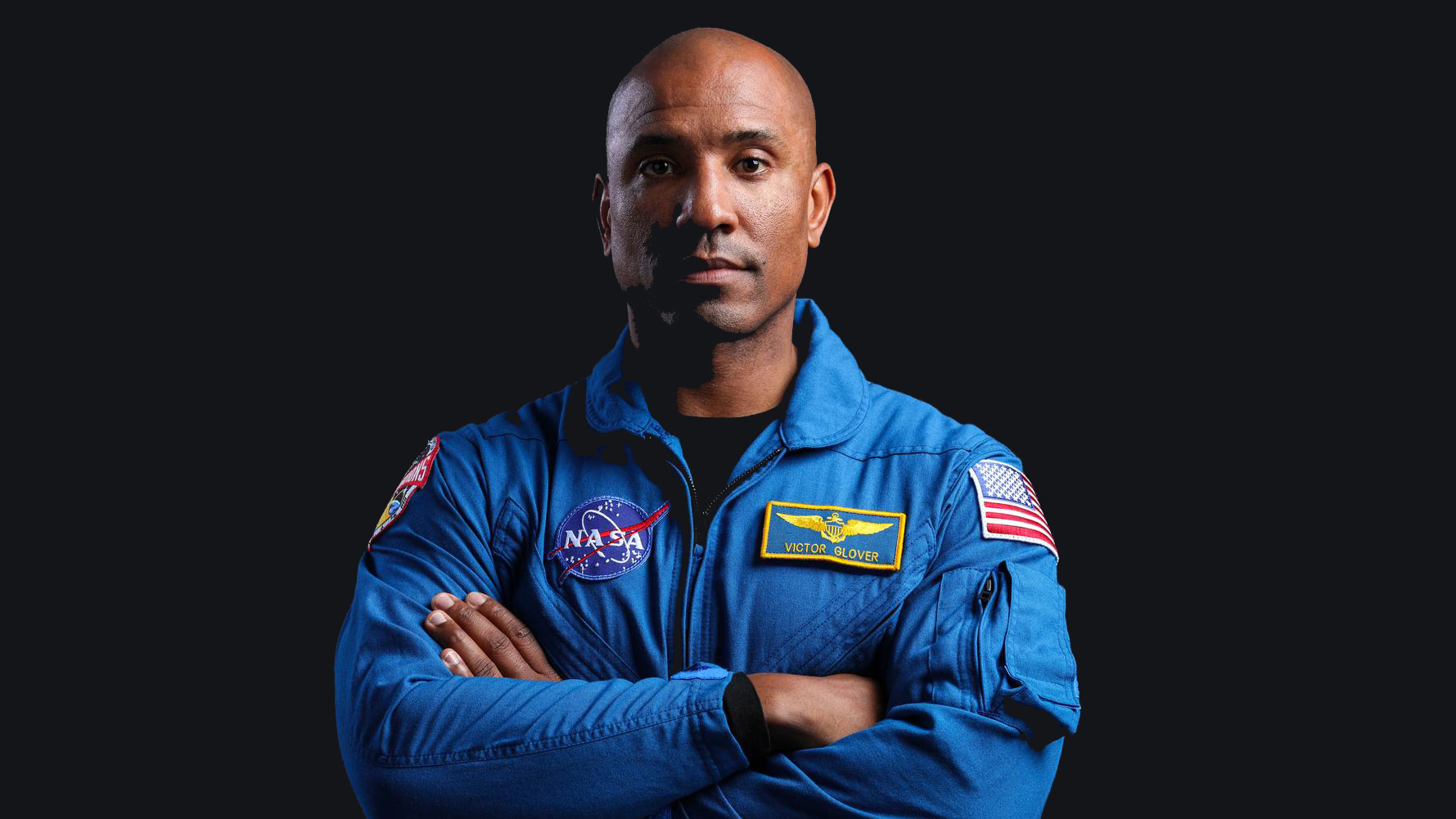
‘If I wanted to go to space, I would have stayed at NASA’: What’s next for Artemis II astronaut Victor Glover after his mission to the moon

NASA astronaut Victor Glover is now "astronaut emeritus." He's hanging up his spacesuit for a position he hopes can guide the future engineering and science leaders of tomorrow.

Glover, who served as pilot on NASA's Artemis II mission that flew around the moon in April, officially began his new role as executive advisor to Jeff Armstrong, president of the California Polytechnic State University (Cal Poly),on Sept. 1, and is stepping away from the majority of his duties at the space agency.

NASA announced on Sept. 9 that Glover, as well as Artemis II commander Reid Wiseman, are transitioning to emeritus status beginning this month, but are not retiring from the agency outright. Even astronauts who do fully retire from NASA are still retained "in the system," Glover told Space.com, "but I actually get to have a badge that is a little bit different. I can come back. I have a NASA email address. I still work closely with the agency. I'm considered a special government employee."

"It allows me to have just a slightly more robust and meaningful relationship with NASA," Glover said — but "more robust" won't necessarily equate to the same daily commitment. His role at Cal Poly will be full-time, according to the university, but he's not exactly going to be putting in typical work hours there either.

"We're still figuring it out," he said. "It's not going to be nine to five. I'm not a faculty member. I don't have a class I have to teach or a board that I oversee. It'll be where the school needs me the most and where I can highlight what great work they're already doing."

Glover's connection to Cal Poly runs deep. He's a Cal Poly alum who graduated with an engineering degree in 1999. A two-sport athlete, he wrestled for the university and played on its football team. And it's where he met his wife, Dionna, who also graduated from Cal Poly. The two have since raised four daughters, all of whom have either graduated or are currently attending their parents' alma mater. With Glover's multifaceted connection to the university, Cal Poly sees his potential contributions as equally diverse.

The university says that Glover, in his position as executive advisor, will work with the gamut of university leadership, including the president, provost and college deans. He will help "identify, develop and accelerate strategic initiatives, partnerships and philanthropy aimed at expanding the university's leadership in engineering, applied computing, aerospace, aviation, maritime, artificial intelligence, cybersecurity, autonomous systems and national defense," according to Cal Poly's statement.
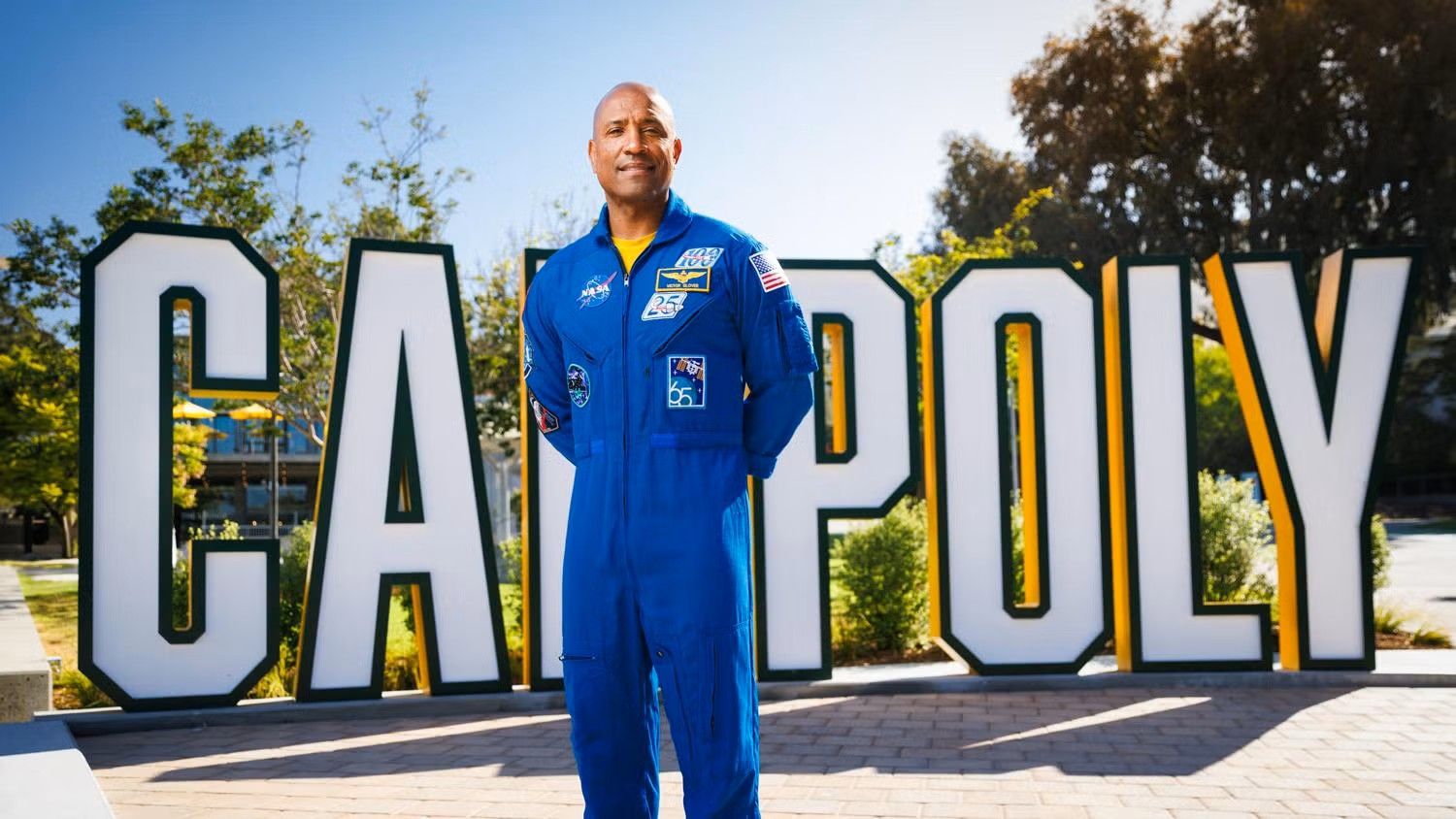
A man in a blue jumpsuit stands in front of giant letters that read

Victor Glover officially began his role at Cal Poly on Sept. 1. (Image credit: Cal Poly)

How that will manifest into Glover's actual contributions is still being figured out. "There's just so much potential," he said, adding that he wants to serve in an additive role for Cal Poly where he can "get in and help, and do the most good."

Cal Poly has been undergoing a period of significant change and expansion over the past several years. This fall, for the first time ever, the university transitioned from a quarter system to a semester-based one. It also recently completed its integration with the former California State University Maritime Academy, whose Vallejo campus is now Cal Poly's Solano Campus and home to the Cal Poly Maritime Academy.

"They're hitting on all cylinders in so many areas," Glover said. "There's so many areas where Cal Poly is doing amazing things, and each of those things by themselves have been a big deal."

The university operates on a "Learn by Doing" philosophy, which emphasizes hands-on, real-world experience alongside classroom instruction. Glover credits his professional successes to this system, and his experiences over a decade at NASA have reinforced his belief in that kind of educational approach.

"Putting energy and time into building trust is just as important, or more important, as building technology, and so I think there's a lot of areas where my NASA experience will also feed back into Learn by Doing," Glover said. "I think everything I did at NASA has a place here."

"At NASA we do some pretty challenging things, pretty risky things, but we have a really strong scientific and technical understanding of what we're doing," Glover said. "That kind of risk-informed decision making is an important part of what we do here [at Cal Poly], whether it's professional development or helping these students to become the next generation of leaders."

Glover cited Charles Lindbergh's book "We," and its perspective on learning to fly a plane, as an example for Learn by Doing's effectiveness. "You teach yourself to fly," Glover said. "An instructor is really there to keep you from having ultimate mistakes. But you teach yourself to fly. It's something that you have to work out yourself. And I think that this school really understands that … We want to make sure that these students can critically think and analyze, but we also want to make sure that they can do the work with their hands."

Flying is something with which Glover has an extensive familiarity. Before he joined NASA in 2013, he was a U.S. Navy aviator and test pilot with 4,000 flight hours in more than 40 aircraft who flew 24 combat missions, though he is now best known for piloting NASA's Orion spacecraft around the moon on Artemis II.

A man in a blue jumpsuit sits in an open jet

Victor Glover lands a T-38 jet at NASA's Kennedy Space Center in Florida on March 27, 2026, ahead of the launch of the Artemis II mission. (Image credit: Space.com / Josh Dinner)

Glover launched aboard Orion on NASA's Space Launch System (SLS) rocket on April 1 with three crewmates — Wiseman, NASA astronaut Christina Koch and Canadian Space Agency astronaut Jeremy Hansen. The quartet spent approximately 10 days aboard the Orion capsule and flew a course around the moon's far side. Their mission was the first to fly a crew to lunar space since Apollo 17 in 1972, and it captured the attention of millions across the world as the astronauts sent back views of the moon unlike any humanity had ever seen.

Artemis II was the first crewed mission in NASA's Artemis program, which has the ultimate goal of establishing a permanent base on the lunar surface. The next time Orion launches, on Artemis III, the spacecraft's crew will be tasked with testing out docking hardware with the program's lunar lander vehicles in Earth orbit. NASA is targeting mid-2027 for that mission. If it's successful, Artemis IV will follow in 2028 as the program's first lunar landing attempt, with subsequent missions with more crew and cargo to incrementally assemble an outpost on the surface of the moon in the 2030s.
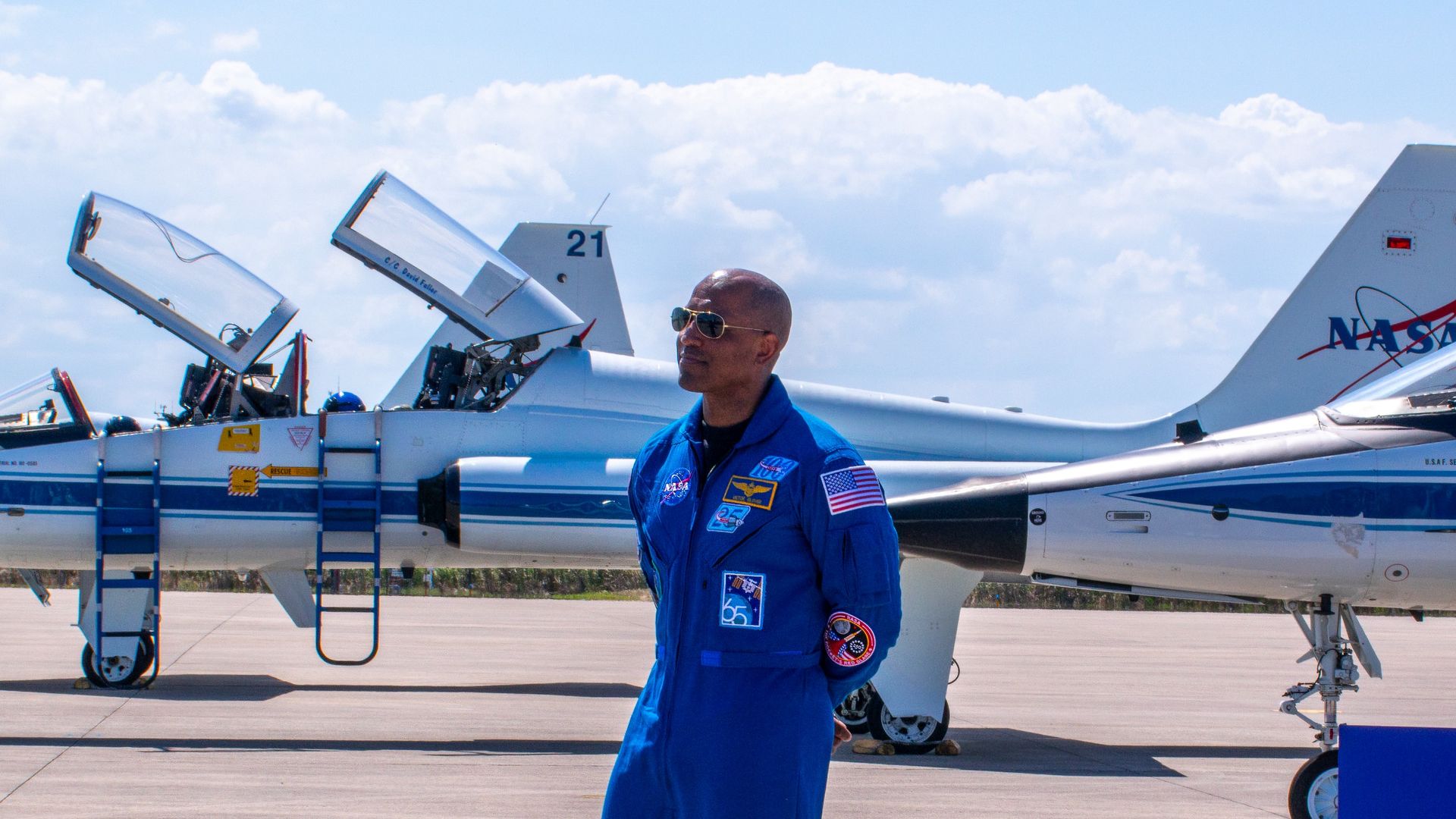
A man in a blue jumpsuit stands in front of giant a trio of NASA jets.

Victor Glover arrives at NASA's Kennedy Space Center in Florida on March 27, 2026, ahead of the launch of the Artemis II mission. (Image credit: Space.com / Josh Dinner)

As the only people to fly aboard Orion in space so far, the Artemis II crew's experience and insight into the spacecraft, and how future Artremis astronauts can best train to fly it, are invaluable to NASA — hence Glover and Wiseman's emeritus status.

Hansen, who trained at NASA's Johnson Space Center (JSC) and lived in Houston since his induction as a CSA astronaut in 2009, announced in July that he's stepping back from active astronaut duty beginning this month and moving back to Canada. On Sept. 8, the day before NASA made the announcement about Glover and Wiseman, Hansen posted a video on X stating that his Artemis II duties officially concluded on Sept. 2.

That leaves Koch as the only Artemis II crew member on an active astronaut roster, but Glover and Wiseman, as emeritus flyers, aren't out of the agency entirely. "With our experience flying Orion in space, the agency knows that we can still make a meaningful contribution to Artemis and human spaceflight in general, without having to be there full time," Glover said. "We can still support our colleagues and their families and the mission while we go off and pursue other other opportunities."

Supporting other astronauts on NASA's roster, and the teams that run the missions, are the parts of the job that Glover enjoyed the most. "[The emeritus status] allows us to still support our colleagues, which is the best part of being an astronaut. It's not flying in space," Glover said.

"I told [NASA leadership], ‘Nothing has really changed,'" Glover said. "If they call me and say, ‘Hey, we need this,' they can count on me to be there because they are so fantastic. I will always be there to carry the water for them when they need it."
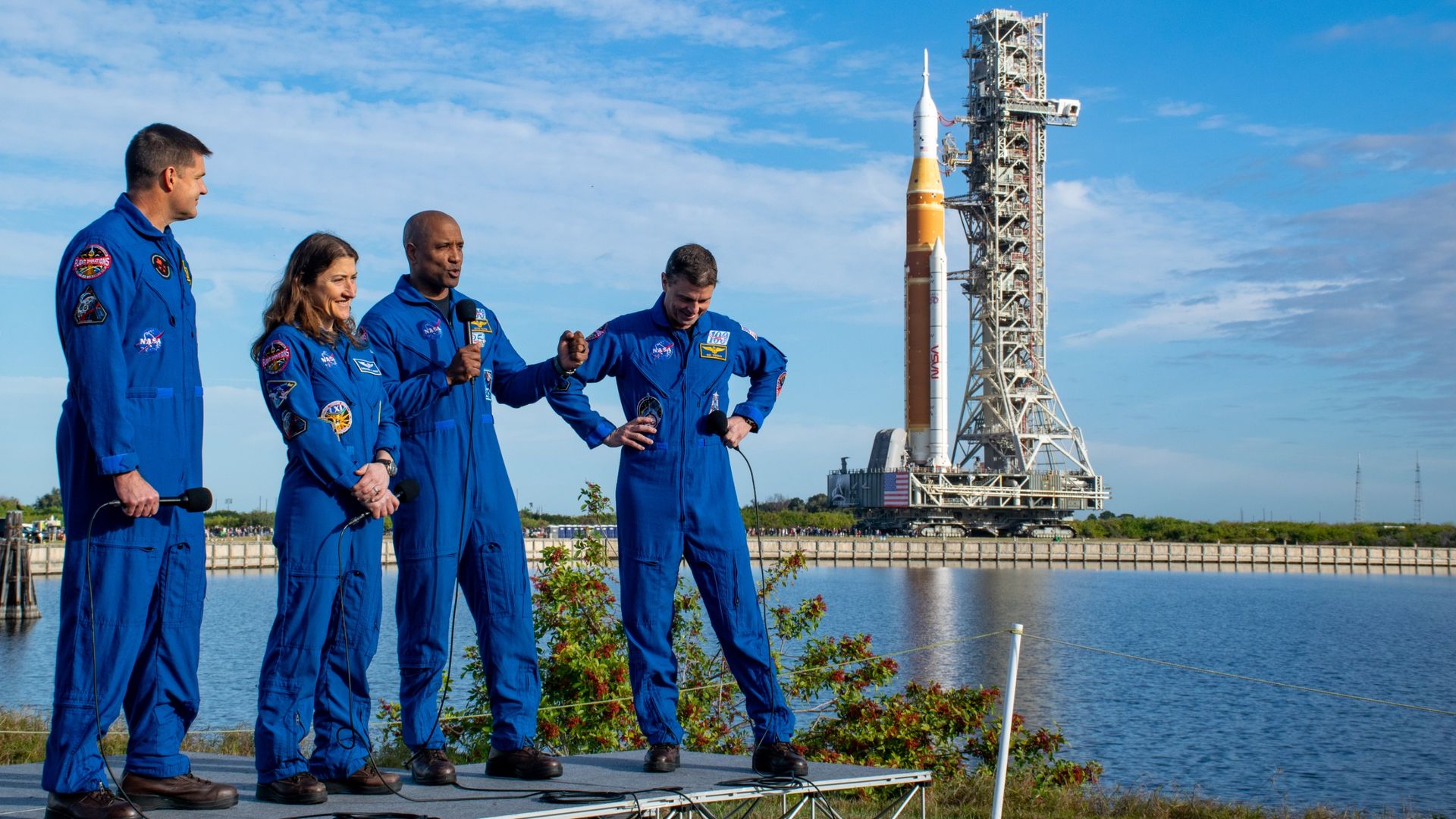
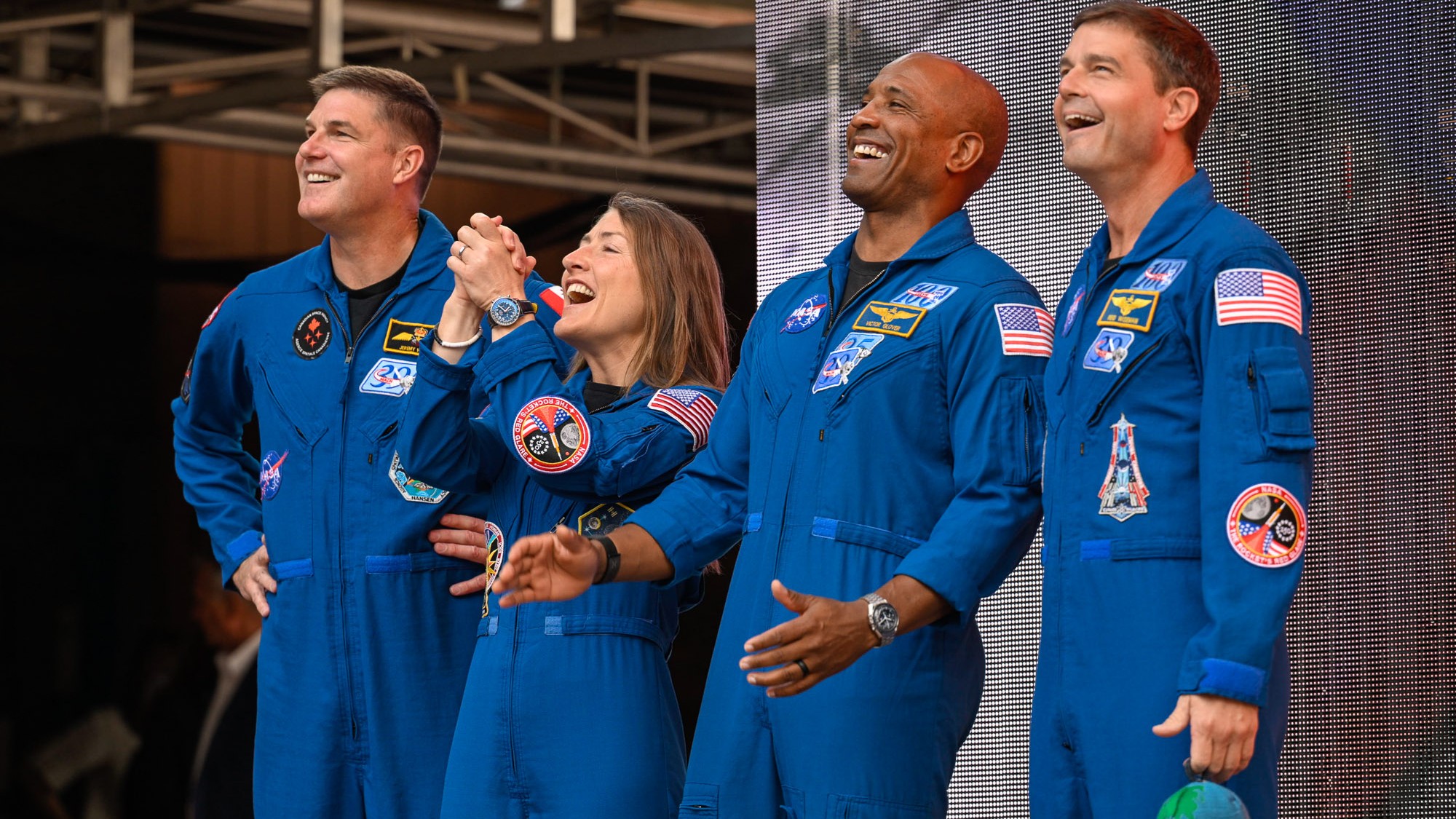
Four humans in blue jumpsuits stand outside on a raised platform. A big orange rocket and launcher tower can be seen in the background.

From left: Canadian Space Agency astronaut Jeremy Hansen, and NASA astronauts Christina Koch, Victor Glover and Reid Wiseman at NASA's Kennedy Space Center during the Artemis II SLS rollout on Jan. 17, 2026. (Image credit: Space.com / Josh Dinner)

Though he'll still be helping astronauts prepare for future missions every now and then, Glover said his own spaceflight days are behind him. Glover had flown to space once before, prior to Artemis II, as pilot of SpaceX's Crew-1 mission to the International Space Station (ISS). Glover spent 168 days in orbit on that stint, serving as flight engineer for Expeditions 64 and 65, and completed four spacewalks.

"I didn't make this move planning to go back to space," Glover said. "I was pretty satisfied after my first space mission, so I don't have this hole in my heart that needs to be filled by going to space again."

A few NASA astronauts who've left and moved on to the private sector have ended up going back to space, like Peggy Whitson, who retired from NASA in 2018 before joining Axiom Space and later commanding the company's Ax-2 and Ax-4 private astronaut missions to the ISS. But Glover doesn't see a move like that in his future.
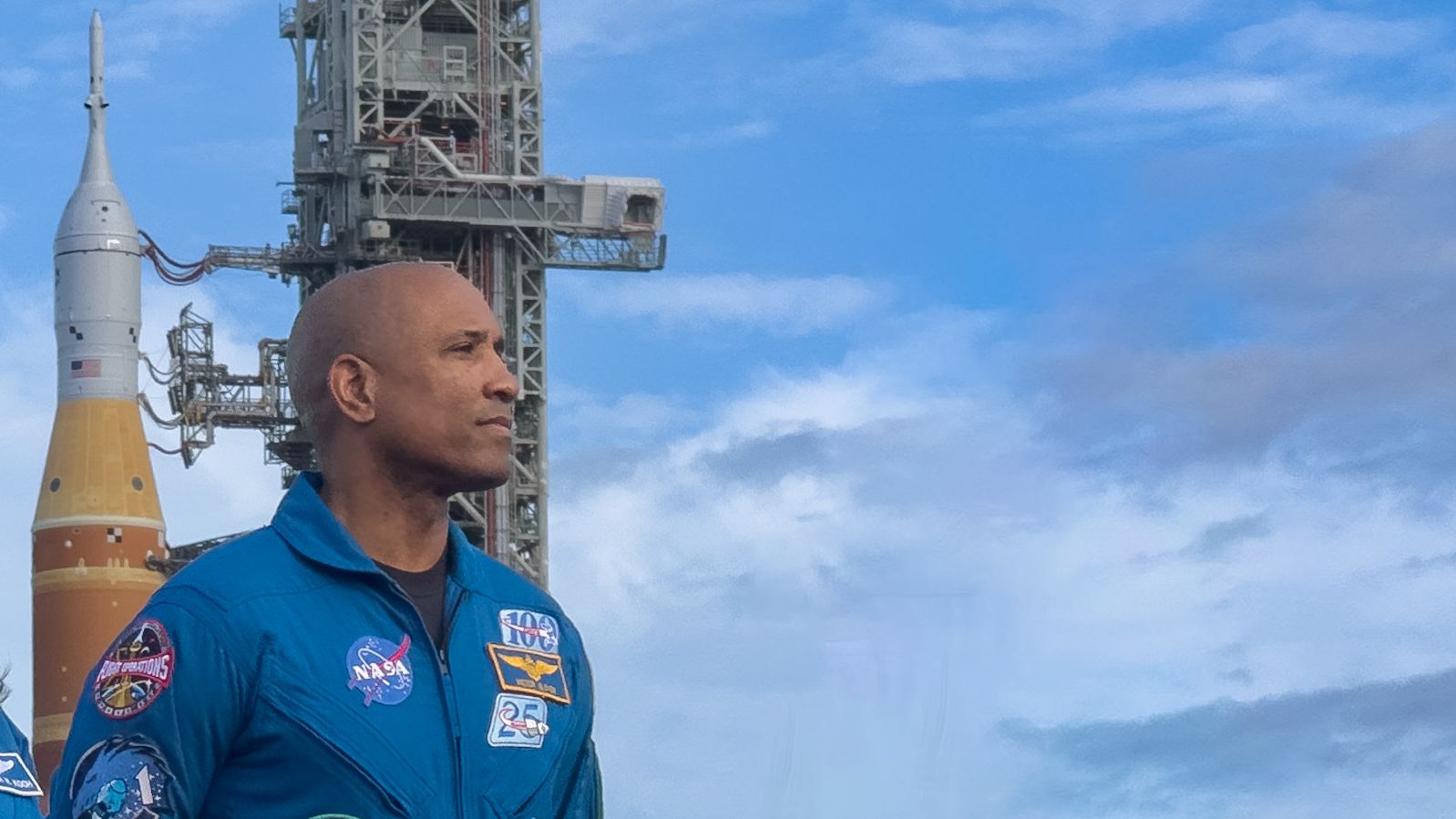
A man in a blue jumpsuit stands against a blue sky with a big orange rocket behind him on the left.

Victor Glover stands at NASA's Kennedy Space Center during the rollout of the Artemis II Space Launch System rocket on Jan. 17, 2026. (Image credit: Space.com / Josh Dinner)

"If I wanted to go to space, I would have stayed at NASA. It's the gold standard," Glover said. "I love our corporate partners and what they're doing. There's some really amazing things, including what Jared Isaacman himself has done … But I would have stayed at NASA full time as an active astronaut if I was trying to go back to space."

Isaacman was sworn in as NASA administrator in December 2025. His spaceflight experience came before that: In September 2021, he commanded SpaceX's Inspiration4 mission, the first all-civilian orbital spaceflight, and later performed the first commercial spacewalk during the private Polaris Dawn mission in September 2024.

In fact, Glover said it was harder walking away from his career flying fighter jets than it was to walk away from the opportunity to maybe one day fly in space again. Harder still might be leaving behind the place he's called home for more than a decade, but ultimately he said it was an easy choice. He's lived in Houston and worked at JSC since his selection into NASA's astronaut class in 2013, but expects he and his family will make the permanent move to the West Coast, to be closer to Cal Poly.

"One of the reasons why this was just such an easy decision to make is that both NASA and Cal Poly … and everybody understands that we need time to get used to this new reality, and they're all giving us a lot of grace and space as we just kind of figure out what the right rhythm, what the right ops tempo is," Glover said. He thinks he and the family will make the move sometime after the New Year.

In the meantime, though you may not see him quite as much on NASA's social media channels, he has made a few appearances in posts on his daughter Maya's TikTok profile. In posts celebrating his return from the moon and recent career shift, Glover can be seen performing dance routines with his family — but don't bother refreshing your feed to load more any time soon.

"Don't expect to see a whole lot more of that, because I would do anything for my kids, but you know, well, I guess almost anything for my kids," Glover said jokingly. When asked which was harder to train for, between piloting Orion and the dance moves, he said, "Oh, clearly the dance moves."
What comes after the moon? Artemis II commander and pilot shift to ’emeritus’ status at NASA

Three of NASA's Artemis II astronauts are starting off the school year with new assignments.

Artemis II commander Reid Wiseman and pilot Victor Glover, both NASA astronauts, will transition into "emeritus status" in September, the space agency announced on Wednesday (Sept. 9). Meanwhile, Canadian mission specialist Jeremy Hansen shared a video on X on Tuesday (Sept. 8) concerning his already-announced transfer from active duty to reserve status in the Canadian military.

The fourth Artemis II astronaut, NASA mission specialist Christina Koch, appears to still be on active duty, as no announcements have been made saying otherwise.

The Artemis II quartet flew around the moon in April, becoming the first people to go beyond low Earth orbit since 1972. The historic journey was widely expected to be the last step in active astronaut duty for at least some of the mission's four astronauts, especially Hansen, who had waited for a flight assignment for 17 years in part due to how Canadian Space Agency funding is allocated. (Robotics provided by the CSA form a minority share of international space partnerships with NASA, and astronaut flight rates are tied to funding.)

The Artemis II astronauts made a series of public appearances together this summer, culminating on Aug. 28 when President Trump awarded them the Congressional Space Medal of Honor. Hansen was only the second non-American to receive the award, which had previously been given to just 30 astronauts total.

While NASA's Wednesday announcement about Glover and Wiseman did not explicitly state that the duo are exiting active astronaut duty, their new role is described as allowing the astronauts to assist NASA as consultants and "individuals with a high degree of technical and professional knowledge," while allowing them to do other things.

The two astronauts are expected to help NASA plan future Artemis program missions. "I'm grateful they will continue sharing what they learned with our astronauts, flight controllers and engineers as we prepare for Artemis III in 2027 and the missions that follow," NASA administrator Jared Isaacman said in the statement.

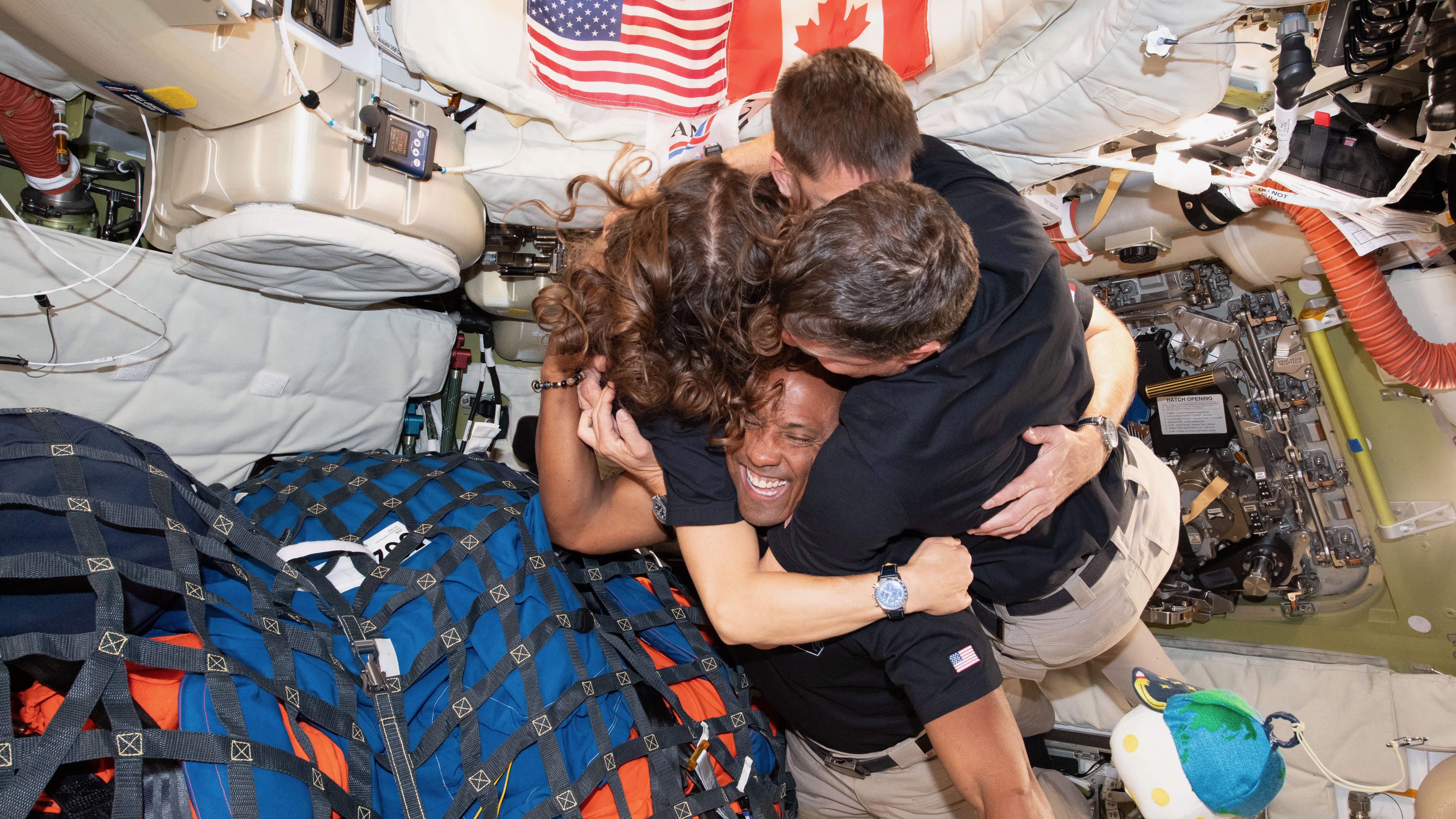
three men and one woman hug inside a space capsule

From left: The Artemis II crew — NASA astronaut Christina Koch, Canadian Space Agency astronaut Jeremy Hansen, and NASA astronauts Reid Wiseman and Victor Glover — take time out for a group hug inside the Orion spacecraft on April 6, 2026. (Image credit: NASA)

Glover, who also retired from the U.S. Navy recently, will now assume a full-time role at his alma mater, California Polytechnic State University in San Luis Obispo, which has aerospace and space programs. The news was announced by the university on Wednesday, but the position took effect on Sept. 1. Glover will be an administrative leader providing advice to senior leadership on education, research and workforce strategies, according to Cal Poly.

"The most meaningful moments of my NASA career were supporting astronauts and their families through missions, and mentoring interns and new hires as they began their own journeys in technical and public service," Glover wrote Wednesday in a post on X about the career change.

Wiseman did not share any specific updates about his career plans on social media. The astronaut also exited active astronaut duty temporarily between 2020 and 2022 when he was chief of the astronaut office for NASA, a role that precludes flying in space as the chief is involved in flight assignments. Wiseman left that role and resumed active astronaut duty before being assigned to Artemis 2, which occurred shortly before the public announcement of the mission's crew in April 2023.

"NASA gave me tremendous responsibility, supported me through two space missions — and my time as chief astronaut — and was always there for my family when we needed it most," Wiseman said in the NASA statement about his career change. "I'm thrilled to continue serving future missions and programs through the emeritus program."

Hansen's Artemis 2 duties officially concluded on Sept. 2, according to his X account, and the astronaut — who has been based out of Houston since 2009 — posted a new video of himself Wednesday walking in the woods in Canada. Hansen said he has retired as a colonel with the Royal Canadian Air Force and is now a reservist working with 3 Canadian Space Division, which is essentially Canada's Space Force.

"The intention of that is to continue to serve Canada and government — the Canadian Space Agency — when it makes sense, to help us take advantage of some of the extraordinary opportunities that are before us right now," Hansen said in the video, adding that he will divulge more details about that work shortly.

Hansen also said he accepted a role as honorary national president with the Canadian military's Air Cadet League of Canada, which the astronaut has often said helped equip him with both flying and leadership skills when Hansen was growing up.

Additionally, Hansen pledged to "continue to share the moon joy" both as an individual and with his crew. For example, he recently joined a Canadian keynote-speakers bureau in which he plans to speak about how to accomplish personal "moonshots." In October, Hansen will also co-release "Earthrise: A Canadian Astronaut's Journey Into Deep Space" (HarperCollins Publishers, 2026) — a book that discusses his career and Artemis 2 — which he co-wrote with Canadian author John Larsen.

President Trump gives Artemis II moon astronauts the Congressional Space Medal of Honor

Four astronauts just received the United States' highest space honor.

President Donald Trump gave the astronauts of NASA's Artemis II moon mission the Congressional Space Medal of Honor today (Aug. 28) during a ceremony at Johnson Space Center in Houston.

"This is a very rare thing. It's for courageous people, brilliant people, bestowed on astronauts who have distinguished themselves with exceptional service to the nation and all of mankind," Trump said during the event.

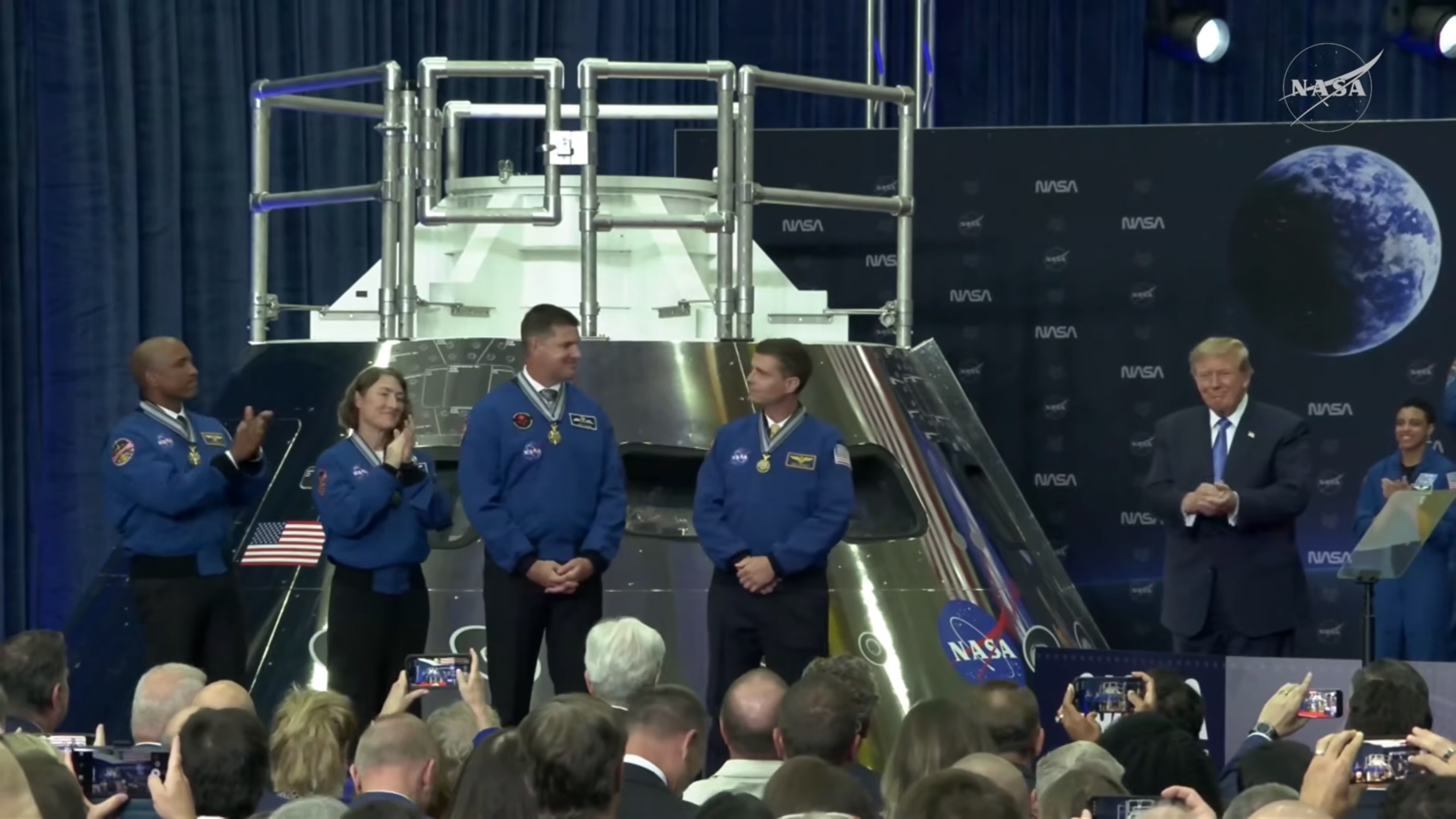
President Donald Trump awarded the four astronauts of NASA's Artemis II moon mission the Congressional Space Medal of Honor on Aug. 28, 2026.

President Donald Trump awarded the four astronauts of NASA's Artemis II moon mission the Congressional Space Medal of Honor on Aug. 28, 2026. (Image credit: NASA TV)

Artemis II launched on April 1 and came back to Earth nine days later. It was the first crewed mission of NASA's Artemis program, which aims to establish a long-term base near the moon's south pole in the coming years.

The flight sent four people — NASA's Reid Wiseman, Victor Glover and Christina Koch, as well as Canadian Space Agency astronaut Jeremy Hansen — on a looping journey around the lunar far side. It was the first crewed trip beyond low Earth orbit since Apollo 17 in 1972, and its astronauts got farther from their home planet than any people ever had before.

Artemis II engaged folks around the world thanks to its importance, its historic nature and the charisma of its astronauts. And some fortuitous orbital dynamics didn't hurt, either: The Artemis II crew were lucky enough to observe a total solar eclipse from beyond the moon, something human eyes had never seen firsthand before.

The Congressional Space Medal of Honor is awarded "to any astronaut who in the performance of his duties has distinguished himself by exceptionalIy meritorious efforts and contributions to the welfare of the Nation and of mankind," NASA wrote in a description of the award, citing Congress' stated criteria.

Though the president gives out the medal, he does so on the recommendation of the NASA administrator, the agency added. Before today, just 30 people had received the award, and most of them are pretty big names. Past honorees include Apollo 11 astronaut Neil Armstrong; Alan Shepard and John Glenn, who were the first Americans to reach space and orbit Earth, respectively; Gemini astronaut Ed White, the first American to perform a spacewalk; and Apollo 13 commander Jim Lovell.

The award was also given to each of the 14 astronauts who died in the space shuttle Challenger and Columbia disasters.

Hansen therefore wasn't the first non-American to receive the medal. Ilan Ramon, one of the seven people who perished when Columbia broke apart upon reentry to Earth's atmosphere on Feb. 1, 2003, was from Israel.

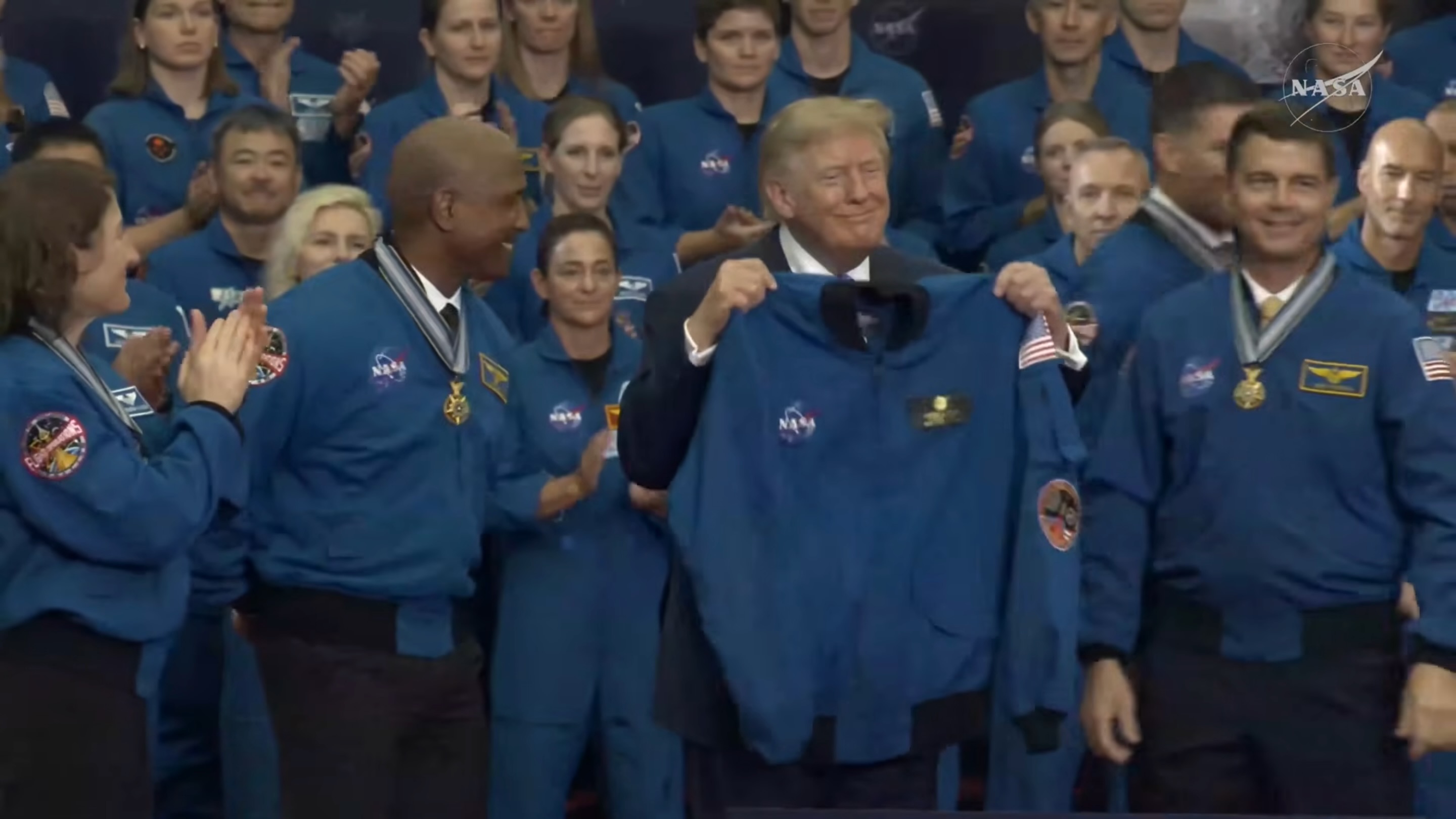
a smiling man in a dark suit holds up a blue flight jacket surrounded by a crowd of people wearing similar jackets

The Artemis II astronauts gave President Trump a special flight jacket on Aug. 28, 2026. (Image credit: NASA TV)

During his speech at today's ceremony, Trump said that the United States is entering a golden age of spaceflight and exploration. And he thanked the Artemis II astronauts for being a guiding light.

"Thanks to the crew of Artemis II, those dreams are closer than ever before," the president said. "We're on the cusp of an adventure and something that's so special, people have really not imagined anything. It's really, civilization is into the stars. The stars are up there and they're beautiful, and you're right next to them. You have the courage to be right next to them. Few people do, but you're leading the way. It's great, great bravery."

The astronauts reciprocated the warmth. For example, they gave the president a blue flight jacket commemorating the mission. And Wiseman, Artemis II's commander, thanked Trump for calling the crew during their mission.

"The one thing that really sticks out to us is, you said how proud you are and how proud our nation is of the job that we have just accomplished," Wiseman said during the ceremony. "And for us, that is what we set out to do. We wanted to inspire this nation and inspire the world, and for us, that showed us we were on the right track. So, thank you for that call."

Editor's note: This story was updated at 1:30 p.m. ET on Aug. 28 with quotes and information from the medal ceremony.

Trump to award NASA’s Artemis II astronauts the Congressional Space Medal of Honor

NASA's Artemis II moon astronauts will join a very exclusive club next week.

President Donald Trump will award those spaceflyers the Congressional Space Medal of Honor next Friday (Aug. 28) at Johnson Space Center in Houston to recognize their historic journey around the moon this past April.

The ceremony will begin at 11 a.m. EDT (1500 GMT) and will feature NASA Administrator Jared Isaacman, President Trump and the Artemis II astronauts. You'll be able to watch it live when the time comes.

Artemis II sent NASA astronauts Reid Wiseman, Victor Glover and Christina Koch, as well as the Canadian Space Agency's Jeremy Hansen, on a 10-day trip around Earth's nearest neighbor. It was the first crewed voyage beyond low Earth orbit since 1972, when the Apollo 17 astronauts returned home from the moon.

The mission's success was a huge step for NASA's Artemis program, which aims to establish a base near the lunar south pole in the coming years.

The Congressional Space Medal of Honor is the highest award that the U.S. government can bestow upon an astronaut. It's possible that only Wiseman, Glover and Koch will receive it next week; NASA's media advisory about the event states that Trump will give the medal to "each of NASA's Artemis II crew members," suggesting that Hansen might not be included. (The award is not limited to American citizens.)

Thirty people have received the Congressional Space Medal of Honor to date. They are:

  • Neil A. Armstrong
  • Frank Borman
  • Charles "Pete" Conrad, Jr.
  • John H. Glenn, Jr.
  • Virgil I. "Gus" Grissom
  • Alan B. Shepard
  • John W. Young
  • Thomas P. Stafford
  • James A. Lovell
  • Shannon W. Lucid
  • Roger B. Chaffee
  • Edward H. White, II
  • William M. Shepherd
  • Rick D. Husband
  • William C. McCool
  • Michael P. Anderson
  • Kalpana Chawla
  • David M. Brown
  • Laurel B. Clark
  • Ilan Ramon
  • Francis R. (Dick) Scobee
  • Michael J. Smith
  • Judith A. Resnik
  • Ronald E. McNair
  • Ellison S. Onizuka
  • Gregory B. Jarvis
  • Sharon Christa McAuliffe
  • Robert L. Crippen
  • Douglas G. Hurley
  • Robert L. Behnken

Artemis II pilot thanks NASA for letting him fly Orion by hand: ‘I’m still blown away by that trust’

MORRISON, Colorado - The Artemis II crew that circuited the moon earlier this year came full circle, dropping by a distinctive spot on Earth that's visually reminiscent of both the moon and Mars.

On Aug. 3, the vast and stunning Red Rocks Amphitheatre served as both an inoculation of near-term nostalgia and heart-felt congratulations to the crew for the impressive journey of Artemis II. The 10-day mission began on April 1 of this year, flew around the moon and back, and splashed down in the Pacific Ocean on April 10. It was the first crewed flight to saunter spaceward beyond low Earth orbit in 53 years.

Some 8,500 people packed the open-air venue at Red Rocks to make eye-contact with space travelers Reid Wiseman, commander, Victor Glover, pilot, Christina Koch and Jeremy Hansen as mission specialists – all of them clearly awestruck by the crowd reaction. The event was a broader post-flight campaign for the foursome, also spotlighting the region's contributions to the sojourn of Artemis II. A science, technology, engineering, and mathematics (STEM) fest was also part of the early morning affair.

four people in blue flight suits stand on a stage in an amphitheater surrounded by red stone cliffs

The Artemis II crew speaks at Red Rocks Amphitheatre in Morrison, Colorado on Aug. 3, 2026. (Image credit: Lockheed Martin)

Iconic location

"I can't imagine a more iconic location on Earth to hear about the trip to the moon," said Robert Lightfoot, president of Lockheed Martin Space and a major aerospace contractor for the Artemis program. There were hundreds of suppliers across the rocky mountain region, over 10,000 employees, that supported the Artemis II mission, he told the gathered throng.

Leadership from industry prime contractors including Lockheed Martin, Amentum, Boeing, L3 Harris and Northrop Grumman took part in the salute to the Artemis II voyage.

Colorado Governor Jared Polis pointed out that "here in Colorado, we're a mile closer to space." As the best and biggest homecoming for the Artemis II crew, he added, "keep reaching for the stars."

Lori Glaze, NASA associate administrator for the Human Spaceflight Mission Directorate, said today "is a truly revolutionary and exciting time for NASA and America's space program. We are going to reach farther. We're going to dream bigger. And we're going to secure America's leadership in deep space exploration and discovery."

four people in blue flight suits stand on a stage in an amphitheater surrounded by red stone cliffs

The Artemis II crew speaks to a crowd of 8,500 at Red Rocks Amphitheatre in Morrison, Colorado on Aug. 3, 2026. (Image credit: Lockheed Martin)

What next?

In a pre-event press gaggle, Space.com asked the Artemis II crew members how their Orion spacecraft named Integrity performed and would help the upcoming Artemis III crewed flight in Earth orbit.

"It handled incredibly well," said Reid Wiseman, Artemis II commander. "Just from habitability, I think that is where we learned the most, putting four humans in the spacecraft. We knew that the machine was technically competent and capable of getting to the moon … Artemis I taught us that," he told Space.com.

"We had some heat shield things we needed to sort out on Artemis II. But putting the four of us in there, seeing how the life support system worked and how is it for habitability, to eat, live, work, and sleep in there, we definitely learned a lot that we've handed on to Artemis III," said Wiseman.

Sense of gratitude

The Red Rock Artemis II stage event had the four Artemis II crew members facing a huge gathering of supportive spectators. In excess of 1,300 questions were submitted by the attendees.

The Artemis II crew entrance was marked by roaring footage of the Artemis I launch scored by music from thunderous Metallica's "Fuel."

"The biggest thing that this mission has given us is an overwhelming sense of gratitude. I think we've got to figure out how to keep this going," Glover said.

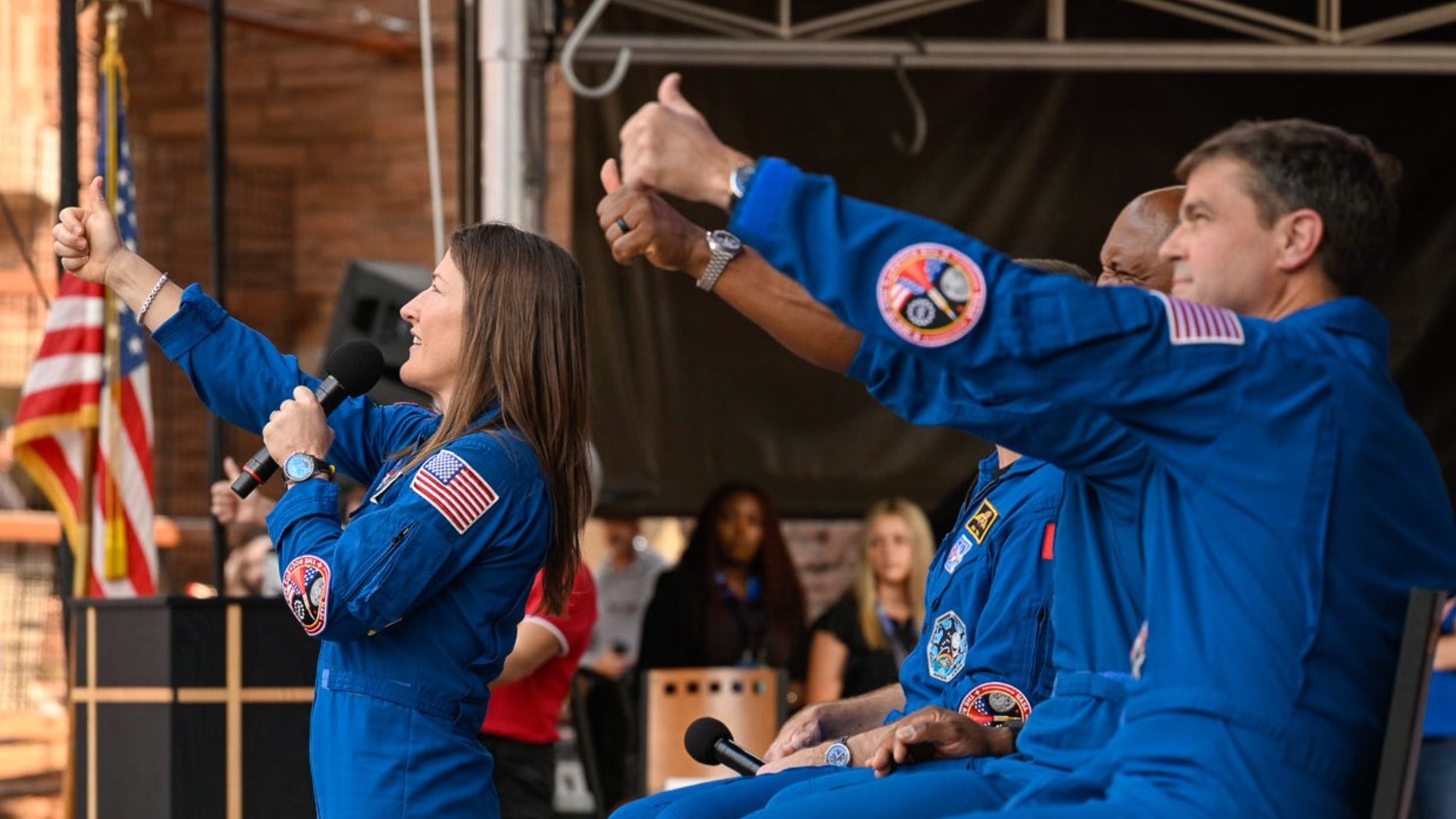
For Christina Koch, the Red Rocks gathering spurred a call and response audience participation. "I say moon, you say joy," to which the throng promptly called back three times. She also asked the audience to put their thumb out in the air. From a distance, "you can cover the entire Earth with your thumb. That's how small it was to us," she said, "but what you knew was that was home."

Proximity operations

Victor Glover, the pilot of Artemis II, focused on a proximity operations demonstration during the flight. That entailed the crew guiding the spacecraft through a series of controlled approach and retreat maneuvers using the detached upper stage, the interim cryogenic propulsion stage, as a reference target.

"That is when we had a chance to fly the spacecraft by hand, not just using the computers," Glover told Space.com. "We actually got to fly. One of the most amazing aspects of that is looking out the window or through the cameras on the [cockpit] displays to determine how far we were from the upper stage," he explained.

That task made use of all four sets of eyes onboard Orion, Glover said. "We did not have radar, or some other type of digital ranging system between us and that vehicle. But the Artemis II team trusted us to fly like that. I'm still blown away by that trust," he said, "and it flew marvelously."

four people in blue flight suits stand on a stage in an amphitheater surrounded by red stone cliffs

The Artemis II crew gives a thumbs-up to the crowd at Red Rocks Amphitheatre in Morrison, Colorado on Aug. 3, 2026. (Image credit: Lockheed Martin)

South pole ambitions

NASA's Glaze added that Artemis III is to fly sometime mid-year in 2027.

"We are going to demonstrate docking with one or both of our two landers, the Blue Origin and the SpaceX lander. They've got some demonstration versions that they are preparing right now. We're working on that mission to prove out, not just going back and forth at a target, but actually docking and doing that hard job," Glaze told Space.com.

Space.com pressed Glaze on the term "demonstration versions" of the Blue Origin and SpaceX lunar landers.

Would the fidelity of those demos be good enough to green-light an actual human moon landing on the Artemis IV mission?

"I do," Glaze responded. "We're working really hard with both of our lander providers on development of the demo pathfinder versions of their landers that we will dock with […] to assure that the docking systems are the same docking system we're going to work with when we are going for the landing mission," she said.

Glaze said that "this is one of the key risks. This allows us to buy down that risk and at least work through that part of the mission. So when we do the landed mission we've got that part out of the way.

"We've got our lessons learned from those docking demonstrations. And then we are really focused on all the risks associated with the landing on the moon … we can really focus our efforts there."

According to Space.com sources, however, there is active discussion of whether the lunar south pole is an advisable location for the first human landing of the Artemis Program. Indeed, Artemis II pilot Glover recently stated that he thinks there's a need to be realistic and progressively work our way to the south pole locale rather than land there first.

"We've had a lot of conversations with both of our lander vendors. The designs they have are for the south pole," responded Glaze. "We're working really closely with them on those designs. And we are very focused on landing at the south pole."

Over the moon

Canada's Artemis II mission specialist, Jeremy Hansen, told the audience that their space trek was a very human experience for the four crew members, "but we came to see and feel you. You shared the moon joy," he said.

Hansen underscored the international character of Artemis II. "It was one of those deliberate contributions to the planet," he said, because billions of us on Earth have to join forces. "We have to work together. We can no longer believe that our end-state is not working together. Not acceptable. We have to collaborate," he said.

Asked by a young audience member about items taken on their excursion around the moon, mission specialist Koch replied: "I took handwritten letters that I hadn't read before from my family, and also a very tall cow figurine. My dad had the idea of having a cow jump over the moon."

NASA’s canceled lunar space station tech will help build the Artemis moon base

Not every canceled NASA program earns a halo after its demise, but one scrapped project is finding new life by contributing its parts to help the space agency achieve its moon base goals faster.

Northrop Grumman is repurposing hardware and technology from the Habitation and Logistics Outpost (HALO) space station module for use on a new series of Lunar Infrastructure Demo (LID) missions. HALO was originally designed as the habitation module for NASA's since-cancelled moon-orbiting Gateway space station but found itself on the chopping block when the agency restructured the Artemis program architecture earlier this year.

Rather than scrap the unfinished module outright, Northrop Grumman will adapt HALO's electrical and mechanical components to support the development of technologies for a moon base that can survive the cold, weeks-long night at the lunar south pole while sustaining the long-term habitation of astronauts inside.

Part of NASA's reasoning for canceling Gateway was the need for expedience. As the agency's vision for Artemis and the return of astronauts to the lunar surface has evolved, China's plans to land the first taikonauts on the moon have steadily taken shape. Those ambitions, and the continued progression of China's lunar program, have kicked off a new space race in which the U.S. and NASA are intent on maintaining their first-place position.

In March, NASA Administrator Jared Isaacman announced a shakeup to the Artemis program designed to enable a more step-by-step approach toward developing the technologies needed for a next-generation crewed lunar landing, and to achieve that landing on the shortest timeline possible.

That timeline currently puts the first Artemis lunar landing with astronauts on the Artemis IV mission, scheduled for late 2028. Before then, however, NASA is planning nearly two dozen uncrewed missions to the moon to lay the groundwork for the infrastructure needed to precede astronauts' return. And, rather than let HALO rust in a warehouse, Northrop is doubling down on its commitment to the cause.

"To help NASA move faster … HALO’s power, data and mechanical interfaces will enable NASA to move with speed and begin gathering real lunar surface performance data sooner," the company said in a press release on Aug. 4.

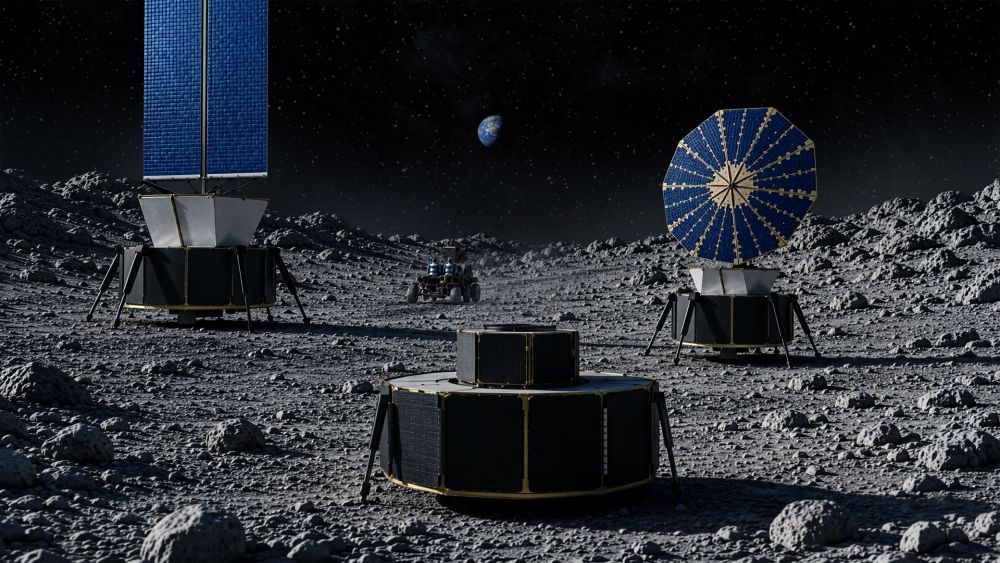
three robotic landers stand on the surface of the moon

Northrop Grumman’s Lunar Infrastructure Demos (LID-1, LID-2 and LID-3) will reuse HALO derived technologies to rapidly mature lunar surface power, thermal, autonomy, communications and hosted payload services that can survive the lunar night and scale into persistent infrastructure near the moon’s south pole.  (Image credit: Northrop Grumman)

Northrop announced 3 LID missions to "reuse HALO-derived technologies to rapidly mature lunar surface power, thermal, autonomy, communications and hosted payload services," which will help NASA gather data to better protect robotics and crews during long-duration stints near the moon's south pole, where the agency plans to establish its Artemis moon base. Neither the company nor NASA gave a target timeline for these missions.

NASA is targeting the south pole specifically because of the abundance of water ice that scientists have detected in that region on the moon. When harnessed appropriately, such ice concentrations can be used for a variety of applications to enable sustainable habitation on the lunar surface — the ultimate goal of the Artemis program — including potable water, radiation shielding and rocket fuel.

NASA believes that overcoming the technological hurdle of "in-situ resource utilization" (ISRU), or the ability to rely on materials locally available to you in order to sustain your survival, is the gold standard of spaceflight that will open the door to humanity's long-term exploration of the cosmos. Manufacturing propellants off Earth, for example, would mean a substantial increase in the distance any particular mission to space can fly, because nearly 95% of a rocket's mass at launch is fuel. So, the ability to refuel in space, circumventing the burden of launching to orbit fully fueled, would give satellites and crewed spacecraft the ability to fly much farther into the solar system than current launch systems allow.

As much as Artemis is, in itself, a program to establish a permanent human presence on the moon, NASA also sees it as the proving ground for technologies that could one day sustain astronaut missions to Mars. There is worry, however, over the national security and economic consequences that could accompany China beating the U.S. to the moon, so speed is top of mind for those tasked with the country's lunar return.

"As America embarks on the next chapter in human space exploration, our Lunar Infrastructure Demos will help turn the moon into a place where astronauts can stay, work and make discoveries that benefit humanity,” said David Schiller, Northrop Grumman's vice president of civil space and sciences, in a statement. “Our ready‑to‑fly, reliable HALO technologies allow NASA to move faster, putting in place robust infrastructure that can endure the lunar night and establish a strong blueprint for a future moon base.”

Radiation-shielding vest aced Artemis I lunar test, could protect astronauts on moon and Mars missions

A radiation-shielding vest might one day protect astronauts from dangerous, random outbursts from the sun, a new study finds.

More than 50 years after the final Apollo mission, NASA's Artemis program aims to return humans to the moon. To succeed, this project must protect astronauts from solar radiation, especially the intense and unpredictable radiation from solar storms. Coating an entire spacecraft with a meaningfully thick layer of radiation shielding remains impractical due to weight constraints, but wrapping astronauts in protective garments may potentially be helpful.

In the new study, researchers experimented with the AstroRad vest, which was designed by the Israeli startup StemRad with support from the Israel Space Agency and aerospace giant Lockheed Martin. The garment was created to protect astronauts from explosions from the sun known as solar particle events.

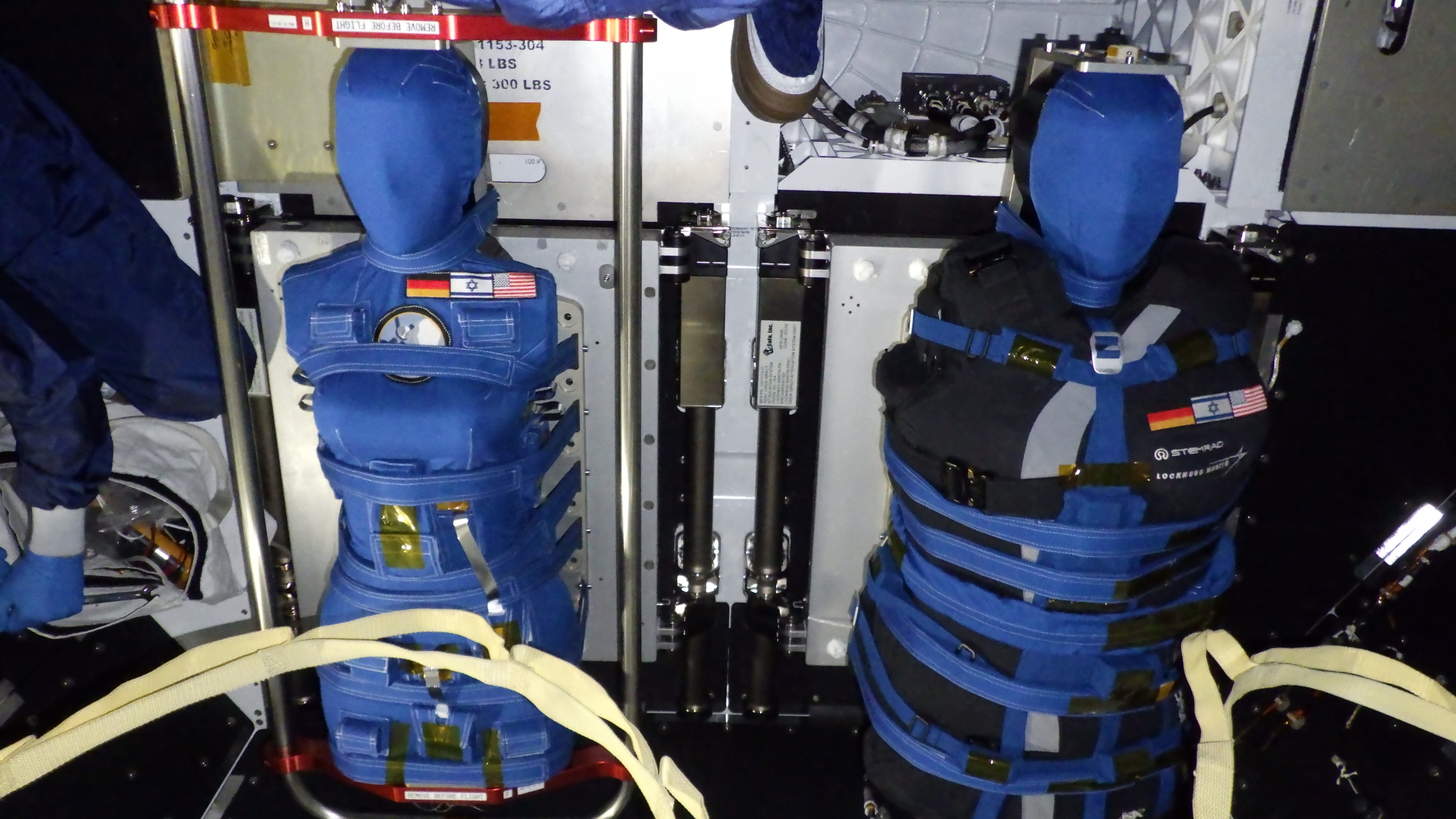
two blue-and-black torso mannequins stand upright inside a spacecraft, strapped in with blue bindings

The "phantoms" Helga and Zohar inside the Orion spacecraft at NASA's Vehicle Assembly Building prior to the launch of Artemis I. Zohar, right, wore the AstroRad vest while Helga did not. (Image credit: NASA/Lockheed Martin/DLR)

"Radiation in space is unavoidable, and a single major solar particle event can make a substantial contribution to an astronaut's lifetime risk of radiation-induced cancer," study co-author Oren Milstein, CEO and co-founder of StemRad, told Space.com. "By significantly reducing that contribution, personal shielding could be particularly important for future lunar and Mars missions."

When it comes to protection against radiation, lead is excellent at blocking hazardous forms of light, such as X-rays and gamma rays. However, lead is much less effective at defending against the kinds of dangerous particles that can hurtle through space. For instance, when fast high-energy electrons known as beta particles strike dense lead atoms, they can trigger a shower of X-rays that are more harmful than the beta particles themselves. And if neutrons strike lead atoms, they can knock loose a spray of neutrons from the atoms' nuclei, worsening the impact from the radiation.

Instead, AstroRad relies on a high-density plastic rich in hydrogen. Among the elements, hydrogen possesses the highest density of electrons per atom, which can help create a dense shield to protect against incoming particles. At the same time, hydrogen atoms normally do not have neutrons, so if neutrons hit them, they cannot generate the kind of dangerous neutron sprays that can happen with lead atoms.

Moreover, the plastic in AstroRad is much lighter than lead. This makes it easier to move around in garments incorporating the plastic, and more practical for space missions in which weight is a major limitation.

The scientists combined thousands of hexagonal rods of the rigid plastic together like scales to create a flexible garment. All in all, each vest weighed about 57 pounds (26 kilograms).

The scientists developed a vest rather than a full-body suit or a helmet because "different organs and tissues have very different sensitivities to radiation, so shielding every part of the body equally is not the most effective approach," study co-author Jordan Houri, lead scientist for space exploration at StemRad, told Space.com. "At the same time, a full-body suit would be much harder to put on and move around in."

The shielding thickness of the AstroRad vest was based on how sensitive to radiation the underlying organs were. This strategy provides about a 30% greater reduction in the dose of radiation a person receives compared with distributing the same amount of shielding uniformly across the body, Houri said.

The researchers tested their vest during NASA's uncrewed Artemis I moon mission in late 2022 using a pair of extraordinarily complex dummies called phantoms. These artificial torsos were constructed of plastics that mimicked the density of human tissue, bone and organs, and each was equipped with more than 5,600 radiation sensors on and in them.

The two phantoms were designed to be adult females, since previous research found that breasts and ovaries are especially susceptible to radiation damage.

"Women are predicted to face a higher risk of radiation-induced cancer," Milstein said. "Targeted shielding could help narrow that difference in risk between male and female astronauts."

Since the phantoms mimicked women, they were given women's names, Zohar and Helga. "Helga was contributed to the experiment by the German Aerospace Center, and Helga is a traditional German name," Milstein said. "Zohar was contributed by the Israel Space Agency, which selected the name through a public outreach campaign. Zohar is a traditional Hebrew name meaning 'radiance,' which we thought was particularly fitting."

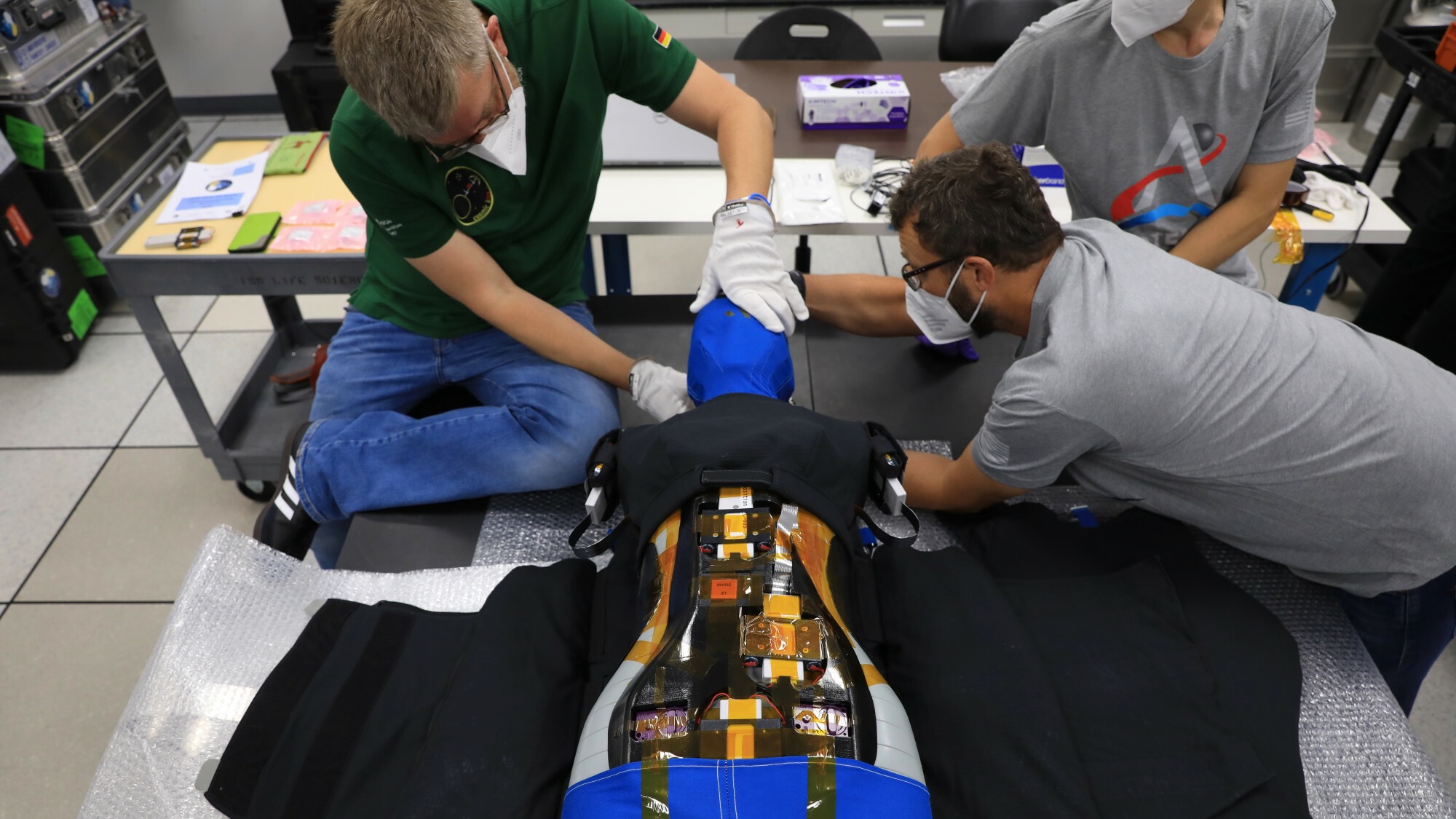
two men assemble a bluish torso-only mannequin on a table

Assembling the Zohar phantom with the AstroRad vest at Kennedy Space Center prior to launch of Artemis I. (Image credit: NASA/DLR)

Zohar and Helga flew seated in NASA's Orion spacecraft; Zohar was equipped with an AstroRad vest, while Helga was not. Although Orion did not encounter a significant solar outburst during its 26-day mission to lunar orbit and back, the researchers were able to extrapolate how much solar radiation astronauts might experience based on what the phantoms encountered passing through the inner Van Allen belt of radiation surrounding Earth.

When the scientists analyzed past solar particle events, they found the AstroRad vest would have significantly reduced the dose of radiation a person during those outbursts — for instance, by nearly 60% for a solar particle event that happened in August 1972.

"We had originally anticipated something closer to 45%, so when we first saw the result, we thought we needed to go back and find an error," Houri said. "Instead, the detailed analysis showed that AstroRad's approach of providing targeted shielding to the most radiation-sensitive organs and tissues was even more effective than we had projected."

Such a reduction could spare astronauts the equivalent of up to 193 days of deep-space radiation exposure. "The most important implication is that AstroRad could help overcome one of the major health challenges limiting long-duration human exploration beyond Earth," Milstein said.

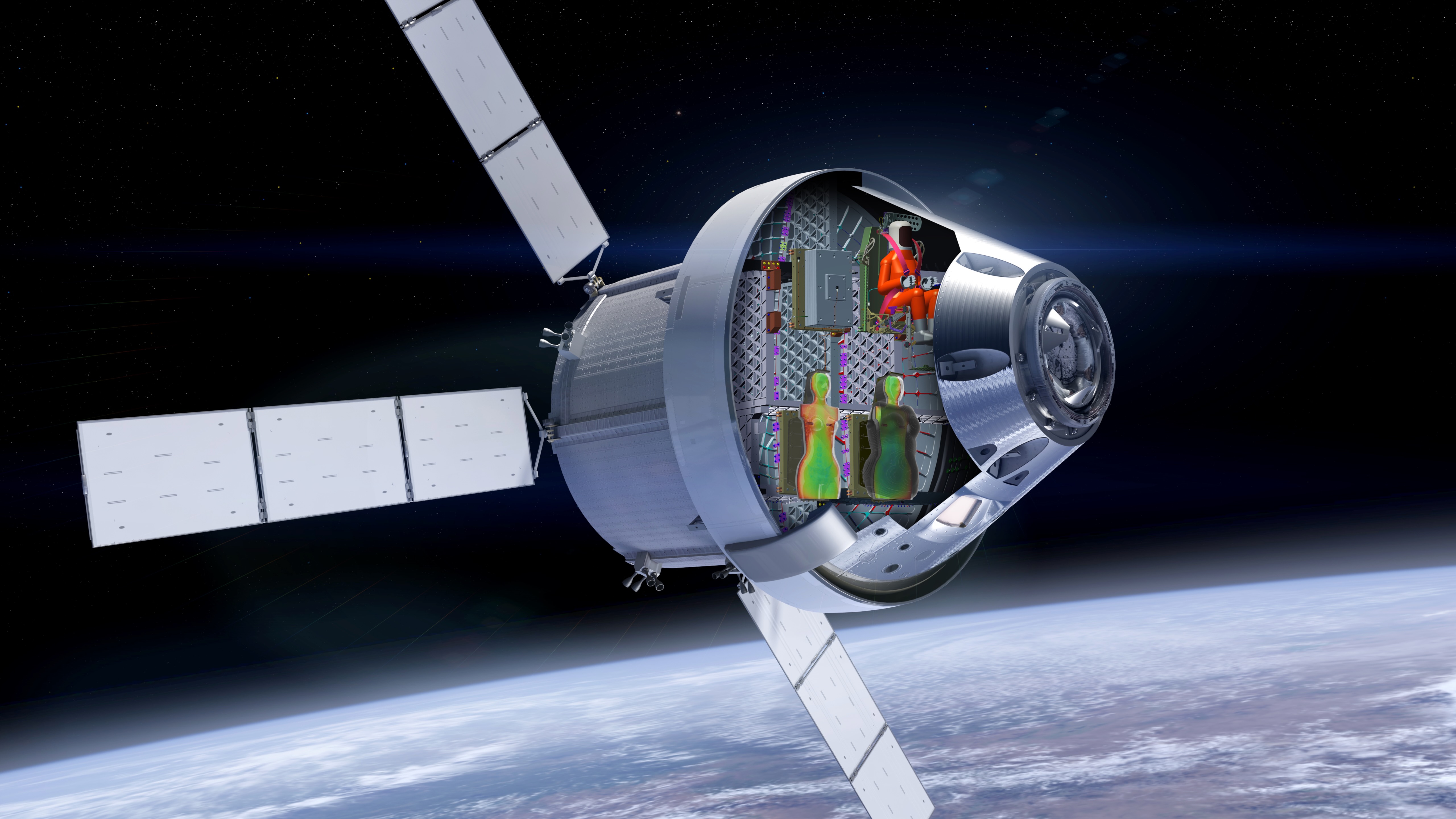
illustration of a conical spacecraft flying above earth, with a cross-section through it showing two torso mannequins and a full-body mannequin

3D rendering of the Matroshka AstroRad Radiation Experiment (MARE) during NASA’s Artemis I mission, showing the two radiation dosimetry phantoms, Helga and Zohar inside the Orion spacecraft. (Image credit: NASA/Lockheed Martin/DLR/StemRad)

AstroRad is not something astronauts would wear continuously throughout an entire mission, Houri said. "AstroRad was developed as an emergency countermeasure for solar particle events, so astronauts would only wear it when radiation levels are elevated, typically for periods of hours or days," he explained.

Still, "although it is not something astronauts would need to wear throughout an entire mission, we designed the vest to remain usable for many hours at a time," Milstein said. During tests with the vests on the International Space Station, "several crew members even slept with it on."

The level of radiation protection the AstroRad vest provided was similar to that supplied by the Orion spacecraft's onboard storm shelter, "while allowing the astronaut wearing it to leave the shelter and continue mission-critical tasks," Houri said. "AstroRad can be used on its own or together with a shelter, but one of its main advantages is that an astronaut can remain protected while moving around the cabin and carrying out essential mission operations rather than remaining inside the shelter."

The scientists are now investigating whether it is possible to manufacture radiation shielding in space using onboard materials. For instance, in collaboration with Florida aerospace company Redwire, "we have already demonstrated that it is possible to 3D-print AstroRad components from recycled polyethylene aboard the International Space Station," Milstein said.

The scientists detailed their findings online today (Aug. 12) in the journal Science Advances.

Artemis moonsuits take a dive | Space photo of the day for July 31, 2026

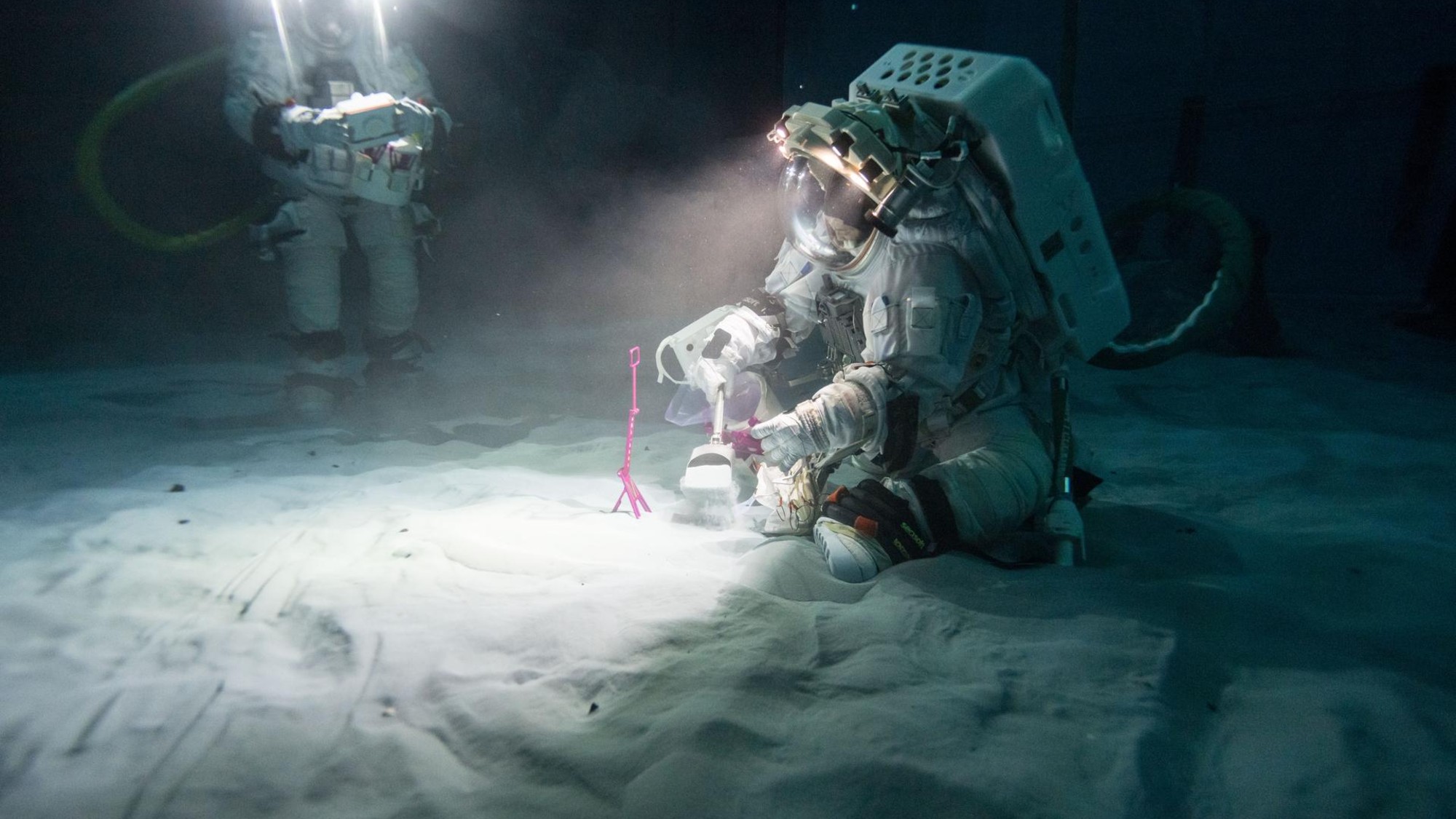
Exploration geologists and Artemis science officers Trevor Graff, left, and Angela Garcia carry out a lunar training development run at NASA's Neutral Buoyancy Laboratory (NBL) in Houston. (Image credit: NASA)

Sometimes to go to the moon, you first have to go underwater.

NASA is currently developing the training program for NASA's Artemis astronauts, some of whom could set foot on the moon during the agency's planned Artemis IV mission. As part of that development, two agency scientists recently donned Artemis moonsuits and took to NASA's underwater training facility.

What is it?

These photos show two NASA exploration geologists and Artemis science officers practicing using the same types of geology tools that astronauts might use when they explore the moon.

The scientists also "deployed a mock lunar payload under low-angle lighting conditions," according to a NASA statement accompanying the photo. NASA is currently aiming to place astronauts at the lunar south pole, where many areas remain in permanent shadow. As such, future lunar explorers may have to operate in near-total darkness and learn how to carry out their missions with very little light.

Exploration geologists and Artemis science officers Trevor Graff, left, and Angela Garcia carry out a lunar training development run at NASA's Neutral Buoyancy Laboratory (NBL) in Houston. (Image credit: NASA)

Why is it incredible?

The fact that NASA is preparing to send humans back to the moon is incredible in itself. Humanity hasn't set foot on our natural satellite since 1972. While NASA still has many technical hurdles to cross when it comes to developing and selecting a moon lander, the agency is pushing ahead with developing the training it will use to prepare its astronauts to explore the lunar surface.

For this particular part of Artemis training development, NASA placed two scientists in its Neutral Buoyancy Laboratory (NBL), a 40-foot-deep (12-meter) pool at NASA's Johnson Space Center in Houston. The particular test in these photos was "the first time that two geologists were suited up simultaneously for lunar geology training in the NBL," according to NASA's statement.

For these tests, a portion of the underwater laboratory was outfitted with soil and rocks that simulate the surface of the moon. The buoyancy of the pool can be manipulated in order to simulate different levels of gravity, helping astronauts train for spacewalks or for exploring other worlds like the moon.

Should Artemis IV astronauts actually land near the moon’s south pole? Artemis II pilot says the lunar equator might be better

The moon's south pole has long been the target of NASA's Artemis lunar landing missions, but one Artemis astronaut is questioning if that's still the best plan.

NASA's Victor Glover, who piloted the Artemis II mission around the moon this past April, proposed a different approach while speaking at the NASA Exploration Science Forum at the agency's Ames Research Center in California on July 21, according to a report published on Space News. "I think we need to be realistic and work our way to the south pole, and maybe not try to go there first," Glover said.

Instead, Glover suggested aiming closer to the moon's equator, where missions can land in areas not at risk of falling out of daylight, and in regions reachable by orbits that allow for quick transfers back to Earth in case of an emergency, according to Space News. That argument aligns with other recent Artemis program changes that NASA has introduced to gradually expand successive mission goals, but whether space agency officials will take his advice depends on what the top priority for Artemis moon landings is deemed to be.

a male astronaut wearing a blue flight suit stands with his arms crossed against a dark background

NASA astronaut Victor Glover, the pilot of the Artemis II moon mission. (Image credit: NASA)

NASA has long targeted the lunar south pole due to its abundance of water ice. Permanently shadowed areas inside craters in this region are believed to harbor large ice deposits, which scientists believe can be used as a resource in the production of several space-travel essentials, like potable water, radiation shielding and rocket fuel. That goes a long way toward achieving the Artemis program's ultimate goal of creating a sustainable, long-term base on the surface of the moon, and using the lessons learned in building that outpost to enable the eventual occupation of Mars.

There is, however, a secondary motivation behind NASA's ramped-up urgency to see its Artemis missions succeed in a timely manner. China has also set its sights on the lunar surface, stoking fears in some U.S. officials about the implications of Chinese astronauts staking some sort of claim at the moon's south pole before American astronauts are able to get there.

During a Senate Commerce Committee hearing last year, several space industry experts, including former NASA Administrator Jim Bridenstine, urged lawmakers not to let that happen. Mike Gold, president of civil and international space at Redwire, told senators that China beating the U.S. back to the moon would mean "a global realignment that will impact our economy, our tax base, our ability to innovate and our national security."

If not just getting back to the moon first, but being the first with boots on the ground at the south pole, is the priority, Glover's suggested approach may not get NASA there in time. China is making fast progress with its lunar program; it has already demonstrated robotic landings and sample returns on both the moon's near and far side and begun developing hardware for a crewed landing by 2030.

NASA's next Artemis mission, Artemis III, is scheduled for next year. It will launch four astronauts aboard the Orion space capsule for rendezvous and docking tests with the program's two commercial lunar lander vehicles, SpaceX's Starship and Blue Origin's Blue Moon. If all goes according to plan on that mission, NASA is targeting late 2028 for the program's first moon landing on Artemis IV. To pull that off, one of the two landers has to be up to the task, and both have faced significant delays that have raised questions about their readiness on NASA's timeline.

To facilitate south pole landings, NASA previously laid out a lunar near-rectilinear halo orbit (NRHO) — a high-altitude, elliptical polar orbit — where Orion would dock with the lunar Gateway space station, and then crews would transfer to and undock aboard one of the Artemis landers to descend to the surface. Gateway is no longer part of the picture, however; the agency has sidelined that outpost to push ahead with a surface base.

But NRHO on its own also introduces some complications that SpaceX and Blue Origin have raised while developing their lunar landers, as well as safety concerns for astronauts facing a potential emergency situation on the moon's surface. Because of its highly elliptical shape and long orbital period, opportunities to launch from the moon's south pole to rendezvous with Orion in NRHO open up just once a week.

To highlight the potential risks imposed by relying on an NRHO, Glover brought up a hypothetical situation — an astronaut health issue that requires a medical evacuation just after landing at a lunar south pole moon base.

"You’re stuck for a week," Glover said. "That’s a big deal to me, and I don’t like that plan … The equator gives me opportunity to save that person."

If the point of Artemis' returning astronauts to the moon as soon as possible is landing there at all, then there's no need for the first of those missions to aim for the south pole, Glover argued. "If you want to go fast, go familiar … If we want to land soon, familiar, daylight, equator."

"I think we need to be realistic and work our way to the south pole, and maybe not try to go there first," he added.

SpaceX is also eyeing an equatorial orbit when Starship flies on the Artemis IV mission, and NASA may already be quietly shifting the mission's landing site to a higher latitude. During a June 9 event that revealed the Artemis III, SpaceX Customer Operations and Integration Vice President Jessica Jensen outlined an Artemis IV mission plan with Starship that didn't involve NRHO.

"We have an updated plan with NASA that includes docking Starship with Orion in Earth orbit instead of NRHO, and then we use Starship to actually do the translunar injection with Orion attached," Jensen said, stressing the same benefits that Glover expressed during the July 21 forum.

"The crew can also abort off the lunar surface nearly any time, versus waiting up to days from NRHO," she said. "In addition to improving crew safety, these new Artemis IV orbits also significantly lower the amount of propellant Starship needs to aggregate in space, since we now just have a more direct route to the moon, and this lower schedule risk overall."

Artemis III astronauts will beam 4k video from Orion to Earth using SpaceX Starlink lasers

Orion is getting an upgrade on Artemis III, and the astronauts aboard are getting WiFi (sort of).

NASA is partnering with SpaceX to equip the Orion spacecraft for Artemis III with a pair of Starlink mini laser terminals, designed to operate on SpaceX's existing Starlink network. The two panels will be installed on Orion's exterior, and will augment the spacecraft's existing communications systems.

The added capability is expected to provide a greater data capacity from Orion to NASA's mission control in Houston, which may include high-definition live video from orbit. The mission is currently scheduled for the second half of 2027, and will also include another sizable contribution from SpaceX: a Starship rocket.

SpaceX currently operates more than 10,000 Starlink spacecraft in LEO, which provide satellite internet coverage across nearly the entire globe to commercially-available wireless terminals about the size of a laptop. Combined, those more than 10,000 and counting satellites are equipped with over 25,000 lasers currently in operation in LEO to maintain the network's interconnectedness, according to a NASA update.

The company previously demonstrated the Starlink constellation's use as a communication relay network during the privately funded Fram2 mission that launched the first human into a polar orbit around Earth in 2025. SpaceX frequently utilizes its high-data capabilities to stream high-definition live views of its Falcon 9 and Starship rocket launches from orbit.

Artemis III is the third in a program of NASA missions with the goal of returning astronauts to the moon and establishing a permanent base on its surface. Artemis III is designed as a practice run for NASA's Orion capsule to rendezvous and dock with the program's commercial lunar lander vehicles, Starship, and Blue Origin's Blue Moon spacecraft, in low Earth orbit (LEO). That's a lot closer to home compared to the Artemis II mission that NASA launched in April of this year.

Artemis II was Orion's first flight with astronauts onboard, and flew a 10-day mission around the far side of the moon. NASA used laser communications during Artemis II as well, using terminals on Orion and ground stations at NASA's Jet Propulsion Lab in California and White Sands Complex in New Mexico to transmit data loads too big for the agency's Near Space and Deep Space radio networks. With flight sticking to LEO during Artemis III, communication limitations become a lot easier to surmount.

If all goes according to plan during Artemis III, NASA has scheduled the first Artemis moon landing on the following mission, Artemis IV. NASA is targeting 2028 to launch Artemis IV, and has selected Starship as the lunar lander that will return astronauts to the lunar surface.