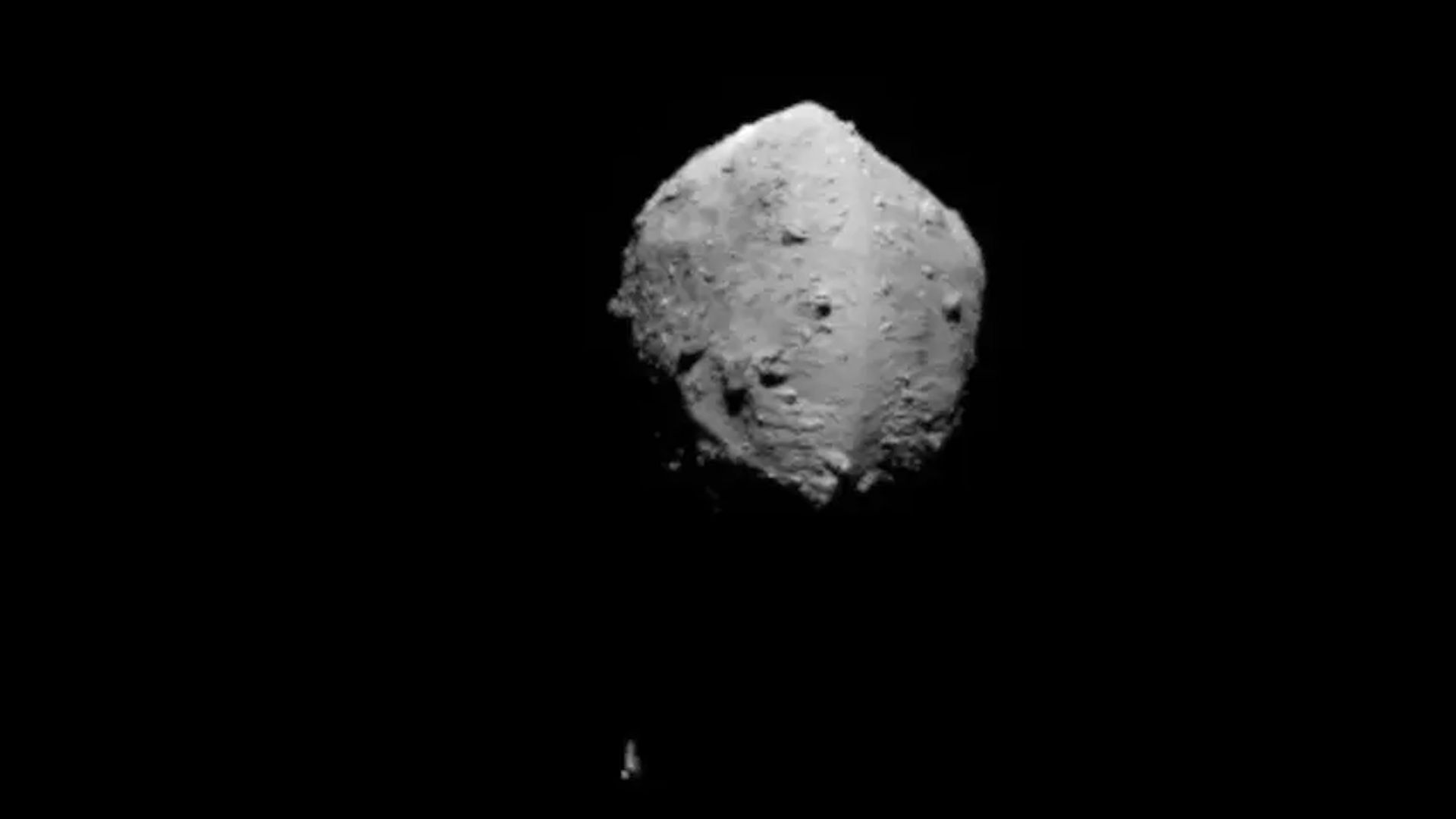
The Didymos binary asteroid system, as seen by Europe's Hera probe. The main asteroid, Didymos, dominates the frame while just a sliver of its "moonlet," Dimorphos, is visible beneath it. ESA released this image on Nov. 5, 2026. (Image credit: ESA)
The European Space Agency's (ESA) Hera spacecraft has gotten its first close-up look at the Didymos binary asteroid system. If that system sounds familiar, it's because it made headlines in September 2022 when NASA's DART (Double Asteroid Redirection Test) spacecraft smashed into it.
The aim of the DART mission was to test whether an impact could divert an asteroid away from a collision course with Earth. The purpose of Hera is to follow up on DART by making up-close observations of the Didymos system.
"The first thing we said was, 'Wow,'" Hera Principal Investigator Patrick Michel said in a statement about the image, which ESA released on Thursday (Nov. 5). "This is the other side of Didymos from the one that DART’s camera showed us shortly before impact, so this feels like looking at a whole new world."
What is it?
The Didymos system consists of the eponymous 2,560-foot-wide (780 meters) space rock and its "moonlet" Dimorphos, which is about 530 feet (160 m) in diameter.
The DART mission impacted Dimorphos on Sept. 26, 2022, with the aim of causing a change in the orbital period of the moonlet. And it worked: Before the impact, Dimorphos completed one lap around Didymos in around 11 hours and 55 minutes. The DART collision reduced the length of this period by around 33 minutes.
The change is a result of the fact that Dimporphos is now traveling at around 2.7 millimeters per second more slowly than it did before the collision.
The newly released photo shows Didymos in detail. Just a sliver of Dimorphos is visible, below and slightly to the left of the main asteroid.
Why is it incredible?
The changes caused by DART were small. But in a real Earth-threatening scenario, even such a tiny shift could help divert an asteroid on a collision course — as long as scientists get enough advance warning of its approach.
Hera's observations should help reveal what other changes have occurred on and around Didymos.
Scientists are already seeing that, while Didymos has the same central ridge along its equator as before the impact, many changes have occurred. This includes the creation of multiple boulders, craters, and patterns of grooves or ridges.
"Since we expect a lot of impact-ejected material to have made it across the approximately 1 kilometer [0.62 miles] of space from Dimorphos to Didymos, it may be that some of these characteristics originate from this transport of material, and we have exciting work ahead of us to sort it out," said Michael Kueppers, ESA’s Hera mission scientist. "We look forward to seeing much more of both bodies and systemically mapping all the changes we identify."
Stay tuned to Space.com for more Hera findings from Didymos.
Europe's Hera planetary defense spacecraft is closing in on the binary asteroid system targeted by NASA's DART deflection test, and can now tell the two rocky bodies apart.
Hera is nearing the end of its voyage to the Didymos asteroid system, having launched on a SpaceX Falcon 9 rocket in October 2024. The spacecraft snapped the image of Didymos and the smaller Dimorphos on Oct. 18 from a distance of 795 miles (1280 kilometers) from the pair, which are currently about 122 million miles (197 million km) from Earth.
"With this image, the smaller Dimorphos asteroid becomes visible for the first time," Michael Kueppers, Hera project scientist at the European Space Agency (ESA), said in a statement. "Before this acquisition, the spacecraft was still resolving the Didymos system as a single dot. But now, even though Dimorphos is made up of only around one pixel in this initial image, it is clearly well separated from its parent body."
Hera performed braking maneuvers earlier in October to slow its approach and put it on course to rendezvous with the binary system. The spacecraft is designed to make follow-up observations of the asteroids using 12 payloads, providing new insights that will prove valuable for planetary defense efforts. The mission also carries a pair of cubesats for a closer look and eventual landing on the 495-foot-wide (151 meters) Dimorphos.
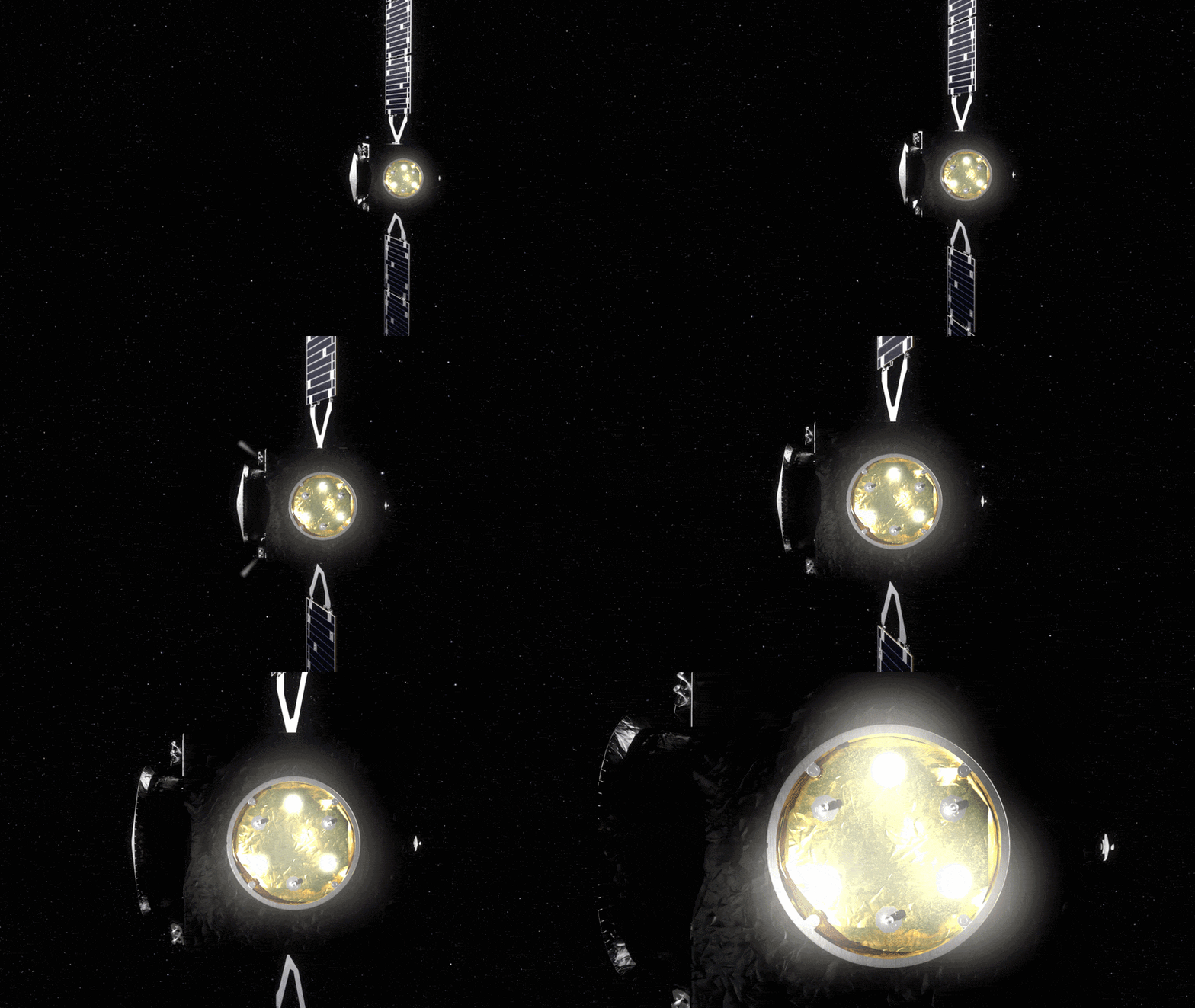
A series of images captured by the DART spacecraft as it sped to impact the asteroid Dimorphos on Sept. 26, 2022. (Image credit: NASA/JHUAPL)
For now, Hera is continuing its approach and preparing for arrival, with a big reveal expected to occur later this month.
"Our views will grow much sharper as Hera comes closer," said ESA's mission manager Ian Carnelli. "We will unveil the first detailed images of Dimorphos — the first object in the solar system to have had its orbit measurably shifted by human action — on 25 November."
NASA's DART mission made a cosmic mess four years ago — and now a new spacecraft is ready to scout out exactly what the first-of-its-kind collision accomplished.
The Double Asteroid Redirection Test (DART) spacecraft slammed into a small space rock called Dimorphos on Sept. 26, 2022, in humanity's first test of planetary defense. That's the field dedicated to protecting Earth from the possibility of a calamitous asteroid impact, and DART mimicked how humans could change the orbit of a threatening space rock, taking it off its collision course.
The mission definitely succeeded, shortening the little asteroid's orbit around a larger rock called Didymos by about 33 minutes. But in order to make the most of the experiment, scientists ensured a second spacecraft would follow DART at a more leisurely pace. That decision will pay off this month with the arrival of a European Space Agency (ESA) spacecraft dubbed Hera, which launched in October 2024, two years after DART's impact.
"Hera wants to be the detective, like Inspector Colombo, going back to the crash scene," said Patrick Michel, a planetary scientist at the French National Centre for Scientific Research (CNRS) and principal investigator of the Hera mission.
An animation of Hera braking as it approaches its destination. (Image credit: ESA)
Scientists have been able to do limited monitoring of the Didymos system over the years with telescopes both on the ground and in space. That's how they calculated the basic change to the orbit, and they've built a basic sketch of what happened.
"We know that there was a lot of material kicked up," said Angela Stickle, a planetary scientist at Johns Hopkins University's Applied Physics Laboratory affiliated with both missions. "We know that we probably left a pretty significant mark on Dimorphos."
But the story isn't over and scientists are far from satisfied. No one knows how big a crater the impact left, or whether it completely rearranged all the asteroid's boulders. There are hints Dimorphos is now tumbling, and material may have moved between it and the larger Didymos.
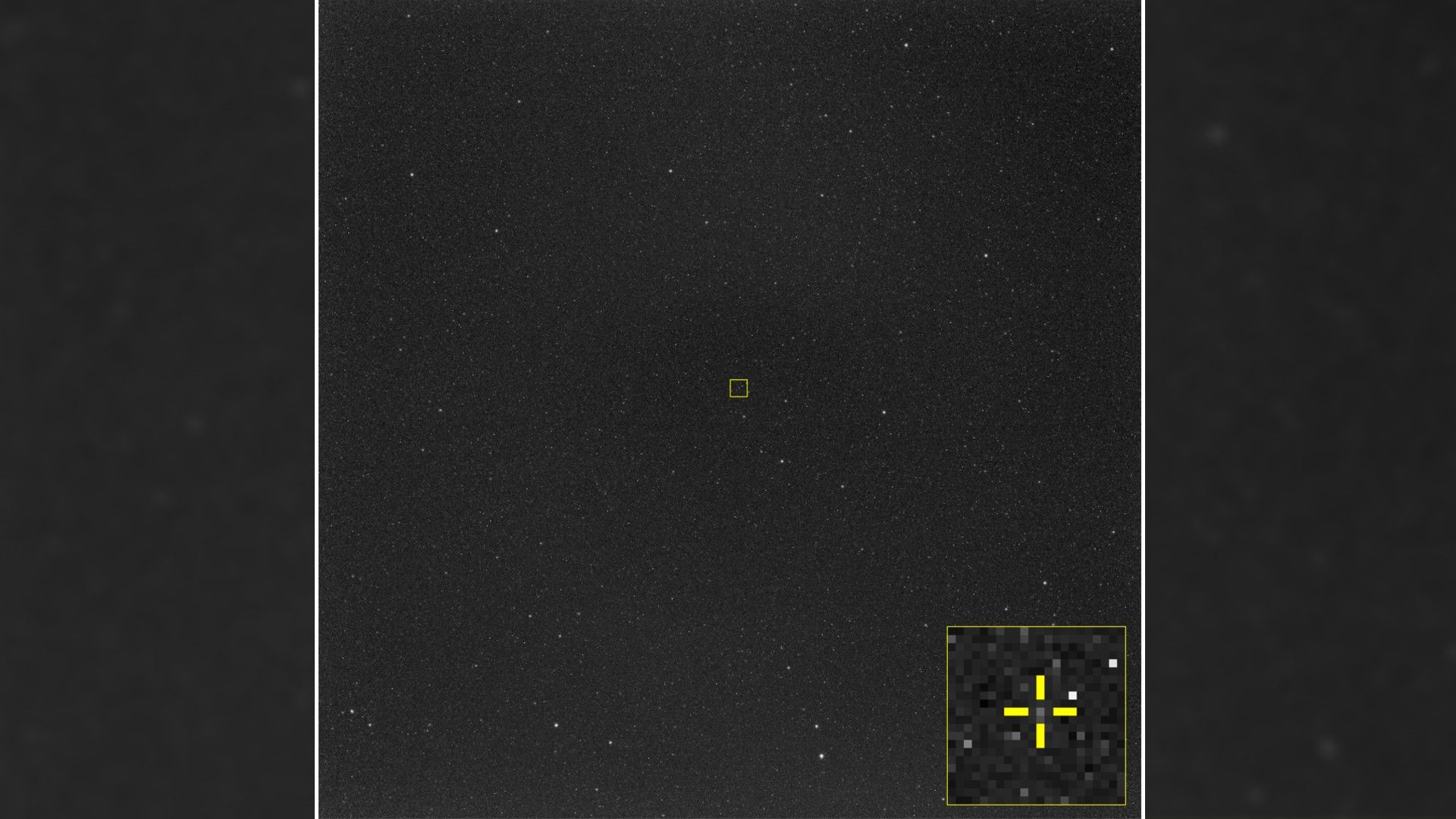
Exactly two years after its launch, ESA's Hera planetary defense mission caught its first glimpse of its destination: the Didymos binary asteroid system, seen from an approximate distance of 147,000 miles (236,500 kilometers) away. (Image credit: ESA)
Even the change to the orbit is complicated, said Cristina Thomas, a planetary astronomer at Northern Arizona University affiliated with both missions: The time Dimorphos took to circle Didymos was still changing some six months after impact, for reasons that aren't clear. "This thing that we thought was going to be very cut and dry turned out to be really interesting and complicated," Thomas said.
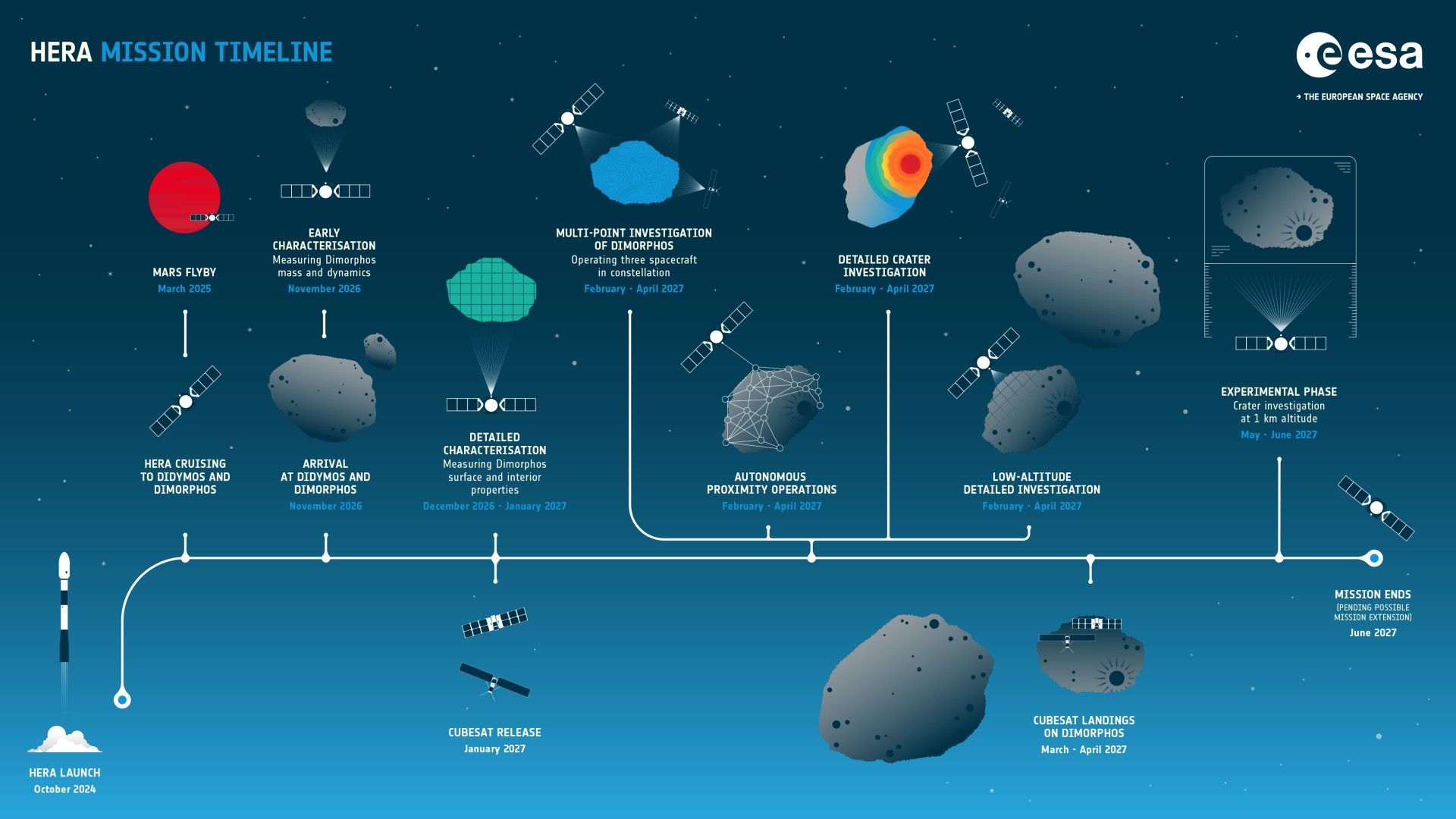
That's where Hera comes in, with its first arrival maneuver scheduled for Oct. 15. During three careful braking maneuvers, the spacecraft will slow down and approach the space rocks. Assuming everything goes smoothly, by early November, the spacecraft will come within 20 miles (30 kilometers) of the two rocks and begin its early science observations, then move even closer in early December.
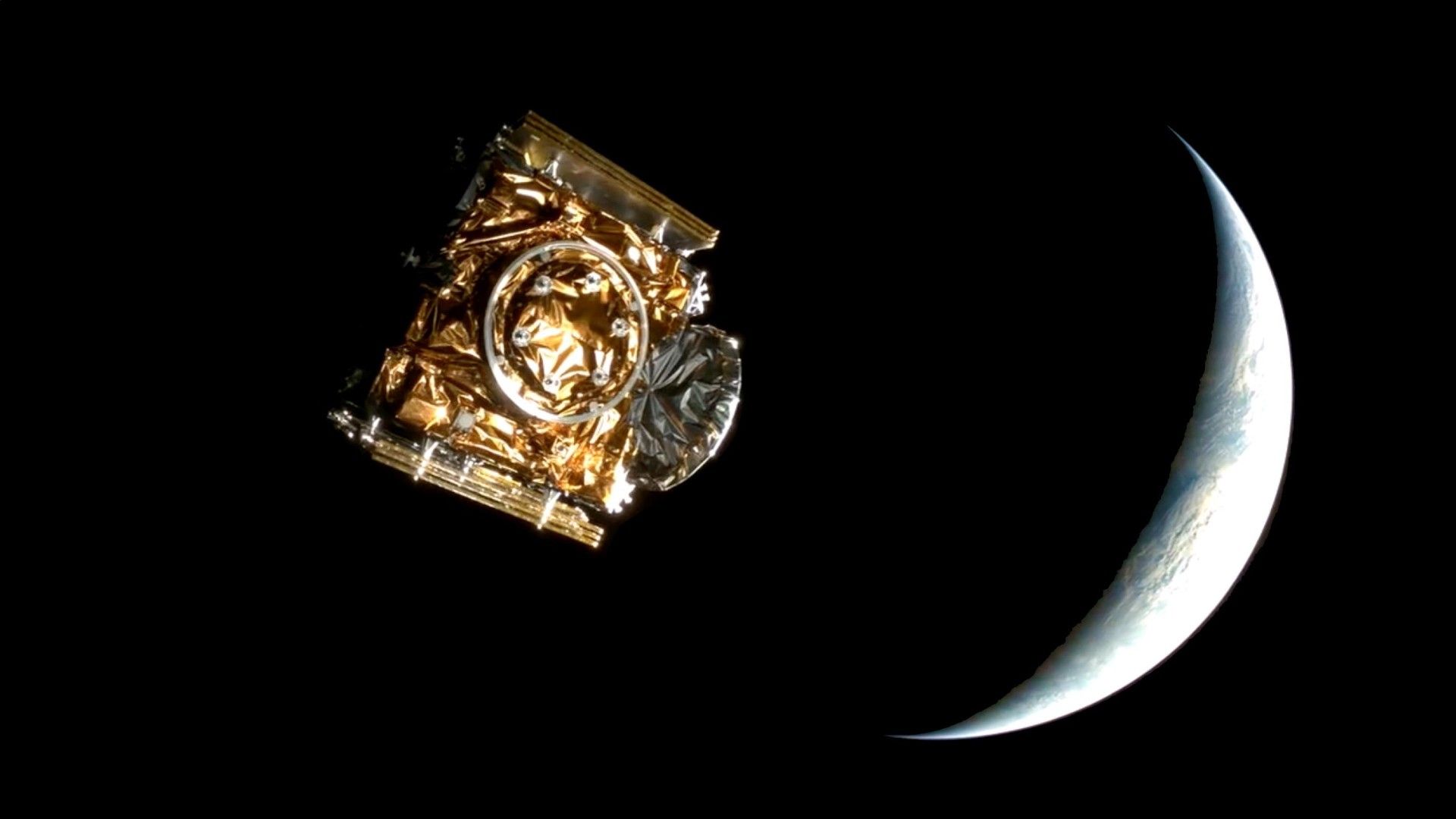
The Hera spacecraft seen after separated from the upper stage of its SpaceX Falcon 9 launcher on Oct. 7, 2024. (Image credit: SpaceX)
Mission personnel can't wait for their first glimpses of Dimorphos — the first time scientists will visit someplace they've seen before without knowing what they'll find. "For us, it's like a new world," Michel said. "The new image won't have anything to do with the previous one, so that's really exciting."
In addition to mapping the two asteroids and seeing what kind of crater the impact left, scientists will also have their eyes peeled for any pieces of the DART spacecraft, although they don't expect to find anything. "We were coming in really fast, so typically, the whole spacecraft you would expect to just kind of shatter or melt," Stickle said. The only sliver of possibility is that part of the two long solar panels stretching off the spacecraft may have snapped off and survived. (The appendages may also have turned the crater shape into an oval.)
The Hera mission's timeline. (Image credit: ESA)
In January, once Hera has settled in, it will release two tiny companions that have piggybacked out to Dimorphos. One, called Milani, will identify the composition of materials on and around Dimorphos. The other, Juventas, will use radar to peer inside Dimorphos — the first time scientists have ever been able to study the interior of a space rock directly. Juventas will end its mission by landing on the small asteroid, and Milani may attempt a landing as well.
A series of images captured by the DART spacecraft as it sped to impact the asteroid Dimorphos on Sept. 26, 2022. (Image credit: NASA/JHUAPL)
The trio of spacecraft will operate in tandem throughout early 2027, and the main spacecraft will operate at least through September 2027. All told, they will give scientists an unprecedented look at the pair of asteroids — the first binary asteroid a spacecraft has ever studied in detail. And the Didymos–Dimorphos duo is a good one to visit first. "It's very ordinary, and I mean that in the best possible way," Thomas said.
Ordinary except, of course, for that time humans punched it, opening the door for the Hera mission to explore the previously unremarkable rocks. And finally, that moment is just around the corner.
"Nothing really worries me," Michel said of the spacecraft's arrival. "It's really just excitement now."