
‘Once-in-a-millennium’ asteroid flyby will be visible to much of the world in 2029

Three years before the skyscraper-size asteroid Apophis makes its very close (but safe) flyby of Earth, scientists have already begun charting exactly when and where billions of people can watch it sweep across the sky.

Speaking at an "Apophis T-3 Years" workshop held earlier this month at the University of Padua in Italy, retired cartographer Michael Zeiler and astronomer Rick Fienberg shared detailed visibility maps charting the asteroid's passage across Earth's skies.

According to their calculations, roughly 90% of the world's population — about 7.6 billion people — lives in regions where Apophis could, in principle, be seen with the naked eye on April 13, 2029. The actual viewing success will depend more on earthly considerations, however, including cloud cover and the extent of light pollution.

Known formally as 99942 Apophis, the space rock will not resemble a blazing meteor tearing through the sky. Instead, scientists say it will appear as a point-like speck of light gliding steadily across, which, at its closest approach, will appear to move by about the apparent width of the full moon every minute.

"It will definitely be noticeable," Fienberg told Space.com. "It's going to be moving more slowly than a satellite — it will cross the sky in hours, rather than minutes, and it will just be a point."

According to the new maps, the asteroid should remain visible to the naked eye for about seven hours, beginning over Australia at 11:00 a.m. EDT (15:00 UTC) and concluding over the North Atlantic at 6:00 p.m. EDT (22:00 UTC).

At 4:35 p.m. EDT (20:35 UTC), Apophis is expected to reach its greatest apparent brightness as it passes over Cameroon, offering prime viewing to an estimated 3.9 billion people across Africa, Asia, eastern South America and parts of Europe.
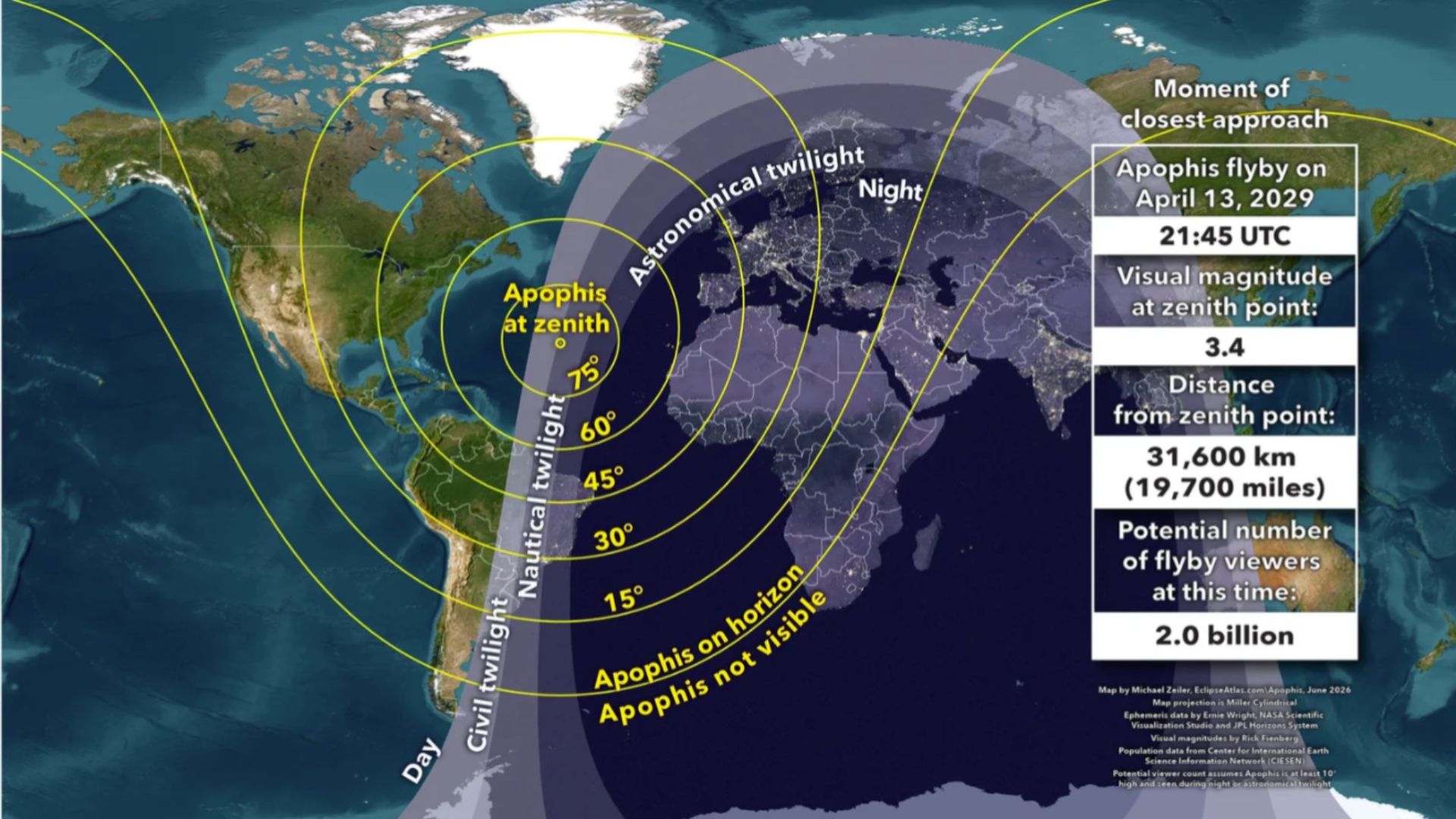
A diagram showing one of the points of peak brightness of Apophis.

One moment of peak brightness for Apophis (as seen from Earth) at the moment of closest approach at 5:45 p.m. EDT (21:45 UTC). The asteroid will be at a height lower than geosynchronous satellites. (Image credit: Eclipseatlas.com)

About an hour later, at 5:45 p.m. EDT (21:45 UTC), the asteroid will make its closest approach to Earth, passing about 19,700 miles (31,600 kilometers) above the North Atlantic — well inside the orbit of Earth's geostationary satellites. The event would be visible across much of South America, the United States, Africa and parts of Europe, reaching roughly 2 billion people.

"This is the first time we've been able to predict in human history an asteroid visibly passing by the Earth," Richard Binzel, a professor of planetary sciences at the Massachusetts Institute of Technology (MIT), said during the workshop. "That's part of a shared experience."

As excitement ramps up for the once-in-a-millennium spectacle, Binzel opened the workshop with three messages: "Apophis will safely pass the Earth. Apophis will safely pass the Earth. Apophis will safely pass the Earth."

That absolute certainty is the hard-won fruit of more than two decades of increasingly precise observations. When Apophis was discovered in 2004, early calculations suggested a 1-in-37 chance of an impact in 2029, making it the most potentially hazardous asteroid known at the time. Additional observations steadily refined the asteroid's orbit, eliminating any possibility of a collision in 2029 and also ruling out any impact threat for at least the next century, according to NASA.

With the impact threat removed, scientists now view the flyby as a rare opportunity to observe how Earth's gravity affects an asteroid during an exceptionally close encounter.
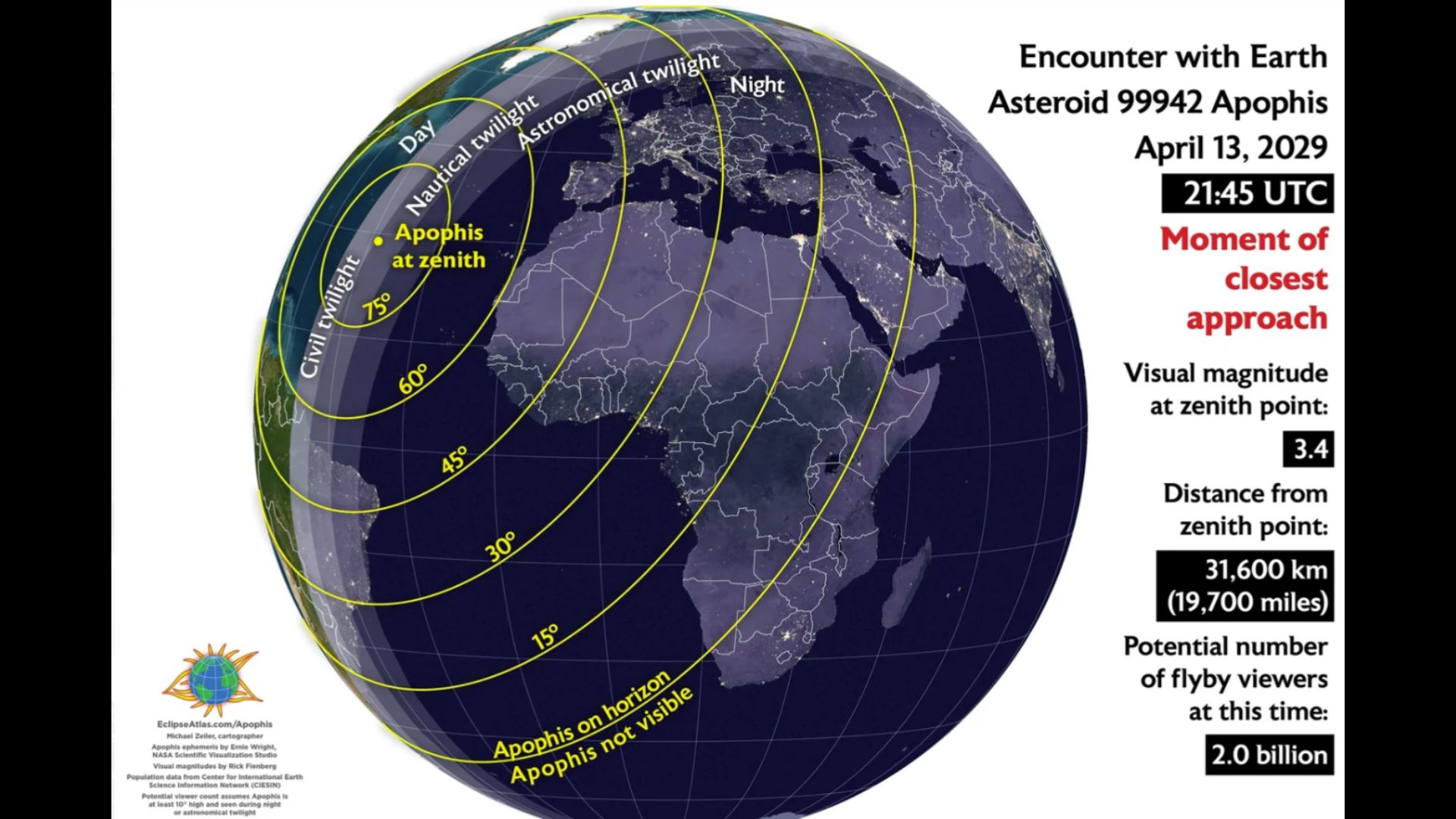
A diagram of the Earth showing a moment of closest approach.

A diagram of Earth showing where Apophis will be at the moment of closest approach on April 13, 2029. (Image credit: Eclipseatlas.com)

Our planet's gravity is expected to tug the asteroid into a new orbit around the sun without posing any future danger. During the flyby, however, those same gravitational forces may stretch and squeeze the asteroid enough to trigger landslides or expose pristine material hidden beneath its weathered surface. Or they may do almost nothing.

"We simply don't know what's going to happen," Binzel said during the workshop. "Apophis may go by and not care too much, or maybe we'll see something significant."

"That's why we have to look," he added. "We're gonna learn a lot either way."

At the workshop, scientists said they hope to monitor the flyby from observatories in Spain's Canary Islands, among other places, as its location in the Atlantic Ocean offers an ideal view of the asteroid's closest approach as well as favorable prospects for clear skies.
Japanese probe set for super-close flyby on July 5: ‘We’re going to discover another beast to put in the zoo of asteroids’

Japan's Hayabusa2 sample-return spacecraft is on target to make one of the closest ever flybys of a near-Earth asteroid in early July, as part of its extended mission campaign.

Hayabusa2 launched in December 2014 and rendezvoused with the asteroid Ryugu four years later. The spacecraft collected samples and delivered them to Earth in 2020, completing its primary objectives. But the hardy spacecraft still has bold plans to deliver new and exciting science data.

The spacecraft has been operating well, despite needing to briefly enter a protective safe mode last year, and now is set to make a flyby of the asteroid Torifune on July 5, Satoshi Tanaka of the Japanese Aerospace Exploration Agency (JAXA) said in a presentation on Hayabusa2 during the 35th Meeting of the NASA Small Bodies Assessment Group (SBAG) on June 11.

The flyby will see Hayabusa2 get within 1 to 10 kilometers (0.62 to 6.2 miles) of Torifune, using its instrument suite to study the roughly 450-meter-wide (1,476 feet) asteroid as it whizzes past at 5.3 kilometers per second (3.3 miles per second).

"This is one of the closest asteroid encounters ever attempted by a mission of this class," Tanaka said. "By combining advanced navigation techniques and the engineering capabilities of Hayabusa2, we have made it possible to achieve a flyby at a distance of only about 1 kilometer."

Torifune was first given the designation 2001 CC21 before being named for a deity from Japanese mythology. Tanaka says the asteroid is somewhat similar to Itokawa — the target of Japan's first Hayabusa mission — but little is known for sure about Torifune, adding a level of uncertainty to this extended mission objective.

"It's still a risky operation, because they had not planned for this," Patrick Michel, the principal investigator for the European Space Agency's Hera asteroid mission and part of the Hayabusa2 science team, told Space.com. "The second thing is that we have a high uncertainty on the size of the object," he added, with the dimensions of the asteroid unknown.

The asteroid could, for example, be a contact binary, according to Michel, in which two separate bodies came together at low velocities. Known contact binary small bodies include the Kuiper belt object Arrokoth, imaged by NASA's New Horizons, and comet 67P/Churyumov-Gerasimenko, described as a "rubber duck" when visited by ESA's Rosetta spacecraft.

"We're going to discover what it looks like. And each time we have seen a new asteroid, we've been surprised," Michel said. "We're going to discover another beast to put in the zoo of asteroids."

The very high velocity of the flyby means there will be limited time to collect images and other data on the asteroid, but the rapid encounter will also provide a useful test for planetary defense, as well as adding to planetary science.

The flyby, using advanced navigation techniques to guide and control the spacecraft, will be a useful test of a rapid reconnaissance concept that could be used to determine the physical properties of an asteroid. Such reconnaissance could provide vital information before intercepting a threatening asteroid with a kinetic impact, as demonstrated by NASA's DART mission in 2022.

Tanaka said that Hayabusa2 has been busy during its deep space cruise phase, including making observations of the zodiacal light and exoplanets, and the Torifune flyby will, hopefully, not be its final act. The ultimate goal of the Hayabusa2 extended mission is to visit the tiny asteroid 1998 KY26 in 2031, which would be the smallest asteroid ever visited. The spacecraft could even attempt to land on the miniscule world, which is just 11 meters (36 feet) wide.

3 billion years old! This Australian crater is the oldest known asteroid impact site on Earth

The oldest known asteroid impact site on Earth was created 3.02 billion years ago in what's now Western Australia — not far from where we've seen the oldest traces of life on our planet.

A rock formation in Western Australia's Pilbara region seems to offer evidence of an asteroid slamming into Earth's newly-formed rocky crust around 3.02 billion years ago. That makes the formation, called the North Pole Dome, the oldest evidence of an asteroid impact on Earth, according to a recent study, which dated crystals in the rocks shocked and reshaped by the impact's tremendous heat and pressure.

It's the latest salvo in an ongoing debate about the age of the crater (or what's left of it after billions of years of erosion), and there's more at stake than bragging rights: a crater dating back this deep in Earth's distant past could shed light on the rise of the continents and the origin of life.

A rare glimpse

Inside most rocks in Earth's crust, tiny grains of mineral called zircon quietly record the passage of eons. Zircon contains tiny amounts of uranium, which slowly but steadily breaks down into lead; that steadiness is key, because the ratios of those two elements reveal how long it's been since a grain of zircon crystallized from hot, molten rock. In this case, zircon grains told Kirkland and his colleagues that it had been about 3.02 billion years since the tremendous heat and pressure of an asteroid impact melted zircon crystals in the rocks around North Pole Dome.

"Some zircons at the North Pole Dome have unusual branching, skeletal shapes," Kirkland said in an emailed press release. "We interpret these as impact-modified crystals, formed when older zircon was disrupted, partly recrystallized, and in places, regrown during the intense heating caused by the impact."

If Kirkland and his colleagues are right, the area, also called the Miralga Impact Structure, is the oldest trace of an asteroid colliding with our planet. The newly published date makes Miralga a relic of a tumultuous period in our solar system's history, called the Late Heavy Bombardment, when the giant planets were still jockeying for position in their orbits around the sun, flinging asteroids and comets toward the inner solar system in the process (or so cosmologists theorize). Amid this rain of space rocks, Earth was midway through the Archaean Eon, with the planet's surface finally cooling to form a thin crust of solid rock. Earth's surface lay beneath an orangish haze of methane, a little like a warmer version of Saturn's moon Titan.

And somewhere in there, the first life took shape.

The oldest traces of that early life are just a few kilometers from North Pole Dome: limestone stromatolites, made of layers of tiny sediment grains trapped in, and eventually left behind by, sheets of early bacteria. The ones in Pilbara are about 3.5 billion years old, another date courtesy of zircon grains. If the Miralga impact happened 3.02 billion years ago, it struck a world already teeming with overlapping mats of bacteria.

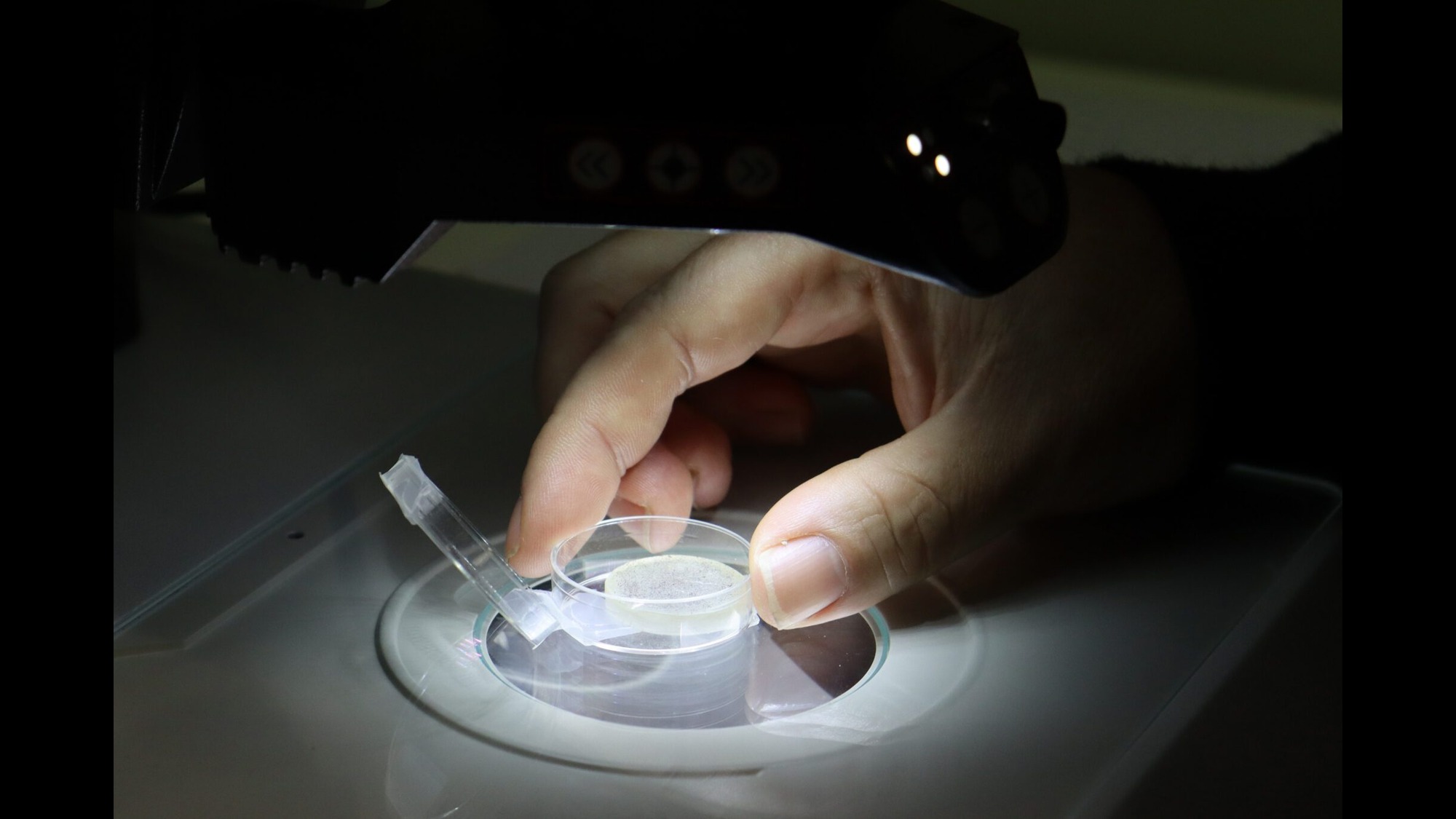
A photo of a hand holding a plastic case under a light with some clear material within.

Dr. Chris Kirkland studying tiny zircon crystals in the lab. (Image credit: Chris Kirkland/Curtain University)

The oldest known Earth rock, a 4.35-billion-year-old sandstone formation (also dated using zircon), lies just a few hundred kilometers south of Pilbara, in the Jack Hills. Why is all of this — the oldest rocks, the oldest asteroid crater, and the oldest traces of life — in Western Australia? It's reasonably likely that crust formed, life emerged, and meteors smashed into the ground millions of years earlier, in places all over the world, but the evidence just happened to be preserved in this area of Australia. Most of Earth's very oldest rocks have long since been reworked by plate tectonics or erosion, basically erasing the first chapters of our geological record.

A heated debate about heated rock

"While the site had previously been identified as an ancient impact crater, its exact age remained uncertain," said Kirkland.

Last year, Kirkland and his colleagues proposed that the impact dated back to 3.47 billion years ago, almost the same age as the nearby stromatolites. In that same paper, the team suggested that the original crater – whose outline has long since eroded away, leaving behind only impact-shocked rocks and tantalizing hints – might have been up to 62 miles (100 km) wide. The 22-mile-wide (35-kilometer-wide) North Pole Dome itself seemed to mark the crater's center; rock in the middle of large craters often rebounds upward after the impact, leaving a peak or dome behind (picture the way the middle of a trampoline flexes upward, captured in a freeze frame).

But another group of geoscientists published a paper a few months later, arguing that Miralga (a name they gave the crater, based on the local Aboriginal peoples' name for the area) couldn't be any more than 2.7 billion years old, and only 10 miles (16 km) wide. That's still substantial, and old enough to be interesting, but too young and too small to have played much of a role in shaping the region's life, or its continental crust.

"By the time of the impact, the Pilbara was already quite old," wrote the study’s authors in an essay at the time (of the paper, not the impact).

The teams agreed on, basically, one thing: the area around North Pole Dome was definitely an impact site, and dating very old rocks is not easy. Both 2025 papers looked at the placement of rocks called shatter cones, which form when the shockwaves of an impact (or, sometimes, an underground nuclear bomb test) pass through rock, leaving behind ripples, striations, or cracks. But based on where the shatter cones appeared in relation to other rock layers, the two teams of scientists drew very different conclusions.

"Ancient craters are incredibly difficult to date, because over billions of years, rocks are altered by heat, pressure, and fluids, which can obscure or reset the original impact signatures," said Kirkland, whose team now argues that the zircon crystal dates are much more precise than either team's previous efforts. "What we've been able to do here is separate the moment of impact from its long geological history."

Curtin University geoscientist Chris Kirkland and his colleagues published their work in the journal Geology.