
A photon from the biggest cosmic explosion since the Big Bang appears to have defied Einstein. Scientists may finally know how

A photon, or particle of light, from the biggest cosmic explosion since the Big Bang, nicknamed "the BOAT" (for the brightest of all time), should not have reached Earth. That is, unless it defied rules defined by Einstein. Now scientists may know how it did this, with new research suggesting how the high-energy photon may have survived a journey of more than two billion light-years without being absorbed.

The BOAT, a gamma-ray burst officially designated GRB 221009A, was first detected on Oct. 9, 2022. Among the ocean of photons from the event that rained down on our planet was the highest-energy photon ever detected originating from a gamma-ray burst. It was detected by Carpet, an ultra-high-energy cosmic-ray detector located at the Baksan Observatory in the Russian Caucasus.

The problem is, according to all current rules of physics, a particle with such high energy shouldn't reach Earth from an explosion occurring such a vast distance away. That's because space isn't empty; it is filled with a "fossil" radiation field of photons left over from just after the Big Bang called the cosmic microwave background (CMB). It should be virtually impossible for a high-energy photon to travel 2 billion light-years without interacting with a CMB photon and being transformed. And still it came.

"We started from a very simple question: how did this photon survive a journey that, according to known physics, should have destroyed it?" team leader Giorgio Galanti from the Italian National Institute for Astrophysics (INAF) said in a statement. "The new data from the Carpet experiment showed us that the explanations proposed so far were no longer sufficient.

"We therefore looked for a theoretical scenario capable of consistently describing what we observe, without resorting to arbitrary corrections to the equations."

A hypothetical transformation

To investigate the mystery of how this high-energy photon reached our planet, Galanti and colleagues turned to incredibly light hypothetical particles called axion-like particles (ALPs).

ALPS could serve as a solution to this puzzle via a mechanism that would allow photons to transform into ALPs as they travel and then convert back into photons as they reach the Milky Way. The problem is that this still can't account for such a high-energy photon.

This team combined the idea of ALPs with a proposed violation of one of the fundamentals of Einstein's 1905 theory of special relativity called "Lorentz invariance."

In short, Lorentz invariance says that observers moving at different speeds should experience the same physical laws. The team tested the idea that Lorentz invariance could be violated at high energies, thus changing how photons propagate through space.
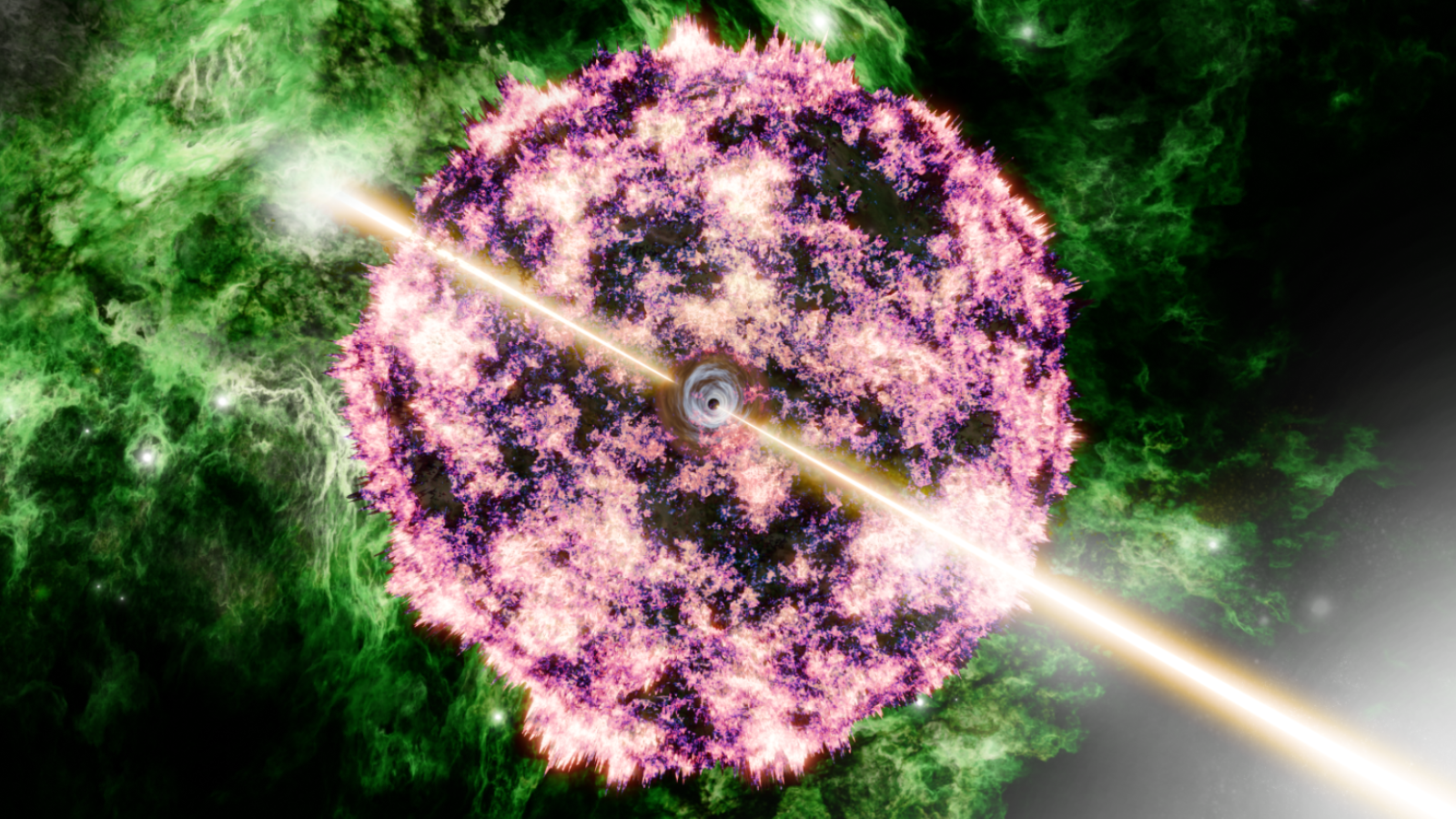
A purple sphere against a green background with two yellow beams emerging from it

An illustration of the supernova that launched teh BOAT, the gamma-ray burst that is the most powerful cosmic explosion since the Big Bang (Image credit: Aaron M. Geller / Northwestern / CIERA / IT Research Computing and Data Services.)

In the scenario devised by the team the photon would have avoided being wiped out by interactions with the CMB as it would avoid interactionc with these fossil photons.

The new research therefore implies that at high enough energies, photons can take a "fast lane" through a transparent universe, dodging the physics that would normally force their destructive transformation.

Interestingly, there is some evidence relating to the BOAT that seemingly backs this theory. According to the picture developed by the team, this high-energy photon should have arrived at Earth around one hour after lower-energy particles of light originating from the BOAT. Indeed, that is exactly what happened.

"The most interesting aspect of our work is that, for the first time, it brings together two ideas that until now had been developed separately," team member Marco Roncadelli of the National Institute for Nuclear Physics (INFN) said. "If future observations confirmed this scenario, the universe would become a natural laboratory for studying quantum gravity at energies enormously higher than those achievable by any accelerator built on Earth."

The team's research is available on the repository site arXiv and has been accepted for publication in the journal Physical Review Letters.
Our Milky Way galaxy might be larger than we thought  

Is the Milky Way even bigger than we thought? New observations have revealed that our galaxy's spiral arms could stretch farther and wider than we previously concluded.

The Milky Way's spiral structure was discovered over 175 years ago in 1850. But new information could completely change our understanding of our cosmic home. Astronomers have taken a new look at our Milky Way galaxy using data from NASA's Chandra X-ray observatory and the European Space Agency's XMM-Newton observatory and have pieced together new, precise measurements of the galaxy's spiral arms. And what they found is that its spiral arms stretch out farther than we once thought, a discovery that could change our understanding of our galaxy's structure.

"The differences are small, but any revision of these distances is important because they are so fundamental for understanding our galaxy," co-author Ilaria Fornasiero said in a statement. "For example, this could mean that astronomers have to revise estimates of the mass of the galaxy, because that affects how wide the arms stretch."

To make this new galactic measurement, researchers had to get a little creative with the data. They measured these cosmic distances by observing X-ray light scattered by the dust in the Milky Way's arms as it echoed out from around gamma-ray bursts, or the most powerful explosions across the universe that happen either when massive stars collapse or neutron stars collide and merge. These massive bursts of energy are happening far beyond our galaxy, but their X-ray light is so powerful that it can reach and bounce off of dust clouds in the Milky Way's arms.

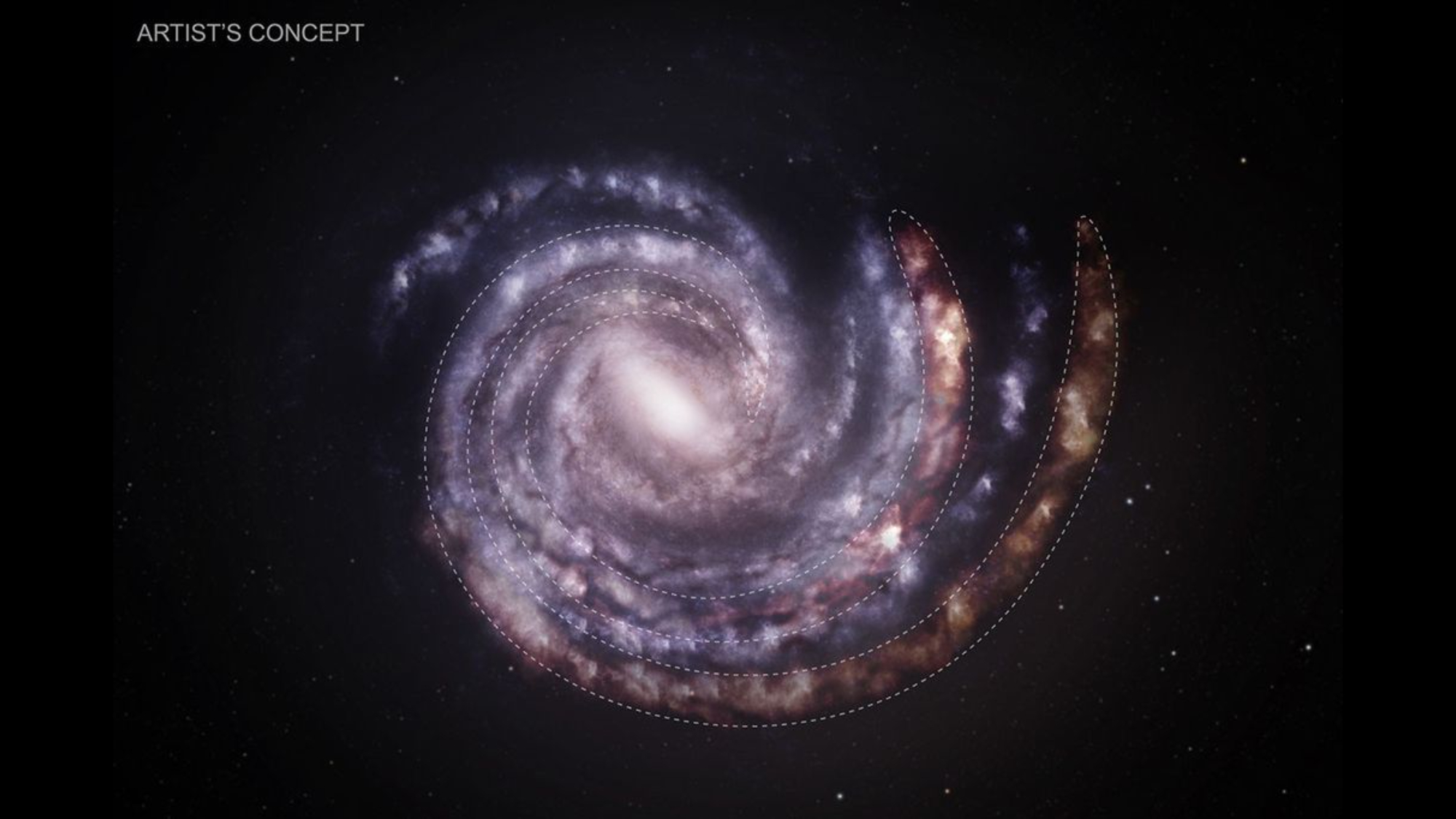
The Milky Way's spiral arms are shown where they were thought to be before and where they are now thought to extend to.

This artist's concept shows where the Milky Way's spiral arms are now thought to extend to and how that compares to previous estimations. (Image credit: NASA/CXC/SAO/M.Weiss)

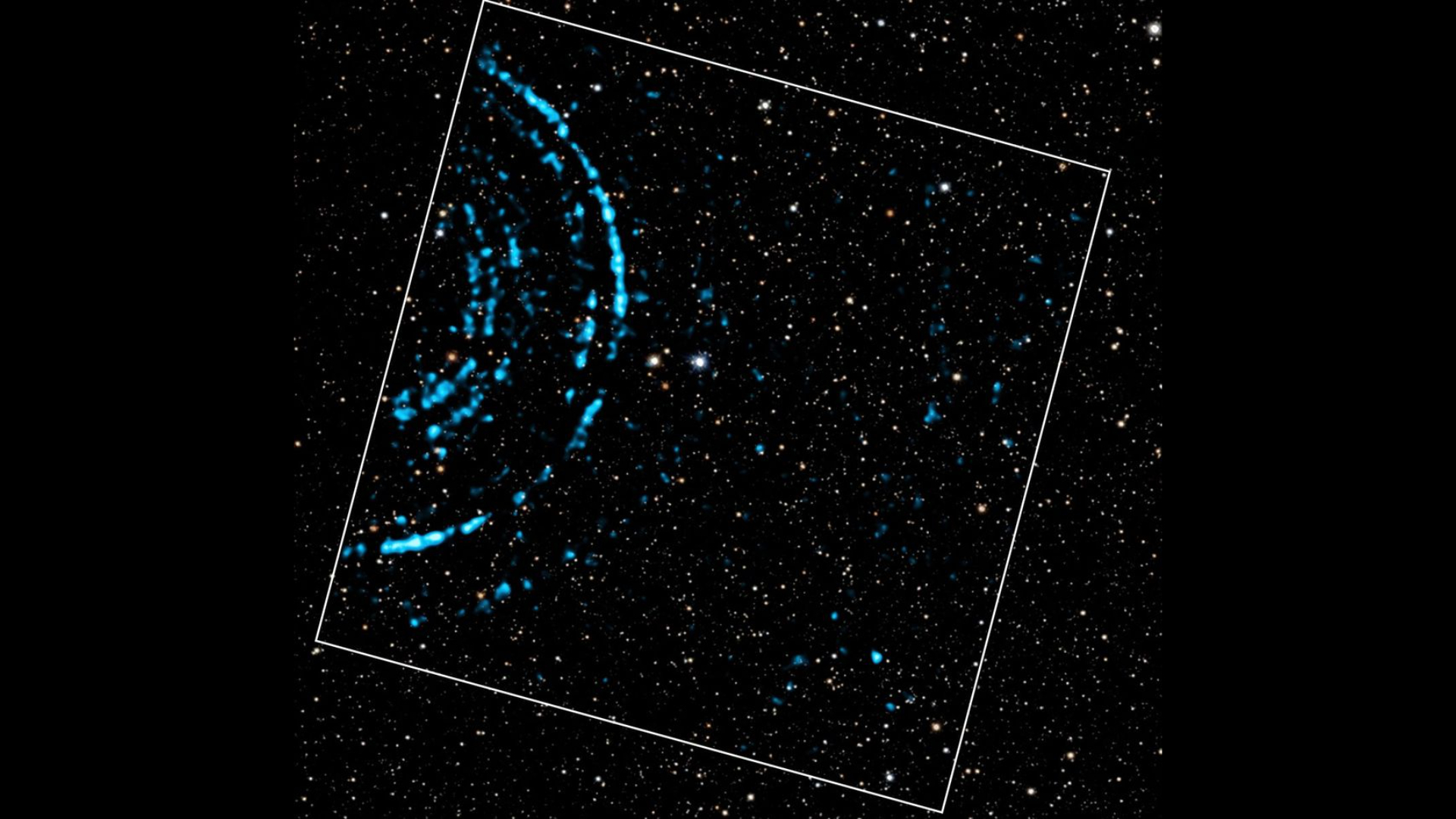
By studying the diameters of the rings of light as they expand away from these explosions and observing how and where they reflect off of the Milky Way's dust, the team was able to precisely point to where the galaxy's arms extend.

"This is a very direct way – relying only on geometry – to precisely measure distances to the Milky Way's spiral arms," lead author Beatrice Vaia, who led this research as a PhD student, said in the statement. "Most other methods rely on assumptions about how the Milky Way rotates, which become increasingly uncertain in the outer regions of our galaxy."

The team used the X-ray light from three different gamma-ray bursts to look at three of the Milky Way's spiral arms: the Perseus, the Outer, and the Outer-Scutum-Centaurus arms. According to these new measurements, both the Outer and the Outer Scutum-Centaurus arms are about ten percent more distant than was previously thought.

With this data, the team was also able to measure the thickness of the Milky Way's most distant arm, which they found to be about 3,500 light-years wide. By incorporating the arm's width, the team ensured that they were measuring the full extension of the arm and not just one particular dust cloud, further bolstering their findings.

Against a background of stars are bright blue lights that create a series of speckled rings echoing outward.

This composite image shows X-ray rings created by a gamma-ray burst bouncing off of the dust clouds in the spiral arms of the Milky Way galaxy. (Image credit: X-ray: NASA/CXC/INAF/B. Vaia et al.; Optical: Pan-STARRS; Image processing: NASA/CXC/SAO/N.Wolk & P.Edmonds)

While it's interesting that the Milky Way's arms extend out a bit farther and wider than we previously thought, these new findings could have larger implications. Based on these new measurements, astronomers may have to reinvestigate our understanding of our galaxy's mass distribution, rotation and overall structure. This evolving understanding could ripple out and impact how we view not just the structure but the evolution of our galaxy and beyond.

But this study isn't one that can be replicated too easily. That's because gamma-ray bursts don't happen all of the time. Even more rare are bursts that we can see clearly through our galaxy.

"We’re relying on the universe to provide us with these events, and so far, over 25 years, we’ve only found a handful that we can use," co-author Andrea Tiengo of Scuola Universitaria Superiore IUSS Pavia said in the same statement. "That said, we will continue to be on the lookout for more."

This work was described in a new study published June 19 in the journal Astronomy & Astrophysics.