Could ‘dark photons’ explain dark matter?

New research suggests that if dark matter is composed of "dark photons," it would not have heated the early cosmos like scientists previously thought. If correct, this discovery could represent a paradigm shift in the hunt for the universe's most mysterious stuff.

Dark matter remains so elusive because, despite outweighing the everyday matter that composes stars, planets, moons and our bodies by a ratio of five to one, it is effectively invisible. That is because it doesn't interact with light. And the fact that electrons, protons, and neutrons do interact with light (or, more accurately, electromagnetic radiation) has inspired the search for particles beyond the Standard Model of particle physics, leading to lots of hypothetical candidates for dark matter.

One of these candidates is the dark photon, the dark universe's version of a photon carrying a force other than electromagnetism, which is the responsibility of standard photons.

When dark photons have been considered in the past, scientists have concluded that they would have transformed into ordinary photons while still embedded in the thick and dense soup that filled the early cosmos. This would have further heated this already blisteringly hot plasma and left detectable traces of dark photons.

This severely limits the search parameters in which dark photons could exist — so much so that many cosmological observations rule out the existence of dark photons.

Now, new computer simulations show that the dismissal of dark photons may have been a little hasty. The conversion of dark photons to photons would have shut off before significant heating could occur.

That brings previously excluded search parameters back into play.

"These exclusions were saying the strength of dark matter had to be 10^8 times weaker than it actually can be," team member Anson Hook at the University of Maryland said in a statement. "This paper opens up a lot of new possibilities to look for dark matter."
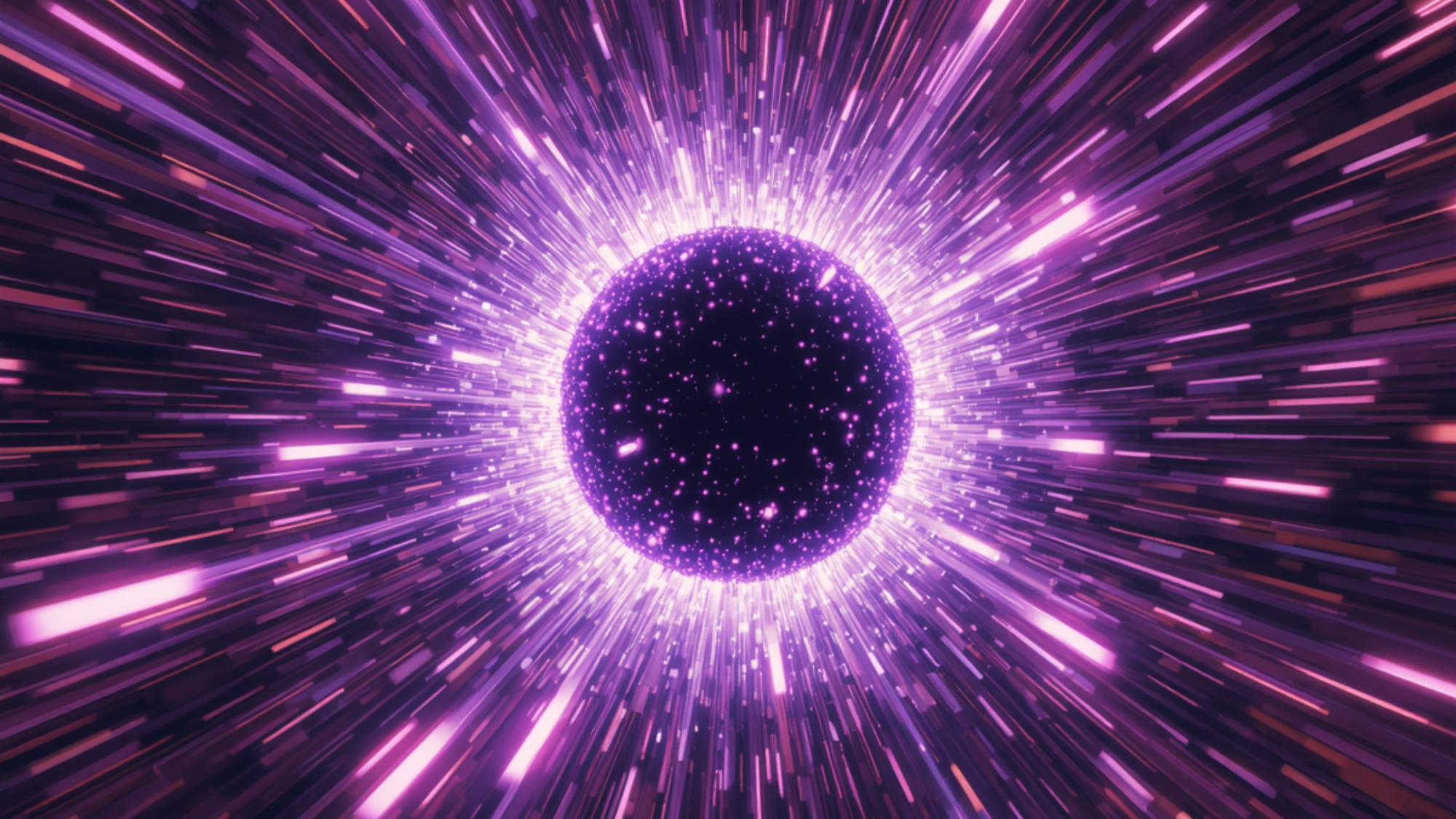
A purple ball surrounded by streaks of light that appear to be shooting outward.

An illustration of a dark photon, a candidate for dark matter. (Image credit: Robert Lea (created with Canva))

The team behind this research first saw hints that the transformation of dark photons to photons may not be as straightforward as scientists had assumed when they realized the amount of energy involved is suspiciously large. The problem, they began to suspect, was the fact that this process had been considered to be linear; in other words, the energy released gradually and steadily converts to plasma.

"The treatment for the last 15 years is a linear treatment. If you use that approximation, you can compute the amount of energy transfer, and it's very large," team member Junwu Huang of the Perimeter Institute said in the statement. "And I realized it's not possible."

Performing their first computer simulations, Huang and colleagues realized that the linear process fails to paint a complete picture.

"What we realized is that, as you are converting energy into the Standard Model plasma, the plasma actually goes crazy," Huang said. "There are a lot of nonlinearities in the system, and these nonlinearities basically shut off the energy conversion after a tiny amount of energy is converted."
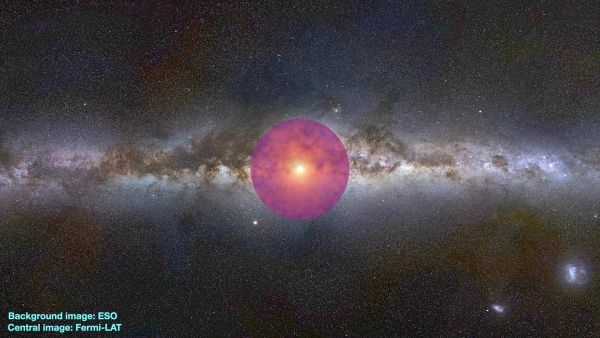
A pink circle in the center of a scene showing the Milky Way's heart.

Dark matter seen at the center of a galaxy. (Image credit: Mattia Di Mauro (ESO/Fermi-Lat))

The research represents a major widening of the parameters in which dark photons could exist, expanding this metaphorical hunting ground considerably. In fact, it could also impact the hunt for hypothetical particles beyond the Standard Model of particle physics.

"By calculating the early universe plasma correctly, experiments will probe new parameter spaces and potentially actually see something," team member Mohamad Shalaby of the Perimeter Institute said in the statement.

The team's research was published on August 13 in the journal Physical Review Letters.
Is dark matter ‘tuned in’ to a hidden dimension?

Two major mysteries in science, the nature of dark matter and the possible existence of higher dimensions, could be linked, new research suggests. The team behind a new study proposes that dark matter may be so strange and ghost-like because it is in tune with a fifth dimension.

When scientists discuss "extra dimensions," they aren't talking about other universes in which another evil version of you exists (and with a beard). Instead, they refer to dimensions that could be "curled up" with reality alongside the standard four-dimensional spacetime, consisting of the three dimensions of space and one dimension of time.

While these extra dimensions remain highly speculative, they have become a hot topic, especially as string theory, the most popular extension to standard physics, relies upon the existence of at least 11 dimensions. Scientists are more sure that dark matter exists, but proving its existence still remains troubling because, despite its gravity literally holding galaxies together and outweighing ordinary matter by around five to one, it remains effectively invisible because it doesn't interact with light and it simply ghosts through ordinary matter.

"Understanding dark matter would represent a profound advance in humanity's knowledge of the cosmos and what it is made of," team member Yu-Dai Tsai of the University of Sheffield said in a statement.

"Our research gives physicists clear new targets in the search for dark matter, while connecting two of the biggest ideas in fundamental physics: the mystery of dark matter and the existence of hidden dimensions."

Dark photons play dark matter like a violin

Though the main idea is that dark matter may operate in the fifth dimension, this new research expands upon that concept with another theory. It suggests that dark matter exists with another inhabitant of the fifth dimension, a force-carrying particle called a "dark photon."

Standard photons are the constituent particles of electromagnetic radiation, or light; dark photons would be similar but for a hypothetical "dark force."

The team's new proposal would see the unique geometry of the fifth dimension causing the masses of dark matter particles to form an arrangement that gives rise to a "dark matter resonance." This is akin to the intense vibration of a musical instrument at certain notes.

"Dark matter resonance is already known to be a powerful idea, with the potential to change our understanding of how dark matter was produced in the early universe and how we search for it today," team member Yu-Dai Tsai of the University of Sheffield said in a statement. "But many previous resonant dark matter models have treated the resonance as an assumption. This work gives a possible deeper origin for it: the resonance may come directly from the geometry of hidden dimensions."

An illustration shows a cloud of dark matter slipping past a distant star

An illustration shows a cloud of dark matter slipping past a distant star (Image credit: Robert Lea (created with Canva))

Tsai explained that while dark matter resonance is a phenomenon that has been explored before, the research conducted by this team differs because it suggests dark matter resonance is not a coincidence. Instead, the possible deeper origin for the resonance sees it emerge directly from the geometry of hidden dimensions. This would allow dark matter to interact strongly shortly after the Big Bang while allowing it to settle into its ghost-like inert existence today.

"This resonance can make dark matter interactions much stronger at crucial epochs in cosmic history, such as in the early universe," Tsai added. "Crucially, the model allows for these strong interactions in the past while still explaining why dark matter appears so inert and hard to detect today."

Of course, it is very early days for the team's theory, but it excitingly offers a way toward solving two of the universe's greatest mysteries.

The team's research was published in the Physical Review D.

Dark energy is still accelerating the expansion of the universe, and astronomers are relieved. ‘Thankfully, we have averted this crisis’

The expansion of the universe is still accelerating under the influence of dark energy, despite recent claims to the contrary, according to new research. This means that dark energy, the mysterious force that dominates the universe, is not weakening but continues to get stronger, considered something of a "cosmological crisis" as it was so against expectations.

In 1998, via the study of cosmic explosions called Type Ia supernovas, astronomers discovered that not only is the universe expanding, but that the speed of that expansion is increasing. "Dark energy" was the name given to the mysterious force driving this accelerating expansion. Since then, scientists have discovered that dark energy accounts for around 70% of the universe's matter and energy.

In November 2025, research was published that suggested the expansion of the universe was slowing, meaning dark energy would be weakening. But this new research suggests that these findings from last year might not be a cosmic hand grenade thrown into the cosmological apple cart, but instead may have actually emerged from a scientific misunderstanding.

"Thankfully, we have averted this crisis, but the mystery about why the rate of expansion of the universe is still accelerating remains," lead author of the new refuting research, Phil Wiseman, from the University of Southampton in the UK, said in a statement. "The previous and well-accepted measurements were, in fact, fine, and our current understanding of the fate of the universe remains robust. By proving our measurements are correct, we can get back to trying to understand what this dark energy actually is, rather than wondering if it exists at all."

The research from 2025 that suggested dark energy was weakening was based upon a reassessment of the brightness of Type Ia supernovas, which occur when a dead star called a white dwarf overfeeds on a companion star. This causes a runaway nuclear explosion of such uniform brightness that it can be used to measure cosmic distances. In fact, these explosions are so uniform that astronomers refer to them as "standard candles."

This prior research determined, incorrectly it now seems, that as the universe has aged, the brightness of Type Ia supernovas had changed, leading to incorrect measurements of distances based on them as well as incorrect estimates of the speed of the universe's expansion. Both of these led to the suggestion that dark energy is weakening.

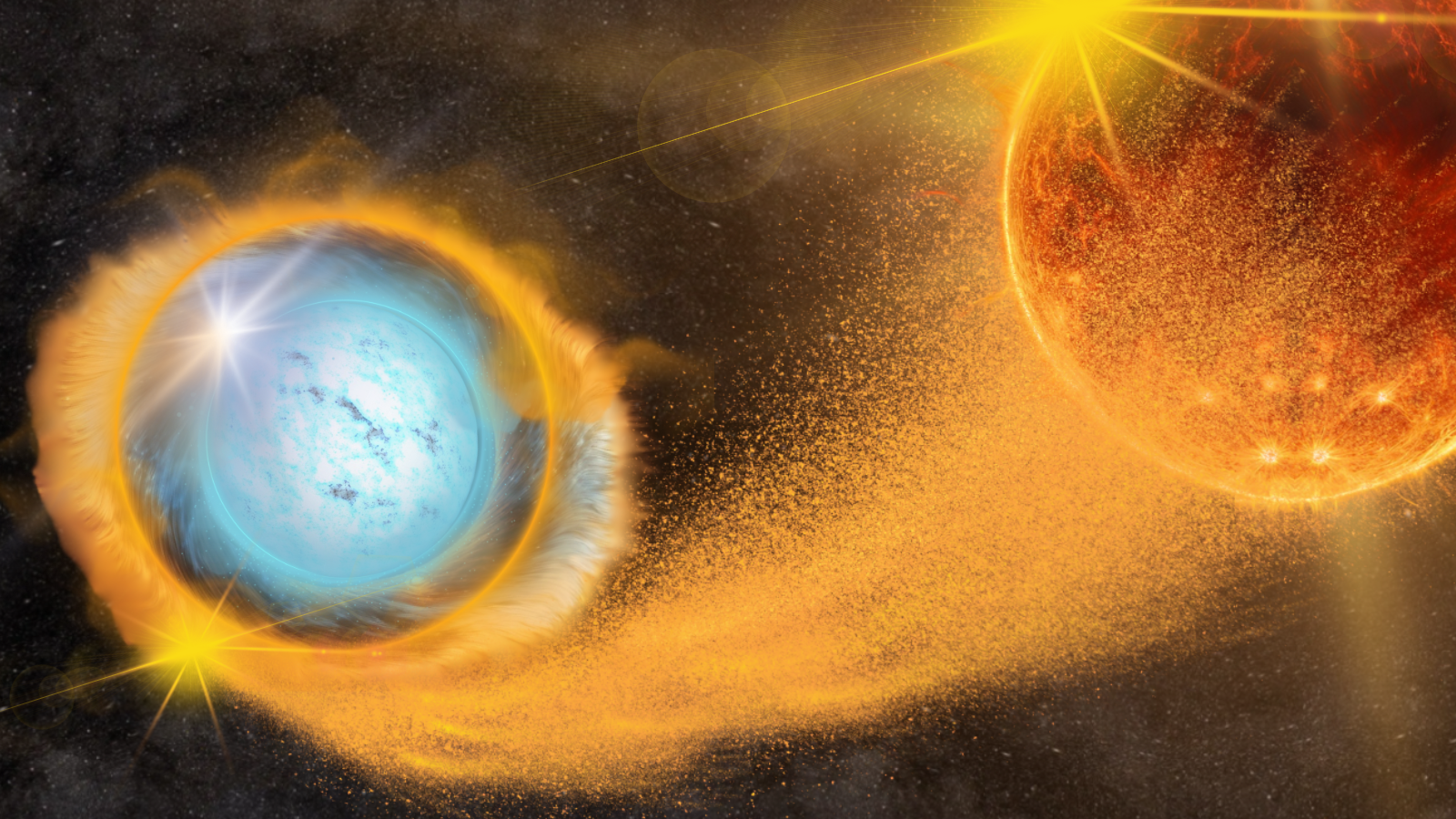
An illustration  of a white dwarf star feeding on a stellar companion prior to a Type Ia supernova

An illustration of a white dwarf star feeding on a stellar companion prior to a type Ia supernova (Image credit: Robert Lea (created with Canva))

But Wiseman and colleagues found this previous team had made an error in how they calculated the ages of exploding white dwarfs, finding they had assumed the ages of these stars would be the same as the ages of the galaxies in which they exploded.

They also found the 2025 research hadn't accounted for a common correction used in cosmology that factors in the masses of galaxies in which Type Ia supernovas occur.

"Extraordinary claims require especially careful testing," team member Adam Riess, who in 2011 shared the Nobel Prize for the discovery of dark energy, said. "What we find is that when we calibrate these supernovae, accounting for different host environments and populations, the evidence for cosmic acceleration remains remarkably consistent."

While the challenge to dark energy's growing dominance over the universe seems now to have been refuted, the back and forth on this topic shows how ideas in science aren't dogma and remain open for revision.

"This is how progress is made," team member Mark Sullivan, also from the University of Southampton, said. "Although this idea did not turn out to be correct, it has opened up new ways of thinking about how supernovae explode and how we can measure dark energy more accurately."

The team's research was published on June 10 in the journal Monthly Notices of the Royal Astronomical Society.