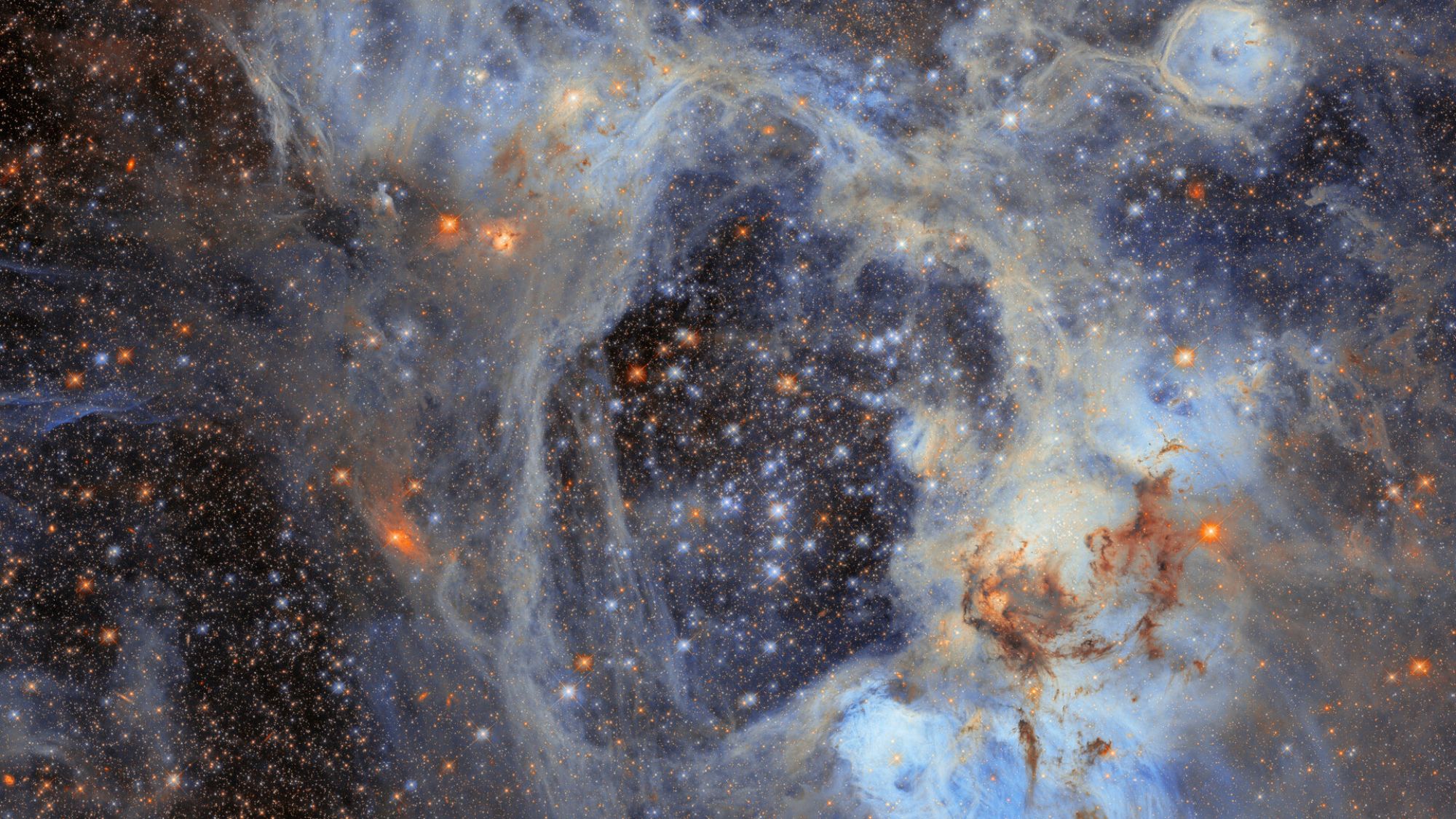
This nebula is named LHA 120-N44, or N44 for short, and it’s located in the constellation Dorado. (Image credit: ESA/Hubble & NASA, D. Gouliermis)
About 160,000 light-years away lies one of our Milky Way's little galactic neighbors: The Large Magellanic Cloud (LMC). And thanks to a new observing program, the Hubble Space Telescope has provided us with an intricate image of a nebula in the LMC. The surprising part? There's a giant void at the center. Scientists call it a "superbubble."
What is it?
What you're seeing in this image is a nebula within the LMC known as LHA 120-N44, or simply N44. It's located in the constellation of Dorado and, like a classic nebula, is the site of stars being born at a noticeably rapid rate.
But of course, what really can't be missed is the huge hole at the center of N44's dusty tendrils — this is the "superbubble," and its dimensions are staggering. NASA says it's about 210 by 140 light-years across — a truly unimaginable size, considering the distance between our sun and Pluto isn't even a single light-year.
One light-year, the distance light travels in a year, is about 6 trillion miles (9.7 trillion kilometers).
Why is it noteworthy?
The superbubble is a bit of a mystery, but one theory of why it exists is that stars at the center of the bubble could have undergone supernova explosions or have released stellar winds that swept away gas in the nebula. This could have resulted in a "void," as NASA calls it, surrounded by a gaseous shell. That would explain away the image we see pretty well, but there will likely be studies dedicated to refining that story.
Of note, in that shell around the superbubble, stars continue to form and show themselves as beautiful little specks across the watercolor-like landscape.
Something else interesting about this image is that N44 is what's known as an "emission nebula," meaning the gas you see has been energized by stars in the area. This enhances the luminescent quality of the portrait.
This is because the energization process, or ionization to be specific, generates ionized gas that ultimately must cool down. During that cooling, it goes from a higher energy state to a lower energy state and thus releases some energy. This energy loss causes N44 to glow brightly, creating the beautiful scene we see.
The reason scientists have used the Hubble Space Telescope to study N44 is this particular nebula offers good conditions to study star formation and evolution. As a matter of fact, Hubble managed to survey nearly half a million stars in and around the cluster, 30,000 of which are in the very early stages of their lives.
N44 has been a major topic of interest for quite some time. For instance, it made headlines in 2021 as well as in 2012 — both times due to Hubble's eye yet again — and observations with the Chandra X-ray Observatory led to a 2011 paper that discusses supernova shock waves and other phenomena shaping the nebula and its cavity.
In late June 2023, on a morning train commuting to work in New York City, David Hendel was scrolling through a recent astronomy paper on his phone when a half-page image caught his eye.
The image, captured a year earlier by the Hubble Space Telescope, showed UGC 9050-Dw1, a dwarf galaxy some 115 million light-years from Earth. It appeared as little more than a faint, diffuse smudge of bluish-white light that astronomers call an ultra-diffuse galaxy — a type of galaxy so sparsely populated with stars that most of its mass is thought to be dark matter, the invisible substance that makes up more than 80% of the matter in the universe but has yet to be directly detected.
What made Hendel pause was not the galaxy itself but a thin, fragile ribbon of stars trailing off from it, so dim it nearly disappeared among the other smudges of light crowding the frame. Hendel, a former astronomer who had studied thousands of similar structures, immediately recognized the subtle interplay of the arc's features, including the shared color of the stars and their curved trajectory pointing toward a tiny, matching bright knot along its track. Together, those clues matched a stellar stream tearing from a tight ball of stars called a globular cluster, pulled apart by the gravity of UGC 9050-Dw1.
If Hendel's reading was correct, it would be the first such stream ever found outside the Milky Way.
"It almost seemed too good to be true," Hendel told Space.com. "At this point I felt the excitement of a discovery to such a degree that I recall looking up and around the train for someone to tell!"
This discovery would give researchers a pristine new laboratory for probing dark matter, and one far less contaminated by competing astrophysical forces that muddy similar searches within our own galaxy. Hendel, who now works in finance but still follows research from his former field, ran a quick literature search to see whether anyone had already documented the feature. No one had.
The right person to tell was not on the train, of course. Before reaching his stop, Hendel took a screenshot, sketched a rough circle around the arc and sent it to Sarah Pearson, an associate professor of astrophysics at Technical University of Denmark's DTU Space, and his friend since their graduate school days at Columbia University.
That message kicked off the collaborative effort that would ultimately confirm the find, led by Pearson and Julie Kiel Holm, a Ph.D. student at the Niels Bohr Institute at Denmark's University of Copenhagen.
The team's paper gives the stream the name Oyashio (pronounced "oh-yah-shee-oh"), Japanese for a cold Pacific current, following a tradition of naming these faint stellar trails after bodies of water in Indigenous languages to honor cultures worldwide with long astronomical traditions, including in Australia, Chile and India.
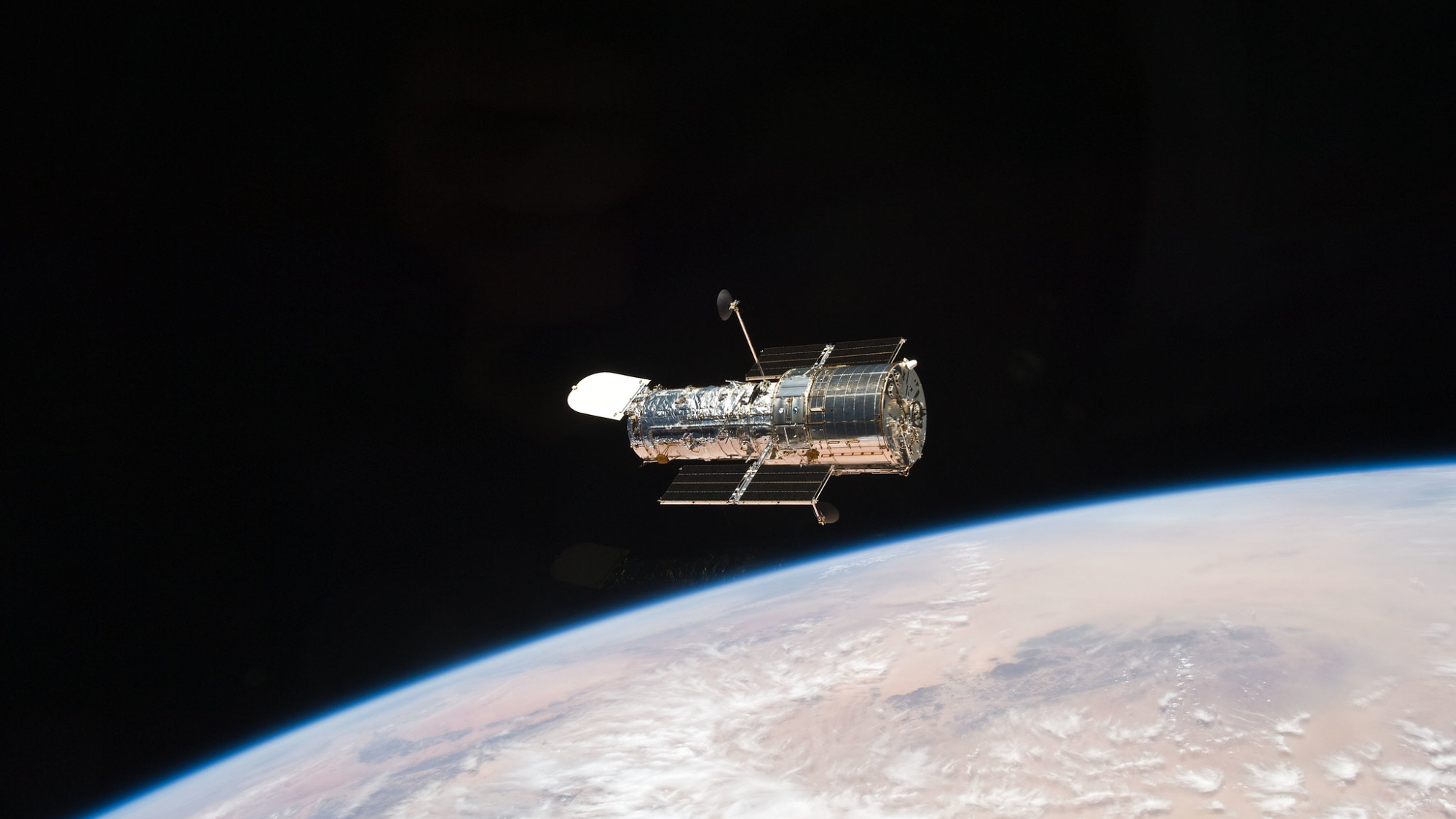
An image of the Hubble Space Telescope. (Image credit: NASA)
Within the Milky Way, astronomers have so far identified roughly 100 stellar stream candidates shed by globular clusters, but finding one around another galaxy is extraordinarily rare. Streams that form when a whole dwarf galaxy is torn apart are relatively easy to spot, since they emerge in the sparse outskirts of a larger galaxy. But globular cluster streams form deep inside their host galaxy, where they are washed out by brighter, more crowded starlight. Oyashio's detection was possible in part because UGC 9050-Dw1's already-sparse stellar population meant a dimmer backdrop gave the stream just enough contrast to be seen, Holm told Space.com.
Oyashio's discovery is "a very exciting step forward," Emily Cunningham, an assistant professorat Boston University who studies stellar streams and dark matter halos and was not involved in the new study, told Space.com. "Using techniques like those described in this paper, we will detect many more streams around other galaxies with upcoming observations from facilities such as the Vera Rubin Observatory and the Nancy Grace Roman Space Telescope."
A sufficiently large catalog of such streams in different galactic environments would allow them to tease out the subtler perturbations that dark matter is predicted to cause at the smallest scales, the researchers say.
"This is one of the most promising avenues for new astrophysical constraints on dark matter's nature," said Hendel.
No Eureka! moment
UGC 9050-Dw1 was first identified in 2017 in images taken by the Canada–France–Hawaii Telescope atop Mauna Kea in Hawaii, as part of a survey for diffuse dwarf galaxies. A follow-up study in 2023, drawing on the same Hubble images in which Hendel later spotted Oyashio, catalogued an "exceptionally high" population of globular clusters near the galaxy. Its authors concluded that UGC 9050-Dw1 likely formed from the merger of two comparably sized galaxies roughly 10 billion years ago, one gentle enough that gas from both survived and ignited a burst of star formation, which would also explain the clusters' uniform color. That 2023 study did not flag Oyashio.
In the new study, Holm and her colleagues recovered Oyashio independently in archival data from both Hubble and the Canada-France-Hawaii Telescope, ruling out the possibility that it was an artifact of telescope imaging or subsequent data processing.
The team then ran thousands of simulations, testing which combinations of globular cluster properties and dark matter distributions could reproduce the stream's observed brightness and shape. The best-fitting models produced new estimates of the UGC 9050-Dw1's total mass and how that mass is spread throughout it, suggesting the galaxy harbors far more dark matter than its sparse stellar population would imply, consistent with expectations for such a diffuse galaxy.
A ring of dark matter (seen by the Hubble Space Telescope in false color), its location inferred from its gravity, around the galaxy cluster ZwCl0024+1652, which is 5 billion light-years away. (Image credit: NASA/ESA/M. Jee and H. Ford (Johns Hopkins University).)
In the study, the team also weighs a range of alternative explanations and lays out why none quite fit the evidence. The arc could be, for instance, a chance alignment of unrelated stars, the product of gravitational lensing from a background galaxy, or a dusty region that happens to mimic a stream's shape. None of those scenarios, the team says, accounts on its own for the key pieces of evidence, chiefly the stars' consistent color, their alignment along a single curved track and that track's connection to what appears to be the globular cluster progenitor.
"It was an interesting process in the sense that there wasn't a specific moment where we're like, 'Okay, now we know what it is,'" Holm told Space.com. "We started with the assumption that just by looking at it, it looks like it could be something. How many different ways can we try to prove that it can't be?"
Still, in the interest of rigor, the team acknowledges it cannot fully exclude every alternative explanation. "There's still the possibility that some stars just randomly fall in this pattern," said Holm, "But again ... for all these things to line up as nicely as they do would require a lot of coincidence."
Dark matter clues
The payoff of that caution lies in what Oyashio can reveal about the universe's invisible scaffolding. As a globular cluster is shredded over billions of years, the stars it sheds fan out along its former orbit rather than scattering randomly, preserving, in effect, a pristine record of the gravitational forces that shaped them. If a clump of dark matter too small to host stars of its own — a "subhalo," in the language of cold dark matter theory — passes through that stream, its gravity can tug stream stars off course and carve out a gap.
"Streams that form from globular clusters are particularly sensitive to these perturbations," said Cunningham.
The challenge lies in isolating the cause, and one stream is not enough to draw firm conclusions about the astrophysical process responsible. Inside the Milky Way, any disturbance in a stream of stars could just as easily come from the galaxy's central bar of stars or from nearby dwarf galaxies falling into the Milky Way, like the Magellanic Clouds. UGC 9050-Dw1 has none of those features, so any gap found in Oyashio would stand as a more confident signature of dark matter at work, Holm said.
"If a gap is observed in a single stream, it is very difficult to say for certain which astrophysical process is responsible," said Cunningham. "However, if we can build up a sufficiently large sample of streams in different galactic environments, we can start to disentangle these effects."
"To do this, we need to look beyond the Milky Way," she added.
New instruments coming online could help do just that. Astronomers are particularly excited for the launch of the Nancy Grace Roman Space Telescope, scheduled for launch Aug. 30 from the Kennedy Space Center in Florida, which has a field of view at least 100 times larger than Hubble’s. In its five-year primary mission, with a possible five-year extension, Roman is expected to measure light from a billion galaxies, according to NASA.
"You would be able to do this kind of research in different galaxies at once with the same exposure, basically," said Holm. She hopes Roman, along with the European Space Agency's Euclid space telescope, which launched in 2023, will turn up more galaxies like Oyashio, "so we can start to put together a more generalized image of how these things work and what they can tell us."
Some of those discoveries could even come to light the way Oyashio did, as a product of pure scientific curiosity applied to data already sitting in an archive. Hendel said he read the 2023 paper mostly because he was intrigued by the team's conclusion that UGC 9050-Dw1 likely formed through a dwarf galaxy merger. "I had no aim when opening it except to satisfy my curiosity," he said.
That he was able to spot a rare feature hiding inside an image collected for a completely different research project speaks to the value of the scientific community's long-standing practice of making data publicly available, Holm said.
"Anyone can come along with another idea and actually find something also interesting with the same data that you didn't know was hiding in it," said Holm. "I think that's also a really cool part of this."
The team's paper was published on Aug. 12 in the journal Nature.
Using NASA's long-serving Hubble Space Telescope, astronomers have discovered that a stellar explosion in the Milky Way is blasting out cosmic bullets travelling at 20 million miles per hour.
The cosmic explosion in question is V445 Puppis, which erupted in 2000 and is the only known "helium nova" in our galaxy. Though astronomers have been studying V445 Puppis for two decades, much of the phenomena associated with it were shrouded in mystery due to a vast cloud of dusty debris that surrounded this nova.
When this debris finally cleared, a team of researchers was able to peer into V445 Puppis using Hubble, NASA's exoplanet-hunting spacecraft TESS (Transiting Exoplanet Survey Satellite), and the Earth-based Very Large Telescope (VLT), along with an array of other instruments. This allowed them to discover not only the "bullets", clumps of potentially oxygen-rich gas it is firing, but also the true nature of this system. This revealed that V445 Puppis consists of a dead star hungrily feeding on a companion star that is, by itself, a rare find. Thus, this system offers scientists a rare chance to study one of the rarest types of binary systems and one of the rarest cosmic explosions.
"The origin of these 'bullets' is a mystery. We suspect that these originated post-outburst, but 'bullets' of this kind have not been observed in any other nova," team member John Mills, a researcher at the University of Warwick in the UK, said in a statement.
What is a helium nova?
Helium novas like V445 Puppis occur when a white dwarf dead star cannibalistically strips helium-rich but hydrogen-poor matter from a star that has already lost its outer layer of hydrogen, exposing inner layers of helium; forming a rare "helium star." By contrast, "ordinary" novas are explosions triggered by the buildup of stolen stellar matter rich in hydrogen, not helium.
As the material accumulates on the surface of the white dwarf (a type of stellar remnant left behind when stars around the mass of the sun die) it creates runaway pressures and temperatures that eventually trigger a thermonuclear explosion.
When V445 Puppis went nova back in late 2000, it launched vast, twin plumes of debris that resemble butterfly wings. Stretching out for more than a trillion miles, astronomers initially spotted this bipolar outflow in infrared. The nova also spawned a thick disc of dust that completely obscured the binary star system. That cloud persisted for over two decades, preventing astronomers who were investigating the expanding debris from determining what kind of stars the blast originated from.
Once the debris cleared, this team determined that the system contained a helium star, one of only a few thousand of these stripped stellar bodies to be discovered among the billions of stars that populate the Milky Way.
"The culprits behind this galactic eruption have been an enduring mystery over the past 25 years, which is why it is very exciting to confirm that this helium nova was the result of a helium star accreting onto a white dwarf," Mills said.
The findings also revealed cosmic "bullets" that are even more remarkable, as they have never been seen around any other novas. Intriguingly, the team also found that V445 Puppis may be about to go nova again, and this could lead to an entirely different type of cosmic explosion.
Is V445 Puppis about to blow its top again?
Mills found that the white dwarf in V445 Puppis has overcome its stellar indigestion and is once again feeding on its companion helium star.
This is the process that led to the initial helium nova, and could mean that another episode of this rare type of cosmic explosion is soon to occur.
That has implications for our understanding of another type of cosmic eruption, this time a type of supernova called a Type Ia supernova. These occur when white dwarfs overfeed on companions and are completely destroyed by the resultant explosion.
Scientists have long suspected that repeated helium nova eruptions could lead to final Type Ia supernovas.
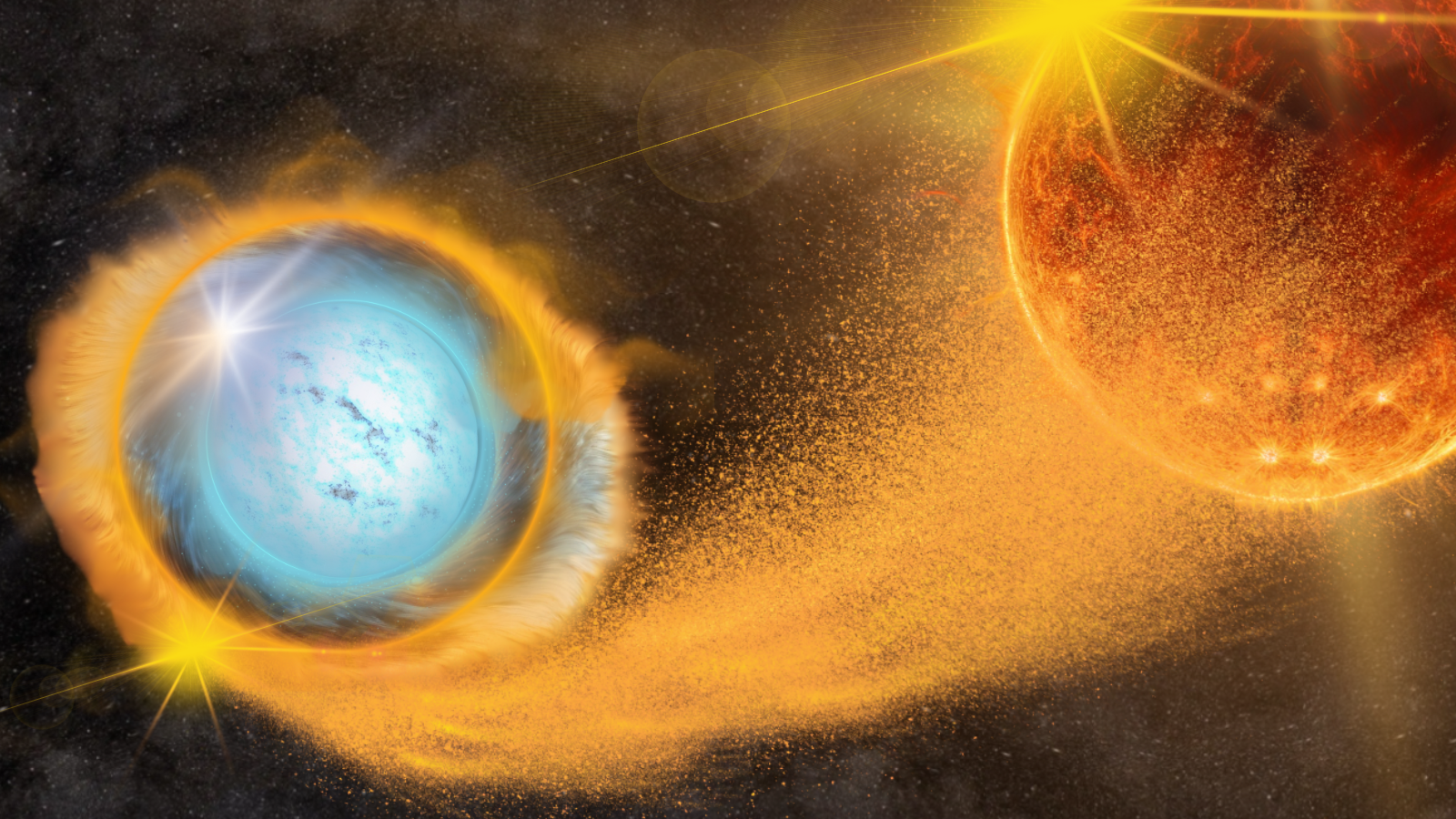
An illustration of a white dwarf star feeding on a stellar companion prior to the eruption of a type Ia supernova (Image credit: Robert Lea (created with Canva))
A new Type Ia supernova would be exciting because these events are so regular in terms of their light emission that they can be used as so-called "standard candles" to measure cosmic distances and gauge the age of the universe.
This means that they can also be employed in the quest to understand how fast the universe's expansion is proceeding, and the influence of the mysterious force called dark energy on this process.
"I look forward to seeing how this result may help us uncover what powers other similar hydrogen-poor astronomical explosions, such as the famous Type Ia supernovas," Mills said.
A bright, dense cluster of hot, massive stars in a galaxy that existed 1.4 billion years after the big bang has been found helping to end the early universe's foggy days during which neutral hydrogen gas was draped across the cosmos, obscuring ultraviolet light from luminous objects.
The cluster was found emitting ultraviolet light in a small but quickly growing galaxy by the Hubble Space Telescope. The presence of this ultraviolet light, and the star-forming history of the cluster producing it, suggests that bursts of star formation contributed to waves of ionizing radiation that gradually cleared out the opaque neutral hydrogen.
In the aftermath of the big bang, the universe was filled with neutral hydrogen gas that is opaque at short wavelengths of light, such as ultraviolet. However, this ultraviolet light was the neutral hydrogen's worst enemy, gradually ionizing the gas across the universe. Once ionized, hydrogen gas cannot absorb ultraviolet light — and so, the cosmos became transparent at those wavelengths.
Because of this, the first billion or so years are called the Epoch of Reionization. It is referred to as "reionization" rather than ionization because, technically, the gas had already been ionized once before during the first 379,000 years after the Big Bang.
While investigating what brought about this epoch, astronomers had identified two chief suspects that could have produced sufficient amounts of ultraviolet light to ionize the neutral hydrogen. One is active supermassive black holes and the other is the first generations of hot, massive stars. The problem is, given that neutral hydrogen is adept at absorbing the ultraviolet light, astronomers have had difficulty tracing that ultraviolet back to its source and identifying which of the two suspects are the main culprit.
In 2023 the James Webb Space Telescope (JWST) made a major breakthrough, finding a galaxy that existed just 900 million years after the Big Bang that was producing enough energy to ionize the neutral gas surrounding it.
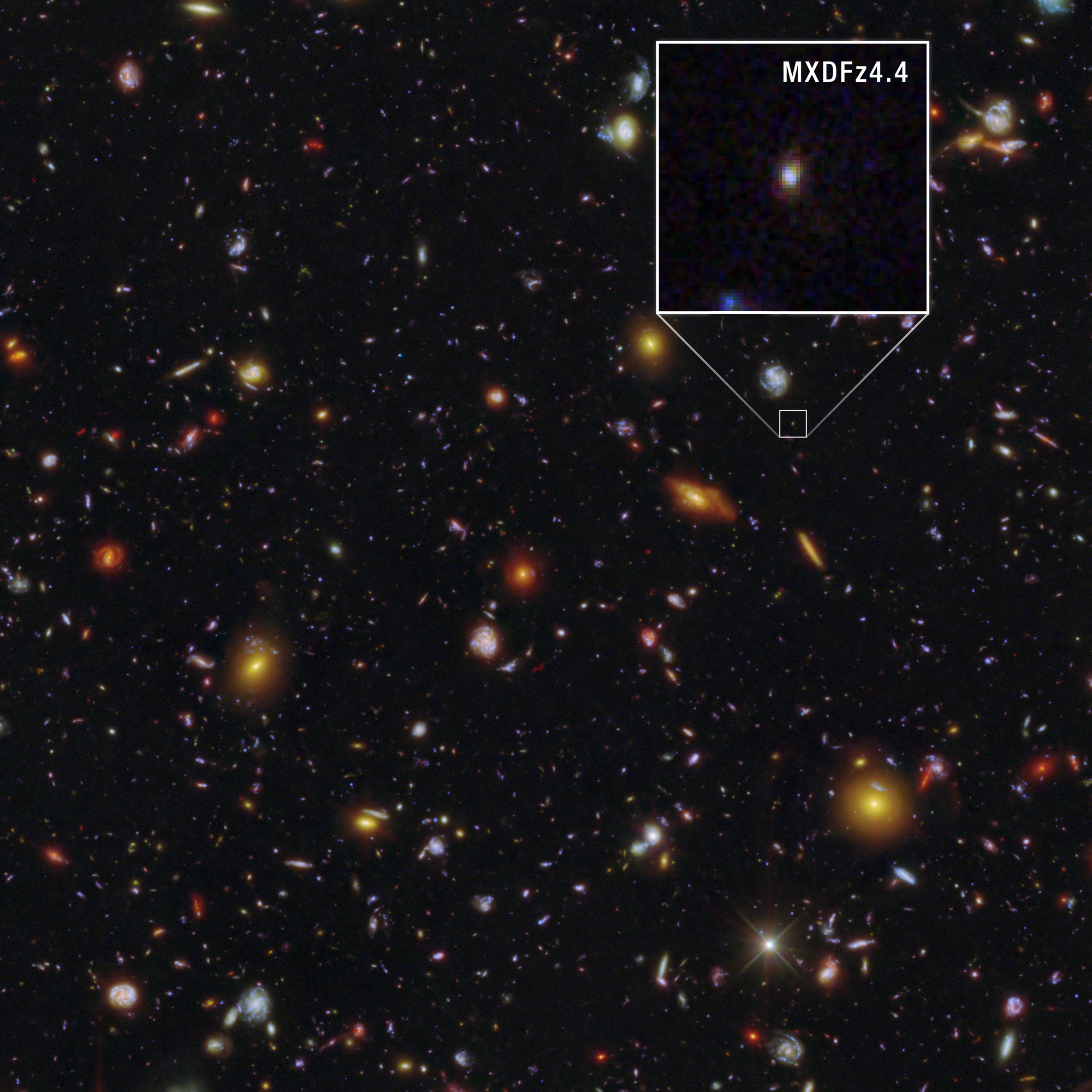
Now the Hubble Space Telescope has gone further, detecting ultraviolet light from a galaxy called MXDFz4.4. This ultraviolet light should only be visible if the surrounding gas had already been ionized.
"Observing a galaxy like this was thought to be impossible," said Ilias Goovaerts of the Space Telescope Science Institute (STScI) in Baltimore, who led the discovery, in a statement. "Researchers expected the 'fog' of neutral hydrogen that filled the early universe would be too thick and obscure our view of its ionizing light. Hubble not only spotted that light, but it also helped reveal incredible details about the galaxy's characteristics."
The full Hubble Space Telescope's view of MXDFz4.4 and its surroundings from our vantage point. (Image credit: NASA/ESA/CSA/STScI/Ilias Goovaerts and Anton Koekemoer (STScI)/Marc Rafelski (STScI, JHU)/ Image Processing: Alyssa Pagan (STScI))
MXDFz4.4 was first identified in the MUSE eXtremely Deep Field (MXDF), with MUSE being the Multi Unit Spectroscopic Explorer on the European Southern Observatory's Very Large Telescope in Chile. The "z4.4" part of its name tells us that the galaxy exists at a redshift of 4.4, meaning that it existed 12.37 billion years ago. As the universe has expanded in the time since then, the ultraviolet light has been redshifted into visible wavelengths that were detected by Hubble.
"Astronomers have found many galaxies that existed at this point in the history of the universe, but we haven't detected ionizing photons from any of them, making MXDFz4.4 one of a kind," said Marc Rafelski, who is the Hubble Deputy Mission Head at STScI.
MXDFz4.4 is 100 times smaller than our Milky Way galaxy but is forming stars ten times faster than our galaxy is. Many of those stars are being born in the tight, luminous cluster producing the ionizing ultraviolet.
An artist's impression of the young, distant galaxy MXDFz4.4 and its dense cluster of luminous stars. (Image credit: NASA/ESA/Leah Hustak (STScI))
The cluster contains "A lot of young, hot, massive stars in a small space [that] do a better job of blasting through opaque gas," said Goovaerts.
Furthermore, by comparing Hubble's observations of MXDFz.4.4 with those of the JWST, which probed for cooler, older stars in the galaxy, Goovaerts and Rafelski's team discovered that the stars in the cluster had formed in bursts, each burst producing fresh quantities of ionizing ultraviolet radiation that helped to clear out more and more of the neutral gas over time. We now see the galaxy about 250 million years after it finished reionizing the surrounding gas. These hot, massive stars in the cluster end their lives after a few million years as supernova explosions, the blast waves and radiation from which can create bubbles in the gas light years across, creating further pathways for ultraviolet light to escape and be detected by Hubble.
The observations seem to nail down the theory that clusters of hot, massive, luminous stars in young galaxies in the early universe played a dominant role in ionizing the universe's neutral gas.
"Hubble's observations of MXDFz4.4 let us test our hypotheses much closer to the Era of Reionization than ever before," said Rafelski. "Finding more galaxies, especially at slightly later cosmic times where larger samples are within reach, would let us refine these measurements and figure out what cleared our view as that era was ending."
The private WorldView Legion 4 Earth-observing satellite snapped an amazing photo of the Hubble Space Telescope on April 23, 2026, a day before the obsevatory's 36th birthday.
This latest image from Hubble forms just one of more than 1.7 million observations that the space telescope has made over the past 36 years since it launched on April 24, 1990.