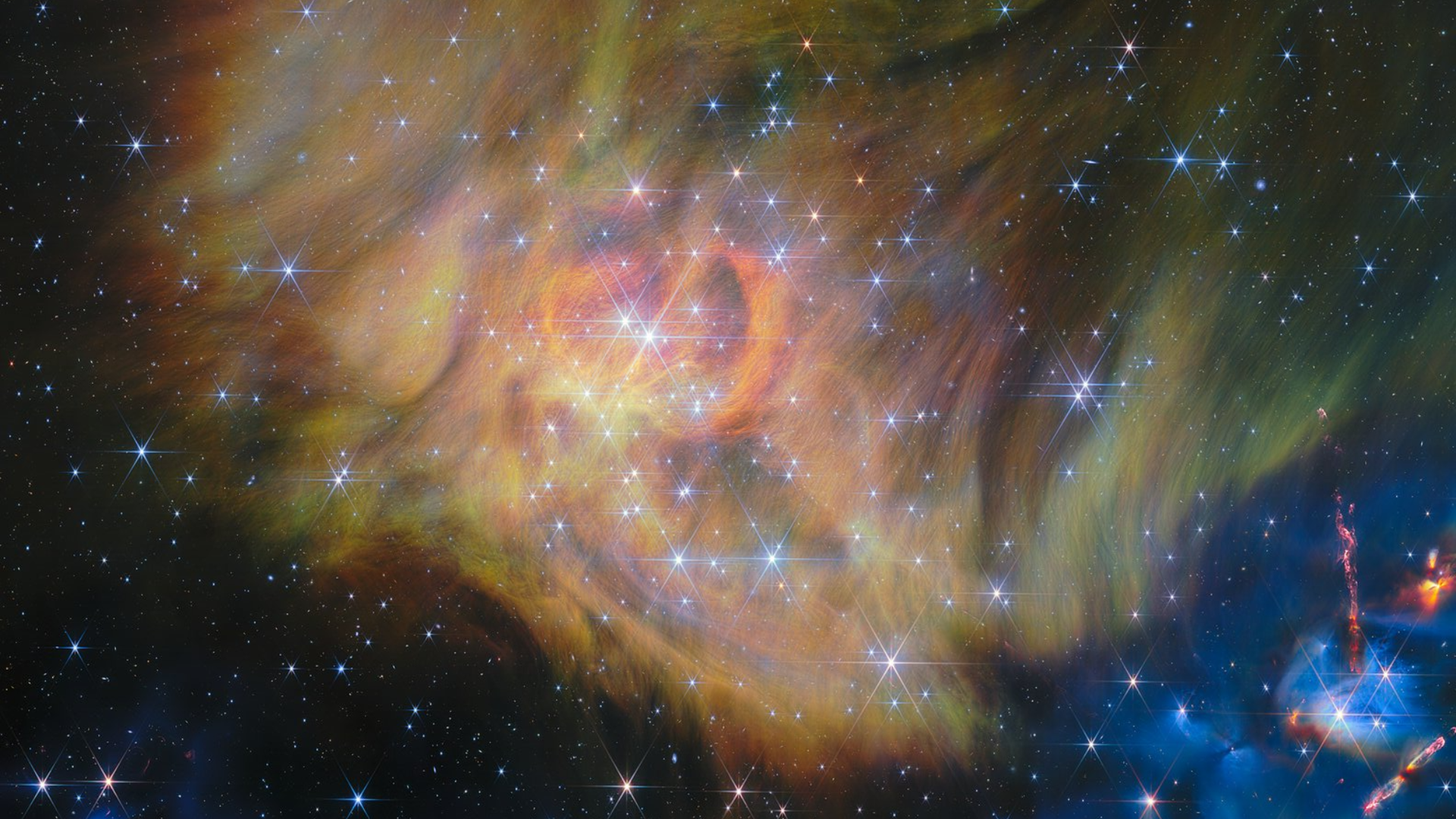
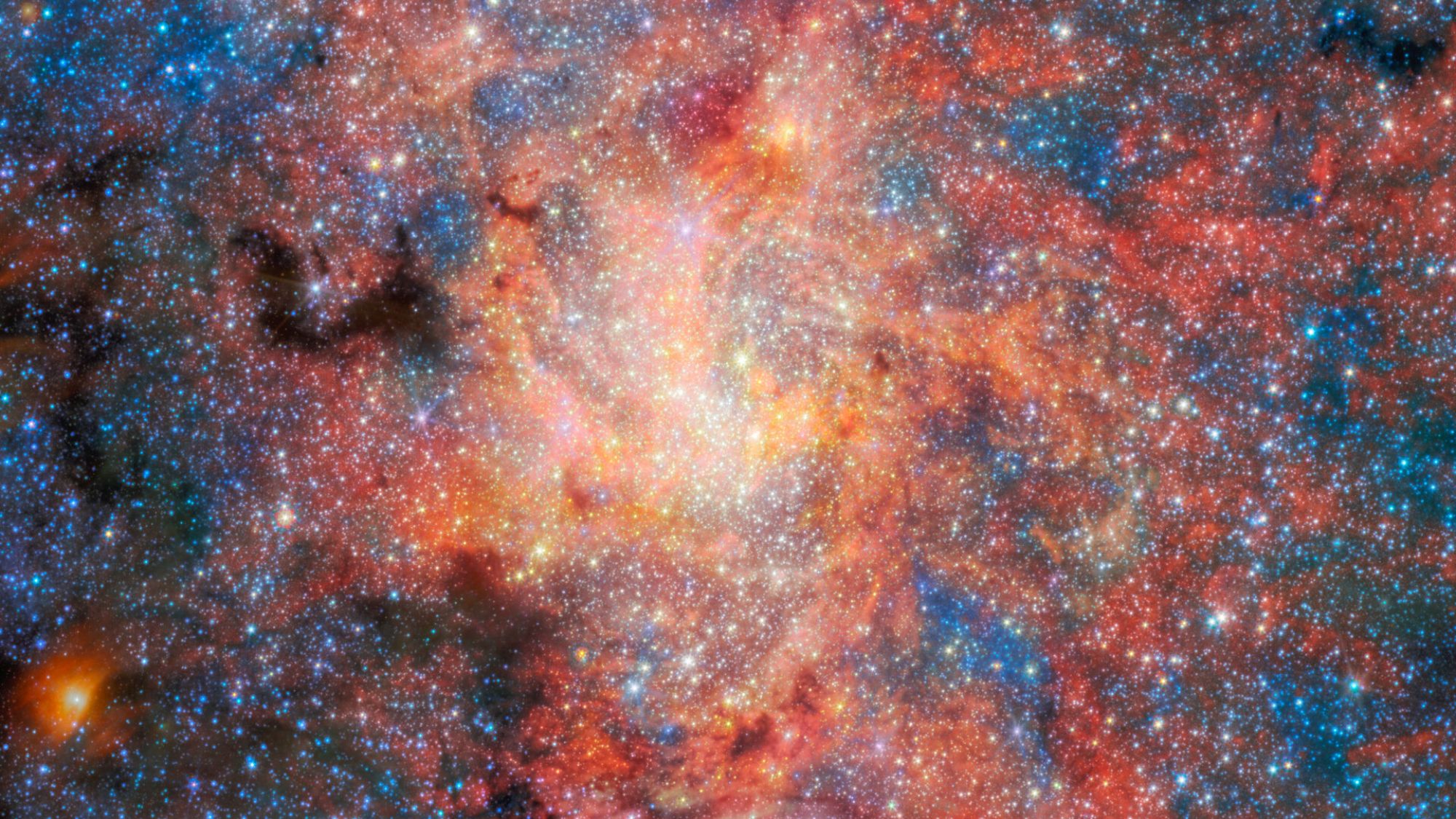
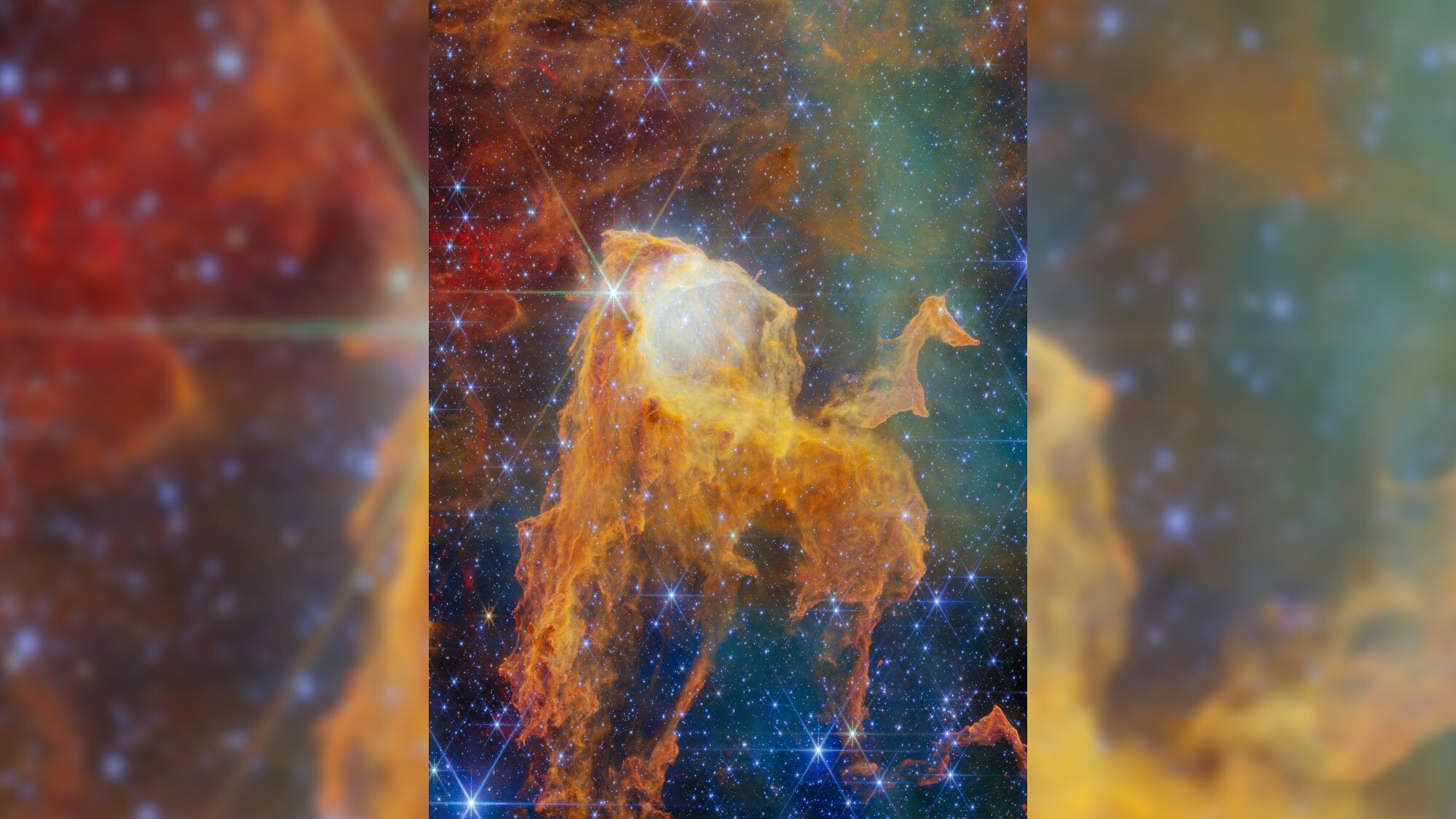
The star-forming region IC 348, as imaged by the James Webb Space Telescope. (Image credit: ESA/Webb, NASA, CSA, K. Luhman, C. Alves De Oliveira, M. Zamani (ESA/Webb))
An ethereal and magnificent display of gas and dust stretches across the cosmos in a spectacular new image captured by NASA's James Webb Space Telescope.
What is it?
Glowing wisps of translucent gas and dust paint a striking image of the star-forming region IC 348 in this new JWST snapshot. In the image, you can see IC 348, a region found about 1,000 light-years away.
In this vast expanse of gas and dust, cold molecular hydrogen gas collapses to create new stars. And this image has no shortage of suns, with twinkling stars speckling the entire cosmic landscape, diffraction spikes and all.
But while this is a star-forming region, objects are found here as well. This image was captured as part of a scientific search for brown dwarfs, which are objects that form like stars but aren't massive enough to kickstart hydrogen fusion in their cores.
Why is it incredible?
Brown dwarfs are one of the great mysteries of our universe. Not as massive as the least massive stars, but more massive than the biggest planets, brown dwarfs are strange objects stuck in the middle.
Brown dwarfs do emit some light and heat, which helps scientists to find them, though doing so can be tricky, as they're much cooler than stars and not that bright (at least in visible light). However, despite being dim, they give off infrared radiation, allowing them to be spotted by infrared instruments aboard space telescopes like JWST.
This incredible new image is part of an observing program that aims to use JWST to find and study the smallest brown dwarfs. In 2022, researchers looking at IC 348 found brown dwarfs just a few times more massive than Jupiter, so they were on the very small end. Researchers hope to find even smaller brown dwarfs to help them better understand how these strange objects form and vary across space.
The Hubble and James Webb space telescopes have teamed up to target some of the smallest, most distant objects in the solar system, discovering that the history of these tiny objects is more puzzling than we'd realized.
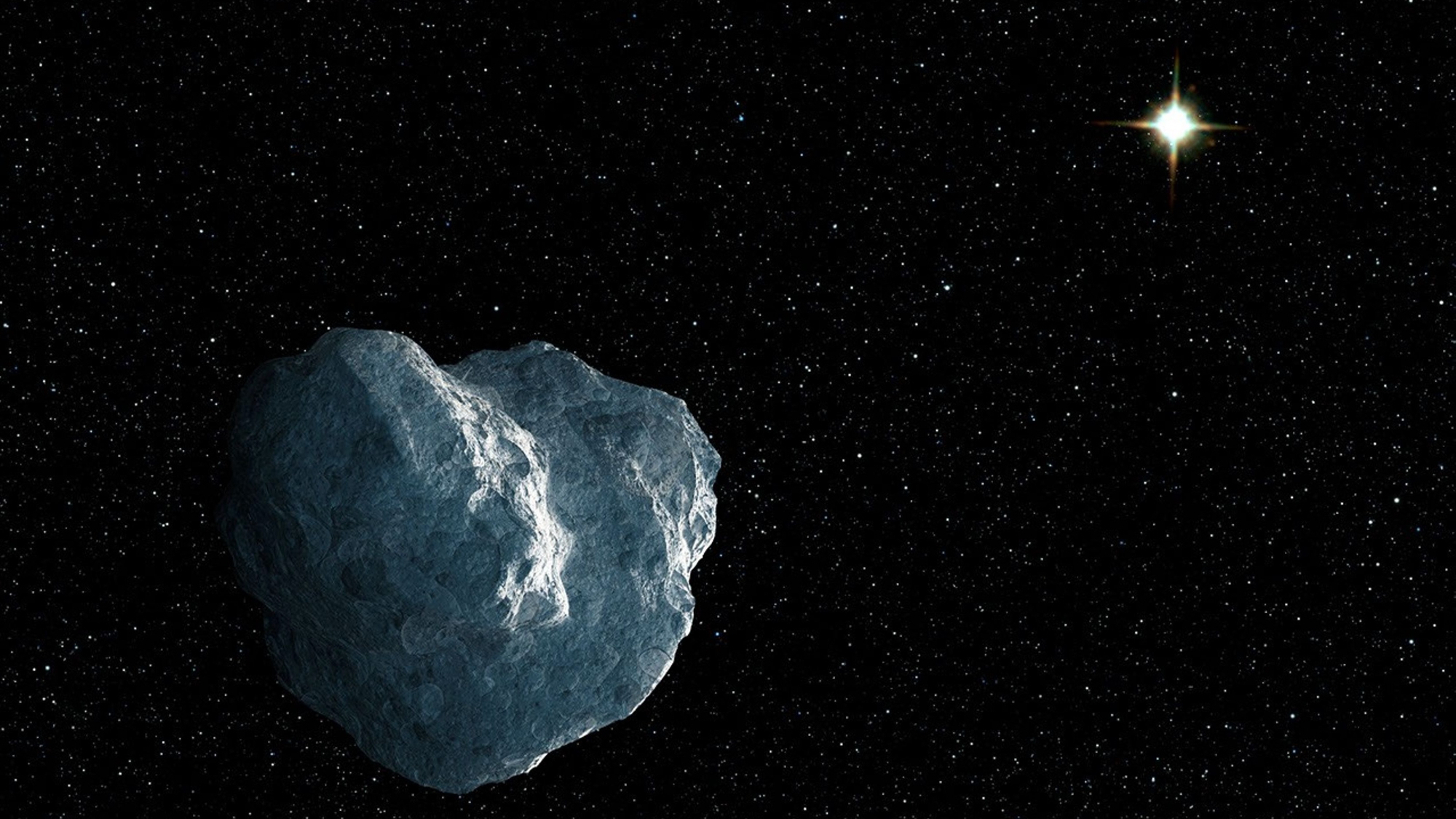
The two orbiting observatories collectively discovered 27 new Trans-Neptunian Objects, or TNOs, all less than 25 miles (40 kilometers) across, with the smallest being only 6 miles (10 kilometers) in diameter. As their name suggests, TNOs orbit the sun from far beyond Neptune. Some of them were born out there, at the dawn of the solar system, as small planetesimals unable to take the extra step to form planets.
Models of how these TNOs formed predicted that they should have been peppered with impacts that mixed up their surface material so that their composition, and therefore color, would be different than larger TNOs. Yet new observations, led by two PhD candidates, Anastasia Morgan of Northern Arizona University and Marielle Eduardo of the University of Victoria found the opposite – the little TNOs still look as pristine as the day they formed.
"You could imagine a scenario where getting knocked around and fragmented would change the surface composition, and then you would see a different surface color for tiny TNOs compared to their larger siblings," said Morgan, who led the color and composition analysis, in a statement. "So it's really fascinating to see that the smallest objects are somehow 'remembering' and preserving the history of how they were made."
TNOs native to the Kuiper Belt move in near-circular orbits around the sun and are level with the ecliptic plane, the imaginary flat 'disc' on which the planets and other objects orbit our star. They are said to be dynamically 'cold' because they haven't really budged since they formed.
Other TNOs, however, formed between the seventh and eighth planets, Uranus and Neptune, but before they could be assimilated into those worlds while those planets were growing, they were ejected by gravitational resonances into the region far beyond Neptune, collectively forming a 'Scattered Disk' of objects on highly elongated orbits significantly inclined to the plane of the solar system. Such TNOs are referred to as being dynamically 'hot'.
Yet even the 'hot' TNOs seem to have resisted any changes to their surface composition.
"These dynamically hot TNOs retain a signature of where they were born, even though they've been orbitally scrambled since then," said David Trilling of Northern Arizona University.
An artist's interpretation of a trans-Neptunian object. (Image credit: Artwork: NASA, ESA, and G. Bacon (STScI); Science: NASA, ESA, and C. Fuentes (Harvard-Smithsonian Center for Astrophysics))
This leads to one of two surprising possibilities. Either there are far fewer impacts taking place far from the sun than astronomers thought, which doesn't match with what we think we know about the population density of objects out there, or the impacts and collisions do take place but for some reason do not tear up the surface of the small TNOs as much as we might expect.
Thanks to the James Webb Space Telescope's (JWST's) infrared vision, Marielle Eduardo was able to figure out the size distribution of the TNOs. When we look in visible light, how bright a TNO appears depends in part on how reflective its surface is, a property referred to as albedo. A larger body with a composition that isn't very reflective might appear fainter at the same distance as a smaller object covered in shiny ice.
However, at infrared wavelengths the brightness of an object is dependent mostly on its size, allowing accurate determinations of the diameters of the 27 TNOs. Surprisingly, there seem to be fewer of the very small TNOs than what models of their formation predict.
"It's very interesting that the process of planetesimal formation ends up producing the same distribution of sizes for both cold and hot populations, despite forming in different regions of the early solar system," said Eduardo. "The process seems to be insensitive to [planet-forming] disk conditions, producing similar planetesimal sizes whether the disk is hot or cold, and dense or fluffy."
These observations push Hubble's and JWST's abilities to the limit. The TNOs are incredibly faint, shining between magnitudes 24.1 and 29.3, described as being equivalent to seeing a swarm of fireflies on the moon from Earth. As such, it is the deepest survey yet into the relatively unknown realm beyond Neptune, just as you'd expect from these two powerful space telescopes getting together.
The research was published in The Astronomical Journal as two separate papers on Sept. 8, one on color and composition, the other on the size distribution of the TNOs.
Using the James Webb Space Telescope (JWST), astronomers have discovered that the ring system of a tiny solar system body is even more interesting than they knew.
The object in question is Chariklo, which orbits the sun between Saturn and Uranus, at around 17 times the distance between Earth and the sun. Despite only being around 155 miles (250 kilometers) wide, Chariklo, part of the Centaur family of asteroids, possesses two thick rings.
Though Saturn is the solar system body most famous for its rings, other planets also have ring systems, albeit less prominent. That includes Uranus, Neptune, and Jupiter. However, Chariklo and the even smaller body Chiron, show that even the most diminutive bodies can develop rings. Now, thanks to the incredible sensitivity of the JWST, scientists know that the rings of Chariklo are even stranger than their initial discovery in 2013 suggested.
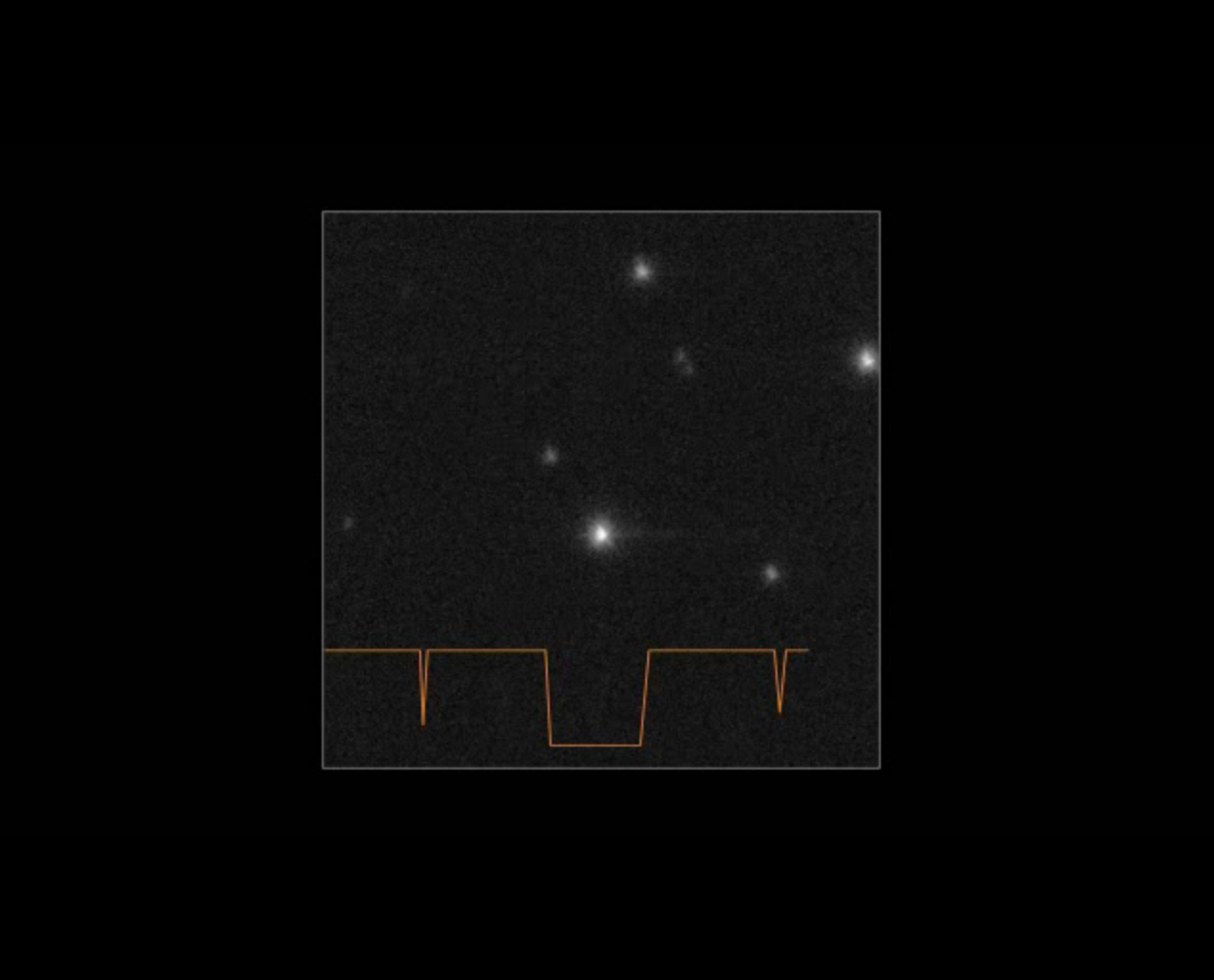
The team, led by researchers from the Institute of Astrophysics of Andalusia (IAA-CSIC), began observing Chariklo with the JWST in Oct. 2022. They used a technique called stellar occultation, which measures the decrease in light from a star when an object passes in front of it.
"By comparing JWST observations with those obtained during other stellar occultations over the last decade, we discovered opposite changes in the two rings: while the inner ring shows significantly higher opacity, the outer ring shows lower opacity," team leader Pablo Santos-Sanz of the IAA-CSIC said in a statement.
The changing rings of the asteroid suggest that it experiences more complex physics than previously thought. This is important because scientists had previously believed that small bodies had relatively stable rings.
"Our results force us to rethink how they form, how they evolve, and what mechanisms maintain their stability," Santos-Sanz said. "The ability to detect these changes opens a new window for understanding the evolution of these systems and, possibly, that of other ring systems in the solar system."
The cause of these changes remains a mystery.
Another milestone for the JWST and Gaia
The research doesn't just represent an important step in our understanding of asteroids and solar system rings, but it is also an important milestone for the JWST.
"Achieving this required knowing with extraordinary precision the orbit of Chariklo, the position of the star, thanks to the European Space Agency’s Gaia mission, and the trajectory of JWST itself around the L2 Lagrange point, a region of space located about 1 million miles (1.5 million kilometers) beyond Earth, away from the sun," team member Yücel Kilic of the IAA-CSIC said. "The JWST follows an orbit around this region that requires periodic corrections through station-keeping maneuvers."
Dips in light from a distant star caused as it is occulted by Chariklo and its rings (Image credit: ESO/Felipe Braga Ribas/M. Kornmesser)
During the occultation the team used in their research, Chariklo was traveling at around 5,600 miles per hour (2.5 kilometers per second) relative to the JWST.
This is incredibly fast by Earth standards, but relatively slow for objects racing through the solar system. This low speed allowed the rings of Chariklo to be resolved in unprecedented detail. Astronomers currently rely on occultation to study Chariklo and its rings, as even the JWST isn't powerful enough to directly image this small and distant asteroid.
The team's research was published on Tuesday (Sept. 9) in the journal Science Advances.
Using the James Webb Space Telescope (JWST), astronomers have studied 72 young, sun-like stars. As a result, they found that forming planets is a real race against time.
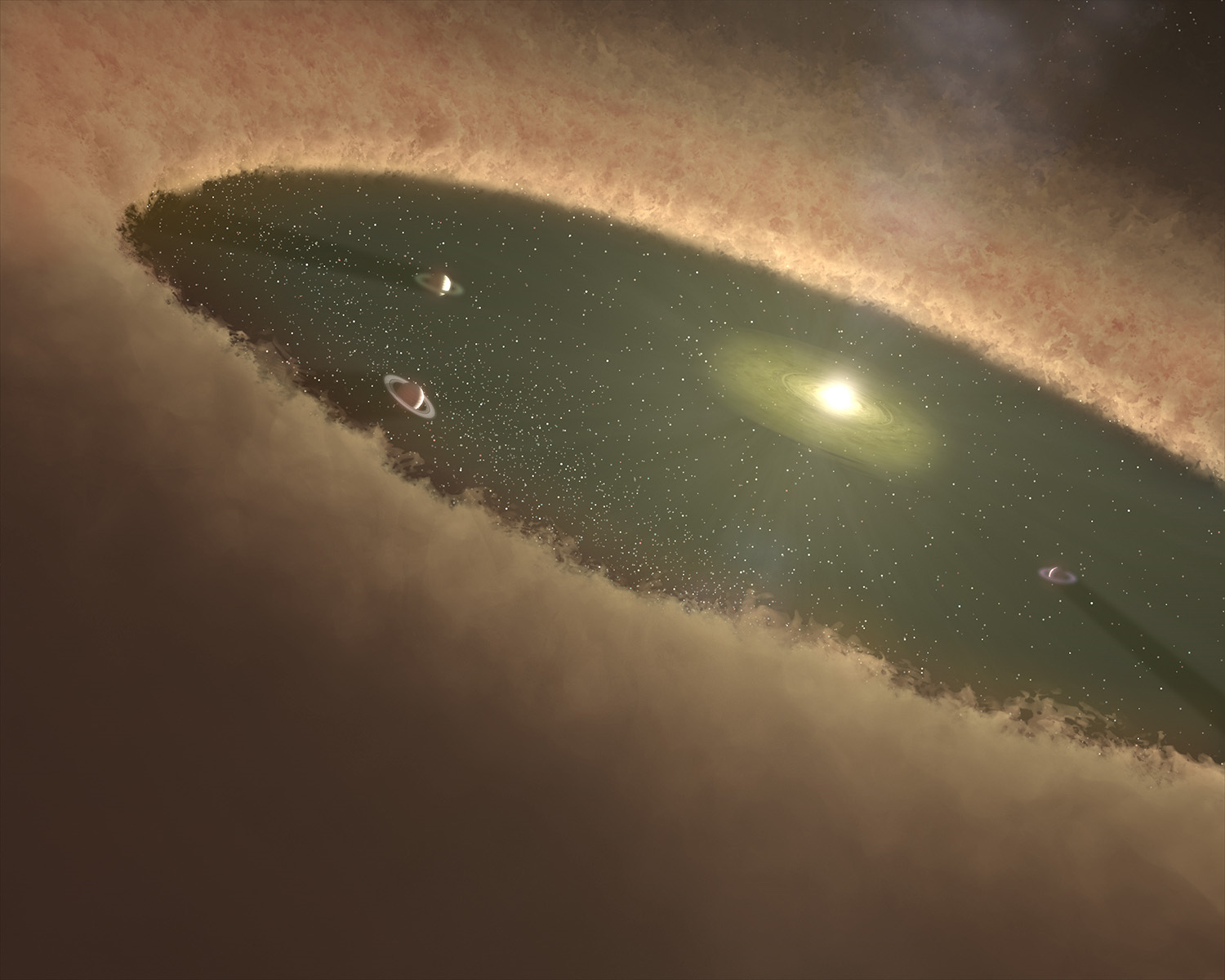
This is because the material that serves as the building blocks for planets is constantly escaping the swirling platters of gas and dust, orprotoplanetary disks, that wrap around infant stars. Some types of planets may find their formation window closing sooner than others.
The team's research represents the most in-depth investigation yet into how matter escapes these protoplanetary disks and how this escape gives rise to different stages of planet formationaround sun-like stars. All in all, the study helps paint a better picture of how and why our solar systemtook the shape it did around the infant sun around 4.6 billion years ago.
"Gas giants like Jupiter must assemble their massive atmospheres while the disk is still substantial enough to supply them, before winds and jets carry that raw material away into space," team leader Naman Bajaj from the University of Arizona said in a statement.
An ill wind blows around infant stars
The team conducted its research using data collected by the JWST’s Mid-Infrared Instrument (MIRI). The scientists tracked matter loss by following the movements of molecular hydrogen, one of the most common molecules in protoplanetary disks. Each of the stars involved in the investigation represented a different stage in the early life of a star system. That meant putting these snapshots together allowed the researchers to create a "movie" detailing the early life of a planetary system.
One of the most important findings of this approach is the mechanisms for material loss from protoplanetary disks seem to evolve and switch dominance as an infant star ages.
This is important because gas giants like Jupiter and Saturn have vast atmospheres. They thus require more raw material to form than smaller rocky worlds like Earth do. Understanding matter loss allows scientists to determine at what stages of protoplanetary disk evolution gas giants can form.
"What is exciting about this study is that we can now see, across a large sample of young systems, how the mechanisms that remove gas from planet-forming disks change with time," team member Uma Gorti from the SETI Institute said in the statement. "Disk dispersal sets a fundamental clock for planet formation: once the gas is gone, the opportunity to build gas-rich planets is essentially over."
An illustration of an evolved protoplanetary disk in which material close to the infant star has been dispersed (Image credit: NASA/ JPL-Caltech/ T. Pyle (SSC))
The researchers found that early in the evolution of protoplanetary disks, powerful, magnetically driven jets and winds dominate mass loss. These jets and winds are powered by magnetic fields that weave through protoplanetary disks.
Later, as the disk thins and starlight can pass through it more easily, these winds and jets weaken, and magnetic processes are dominated by high-energy radiation from the infant star ionizing gas and blowing it into space. The latter process is called photoevaporation.
All this reveals there is no one single process responsible for stripping planet-forming material from around infant stars. The research also demonstrates the JWST is more than capable of studying the dispersal of gas and dust around individual infant stars.
The next step for the team is to discover just how much material these different mechanisms shift. The scientists could also look into the areas of the disks in which the mechanisms studied operate. Down the line, this will help develop a model to reveal just how rapidly planet-formation is shut off — and in which regions of a protoplanetary disk different types of planets are most likely to form.
The heart of the Milky Way may be more hospitable to water than astronomers thought.
Using the James Webb Space Telescope (JWST), researchers detected water and cosmic dust around an aging star only 0.55 light-years from Sagittarius A* (Sgr A*), the supermassive black hole at the center of our galaxy.
The new study suggests that water and dust can form and survive surprisingly close to a supermassive black hole, where intense radiation and other harsh conditions might otherwise be expected to destroy them. The team used Webb's Mid-Infrared Instrument (MIRI) to study IRS 3, an aging star located in the crowded environment surrounding Sgr A*, which has a mass of about 4 million suns, according to a statement from the European Space Agency (ESA).
(Image credit: ESA/Webb, NASA & CSA, F. Peißker, J. Lu, F. Yusef-Zadeh, N. B. Sabha, C. Chan)
"Galactic centres are among the most extreme environments, so understanding whether stars can continue enriching their surroundings there is an important question," Florian Peißker, lead author of the study from the University of Cologne in Germany, said in the statement. "With Webb, we can directly observe how stars behave under these conditions and see that dust production remains remarkably resilient."
IRS 3 — one of the brightest mid-infrared sources in the galactic center — is an asymptotic giant branch star, meaning it has reached a late stage of stellar evolution in which it sheds large amounts of gas and dust through powerful stellar winds. Such dying stars act as cosmic recycling centers, returning material to space that can eventually become incorporated into future generations of stars and planets.
But IRS 3 lives in a particularly unforgiving neighborhood. The center of the Milky Way is densely packed with stars and exposed to intense radiation, raising questions about whether molecules and newly produced dust can persist there.
However, Webb's observations suggest they can. By combining observations of IRS 3's spectrum with simulations of how its light travels through different models of the surrounding material, researchers reconstructed the structure of the star's envelope. They found a layered, shell-like distribution of silicate dust extending roughly 10,000 astronomical units from the star (one astronomical unit, or AU, is the average distance between Earth and the sun). Temperatures within the envelope fall from about 1,700 degrees Fahrenheit (927 degrees Celsius) near the star to around minus 280 F (minus 173 C) in its outer regions. Webb's observations also revealed clear evidence of water within the envelope — the first such detection for IRS 3.
"The detection of water is especially exciting because it shows that molecular material can survive in an environment dominated by intense radiation," Macarena Garcia Marin, co-author of the study and an ESA astronomer, said in the statement.
While the observations don't reveal how much water is present, the detection shows that water can survive in the harsh environment near the galactic center. Water and dust are important ingredients in the chemistry that accompanies star and planet formation, meaning material shed by aging stars such as IRS 3 could eventually contribute to future generations of stars and planets.
Finding water and dust near Sgr A* therefore suggests that aging stars can continue enriching their surroundings even in the harsh conditions near a supermassive black hole. The findings could help astronomers better understand how material is recycled in the centers of galaxies and the role evolved stars play in supplying those regions with fresh dust and molecules.
Their findings were published Aug. 11 in the journal Astronomy & Astrophysics.
The most distant 'black hole star' yet found, existing in the universe less than 660 million years after the Big Bang, has provided a vital clue as to the origin of the mysterious "little red dots" that populate the James Webb Space Telescope's images of the early universe.
The consensus seems to be that these bizarre objects, which were first discovered in 2022, are growing supermassive black holes entombed within huge clouds of gas that have spectrums similar to cool, red stars, such as red giants. Recently, astronomers have been finding that some of these objects are placed within the center of young galaxies whose light has been traveling for about 12 billion years, give or take a billion, to reach us. Given their distance and faintness, black hole stars' light is difficult to disentangle from the light of a surrounding galaxy, especially when we know there is likely a galaxy there that's too faint for the JWST to resolve.
However, a newly discovered black hole star, unearthed during a JWST program called the Mirage or Miracle (MoM) survey, is acting as a kind of a missing link.
"The Mirage or Miracle survey was designed specifically to target sources considered 'risky,' meaning they could either be amazing discoveries or just interlopers, such as some cold nearby stars that look like distant galaxies," Jorryt Matthee of the Institute of Science and Technology Austria and a co-investigator on the MoM survey said in a statement. In particular, the survey focuses on objects that look like they could be very high redshift galaxies (around a redshift of 10 or more, which equates to having existed about at least 13.1 billion years ago).
The black hole star found by the survey has been named MoM-BH*-1 and is the best example yet of a "naked" black hole star, meaning astronomers are fairly certain it exists in space on its own rather than inside a burgeoning galaxy. This means all of its light is generated by accretion onto the black hole at the center of the cloud. Though we cannot see this accretion because of the obscuring gas cloud, this light energizes the surrounding cloud from within, causing it to glow just as energy generated within the sun causes its outer layers to radiate.
"The spectrum we detected is our best evidence of a cloak of gas feeding an early forming black hole," Rohan Naidu of the University of Hawaii, who led the team who discovered MoM-BH*-1 and is co-leader of the MoM survey, said in the statement.
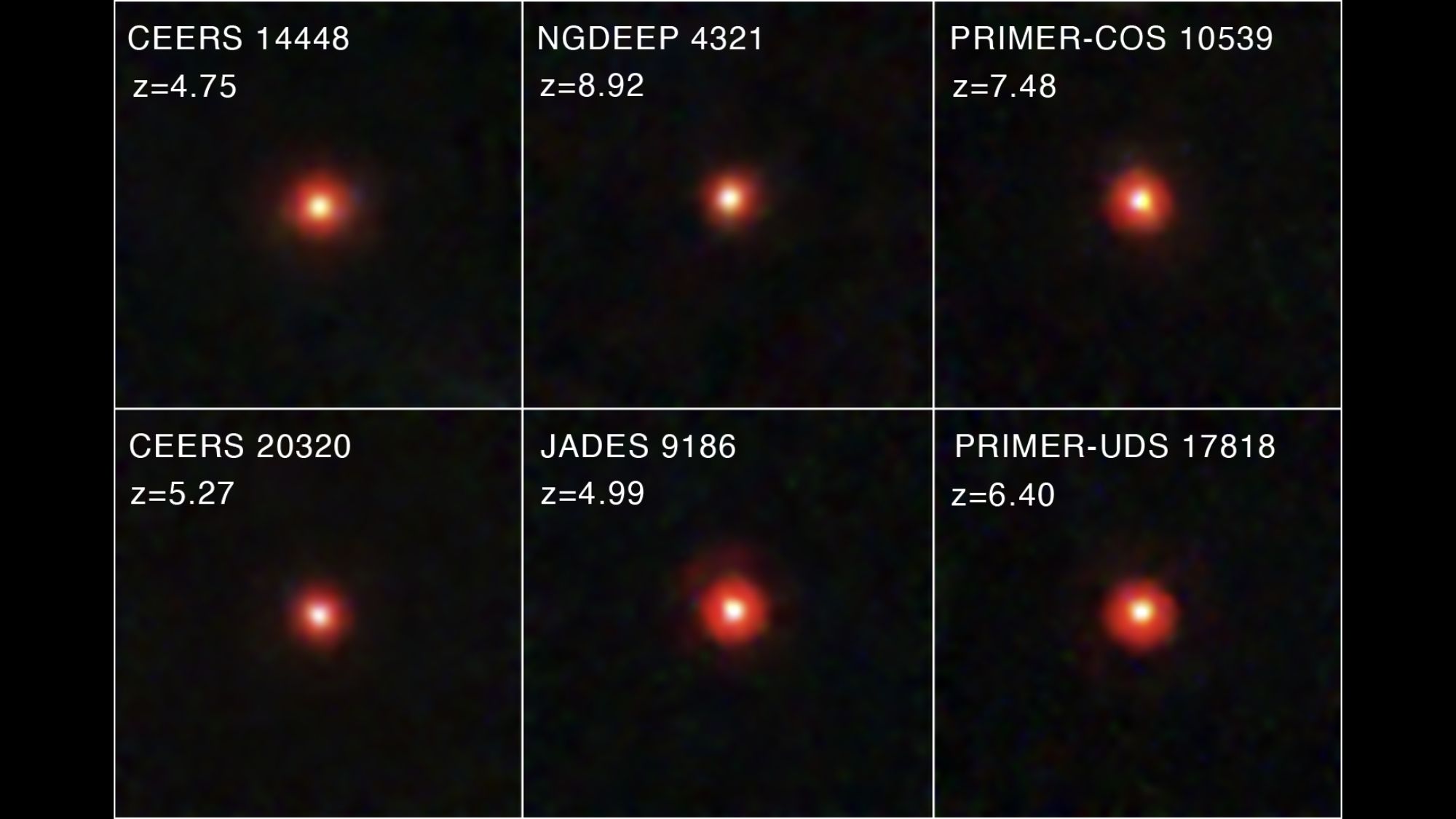
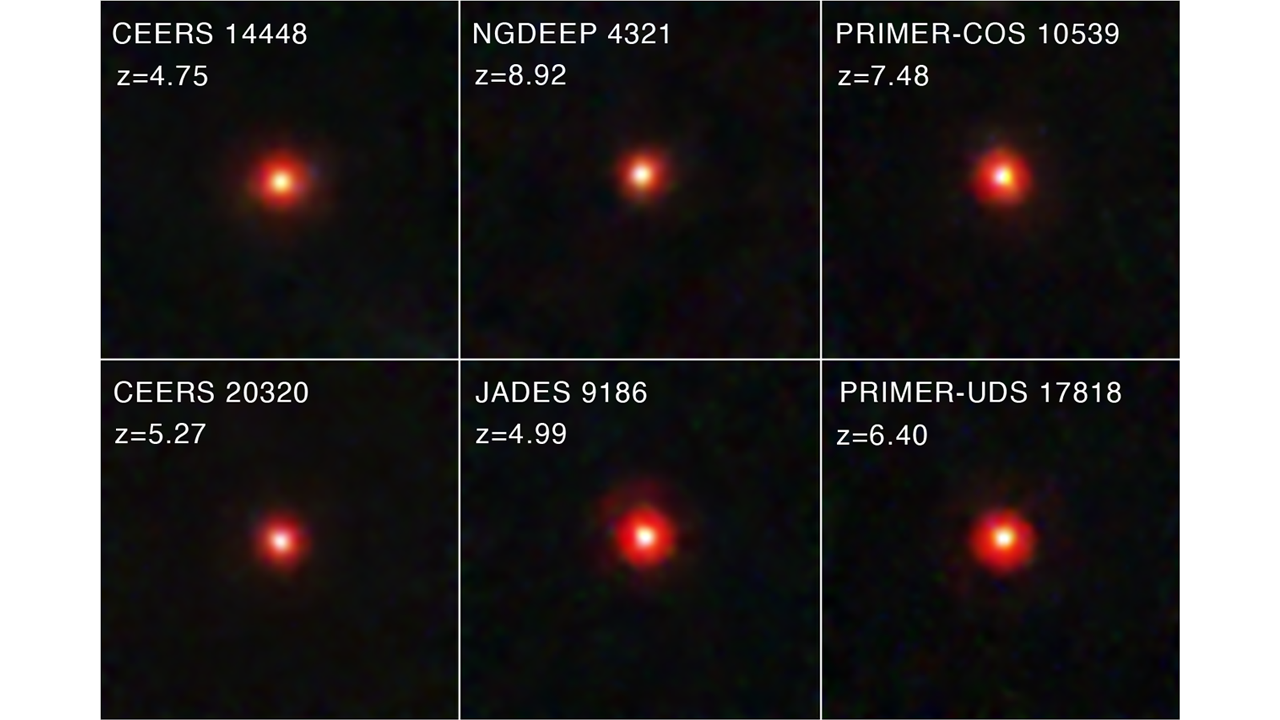
Some of the JWST's little red dot discoveries. (Image credit: NASA, ESA, CSA, STScI, Dale Kocevski (Colby College))
Intriguingly, MoM-BH*-1 lies close in space to a young galaxy at the same redshift, and estimates suggest that it will take another 100 million years for the black hole star to collide and merge with the galaxy. Naidu and Matthee's team modeled what the spectrum of the galaxy would look like after it has merged with MoM-BH*-1, and found that it would look very much like the little red dots already known to exist within galaxies.
"Considering the black hole star as a template for the black hole component of little red dots helps clarify many of the uncertainties about them," said Matthee. "If embedded in similar host galaxies, black hole stars like MoM-BH*-1 might well serve as the central engines of baby quasars."
In this way, MoM-BH*-1 provides strong evidence for the object at the heart of faint galaxies encompassing little red dots as being a black hole star. Recent observations of some little red dots at lower redshifts have shown the cloud of gas around the black hole begin to disintegrate, exposing the black hole and the X-rays produced by the accretion of gas onto it. These black holes appear to be growing fast, and the environments surrounding such active black holes become highly luminous, creating a quasar.
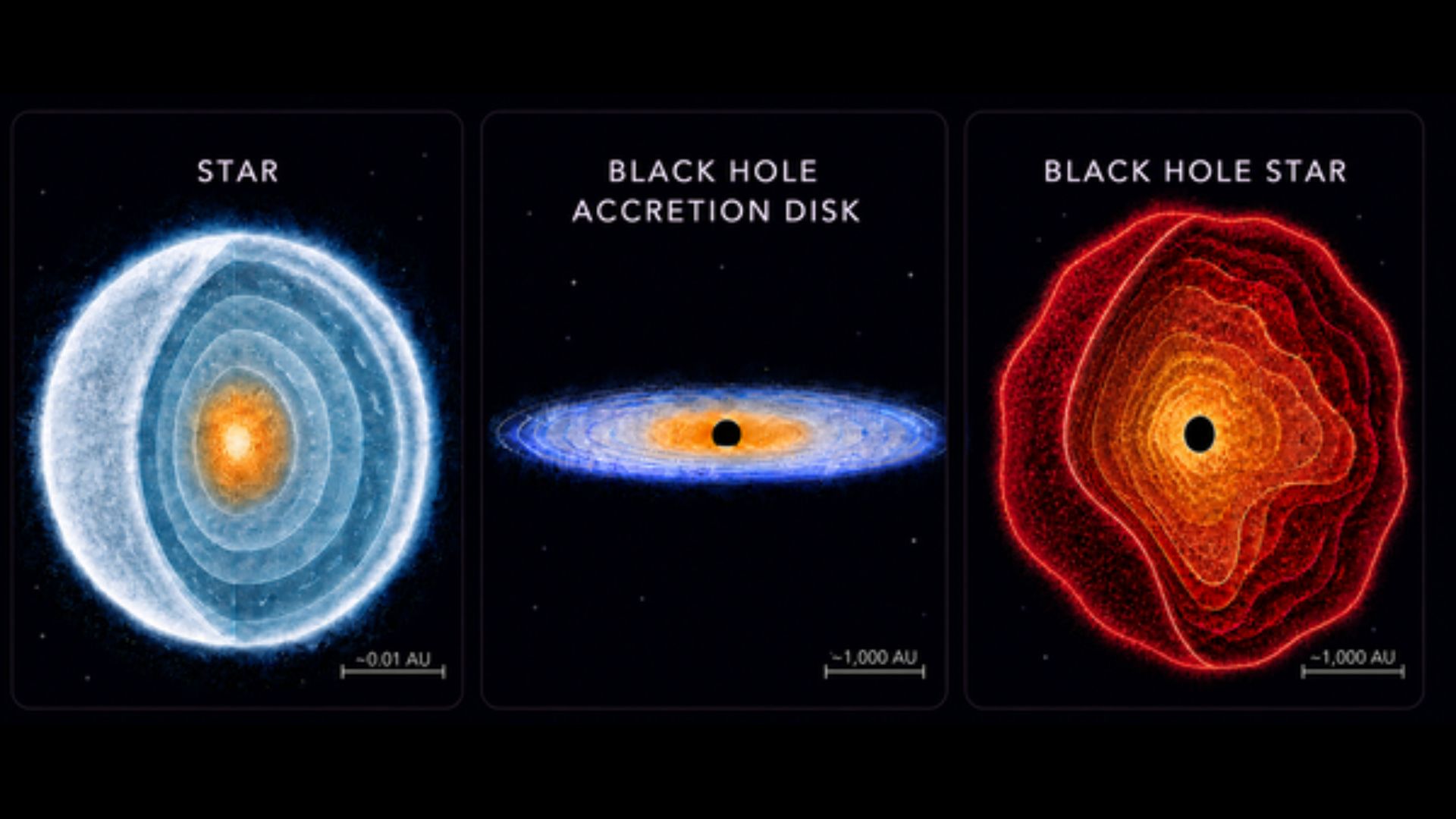
An artist's impression depicting the similarity between stars and black hole stars, except that black hole stars are at least 100,000 times larger than the sun. (Image credit: Rohan Naidu (University of Hawaii).)
"Astronomers have never lacked imagination: since the discovery of quasars, there has been no dearth of theories to explain how these black holes grew so massive so fast," said Naidu. "Something spectacular must have happened in the early universe. Now with JWST, we can directly observe this era and see for ourselves which scenarios actually occur."
Learning of the birth of supermassive black holes and whether they predate the galaxies that surround them was one of the primary science goals of the JWST before it launched. In this it has been tremendously successful so far. Despite little red dots having only been discovered four years ago, research into them and black hole stars is accelerating, with new findings coming out now almost on a weekly basis.
"These are incredibly exciting times with nearly a thousand papers and preprints on little red dots in the past two to three years," said Matthee. "Far from a mirage, this might well be a cosmic miracle."
The findings were published on Aug. 13 in the journal Nature.
New evidence has come to light showing that the mysterious 'little red dots' discovered in the early universe by the James Webb Space Telescope could evolve into the active centers of fully formed galaxies.
"Everything created in the early universe must evolve into something around us," said George Rieke of the University of Arizona in a statement. "We have had little idea of what little red dots become, but these results finally show us how to find their progeny."
Discovered by the James Webb Space Telescope (JWST) almost as soon as it became operational in 2022, little red dots have been a perplexing cosmological mystery. As their name suggests, they appear small, red and surprisingly bright. They are mostly found at redshift values suggesting they existed between 13.2 and 12.2 billion years ago. To shine so brightly at such great distances would usually imply these objects are quasars — which are luminous nuclei of galaxies powered by active supermassive black holes — but the light coming from little red dots is more like that of bloated stars. It looks to be mostly in infrared with some ultraviolet, and none of the X-rays that one would expect from an active black hole chomping down on material.
As such, researchers have come up with the hypothesis that little red dots are "black hole stars," or vast clouds of gas heated from within by a concealed but growing supermassive black hole.
However, the population of little red dots drops off a cliff at redshifts equating to less than 12 billion years ago. Where did they all go? There are two options. Either they all died off, or they developed into objects more familiar to us.
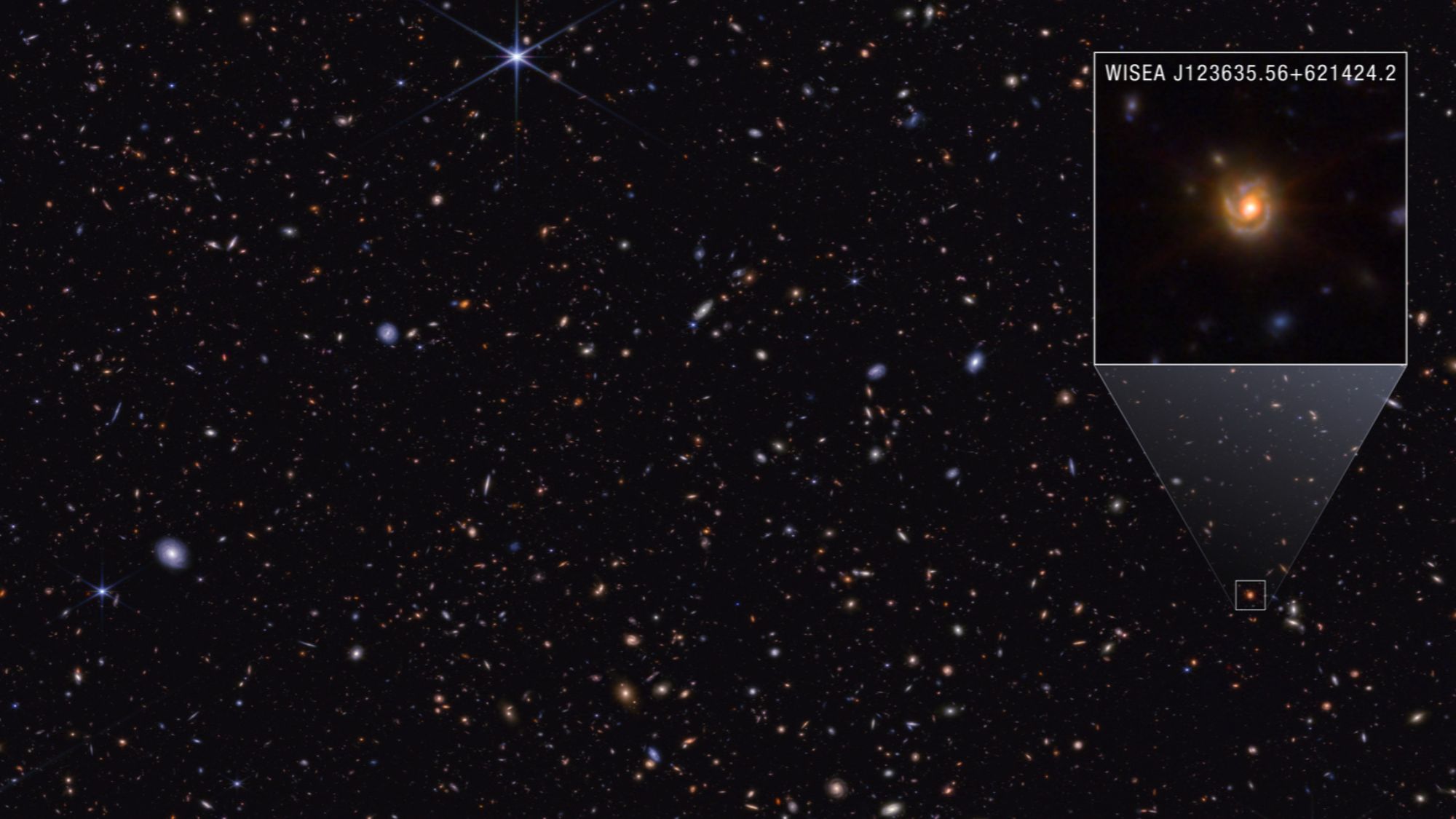
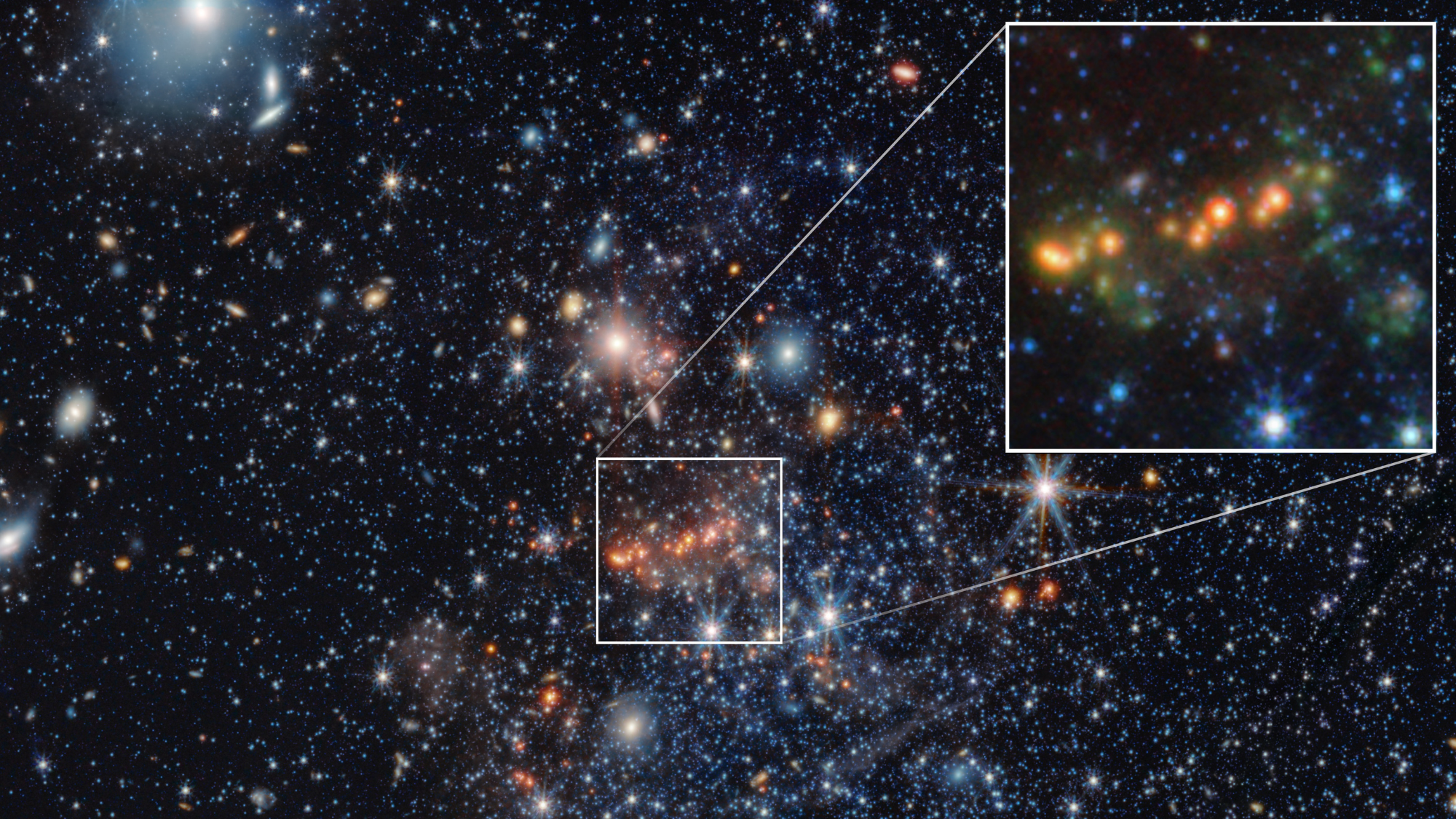
A team led by Pierluigi Rinaldi, who was at the University of Arizona's Steward Observatory when conducting this research but is now at the Space Telescope Science Institute (STScI) in Baltimore, think it has identified a descendent of a little red dot. It appears to be in the form of a distant galaxy, catalogued as WISEA J123635.56+621424.2, which is found at a redshift of 2, meaning that we see it as it was 10.5 billion years ago.
The galaxy displays neat spiral arms around a red core. Rinaldi's team have nicknamed it the Saguaro, after a species of cactus native to the Sonoran desert in the United States' south-west, thanks to the galaxy's arms and how its core resembles the red fruit produced by the cactus.
A field of galaxies in Ursa Major, with the Saguaro galaxy inset. (Image credit: NASA/ESA/CSA/STScI/Pierluigi Rinaldi (Steward Observatory); Image Processing: Alyssa Pagan (STScI))
Saguaro's core has all the hallmarks of a little red dot. It shines bright in infrared as seen by JWST, and also emits in ultraviolet as detected by the Hubble Space Telescope. Yet, NASA's Chandra X-ray Observatory has also detected faint X-rays originating from Saguaro.
"What the X-ray observations show is that this galaxy has an active galactic nucleus, and a very obscured one at that," Carys Gilbert of the University of Cape Town in South Africa, who participated in the study alongside Rinaldi, said in the statement. "It's not only obscured but also X-ray weak. That kind of combination could explain the lack of X-ray emission that we see from all other little red dots. It fits the puzzle of little red dots nicely."
This is not the first time X-rays have been seen coming from a little red dot. Earlier this year it was reported that scattered X-rays were seen breaking through from a little red dot called 3DHST-AEGIS-12014, given credence to the hypothesis that little red dots are black hole stars, where the black hole gradually consumes the "star" from the inside out, eventually carving holes through which X-rays can escape. We see 3DHST-AEGIS-12014 as it was 11.8 billion years ago, meaning that Saguaro, which existed 1.3 billion years later, is a little bit further on in its development.
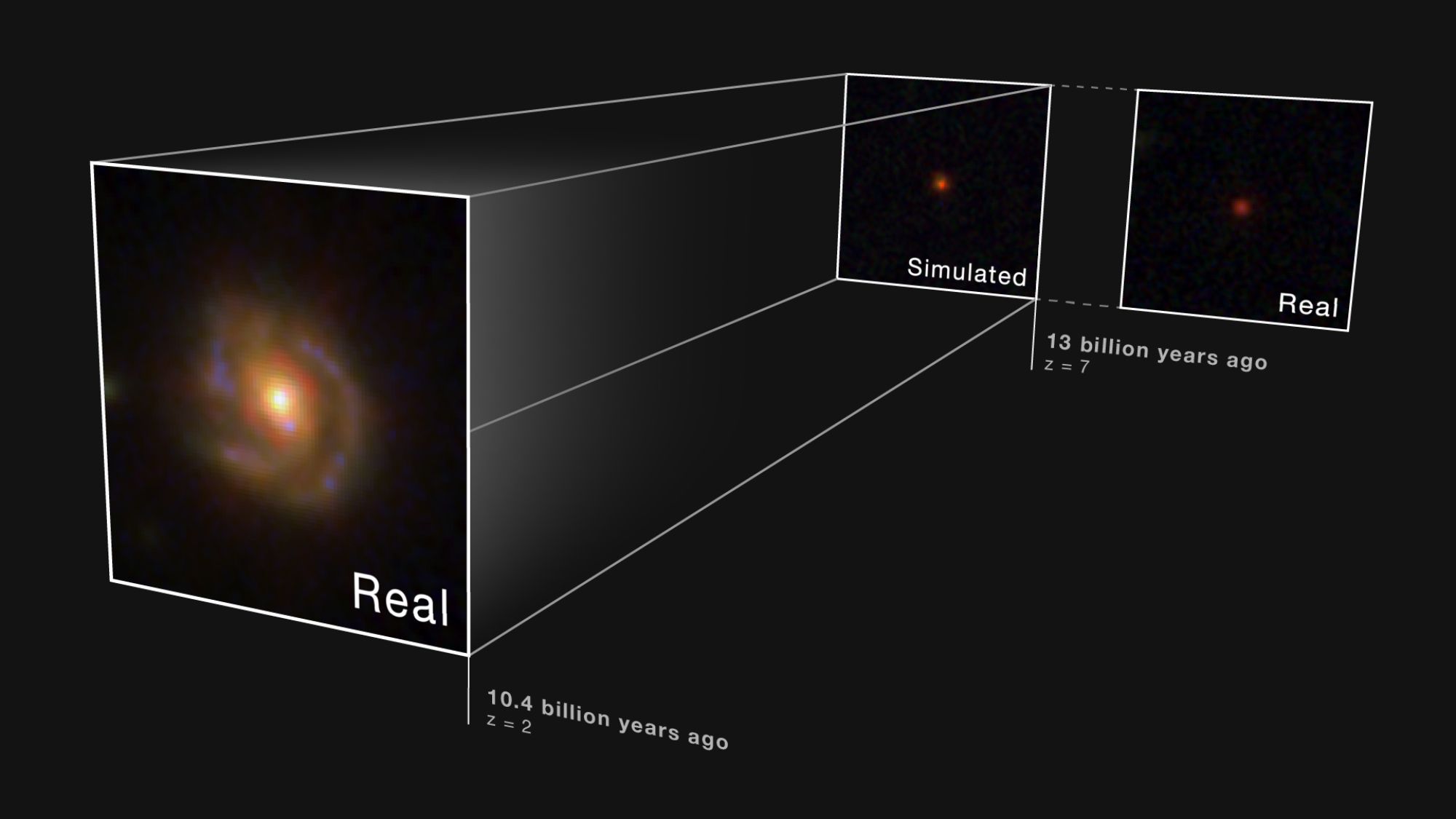
A comparison to how the Saguaro galaxy appears to us now, and how it would appear as a little red dot if it existed at a higher redshift. (Image credit: Alyssa Pagan (STScI); Illustration: Leah Hustak (STScI))
"Because the Saguaro is at lower redshift, we can see the very beautiful and bright host galaxy in high resolution and detail with Webb and Hubble," said Harvard's Zihao Wu, who was also part of Rinaldi's team.
Intrigued, Rinaldi's team simulated how Saguaro would appear to us if it existed a billion years after the big bang. Much of its galactic structure would either be less developed or simply just too faint to be seen at such distance. All that would be visible would be the nucleus, looking very much like all the other little red dots.
This implies that little red dots are not a unique population of their own, but are simply a phase in the development of galaxies with supermassive black holes. Our own Milky Way could have been a little red dot once upon a time.
Saguaro is a crucial link in the story of little red dots and how they connect with modern galaxies. While there is still much to learn, such as the beginning of their story and how they form, the middle and end of their story is now beginning to take shape.
The Carina Nebula's "Treasure Chest" stuns in this new image captured by the James Webb Space Telescope. (Image credit: ESA/Webb, NASA & CSA, M. Reiter)
In a nebula far, far away, colossal clouds of dust and gas tower amongst the stars.
What is it?
This spectacular new image from the James Webb Space Telescope showcases the brilliant majesty of the Carina Nebula, a giant cloud of dust and gas found 7,500 light-years away in the constellation Carina.
In this new image, captured by JWST's Near-Infrared Camera (NIRCam), you can see the nebula in a whole new light. This snapshot captures a specific feature that is being dubbed the "Treasure Chest," as it vaguely resembles a glowing coffer overflowing with stellar jewels.
This "Treasure Chest" contains a cluster of young stars, approximately 70 stars in total. While these might be young, growing stars, the most massive of the bunch is a whopping 19 times more massive than our sun.
Why is it incredible?
While JWST has looked at the Carina Nebula before, new observations can reveal completely new details and help scientists uncover new information about the nebula and the strange ways in which the universe works.
Right now, scientists think that the star cluster in the "Treasure Chest" is about 1.3 million years old. However, previous estimates thought the grouping could be just 100,000 years old. So, new observations by powerful telescopes like JWST can significantly change our understanding of the cosmos.
With each new observation or data point, the history and context of the universe around us could completely transform. And, as this star cluster grows over time, its stars will become more brilliant. They may therefore illuminate more of this star cluster, potentially revealing details and secrets of this "treasure" that scientists might never have predicted.
Paleontologists now know that many of the dinosaurs didn't disappear but instead evolved into modern birds, and new research suggests that "cosmic dinosaurs" observed by the James Webb Space Telescope (JWST) didn't go extinct either. Rather, they may have evolved into familiar sights in the modern universe: vast conglomerations of densely packed stars called "globular clusters."
Little Red Dots became quite the puzzle for astronomers in 2022, when the JWST began to routinely spot them in abundance around 600 million years after the Big Bang. That is because these objects seemingly disappear before the cosmos gets to around 2 billion years old.
Astronomers have proposed many different explanations for Little Red Dots, including the suggestion that they could be "black hole stars," or black holes wrapped in vast shrouds of dense gas and dust. This team theorizes that a forming globular cluster with a supermassive star, a hypothetical short-lived stellar body with between 1,000 and 10,000 times the mass of the sun, would also look a lot like a Little Red Dot at its heart.
"These may not be just a strange new JWST population with no connection to the universe around us today," team leader John Chisholm of the University of Texas Austin said in a statement. "Instead, Little Red Dots may persist past the early universe, evolving into something relatively familiar.
"Little Red Dots could be galaxies, they could involve black holes, or they could be something even more unexpected. Our work shows that forming globular clusters with supermassive stars should be part of that conversation."
An unfamiliar side to a familar sight
Globular clusters are generally seen in large galaxies and are densely packed with up to many millions of ancient stars. Our galaxy, the Milky Way, is host to at least 150 globular clusters, and though familiar, astronomers still aren't quite sure how they form.
"We usually see them [globular clusters] after billions of years of evolution, at a time when their massive stars are gone, their gas has been cleared out, and dynamical processes have changed their masses and structures," team member Danielle Berg of UT Austin said in the statement. "That makes it very hard to reconstruct the original conditions they formed in."
It is thought that the stars in globular clusters all formed at the same time in the early universe. However, at this time the cosmos should only have had hydrogen, helium and a smattering of heavier elements (which astronomers call "metals") available for star construction. Yet, many stars in globular clusters are strangely abundant in helium and metals like nitrogen, sodium and aluminum, while lacking the expected levels of carbon, oxygen and magnesium.
"This specific pattern indicates nuclear fusion at very high temperatures, much higher than in the cores of even massive normal stars," team member Mike Boylan-Kolchin of UT Austin said in the statement. "A supermassive star is precisely the kind of environment that could produce this combination."
Globular cluster NGC 6638, as seen by the Hubble Space Telescope. (Image credit: ESA/Hubble & NASA, R. Cohen)
Supermassive stars capable of generating this kind of heat would form in the dense environments of early globular clusters in which stellar collisions and mergers would be expected to occur over and over again. The resultant supermassive stars would be short-lived, lasting just around 1 million years (remember the sun is middle-aged at 4.6 billion years old) — but this would be sufficient time to forge the elements needed to explain the peculiar chemistry of globular clusters.
When these supermassive stars die in supernova explosions, the elements they forged would be blasted out to become the building blocks of the next generation of stars. This would provide the stars of modern globular clusters with their unusual chemical fingerprints.
"In our model, the supermassive star that helps make the object look like a Little Red Dot would live for only a short time," Chisholm continued. "Once that star dies, the object may no longer look like a Little Red Dot, even if the cluster itself survives billions of years."
Just some of the "little red dot" galaxies discovered by the JWST. (Image credit: NASA, ESA, CSA, STScI, Dale Kocevski (Colby College))
Strange chemistry isn't the only thing linking early globular clusters with Little Red Dots, however. Not only does the team propose that the distribution of Little Red Dots in the early universe matches the distribution of modern globular clusters, but they also say models of Little Red Dot evolution show that their estimated masses could easily lead to the masses of globular clusters seen in the recent universe.
There is also the issue of timing. Little Red Dots appear around 600 million years after the Big Bang, and that is also the time that scientists estimate that globular clusters would have begun to form.
"There's no single smoking gun at this point that says Little Red Dots are globular clusters, but it would explain a lot of diverse and surprising observations," said Boylan-Kolchin.
This study is currently available to view as a pre-print on the paper repository arXiv.
Using the James Webb Space Telescope (JWST), astronomers have discovered the secrets of early galaxies that pumped the infant cosmos full of dust, which would become vital for the birth of new stars and the growth of galaxies.
However, while the JWST is powerful enough to see many of these early galaxies, it is still limited when it comes to delving into them in great detail. So, the team at the heart of this research worked around this by studying a much closer and more modern galaxy with many characteristics that resemble the universe's first galaxies.
In lieu of being able to study the processes that occurred in the early universe that allowed galaxies to be seeded with "metals, (the term astronomers use to describe elements heavier than hydrogen and helium), the researchers turned their attention to a dwarf galaxy just 4.6 million light-years away.
"Directly studying the galaxies that populated the early universe is still very difficult, which is why observing a nearby galaxy like Sextans A, which presents similar chemical conditions, offers us a precious opportunity to understand how the first generations of stars evolved and what role they played in transforming the interstellar medium," team leader Claudio Gavetti of the National Institute for Astrophysics (INAF) said in a statement.
How does Sextans A impersonate ancient galaxies?
The early universe was a pretty dull place in terms of chemistry. That is because it was dominated by the lightest element, hydrogen, with some helium and a tiny smattering of heavy elements, or metals. That means that the first generation of stars, so-called POP III stars, were correspondingly metal-poor.
During their lives, however, POP III stars fused hydrogen and helium in their cores to forge heavier elements. When these original stars reached the ends of their lives, they exploded in supernova explosions that dispersed these metals into the interstellar medium, the vast clouds of dust and gas between stars.
Eventually, dense and cool patches in these vast clouds collapsed under their own gravity, birthing the next generation of stars, POP II stars, which, thanks to the supernova deaths of their predecessors, were richer in metals.
The dwarf galaxy Sextans A observed by the James Webb Space Telescope. (Image credit: NASA, ESA, CSA, STScI, Janice Lee (NOIRLab). Image processing: Alyssa Pagan (STScI).)
Our own star, the sun, is classed as a POP I star, meaning it is even richer in metals than these second-generation stars. However, not all modern galaxies are so metal-rich; this is especially true for dwarf galaxies like Sextans A, even though it lies at the outer edge of our cosmic backyard, known as the "local group."
Sextans A is so metal-poor that it is estimated to contain only between 1% and 7% of the heavy elements found in the sun. That makes it a great proxy for the study of metal-poor early galaxies.
Using the JWST's NIRCam (Near-InfraRed Camera) and MIRI (Mid-Infrared Instrument) instruments, Gavetti and colleagues obtained high-resolution observations of Sextans A that allowed them to map the dwarf galaxy's entire population of stars during an evolutionary phase known as the "asymptotic red giant branch."
This phase occurs when stars larger than the sun exhaust helium in their cores, creating an inert carbon heart, but nuclear fusion continues in outer alternating helium- and hydrogen-burning layers. These stars "puff out" as a result of this and can undergo thousandfold increases in brightness.
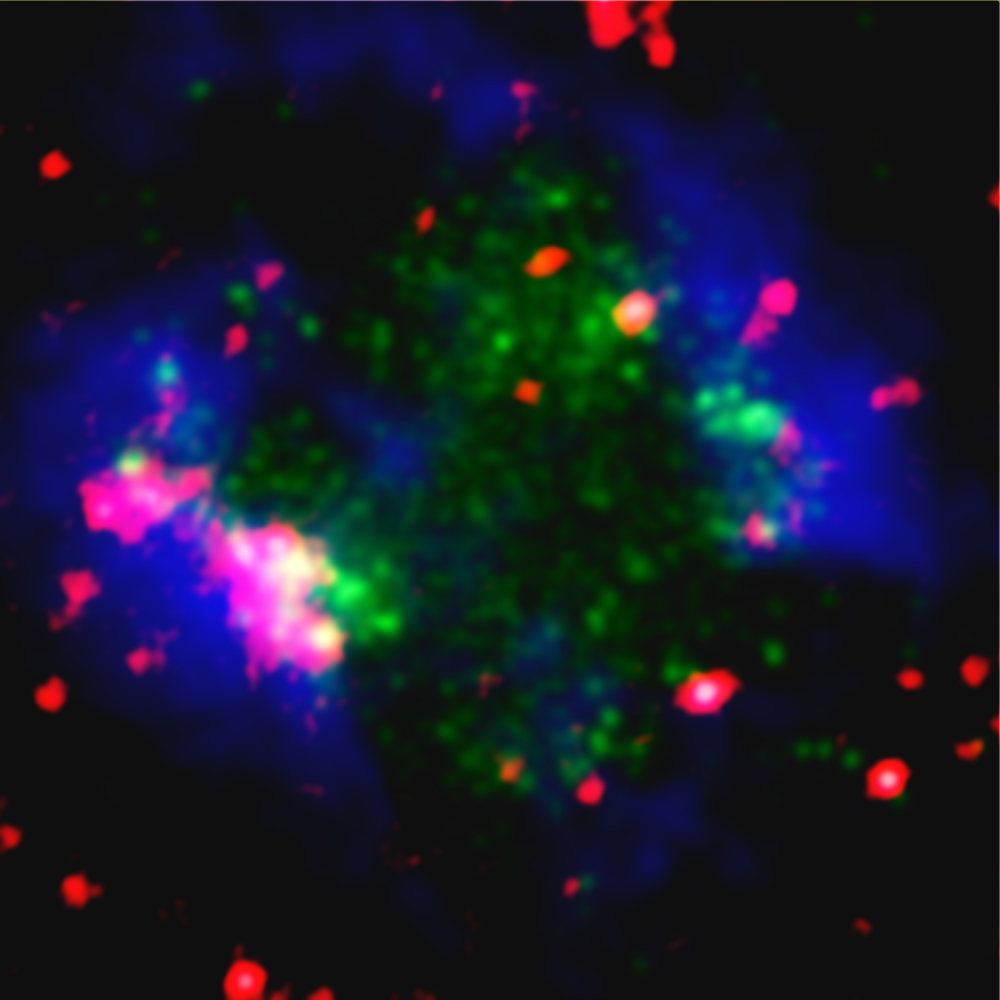
An image of the galaxy Sextans A where Red indicates the infrared emission of dust, blue the emission of atomic hydrogen gas, and green the far-ultraviolet emission created by newly formed stars. (Image credit: Yong Shi)
The team's findings revealed that around 90% of the asymptotic red giant branch stars they studied were not surrounded by envelopes of dust. However, around 20 or so of these stars were embedded in thick dust shells. They also found that these "dust factories" formed between 2 billion and 3 billion years ago from stars with an initial mass about 1.5 times the mass of the sun.
This research is a leap forward in understanding which stars in the early universe were most likely to create the metal dust that would have enriched the next generations of stars. That means it helps paint a complete picture of how the universe as we see it today took shape.
The scientists behind this study say that this type of research would have been impossible before the launch of Webb.
"The JWST allows us to observe in unprecedented detail environments that until a few years ago were beyond our reach," team member Flavia Dell'Agli of the INAF. "The value of these data lies not only in the images, but in the ability to compare them with theoretical models and verify how correctly they describe the evolution of stars."