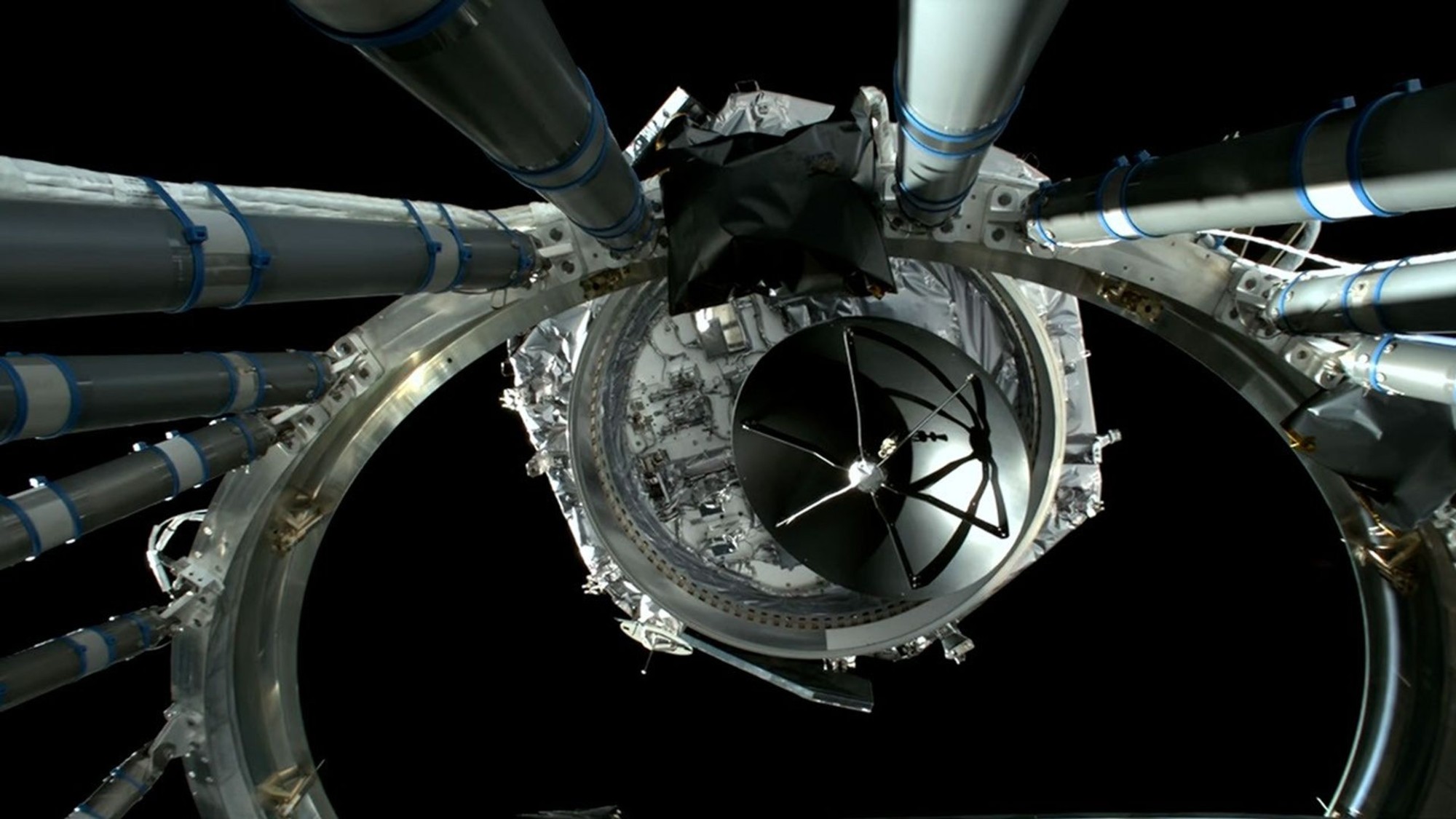
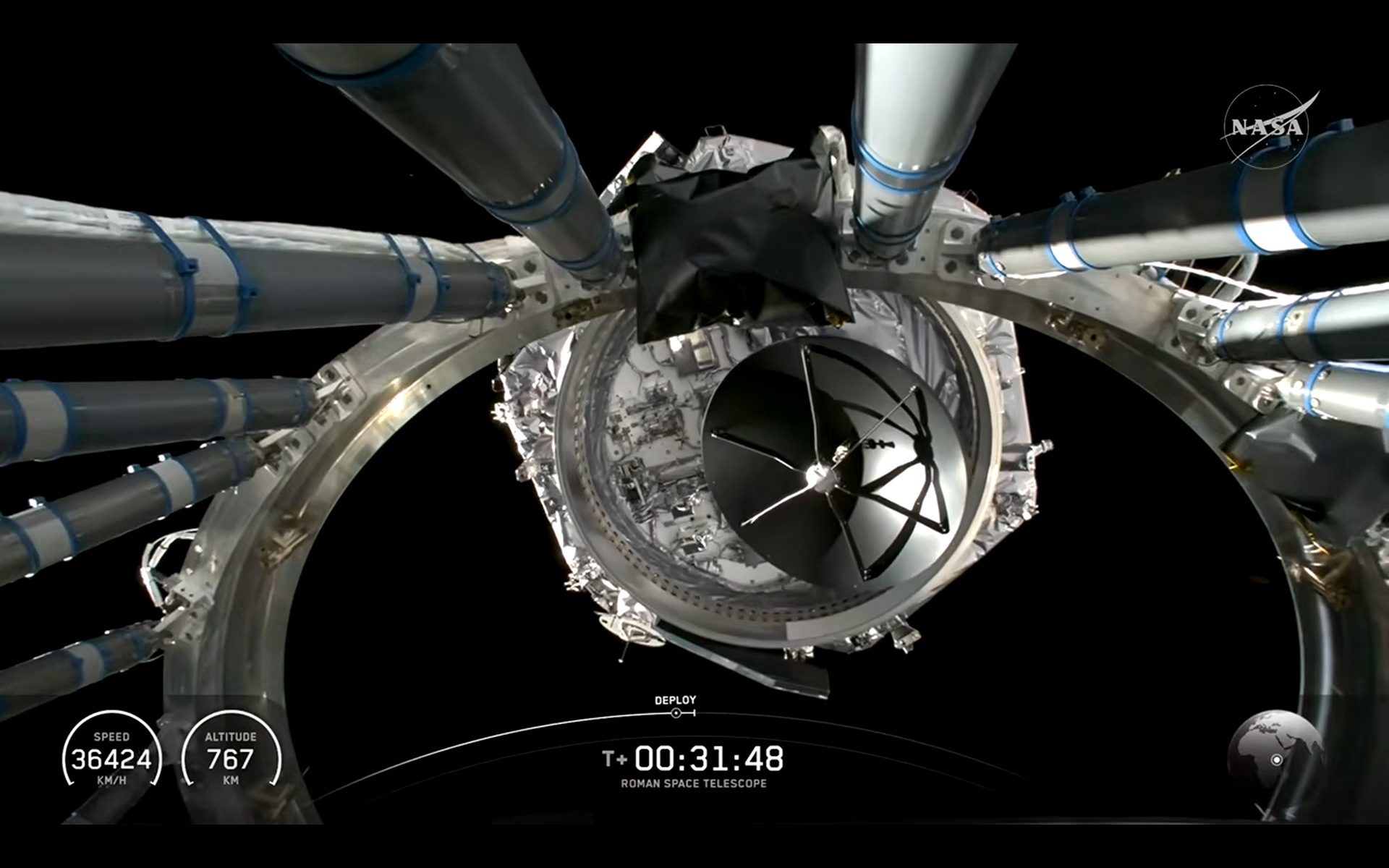
NASA's Nancy Grace Roman Space Telescope separates from a SpaceX Falcon Heavy upper stage after launching on Aug. 30, 2026. (Image credit: NASA)
NASA caught a breathtaking image of its next-generation Nancy Grace Roman Space Telescope deploying into space shortly after launch.
What is it?
This image was captured just some 31 minutes after the Roman telescope took off atop a SpaceX Falcon Heavy rocket from NASA's Kennedy Space Center in Florida on Sunday (Aug. 30).
The photo shows the Nancy Grace Roman Space Telescope (or Roman) flying on its own for the first time, shortly after separating from the upper stage of the SpaceX Falcon Heavy rocket that sent it to orbit. In the foreground, the telescope's payload adapter can be seen, while just behind, the orbital observatory floats into the blackness of space with its solar arrays still folded for launch.
This view reveals the back of the telescope, upon which its High Gain Antenna (HGA) radiofrequency dish can be seen. This is the dish the telescope will use to communicate with mission controllers on the ground and beam its groundbreaking science back to Earth.
Now well into its mission, the Roman Space Telescope will begin a 90-day commissioning period while traveling to sun-Earth Lagrange Point 2, or L2, a gravitationally stable parking spot in space between our planet and its star.
Why is it incredible?
It's always incredible seeing views like this one from space. Getting to witness a spacecraft deploy into orbit offers a rare glimpse at the conditions they experience in the vacuum of space.
But more than that, this photograph depicts the culmination of two decades of work from NASA and its contractors who helped develop and build the $4 billion Nancy Grace Roman Space Telescope — ahead of schedule and under budget, a rarity in the spaceflight world.
Once at L2 and fully commissioned, the telescope will begin probing the universe for clues that might help unravel the mysteries of dark matter and dark energy, as well as hunting for exoplanets around distant stars.
Rocket Lab successfully launched a private Japanese radar satellite to orbit early Wednesday morning (Sept. 2).
An Electron vehicle lifted off from Rocket Lab's New Zealand site on Wednesday at 8:01 a.m. EDT (1201 GMT; 12:01 a.m. local New Zealand time on Sept. 3). It carried a single Strix satellite for Synspective, a Tokyo-based Earth-imaging company.
Synspective is assembling a constellation of about 30 Strix satellites in low Earth orbit (LEO). These spacecraft — which are named after a widespread genus of owl — use synthetic aperture radar (SAR) to study our planet both day and night, and in all weather conditions.
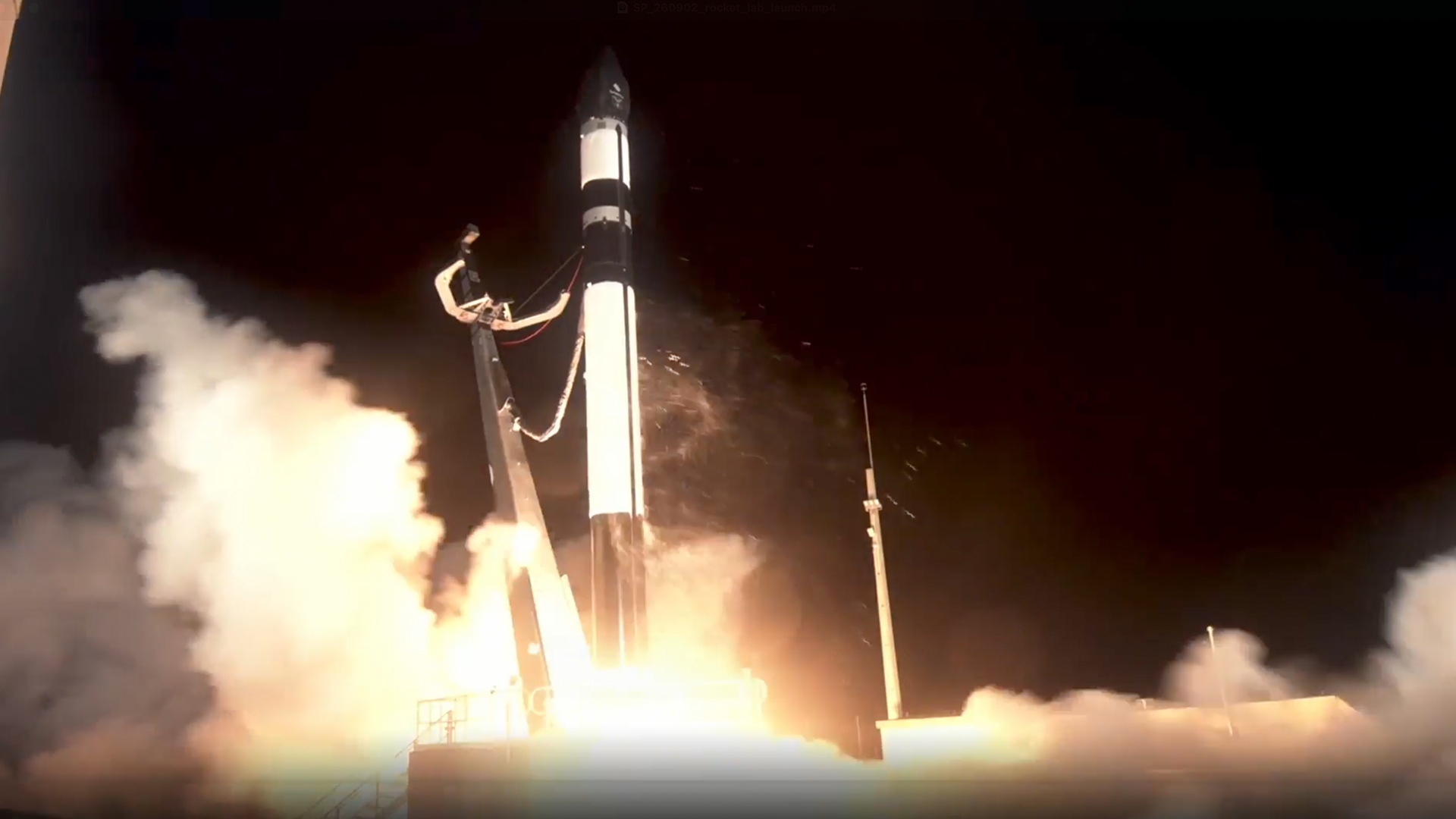
A Rocket Lab electron rocket launches the 'Owl Around the World' mission from New Zealand on Sept. 2, 2026. (Image credit: Rocket Lab)
The Strix constellation will "make it possible to quickly monitor and confirm on-the-ground changes during disasters such as earthquakes and floods at night, as well as in areas that are difficult to access," Synspective's website reads.
"In addition to disaster response, we will leverage our SAR satellite capabilities to promote efficient resource utilization," it adds. "For example, we can use our satellite data to monitor natural resources and urban development, ensuring sustainable and optimal use of land and water."
Eleven Strix satellites have now reached orbit to date, all of them atop Electron vehicles. Rocket Lab is currently the sole launch provider for Synspective and has 16 more missions for the company on its manifest after Wednesday's mission.
All went according to plan on Wednesday, according to Rocket Lab: The Electron's upper "kick stage" deployed the Strix satellite 56 minutes after liftoff, at an altitude of 357 miles (575 kilometers).
The 59-foot-tall (18 meters) Electron is designed to give small satellites dedicated rides to Earth orbit and beyond. Wednesday's mission, which Rocket Lab calls "Owl Around the World," was the rocket's 12th of 2026 and 85th overall.
Rocket Lab has also launched nine missions to date with HASTE, a suborbital version of Electron that allows customers to test sensors and instruments in a hypersonic flight environment. While Electron debuted in 2017, HASTE lifted off for the first time in June 2023.
Editor's note: This story was updated at 11:40 a.m. ET on Sept. 2 with news of successful satellite deployment.
CAPE CANAVERAL, Fla. — A new era of astronomy is about to begin after NASA's newest flagship observatory leaped from the terrestrial bounds of Earth into the vastness of space this morning.
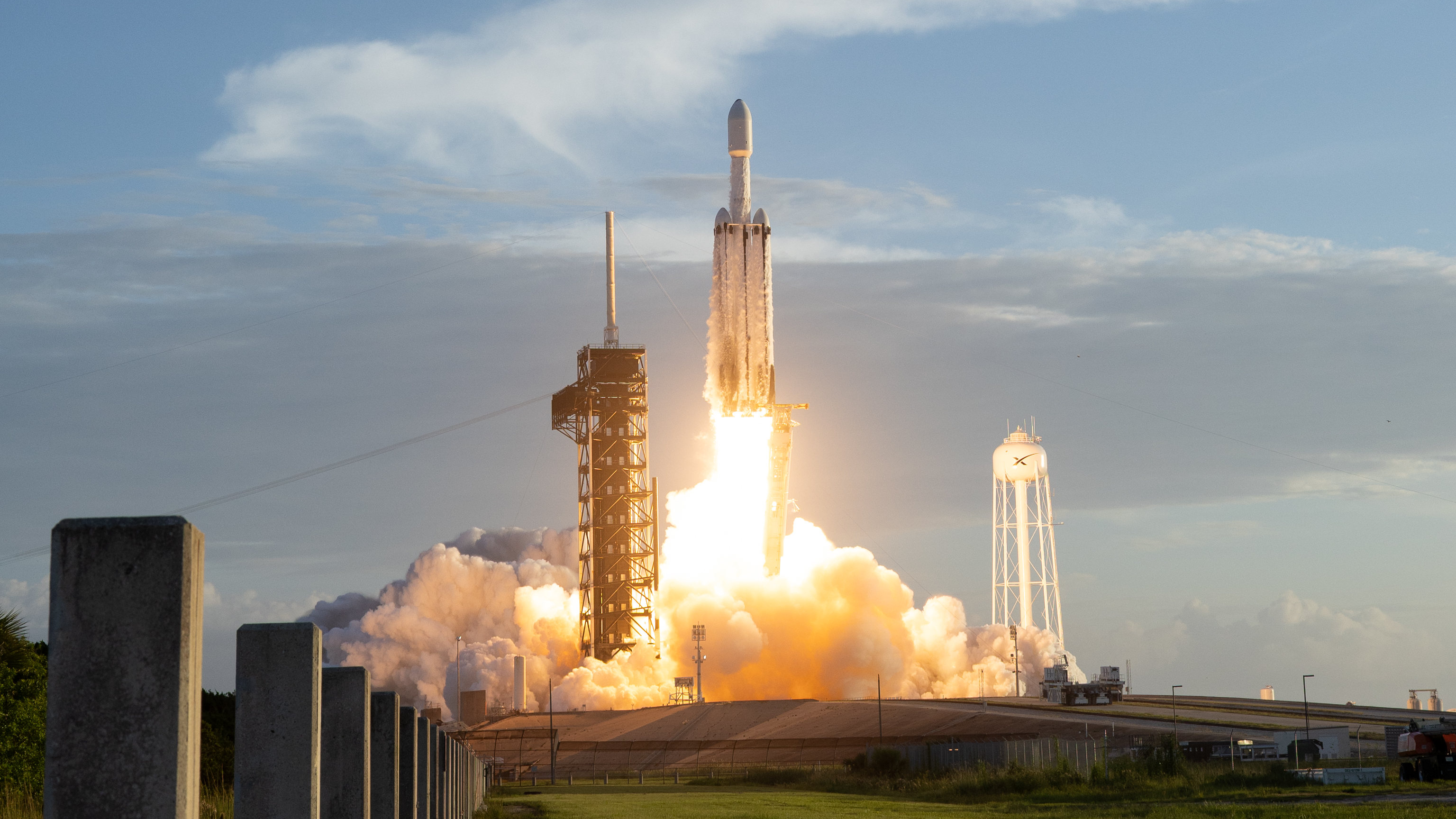
NASA's Nancy Grace Roman Space Telescope launched today (Aug. 30) on a SpaceX Falcon Heavy rocket from the Kennedy Space Center here in Florida. Liftoff occurred at 7:26 a.m. EDT (1126 GMT) at Launch Complex-39A (LC-39A).
Roman is NASA's newest orbital observatory designed to add to the wealth of research and discoveries we've received from the Hubble Space Telescope and James Webb Space Telescope. "The scope is extraordinary," Roman senior scientist Julie McEnery said during live commentary. "We will do a survey of our own Milky Way galaxy and find 20 billion stars. That would make it the largest catalog of astronomical objects that's ever been produced."
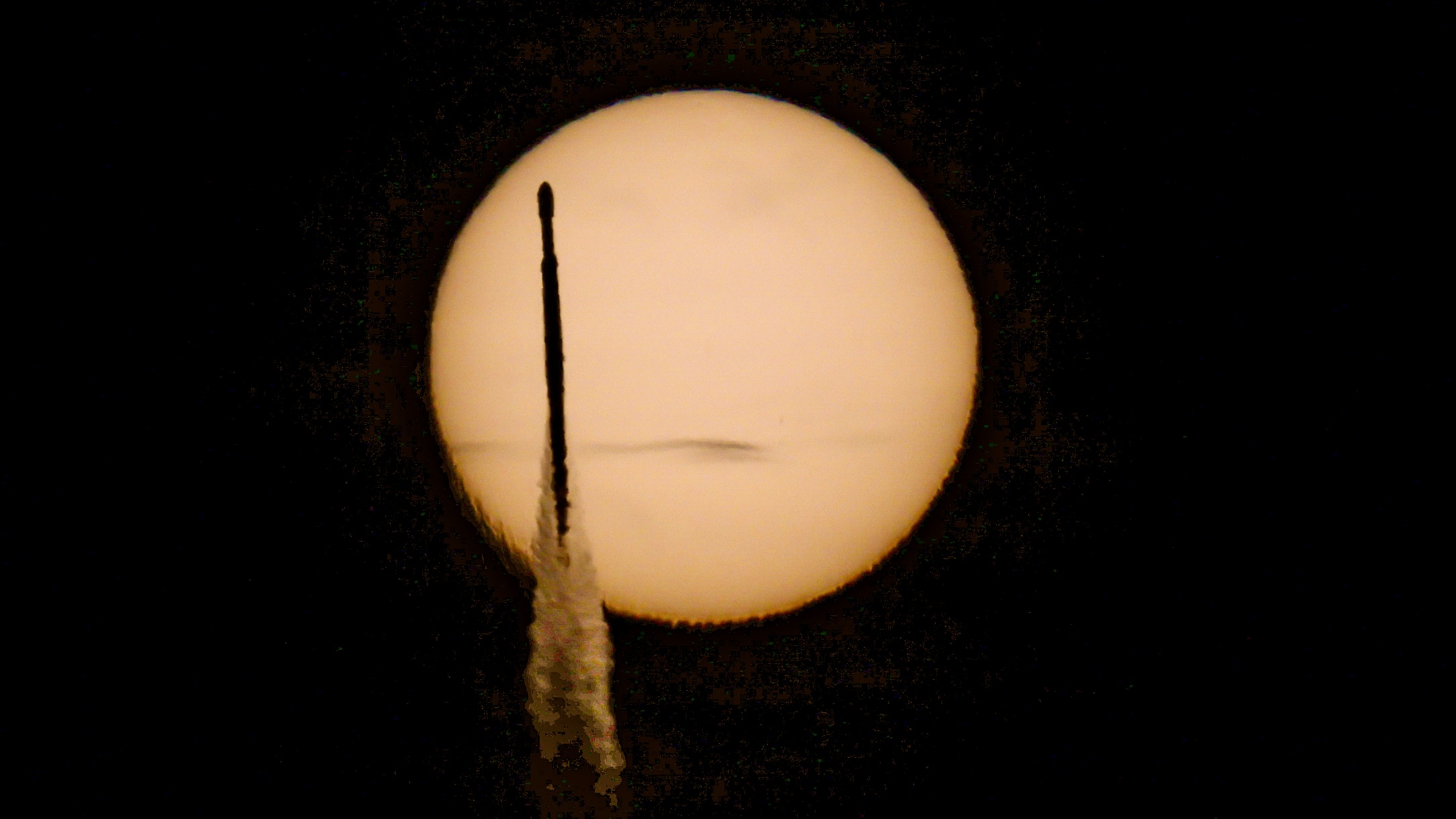
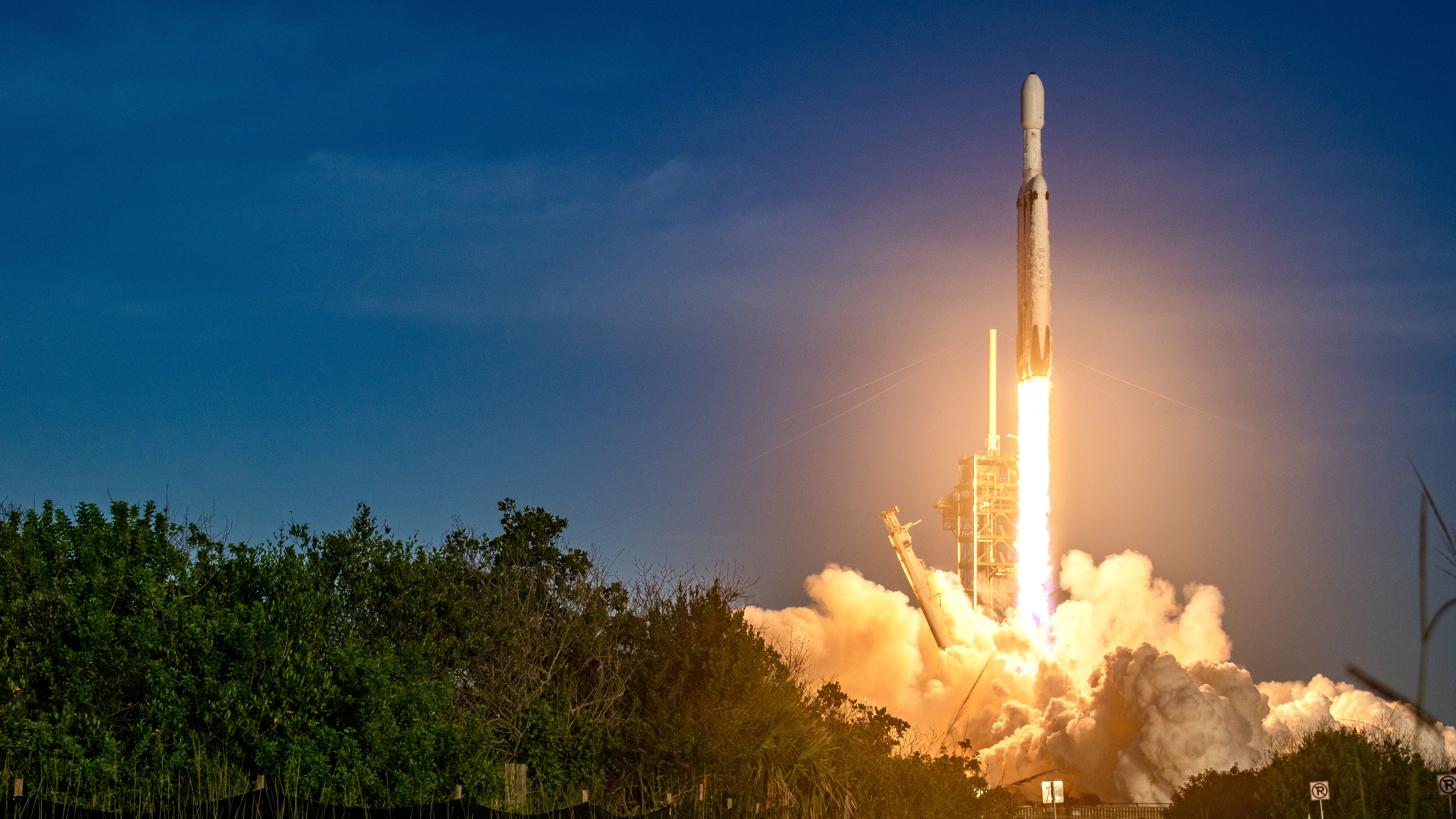
A SpaceX Falcon Heavy rocket carrying NASA's Roman Space Telescope crosses the sun during launch from Pad 39A of NASA's Kennedy Space Center, Florida on Aug. 30, 2026.Space.com / Josh Dinner A SpaceX Falcon Heavy rocket launches with NASA’S Nancy Grace Roman Space Telescope onboard from Launch Complex 39 on Aug. 30, 2026, at NASA’s Kennedy Space Center in Florida.Space.com / Josh Dinner A SpaceX Falcon Heavy rocket launches with NASA’S Nancy Grace Roman Space Telescope onboard from Launch Complex 39 on Aug. 30, 2026, at NASA’s Kennedy Space Center in Florida.NASA/Joel Kowsky
While Hubble and the JWST are built to get close looks at distant phenomena in the universe, Roman will study the bigger picture of our cosmos. Its main instrument, known as the Wide Field Instrument (WFI), will take extremely wide images of the universe, capturing ultra-high definition views across broad swaths of the sky. It's also equipped with the first active coronagraph to be used in space, which will revolutionize exoplanet studies.
The Roman Space Telescope is named after NASA's first chief astronomer Nancy Grace Roman, the first woman in an executive leadership role at the space agency. It was Roman who advocated for a telescope in space, leading to the Hubble Space Telescope. Roman, who died in 2018, earned the nickname "Mother of Hubble" as a result.
"It was Nancy in the old days, before the internet and before Google and email and all that stuff, who really helped to sell the Hubble Space Telescope, organize the astronomers, who eventually convinced Congress to fund it," Ed Weiler, Roman’s successor as Hubble's chief scientist, told the Voice of America in 2011.
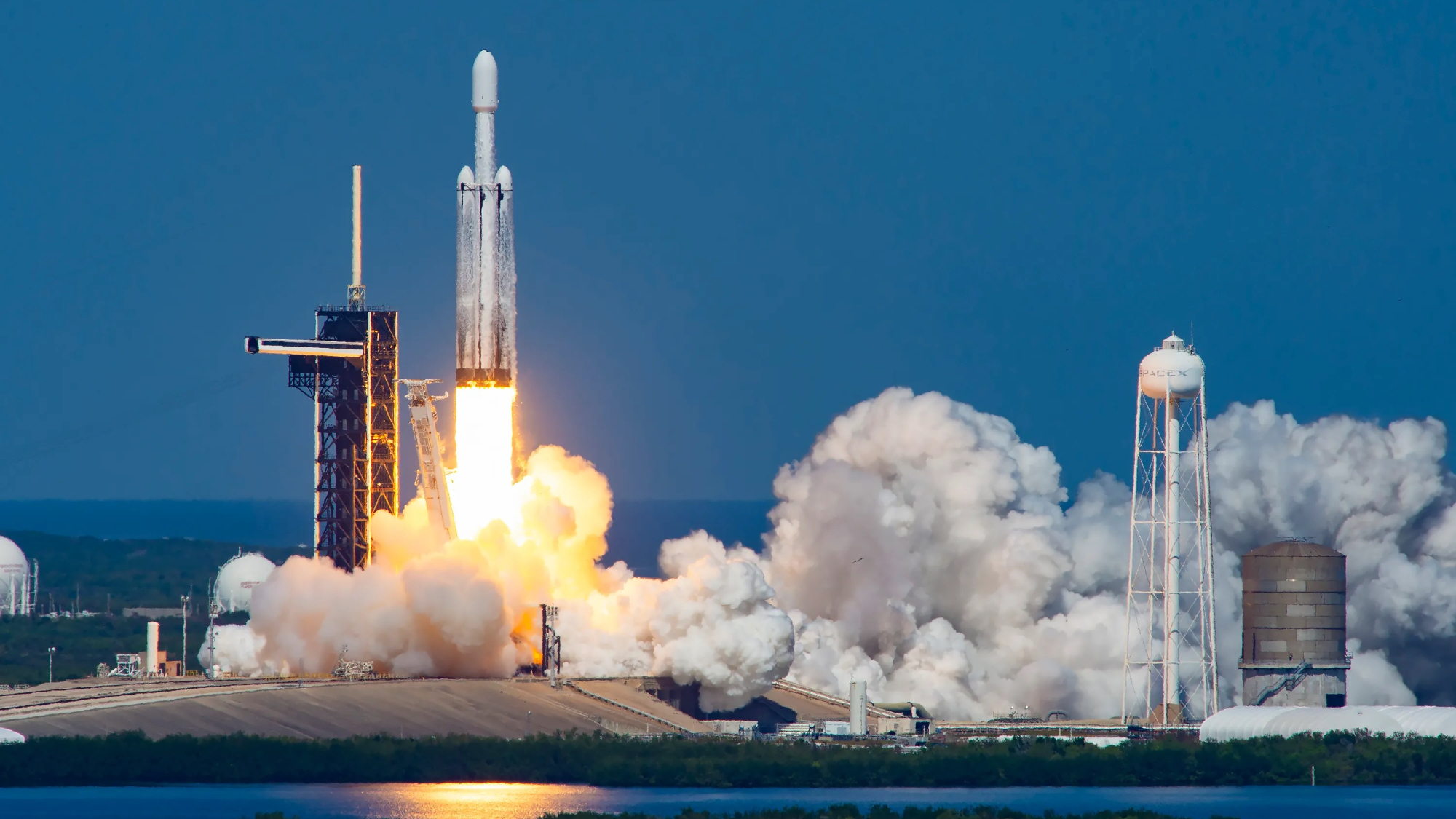
At liftoff, Falcon Heavy blazed off the pad at LC-39A, roaring with the thunder of 27 Merlin 1D engines on the business end of the SpaceX triple-booster launch vehicle. About 2.5 minutes into flight, the rocket's two side boosters cut off their engines for a nominal separation and began trajectory burns to return for a landing back here on the Space Coast.
The rocket's core booster then continued onward to deliver Falcon Heavy's second stage equipped with Roman into space. Main engine cut off (MECO) and separation of Falcon Heavy's main stage took place about four minutes after liftoff, with fairing separation about 15 seconds later.
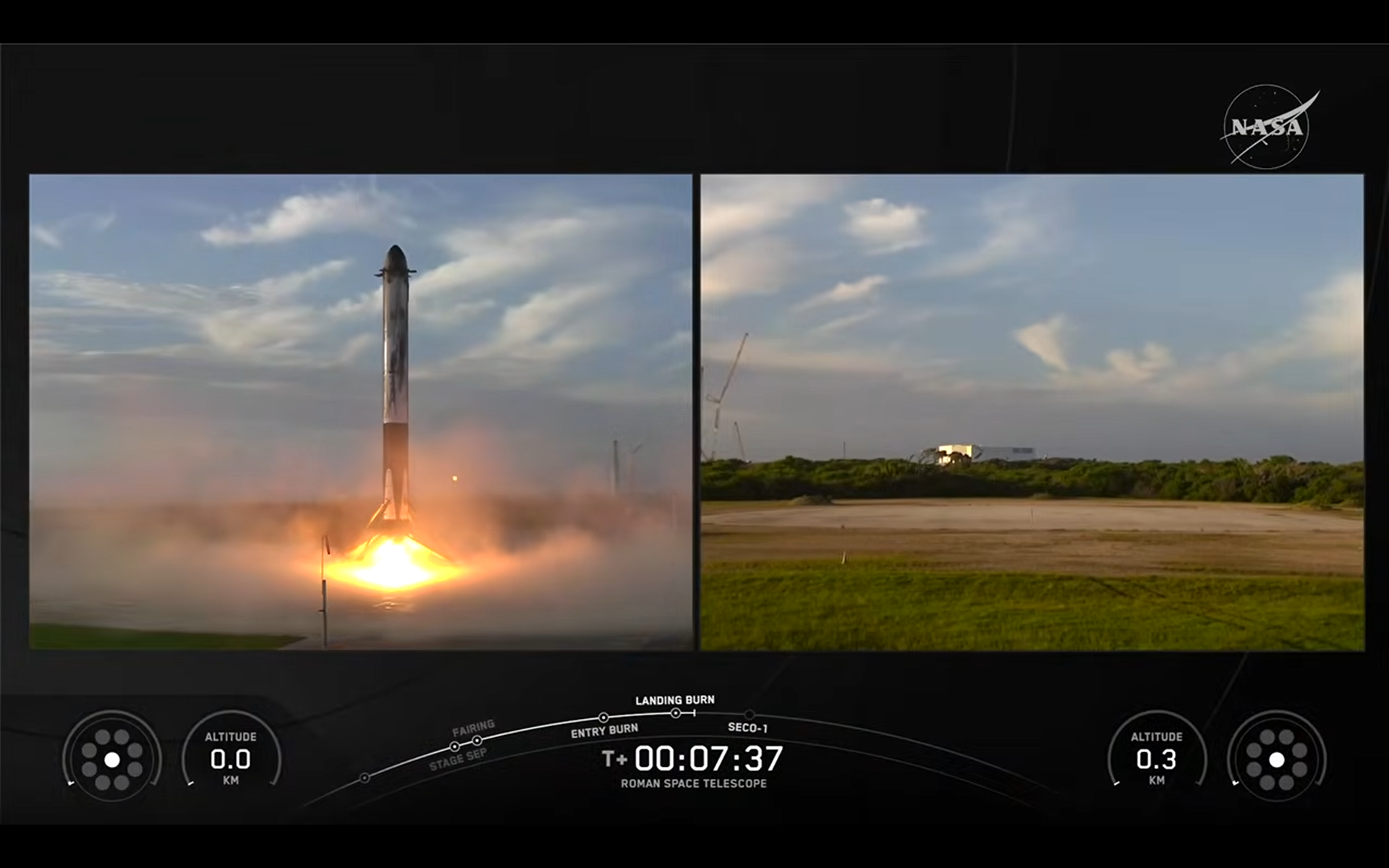
Falcon Heavy's side boosters, meanwhile, executed boostback burns for landings at SpaceX's Launch Complex-40 and Landing Zone-2 at Cape Canaveral Space Force Base, a few miles downrange from LC-39A.
A view of on e of the two SpaceX Falcon Heavy side booster as it lands at Cape Canveral Space Force Station following the Roman Space Telescope launch. (Image credit: NASA)
Roman's delivery to space caps more than a decade and $4 billion of development for the space telescope, which was made possible, in part, by incorporating elements of an unused spy satellite.
With its coronagraph and WFI, the telescope is designed to make groundbreaking strides in the fields of dark matter and dark energy, exoplanet discoveries, and will be capable of capturing views 100 times wider than those of its Hubble predecessor.
"The smallest Roman images will be a billion pixels," Dominic Benford, progam scientist for the Roman Space Telescope, said during live commentary. "When we take a billion-pixel image, there isn't a screen on Earth large enough to display all the pixels."
NASA's Roman Space Telescope flies free from its SpaceX Falcon Heavy rocket after a successful launch on Aug. 30, 2026. The large dish visible on the spacecraft is its high-gain antenna, which will beam its trillion-pixel photos back to Earth. (Image credit: NASA)
The coronagraph works by blocking out the light of distant stars in such a way that scientists can examine minute details around those stars — meaning they can map out exoplanets orbiting in the systems. Once active, Roman's Wide Field Instrument (WFI) will capture more than a terabyte of data daily; its largest survey will take over a year to complete and is expected to fill more than half a million 4K TVs.
How big will the largest Roman image be?
"A trillion pixels," Benford said.
You can actually adopt one of those Roman Space Telescope pixels yourself with NASA's new "Adopt a Pixel" program, which the agency announced during the Roman launch.
Roman's Falcon Heavy launch vehicle released the telescope to fly on its own a short 31 minutes after liftoff. NASA cheered the success, and even got a bit of a nod from celebrities in the form of a record message from singer Jewel.
"As you may know, I make artwork using astrophysical data, and there would be no data more fascinating than dark energy and dark matter," Jewel said in a recorded video. "And so, it is with this great wish of great success and Godspeed that I wish the Nancy Grace Roman Space Telescope so excited.
Now, the telescope is headed to sun-Earth Lagrange point 2 (L2), a relatively stationary orbital location beyond the orbit of the moon that allows the spacecraft to remain persistently on Earth's night side, with the sun on the opposite side of the planet. The locale places the sun to Roman's backside and points its sensitive instruments away from the intrusion of light reflected off the Earth and moon.
Roman's journey to L2 will take about 90 days. The first 40 or so of those days will be spent turning on the telescope's instruments and performing status checks as the spacecraft slowly configures itself for operation. Science commissioning will begin after about 45 days, its completion corresponding with when Roman arrives at L2.
"I very much hope, and in fact, expect that the most exciting science of Roman will be a surprise — something we couldn't predict and that will set the stage for the next, deeper set of questions for future missions to progress," McEnery told reporters a day before launch.
The telescope’s first images are expected in the beginning months of 2027.
CAPE CANAVERAL, Fla. — A new flagship observatory is about to launch to space and join the ranks of its powerful predecessors, like the Hubble and James Webb space telescopes.
NASA's groundbreaking new Nancy Roman Grace Space Telescope is ready to lift off aboard a SpaceXFalcon Heavy rocket. It's scheduled to depart from Launch Complex-39A at NASA's Kennedy Space Center in Florida, bound for a gravitationally stable spot in space called Lagrange Point 2, or L2, nearly 1 million miles (1.6 million km) from Earth. The spacecraft's first window for launch is tomorrow (Aug 30) at 7:26 a.m. EDT (1126 GMT).
Mission managers and launch administrators held a prelaunch briefing on Saturday (Aug. 29), confirming NASA and SpaceX's "go" to proceed toward tomorrow's lift off. Weather tomorrow currently poses a 50% chance of favorable launch conditions, according to launch weather officer Justin McReynolds of the Space Force's 45th Weather Squadron.
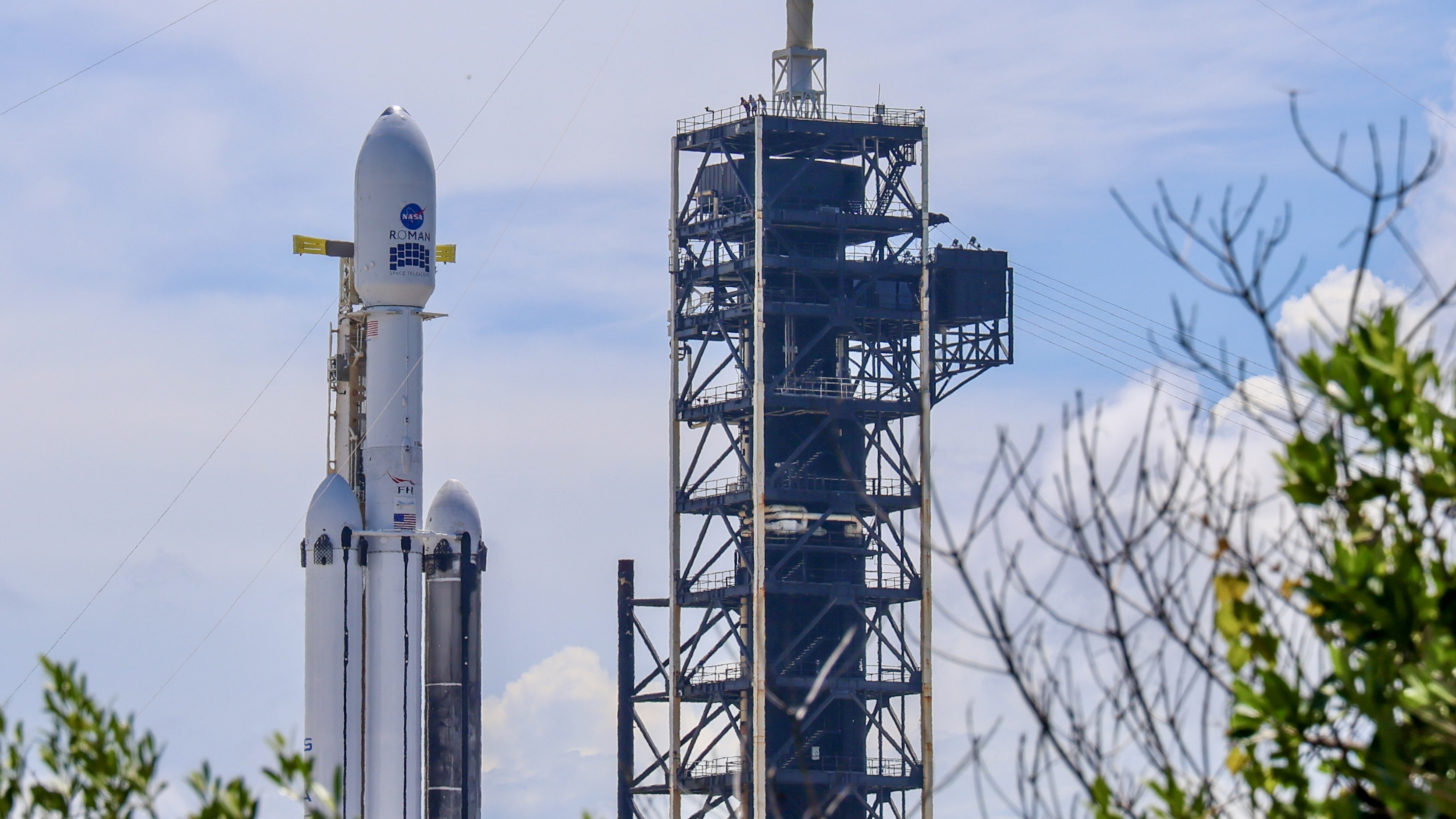
SpaceX's Falcon Heavy stands at LC-39A with NASA's Nancy Grace Roman Space Telescope on Aug. 29, 2026. (Image credit: Space.com / Josh Dinner)
Roman's final L2 destination will place the spacecraft in a persistent position on the opposite side of Earth from the sun. "That means that we have a wide open view of the sky that really exceeds anything in low Earth orbit like Hubble could achieve," Jackie Townsend, Roman's project manager, said during the press conference.
Once in space and operational, Roman will begin completing wide surveys of the entire universe, taking thousands of images every day. The telescope will also allow for new research into dark matter and dark energy, and it will directly image exoplanets around distant stars.
"Nancy Grace Space Telescope will blow your mind. It is the size of a tour bus, and it weighs the same as a T-Rex," Nicky Fox, associate administrator for the Science Mission Directorate at NASA, said during the press conference. "To put it into perspective, it will be as if Hubble and James Webb kind of peer through a keyhole at the universe, while Nancy Grace Roman will kick the door down."
Fox also put Roman's scientific potential in further context, saying its enormous datasets could help researchers tackle some of astronomy’s biggest questions. "Roman’s data will help bring us closer than ever to answering humanity's most profound questions,” Fox said, including whether "there are other solar systems like ours" and, ultimately, "are we alone in the universe?"
Before any of that science begins, however, Roman first has to get off the ground — and weather remains the biggest uncertainty for Sunday morning. McReynolds said forecasters are primarily watching offshore cumulus clouds, and the possibility of those producing showers or thunderstorms.
Conditions improve for the backup opportunities Monday and Tuesday, McReynolds said. The tropical disturbance influencing Sunday's forecast is expected to move west, dropping the probability of weather violating launch criteria to about 30% — offering a 70% chance of acceptable conditions.
Once in space, Roman will spend roughly three months going through instrument deployments, calibrations and checkout activities as it travels toward its operational orbit around L2. NASA expects the observatory's first science images to be released in early 2027.
SpaceX just took another step toward the highly anticipated next test flight of its Starship megarocket.
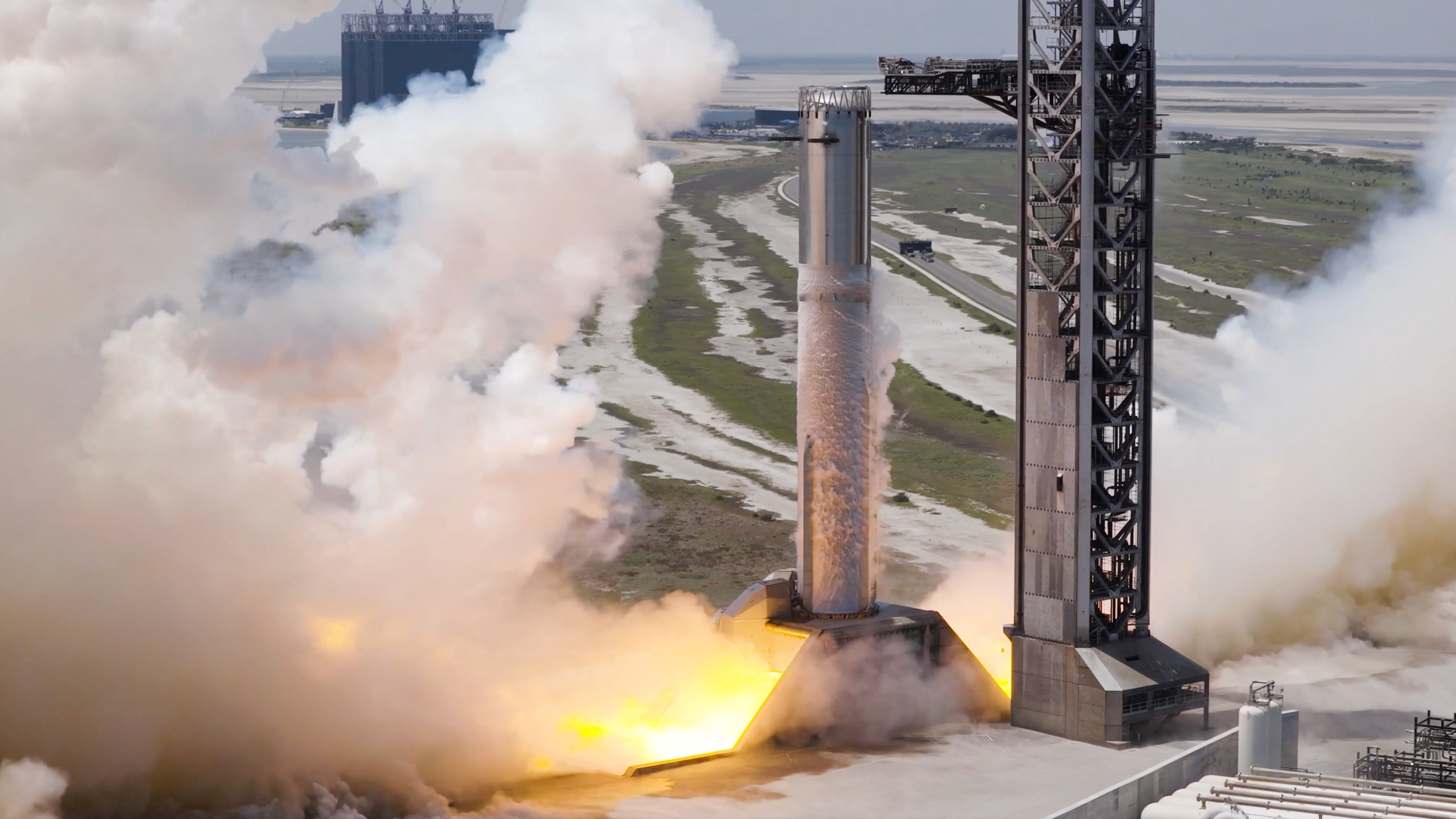
The company conducted an engine test with Starship's giant first-stage booster, known as Super Heavy, on the launch pad at its Starbase site in South Texas on Friday (Aug. 28).
"Full duration 33-engine static fire with the Super Heavy booster preparing for Flight 14," SpaceX wrote in a Friday X post that shared two videos of the test.
SpaceX fired up all 33 engines of its Super Heavy booster to gear up for the next Starship test flight, which will mark the first time the vehicle goes orbital. (Image credit: SpaceX)
As that post indicates, SpaceX is gearing up for the 14th test flight of Starship, a megarocket that consists of Super Heavy and a 171-foot-tall (52 meters) upper stage known as Starship, or Ship for short.
The company has already vetted the engines on Flight 14's Ship, firing up all six of them last week at Starbase.
SpaceX is believed to be targeting mid-September for Flight 14, which will be a big milestone in Starship's development — the vehicle's first-ever orbital trip. Ship will also apparently deploy operational payloads into orbit on the flight — a batch of SpaceX's next-gen "Version 3" Starlink satellites.
Ship successfully deployed 20 V3 Starlinks on Flight 13 last month, but on a suborbital trajectory, and the satellites soon crashed back to Earth.
Starship is the biggest and most powerful rocket ever built, and both Super Heavy and Ship are designed to be fully and rapidly reusable. SpaceX therefore thinks the megarocket can revolutionize spaceflight, helping humanity expand its footprint out into the solar system.
NASA is invested in the vehicle as well. The agency chose Ship as a crewed lunar lander for its Artemis program, which aims to build a base near the moon's south pole in the coming years. If all goes to plan for SpaceX, Ship will fly on NASA's Artemis III mission to Earth orbit in mid-2027 and land astronauts on the moon on Artemis IV in late 2028. (NASA picked a second crewed Artemis lander, Blue Origin's Blue Moon, which could fly on one or both of those missions as well).
A huge SpaceX rocket is just minutes away from launching NASA's next great observatory into space: the Roman Space Telescope. But if you're hoping to watch it live online, you'll have to get up pretty early today (Aug. 30) or you'll miss it.
"Roman’s deep, sweeping surveys will help investigate dark energy and dark matter, discover and characterize planets beyond our solar system, map billions of galaxies, study black holes and share enormous amounts of data with both scientists and the public," NASA said in an update Friday (Aug. 28), after clearing Roman for launch.
Here's a look at what time NASA's Roman Space Telescope will launch atop a SpaceX Falcon Heavy rocket, as well as how to watch online.
What time is SpaceX's Roman Space Telescope launch?
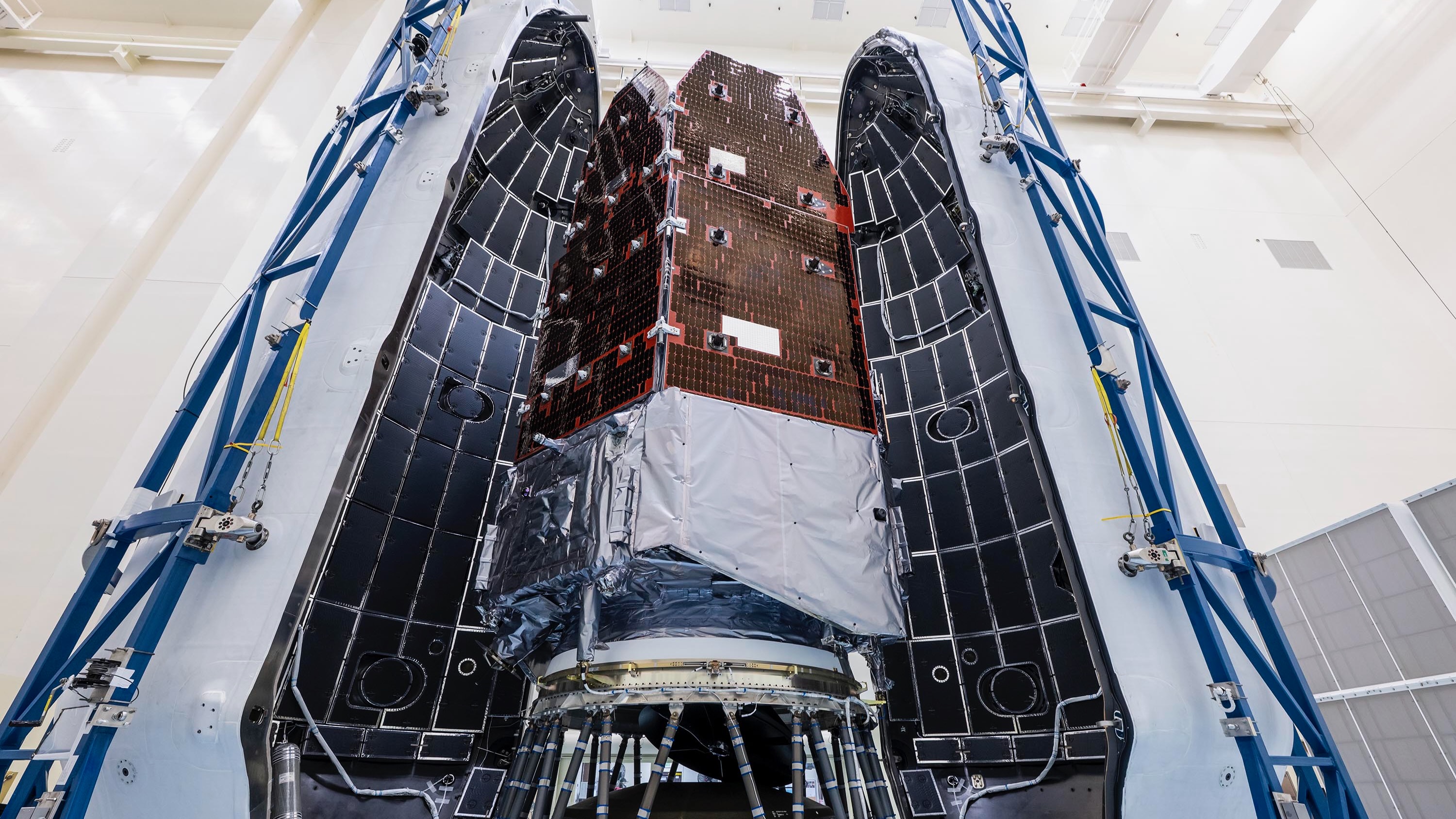
NASA's Nancy Grace Roman Space Telescope is encapsulated in the payload fairing of its SpaceX Falcon Heavy rocket. (Image credit: SpaceX)
SpaceX is currently targeting the launch of NASA's Roman Space Telescope for no earlier than 7:26 a.m. EDT (1126 GMT) today, Aug. 30.
The company will launch Roman into space atop a Falcon Heavy rocket from Launch Complex 39A at NASA's Kennedy Space Center in Florida. A launch livestream will begin about one hour before liftoff.
While SpaceX hopes to launch Roman on time, the company can try again tomorrow, on Monday, Aug. 31, if needed. A launch on that day would lift off a few minutes earlier, at 7:22 a.m. EDT (1122 GMT), SpaceX has said.
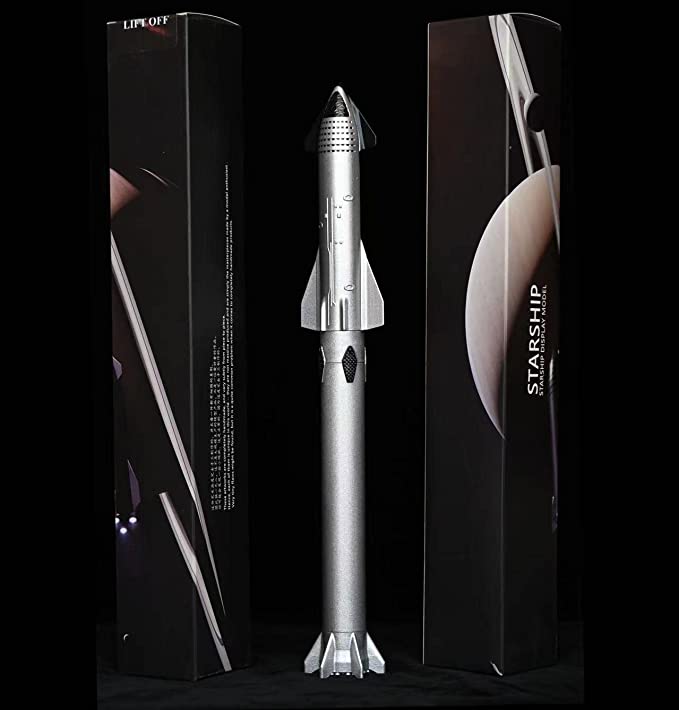
Even if you can't see SpaceX's Starship in person, you can score a model of your own. Standing at 13.77 inches (35 cm), this is a 1:375 ratio of SpaceX's Starship as a desktop model. The materials here are alloy steel and it weighs just 225g.View Deal
Can I watch SpaceX's Roman Space Telescope launch?
NASA will provide a launch webcast early Sunday morning. That livestream begins Aug. 30 at 6:20 a.m. EDT (1020 GMT) and will run through the launch and a post-launch briefing. That livestream can be found on the NASA website here, as well as all of NASA Social channels (Facebook, Instagram, X), and streaming channels like Twitch, Discovery+, Amazon Prime, NASA+, and of course YouTube.
SpaceX will also host its own launch livestream via its X account, which will begin about an hour before liftoff.
As mentioned above, SpaceX aims to launch Roman for NASA at 7:26 a.m. EDT (1126 GMT), with the flight lasting about 31 minutes and 31 seconds — the time post-liftoff at which Roman is expected to deploy into space.
A post-launch press conference is scheduled for 9:30 a.m. EDT (1330 GMT) and will include comments from the experts listed below.
NASA Administrator Jared Isaacman
Nicky Fox, associate administrator, Science Mission Directorate, NASA Headquarters
Jackie Townsend, Roman telescope project manager, NASA Goddard
Julie McEnery, Roman telescope senior project scientist, NASA Goddard
Denton Gibson, launch director, NASA’s Launch Services Program, NASA Kennedy
How long is SpaceX's Roman Space Telescope launch?
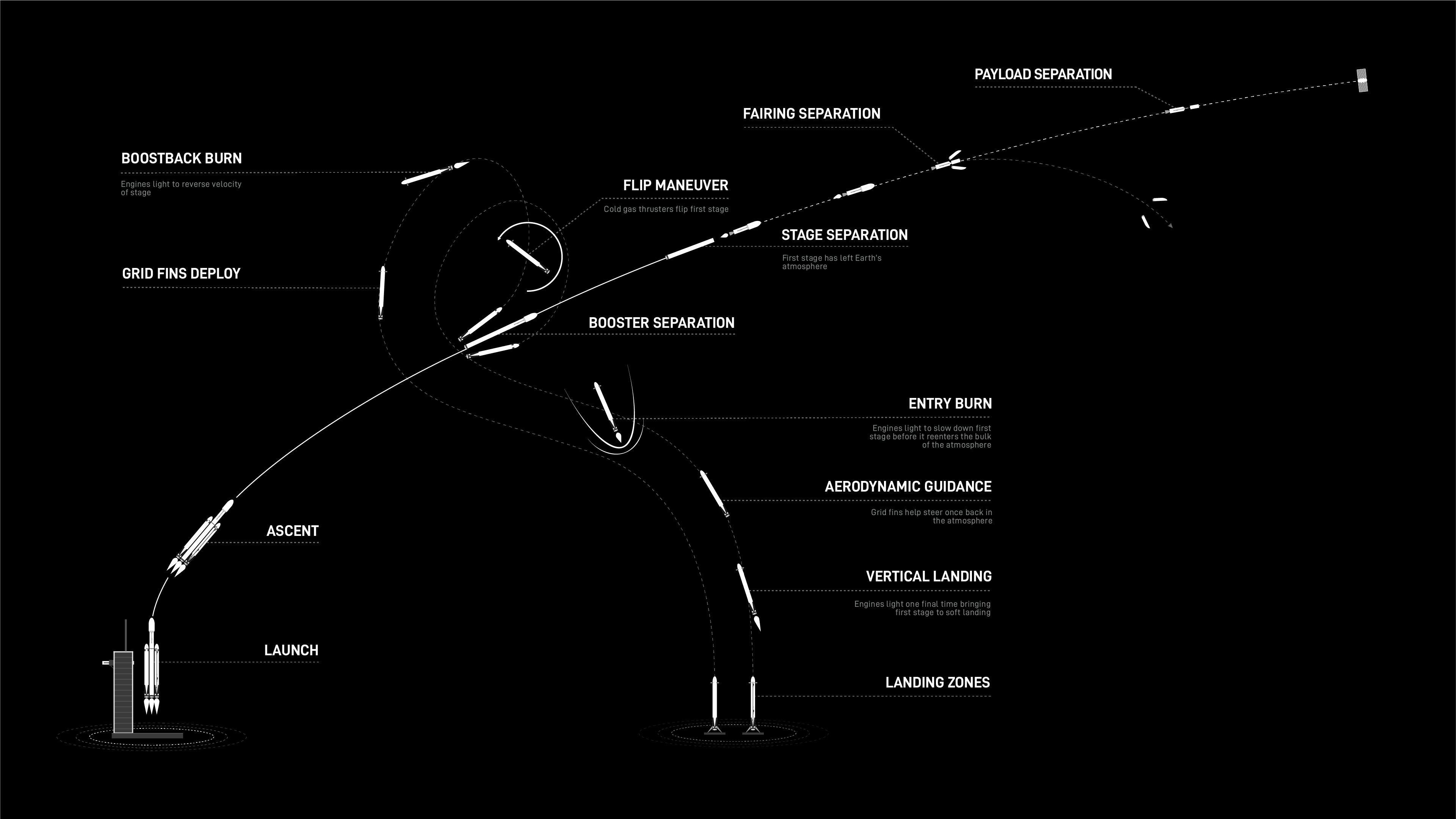
A diagram showing SpaceX's Roman Space Telescope launch profile on a Falcon Heavy rocket. The flight should last about 31.5 minutes. (Image credit: SpaceX)
SpaceX's Roman Space Telescope launch for NASA will last just over 31 minutes (31 minutes and 31 seconds, to be exact), in order to send Roman on its way into deep space.
After liftoff, the Falcon Heavy rocket's core booster and twin side boosters will fire for just under 2.5 minutes, after which the side boosters will separate and return to Earth. If all goes well, they should land about 7 minutes, 23 seconds after liftoff.
"This is the first and third flight for the two first stage side boosters supporting this mission, which previously launched theGOES-U and Viasat-3 F3 missions," SpaceX wrote in a mission overview. "Following stage separation, Falcon Heavy’s two side boosters will land on SpaceX’s Landing Zones 2 and 40 (LZ-2 and LZ-40) at Cape Canaveral Space Force Station in Florida." SpaceX does not appear to be planning a core first-stage landing off shore for this flight.
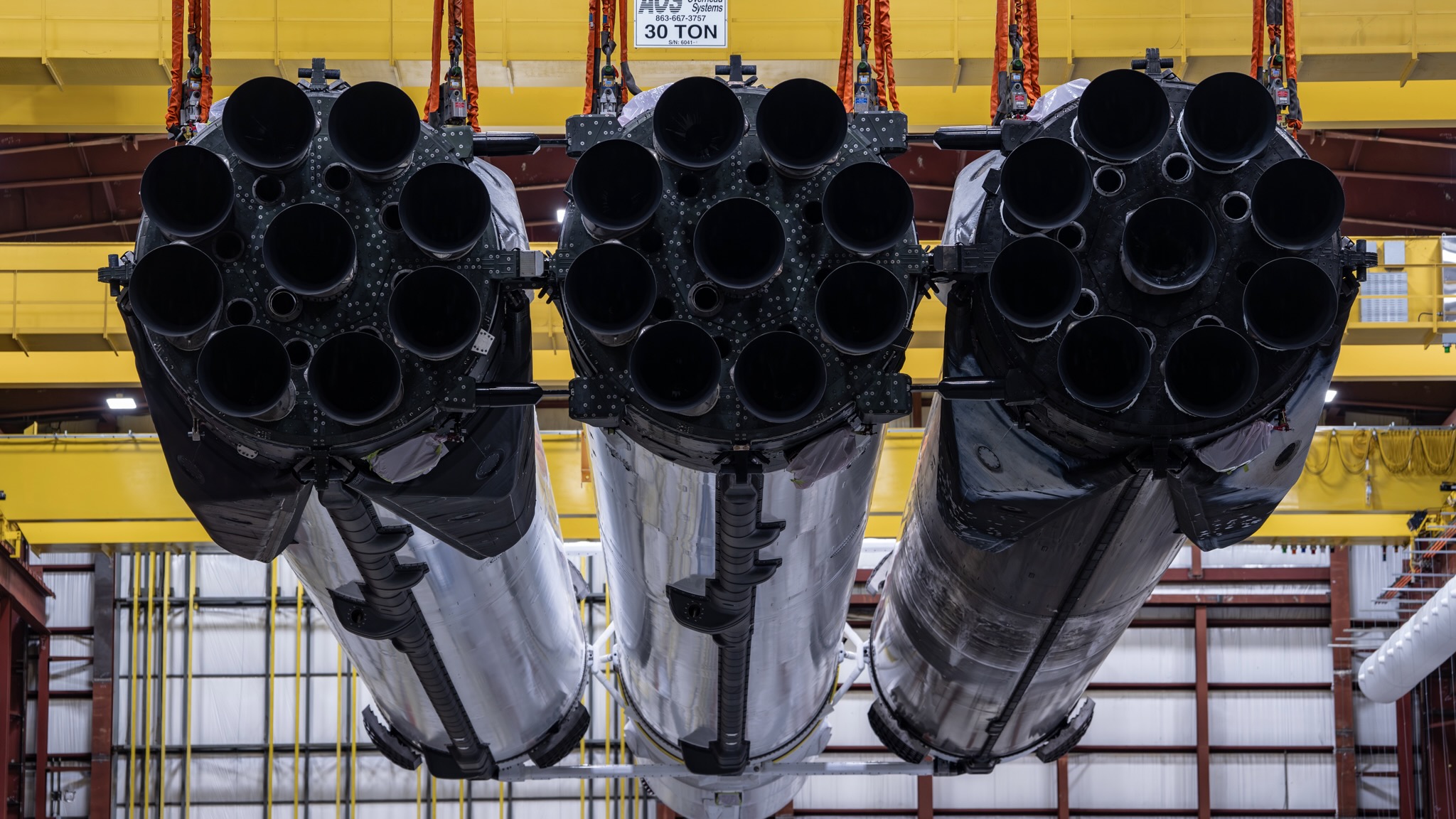
The three first-stage boosters of the Falcon Heavy rocket that will launch NASA's Nancy Grace Roman Space Telescope on Aug. 30, 2026. SpaceX shared this photo via X on Aug. 26. (Image credit: SpaceX)
Here's a look at the launch and flight timeline from SpaceX.
The upper stage of the Falcon Heavy will continue firing its engine through the 8-minutes-and-28-seconds mark, when it will shut down for a 16-minute cruise period. Just over 24 minutes into the flight, the second stage will reignite its single Merlin engine for about three minutes before shutting down for good.
The Roman Space Telescope will then deploy from its carrier at the 31:31 minute mark. It is expected to deploy its solar panels and sunshade shortly after liftoff, then spend the next few days unfolding its antenna and aperture cover, while also performing a mid-course correction burn on its way to its final destination: a stable point in space called Lagrange Point 2, about 1 million miles (1.5 million kilometers) from Earth, opposite the sun.
"The Roman team will complete a carefully orchestrated series of deployments, calibrations, and tests in the three months following launch before the observatory reaches its final orbit," NASA has said of the steps that will follow.
What if the Roman Space Telescope can't launch?
If SpaceX can't launch the Roman Space Telescope on Aug. 30, the company and NASA have at least one backup day to try again.
A second launch window is available on Monday, Aug. 31, at 7:22 a.m. EDT (1122 GMT), according to SpaceX. Both SpaceX and NASA are watching the weather closely to determine if Roman can fly on Aug. 30.
"Meteorologists with the U.S. Space Force’s Space Launch Delta 45 Weather Squadron are predicting a 60% chance of favorable weather conditions for launch, which is targeted for 7:26 a.m. EDT on Sunday, Aug. 30 from Launch Complex 39A at Kennedy," NASA wrote in an update Friday (Aug. 28).
LandSpace's first attempt to land a rocket was quite a spectacle, as newly released video footage reminds us.
The Beijing-based company's Zhuque-3 launcher reached orbit successfully during its debut mission on Dec. 3, 2025 — quite a feat for any rocket.
But Zhuque-3 couldn't pull off the twofer. Its first stage experienced problems during the latter stages of its return to Earth, ultimately exploding in a violent fireball near its designated landing pad.
The first stage of LandSpace's first Zhuque-3 rocket crashes while trying to land on Dec. 3, 2025. (Image credit: CCTV)
We recently got some up-close looks at that failed return to Earth, thanks to CCTV. On Aug. 20, the state-run Chinese broadcaster released dramatic footage of the landing attempt, which includes video captured from a camera on the booster itself.
Those selfie shots highlight the rocket's resemblance to the paragon of reuse, SpaceX's Falcon 9. For example, we see the rapidly approaching ground through the metal mesh of two hypersonic grid fins, attitude-control devices the Falcon 9 pioneered and popularized.
The CCTV video also shows that Zhuque-3 was in trouble before it hit the ground: The booster suffered a mini-explosion during descent and was already a flaming wreck when it reintroduced itself to terra firma.
LandSpace apparently learned some important lessons that day because Zhuque-3's second mission, which occurred on Aug. 18, was a complete success. The 216-foot-tall (66 meters) rocket delivered a satellite to orbit, and its first stage stuck the landing.
It was the first-ever touchdown by a private Chinese orbital rocket, and just the second by a Chinese orbital launcher of any description. The first was pulled off on July 10 by the first stage of a Long March 10B rocket, which nestled softly into a net-like apparatus installed on a ship at sea.
You can watch it live here at Space.com, courtesy of NASA, beginning at 6:20 a.m. EDT (1020 GMT). You don't have to wait that long for a Roman fix, actually; there's stuff to watch on Saturday (Aug. 29) as well. Here's a rundown of this weekend's Roman action.
SpaceX's Falcon Heavy rocket launches NASA's Europa Clipper mission from Florida on Oct. 14, 2024. (Image credit: SpaceX)
Saturday: Prelaunch briefings
Things kick off at on Saturday at 9 a.m. EDT (1300 GMT) withNASA's Roman Space Telescope mission science briefing. This should be quite eventful, for Roman's science goals are ambitious; it will likely discover thousands of exoplanets, for example, and reveal intriguing new information about mysterious dark matter and dark energy.
Participants are:
Shawn Domagal-Goldman, director, Astrophysics Division, NASA Headquarters
Kristen McQuinn, Roman Science Operations Center lead, Space Telescope Science Institute
Lee Armus, Roman Science Support Center lead, Caltech/IPAC
Next up is the prelaunch press conference, which will discuss the mission's launch readiness. It will start at 10:30 a.m. EDT (1430 GMT) and feature the following folks:
Nicky Fox, associate administrator, Science Mission Directorate, NASA Headquarters
Lucas Paganini, Roman telescope program executive, NASA Headquarters
Jackie Townsend, Roman telescope project manager, NASA Goddard
Denton Gibson, launch director, NASA’s Launch Services Program, NASA Kennedy
Julianna Scheiman, director, NASA Science and Dragon Programs, SpaceX
Justin McReynolds, launch weather officer, 45th Weather Squadron, U.S. Space Force
Then, at 11:45 a.m. EDT (1545 GMT), NASA Administrator Jared Isaacman, an accomplished pilot and private astronaut, will put on a mini air show of sorts.
Isaacman "is expected to fly past the Nancy Grace Roman Space Telescope and Falcon Heavy rocket on the launch pad in his jet," NASA wrote in an Aug. 24 media advisory. "The flyby will be shown live on the same stream as the prelaunch news conference, with a view of the launch pad during the transition. The flyby is subject to weather and operational considerations."
Sunday: Launch day
And there's more to watch on Sunday than the launch itself. At 9:30 a.m. EDT (1330 GMT), NASA will hold a post-launch briefing featuring Isaacman, Fox, Townsend, McEnery and Gibson.
They'll likely discuss the next steps for Roman, which include a 30-day journey to its deep-space home, the sun-Earth Lagrange Point 2. This spot lies about 930,000 miles (1.5 million kilometers) from Earth in the direction of Mars. It's gravitationally stable, meaning Roman will be able to stay put without expending much fuel.
Mission team members will spend the next few months checking out the observatory's systems and science gear. It should be ready to begin its five-year science mission in early 2027.
More than a month after its epic spaceflight, Starship is finally headed home.
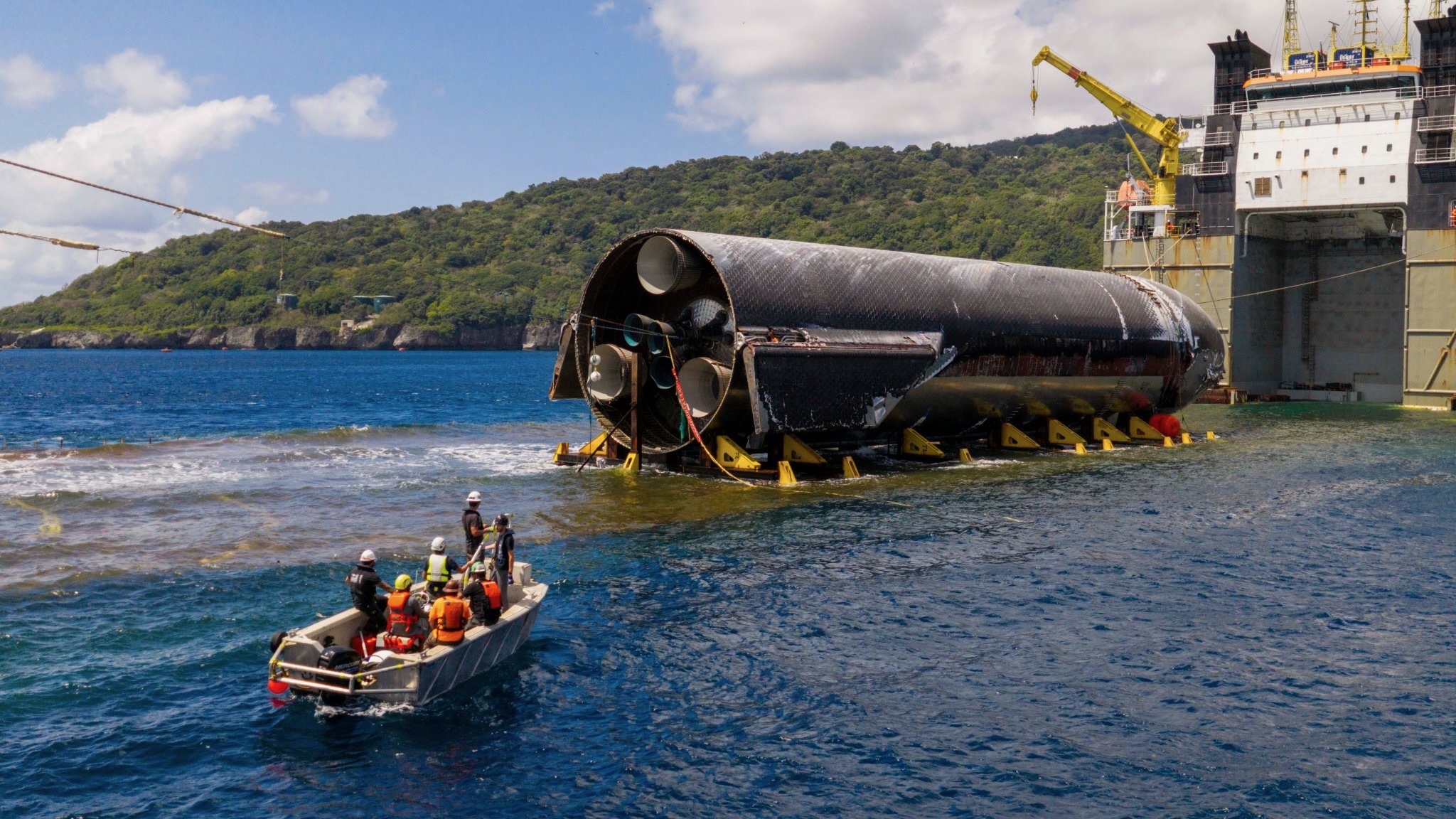
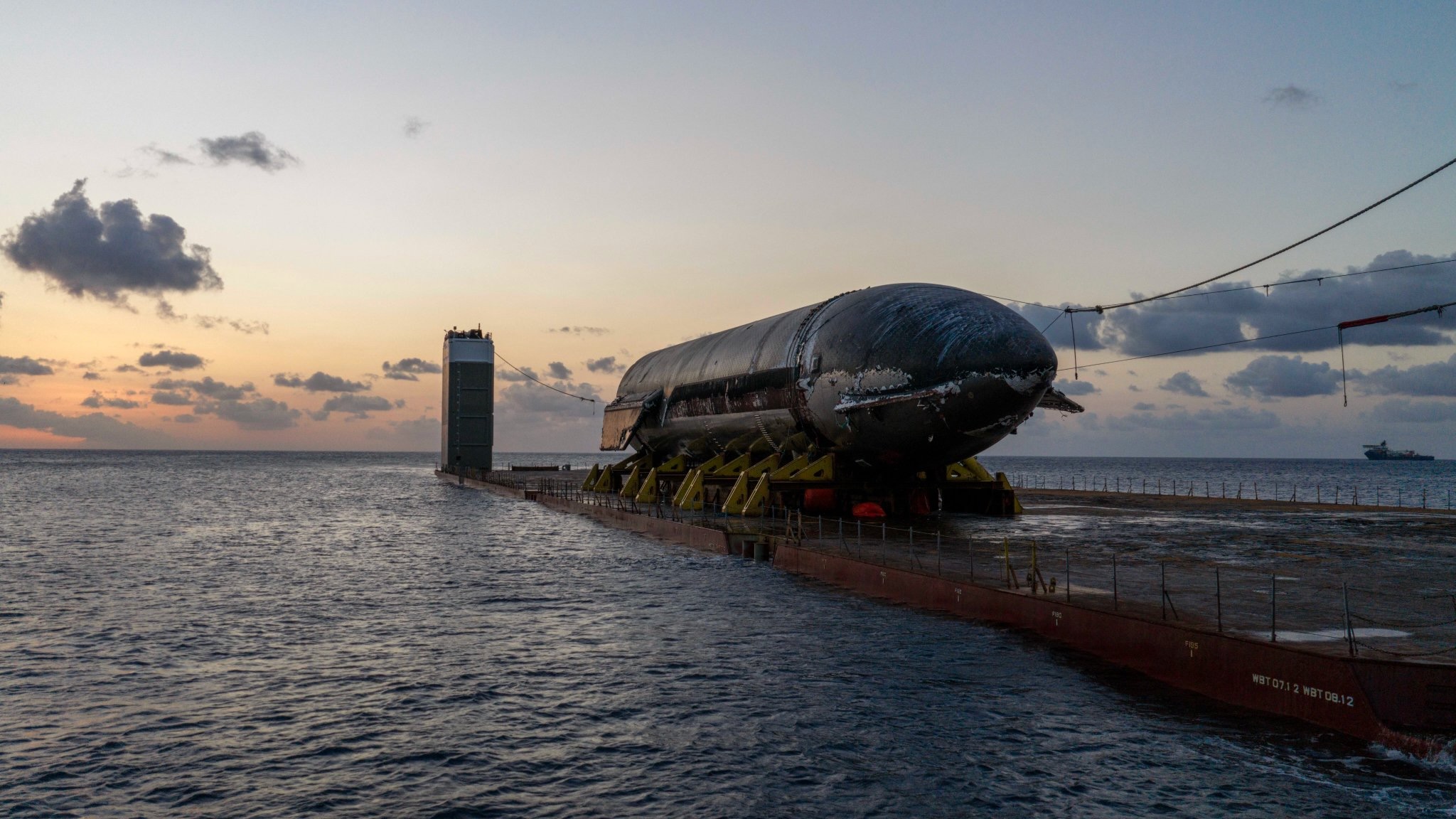
SpaceX announced today (Aug. 27) that it has loaded Starship's 171-foot-tall (52 meters) upper stage — known as Starship, or simply Ship — onto a huge "semi-submersible" ship in the Indian Ocean, off the coast of Christmas Island.
Ship had been in the water since July 24, when it splashed down to bring an end to the Starship program's 13th test flight. The vehicle will now head back to SpaceX's Starbase site in South Texas, a journey expected to take several months, according to the company.
The semi-submersible's deck rises with Ship on board. (Image credit: SpaceX)
Starship Flight 13 lifted off from Starbase, sending Ship on an hour-long suborbital jaunt that went quite well. The vehicle deployed its payloads — 20 of SpaceX's big, next-gen Starlink "Version 3" satellites — into space as planned and also managed to relight one of its six Raptor engines in the final frontier as well.
Ship then splashed down softly in the Indian Ocean off the coast of Western Australia — so softly, in fact, that it survived the ordeal intact. This was unprecedented; on every previous Starship flight, the upper stage had either broken apart during reentry to Earth's atmosphere or exploded shortly after splashdown, when it toppled sideways into the waves. (Starship's first-stage booster, known as Super Heavy, attempted a soft splashdown in the Gulf of Mexico during Flight 13 but suffered engine problems and hit the water hard.)
SpaceX determined to take advantage of this unexpected development. Getting an up-close look at Ship, the company said, would shed light on how its heat shield held up during the flight — key information that could advance the development of Starship, which is designed to be fully and rapidly reusable.
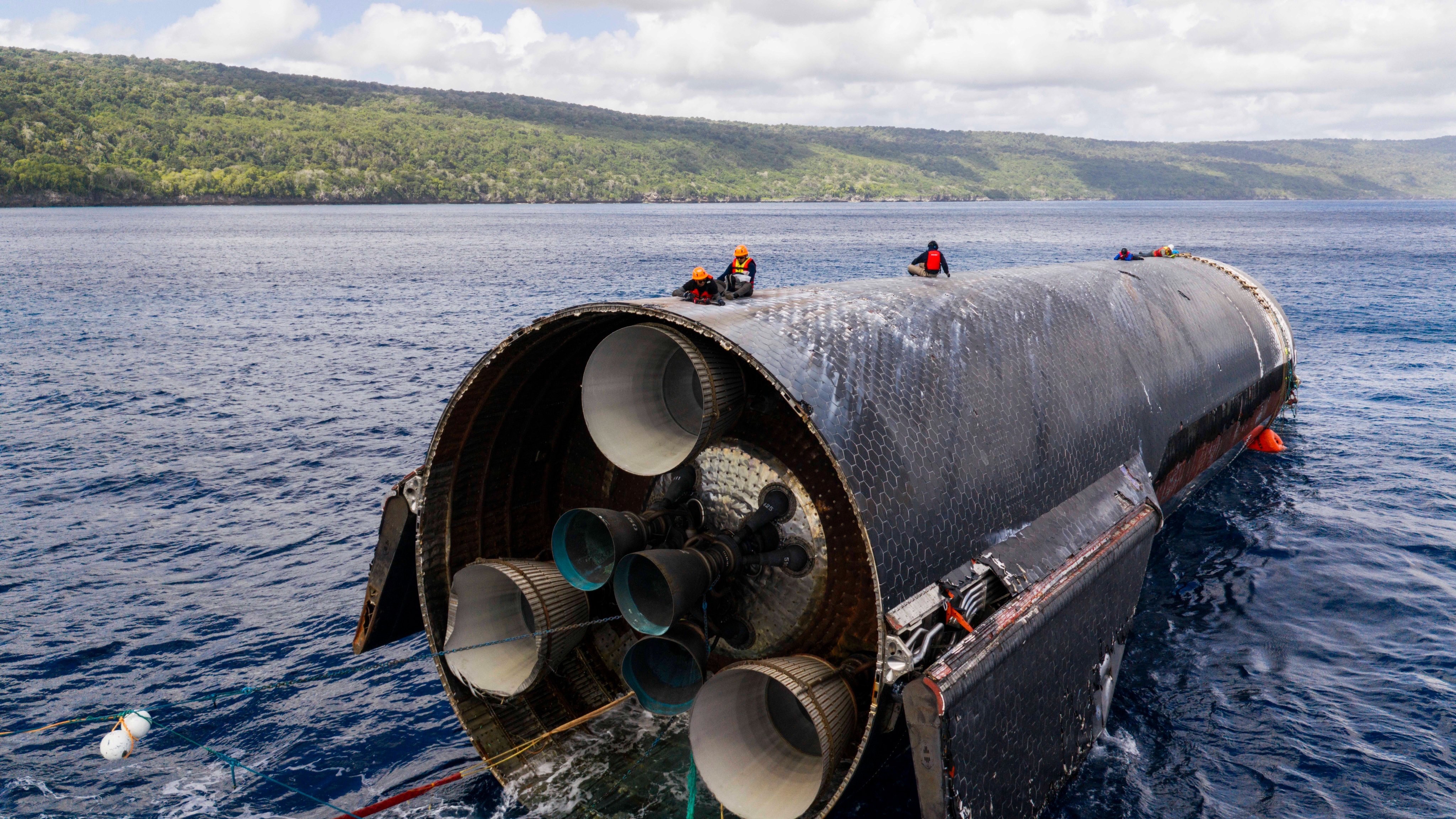
SpaceX engineers inspect Flight 13's Ship as it floats off the coast of Christmas Island. (Image credit: SpaceX)
So the company began towing the Flight 13 Ship to shore — an endeavor that initially seemed doomed to failure.
"Unfortunately, ship recovery is not looking good right now," SpaceX founder and CEO Elon Musk said in an Aug. 7 post on X, the social media platform he bought in 2022. He was responding to a SpaceX post that same day, which cited "challenging conditions and increasingly rough seas."
Ship is now on its its way back to Texas. (Image credit: SpaceX)
SpaceX persevered, however, and managed to tow Ship to Christmas Island, an Australian territory that lies about 1,200 miles (1,900 kilometers) northwest of the city of Broome. Once there, company engineers inspected the vehicle for several days as it bobbed in the waves, gathering valuable data, according to SpaceX.
"They collected heatshield samples and gained vital insight into how the vehicle handled reentry with improvements now planned on future vehicles," SpaceX said today in an X post that shared several photos of the operation.
Further analysis doubtless awaits, after the semi-submersible hauler vessel — so called because its deck goes underwater beneath heavy floating payloads, then rises up with them on board — arrives in Texas.
"Congratulations to the entire SpaceX Recovery team for battling through challenging conditions to give our engineers access to a wealth of data to continue rapidly developing Starship," SpaceX wrote in another X post today.