A New Headset to Help With Depression Is Now Available in the US
The device made by Flow Neuroscience is approved by the FDA and could help people get off antidepressants—but it costs $2,200.

Science and reality
If this summer felt hotter than usual, you're not alone. As it turns out, this past summer was the hottest on record in the United States.
This is the hottest that summer in the U.S. has been in at least 132 years. Specifically, the temperatures rose to 3 degrees Fahrenheit (1.67 degrees Celsius) above average, beating out the most recent record set in 2021 of 0.4 degrees F (0.22 degrees C) above average, according to a new report from National Oceanic and Atmospheric Administration (NOAA). And looking month-to-month, this was also the hottest August we've ever seen.
The record-breaking season saw unmatched temperature highs across the contiguous U.S. (all of the adjoining states, excluding Alaska and Hawaii which just aren't a part of this record) from June through August. But scorching temperatures aren't all that this new record reveals, as this summer was also one of the driest on record for the contiguous U.S., with more than half of the country in a drought by September. The summer of 2026 saw both extreme precipitation highs and lows across the country, too. From droughts to heavy rain, there was nothing average about the precipitation seen across the U.S. this summer.
Digging into some of the details, the full summer was 3 degrees F above the average for the season, 74.4 degrees F (23.5 degrees C). August was 3.5 degrees F (1.94 degrees C) above average for the month at 75.6 F (24.2 C). And while most of the contiguous U.S. experienced well above average temperatures this summer, some locations felt the heat the most. The Southwest, the southern Rockies, the southwestern Plains, southern Florida, California, Nevada, New Mexico and Colorado hit particularly high temperatures this August.
Looking at the summer's unusual precipitation levels, the total precipitation across the contiguous U.S. was 0.32 inches (0.8 centimeters) below average, making this past summer the third driest on record, and the driest summer since 2000. By Sept. 1, 59.1% of the country was in drought. There was drought across the West, the upper Midwest, the Deep South and more. Over 75% of Puerto Rico lie in drought conditions as well, with 40% being in "extreme drought." And while summer might be ending, a lot of this drought is projected to continue, according to the report from NOAA. When it comes to drier lands, that also means an increased risk of wildfire.
Though these temperature differences might seem small or relatively mild at face value, they have massive consequences. As climate change progresses primarily due to greenhouse gas emissions caused by human activities like transportation and manufacturing, we continue to see a whole host of its effects across the world. This ranges from rising average temperatures and glacial ice loss to sea level rise and worsening natural disasters. Those natural disasters include events like flooding, hurricanes, wildfires and cyclones.
While different areas of the world will experience different effects of global warming, one thing remains true for all: The consequences will only continue to worsen as our planet warms.
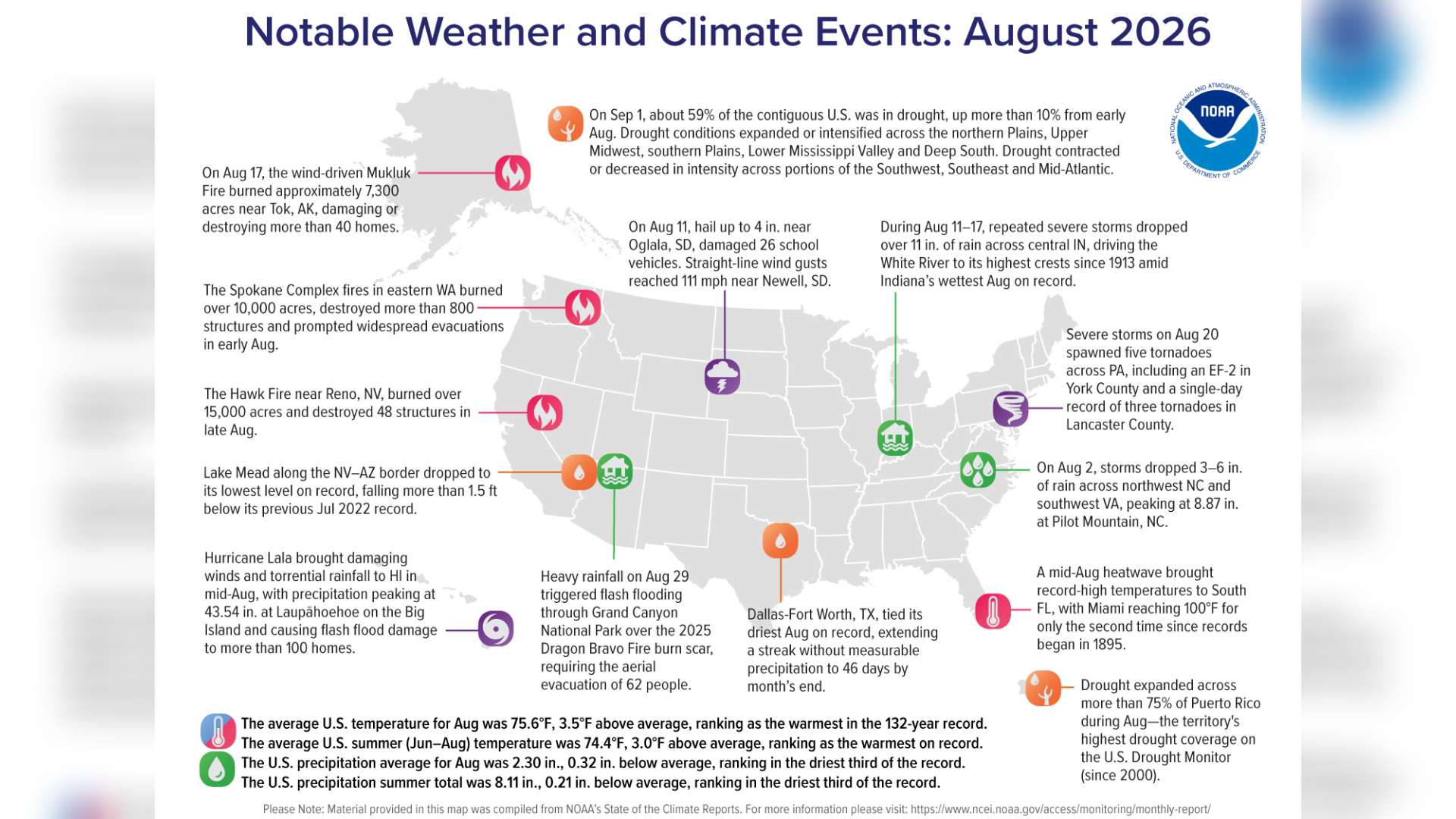
If we just look at this past August 2026 in the U.S., not only did we see record-high temperatures, but also weather and climate disasters of all varieties. Fires broke out over 10,000 acres of eastern Washington, even spreading across the state and into Oregon. More fires, in fact, spread across Nevada and Alaska while wind gusts up to 111 miles per hour (178.6 kilometers per hour) tore across South Dakota. A heatwave brought sweltering temperatures to south Florida and Hurricane Lala brought intense winds, rain and flooding to Hawaii;. And these are just a few of the many examples — from just this last month.
Global warming will soon cross a critical threshold, surpassing a dangerous limit set years ago, the United Nations Environment Programme (UNEP) has found. But experts say it's still possible to cool things back down, emphasizing that the stakes are too high to stop trying.
In 2015, 196 nations and territories signed the Paris Agreement, pledging to restrict the average rise of global temperatures to below 2 degrees Celsius (3.6 degrees Fahrenheit) above pre-industrial levels. Ideally, the rise was meant to be kept to 1.5 degrees C (2.7 degrees F) above those levels. However, according to a new report detailed by the UNEP, we are on track to cross that 1.5 C line — and soon.
"This summer's scorching heat, raging wildfires and deadly floods are a warning of what lies ahead. We must make the overshoot above 1.5 degrees as small and short as possible. That demands an overshoot of ambition," U.N. Secretary-General Antőnio Guterres said in a statement.
According to the new report, experts have found that if we as a planet continue with business as usual, not only will we pass 1.5 C, but it will happen within just a few years. The report, however, maintained a positive tone. Rather than simply predicting a doomsday plot, the main purpose of this release is to outline a pathway with the necessary steps to set things on the right track.
"As global temperature rise gets set to cross 1.5°C, pushing climate risks and impacts to dangerous new heights, the world must strive to return to below 1.5°C as soon as possible and simultaneously reduce the vulnerability of societies, communities and economies to climate impacts," the report, titled "Limiting Overshoot: Navigating exceedance of 1.5°C and pathways towards return," states in its abstract.
Climate change is primarily caused and driven by human activities like transportation, industrial manufacturing, agriculture and more. According to the report, the two main aspects of this work need to be: reducing emissions and enabling adaptations to protect people impacted by the effects of climate change.
The U.N. states in the report the necessity of both an immediate and sustained reduction in the emissions of greenhouse gases like methane and carbon dioxide. Not only do we need to find a way to cut emissions fairly immediately, but we also need to find a way to sustain that effort over time. The U.N. further states it is important to not only work toward removing carbon from the atmosphere, eventually reaching net-negative emissions where more emissions are removed by humans from the atmosphere than added to the atmosphere.
This sort of carbon capture technology is still fairly early in its development, but according to the U.N., it is essential we find ways to rapidly move toward a future where we can capture and store carbon from the air and therefore reduce the quantity of greenhouse gases around our planet.
In addition to these long-term emission reduction actions, in this report the U.N. has also asserted that this process will need to include "adaptation actions," or ways to support the many people and communities already affected by climate change.
Even if all of the world's nations start working immediately to drastically reduce emissions, we are already seeing the sometimes fatal and irreversible effects of climate change. From increasing the intensity of wildfire seasons to worsening natural disasters, climate change is far from a distant future. It's our reality, especially for those living in high-risk areas like coastlines. So, while the nations of the world need to work together to reduce emissions, it is also important that adaptations are found to reduce the existing and future impacts of climate change on our communities.
"There are no good outcomes if we remain above 1.5°C. Across the globe, extreme heatwaves are already proving that climate impacts will strike faster, hit harder, and last longer — costing more lives and causing deeper disruption," Inger Andersen, the Executive Director of UNEP, said in the same statement. "Now is the time we must double down on climate action. We can — and must — get on the right path. By cutting greenhouse gas emissions, strengthening resilience and adaptation, and ensuring exceedance of 1.5°C is as small and short as possible."
A photon, or particle of light, from the biggest cosmic explosion since the Big Bang, nicknamed "the BOAT" (for the brightest of all time), should not have reached Earth. That is, unless it defied rules defined by Einstein. Now scientists may know how it did this, with new research suggesting how the high-energy photon may have survived a journey of more than two billion light-years without being absorbed.
The BOAT, a gamma-ray burst officially designated GRB 221009A, was first detected on Oct. 9, 2022. Among the ocean of photons from the event that rained down on our planet was the highest-energy photon ever detected originating from a gamma-ray burst. It was detected by Carpet, an ultra-high-energy cosmic-ray detector located at the Baksan Observatory in the Russian Caucasus.
The problem is, according to all current rules of physics, a particle with such high energy shouldn't reach Earth from an explosion occurring such a vast distance away. That's because space isn't empty; it is filled with a "fossil" radiation field of photons left over from just after the Big Bang called the cosmic microwave background (CMB). It should be virtually impossible for a high-energy photon to travel 2 billion light-years without interacting with a CMB photon and being transformed. And still it came.
"We started from a very simple question: how did this photon survive a journey that, according to known physics, should have destroyed it?" team leader Giorgio Galanti from the Italian National Institute for Astrophysics (INAF) said in a statement. "The new data from the Carpet experiment showed us that the explanations proposed so far were no longer sufficient.
"We therefore looked for a theoretical scenario capable of consistently describing what we observe, without resorting to arbitrary corrections to the equations."
To investigate the mystery of how this high-energy photon reached our planet, Galanti and colleagues turned to incredibly light hypothetical particles called axion-like particles (ALPs).
ALPS could serve as a solution to this puzzle via a mechanism that would allow photons to transform into ALPs as they travel and then convert back into photons as they reach the Milky Way. The problem is that this still can't account for such a high-energy photon.
This team combined the idea of ALPs with a proposed violation of one of the fundamentals of Einstein's 1905 theory of special relativity called "Lorentz invariance."
In short, Lorentz invariance says that observers moving at different speeds should experience the same physical laws. The team tested the idea that Lorentz invariance could be violated at high energies, thus changing how photons propagate through space.

In the scenario devised by the team the photon would have avoided being wiped out by interactions with the CMB as it would avoid interactionc with these fossil photons.
The new research therefore implies that at high enough energies, photons can take a "fast lane" through a transparent universe, dodging the physics that would normally force their destructive transformation.
Interestingly, there is some evidence relating to the BOAT that seemingly backs this theory. According to the picture developed by the team, this high-energy photon should have arrived at Earth around one hour after lower-energy particles of light originating from the BOAT. Indeed, that is exactly what happened.
"The most interesting aspect of our work is that, for the first time, it brings together two ideas that until now had been developed separately," team member Marco Roncadelli of the National Institute for Nuclear Physics (INFN) said. "If future observations confirmed this scenario, the universe would become a natural laboratory for studying quantum gravity at energies enormously higher than those achievable by any accelerator built on Earth."
The team's research is available on the repository site arXiv and has been accepted for publication in the journal Physical Review Letters.