
Something is awry in the cosmos. Most of the universe seems to be … essentially, missing.
The post Dark Matter … Still Super Hard to Find appeared first on WIRED.

Science and reality
Something is awry in the cosmos. Most of the universe seems to be … essentially, missing.
The post Dark Matter … Still Super Hard to Find appeared first on WIRED.

A newly-improved Advanced Laser Interferometer Gravitational-Wave Observatory began generating data this year, after a $200 million upgrade.
The post An Upgrade Helps to Look for Gravitational Waves appeared first on WIRED.

Sure, the LHC is impressive. But even bigger machines are in the works.
The post New Accelerators on the Horizon appeared first on WIRED.

Iranian science may be one of the winners in this summer’s deal brokered between the Islamic Republic of Iran and a group of world powers
The post Pushing Iranian Physics Forward appeared first on WIRED.

As gifting targets, nerds are tough. But we've got you covered.
The post Perfect Gifts for the Science Nerd in Your Life appeared first on WIRED.
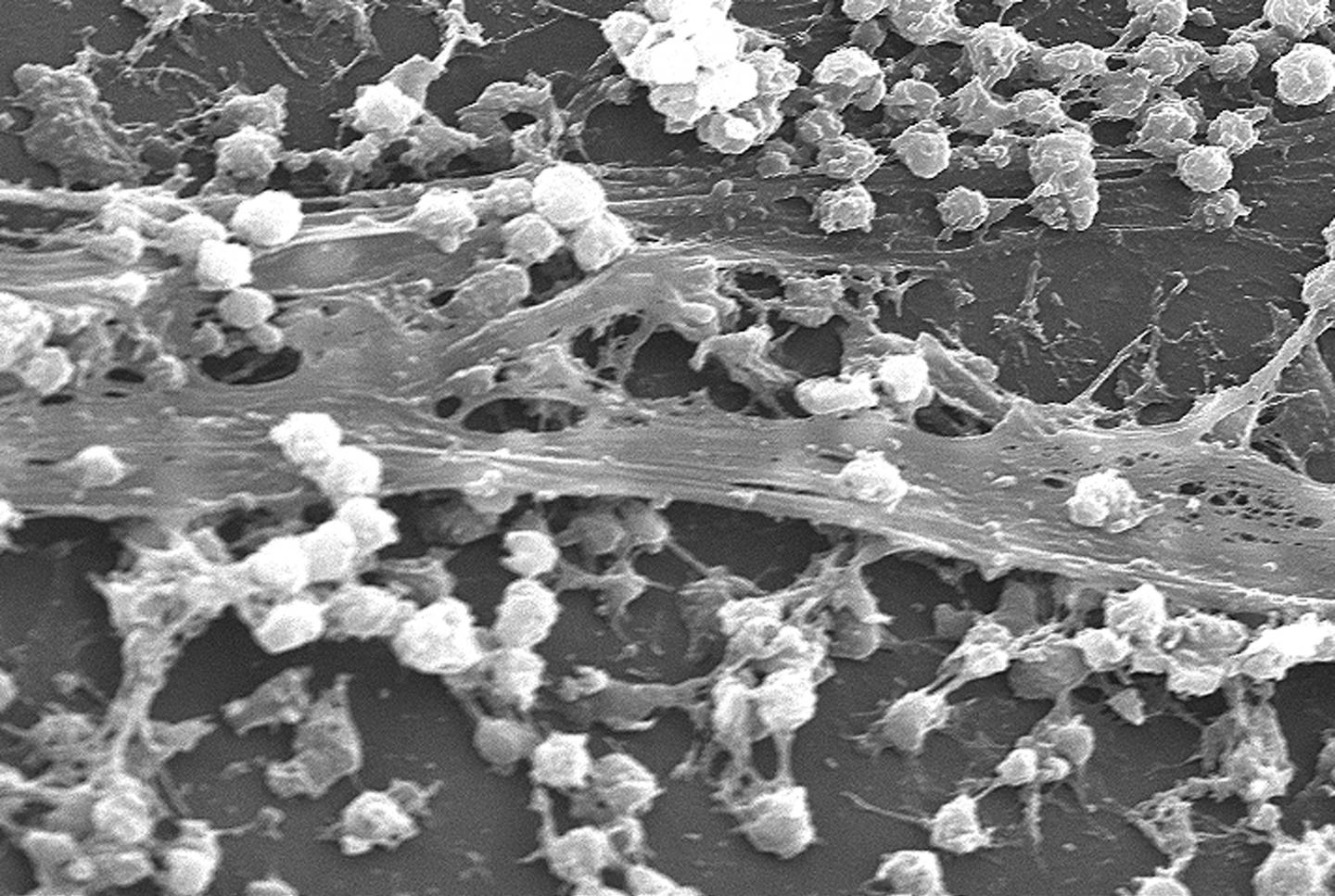
Staphylococcus aureus bacterial biofilm on an indwelling catheter (credit: CDC)
A solution for biofilms* — a scourge of infections in hospitals and kitchens formed by bacteria that stick to each other on living tissue and medical instruments — has been developed by University of New South Wales researchers: Injecting iron oxide nanoparticles into the biofilms, and using an applied magnetic field to heat them, triggering them into dispersing.
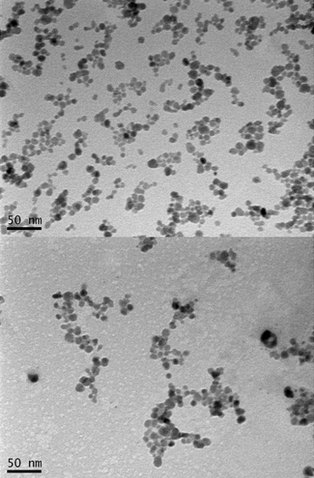
Transmission electron microscopy (TEM) micrographs of dried nanoparticles before (top) and after (bottom) conjugation with polymer (credit: Thuy-Khanh Nguyen et al./Scientific Reports)
“Chronic biofilm-based infections are often extremely resistant to antibiotics and many other conventional antimicrobial agents, and have a high capacity to evade the body’s immune system,” said Associate Professor Cyrille Boyer of the School of Chemical Engineering and deputy director of Australian Centre for NanoMedicine. “Our study points to a pathway for the non-toxic dispersal of biofilms in infected tissue, while also greatly improving the effect of antibiotic therapies.”
When biofilms want to colonize a new site, they disperse into individual cells, reducing the protective action of the biofilm. It is this process the UNSW team sought to trigger. They achieved this using iron oxide nanoparticles coated with polymers that help stabilize and maintain the nanoparticles in a dispersed state, making them an ideal non-toxic tool for treating biofilm infection.
Once dispersed, the bacteria are easier to deal with, creating the potential to remove recalcitrant, antimicrobial-tolerant biofilm infections with antimicrobial agents.
The discovery of how to dislodge biofilms by the UNSW Faculty of Engineering team was made using the opportunistic human pathogen Pseudomonas aeruginosa. This is a model organism whose response to the technique the researchers believe will apply to most other bacteria.
“The use of these polymer-coated iron oxide nanoparticles to disperse biofilms may have broad applications across a range of clinical and industrial settings,” said Boyer.
The research appears in an open-access paper today (Dec. 21) in Nature’s Scientific Reports.
* Biofilms have been linked to 80% of infections, forming on living tissues (e.g. respiratory, gastrointestinal and urinary tracts, oral cavities, eyes, ears, wounds, heart and cervix) or dwelling in medical devices (e.g. dialysis catheters, prosthetic implants and contact lenses).
The formation of biofilms is a growing and costly problem in hospitals, creating infections that are more difficult to treat — leading to chronic inflammation, impaired wound healing, rapidly acquired antibiotic resistance and the spread of infectious embolisms in the bloodstream.
They also cause fouling and corrosion of wet surfaces, and the clogging of filtration membranes in sensitive equipment, even posing a threat to public health by acting as reservoirs of pathogens in distribution systems for drinking water.
In general, bacteria have two life forms during growth and proliferation: planktonic, where bacteria exist as single, independent cells; or aggregated together in colonies as biofilms, where bacteria grow in a slime-like polymer matrix that protects them from the environment around them.
Acute infections mostly involve planktonic bacteria, which are usually treatable with antibiotics. However, when bacteria have had enough time to form a biofilm — within a human host or non-living material such as dialysis catheters – an infection can often become untreatable and develop into a chronic state.
UNSW | 2015 Malcolm McIntosh Prize for Physical Scientist of the Year
Abstract of Iron oxide nanoparticle-mediated hyperthermia stimulates dispersal in bacterial biofilms and enhances antibiotic efficacy
The dispersal phase that completes the biofilm lifecycle is of particular interest for its potential to remove recalcitrant, antimicrobial tolerant biofilm infections. Here we found that temperature is a cue for biofilm dispersal and a rise by 5 °C or more can induce the detachment of Pseudomonas aeruginosa biofilms. Temperature upshifts were found to decrease biofilm biomass and increase the number of viable freely suspended cells. The dispersal response appeared to involve the secondary messenger cyclic di-GMP, which is central to a genetic network governing motile to sessile transitions in bacteria. Furthermore, we used poly((oligo(ethylene glycol) methyl ether acrylate)-block-poly(monoacryloxy ethyl phosphate)-stabilized iron oxide nanoparticles (POEGA-b-PMAEP@IONPs) to induce local hyperthermia in established biofilms upon exposure to a magnetic field. POEGA-b-PMAEP@IONPs were non-toxic to bacteria and when heated induced the detachment of biofilm cells. Finally, combined treatments of POEGA-b-PMAEP@IONPs and the antibiotic gentamicin reduced by 2-log the number of colony-forming units in both biofilm and planktonic phases after 20 min, which represent a 3.2- and 4.1-fold increase in the efficacy against planktonic and biofilm cells, respectively, compared to gentamicin alone. The use of iron oxide nanoparticles to disperse biofilms may find broad applications across a range of clinical and industrial settings.

The MemNet algorithm ranks images by how memorable and forgettable they are. It also creates a heat map (second image from left) identifying the image’s most memorable and forgettable regions, ranging from red (most memorable) to blue (most forgettable). The image can then be subtly tweaked to increase or decrease its memorability score (three images on right). (credit: CSAIL)
Researchers at MIT’s Computer Science and Artificial Intelligence Laboratory (CSAIL) have developed a deep-learning algorithm that can predict how memorable or forgettable an image is almost as accurately as humans, and they plan to turn it into an app that tweaks photos to make them more memorable.
For each photo, the “MemNet” algorithm also creates a “heat map” (a color-coded overlay) that identifies exactly which parts of the image are most memorable. You can try it out online by uploading your own photos to the project’s “LaMem” dataset.
The research is an extension of a similar algorithm the team developed for facial memorability. The team fed its algorithm tens of thousands of images from several different datasets developed at CSAIL, including LaMem and the scene-oriented SUN and Places. The images had each received a “memorability score” based on the ability of human subjects to remember them in online experiments.
Close to human performance
The team then pitted its algorithm against human subjects by having the model predicting how memorable a group of people would find a new never-before-seen image. It performed 30 percent better than existing algorithms and was within a few percentage points of the average human performance.
By emphasizing different regions, the algorithm can also potentially increase the image’s memorability.
“CSAIL researchers have done such manipulations with faces, but I’m impressed that they have been able to extend it to generic images,” says Alexei Efros, an associate professor of computer science at the University of California at Berkeley. “While you can somewhat easily change the appearance of a face by, say, making it more ‘smiley,’ it is significantly harder to generalize about all image types.”
LaMem is the world’s largest image-memorability dataset. With 60,000 images, each annotated with detailed metadata about qualities such as popularity and emotional impact, LaMem is the team’s effort to spur further research on what they say has often been an under-studied topic in computer vision.
Team members picture a variety of potential applications, from improving the content of ads and social media posts, to developing more effective teaching resources, to creating your own personal “health-assistant” device to help you remember things. The team next plans to try to update the system to be able to predict the memory of a specific person, as well as to better tailor it for individual “expert industries” such as retail clothing and logo design.
The work is supported by grants from the National Science Foundation, as well as the McGovern Institute Neurotechnology Program, the MIT Big Data Initiative at CSAIL, research awards from Google and Xerox, and a hardware donation from Nvidia.
Progress in estimating visual memorability has been limited by the small scale and lack of variety of benchmark data. Here, we introduce a novel experimental procedure to objectively measure human memory, allowing us to build LaMem, the largest annotated image memorability dataset to date (containing 60,000 images from diverse sources). Using Convolutional Neural Networks (CNNs), we show that fine-tuned deep features outperform all other features by a large margin, reaching a rank correlation of 0.64, near human consistency (0.68). Analysis of the responses of the high-level CNN layers shows which objects and regions are positively, and negatively, correlated with memorability, allowing us to create memorability maps for each image and provide a concrete method to perform image memorability manipulation. This work demonstrates that one can now robustly estimate the memorability of images from many different classes, positioning memorability and deep memorability features as prime candidates to estimate the utility of information for cognitive systems. Our model and data are available at: http://memorability.csail.mit.edu

Watch the livestream of the emergency spacewalk.
The post Astronauts Need to Fix the ISS Before Its Cargo Ship Docks appeared first on WIRED.

Thanks to a host of ingenious tech tweaks, air travel is light-years better for the planet than it used to be.
The post Why Flying Home for the Holidays Might Be Greener Than Driving appeared first on WIRED.

SpaceX is attempting their first launch since a rocket exploded in June, and they're going big.
The post SpaceX Will Launch (And Land?) Its Most Powerful Rocket Yet appeared first on WIRED.