
Computer scientists are abuzz over a fast new algorithm for solving one of the central problems in the field.
The post Landmark Algorithm Breaks 30-Year Impasse appeared first on WIRED.

Science and reality
Computer scientists are abuzz over a fast new algorithm for solving one of the central problems in the field.
The post Landmark Algorithm Breaks 30-Year Impasse appeared first on WIRED.

Space photos of the week: December 13–19.
The post Space Photos of the Week: This Is One Cranky Child Star appeared first on WIRED.

Adult reindeer bot flies look like harmless fluffy bees, but they're not really that cuddly.
The post Reindeer Bot Flies Are Not Particularly Festive appeared first on WIRED.

Just after noon Eastern today, Cassini will fly by the icy moon Enceladus for the final time---and a tearful farewell it'll be.
The post Cassini Bids Its Final Farewell to Saturn’s Moon Enceladus appeared first on WIRED.
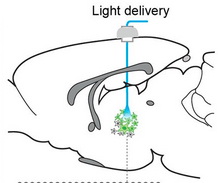
Optogenetic laser light stimulation of the thalamus (credit: Jia Liu et al./eLife)
By flashing high-frequency (40 to 100 pulses per second) optogenetic lasers at the brain’s thalamus, scientists were able to wake up sleeping rats and cause widespread brain activity. In contrast, flashing the laser at 10 pulses per second suppressed the activity of the brain’s sensory cortex and caused rats to enter a seizure-like state of unconsciousness.
“We hope to use this knowledge to develop better treatments for brain injuries and other neurological disorders,” said Jin Hyung Lee, Ph.D., assistant professor of neurology, neurosurgery, and bioengineering at Stanford University, and a senior author of the study, published in the open-access journal eLIFE.
Located deep inside the brain, the thalamus regulates arousal, acting as a relay station to the cortex for neural signals from the body. Damage to neurons in the central part of the thalamus may lead to problems with sleep, attention, and memory.*
Combining light stimulation and fMRI measurements
The observations used a combination of optogenetics and whole-brain functional MRI (fMRI) — known as “ofMRI” — to detect overall effects on the brain, along with EEG and single-unit cell recordings.The researchers noted in the paper that “using targeted, temporally precise optogenetic stimulation in the current study allowed us to selectively excite a single group of neuronal elements and identify their specific role in creating distinct modes of network function.” That could not be achieved with conventional electrode stimulation, the researchers say.
They explain that this method may allow for direct-brain stimulation (DBS) therapeutic methods to be optimized in the clinic “for a wide range of neurological disorders that currently lack such treatment.”
“This study takes a big step towards understanding the brain circuitry that controls sleep and arousal,” Yejun (Janet) He, Ph.D., program director at NIH’s National Institute of Neurological Disorders and Stroke (NINDS), which partially funded the study.
* Further experiments suggested the different effects may be due to a unique firing pattern by inhibitory neurons in a neighboring brain region, the zona incerta, during low frequency stimulation. Cells in this brain region have been shown to send inhibitory signals to cells in the sensory cortex. Electrical recordings showed that during low frequency stimulation of the central thalamus, zona incerta neurons fired in a spindle pattern that often occurs during sleep. In contrast, sleep spindles did not occur during high frequency stimulation. Moreover, when the scientists blocked the firing of the zona incerta neurons during low frequency stimulation of the central thalamus, the average activity of sensory cortex cells increased.
Central thalamus plays a critical role in forebrain arousal and organized behavior. However, network-level mechanisms that link its activity to brain state remain enigmatic. Here, we combined optogenetics, fMRI, electrophysiology, and video-EEG monitoring to characterize the central thalamus-driven global brain networks responsible for switching brain state. 40 and 100 Hz stimulations of central thalamus caused widespread activation of forebrain, including frontal cortex, sensorimotor cortex, and striatum, and transitioned the brain to a state of arousal in asleep rats. In contrast, 10 Hz stimulation evoked significantly less activation of forebrain, inhibition of sensory cortex, and behavioral arrest. To investigate possible mechanisms underlying the frequency-dependent cortical inhibition, we performed recordings in zona incerta, where 10, but not 40, Hz stimulation evoked spindle-like oscillations. Importantly, suppressing incertal activity during 10 Hz central thalamus stimulation reduced the evoked cortical inhibition. These findings identify key brain-wide dynamics underlying central thalamus arousal regulation.

That Hawaiian sand between your toes isn't just ground-up rock. In fact, very little of it is. The vast majority came out of a parrotfish.
The post Absurd Creatures: This Fish Makes Hawaii’s Beaches in an … Unorthodox Way appeared first on WIRED.

This past week in Iowa, Ted Cruz took the lead away from Donald Trump, according to the nation's polls. Here's why that doesn't mean jack.
The post Why You Probably Shouldn’t Trust This Week’s Political Polls appeared first on WIRED.


That time has come again, to look back on the volcanic events of 2015 and decide what three volcanic events really captured your imagination this year.
The post Cast Your Vote for the Greatest Volcanic Event of 2015! appeared first on WIRED.
