
The most powerful consumer cravings and sense memories may be triggered by the aroma of fresh pine.
The post What’s Inside That Seasonal Febreze That Smells Like Pine appeared first on WIRED.

Science and reality
The most powerful consumer cravings and sense memories may be triggered by the aroma of fresh pine.
The post What’s Inside That Seasonal Febreze That Smells Like Pine appeared first on WIRED.


This article won't amaze or shock you. What it will do is explain why so many of us continually fall for clickbait.
The post You’ll Be Outraged at How Easy It Was to Get You to Click on This Headline appeared first on WIRED.

May I introduce the charming, fantastically camouflaged pygmy seahorse.
The post Absurd Creature of the Week: The Littlest, Most Adorable-est Seahorse Fits on Your Fingernail appeared first on WIRED.
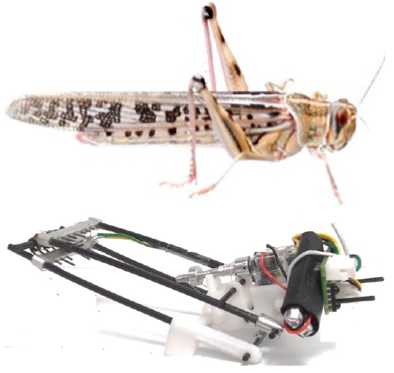
Locust-inspired TAUB robot (credit: Tel Aviv University)
A locust-inspired miniature robot that can jump 3.35 meters (11 ft.), covering a distance of 1.37 meters (4.5 ft.) horizontally in one leap is designed to handle search-and-rescue and reconnaissance missions in rough terrain.
The new locust-inspired robot, dubbed “TAUB” (for “Tel Aviv University and Ort Braude College”), is 12.7 cm (5 in.) long and weighs weighs 23 grams (less than one ounce). It was developed by Tel Aviv University and Ort Braude College researchers.
The ABS plastic body of the robot was 3D-printed, its legs are composed of stiff carbon rods, and its torsion springs of steel wire. A small on-board battery powers the robot, which is remotely controlled via an on-board microcontroller.
Torsion springs
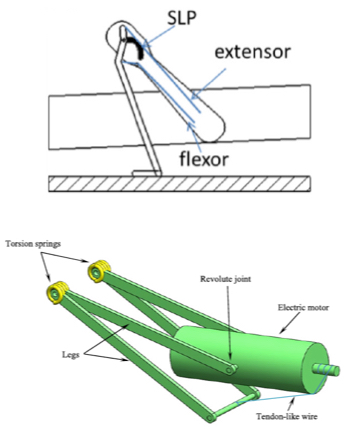
Locust vs. robot leg models (credit: Tel Aviv University)
A locust catapults itself in a three-stage process. First, the legs are bent in the preparation stage. Then the legs are locked in place at the joint. Finally, a sudden release of the flexor muscle on the upper leg unlocks the joint and causes a rapid release of energy.
This creates a fast-kicking movement of the legs that propels the locust into the air.
Like the locust, which uses stored mechanical energy to enhance the action of its leg muscles, the robot’s “high-jump” is due to its ability to store energy in its torsion springs.
The researchers are currently working on a gliding mechanism that will enable the robot to extend its jumping range, lower its landing impact, execute multiple steered jumps, and stabilize while airborne, expanding the possible field applications of the robot.
Unmanned ground vehicles are mostly wheeled, tracked, or legged. These locomotion mechanisms have a limited ability to traverse rough terrain and obstacles that are higher than the robot’s center of mass. In order to improve the mobility of small robots it is necessary to expand the variety of their motion gaits. Jumping is one of nature’s solutions to the challenge of mobility in difficult terrain. The desert locust is the model for the presented bio-inspired design of a jumping mechanism for a small mobile robot. The basic mechanism is similar to that of the semilunar process in the hind legs of the locust, and is based on the cocking of a torsional spring by wrapping a tendon-like wire around the shaft of a miniature motor. In this study we present the jumping mechanism design, and the manufacturing and performance analysis of two demonstrator prototypes. The most advanced jumping robot demonstrator is power autonomous, weighs 23 gr and is capable of jumping to a height of 3.35m, covering a distance of 1.37m.

How does water on the surface of this bizarre material control UV light emission and also its conductivity? (credit: Mohammad A. Islam et al./Nano Letters)
In a remarkable chance landmark discovery, a team of researchers at four universities has discovered a mysterious material that emits ultraviolet light and has insulating, electrical conducting, semiconducting, superconducting, and ferromagnetic properties — all controlled by surface water.
It happened while the researchers were studying a sample of lanthanum aluminate film on a strontinum titanate crystal. The sample mysteriously began to glow, emitting intense levels of ultraviolet light from its interior. After carefully reproducing the experimental conditions, they tracked down the unlikely switch that turns UV light on or off: surface water moisture.
The team of researchers from Drexel University, the University of Pennsylvania, the University of California at Berkeley, and Temple University also found that the interface between the materials’ two layers of electrical insulators also had an unusual electrical conducting state that, like UV, could also be altered by the water on the surface. On top of that, the material also exhibited superconducting, ferromagnetic ordering, and photoconductive properties.
Even weirder, “we can also make [the effects] stronger by increasing the distance between the molecules and surface and the buried interface, by using thicker films for example,” said Drexel College of Engineering Professor Jonathan E. Spanier.
Calling in the theorists
Puzzled, the researchers turned to their theory collaborators on the team: Penn’s Andrew M. Rappe, Fenggong Wang, and Diomedes Saldana-Grego.
According to Rappe, this is the first report of the introduction of molecules to the surface controlling the emission of light — of any color — from a buried solid-surface interface. “The mechanism of a molecule landing and reacting, called dissociative chemisorption, as a way of controlling the onset and suppression of light is unlike any other previously reported,” Saldana-Grego added.
The team recently published its findings in the American Chemical Society journal Nano Letters.
Multiple personality
“We suspect that the material could be used for simple devices like transistors and [chemical] sensors,” said Mohammad Islam, an assistant professor from the State University of New York at Oswego, who was on Spanier’s team when he was at Drexel.
“By strategically placing molecules on the surface, the UV light could be used to relay information — much the way computer memory uses a magnetic field to write and rewrite itself, but with the significant advantage of doing it without an electric current. The strength of the UV field also varies with the proximity of the water molecule; this suggests that the material could also be useful for detecting the presence of chemical agents.”
We report intense, narrow line-width, surface chemisorption-activated and reversible ultraviolet (UV) photoluminescence from radiative recombination of the two-dimensional electron gas (2DEG) with photoexcited holes at LaAlO3/SrTiO3. The switchable luminescence arises from an electron transfer-driven modification of the electronic structure via H-chemisorption onto the AlO2-terminated surface of LaAlO3, at least 2 nm away from the interface. The control of the onset of emission and its intensity are functionalities that go beyond the luminescence of compound semiconductor quantum wells. Connections between reversible chemisorption, fast electron transfer, and quantum-well luminescence suggest a new model for surface chemically reconfigurable solid-state UV optoelectronics and molecular sensing.

A simulation of the orbital configuration of the Wolf 1061 system. Wolf 1061 is an inactive red dwarf star, smaller and cooler than our sun, 14 light years away. The planetary habitable zone around the star is marked in green — the colors grade from red (where a planet would be too hot), through green (where the surface of a planet could sustain liquid water), through to blue (where a planet would be too cold). (credit: Made using Universe Sandbox 2 software)
UNSW Australia astronomers have discovered the closest potentially habitable planet found outside our solar system so far, orbiting a star just 14 light years away.
The planet, more than four times the mass of the Earth, is one of three that the team detected around a red dwarf star called Wolf 1061.
“It is a particularly exciting find because all three planets are of low enough mass to be potentially rocky and have a solid surface, and the middle planet, Wolf 1061c, sits within the ‘Goldilocks’ zone where it might be possible for liquid water — and maybe even life — to exist,” says lead study author UNSW’s Duncan Wright.
“While a few other planets have been found that orbit stars closer to us than Wolf 1061, those planets are not considered to be remotely habitable,” Dr Wright says.
The three newly detected planets orbit the small, relatively cool and stable star about every 5, 18 and 67 days. Their masses are at least 1.4, 4.3 and 5.2 times that of Earth, respectively. The larger outer planet falls just outside the outer boundary of the habitable zone and is also likely to be rocky, while the smaller inner planet is too close to the star to be habitable.
The discovery will be published in The Astrophysical Journal Letters (an open access article).
Small rocky planets like our own are now known to be abundant in our galaxy, and multi-planet systems also appear to be common. However most of the rocky exoplanets discovered so far are hundreds or thousands of light years away.
An exception is Gliese 667Cc which lies 22 light years from Earth. It orbits a red dwarf star every 28 days and is at least 4.5 times as massive as Earth.
“The close proximity of the planets around Wolf 1061 means there is a good chance these planets may pass across the face of the star. If they do, then it may be possible to study the atmospheres of these planets in future to see whether they would be conducive to life,” says team member UNSW’s Dr Rob Wittenmyer.
UNSW Science | A simulation of the orbital configuration of the Wolf 1061 system. Wolf 1061 is an inactive red dwarf star, smaller and cooler than our sun, 14 light years away.
The orbits for the planets b, c and d (ordered from the inner planet to the outer) have periods of 4.9 days, 17.9 days and 67.2 days. In the simulation we show the planet orbits as all lying in a single plane.
The planetary habitable zone around the star is marked in green – the colours grade from red (where a planet would be too hot), through green (where the surface of a planet could sustain liquid water), through to blue (where a planet would be too cold).
Credit: This simulation was made using the Universe Sandbox 2 software from universesandbox.com
We use archival HARPS spectra to detect three planets orbiting the M3 dwarf Wolf 1061 (GJ 628). We detect a 1.36 M⊕ minimum-mass planet with an orbital period P = 4.888 d (Wolf 1061b), a 4.25 M⊕ minimum-mass planet with orbital period P = 17.867 d (Wolf 1061c), and a likely 5.21 M⊕ minimum-mass planet with orbital period P = 67.274 d (Wolf 1061d). All of the planets are of suffi- ciently low mass that they may be rocky in nature. The 17.867 d planet falls within the habitable zone for Wolf 1061 and the 67.274 d planet falls just outside the outer boundary of the habitable zone. There are no signs of activity observed in the bisector spans, cross-correlation full-width-half-maxima, Calcium H & K indices, NaD indices, or Hα indices near the planetary periods. We use custom methods to generate a cross-correlation template tailored to the star. The resulting velocities do not suffer the strong annual variation observed in the HARPS DRS velocities. This differential technique should deliver better exploitation of the archival HARPS data for the detection of planets at extremely low amplitudes.
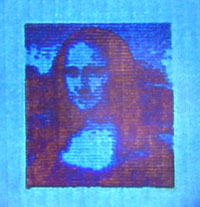
A laser-printed microscopic image of Mona Lisa 50 micrometers long, less than one pixel on an iPhone Retina display (credit: Technical University of Denmark)
A new laser-printing technology allows for printing high-resolution data and color images at the unprecedented resolution of 127,000 dots per inch (DPI) and with a speed of 1 nanosecond per pixel — developed by researchers at Technical University of Denmark’s DTU Nanotech and DTU Fotonik.
At that extreme resolution, images can be printed on the microscale. This patented method uses special plasmonic metasurfaces coated with 20 nanometers of aluminum. When a laser pulse heats each nanocolumn (up to 1,500°C for a few nanoseconds), it melts and is deformed.
The intensity of the laser beam heating controls the amount of deformation, which determines which color are printed. Low-intensity laser pulses lead to a minor deformation of the nanocolumn, resulting in blue and purple hue reflections. Stronger laser pulses create a larger deformation, which leads to reflection from the nanocolumn at longer wavelength orange and yellow hue.
According to Professor Anders Kristensen, it’s also possible to save data invisible to the naked eye with this technology. “This includes serial numbers or bar codes of products and other information. The technology can also be used to combat fraud and forgery, as the products will be labeled in way that makes them very difficult to reproduce. It will be easier to determine whether the product is an original or a copy.”
The new laser printing technology can also be used on a larger scale to personalize products such as mobile phones with unique decorations, names, etc. and for marking parts for cars, such as instrument panels and buttons. The scientists hope to eventually replace conventional laser printers.
Colour generation by plasmonic nanostructures and metasurfaces has several advantages over dye technology: reduced pixel area, sub-wavelength resolution and the production of bright and non-fading colours. However, plasmonic colour patterns need to be pre-designed and printed either by e-beam lithography (EBL) or focused ion beam (FIB), both expensive and not scalable processes that are not suitable for post-processing customization. Here we show a method of colour printing on nanoimprinted plasmonic metasurfaces using laser post-writing. Laser pulses induce transient local heat generation that leads to melting and reshaping of the imprinted nanostructures. Depending on the laser pulse energy density, different surface morphologies that support different plasmonic resonances leading to different colour appearances can be created. Using this technique we can print all primary colours with a speed of 1 ns per pixel, resolution up to 127,000 dots per inch (DPI) and power consumption down to 0.3 nJ per pixel.
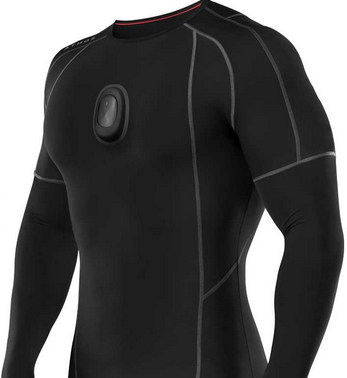
The Athos Upper Body Package includes 14 built in sensors for real-time muscle and heart rate data. (credit: Athos)
Wearables will “disappear” in 2016, predicts New Enterprise Associates venture capital partner Rick Yang, cited in a Wednesday (Dec. 16) CNBC article — integrated “very directly into your everyday life, into your existing fashion sense to the extent that nobody knows you’re wearing a wearable,” he said.
For example, Athos makes smart workout clothes embedded with inconspicuous technology that tracks muscle groups, heart, and breathing rates, he noted.
But taking that next step in wearable technology means ditching bulky, clothes-deforming batteries. Supercapacitors (see “Flexible 3D graphene supercapacitors may power portables and wearables“), as discussed on KurzweilAI, are a perfect match for that. They work like tiny batteries, but unlike batteries, they can be rapidly charged and deliver more power quickly in a smaller space.
They’re a lot smaller and thinner than batteries. But still too bulky.
Weaving electronics into fabrics
Enter Case Western Reserve University researchers, who announced Wednesday that have developed flexible wire-shaped microsupercapacitors that can be embedded as microscopic-sized wires directly in fabrics. These provide three times higher capacitance than previous attempts to create microsupercapacitors, the researchers say.*
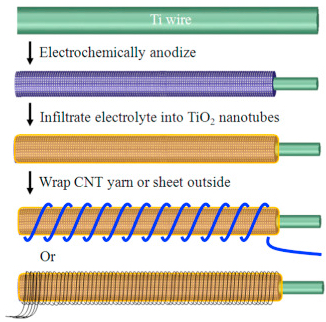
Wearable wires (credit: Tao Chen, Liming Dai/Energy Storage Materials)
In this new design, the modified titanium wire is coated with a solid electrolyte made of polyvinyl alcohol and phosphoric acid. The wire is then wrapped with either yarn or a sheet made of aligned carbon nanotubes, which serves as the second electrode.
The titanium oxide nanotubes, which are semiconducting, separate the two active portions of the electrodes, preventing a short circuit.
“They’re very flexible, so they can be integrated into fabric or textile materials,” said Liming Dai, the Kent Hale Smith Professor of Macromolecular Science and Engineering. “They can be a wearable, flexible power source for wearable electronics and also for self-powered biosensors or other biomedical devices, particularly for applications inside the body.”
The scientists published their research on the microsupercapacitor in the journal Energy Storage Materials this week. The study builds on earlier carbon-based supercapacitors.
Conductive inks
An article just published in Chemical & Engineering News (C&EN) profiles textiles printed with such stretchable embedded wiring and electronic sensors, which can transmit data wirelessly and withstand washing.
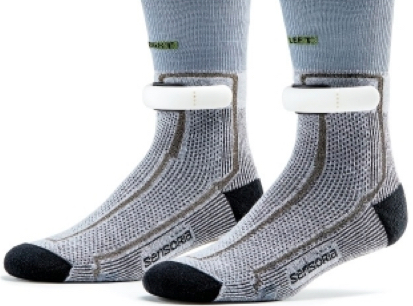
Smart socks (credit: Sensoria)
For example, “smart socks” incorporate stretchable silver-based conductive yarns that connect their sensors to a magnetic Bluetooth electronic anklet that transmits data to a mobile app to keep track of foot landings, cadence, and time on the ground.
The data are intended to help runners improve their form and performance. Two pairs of socks and an anklet cost $200.
C&EN also highlights another key technology: conductive inks, which are used by BeBop Sensors in a design for a thin shoe insole integrated with piezoresistive-fabric sensors and silicon-based electronics, which are capable of measuring a wearer’s foot pressure.
They’ve also developed a conceptual design for a car steering wheel cover that senses driver alertness and weight-lifting gloves that sense weight and load distribution between hands.
Mounir Zok, senior sports technologist for the U.S. Olympic Committee dates the beginning of wearable technology to 2002, when relatively small electronic devices first began to replace the probes, electrodes, and masks that athletes wore while tethered to monitoring equipment in training labs, C&EN notes.
Devices to measure heart rate, power, cadence, and speed can lead to improved performance for athletes, Zok explained. Many of the first wearable devices designed for track and field were cumbersome and interfered with performance. But the smaller, more flexible, less power-hungry devices available today are helping Zok and his colleagues better monitor athletic improvements.
* In a lab experiment, the microsupercapactitor was able to store 1.84 milliFarads per micrometer. Energy density was 0.16 x 10⁻³ milliwatt-hours per cubic centimeter and power density .01 milliwatt per cubic centimeter.
Wire-shaped devices, such as solar cells and supercapacitors, have attracted great attentions due to their unique structure and promise to be integrated into textiles as portable energy source. To date, most reported wire-shaped supercapacitors were developed based on carbon nanomaterial-derived fiber electrodes whereas titania was much less used, though with excellent pseudocapacitvie properties. In this work, we used a titanium wire sheathed with radially aligned titania nanotubes as one of the electrodes to construct all-solid-state microsupercapacitors, in which the second electrode was carbon nanotube fiber or sheet. The capacitance of the resulting microsupercapacitor with a CNT sheet electrode (1.84 mF cm−2) is about three time of that for the corresponding device with the second electrode based on a single CNT yarn. The unique wire-shaped structure makes it possible for the wire-shaped microsupercapacitors to be woven into various textiles and connected in series or parallel to meet a large variety of specific energy demands.
