
SoCal’s Massive Water Agency Grabs Up Land on NorCal’s Wettest River

Science and reality
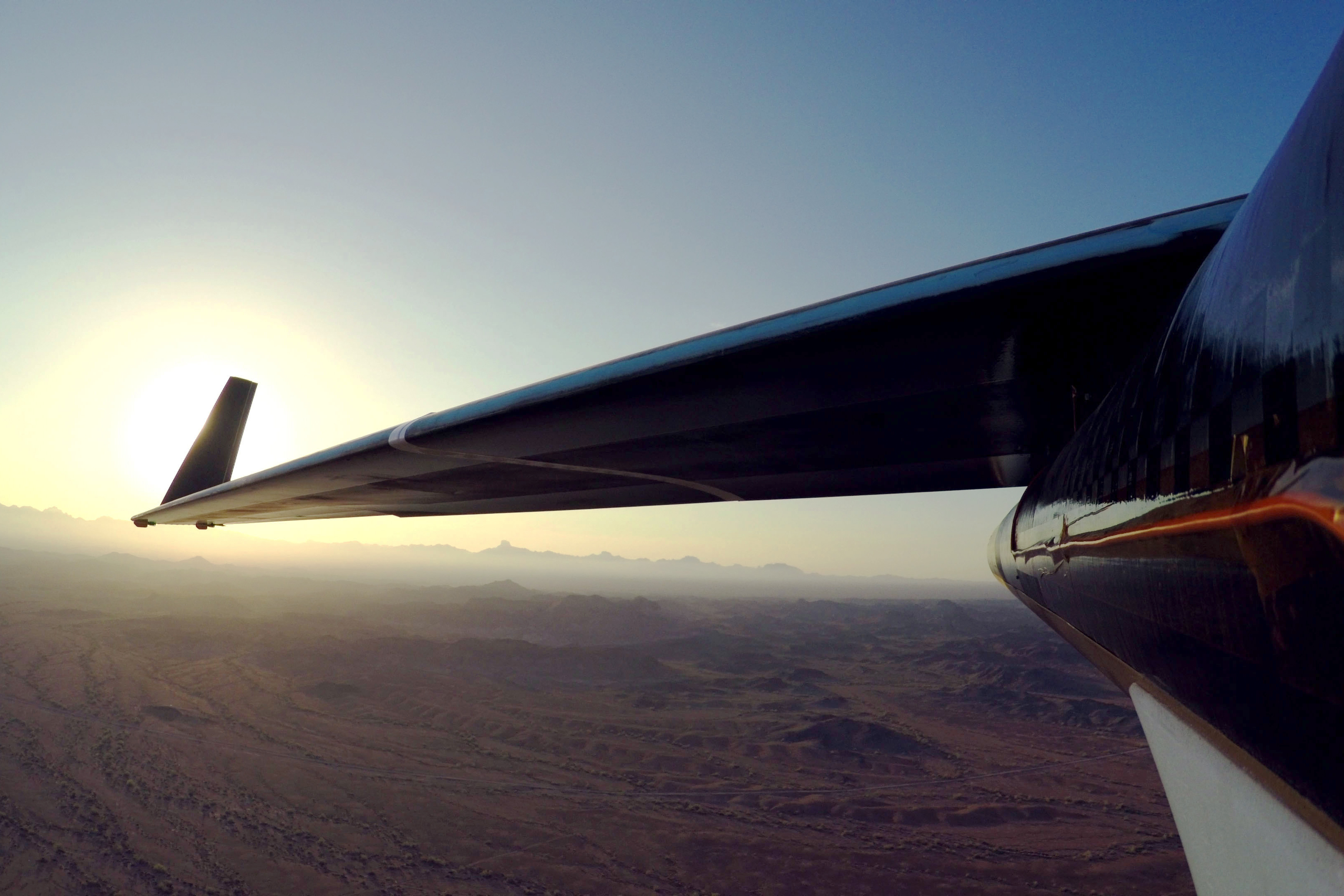
(credit: Facebook)
Facebook Connectivity Lab announced today the first full-scale test flight of Aquila — a solar-powered unmanned airplane/drone designed to bring affordable internet access to some of the 1.6 billion people living in remote locations with no access to mobile broadband networks.
When complete, Aquila will be able to circle a region up to 60 miles in diameter, beaming internet connectivity down from an altitude of more than 60,000 feet to people within a 60-mile communications diameter for up to 90 days at a time. It will be part of a future fleet of drones.
Facebook
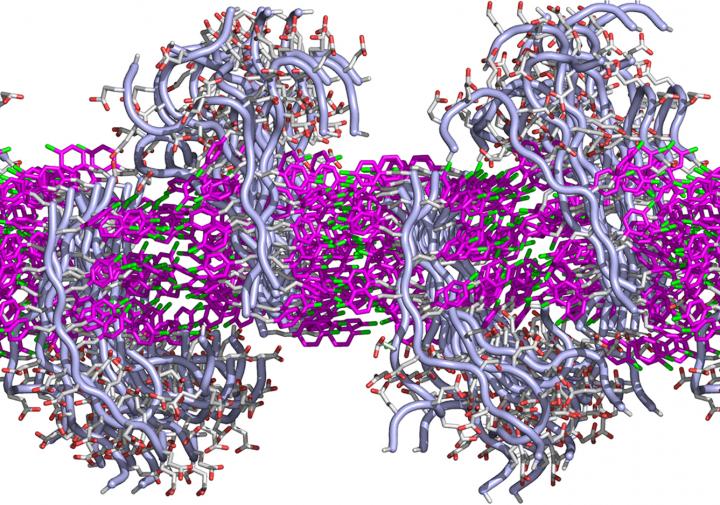
This simulated cross-section shows how the lipid-like peptoids interact to form a membrane. Each peptoid has two sections: a fatty-like region that interacts via benzene rings (shown in pink) with its neighbors to form a sheet, and a water-loving region that juts above or below the flat sheet. Each region can be designed to have specific functions. (credit: Chun-Long Chen/PNNL)
Materials scientists at the Department of Energy’s Pacific Northwest National Laboratory have created a new material that performs like a biological cell membrane — a material that has long been sought for applications like water purification and drug delivery.
The “peptoid” material can assemble itself into a sheet that’s thinner, but more stable, than a soap bubble, the researchers report this week in Nature Communications. The assembled sheet can withstand being submerged in a variety of liquids and can even repair itself after damage.
“We believe these materials have potential in water filters, sensors, drug delivery, and especially fuel cells or other energy applications,” said chemist Chun-Long Chen.
Biological cell membranes, which are made from thin sheets of fatty molecules called lipids, are at least ten times thinner than an iridescent soap bubble and yet allow cells to collectively form organisms as diverse at bacteria, trees and people.
Cell membranes are also very selective about what they let pass through, using tiny embedded proteins as gatekeepers. Membranes repair dings to their structure automatically and change thickness to pass signals from the outside environment to the cell’s interior, where most of the action is.
Scientists would like to take advantage of these gatekeeping and other membrane properties to make filters. A cell-membrane-like material would have advantages over other thin materials such as graphene. For example, mimicking a cell membrane’s efficient gatekeeping could result in water purifying membranes that don’t require a lot of pressure or energy to push the water through.
How to design imitation biological cell membranes
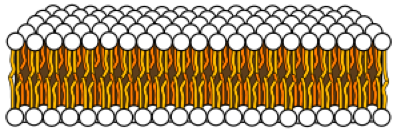
Lipid bilayer sheet (credit: Mariana Ruiz Villarreal/Wikipedia)
Synthetic molecules called peptoids have caught the interest of researchers because they are cheap, versatile and customizable. They are like natural proteins, including those that embed themselves in cell membranes, and can be designed to have very specific forms and functions. So Chen and colleagues decided to see if they could design peptoids to make them more lipid-like (that is, more like fats).
Lipid molecules are long and mostly straight: They have a fatty end that prefers to hang out with other fats, and a water-like end that prefers the comfort of water. Because of this chemistry, lipid molecules arrange themselves with the fatty ends pointed toward each other, sandwiched between the water-loving ends pointed out. Scientists call this a lipid bilayer, essentially a sheet that envelops the contents of a cell. Proteins or carbohydrate molecules embed themselves in the membranous sheet.
Inspired by this, Chen and colleagues designed peptoids in which each base peptoid was a long molecule with one end water-loving and the other end fat-loving. They chose chemical features that they hoped would encourage the individual molecules to pack together. They examined the resulting structures using a variety of analysis methods, including some at the Advanced Light Source and the Molecular Foundry, two DOE Office of Science User Facilities at Lawrence Berkeley National Laboratory.
Forming nanomembranes
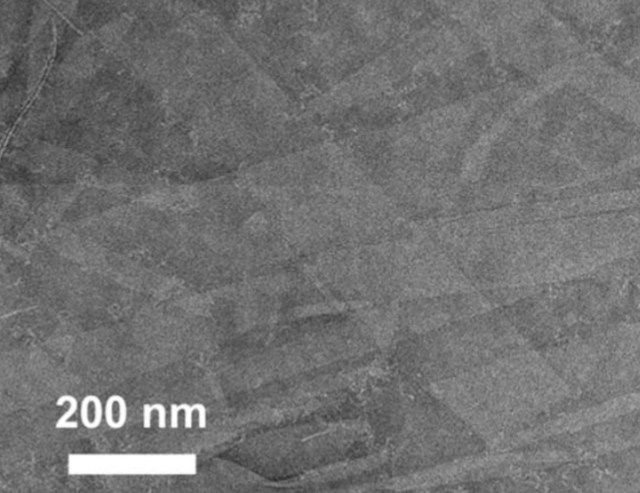
Peptoid nanomembrane (credit: Haibao Jin et al./Nature Communications)
The team found that after putting the lipid-like peptoids into a liquid solution, the molecules spontaneously crystallized and formed “nanomembranes” — straight-edged sheets as thin as cell membranes — floating in the beaker. These nanomembranes maintained their structure in water or alcohol, at different temperatures, in solutions with high or low pH, or high concentrations of salts, a feat that few cell membranes could accomplish.
To better understand the nanomembranes, the team simulated how single peptoid molecules interacted with each other using molecular dynamics software. The simulated peptoids formed a membrane reminiscent of a lipid bilayer: The fat-loving ends lined up in the middle, and their water-loving ends pointed outward either above or below.
They also confirmed the ability of the synthetic membranes to hold proteins that have specific functions, such as ones that let water, and only water, through, and to repair themselves.
The results showed the researchers that they are on the right path to making synthetic cell membrane-like materials. The next step, Chen said, is to build biomimetic membranes by incorporating natural membrane proteins or other synthetic water channels such as carbon nanotubes into these sheet matrices. The team is also looking into ways to make the peptoid membranes conductive for energy uses.
This work was supported by the Department of Energy Office of Science and PNNL.
An ability to develop sequence-defined synthetic polymers that both mimic lipid amphiphilicity for self-assembly of highly stable membrane-mimetic 2D nanomaterials and exhibit protein-like functionality would revolutionize the development of biomimetic membranes. Here we report the assembly of lipid-like peptoids into highly stable, crystalline, free-standing and self-repairing membrane-mimetic 2D nanomaterials through a facile crystallization process. Both experimental and molecular dynamics simulation results show that peptoids assemble into membranes through an anisotropic formation process. We further demonstrated the use of peptoid membranes as a robust platform to incorporate and pattern functional objects through large side-chain diversity and/or co-crystallization approaches. Similar to lipid membranes, peptoid membranes exhibit changes in thickness upon exposure to external stimuli; they can coat surfaces in single layers and self-repair. We anticipate that this new class of membrane-mimetic 2D nanomaterials will provide a robust matrix for development of biomimetic membranes tailored to specific applications.

Tesla Autopilot (credit: Tesla Motors)
Elon Musk revealed his new master plan for Tesla today (July 20) in a blog post published on Tesla’s website:
Increasing safety: “morally reprehensible to delay”
In the context of the recent Autopilot problem, Musk clarified why Tesla is deploying partial autonomy now, rather than waiting until some point in the future: “When used correctly, it is already significantly safer than a person driving by themselves and it would therefore be morally reprehensible to delay release simply for fear of bad press or some mercantile calculation of legal liability.
“According to the recently released 2015 NHTSA report, automotive fatalities increased by 8% to one death every 89 million miles. Autopilot miles will soon exceed twice that number and the system gets better every day. It would no more make sense to disable Tesla’s Autopilot, as some have called for, than it would to disable autopilot in aircraft, after which our system is named.”
Another way to increase safety, he says, is new heavy-duty trucks and high passenger-density urban transport, both planned for unveiling next year. “With the advent of autonomy, it will probably make sense to shrink the size of buses and transition the role of bus driver to that of fleet manager. … Traffic congestion would improve due to increased passenger areal density by eliminating the center aisle and putting seats where there are currently entryways, and matching acceleration and braking to other vehicles, thus avoiding the inertial impedance to smooth traffic flow of traditional heavy buses. It would also take people all the way to their destination.”
Lowering the cost of an autonomous car
Musk said that when true self-driving is approved by regulators, “it will mean that you will be able to summon your Tesla from pretty much anywhere. Once it picks you up, you will be able to sleep, read, or do anything else enroute to your destination.
“You will also be able to add your car to the Tesla shared fleet just by tapping a button on the Tesla phone app and have it generate income for you while you’re at work or on vacation, significantly offsetting and at times potentially exceeding the monthly loan or lease cost. This dramatically lowers the true cost of ownership to the point where almost anyone could own a Tesla. Since most cars are only in use by their owner for 5% to 10% of the day, the fundamental economic utility of a true self-driving car is likely to be several times that of a car which is not.”
Musk said that in cities where demand exceeds the supply of customer-owned cars, “Tesla will operate its own fleet, ensuring you can always hail a ride from us no matter where you are.”

Crash avoidance technologies now available in non-luxury vehicles include Lane Departure Warning (LDW), Forward Collision Warning (FCW), and Blind Spot Monitoring Roadway (BSM). (credit: Corey D. Harper et al./Accident Analysis and Prevention)
U.S. National Highway Traffic Safety Administration chief Mark Rosekind said at a conference today (July 20) that the government “will not abandon efforts to speed the development of self-driving cars … to reduce the 94 percent of car crashes attributed to human error, despite a fatal accident involving a Tesla Model S operating on an autopilot system,” Reuters reports. But autonomous vehicles must be “much safer” than human drivers before they are deployed on U.S. roads, he added.
However, Carnegie Mellon College of Engineering researchers suggest that already-available partially automated vehicle crash-avoidance technologies are a practical interim solution, they conclude in a study published in the journal Accident Analysis and Prevention.
These technologies — which include forward collision warning and avoidance, lane departure warning, blind spot monitoring, and partially autonomous braking or controls — are already available in non-luxury vehicles such as the Honda Accord and Mazda CX-9. If these technologies were deployed in all “light-duty vehicles,” it could prevent or reduce the severity of up 1.3 million crashes a year, including 10,100 fatal wrecks, according to the study.
“While there is much discussion about driverless vehicles, we have demonstrated that even with partial automation, there are financial and safety benefits,” says Chris T. Hendrickson, director of the Carnegie Mellon Traffic21 Institute.
When the team compared the price of equipping cars with safety technology to the expected annual reduction in the costs of crashes (based on government and insurance industry data), they discovered a net cost benefit (in addition to life-saving benefits) in two scenarios:
Carnegie Mellon’s Technologies for Safe and Efficient Transportation (T-SET) University Transportation Center, the National Science Foundation, and the Hillman Foundation funded the project.
Abstract of Cost and benefit estimates of partially-automated vehicle collision avoidance technologies
Many light-duty vehicle crashes occur due to human error and distracted driving. Partially-automated crash avoidance features offer the potential to reduce the frequency and severity of vehicle crashes that occur due to distracted driving and/or human error by assisting in maintaining control of the vehicle or issuing alerts if a potentially dangerous situation is detected. This paper evaluates the benefits and costs of fleet-wide deployment of blind spot monitoring, lane departure warning, and forward collision warning crash avoidance systems within the US light-duty vehicle fleet. The three crash avoidance technologies could collectively prevent or reduce the severity of as many as 1.3 million U.S. crashes a year including 133,000 injury crashes and 10,100 fatal crashes. For this paper we made two estimates of potential benefits in the United States: (1) the upper bound fleet-wide technology diffusion benefits by assuming all relevant crashes are avoided and (2) the lower bound fleet-wide benefits of the three technologies based on observed insurance data. The latter represents a lower bound as technology is improved over time and cost reduced with scale economies and technology improvement. All three technologies could collectively provide a lower bound annual benefit of about $18 billion if equipped on all light-duty vehicles. With 2015 pricing of safety options, the total annual costs to equip all light-duty vehicles with the three technologies would be about $13 billion, resulting in an annual net benefit of about $4 billion or a $20 per vehicle net benefit. By assuming all relevant crashes are avoided, the total upper bound annual net benefit from all three technologies combined is about $202 billion or an $861 per vehicle net benefit, at current technology costs. The technologies we are exploring in this paper represent an early form of vehicle automation and a positive net benefit suggests the fleet-wide adoption of these technologies would be beneficial from an economic and social perspective.

