
So You Think You Love Earth? Wait Until You See It in VR

Science and reality
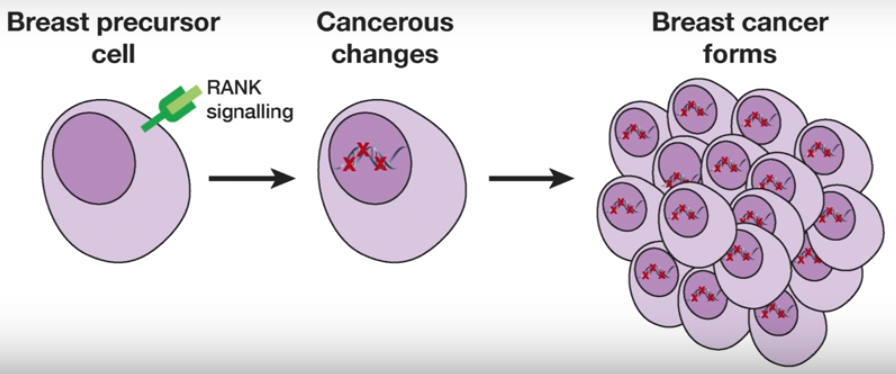
Breast cancer formation (credit: Walter and Eliza Hall Institute)
Australian researchers have discovered that an existing medication could have promise in preventing breast cancer in women carrying a faulty BRCA1 gene, who are at high risk of developing aggressive breast cancer.
Currently, many women with this mutation choose surgical removal of breast tissue and ovaries to reduce their chance of developing breast and ovarian cancer. Notably, in May 2013, actress Angelina Jolie, who reportedly had with an estimated 87 per cent risk of breast cancer and 50 per cent risk of ovarian cancer, chose to have d2ouble mastectomy with breast reconstruction.
Women with mutation have an approximately 65% cumulative risk of developing breast cancer by age 70, the researchers note, based on a 2003 combined analysis of 22 studies.
A drug option
But now, another option may be be possible, as 16 scientists (most in Australia) report in an advance online paper in Nature Medicine this week.
The researchers discovered that pre-cancerous cells could be identified by a marker protein called RANK. A concurrent study led by an Austrian group had also identified the importance of RANK.
This was an important breakthrough, they said, because an inhibitor of the RANK signalling pathway was already in clinical use: the drug denosumab. The researchers suggest the drug may have potential to prevent breast cancer from developing.
If confirmed in clinical studies, this would provide a non-surgical option to prevent breast cancer in women with elevated genetic risk.
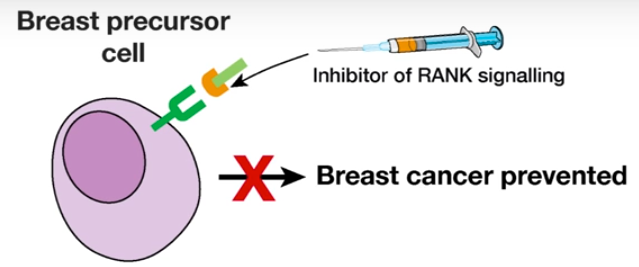
Breast cancer prevention (credit: Walter and Eliza Hall Institute)
“This is potentially a very important discovery for women who carry a faulty BRCA1 gene, who have few other options,” said Walter and Eliza Hall Institute of Medical Research professor Geoffrey J. Lindeman. “Current cancer prevention strategies for these women include surgical removal of the breasts and/or ovaries, which can have serious impacts on people’s lives.
“To progress this work, denosumab would need to be formally tested in clinical trials in this setting as it is not approved for breast cancer prevention,” he said.
The research was published this week in Nature Medicine and was supported by The National Breast Cancer Foundation, The Qualtrough Cancer Research Fund, The Joan Marshall Breast Cancer Research Fund, the Australian Cancer Research Foundation, Cancer Council Victoria, the Cancer Therapeutics Cooperative Research Centre, an Amgen Preclinical Research Program Grant, the National Health and Medical Research Council, the Victorian Cancer Agency, and the Victorian Government Operational Infrastructure Support Scheme.
The Walter and Eliza Hall Institute | ‘Holy grail’ of breast cancer prevention in high-risk women may be in sight
Abstract of RANK ligand as a potential target for breast cancer prevention in BRCA1-mutation carriers
Individuals who have mutations in the breast-cancer-susceptibility gene BRCA1 (hereafter referred to as BRCA1-mutation carriers) frequently undergo prophylactic mastectomy to minimize their risk of breast cancer. The identification of an effective prevention therapy therefore remains a ‘holy grail’ for the field. Precancerous BRCA1mut/+ tissue harbors an aberrant population of luminal progenitor cells, and deregulated progesterone signaling has been implicated in BRCA1-associated oncogenesis. Coupled with the findings that tumor necrosis factor superfamily member 11 (TNFSF11; also known as RANKL) is a key paracrine effector of progesterone signaling and that RANKL and its receptor TNFRSF11A (also known as RANK) contribute to mammary tumorigenesis, we investigated a role for this pathway in the pre-neoplastic phase of BRCA1-mutation carriers. We identified two subsets of luminal progenitors (RANK+ and RANK−) in histologically normal tissue of BRCA1-mutation carriers and showed that RANK+ cells are highly proliferative, have grossly aberrant DNA repair and bear a molecular signature similar to that of basal-like breast cancer. These data suggest that RANK+ and not RANK− progenitors are a key target population in these women. Inhibition of RANKL signaling by treatment with denosumab in three-dimensional breast organoids derived from pre-neoplasticBRCA1mut/+ tissue attenuated progesterone-induced proliferation. Notably, proliferation was markedly reduced in breast biopsies from BRCA1-mutation carriers who were treated with denosumab. Furthermore, inhibition of RANKL in a Brca1-deficient mouse model substantially curtailed mammary tumorigenesis. Taken together, these findings identify a targetable pathway in a putative cell-of-origin population in BRCA1-mutation carriers and implicate RANKL blockade as a promising strategy in the prevention of breast cancer.

Olli (credit: Local Motors)
Local Motors, creator of the world’s first 3D-printed cars, has developed the first self-driving “cognitive” vehicle, using IBM Watson Internet of Things (IoT) for Automotive.
The vehicle, dubbed “Olli,” can carry up to 12 people. It uses IBM Watson and other systems to improve the passenger experience and allow natural interaction with the vehicle. Olli will be used on public roads locally in Washington DC and later this year in Miami-Dade County.
Olli is the first vehicle to use the cloud-based cognitive computing capability of IBM Watson IoT to analyze and learn from high volumes of transportation data, produced by more than 30 sensors embedded throughout the vehicle. Sensors will be added and adjusted continually as passenger needs and local preferences are identified.
Four Watson developer APIs — Speech to Text, Natural Language Classifier, Entity Extraction and Text to Speech — will enable passengers to interact conversationally with Olli while traveling from point A to point B, discussing topics about how the vehicle works, where they are going, and why Olli is making specific driving decisions.
Watson empowers Olli to understand and respond to passengers’ questions as they enter the vehicle, such as destinations (“Olli, can you take me downtown?”) or specific vehicle functions (“how does this feature work?” or even “are we there yet?”). Passengers can also ask for recommendations on local destinations such as popular restaurants or historical sites based on analysis of personal preferences.
“Cognitive computing provides incredible opportunities to create unparalleled, customized experiences for customers, taking advantage of the massive amounts of streaming data from all devices connected to the Internet of Things, including an automobile’s myriad sensors and systems,” said Harriet Green, General Manager, IBM Watson Internet of Things, Commerce & Education.
Miami-Dade County and Las Vegas are also exploring a pilot program in which several autonomous vehicles would be used to transport people around Miami and Las Vegas.
IBM Internet of Things | Local Motors Debuts “Olli,” the First Self-driving Vehicle to Tap the Power of IBM Watson
IBM Internet of Things | Harnessing vehicle safety data with analytics
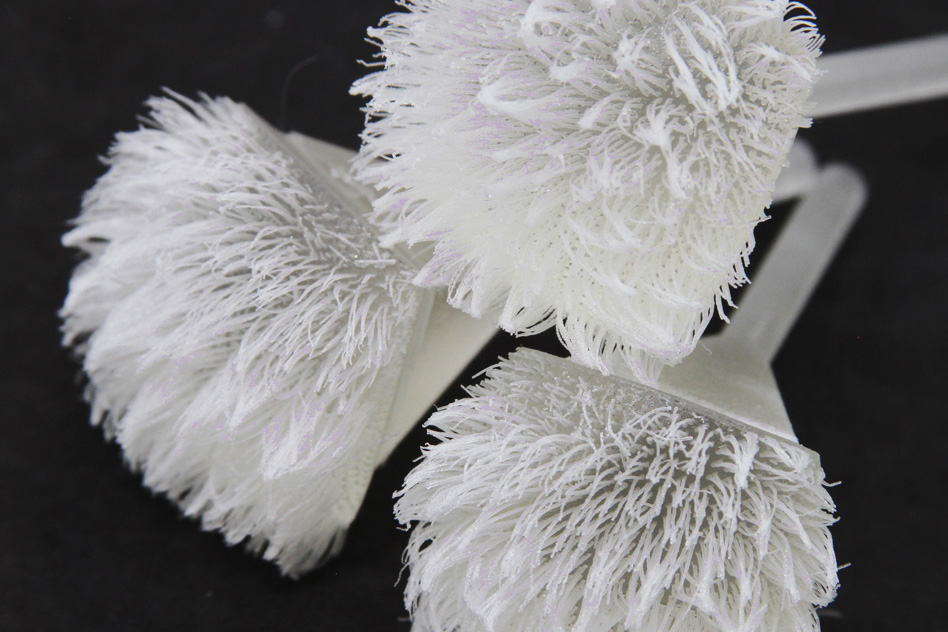
3-D printed hair (credit: Tangible Media Group/MIT Media Lab)
Researchers in MIT’s Media Lab have bypassed a major design step in 3-D printing — quickly and efficiently modeling and printing thousands of hair-like structures.
Instead of using conventional computer-aided design (CAD) software to draw thousands of individual hairs on a computer — a step that would take hours to compute — the team built a new software platform called “Cilllia” that lets users simply define the angle, thickness, density, and height of thousands of hairs in just a few minutes.
Using the new software, the researchers designed arrays of hair-like structures at a resolution of 50 micrometers — about the width of an average human hair. They then designed and printed arrays, ranging from coarse bristles to fine fur, onto flat and also curved surfaces, using a conventional 3-D printer.
The goal was to perform useful tasks such as sensing, adhesion, and actuation … and maybe create a few toys.
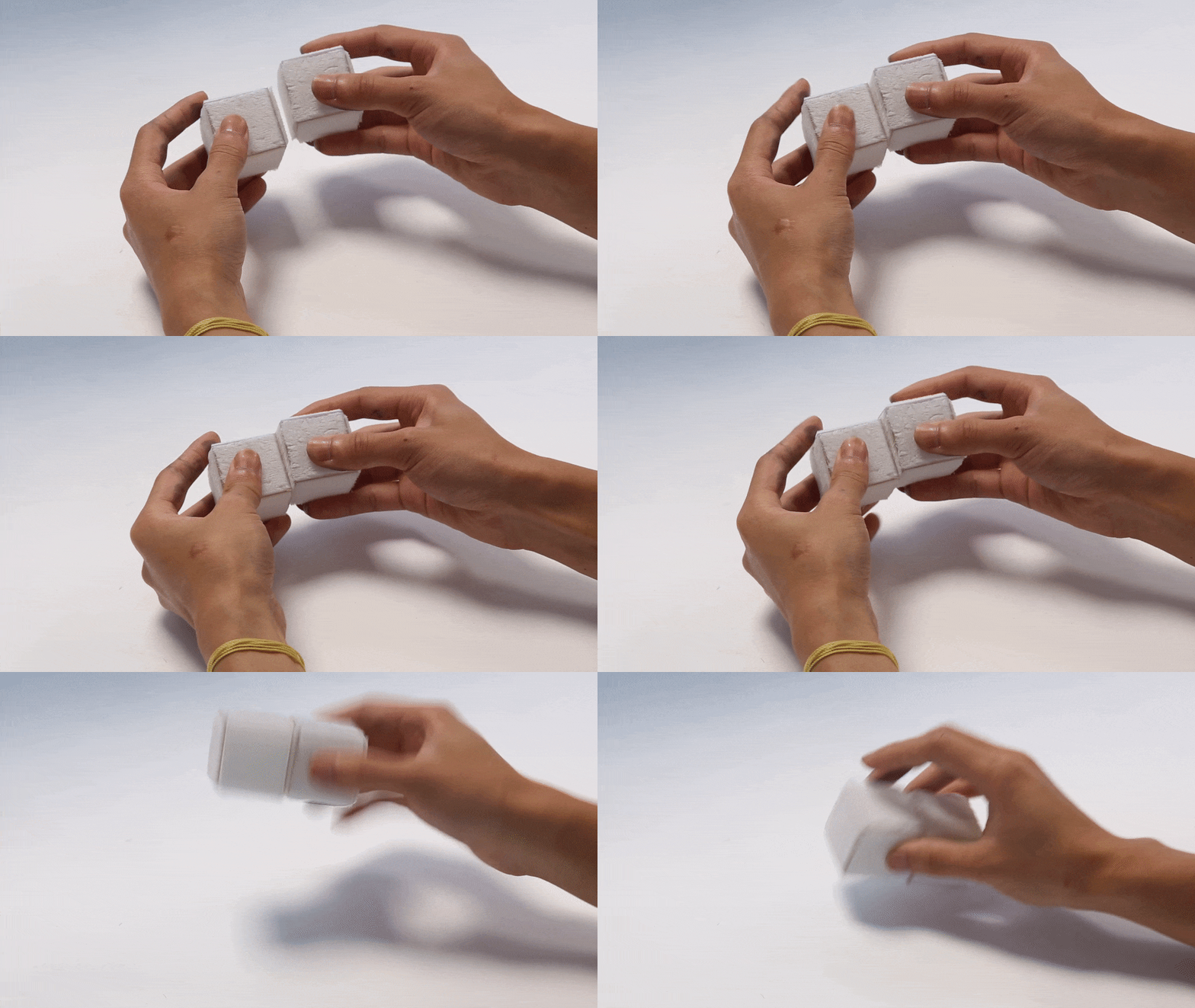
The 3-D printed hairs act like Velcro. (credit: MIT Media Lab researchers)
To demonstrate adhesion, the team printed arrays that act as Velcro-like bristle pads. Depending on the angle of the bristles, the pads can stick to each other with varying forces. For sensing, the researchers printed a small furry rabbit figure, equipped with LED lights that light up when a person strokes the rabbit in certain directions.

Vibrations cause a piece of metal to move across the 3-D printed hairs. (credit: MIT Media Lab researchers)
And to see whether 3-D-printed hair can help actuate, or move objects, the team fabricated a weight-sorting table made from panels of printed hair with specified angles and heights. As a small vibration source shook the panels, the hairs were able to move coins across the table, sorting them based on the coins’ weight and the vibration frequency.
A software challenge
“[Hair] comes with a challenge that is not on the hardware, but on the software side,” says Jifei Ou, lead author on a paper presented at the Association for Computing Machinery’s CHI Conference on Human Factors in Computing Systems in May.
To 3-D-print hair using existing software, designers would have to model hair in CAD, drawing out each individual strand, then feed the drawing through a slicer program that represents each hair’s contour as a mesh of tiny triangles. The program would then create horizontal cross sections of the triangle mesh, and translate each cross section into pixels, or a bitmap, that a printer could then print out, layer by layer.
Ou says designing a stamp-sized array of 6,000 hairs using this process would take several hours to process. “If you were to load this file into a normal slicing program, it would crash the program,” he says.
Hair pixels
To design hair, the researchers chose to do away with CAD modeling entirely. Instead, they built a new software platform to model first a single hair and then an array of hairs, and finally to print arrays on both flat and curved surfaces.*
Using these techniques, the team printed pads of Velcro-like bristles, and paintbrushes with varying textures and densities.
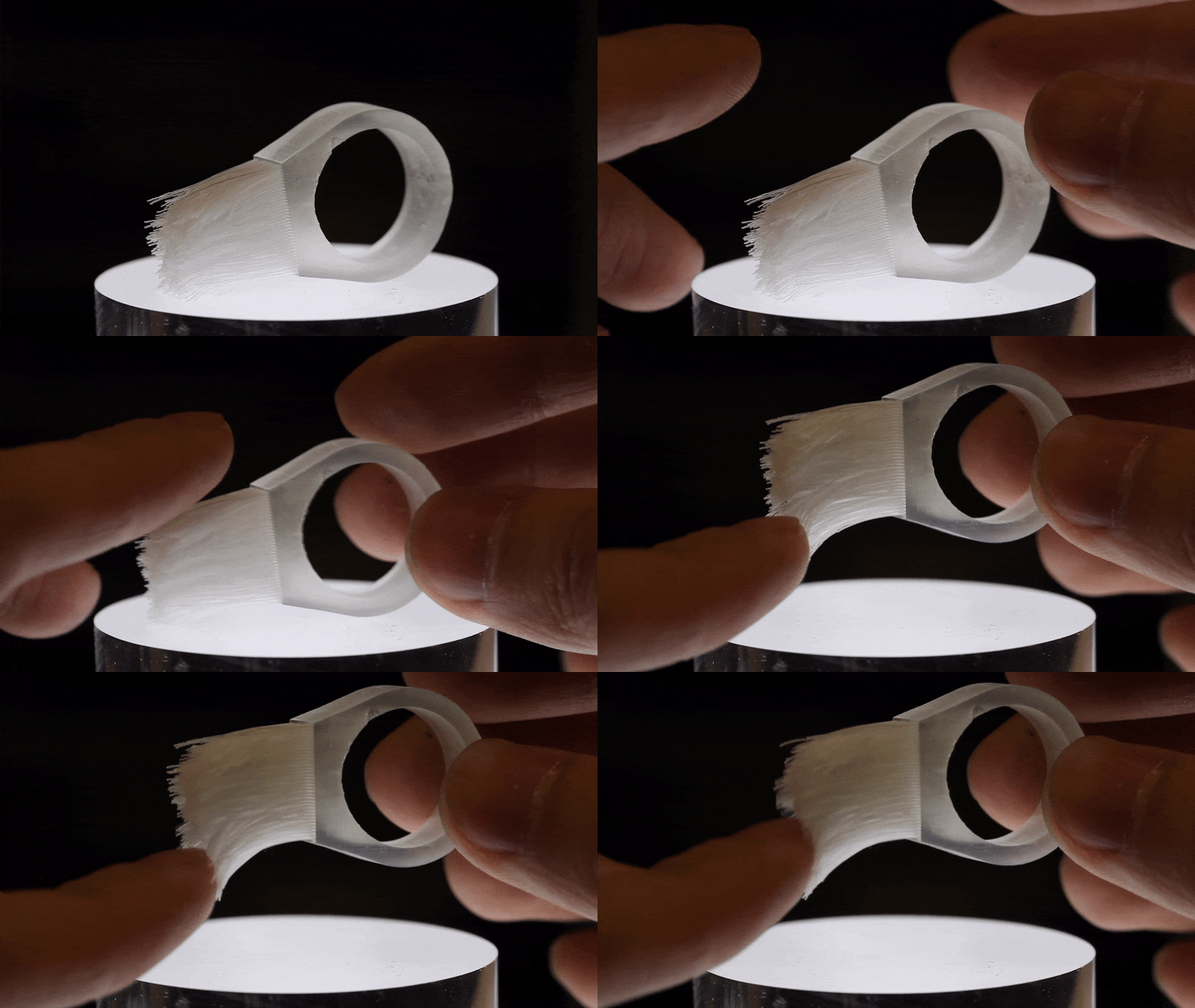
The researchers attached the 3-D printed hairs to a ring. (credit: MIT Media Lab researchers)
Printing hair on curved surfaces proved trickier. To do this, the team first imported a CAD drawing of a curved surface, such as a small rabbit, then fed the model through a slicing program to generate a triangle mesh of the rabbit shape. They then developed an algorithm to locate the center of each triangle’s base, then virtually drew a line out, perpendicular to the triangle’s base, to represent a single hair. Doing this for every triangle in the mesh created a dense array of hairs running perpendicular to the rabbit’s curved surface.
The researchers then used their color mapping techniques to quickly customize the rabbit hair’s thickness and stiffness.
Interactive toys and other objects
“With our method, everything becomes smooth and fast,” Ou says. “Previously it was virtually impossible, because who’s going to take a whole day to render a whole furry rabbit, and then take another day to make it printable?”
Among other applications, Ou says 3-D-printed hair may be used in interactive toys. To demonstrate, his team inserted an LED light into the fuzzy printed rabbit, along with a small microphone that senses vibrations. With this setup, the bunny turns green when it is petted in the correct way, and red when it is not.
“The ability to fabricate customized hair-like structures not only expands the library of 3-D-printable shapes, but also enables us to design alternative actuators and sensors,” the authors conclude in their paper. “3-D-printed hair can be used for designing everyday interactive objects.”
Kelly Schaefer, a designer at IDEO, a design consulting firm, says “this type of work expands the possibilities of 3-D printing as an industry because of the new applications it suggests.”
* The researchers modeled a single hair by representing an elongated cone as a stack of fewer and fewer pixels, from the base to the top. To change the hair’s dimensions, such as its height, angle, and width, they simply changed the arrangement of pixels in the cone.
To scale up to thousands of hairs on a flat surface, Ou and his team used Photoshop to generate a color mapping technique. They used three colors — red, green, and blue — to represent three hair parameters — height, width, and angle. For example, to make a circular patch of hair with taller strands around the rim, they drew a red circle and changed the color gradient in such a way that darker hues of red appeared around the circle’s rim, denoting taller hairs. They then developed an algorithm to quickly translate the color map into a model of a hair array, which they then fed to a 3-D printer.
Abstract of Cilllia: 3D Printed Micro-Pillar Structures for Surface Texture, Actuation and Sensing
This work presents a method for 3D printing hair-like structures on both flat and curved surfaces. It allows a user to design and fabricate hair geometries that are smaller than 100 micron. We built a software platform to let users quickly define the hair angle, thickness, density, and height. The ability to fabricate customized hair-like structures not only expands the library of 3D-printable shapes, but also enables us to design passive actuators and swipe sensors. We also present several applications that show how the 3D-printed hair can be used for designing everyday interactive objects.
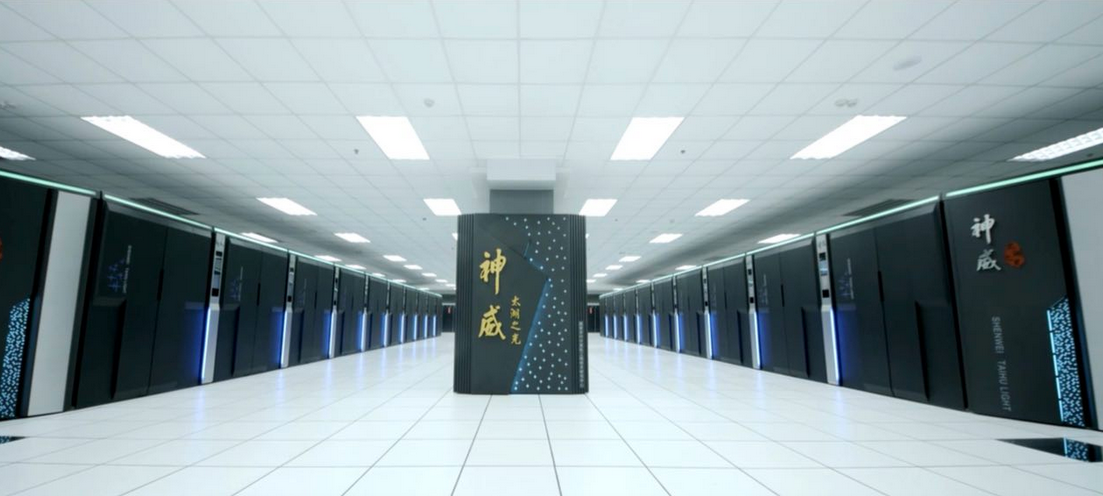
Sunway TaihuLight System (credit: National Supercomputing Center)
Chinese supercomputers maintained their No. 1 ranking on the 47th edition of the TOP500 list of the world’s top supercomputers, announced today (June 20). The new Sunway TaihuLight supercomputer operates at 93 petaflop/s (quadrillions of calculations per second) Rmax on the LINPACK benchmark — twice as fast and three times as efficient as China’s Tianhe-2 (at 33.86 petaflop/s), now in the #2 spot.
The new supercomputer was developed by the National Research Center of Parallel Computer Engineering & Technology (NRCPC) and installed at the National Supercomputing Center in Wuxi in China’s Jiangsu province. The complete system has a theoretical peak performance of 125.4 Pflop/s, with 10,649,600 cores and 1.31 PB of primary memory, according to a report by Top500 co-compiler Jack Dongarra of the University of Tennessee.
The newest edition of the semiannual TOP500 list was announced today at the 2016 International Supercomputer Conference in Frankfurt.
China now leads with largest number of supercomputers
The latest list marks the first time since the inception of the TOP500 that the U.S is not home to the largest number of systems. China now leads with 167 systems and the U.S. is second with 165. China also leads the performance category, thanks to the No. 1 and No. 2 systems. Titan, a Cray XK7 system installed at the Department of Energy’s (DOE) Oak Ridge National Laboratory, is now the No. 3 system, at 17.59 petaflop/s.
Sunway TaihuLight was also built entirely using processors designed and made in China (Tianhe-2 was built with Intel processors).
U.S. primacy on the Top500 list has slipped for a number of reasons, including lower government support, private-sector investing now focused on cloud-computing centers, and the U.S. policy of blocking the sale of a number of advanced microprocessors to China, possibly accelerating development of China’s own technology, the New York Times reports. (Last year, the Obama administration began a new effort to develop an“exascale” supercomputer; it would be more than 10 times faster than the Sunway TaihuLight.)
However, because of funding shortages and technology challenges, “there has been a delay in getting the exascale launched in the U.S., and as a result, we’re further behind than we should be,” Dongarra told the Times, noting that the Chinese government is committed to reaching the exascale goal by the end of this decade.
Cray continues to be the leader in the TOP500 list in total installed performance share, with 19.9 percent (down from 25 percent). Thanks to the Sunway TaihuLight system, the National Research Center of Parallel Computer Engineering & Technology takes the second spot with 16.4 percent of the total performance — with just one machine. IBM takes the third spot with 10.7 percent share, down from 14.9 percent six months ago.
Energy-efficiency ratings
For the first time, the data collection and curation of the Green500 project, which ranks supercomputers by energy efficiency, is now integrated with the TOP500 project. The most energy-efficient system and No. 1 on the Green500 is Shoubu, a PEZY Computing/Exascaler ZettaScaler-1.6 System achieving 6.67 GFfops/Watt at the Advanced Center for Computing and Communication at RIKEN in Japan.
Other highlights from the Top 500 list:
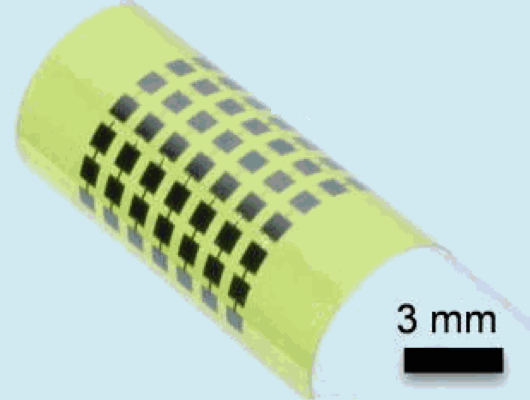
Ultra-thin solar cells flexible enough to bend around small objects, such as this 6-mm-diameter glass rod (credit: Juho Kim, et al./APL)
Scientists in South Korea have designed ultra-thin photovoltaics that are flexible enough to wrap around a thin glass rod. The new solar cells could power wearable electronics like smart watches and fitness trackers.
“Our photovoltaic is about 1 micrometer thick” (the thinnest human hair is about 17 micrometers), said Jongho Lee, an engineer at the Gwangju Institute of Science and Technology in South Korea. Standard photovoltaics are usually hundreds of times thicker, and most other thin photovoltaics are 2 to 4 times thicker, he explained.
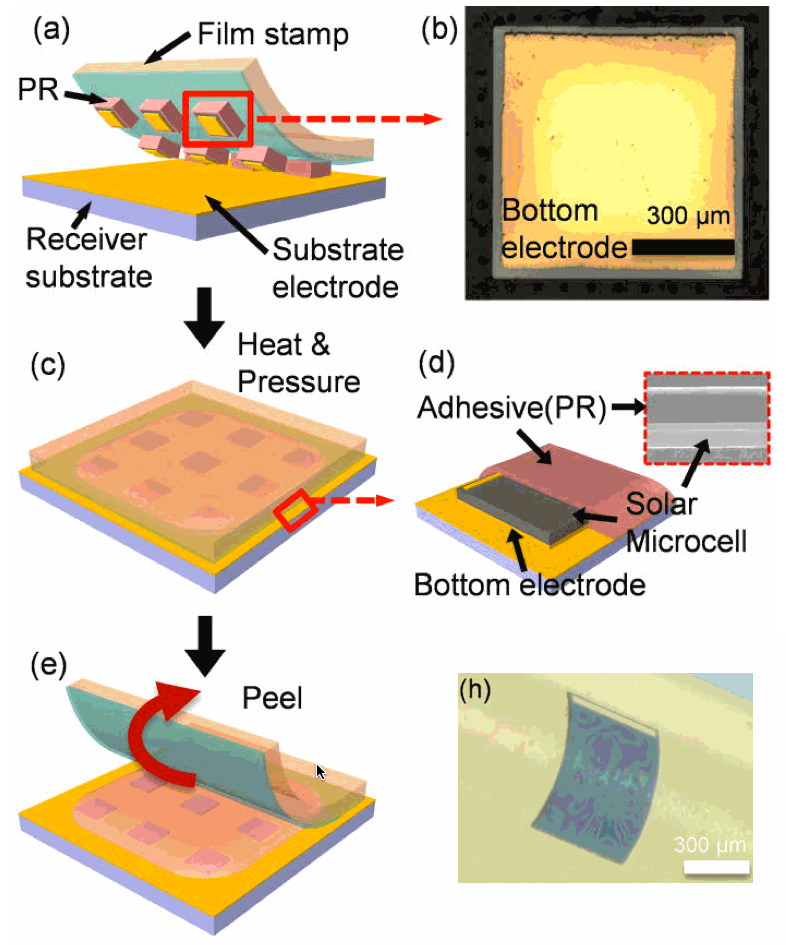
Fabrication procedure of the flexible vertical ultra-thin gallium-arsenide solar microcells.* (credit: Juho Kim, et al./APL)
The researchers made the ultra-thin solar cells from the semiconductor gallium arsenide. They stamped the cells directly onto a flexible substrate without using an adhesive (which would add to the material’s thickness).
The cells were then “cold welded” to the electrode on the substrate by applying pressure at 170 degrees Celsius and melting a top layer of material called photoresist, which acted as a temporary adhesive. The photoresist was later peeled away, leaving the direct metal-to-metal bond.
The metal bottom electrode layer also serves as a reflector to direct stray light back to the solar cells (to increase current output). The researchers tested the efficiency of the device at converting sunlight to electricity and found that it was comparable to thicker photovoltaics.
The team performed bending tests and found the cells could wrap around a radius as small as 1.4 millimeters. They also performed numerical analysis of the cells, finding that they experience one-fourth the amount of strain of similar cells that are 3.5 micrometers thick.
A few other groups have reported solar cells with thicknesses of around 1 micrometer, but have produced the cells in different ways, for example, by removing the whole subtrate by etching. By transfer-printing instead of etching, the new method developed by Lee and his colleagues could be used to make very flexible photovoltaics with a smaller amount of materials, according to Lee.
The thin cells can also be integrated onto glasses frames or fabric and might power the next wave of wearable electronics, Lee said.
The researchers report the results in an open-access paper in the journal Applied Physics Letters, from AIP Publishing.
* (a) Schematic illustration of a film stamp with vertical gallium-arsenide microcells fabricated and isolated from the epitaxially grown source wafers. The photoresist (PR) temporarily holds the solar microcells on the source wafers. (b) The bottom electrode, which also serves as a back reflector, is deposited onto the backside of the ultra-thin vertical GaAs microcells. (c) After the film stamp is brought into contact with the receiver substrate, heat (∼170 °C) and pressure (∼80 kPa) are applied to melt the PR to serve as an adhesive. (d) Cross-sectional scanning electron microscope (SEM) image of the microcell covered with the adhesive (PR) on the receiver substrate after the printing process. The bottom electrode is in direct contact with the Au layer on the receiver substrate. (e) Peeling the film stamp leaves the vertical ultra-thin solar microcells on the receiver substrate. (h) An optical image of the microcell wrapped on a glass slide with a radius of 1 mm. The microcell is encapsulated with a thin epoxy layer (thickness ∼2 μm).
