Higher intake of whole grains associated with lower risk of major chronic diseases and death

Cereal plant, 7-grain bread, wholegrain food (credit: iStock)

A meta-analysis of 45 studies (64 publications) of consumption of whole grain by an international team of researchers, led by Dagfinn Aune, PhD, at Imperial College London, found lower risks of coronary heart disease and cardiovascular disease overall, as well as deaths from all causes and from specific diseases, including stroke, cancer, diabetes, infectious and respiratory diseases.

The researchers say these results “strongly support dietary recommendations to increase intake of whole grain foods in the general population to reduce risk of chronic diseases and premature mortality.”

The results have been published in an open-access paper in the British Medical Journal (BMJ).

The greatest benefit was seen for people who increased from no intake of whole grain to two servings per day, equivalent to 32 g/day, such as 32 g of whole grain wheat, or to 60 g product/day, such as 60 g of whole grain wheat bread.

Further reductions in risks were observed up to 7.5 servings a day, equivalent to 225 g/day of whole grain products, and suggest additional benefits at higher intakes.

Relation to specific types of disorders

A large body of evidence has emerged on the health benefits of whole grain foods over the last 10–15 years. Grains are one of the major staple foods worldwide and provide on average 56% of energy intake and 50% of protein intake.

But recommendations on the daily amount and types of whole grain foods needed to reduce risk of chronic disease and mortality have often been unclear or inconsistent. So the researchers carried out a systematic review and meta-analysis of 45 published studies on whole grain consumption in relation to several health outcomes and all-cause mortality.*

They found reductions in the relative risk of coronary heart disease (19%), cardiovascular disease (22%), all cause mortality (17%), and mortality from stroke (14%), cancer (15%), respiratory disease (22%), infectious disease (26%), and diabetes (51%) per 90 g/day of whole grain product (one serving equals 30g of whole grain product).

Reductions in risks of cardiovascular disease and all-cause mortality were associated with intake of whole grain bread, whole grain breakfast cereals, and added bran, as well as total intake of bread and breakfast cereals.

There was little evidence of an association with intake of refined grains, white rice, total rice or other grains.

Caveats and recommendations

Few people may have total grain intake of three or more servings a day, so the authors recommend “increasing intake of whole grains, and as much as possible to choose whole grains rather than refined grains.”

However, the researchers noted that systematic reviews and meta-analyses involving observational research cannot be used to draw conclusions about cause and effect.

They call for more research to determine health benefits of different types of whole grain in different geographical regions, as most of the current evidence is from the U.S. and fewer studies have been conducted in Europe, Asia and other regions. Studies of specific diseases, and less common causes of deaths, are needed.

They caution that it’s important that “great care” should be taken not to promote whole grain foods with high sugar and salt content, and call for more research on the “biological mechanisms of health effects and contribution to health of different grain types.”

A related study published in The Journals of Gerontology, Series A (recently described on KurzweilAI — see Dietary fiber has biggest influence on successful aging, research reveals) found that fiber that made the biggest difference to what the researchers termed “successful aging,” meaning “the absence of disability, depressive symptoms, cognitive impairment, respiratory symptoms, and chronic diseases including cancer, coronary artery disease, and stroke.”

* They included more than 7,000 cases of coronary heart disease, 2,000 cases of stroke, 26,000 cases of cardiovascular disease, 34,000 deaths from cancer, and 100,000 deaths among 700,000 participants.


Abstract of Whole grain consumption and risk of cardiovascular disease, cancer, and all cause and cause specific mortality: systematic review and dose-response meta-analysis of prospective studies

Objective To quantify the dose-response relation between consumption of whole grain and specific types of grains and the risk of cardiovascular disease, total cancer, and all cause and cause specific mortality.

Data sources PubMed and Embase searched up to 3 April 2016.

Study selection Prospective studies reporting adjusted relative risk estimates for the association between intake of whole grains or specific types of grains and cardiovascular disease, total cancer, all cause or cause specific mortality.

Data synthesis Summary relative risks and 95% confidence intervals calculated with a random effects model.

Results 45 studies (64 publications) were included. The summary relative risks per 90 g/day increase in whole grain intake (90 g is equivalent to three servings—for example, two slices of bread and one bowl of cereal or one and a half pieces of pita bread made from whole grains) was 0.81 (95% confidence interval 0.75 to 0.87; I2=9%, n=7 studies) for coronary heart disease, 0.88 (0.75 to 1.03; I2=56%, n=6) for stroke, and 0.78 (0.73 to 0.85; I2=40%, n=10) for cardiovascular disease, with similar results when studies were stratified by whether the outcome was incidence or mortality. The relative risks for morality were 0.85 (0.80 to 0.91; I2=37%, n=6) for total cancer, 0.83 (0.77 to 0.90; I2=83%, n=11) for all causes, 0.78 (0.70 to 0.87; I2=0%, n=4) for respiratory disease, 0.49 (0.23 to 1.05; I2=85%, n=4) for diabetes, 0.74 (0.56 to 0.96; I2=0%, n=3) for infectious diseases, 1.15 (0.66 to 2.02; I2=79%, n=2) for diseases of the nervous system disease, and 0.78 (0.75 to 0.82; I2=0%, n=5) for all non-cardiovascular, non-cancer causes. Reductions in risk were observed up to an intake of 210-225 g/day (seven to seven and a half servings per day) for most of the outcomes. Intakes of specific types of whole grains including whole grain bread, whole grain breakfast cereals, and added bran, as well as total bread and total breakfast cereals were also associated with reduced risks of cardiovascular disease and/or all cause mortality, but there was little evidence of an association with refined grains, white rice, total rice, or total grains.

Conclusions This meta-analysis provides further evidence that whole grain intake is associated with a reduced risk of coronary heart disease, cardiovascular disease, and total cancer, and mortality from all causes, respiratory diseases, infectious diseases, diabetes, and all non-cardiovascular, non-cancer causes. These findings support dietary guidelines that recommend increased intake of whole grain to reduce the risk of chronic diseases and premature mortality.

Built-in miniaturized micro-supercapacitor powers silicon chip

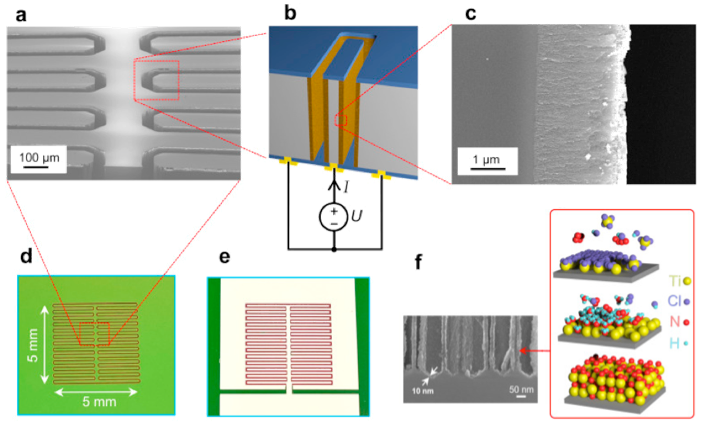
In-chip porous silicon-titanium nitride supercapacitor. (a) Scanning electron microscopy (SEM) inset of the trenches separating the electrodes (dark gray). (b) Rotated schematic illustration of the cross-section of two opposite electrodes of a device (titanium nitride-coated porous silicon layer with aluminum contact pads on the back side), with electrolyte shown in orange. (c) Higher-magnification SEM picture of the porous silicon regions. (d) Device trench side. (e) metallization side containing aluminum contacts for electrodes. (f) 3D illustration of two atomic-layer-deposition cycles of titanium-nitride growth. (credit: adapted from Kestutis Grigoras et al./Nano Energy)

Finnish researchers have developed a method for building highly efficient miniaturized micro-supercapacitor energy storage directly inside a silicon microcircuit chip, making it possible to power autonomous sensor networks, wearable electronics, and mobile internet-of-things (IoT) devices.

Supercapacitors function similar to standard batteries, but store electrostatic energy instead of chemical energy.

The researchers at VTT Technical Research Centre of Finland have developed a hybrid nano-electrode that’s only a few nanometers thick. It consists of porous silicon coated with a titanium nitride layer formed by atomic layer deposition.

The nano-electrode design features the highest-ever conductive surface-to-volume ratio. That combined with an ionic liquid (in a microchannel formed in between two electrodes), results in an extremely small form factor and efficient energy storage. That design makes it possible for a silicon-based micro-supercapacitor to achieve higher energy storage (energy density) and faster charge/discharge (power density) than the leading carbon- and graphene-based supercapacitors, according to the researchers.

The micro-supercapacitor can store 0.2 joule (55 microwatts of power for one hour) on a one-square-centimeter silicon chip. This design also leaves the surface of the chip available for active integrated microcircuits and sensors.

Micro-supercapacitors can also be integrated directly with active microelectronic devices to store electrical energy generated by thermal, light, and vibration energy harvesters to supply electrical energy (see, for example, Wireless device converts ‘lost’ microwave energy into electric power).

An open-access paper on the research has been published in Nano Energy journal.


Abstract of Conformal titanium nitride in a porous silicon matrix: A nanomaterial for in-chip supercapacitors

Today’s supercapacitor energy storages are typically discrete devices aimed for printed boards and power applications. The development of autonomous sensor networks and wearable electronics and the miniaturization of mobile devices would benefit substantially from solutions in which the energy storage is integrated with the active device. Nanostructures based on porous silicon (PS) provide a route towards integration due to the very high inherent surface area to volume ratio and compatibility with microelectronics fabrication processes. Unfortunately, pristine PS has limited wettability and poor chemical stability in electrolytes and the high resistance of the PS matrix severely limits the power efficiency. In this work, we demonstrate that excellent wettability and electro-chemical properties in aqueous and organic electrolytes can be obtained by coating the PS matrix with an ultra-thin layer of titanium nitride by atomic layer deposition. Our approach leads to very high specific capacitance (15 F cm−3), energy density (1.3 mWh cm−3), power density (up to 214 W cm−3) and excellent stability (more than 13,000 cycles). Furthermore, we show that the PS–TiN nanomaterial can be integrated inside a silicon chip monolithically by combining MEMS and nanofabrication techniques. This leads to realization of in-chip supercapacitor, i.e., it opens a new way to exploit the otherwise inactive volume of a silicon chip to store energy.

Hierarchies exist in the brain because of lower connection costs, research shows

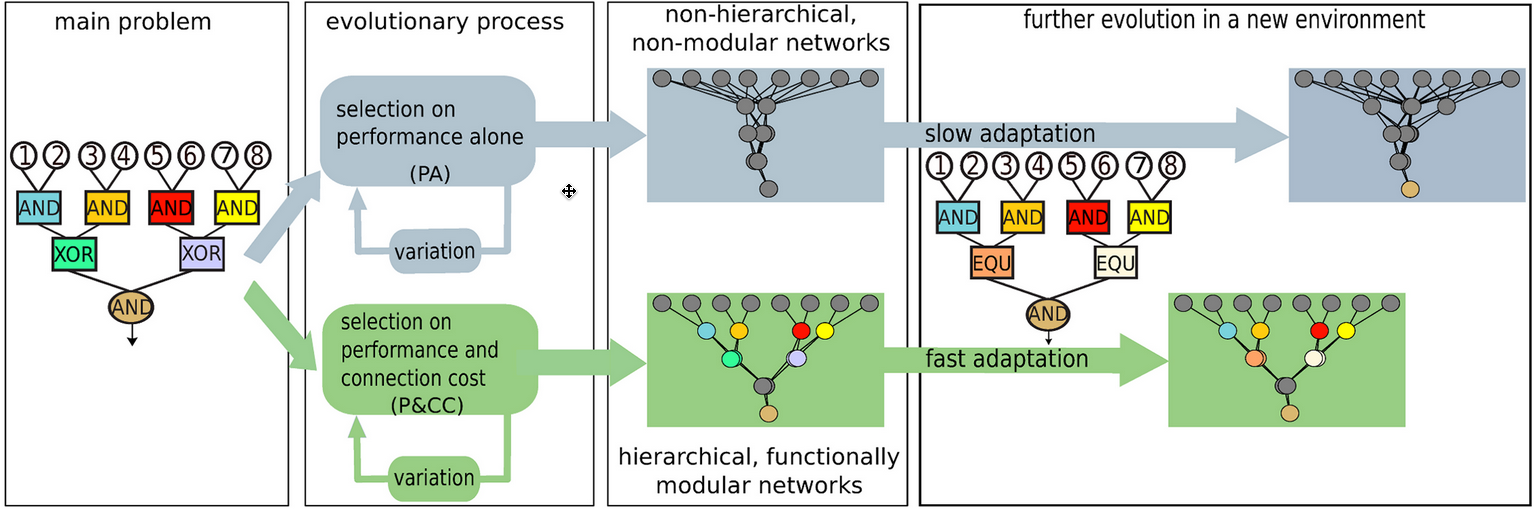
The Evolutionary Origins of Hierarchy: Evolution with performance-only selection results in non-hierarchical and non-modular networks, which take longer to adapt to new environments. However, evolving networks with a connection cost creates hierarchical and functionally modular networks that can solve the overall problem by recursively solving its sub-problems. These networks also adapt to new environments faster. (credit: Henok Mengistu et al./PLOS Comp. Bio)

New research suggests why the human brain and other biological networks exhibit a hierarchical structure, and the study may improve attempts to create artificial intelligence.

The study, by researchers from the University of Wyoming and the French Institute for Research in Computer Science and Automation (INRIA, in France), demonstrates that the evolution of hierarchy — a simple system of ranking — in biological networks may arise because of the costs associated with network connections.

This study also supports Ray Kurzweil’s theory of the hierarchical structure of the neocortex, presented in his 2012 book, How to Create a Mind.

The human brain has separate areas for vision, motor control, and tactile processing, for example, and each of these areas consist of sub-regions that govern different parts of the body.

Evolutionary pressure to reduce the number and cost of connections

The research findings suggest that hierarchy evolves not because it produces more efficient networks, but instead because hierarchically wired networks have fewer connections. That’s because connections in biological networks are expensive — they have to be built, maintained, etc. — so there’s an evolutionary pressure to reduce the number of connections.

In addition to shedding light on the emergence of hierarchy across the many domains in which it appears, these findings may also accelerate future research into evolving more complex, intelligent computational brains in the fields of artificial intelligence and robotics.

The research, led by Henok S. Mengistu, is described in an open-access paper in PLOS Computational Biology. The researchers also simulated the evolution of computational brain models, known as artificial neural networks, both with and without a cost for network connections. They found that hierarchical structures emerge much more frequently when a cost for connections is present.

Aside from explaining why biological networks are hierarchical, the research might also explain why many man-made systems such as the Internet and road systems are also hierarchical. “The next step is to harness and combine this knowledge to evolve large-scale, structurally organized networks in the hopes of creating better artificial intelligence and increasing our understanding of the evolution of animal intelligence, including our own,” according to the researchers.


Abstract of The Evolutionary Origins of Hierarchy

Hierarchical organization—the recursive composition of sub-modules—is ubiquitous in biological networks, including neural, metabolic, ecological, and genetic regulatory networks, and in human-made systems, such as large organizations and the Internet. To date, most research on hierarchy in networks has been limited to quantifying this property. However, an open, important question in evolutionary biology is why hierarchical organization evolves in the first place. It has recently been shown that modularity evolves because of the presence of a cost for network connections. Here we investigate whether such connection costs also tend to cause a hierarchical organization of such modules. In computational simulations, we find that networks without a connection cost do not evolve to be hierarchical, even when the task has a hierarchical structure. However, with a connection cost, networks evolve to be both modular and hierarchical, and these networks exhibit higher overall performance and evolvability (i.e. faster adaptation to new environments). Additional analyses confirm that hierarchy independently improves adaptability after controlling for modularity. Overall, our results suggest that the same force–the cost of connections–promotes the evolution of both hierarchy and modularity, and that these properties are important drivers of network performance and adaptability. In addition to shedding light on the emergence of hierarchy across the many domains in which it appears, these findings will also accelerate future research into evolving more complex, intelligent computational brains in the fields of artificial intelligence and robotics.

Electrical fields aid wound healing

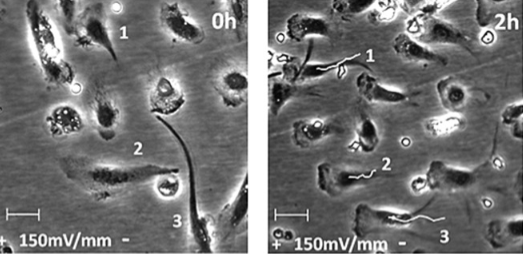
Human macrophages migrating directionally toward an electrode. Left: no electric field. Right: Time-lapse photo two hours after 150 mV/mm electric field applied (white lines shows the movement path toward candida yeast; numbers indicate start and end positions of cells). (credit: Joseph I. Hoare et al./JLB)

Small electrical currents appear to activate certain immune cells to jumpstart or speed wound healing and reduce infection when there’s a lack of immune cells available, such as with diabetes, University of Aberdeen (U.K.) scientists have found.

In a lab experiment, the scientists exposed healing macrophages (white blood cells that eat things that don’t belong), taken from human blood, to electrical fields of strength similar to that generated in injured skin. When the voltage was applied, the macrophages moved in a directed manner to Candida albicans fungus cells (representing damaged skin) to facilitate healing (engulfing and digesting extracellular particles). (This process is called “phagocytosis,” in which macrophages clean the wound site, limit infection, and  allow the repair process to proceed.)

The electric fields enhanced the uptake and clearance of a variety of targets known to promote inflammation and impair healing in addition to Candida albicans, including latex beads and expended white blood cells.*

“These findings raise the prospect that EF-based therapies could be extended beyond tissue repair and ultimately, be exploited to modulate the function of macrophages in other inflammatory diseases where these cells are dysregulated,” the researchers note in a report appearing in the June 2016 issue of the Journal of Leukocyte Biology.

“This new work identifies previously unappreciated opportunities to tune immune system function with electrical fields and has potentially wide-reaching implications for wound repair for a variety of diseases where macrophages play a role, including infectious disease, cancer and even obesity,” said John Wherry, Ph.D., Deputy Editor of the Journal of Leukocyte Biology.

The research extends previous research reported by KurzweilAI (New evidence that electrical stimulation accelerates wound healing).

* The experiments also showed that electric fields selectively augmented the production of protein modulators associated with the healing process, enhancing cytokine (growth factor) production and phagocytic activity essential for clearance of infection and for tissue repair and confirming that macrophages are tuned to respond to naturally generated electrical signals in a manner that boosts their healing ability.


Abstract of Electric fields are novel determinants of human macrophage functions

Macrophages are key cells in inflammation and repair, and their activity requires close regulation. The characterization of cues coordinating macrophage function has focused on biologic and soluble mediators, with little known about their responses to physical stimuli, such as the electrical fields that are generated naturally in injured tissue and which accelerate wound healing. To address this gap in understanding, we tested how properties of human monocyte-derived macrophages are regulated by applied electrical fields, similar in strengths to those established naturally. With the use of live-cell video microscopy, we show that macrophage migration is directed anodally by electrical fields as low as 5 mV/mm and is electrical field strength dependent, with effects peaking ∼300 mV/mm. Monocytes, as macrophage precursors, migrate in the opposite, cathodal direction. Strikingly, we show for the first time that electrical fields significantly enhance macrophage phagocytic uptake of a variety of targets, including carboxylate beads, apoptotic neutrophils, and the nominal opportunist pathogen Candida albicans, which engage different classes of surface receptors. These electrical field-induced functional changes are accompanied by clustering of phagocytic receptors, enhanced PI3K and ERK activation, mobilization of intracellular calcium, and actin polarization. Electrical fields also modulate cytokine production selectively and can augment some effects of conventional polarizing stimuli on cytokine secretion. Taken together, electrical signals have been identified as major contributors to the coordination and regulation of important human macrophage functions, including those essential for microbial clearance and healing. Our results open up a new area of research into effects of naturally occurring and clinically applied electrical fields in conditions where macrophage activity is critical.