

Are you smarter than a macaw?

The macaw has a brain the size of an unshelled walnut, compared to the macaque monkey’s lemon-sized brain. But the macaw has more neurons in its forebrain — the portion of the brain associated with intelligent behavior — than the macaque. (credit: Vanderbilt University)

The first study to systematically measure the number of neurons in the brains of more than two dozen species of birds has found that the birds that were studied consistently have more neurons packed into their small brains than those in mammalian or even primate brains of the same mass.

The study results were published online in an open-access paper in the Proceedings of the National Academy of Sciences early edition on the week of June 13.
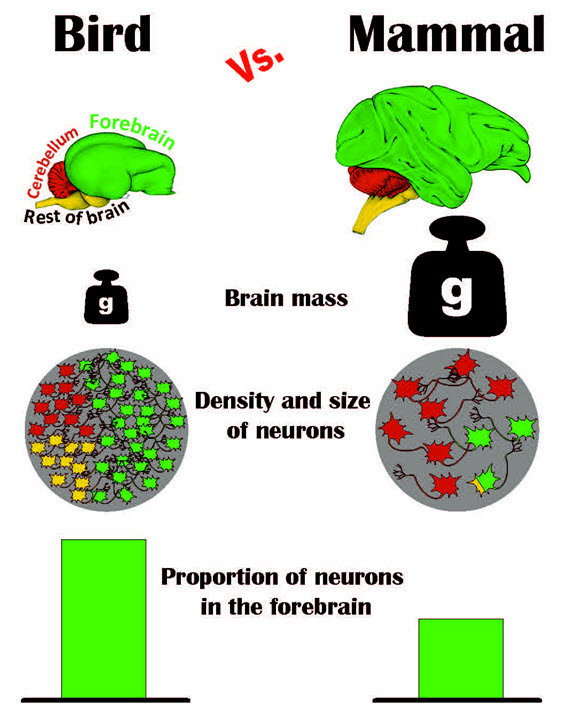
Graphic summary of the results of the avian brain study (credit: Pavel Nemec, Charles University of Prague)

“For a long time having a ‘bird brain’ was considered to be a bad thing. Now it turns out that it should be a compliment,” said Vanderbilt University neuroscientist Suzana Herculano-Houzel, senior author of the paper with Pavel Němec at the Charles University in Prague.

The study answers a puzzle that comparative neuroanatomists have been wrestling with for more than a decade: How can birds with their small brains perform complicated cognitive behaviors?

The conundrum was created by a series of studies beginning in the previous decade that directly compared the cognitive abilities of parrots and crows with those of primates. The studies found that the birds could manufacture and use tools, use insight to solve problems, make inferences about cause-effect relationships, recognize themselves in a mirror, and plan for future needs, among other cognitive skills previously considered the exclusive domain of primates.
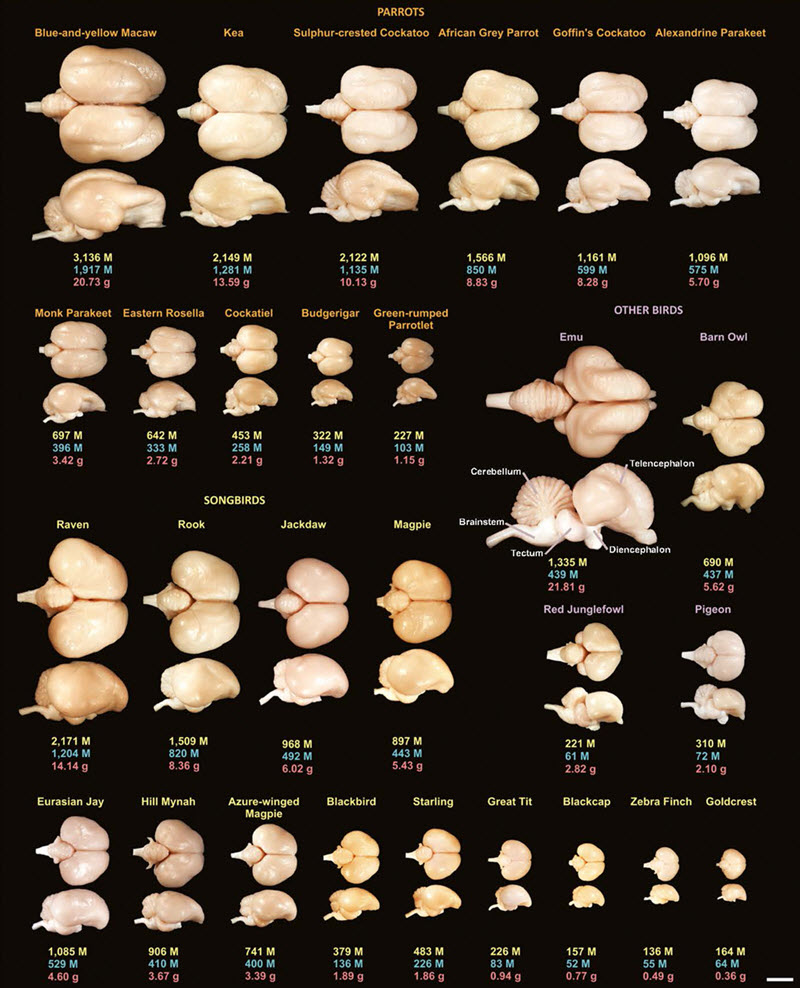
The collection of avian brains that the scientists analyzed. For each species, the total number of neurons (in millions) in each brain is shown in yellow, the number of neurons (in millions) in the forebrain (pallium) is shown in blue and the brain mass (in grams) is shown in red. The scale bar in the lower right is 10 mm. (credit: Suzana Herculano-Houzel, Vanderbilt University)

So scientists assumed avian brains must  be wired differently from primate brains. Two years ago, even this hypothesis was knocked down by a detailed study of pigeon brains, which concluded that they are, in fact, organized along quite similar lines to those of primates.

More neurons in the forebrain than previously thought
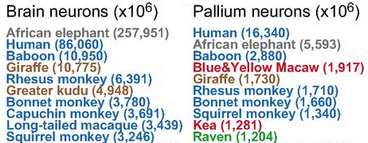
Top ten in number of whole-brain neurons and pallium (forebrain) neurons for the avian and mammalian species examined (credit: Seweryn Olkowicz et al./PNAS)

The new study provides a plausible explanation: Birds can perform these complex behaviors because birds’ forebrains contain a lot more neurons than any one had previously thought — as many as in mid-sized primates.

“We found that birds, especially songbirds and parrots, have surprisingly large numbers of neurons in their pallium: the part of the brain that corresponds to the cerebral cortex, which supports higher cognition functions such as planning for the future or finding patterns. That explains why they exhibit levels of cognition at least as complex as primates,” said Herculano-Houzel.

That’s because the neurons in avian brains are much smaller and more densely packed than those in mammalian brains, the study found. Parrot and songbird brains, for example, contain about twice as many neurons as primate brains of the same mass and two to four times as many neurons as equivalent rodent brains.

Also, the proportion of neurons in the forebrain is significantly higher, the study found.

More than one way to build better brains

“In designing brains, nature has two parameters it can play with: the size and number of neurons and the distribution of neurons across different brain centers,” said Herculano-Houzel, “and in birds we find that nature has used both of them.”

Although she acknowledges that the relationship between intelligence and neuron count has not yet been firmly established, Herculano-Houzel and her colleagues argue that having the same or greater forebrain neuron counts than primates with much larger brains can potentially provide the birds with much higher “cognitive power” per pound than mammals.

In other words, there’s more than one way to build better brains. Previously, neuroanatomists thought that as brains grew larger, neurons had to grow bigger as well because they had to connect over longer distances. “But bird brains show that there are other ways to add neurons: Keep most neurons small and locally connected and only allow a small percentage to grow large enough to make the longer connections. This keeps the average size of the neurons down,” she explained.

But that raises troubling questions:

  • Does the surprisingly large number of neurons in bird brains comes at a correspondingly large energetic cost?
  • Are the small neurons in bird brains a response to selection for small body size due to flight, or possibly the ancestral way of adding neurons to the brain — from which mammals, not birds, may have diverged.

Herculano-Houzel hopes that the results of the study and the questions it raises will stimulate other neuroscientists to begin exploring the mysteries of the avian brain, especially how their behavior compares to that of mammals of similar numbers of neurons or brain size.

Researchers at Charles University in Prague and the University of Vienna were also involved in the study.


Vanderbilt University | Bird Brain: Smarter Than You Think


Vanderbilt University | Study gives new meaning to the term “bird brain”


Abstract of Birds have primate-like numbers of neurons in the forebrain

Some birds achieve primate-like levels of cognition, even though their brains tend to be much smaller in absolute size. This poses a fundamental problem in comparative and computational neuroscience, because small brains are expected to have a lower information-processing capacity. Using the isotropic fractionator to determine numbers of neurons in specific brain regions, here we show that the brains of parrots and songbirds contain on average twice as many neurons as primate brains of the same mass, indicating that avian brains have higher neuron packing densities than mammalian brains. Additionally, corvids and parrots have much higher proportions of brain neurons located in the pallial telencephalon compared with primates or other mammals and birds. Thus, large-brained parrots and corvids have forebrain neuron counts equal to or greater than primates with much larger brains. We suggest that the large numbers of neurons concentrated in high densities in the telencephalon substantially contribute to the neural basis of avian intelligence.

Mobilizing mitochondria to regenerate damaged neurons

After axonal injury, nearby mitochondria become incapable of producing ATP, as indicated by their change in color from yellow (healthy) to green (damaged) (credit: Zhou et al., 2016)

Boosting the transport of mitochondria (cell energy suppliers) along neuronal axons enhances the ability of mouse nerve cells to repair themselves and regrow after injury or disease, researchers at the National Institute of Neurological Disorders and Stroke report in The Journal of Cell Biology.

Neurons need large amounts of energy to extend their axons long distances through the body. This energy — in the form of adenosine triphosphate (ATP) — is provided by mitochondria.

During development, mitochondria are transported up and down growing axons to generate ATP wherever it is needed. In adults, however, mitochondria become less mobile as mature neurons produce a protein called syntaphilin that anchors the mitochondria in place.

Zu-Hang Sheng and colleagues at the National Institute of Neurological Disorders and Stroke wondered whether this decrease in mitochondrial transport might explain why adult neurons are typically unable to regrow after injury.

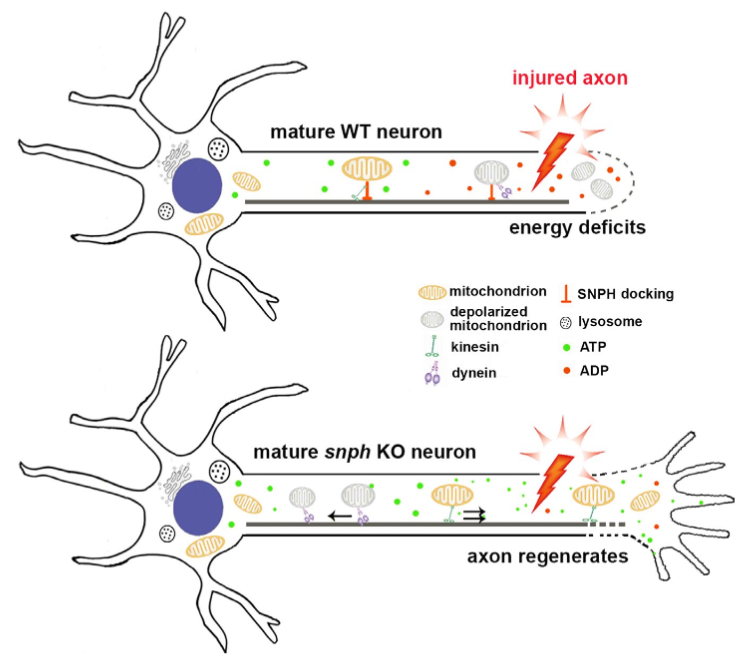
Repairing damaged neurons (top) by enhancing mitochondrial transport (bottom) (credit: Bing Zhou et al./JCB)

They initially found that when mature mouse axons are severed, nearby mitochondria are damaged and become unable to provide sufficient ATP to support injured nerve regeneration. However, when the researchers experimentally removed syntaphilin from the nerve cells (by using a genetically modified mouse), mitochondrial transport was enhanced, allowing the damaged mitochondria to be replaced by healthy mitochondria capable of producing ATP.

The Syntaphilin-deficient mature neurons therefore regained the ability to regrow after injury, just like young neurons.

“Our in vivo and in vitro studies suggest that activating an intrinsic growth program requires the coordinated modulation of mitochondrial transport and recovery of energy deficits. Such combined approaches may represent a valid therapeutic strategy to facilitate regeneration in the central and peripheral nervous systems after injury or disease,” Sheng says.


Abstract of Facilitation of axon regeneration by enhancing mitochondrial transport and rescuing energy deficits

Although neuronal regeneration is a highly energy-demanding process, axonal mitochondrial transport progressively declines with maturation. Mature neurons typically fail to regenerate after injury, thus raising a fundamental question as to whether mitochondrial transport is necessary to meet enhanced metabolic requirements during regeneration. Here, we reveal that reduced mitochondrial motility and energy deficits in injured axons are intrinsic mechanisms controlling regrowth in mature neurons. Axotomy induces acute mitochondrial depolarization and ATP depletion in injured axons. Thus, mature neuron-associated increases in mitochondria-anchoring protein syntaphilin (SNPH) and decreases in mitochondrial transport cause local energy deficits. Strikingly, enhancing mitochondrial transport via genetic manipulation facilitates regenerative capacity by replenishing healthy mitochondria in injured axons, thereby rescuing energy deficits. An in vivo sciatic nerve crush study further shows that enhanced mitochondrial transport in snph knockout mice accelerates axon regeneration. Understanding deficits in mitochondrial trafficking and energy supply in injured axons of mature neurons benefits development of new strategies to stimulate axon regeneration.

Higher intake of whole grains associated with lower risk of major chronic diseases and death

Cereal plant, 7-grain bread, wholegrain food (credit: iStock)

A meta-analysis of 45 studies (64 publications) of consumption of whole grain by an international team of researchers, led by Dagfinn Aune, PhD, at Imperial College London, found lower risks of coronary heart disease and cardiovascular disease overall, as well as deaths from all causes and from specific diseases, including stroke, cancer, diabetes, infectious and respiratory diseases.

The researchers say these results “strongly support dietary recommendations to increase intake of whole grain foods in the general population to reduce risk of chronic diseases and premature mortality.”

The results have been published in an open-access paper in the British Medical Journal (BMJ).

The greatest benefit was seen for people who increased from no intake of whole grain to two servings per day, equivalent to 32 g/day, such as 32 g of whole grain wheat, or to 60 g product/day, such as 60 g of whole grain wheat bread.

Further reductions in risks were observed up to 7.5 servings a day, equivalent to 225 g/day of whole grain products, and suggest additional benefits at higher intakes.

Relation to specific types of disorders

A large body of evidence has emerged on the health benefits of whole grain foods over the last 10–15 years. Grains are one of the major staple foods worldwide and provide on average 56% of energy intake and 50% of protein intake.

But recommendations on the daily amount and types of whole grain foods needed to reduce risk of chronic disease and mortality have often been unclear or inconsistent. So the researchers carried out a systematic review and meta-analysis of 45 published studies on whole grain consumption in relation to several health outcomes and all-cause mortality.*

They found reductions in the relative risk of coronary heart disease (19%), cardiovascular disease (22%), all cause mortality (17%), and mortality from stroke (14%), cancer (15%), respiratory disease (22%), infectious disease (26%), and diabetes (51%) per 90 g/day of whole grain product (one serving equals 30g of whole grain product).

Reductions in risks of cardiovascular disease and all-cause mortality were associated with intake of whole grain bread, whole grain breakfast cereals, and added bran, as well as total intake of bread and breakfast cereals.

There was little evidence of an association with intake of refined grains, white rice, total rice or other grains.

Caveats and recommendations

Few people may have total grain intake of three or more servings a day, so the authors recommend “increasing intake of whole grains, and as much as possible to choose whole grains rather than refined grains.”

However, the researchers noted that systematic reviews and meta-analyses involving observational research cannot be used to draw conclusions about cause and effect.

They call for more research to determine health benefits of different types of whole grain in different geographical regions, as most of the current evidence is from the U.S. and fewer studies have been conducted in Europe, Asia and other regions. Studies of specific diseases, and less common causes of deaths, are needed.

They caution that it’s important that “great care” should be taken not to promote whole grain foods with high sugar and salt content, and call for more research on the “biological mechanisms of health effects and contribution to health of different grain types.”

A related study published in The Journals of Gerontology, Series A (recently described on KurzweilAI — see Dietary fiber has biggest influence on successful aging, research reveals) found that fiber that made the biggest difference to what the researchers termed “successful aging,” meaning “the absence of disability, depressive symptoms, cognitive impairment, respiratory symptoms, and chronic diseases including cancer, coronary artery disease, and stroke.”

* They included more than 7,000 cases of coronary heart disease, 2,000 cases of stroke, 26,000 cases of cardiovascular disease, 34,000 deaths from cancer, and 100,000 deaths among 700,000 participants.


Abstract of Whole grain consumption and risk of cardiovascular disease, cancer, and all cause and cause specific mortality: systematic review and dose-response meta-analysis of prospective studies

Objective To quantify the dose-response relation between consumption of whole grain and specific types of grains and the risk of cardiovascular disease, total cancer, and all cause and cause specific mortality.

Data sources PubMed and Embase searched up to 3 April 2016.

Study selection Prospective studies reporting adjusted relative risk estimates for the association between intake of whole grains or specific types of grains and cardiovascular disease, total cancer, all cause or cause specific mortality.

Data synthesis Summary relative risks and 95% confidence intervals calculated with a random effects model.

Results 45 studies (64 publications) were included. The summary relative risks per 90 g/day increase in whole grain intake (90 g is equivalent to three servings—for example, two slices of bread and one bowl of cereal or one and a half pieces of pita bread made from whole grains) was 0.81 (95% confidence interval 0.75 to 0.87; I2=9%, n=7 studies) for coronary heart disease, 0.88 (0.75 to 1.03; I2=56%, n=6) for stroke, and 0.78 (0.73 to 0.85; I2=40%, n=10) for cardiovascular disease, with similar results when studies were stratified by whether the outcome was incidence or mortality. The relative risks for morality were 0.85 (0.80 to 0.91; I2=37%, n=6) for total cancer, 0.83 (0.77 to 0.90; I2=83%, n=11) for all causes, 0.78 (0.70 to 0.87; I2=0%, n=4) for respiratory disease, 0.49 (0.23 to 1.05; I2=85%, n=4) for diabetes, 0.74 (0.56 to 0.96; I2=0%, n=3) for infectious diseases, 1.15 (0.66 to 2.02; I2=79%, n=2) for diseases of the nervous system disease, and 0.78 (0.75 to 0.82; I2=0%, n=5) for all non-cardiovascular, non-cancer causes. Reductions in risk were observed up to an intake of 210-225 g/day (seven to seven and a half servings per day) for most of the outcomes. Intakes of specific types of whole grains including whole grain bread, whole grain breakfast cereals, and added bran, as well as total bread and total breakfast cereals were also associated with reduced risks of cardiovascular disease and/or all cause mortality, but there was little evidence of an association with refined grains, white rice, total rice, or total grains.

Conclusions This meta-analysis provides further evidence that whole grain intake is associated with a reduced risk of coronary heart disease, cardiovascular disease, and total cancer, and mortality from all causes, respiratory diseases, infectious diseases, diabetes, and all non-cardiovascular, non-cancer causes. These findings support dietary guidelines that recommend increased intake of whole grain to reduce the risk of chronic diseases and premature mortality.