
How creating defective nanodiamonds could revolutionize nanotechnology and quantum computing

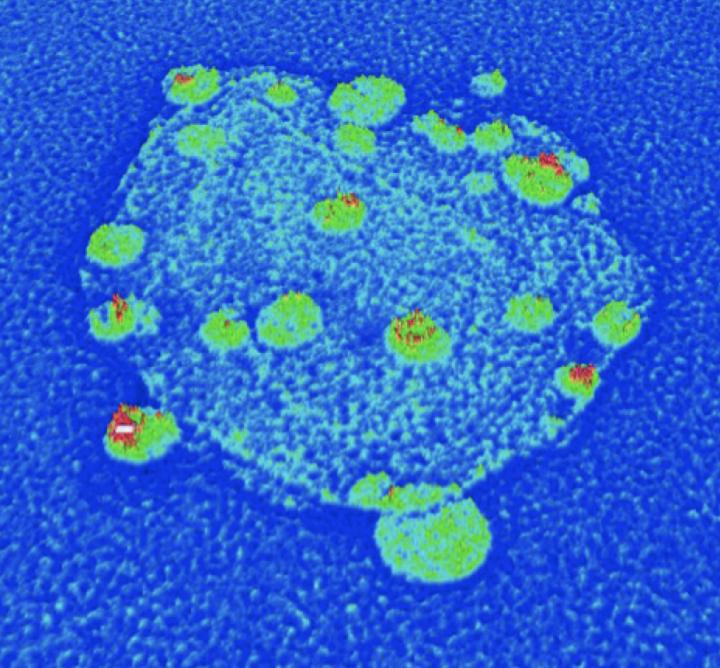
This electron microscope image shows a hybrid nanoparticle consisting of a nanodiamond (roughly 50 nanometers wide) covered in smaller silver nanoparticles that enhance the diamond’s optical properties. (credit: Min Ouyang)

University of Maryland researchers have developed a method to quickly and inexpensively assemble diamond-based hybrid nanoparticles from the ground up in large quantities while avoiding many of the problems with current methods.

These hybrid nanoparticles could speed the design of room-temperature qubits for quantum computers and create brighter dyes for biomedical imaging or highly sensitive magnetic and temperature sensors, for example.

When impurities are better
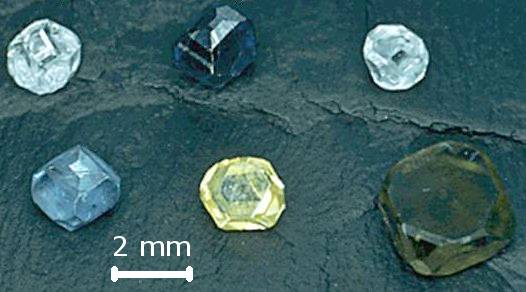
Synthetic diamonds of various colors (from defects) grown by the high-pressure high-temperature technique (credit: Wikipedia/
public domain)

The basic trick in creating a interesting or useful diamond is, ironically: Add a defect in the diamond’s crystal lattice. It’s similar to doping silicon to give it special electronic properties (such as making it work as a transistor).

Pure diamonds consist of an orderly lattice of carbon atoms and are completely transparent. However, pure diamonds are quite rare in natural diamond deposits; most have defects resulting from non-carbon impurities such as nitrogen, boron and phosphorus. Such defects create the subtle and desirable color variations seen in gemstone diamonds.

This altered bond is also the source of the optical, electromagnetic, and quantum physical properties that will make a nanodiamond useful when paired with other nanomaterials.

Nitrogen vacancy impurity
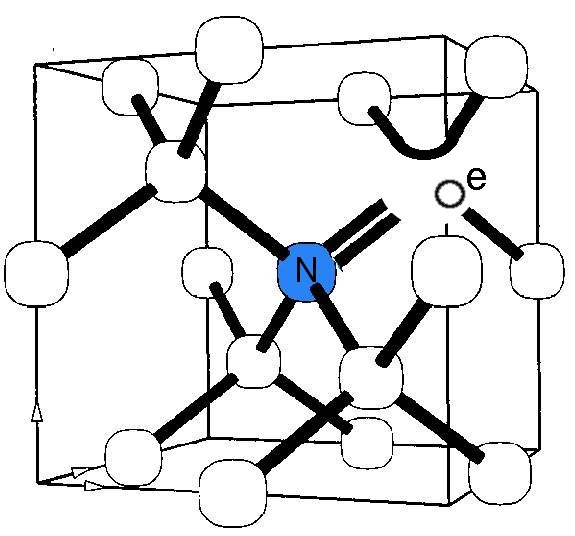
Model of nitrogen-vacancy center in diamond (credit: Wikipedia/public domain)

The most useful impurity — and used in the Maryland study — is the famous “nitrogen vacancy” defect: Sticking in a single nitrogen atom where a carbon atom should be, with an empty space right next to it.

As KurzweilAI has shown in several articles, a nitrogen vacancy in a diamond (or other crystalline materials) can lead to a variety of interesting new properties, such as a highly sensitive way to detect neural signals, an ultrasensitive real-time magnetic field detector, and importantly, making a nanodiamond behave as a quantum bit (qubit) for use in quantum computing and other applications.

Nearly all qubits studied to date require ultra-cold temperatures to function properly. A qubit that works at room temperature would represent a significant step forward, helping use quantum circuits in industrial, commercial and consumer-level electronics. That’s of special interest to Ougang’s team.

Volume production of hybrid nanoparticles
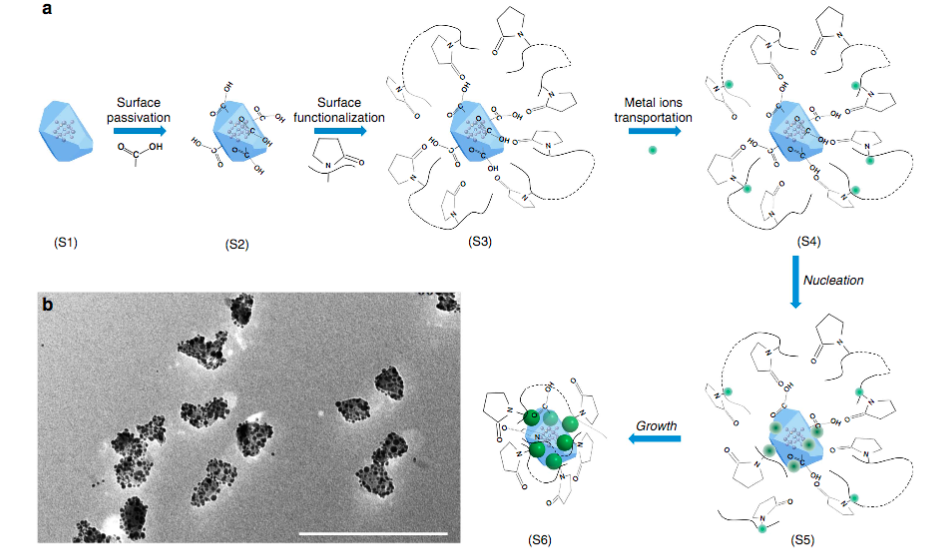
A synthetic route for hybrid nanodiamond nanoparticles. (a) Different growth stages, ending in (S6) growth of metal nanoparticles on the nanodiamond surface. (b) Transmission electron microscope image showing hybrid nanodiamond-silver nanostructures made by following the synthetic scheme in (a). Scale bar, 200 nm. (credit: J. Gong et al./Nature Communications)

Ougang’s and colleagues’ main breakthrough, though, is their method for constructing the hybrid nanoparticles. Other researchers have paired nanodiamonds with complementary nanoparticles using relatively imprecise methods, such as manually installing the diamonds and particles next to each other onto a larger surface one by one.

These top-down methods are costly, time consuming, and introduce a host of complications. “Our key innovation is that we can now reliably and efficiently produce these freestanding hybrid particles in large numbers,” explained Ouyang, who also has appointments in the UMD Center for Nanophysics and Advanced Materials and the Maryland NanoCenter, with an affiliate professorship in the UMD Department of Materials Science and Engineering.

His team’s method also enables precise control of the hybrid particles’ properties, such as the composition and total number of non-diamond particles.

“A major strength of our technique is that it is broadly useful and can be applied to a variety of diamond types and paired with a variety of other nanomaterials,” Ouyang said. “It can also be scaled up fairly easily. We are interested in studying the basic physics further, but also moving toward specific applications.”


Abstract of Nanodiamond-based nanostructures for coupling nitrogen-vacancy centres to metal nanoparticles and semiconductor quantum dots

The ability to control the interaction between nitrogen-vacancy centres in diamond and photonic and/or broadband plasmonic nanostructures is crucial for the development of solid-state quantum devices with optimum performance. However, existing methods typically employ top-down fabrication, which restrict scalable and feasible manipulation of nitrogen-vacancy centres. Here, we develop a general bottom-up approach to fabricate an emerging class of freestanding nanodiamond-based hybrid nanostructures with external functional units of either plasmonic nanoparticles or excitonic quantum dots. Precise control of the structural parameters (including size, composition, coverage and spacing of the external functional units) is achieved, representing a pre-requisite for exploring the underlying physics. Fine tuning of the emission characteristics through structural regulation is demonstrated by performing single-particle optical studies. This study opens a rich toolbox to tailor properties of quantum emitters, which can facilitate design guidelines for devices based on nitrogen-vacancy centres that use these freestanding hybrid nanostructures as building blocks.


Universe’s first life might have been born on diamond planets

In this artist’s conception, a carbon planet orbits a sunlike star in the early universe. Young planetary systems lacking heavy chemical elements but relatively rich in carbon could form worlds made of graphite, carbides, and diamond rather than Earth-like silicate rocks. Blue patches show where water has pooled on the planet’s surface, forming potential habitats for alien life. (credit: Christine Pulliam (CfA), Sun image: NASA/SDO)

New findings by scientists at the Harvard-Smithsonian Center for Astrophysics (CfA) suggest that planet formation in the early universe might have created carbon planets consisting of graphite, carbides, and diamond and that astronomers might find these diamond worlds by searching a rare class of stars.

“This work shows that even stars with a tiny fraction of the carbon in our solar system can host planets,” says lead author and Harvard University graduate student Natalie Mashian. “We have good reason to believe that alien life will be carbon-based, like life on Earth, so this also bodes well for the possibility of life in the early universe.”

The primordial universe consisted mostly of hydrogen and helium, and lacked chemical elements like carbon and oxygen necessary for life as we know it. Only after the first stars exploded as supernovae and seeded the second generation did planet formation and life become possible.

Clues to how life got started in the universe

Mashian and her PhD thesis advisor Avi Loeb examined a particular class of old stars known as carbon-enhanced metal-poor (CEMP) stars. These “anemic” stars contain only one hundred-thousandth as much iron as our Sun, meaning they formed before interstellar space had been widely seeded with heavy elements.

“These stars are fossils from the young universe,” explains Loeb. “By studying them, we can look at how planets, and possibly life in the universe, got started.”

CEMP stars have more carbon than would be expected, given their age. This relative abundance would influence planet formation as fluffy carbon dust grains (from supernovae) clump together to form tar-black worlds.

From a distance, these carbon planets would be difficult to tell apart from more Earth-like worlds. Their masses and physical sizes would be similar. Astronomers would have to examine their atmospheres for signs of their true nature. Gases like carbon monoxide and methane would envelop these unusual worlds.

The transit technique for detecting carbon planets

When a planet crosses in front of its star as viewed by an observer, the event is called a transit. The relative change in flux caused by a carbon-based planet transiting across its host CEMP star would range from ~0.0001% to ~0.01%.
(credit: NASA Ames)

But a dedicated search for planets around CEMP stars can be done using the transit technique, the scientists suggest. We encountered the transit technique on KurzweilAI in “How to use laser cloaking to hide Earth from remote detection by aliens” — in which we noted we two Columbia University astronomers suggested that we could cloak our Earth from aliens by shining a laser during transits so they couldn’t see the tiny giveaway changes in brightness — or that we could modify the light from our Sun during a transit to make it obviously artificial, sending a message to ET: “we’re here.”

In the new CfA paper, published in the Monthly Notices of the Royal Astronomical Society*, the scientists note that the relative change in flux caused by a carbon-based planet transiting across its host CEMP star ranges from ~0.0001% to ~0.01% — too weak to be detected by ground telescopes. That means it would require “space-based transit surveys that continuously monitor a large number of potential host stars over several years and measure their respective transit light curves.”

Fortunately, “there are a number of ongoing, planned, and proposed space missions committed to this cause,” the CfA scientists note. No word if the space-based transit surveys will also watch for artificial messages.

Headquartered in Cambridge, Mass., the Harvard-Smithsonian Center for Astrophysics (CfA) is a joint collaboration between the Smithsonian Astrophysical Observatory and the Harvard College Observatory. CfA scientists, organized into six research divisions, study the origin, evolution and ultimate fate of the universe.

* The CfA study is also available (open-access) on arXiv.


Abstract of CEMP stars: possible hosts to carbon planets in the early universe

We explore the possibility of planet formation in the carbon-rich protoplanetary disks of carbon-enhanced metal-poor (CEMP) stars, possible relics of the early Universe. The chemically anomalous abundance patterns ([C/Fe] ≥ 0.7) in this subset of low-mass stars suggest pollution by primordial core-collapsing supernovae (SNe) ejecta that are particularly rich in carbon dust grains. By comparing the dust-settling timescale in the protoplanetary disks of CEMP stars to the expected disk lifetime (assuming dissipation via photoevaporation), we determine the maximum distance rmax from the host CEMP star at which carbon-rich planetesimal formation is possible, as a function of the host star’s [C/H] abundance. We then use our linear relation between rmax and [C/H], along with the theoretical mass-radius relation derived for a solid, pure carbon planet, to characterize potential planetary transits across host CEMP stars. Given that the related transits are detectable with current and upcoming space-based transit surveys, we suggest initiating an observational program to search for carbon planets around CEMP stars in hopes of shedding light on the question of how early planetary systems may have formed after the Big Bang.

Deep neural networks to help identify, formulate advanced antiaging supplements

(credit: InSilico Medicine)

Insilico Medicine and Life Extension announced today an exclusive collaboration to identify novel biomarkers of human aging through the use of big-data analytics and AI, with the ultimate goal of discovery and formulation of nutrients to support health and longevity.

Insilico Medicine* is a big-data analytics company specializing in applying advances in deep learning to discovery of biomarkers and drugs. Life Extension**, a Florida-based organization established in the early 1980s, is a dietary-supplement innovator dedicated to extending healthy human longevity.

Insilico Medicine will focus on applying advanced signaling pathway activation analysis techniques and deep-learning algorithms to find nutraceuticals that mimic the tissue-specific transcriptional response of many known interventions and pathways associated with health and longevity.

Life Extension will use this information to develop novel nutraceutical products to support health and longevity, such as “geroprotectors” — precision natural organic small-molecule formulations that slow down or even reverse age-associated conditions and damage.

“Senescence is accompanied by a shift in cellular signaling that initiates and promotes a system-wide degenerative condition,” William Faloon, co-founder of the Life Extension Foundation, told KurzweilAI. “By turning back ‘on’ youthful signaling pathways while suppressing those that emerge during normal maturation, we expect to gain significant control over what are now thought to be inevitable pathologies of old age.”

“This collaboration means a lot to our team. For many years I was buying a range of supplements from Life Extension, and saw how passionate they are about extending healthy human life and supporting cutting-edge research in the field,” said Alex Zhavoronkov, PhD, CEO of Insilico Medicine, Inc. and the chief science officer of the Biogerontology Research Foundation in the UK. “Life Extension’s discovery research and product development teams have decades of experience in the pharmaceutical and nutraceutical research and have set very high standards for science-based nutraceutical discovery.”

Insilico Medicine scientists will present the results of this collaboration at RAADFest in San Diego in August, a longevity-focused conference.

Applying deep-learning techniques to aging

Insilico Medicine scientists have recently authored key papers on applying deep-learning techniques to biomedical applications in influential peer-reviewed journals, including “Developing criteria for evaluation of geroprotectors as a key stage toward translation to the clinic,” published in Aging Cell.

Other papers include “Deep learning applications for predicting pharmacological properties of drugs and drug repurposing using transcriptomic data” in Molecular Pharmaceutics, a journal published by the American Chemical Society; “Applications of Deep Learning in Biomedicine“, also in Molecular Pharmaceutics; and “Deep biomarkers of human aging: Application of deep neural networks to biomarker development” in Aging, a high-impact journal in aging research.

“We believe that accelerating the rate of progress in novel biomarker identification, as well as precision nutrient formulation development, is critical,” said Andrew G. Swick, Ph.D., senior vice president of scientific affairs, discovery research and product development for Life Extension.

“Life Extension aims to improve health and human longevity by utilizing the experience of noted research scientists and engaging in academic and industry collaborations. Artificial intelligence is one of the promising areas, where years of experience in the nutraceutical industry combined with sophisticated biologically inspired algorithms and high-performance computing may produce unprecedented results.”

* Insilico Medicine, Inc. is a bioinformatics company located at the Emerging Technology Centers at the Johns Hopkins University Eastern campus in Baltimore, with R&D resources in Belgium, Russia, and Poland. It utilizes advances in genomics, big-data analysis, and deep learning for in silico drug discovery and drug repurposing for aging and age-related diseases. The company pursues internal drug discovery programs in cancer, Parkinson’s, Alzheimer’s, sarcopenia, and geroprotector discovery. Through its Pharma.AI division, the company provides advanced machine-learning services to biotechnology, pharmaceutical, and skin-care companies.

** A trailblazer in the $35 billion U.S. dietary supplement industry for the past 36 years, Life Extension’s core mission is to extend the healthy human life span using an integrative approach by reporting on and funding cutting-edge scientific research. Life Extension Buyers Club (Life Extension) offers a full-range of premium-quality vitamins, minerals, and hormones as well as unique, specially made formulas. The company’s products are developed based on the latest scientific studies from peer-reviewed medical journals and are continually updated as new information occurs.