Face it, the Olympics won’t be axed. We need to Zika-proof them
Cancelling the $11-billion Games in Brazil is not a realistic option but there are things we can do to hinder the spread of Zika, says Debora MacKenzie

Science and reality


(credit: iStock)
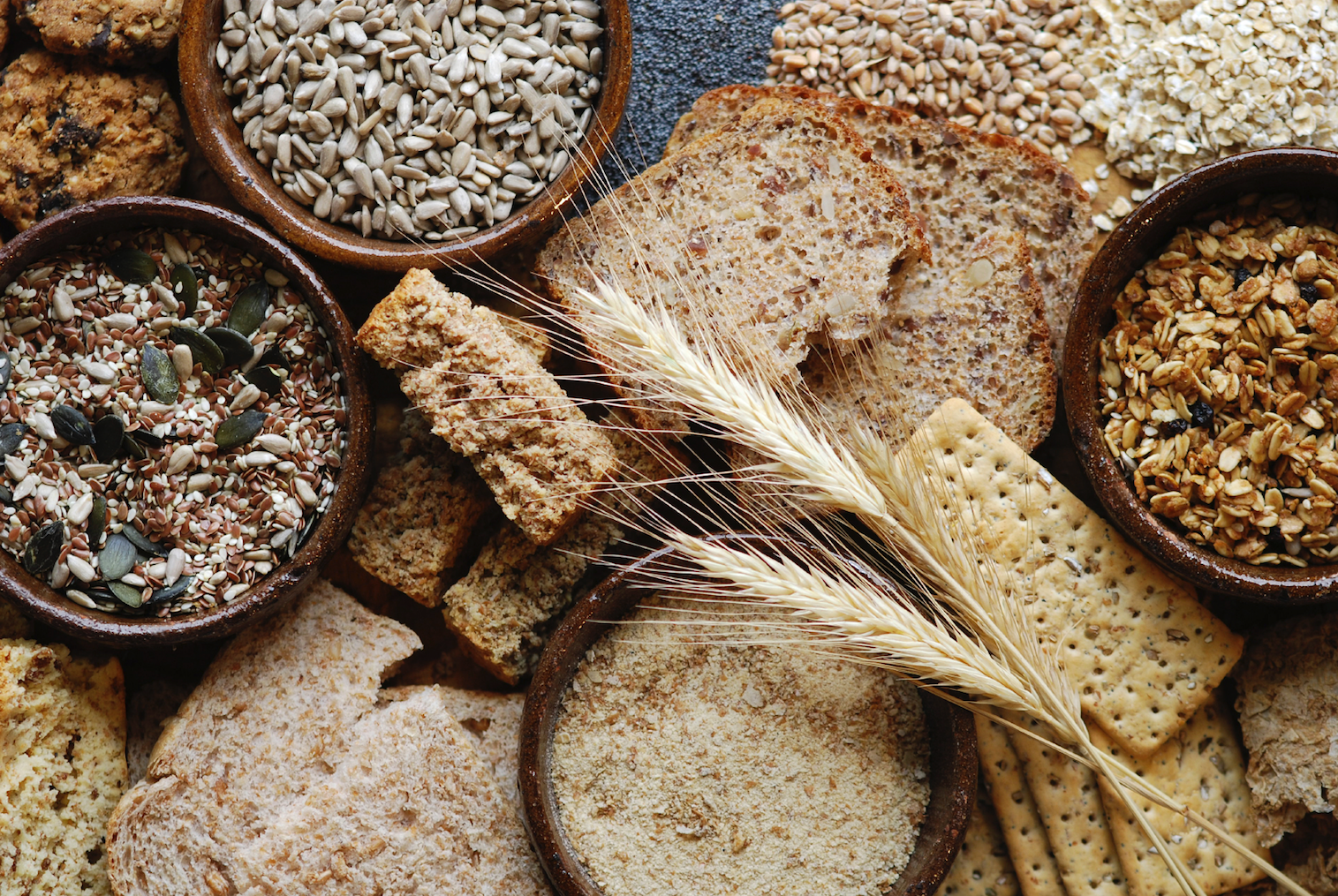
Eating the right amount of dietary fiber from breads, cereals, and fruits can help us avoid disease and disability into old age, according to an open-access paper published in The Journals of Gerontology, Series A: Biological Sciences and Medical Sciences by scientists from The Westmead Institute for Medical Research in Australia.
Using data compiled from the Blue Mountains Eye Study, a benchmark population-based study that examined a cohort of more than 1,600 adults aged 50 years and older for long-term sensory loss risk factors and systemic diseases, the researchers found that out of all the factors they examined — including a person’s total carbohydrate intake, total fiber intake, glycemic index, glycemic load, and sugar intake — it was, surprisingly, fiber that made the biggest difference to what the researchers termed “successful aging.”
Successful aging was defined as including an absence of disability, depressive symptoms, cognitive impairment, respiratory symptoms, and chronic diseases including cancer, coronary artery disease, and stroke.
Fiber, or roughage, is the indigestible part of plant foods that pushes through the digestive system, absorbing water along the way and easing bowel movements.
According to lead author of the paper, Associate Professor Bamini Gopinath, PhD, from the Institute’s Centre for Vision Research, “Out of all the variables that we looked at, fiber intake —- which is a type of carbohydrate that the body can’t digest — had the strongest influence,” she said. “Essentially, we found that those who had the highest intake of fiber or total fiber actually had an almost 80 percent greater likelihood of living a long and healthy life over a 10-year follow-up. That is, they were less likely to suffer from hypertension, diabetes, dementia, depression, and functional disability.”
While it might have been expected that the level of sugar intake would make the biggest impact on successful aging, Gopinath pointed out that the particular group they examined were older adults whose intake of carbonated and sugary drinks was quite low.
Although it is too early to use the study results as a basis for dietary advice, Gopinath said the research has opened up a new avenue for exploration. “There are a lot of other large cohort studies that could pursue this further and see if they can find similar associations. And it would also be interesting to tease out the mechanisms that are actually linking these variables,” she said.
This study backs up similar recent findings by the researchers, which highlight the importance of the overall diet and healthy aging.
In another study published last year in The Journals of Gerontology, Westmead Institute researchers found that, in general, adults who closely adhered to recommended national dietary guidelines reached old age with an absence of chronic diseases and disability, and had good functional and mental health status.
Background: We prospectively examined the relationship between dietary glycemic index (GI) and glycemic load (GL), carbohydrate, sugars, and fiber intake (including fruits, vegetable of breads/cereals fiber) with successful aging (determined through a multidomain approach).
Methods: A total of 1,609 adults aged 49 years and older who were free of cancer, coronary artery disease, and stroke at baseline were followed for 10 years. Dietary data were collected using a semiquantitative Food Frequency Questionnaire. Successful aging status was determined through interviewer-administered questionnaire at each visit and was defined as the absence of disability, depressive symptoms, cognitive impairment, respiratory symptoms, and chronic diseases (eg, cancer and coronary artery disease).
Results: In all, 249 (15.5%) participants had aged successfully 10 years later. Dietary GI, GL, and carbohydrate intake were not significantly associated with successful aging. However, participants in the highest versus lowest (reference group) quartile of total fiber intake had greater odds of aging successfully than suboptimal aging, multivariable-adjusted odds ratio (OR), 1.79 (95% confidence interval [CI] 1.13–2.84). Those who remained consistently below the median in consumption of fiber from breads/cereal and fruit compared with the rest of cohort were less likely to age successfully, OR 0.53 (95% CI 0.34–0.84) and OR 0.64 (95% CI 0.44–0.95), respectively.
Conclusions: Consumption of dietary fiber from breads/cereals and fruits independently influenced the likelihood of aging successfully over 10 years. These findings suggest that increasing intake of fiber-rich foods could be a successful strategy in reaching old age disease free and fully functional.
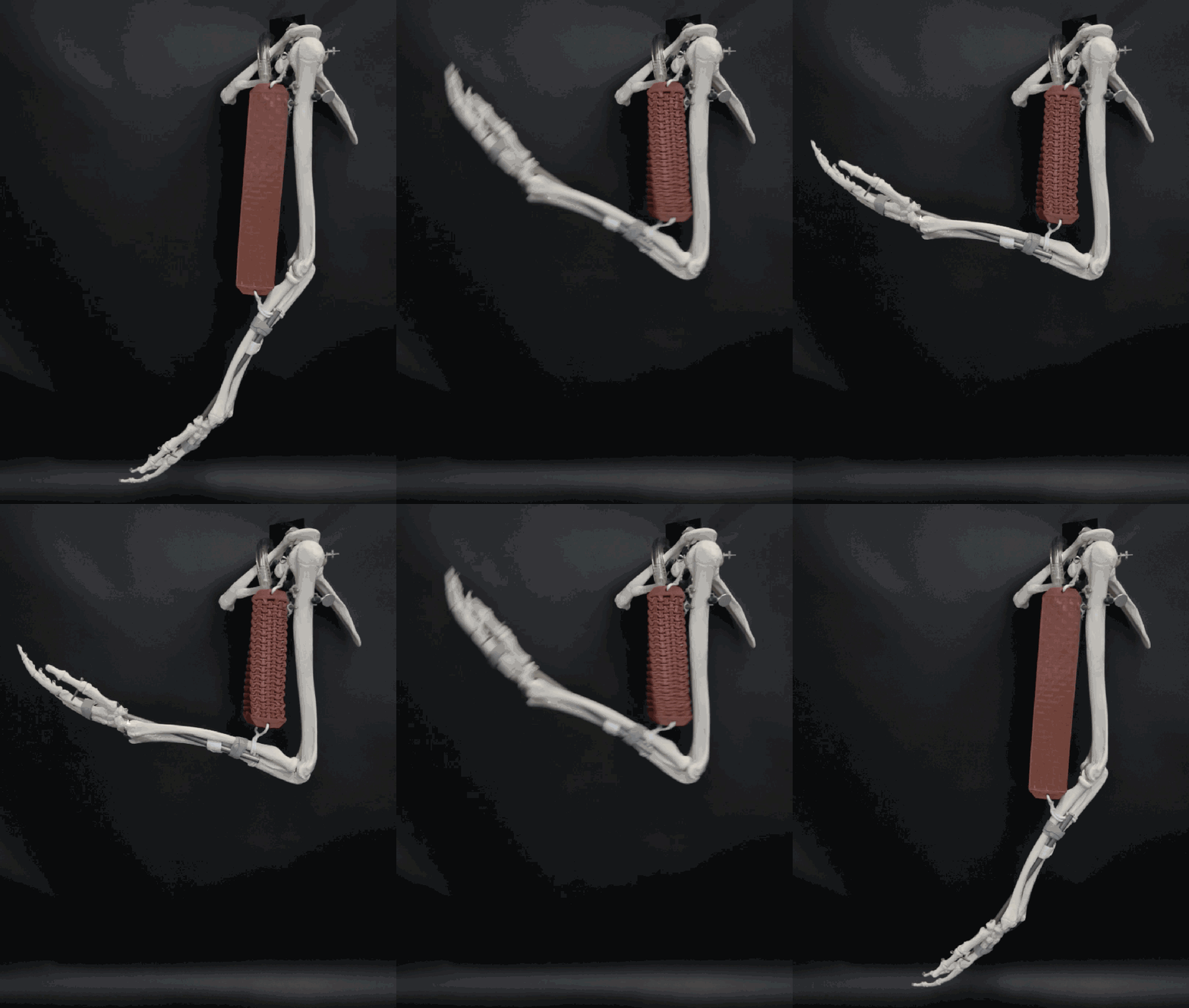
VAMPs are functionally modeled after the human bicep, similar to the biological muscle in terms of response time and efficiency. (credit: Wyss Institute at Harvard University)
If robots are going work around humans, they will have to be softer and safer. A Harvard team has designed a new actuator with that in mind. Its movements are similar to those of a human bicep muscle, using vacuum power to automate soft rubber beams. Like real muscles, the actuators are soft, shock-absorbing, and pose no danger, according to the researchers.
The work is led by George Whitesides, Ph.D., a Core Faculty member at Harvard’s Wyss Institute for Biologically Inspired Engineering, the Woodford L. and Ann A. Flowers University Professor of Chemistry and Chemical Biology in Harvard University’s Faculty of Arts and Sciences (FAS), and a Director of the Kavli Institute for Bionano Science and Technology at Harvard University.
Whitesides’ team took an unconventional approach to its design, relying on vacuum to decrease the actuator’s volume and cause it to buckle. While conventional engineering would consider bucking to be a mechanical instability and a point of failure, in this case the team leveraged this instability to develop VAMPs (vacuum-actuated muscle-inspired pneumatic structures). Previous soft actuators rely on pressurized systems that expand in volume, but VAMPs mimic true muscle because they contract, which makes them useful in confined spaces and for a variety of purposes.
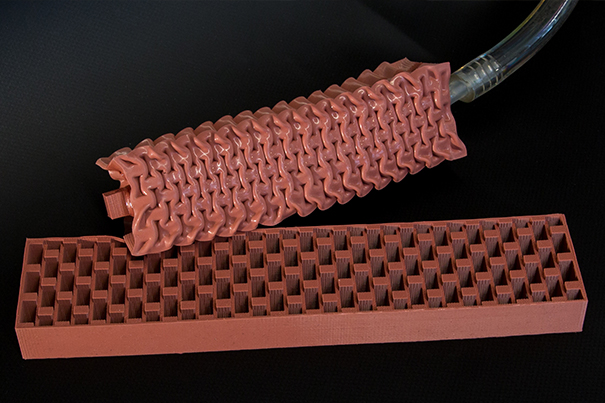
In this image, VAMPs are shown actuated and cut open in cross section. The honeycomb cross section shows the inner chambers that collapse when vacuum is applied. (credit: Wyss Institute at Harvard University)
The actuator has soft elastomeric rubber beams filled with small, hollow chambers of air like a honeycomb. By applying vacuum, the chambers collapse and the entire actuator contracts, generating movement. The internal honeycomb structure can be custom tailored to enable linear, twisting, bending, or combinatorial motions.
The team envisions that robots built with VAMPs could be used to assist the disabled or elderly, to serve food, deliver goods, and perform other tasks related to the service industry. Soft robots could also make industrial production lines safer and faster, and quality control easier to manage by enabling human operators to work in the same space.
Fail-safe design
VAMPs are designed to prevent failure — even when damaged with a 2mm hole, the team showed that VAMPs will still function. In the event that major damage is caused to the system, it fails safely. “It can’t explode, so it’s intrinsically safe,” said Whitesides. Whereas other actuators powered by electricity or combustion could cause damage to humans or their surroundings, loss of vacuum pressure in VAMPs would simply render the actuator motionless.
“These self-healing, bioinspired actuators bring us another step closer to being able to build entirely soft-bodied robots, which may help to bridge the gap between humans and robots and open entirely new application areas in medicine and beyond,” said Wyss Founding Director Donald Ingber, M.D., Ph.D., who is also the Judah Folkman Professor of Vascular Biology at Harvard Medical School and the Boston Children’s Hospital Vascular Biology Program, as well as Professor of Bioengineering at Harvard’s John A. Paulson School of Engineering and Applied Sciences (SEAS).
The work was reported June 1 in the journal Advanced Materials Technologies.
Harvard’s Office of Technology Development has filed patents on this and related inventions, and the soft actuator technology has been licensed to Soft Robotics, Inc., a startup launched in 2013 and cofounded by Whitesides. The company is developing robotic grasping systems toward initial applications including picking and packing in unstructured environments — for example, handling fruits and vegetables in produce distribution warehouses. Longer term, this technology can be leveraged to develop products for biomedical applications.
Abstract of Buckling Pneumatic Linear Actuators Inspired by Muscle
The mechanical features of biological muscles are difficult to reproduce completely in synthetic systems. A new class of soft pneumatic structures (vacuum-actuated muscle-inspired pneumatic structures) is described that combines actuation by negative pressure (vacuum), with cooperative buckling of beams fabricated in a slab of elastomer, to achieve motion and demonstrate many features that are similar to that of mammalian muscle.

White willow (Salix alba) is a natural source of salicylic acid (credit: Otto Wilhelm Thomé (1885)/public domain)
Scientists from the Gladstone Institutes have identified a new pathway by which salicylic acid — a key compound in aspirin (acetylsalicylic acid) — stops inflammation and cancer.
In a study published in eLife, the researchers found that both salicylic acid — and also diflunisal, a cousin of aspirin — suppress two key proteins (p300 and CREB-binding protein or CBP) that help control gene expression throughout the body.
These proteins are epigenetic regulators that control the levels of proteins that cause inflammation or are involved in cell growth.
So by suppressing these proteins, these compounds can prevent cellular damage caused by inflammation. This study provides the first concrete demonstration that both p300 and CBP can be targeted by drugs and may have important clinical implications.
“Salicylic acid is one of the oldest drugs on the planet, dating back to the Egyptians and the Greeks, but we’re still discovering new things about it,” said senior author Eric Verdin, MD, associate director of the Gladstone Institute of Virology and Immunology. “Uncovering this pathway of inflammation that salicylic acid acts upon opens up a host of new clinical possibilities for these drugs.”
Shrinking tumors
Scientists at Gladstone and Sylvester Comprehensive Cancer Center, at the University of Miami Miller School of Medicine, worked together to test whether suppressing p300 with diflunisal would suppress leukemia growth in mice. As predicted, diflunisal stopped cancer progression and shrunk the tumors in the mouse model of leukemia.
“We have conducted a clinical trial of salicylic acid in patients with hematologic cancers and found it to be safe,” said Sylvester director and co-author Stephen D. Nimer, MD. “Thus, this collaborative effort to develop novel epigenetic therapies is an important next step in our journey to find more effective treatment for leukemia patients.”
The scientists are now pursuing a clinical trial that will test the ability of salicylic acid to treat patients with leukemia as part of novel combination therapies. Other possible clinical applications for salicylic acid include other forms of cancer, type 2 diabetes, inflammatory diseases, and even neurodegenerative disorders, such as Alzheimer’s disease.
Prior Gladstone research showed that another drug containing salicylic acid prevented the accumulation of tau in neurons and protected against cognitive decline in a mouse model of dementia.
Researchers from the University of Miami, University of Pennsylvania, and the National Cancer Institute also took part in the study.
Funding was provided by the University of California, San Francisco-Gladstone Institute of Virology and Immunology Center for AIDS Research (CFAR), the University of California, Berkeley Fogarty International AIDS Training Program, the American Cancer Society, the Larry L. Hillblom Foundation, the John A. Hartford Foundation, the National Cancer Institute, and the UCSF Geriatric Research Training Program.
Salicylate and acetylsalicylic acid are potent and widely used anti-inflammatory drugs. They are thought to exert their therapeutic effects through multiple mechanisms, including the inhibition of cyclo-oxygenases, modulation of NF-κB activity, and direct activation of AMPK. However, the full spectrum of their activities is incompletely understood. Here we show that salicylate specifically inhibits CBP and p300 lysine acetyltransferase activity in vitro by direct competition with acetyl-Coenzyme A at the catalytic site. We used a chemical structure-similarity search to identify another anti-inflammatory drug, diflunisal, that inhibits p300 more potently than salicylate. At concentrations attainable in human plasma after oral administration, both salicylate and diflunisal blocked the acetylation of lysine residues on histone and non-histone proteins in cells. Finally, we found that diflunisal suppressed the growth of p300-dependent leukemia cell lines expressing AML1-ETO fusion protein in vitro and in vivo. These results highlight a novel epigenetic regulatory mechanism of action for salicylate and derivative drugs.