
Giant old galaxies, not Milky Ways, are best for life to thrive
Looking at how quickly stars form can nail down the galaxies that should be best for life – and our own doesn't come out on top



Science and reality

Space photos of the week, July 26 – August 1.
The post Space Photos of the Week: This Nebula Doesn’t Come in Peace appeared first on WIRED.

Researchers are uncovering the hidden laws that reveal how the Internet grows, how viruses spread, and how financial bubbles burst.
The post New Laws Explain Why Fast-Growing Networks Break appeared first on WIRED.

Samples of the new hybrid sol-gel material are shown placed on a clear plastic substrate for testing (credit: John Toon, Georgia Tech)
Using a hybrid silica sol-gel material and self-assembled monolayers of a common fatty acid, Georgia Tech researchers have developed a new supercapacitor material that provides electrical-energy storage capacity rivaling some batteries.
Capacitors can provide large amounts of current quickly (high power density), unlike batteries. So if this material can be scaled up from laboratory samples, devices made from it could surpass traditional electrolytic (high-capacity) capacitors for applications in areas where quick-discharge is needed, such as electromagnetic propulsion, electric vehicles, and defibrillators. The new material also has high energy density (ability, like batteries, to store a lot of power).
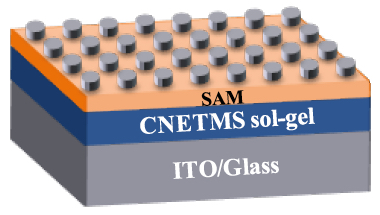
Schematic representation of new thin-film capacitor using bilayer dielectric formed by self-assembled monolayer (SAM) and sol-gel and electrode layers formed by the gray discs (representing aluminum electrodes) and ITO (indium tin oxide) (not to scale). (credit: Yunsang Kim et al./ Advanced Energy Materials)
The new bilayer dielectric material is composed of a nanoscale self-assembled monolayer (SAM) (insulating) material formed between a sol-gel film and the aluminized mylar film electrodes. The bilayer structure blocks the injection of electrons into the sol-gel material, providing low leakage current, high breakdown strength, and high energy extraction efficiency.
The researchers showed that the capacitor could be rolled and re-rolled several times while maintaining high energy density, demonstrating its flexibility.
The research, supported by the Office of Naval Research and the Air Force Office of Scientific Research, was reported July 14 in the journal Advanced Energy Materials.
Better energy density than thin-film lithium ion batteries
In their structures, the researchers demonstrated maximum extractable energy densities up to 40 joules per cubic centimeter, an energy extraction efficiency of 72 percent at a field strength of 830 volts per micron, and a power density of 520 watts per cubic centimeter.
The performance exceeds that of conventional electrolytic capacitors and thin-film lithium ion batteries, although it doesn’t match the lithium ion battery formats commonly used in electronic devices and vehicles.
The next step will be to scale up the materials to see if the attractive properties transfer to larger devices. If that is successful, the researchers expect to commercialize the material through a startup company or SBIR project.
The U.S. Naval Research Laboratory was also involved in the project.
Abstract of Bilayer Structure with Ultrahigh Energy/Power Density Using Hybrid Sol–Gel Dielectric and Charge-Blocking Monolayer
A hybrid sol–gel dielectric bilayer structure yields a maximum energy density of 40 J cm−3 with high extraction efficiency. The silica sol–gel dielectric is coated by an alkylphosphonic acid monolayer, as a charge-blocking layer. The dense monolayer suppresses charge injection and electrical conduction, leading to high energy extraction efficiency, which exhibits nearly linear dielectric behavior suitable for high energy density applications.
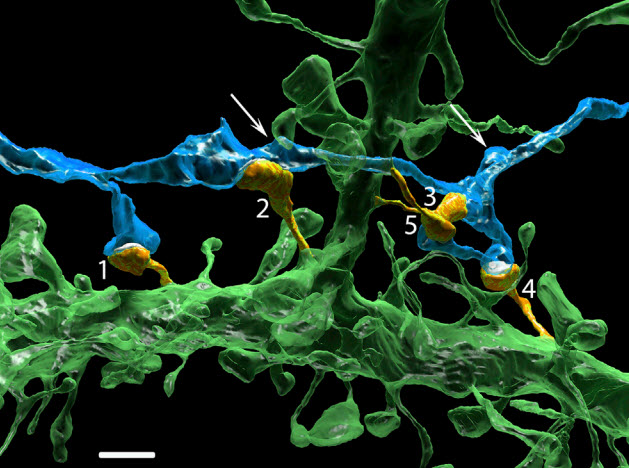
Multiple synapses of the same axon innervate multiple spines of the same postsynaptic cell. An extreme example in which one axon (blue) innervates five dendritic spines (orange, labeled 1–5) of a basal dendrite (green) is shown. Arrows point to other varicosities (swellings) of this axon that are innervating dendritic spines of other neurons. Scale bar, 2 mm. (credit: Narayanan Kasthuri et al./Cell)
Using an electron microscope, researchers have peered down inside the brain of an adult mouse at a scale previously unachievable, generating dramatic color images at 3-nm-pixel resolution. The research was published Thursday July 30 in an open-access paper in the journal Cell.
Focusing on a small area of the mouse brain that receives sensory information from mouse whiskers, the researchers built a system that automatically slices a subject brain into thousands of thin 29-nm coronal brain slices (each section 1 square millimeter) and sticks them to a conveyer belt. After staining the slices to differentiate different tissues, an automated electron microscope took pictures of each slice. A computer then assigned different colors to individual structures and combined the images to produce a 3-D map.
The scientists used a program called VAST, developed by co-author Daniel Berger of Harvard and MIT, to label and piece apart each individual “object” (e.g., neuron, glial cell, blood vessel cell, etc.) using different colors, as well as smaller structures such as dendrites and mitochondria. They also created an annotated inventory of 1700 synapses.

Synapses in contact with a dendrite (the large red object). The white dots are synaptic vesicles inside axons. (credit: N. Kasthuri et al./Cell)
“The complexity of the brain is much more than what we had ever imagined,” says study first author Narayanan “Bobby” Kasthuri, of the Boston University School of Medicine. “We had this clean idea of how there’s a really nice order to how neurons connect with each other, but if you actually look at the material it’s not like that. The connections are so messy that it’s hard to imagine a plan to it, but we checked and there’s clearly a pattern that cannot be explained by randomness.
“If we could make a map of a brain with schizophrenia and compare it to one without schizophrenia, we can look for inappropriate connections that may contribute to the disorder,” he said.
The cost and data storage demands for this type of research are still high, but the researchers expect expenses to drop over time (as has been the case with genome sequencing).
To allow for further inquiries and analyses in the high-resolution volume (80,000 cubic meters), scientists provide access to all of the image data via the Open Connectome Project, along with custom analytic software. They are also partnering with Argonne National Laboratory with the hopes of creating a national brain laboratory that neuroscientists around the world can access within the next few years.
Hauser Studio, Harvard University | Connections in a Cube/ Cell, July 30, 2015 (Vol. 162, Issue 3)
Abstract of Saturated Reconstruction of a Volume of Neocortex
We describe automated technologies to probe the structure of neural tissue at nanometer resolution and use them to generate a saturated reconstruction of a sub-volume of mouse neocortex in which all cellular objects (axons, dendrites, and glia) and many sub-cellular components (synapses, synaptic vesicles, spines, spine apparati, postsynaptic densities, and mitochondria) are rendered and itemized in a database. We explore these data to study physical properties of brain tissue. For example, by tracing the trajectories of all excitatory axons and noting their juxtapositions, both synaptic and non-synaptic, with every dendritic spine we refute the idea that physical proximity is sufficient to predict synaptic connectivity (the so-called Peters’ rule). This online minable database provides general access to the intrinsic complexity of the neocortex and enables further data-driven inquiries.

The Ebola vaccine being prepared for injection (credit: WHO/S. Hawkey)
An Ebola vaccine known as VSV-EBOV, provided by Merck, Sharp & Dohme, has shown 100% efficacy in individuals, according to results from an interim analysis published (open access) today (July 31) in the British journal The Lancet.
“This is an extremely promising development,” said Margaret Chan, M.D., Director-General of the World Health Organization. “The credit goes to the Guinean Government, the people living in the communities and our partners in this project. An effective vaccine will be another very important tool for both current and future Ebola outbreaks.”
An independent body of international experts — the Data and Safety Monitoring Board — conducted the review.
Based on the results, the Guinean national regulatory authority and ethics review committee have approved continuation of the trial to acquire conclusive evidence for the vaccine’s capacity to protect populations through what is called “herd immunity.”
“The ‘ring’ vaccination method adopted for the vaccine trial is based on the smallpox eradication strategy,” said John-Arne Røttingen, Director of the Division of Infectious Disease Control at the Norwegian Institute of Public Health and Chair of the Study Steering Group.
“The premise is that by vaccinating all people who have come into contact with an infected person you create a protective ‘ring’ and stop the virus from spreading further. This strategy has helped us to follow the dispersed epidemic in Guinea, and will provide a way to continue this as a public health intervention in trial mode.”
“This record-breaking work marks a turning point in the history of health R&D,” said Assistant Director-General Marie-Paule Kieny, who leads the Ebola Research and Development effort at WHO. “We now know that the urgency of saving lives can accelerate R&D. We will harness this positive experience to develop a global R&D preparedness framework so that if another major disease outbreak ever happens again, for any disease, the world can act quickly and efficiently to develop and use medical tools and prevent a large-scale tragedy.”
VSV-EBOV was developed by the Public Health Agency of Canada.

An international coalition of researchers may have found an effective Ebola vaccine.
The post At Last: An Ebola Vaccine That Might Actually Work appeared first on WIRED.

Erika Check Hayden traveled to Sierra Leone to report on the front lines of the fight against Ebola.
The post The Long, Winding Road to an Ebola Treatment appeared first on WIRED.

The people and media outlets covering the science of how cities work.
The post Follow Friday: The Secrets of How Cities Work appeared first on WIRED.
