A new process for studying proteins associated with diseases

Schematic of phosphoprotein biosynthesis from E. coli bacteria. Sep-OTS: genetically encoded phosphoserine; CFPS: cell-free protein synthesis; NTPs: nucleoside triphosphates; lysis:  breaking down cell membrane. (credit: Javin P. Oza et al./Nature Communications)

Researchers from Northwestern University and Yale University have developed a new technology to help scientists understand how proteins work and fix them when they are broken. Such knowledge could pave the way for new drugs for a myriad of diseases, including cancer.

The human body turns its proteins on and off (to alter their function and activity in cells) using “phosphorylation” — the reversible attachment of phosphate groups to proteins. These “decorations” on proteins provide an enormous variety of functions and are essential to all forms of life. Little is known, however, about how this important dynamic process works in humans.

Phosphorylation: a hallmark of disease

Using a special strain of E. coli bacteria, the researchers built a cell-free protein synthesis platform technology that can manufacture large quantities of these human phosphoproteins for scientific study. The goal is to enable scientists to learn more about the function and structure of phosphoproteins and identify which ones are involved in disease.

The study was published Sept. 9 in an open-access paper by the journal Nature Communications.

Trouble in the phosphorylation process can be a hallmark of disease, such as cancer, inflammation and Alzheimer’s disease. The human proteome (the entire set of expressed proteins) is estimated to be phosphorylated at more than 100,000 unique sites, making study of phosphorylated proteins and their role in disease a daunting task.

“Our technology begins to make this a tractable problem,”  said  Michael C. Jewett, an associate professor of chemical and biological engineering who led the Northwestern team. “We now can make these special proteins at unprecedented yields, with a freedom of design that is not possible in living organisms. The consequence of this innovative strategy is enormous.”

A “plug-and-play” protein expression platform

Jewett and his colleagues combined state-of-the-art genome engineering tools and engineered biological “parts” into a “plug-and-play” protein expression platform that is cell-free. Cell-free systems activate complex biological systems without using living intact cells. Crude cell lysates, or extracts, are employed instead.

The researchers prepared cell lysates of genomically recoded bacteria that incorporate amino acids not found in nature. This allowed them to harness the cell’s engineered machinery and turn it into a factory, capable of on-demand biomanufacturing new classes of proteins.

To demonstrate their cell-free platform technology, the researchers produced a human kinase that is involved in tumor cell proliferation and showed that it was functional and active. Kinase is an enzyme (a protein acting as a catalyst) that transfers a phosphate group onto a protein. Through this process, kinases activate the function of proteins within the cell. Kinases are implicated in many diseases and, therefore, of particular interest.

“The ability to produce kinases for study should be useful in learning how these proteins function and in developing new types of drugs,” Jewett said.


Abstract of Robust production of recombinant phosphoproteins using cell-free protein synthesis

Understanding the functional and structural consequences of site-specific protein phosphorylation has remained limited by our inability to produce phosphoproteins at high yields. Here we address this limitation by developing a cell-free protein synthesis (CFPS) platform that employs crude extracts from a genomically recoded strain of Escherichia coli for site-specific, co-translational incorporation of phosphoserine into proteins. We apply this system to the robust production of up to milligram quantities of human MEK1 kinase. Then, we recapitulate a physiological signalling cascade in vitro to evaluate the contributions of site-specific phosphorylation of mono- and doubly phosphorylated forms on MEK1 activity. We discover that only one phosphorylation event is necessary and sufficient for MEK1 activity. Our work sets the stage for using CFPS as a rapid high-throughput technology platform for direct expression of programmable phosphoproteins containing multiple phosphorylated residues. This work will facilitate study of phosphorylation-dependent structure–function relationships, kinase signalling networks and kinase inhibitor drugs.

A simulated quantum learning lab in Vienna that you can access virtually

Interference of complex molecules are pictured in the Kapitza-Dirac-Talbot-Lau interferometer (credit: Quantum Nanophysics group, University of Vienna; Image: Mathias Tomandl & Patrick Braun)

Ever feel like digging into quantum physics — and actually understanding it? Then you may enjoy a novel virtual hands-on remote learning environment developed by quantum physicists at the University of Vienna in collaboration with university and high-school students, and available free online.

The new teaching concept, called “Simulated Interactive Research Experiments” (SiReX), is described in an open-access paper in the journal Scientific Reports.

Simulation of the University of Vienna interferometer: measuring the two-dimensional interference pattern of molecules (credit: Mathias Tomandl et al./Scientific Reports)

The physicists, led by Markus Arndt at the University of Vienna, created two research laboratories as photorealistic computer simulations, allowing you to access simulated instruments in virtual experiments*.

The physicists say the virtual laboratories provide insights into fundamental understanding and applications of quantum mechanics with macromolecules and nanoparticles, including a wave-particle dualism experiment and  interferometry with large molecules.

A version of the virtual lab can also be experienced as an interactive exhibit in the Natural History Museum Vienna.

* Tip: skip the “find the coffee cups” practice task at the beginning.


Quantum Nanophysics group, University of Vienna| Interactive quantum lab


Abstract of Simulated Interactive Research Experiments as Educational Tools for Advanced Science

Experimental research has become complex and thus a challenge to science education. Only very few students can typically be trained on advanced scientific equipment. It is therefore important to find new tools that allow all students to acquire laboratory skills individually and independent of where they are located. In a design-based research process we have investigated the feasibility of using a virtual laboratory as a photo-realistic and scientifically valid representation of advanced scientific infrastructure to teach modern experimental science, here, molecular quantum optics. We found a concept based on three educational principles that allows undergraduate students to become acquainted with procedures and concepts of a modern research field. We find a significant increase in student understanding using our Simulated Interactive Research Experiment (SiReX), by evaluating the learning outcomes with semi-structured interviews in a pre/post design. This suggests that this concept of an educational tool can be generalized to disseminate findings in other fields.

Ultrafast ‘electron camera’ visualizes atomic ripples in 2-D material

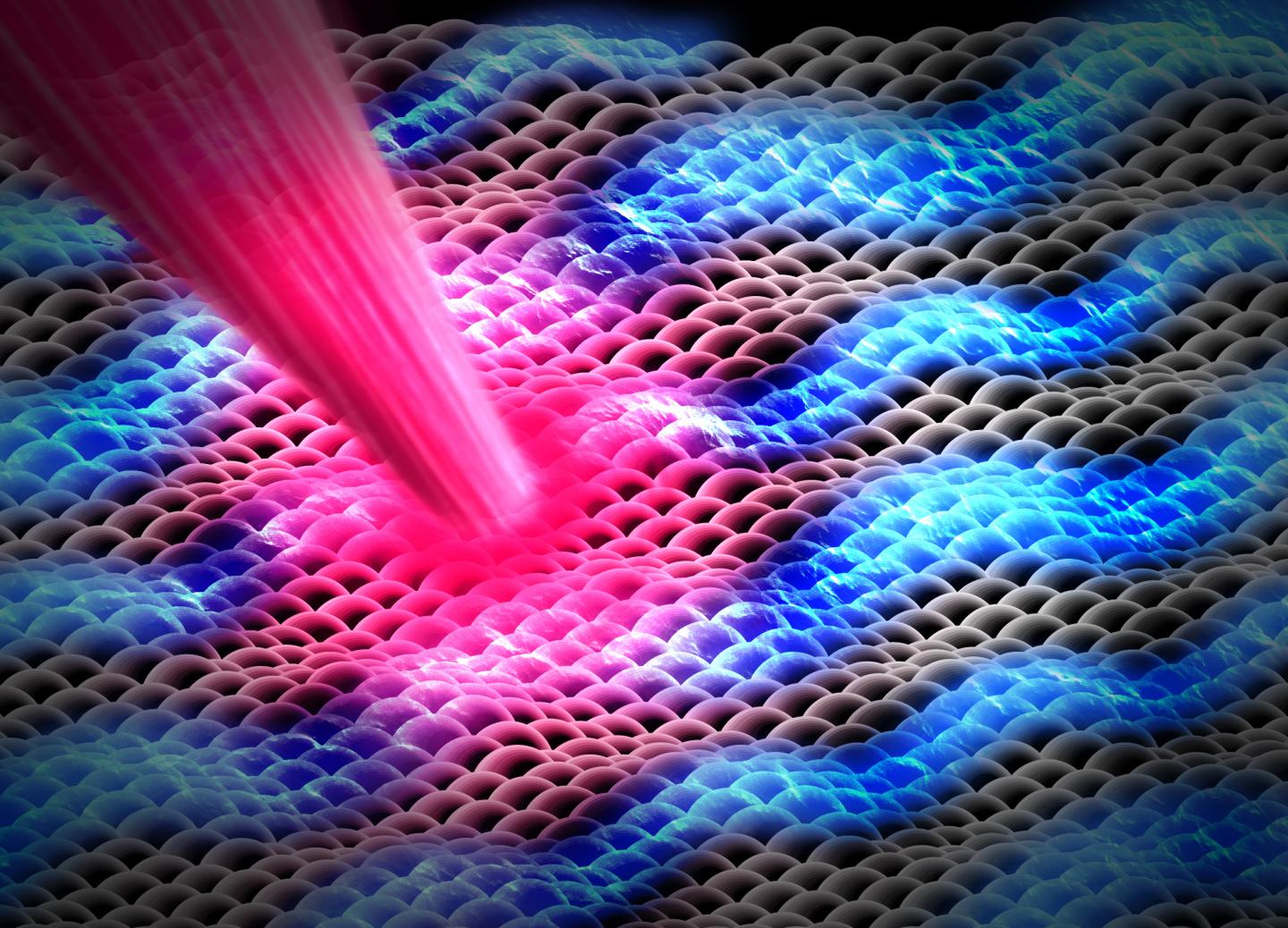
Researchers have used SLAC’s “electron cameras” to take snapshots of a three-atom-thick layer of a promising material called molybdenum disulfide as it wrinkles in response to a laser pulse. Understanding these dynamic ripples could provide crucial clues for the development of next-generation solar cells, electronics, and catalysts. (credit: SLAC National Accelerator Laboratory)

A new “electron camera” can capture images of individual moving atoms as they form wrinkles on a three-atom-thick material and in trillionths of a second — one of the world’s fastest. It has been developed by scientists from the Department of Energy’s SLAC National Accelerator Laboratory and Stanford University.

This unprecedented level of detail could guide researchers in developing more efficient solar cells, fast and flexible nanoelectronics, and high-performance chemical catalysts.

The breakthrough, published Aug. 31 in Nano Letters, was made possible by SLAC’s instrument for ultrafast electron diffraction (UED), which uses energetic electrons to take snapshots of atoms and molecules.

SLAC National Accelerator Laboratory | This animation explains how researchers use high-energy electrons at SLAC to study faster-than-ever motions of atoms and molecules relevant to important materials properties and chemical processes.

Extraordinary 2-D materials

Monolayers, or 2-D materials, contain just a single layer of molecules. In this form, they can take on new and exciting properties, such as superior mechanical strength and an extraordinary ability to conduct electricity and heat. But how do these monolayers acquire their unique characteristics? Until now, researchers only had a limited view of the underlying mechanisms.

A representative electron diffraction pattern from monolayer Molybdenum disulfide (MoS2) taken with the new SLAC electron camera, showing the crystalline nature of the sample (credit: (credit: SLAC National Accelerator Laboratory)

“The functionality of 2-D materials critically depends on how their atoms move,” said SLAC and Stanford researcher Aaron Lindenberg, who led the research team.

“However, no one has ever been able to study these motions on the atomic level and in real time before. Our results are an important step toward engineering next-generation devices from single-layer materials.”

The research team looked at molybdenum disulfide, or MoS2, which is widely used as a lubricant but takes on a number of interesting behaviors when in single-layer form.

For example, the monolayer form is normally an insulator, but when stretched, it can become electrically conductive. This switching behavior could be used to function like transistors in thin, flexible electronics and to encode information in data-storage devices.

Thin films of MoS2 are also under study as possible catalysts that facilitate chemical reactions. In addition, they capture light very efficiently and could be used in future solar cells.

Because of this strong interaction with light, researchers also think they may be able to manipulate the material’s properties with light pulses.

“To engineer future devices, control them with light, and create new properties through systematic modifications, we first need to understand the structural transformations of monolayers on the atomic level,” said Stanford researcher Ehren Mannebach, the study’s lead author.

Electron camera reveals ultrafast motions

Previous analyses showed that single layers of molybdenum disulfide have a wrinkled surface. However, these studies only provided a static picture. The new study reveals for the first time how surface ripples form and evolve in response to laser light.

Visualization of laser-induced motions of atoms (black and yellow spheres) in a molybdenum disulfide monolayer: The laser pulse creates wrinkles with large amplitudes — more than 15 percent of the layer’s thickness — that develop in a trillionth of a second. (credit: K.-A. Duerloo/Stanford)

Researchers at SLAC placed their monolayer samples, which were prepared by Linyou Cao’s group at North Carolina State University, into a beam of very energetic electrons. The electrons, which come bundled in ultrashort pulses, scatter off the sample’s atoms and produce a signal on a detector that scientists use to determine where atoms are located in the monolayer. This technique is called ultrafast electron diffraction.

The team then used ultrashort laser pulses to excite motions in the material, which cause the scattering pattern to change over time.

To study ultrafast atomic motions in a single layer of molybdenum disulfide, researchers followed a pump-probe approach: They excited motions with a laser pulse (pump pulse, red) and probed the laser-induced structural changes with a subsequent electron pulse (probe pulse, blue). The electrons of the probe pulse scatter off the monolayer’s atoms (blue and yellow spheres) and form a scattering pattern on the detector — a signal the team used to determine the monolayer structure. By recording patterns at different time delays between the pump and probe pulses, the scientists were able to determine how the atomic structure of the molybdenum disulfide film changed over time. (credit: SLAC National Accelerator Laboratory)

“Combined with theoretical calculations, these data show how the light pulses generate wrinkles that have large amplitudes — more than 15 percent of the layer’s thickness — and develop extremely quickly, in about a trillionth of a second. This is the first time someone has visualized these ultrafast atomic motions,” Lindenberg said.

Once scientists better understand monolayers of different materials, they could begin putting them together and engineer mixed materials with completely new optical, mechanical, electronic and chemical properties.

The research was supported by DOE’s Office of Science, the SLAC UED/UEM program development fund, the German National Academy of Sciences, and the U.S. National Science Foundation.


Abstract of Dynamic Structural Response and Deformations of Monolayer MoS2 Visualized by Femtosecond Electron Diffraction

Two-dimensional materials are subject to intrinsic and dynamic rippling that modulates their optoelectronic and electromechanical properties. Here, we directly visualize the dynamics of these processes within monolayer transition metal dichalcogenide MoS2 using femtosecond electron scattering techniques as a real-time probe with atomic-scale resolution. We show that optical excitation induces large-amplitude in-plane displacements and ultrafast wrinkling of the monolayer on nanometer length-scales, developing on picosecond time-scales. These deformations are associated with several percent peak strains that are fully reversible over tens of millions of cycles. Direct measurements of electron–phonon coupling times and the subsequent interfacial thermal heat flow between the monolayer and substrate are also obtained. These measurements, coupled with first-principles modeling, provide a new understanding of the dynamic structural processes that underlie the functionality of two-dimensional materials and open up new opportunities for ultrafast strain engineering using all-optical methods.