
From fake blood to rocket-launched lit matches, your budding researcher will love these sites.
The post The Best Oooey Gooey, Kid-Friendly Science on the Web appeared first on WIRED.

Science and reality
From fake blood to rocket-launched lit matches, your budding researcher will love these sites.
The post The Best Oooey Gooey, Kid-Friendly Science on the Web appeared first on WIRED.


The heaviest confirmed insect is the giant weta, a titanic species from New Zealand. But why get so big? Why not get bigger?
The post Absurd Creatures: Meet the Wonderful Bug That’s as Big as a Gerbil appeared first on WIRED.

The rocket engine-maker Aerojet Rocketdyne has bid $2 billion to buy United Launch Alliance, the government's favorite rocket launcher.
The post Surprise $2B Bid Could Be Trouble for Bezos’ Space Company appeared first on WIRED.

Reuben Wu traveled thousands of miles to photograph a volcano where the sulfuric gases glow blue.
The post Inside the Crater That Leaks Neon Blue ‘Lava’ appeared first on WIRED.

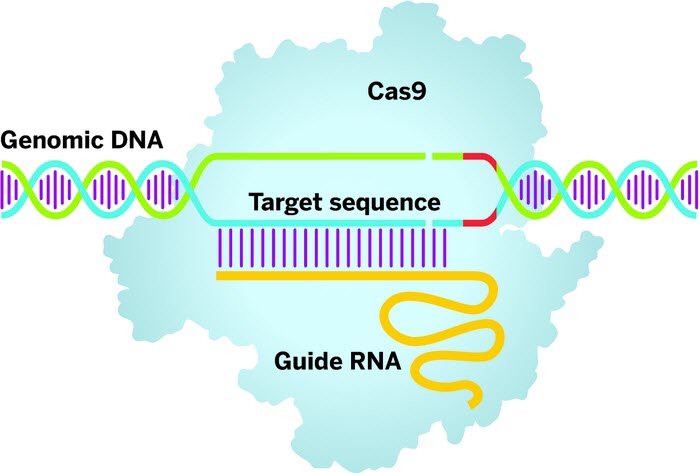
Clustered regularly interspaced short palindromic repeats (CRISPRs) technology employs a guide RNA to direct the Cas9 enzyme (light blue) to a target DNA sequence. Once there, Cas9 will bind when it finds a protospacer-adjacent motif sequence (red) in the DNA and cut both strands, priming the gene sequence for editing. (credit: Adapted from OriGene Technologies)
Within the past few years, a new technology has made altering genes in plants and animals much easier than before. The tool, called CRISPR/Cas9 or just CRISPR, has spurred a flurry of research that could one day lead to hardier crops and livestock, as well as innovative biomedicines.
But along with potential benefits, it raises red flags, according to an open-access article in Chemical & Engineering News (C&EN), the weekly newsmagazine of the American Chemical Society.
Ann M. Thayer, a senior correspondent at C&EN, notes that scientists have long had the ability to remove, repair or insert genetic material in cells. But the process was time consuming and expensive. CRISPR (“clustered regularly interspaced short palinodromic repeats”) streamlines gene editing dramatically. Its simplicity has enabled far more scientists to get involved in such work. In a short time, they have now used CRISPR to edit genes in insects, plants, fish, rodents and monkeys.
The potential agricultural and medical applications that could result from the tool in the future have attracted the interest of venture capitalists and pharmaceutical companies, the article says. While it seems CRISPR work is moving full-steam ahead, a couple of recent developments could check its growth.
In April, Chinese scientists reported that they had attempted to alter a gene in nonviable human embryos. The announcement sparked bioethicists to call for a more cautious approach to gene editing. The other wrench in the system is an ongoing dispute over who should be awarded the patent for inventing CRISPR. Until these issues are resolved, some investors and researchers will opt to wait on the sidelines.
McGovern Institute for Brain Research at MIT | Genome Editing with CRISPR-Cas9

Schematic of the x-ray microscopy measurements. The x-ray spot size at the sample was 35 nm and the transmitted x-rays (from the zone plate) were detected by an avalanche photo diode. Images were recorded by raster scanning of the sample. (credit: R. Kukreja et al./Physics Review Letters)
A team of physicists has taken pictures of a theorized but previously undetected “magnetic soliton” that they believe could be an energy-efficient means to transfer data in future electronic devices.
The research, which appears in the journal Physical Review Letters, was conducted by scientists at New York University, Stanford University, and the SLAC National Accelerator Laboratory.
Harnessing solitons to transmit data

Illustration of a water soliton wave. The blue line represents carrier (energy source) waves, while the red line is the envelope. (credit: Wikimedia Commons)
Solitons (solitary waves) were theorized in the 1970s to occur in magnets. They form because of a delicate balance of magnetic forces — much like water waves can form a tsunami. These magnetic waves could potentially be harnessed to transmit data in magnetic circuits in a way that is far more energy-efficient than current methods that involve moving electrical charges, the researchers suggest.
That’s because solitons are stable objects that overcome resistance, or friction, as they move. By contrast, electrons, used to move data today, generate heat as they travel, due to resistance and thus require additional energy, such as from a battery, as they transport data to its destination.
The scientists made the discovery using x-ray microscopy at the Stanford Synchrotron Radiation Lightsource. They observed an abrupt onset of magnetic waves with a well-defined spatial profile that matched the predicted form of a solitary magnetic wave, or magnetic soliton.
“This is an exciting discovery because it shows that small magnetic waves — also known as spin-waves — can add up to a large … wave that can maintain its shape as it moves,” explains Andrew Kent, a professor of physics at NYU and the study’s senior author.
“Magnetism has been used for navigation for thousands of years and more recently to build generators, motors, and data storage devices,” adds co-author Hendrik Ohldag, a scientist at the Stanford Synchrotron Radiation Laboratory (SSRL), where the soliton was discovered. “However, magnetic elements were mostly viewed as static and uniform. To push the limits of energy efficiency in the future we need to understand better how magnetic devices behave on fast timescales at the nanoscale, which is why we are using this dedicated ultrafast x-ray microscope.”
Abstract of X-ray Detection of Transient Magnetic Moments Induced by a Spin Current in Cu
We have used a MHz lock-in x-ray spectromicroscopy technique to directly detect changes in magnetic moment of Cu due to spin injection from an adjacent Co layer. The elemental and chemical specificity of x rays allows us to distinguish two spin current induced effects. We detect the creation of transient magnetic moments of 3 × 10⁻⁵μB on Cu atoms within the bulk of the 28 nm thick Cu film due to spin accumulation. The moment value is compared to predictions by Mott’s two current model. We also observe that the hybridization induced existing magnetic moments at the Cu interface atoms are transiently increased by about 10% or 4 × 10⁻³μB per atom. This reveals the dominance of spin-torque alignment over Joule heat induced disorder of the interfacial Cu moments during current flow.