
Why welcoming more refugees makes economic sense for Europe
Europe's leaders are under pressure to accept 130,000 more refugees, mostly from Syria. It's not just the right thing to do, it makes economic sense



Science and reality


Interlocking origami zigzag paper tubes can be configured to build a variety of structures that have stiffness and function, but can fold compactly for storage or shipping. (credit: Rob Felt)
A new origami “zippered tube” design that makes paper-based (or other thin materials) structures stiff enough to hold weight, yet can fold flat for easy shipping and storage could transform structures ranging from microscopic robots to furniture and even buildings.
That’s what researchers from the University of Illinois at Urbana-Champaign, the Georgia Institute of Technology, and the University of Tokyo suggest in a Proceedings of the National Academy of Sciences paper.
Such origami structures could include a robotic arm that reaches out and scrunches up, a construction crane that folds to pick up or deliver a load, furniture, and quick-assembling emergency shelters, bridges — and other infrastructure used in the wake of a natural disaster.
Pop-up buildings?
The researchers use a particular origami technique called Miura-ori folding: They make precise, zigzag-folded strips of paper, then glue two strips together to make a tube. While the single strip of paper is highly flexible, the tube is stiffer and does not fold in as many directions.
Interlocking two tubes in zipper-like fashion made them much stiffer and harder to twist or bend, they found. The structure folds up flat, yet rapidly and easily expands to the rigid tube configuration.
The zipper configuration works even with tubes that have different angles of folding. By combining tubes with different geometries, the researchers can make many different three-dimensional structures, such as a bridge, a canopy, or a tower.
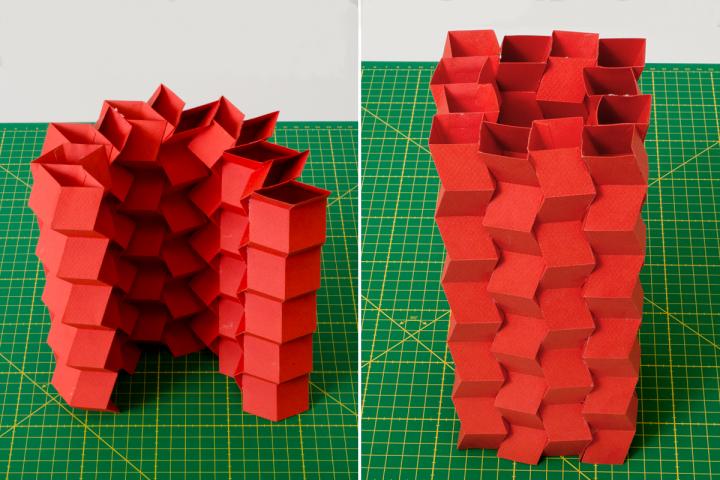
Origami “zipper tubes” — interlocking zigzag paper tubes — can be configured to build a variety of structures that have stiffness and function, but can fold compactly for storage or shipping (credit: L. Brian Stauffer)
Transformable structures
“The ability to change functionality in real time is a real advantage in origami,” said Georgia Tech professor Glaucio Paulino. “By having these transformable structures, you can change their functionality and make them adaptable. They are reconfigurable. You can change the material characteristics: You can make them stiffer or softer depending on the intended use.”
The team uses paper prototypes to demonstrate how a thin, flexible sheet can be folded into functional structures, but their techniques could be applied to other thin materials, according to the researchers. Larger-scale applications could combine metal or plastic panels with hinges.
Next, the researchers plan to explore new combinations of tubes with different folding angles to build new structures. They also hope to apply their techniques to other materials and explore applications from large-scale construction to microscopic structures for biomedical devices or robotics.
“All of these ideas apply from the nanoscale and microscale up to large scales and even structures that NASA would deploy into space,” Paulino said. “Depending on your interest, the applications are endless. We have just scratched the surface. Once you have a powerful concept, which we think the zipper coupling is, you can explore applications in many different areas.”
Abstract of Origami tubes assembled into stiff, yet reconfigurable structures and metamaterials
Thin sheets have long been known to experience an increase in stiffness when they are bent, buckled, or assembled into smaller interlocking structures. We introduce a unique orientation for coupling rigidly foldable origami tubes in a “zipper” fashion that substantially increases the system stiffness and permits only one flexible deformation mode through which the structure can deploy. The flexible deployment of the tubular structures is permitted by localized bending of the origami along prescribed fold lines. All other deformation modes, such as global bending and twisting of the structural system, are substantially stiffer because the tubular assemblages are overconstrained and the thin sheets become engaged in tension and compression. The zipper-coupled tubes yield an unusually large eigenvalue bandgap that represents the unique difference in stiffness between deformation modes. Furthermore, we couple compatible origami tubes into a variety of cellular assemblages that can enhance mechanical characteristics and geometric versatility, leading to a potential design paradigm for structures and metamaterials that can be deployed, stiffened, and tuned. The enhanced mechanical properties, versatility, and adaptivity of these thin sheet systems can provide practical solutions of varying geometric scales in science and engineering.
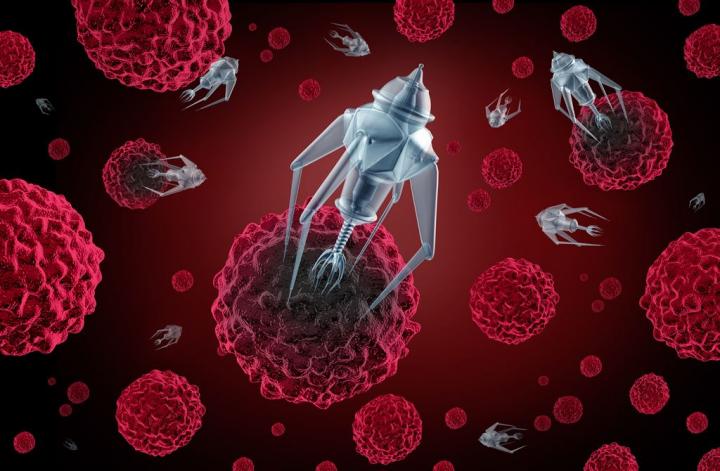
Using a double layer of lipids facilitates assembly of DNA origami nanostructures, bringing us one step closer to future DNA nanomachines, as in this artist’s impression (credit: Kyoto University’s Institute for Integrated Cell-Material Sciences)
Kyoto University scientists in Japan have developed a method for creating larger 2-D self-assembling DNA origami* nanostructures.
Current DNA origami methods can create extremely small two- and three-dimensional shapes that could be used as construction material to build nanodevices, such as nanomotors, in the future for targeted drug delivery inside the body, for example. KurzweilAI recently covered advanced methods developed by Brookhaven National Laboratory and Arizona State University’s Biodesign Institute.
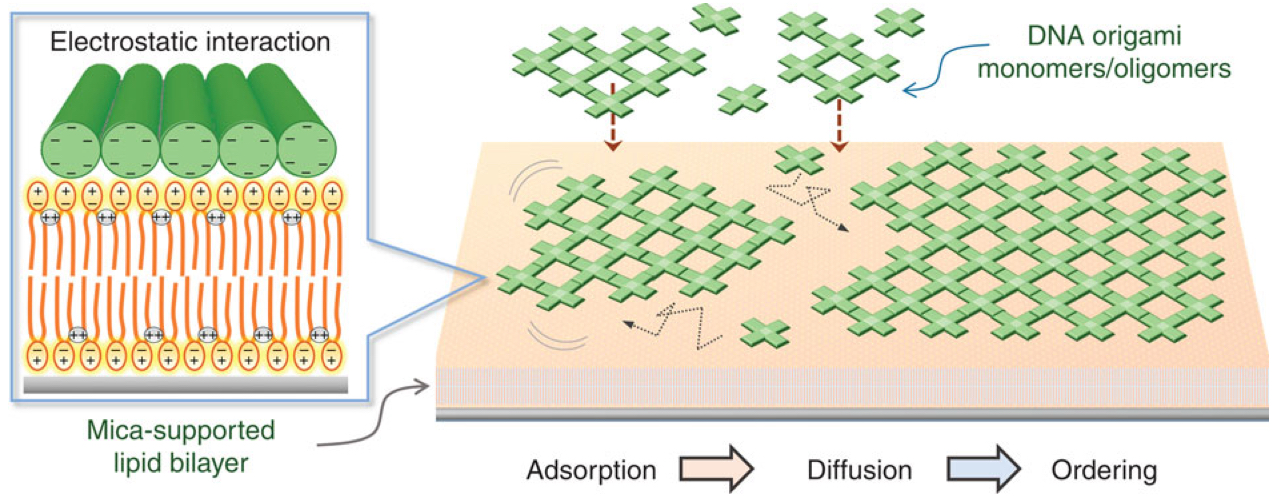
Lipid bilayer allows DNA origami structures to easily self-assemble into 2-D nanostructures (credit: Yuki Suzuki et al./Nature Communications)
Unlike those rigid structures, the Kyoto scientists used a double layer of lipids (fats) containing both a positive and a negative charge. That caused the DNA origami structures to be absorbed onto the lipid layer via electrostatic interaction. The weak bond between the origami structures and the lipid layer allowed them to move more freely than in other approaches, facilitating their interaction with one another and allowing them to self-assemble and form larger structures.
“We anticipate that our approach will further expand the potential applications of DNA origami structures and their assemblies in the fields of nanotechnology, biophysics, and synthetic biology,” says chemical biologist Professor Hiroshi Sugiyama from Kyoto University’s Institute for Integrated Cell-Material Sciences (iCeMS).
The study was published in an open-access paper in Nature Communications on August 27, 2015.
* The technique of DNA origami capitalizes on the simple base-pairing properties of DNA, a molecule built from the four nucleotides Adenine (A), Thymine (T), Cytosine (C) and Guanine (G). The rules of the game are simple: A’s always pair with T’s and C’s with G’s. Using this abbreviated vocabulary, the myriad body plans of all living organisms are constructed; though duplicating even Nature’s simpler designs has required great ingenuity.
The basic idea of DNA origami is to use a length of single-stranded DNA as a scaffold for the desired shape. Base-pairing of complementary nucleotides causes the form to fold and self-assemble. The process is guided by the addition of shorter “staple strands,” which act to help fold the scaffold and to hold the resulting structure together. Various imaging technologies are used to observe the tiny structures, including fluorescence-, electron- and atomic-force microscopy.
Abstract of Lipid-bilayer-assisted two-dimensional self-assembly of DNA origami nanostructures
Self-assembly is a ubiquitous approach to the design and fabrication of novel supermolecular architectures. Here we report a strategy termed ‘lipid-bilayer-assisted self-assembly’ that is used to assemble DNA origami nanostructures into two-dimensional lattices. DNA origami structures are electrostatically adsorbed onto a mica-supported zwitterionic lipid bilayer in the presence of divalent cations. We demonstrate that the bilayer-adsorbed origami units are mobile on the surface and self-assembled into large micrometre-sized lattices in their lateral dimensions. Using high-speed atomic force microscopy imaging, a variety of dynamic processes involved in the formation of the lattice, such as fusion, reorganization and defect filling, are successfully visualized. The surface modifiability of the assembled lattice is also demonstrated by in situ decoration with streptavidin molecules. Our approach provides a new strategy for preparing versatile scaffolds for nanofabrication and paves the way for organizing functional nanodevices in a micrometer space.

How studying algae came to change neuroscience.
The post The Unexpected Science of Manipulating Neurons With Light appeared first on WIRED.


Some people say they can read more than a thousand words per minute. But are they really understanding all that?
The post Big Question: Is Speed Reading Actually Possible? appeared first on WIRED.


