
World set to embark on UN sustainable goals to eradicate poverty
At a summit in New York this week, world leaders are expected to approve a set of goals and targets linked to sustainable and equitable development



Science and reality

Everywhere you go, everything you do, you are surrounded by an aura of microbes.
The post Your Body Is Surrounded by Clouds of Skin and Fart Bacteria appeared first on WIRED.

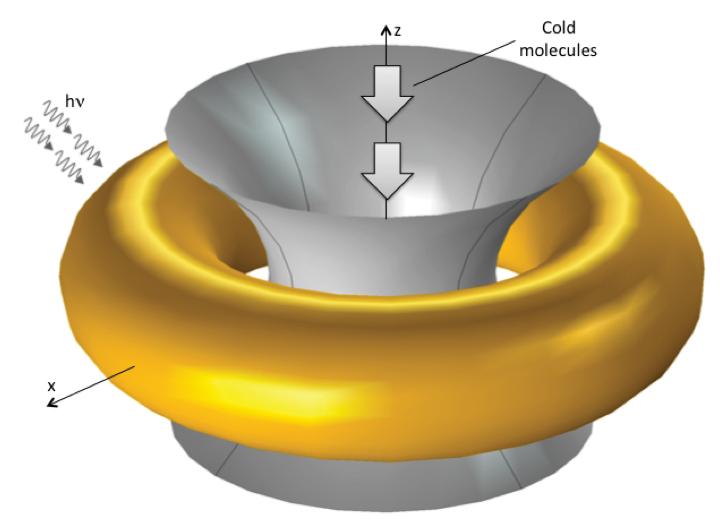
With a nano-ring-based toroidal trap, cold polar molecules near the gray shaded surface approaching the central region may be trapped within a nanometer-scale volume (credit: ORNL)
In a paper published in Physical Review A, Oak Ridge National Laboratory and University of Tennessee physicists describe conceptually how they may be able to trap and exploit a molecule’s energy to advance a number of fields.
“A single molecule has many degrees of freedom, or ways of expressing its energy and dynamics, including vibrations, rotations and translations,” said Ali Passian of Oak Ridge National Lab. “For years, physicists have searched for ways to take advantage of these molecular states, including how they could be used in high-precision instruments or as an information storage device for applications such as quantum computing.”
It’s a trap!
Catching a molecule with minimal disturbance is not an easy task, considering its size — about 1 nanometer — but this paper proposes a method that may overcome that obstacle.
When interacting with laser light, the ring toroidal nanostructure can trap the slower molecules at its center. That’s because the nano-trap, which can be made of gold using conventional nanofabrication techniques, creates a highly localized force field surrounding the molecules. The team envisions using scanning probe microscopy techniques, which can measure extremely small forces, to access individual nano-traps.
“Once trapped, we can interrogate the molecules for their spectroscopic and electromagnetic properties and study them in isolation without disturbance from the neighboring molecules,” Passian said.
Previous demonstrations of trapping molecules have relied on large systems to confine charged particles such as single ions. Next, the researchers plan to build actual nanotraps and conduct experiments to determine the feasibility of fabricating a large number of traps on a single chip.
“If successful, these experiments could help enable information storage and processing devices that greatly exceed what we have today, thus bringing us closer to the realization of quantum computers,” Passian said.
Abstract of Toroidal nanotraps for cold polar molecules
Electronic excitations in metallic nanoparticles in the optical regime that have been of great importance in surface-enhanced spectroscopy and emerging applications of molecular plasmonics, due to control and confinement of electromagnetic energy, may also be of potential to control the motion of nanoparticles and molecules. Here, we propose a concept for trapping polarizable particles and molecules using toroidal metallic nanoparticles. Specifically, gold nanorings are investigated for their scattering properties and field distribution to computationally show that the response of these optically resonant particles to incident photons permit the formation of a nanoscale trap when proper aspect ratio, photon wavelength, and polarization are considered. However, interestingly the resonant plasmonic response of the nanoring is shown to be detrimental to the trap formation. The results are in good agreement with analytic calculations in the quasistatic limit within the first-order perturbation of the scalar electric potential. The possibility of extending the single nanoring trapping properties to two-dimensional arrays of nanorings is suggested by obtaining the field distribution of nanoring dimers and trimers.
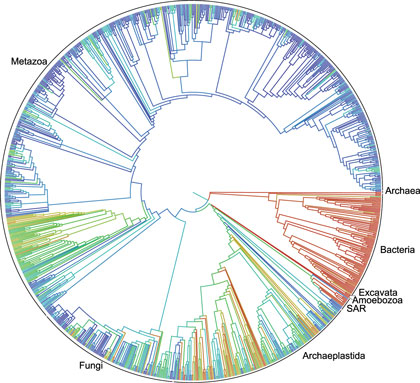
This circular family tree of Earth’s lifeforms is considered a first draft of the 3.5-billion-year history of how life evolved and diverged (credit: Duke University)
A first draft of the “tree of life” for the roughly 2.3 million named species of animals, plants, fungi and microbes — from platypuses to puffballs — has been released.
A collaborative effort among eleven institutions, the tree depicts the relationships among living things as they diverged from one another over time, tracing back to the beginning of life on Earth more than 3.5 billion years ago.
Tens of thousands of smaller trees have been published over the years for select branches of the tree of life — some containing upwards of 100,000 species — but this is the first time those results have been combined into a single tree that encompasses all of life.
“This is the first real attempt to connect the dots and put it all together,” said principal investigator Karen Cranston of Duke University. “Think of it as Version 1.0.” The current version of the tree — along with the underlying data and source code — is available to browse, edit, and download free at https://tree.opentreeoflife.org — a sort of “Wikipedia” for the evolutionary trees.
It is also described in an open-access article appearing Sept. 18 in the Proceedings of the National Academy of Sciences.
Uses of evolutionary trees
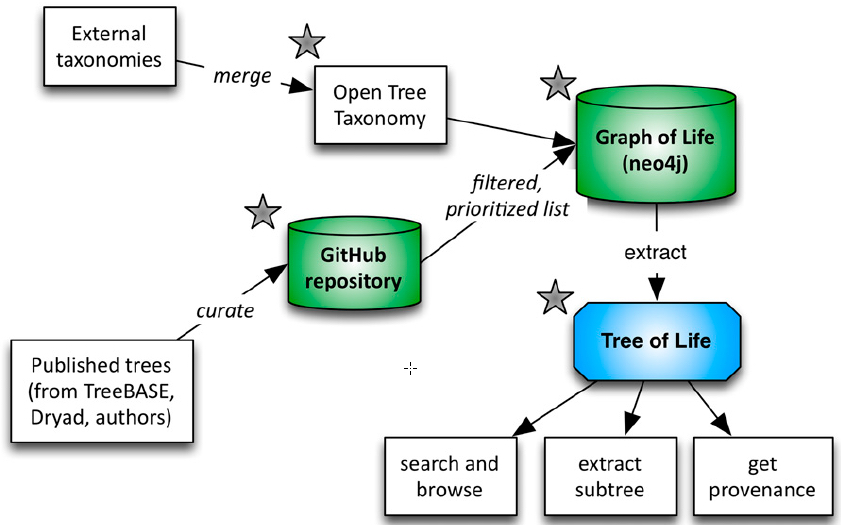
Open Tree of Life workflow (credit: Cody E. Hinchliff et al./PNAS)
Understanding how the millions of species on Earth are related to one another helps scientists discover new drugs, increase crop and livestock yields, and trace the origins and spread of infectious diseases such as HIV, Ebola and influenza, the scientists say.
The researchers pieced it together by compiling thousands of smaller chunks that had already been published online and merging them together into a gigantic “supertree” that encompasses all named species. The initial draft is based on nearly 500 smaller trees from previously published studies.
To map trees from different sources to the branches and twigs of a single supertree, one of the biggest challenges was simply accounting for the name changes, alternate names, common misspellings and abbreviations for each species. The eastern red bat, for example, is often listed under two scientific names, Lasiurus borealis and Nycteris borealis. Spiny anteaters once shared their scientific name with a group of moray eels.
“Although a massive undertaking in its own right, this draft tree of life represents only a first step,” the researchers wrote. For one, only a tiny fraction of published trees are digitally available.
A survey of more than 7,500 phylogenetic studies published between 2000 and 2012 in more than 100 journals found that only one out of six studies had deposited their data in a digital, downloadable format that the researchers could use.
The vast majority of evolutionary trees are published as PDFs and other image files that are impossible to enter into a database or merge with other trees.
As a result, the relationships depicted in some parts of the tree, such as the branches representing the pea and sunflower families, don’t always agree with expert opinion.
Other parts of the tree, particularly insects and microbes, remain elusive. That’s because even the most popular online archive of raw genetic sequences — from which many evolutionary trees are built — contains DNA data for less than five percent of the tens of millions species estimated to exist on Earth.
“As important as showing what we do know about relationships, this first tree of life is also important in revealing what we don’t know,” said co-author Douglas Soltis of the University of Florida.
To help fill in the gaps, the team is also developing software that will enable researchers to log on and update and revise the tree as new data come in for the millions of species still being named or discovered.
“It’s by no means finished,” Cranston said. “It’s critically important to share data for already-published and newly-published work if we want to improve the tree.”
“Twenty five years ago people said this goal of huge trees was impossible,” Soltis said. “The Open Tree of Life is an important starting point that other investigators can now refine and improve for decades to come.”
Abstract of Synthesis of phylogeny and taxonomy into a comprehensive tree of life
Reconstructing the phylogenetic relationships that unite all lineages (the tree of life) is a grand challenge. The paucity of homologous character data across disparately related lineages currently renders direct phylogenetic inference untenable. To reconstruct a comprehensive tree of life, we therefore synthesized published phylogenies, together with taxonomic classifications for taxa never incorporated into a phylogeny. We present a draft tree containing 2.3 million tips—the Open Tree of Life. Realization of this tree required the assembly of two additional community resources: (i) a comprehensive global reference taxonomy and (ii) a database of published phylogenetic trees mapped to this taxonomy. Our open source framework facilitates community comment and contribution, enabling the tree to be continuously updated when new phylogenetic and taxonomic data become digitally available. Although data coverage and phylogenetic conflict across the Open Tree of Life illuminate gaps in both the underlying data available for phylogenetic reconstruction and the publication of trees as digital objects, the tree provides a compelling starting point for community contribution. This comprehensive tree will fuel fundamental research on the nature of biological diversity, ultimately providing up-to-date phylogenies for downstream applications in comparative biology, ecology, conservation biology, climate change, agriculture, and genomics.

Active thermal cloak hides a circular object in conductive heat flow by “pumping” heat from hot end to cold end (credit: Xu & Zhang/NTU)
A new thermal cloak that can render an object thermally invisible by actively redirecting incident heat has been developed by scientists at the Nanyang Technological University (NTU) in Singapore. It’s similar to how optical invisibility cloaks can bend and diffract light to shield an object from sight and specially fabricated acoustic metamaterials can hide an object from sound waves.
The system has the potential to fine-tune temperature distribution and heat flow in electronic and semiconductor systems for applications that require efficient heat dissipation (cooling) and homogenous (even) thermal expansion, such as high-power engines, magnetic resonance imaging (MRI) instruments, thermal sensors, and clothing, said Prof. Baile Zhang of NTU.
Zhang and colleagues previously designed a metamaterial thermal cloak that passively guided conductive heat around a hidden object, with no way to control heat flow and direction. The researchers decided to look into controlling thermal cloaking electrically by actively “pumping” heat from one side of the hidden object to the other side, using thermoelectric modules, as described in an open-access paper and on the cover of Applied Physics Letters, from AIP Publishing.
Building the thermal cloak

Design of active thermal cloak. (a) Multiple thermoelectic components are arranged around the air hole with equal distance on the Carbon Steel plate. Blue components absorb incident thermal flux while red ones release heat back to the plate. (b) The side view of the marked region in (a), illustrating the working mechanism of TE components when functioning as heat absorber/emitter. An applied voltage causes a directional motion of charge carriers in positive/negative blocks, resulting in a heat flux in the designed direction. The bottom/top orange arrow indicates the absorption/release of heat by TE components. The dashed arrow indicates the heat transfer through a constant-temperature heat “reservoir” which is a large copper bulk in the experiment. (credit: Dang Minh Nguyen et al./Applied Physics Letters)
To construct their active thermal cloak, the researchers deployed 24 small thermoelectric modules, which are semiconductor heat pumps controlled by an external input voltage, around a 62-millimeter diameter air hole in a carbon steel plate just 5 mm thick. The modules operate via the Peltier effect, in which a current running through the junction between two conductors can remove or generate heat.
When many modules are attached in series, they can redirect heat flow. The researchers attached the bottom and top ends of the modules to hot and cold surfaces at 60° C and 0° C respectively to generate diffusive heat flux.
When the researchers applied a variety of specific voltages to each of the 24 modules, the heat falling on the hot-surface side of the air hole was absorbed and delivered to a constant-temperature copper heat reservoir attached to the modules. The modules on the cold-surface side released the same amount of heat from the reservoir into the steel plate. This prevented heat from diffusing through the air hole, a technique, the researchers say, that can be used to shield sensitive electronic components from heat dissipation.
The researchers found that their active thermal cloaking was not limited by the shape of the object being hidden.
Zhang and his colleagues plan to apply the thermal cloaks in electronic systems, improve the efficiency of heat transfer, and develop an intelligent control system for the cloak.
Abstract of Active thermal cloak
Thermal cloaking, as an ultimate thermal “illusion” phenomenon, is the result of advanced heat manipulation with thermal metamaterials—heat can be guided around a hidden object smoothly without disturbing the ambient thermal environment. However, all previous thermal metamaterial cloaks were passive devices, lacking the functionality of switching on/off and the flexibility of changing geometries. In this letter, we report an active thermal cloaking device that is controllable. Different from previous thermal cloaking approaches, this thermal cloak adopts active thermoelectric components to “pump” heat from one side to the other side of the hidden object, in a process controlled by input electric voltages. Our work not only incorporates active components in thermal cloaking but also provides controllable functionality in thermal metamaterials that can be used to construct more flexible thermal devices.
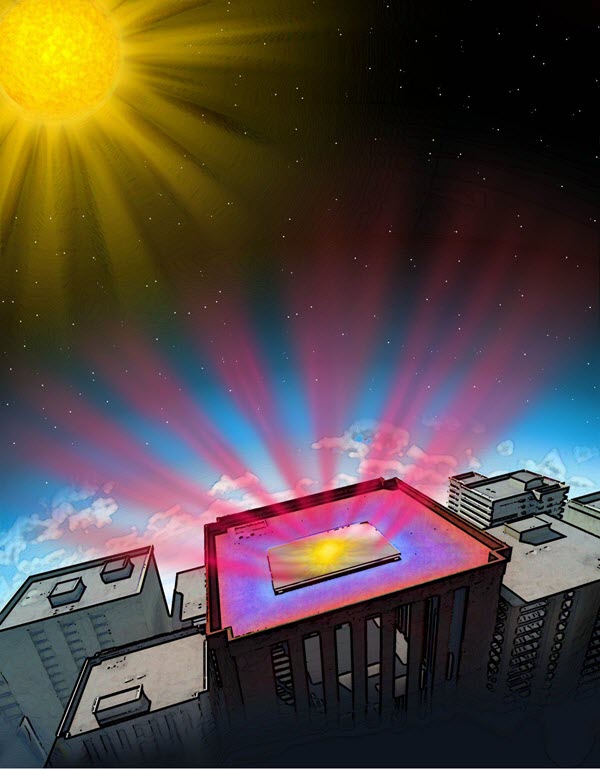
Stanford engineers have invented a transparent material that improves the efficiency of solar cells by radiating thermal energy (heat) into space (credit: Stanford Engineering)
Stanford engineers have developed a transparent material that improves the efficiency of solar cells by radiating thermal energy (heat) into space, even in full sunlight.
The invention may solve a longstanding problem for the solar industry: the hotter solar cells become, the less efficient they are at converting sunlight to electricity. The Stanford solution is based on a thin, patterned silica material laid on top of a traditional solar cell. The material is transparent to the visible sunlight that powers solar cells, but captures and emits thermal radiation, or heat, cooling the solar cell and thus allowing it to convert more photons into electricity.
The work by Shanhui Fan, a professor of electrical engineering at Stanford, research associate Aaswath P. Raman and doctoral candidate Linxiao Zhu is described in the current issue of Proceedings of the National Academy of Sciences.
The same inventors previously developed an ultrathin material, covered on KurzweilAI, that radiated infrared light (in the thermal “long” infrared atmospheric transparency window of ~7 to 30 microns) from the Sun directly back toward space without warming the atmosphere (thus avoiding the greenhouse effect). They presented that work in Nature, describing it as “radiative cooling” because it shunted thermal energy directly into the deep, cold void of space. It was specifically intended for cooling buildings.
A silica photonic crystal radiator
In their new paper, the researchers applied that work to improve solar array performance.

Silica photonic crystal radiates far-infrared light (heat) into space (credit: Linxiao Zhu et al./PNAS)
The Stanford team tested their technology on a custom-made solar absorber — a device that mimics the properties of a solar cell without producing electricity — covered with a silica photonic crystal (a micrometer-scale pattern) designed to maximize the capability to dump heat, in the form of infrared light (in 8 to 30 microns range) into space. Their experiments showed that the overlay allowed visible light to pass through to the solar cells, but that the pattern also cooled the underlying absorber by as much as 23 degrees Fahrenheit.
For a typical crystalline silicon solar cell with an efficiency of 20 percent, 23 F of cooling would improve absolute cell efficiency by more than 1 percent, a figure that represents a significant gain in energy production.
The researchers said the new transparent thermal overlays work best in dry, clear environments, which are also preferred sites for large solar arrays. They believe they can scale things up so that commercial and industrial applications are feasible, perhaps using nanoprint lithography, which is a common technique for producing nanometer-scale patterns.
Cooler cars
Zhu said the technology has significant potential for any outdoor device or system that demands cooling but requires the preservation of the visible spectrum of sunlight for either practical or aesthetic reasons.
“Say you have a car that is bright red,” Zhu said. “You really like that color, but you’d also like to take advantage of anything that could aid in cooling your vehicle during hot days. Thermal overlays can help with passive cooling, but it’s a problem if they’re not fully transparent.” That’s because the perception of color requires objects to reflect visible light, so any overlay would need to be transparent, or else tuned such that it would absorb only light outside the visible spectrum.
“Our photonic crystal thermal overlay optimizes use of the thermal portions of the electromagnetic spectrum without affecting visible light,” Zhu said, “so you can radiate heat efficiently without affecting color.”
Abstract of Radiative cooling of solar absorbers using a visibly transparent photonic crystal thermal blackbody
A solar absorber, under the sun, is heated up by sunlight. In many applications, including solar cells and outdoor structures, the absorption of sunlight is intrinsic for either operational or aesthetic considerations, but the resulting heating is undesirable. Because a solar absorber by necessity faces the sky, it also naturally has radiative access to the coldness of the universe. Therefore, in these applications it would be very attractive to directly use the sky as a heat sink while preserving solar absorption properties. Here we experimentally demonstrate a visibly transparent thermal blackbody, based on a silica photonic crystal. When placed on a silicon absorber under sunlight, such a blackbody preserves or even slightly enhances sunlight absorption, but reduces the temperature of the underlying silicon absorber by as much as 13°C due to radiative cooling. Our work shows that the concept of radiative cooling can be used in combination with the utilization of sunlight, enabling new technological capabilities.

WIRED had a chat with Martin Blaser, NYU doctor and chair of the White House's new push to save ourselves from overusing antibiotics.
The post The US Is Finally Taking Action on Antibiotic Resistance appeared first on WIRED.

