
Cassini probe to dive deep through watery plume on Enceladus
NASA's Cassini spacecraft is set to make its deepest dive yet through the Saturn moon's plume, perhaps close enough to spot the ingredients for life



Science and reality


NASA's Cassini space probe makes its second-to-last passage of Saturn's icy moon Enceladus.
The post Cassini Is About to Taste the Huge Geysers of Enceladus appeared first on WIRED.


Following a major earthquake, the health care needs begin with trauma care, then disease, and eventually mental health.
The post The Afghan Quake’s True Cost Could Come in the Winter appeared first on WIRED.

The World Health Organization classifies the causes of cancer in a horribly confusing way.
The post Bacon Causes Cancer? Sort of. Not Really. Ish. appeared first on WIRED.
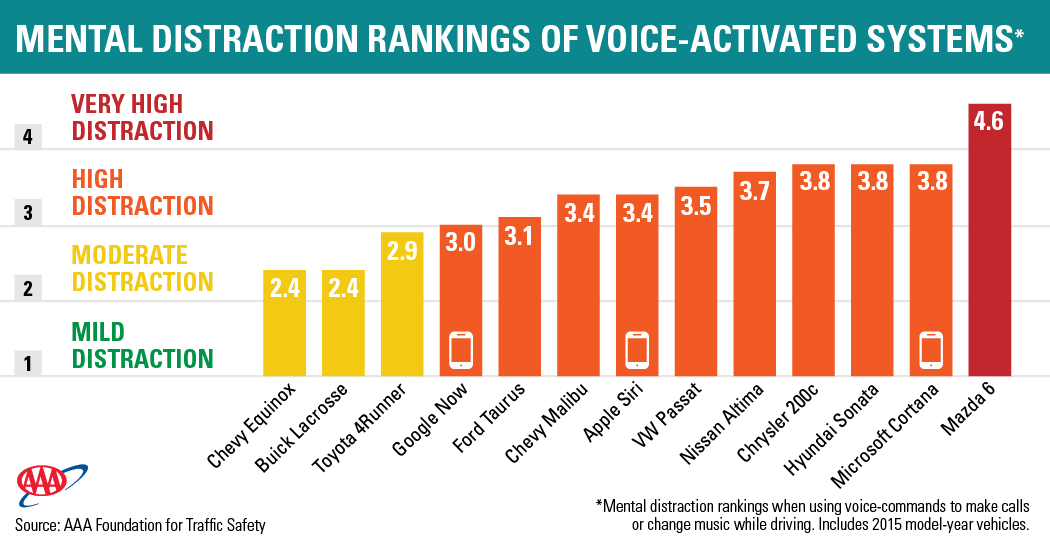
This graphic shows the mental distraction scores of three smartphone personal assistants and 10 in-vehicle infotainment systems for using voice commands in cars to call contacts, dial phone numbers or change music. The smartphone assistants’ scores were 0.3 points higher than shown if a driver also sent text messages using them. (credit: AAA Foundation for Traffic Safety)
If you think it is okay to talk to your car infotainment system or smartphone while driving or even when stopped at a red light, think again. It takes up to 27 seconds to regain full attention after issuing voice commands, University of Utah researchers found in two new studies for the AAA Foundation for Traffic Safety.
One of the studies showed that it is highly distracting to use hands-free voice commands to dial phone numbers, call contacts, change music, and send texts with Microsoft Cortana, Apple Siri and Google Now smartphone personal assistants.
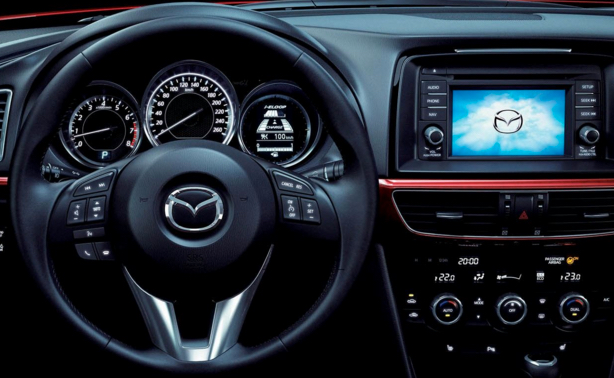
Mazda 2015 steering wheel and dashboard. Phone calls can be dialed or received via Bluetooth on the steering wheel and the display has multiple screens for phone directory, radio, Sirius XM, and GPS. (credit: Landmark MAZDA)
The other study examined voice-dialing, voice-contact calling, and music selection using in-vehicle information or “infotainment” systems in 10 model-year 2015 vehicles. Three were rated as moderately distracting, six as highly distracting and the system in the 2015 Mazda 6 as very highly distracting.
The research also found that, contrary to what some may believe, practice with voice-recognition systems doesn’t eliminate distraction. The studies also showed older drivers — those most likely to buy autos with infotainment systems — are much more distracted than younger drivers when giving voice commands.
But the most surprising finding was that a driver traveling only 25 mph continues to be distracted for up to 27 seconds after disconnecting from highly distracting phone and car voice-command systems, and up to 15 seconds after disconnecting from the moderately distracting systems. The 27 seconds means a driver traveling 25 mph would cover the length of three football fields before regaining full attention.
“Many of these systems have been put into cars with a voice-recognition system to control entertainment: Facebook, Twitter, Instagram, Snapchat, Facetime, etc. We now are trying to entertain the driver rather than keep the driver’s attention on the road.”
The new AAA reports urge that voice activated, in-vehicle information systems “ought not to be used indiscriminately” while driving, and advise that “caution is warranted” in smart-phone use while driving.
The studies are fifth and sixth since 2013 by University of Utah psychologists and funded by the AAA Foundation for Traffic Safety. AAA formerly was known as the American Automobile Association. Strayer and Cooper ran the studies with Utah psychology doctoral students Joanna Turrill, James Coleman and Rachel Hopman.
The previous Utah-AAA studies devised a five-point scale: 1 mild distraction, 2 moderate distraction, 3 high distraction, 4 very high distraction and 5 maximum distraction. Those studies showed cellphone calls were moderately distracting, with scores of 2.5 for hand-held calls and 2.3 for hands-free calls. Listening to a book on tape rated mild distraction at 1.7. Listening to the radio rated 1.2.
One of the new studies found mild distraction for in-vehicle information systems in the Chevy Equinox with MyLink (2.4), Buick Lacrosse with IntelliLink (2.4) and Toyota 4Runner with Entune (2.9).
High distraction systems were the Ford Taurus with Sync MyFord Touch (3.1), Chevy Malibu with MyLink (3.4), Volkswagen Passat with Car-Net (3.5), Nissan Altima with Nissan Connect (3.7), Chrysler 200c with Uconnect (3.8) and Hyundai Sonata with Blue Link (3.8). The Mazda 6’s Connect system rated very highly distracting (4.6).
In some cases, the same voice-command system (like Chevy MyLink) got different distraction scores in different models – something the researchers speculate is due to varying amounts of road noise and use of different in-vehicle microphones.
The second new study found all three major smartphone personal assistants either highly or very highly distracting. Two scores were given to each voice-based system: A lower number for using voice commands only to make calls or change music when driving — the same tasks done with the in-car systems — and a higher number that also included using smartphones to send texts by voice commands.
In 2013, 3,154 people died and 424,000 others were injured in motor vehicle crashes on U.S. roads involving driver distraction, says the U.S. Department of Transportation.
The study reports, which are listed below, are open-access.
Georgia Tech | Algorithm allows robot to fall gracefully
Researchers at Georgia Tech are teaching robots how to fall with grace and without serious damage.
This is becoming important as costly robots become more common in manufacturing, healthcare, and domestic tasks.
Ph.D. graduate Sehoon Ha and Professor Karen Liu developed a new algorithm that tells a robot how to react to a wide variety of falls, from a single step to recover from a gentle nudge to a rolling motion that breaks a high-speed fall. The idea is learn the best sequence of movements to slow their momentum and minimize the damage or injury they might cause to themselves or others while falling.
“Our work unified existing research about how to teach robots to fall by giving them a tool to automatically determine the total number of contacts (how many hands shoved it, for example), the order of contacts, and the position and timing of those contacts,” said Ha, now a postdoctoral associate at Disney Research Pittsburgh. “All of that impacts the potential of a fall and changes the robot’s response.”
The algorithm was validated in physics simulation and experimentally tested on a BioloidGP humanoid.
With the latest finding, Ha builds upon Liu’s previous research that studied how cats modify their bodies in the midst of a fall. Liu knew from that work that one of the most important factors in a fall is the angle of the landing.
“From previous work, we knew a robot had the computational know-how to achieve a softer landing, but it didn’t have the hardware to move quickly enough like a cat,” Liu said. “Our new planning algorithm takes into account the hardware constraints and the capabilities of the robot, and suggests a sequence of contacts so the robot gradually can slow itself down.”
They suggest robots may soon fall more gracefully than people — and possibly even cats.
DARPA TV | A Celebration of Risk (a.k.a., Robots Take a Spill)
This paper introduces a new planning algorithm to minimize the damage of humanoid falls by utilizing multiple contact points. Given an unstable initial state of the robot, our approach plans for the optimal sequence of contact points such that the initial momentum is dissipated with minimal impacts on the robot. Instead of switching among a collection of individual control strategies, we propose a general algorithm which plans for appropriate responses to a wide variety of falls, from a single step to recover a gentle nudge, to a rolling motion to break a high-speed fall. Our algorithm transforms the falling problem into a sequence of inverted pendulum problems and use dynamic programming to solve the optimization efficiently. The planning algorithm is validated in physics simulation and experimentally tested on a BioloidGP humanoid.