
World Health Organization may approve first malaria vaccine
Experts advising the WHO are expected to recommend the use of the vaccine in some malaria-stricken countries



Science and reality

Theranos allegedly hid data showing its tests didn't work. The government could change rules that let that happen, but it could ruin diagnostic testing.
The post Fixing the Laws That Let Theranos Hide Data Won’t Be Easy appeared first on WIRED.


Bernie Sanders says climate change is our biggest national security issue. Is he right? And what does it mean if he is?
The post How Climate Change Became a National Security Problem appeared first on WIRED.

Everyone wants a hoverboard. Here are three real hoverboards that exist right now.
The post How the Most Promising Hoverboards Actually Work appeared first on WIRED.
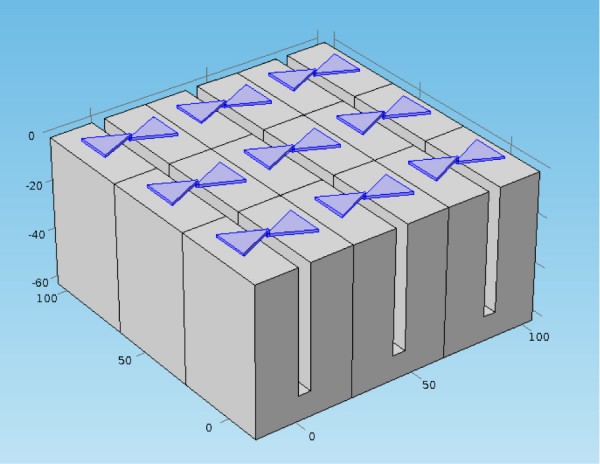
A rectenna metamaterial surface with bow-tie antennas for capture 10,000 to 100,000 times more thermal energy for conversion to DC electricity (credit: Won Park/University of Colorado)
Scientists from the University of Colorado are developing a new type of “rectenna” to efficiently “harvest” thermal emissions (waste heat) radiated from devices (a rectenna converts electromagnetic radiation to DC current).
Currently rectennas work best at low frequencies, but most heat is at higher radiation frequencies — up to the 100 THz (100 trillion cycles per second) range. So Won Park and his colleagues found a way to enhance thermal emission of hot bodies at the lower end of the spectrum (around 1 THz): by manipulating the surface of the object.
A metamaterial for engineering thermal emission
Park’s team uses software to analyze how the nanoscale topology of a surface — its bumps, holes or grooves — changes the way that electromagnetic radiation interacts with the surface. In some instances the geometry supports the formation of a wave of rippling electronic charges, called a plasmon, that hugs the surface.
“We design the surface to support a surface wave, because the presence of the wave offers a new avenue for engineering thermal emission,” Park said. For the case of optimizing thermal energy harvesting, the researchers found they could “spectrally tune” a surface to emit more radiation at 1 THz frequency.
The researchers first optimized the design, which consists of a copper plate with a regular array of tiny holes, using simulations. They then built the design in the lab and confirmed that the plate did indeed produce the type of surface waves predicted by the simulations.
The researchers also used computer modeling to design a bowtie-shaped antenna that would effectively capture the enhanced thermal emission. Simulations predict that an antenna placed near the holey surface could capture 10,000 to 100,000 times more thermal energy than an antenna in open space.
The team is in the process of experimentally testing this prediction and hopes to have new results to report soon. The results will also help the team calculate how rectenna thermal energy harvesting might compare to other ways of harvesting waste heat, such as thermoelectric materials.
The researchers described the system at the AVS 62nd International Symposium and Exhibition in San Jose, Calif. today (Monday, Oct. 19). The research is funded in part by a grant from Redwave Energy Inc.
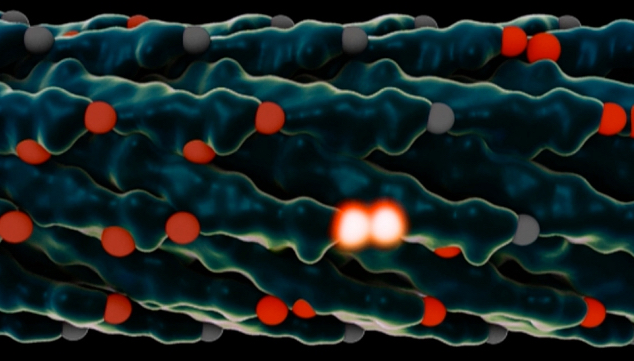
Rendering of a virus used in the MIT experiments. The light-collecting centers, called chromophores, are in red, and chromophores that just absorbed a photon of light are glowing white. After the virus is modified to adjust the spacing between the chromophores, energy can jump from one set of chromophores to the next faster and more efficiently. (credit: the researchers and Lauren Alexa Kaye)
MIT engineers have achieved a significant efficiency boost in a light-harvesting system, using genetically engineered viruses to achieve higher efficiency in transporting energy from receptors to reaction centers where it can be harnessed, making use of the exotic effects of quantum mechanics. Emulating photosynthesis in nature, it could lead to inexpensive and efficient solar cells or light-driven catalysis,
This achievement in coupling quantum research and genetic manipulation, described this week in the journal Nature Materials, was the work of MIT professors Angela Belcher, an expert on engineering viruses to carry out energy-related tasks, and Seth Lloyd, an expert on quantum theory and its potential applications, and 15 collaborators at MIT and in Italy.
The “Quantum Goldilocks Effect”
In photosynthesis, a photon hits a receptor called a chromophore, which in turn produces an exciton — a quantum particle of energy. This exciton jumps from one chromophore to another until it reaches a reaction center, where that energy is harnessed to build the molecules that support life, or photosynthesis.
But the hopping pathway of excitons is random and inefficient unless it takes advantage of quantum effects that allow it, in effect, to take multiple pathways at once and select the best ones, behaving more like a wave than a particle.
To do that, the chromophores have to be arranged just right, with exactly the right amount of space between them. This, Lloyd explains, is known as the “Quantum Goldilocks Effect.”
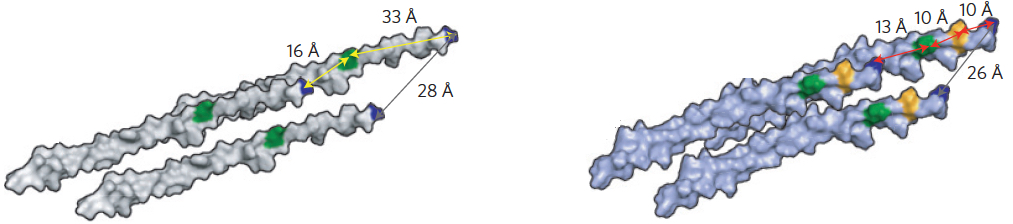
Molecular models of the genetically engineered viruses. Left virus has long inter-binding site distances of 16Å and 33Å within two proteins. Right virus has closer inter-binding site distances of approximately 10Å and 13Å, achieving faster excitation-energy transport speed. (credit: Heechul Park et al./Nature Materials)
That’s where the virus comes in. By engineering a virus that Belcher has worked with for years, the team was able to get it to bond with multiple synthetic chromophores — or, in this case, organic dyes. The researchers were then able to produce many varieties of the virus, with slightly different spacings between those synthetic chromophores, and select the ones that performed best.
In the end, they were able to more than double excitons’ speed, increasing the distance they traveled before dissipating — a significant improvement in the efficiency of the process.
The project started from a chance meeting at a conference in Italy. Lloyd and Belcher, a professor of biological engineering, were reporting on different projects they had worked on, and began discussing the possibility of a project encompassing their very different expertise. Lloyd, whose work is mostly theoretical, pointed out that the viruses Belcher works with have the right length scales to potentially support quantum effects.
In 2008, Lloyd had published a paper demonstrating that photosynthetic organisms transmit light energy efficiently because of these quantum effects. When he saw Belcher’s report on her work with engineered viruses, he wondered if that might provide a way to artificially induce a similar effect, in an effort to approach nature’s efficiency.
“I had been talking about potential systems you could use to demonstrate this effect, and Angela said, ‘We’re already making those,’” Lloyd recalls. Eventually, after much analysis, “We came up with design principles to redesign how the virus is capturing light, and get it to this quantum regime.”
Within two weeks, Belcher’s team had created their first test version of the engineered virus. Many months of work then went into perfecting the receptors and the spacings.
Once the team engineered the viruses, they were able to use laser spectroscopy and dynamical modeling to watch the light-harvesting process in action, and to demonstrate that the new viruses were indeed making use of quantum coherence to enhance the transport of excitons.
“It was really fun,” Belcher says. “A group of us who spoke different [scientific] languages worked closely together, to both make this class of organisms, and analyze the data. That’s why I’m so excited by this.”
Inexpensive and efficient solar cells or light-driven catalysis
While this initial result is essentially a proof of concept rather than a practical system, it points the way toward an approach that could lead to inexpensive and efficient solar cells or light-driven catalysis, the team says. So far, the engineered viruses collect and transport energy from incoming light, but do not yet harness it to produce power (as in solar cells) or molecules (as in photosynthesis). But this could be done by adding a reaction center, where such processing takes place, to the end of the virus where the excitons end up.
“This is exciting and high-quality research,” says Alán Aspuru-Guzik, a professor of chemistry and chemical biology at Harvard University who was not involved in this work. The research, he says, “combines the work of a leader in theory (Lloyd) and a leader in experiment (Belcher) in a truly multidisciplinary and exciting combination that spans biology to physics to potentially, future technology.”
“Access to controllable excitonic systems is a goal shared by many researchers in the field,” Aspuru-Guzik adds. “This work provides fundamental understanding that can allow for the development of devices with an increased control of exciton flow.”
The research was supported by the Italian energy company Eni through the MIT Energy Initiative. The team included researchers at the University of Florence, the University of Perugia, and Eni.
MIT | See how researchers genetically engineer viruses to more efficiently transport energy.
Abstract of Enhanced energy transport in genetically engineered excitonic networks
One of the challenges for achieving efficient exciton transport in solar energy conversion systems is precise structural control of the light-harvesting building blocks. Here, we create a tunable material consisting of a connected chromophore network on an ordered biological virus template. Using genetic engineering, we establish a link between the inter-chromophoric distances and emerging transport properties. The combination of spectroscopy measurements and dynamic modelling enables us to elucidate quantum coherent and classical incoherent energy transport at room temperature. Through genetic modifications, we obtain a significant enhancement of exciton diffusion length of about 68% in an intermediate quantum-classical regime.

Left: digital Mask Projection Stereolithography (DMP-SL) process; right: soft pneumatic actuator
being printed using elastomeric precursor (EP) (credit: Cornell University)
Cornell University engineers have developed a process for 3D-printing a soft robotic tentacle that mimics the complex movements and degree of freedom of an octopus tentacle.
The tentacle achieves its dexterity through a 3-dimensional arrangement of muscles in three mutually perpendicular directions (longitudinal, transverse and helical). The process uses an elastomeric (both elastic and flows) material combined with a low-cost, reliable, and simple method for 3D-printing elastomeric pneumatic actuators.
The invention is a “promising route to sophisticated, biomimetic systems,” according to Rob Shepherd, assistant professor of mechanical and aerospace engineering and senior author of a recent study published in the journal Bioinspiration & Biomimetics.
The research was funded by the Air Force Office of Scientific Research, 3M and the National Science Foundation.
Cornell University Media Relations | 3D-printed ‘soft’ robotic tentacle displays new level of agility
Abstract of 3D printing antagonistic systems of artificial muscle using projection stereolithography
The detailed mechanical design of a digital mask projection stereolithgraphy system is described for the 3D printing of soft actuators. A commercially available, photopolymerizable elastomeric material is identified and characterized in its liquid and solid form using rheological and tensile testing. Its capabilities for use in directly printing high degree of freedom (DOF), soft actuators is assessed. An outcome is the ~40% strain to failure of the printed elastomer structures. Using the resulting material properties, numerical simulations of pleated actuator architectures are analyzed to reduce stress concentration and increase actuation amplitudes. Antagonistic pairs of pleated actuators are then fabricated and tested for four-DOF, tentacle-like motion. These antagonistic pairs are shown to sweep through their full range of motion (~180°) with a period of less than 70 ms.
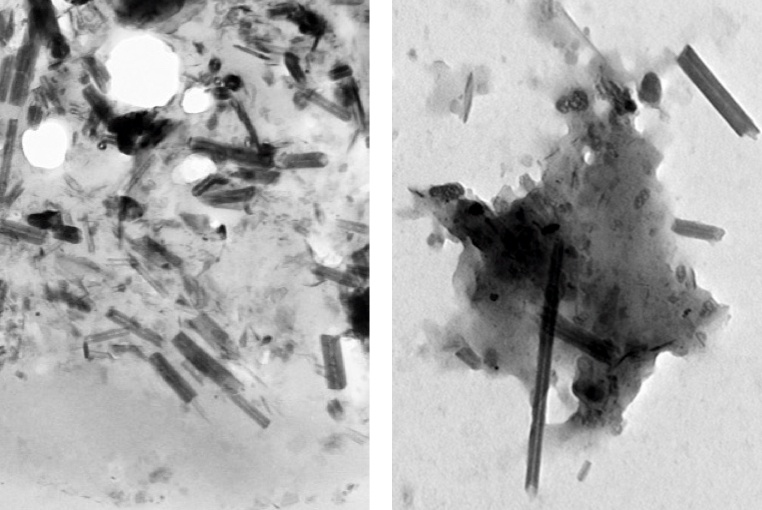
Carbon nanotubes (rods) and nanoparticles (black clumps) found inside a lung cell vacuole (left) are similar to those found in vehicle exhaust in tailpipes of cars in Paris (right) (credit: Fathi Moussa/Paris-Saclay University)
Carbon nanotubes (CNTs) have been found in cells extracted from the airways of Parisian children under routine treatment for asthma, according to a report in the journal EBioMedicine (open access) by scientists in France and at Rice University.
The cells were taken from 69 randomly selected asthma patients aged 2 to 17 who underwent routine fiber-optic bronchoscopies as part of their treatment. The researchers analyzed particulate matter found in the alveolar macrophage cells (also known as dust cells), which help stop foreign materials like particles and bacteria from entering the lungs.
The study partially answers the question of what makes up the black material inside alveolar macrophages, the original focus of the study. The researchers found single-walled and multiwalled carbon nanotubes and amorphous carbon among the cells.
The nanotube aggregates in the cells ranged in size from 10 to 60 nanometers in diameter and up to several hundred nanometers in length, small enough that optical microscopes would not have been able to identify them in samples from former patients. The new study used more sophisticated tools, including high-resolution transmission electron microscopy, X-ray spectroscopy, Raman spectroscopy, and near-infrared fluorescence microscopy to definitively identify them in the cells and in the environmental samples.
“The concentrations of nanotubes are so low in these samples that it’s hard to believe they would cause asthma, but you never know,” said Rice chemist Lon Wilson, a corresponding author of the paper. “What surprised me the most was that carbon nanotubes were the major component of the carbonaceous pollution we found in the samples.”
The study notes but does not make definitive conclusions about the controversial proposition that carbon nanotube fibers may act like asbestos, a proven carcinogen. But the authors did note that “long carbon nanotubes and large aggregates of short ones can induce a granulomatous (inflammation) reaction.”
The researchers also suggested previous studies that link the carbon content of airway macrophages and the decline of lung function should be reconsidered in light of the new findings. The researchers also suggested that the large surface areas of nanotubes and their ability to adhere to substances may make them effective carriers for other pollutants.
Carbon nanotubes from forest fires and cars?
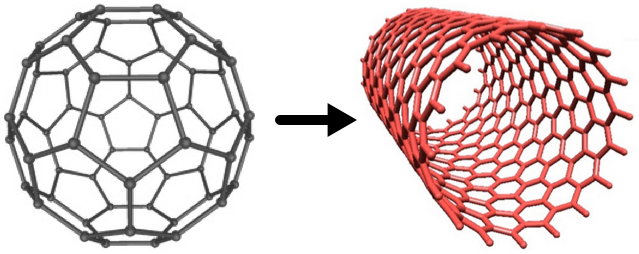
Fullerenes (left) can be converted to carbon nanotubes (right) with a catalytic process, according to Rice chemists (credits: Soroush83/CC and Matías Soto/Rice University)
However, similar nanotubes have been found in samples from the exhaust pipes of Paris vehicles, in dust gathered from various places around the city, in spider webs in India, and even in ice cores, the paper notes.
“We know that carbon nanoparticles are found in nature,” Wilson said, noting that round fullerene (C60) molecules are commonly produced by volcanoes, forest fires, and other combustion of carbon materials. “All you need is a little catalysis to make carbon nanotubes instead of fullerenes.”
A car’s catalytic converter, which turns toxic carbon monoxide into safer emissions, bears at least a passing resemblance to the Rice-invented high-pressure carbon monoxide, or HiPco, process to make carbon nanotubes, he said. “So it is not a big surprise, when you think about it,” Wilson said.
“Based on our discovery of CNTs in tailpipes, we propose that the catalytic converters of the automobiles are manufacturing carbon nanotubes, Wilson told KurzweilAI. “However, we have not actually proven that.”
We are all carbon-nanotube bearers now
For ethical reasons, no cells from healthy patients were analyzed, but because nanotubes were found in all of the samples, the study led the researchers to conclude that carbon nanotubes are likely to be found in everybody.
“It’s kind of ironic. In our laboratory, working with carbon nanotubes, we wear facemasks to prevent exactly what we’re seeing in these samples, yet everyone walking around out there in the world probably has at least a small concentration of carbon nanotubes in their lungs,” he said.
The study followed one released by Rice and Baylor College of Medicine earlier this month with the similar goal of analyzing the black substance found in the lungs of smokers who died of emphysema. That study found carbon black nanoparticles that were the product of the incomplete combustion of such organic material as tobacco.
Co-authors are from Paris-Saclay University, the Paediatric Pulmonology and Allergy Center and the Department of Anatomo-Pathology of the Groupe hospitalier La Roche-Guyon, and Paris Diderot University. The Welch Foundation partially supported the research.
Abstract of Anthropogenic Carbon Nanotubes Found in the Airways of Parisian Children
Compelling evidence shows that fine particulate matters (PM) from air pollution penetrate lower airways and are associated with adverse health effects even within concentrations below those recommended by the WHO. A paper reported a dose-dependent link between carbon content in alveolar macrophages (assessed only by optical microscopy) and the decline in lung function. However, to the best of our knowledge, PM had never been accurately characterized inside human lung cells and the most responsible components of the particulate mix are still unknown. On another hand carbon nanotubes (CNTs) from natural and anthropogenic sources might be an important component of PM in both indoor and outdoor air.
We used high-resolution transmission electron microscopy and energy dispersive X-ray spectroscopy to characterize PM present in broncho-alveolar lavage-fluids (n = 64) and inside lung cells (n = 5 patients) of asthmatic children. We show that inhaled PM mostly consist of CNTs. These CNTs are present in all examined samples and they are similar to those we found in dusts and vehicle exhausts collected in Paris, as well as to those previously characterized in ambient air in the USA, in spider webs in India, and in ice core. These results strongly suggest that humans are routinely exposed to CNTs.
