
DNA-cutting enzymes could slice through gene editing patent spat
The most significant biotechnology breakthrough in recent years, a technology called CRISPR, has sparked a patent battle: novel research suggests a workaround


Science and reality
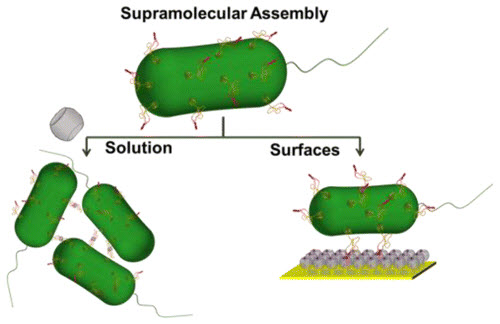
“Living implant” using a bacterial strain (credit: Shrikrishnan Sankaran et al./ACS Nano)
A method for merging bacteria in human cells as “living implants” has been developed by University of Twente researchers. The implants could include stents equipped with bacteria on which endothelial cells (cells that form the lining of blood vessels) can grow, or bacteria that can release medicines in specific parts of the body.
They achieved this by supramolecular assembly, modifying the DNA of E. coli bacteria in such a way that a small molecule called Cucurbit[8]uril attaches to a protein on the cell membrane. This substance could then attach to other building blocks, forming a sort of natural Velcro.
The research was published in the journal ACS Nano. It was sponsored by the European Union.
Abstract of Incorporating Bacteria as a Living Component in Supramolecular Self-Assembled Monolayers through Dynamic Nanoscale Interactions
Supramolecular assemblies, formed through noncovalent interactions, has become particularly attractive to develop dynamic and responsive architectures to address living systems at the nanoscale. Cucurbit[8]uril (CB[8]), a pumpkin shaped macrocylic host molecule, has been successfully used to construct various self-assembled architectures for biomedical applications since it can simultaneously bind two aromatic guest molecules within its cavity. Such architectures can also be designed to respond to external stimuli. Integrating living organisms as an active component into such supramolecular architectures would add a new dimension to the capabilities of such systems. To achieve this, we have incorporated supramolecular functionality at the bacterial surface by genetically modifying a transmembrane protein to display a CB[8]-binding motif as part of a cystine-stabilized miniprotein. We were able to confirm that this supramolecular motif on the bacterial surface specifically binds CB[8] and forms multiple intercellular ternary complexes leading to aggregation of the bacterial solution. We performed various aggregation experiments to understand how CB[8] interacts with this bacterial strain and also demonstrate that it can be chemically reversed using a competitor. To confirm that this strain can be incorporated with a CB[8] based architecture, we show that the bacterial cells were able to adhere to CB[8] self-assembled monolayers (SAMs) on gold and still retain considerable motility for several hours, indicating that the system can potentially be used to develop supramolecular bacterial biomotors. The bacterial strain also has the potential to be combined with other CB[8] based architectures like nanoparticles, vesicles and hydrogels.

The ten scientists awarded the 2015 MacArthur "genius" grants all look at systems and networks in their work.
The post The 10 New MacArthur Genius Scientists Are All Connected appeared first on WIRED.

In this demo, a block on a stick climbs up the stick when the stick is hit with a hammer. Here's how it works.
The post A Simple Physics Project That’ll Show You How Inertia Works appeared first on WIRED.


Health care has its own social network, where users share and discuss everything from compound fractures to gigantic tumors.
The post The Social Network Where Doctors Swap Gross Pics of Patients appeared first on WIRED.


Chemist Abby Knight is adding plastic to the ocean to clean up another type of trash.
The post Adding More Plastic to Our Oceans Could Clean Them Up appeared first on WIRED.

After nine years and $7 billion, the Royal Dutch Shell oil company is abandoning its drilling rights in the Arctic Ocean north of Alaska.
The post Shell Didn’t Quit Alaska Out of the Goodness of Its Heart appeared first on WIRED.