
Unlikely graphene-nanotube combination forms high-speed digital switch

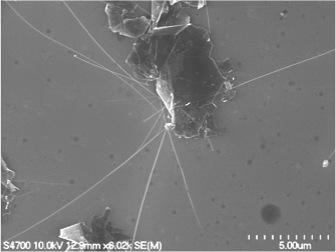
Hair-like boron nitride nanotubes intersect a sheet of graphene (top) to create a high-speed digital switch (credit: Michigan Tech, Yoke Khin Yap)

By themselves, graphene is too conductive while boron nitride nanotubes are too insulating, but combining them could create a workable digital switch — which can be used for controlling electrons in computers and other electronic devices.

To create this serendipitous super-hybrid, Yoke Khin Yap, a professor of physics at Michigan Technological University, and his team exfoliated (peeled off) graphene(from graphite) and modified the material’s surface with tiny pinholes, then grew the boron nitride nanotubes up and through the pinholes — like a plant randomly poking up through a crack in a concrete pavement. That formed a “band gap” mismatch, which created “a potential barrier  that stops electrons,” he said.

In other words, a switch.

The chemical structures of graphene (gray) and boron nitride nanotubes (pink and purple) can be used to create a digital switch at the point where the two materials come in contact (credit: Michigan Tech, Yoke Khin Yap)

High switching speed

The band gap mismatch results from the materials’ structure: graphene’s flat sheet conducts electricity quickly, and the atomic structure in the nanotubes halts electric currents. This disparity creates a barrier, caused by the difference in electron movement as currents move next to and past the hair-like boron nitride nanotubes. These points of contact between the materials, called heterojunctions, are what make the digital on/off switch possible.

Yap and his research team have also shown that because the materials are respectively so effective at conducting or stopping electricity, the resulting switching ratio is high. So how fast the materials can turn on and off is several orders of magnitude greater than current graphene switches. And this speed could eventually quicken the pace of electronics and computing.

Yap says this study is a continuation of past research into making transistors without semiconductors. The problem with semiconductors like silicon is that they can only get so small, and they give off a lot of heat; the use of graphene and nanotubes bypasses those problems. In addition, the graphene and boron nitride nanotubes have the same atomic arrangement pattern, or lattice matching. With their aligned atoms, the graphene-nanotube digital switches could avoid the issues of electron scattering.

“You want to control the direction of the electrons,” Yap explains, comparing the challenge to a pinball machine that traps, slows down and redirects electrons. “This is difficult in high speed environments, and the electron scattering reduces the number and speed of electrons.”

The journal Scientific Reports recently published their work in an open-access paper.


Abstract of Switching Behaviors of Graphene-Boron Nitride Nanotube Heterojunctions

High electron mobility of graphene has enabled their application in high-frequency analogue devices but their gapless nature has hindered their use in digital switches. In contrast, the structural analogous, h-BN sheets and BN nanotubes (BNNTs) are wide band gap insulators. Here we show that the growth of electrically insulating BNNTs on graphene can enable the use of graphene as effective digital switches. These graphene-BNNT heterojunctions were characterized at room temperature by four-probe scanning tunneling microscopy (4-probe STM) under real-time monitoring of scanning electron microscopy (SEM). A switching ratio as high as 105 at a turn-on voltage as low as 0.5 V were recorded. Simulation by density functional theory (DFT) suggests that mismatch of the density of states (DOS) is responsible for these novel switching behaviors.
Sleeping on your side may clear waste from your brain most effectively

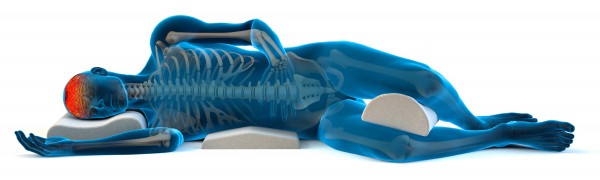
The brain’s glymphatic pathway clears harmful wastes, especially during sleep. This lateral position could prove to be the best position for the brain-waste clearance process (credit: Stony Brook University)

Sleeping in the lateral, or side position, as compared to sleeping on one’s back or stomach, may more effectively remove brain waste, and could reduce the chances of developing Alzheimer’s, Parkinson’s and other neurological diseases, according to researchers at Stony Brook University.

Stony Brook University researchers discovered this in experiments with rodents by using dynamic contrast magnetic resonance imaging (MRI) to image the brain’s glymphatic pathway, a complex system that clears wastes and other harmful chemical solutes from the brain. They also used kinetic modeling to quantify the CSF-ISF exchange rates in anesthetized rodents’ brains in lateral, prone, and supine positions.

Colleagues at the University of Rochester used fluorescence microscopy and radioactive tracers to validate the MRI data and to assess the influence of body posture on the clearance of amyloid from the brains.

Their finding is published in the Journal of Neuroscience.

Most popular position in humans and animals

“It is interesting that the lateral sleep position is already the most popular in human and most animals —even in the wild — and it appears that we have adapted the lateral sleep position to most efficiently clear our brain of the metabolic waste products that built up while we are awake,” says Maiken Nedergaard, PhD, a co-author at the University of Rochester.

“The study therefore adds further support to the concept that sleep subserves a distinct biological function of sleep and that is to ‘clean up’ the mess that accumulates while we are awake. Many types of dementia are linked to sleep disturbances, including difficulties in falling asleep. It is increasing acknowledged that these sleep disturbances may accelerate memory loss in Alzheimer’s disease.”

The brain-waste clearing system

Cerebrospinal fluid (CSF) filters through the brain and exchanges with interstitial fluid (ISF) to clear waste in the glymphatic pathway, similar to the way the body’s lymphatic system clears waste from organs. The glymphatic pathway is most efficient during sleep. Brain waste includes amyloid β (amyloid) and tau proteins, chemicals that negatively affect brain processes if they build up.

Helene Benveniste, MD, PhD, Principal Investigator and a Professor in the Departments of Anesthesiology and Radiology at Stony Brook University School of Medicine, cautioned that further testing with MRI or other imaging methods in humans is necessary.

New York University Langone Medical Center was also involved in the research.


Abstract of The Effect of Body Posture on Brain Glymphatic Transport

The glymphatic pathway expedites clearance of waste, including soluble amyloidβ (Aβ) from the brain. Transport through this pathway is controlled by the brain’s arousal level because, during sleep or anesthesia, the brain’s interstitial space volume expands (compared with wakefulness), resulting in faster waste removal. Humans, as well as animals, exhibit different body postures during sleep, which may also affect waste removal. Therefore, not only the level of consciousness, but also body posture, might affect CSF–interstitial fluid (ISF) exchange efficiency. We used dynamic-contrast-enhanced MRI and kinetic modeling to quantify CSF-ISF exchange rates in anesthetized rodents” brains in supine, prone, or lateral positions. To validate the MRI data and to assess specifically the influence of body posture on clearance of Aβ, we used fluorescence microscopy and radioactive tracers, respectively. The analysis showed that glymphatic transport was most efficient in the lateral position compared with the supine or prone positions. In the prone position, in which the rat’s head was in the most upright position (mimicking posture during the awake state), transport was characterized by “retention” of the tracer, slower clearance, and more CSF efflux along larger caliber cervical vessels. The optical imaging and radiotracer studies confirmed that glymphatic transport and Aβ clearance were superior in the lateral and supine positions. We propose that the most popular sleep posture (lateral) has evolved to optimize waste removal during sleep and that posture must be considered in diagnostic imaging procedures developed in the future to assess CSF-ISF transport in humans.