US military practices orbital dogfighting in 1st-ever ‘live fly’ exercise in space

United States Space Command just held its first-ever "Apollo Maneuvers" exercise, which saw spacecraft maneuvering through simulated contested environments.

U.S. Space Command combines assets and personnel from each U.S. military branch (including the U.S. Space Force) to project American military power into and from orbit. It's unclear which or how many satellites or spacecraft took place in Space Command's recent Apollo Maneuvers 2026, but the exercise involved international partners, according to a command statement. What is known is that the exercise aimed to demonstrate "dynamic on-orbit operations, validate contested logistics and advance collective space maneuver doctrine."

To put it in plain English, this means that Space Command practiced maneuvering satellites and other spacecraft in proximity to one another in a simulated conflict environment, in order to continue refining the "orbital dogfighting" that the U.S. military has been hinting at for some years.

In military terms, dogfighting refers to the close aerial combat that fighter jets engage in, pitting two or more pilots against one another in contests of flying ability and firepower.

In terms of space, this involves "objects in space maneuvering in and out and around each other in synchronicity, and in control," according to Space Force's Vice Chief of Space Operations Gen. Michael A. Guetlein.

“That's what we call dogfighting in space," Guetlein told attendees at a conference in 2025, according to Air & Space Forces, while speaking about Chinese satellite operations observed in 2024.

From statements that U.S. Space Command leadership gave about its recent exercise, it sounds like Apollo Maneuvers practiced just that, but in space.

"We will take some of our existing satellites and work with partners to demonstrate what are some of the requirements and capabilities to be able to maneuver for advantage, not just maneuver when you have to change your orbital position," Space Force Gen. Stephen N. Whiting, commander of U.S. Space Command, told reporters last month during a briefing at Redstone Arsenal in Alabama, according to Air & Space Forces.

"The side that can maneuver persistently and at scale will set the operational rhythm in orbit."

a man in a black military dress uniform speaks on a stage in front of an image of earth seen from space

Space Force Gen. Stephen N. Whiting, commander of U.S. Space Command, delivers a keynote address at the Space Foundation's 40th annual Space Symposium in Colorado Springs, Colorado on April 8, 2025. (Image credit: Space Foundation)

When it comes to space and what appears to be the inevitability of a conflict extending to Earth orbit, we're still not quite sure what that will look like. But several nations have been developing capabilities and concepts for maneuvering satellites in close proximity to other satellites with the intent to destroy or disable them, or to deny or degrade their communications or intelligence-gathering capabilities.

The U.S. Space Force, in particular, has been developing an operations framework for fighting a war in space and has held multiple training exercises aimed at practicing "orbital warfare."

But Space Force and U.S. Space Command still appear to lack many of the technologies they say they need to wage such warfare. Speaking at the Space Foundation's Space Symposium in 2025, Whiting stated that that the United States needs "orbital interceptors" to fight in space.

"And what do we call these?" Whiting rhetorically asked attendees. "We call these weapons, and we need them to deter a space conflict and to be successful if we end up in such a fight."

But U.S. Space Force has ordered and executed recent missions that have demonstrated capabilities and technologies along the lines of what Whiting described.

In June 2026, for example, a Rocket Lab Electron rocket sent one of the company's Puma satellites to orbit, where it rendezvoused with a True Anomaly Jackal spacecraft that launched a month earlier. Once both spacecraft were in orbit, they maneuvered close to one another to simulate "dynamic engagements."

The mission showed Space Force's "readiness to lean on our commercial partners to deny, disrupt and counter any adversarial advantage — no matter where they try to operate in space," according to a Space Force statement.


Falcon Heavy brings the heat | Space photo of the day for Sept. 2, 2026

Fire spews from the 27 Merlin engines of a SpaceX Falcon Heavy rocket during the launch of NASA's Nancy Grace Roman Space Telescope on Aug. 30, 2026. (Image credit: SpaceX)

SpaceX's Falcon Heavy rocket can generate some serious thrust, leading to incredible displays of fireworks as seen in the photo above.

What is it?

In this photo, the 27 Merlin engines of a SpaceX Falcon Heavy rocket spew fire as they generate the thrust that sent NASA's revolutionary Nancy Grace Roman Space Telescope to orbit on a picture-perfect morning launch on Sunday, Aug. 30, 2026.

Falcon Heavy sent Roman to a gravitationally stable parking spot known as Lagrange Point 2, located 1 million miles away (1.5 million kilometers) between Earth and Mars, where the gravitational pulls of the sun and Earth equal out.

Once there, the Roman Space Telescope will spend a few months coming online before it begins conducting groundbreaking science, searching the universe for signs of dark energy and dark matter and hunting for distant exoplanets.

Why is it incredible?

SpaceX only pulls out Falcon Heavy when it needs incredible heavy-lift capability. The rocket essentially consists of three Falcon 9 rocket boosters attached to one another, whose combined 27 Merlin engines can generate over 5 million pounds (2.27 million kilograms) of thrust. That lift power enables Falcon Heavy to send large payloads to distant destinations.

Aside from Roman, other notable Falcon Heavy missions include the 2024 launch of the Europa Clipper mission to Jupiter's icy moon, the Psyche probe that will investigate a metal-rich asteroid in the main belt between Mars and Jupiter, and most famously, a Tesla Roadster convertible featuring a mannequin 'driver'.

Repairing the ISS 250 miles above Earth | Space photo of the day for Sept. 1, 2026

ESA astronaut Sophie Adenot on the outside of the International Space Station during an extravehicular activity on Aug. 25, 2026. (Image credit: ESA/NASA)

Repairing an engineering marvel like the International Space Station is no easy feat by itself, but it's even more impressive when it's done 250 miles (400 kilometers) up.

What is it?

In this photograph, European Space Agency (ESA) astronaut Sophie Adenot works on the exterior of the International Space Station on Aug. 25, 2026.

The photo was taken while Adenot and NASA astronaut Anil Menon were conducting a 6.5-hour spacewalk, or extravehicular activity (EVA), to replace one of two Space-to-Ground antennas on the outside of the ISS.

This was the second EVA that Adenot and Menon performed to replace the antenna. During a previous spacewalk a week earlier, the pair ran out of time before the new antenna could be installed.

With that first spacewalk, Adenot became the first woman from France to ever conduct an EVA.

Why is it incredible?

It can be hard to conceptualize just how high up the ISS orbits until you see a photo like this one; few people on Earth have ever flown as high as 250 miles (400 km), so that altitude can feel a bit abstract. Seeing an astronaut like Adenot clinging to the space station with the clouds and blue oceans of Earth below puts things into perspective.

At that height, the ISS orbits at quite a high rate of speed. The orbital laboratory zips around Earth at 17,500 mph (28,000 kph), meaning it circles the planet 16 times a day. This photo was taken on day 194, or orbit 3010, of Adenot's mission, which began in February when she launched to the ISS as part of NASA's Crew-12 mission.

Roman telescope leaves its rocket behind | Space photo of the day for Aug. 31, 2026

NASA's Nancy Grace Roman Space Telescope separates from a SpaceX Falcon Heavy upper stage after launching on Aug. 30, 2026. (Image credit: NASA)

NASA caught a breathtaking image of its next-generation Nancy Grace Roman Space Telescope deploying into space shortly after launch.

What is it?

This image was captured just some 31 minutes after the Roman telescope took off atop a SpaceX Falcon Heavy rocket from NASA's Kennedy Space Center in Florida on Sunday (Aug. 30).

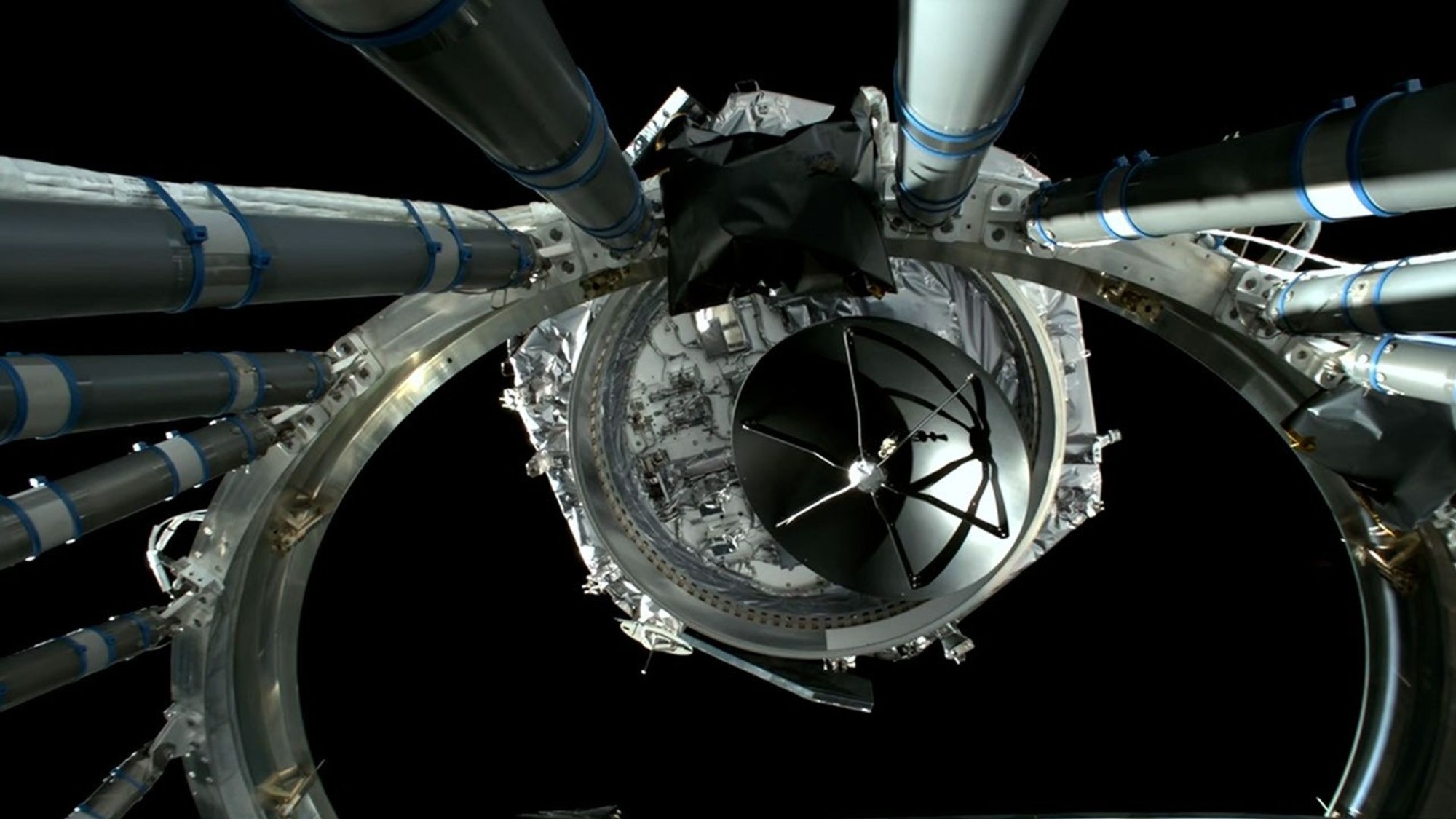
The photo shows the Nancy Grace Roman Space Telescope (or Roman) flying on its own for the first time, shortly after separating from the upper stage of the SpaceX Falcon Heavy rocket that sent it to orbit. In the foreground, the telescope's payload adapter can be seen, while just behind, the orbital observatory floats into the blackness of space with its solar arrays still folded for launch.

This view reveals the back of the telescope, upon which its High Gain Antenna (HGA) radiofrequency dish can be seen. This is the dish the telescope will use to communicate with mission controllers on the ground and beam its groundbreaking science back to Earth.

Now well into its mission, the Roman Space Telescope will begin a 90-day commissioning period while traveling to sun-Earth Lagrange Point 2, or L2, a gravitationally stable parking spot in space between our planet and its star.

Why is it incredible?

It's always incredible seeing views like this one from space. Getting to witness a spacecraft deploy into orbit offers a rare glimpse at the conditions they experience in the vacuum of space.

But more than that, this photograph depicts the culmination of two decades of work from NASA and its contractors who helped develop and build the $4 billion Nancy Grace Roman Space Telescope  — ahead of schedule and under budget, a rarity in the spaceflight world.

Once at L2 and fully commissioned, the telescope will begin probing the universe for clues that might help unravel the mysteries of dark matter and dark energy, as well as hunting for exoplanets around distant stars.

Curiosity climbs to new heights on Mars | Space photo of the day for Aug. 28, 2026

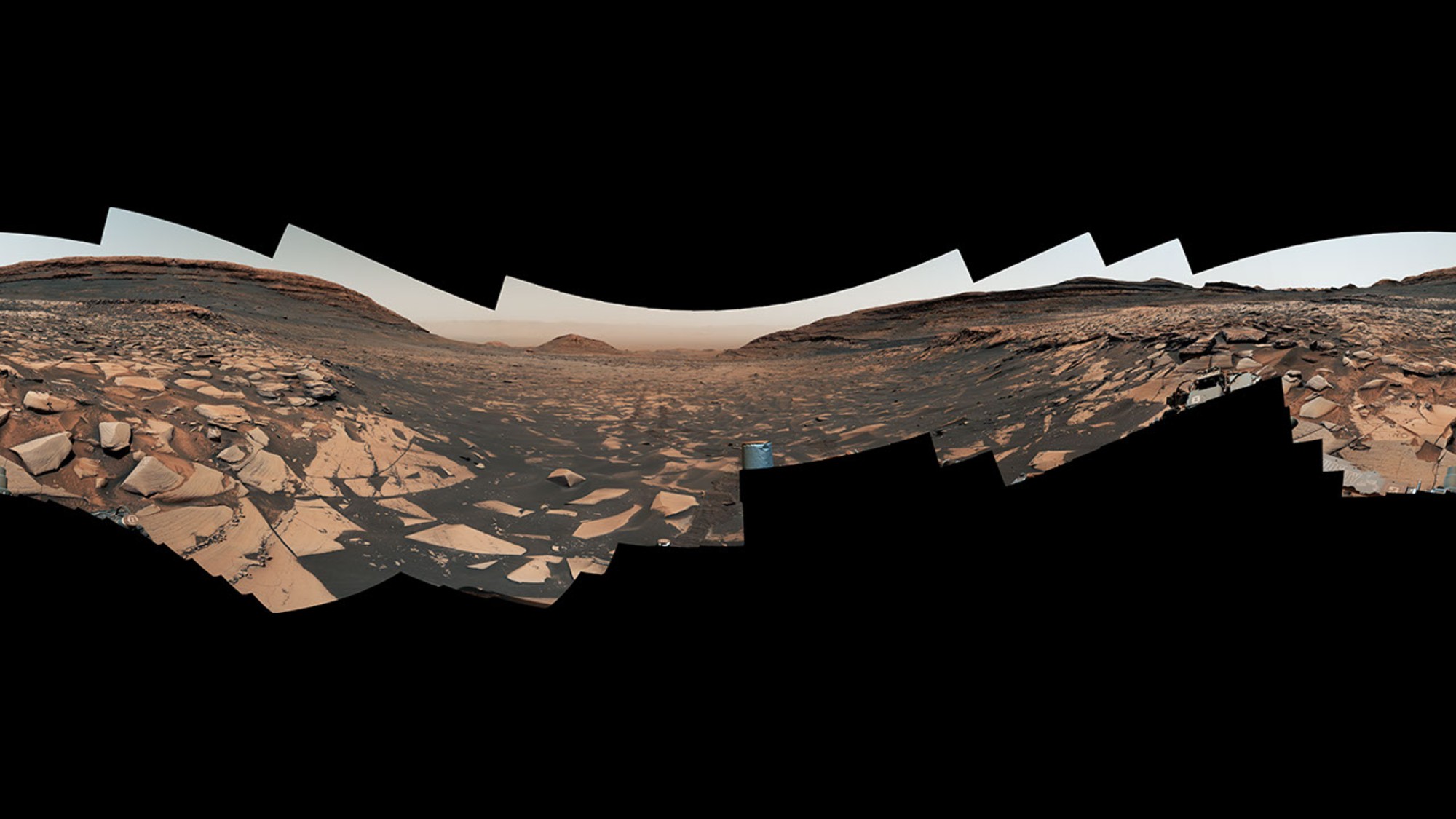
A photograph taken by NASA's Curiosity Mars rover from the floor of Gale Crater, on Aug. 1 and Aug. 2, 2026, the 4,972nd and 4,973rd Martian days, or sols, of the rover's mission. The photo captures a valley on the side of Mount Sharp, the 3-mile-tall (5-kilometer) mountain the rover has been climbing since 2014. (Image credit: NASA/JPL-Caltech/MSSS)

One of NASA's intrepid Mars rovers has notched another impressive milestone during its exploration of the Red Planet.

What is it?

NASA's Curiosity Mars rover used its Mastcam camera to capture a panorama made up of 323 individual images. The images were taken on Aug. 1 and Aug. 2, 2026, the 4,972nd and 4,973rd Martian days (or sols) of the rover's mission, just as Curiosity notched a total of 1 kilometer (0.6 miles) of elevation gain throughout its now 14-year exploration of the Red Planet.

The images show the wide expanse of a broad valley nicknamed "Valle Grande," a depression on the side of Mars' Mount Sharp, the 3-mile-tall (5-kilometer) mountain the rover has been climbing since 2014. The valley's floor and northern rim can be seen in the distance.

Why is it incredible?

a panoramic image showing a reddish orange, dusty landscape

A panorama of Mars' Mount Sharp, captured by NASA's Curiosity rover from the floor of Gale Crater, on Aug. 1 and Aug. 2, 2026, the 4,972nd and 4,973rd Martian days, or sols, of the rover's mission. (Image credit: NASA/JPL-Caltech/MSSS)

Curiosity's mission has been incredible for a number of reasons. For one, the daring "sky crane" maneuver that NASA and the Jet Propulsion Laboratory used to land the SUV-sized robot on the Red Planet changed Mars landings forever.

Since then, Curiosity has discovered clues that liquid water once flowed across the surface of Mars and has found tantalizing evidence of complex organic molecules on the Red Planet, including some that scientists consider to be the "building blocks" of life.

And even after 14 years of traveling across the Red Planet and suffering considerable damage to its wheels, NASA says Curiosity has plenty of exploration and science left to conduct.

Another one of NASA's Mars rovers, Perseverance, recently notched a travel milestone of its own when it surpassed 26.2 miles (42.2 km) of travel  — the length of a marathon  — across the Martian surface.

Glowing galaxy with anomalous extra arms | Space photo of the day for Aug. 27, 2026

a colorful swirl of light on a black background

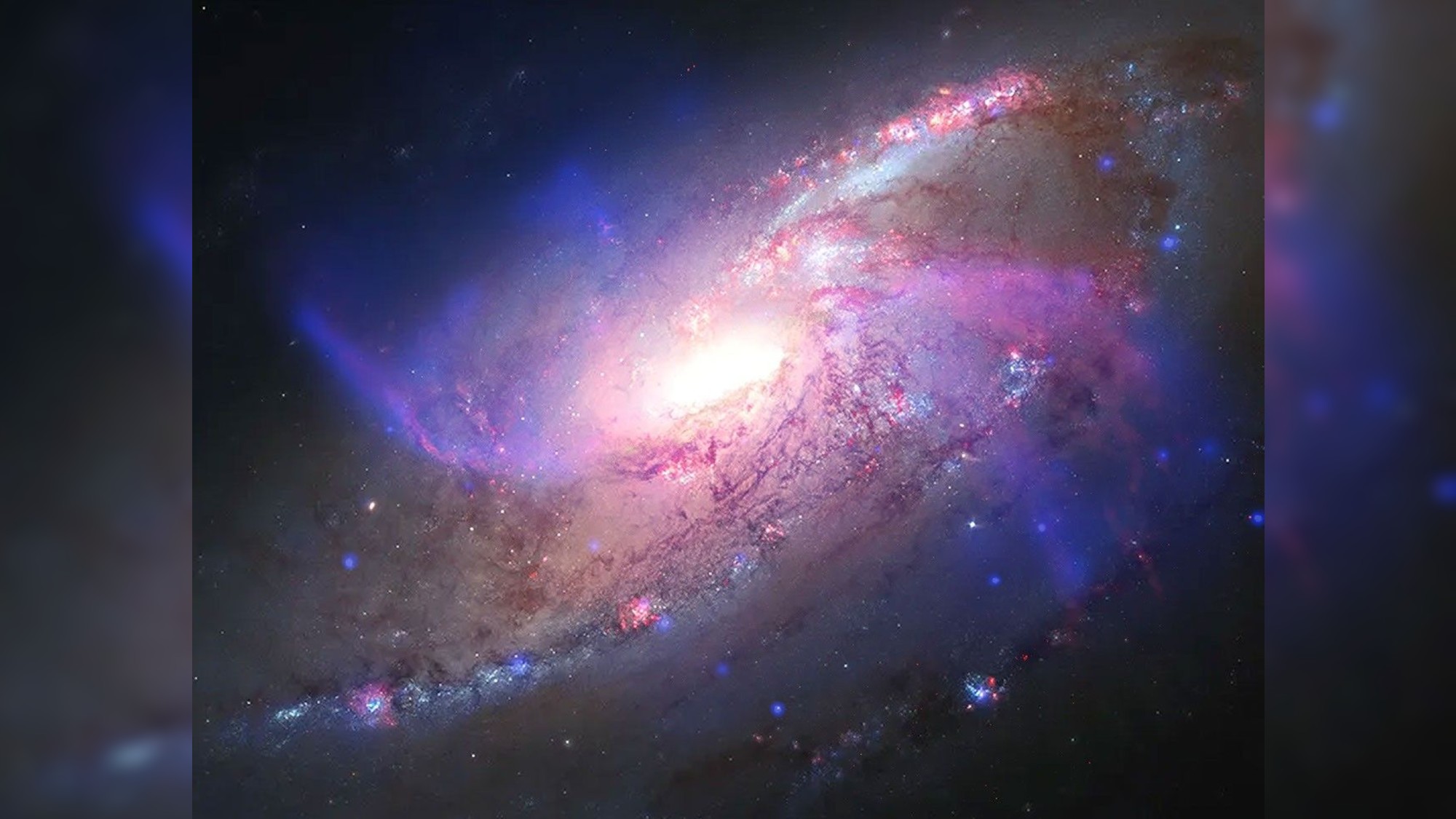
An image of this spiral galaxy NGC 4258 that combines X-ray observations from NASA's Chandra X-ray observatory (seen here in royal blue), optical light gathered by the Hubble Space Telescope (red, yellow and pale blue), and infrared light seen by the James Webb Space Telescope (bright orange). (Image credit: X-ray: NASA/CXC/SAO; Optical: NASA/ESA/STScI; Infrared: NASA/ESA/CSA/STScI; Image Processing: NASA/CXC/SAO/L. Frattare)

A trio of NASA space telescopes teamed up to capture a gorgeous new look at the glowing spiral galaxy NGC 4258 and its two anomalous extra arms.

What is it?

This image shows NGC 4258, also known as Messier 106, a spiral galaxy located some 24 million light-years away in the constellation Canes Venatici, the "Hunting Dogs." It is a fairly bright galaxy and can be viewed in the spring sky in the Northern Hemisphere with most telescopes.

Messier 106 is noteworthy for having two "anomalous" extra arms, the long curved regions of bright gases, dust and young stars that are characteristic of all spiral galaxies. But while most spiral galaxies have only a pair of arms, Messier 106 has two pairs. According to NASA, the extra set is composed of hot gases that are churned away from the galactic center by the supermassive black hole at the heart of NGC 4258.

Why is it incredible?

This image shows off the incredible teamwork that NASA's flagship orbital observatories can pull off. It combines X-ray observations from NASA's Chandra X-ray observatory (seen here in royal blue), optical light gathered by the Hubble Space Telescope (red, yellow and pale blue), and infrared light seen by the James Webb Space Telescope (bright orange).

By combining multiple types of light into one image, NASA is able to reveal the complete picture of what this energetic galaxy is made of.

The image also shows the incredible power of the black holes found at the centers of galaxies. "M106 helps show how supermassive black holes can create structural features that mimic star-bearing spiral arms, influencing a galaxy's evolution," NASA wrote in a statement accompanying the image.

This image was part of a NASA release of 16 new "galactic gems" captured by Chandra and other observatories.

Mysterious Russian ‘space activity’ causes US Air Force flight to Antarctica to turn around: report

A mysterious incident over the southern Indian Ocean forced a U.S. Air Force aircraft to turn around due to an unnamed hazard in space.

According to several New Zealand-based news outlets, a U.S. Air Force (USAF) C-17 Globemaster transport aircraft left Christchurch Airport on New Zealand's South Island on Tuesday (Aug. 18) bound for McMurdo Station in Antarctica. Aircraft trackers using flight radar software noticed the C-17 turn around over the ocean some two hours into its flight.

According to a statement from New Zealand's Civil Aviation Authority given to the country's Stuff news outlet, the C-17 turned around after the Russian Air Traffic Management Corporation issued a notice advising of "space activity, potentially hazardous to aviation en route to Antarctica." It still remains unknown what that activity might have entailed, and the USAF has yet to issue a statement.

The U.S. Federal Aviation Administration (FAA) issued a NOTAM (Notice to Airmen) on Aug. 10 for a large region of airspace over Australia and the Indian Ocean known as the Melbourne Flight Information Region, or YMMM. The notice states that, beginning on Aug. 14, "Russian aerospace activities will take place" and that there is "possible debris" in several areas throughout the massive YMMM airspace.

It's possible that the notice that caused the C-17 to turn around was related to this NOTAM, which was still active as of Tuesday.

black text on a white background

A NOTAM issued by the FAA on Aug. 14 stating there was "possible debris" due to "Russian aerospace activities" throughout a large region of airspace covering Australia and the Indian Ocean. (Image credit: FAA)

There is precedent that might give some clues as to what that aerospace activity might have been.

In the last few years, pieces of falling space debris reentering Earth's atmosphere have caused several airspace closures. In November 2022, for example, the core stage of a Chinese Long March 5B rocket fell to Earth in an uncontrolled reentry over Spain, prompting multiple airspace closures out of caution.

In January 2025, SpaceX's Starship exploded on its seventh test flight, raining fiery debris over the Atlantic Ocean near the Turks and Caicos islands. The FAA activated a "Debris Response Area" near the falling debris, causing some aircraft to have to divert to secondary airports due to low fuel.

a large grey airplane sits on a snow-covered plateau

A U.S. Air Force C-17 Globemaster set to leave Antarctica for New Zealand from McMurdo Station, Antarctica on Nov. 12, 2016. (Image credit: MARK RALSTON/AFP via Getty Images)

That same month, a study published in the journal Scientific Reports found there is a 26% chance of "an uncontrolled space debris reentry in busy airspaces" due to the sharp increase in space traffic in recent years. But experts say much more data is needed to determine how to mitigate risks and how to respond in the event of such debris incidents.

Of course, there remains the chance that Russia's notice to air crews wasn't caused by falling space debris at all. Governments regularly issue similar notices when they are testing weapons that fly to high altitudes, such as ballistic missiles.

Typically, however, such tests are planned far in advance, meaning any notices would have been issued long before the USAF's C-17 took to the air.

‘The X-Files’ creator Chris Carter says new director’s cut of ‘I Want to Believe’ is ‘the horror movie that we really wanted to make’ (interview)

Eighteen years later, it still gives me a jump scare, even though I know it's coming.

Agent Mulder, hot on the trail of a group of murderers who are harvesting their victims' organs, breaks into a makeshift laboratory in an attempt to save an abducted woman. He finds a gruesome scene of bodies on ice and surgeons, scalpels in hand, preparing to transplant the villain's head onto the abducted woman's body. Mulder turns and  — there it is! The villain's severed head on ice! And it opens its eyes.

It sounds less like a scene out of a science fiction mystery series and one more suited to a horror film. And that's precisely why Chris Carter, creator of "The X-Files", is revisiting the 2008 film "The X-Files: I Want to Believe" in a new R-rated director's cut coming to Hulu on Aug. 14.

Space.com got the chance to speak with Carter about the upcoming director's cut and the inspiration behind revisiting the standalone "X-Files" film nearly two decades after its release.

"I wanted to make the scary movie that I always had intended to make, intended to direct, and this is more in line with that," Carter told Space.com. "It gave me a chance to remember the making of the movie and what I had intended it to be, and how different it was from that original vision."

The director's cut features a new addition to the film's title  — "The X-Files: I Want to Believe  — Vrach Frankenshteyn". Carter said the name at the end (Russian for "Doctor Frankenstein") is a way of alluding to the tone and themes that he intended to focus on in the original film.

"It's a Frankenstein story, and the original inspiration for it was a doctor in Cleveland, Ohio, who transplanted the head of a monkey onto another monkey, and I thought that is perfect X-Files territory," Carter said.

Chris Carter on the set of the 2008 film "The X-Files: I Want to Believe." (Image credit: 20th Century Studios/Walt Disney Co.)

Carter's original version of the film was re-edited two times in order for it to be released with the PG-13 rating that 20th Century Fox (now 20th Century Studios) insisted upon.

"When we first made the movie, we had a vision, and we tried to bring it to life. And when we took it to the executives at 20th Century Fox, they said, 'This isn't a PG-13 movie. This is torture porn.'

"And so we cut it back to what we thought was a PG-13 movie to placate the executives, and then we gave it to the motion picture censors, and they said this isn't a PG-13 movie."

With many of the horror elements cut or toned down, the 2008 theatrical release ended up focusing quite a bit of time on the relationship between Mulder and Scully  — a fan-favorite part of the series for sure, but not one that Carter intended to be so central to "I Want to Believe."

David Duchovny and Gillian Anderson as FBI agents Fox Mulder and Dana Scully in "The X-Files: I Want to Believe  — Vrach Frankenshteyn." (Image credit: 20th Century Studios/Walt Disney Co.)

The film's plot centers on a group of women who go missing. When a disgraced priest begins having supernatural visions of the missing women, agents Mulder and Scully come out of retirement to take on another case full of mysteries and unexplained events. Their investigation finds them uncovering an illegal organ harvesting operation, bizarre life extension experiments conducted by a murderous mad scientist, and unexplained supernatural occurrences and synchronicities: classic "X-Files" fare.

But despite being rooted in the long-running themes of the nine-season series, the film is accessible for first-time "X-Files" viewers or casual fans (or its underrated spin-off).

Rather than diving into the dense, overlapping conspiracies that form the series' core mythology of alien invasion and the government cover-up that keeps it a secret, "The X-Files: I Want to Believe  — Vrach Frankenshteyn" is what is referred to as a "monster of the week" story. It's a standalone plot that doesn't require a deep knowledge of the series or its mythology to enjoy.

David Duchovny, Gillian Anderson and Chris Carter on the set of the 2008 film "The X-Files: I Want to Believe." (Image credit: 20th Century Studios/Walt Disney Co.)

Interestingly, the film breaks with the tradition of director's cuts featuring loads of deleted scenes and footage that never made it past the cutting room floor. It actually features a shorter runtime than the theatrical release.

"And everyone asks me that; why is it with most directors' cuts they're always longer because they throw everything in that got cut out. In this case, I felt it could be streamlined a little," Carter said. "I lightened up a little bit on the Mulder and Scully relationship beats and focused more on the horror movie that we really wanted to make."

In keeping with "X-Files" tradition, the director's cut also leaves many of its core mysteries and supernatural elements unresolved. That central theme, the ongoing search for truth and meaning in a sometimes mysterious and unexplainable universe, reflects Carter's own views.

"I really think of science as a search for God, and there are so many big questions that are unanswered, and we are trying to find the answers to those things," Carter said. "And will those answered questions bring us closer to an idea or a how it how it all began? What came before the Big Bang?"

Gillian Anderson as Dana Scully in "The X-Files: I Want to Believe  — Vrach Frankenshteyn." (Image credit: 20th Century Studios/Walt Disney Co.)

Perhaps in a case of life imitating art, another key theme of "The X-Files" has made its way into the halls of the White House and Capitol Hill in recent years.

The U.S. government has held several congressional hearings discussing disclosure of alleged UFO secrets. The Trump administration has even released dozens of files, images and videos of alleged UFOs, or UAPs, as they're now known. Conspiracy theories of all kinds, particularly when it comes to aliens, have become mainstream.

Does that mean the truth is really out there? It certainly shows that we, as a nation, want to believe. But whatever the case may be, it is that same wonder, the same drive to question authority and probe the unknown, that drives Chris Carter to explore "The X-Files" after more than three decades.

"In every conspiracy is the kernel of truth, and that's interesting to me as a storyteller," Carter said.

"The X-Files: I Want to Believe  — Vrach Frankenshteyn" debuts on Hulu on Aug. 14, 2026.

Total solar eclipse 2026 thrills millions with a stunning cosmic spectacle (photos, video)

And just like that, it's over.

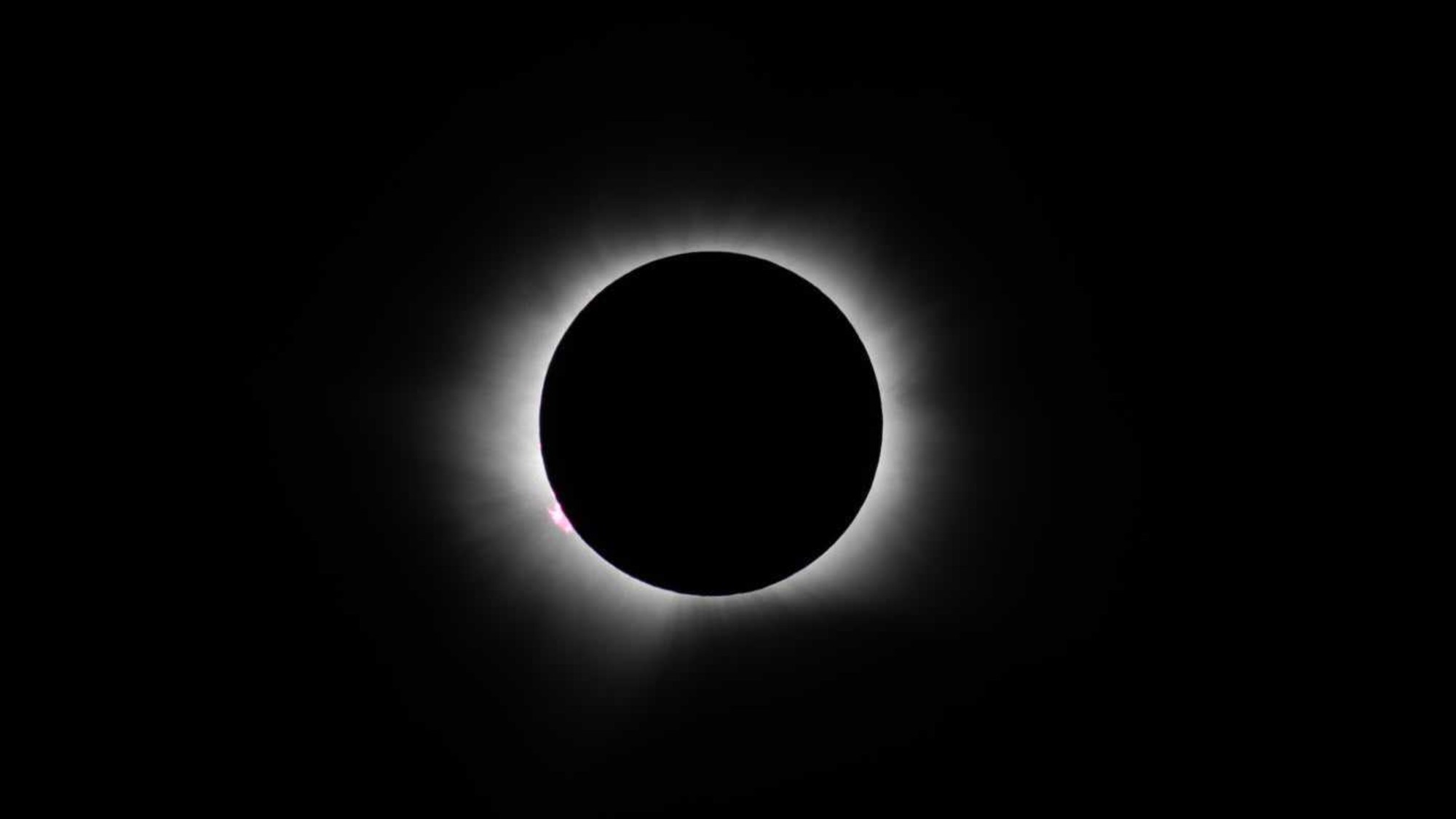
Total solar eclipses are incredible moments in time, but they are fleeting. As the moon passes directly in front of the sun and its shadow sweeps across Earth's surface, the temperature drops and the light takes on an eerie twilight quality. Birds and other animals go quiet. It's a spectacle unlike any other. And for millions today who were lucky enough to be in the path of totality across Greenland, Iceland and Spain, that's exactly what they experienced.

"I cannot believe what I just witnessed. I knew what to expect  — I've seen thousands of photos but nothing compares to that feeling you get when you watch the sun transform before your very eyes," Space.com skywatching editor Daisy Dobrijevic said after watching the eclipse from the deck of the MS Spitsbergen on the HX Expeditions eclipse voyage in Scoresby Sund, Greenland on Aug. 12, 2026.

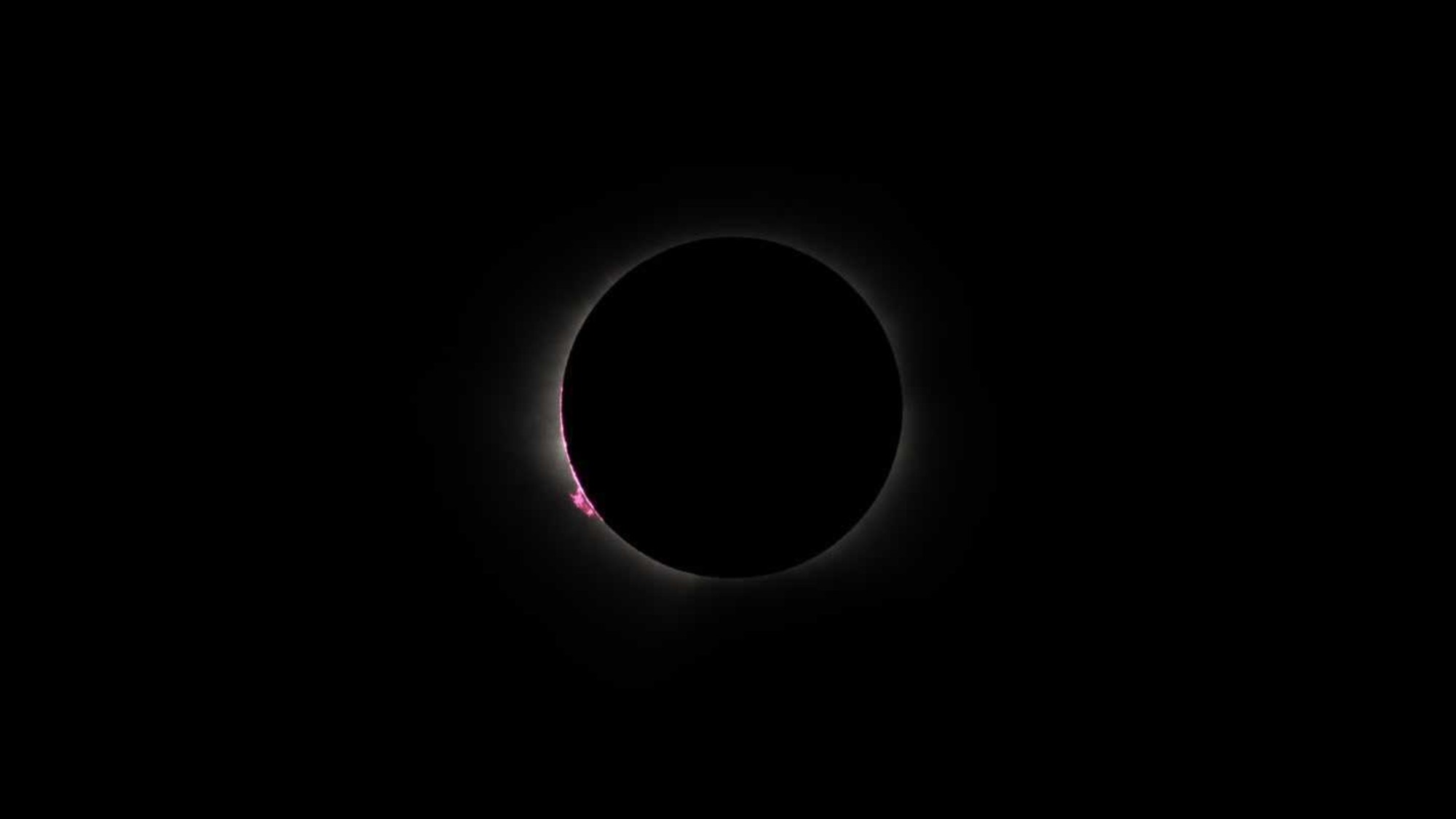
a thin white line of wispy light on a black background

The sun during a total solar eclipse as seen from the deck of the MS Spitsbergen on the HX Expeditions eclipse voyage in Scoresby Sund, Greenland on Aug. 12, 2026. (Image credit: Daisy Dobrijevic/Future)

"It looked so big in the sky with the delicate corona streaming out into the abyss. Jupiter, Mercury and Venus even joined in the show. The huge prominence was the icing on the cake," Dobrijevic added.

"This is something I will never forget and I feel privileged to have experienced it in one of the most remarkable environments on Earth and alongside an incredible group of people aboard HX Expedition's MS Spitsbergen."

a thin white line of wispy light on a black background

The sun during a total solar eclipse as seen from deck of the MS Spitsbergen on the HX Expeditions eclipse voyage in Scoresby Sund on Aug. 12, 2026. (Image credit: Daisy Dobrijevic/Future)

The 182 mile-wide (293-kilometer) path of totality — the line "drawn" on the face our our planet by the moon's shadow — began near Siberia over the Arctic Ocean and first arced down into eastern Greenland.

From there, the path stretched across western Iceland and then into northern Spain where millions gathered to witness the spectacle.

"It was the most incredible thing I've seen in my entire life," said Space.com skywatching writer Anthony Wood after witnessing the eclipse from Valoria la Buena, Spain alongside a team of citizen scientists from the Dynamic Eclipse Broadcast initiative. "It feels like it really shouldn't be happening. It strikes the lizard part of your brain that just tells you that this shouldn't be real."

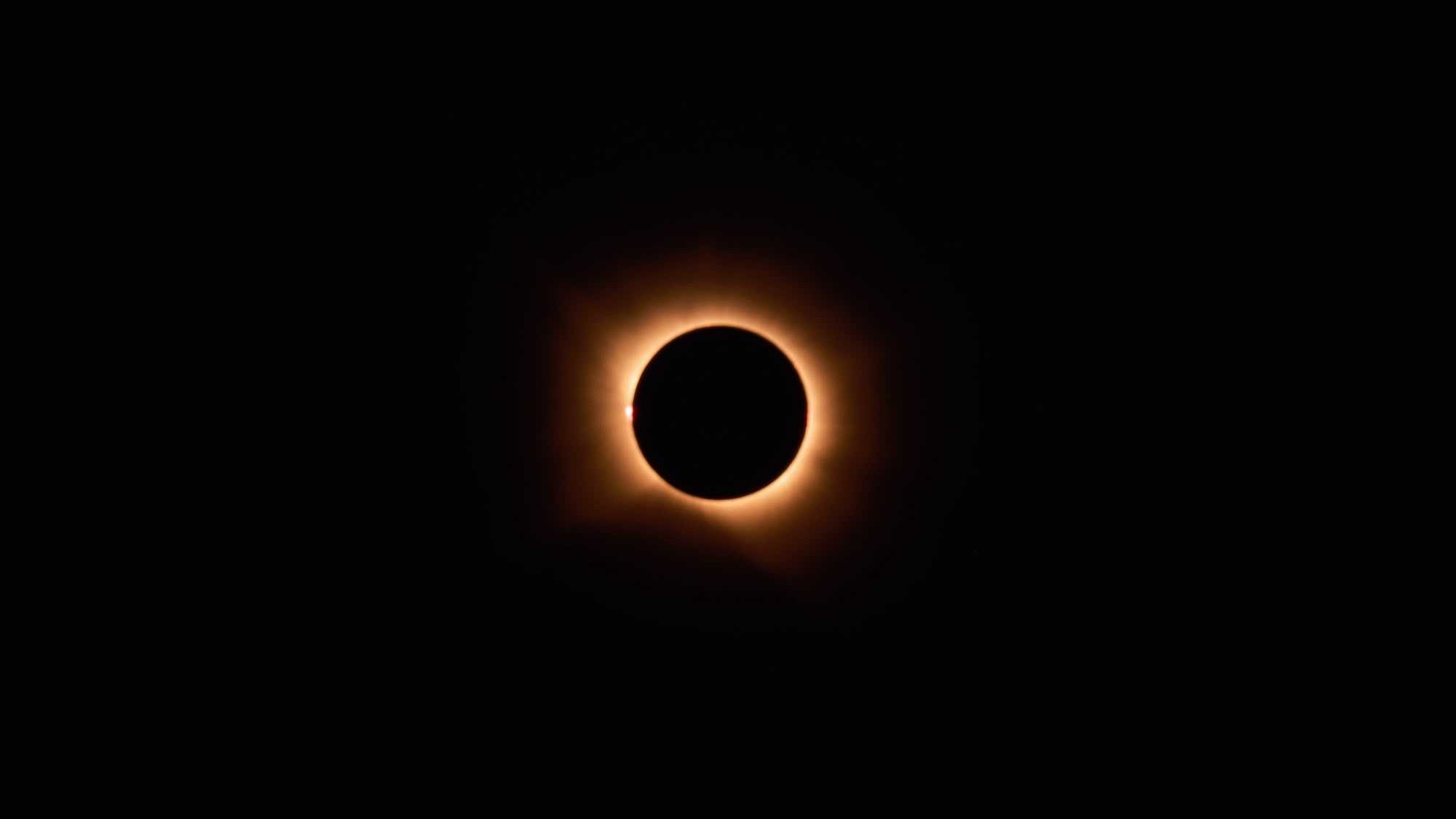
a ring of fire on a black background

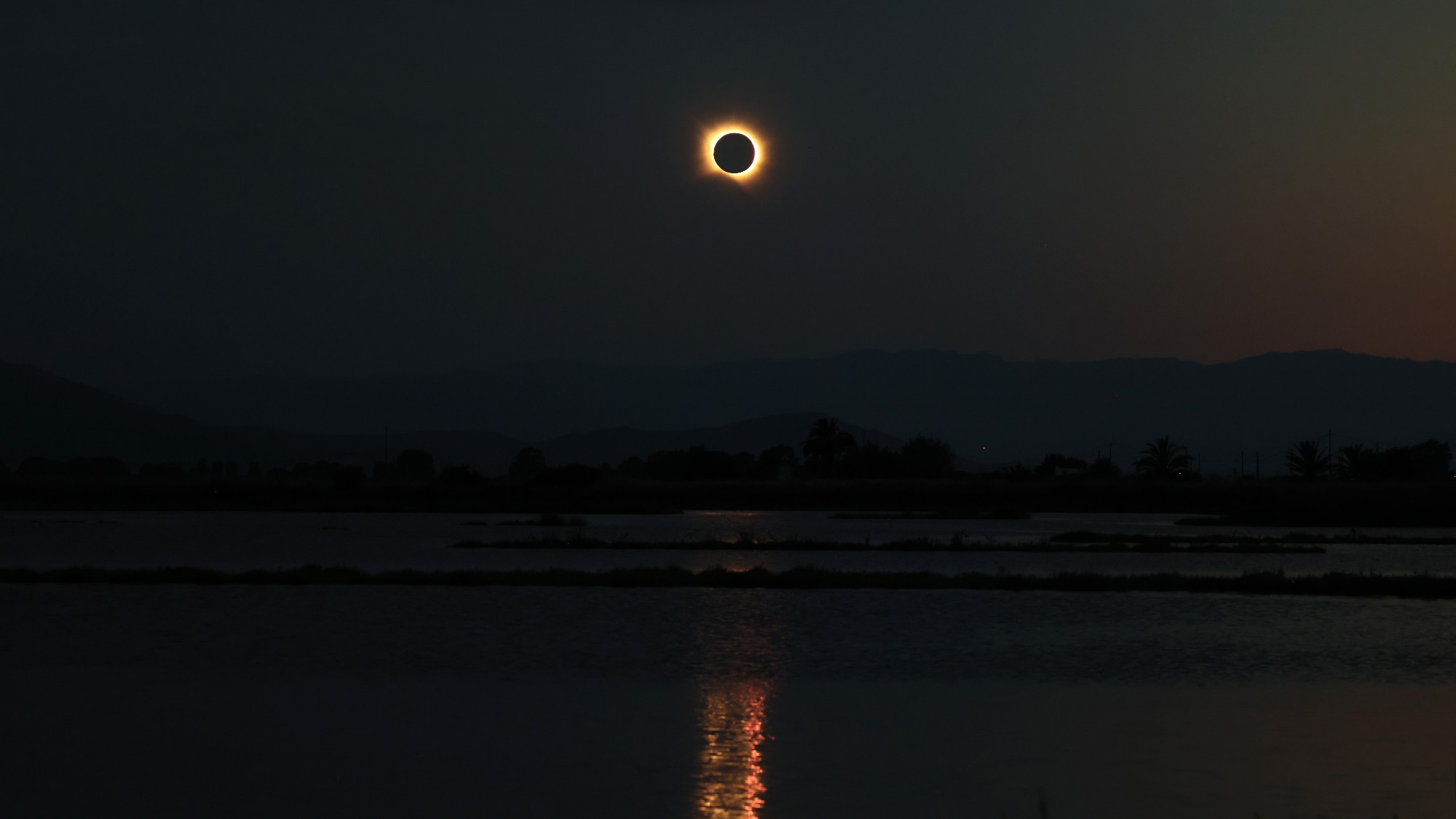
A total solar eclipse as seen in Valoria la Buena, Spain on Aug. 12, 2026. (Image credit: Anthony Wood/Future)

The path then crossed the Balearic Islands just east of Spain before ending over the Mediterranean Sea as the sun set.

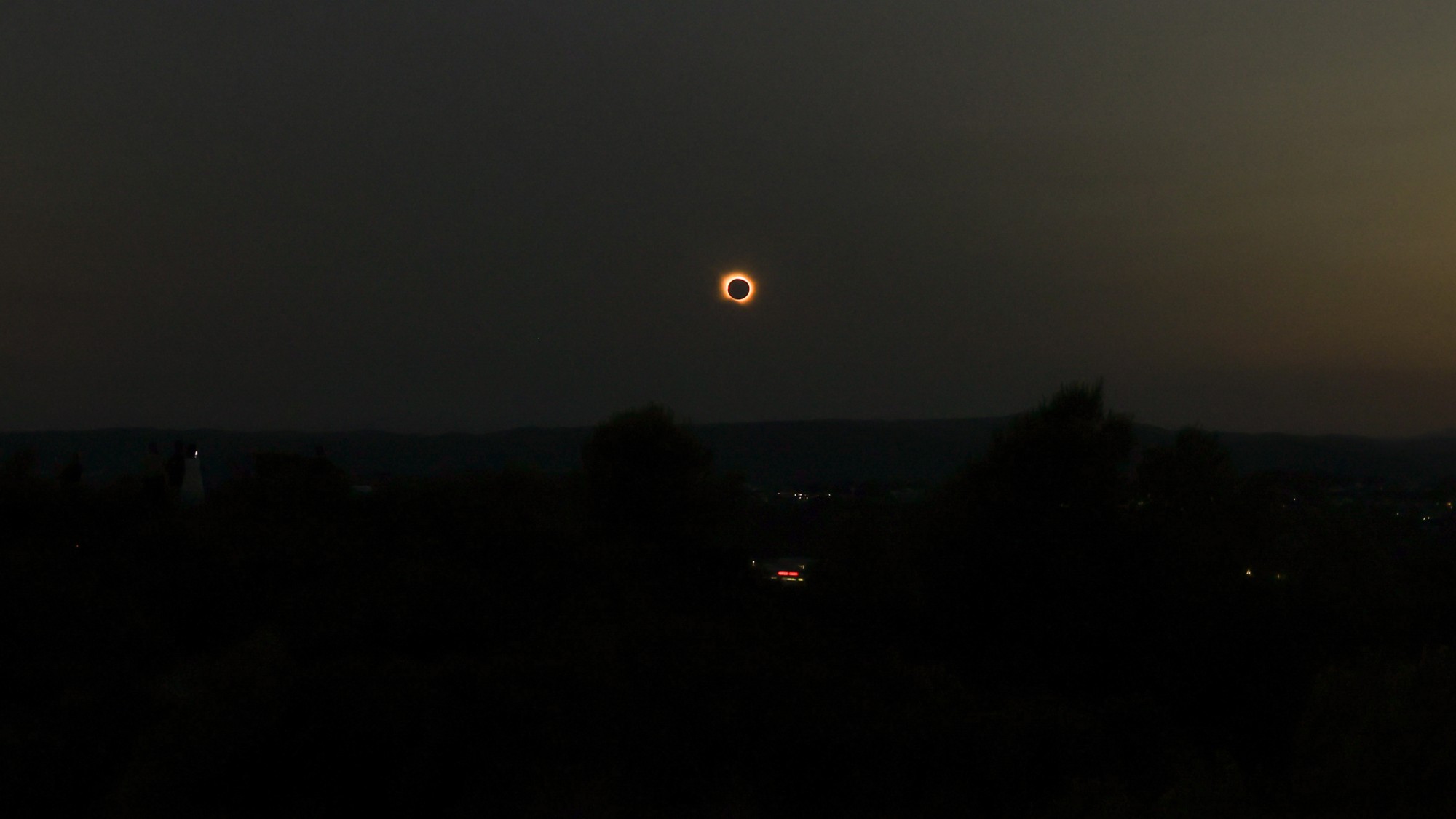
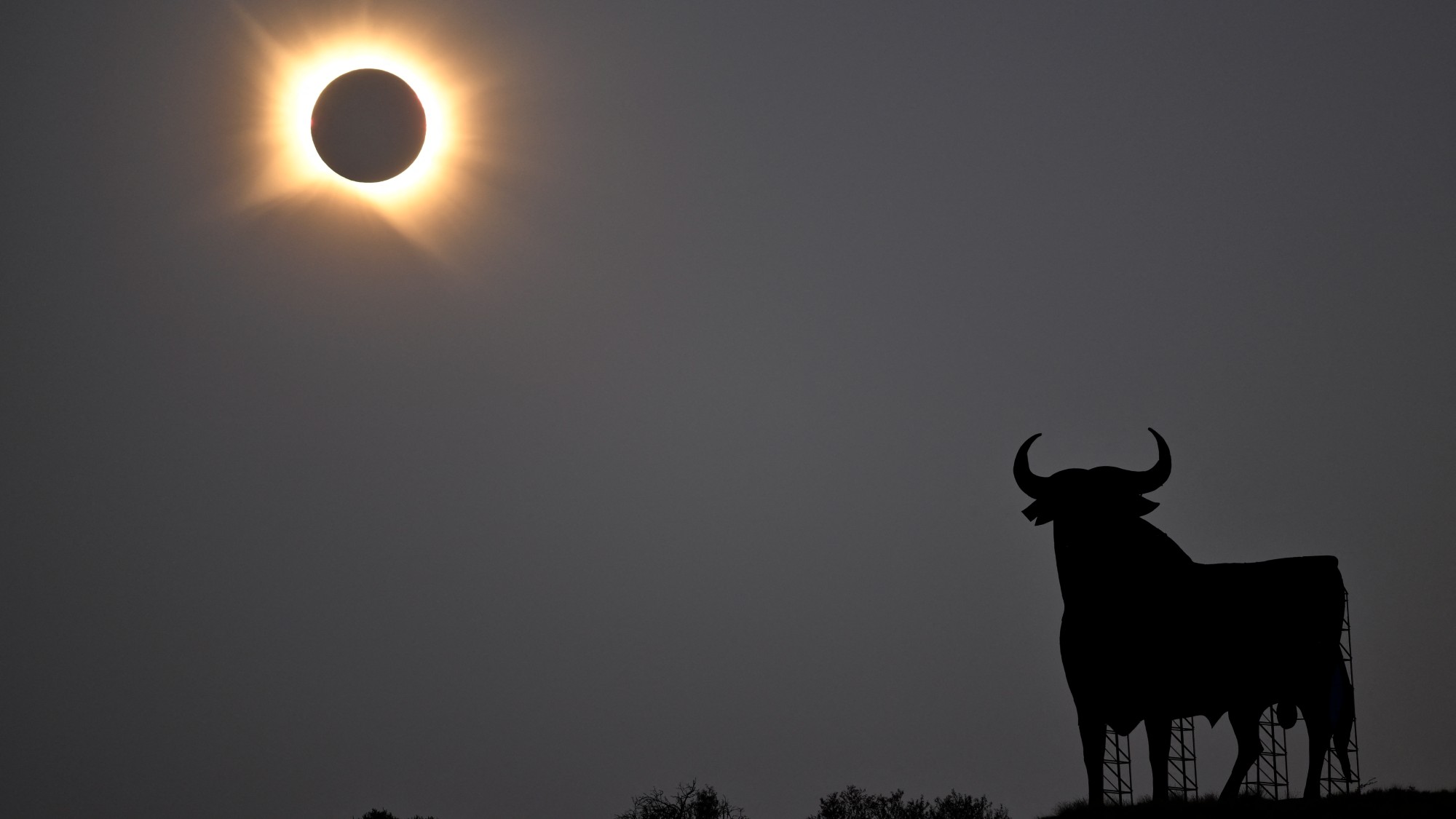
the sun is blocked by a dark orb in a dusky, grey sky

A total solar eclipse is seen above the mountains on Aug. 12, 2026 in Segur de Calafell, Spain. (Image credit: Eric Alonso/Getty Images)

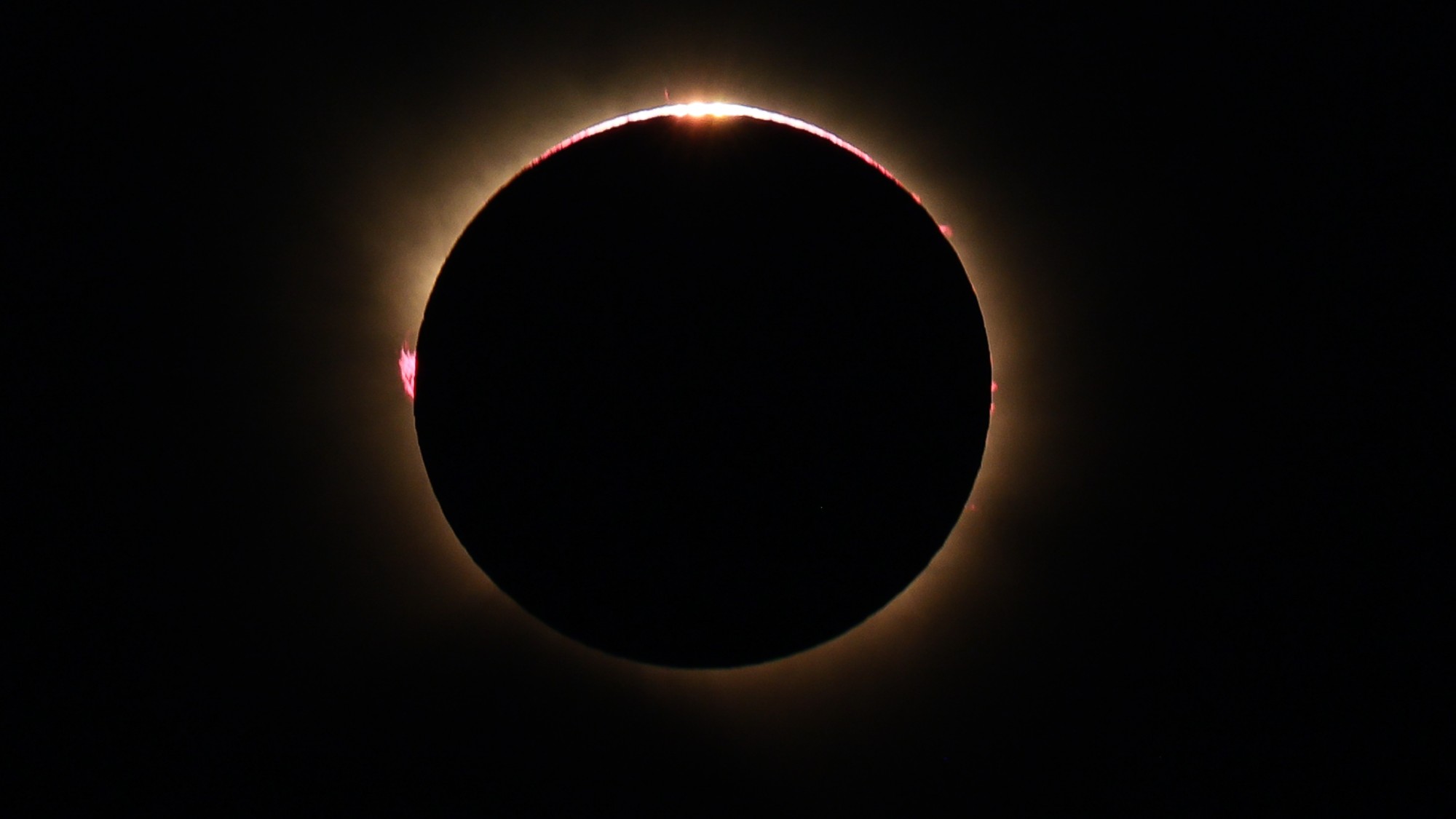
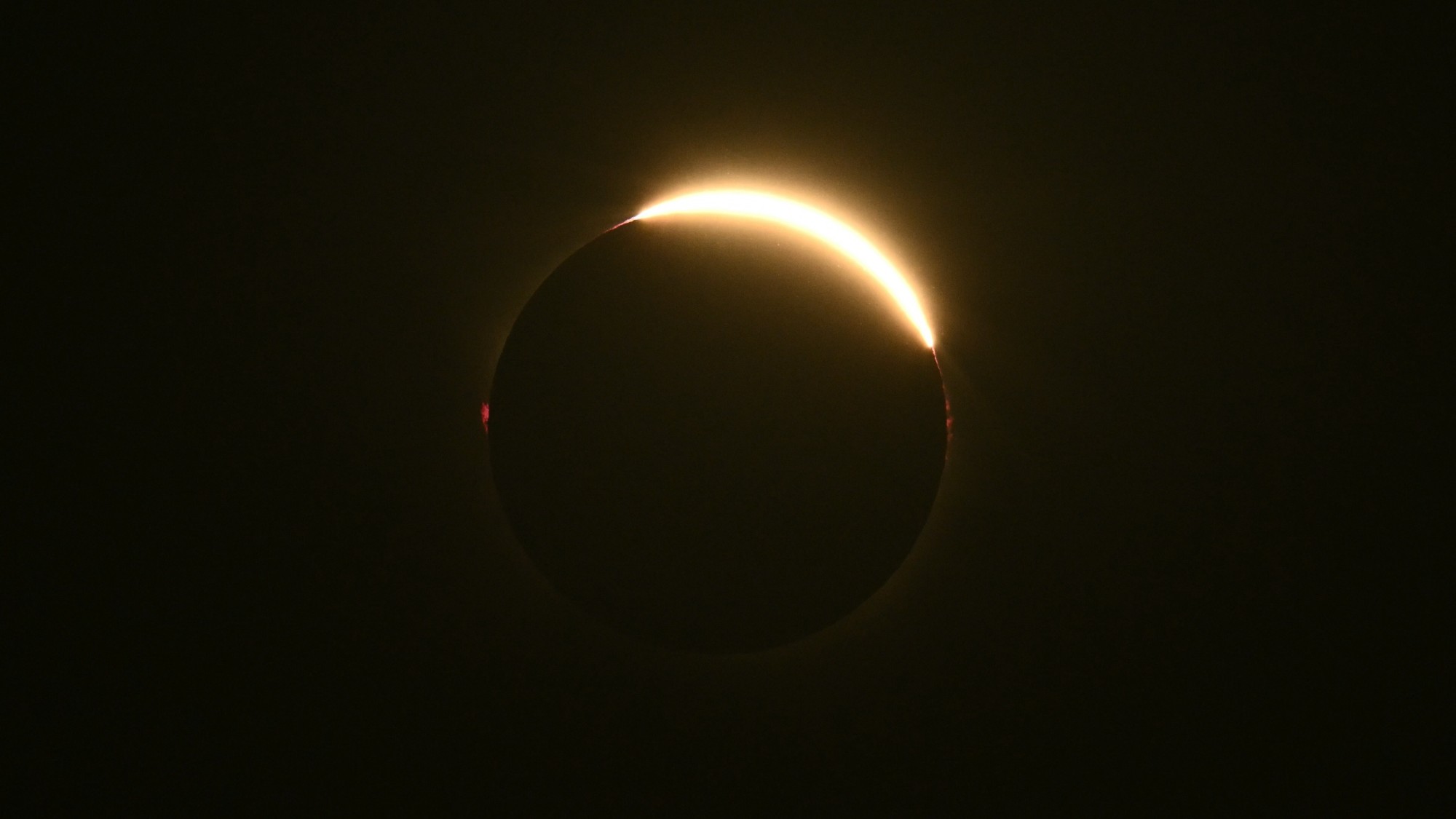
Eclipse-watchers inside the narrow path of the moon's shadow were given a rare naked-eye glimpse of the sun's outer atmosphere, known as the corona. Witnessing the crown-like shape of the corona stretching away from the dark shadow of the moon is one of the most breathtaking moments of an eclipse. Photographs don't do it justice, as they rarely do.

a ring of fire on a black background

A total solar eclipse is seen from San Millán de los Caballeros, Spain, Aug. 12, 2026. (Image credit: Bill Ingalls/NASA via Getty Images)

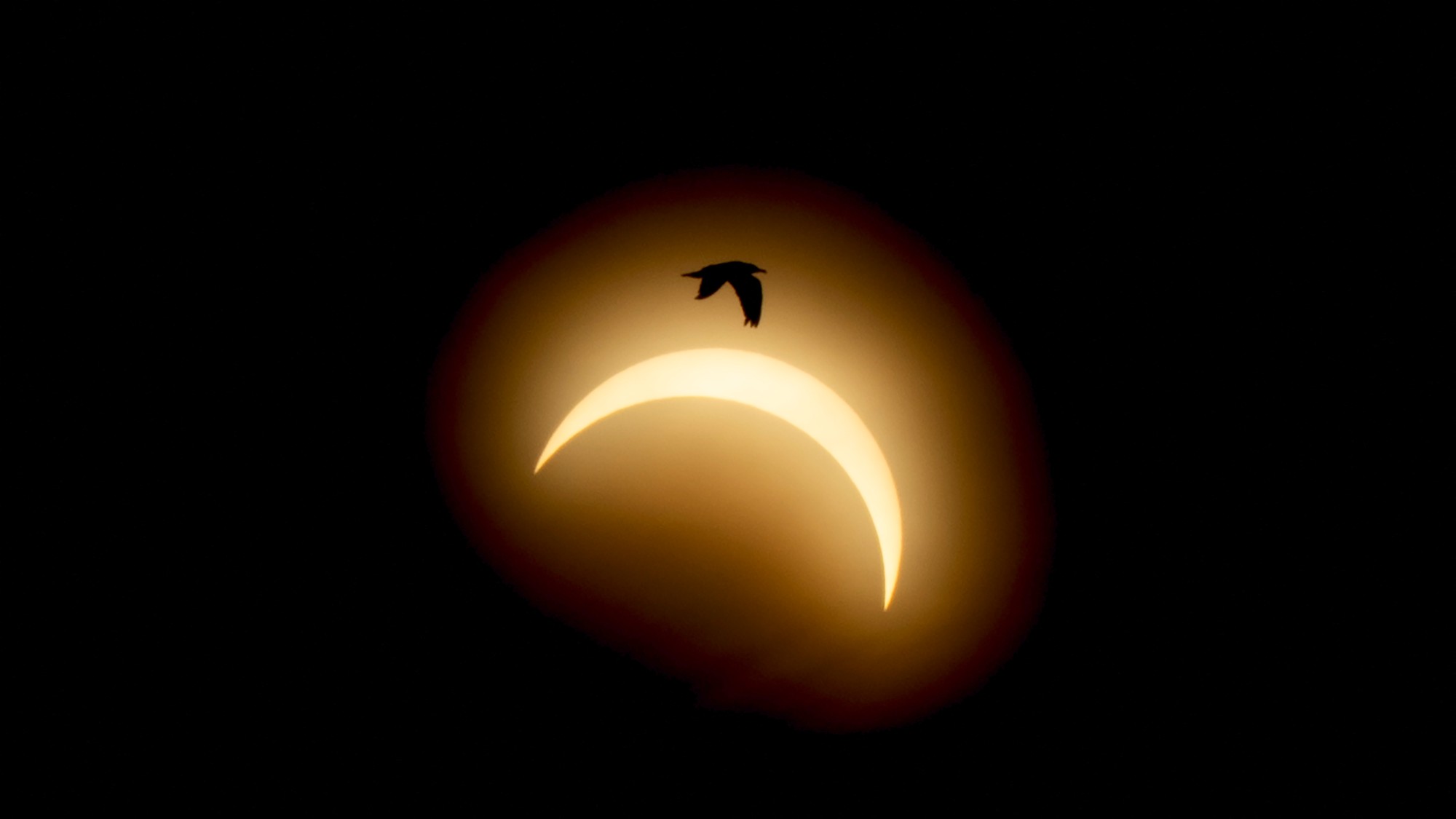
Outside of the path of totality, skywatchers throughout Europe and Scandinavia were able to catch a glimpse of a partial solar eclipse — in which the moon appears to take a "bite" out of the sun.

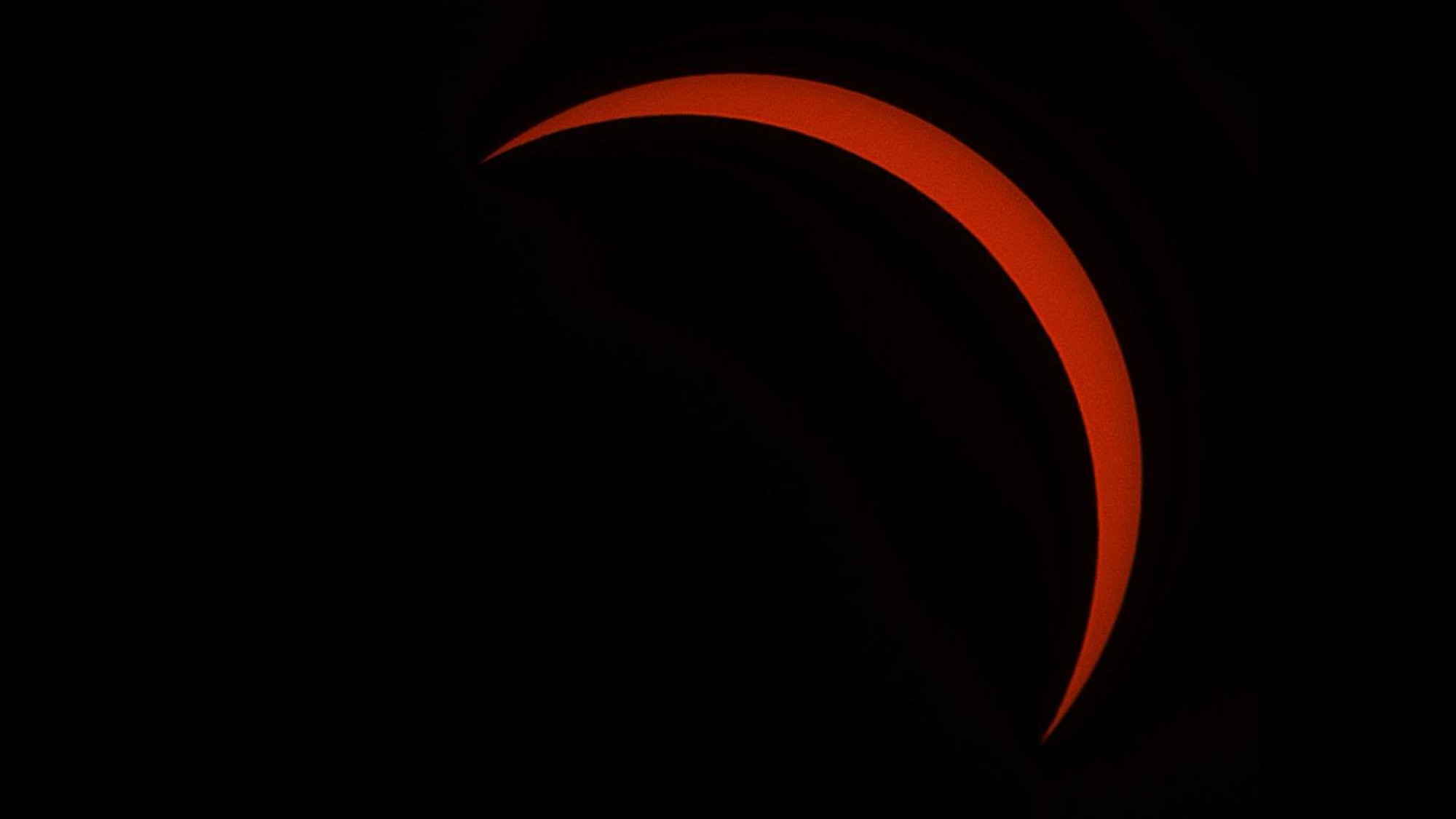
Space.com's Harry Bennett captured the partial eclipse from a hilltop in Somerset, England, shooting the scene with a Unistellar Equinox 2 smart telescope equipped with a solar filter.

a thin red crescent on a black background

A partial solar eclipse as seen on Aug. 12, 2026 from Kelston Roundhill in Bath, Somerset, England. (Image credit: Harry Bennett/Future)

The partial solar eclipse was also visible for much of the northeastern United States and as far west as Michigan. Much of Canada got to witness the partial eclipse too, and so did Alaska.

a bright ring of light on a black background

A total solar eclipse on Aug. 12, 2026 as seen from Segur de Calafell, Spain. (Image credit: Leon Neal/Getty Images)

What causes a total solar eclipse?

A total solar eclipse happens when the moon passes directly in front of the sun as seen from Earth. When this alignment happens, the moon casts its shadow along a line known as the path of totality. Only within this stripe will you be able to experience full totality.

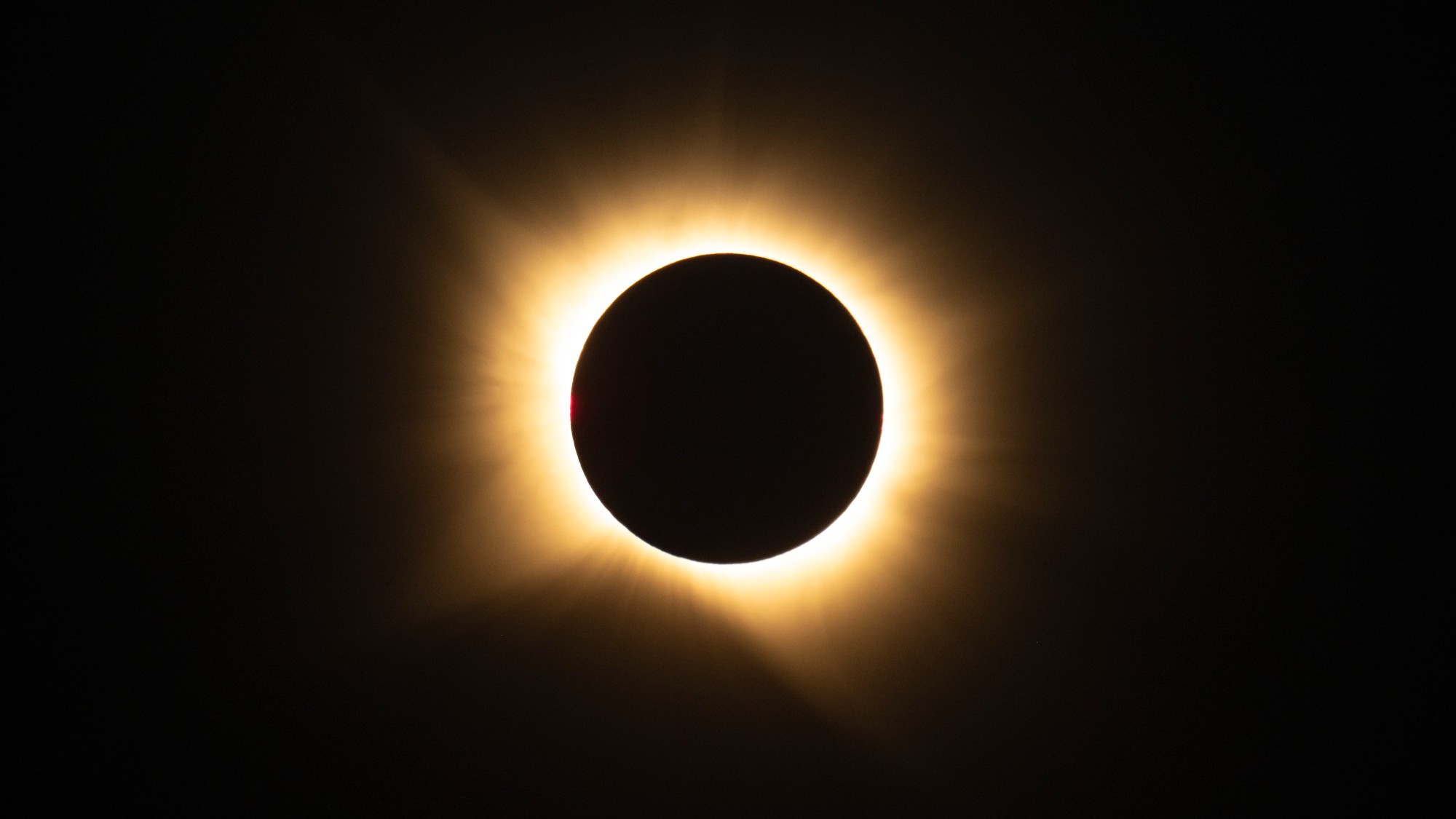
the moon completely blocks the sun, creating a fiery ring in a grey sky

The sun's corona glows as the moon completely blocks the Sun during the totality phase of the total solar eclipse as seen from San Asensio, La Rioja region, on Aug. 12, 2026. (Image credit: Ander Gillenea / AFP via Getty Images)

Another factor to consider is that the moon has an elliptical, or oval-shaped, orbit. This means that it's sometimes closer to Earth than other times. Total solar eclipses only occur when the moon is at just the right distance from Earth, making it appear the same size in the sky as the sun (or even slightly larger). This obscures the blinding light of the sun, allowing viewers to glimpse our star's outer atmosphere, or corona.

a bright ring of light on a black background

The moon passes over the sun's horizon during a partial solar eclipse at Abbadia, le Château Observatoire in Hendaye, southwestern France, on Aug. 12, 2026. (Image credit: Philippe Lopez / AFP via Getty Images)

When the moon is a bit farther away from Earth, it appears relatively smaller. And when solar eclipses fall on a date when the moon is at this greater distance from our planet, the moon doesn't completely block the sun. This creates what's known as an annular solar eclipse, or a "ring of fire" in the sky.

a fiery circle on a black background

A total solar eclipse is seen on Aug. 12, 2026 in the Riet Vell Nature Reserve in Amposta, Spain. (Image credit: James Breeden/Getty Images)

When is the next total solar eclipse?

The next total solar eclipse will occur on Aug. 2, 2027 and will be visible throughout a 160-mile-wide (258-kilometer) path that crosses southern Spain, northern Morocco, northern Algeria, northern Tunisia, northeast Libya, central Egypt, the northeastern tip of Sudan, southwest Saudi Arabia, Yemen and the northeastern tip of Somalia.

Outside of this path, a partial solar eclipse will be visible to most of Europe, much of the African continent, the Middle East, Southeast Asia, eastern Canada and parts of Maine.

a fiery circle on a black background

A partial solar eclipse is seen at the Mariager Fjord in Denmark, on Aug. 12, 2026. (Image credit: Bo Amstrup / Ritzau Scanpix / AFP via Getty Images)

In North America, the next total solar eclipse will take place on March 30, 2033, and will be visible from Alaska. Looking farther out, the U.S. states of Montana, South Dakota, North Dakota, and areas of Canada will witness a total solar eclipse on Aug. 23, 2044.

Submit your eclipse photos! If you captured a photo of the Aug. 12 total solar eclipse and would like to share it with Space.com's readers, send photos, videos, a brief description of your experience, and your name, location and content usage permission release to spacephotos@space.com.

Mars rover watches Earth disappear behind Phobos | Space photo of the day for Aug. 6, 2025

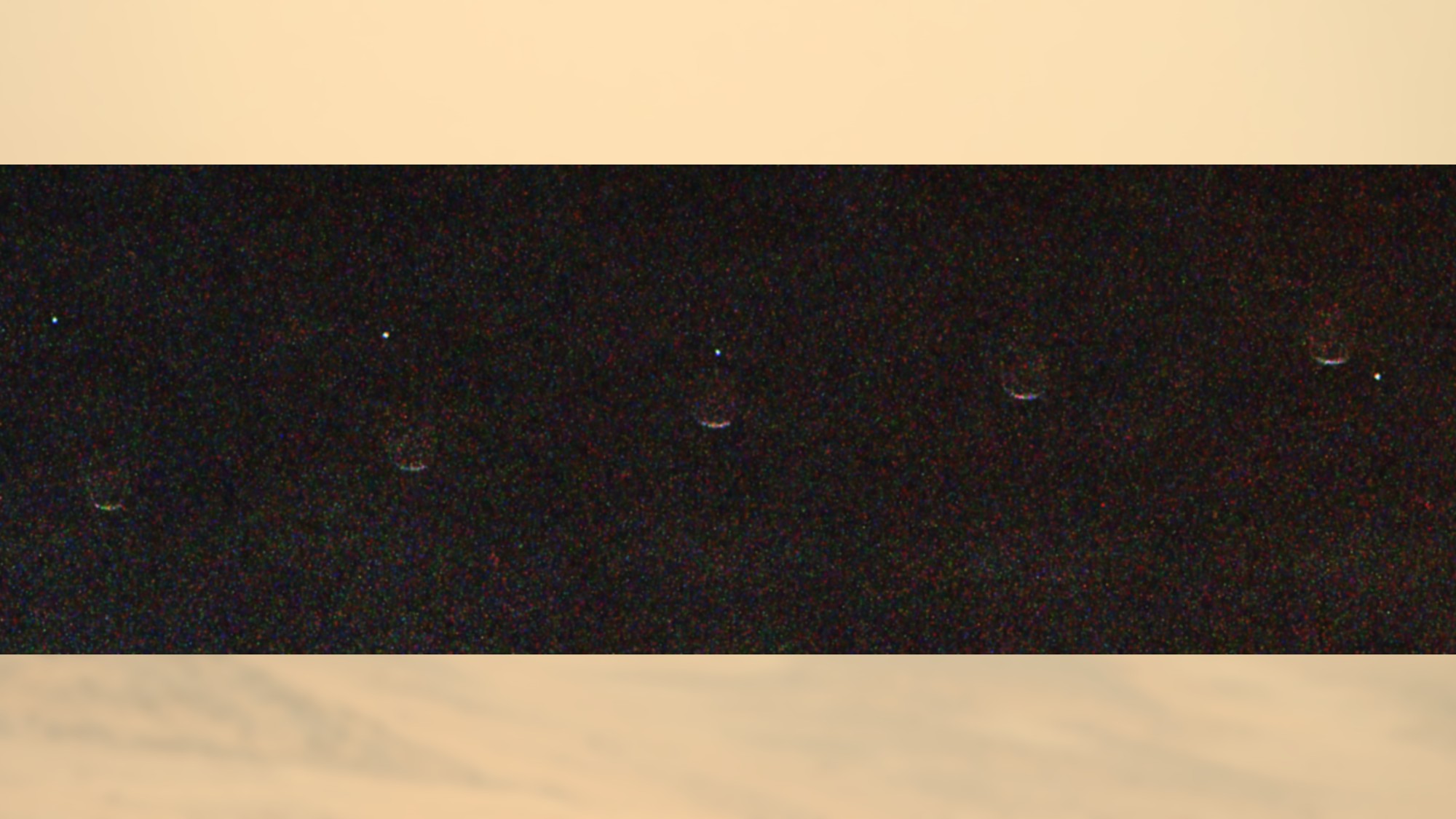
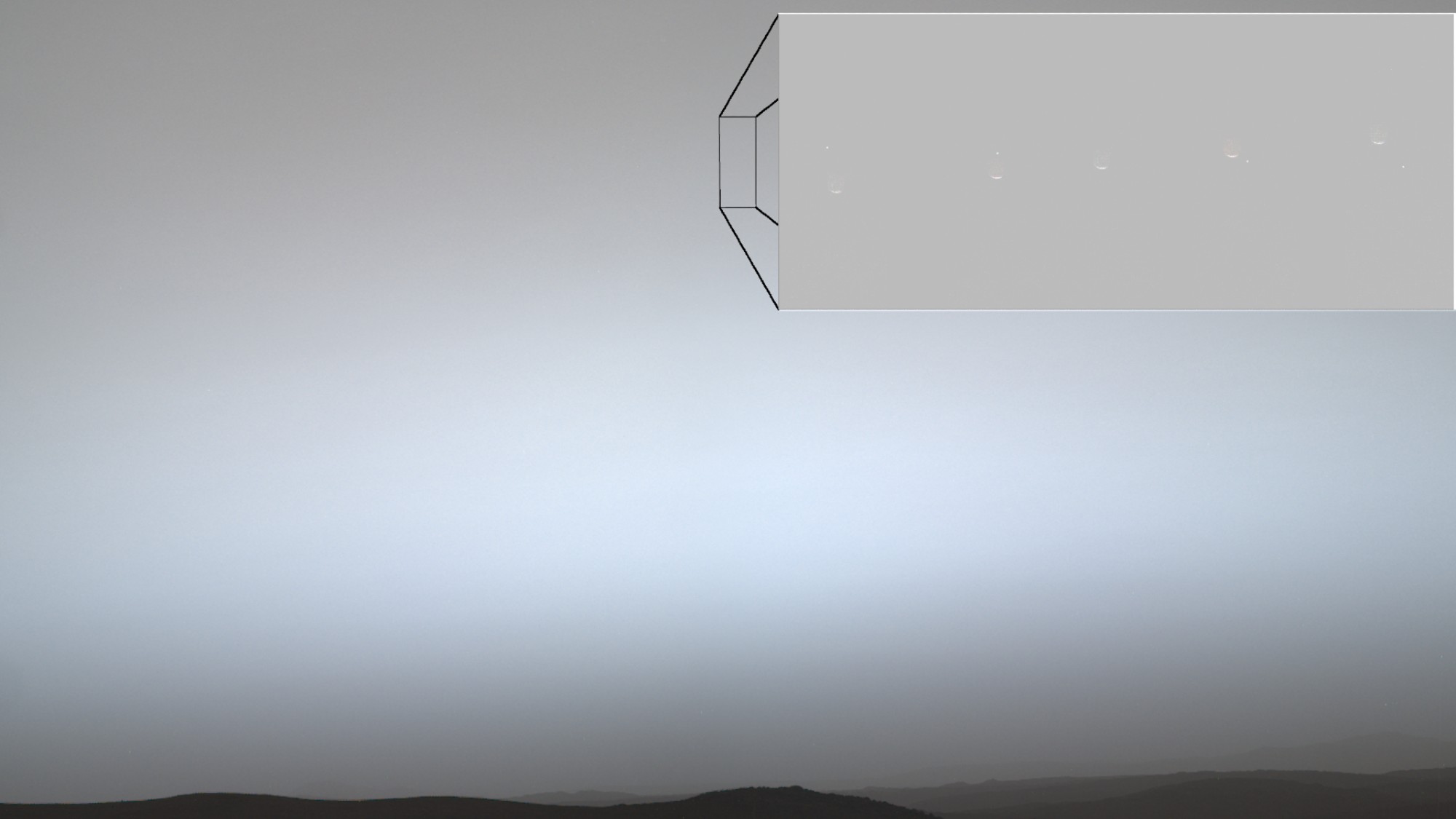
A composite image captured by NASA's Perseverance rover on July 2, 2026 showing Earth (the bright dot) passing behind Mars' moon Phobos in the Red Planet sky. (Image credit: NASA/JPL-Caltech/ASU/MSSS/SSI)

NASA's Perseverance rover witnessed a rare event recently, when Earth briefly disappeared behind Mars' moon Phobos in the Red Planet sky.

What is it?

These new composite images were released by NASA's Jet Propulsion Laboratory (JPL) and taken on July 2, 2026, the 1,907th Martian day of Perseverance's mission. They consist of nine different images taken by the rover's Mastcam-Z instrument as it pointed up into the hazy Martian sky, watching our planet, seen here as a pale dot, cross behind the Mars moon Phobos.

This type of event is known as an occultation, from the Latin word occultare, meaning "to hide." On Earth, the most common type of occultation occurs when our moon passes in front of background stars or when planets pass behind the moon.

Mars has two moons, Phobos and Deimos. Phobos is the larger and innermost moon. Both are lumpy and irregularly shaped, and astronomers aren't sure whether they came from the asteroid belt or were formed from an ancient impact near or on the Red Planet.

a dot of light disappears behind a crescent of light on a grey background

A composite of nine different images captured by NASA's Perseverance rover on July 2, 2026 showing Earth (the bright dot) passing behind Mars' moon Phobos in the Martian sky. (Image credit: NASA/JPL-Caltech/ASU/MSSS/SSI)

Why is it incredible?

The image took careful preparation and required Perseverance to be in the right place at the right time.

"Phobos crosses the Martian sky three times a day, and Earth is visible for months at a stretch, but catching one directly behind the other takes planning and a little luck," said Mark Lemmon, a Mastcam-Z co-investigator at the Space Science Institute.

Aside from catching Earth passing behind Phobos, Perseverance has also witnessed Phobos passing in front of the sun, in what JPL calls a "Martian solar eclipse."