Planet hunter gets the silent treatment | Space photo of the day for July 24, 2026

Bronze shiny spacecraft electronics in a room with blue padding on the walls.

ESA's Plato spacecraft completes critical testing ahead of its spaceflight. (Image credit: ESA - R. Moorkens O'Reilly)

A planet-hunting spacecraft named Plato just passed a series of critical tests as it prepares for the challenges of outer space.

What is it?

Gleaming in the light of a laboratory, this box of electronics is actually the European Space Agency's Plato spacecraft sitting inside a special test chamber where it underwent critical tests ahead of its planned spaceflight.

The Plato (PLAnetary Transits and Oscillations of stars) probe is designed to study terrestrial exoplanets, or rocky planets outside of our solar system that are Earth-sized or smaller.

This chamber, called the Maxwell Test Chamber (which is located at the European Space Research and Technology Centre in the Netherlands), is an enclosure made of conductive metal that blocks electromagnetic fields. On top of the conductive metal are foam spikes. Combined, they block out and/or absorb all electrical signals and sounds to mimic some aspects of the environment of the vacuum of space.

In this enclosure, the team turned on Plato's electronics to make sure that signals from some of the probe's instruments don't interfere with other systems or electronics on the craft. With all other signals blocked out, scientists had a clear look into how it might perform in space.

Why is it incredible?

This test is critical as Plato will need to be able to collect data and run its instruments without interference from electronics or signals from elsewhere on the spacecraft. But it's pretty impossible to ensure that things would work as planned amidst the "noise" on planet Earth.

To get any spacecraft ready to operate in the void of space, researchers conduct all sorts of tests to make absolutely sure that they're up to the challenge. In addition to tests like this, spacecraft can be placed in extremely hot or cold temperature chambers or even shaken around to make sure that they can handle the violent conditions of a rocket launch. It's amazing how we can recreate different aspects of outer space here on Earth to prepare for these missions.

NASA’s retired astronauts are hitting the road to get young people to vote: ‘one small step for you, and one giant leap for our country.’

LOS ANGELES — Standing in the shadow of the space shuttle Endeavour, a group of retired NASA astronauts announced their plan to travel the country visiting colleges to try to inspire younger generations to get out and vote. This campaign comes as we lead up to the November midterm election.

This past year, a group of retired NASA astronauts teamed up for a single cause: to defend the U.S. constitution. They banded together as part of a non-profit, non-partisan activist organization called Astronauts for America. So far, they have been speaking out, using their astronaut expertise, platforms, cultural relevance and role model status to speak out in support of "science, evidence-based decision-making, public service and the rule of law," their website reads. Now, as the group announced at an event at the California Science Center's new air and space center — home to the shuttle Endeavour — they're hitting the road on a campaign tour of colleges called "Vote for Freedom."

"We have to do what we can to ensure that the country makes it through the challenges that we're dealing with here, and that is the message that we're going to be taking to colleges and universities," Apollo 9 astronaut Rusty Schweickart told Space.com. "And the agency that we have, the immediate agency, is to vote."

This tour will send astronauts from the group on a four-month jaunt across the country. Astronauts from the group's more than 100 members will visit state and community colleges, county fairs and even town halls, aiming to reach first-time voters and young people who might be new to voting.

"I'm really excited to look a bunch of younger Americans in the eye and make sure that they know that someone that they can trust said: ;Listen, you matter, because our country matters, and our country needs you,'" former NASA astronaut Cady Coleman told Space.com.

"It's with a uniquely American kind of freedom that we were able to go to the moon, and that same freedom launched the spaceship behind us 25 times into space. Now we see those freedoms under heavy threat," former NASA astronaut Steve Smith said during the event. "We're seeing chaos instead of community, violence instead of votes, lies instead of laws, and fear instead of fate. That's how democracy and freedom die."

"The mission is all that matters. Now, our country is the mission, and our message is simple: going to the polls is one small step for you, and one giant leap for our country," Smith added.

Members of Astronauts for America stand in front of the space shuttle Endeavor at the California Science Center.

Former NASA astronaut Steve Smith speaks alongside other former astronauts in front of the space shuttle Endeavor at the California Science Center on July 20, 2026. (Image credit: Space.com/Chelsea Gohd)

This campaign leads up to the U.S. midterm elections this November. Midterm elections happen halfway through every four-year presidency. This election allows voters to decide what Congress looks like, and which political party controls Congress. This can ultimately have a major impact on what laws and decisions are passed moving forward, and whether Congress will reject or change actions by the president moving forward. And this group of astronauts is serious about the importance of getting people out to exercise their right to vote.

"I'm a child of the segregated South; I grew up in Columbia, South Carolina," former astronaut and NASA Administrator Charlie Bolden, who also serves as a steering committee member for Astronauts for America, said at the event. "I graduated in 1964. Anybody know what happened in 1964? The Voting Rights Act. So, as a person growing up in my hometown, it wasn't a guarantee that my mom and dad were going to be able to go out and vote. I look at what's going on today about people trying to restrict the ability of people to cast their ballot. That's not who we are. That's not America."

The group of astronauts recently spoke out about voting access after the U.S. Supreme Court ruled in favor of protecting the right to absentee voting, in response to attempts by the Trump administration to place restrictions on the current voting process. Especially leading up to the November midterms, each vote carries significant weight. And while this nonpartisan group isn't telling you who to vote for, they do think that everyone who can should vote.

"As astronauts, we signed an oath to our nation, and we are mission-oriented people. And our nation is now the mission," Coleman added. "We need to recognize that everyone's voice is important, and one of the voices that we don't hear very much is the young people. And we want them to understand that, even though sometimes change can seem daunting, their perspective is really important, and, you know, their voice is important."

Satellite spots a ‘hummingbird’ in Antarctica | Space photo of the day for July 23, 2026

A black and white hummingbird shape appears in data of a mountaintop.

A hummingbird shape in satellite data from NISAR is actually a mountaintop spotted in Antarctica. (Image credit: NASA/JPL-Caltech)

In satellite data captured over Antarctica, what appears to be a beautiful, colorful hummingbird emerges from the crest of a mountaintop.

What is it?

While there are no hummingbirds flying around Antarctica, we can see what looks like a small, purple bird in a new satellite image of an Antarctic mountain. The dark belly of this "bird" at the center of this image is actually the top of the mountain Nunatak Zaterjavshijsja in East Antarctica.

What looks like a bird's tail is a stream of ice flowing northeast all the way out to the ocean, and what appear to be feathers splaying outward from the mountaintop are actually crevasses down the mountain. These crevasses are formed by a glacier fracturing the mountain's surface as it flows in the icy current toward the ocean.

This view was captured by radar instruments onboard the satellite NISAR (NASA-ISRO Synthetic Aperture Radar) that launched as a collaboration between NASA and ISRO (Indian Space Research Organisation). The director of NASA's Earth Science Division called NISAR "the most sophisticated radar we've ever built" in a pre-launch briefing last year.

Why is it incredible?

At first glance, this image is puzzling. What could it possibly be? Its bold colors and sharp lines evoke almost alien qualities. But the strange beauty of the shapes and colors in this satellite image reveal important information about glacier movements on the mountain.

"First, it's a beautiful image, with rich details of features that provide insights to how the glacier is moving. Then, because radar can often see through snow and deep into the ice, NISAR can observe fundamentally different properties of Antarctic ice than can be seen in optical imagery," Seongsu Jeong, the signal analysis engineer who produced the image at NASA's Jet Propulsion Laboratory, said in a statement. "With NISAR we're seeing what's hidden beneath the surface."

And now anyone can explore NISAR's data. Earlier this week, on July 20, NISAR started making the data from its radar instruments public. Moving forward, mission teams will be rolling out this data so researchers everywhere can use it to study and protect our ever-changing planet.

Our 1st-ever up-close look at the Martian surface | Space photo of the day for July 22, 2026

A black-and-white image of the surface of Mars with rocks and part of the Viking 1 lander.

The first-ever photo captured on the surface of Mars, snapped on July 20, 1976 by NASA's Viking 1 lander. (Image credit: NASA/JPL)

You're looking at history. What might seem like a simple black-and-white picture of some rocks is actually the first photograph ever taken on the surface of Mars.

What is it?

Bright and early on the morning of July 20, 1976, NASA's Viking 1 lander touched down on the surface of Mars. This moment 50 years ago marked the first fully successful touchdown on the Red Planet, and, pretty much as soon as it landed, Viking 1 captured the first image of the Martian surface.

The Soviet Union had already made multiple Mars landing attempts, all of them failures to some degree. The nation's Mars 3 lander did manage to survive its landing initially in December 1971, but it lost contact less than two minutes later.

Viking 1 did more than just survive. While its mission tasked the lander with studying the planet for 90 days after landing, it lasted over six years on the planet and made some incredible observations. The Viking 1 lander worked in tandem with an orbiter by the same name, and was soon joined at Mars by Viking 2, another lander/orbiter pair.

Why is it incredible?

It has now been 50 years since Viking 1's historic first, which opened our eyes to the Martian surface. And NASA has kept improving technologies and exploring further on Mars ever since. Agency rovers began scouring the planet's surface in the 1990s, so we have gathered data on the planet's surface for decades upon decades at this point.

But in 1976, no one had ever seen the surface of Mars close up. This view was preceded by science fiction like Ray Bradbury's "The Martian Chronicles," which painted fantastical possibilities about what it might really be like on Mars. With Viking 1's view, we finally got some concrete evidence of the reality on the planet.

In 50 years, our understanding of Mars, our solar system and beyond has grown tremendously. But with each major accomplishment, we can look back at previous milestones such as this to see the stepping stones that paved the way to get us there.

James Webb Space Telescope looks back in time 4.4 billion years | Space photo of the day for July 21, 2026

A black space background is speckled by yellow, white, blue and orange stars including blue stars with long diffraction spikes.

The James Webb Space Telescope captured this image of a young galaxy cluster, MACS J0553.4-3342. (Image credit: ESA/Webb, NASA & CSA, S. Fujimoto)

A young cluster of galaxies sparkles under a cosmic glow that's 4.4 billion years old. This peek into the past shows the stellar spectacle of a galaxy cluster still forming.

What is it?

The James Webb Space Telescope snapped this image of the galaxy cluster MACS J0553.4-3342 on July 3 using its near-infrared camera (NIRCam). The glorious, glimmering sight is actually a massive young galaxy cluster forming 4.4 billion years ago. A galaxy cluster is a grouping of galaxies held together by gravity. Galaxy clusters can contain hundreds or even thousands of galaxies and are the largest known structures in the entire universe that are held together in this way.

Why is it incredible?

Because light takes time to travel through space, and because the JWST can look incredibly far out into space, this telescope acts as a sort time machine.

This power isn't unique to the JWST, however. Other telescopes like the Hubble Space Telescope, for instance, have similarly peered back in time through the cosmos and revealed some incredible, ancient sights. However, the JWST's specialized instruments like NIRCam allow the telescope to pick up incredibly faint light from galaxies remarkably far away. This greatly stretches how far back in time we can see.

But the really incredible thing is, you can look back in time yourself — with only your eyes. While JWST can look exceptionally far out into space and can capture the very faint light of ancient galaxies, the light coming from the stars you can see with your bare eyes also had to travel over incredible stretches of time to reach you. Think about this: the light coming from a constellation you love may have traveled across millions of light-years to get to your eyes.

Ancient sandstorm leaves behind wreckage on Mars | Space photo of the day for July 20, 2026

Sandy-colored large and small rocks on the Mars surface.

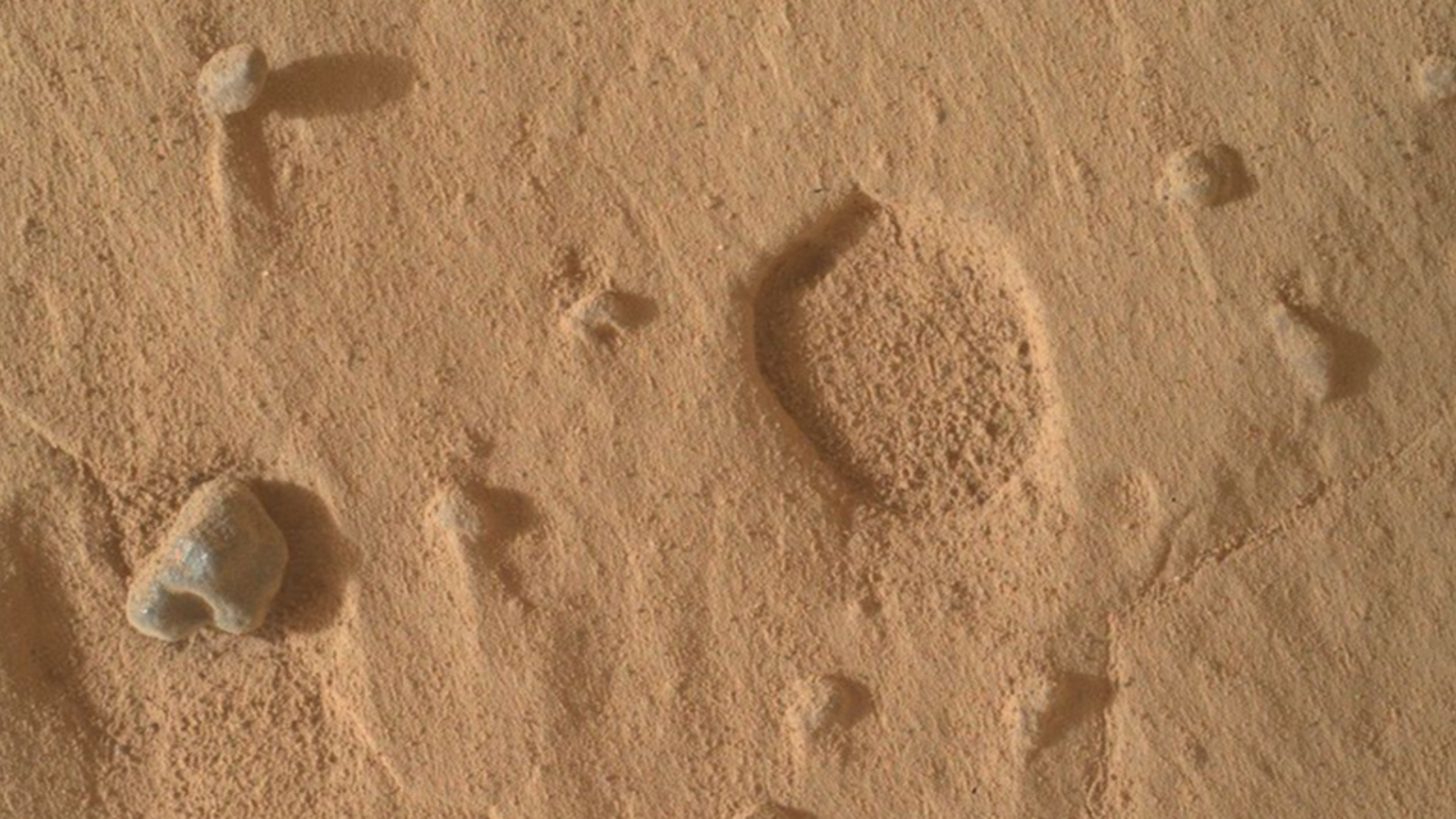
NASA's Curiosity rover snapped this image on the surface of Mars, and scientists think it's the wreckage of an ancient sandstorm. (Image credit: NASA/JPL-Caltech/MSSS)

NASA's Curiosity rover has uncovered evidence of ancient sandstorms on the Red Planet.

What is it?

Scientists think ancient Mars was quite different than it is today. While we might know it now as a barred, reddish wasteland, billions of years ago it actually had an atmosphere. Scientists even think that it had flowing rivers and expansive lakes.

And with observations from the Curiosity rover, researchers are exploring ancient sandstorms they think blew across the Martian landscape.

In this image Curiosity snapped, you can see what experts think is the aftermath of an especially extreme sandstorm in a spot nicknamed "Jawbone Canyon." Winds from this storm were likely so extreme that they pushed sand into rippling waves that eventually hardened into rock.

And if you really look closely at this image, you can almost see how the rocks appear to have ripples on them.

While the image was captured in 2024, a new investigation of the observation and discovery of this sandstorm was described in a study published this year in the journal Geology.

Why is it incredible?

This observation by Curiosity is part of a long history of exploration on the Martian surface that actually began 50 years ago today.

On July 20, 1976, NASA's Viking 1 lander touched down on the Red Planet. Aside from the Soviet Mars 3 lander that lasted only a few seconds on the world before losing contact, Viking 1 was the first Mars lander to survive landing and successfully went on to study the planet.

Viking-1 took the first-ever images on the surface of Mars, studied the planet's soil and really sparked investigation of whether or not the world may have ever supported life. Thanks to the success of this mission 50 years ago, today we have rovers like Curiosity and Perseverance on Mars leading us at the cutting edge of exploration.

Smoke from devastating Canada wildfires visible from space | Space photo of the day for July 17, 2026

This image from space shows wildfires over Canada.

Smoke from wildfires across Canada travels across both Canada and the U.S. in this satellite image captured by NOAA-21 on July 14, 2026. (Image credit: NASA Earth Observatory/Lauren Dauphin)

The wildfires tearing across Canada are so extreme that the smoke billowing upward can be seen from space.

What is it?

Over 850 wildfires are currently devastating Canada, as reported by the Canadian Interagency Forest Fire Center. The fires are spreading across Manitoba, Saskatchewan and Ontario; most remain completely uncontrolled.

In addition to the immense destruction caused by the fires themselves, the smoke from these fires is causing serious concerns about dangerously poor air quality all across Canada and even in the northeastern United States. As far as New York, the air quality on Thursday (July 16) was labeled "very unhealthy" after the state activated emergency air quality protocols.

The smoke is so expansive it's clearly visible in this image captured on July 14 from Earth orbit.

Why is it noteworthy?

Studying wildfires and wildfire smoke from orbit can give us a bigger picture view of these catastrophic event. This data is important for disaster relief in the short term — but also in the long-term. With climate change continuing to progress due to human activities like burning coal for cheap power, we can expect natural disasters to worsen. Among the many effects of climate change, this includes longer and more intense wildfire seasons, especially in regions that are already susceptible to fire such as these regions across Canada.

The new image was captured by the NOAA-21 satellite with the instrument VIIRS (Visible Infrared Imagine Radiometer Suite). You can see massive plumes of smoke over southeastern Canada treading into the northeastern U.S. Thick smoke covers swaths of Canada's landscape and wisps of smoke trail all the way down through New York and across the U.S.

Most of this smoke, at least the smoke we can see in this satellite image, is coming from wildfires in northwestern Ontario. As the wildfires continue to burn, satellites like NOAA-21 will be keeping watch.

Astronomers discover 1st atmosphere around a rocky Earth-like planet in the habitable zone

This might be the closest we've gotten to finding a planet that could support life: Astronomers have detected an atmosphere around an Earth-like, rocky planet orbiting in the habitable zone around its star, a monumental first.

The rocky planet, called LHS 1140 b, is 48-light-years away from Earth and according to this new research, it has an atmosphere that contains helium. It is also the first rocky planet to have an atmosphere be detected directly. This is the first rocky planet to be found with an atmosphere that is also in the habitable zone, meaning it's at the right distance away from its star for liquid water to potentially exist on the planet. As we continue to search the cosmos for planets that can be considered "habitable," this planet checks more boxes than almost anything we've ever seen.

"We have actually detected directly the helium present in the atmosphere itself, and that's the first direct detection for any rocky exoplanet, which is really exciting … and then there's this added bonus that it's in the habitable zone, which is super exciting for astrobiology and habitability and searching for life," lead author Collin Cherubim, who recently earned his Ph.D. from Harvard University, told Space.com. "It feels kind of surreal."

What's this planet like?

Let's explore this planet and the system where it "lives."

This exoplanet, or planet outside of our solar system, was first discovered in 2017 by a team led by astronomer Jason Dittmann who is now a co-author on this new discovery.

"This planet was found like 10 years ago, and we're just now saying, okay, that's an atmosphere," Dittman told Space.com. "We're slowly narrowing the gap and checking these boxes … we're finding a planet that's rocky, a planet that's of the right temperature and now … it's like okay, we finally found one that has an atmosphere."

And being a rocky planet, "there's definitely a surface … it's made of rocks," Dittman said. What does the planet's surface look like? We can't say yet, but the researchers who found this planet's atmosphere think there's a good chance it could have water.

While it orbits a red dwarf star, which is smaller and cooler than the sun, it orbits closer than we do to our star, maintaining a temperature that keeps the planet in the "Goldilocks zone" where liquid water could exist on its surface.

"It probably also has a lot of water," Cherubim said. "If it has some amount of atmosphere that can provide a bit of a greenhouse effect, which we know that it does now … it will very likely be what we consider to be habitable conditions on Earth, and conditions that would likely support liquid water."

So is it Earth-like? While it's certainly not an Earth copy, this planet can be considered Earth-like in two main ways, Cherubim shared. One: its overall composition. The planet is rocky, likely with an iron core and (now we know) it has an atmosphere. And two: the planet's temperature is just right for liquid water, which is necessary for life at least as far as we understand it on our planet.

Finding an atmosphere

The discovery of the first exoplanet was confirmed just over 30 years ago. Since then, scientists have found over 6,000 exoplanets and counting. And while a few rocky planets have been found in their star's habitable zone, it wasn't until now that an atmosphere has been confirmed around a rocky planet in the habitable zone.

One reason why scientists have had a hard time finding such planets with atmospheres is their stars. LHS 1140 b orbits the most common type of star, a red dwarf, which is about one-third the size of our sun. This type of star remains active for a lot longer than stars like our sun. This activity means it releases bursts of extreme radiation like solar flares and coronal mass ejections. And typically, the extreme radiation around these stars totally strips the atmospheres from the planets orbiting them, so astronomers have wondered if planets orbiting these stars can have an atmosphere at all.

"This discovery is a big deal because it's showing that at least this rocky planet has retained an atmosphere over billions of years," Cherubim said. It's "a bona fide, robust way of saying yes, atmospheres can survive on rocky exoplanets."

It's possible that other gases beyond helium are in the planet's atmosphere, and it's possible that some of its atmosphere was previously stripped away by its star's radiation. But the red dwarf that this planet orbits is roughly 6 billion years old, a few billion years older than the age at which their extreme radiation activity begins calming down. So while some helium is still slowly escaping the planet's atmosphere over time, the team expects the planet to retain an atmosphere, Dittman shared. After all, even Earth's helium is slowly escaping our own atmosphere.

The proof is in the atmosphere

To prove that this planet has an atmosphere, the team started with a prediction that Cherubim made during graduate school. It all started with a theoretical model and a sneaking suspicion that there must be rocky exoplanets with atmospheres other than Earth.

"This came out of a very specific prediction from a planetary evolution model that I actually developed myself, from scratch, from first principles, for my Ph.D. as a theorist, and I made a very specific prediction about this planet," Cherubim said. "And then I went out and did a pretty unexpected, weird thing using this technique that's typically reserved for observing giant planets, and I used it for a rocky planet, which nobody has done before.

"And lo and behold, I made this measurement that was actually consistent with my prediction. And it was really nice to kind of close the whole loop of the scientific method."

The team took the theoretical model that Cherubim developed in graduate school and put it to the test using the Warm Infrared Echelle (WINERED) Spectrograph on the Magellan Observatory in Chile. And with their observations, they were able to see LHS 1140 b and another planet both transit, or pass in front of, their star in the same night. With this spectrographic data, they could identify the signatures of molecules in the atmospheres of these planets as they passed in front of the star. And while one planet yielded no results, this planet showed a direct, undeniable helium signature.

Are there aliens?

When looking at a planet that is rocky, has an atmosphere, and is in the habitable zone (meaning it could have liquid water), the question of life comes up quite quickly.

But the researchers don't have enough data to make that conjecture. "I'm not claiming this planet has life," Cherubim made clear. With further investigation, scientists could better understand what else might be in this planet's atmosphere, and they could confirm if it has water. Further observations might not be able to confirm habitability or identify any life on the planet, but they could at least help us to better understand planets like this.

With this being the first planet of its kind discovered, further exploration will help us to put the pieces together. But it is certainly a major step forward in the eternal human quest to answer the question: are we alone?

This work was described in a study published in the journal Science.

A laser disappears into the Milky Way’s heart | Space photo of the day for July 16, 2026

A telescope sits underneath a speckled, colorful night sky as a beam of laser light shoots up as a laser star guide.

The Gemini South Observatory shoots out a beam of light. (Image credit: International Gemini Observatory/NOIRLab/NSF/AURA/P. Horálek)

A laser star guide beams up from the Gemini South Observatory and into the Milky Way on Cerro Pachón, a mountain in central Chile.

What is it?

The Gemini South Observatory, located in Chile, is one of two Gemini Observatories with the other located in Hawaii (named Gemini North, or 'Alopeke) on the volcano Mauna Kea.

Each Gemini Observatory has a 26.6-foot (8.1-meter) telescope. On the same mountain in Chile sits the 13.4-foot (4.1-meter) SOAR telescope.

In this photograph captured by Petr Horálek, an audiovisual ambassador for the U.S. national center for ground-based, nighttime optical astronomy at NOIRLab (the National Optical-Infrared Astronomy Research Laboratory), it looks like Gemini South is about to be beamed up into the night sky.

However, there isn't some alien ship behind that laser beam. Instead, Gemini South is beaming up a laser guide star, or a powerful laser that creates the appearance of a fake star in the night sky. This fake star acts as a reference point, helping the telescope to calibrate and correct any light distortions.

Why is it incredible?

Even from just this photograph, which shows an observatory in action, it's clear why this mountain is a hotspot for astronomical observing.

These peaks are chosen for many reasons, including their altitude and how far they are from bright lights that could affect observations. But even in a regular photograph, Horálek was able to show the incredible beauty of the glow of the Milky Way's heart above the mountain range, with every color in the rainbow popping up in the gas and dust across our galaxy.

Even the framing of the shot draws you in, as the viewer feels almost pulled down the road toward the observatory and right up into the Milky Way.

Meteorite that crashed through New Jersey house could hold the clues to life’s origins

A space rock exploded through a bedroom ceiling in New Jersey, and scientists have now traced its origins to a strange, briny asteroid once visited by a NASA mission.

Two years ago on July 16, 2024 in the middle of the afternoon, a sonic boom shook New York City as a fireball streaked through the sky. The culprit? A rock the size of a heavy airline bag weighing roughly 110 pounds (50 kilograms). The meteorite hurtled over the east coast before crash-landing in a house in Hillsborough, New Jersey where the homeowner found it, reeking of sulfur. In studying this meteorite, scientists think that it could have come from the surface of an asteroid where liquid saltwater could have rested, possibly providing clues to life's origins on Earth.

"In a way, you can think of it as smelling the origins of life's atmosphere," lead author and meteor astronomer Peter Jenniskens of the SETI Institute and NASA’s Ames Research Center, told Space.com.

Despite its sulfuric stench, in a stroke of absolute luck, this meteorite crashed into the right house. After traveling through our atmosphere and heating up, searing through the sky and then crashing through a roof and then a bedroom ceiling, the meteorite broke apart into pieces. The homeowner not only sprung into action to collect these pieces of space rock into jars, they did so with gloves, protecting the rocks and keeping them remarkably well-preserved.

"He had the wherewithal to put on gloves and take out jars," Jenniskens said. "And for this type of meteorite, carbonaceous chondroits, it's very important because they just suck in every moisture you can think [of]." So if he would've handled the rocks with his bare hands, oils or moisture from his hands could have completely contaminated the rock, which is common in found meteorites. The homeowner also thought to call the American Meteor Society very quickly after recovering the rocks, making these samples unusually pristine.

A fragment of the Hillsborough meteorite.

A fragment of the Hillsborough meteorite. (Image credit: SETI Institute)

Of course, some of the rocks were found to have some fiberglass and even carpet remnants on them after crashing through the roof of a house, Jenniskens said. But the integrity of the meteorites was still incredibly well-preserved for scientific investigation.

What did they find in these space rocks?

Once the rock fragments were collected, they were brought in for analysis led by co-author Mike Zolensky, a meteoriticist at NASA's Johnson Space Center. And they found the now-dubbed "Hillsborough meteorite" to be full of organic compounds created through chemical reactions with minerals also present in the rock as well as amino acids. They also found that some parts of the rocks were more altered by water than others.

They classified the meteorite as a CM1/2 carbonaceous chondrite, which are primitive meteorites that formed in the early solar system. CM2 meteorites typically come from parent asteroids that haven't been significantly altered by water while CM1 typically comes from asteroids with water. The Hillsborough meteorite doesn't fit neatly into either category, with some pieces of the rock altered by salty water.

This provided evidence that its parent asteroid must have had water, leading them to further classify this rock as a CM1/2, a category between 1 and 2. This is only the second meteorite of this type observed on Earth.

"Thanks to the homeowner’s quick reaction, these are the most pristine CM1/2 meteorites we know of," Jenniskens said in a statement.

They also found small, salty fragments inside the meteorite, leading the researchers to conclude that this rock may have come from a near-surface area of its parent asteroid, where liquid water evaporated and salt accumulated. A salty, briny asteroid.

This salty brine on the rock's parent asteroid could be an important piece to study, as researchers think that such a brine could ignite the chemical reactions between organic molecules and minerals that could create life. Some theories suggest that life on Earth began thanks to minerals and molecules deposited by crashing meteorites, and further study of such a well-preserved piece of a briny asteroid could help to put those pieces together.

And while the team doesn't know the full story behind the organic compounds and amino acids found in this rock, early analysis suggests that the amino acids present formed on the rock's parent asteroid with the help of chemical reactions in this briny environment.

Another major finding came from information from even before the crash. Thanks to reports from members of the public and footage from cameras (even doorbell cameras) across the eastern U.S., experts led by Jenniskens were able to piece together the trajectory of the object. Doppler weather radar at Newark Airport even helped to put the pieces together, detecting a long trail of pebbles stretching from Staten Island to New Jersey falling from the rock as it fell apart and out of the sky. This combined intel provided experts with the object's speed, and the direction from which it came.

In piecing together the rocks' trajectory, "we can say where they came from in the asteroid belt," Jenniskens said. "This one seemed to have come out of the inner asteroid belt."

In fact, he added that this meteorite's parent asteroid likely came from an area of the asteroid belt already observed in a flyby by NASA's Lucy mission, which is exploring the asteroids of the solar system. Could it be possible that Lucy observed the same bit of rock that ended up in a bedroom in New Jersey?

Jenniskens added that "If you hear about a meteorite fall in your area, please check your dash cams and video cameras and security ring [cameras], and even your cell phones." Who knows, you might have even accidentally captured footage that helps researchers to better understand a mysterious rock from space.

And if you live in the greater New York City area and want to get a closer look at this space rock, some of the meteorite fragments will be on display, curated at the American Museum of Natural History.

This work was described in a study published in the journal Science Advances.