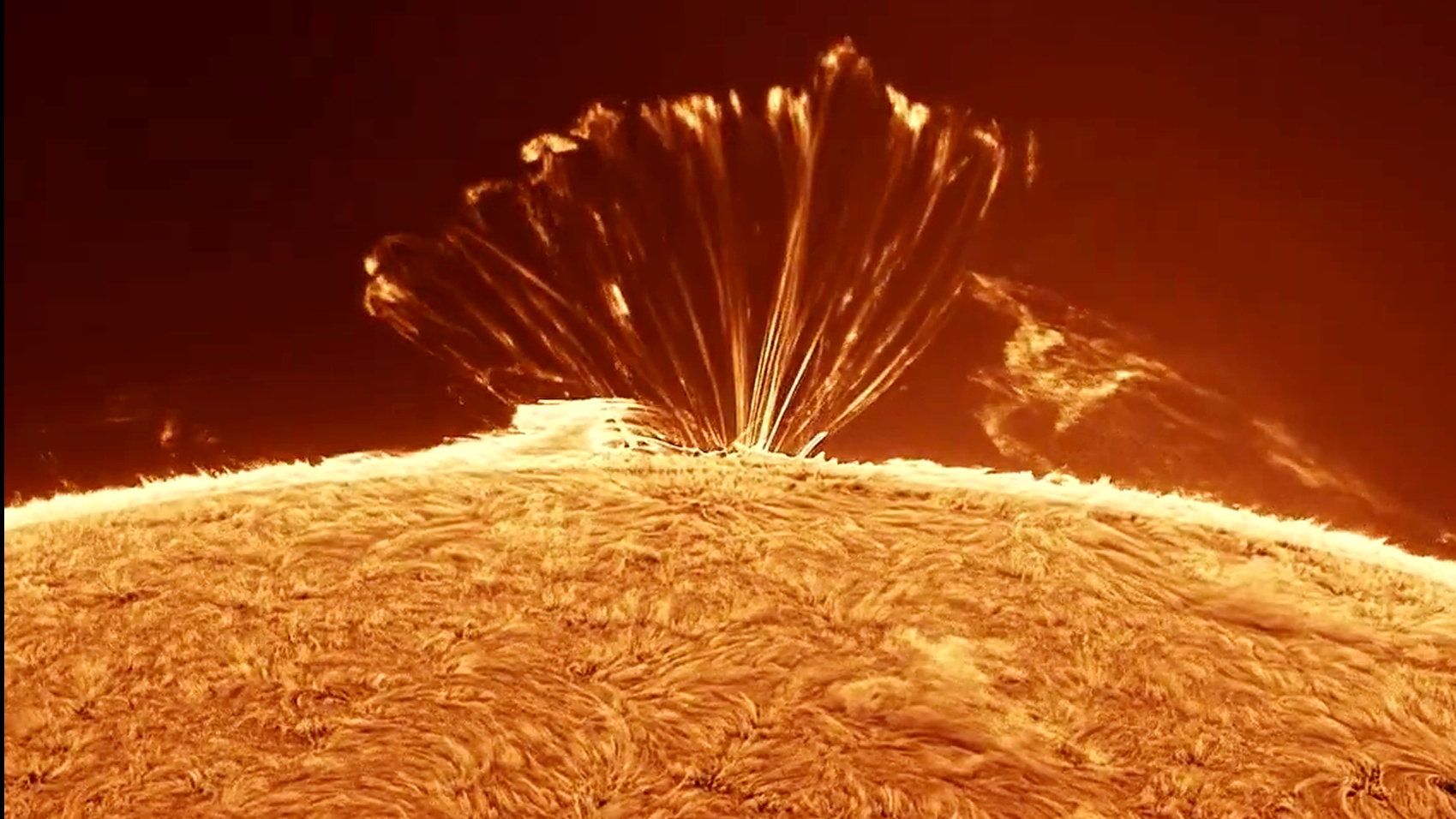
Astrophotographer Mark Johnston captured the sun in remarkable detail from his backyard in Arizona. (Image credit: Mark Johnston)
A spectacular series of glowing plasma loops arcs above the sun in this remarkable view captured from an astrophotographer's backyard.
What is it?
This image is a still from a high-resolution timelapse captured by astrophotographer Mark Johnston from Scottsdale, Arizona on Aug. 21, 2026.
The footage shows a coronal loop arcade — a series of arching loops of hot plasma shaped by the sun's magnetic field — extending high above the solar limb, or apparent edge of the sun.
Johnston recorded the scene for more than two hours, from 7:56 a.m. to 10:12 a.m. local time. His footage reveals the movement of plasma within the loops, including 'coronal rain' as material cools and falls back towards the lower solar atmosphere along magnetic field lines.
The sequence was captured using a TEC160FL refractor equipped with specialized hydrogen-alpha (H-alpha) solar imaging equipment, which helps reveal structures in the sun's atmosphere that would otherwise be very difficult to see.
Why is it incredible?
Coronal loop arcades like this one are a rare sight, but Johnston was particularly lucky to catch this one almost side-on at the edge of the sun, revealing the dramatic arching shape in exquisite detail.
"To see one AND catch it right on the limb AND have it happen on a clear day when I'm home and able to catch it was a real treat," Johnston told Space.com in an email.
Lucky for us, Johnston keeps a close eye on our star. The first thing he does each morning is check real-time imagery from NASA's Solar Dynamics Observatory (SDO) to see what the sun is up to.
"One day I saw this and leapt out of bed and dashed to get set up to capture it," Johnston said.
And this isn't the first spectacular solar show Johnston has captured from his backyard. Back in June, he imaged a colossal 'Godzilla' plasma cloud seemingly stalking the edge of the sun, complete with streams of coronal rains cascading back towards the solar surface.
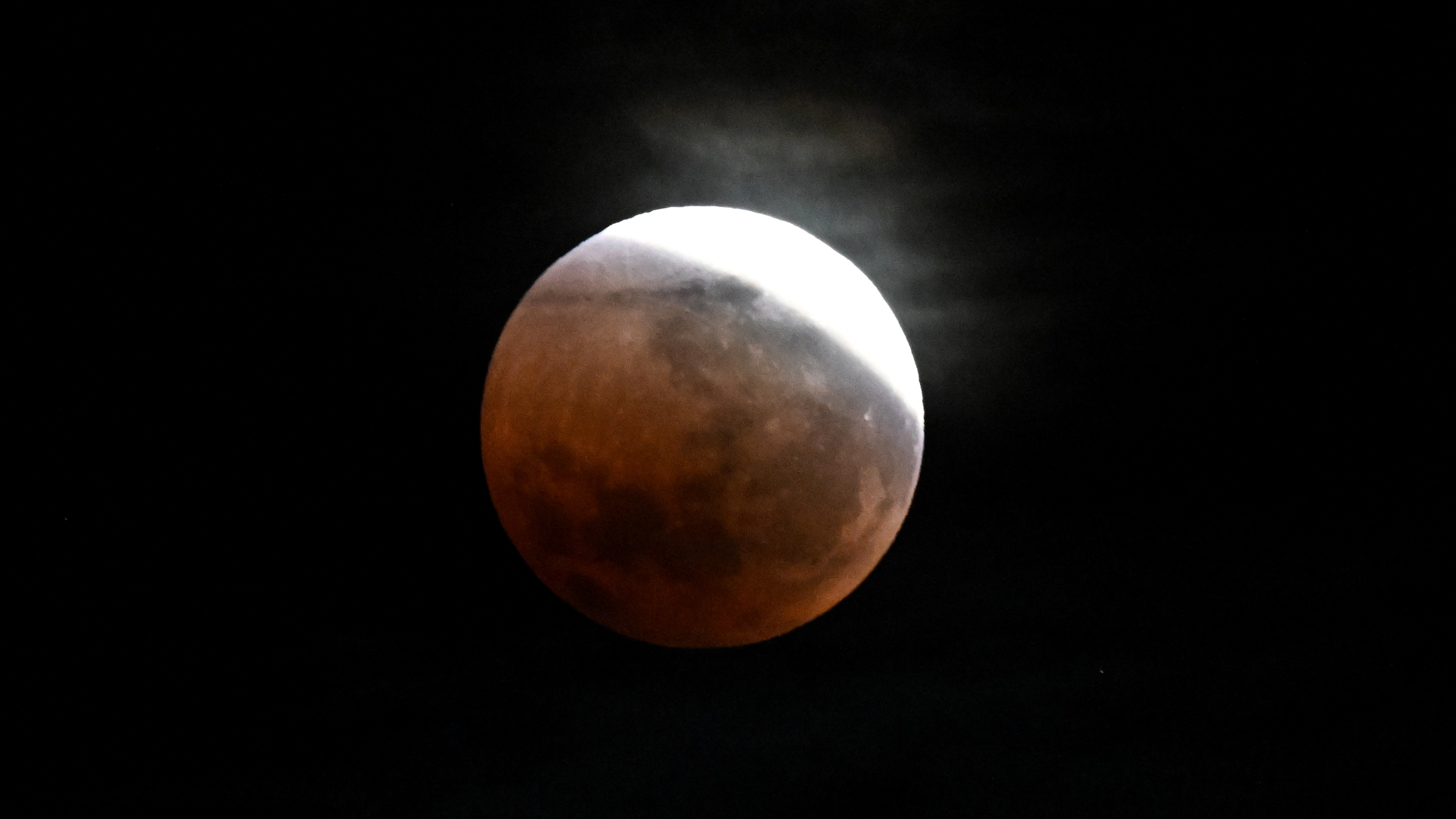
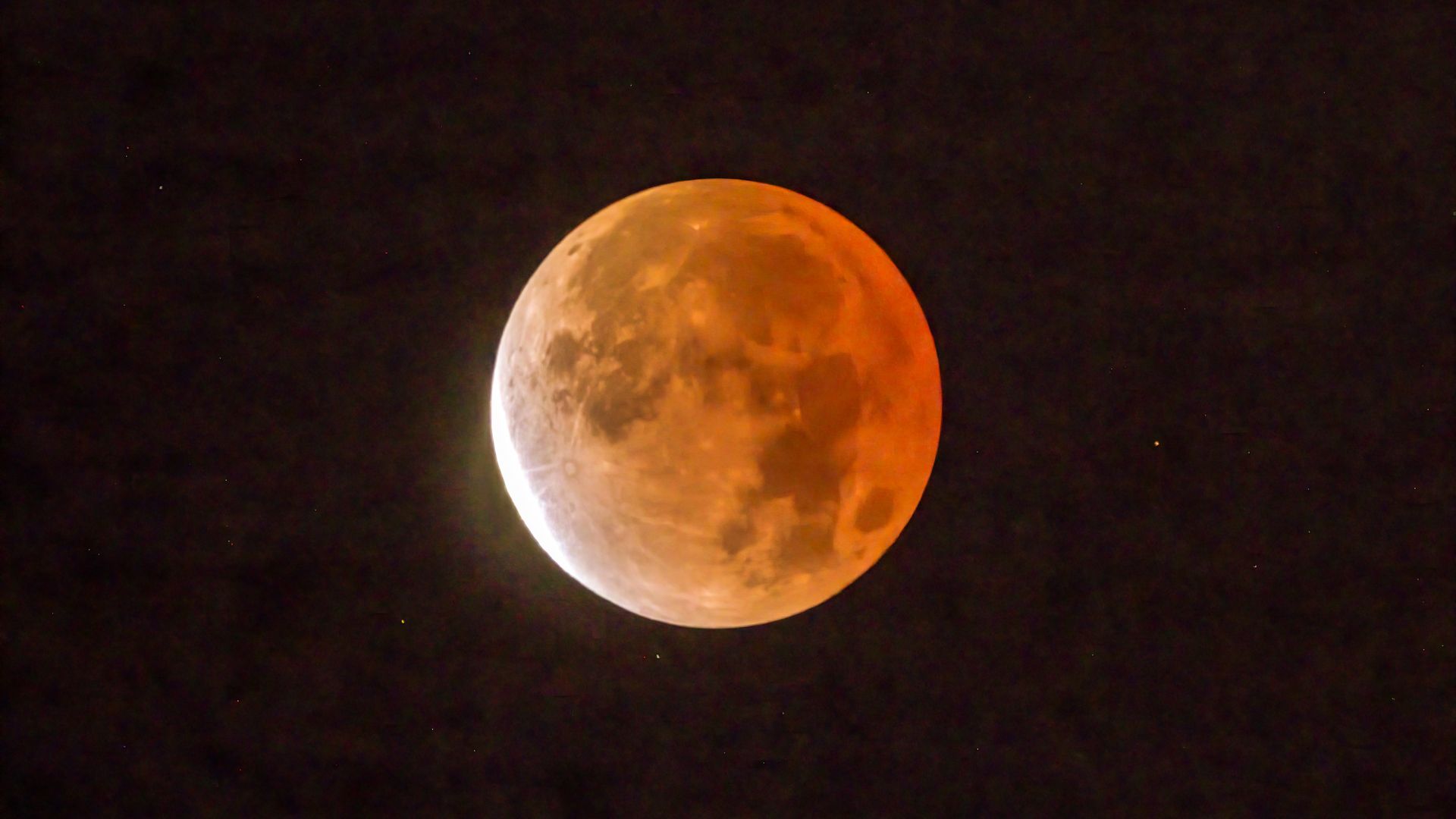
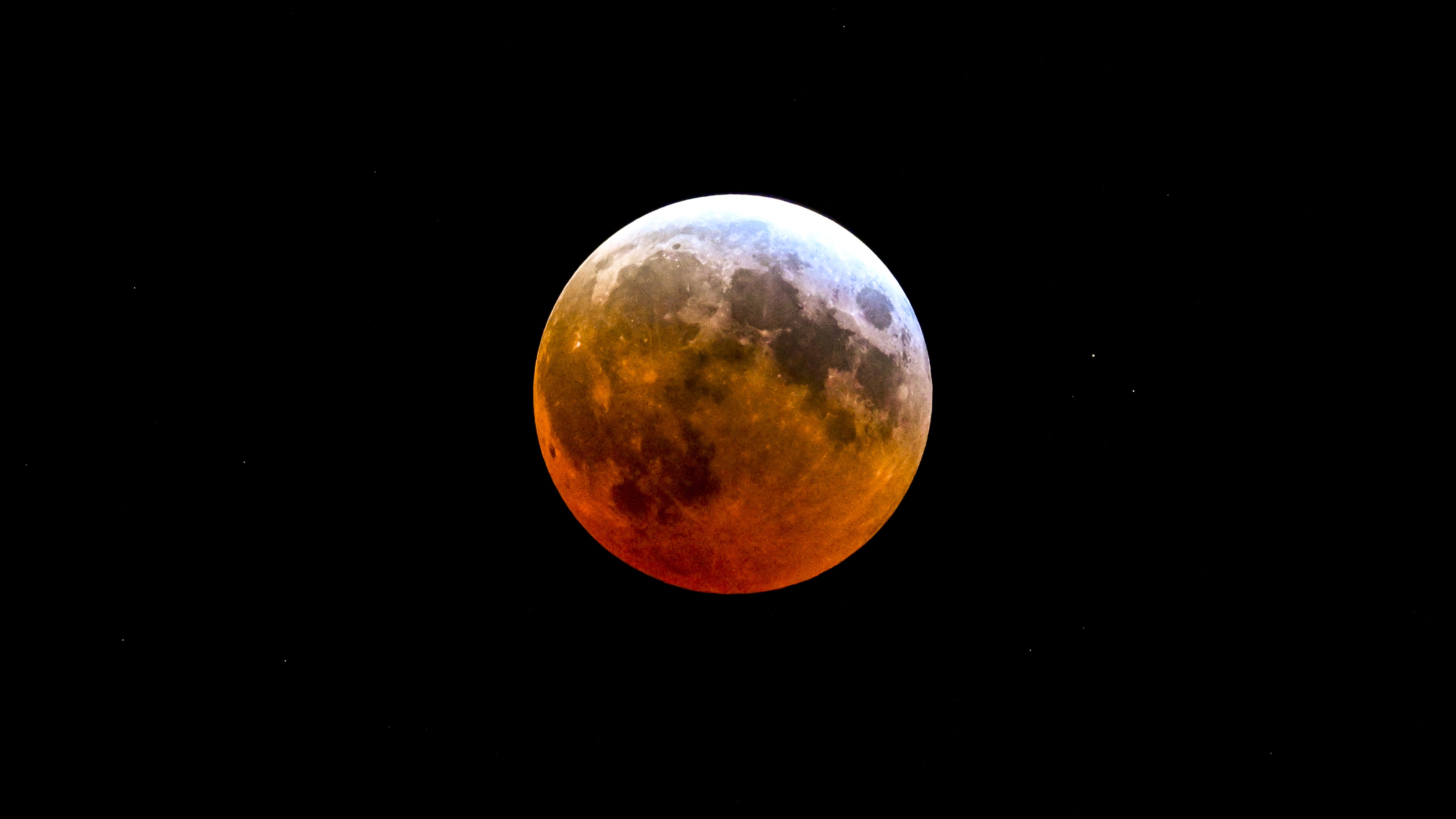
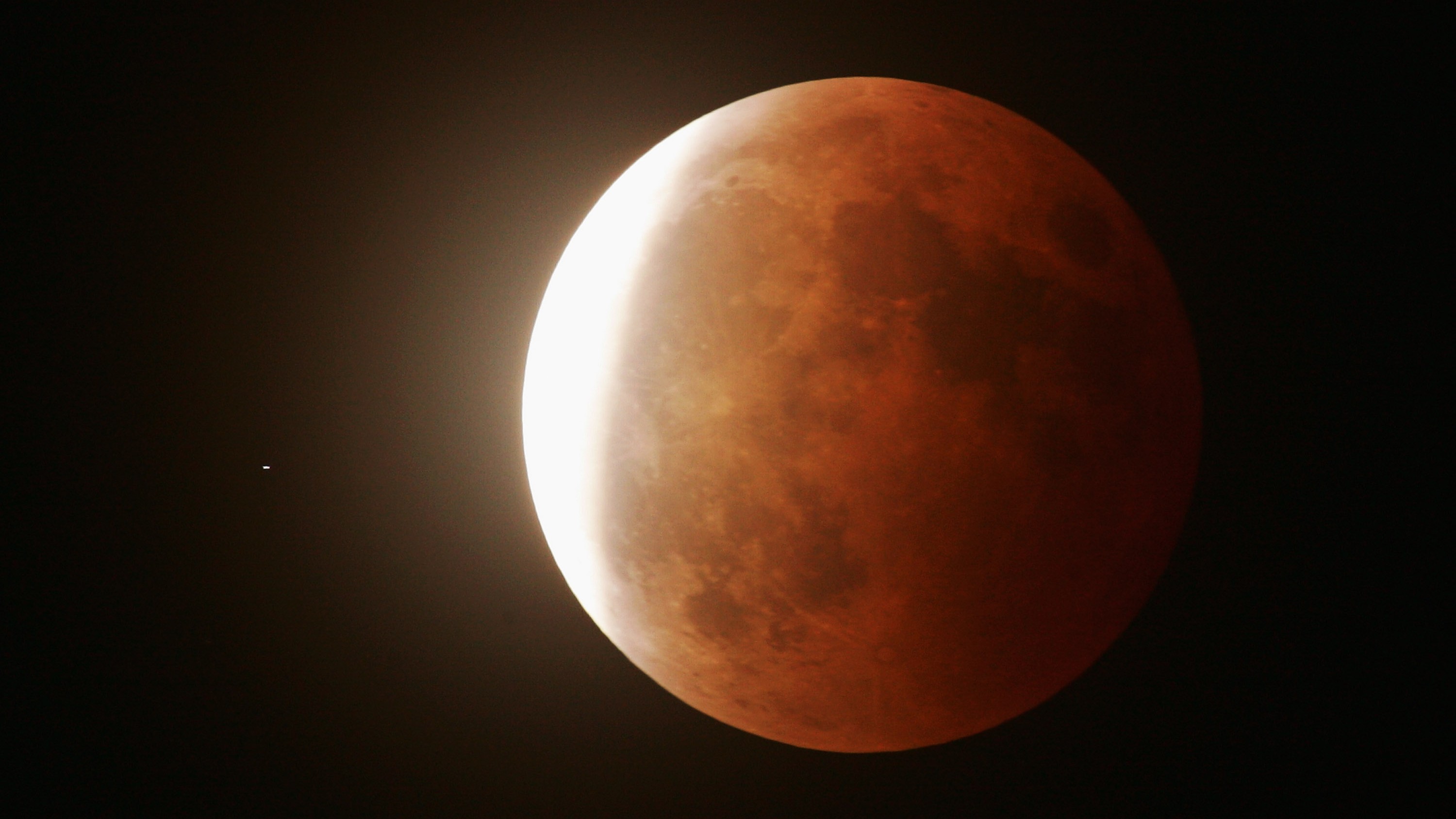
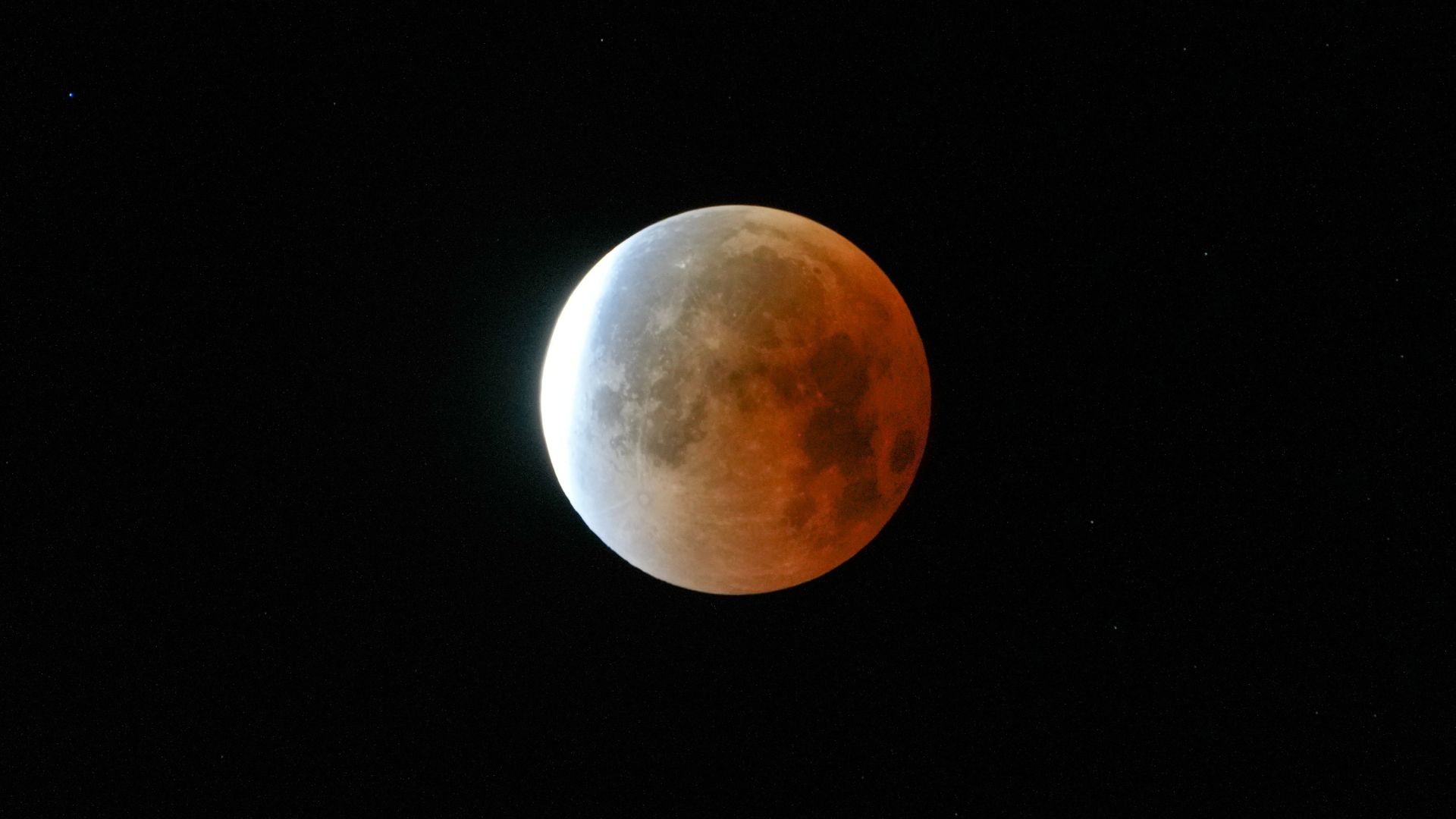
August's 96% partial lunar eclipse has been and gone, putting on a mesmerizing show for stargazers across the night side of Earth as out planet's shadow slipped silently across the face of the moon, forcing it to adopt a striking crimson hue at the point of maximum eclipse.
Tonight (Aug. 27-28), the full Sturgeon Moon will slip into Earth's shadow, creating a stunning "almost blood moon" as up to 96.2% of the lunar surface disappears into the darkest part of our planet's shadow, the umbra.
At maximum eclipse, much of the moon may take on an eerie reddish hue as sunlight filtered through Earth's atmosphere is refracted into the shadow and onto the lunar surface. Only a thin sliver of moon will escape Earth's umbra, appearing as a bright arc against an otherwise dim, rusty-red lunar disk.
Lunar eclipses are entirely safe to watch with the naked eye. Unlike a solar eclipse, you don't need filters or certified glasses. Just find the moon at the right time, then simply sit back, relax and enjoy the show. If you can't watch the eclipse in person, you can watch all the action unfold here on Space.com with these free livestreams, weather permitting. You can also follow along with the latest updates with our lunar eclipse live blog.
Who can see it?
The partial lunar eclipse favors observers across North and South America. About 12% of the world's population — 987 million people — will be able to see all phases of the eclipse, according to Time and Date, weather permitting.
Skywatchers across parts of Europe and Africa will also see the lunar eclipse. However, for many observers, including those in the UK, the moon will set shortly after maximum eclipse, cutting off the later stages of the partial phase.
When to look
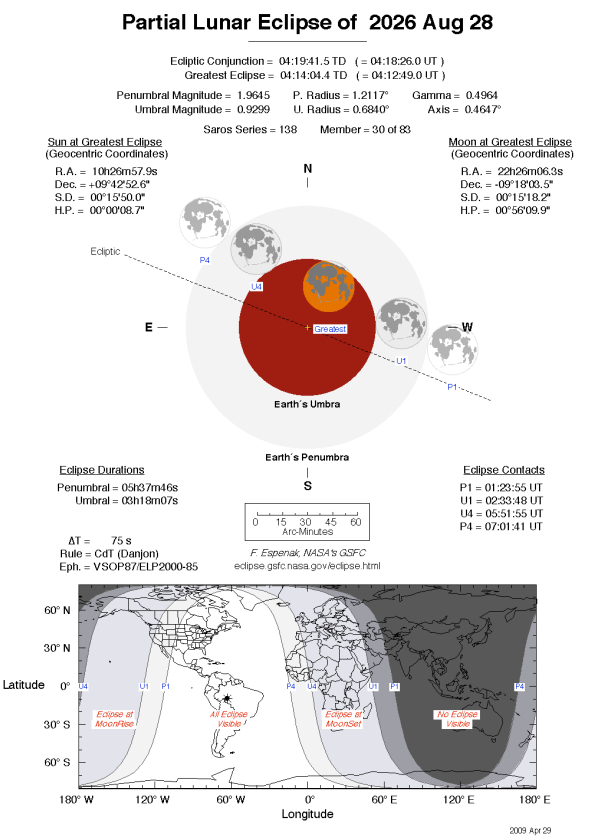
A map of the lunar eclipse on Aug. 27-28, 2026. Click the arrows in the bottom-left corner to expand to full screen. (Image credit: F. Espenak, NASA's GSFC)
The eclipse reaches its maximum at 12:12 a.m. EDT (0412 GMT) on Aug. 28, when 96.2% of the lunar surface will be covered by Earth's dark umbral shadow.
But if you have the time, it's worth settling in to watch as much of the eclipse as possible, particularly from the start of the partial phase at around 10:33 p.m. EDT on Aug. 27 (0233 GMT on Aug. 28).
The penumbral phase begins earlier, at 9:23 p.m. EDT on Aug. 27 (0123 GMT on Aug. 28), but the initial dimming will be extremely subtle because Earth's outer penumbral shadow is so faint.
I'd recommend starting your observations when the partial phase starts. From then on, you'll see Earth's shadow take progressively larger "bites" out of the moon. It can almost feel like watching the moon's monthly phases sped up into just a few hours as its appearance changes before your eyes.
Editor's Note: If you capture a photo of the August lunar eclipse and want to share it with Space.com's readers, then please send your photo(s), comments, name and location to spacephotos@space.com.
Aurora chasers are on alert after NOAA's Space Weather Prediction Center (SWPC) issued a moderate (G2) geomagnetic storm watch for Friday (Aug. 28), as coronal mass ejections (CMEs) launched from the sun yesterday (Aug. 25) head toward Earth.
The CME arrival follows a powerful M6.9 solar flare from restless sunspot region 4513 on Aug. 25. NOAA's SWPC has also issued a minor (G1) geomagnetic storm watch for Thursday (Aug. 27), as a stream of fast solar wind from a coronal hole is expected to buffet Earth ahead of the incoming CMEs
The M6.98 solar flare erupted from the active sunspot region 4513 and peaked at 6 a.m. EDT (1000 GMT), according to SpaceWeatherLive. 4513 has been particularly active over the previous 24 hours, firing off a barrage of solar flares including five powerful M-class eruptions. Solar flares are ranked by strength into five classes — A, B, C, M and X — with each class 10 times more powerful than the one before it. M-class flares are the second-strongest category, sitting just below the most powerful X-class eruptions.
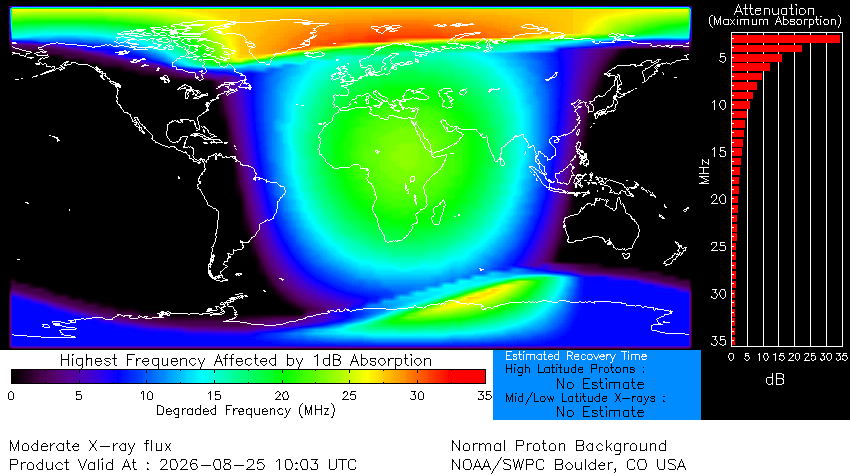
The eruption also triggered a moderate (R2) radio blackout across the sunlit side of Earth, affecting high-frequency radio communications over parts of Africa, Europe and the Arctic.
High-frequency radio blackouts from the M-class solar flare on Aug. 25. (Image credit: NOAA Space Weather Prediction Center)
CME incoming and possible northern lights?
The M6.9 flare wasn't the only eruption to launch material into space on Aug. 25. Several CMEs left the sun that day and NOAA's SWPC now anticipates their arrival at Earth.
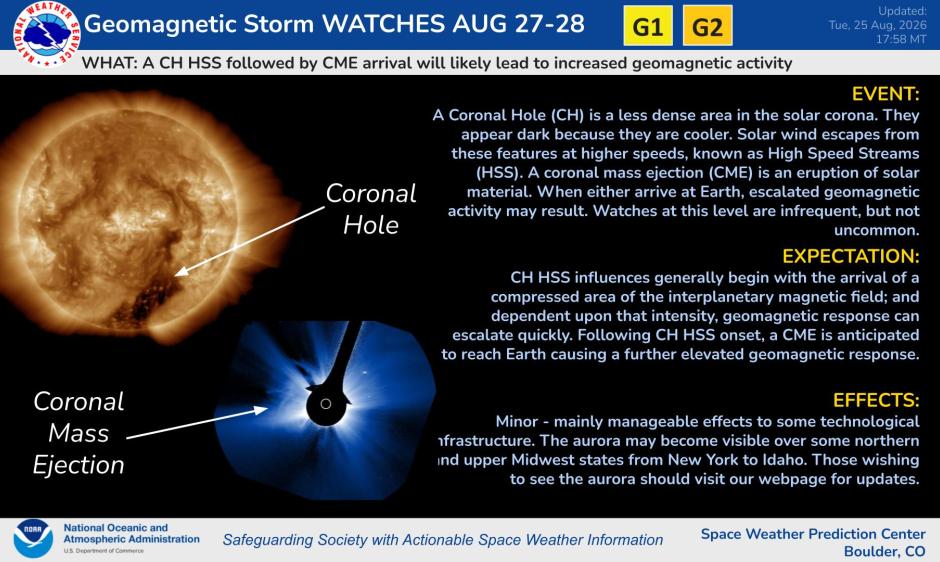
NOAA's SWPC has issued a moderate (G2) geomagnetic storm watch for Aug. 28.
Before then, a coronal hole high-speed stream is forecast to reach Earth, prompting a minor (G1) geomagnetic storm watch for Aug. 27. NOAA forecasts isolated G1 to G2 conditions across Aug. 27-28 due to the combined influence of the high-speed solar wind stream and the incoming CME activity.
During G2 geomagnetic storm conditions, the northern lights can push farther south than usual, potentially becoming visible across parts of the northern U.S. and northern Europe.
NOAA's Space Weather Prediction Center has issued a geomagnetic storm watch for Aug. 27-28. (Image credit: NOAA's Space Weather Prediction Center)
If the glancing CME arrival coincides with the high-speed solar wind stream, the two influences could work together to ramp up geomagnetic activity and potentially enhance aurora activity.
How much of an impact the CME ultimately has will depend on its exact arrival time and, crucially, the orientation of its magnetic field when it reaches Earth. A strong southward magnetic field would interact more effectively with Earth's magnetic field, increasing the chances of stronger geomagnetic activity.
We'll be keeping a close eye on the latest models and space weather forecasts as Friday approaches and will update this story as more information becomes available.
Editor's note: This story was updated on Aug. 26 at 4:00 a.m. EDT (0800 GMT) to include NOAA's latest forecast and geomagnetic storm watches for Aug. 27 and Aug. 28.
August's 96% partial lunar eclipse has been and gone, putting on a mesmerizing show for stargazers across the night side of Earth as out planet's shadow slipped silently across the face of the moon, forcing it to adopt a striking crimson hue at the point of maximum eclipse.
A dramatic partial lunar eclipse will occur tonight (Aug. 27-28), with almost the entire moon slipping into Earth's shadow.
At its peak, at 12:12 a.m. EDT (0412 GMT) on Aug. 28, 96.2% of the lunar surface will be covered by Earth's dark umbral shadow, leaving only a slender portion of the moon directly illuminated by the sun. The rest of the lunar surface may take on an eerie reddish-orange hue, creating an impressive 'almost blood moon'. The eclipse will be visible from North and South America, Europe and Africa, though exactly how much you'll see will depend on your location (and clouds!).
The eclipse begins when the moon enters Earth's faint outer shadow at 9:23 p.m. EDT on Aug. 27 (0123 GMT on Aug. 28).
Things get much more interesting at 10:33 p.m. EDT (0233 GMT), when the partial eclipse begins and Earth's dark umbral shadow starts to creep across the lunar surface.
Maximum eclipse occurs at 12:12 a.m. EDT (0412 GMT) on Aug. 28, when 96.2% of the moon will be immersed in Earth's umbra.
The partial phase ends at 1:51 a.m. EDT (0551 GMT), with the penumbral eclipse concluding at 3:01 a.m. EDT (0701 GMT).
A map of the lunar eclipse on Aug. 27-28, 2026. Click the arrows in the bottom left corner to expand to full screen. (Image credit: F. Espenak, NASA's GSFC)
North and South America are particularly well-placed for the entire eclipse.
For European skywatchers, the eclipse takes place during the early morning of Aug. 28, with the moon setting while the partial eclipse is still underway. From London, maximum eclipse occurs at 5:12 a.m. BST, just over an hour before moonset.
How to view the lunar eclipse
Unlike a solar eclipse, you don't need any special equipment to view a lunar eclipse. Simply head outside and look up. If you own binoculars or a telescope, take a look through them for an even better view of Earth's shadow sweeping across the lunar surface.
Editor's Note: If you capture a photo of the August lunar eclipse and want to share it with Space.com's readers, then please send your photo(s), comments, name and location to spacephotos@space.com.
The countdown is on for the deep partial lunar eclipse of Aug. 27-28. Over the next week, we'll be bringing you the latest eclipse news, viewing tips as well as live updates throughout eclipse night.
Although this isn't quite a total lunar eclipse, it's pretty close! At maximum eclipse, 96.2% of the moon will slip into Earth's dark central shadow known as the umbra, according to Time and Date. Much of the moon may take on a rusty red hue, while a thin sliver remains brightly illuminated.
It's the deepest partial lunar eclipse visible anywhere on Earth until Dec. 31, 2028, making it a must-see event worth staying up late — or setting an alarm early — for.
1 week to go until the deepest partial lunar eclipse until 2028
The partial phase of a lunar eclipse captured over Sydney in September 2025. (Image credit: Photo by Saeed KHAN / AFP via Getty Images)
We're officially one week away from one of the best skywatching events of the year!
On the evening of Aug. 27 (for North America), or the early hours of Aug. 28 (for western Europe), Earth's shadow will creep across the full moon during a very deep partial lunar eclipse. At maximum eclipse, 96.2% of the moon will be immersed in Earth's dark central shadow.
The eclipse will be visible, at least in some part, from North and South America, Europe, Africa and parts of western Asia, weather permitting. Observers in the Americas are well-positioned for the best views while skywatchers across Europe will need to look toward the western horizon before sunrise as the eclipse reaches its peak.
Why this partial lunar eclipse is one you won't want to miss
Craters and lunar seas mark the lunar surface during a deep lunar eclipse. (Image credit: Orchidpoet via Getty Images)
When most people hear the words "partial lunar eclipse," they might often assume it will be less impressive than a total eclipse, and not really worth the effort to try and see it. But the Aug. 27-28 eclipse is anything but ordinary.
At maximum eclipse, 96.2% of the moon will be immersed in Earth's umbra, the darkest part of our planet's shadow. That means only a thin sliver of the lunar surface will remain directly illuminated by the sun, while the rest of the moon will take on a deep reddish-orange hue.
If you miss this one, you'll have to wait until Dec. 31, 2028 for another lunar eclipse that rivals it in spectacle. So whether you're planning on staying up late in the US or setting your alarms early in Europe, this is one skywatching show that's well worth making time for!
Where will the Aug. 27-28 partial lunar eclipse be visible?
The partial phase of a lunar eclipse captured over Canada in 2025. (Image credit: Photo by Chen Shaojin/VCG via Getty Images)
The good news is that unlike a solar eclipse, a lunar eclipse can be seen from anywhere the moon is above the horizon. That means millions of skywatchers worldwide will have a chance to witness at least part of the Aug. 27-28 eclipse, weather permitting.
The best views will be from North and South America, where the entire eclipse will be visible. Across Europe and Africa, the eclipse takes place before dawn on Aug. 28, with the moon setting during the latter stages of the event.
A lunar eclipse captured over the United Kingdom in 2007. (Image credit: Photo by Mike Hewitt/Getty Images)
One of the wonderful things about a lunar eclipse is that it can be witnessed by everyone who happens to be on the night side of Earth as it occurs, weather permitting.
You don't need any special equipment like eclipse glasses to enjoy the show. Simply step outside and look up to see Earth's curved inner shadow crawl across the moon in a spectacular display of orbital mechanics.
Want a closer look? No problem! It's completely safe to point a pair of binoculars or a telescope at the moon during a lunar eclipse. Doing so will give you a magnified view of the colossal craters and dark lunar seas that mark the moon's near side as they fall within the umbral shadow.
3 days to go! Here's everything you need to know
3 days until the partial lunar eclipse, here's everything you need to know. (Image credit: Eclipse inset: Giovanni Bortolani via Getty Images. Royalty Free. Graphic created in Canva Pro.)
The deep partial lunar eclipse is just a few days away, so now is the perfect time to start planning how you're going to view the "almost blood moon".
At maximum eclipse, 96.2% of the moon's surface will be covered by Earth's dark central shadow known as the umbra. While the moon won't be completely eclipsed — so this isn't technically a "blood moon" — much of the lunar surface is expected to take on a reddish-orange hue, with just a thin sliver remaining brightly illuminated.
What will happen during each stage of the partial lunar eclipse?
A partial lunar eclipse turns the moon red in the skies over Sri Lanka. (Image credit: Photo by Thilina Kaluthotage/NurPhoto via Getty Images)
A partial lunar eclipse has five distinct phases that occur simultaneously for everyone on the night side of Earth as our planet slips between the sun and its natural satellite during the full moon phase.
The eclipse begins as Earth's outer penumbral shadow subtly darkens the moon, after which the inner umbral shadow reveals our planet's curved silhouette as it advances across the lunar disk.
(Image credit: Created in Canva Pro by Daisy Dobrijevic)
Planning to watch the deep partial lunar eclipse this week? You'll want to make sure you're looking up at the right time.
The eclipse begins at 9:23 p.m. EDT on Aug. 27 (0123 GMT on Aug. 28), when the moon enters Earth's faint outer shadow, known as the penumbra. From then, the eclipse will deepen and become more visible over several hours as the moon passes into Earth's darker umbral shadow, ultimately leaving 96.2% of the lunar surface covered at its peak.
I woke up on the morning of Aug. 12 and looked out of the window to something I hadn't dared hope for: blue sky.
After days of scrutinizing weather models that seemed determined to test the nerves of everyone aboard the HX Expeditions ship MS Spitsbergen, somehow, against the odds, the clouds had cleared. Even then, I didn't trust it (especially after my 2024 eclipse experience). We had traveled thousands of miles, crossed the Greenland Sea and ventured deep into Scoresby Sund to put ourselves in the path of the moon's shadow. Now there was nothing to do but wait — and hope the sky stayed clear.
The wind howled across the deck, but nobody seemed to mind. If anything, it was helping us, keeping the clouds at bay. The atmosphere aboard felt like Christmas Eve with a ship full of overexcited children. Some guests had chased eclipses across the world; for others, this would be their first. Either way, Aug. 12 was the date we'd been waiting years for.
But by the time we reached Scoresby Sund, something had shifted.
I had traveled all this way to look up. Instead, I found myself looking around. I'd come here for 2 minutes and 14 seconds of darkness. Instead, Greenland had spent the previous days relentlessly demanding my full attention.
This trip was made possible by travel and accommodation provided by HX Expeditions.
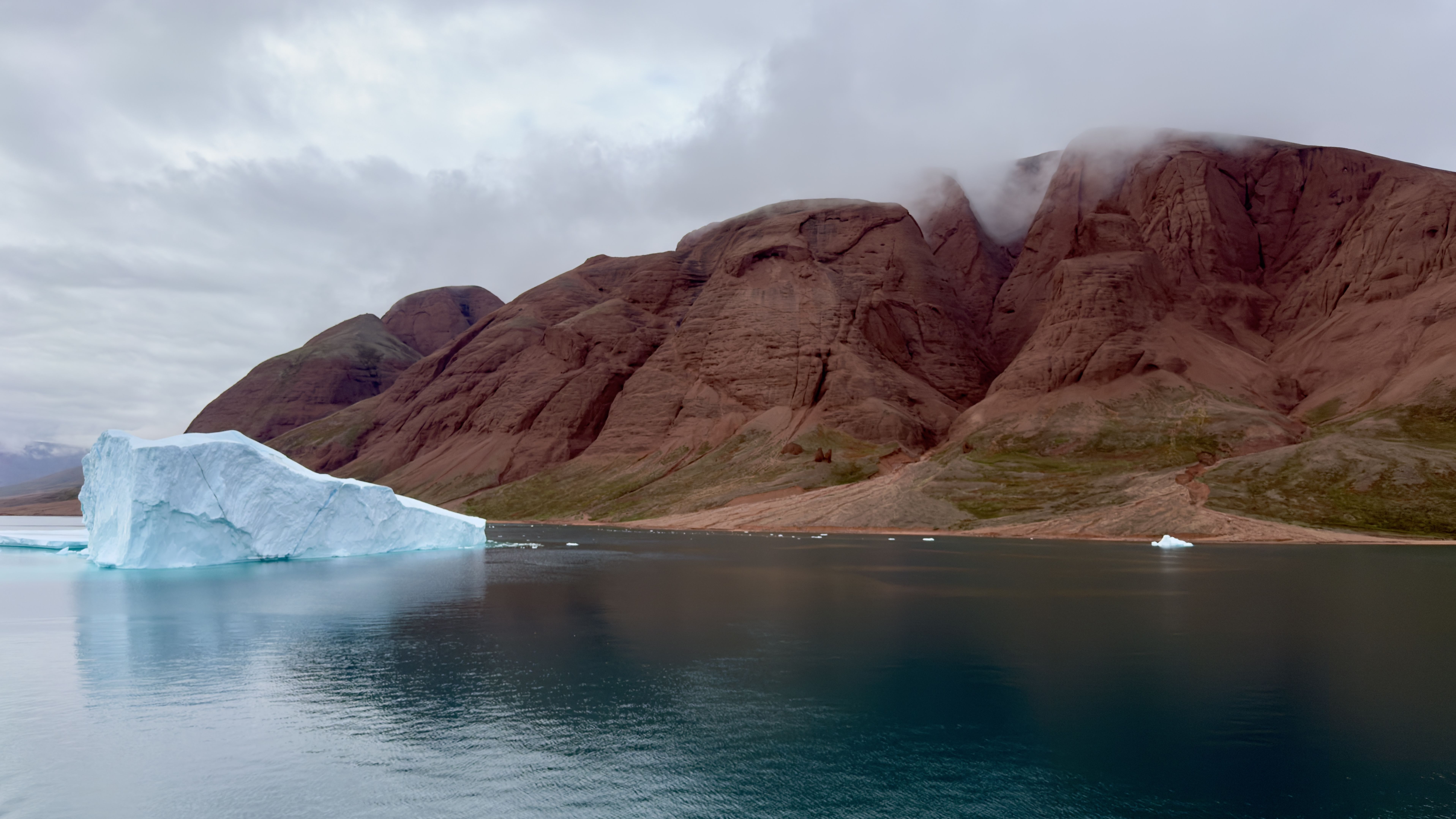
After a couple of days at sea during the crossing from Svalbard to East Greenland, our first sight of land appeared almost like a mirage on the horizon. Soon, icebergs were drifting past the ship and the scale of the landscape became increasingly difficult to comprehend. We could sail for hours through Northeast Greenland National Park without seeing a single sign of human civilization beyond our own ship. At times, moving through those immense geological landscapes felt less like traveling across Earth and more like exploring some distant, icy-covered moon.
The East Coast of Greenland is one of the most remarkable environments I have ever experienced. (Image credit: Daisy Dobrijevic/Future)
Yet, the more otherworldly Greenland appeared, the more it made me appreciate our own planet.
At times it felt as though I'd stepped into a geology textbook. Processes and structures I'd previously seen reduced to diagrams were suddenly towering above me. And amongst all the enormity were the tiniest signs of life: lichens and miniature Arctic plants hugging the ground beneath vast mountains and glaciers.
The scale and contrast were overwhelming at times, and no view stayed the same for long.
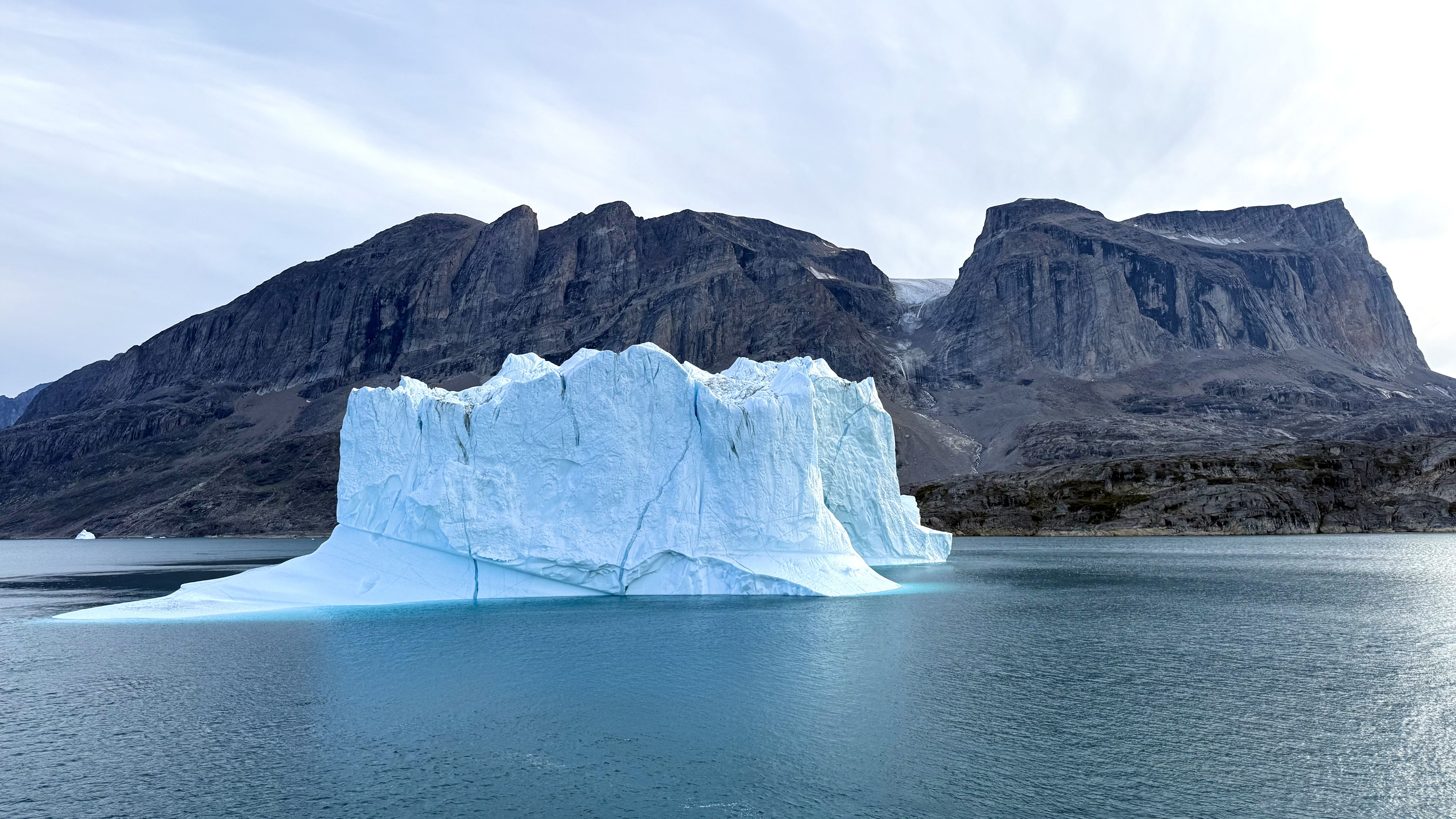
An iceberg viewed from one side could morph into a completely different form as the ship sailed past it. A break in the clouds could transform a gray mountainside in seconds. In Scoresby Sund, even the ice seemed to echo the landscape around it as jagged peaks, flat-topped slabs and sculpted ridges rose from the water like miniature versions of the colossal mountains behind them.
A landscape dominated by giants. (Image credit: Daisy Dobrijevic/Future)
The Greenland scenery was a gift that kept on giving, and I found myself increasingly reluctant to go inside. I began meticulously scanning for wildlife, because I'd learned how quickly something extraordinary could appear.
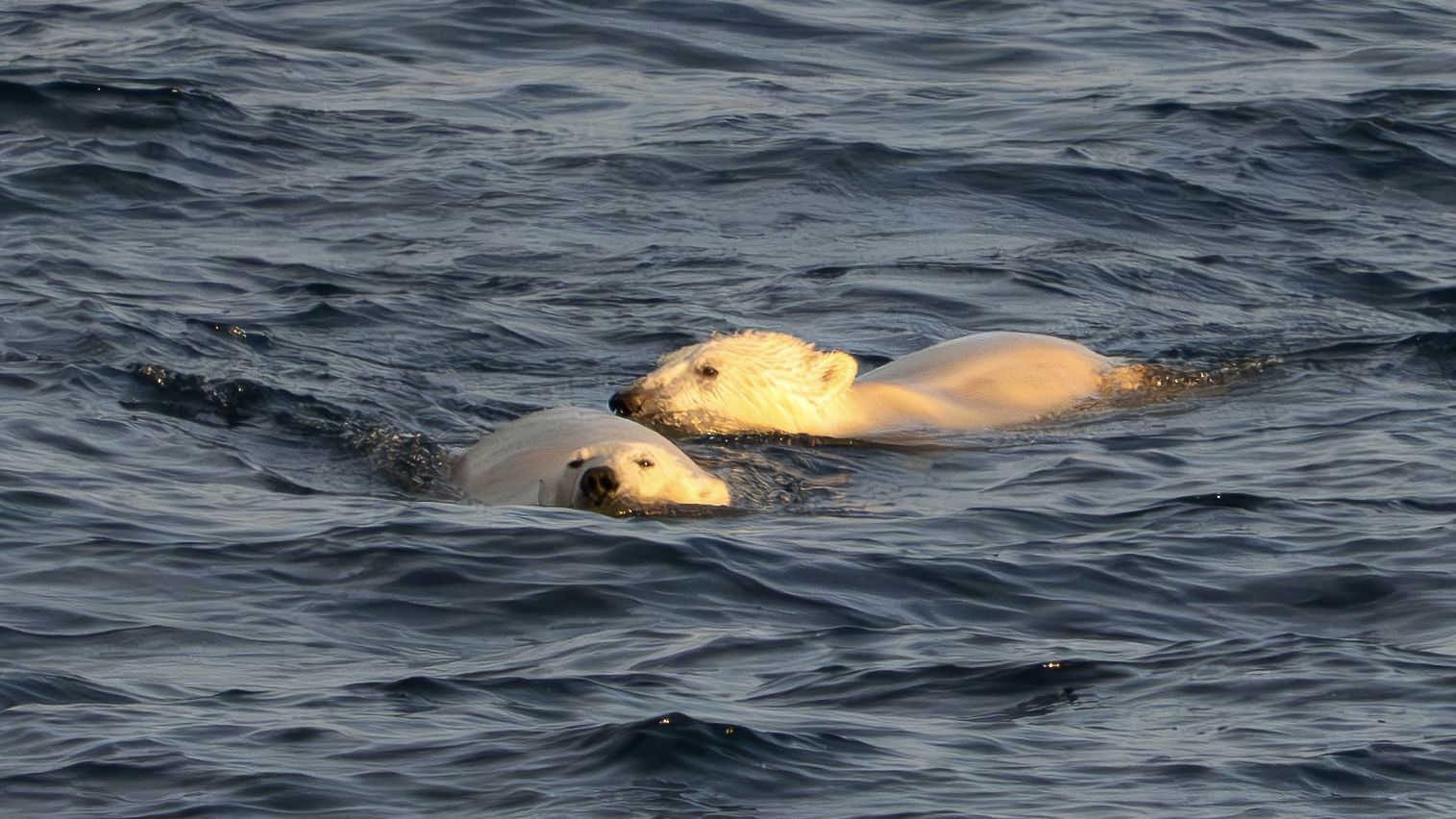
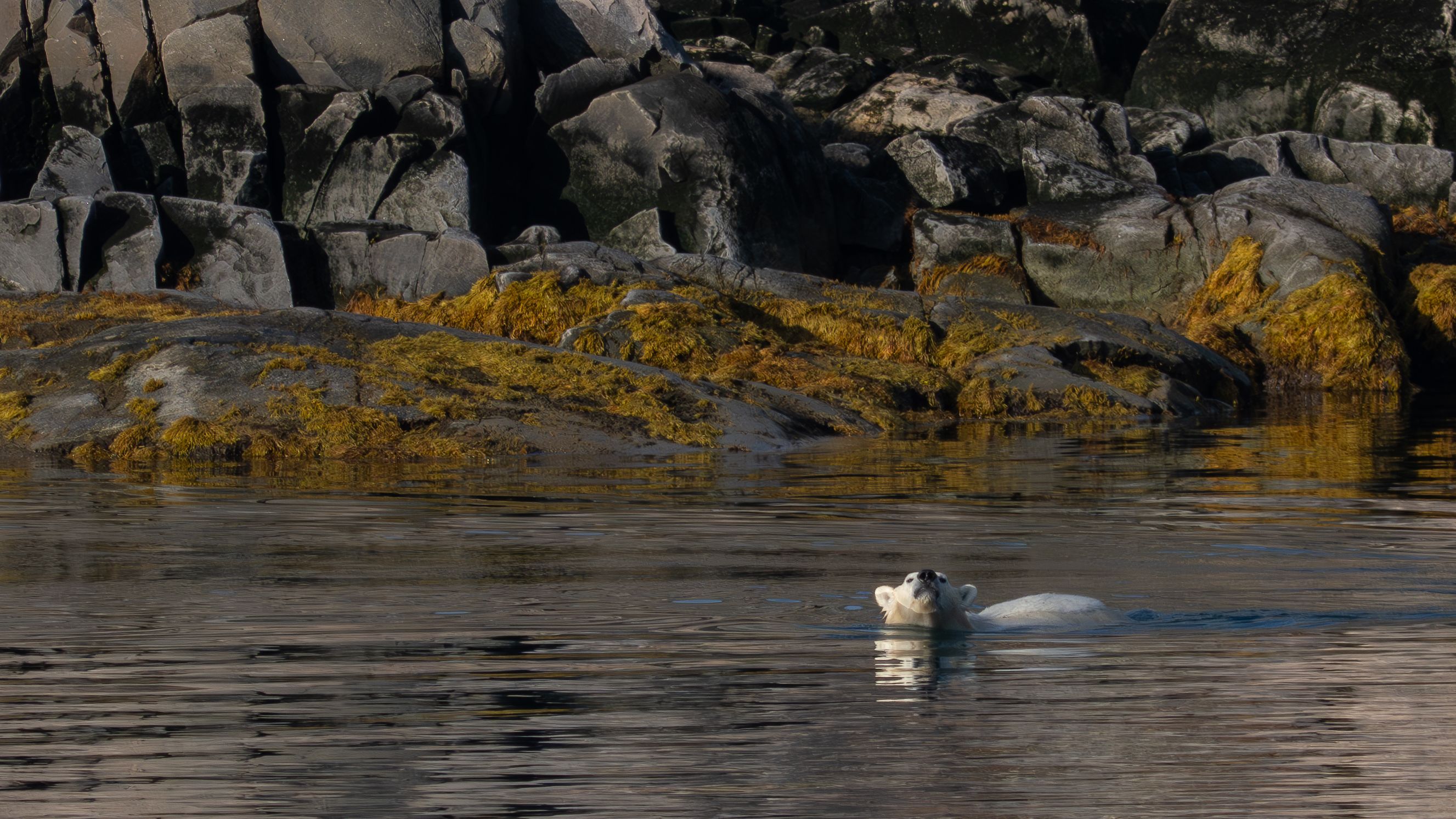
On an impromptu evening walk in Longyearbyen before we set sail, beluga whales had suddenly surfaced in the bay. Later, in Greenland, while I was distracted by a spectacular circumzenithal arc and sundogs overhead, one of a handful of people still standing on deck spotted two tiny white shapes in the water. I thought they were birds bobbing along.
Then I lifted my camera and zoomed in.
Polar bears.
Two unexpected visitors. (Image credit: Daisy Dobrijevic/Future, captured with Sony A7RV and FE 400-800mm F6.3-8 G OSS lens)
It became something of a lesson for the expedition: stay curious, keep your eyes open and remember to look both up and down.
That curiosity seemed to unite everyone aboard. Guests had traveled from around the world for this eclipse opportunity. There were seasoned eclipse chasers looking to experience totality somewhere extraordinary, first-timers who had no idea how they would react and people drawn as much by the adventure and wildlife, as the eclipse itself.
HX Expeditions' onboard science and education programme gave that shared enthusiasm somewhere to go. Our days were filled with nature landings, lectures, citizen-science projects and conversations with experts, helping us do more than simply travel through Greenland. The programme encouraged us to pay closer attention — not merely to see the landscape, but to understand and truly experience it.
Conversations jumped from eclipses to wildlife, travel, geology and perhaps, inevitably for a ship full of skywatchers, clouds. We took part in the GLOBE Observer cloud citizen science project and found ourselves happily studying them — while collectively hoping they would be nowhere near the sun on eclipse day.
The eclipse had brought us together, but the journey had quickly become about much more.
MS Spitsbergen poised and ready for the total solar eclipse on Aug. 12, 2026. (Image credit: Daisy Dobrijevic/Future)
Then, on Aug. 12, our attention returned to the sky.
When the moon took its first tiny bite from the solar disk, excitement rippled across the deck. For the next hour, it steadily consumed more of the sun.
As totality approached, the quality of the light began to change.
It became strangely yellow and dull, yet at the same time the landscape seemed almost unnaturally sharp. It was eerie — familiar enough to still resemble daylight, but wrong enough that your brain knew something extraordinary was happening.
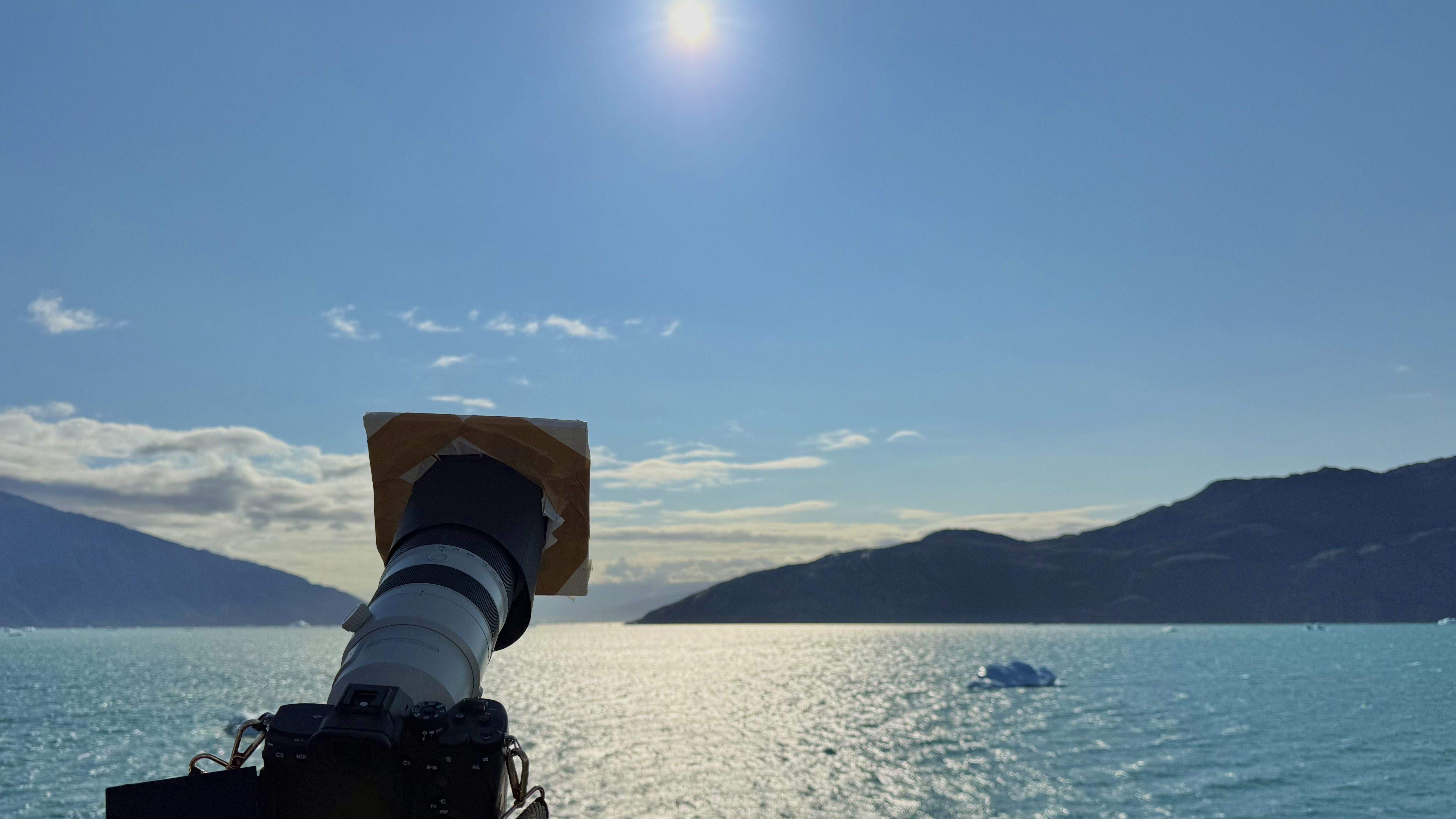
Poised and ready for the eclipse. I captured the image of totality with a Sony A7RV and FE 400-800mm F6.3-8 G OSS lens and a makeshift solar filter using Baader AstroSolar Safety Film. (Image credit: Daisy Dobrijevic/Future)
What amazed me most was how long that daylight persisted.
Even when only the tiniest sliver of sun remained, Greenland was still illuminated. I knew scientifically how intensely bright the solar photosphere is, but knowing it and watching that minuscule fraction of sunlight continue to illuminate an entire landscape were two very different things.
Then the final fraction disappeared.
The world around me plunged into twilight.
And there it was.
Totality.
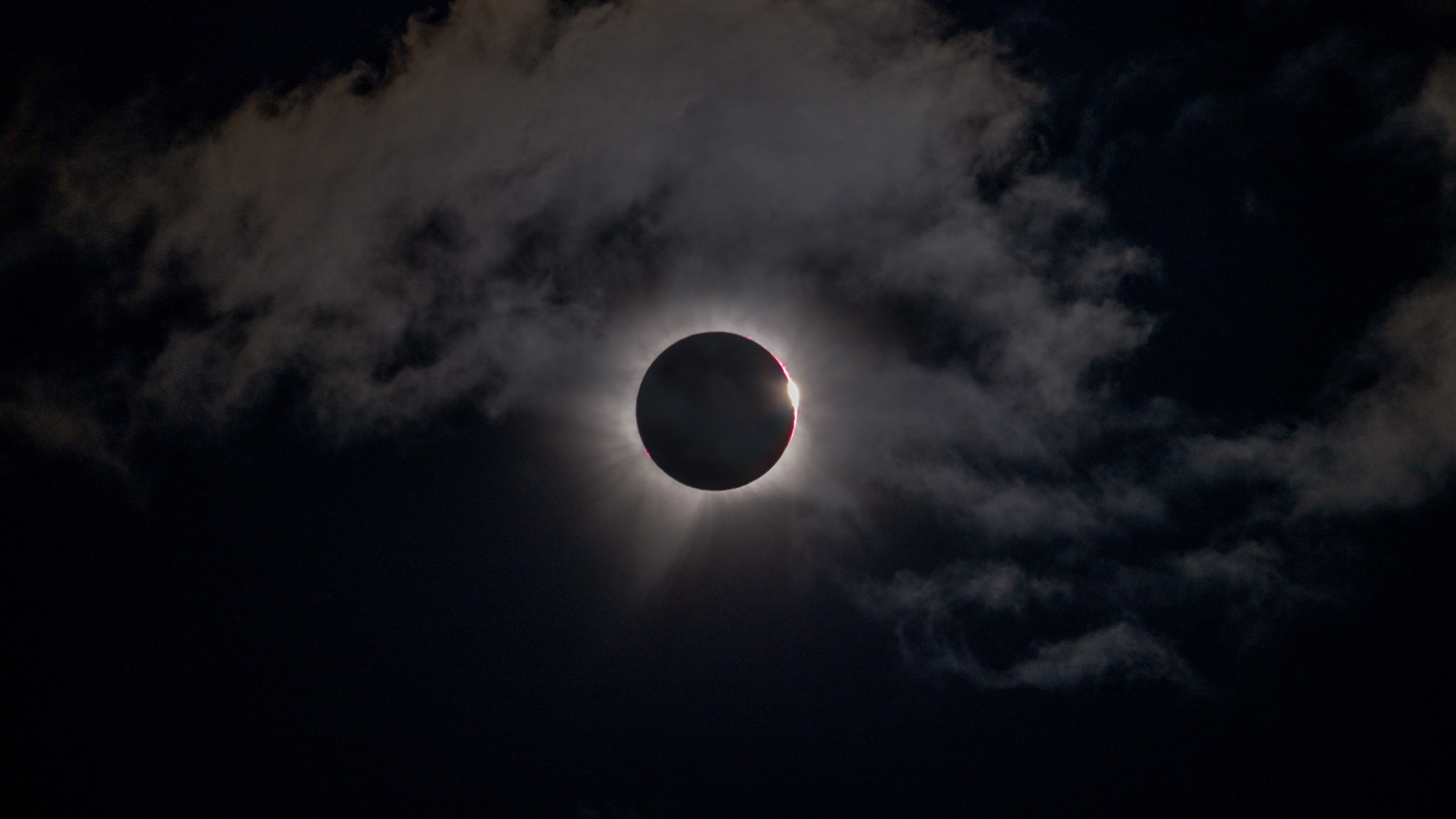
The total solar eclipse viewed from the deck of HX Expeditions' MS Spitsbergen. (Image credit: Daisy Dobrijevic/Future)
I knew exactly what I was supposed to see. I've written about eclipses for years. I understand the science. I had seen thousands of photographs of the corona, prominences, Baily's beads and diamond rings.
None of it prepared me for the feeling of actually seeing one.
The first thing that struck me was how large the eclipsed sun appeared to the naked eye. Photographs had never prepared me for that sense of scale, nor how much detail I could see with my own eyes.
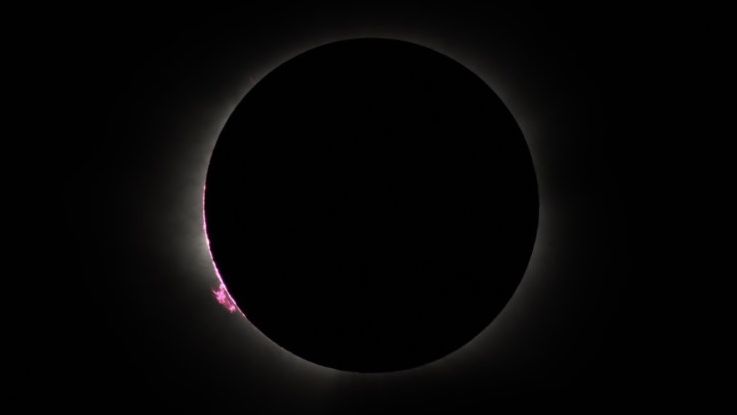
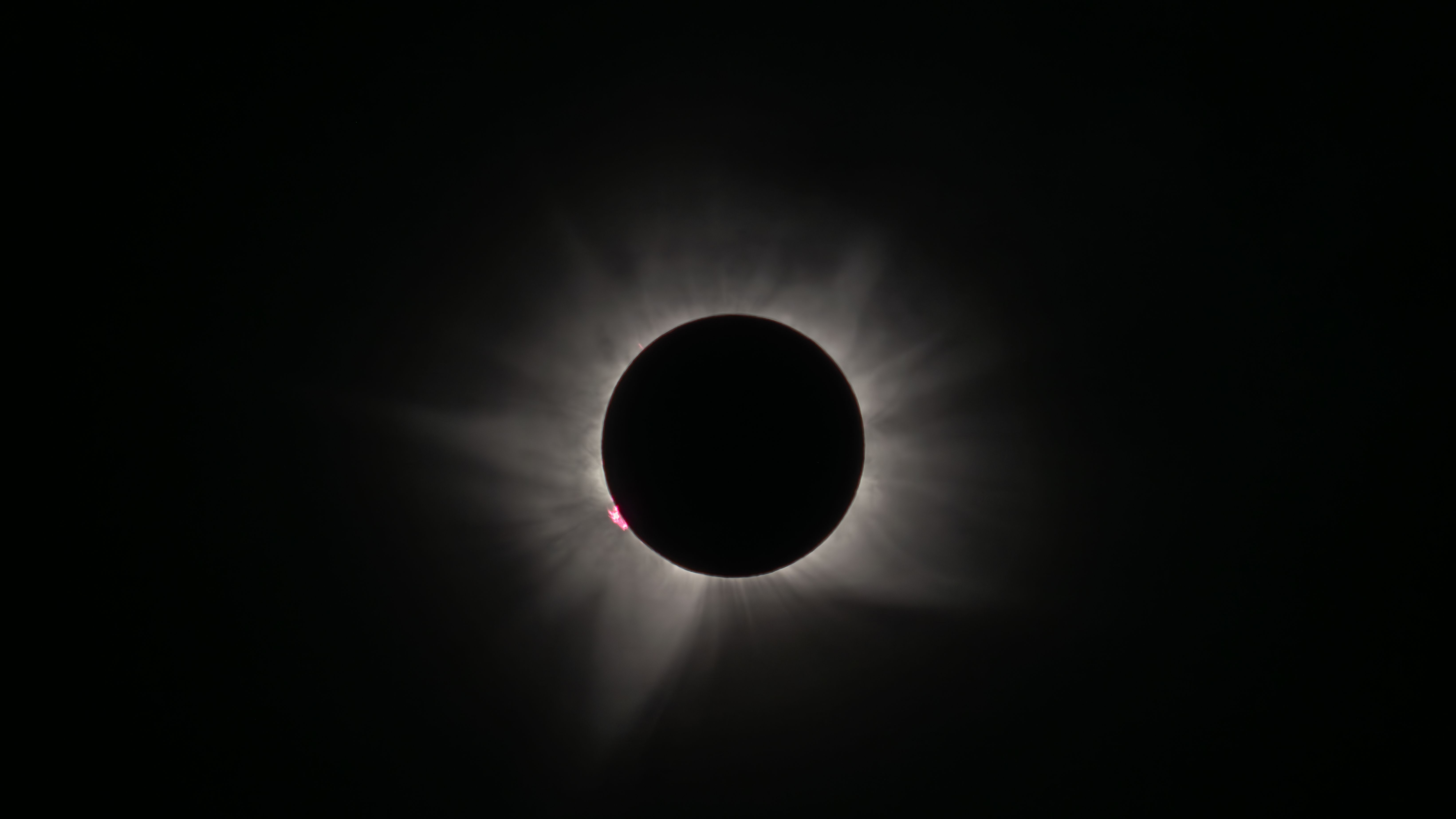
The giant pink prominence on the lower left limb was bright enough to see with the naked eye. (Image credit: Daisy Dobrijevic/Future, captured with Sony A7RV and FE 400-800mm F6.3-8 G OSS lens)
The moon itself looked impossibly dark — a black void punched into the sky — surrounded by the pearly white corona. Long streamers stretched away from the sun and around the moon's edge I could see bright pink prominences.
I was so surprised to see this vivid pink color with my own eyes. For 2 minutes and 14 seconds, I saw the sun as I had never seen it before.
But even then, I couldn't just look up.
I looked around. Jupiter and Mercury shone clearly off to one side of the eclipsed sun, with Mercury far brighter and easier to spot than I had expected. Venus blazed on the other side.
Then I looked down. Below the eclipsed sun were icebergs. Beside us rose the immense walls of Scoresby Sund. Glaciers carved their path through the landscape.
Above it all hung that black disk and its enormous, delicate corona. My brain simply couldn't take it all in.
There was too much beauty. Too much scale. Too much happening at once.
People use words such as "mind-blowing" and "speechless" so often that they begin to lose their meaning.
But my mind was really blown. And I really was speechless. Perhaps the best way I can describe it is that my mind felt full, but quiet. Full because there was almost too much to comprehend, but quiet because for those fleeting moments, there was room for nothing else.
I was astonished by how much of the corona you could see with the naked eye. (Image credit: Daisy Dobrijevic/Future, captured with Sony A7RV and FE 400-800mm F6.3-8 G OSS lens)
The intensity of the experience surprised guests who had originally joined the voyage for different reasons.
"My husband and I came to see the wildlife, and we were actually in awe of what we saw in relation to the solar eclipse," Kenya Haupt, from Colorado, told Space.com. "Truly an emotional experience"
The reasons for joining the expedition varied, but beneath the moon’s shadow, the experience became a collective one.
For Shubhada Maitra, from India, it was her first total solar eclipse.
"When I looked around me, I just had a feeling that we were one community, taking part in one of the most spectacular, perhaps once-in-a-lifetime celestial events," Maitra said. "Although we came from different countries, different nationalities, genders, all of that, that solar eclipse just bound us together."
"Without saying anything, we were just so connected in that experience."
Lisa Marie Morse, from Rhode Island, described the eclipse as both "joyous and melancholy."
"In that moment of darkness, I felt a powerful connection with all living things, to an infinite ancient rhythm locking us together for 134 seconds of shared awareness, then releasing us back into our daily slumber," Morse said. "It was magical."
Then, almost as quickly as totality had arrived, it was ending.
The first brilliant beads of sunlight appeared from behind the moon.
They were beautiful, but there was a sadness in seeing them too. The corona, prominences and extraordinary black void that had dominated the sky were about to disappear once more into the overwhelming glare of the sun.
Two minutes and 14 seconds had somehow felt both packed with experience and impossibly brief. I had just enough time to look with my naked eye, search for planets, check it out through binoculars and try to absorb the reactions around me.
Then it was gone.
For seasoned eclipse chaser Roy Tillcock from the Isle of Wight, the clear view had come as a genuine surprise.
"This was one of the most unexpected eclipses I've seen," he said. "I did not have high hopes of seeing it, and there it was. Brilliant."
And, as if to underline just how fortunate we had been, the clouds rolled in shortly after totality. A few minutes later, and this could have been a very different story.
Some skywatchers were emotional. Others were exhilarated. Many, like me, seemed to be struggling to find words big enough for what had happened.
Perhaps that is part of why eclipse chasing becomes so addictive. We can explain the science of totality in extraordinary detail. We can calculate the path of the moon's shadow years in advance, travel thousands of miles to stand beneath it and know exactly when and where darkness will fall.
But knowing what to expect is not the same as experiencing it.
The following morning, Greenland was still there, still demanding my undivided attention. Icebergs drifted past the ship. Mountains towered above the fjord. The sunlight shifted and the landscape transformed once again. I had traveled all this way to look up.
There was never a bad view as we journeyed through Scoresby Sund aboard MS Spitsbergen. (Image credit: Daisy Dobrijevic/Future)
But somewhere along the journey, I had learned to truly look around. Here I was, standing on a planet of glaciers, oceans, wildlife and ancient rock, watching its moon pass perfectly across its star at a moment in Earth's history when their apparent size in our sky happened to match. How lucky are we to experience any of this? Luck, ultimately, is something no eclipse chaser can ignore.
We could calculate where the shadow would fall. We could sail into its path. We could scrutinize forecasts, prepare our equipment and position ourselves as carefully as possible.
But we couldn't command the clouds to cooperate.
Nature always has the final say. And on Aug. 12, 2026, in a remote fjord in East Greenland, nature said yes.
Greenland was full of surprises. (Image credit: Daisy Dobrijevic/Future, captured with Sony A7RV and FE 400-800mm F6.3-8 G OSS lens)
Editor's note: This trip was made possible by travel and accommodation provided by HX Expeditions.
Yesterday (Aug.12), millions of people enjoyed a total solar eclipse as it swept across parts of Greenland, Iceland and Spain, while a partial solar eclipse was visible across much of Europe and northwest Africa.
If all that eclipse excitement has you eager for more, the good news is you won't have to wait long, because two remarkable solar eclipses are coming in 2027. First comes a dramatic "ring of fire" annular solar eclipse on Feb 6, followed six months later by the total solar eclipse on Aug. 2 — an event many eclipse chasers are already calling the "eclipse of the century".
First up, a dazzling "ring of fire"
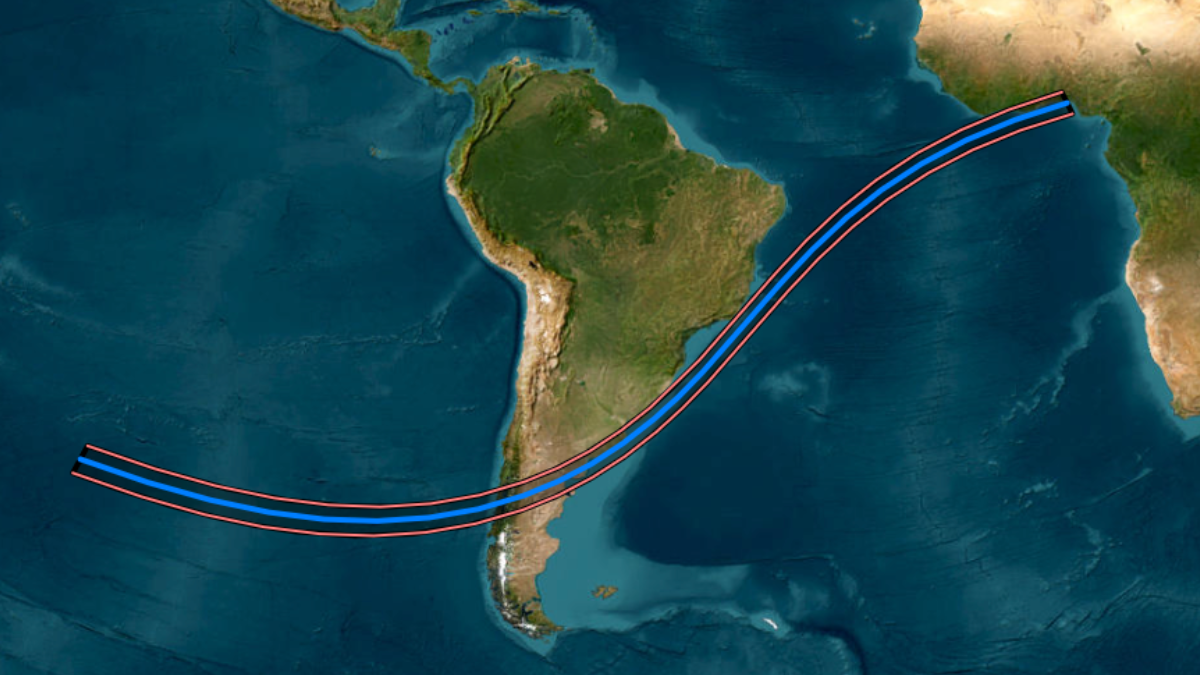
On Feb. 6, 2027, an annular solar eclipse will be visible across parts of Chile, Argentina and the coastal parts of West Africa, while the partial phase of the eclipse where the moon takes a "bite" out of the sun will be visible across South America and West Africa.
An annular solar eclipse happens when the moon passes directly in front of the sun when it is slightly farther away from Earth than during a total solar eclipse. As such, the moon appears a little smaller in the sky and doesn't completely cover the sun, leaving a brilliant ring of sunlight around the moon's silhouette, the "ring of fire".
The global path of the 'ring of fire' annular solar eclipse on Feb. 6, 2027. (Image credit: Created and annotated by Jamie Carter using MapHub.net. Source: Esri, Maxar, GeoEye, Earthstar Geographics, CNES/Airbus DS, USDA, USGS, AeroGRID, IGN, and the GIS User Community. Eclipse path from Xavier Jubier.))
The "eclipse of the century"
If the "ring of fire" eclipse wasn't enough, 2027 serves up another, even more spectacular eclipse.
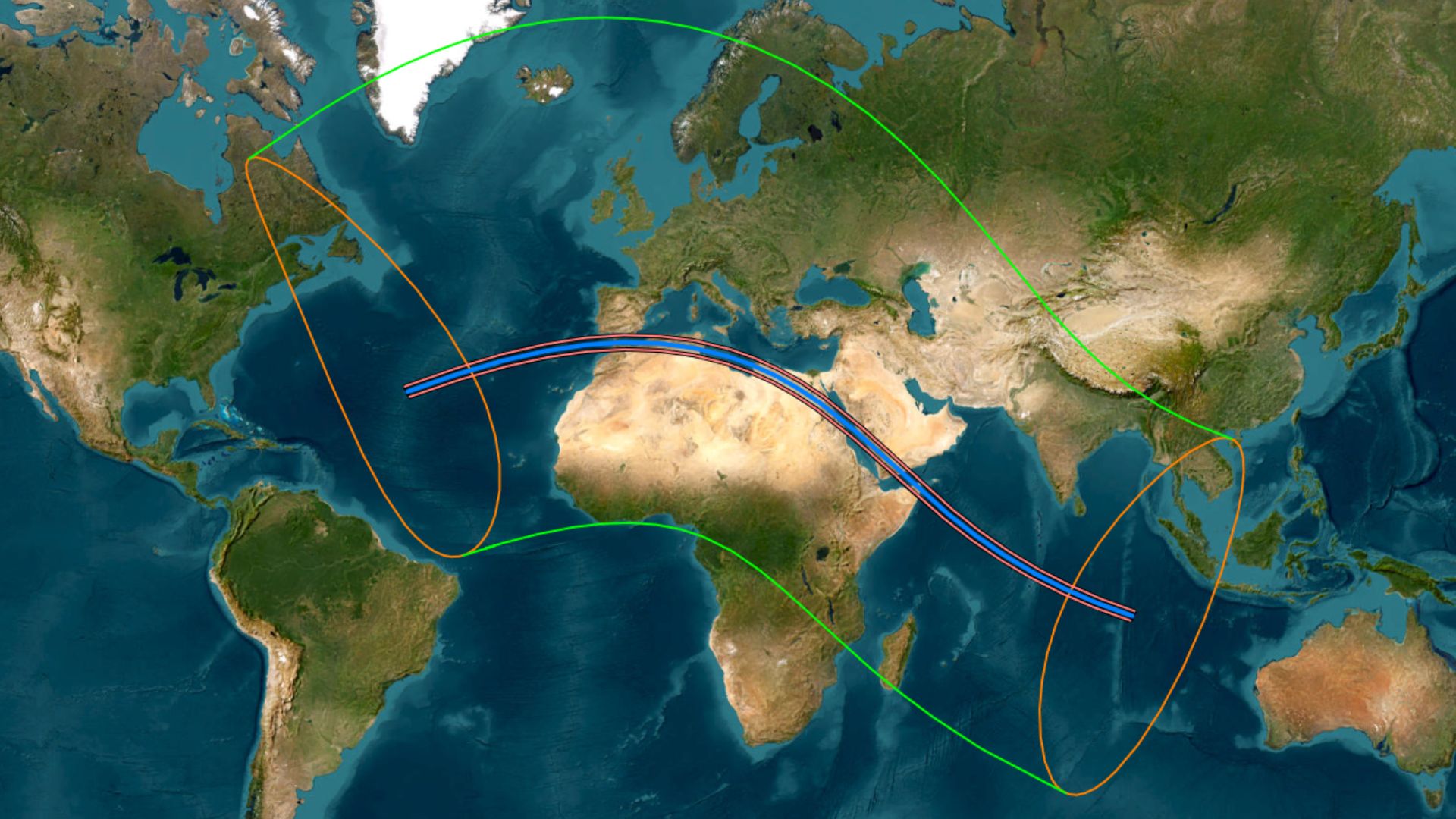
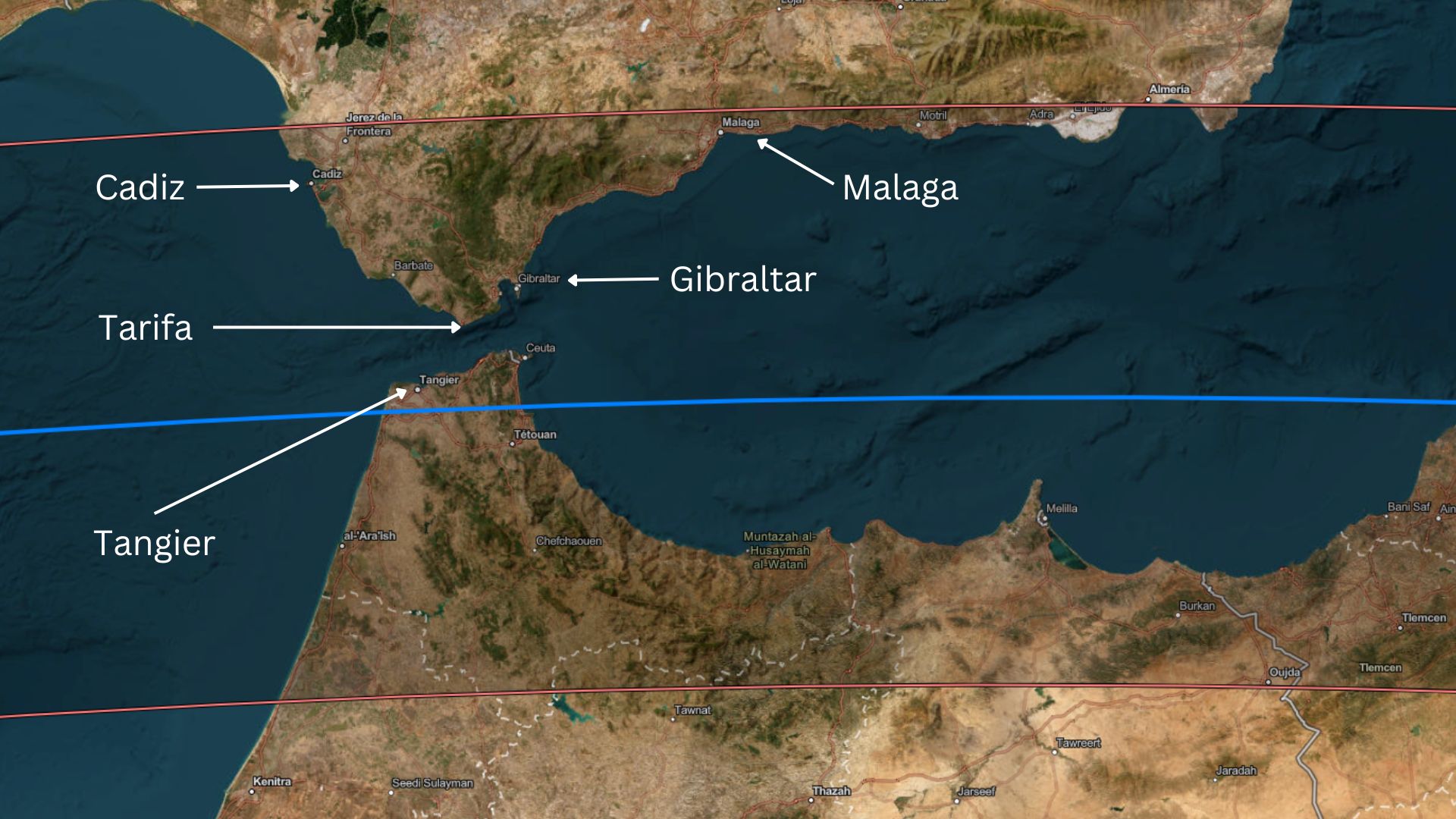
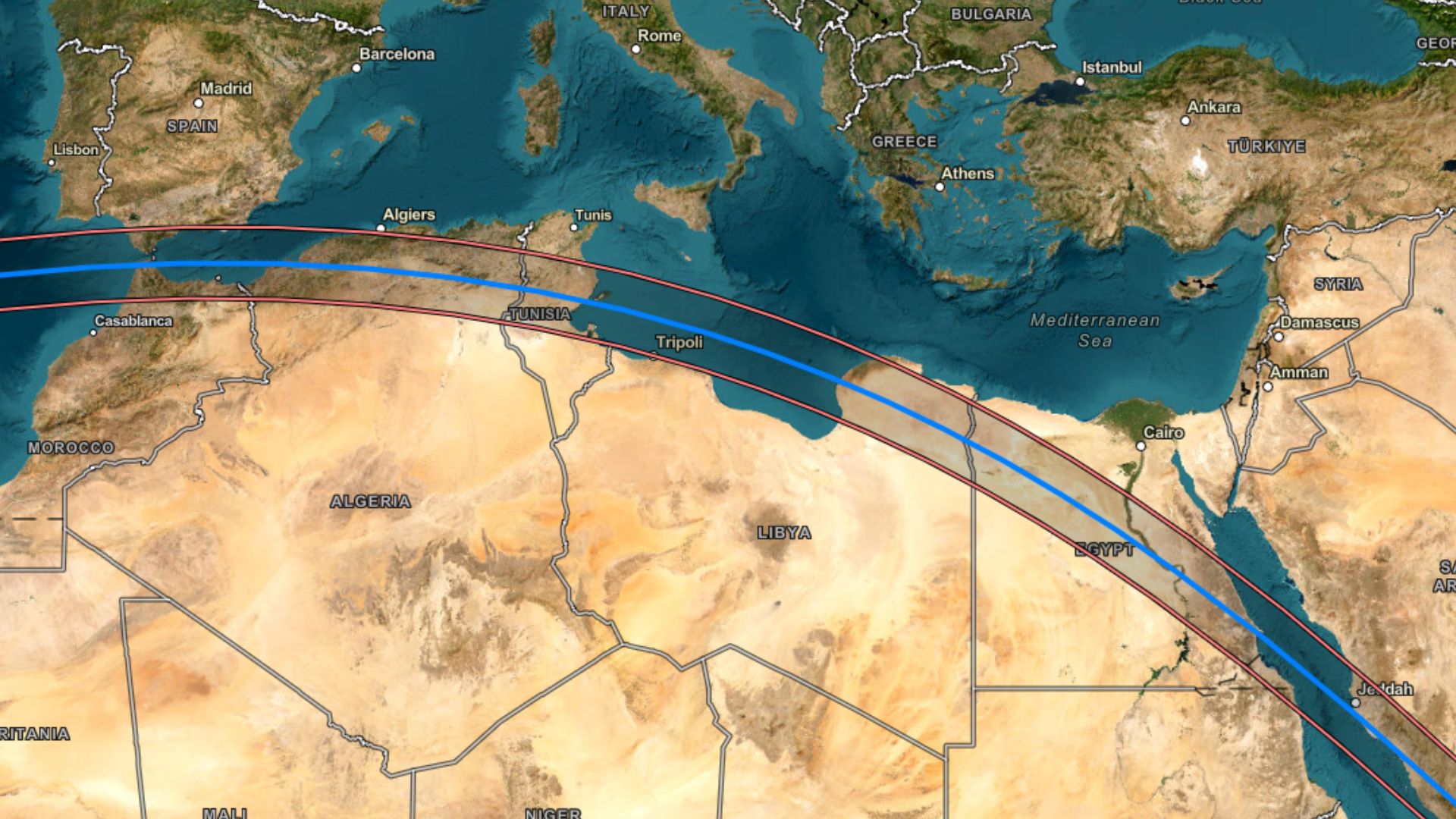
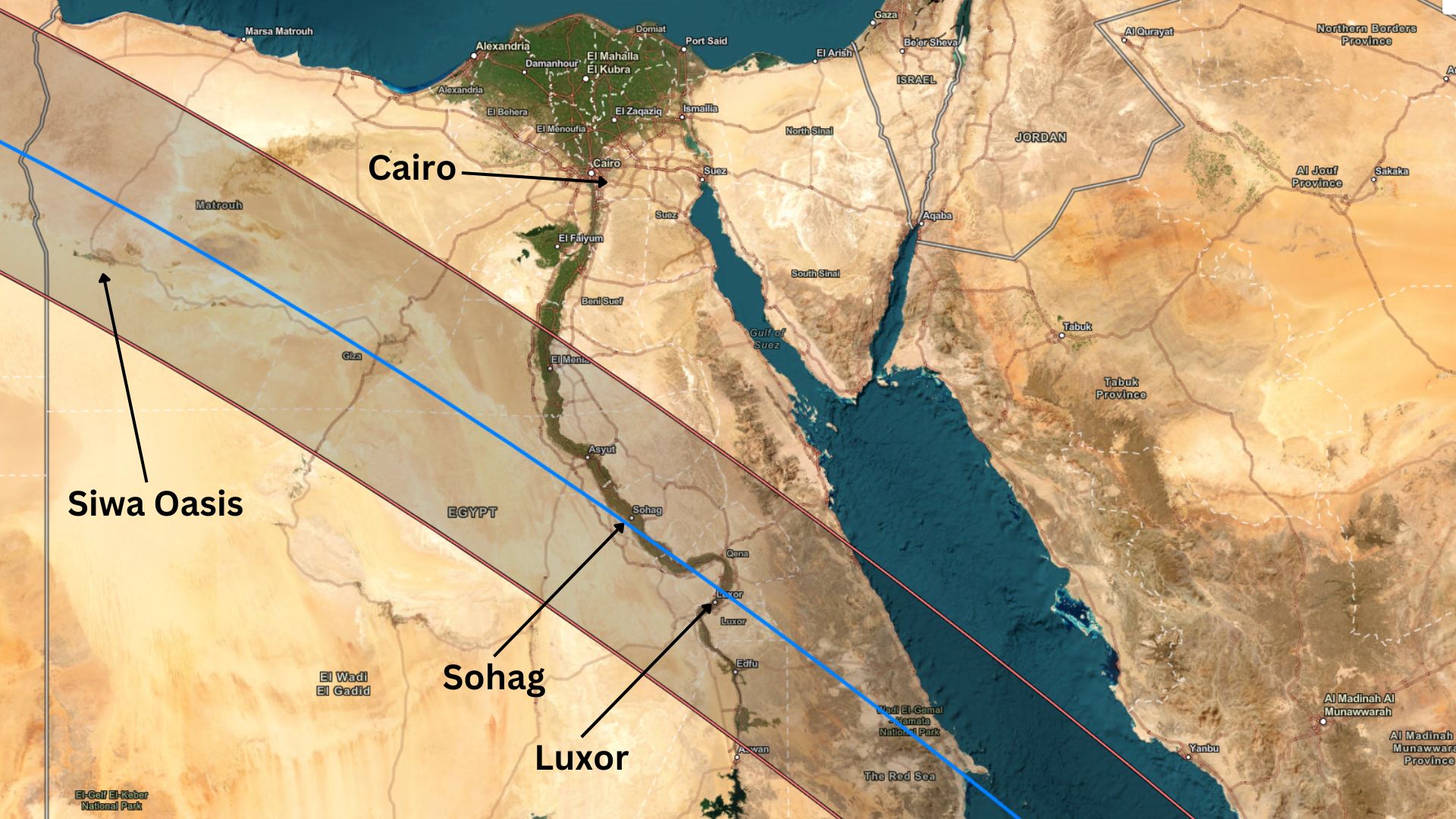
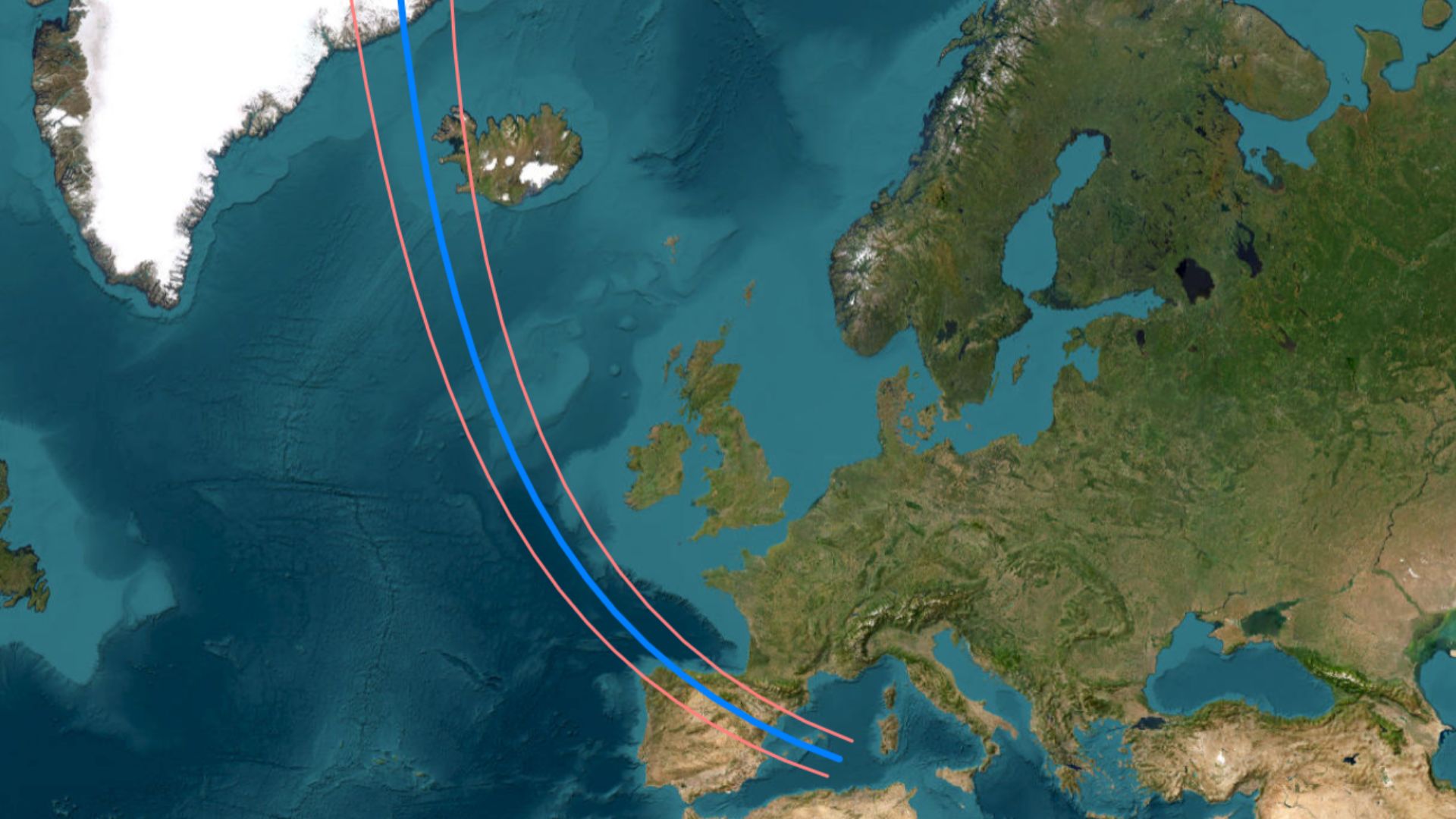
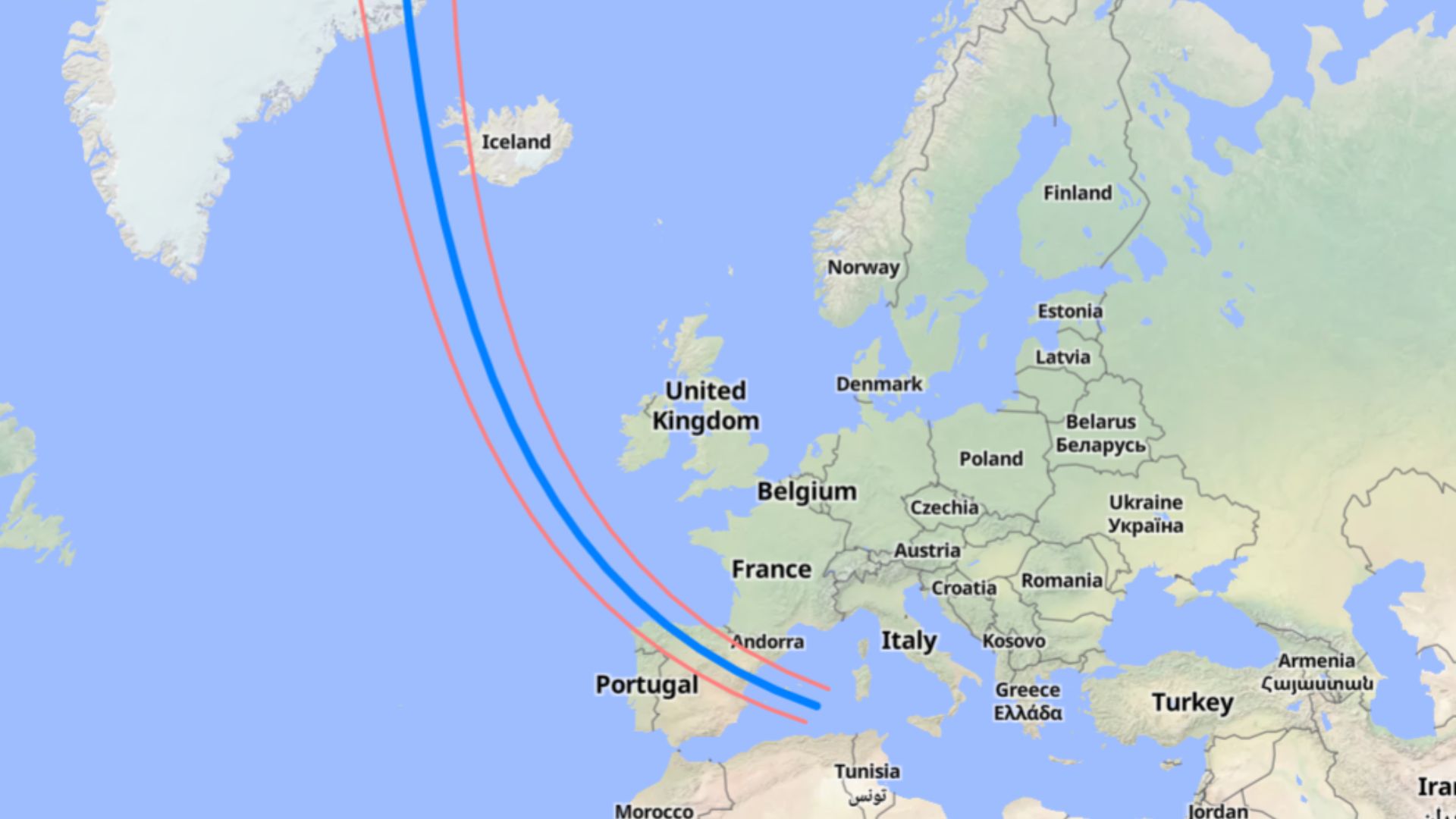
On Aug. 2, 2027, the moon's shadow will race across southern Europe, North Africa and the Middle East, treating skywatchers with one of the longest total solar eclipses of the century. At its greatest point, totality will last an extraordinary 6 minutes and 23 seconds — more than twice as long as many other total solar eclipses.
Created using MapHub.net. Source: Esri, Maxar, GeoEye, Earthstar Geographics, CNES/Airbus DS, USDA, USGS, AeroGRID, IGN, and the GIS User Community), path from Xavier M JubierCreated using MapHub.net. Source: Esri, Maxar, GeoEye, Earthstar Geographics, CNES/Airbus DS, USDA, USGS, AeroGRID, IGN, and the GIS User Community), path from Xavier M JubierCreated using MapHub.net. Source: Esri, Maxar, GeoEye, Earthstar Geographics, CNES/Airbus DS, USDA, USGS, AeroGRID, IGN, and the GIS User Community), path from Xavier M JubierCreated using MapHub.net. Source: Esri, Maxar, GeoEye, Earthstar Geographics, CNES/Airbus DS, USDA, USGS, AeroGRID, IGN, and the GIS User Community), path from Xavier M Jubier
Combined with favorable August weather across parts of North Africa, it's easy to see why many eclipse enthusiasts are already planning their trips in advance.
If you're thinking about experiencing the Aug. 2, 2027 total solar eclipse for yourself, now is the perfect time to start planning. We've rounded up expert travel tips to help you choose the best viewing location and avoid common pitfalls, as well as 10 unforgettable tours and experiences that will put you right in the heart of one of the greatest celestial events of the century.
The Perseid meteor shower, one of the most prolific and impressive meteor showers of the year, peaks tonight!
Widely regarded as one of the best meteor showers of the year, the Perseids can produce up to 100 meteors per hour under ideal viewing conditions and weather permitting.
This year's display is particularly favorable because the shower peaks on the night of the new moon, leaving skies free from bright moonlight that can wash out fainter meteors.
What time should I look?
The Perseids can produce meteors throughout the night, but the best viewing begins around 11 p.m. local time, with activity increasing after midnight and continuing until the predawn hours. Under dark, clear skies, patient observers could see dozens of meteors every hour with the highest rates expected just before dawn.
Where do they come from?
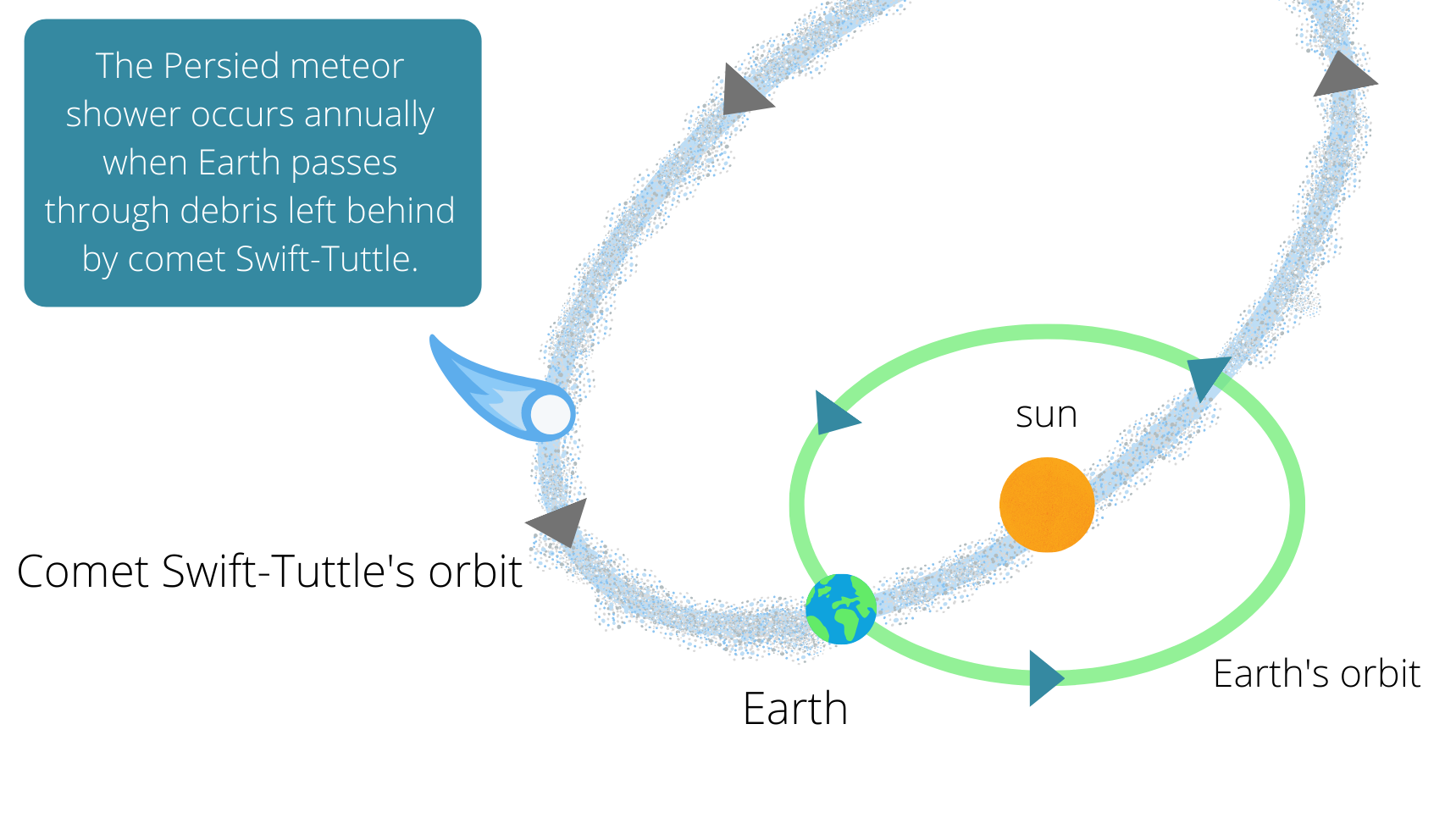
The annual show occurs as Earth passes through a trail of comet dust and rocky debris left behind by Comet 109P/Swift-Tuttle. Every year, our planet plows through this stream of cometary material, causing tiny fragments — many no larger than a grain of sand — to slam into Earth's atmosphere at around 133,000 mph (214,000 km/h).
As these particles compress and heat the air in front of them, they burn up high above Earth's surface, creating the brilliant streaks of light we know as meteors or shooting stars.
Every year, Earth passes through the path of Comet Swift-Tuttle. With the Perseid meteor shower's peak occurring when Earth passes through the densest, dustiest area. (Image credit: Future)
How can I see the Perseids?
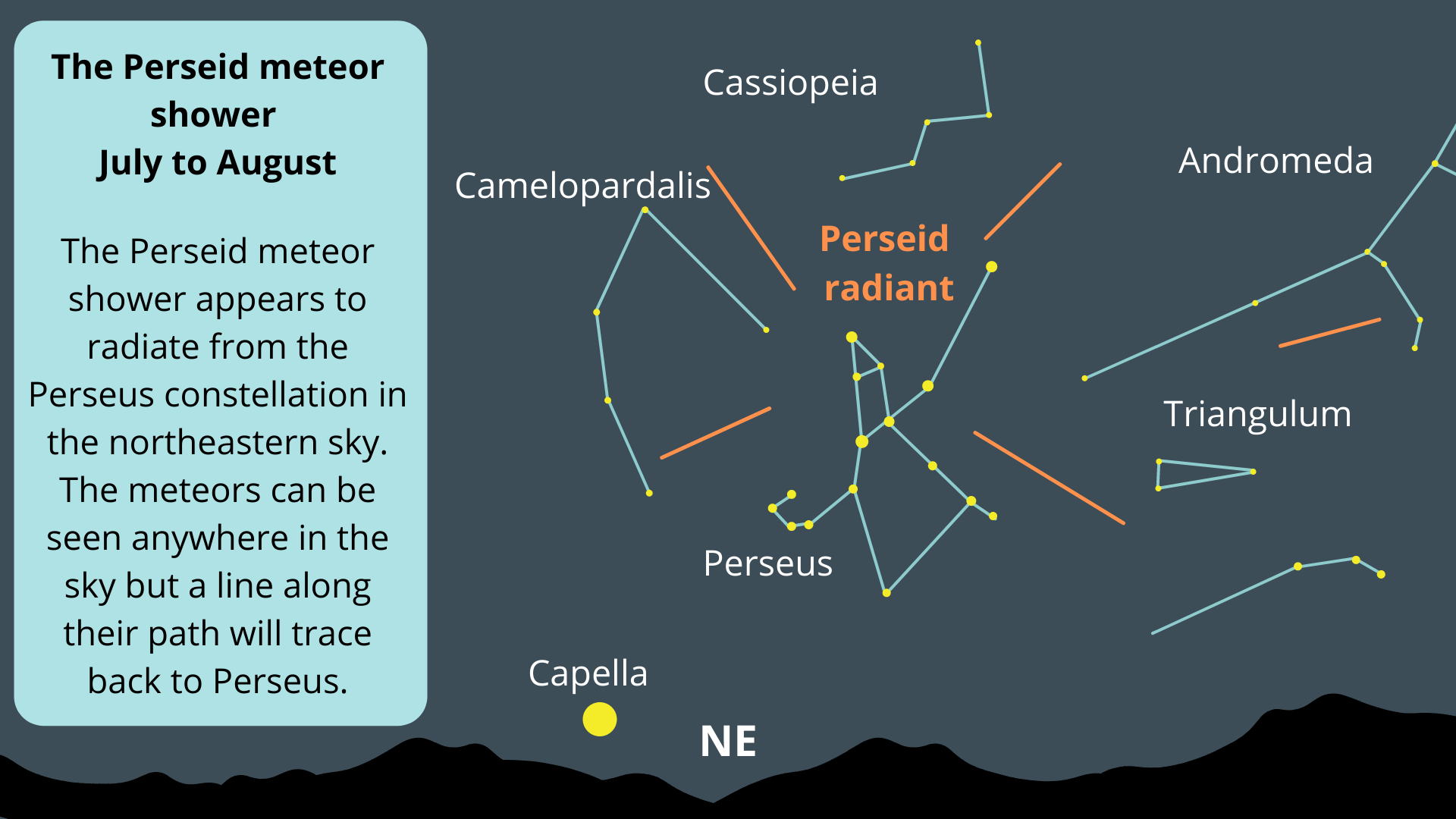
The Perseids appear to radiate from the constellation Perseus, but you don't need to look directly at the constellation to enjoy the show. In fact, the longest and brightest meteors appear about 45 degrees away from the radiant, when you're not viewing them head-on.
To give yourself the best chance of seeing as many meteors as possible, head somewhere with dark skies, away from city lights and give your eyes around 30 minutes to adjust to the darkness. Avoid checking bright phone screens (easier said than done!) and leave the telescope or binoculars at home — meteors are best enjoyed with the naked eye.
The Perseid meteor shower will appear to radiate from the Perseus constellation. (Image credit: Future)
The highest number of meteors occurs in the predawn hours because it's when the side of Earth you're situated on has rotated into the stream of comet debris. You can think of it a bit like driving through rain — the windshield catches more raindrops than the rear window because it's facing the direction of travel. Likewise, before dawn, your location on Earth is facing into the stream of comet debris, meaning more meteoroids collide with Earth's atmosphere overhead.
A rare double sky show
Best cameras for astrophotography
(Image credit: Nikon)
If you're looking for a good camera for meteor showers and astrophotography, our top pick is the Nikon D850.
Why have one remarkable sky event when you can have two? This year's Perseid peak arrives on the heels of today'stotal solar eclipse that crosses parts of Greenland, Iceland and Spain, making it possible to witness two of the year's most spectacular celestial events within just a few hours of each other.
If you're unable to catch the Perseids tonight, don't worry! While meteor numbers will gradually decline after the peak, the Perseids remain active through Aug. 24, meaning there are still opportunities to catch plenty of shooting stars under clear, dark skies.
Today (Aug. 12), millions of people across Greenland, Iceland and Spain will witness a total solar eclipse as the moon completely covers the sun, turning day into night, albeit briefly.
It's Europe's first total solar eclipse since 1999, and with a maximum of 2 minutes, 18 seconds of totality, it will be worth the wait … weather permitting!
Even if you're not inside the path of totality, there's still plenty to see. A dramatic partial solar eclipse will be visible across much of Europe, offering millions more the chance to watch the moon take a 'bite' out of the sun. More than 90% of the sun will be covered for major cities such as London, Paris and Dublin.
Where will the eclipse be visible?
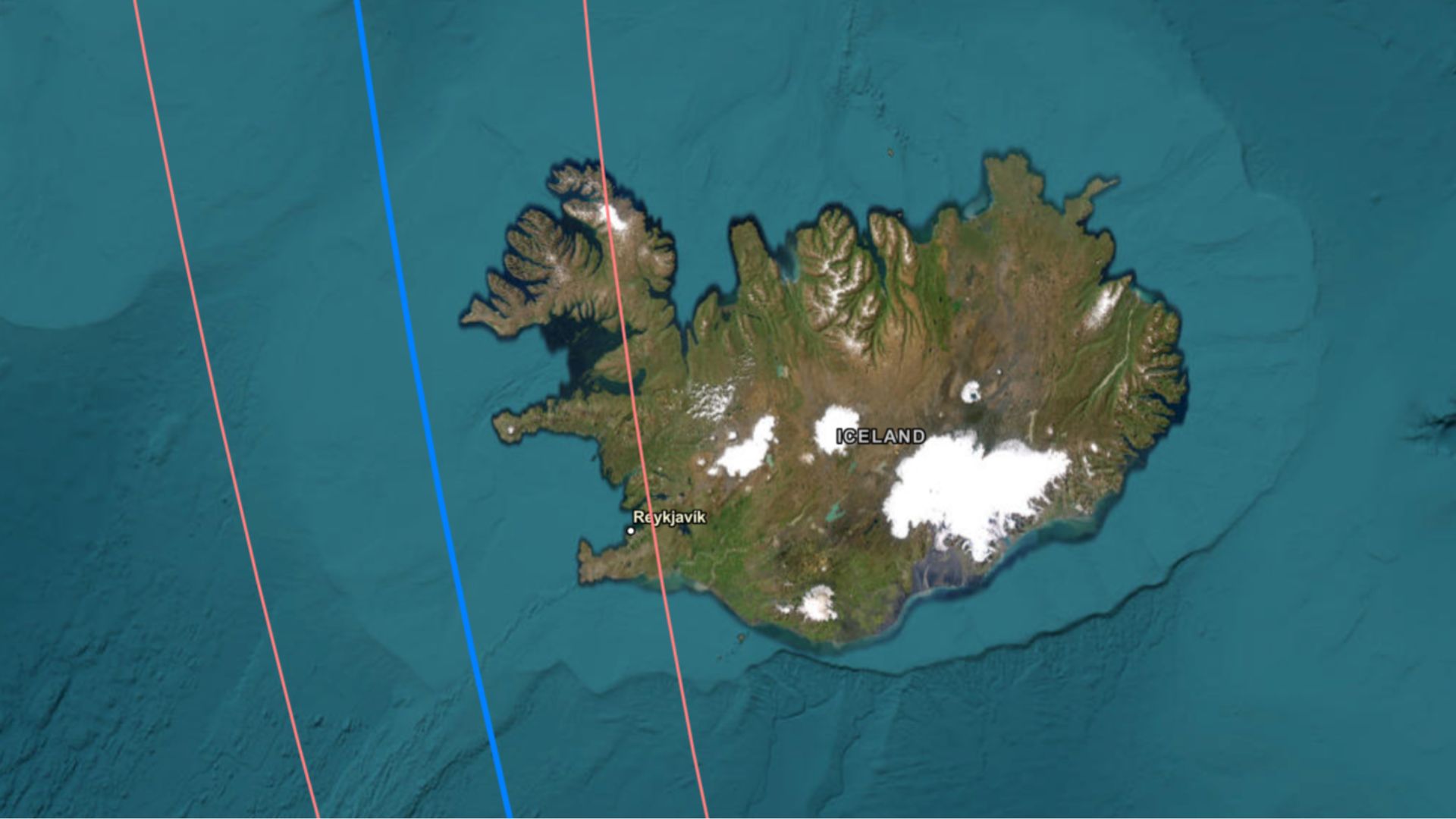
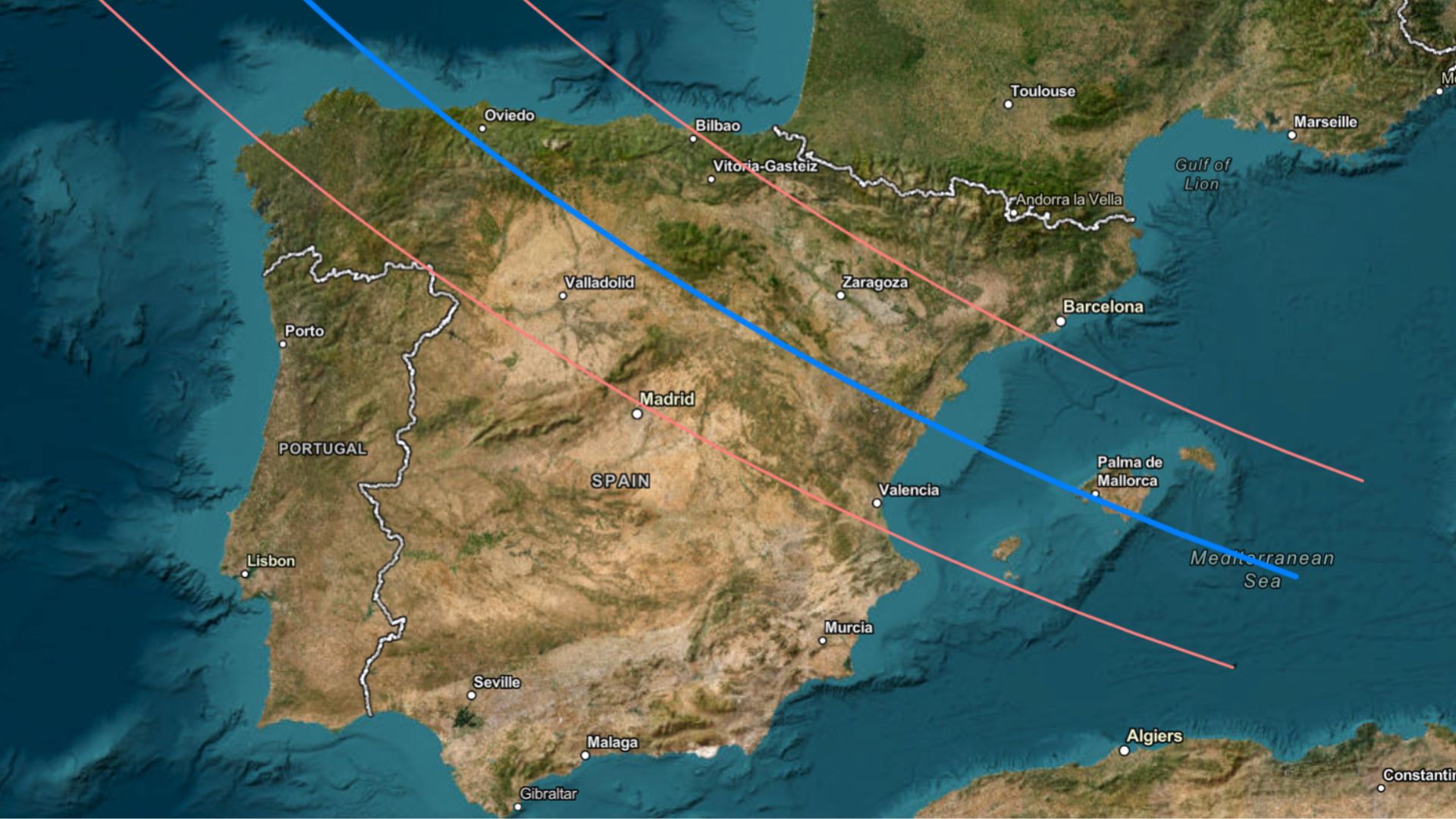
Today's eclipse will unfold over roughly 96 minutes as the moon's shadow races across Greenland, Iceland and Spain. Totality begins in Greenland in the late afternoon before reaching Spain in the evening, where skywatchers will witness the rare spectacle of a low-horizon sunset eclipse.
Path of totalityCreated using MapHub.net. Source: Esri, Maxar, GeoEye, Earthstar Geographics, CNES/Airbus DS, USDA, USGS, AeroGRID, IGN, and the GIS User CommunityPath of totalityCreated using MapHub.net. Source: Esri, Maxar, GeoEye, Earthstar Geographics, CNES/Airbus DS, USDA, USGS, AeroGRID, IGN, and the GIS User CommunityPath of totalityCreated using MapHub.net. Source: Esri, Maxar, GeoEye, Earthstar Geographics, CNES/Airbus DS, USDA, USGS, AeroGRID, IGN, and the GIS User CommunityPath of totalityCreated using MapHub.net. Source: Esri, Maxar, GeoEye, Earthstar Geographics, CNES/Airbus DS, USDA, USGS, AeroGRID, IGN, and the GIS User Community
What time is the eclipse?
The eclipse occurs at different times depending on your location.
Our eclipse live blogwill bring you the latest updates throughout the day, including weather reports, photos, videos and observations from across Greenland, Iceland and Spain.
We'll also have reporters in the field. Skywatching Editor Daisy Dobrijevic is on an eclipse expedition to Greenland with HX, while Skywatching Writer Anthony Wood is observing from northern Spain with the DEB initiative and a team of citizen scientists.
Follow along throughout the day here on Space.com and our social channels (Instagram and TikTok) as we bring you firsthand reports from the path of totality and share some of the best eclipse images.
How to observe the eclipse
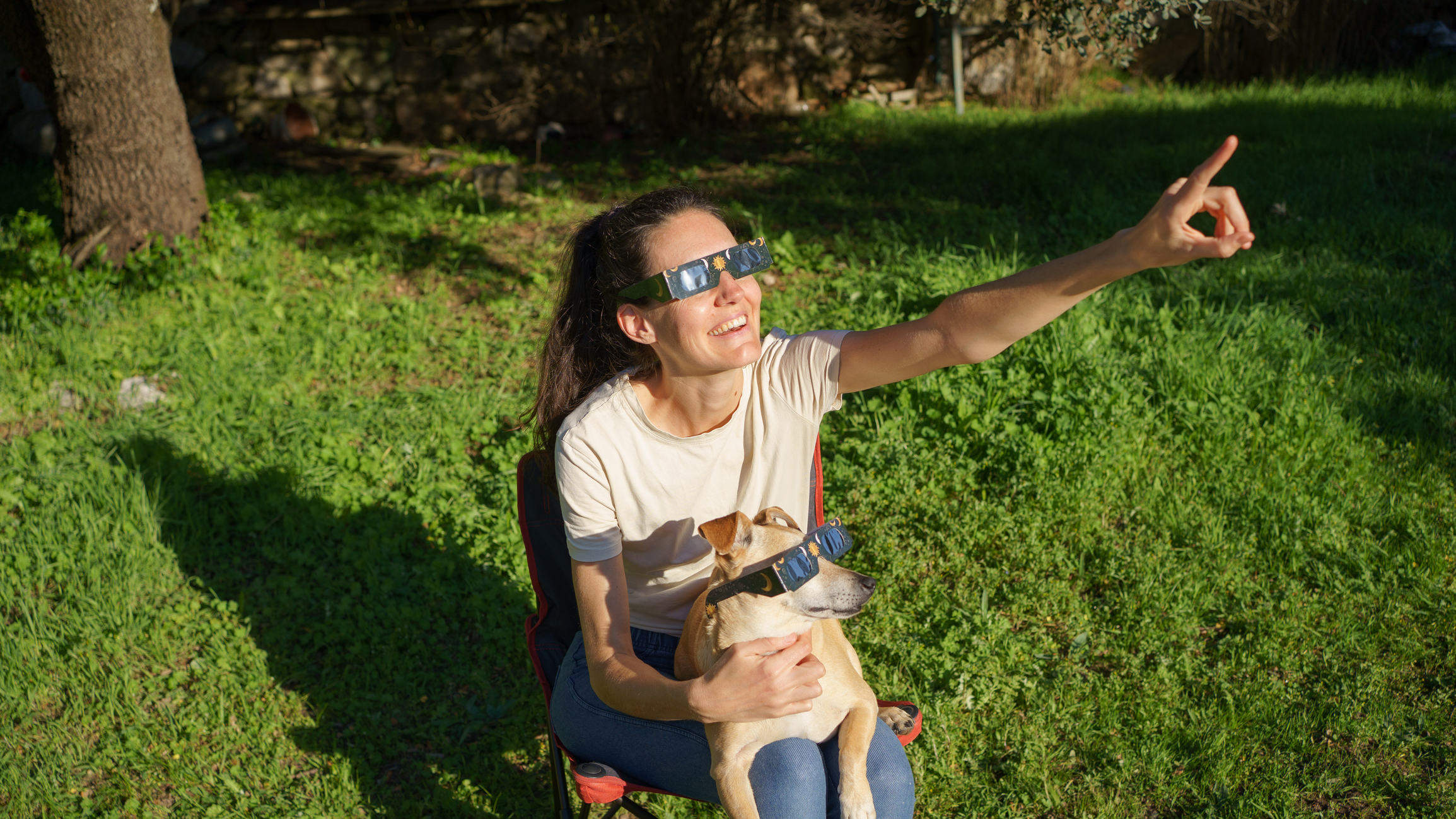
Appropriate eye protection is a must when viewing the sun. (Image credit: Arianne de San Jose van Hoof via Getty Images)
Never look directly at the sun without proper eye protection.
The only time it is safe to view the eclipse without eye protection is during the brief period of totality, when the moon completely covers the sun. As soon as even a small portion of the sun reappears, eclipse glasses must be worn again.
Editor's note: If you capture a photo of the solar eclipse and would like to share it with Space.com's readers, send your photo(s), comments, and your name and location to spacephotos@space.com.
On Aug. 12, 2026, a total solar eclipse will sweep across Earth, giving skywatchers across Greenland, Iceland and northern Spain an incredible view of totality. As the moon completely covers the sun, day will briefly turn to twilight, revealing the sun's faint outer atmosphere, the corona. But could totality reveal something else too?
Although totality never produces true nighttime darkness, it does briefly dim the sky to roughly the brightness of twilight. Since eclipse chasers in Greenland and Iceland will be in the auroral zone — the geographic zone around Earth's magnetic pole where auroras are most frequently seen — it's natural to wonder whether the two phenomena could appear together.
The answer is yes — but only if everything falls perfectly into place.
"During totality, the sky brightness is comparable to civil twilight (the first period of darkness after sunset, until the sun reaches six degrees below the observer's horizon). It's uncommon to see auroras during this time, but by no means impossible," Tom Kerss, independent astronomer and Chief Aurora Chaser for tour company Hurtigruten, told Space.com in an email.
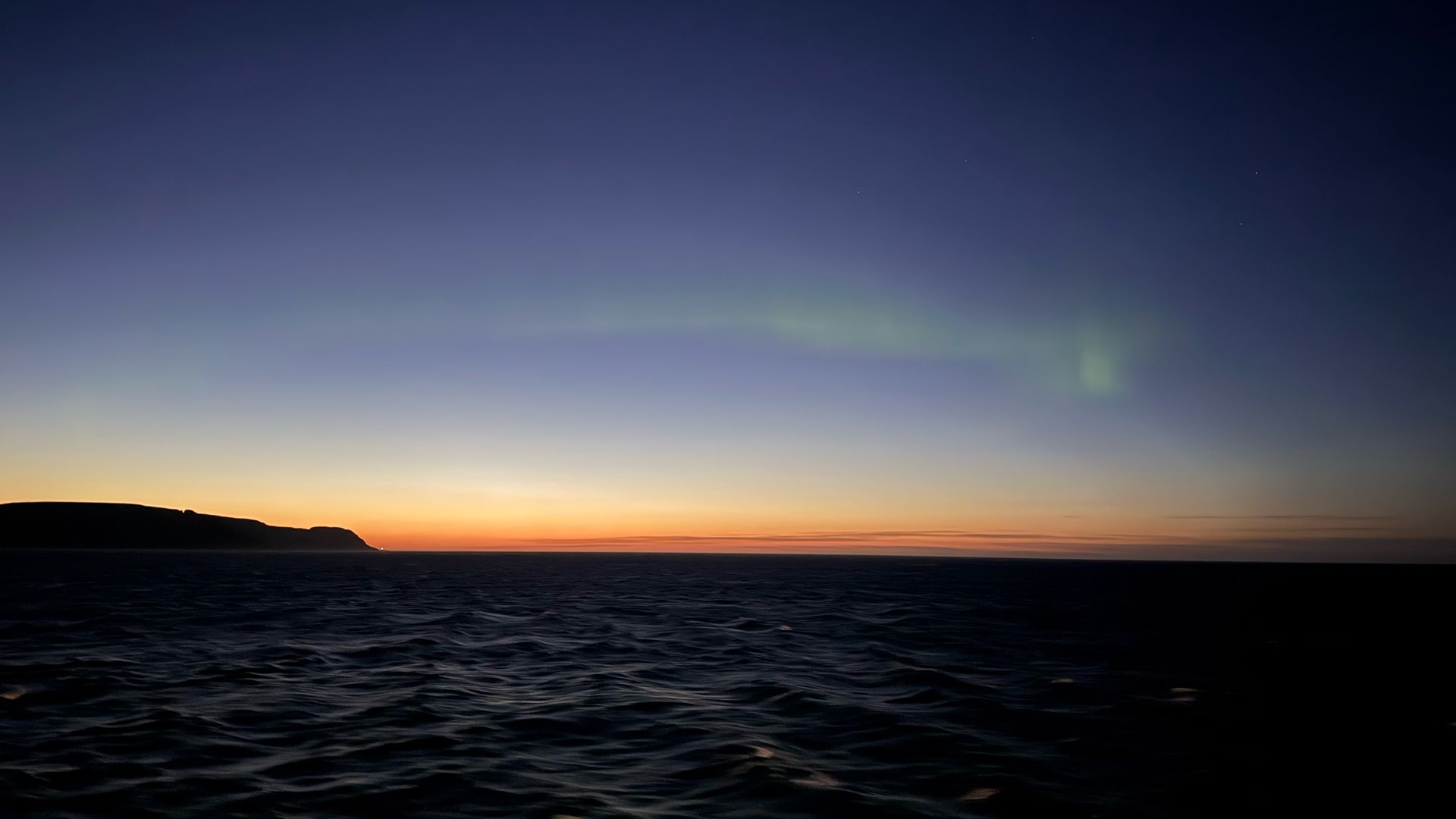
Kerss knows this from experience. Last year, he photographed the northern lights in Norway at twilight, demonstrating that sufficiently bright auroras can remain visible even before the sky becomes fully dark.
Twilight aurora captured by Tom Kerss in Norway, 2025. (Image credit: Tom Kerss)
However, the aurora's position in the sky would impact its visibility.
"During totality in August, the surface brightness of the sun's corona would almost certainly outshine auroras in its vicinity, but other parts of the sky away from the eclipse could host visible auroral structures," said Kerss.
So while it's physically possible, how likely is it?
Not very.
"If the auroral activity stays quiet, we wouldn't expect to see it during totality even though we know some energy is probably being emitted in the dayside portion of the oval," Kerss said.
To have any realistic chance of seeing the northern lights during the eclipse, Earth would need to be in the grip of a severe geomagnetic storm. These storms occur when eruptions from the sun, such as coronal mass ejections (CMEs), slam into Earth's magnetic field. During such conditions, auroras can get a dramatic boost, appearing brighter and more widespread than usual.
Kerss explained that observers would almost certainly need a G4 or G5 geomagnetic storm (G5 is the most powerful category) to overlap with the eclipse to have any realistic chance of seeing an aurora show because they will be on Earth's dayside.
"Bright, nightside aurora can be driven by powerful substorm activity, in which energy is stored and released," Kerss explained. "The dayside aurora is driven by a combination of favorably aligned solar wind (which opens the field lines around the Earth's polar cusps) and strong precipitation directly into the auroral oval. This latter requirement is contingent on very strong or extreme geomagnetic activity."
Kerss' thoughts are echoed by Pål Brekke, a solar physicist and northern lights expert working as Lead of Space Science at the Norwegian Space Agency.
Brekke knows just how difficult this is. He attempted to spot auroras during the 2015 total solar eclipse over Svalbard but found the sky never got dark enough.
"The sky never got that dark — we could hardly see any planets and no stars," Brekke told Space.com in an email. "Most probably because the snow-covered valley and mountains reflecting lights leaking in from the side of the moon's shadow. Making the sky too bright even during the eclipse."
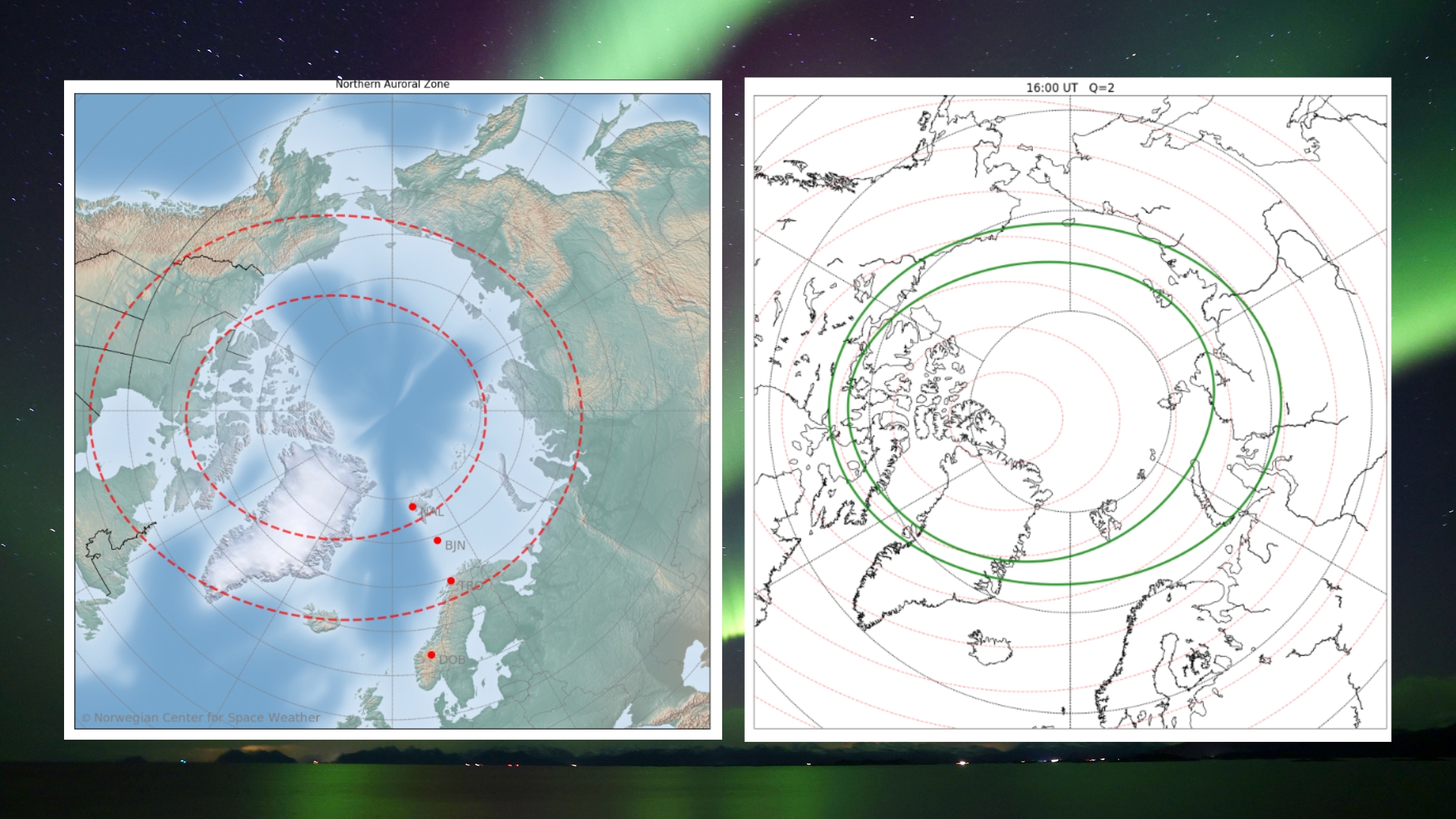
Brekke also pointed out that the timings work against eclipse chasers. Totality occurs in the afternoon over Greenland and Iceland, meaning observers will be beneath the daytime portion of the auroral oval. Unlike the nighttime aurora oval, which expands dramatically during geomagnetic storms, the dayside auroral oval changes much less, making displays harder to see even during active space weather.
Left: The auroral zone — a geographic band on Earth that passes under the oval. Right: The approximate location of the daytime auroral oval at 1600 UTC (around the time of totality for observers in Greenland and Iceland) showing the instantaneous, ring-shaped region where auroras are most likely to occur at that time. (Image credit: Magnar Gullikstad Johnsen, Background added in Canva Pro by Daisy Dobrijevic)
"The chance for aurora over Spain is very low — that would need a KP=9 or so — and 20:00 [UTC] is still very early so the fattest part of the oval is still not over Spain at that time. So our guess is it will not be very likely," said Brekke.
There is one scenario, however, that could make eclipse day even more extraordinary.
"If the sun launches CMEs in the days before the eclipse, it'll be very exciting for anyone going to Iceland or Greenland, and since the exceptional Perseid Meteor Shower will also peak on that date, there's a rare opportunity to see three of the sky's greatest wonders together if conditions line up," said Kerss.
The odds may be slim, but they're not zero.
If the sun happens to unleash a powerful geomagnetic storm in the days leading up to Aug. 12, eclipse chasers in Greenland or Iceland could witness something truly remarkable.
If not, don't be too disappointed. During totality, the sun itself puts on one of nature's greatest spectacles — and that's where your attention should be.