This vitamin stops the aging process in organs, say Swiss researchers

Improved muscle stem cell numbers and muscle function in NR-treated aged mice: Newly regenerated muscle fibers 7 days after muscle damage in aged mice (left: control group; right: fed NR). (Scale bar = 50 μm). (credit: Hongbo Zhang et al./Science)

EPFL researchers have restored the ability of mice organs to regenerate and extend life by simply administering nicotinamide riboside (NR) to them.

NR has been shown in previous studies to be effective in boosting metabolism and treating a number of degenerative diseases. Now, an article by PhD student Hongbo Zhang published in Science also describes the restorative effects of NR on the functioning of stem cells for regenerating organs.

As in all mammals, as mice age, the regenerative capacity of certain organs (such as the liver and kidneys) and muscles (including the heart) diminishes. Their ability to repair them following an injury is also affected. This leads to many of the disorders typical of aging.

Mitochondria —> stem cells —> organs

To understand how the regeneration process deteriorates with age, Zhang teamed up with colleagues from ETH Zurich, the University of Zurich, and universities in Canada and Brazil. By using several biomarkers, they were able to identify the molecular chain that regulates how mitochondria — the “powerhouse” of the cell — function and how they change with age. “We were able to show for the first time that their ability to function properly was important for stem cells,” said Auwerx.

Under normal conditions, these stem cells, reacting to signals sent by the body, regenerate damaged organs by producing new specific cells. At least in young bodies. “We demonstrated that fatigue in stem cells was one of the main causes of poor regeneration or even degeneration in certain tissues or organs,” said Zhang.

How to revitalize stem cells

Which is why the researchers wanted to “revitalize” stem cells in the muscles of elderly mice. And they did so by precisely targeting the molecules that help the mitochondria to function properly. “We gave nicotinamide riboside to 2-year-old mice, which is an advanced age for them,” said Zhang.

“This substance, which is close to vitamin B3, is a precursor of NAD+, a molecule that plays a key role in mitochondrial activity. And our results are extremely promising: muscular regeneration is much better in mice that received NR, and they lived longer than the mice that didn’t get it.”

Parallel studies have revealed a comparable effect on stem cells of the brain and skin. “This work could have very important implications in the field of regenerative medicine,” said Auwerx. This work on the aging process also has potential for treating diseases that can affect — and be fatal — in young people, like muscular dystrophy (myopathy).

So far, no negative side effects have been observed following the use of NR, even at high doses. But while it appears to boost the functioning of all cells, it could include pathological ones, so further in-depth studies are required.


Abstract of NAD+ repletion improves mitochondrial and stem cell function and enhances life span in mice

Adult stem cells (SCs) are essential for tissue maintenance and regeneration yet are susceptible to senescence during aging. We demonstrate the importance of the amount of the oxidized form of cellular nicotinamide adenine dinucleotide (NAD+) and its impact on mitochondrial activity as a pivotal switch to modulate muscle SC (MuSC) senescence. Treatment with the NAD+ precursor nicotinamide riboside (NR) induced the mitochondrial unfolded protein response (UPRmt) and synthesis of prohibitin proteins, and this rejuvenated MuSCs in aged mice. NR also prevented MuSC senescence in the Mdx mouse model of muscular dystrophy. We furthermore demonstrate that NR delays senescence of neural SCs (NSCs) and melanocyte SCs (McSCs), and increased mouse lifespan. Strategies that conserve cellular NAD+ may reprogram dysfunctional SCs and improve lifespan in mammals.

Electronic devices that melt in your brain

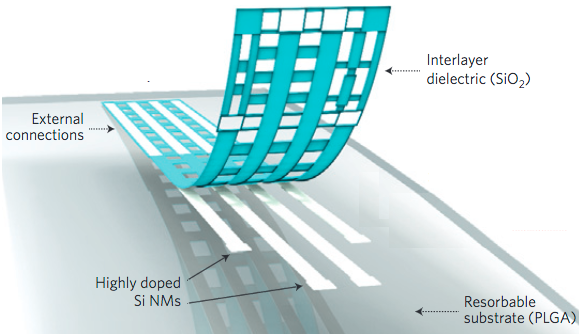
Illustration of the construction of a bioresorbable neural electrode array for ECoG and subdermal EEG measurements. A photolithographically patterned, n-doped silicon nanomaterial (300 nm thick) is used for electrodes and interconnects. A 100 nm thick film of silicon dioxide and a foil of PLGA (30 nm thick) serve as a bioresorbable encapsulating layer and substrate, respectively. The device connects to an external data acquisition system through a conductive film interfaced to the Si nm interconnects at contact pads at the edge. (credit: Ki Jun Yu et al./Nature Materials))

Two implantable devices developed by American and Chinese researchers are designed to dissolve in the brain over time and may eliminate several current problems with implants.

University of Pennsylvania researchers have developed an electrode and an electrode array, both made of layers of silicon and molybdenum that can measure physiological characteristics (like neuron signals) and dissolve at a known rate (determined by the material’s thickness). The team used the device in anesthetized rats to record brain waves (EEGs) and induced epileptic spikes in intact live tissue.

In another experiment, they showed the dissolvable electronics could be used in a complex, multiplexed ECoG (intracranial electroencephalography) array over a 30-day period.

Cartoon illustration of a four-channel bioresorbable electrode array implanted on the left hemisphere of the brain of a rat for chronic recordings. A flexible cable connects the array to a custom-built circular interface board fixed to the skull using dental cement. (credit: Ki Jun Yu et al./Nature Materials)

As the researchers note online in Nature Materials, this new technology offers equal or greater resolution for measuring the brain’s electrical activity, compared to conventional electrodes, while eliminating “the risks, cost, and discomfort associated with surgery to extract current devices used for post-operative monitoring,” according to senior co-author Brian Litt, MD, a professor of Neurology, Neurosurgery, and Bioengineering at the Perelman School of Medicine.

Other potential uses of the dissolvable electronics include:

  • Disorders such as epilepsy, Parkinson’s disease, depression, chronic pain, and conditions of the peripheral nervous system. “These measurements are critically important for mapping and monitoring brain function during and in preparation for neurosurgery, for assisting in device placement, such as for Parkinson’s disease, and for guiding surgical procedures on complex, interconnected nerve structures,” Litt said.
  • Post-operative monitoring and recording of physiological characteristic after minimally invasive placement of vascular, cardiac, orthopaedic, neural or other devices. At present, post-operative monitoring is based on clinical examination or interventional radiology, which is invasive, expensive, and impractical for continuous monitoring over days to months.
  • Heart and brain surgery for applications such as aneurysm coiling, stent placement, embolization, and endoscopic operations. These new devices could also monitor structures that are exposed during surgery, but are too delicate to disturb later by removing devices.
  • More complex devices that also include flow, pressure, and other measurement capabilities.

The research was funded by the Defense Advanced Research Projects Agency, the Penn Medicine Neuroscience Center, a T32- Brain Injury Research Training Grant, the Mirowski Family Foundation, and by Neil and Barbara Smit.

A bioresorbable memristor
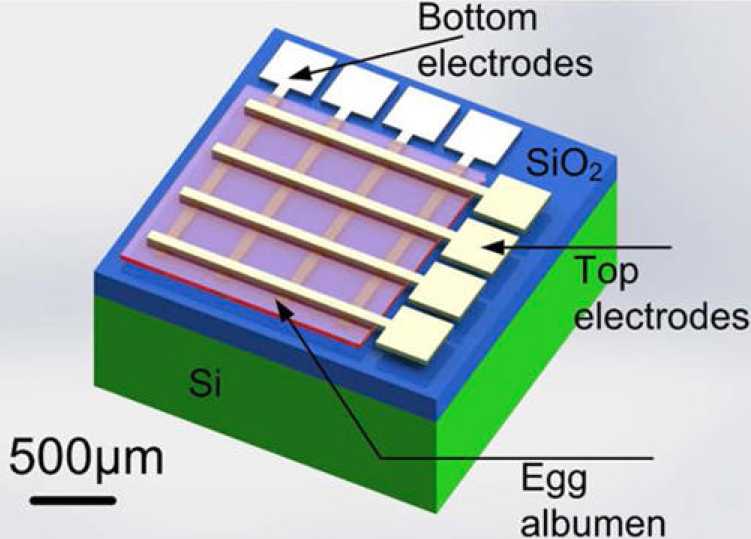
A 3D schematic drawing of cross-bar memristors on a silicon wafer made with dissolvable materials. (credit: Xingli He et al./Applied Materials & Interfaces)

In related research, Chinese researchers have developed a memristor (memory resistor) with biodissolvable components, using a 30 nm film of egg albumin protein on a silicon film substrate and electrodes made out of magnesium and tungsten.*

Testing showed that the device’s bipolar switching performance was comparable to oxide-based memristors, with a high-to-low resistance ratio in the range of 100 to 10,000. The device can store information for more than 10,000 seconds without any deterioration, showing its high stability and reliability.

Under dry conditions in the lab, the components worked reliably for more than three months. In water, the electrodes and albumin dissolved in two to 10 hours in the lab. The rest of the chip took about three days to break down, leaving minimal residues behind, the researchers report in the journal ACS Applied Materials & Interfaces.

The research was funded by the National Natural Science Foundation of China and the Research Fund for the Doctoral Program of Higher Education of China.

* Memristors may have future applications in nanoelectronic memories, computer logic, and neuromorphic/neuromemristive computer architectures. As shown in the following illustration, redox (oxidation and reduction) of iron molecules in albumen are primarily responsible for this memristor’s switching behavior. However, both Mg and W electrodes can dissolve in water easily and were shown to diffuse into the albumen film, where they also contribute to the formation of conductive filaments through redox reactions.
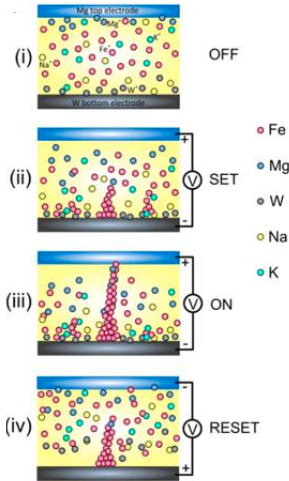
Schematic of the four switching processes for an albumen-based memristor, showing initial state of a memristor with Mg and W as the top and bottom electrode, respectively. (i) The colored spheres represent different ions. (ii) When a positive voltage is applied to the top electrode, ions move along the electric field, and accumulate locally in strong field regions in the albumen layer; meanwhile, injected electrons from the bottom electrode reduce metallic ions such as Fe3+ and Mg2+ to metal elements. (iii) At a specific voltage, the filaments are formed to connect the top and bottom electrodes electrically, and the device is turned on (the low resistance state). (iv) When applying a reset voltage, the conductive filaments are broken due to the oxidation of the metal elements by the injected electrons from the top electrode, the filaments are ruptured near the top electrode, and the device returns to the high-resistance state. (credit: Xingli He et al./Applied Materials & Interfaces)


Abstract of Bioresorbable silicon electronics for transient spatiotemporal mapping of electrical activity from the cerebral cortex

Bioresorbable silicon electronics technology offers unprecedented opportunities to deploy advanced implantable monitoring systems that eliminate risks, cost and discomfort associated with surgical extraction. Applications include postoperative monitoring and transient physiologic recording after percutaneous or minimally invasive placement of vascular, cardiac, orthopaedic, neural or other devices. We present an embodiment of these materials in both passive and actively addressed arrays of bioresorbable silicon electrodes with multiplexing capabilities, which record in vivo electrophysiological signals from the cortical surface and the subgaleal space. The devices detect normal physiologic and epileptiform activity, both in acute and chronic recordings. Comparative studies show sensor performance comparable to standard clinical systems and reduced tissue reactivity relative to conventional clinical electrocorticography (ECoG) electrodes. This technology offers general applicability in neural interfaces, with additional potential utility in treatment of disorders where transient monitoring and modulation of physiologic function, implant integrity and tissue recovery or regeneration are required.


Abstract of Transient Resistive Switching Devices Made from Egg Albumen Dielectrics and Dissolvable Electrodes

Egg albumen as the dielectric, and dissolvable Mg and W as the top and bottom electrodes are used to fabricate water-soluble memristors. 4 × 4 cross-bar configuration memristor devices show a bipolar resistive switching behavior with a high to low resistance ratio in the range of 1 × 10² to 1 × 10⁴, higher than most other biomaterial-based memristors, and a retention time over 104 s without any sign of deterioration, demonstrating its high stability and reliability. Metal filaments accompanied by hopping conduction are believed to be responsible for the switching behavior of the memory devices. The Mg and W electrodes, and albumen film all can be dissolved in water within 72 h, showing their transient characteristics. This work demonstrates a new way to fabricate biocompatible and dissolvable electronic devices by using cheap, abundant, and 100% natural materials for the forthcoming bioelectronics era as well as for environmental sensors when the Internet of things takes off.


WiFi capacity doubled at less than half the size

Columbia University engineering researchers have developed a new “circulator” technology that can double WiFi speed while reducing the size of wireless devices. It does this by requiring only one antenna (instead of two, for transmitter and receiver) and by using conventional CMOS chips instead of resorting to large, expensive magnetic components.

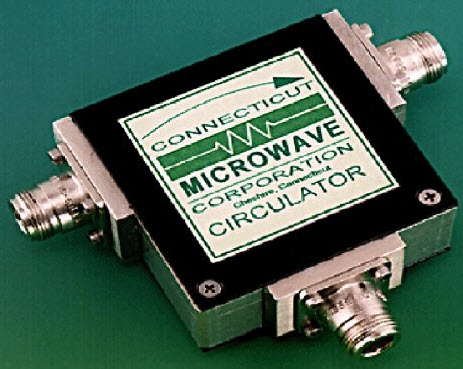
Current bulky circulator design (credit: Connecticut Microwave Corporation)

Columbia engineers previously invented a “full-duplex” radio integrated circuit on a conventional CMOS chip. “Full duplex” means simultaneous transmission and reception at the same frequency in a wireless radio, unlike “half-duplex” (transmitting and receiving at different times, used by current cell phones and other wireless devices). Full duplex also allows for faster transmission speeds.

The new circulator technology further miniaturizes future WiFi and other wireless devices (see Lighter, cheaper radio-wave device could double the useful bandwidth in wireless communications — an earlier circulator device developed by The University of Texas at Austin engineers that was not integrated on a CMOS chip).

“Full-duplex communications, where the transmitter and the receiver operate at the same time and at the same frequency, has become a critical research area and now we’ve shown that WiFi capacity can be doubled on a nanoscale silicon chip with a single antenna,” said Electrical Engineering Associate Professor Harish Krishnaswamy, director of the Columbia High-Speed and Mm-wave IC (CoSMIC) Lab. “This has enormous implications for devices like smartphones and tablets.”

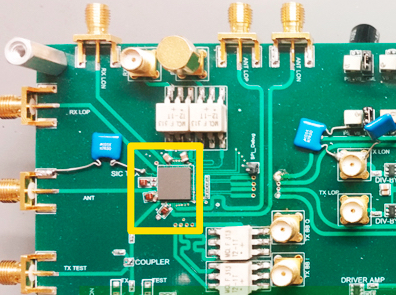
Prototype of first CMOS full-duplex receiver IC with integrated magnetic-free circulator (credit: Negar Reiskarimian, Columbia Engineering)

By combining circulator and full-duplex technologies, “this technology could revolutionize the field of telecommunications,” he said. “Our circulator is the first to be put on a silicon chip, and we get literally orders of magnitude better performance than prior work.”

How to embed circulator technology on a CMOS chip

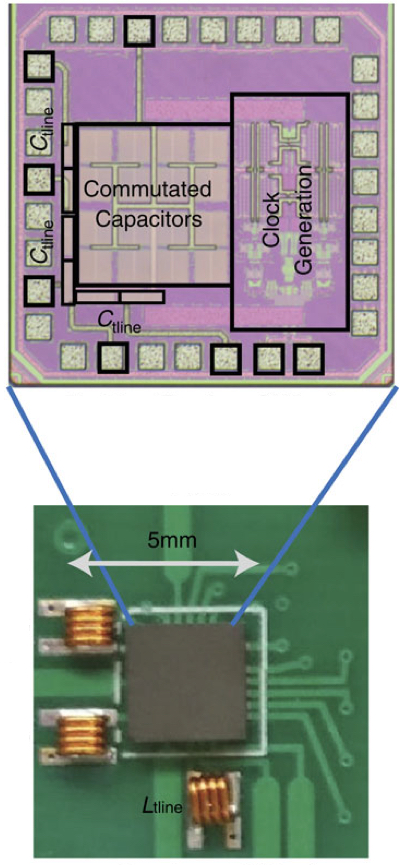
CMOS circulator IC on a printed-curcuit board, interfaced with off-chip inductors. (credit: Negar Reiskarimian, Columbia Engineering)

A circulator allows for using only one antenna to both transmit and receive. To do that, it has to “break” “Lorentz reciprocity” — a fundamental physical characteristic of most electronic structures that requires that electromagnetic waves travel in the same manner in both forward and reverse directions.

The traditional way of breaking Lorentz reciprocity and building radio-frequency circulators has been to use magnetic materials such as ferrites, which lose reciprocity when an external magnetic field is applied. But these materials are not compatible with silicon chip technology, and ferrite circulators are bulky and expensive.

Krishnaswamy and his team were able to design a highly miniaturized circulator that uses switches to rotate the signal across a set of capacitors to emulate the non-reciprocal “twist” of the signal that is seen in ferrite materials.

“Being able to put the circulator on the same chip as the rest of the radio has the potential to significantly reduce the size of the system, enhance its performance, and introduce new functionalities critical to full duplex,” says PhD student Jin Zhou, who integrated the circulator with a full-duplex receiver.

Circulator circuits and components have applications in many different scenarios, from radio-frequency full-duplex communications and radar to building isolators that prevent high-power transmitters from being damaged by back-reflections from the antenna. The ability to break reciprocity also opens up new possibilities in radio-frequency signal processing that are yet to be discovered.

The circulator research is published in an open-access paper on April 15 in Nature Communications. A paper detailing the single-chip full-duplex radio with the circulator and additional echo cancellation was presented at the 2016 IEEE International Solid-State Circuits Conference on February 2.

The work has been funded by the DARPA Microsystems Technology Office and the National Science Foundation.


Abstract of Magnetic-free non-reciprocity based on staggered commutation

Lorentz reciprocity is a fundamental characteristic of the vast majority of electronic and photonic structures. However, non-reciprocal components such as isolators, circulators and gyrators enable new applications ranging from radio frequencies to optical frequencies, including full-duplex wireless communication and on-chip all-optical information processing. Such components today dominantly rely on the phenomenon of Faraday rotation in magneto-optic materials. However, they are typically bulky, expensive and not suitable for insertion in a conventional integrated circuit. Here we demonstrate magnetic-free linear passive non-reciprocity based on the concept of staggered commutation. Commutation is a form of parametric modulation with very high modulation ratio. We observe that staggered commutation enables time-reversal symmetry breaking within very small dimensions (λ/1,250 × λ/1,250 in our device), resulting in a miniature radio-frequency circulator that exhibits reduced implementation complexity, very low loss, strong non-reciprocity, significantly enhanced linearity and real-time reconfigurability, and is integrated in a conventional complementary metal–oxide–semiconductor integrated circuit for the first time.


Abstract of Receiver with integrated magnetic-free N-path-filter-based non-reciprocal circulator and baseband self-interference cancellation for full-duplex wireless

Full-duplex (FD) is an emergent wireless communication paradigm where the transmitter (TX) and the receiver (RX) operate at the same time and at the same frequency. The fundamental challenge with FD is the tremendous amount of TX self-interference (SI) at the RX. Low-power applications relax FD system requirements [1], but an FD system with -6dBm transmit power, 10MHz signal bandwidth and 12dB NF budget still requires 86dB of SI suppression to reach the -92dBm noise floor. Recent research has focused on techniques for integrated self-interference cancellation (SIC) in FD receivers [1-3]. Open challenges include achieving the challenging levels of SIC through multi-domain cancellation, and low-loss shared-antenna (ANT) interfaces with high TX-to-RX isolation. Sharedantenna interfaces enable compact form factor, translate easily to MIMO, and ease system design through channel reciprocity.

A robot for ‘soft tissue’ surgery outperforms surgeons

The STAR robot suturing intestinal tissue (credit: Azad Shademan et al./Science Translational Medicine)

Can a robot handle the slippery stuff of soft tissues that can move and change shape in complex ways as stitching goes on, normally requiring a surgeon’s skill to respond to these changes to keep suturing as tightly and evenly as possible?

A Johns Hopkins University and Children’s National Health System research team decided to find out by using their  “Smart Tissue Autonomous Robot” (STAR) to perform in a procedure called anastomosis* (joining two tubular structures such as blood vessels together), using pig intestinal tissue.

The researchers published the results today in an open-access paper in the journal Science Translational Medicine. The robot surgeon took longer (up to 57 minutes vs. 8 minutes for human surgeons) but “the machine does it better,” according to Peter Kim, M.D., Professor of Surgery at the Sheikh Zayed Institute for Pediatric Surgical Innovation, Children’s National Health System in Washington D.C. Kim said the procedure was about  60 percent fully autonomous and 40 percent supervised (“we made some minor adjustments”), but that it can be made fully autonomous.

“The equivalent of a fancy sewing machine”

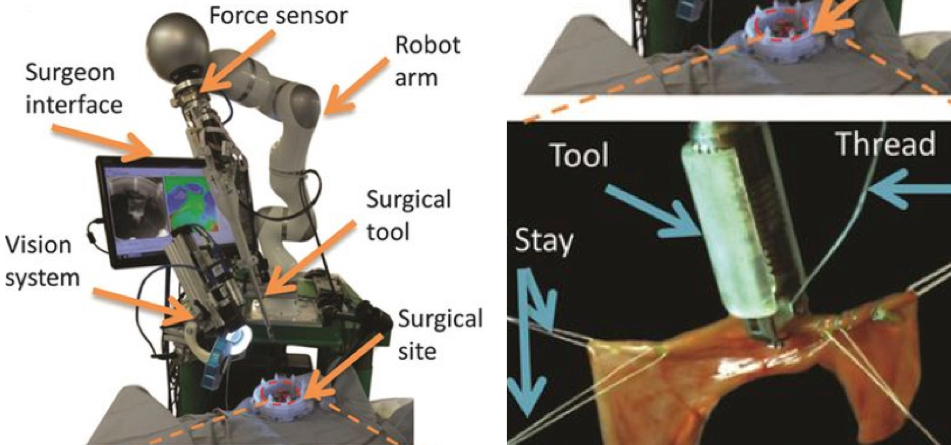
Automating soft tissue surgery. Left: The STAR system integrates near-infrared fluorescent (NIRF) imaging of markers (added by the surgeon to allow STAR to track surgical motions through blood and tissue occlusions), 3D plenoptic vision (captures the intensity and direction of the light rays emanating from the markers), force sensing, submillimeter positioning, and actuated surgical tools. Right: surgical site detail during linear suturing task showing a longitudinally cut porcine intestine suspended by five stay sutures. (credit: Azad Shademan et al./Science Translational Medicine)

STAR was developed by Azad Shademan and associates at the Sheikh Zayed Institute. It features a 3D imaging system and a near-infrared sensor to spot fluorescent markers along the edges of the tissue to keep the robotic suture needle on track. Unlike most other robot-assisted surgical systems, such as the Da Vinci Si, it operates without human hands-on guidance (but under the surgeon’s supervision).

In the research, the STAR robotic sutures were compared with the work of five surgeons completing the same procedure using three methods: open surgery, laparoscopic, and robot assisted surgery. Researchers compared consistency of suture spacing, pressure at which the seam leaked, mistakes that required removing the needle from the tissue or restarting the robot, and completion time.

The system promises to improve results for patients and make the best surgical techniques more widely available, according to the researchers. Putting a robot to work in this form of surgery “really levels the playing field,” said Simon Leonard, a computer scientist an assistant research professor in the Johns Hopkins Whiting School of Engineering, who worked for four years to program the robotic arm to precisely stitch together pieces of soft tissue.

As Leonard put it, they’re designing an advanced surgical tool, “the equivalent of a fancy sewing machine.”

* Anastomosis is performed more than a million times a year in the U.S.; more than 44.5 million such soft-tissue surgeries are performed in the U.S. each year. According to the researchers, complications such as leakage along the seams occur nearly 20 percent of the time in colorectal surgery and 25 to 30 percent of the time in abdominal surgery.


Carla Schaffer/AAAS | Robotic Surgery Just Got More Autonomous


Abstract of Supervised autonomous robotic soft tissue surgery

The current paradigm of robot-assisted surgeries (RASs) depends entirely on an individual surgeon’s manual capability. Autonomous robotic surgery—removing the surgeon’s hands—promises enhanced efficacy, safety, and improved access to optimized surgical techniques. Surgeries involving soft tissue have not been performed autonomously because of technological limitations, including lack of vision systems that can distinguish and track the target tissues in dynamic surgical environments and lack of intelligent algorithms that can execute complex surgical tasks. We demonstrate in vivo supervised autonomous soft tissue surgery in an open surgical setting, enabled by a plenoptic three-dimensional and near-infrared fluorescent (NIRF) imaging system and an autonomous suturing algorithm. Inspired by the best human surgical practices, a computer program generates a plan to complete complex surgical tasks on deformable soft tissue, such as suturing and intestinal anastomosis. We compared metrics of anastomosis—including the consistency of suturing informed by the average suture spacing, the pressure at which the anastomosis leaked, the number of mistakes that required removing the needle from the tissue, completion time, and lumen reduction in intestinal anastomoses—between our supervised autonomous system, manual laparoscopic surgery, and clinically used RAS approaches. Despite dynamic scene changes and tissue movement during surgery, we demonstrate that the outcome of supervised autonomous procedures is superior to surgery performed by expert surgeons and RAS techniques in ex vivo porcine tissues and in living pigs. These results demonstrate the potential for autonomous robots to improve the efficacy, consistency, functional outcome, and accessibility of surgical techniques.

More evidence that you’re a mindless robot with no free will

(credit: iStock)

The results of two Yale University psychology experiments suggest that what we believe to be a conscious choice may actually be constructed, or confabulated, unconsciously after we act — to rationalize our decisions. A trick of the mind.

“Our minds may be rewriting history,” said Adam Bear, a Ph.D. student in the Department of Psychology and lead author of a paper published April 28 in the journal Psychological Science.

Tricks of the mind

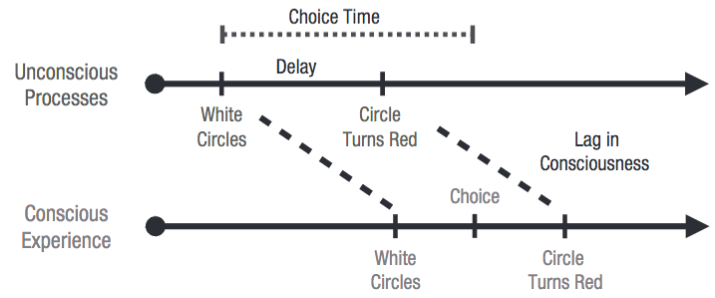
A model of “postdictive” choice. Although choice of a circle is not actually completed until after a circle has turned red, the choice may seem to have occurred before that event because the participant has not yet become conscious of the circle’s turning red. The circle’s turning red can therefore unconsciously bias a participant’s choice when the delay is sufficiently short. (credit: Adam Bear and Paul Bloom/Psychological Science)

Bear and Paul Bloom performed two simple experiments to test how we experience choices. In one experiment, participants were told that five white circles would appear on the computer screen in front of them and, in rapid-fire sequence, one would turn red. They were asked to predict which one would turn red and mentally note this. After a circle turned red, participants then recorded by keystroke whether they had chosen correctly, had chosen incorrectly, or had not had time to complete their choice.

The circle that turned red was always selected by the system randomly, so probability dictates that participants should predict the correct circle 20% of the time. But when they only had a fraction of a second to make a prediction, these participants were likely to report that they correctly predicted which circle would change color more than 20% of the time.

In contrast, when participants had more time to make their guess — approaching a full second — the reported number of accurate predictions dropped back to expected levels of 20% success, suggesting that participants were not simply lying about their accuracy to impress the experimenters.

(In a second experiment to eliminate artifacts, participants chose one of two different-colored circles, with similar results.)

Confabulating reality

What happened, Bear suggests, is that events were rearranged in subjects’ minds: People unconsciously perceived the color red from the screen image before they predicted it would appear, but then right after that, consciously experienced these two things in the opposite order.

Bear said it is unknown whether this “postdictive” illusion is caused by a quirk in perceptual processing that can only be reproduced in the lab, or whether it might have “far more pervasive effects on our everyday lives and sense of free will.”

Previous research at Charité–Universitätsmedizin Berlin suggests the latter, and includes volition. That research involved a “duel” game between a human and a brain-computer interface (see Do we have free will?). It showed that there‘s a “point of no return” in the decision-making process (at about 200 milliseconds before actual movement onset), after which cancellation of a person’s movement is no longer possible.


Abstract of A Simple Task Uncovers a Postdictive Illusion of Choice

Do people know when, or whether, they have made a conscious choice? Here, we explore the possibility that choices can seem to occur before they are actually made. In two studies, participants were asked to quickly choose from a set of options before a randomly selected option was made salient. Even when they believed that they had made their decision prior to this event, participants were significantly more likely than chance to report choosing the salient option when this option was made salient soon after the perceived time of choice. Thus, without participants’ awareness, a seemingly later event influenced choices that were experienced as occurring at an earlier time. These findings suggest that, like certain low-level perceptual experiences, the experience of choice is susceptible to “postdictive” influence and that people may systematically overestimate the role that consciousness plays in their chosen behavior.

Astronomers discover potentially habitable planets just 40 light years from Earth

This artist’s rendering shows an imagined view of the three planets orbiting an ultracool dwarf star just 40 light-years from Earth that were discovered using the TRAPPIST telescope at ESO’s La Silla Observatory. In this view, one of the inner planets is seen in transit (black dot) across the disc of its tiny and dim parent star. (credit: M. Kornmesser/ESO)

Astronomers have detected three exoplanets just 40 light years from Earth whose sizes and temperatures are comparable to those of Earth. The planets may be the best targets found so far for the search for life outside the solar system.

The results were published Monday (May 2) in the journal Nature.

Because the system is relatively close to Earth, co-author Julien de Wit, a postdoc at MIT, says scientists will soon be able to study the planets’ atmospheric compositions, as well as assess their habitability and whether life actually exists within this planetary system.

The scientists discovered the planets using TRAPPIST (TRAnsiting Planets and PlanetesImals Small Telescope), a 60-centimeter telescope operated by the University of Liège, based in Chile. Built by lead authors Michael Gillon and Emmanuel Jehin of the University of Liège, TRAPPIST is designed to focus on 60 nearby small, ”ultracool” dwarf stars (those with effective temperatures of less than 2,700 kelvin) — stars that are so faint they are invisible to optical telescopes and are monitored at infrared wavelengths.

The team focused the telescope on the dwarf star, which they named TRAPPIST-1 — a Jupiter-sized star that is one-eighth the size of our sun and significantly cooler. Over several months, the scientists observed the star’s infrared signal fade slightly at regular intervals, suggesting that several objects were passing in front of the star.

Most exoplanetary missions have been focused on finding systems around bright, solar-like stars. These stars emit radiation in the visible band and can be seen with optical telescopes. However, because these stars are so bright, their light can overpower any signal coming from a planet. Ultracool stars emit radiation in the infrared band. Because they are so faint, these tiny red stars would not drown out the image of a planet crossing the star, giving scientists a better chance of detecting orbiting planets.

May be in the habitable zone

From their observations, the scientists determined that all three planets are likely tidally locked, with permanent day and night sides.

The two innermost planets orbit the star in 1.5 and 2.4 days and receive only four and two times, respectively, the amount of radiation the Earth receives from the sun. The third planet may orbit the star in anywhere from four to 73 days, and may receive even less radiation than Earth. But given their size and proximity to their star, all three planets may have regions with temperatures well below 127 degrees C (260 degrees F), within a range that is suitable for sustaining liquid water and life.

The two planets closest to the star may have day sides that are too hot, and night sides too cold, to host any life forms. However, there may be a “sweet spot” — a region that still receives daylight, but with relatively cool temperatures — on the western side of both planets that may be temperate enough to sustain conditions suitable for life. The third planet, furthest from its star, may be entirely within the habitable zone.

“Now we have to investigate if they’re habitable,” de Wit says. “We will investigate what kind of atmosphere they have, and then will search for biomarkers and signs of life. We have facilities all over the globe and in space that are helping us, working from UV to radio, in all different wavelengths to tell us everything we want to know about this system.”

This research was funded, in part, by the Belgian Fund for Scientific Research, the European Research Council, and NASA.


Abstract of Temperate Earth-sized planets transiting a nearby ultracool dwarf star

Star-like objects with effective temperatures of less than 2,700 kelvin are referred to as ‘ultracool dwarfs’. This heterogeneous group includes stars of extremely low mass as well as brown dwarfs (substellar objects not massive enough to sustain hydrogen fusion), and represents about 15 per cent of the population of astronomical objects near the Sun. Core-accretion theory predicts that, given the small masses of these ultracool dwarfs, and the small sizes of their protoplanetary disks, there should be a large but hitherto undetected population of terrestrial planets orbiting them—ranging from metal-rich Mercury-sized planets to more hospitable volatile-rich Earth-sized planets. Here we report observations of three short-period Earth-sized planets transiting an ultracool dwarf star only 12 parsecs away. The inner two planets receive four times and two times the irradiation of Earth, respectively, placing them close to the inner edge of the habitable zone of the star. Our data suggest that 11 orbits remain possible for the third planet, the most likely resulting in irradiation significantly less than that received by Earth. The infrared brightness of the host star, combined with its Jupiter-like size, offers the possibility of thoroughly characterizing the components of this nearby planetary system.

IBM makes quantum computing available free on IBM Cloud

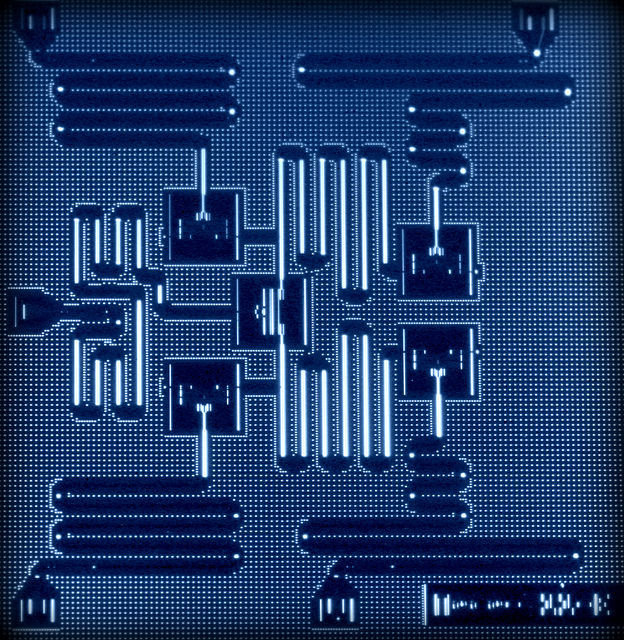
Layout of IBM’s five superconducting quantum bit device. In 2015, IBM scientists demonstrated critical breakthroughs to detect quantum errors by combining superconducting qubits in latticed arrangements, and whose quantum circuit design is the only physical architecture that can scale to larger dimensions. Now, IBM scientists have achieved a further advance by combining five qubits in the lattice architecture, which demonstrates a key operation known as a parity measurement — the basis of many quantum error correction protocols. (credit: IBM Research)

IBM Research has announced that effective Wednesday May 4, it is making quantum computing available free to members of the public, who can access and run experiments on IBM’s quantum processor, via the IBM Cloud, from any desktop or mobile device.

IBM believes quantum computing is the future of computing and has the potential to solve certain problems that are impossible to solve on today’s supercomputers.

The cloud-enabled quantum computing platform, called IBM Quantum Experience, will allow users to run algorithms and experiments on IBM’s quantum processor, work with the individual quantum bits (qubits), and explore tutorials and simulations around what might be possible with quantum computing.

The quantum processor is composed of five superconducting qubits and is housed at the IBM T.J. Watson Research Center in New York. IBM’s quantum architecture can scale to larger quantum systems. It is aimed at building a universal quantum computer that can be programmed to perform any computing task and will be exponentially faster than classical computers for a number of important applications for science and business, IBM says.


IBM | Explore our 360 Video of the IBM Research Quantum Lab

IBM envisions medium-sized quantum processors of 50–100 qubits to be possible in the next decade. With a quantum computer built of just 50 qubits, none of today’s TOP500 supercomputers could successfully emulate it, reflecting the tremendous potential of this technology.

“Quantum computing is becoming a reality and it will extend computation far beyond what is imaginable with today’s computers,” said Arvind Krishna, senior vice president and director, IBM Research. “This moment represents the birth of quantum cloud computing. By giving hands-on access to IBM’s experimental quantum systems, the IBM Quantum Experience will make it easier for researchers and the scientific community to accelerate innovations in the quantum field, and help discover new applications for this technology.”

This leap forward in computing could lead to the discovery of new pharmaceutical drugs and completely safeguard cloud computing systems, IBM believes. It could also unlock new facets of artificial intelligence (which could lead to future, more powerful Watson technologies), develop new materials science to transform industries, and search large volumes of big data.

The IBM Quantum Experience


IBM | Running an experiment in the IBM Quantum Experience

Coupled with software expertise from the IBM Research ecosystem, the team has built a dynamic user interface on the IBM Cloud platform that allows users to easily connect to the quantum hardware via the cloud.

In the future, users will have the opportunity to contribute and review their results in the community hosted on the IBM Quantum Experience and IBM scientists will be directly engaged to offer more research and insights on new advances. IBM plans to add more qubits and different processor arrangements to the IBM Quantum Experience over time, so users can expand their experiments and help uncover new applications for the technology.

IBM employs superconducting qubits that are made with superconducting metals on a silicon chip and can be designed and manufactured using standard silicon fabrication techniques. Last year, IBM scientists demonstrated critical breakthroughs to detect quantum errors by combining superconducting qubits in latticed arrangements, and whose quantum circuit design is the only physical architecture that can scale to larger dimensions.


IBM | IBM Brings Quantum Computing to the Cloud

Now, IBM scientists have achieved a further advance by combining five qubits in the lattice architecture, which demonstrates a key operation known as a parity measurement — the basis of many quantum error correction protocols.

By giving users access to IBM’s experimental quantum systems, IBM believes it will help businesses and organizations begin to understand the technology’s potential, for universities to grow their teaching programs in quantum computing and related subjects, and for students (IBM’s potential future customers) to become aware of promising new career paths. And of course, to raise IBM’s marketing profile in this emerging field.

The world’s tiniest, most powerful nanoengine

Exploding polymer-coated gold nanoparticles in the world’s tiniest engine (credit: Yi Ju/University of Cambridge NanoPhotonics)

University of Cambridge researchers have developed the world’s tiniest engine, capable of a force per unit-weight nearly 100 times higher* than any motor or muscle.

The new nano-engines could lead to nanorobots small enough to enter living cells to fight disease, the researchers say.

Professor Jeremy Baumberg from the Cavendish Laboratory, who led the research, has named the devices “actuating nanotransducers” (ANTs). “Like real ants, they produce large forces for their weight,” he quipped.

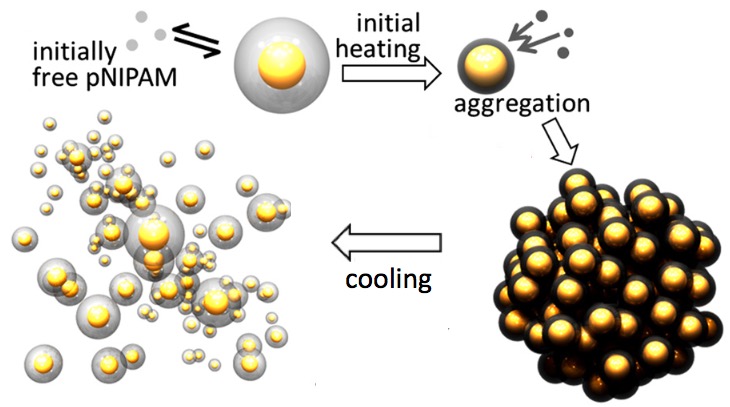
As reported in the journal PNAS, the prototype ANT device —  just a few billionths of a meter in size — is made of gold nanoparticles bound together with temperature-responsive gel polymers. It can function as a piston or spring and works in a reversible cycle. Loose nanoparticles in water are first heated. When the temperature reaches 32 degrees C, they suddenly aggregate into a tight ball. Cooling causes the nanoparticles to rapidly take on water and expand in a sudden explosion.

The ANT reversible cycle. Left: ANTs are created by adding a polymer (gray spheres) called pNIPAM to gold nanoparticles (yellow). A blue-light laser then heats the ANT solution. When heated to 32 degrees C with a laser, the polymer nanoparticles absorb large amounts of elastic energy in a fraction of a second as the polymer coatings expel all the water from the gel and collapse, forcing the gold nanoparticles to bind together into dehydrated tight clusters (right). When the device is cooled (by turning off the laser), the polymers rapidly take on water and expand. That strongly, rapidly, and explosively pushes the gold nanoparticles apart — suddenly releasing energy, similar to release of a tightly compressed spring. (credit: Tao Ding et al./PNAS, adapted)

“It’s like an explosion,” said Tao Ding, PhD., from Cambridge’s Cavendish Laboratory, and the paper’s first author. “We have hundreds of gold balls flying apart in a millionth of a second when water molecules inflate the polymers around them.”

This “explosion” process converts Van de Waals energy — the attraction or repulsion between atoms or molecules — into the elastic energy of polymer molecules and releases it very quickly. “The whole process is like a nano-spring,” explained Baumberg. “The smart part here is we make use of Van de Waals attraction of heavy metal particles to set the springs (polymers) and water molecules to release them, which is very reversible and reproducible.”

Biological, other applications

KurzweilAI has covered a number of kinetic nanorobotic and microrobotic devices, including 3D-motion nanomachines from DNA, a magnetically controlled “nanoswimmer” for delivering drugs, sperm-inspired microrobots controlled by magnetic fields, and bacteria-powered microrobots.  However, the forces exerted by ANT devices are several orders of magnitude larger* than those for any other previously produced device, according to the researchers. ANT devices are bio-compatible, cost-effective to manufacture, fast to respond, and energy-efficient, according to the researchers.

Possible applications include microrobotics, sensing, storage devices, smart windows and walls, and especially biomedical uses, since the spring process occurs at biological temperatures (32 degrees C or 90 degrees F). The team plans to initially commercialize this technology for optically controlled biological microfluidic pumps and valves.

The research is funded as part of a UK Engineering and Physical Sciences Research Council (EPSRC) investment in the Cambridge NanoPhotonics Centre, and by the European Research Council (ERC).

* On the order of nN compared to typically 10 fN/nm2, with up to GHz switching speeds.


Abstract of Light-induced actuating nanotransducers

Nanoactuators and nanomachines have long been sought after, but key bottlenecks remain. Forces at submicrometer scales are weak and slow, control is hard to achieve, and power cannot be reliably supplied. Despite the increasing complexity of nanodevices such as DNA origami and molecular machines, rapid mechanical operations are not yet possible. Here, we bind temperature-responsive polymers to charged Au nanoparticles, storing elastic energy that can be rapidly released under light control for repeatable isotropic nanoactuation. Optically heating above a critical temperature Tc = 32 °C using plasmonic absorption of an incident laser causes the coatings to expel water and collapse within a microsecond to the nanoscale, millions of times faster than the base polymer. This triggers a controllable number of nanoparticles to tightly bind in clusters. Surprisingly, by cooling below Tc their strong van der Waals attraction is overcome as the polymer expands, exerting nanoscale forces of several nN. This large force depends on van der Waals attractions between Au cores being very large in the collapsed polymer state, setting up a tightly compressed polymer spring which can be triggered into the inflated state. Our insights lead toward rational design of diverse colloidal nanomachines.

Harold Cohen: in memoriam

TCM#2 (1995) 45×58 — Dye on paper, painted with the AARON painting machine (credit: Howard Cohen)

By Paul Cohen

Harold Cohen, artist and pioneer in the field of computer-generated art, died on April 27, 2016 at the age of 87. Cohen is the author of AARON, perhaps the longest-lived and certainly the most creative artificial intelligence program in daily use.

Cohen viewed AARON as his collaborator. At times during their decades-long relationship, AARON was quite autonomous, responsible for the composition, coloring and other aspects of a work; more recently, AARON served Cohen by making drawings that Cohen would develop into paintings. Cohen’s death is the end of a lengthy partnership between an artist and an artificial intelligence.

Cohen grew up in England. He studied painting at the Slade School of Fine Arts in London, and later taught at the Slade as well as Camberwell, Nottingham and other arts schools. He represented Great Britain at major international festivals during the 60′s, including the Venice Biennale, Documenta 3, and the Paris Biennale. He showed widely and successfully at the Robert Fraser Gallery, the Alan Stone Gallery, the Whitechapel Gallery, the Arnolfini Gallery, the Victoria and Albert Museum, and many other notable venues in England and Europe.

Then, in 1968, he left London for a one-year visiting faculty appointment in the Art Department at the University of California, San Diego. One year became many,  Cohen became Department Chair, then Director of the Center for Research in Computing and the Arts at UCSD, and eventually retired emeritus in 1994.

The Last Machine Age (2015) 35.75×65.75 — Pigment ink on canvas was finger painted using Harold Cohen’s finger painting system (credit: Howard Cohen)

A scientist and engineer of art

Leaving the familiar, rewarding London scene presaged a career of restless invention. By 1971, Cohen had taught himself to program a computer and exhibited computer-generated art at the Fall Joint Computer Conference. The following year, he exhibited not only a program but also a drawing machine at the Los Angeles County Museum. A skilled engineer, Cohen built many display devices: flatbed plotters, a robotic “turtle” that roamed and drew on huge sheets of paper, even a painting robot that mixed its own colors.

These machines and the museum-goers’ experiences were always important to Cohen, whose fundamental question was, “What makes images evocative?”  The distinguished computer scientist and engineer Gordon Bell notes that “Harold was really a scientist and engineer of art.”

Indeed, AARON was a thoroughly empirical project: Cohen studied how children draw, he tracked down the petroglyphs of California’s Native Americans,  he interviewed viewers and he experimented with algorithms to discover the characteristics of images that make them seem to stand for something. Although AARON went through an overtly representational phase, in which images were recognizably of people or potted plants,  Cohen and AARON returned to abstraction and evocation and methods for making images that produce cascades of almost-recognition and associations in the minds of viewers.

Harold Cohen and AARON: Ray Kurzweil interviews Harold Cohen about AARON (credit: Computer History Museum/Kurzweil Foundation)

“Harold Cohen is one of those rare individuals in the Arts who performs at the highest levels both in the art world and the scientific world,” said Professor Edward Feigenbaum of Stanford University’s Artificial Intelligence Laboratory, where Cohen was exposed to the ideas and techniques of artificial intelligence. “All discussions of creativity by computer invariably cite Cohen’s work,” said Feigenbaum.

Cohen had no patience for the “is it art?” question. He showed AARON’s work in the world’s  galleries, museums and science centers — the Tate, the Stedelijk, the San Francisco Museum of Art, Documenta, the Boston Computer Museum, the Ontario Science Center, and many others. His audiences might have been drawn in by curiosity and the novelty of computer-generated art, but they would soon ask, “how can a machine make such marvelous pictures? How does it work?” The very questions that Cohen asked himself throughout his career.

AARON’s images and Cohen’s essays and videos can be viewed at www.aaronshome.com.

Cohen is survived by his partner Hiromi Ito; by his brother Bernard Cohen; by Paul Cohen, Jenny Foord and Zana Itoh Cohen; by Sara Nishi, Kanoko Nishi-Smith, and Uta and Oscar Nishi-Smith; by Becky Cohen; and by Allegra Cohen, Jacob and Abigail Foord, and Harley and Naomi Kuych-Cohen.


ACM SIGGRAPH Awards | Harold Cohen, Distinguished Artist Award for Lifetime Achievement

Skull echoes could become the new passwords for augmented-reality glasses

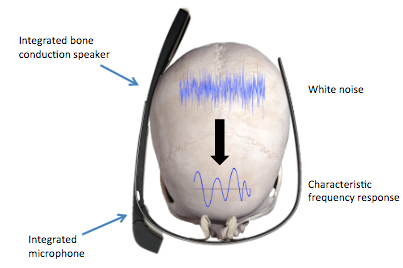
SkullConduct uses the bone conduction speaker and microphone integrated into some augmented-reality glasses and analyzes the characteristic frequency response of an audio signal sent through the user’s skull as a biometric system. (credit: Stefan Schneegass et al./Proc. ACM SIGCHI Conference on Human Factors in Computing Systems)

German researchers have developed a biometric system called SkullConduct that uses bone conduction of sound through the user’s skull for secure user identification and authentication on augmented-reality glasses, such as Google Glass, Meta 2, and HoloLens.

SkullConduct uses the microphone already built into many of these devices and adds electronics (such as a chip) to analyze the frequency response of sound after it travels through the user’s skull. The researchers, at the University of Stuttgart, Saarland University, and Max Planck Institute for Informatics, found that individual differences in skull anatomy result in highly person-specific frequency responses that can be used as a biometric system.

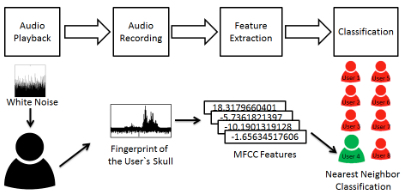
The recognition pipeline used to authenticate users: (1) white noise is played back using the bone conduction speaker, (2) the user’s skull influences the signal in a characteristic way, (3) MFCC features are extracted, and (4) a neuron-network algorithm is used for classification. (credit: Stefan Schneegass et al./Proc. ACM SIGCHI Conference on Human Factors in Computing Systems)

The system combines “Mel Frequency Cepstral Coefficient” (MFCC) (a feature extraction method used in automatic speech recognition) with a lightweight neural-network classifier algorithm that can directly run on the augmented-reality device.

The researchers also conducted a controlled experiment with ten participants that showed that skull-based frequency response serves as a robust biometric, even when taking off and putting on the device multiple times. The experiments showed that the system could identify users with 97.0% accuracy and authenticate them with an error rate of 6.9%.

It’s not as accurate as the CEREBRE biometric system (see You can now be identified by your ‘brainprint’ with 100% accuracy), but it’s low-cost, portable, and doesn’t require a complex system and extensive user testing.


Abstract of SkullConduct: Biometric User Identification on Eyewear Computers Using Bone Conduction Through the Skull

Secure user identification is important for the increasing number of eyewear computers but limited input capabilities pose significant usability challenges for established knowledge-based schemes, such as a passwords or PINs. We present SkullConduct, a biometric system that uses bone conduction of sound through the user’s skull as well as a microphone readily integrated into many of these devices, such as Google Glass. At the core of SkullConduct is a method to analyze the characteristic frequency response created by the user’s skull using a combination of Mel Frequency Cepstral Coefficient (MFCC) features as well as a computationally light-weight 1NN classifier. We report on a controlled experiment with 10 participants that shows that this frequency response is person-specific and stable – even when taking off and putting on the device multiple times – and thus serves as a robust biometric. We show that our method can identify users with 97.0% accuracy and authenticate them with an equal error rate of 6.9%, thereby bringing biometric user identification to eyewear computers equipped with bone conduction technology.