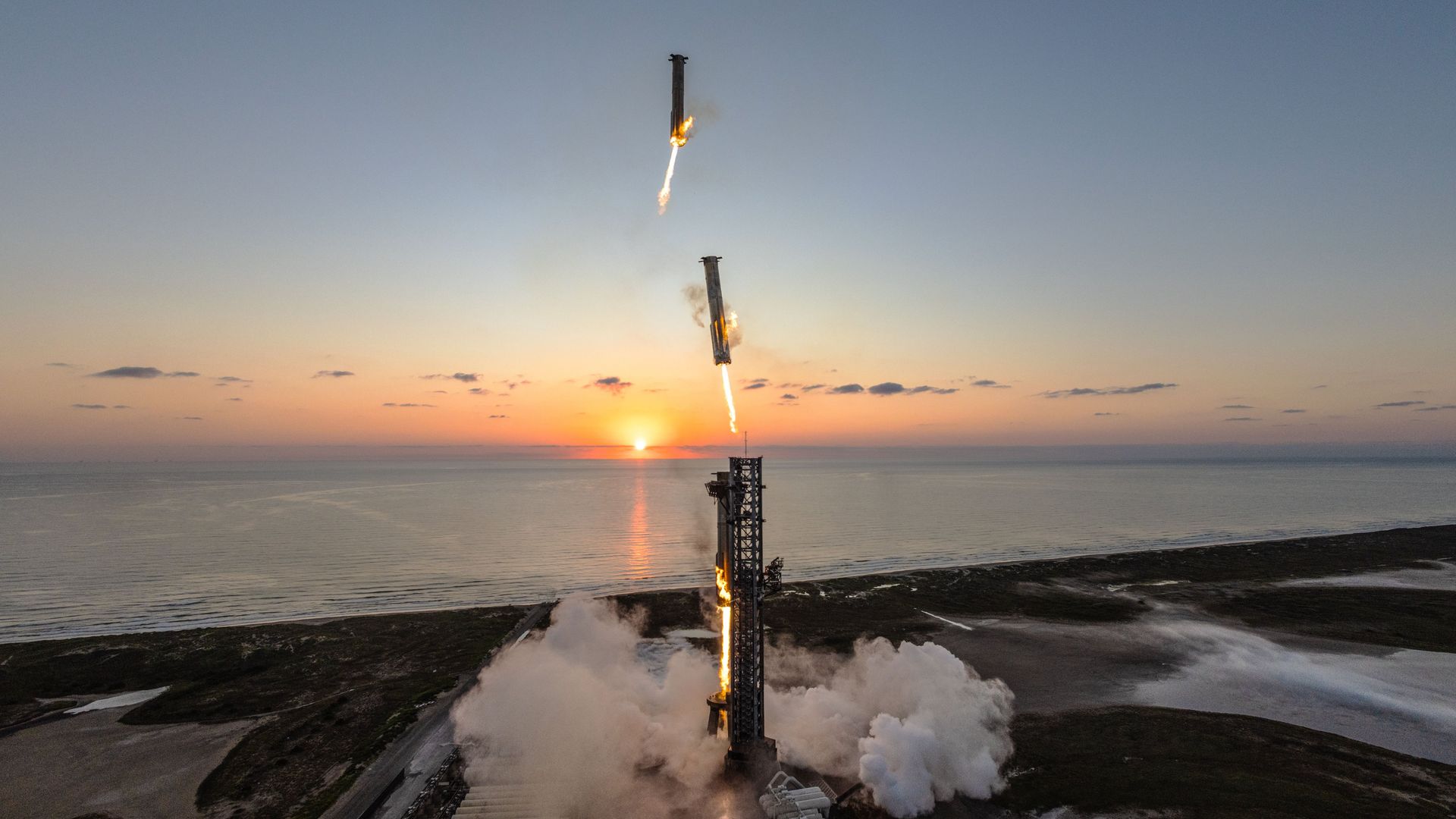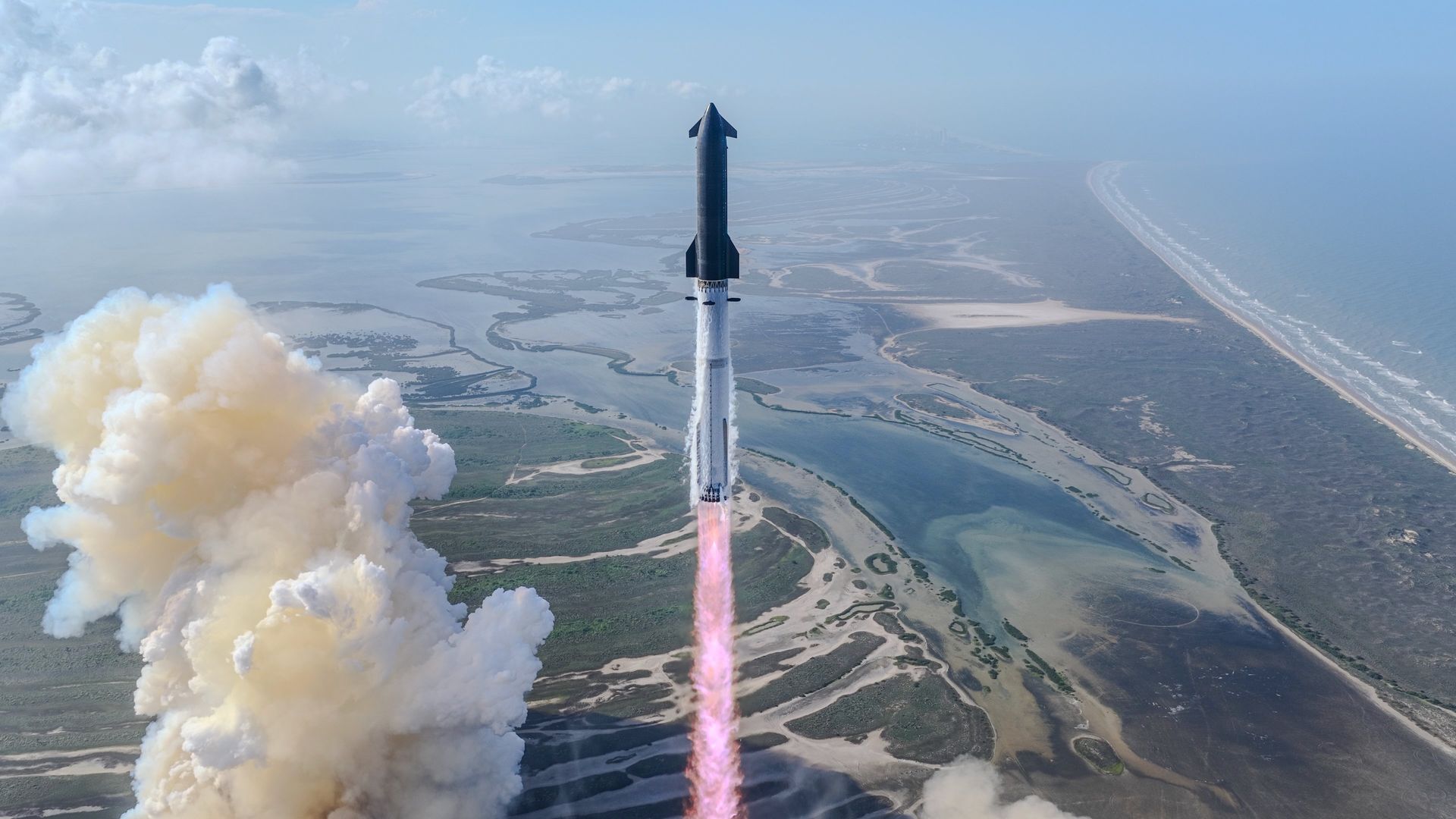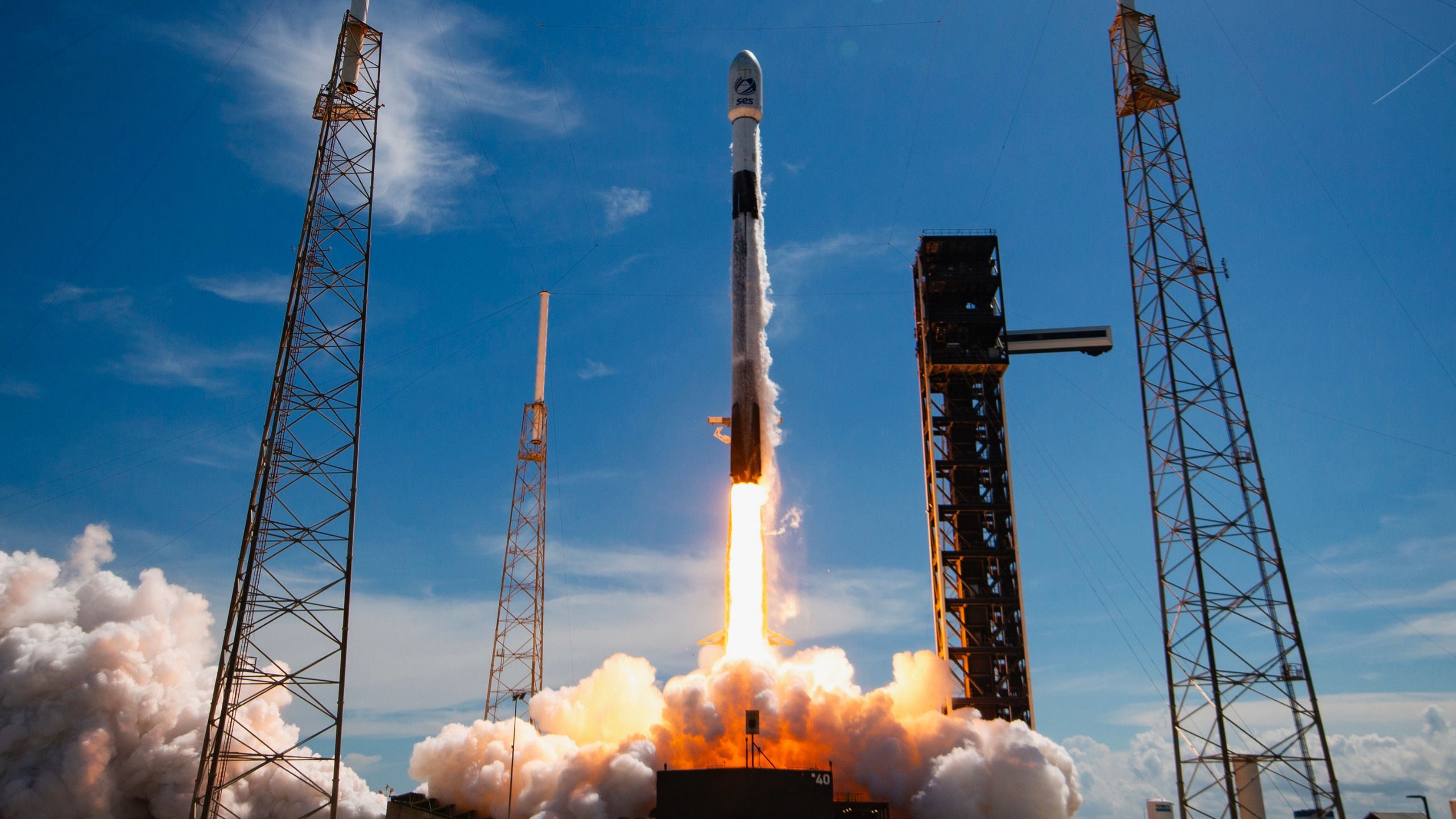
The 13th test flight of SpaceX's Starship megarocket went pretty well — and provided some amazing visuals, too.
Flight 13 launched on Friday (July 24), sending the 408-foot-tall (124 meters) Starship Version 3 (V3) vehicle aloft from SpaceX's Starbase site in South Texas.
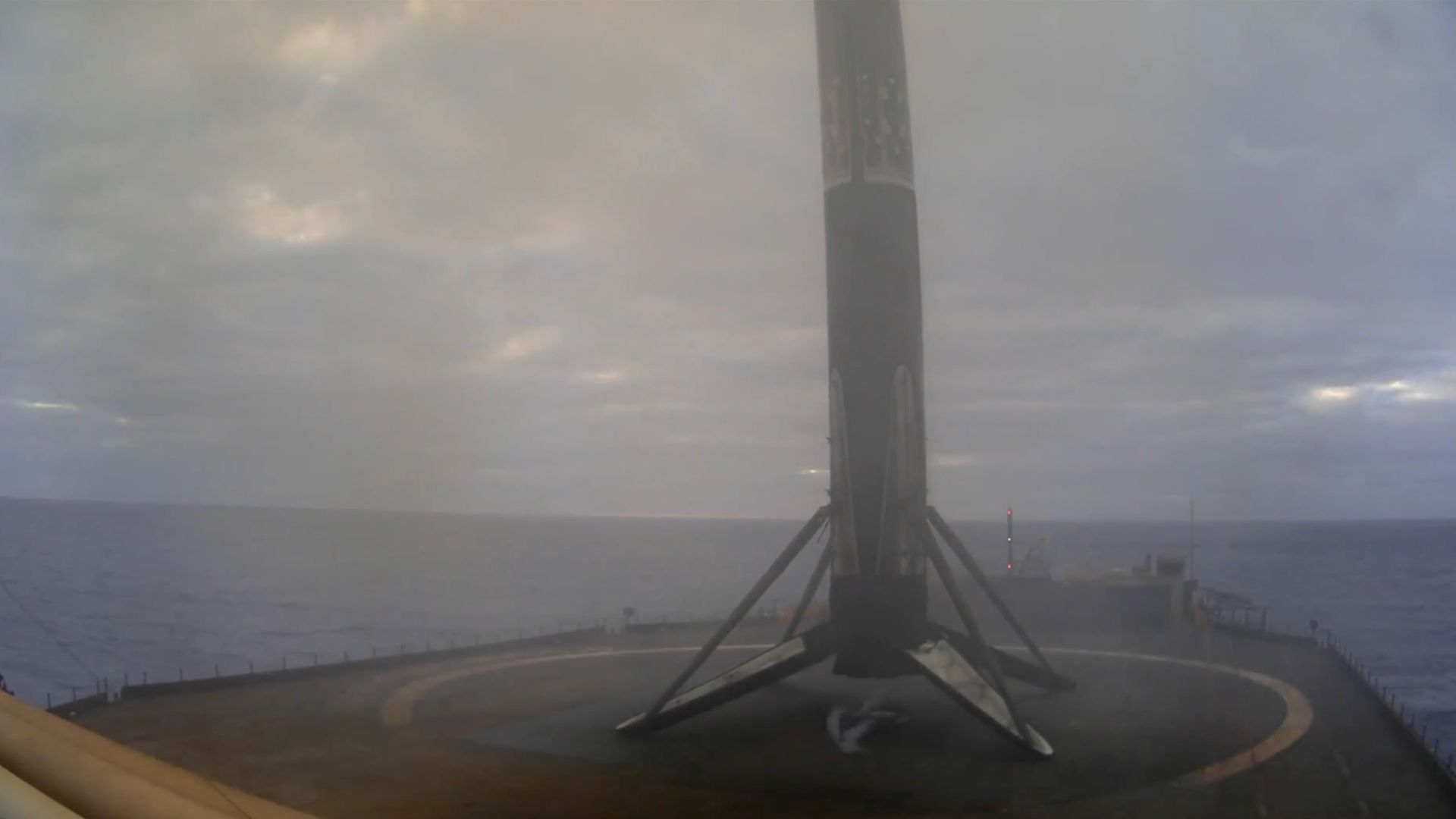
Starship's Super Heavy booster had some engine issues on its way back to Earth. But the Ship upper stage hit all of its marks, successfully deploying 20 next-gen Starlink satellites, re-igniting one of its Raptor engines in space as planned and splashing down softly off the coast of Western Australia. So softly, in fact, that Ship didn't explode after hitting the water — a first for a Starship flight.
The two stages of SpaceX's Starship megarocket separate during the vehicle's 13th test flight, on July 24, 2026. (Image credit: SpaceX)
SpaceX shared these milestones with us in real time, via the company's Flight 13 launch webcast. And the company highlighted a few of them after the fact as well, with some stunning imagery published on its X account.
One Friday post, for example, shows footage from Super Heavy of Ship cruising away shortly after stage separation, its six Raptors glowing with exertion against the backdrop of a gorgeously blue Earth.
Another Friday X post provides a Ship's-eye view of the vehicle's descent toward the Indian Ocean, steering its way from sky to sea. The video switches over to drone footage just before Ship hits the water, capturing from above the dramatic splashdown — and Ship's survival, despite the outbreak of a sizeable fire around its nose.
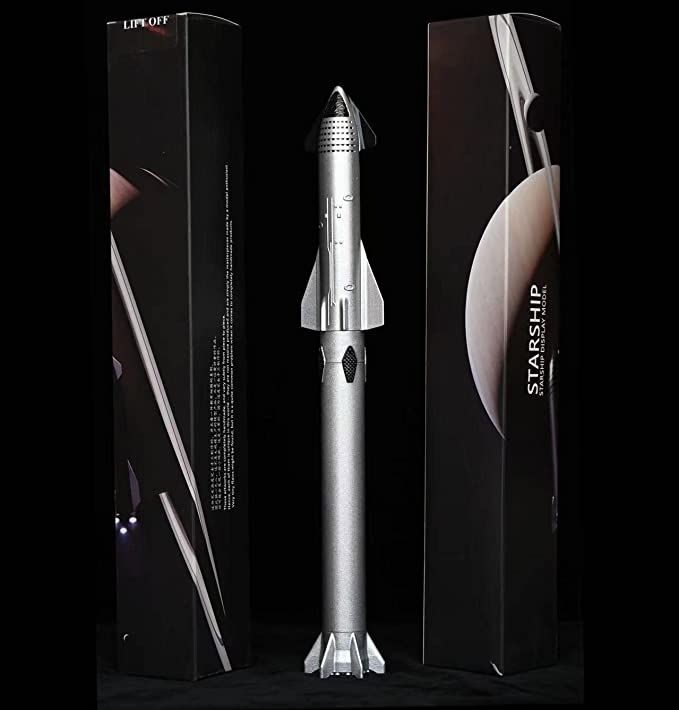
Even if you can't see SpaceX's Starship in person, you can score a model of your own. Standing at 13.77 inches (35 cm), this is a 1:375 ratio of SpaceX's Starship as a desktop model. The materials here are alloy steel and it weighs just 225g.View Deal
Both Ship and Super Heavy are designed to be fully and rapidly reusable. Eventually, both vehicles will return to the launch site shortly after liftoff, for capture with their launch tower's "chopstick" arms, refurbishment and reflight.
SpaceX has already caught Super Heavy on three Starship test flights and will try to do the same with Ship for the first time on Flight 14, provided no red flags emerge during Flight 13 data review, according to SpaceX founder and CEO Elon Musk.
Starship conducted its first test flight in April 2023. Flight 13 was the second launch Version 3 of the vehicle, the first iteration of the vehicle that's designed to be operational.
SpaceX is working hard to get the giant rocket up and running soon. Starship is slated to fly on NASA's Artemis III astronaut mission to Earth orbit next summer and to land astronauts near the moon's south pole on Artemis IV in late 2028.
Rocket Lab is expanding its launch operations to the snowy north.
The California-based company, which already flies from New Zealand and Virginia, just inked a $266 million deal with the U.S. Space Force to fly up to 18 missile-defense missions, most of them from Alaska.
"The size and scale of this contract reflects the Space Force's confidence in our ability to meet their urgent national security demands with speed, responsiveness and scale, and we're proud to provide the high-frequency launch capacity required to keep the U.S. ahead of global threats," Rocket Lab founder and CEO Peter Beck said in a statement today (July 27).
The contract covers 12 suborbital launches, with the possibility of up to six more. These missions "will primarily take place" from the Pacific Spaceport Complex, a picturesque site on Alaska's Kodiak Island, which is most famous for its thriving population of brown bears.
The spaceport has hosted nearly three dozen missions since opening in 1998, most of them suborbital flights for the U.S. military. Recently, however, it has supported launches of private orbital rockets — specifically, those built by Astra and ABL Space Systems (now known as Long Wall).
The newly announced Rocket Lab missions will almost certainly be performed by HASTE, a suborbital variant of the company's workhorse Electron small-satellite launcher that customers use to test hypersonic technologies in the flight environment.
They may also be part of the United States' sprawling Golden Dome missile-defense initiative, though we don't know that for sure; today's release provides few details about the launches.
A Rocket Lab HASTE suborbital rocket launches on the "Prometheus Run" mission for the U.S. military on Nov. 18, 2025. (Image credit: Rocket Lab)
Rocket Lab's primary launch site is on Māhia Peninsula, on the North Island of Peter Beck's native New Zealand. The company also flies from two pads on Wallops Island, Virginia, one of which has been the jumping-off point for all HASTE suborbital launches to date.
HASTE debuted in June 2023 and now has nine missions under its belt. Electron lifted off for the first time in May 2017 and has flown 82 times to date.
A U.S.-Russian crew returned to Earth from the International Space Station early Sunday morning (July 26), after 241 days in orbit.
A Soyuz spacecraft carrying NASA astronaut Chris Williams and Sergey Kud-Sverchkov and Sergei Mikaev of the Russian space agency Roscosmos undocked from the orbiting lab on Sunday at 3:03 a.m. EDT (0703 GMT).
The Soyuz, known as MS-28, landed on the steppe of Kazakhstan 3 hours and 24 minutes later, at 6:27 a.m. EDT (1027 GMT).
Roscosmos' Soyuz MS-28 spacecraft is seen as it lands in a remote area near the town of Dzhezkazgan, Kazakhstan with Expedition 74 NASA astronaut Chris Williams and Roscosmos cosmonauts Sergey Kud-Sverchkov, and Sergei Mikaev aboard, on Sunday, July 26, 2026. (Image credit: NASA/Bill Ingalls)
The crew's departure activities began on Saturday morning with a change-of-command ceremony aboard the International Space Station (ISS). Kud‑Sverchkov handed over the reins of the orbiting lab to NASA astronaut Jessica Meir, part of the transition from ISS Expedition 74 to Expedition 75 (which officially began when Soyuz MS‑28 undocked).
The crew then gave their farewells and closed the hatches between the ISS and Soyuz MS-28 on Saturday night.
NASA astronaut Chris Williams, left, Roscosmos cosmonaut Sergey Kud-Sverchkov, center, and Roscosmos cosmonaut Sergei Mikaev are seen inside the Soyuz MS-28 spacecraft after they landed in Kazakhstan on Sunday, July 26, 2026. (Image credit: NASA/Bill Ingalls)
Soyuz MS-28 launched to the ISS on Nov. 27, which was Thanksgiving Day. That liftoff kicked off the first space mission for Williams and Mikaev and the second for Kud‑Sverchkov, who now has logged 426 days and 9 minutes in space.
The MS-28 trio orbited Earth 3,856 times and traveled a total of more than 102 million miles (164 million kilometers).
Now back on Earth, the three spaceflyers were first flown by helicopter to Karaganda, Kazakhstan, where recovery teams were based. Williams then will return to NASA's Johnson Space Center in Houston, while Kud‑Sverchkov and Mikaev head back to their training base in Star City, Russia.
The world's most powerful solid-fuel rocket just aced its third-ever mission.
Gravity-1, a distinctively squat and stubby rocket, launched Tuesday night (July 21) from the deck of a ship stationed off the coast of Shanghai.
Liftoff occurred at 10:54 p.m. EDT (0254 GMT and 10:54 a.m. Beijing time on July 22), according to the state-run Chinese outlet Xinhua, which further reported that all nine satellites reached "their designated orbits." Details about those satellites were not provided.
Orienspace's Gravity-1 rocket launches nine satellites to orbit from a ship at sea on July 21, 2026. (Image credit: CCTV)
Gravity-1 is operated by Orienspace, a company based in the eastern Chinese province of Shandong. The rocket stands about 100 feet (30 meters) tall — less than half the height of SpaceX's workhorse Falcon 9 vehicle.
Gravity-1 consists of three core stages and four strap-on boosters, all of which feature solid rocket motors. The launcher can haul up to 14,300 pounds (6,500 kilograms) of payload to low Earth orbit (LEO), making it the most powerful solid rocket in the world. (For comparison: The liquid-fueled Falcon 9 can deliver a maximum of 50,265 pounds, or 22,800 kg, to LEO.)
The Chinese vehicle now has three flights under its belt, all of which launched from ships at sea and achieved full mission success. Gravity-1's first two flights occurred in January 2024 and October 2025.
There won't be such a long gap before Gravity-1 flies again, if all goes to plan. The rocket is expected to launch a batch of Chinese internet satellites in the next few months, according to the state-run outlet CGTN.
And Orienspace's ambitions don't end with Gravity-1. The company is also developing Gravity-2 and Gravity-3, larger, more powerful rockets that will feature liquid-fueled core stages and solid rocket boosters.
Gravity-2 could be ready to fly by the end of the year, CGTN reported. And that vehicle will likely lift off from an ocean-based pad as well.
"Sea launch of solid-propellant rockets paves the way for future launch of liquid rockets at sea," said Gravity-1 chief designer Xu Guoguang, according to CGTN. "We are also considering other methods, such as launching from drilling platforms."
The fight continues against SpaceX's controversial South Texas land swap.
That deal, which the company made with the U.S. Fish and Wildlife Service (USFWS), gives SpaceX 727 acres (294 hectares) of public land that's currently part of the Lower Rio Grande Valley National Wildlife Refuge. In exchange, the company hands over 683 acres (276 hectares) of its territory in the area, not all of it contiguous, to the USFWS.
Last month, a coalition of conservation and tribal groups sued the USFWS over the swap, saying it degrades the refuge and violates multiple laws, including the National Wildlife Refuge System Improvement Act of 1997. And yesterday (July 20), those groups filed an emergency injunction, asking a federal judge to stop the exchange until the courts can rule on the ongoing case.
"Federal officials are racing to fork over America's public lands to one of wealthiest corporations on Earth before the courts can even weigh in," Laiken Jordahl, national public lands advocate at the Center for Biological Diversity, said in a statement yesterday (July 20).
"This refuge is one of the last places left for the public to enjoy nature in the Rio Grande Valley," Jordahl added. "Why should Texans be forced to surrender even more of their public lands to a trillion-dollar corporation? The court has to intervene now, because once these refuge lands are transferred to SpaceX, they’re gone forever."
The land set to be transferred to SpaceX is near Starbase, the manufacturing and launch hub for the company's Starship megarocket. SpaceX sees Starship as transformational; it's the biggest and most powerful launcher ever built, and it's designed to be fully and rapidly reusable.
SpaceX's Starbase site sits amid wetlands with high biodiversity in South Texas. (Image credit: SpaceX)
Starship remains in the development-and-testing phase. It has flown 12 suborbital test flights to date, all of them from Starbase, and is gearing up for Flight 13 this Thursday (July 23).
These launches pose a threat to the wildlife that the 90,000-acre (36,420 hectares) refuge was established to protect, according to the Center for Biological Diversity, a conservation nonprofit based in Tucson, Arizona.
"A 2024 study found that, after one launch, every single monitored shorebird nest near the launch site suffered egg damage or loss," the organization said in yesterday's statement. "Instead of taking any enforcement actions or working with SpaceX to reduce or eliminate its harm to the refuge, the Service [USFWS] is now citing the resulting degradation as justification for handing the public land to SpaceX."
Some of the land being transferred to SpaceX is part of the Palmito Ranch Battlefield National Historic Landmark, where the final battle of the Civil War was fought. This means the swap also violates the National Historic Preservation Act, according to the Center or Biological Diversity.
The Center or Biological Diversity and its partners also take issue with how the land deal was made.
"The proposed land exchange was first made public in March, but records obtained under the Freedom of Information Act show internal agency planning began as early as April 2025," yesterday's statement reads. "In those discussions with the regional director of the Service, the agency developed 'the most expedited schedule possible' for completing a land transfer and recommended hiring additional staff to meet what they described as an 'optimum timeframe.'"
The plaintiffs in the lawsuit against the USFWS are the Center for Biological Diversity, Save RGV, the Carrizo/Comecrudo Nation of Texas, Inc., and the South Texas Environmental Justice Network.
SpaceX called today's launch MRV-MEV, because it's sending up a Mission Robotic Vehicle and three Mission Extension Pods (MEPs). These spacecraft will be operated by SpaceLogistics, a subsidiary of Virginia-based aerospace giant Northrop Grumman.
Northrop Grumman integrated the robotics payload, developed by the Naval Research Laboratory (NRL), onto its Mission Robotics Vehicle at the company’s Dulles, Virginia facility. (Image credit: Northrop Grumman)
MRV-MEV is headed to geostationary orbit (GEO), 22,236 miles (35,786 kilometers) above Earth. At this altitude, orbital speed matches the velocity of our planet's rotation, allowing spacecraft to "hover" over the same patch of ground continuously. For this reason, GEO is a popular destination for spy, communications and weather satellites.
The new mission will work to extend the lives of such satellites. The MRV is equipped with two 10-foot-long (3 meters) robotic arms, a system developed by the U.S. Defense Advanced Research Projects Agency (DARPA) with the help of the Naval Research Laboratory. The spacecraft will use those arms to attach the MEPs — the first three ever to launch — to three separate satellites in GEO.
"Once installed, the MEP uses electric propulsion to provide orbit control and momentum unloading for a client satellite," Northrop Grumman wrote in an MEP fact sheet. "The MEP is controlled by the customer via a self-contained C- or Ku-band telemetry and command system, and [is] capable of providing up to eight years of life extension for a typical 2,000 kg satellite in GEO."
The Australian satellite operator Optus booked one of the MEPs, and Intelsat hired out the other two, according to Tech Times.
The MRV and MEPs will reach GEO separately. When it's rendezvous time, the robotic-armed spacecraft will grab an MEP and ferry it over to its client satellite, Tech Times reported. The MRV will then remain in GEO after it has installed the third MEP, waiting for other such "satellite jetpacks" to reach orbit.
In addition to installing MEPs, the MRV "can relocate, inspect, repair and upgrade spacecraft while in orbit," Northrop Grumman's website states.
"MRV includes a Northrop Grumman-developed Passive Refueling Module (PRM), the first refueling interface standard approved by the U.S. Space Force, which enables MRV to be refueled in orbit," it adds. "With advanced robotics technology and Northrop Grumman's proven experience in satellite servicing, the mission delivers an unprecedented capability and new class of system that can continuously evolve to support novel or increasingly advanced missions for our nation, making assets in space more resilient."
That "proven experience in satellite servicing" consists of two previous Northrop Grumman projects. Mission Extension Vehicle-1 (MEV-1) — the first-ever commercial satellite-servicing spacecraft — launched in October 2019 and successfully rendezvoused with its target in GEO (the communications satellite Intelsat 901) four months later. MEV-2 launched in August 2020 and docked with Intelsat 10-02 the following April.
Neither MEV-1 nor MEV-2 used Mission Extension Pods, however. Each of those previous efforts employed a single servicing craft, which made its way to the target satellite, docked and performed life-extension duties on its own.
All went according to plan during the launch: The Falcon 9's upper stage deployed the MRV 35.5 minutes after liftoff and the three MEPs at 10-minute intervals after that, according to SpaceX.
In a departure from most Falcon 9 missions, there was not a first-stage landing today.
"Due to the additional performance needed to launch these payloads to geosynchronous transfer orbit, this will be the 32nd and final flight for the Falcon 9 first stage booster supporting this mission, which previously launched CRS-24, Eutelsat HOTBIRD 13F, OneWeb 1, SES-18 and SES-19, and 27 Starlink missions," SpaceX's MRV-MEP mission description reads.
SpaceX's rocket-reuse record is 36 flights, set earlier this month during a Falcon 9 launch of the company's Starlink internet satellites.
MEV-MEP was SpaceX's second launch of the day. The company also sent 24 Starlink craft to orbit atop a Falcon 9 from California this morning.
Editor's note: This story was updated at 5:23 p.m. ET with news of successful liftoff. It was then updated again at 11:05 a.m. ET on July 22 with news of successful payload deployment, and to note DARPA's key role in this mission.
SpaceX has pushed the next launch of its Starship megarocket back a few more days.
Elon Musk's company is now targeting Thursday (July 23) for Flight 13 of Starship, the giant, fully reusable vehicle it's developing to help get people to the moon and Mars, among other spaceflight tasks.
If all goes to plan, the 408-foot-tall (124.4 meters) Starship will lift off from SpaceX's Starbase site in South Texas on Thursday during a 90-minute window that opens at 6:45 p.m. EDT (2245 GMT; 5:45 p.m. local Texas time). You can watch the action live here at Space.com, courtesy of SpaceX.
It will be the second launch attempt for Starship Flight 13. The first came last Thursday (July 16) and ended in an abort, which occurred just as the giant rocket's 33 first-stage Raptor engines were firing up.
"To be confident of a good flight, 2 Raptors will be removed & replaced. Most probable launch timing is early next week," Musk said on July 16 via X, the social media platform he owns.
SpaceX first targeted today (July 20) for Flight 13's second try. On Sunday (July 19), however, the company announced that it had pushed that date back to no earlier than Thursday.
Even if you can't see SpaceX's Starship in person, you can score a model of your own. Standing at 13.77 inches (35 cm), this is a 1:375 ratio of SpaceX's Starship as a desktop model. The materials here are alloy steel and it weighs just 225g.View Deal
Flight 13 will be the second launch of Starship Version 3 (V3), the latest, most advanced iteration of the megarocket. V3 is the variant that will land astronauts on the moon for NASA's Artemis program and fly SpaceX's first Mars missions, if all goes to plan.
The plan for the upcoming suborbital launch is similar to that of Flight 12, which lifted off on May 22. Starship's Super Heavy first stage will aim to steer itself back to Earth for a controlled splashdown in the Gulf of Mexico, while the Ship upper stage will do the same halfway around the world, off the coast of Western Australia.
SpaceX accomplished the latter objective on Flight 12 but not the former; Super Heavy suffered engine issues during its return to Earth and ended up hitting the Gulf waters hard.
Flight 13 will do a few new things, however. For example, it will carry 20 of SpaceX's next-gen Starlink V3 internet satellites, which have never flown to space before. SpaceX plans to build a constellation of 100,000 Starlink V3 spacecraft in low Earth orbit over the coming years, and Starship will do all of the heavy lifting.
These 20 Starlinks won't stay aloft for long, however. Since Ship is flying on a suborbital trajectory, the satellites will come back to Earth relatively quickly — about 20 minutes after deployment, according to SpaceX's Flight 13 mission description.
Starship debuted in April 2023. All of its test flights to date have been suborbital.
Half a century after first putting hardware down on Mars, NASA is looking to explore the Red Planet's skies.
On July 20, 1976, the Viking 1 lander touched down in the western reaches of Chryse Planitia (the "Golden Plain"), a large circular landform that lies 22.5 degrees north of the Martian equator.
It was the first-ever Mars landing for NASA. Viking 1, along with its twin Viking 2, went on to conduct the first fully successful mission on the Red Planet's surface. (The Soviet Union's Mars 3 probe survived its touchdown attempt on Dec. 2, 1971 but died less than two minutes later.) And those missions have left a rich and intriguing legacy.
The first color image ever captured on the surface of Mars. NASA's Viking 1 lander took this photo on July 21, 1976. (Image credit: NASA)
Viking 1 and Viking 2 — which touched down in a different Red Planet region on Sept. 3, 1976 — were sent to the surface to search for signs of life on Mars. (Each mission also featured an orbiter, which studied the planet from above.)
The landers did this using three different experiments, two of which returned negative results. But the third, called Labeled Release (LR), was different. LR observed a steady stream of carbon dioxide gas coming from dirt into which it had introduced nutrients — a possible sign of microbial metabolism.
Some scientists deemed the LR results a likely life detection. But most disagreed, ascribing them to abiotic reactions and stressing that, overall, the Viking data paint a picture of a dead planet.
That disagreement illustrates one of the main legacies of the Viking program: It showed researchers that hunting for extraterrestrial life is a complicated business, and they needed to learn more about Mars before attempting the search again on the Red Planet.
NASA didn't send a surface craft to Mars for another two decades, a hiatus caused in part by the Vikings' ambiguous results and high price tag, as well as a shifting of funds to the nascent space shuttle program.
The dry spell was broken in July 1997, when the agency's Pathfinder lander touched down in Chryse Planitia, about 530 miles (850 kilometers) from Viking 1. The main goals of Pathfinder's mission were to demonstrate a new "faster, better, cheaper" method of Mars exploration, prove out a new airbag-based landing system and get a mobile robot onto the red dirt.
Pathfinder achieved all of these objectives, notching the third by deploying a small rover named Sojourner. The little wheeled robot stumbled across rounded pebbles — strong evidence that they had been exposed to flowing water.
This discovery helped shape a new NASA Mars exploration strategy, one that aims to make an informed search for alien life after "following the water." Life as we know it depends on water, so the agency built rovers designed to hunt for signs of past liquid water and potentially habitable environments.
The twin golf-cart-sized rovers Spirit and Opportunity landed in 2004, and the car-sized Curiosity followed suit in August 2012. Then came Perseverance, which landed inside Mars' Jezero Crater in February 2021.
All of these wheeled explorers found evidence of past aqueous environments. Curiosity and Perseverance — with their more extensive and sophisticated scientific payloads — delved even deeper, discovering complex organic molecules that may have been produced by life as we know it.
The two latter rovers are continuing their work; both remain active on the Red Planet. (Pathfinder and Sojourner operated for about three months; Spirit was declared dead in 2010 and Opportunity fell victim to a Mars dust storm in 2018.)
Perseverance has collected a variety of Mars samples, which NASA wants to return to Earth for detailed study. As the Vikings' experience suggests, such a level of intense scrutiny may be necessary to make a definitive detection of life on Mars, if it indeed exists. (Getting those samples home is not a foregone conclusion, however; NASA's original plan was deemed too expensive, and it's now looking into a new return strategy.)
Perseverance also carried a little robotic companion, which heralded a new phase of Red Planet exploration — the Ingenuity helicopter.
Ingenuity was a technology demonstration, designed to show that rotorcraft could effectively ply the thin Red Planet skies. (Mars' atmosphere is just 1% as dense as that of Earth at sea level.)
The $80 million mission was a rousing success. The 4-pound (1.8 kilograms) Ingenuity was expected to make just five short hops on Mars but ended up flying 72 times over the course of nearly three years of activity. (Its first flight occurred on April 19, 2021, and its last was on Jan. 18, 2024.)
So NASA aimed higher, drawing up plans for future helicopter missions that could collect valuable scientific data. And such a mission is on course to launch in 2028, if all goes according to plan: Skyfall, which will send three Ingenuity-like choppers to Mars on a nuclear-powered rocket.
"Equipped with a suite of scientific instruments, these aerial scouts will map hidden ice deposits and analyze weather patterns," NASA officials wrote in a description of Skyfall. "The mission will also demonstrate how aerial vehicles can generate wide terrain and subsurface maps to identify safe and resource-rich destinations for future American astronauts venturing to Mars."
And Skyfall could be just another step toward even more ambitious aerial exploration on the Red Planet. NASA's Jet Propulsion Laboratory in Southern California, which built and operated Ingenuity, is looking into larger, more capable Mars helicopters that could do a wider variety of work on the Red Planet.
This is all part of Viking 1's legacy. That historic touchdown on Mars half a century ago lifted exploration up — all the way into the skies of another world.
That's two last-second launch aborts in a row for SpaceX.
One of the company's Falcon 9 rockets tried to loft 24 Starlink internet satellites from Vandenberg Space Force Base in California this morning (July 20), but the attempt was aborted just as the first-stage engines started firing up.
Something similar happened on Thursday afternoon (July 16), when SpaceX attempted to launch the 13th test flight of its Starship megarocket.
A SpaceX Falcon 9 rocket tries to launch 24 Starlink satellites from Vandenberg Space Force Base on July 20, 2026. The launch aborted at the last second. (Image credit: SpaceX)
The two events likely have little in common other than a proximity in time. They involved two very different vehicles, after all: The workhorse Falcon 9 is the most reliable and active rocket on the planet; it has already launched 84 times this year, with zero failures.
Starship, on the other hand, remains in the development-and-testing phase. SpaceX has high hopes for the giant vehicle, which combines full reusability with unprecedented brawn. (It's the biggest and most powerful rocket ever built.)
The two vehicles are also powered by different engines. The Falcon 9's first stage employs nine Merlin 1Ds, whereas Starship's Super Heavy booster uses 33 next-gen Raptors.
SpaceX decided to swap out two of those Raptors ahead of the next Flight 13 launch attempt, which is scheduled for Thursday afternoon (July 23).
The Vandenberg Starlink launch, meanwhile, is back on the docket for Tuesday morning (July 21). It's scheduled to lift off during a nearly four-hour window that opens at 10 a.m. EDT (1400 GMT; 7 a.m. local California time), according to a SpaceX mission description.
Skyroot Aerospace successfully launched its Vikram-1 rocket to low Earth orbit (LEO) early Saturday morning (July 18), making India just the third country with a private orbital launch capability. The other two are established space powers — the U.S. and China.
"It is the dawn of a new space era," one of Skyroot's commentators said during the company's launch webcast on Saturday.
The view from the third stage of Skyroot Aerospace's Vikram-1 rocket during its debut launch on July 18, 2026. (Image credit: Skyroot Aerospace)
Skyroot Aerospace is based in the central Indian city of Hyderabad and was founded in 2018. The company made history for the first time four years later with its Vikram-S suborbital rocket, becoming the first private Indian outfit ever to reach space.
Vikram-1 is the next step for Skyroot: an orbital vehicle. The four-stage, seven-story-tall rocket is a small-satellite launcher; it can haul about 770 pounds (350 kilograms) of payload to LEO, according to the company.
"The small satellite launch market is deeply constrained on the supply side," Skyroot co-founder and CEO Pawan Kumar Chandana said in an emailed statement on Thursday (July 16).
"At the same time, the demand for services enabled by satellites in space will only continue to grow, and that is where Skyroot's opportunity lies," added Chandana, who, like company co-founder Naga Bharath Daka, used to work for the Indian Space Research Organisation.
The company began exploiting that opportunity on Saturday morning, with a test flight called Aagaman (Sanskrit for "Arrival"). The main goal was to see how Vikram-1 and its various systems performed during flight. But the rocket also carried some customer payloads, which were scheduled to be deployed at an altitude of 280 miles (450 kilometers).
Those payloads included a technology demonstration from the German company DCUBED; the Solaras S3 nanosatellite pathfinder from Indian startup Grahaa Space; and Embrace, a robotic arm built by the Indian company Cosmoserve Space that's designed to capture space debris.
Vikram-1 also carried Skyroot's SCOPE satellite, which collected a variety of data to help the company assess the rocket's performance during flight. There were two symbolic payloads on board as well — a small, 18-karat gold rocket from the artist Ajay Kumar Mattewada and "Cosmic Bloom," which was designed by Cosmos Diamonds, a company that makes jewelry using lab-grown gems.
Aerial view of Skyroot Aerospace's Infinity Campus in Hyderabad, India, showing a life-size model of the company's Vikram-1 rocket outside. (Image credit: Sumil Sudhakaran/Skyroot Aerospace)
All of them made it to space safe and sound. Vikram-1 lifted off from the Satish Dhawan Space Centre, on the Indian barrier island of Sriharikota, on Saturday at 2:35 a.m. EDT (0635 GMT; 12:05 p.m. India Standard Time), roaring off the pad in a flash thanks to its first-stage solid rocket motor.
The rocket performed as planned, sticking to a nominal trajectory and deploying the payloads right on schedule. Vikram-1 had ticked all of its boxes by just 17 minutes after liftoff, leading to a pronouncement from mission control.
"The Vikram-1 Aagaman mission is a grand success," the mission director said, eliciting cheers from the folks in the room.
It was a big moment for Skyroot and for India, and it augurs big things to come, according to Lt. Gen. AK Bhatt (retired), Director General of the Indian Space Association.
"The successful orbital launch of Skyroot Aerospace’s Vikram-1 (Mission Aagaman) is a defining milestone for India’s space journey," Bhatt said in an emailed statement shortly after the mission wrapped up. "By executing the nation's first fully private orbital flight, Skyroot has shattered legacy boundaries, demonstrating that our domestic industry is primed to handle end-to-end space missions."
Editor's note: This story was updated at 3:25 a.m. ET on July 18 with news of successful launch and satellite deployment.