Virgin Galactic's first "Delta-class" space plane just made its maiden voyage.
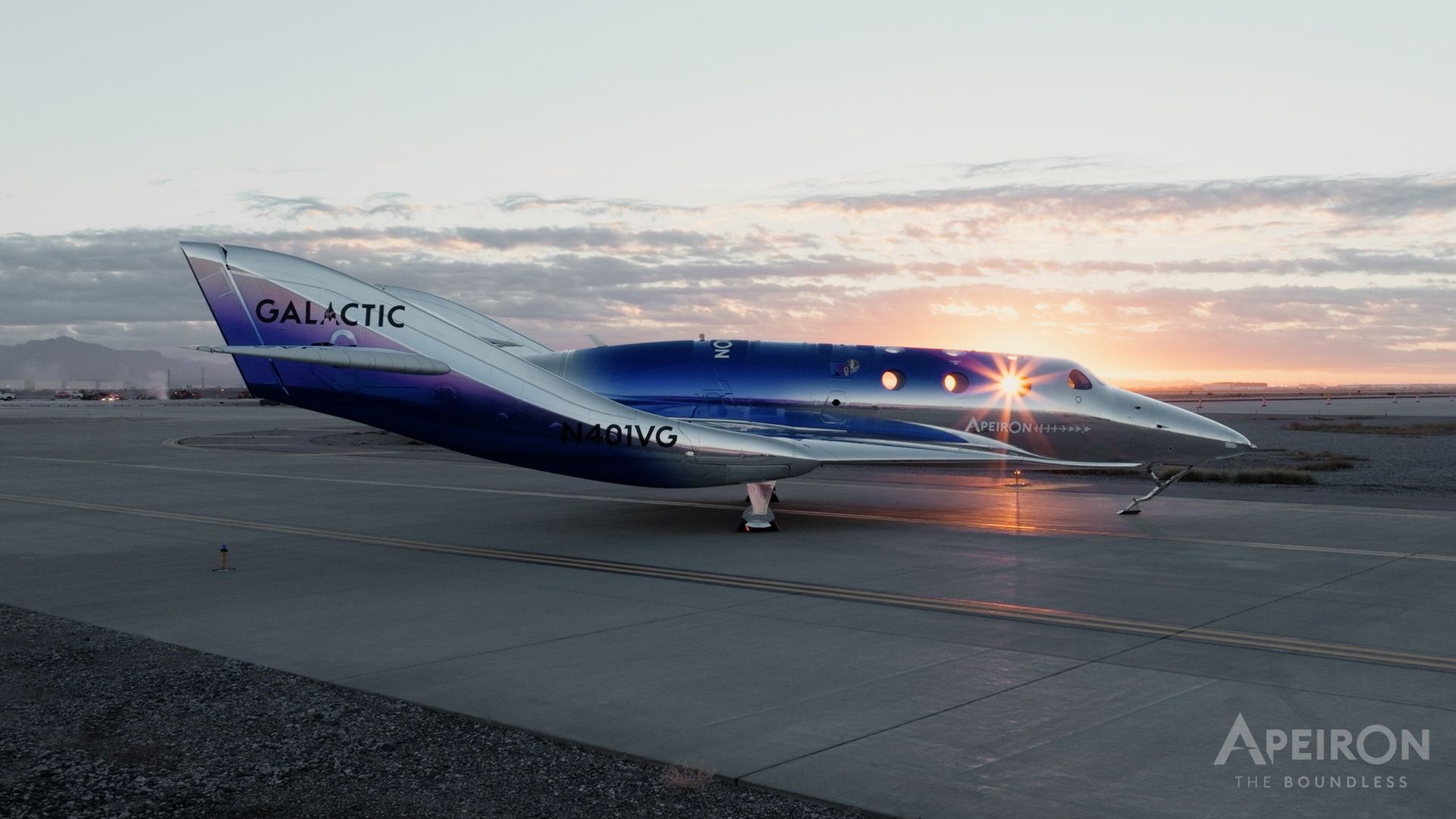
The next-gen suborbital vehicle, named Apeiron (Greek for "Boundless"), lifted off for the first time ever on Thursday (Oct. 28). Flying beneath the wings of its carrier aircraft, VMS Eve, Apeiron traveled from Virgin's manufacturing site in Mesa, Arizona, to its launch site, Spaceport America in New Mexico.
"Seeing the ship fly beneath Eve to Spaceport America was a moment years in the making," Virgin Galactic CEO Michael Colglazier said in a statement on Thursday. "To our team and our astronaut community: your Spaceship has arrived."
Virgin Galactic's first Delta-class space plane, named Apeiron, takes to the skies for the first time on Oct. 28, 2026, beneath the wings of its carrier plane, VMS Eve. (Image credit: Virgin Galactic)
Apeiron will undergo a series of checks and tests at Spaceport America, leading up to a planned start of commercial service in the spring of 2027.
During those customer flights, Eve will carry Apeiron to an altitude of about 45,000 feet (13,700 meters), then drop the space plane. Apeiron will fire up its onboard rocket motor, which will carry the six-passenger, two-pilot vehicle to suborbital space.
Passengers will experience a few minutes of weightlessness and get to see the curve of Earth against the blackness of space before coming down for a runway landing back at Spaceport America.
Virgin Galactic has done this before, with its VSS Unity space plane. Unity flew seven commercial suborbital missions during its operational life, which ran from June 2023 to June 2024.
Apeiron and other Delta-class planes are built for a much heavier workload, according to Virgin Galactic.
"Designed to fly twice per week with a vehicle lifetime of more than 500 missions, each Spaceship in the next-generation fleet is built to support the economics of a scaled commercial operation, with increased flight cadence and a cost profile unprecedented in the industry," company representatives wrote in the same statement.
And there will indeed be a fleet, if all goes to plan. The second Delta ship is under construction, for example, and is expected to enter service in mid-2027, according to Virgin Galactic.
Apeiron and its Delta-class siblings will need to fly a lot to deal with Virgin Galactic's backlog: Nearly 700 ticket-holders are currently waiting to fly, according to the company. And demand remains high; the latest batch of seats, which were priced at $750,000 apiece, sold out. Virgin plans to sell the next tranche of tickets for $850,000 each, LATTE Luxury News reported.
Another look at Apeiron. (Image credit: Virgin Galactic)
When Apeiron gets up and running, it will be the only game in town for suborbital space tourists.
Virgin Galactic once shared the skies with Jeff Bezos' Blue Origin, which flew paying customers to the final frontier on its New Shepard vehicle. New Shepard conducted 14 crewed suborbital flights between July 2021 and January 2026 but is currently grounded while the company focuses on helping NASA land Artemis astronauts on the moon.
President Trump talks to the Artemis III crew on Oct. 28, 2026. (Image credit: The White House)
The Artemis III astronauts are NASA's Randy Bresnik (commander), Andre Douglas and Frank Rubio (mission specialists) and the European Space Agency's Luca Parmitano (pilot). All four — plus backup crewmate Bob Hines of NASA, and agency chief Jared Isaacman — made the White House trip.
"It was a great day at the White House with President Trump and the talented crew of Artemis III," Isaacman wrote via X on Thursday.
Artemis III will launch to low Earth orbit in the summer of 2027, if all goes according to plan. The roughly two-week-long mission will aim to dock NASA's Orion capsule with SpaceX's Starship vehicle and/or Blue Origin's Blue Moon.
NASA selected Starship and Blue Moon to be the crewed lunar landers for the Artemis program, so Artemis III will provide valuable practice: On moon-landing missions, astronauts will launch aboard Orion and then meet up with either Starship or Blue Moon, which will carry them to the lunar surface and back up again.
We don't yet know which private lander(s) will launch on Artemis III; NASA would like to fly both of them, but it's unclear if both will be ready when the time comes.
That uncertainty applies to Artemis IV as well. We'll have to wait a bit before we know which spacecraft will have the honor of putting astronauts down on the moon for the first time since Apollo 17 in 1972.
SpaceX just checked another big box on the path to its 15th Starship test flight, which promises to be pretty epic.
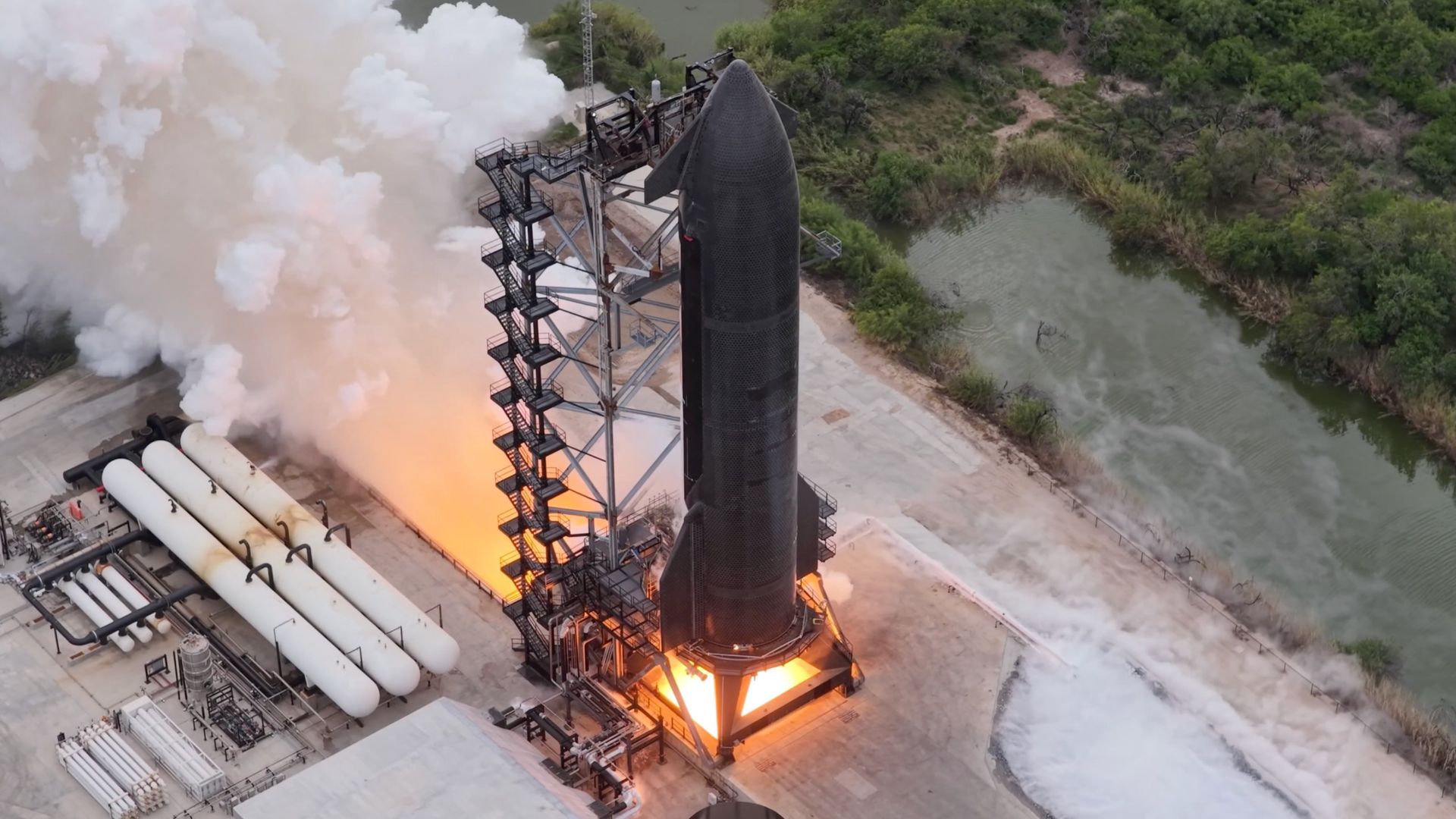
The company conducted static-fire tests with Starship's Ship upper stage on Monday (Oct. 26) and Tuesday (Oct. 27), igniting its Raptor engines while the vehicle, known as Ship 42, remained anchored to the ground.
"Ship 42 static fires complete. The Starship preparing for Flight 15 performed a full duration, six-engine static fire, and fired a single Raptor engine to simulate a deorbit burn," SpaceX said in a Wednesday (Oct. 28) X post that shared video of the tests.
SpaceX conducts a six-engine static fire test with its Flight 15 Starship upper stage on Oct. 27, 2026. (Image credit: SpaceX)
The Ship 42 tests come on the heels of a successful 33-engine static fire with Booster 22, the Starship Super Heavy first stage that will conduct Flight 15. Everything therefore appears to remain on track for Flight 15, which SpaceX founder and CEO Elon Musk has said is targeted for sometime in November.
All Starship launches are worth watching, but this one should be particularly exciting. Musk said last week that SpaceX will try to catch both Ship and Super Heavy during Flight 15, provided the company can get regulatory approval to do so.
These catches are performed by the "chopstick" arms of the launch tower at Starbase, SpaceX's Starship launch and manufacturing hub in South Texas. The company has snagged Super Heavy on three Starship test flights to date but has not yet attempted a Ship capture.
Double chopstick catches will be the norm on operational Starship launches, if all goes to plan. This recovery strategy will reduce the time needed to get Super Heavy and Ship ready for reflight, significantly boosting launch cadences, according to SpaceX. (Starship is designed to be fully reusable, unlike SpaceX's Falcon 9 and Falcon Heavy rockets, whose upper stages are expendable.)
SpaceX is already riding a historic success with Starship: The megarocket reached orbit for the first time ever on Flight 14, which took place on Sept. 28.
And Ship deployed 26 of the company's next-gen Starlink V3 satellites during that flight, starting the assembly of a new broadband constellation that Musk has said will eventually consist of 100,000 spacecraft.
Starlink V3 missions will therefore make up a significant percentage of Starship launches for the foreseeable future. But SpaceX also plans to use the megarocket to build an even bigger constellation in Earth orbit — Starmind, which could harbor one million of the company's AI data center satellites.
The powerful Vera Rubin Observatory has spotted what seems to be a dwarf planet circling the sun in the frigid depths beyond Neptune.
The icy object, known as 2026 ED138, is likely between 600 and 1500 kilometers (373 to 972 miles) wide, scientists say. It's therefore probably big enough to be sculpted into a sphere by its own gravity — a key characteristic that separates dwarf planets from asteroids and other small space rocks.
And if 2026 ED138 is indeed a dwarf planet, that's a pretty big deal, as astronomers have confirmed just five of them to date: Pluto, Ceres, Eris, Haumea and Makemake.
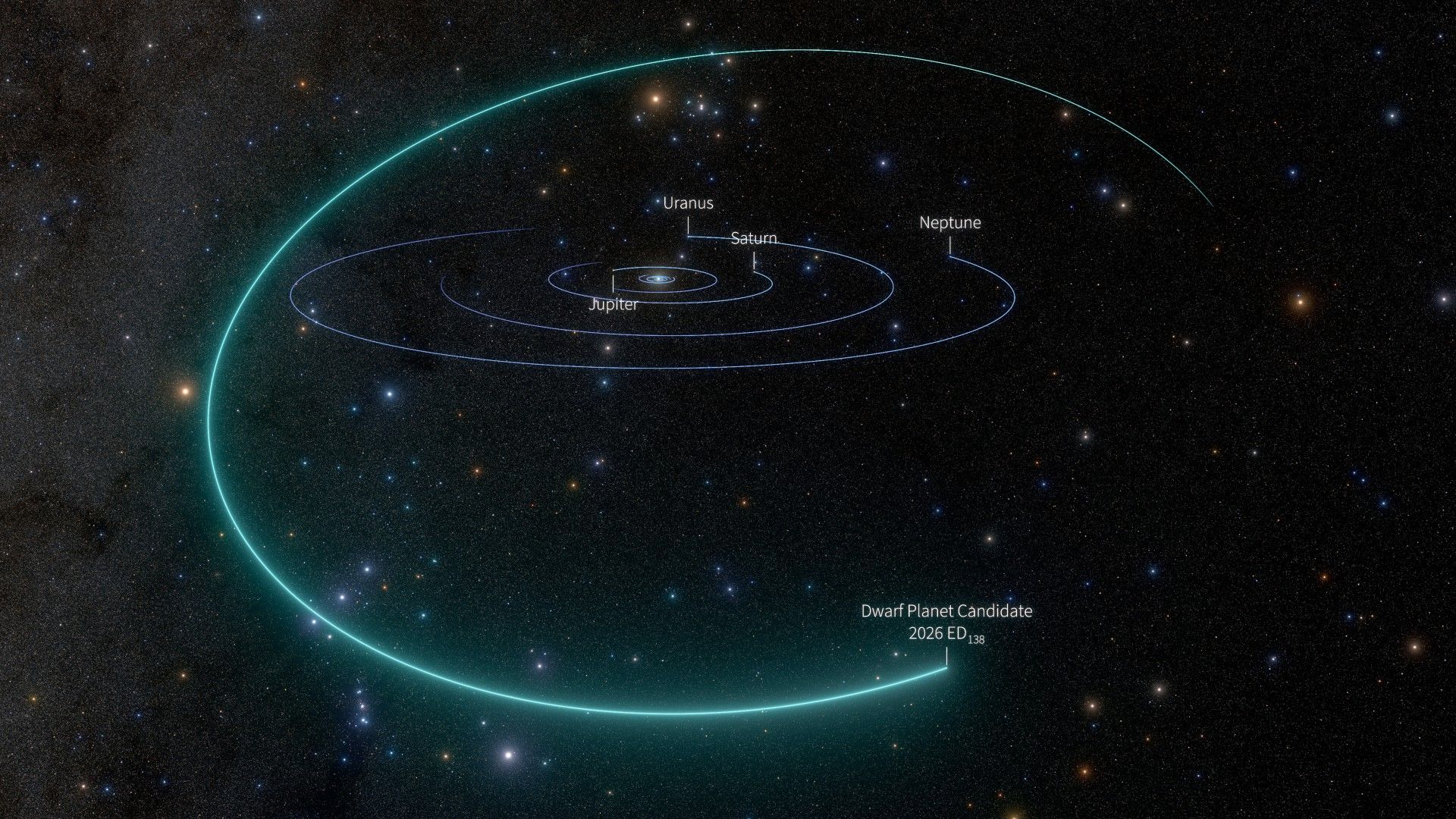
An illustration of the solar system showing the orbital pathway of newly discovered dwarf planet candidate 2026 ED138 (ED138). (Image credit: NSF–DOE Vera C. Rubin Observatory/NOIRLab/SLAC/AURA/R. ProctorImage Processing: M. Zamani (NSF NOIRLab)Orbit data provided by the IAU Minor Planet Center (MPCorb catalog), funded by NASA PDCO and the Tamkin Foundation.Star map: NASA/Goddard Space Flight Center Scientific Visualization Studio. Gaia DR2: ESA/Gaia/DPAC)
2026 ED138 was discovered by Matthew Holman, who works at the Center for Astrophysics | Harvard & Smithsonian (CfA). The big moment came on Oct. 13, when Holman was running previously collected Rubin data through a search code that he developed with his CfA colleague Kevin Napier.
That search revealed a mysterious object beyond Neptune's orbit. Despite its immense distance from the sun, this body was relatively bright, suggesting that it's larger than the average trans-Neptunian object.
"My first reaction was one of excited disbelief," Holman said in a statement on Tuesday (Oct. 27), the day the discovery of 2026 ED138 was announced. "Objects like this are very rare, so I immediately started checking whether I or the code had done something wrong."
Those checks involved a thorough search through Rubin's catalog. And that catalog is pretty heft, even though Rubin is a pretty new scope.
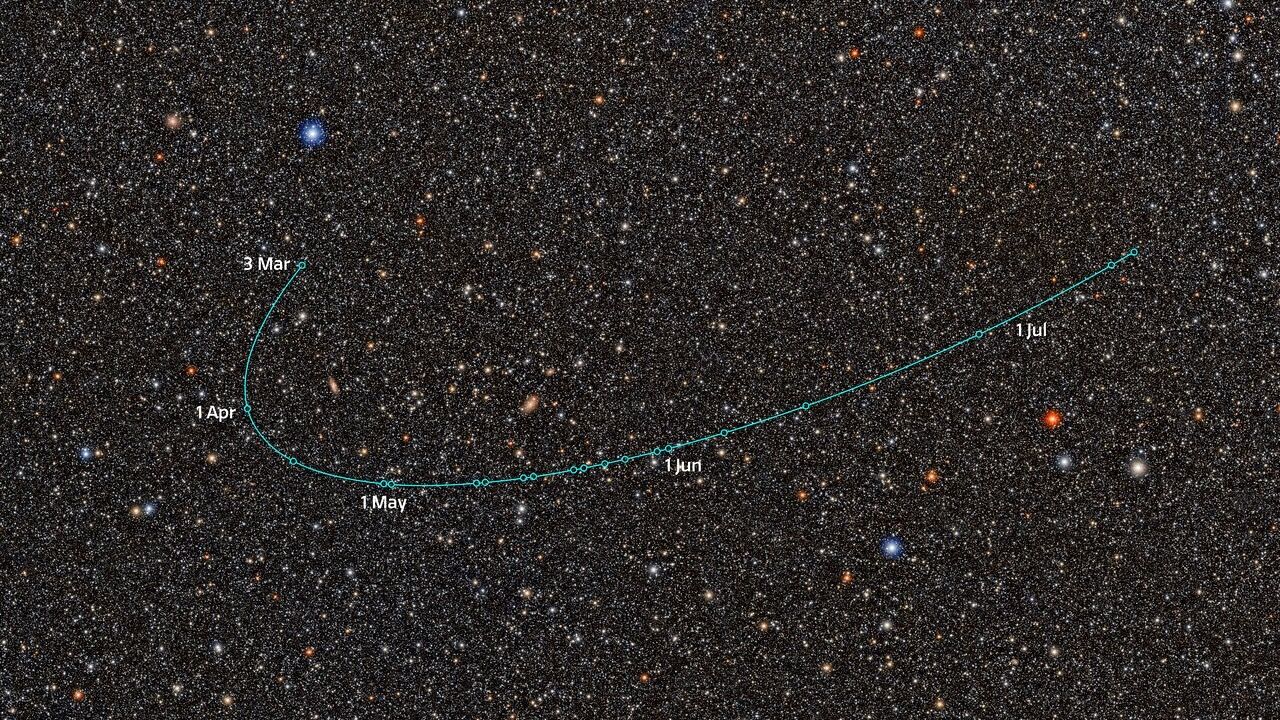
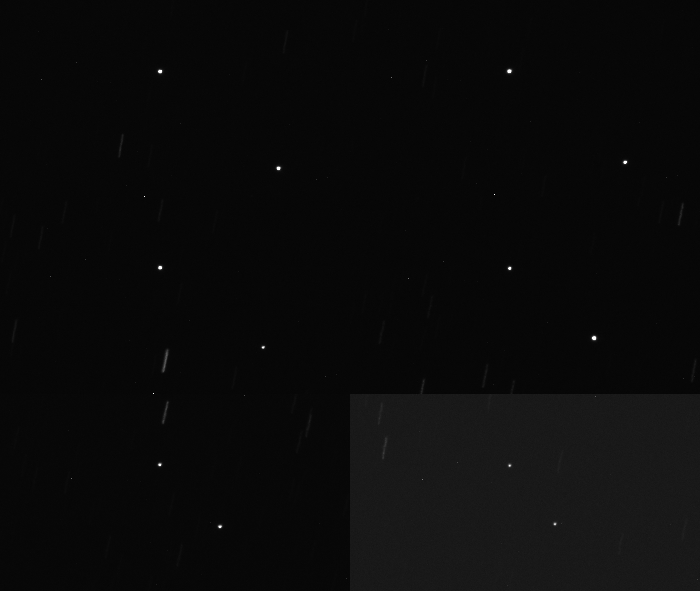
This image shows the orbital pathway of the newly discovered dwarf planet candidate 2026 ED138, as observed by the NSF-DOE Vera C. Rubin Observatory. This image is a composite of multiple images captured by Rubin between March 4 and July 11, 2026 at intervals indicated by the teal circles. ED138 is visible at the center of each circle. (Image credit: NSF-DOE Vera C. Rubin Observatory/NOIRLab/SLAC/AURA. Acknowledgement: Image Processing: M. Jurić (UW), D. de Martin & M. Zamani (NSF NOIRLab))
The Vera Rubin Observatory sits atop Cerro Pachón, an 8,799-foot-tall (2,682 meters) mountain in northern Chile, and features a primary mirror 28 feet (8.4 m) wide. The scope achieved first light in April 2025 and began its main project, the 10-year-long Legacy Survey of Space and Time (LSST), in June of this year.
During the LSST, Rubin images the entire southern sky every few days using a 3.2-gigapixel camera, the largest digital camera ever built for astronomy. This work creates a high-resolution time-lapse "movie" that can reveal a great deal about the cosmos.
For example, astronomers think Rubin will shed light on dark energy and dark matter, the mysterious stuff that together makes up most of the universe's mass-energy budget. Its observations will also serve as a solar system inventory, helping scientists map out our cosmic backyard like never before. Rubin has already discovered more than 11,000 new asteroids, for example, with many more surely to come.
The LSST inventory will likely include a number of new dwarf planets as well — including, possibly, 2026 ED138. For the object definitely exists: Holman and his colleague Mario Jurić, who works at the University of Washington and serves as Rubin Solar System Lead Scientist, found that Rubin spotted 2026 ED138 30 separate times on 20 nights between March 4 and July 11 of this year.
And further digging revealed that the Dark Energy Camera (DEC), an instrument on the Víctor M. Blanco 4-meter Telescope at the Cerro Tololo Inter-American Observatory in Chile, also spotted 2026 ED138. Indeed, DEC observations of the object go all the way back to 2016.
A mosaic of images captured by the NSF-DOE Vera C. Rubin Observatory of the newly discovered dwarf planet candidate 2026 ED138. Its distance from the sun places it beyond the orbit of Pluto, and initial analysis indicates that it may be among the largest and brightest bodies scientists have discovered in this region of the solar system. (Image credit: NSF-DOE Vera C. Rubin Observatory/NOIRLab/SLAC/AURA. Image Processing: M. Jurić (UW), D. de Martin & M. Zamani (NSF NOIRLab))
The data show that 2026 ED138's orbit is tilted by about 25 degrees relative to the plane of the solar system. It therefore likely had a gravitational interaction with Neptune, which knocked it off kilter, scientists say.
2026 ED138 currently lies about 46 astronomical units (AU) from the sun. (One AU is the Earth-sun distance — about 93 million miles, or 150 million kilometers). This puts it beyond Pluto's average distance from the sun, which is roughly 40 AU.
There is still much to learn about the object, however. For example, we won't know whether or not it's a dwarf planet until astronomers nail down its size. And that will require observations in infrared light, the range of wavelengths that NASA's James Webb Space Telescope is optimized for.
So stay tuned: There's doubtless more news about 2026 ED138 coming, and Rubin could turn up more worlds like it in the coming months and years.
"If confirmed as a dwarf planet, ED138 would join a very small family of worlds," Holman said. "Rubin will image the whole southern sky again and again for 10 years, so any others hiding in the places earlier surveys skipped are now within reach."
PALO ALTO, Calif. — Cowboy Space just showed us how it plans to become a big player in the final frontier.
The California-based company, which is run by Robinhood co-founder Baiju Bhatt, intends to operate a constellation of 20,000 AI data centers in low Earth orbit (LEO). It will build those satellites in house and launch them on a homegrown rocket — a vehicle Cowboy Space unveiled here on Monday night (Oct. 26), at an event it called "Big Sky Rising."
"It's a fundamentally novel approach to rocketry in the modern era, in our opinion," Bhatt said during the event. "The idea is that you have a two-stage rocket where the upper stage of the rocket itself transforms into the satellite."
Big Iron's first stage will be reusable. The upper stage will serve as a data-center satellite after reaching orbit. (Image credit: Cowboy Space)
That rocket is called Big Iron, Bhatt told us on Monday night. And so is the data-center satellite, as both are considered to be part of the same system.
The stainless-steel rocket will be 282 feet (86 meters) tall and 15.4 feet (4.7 m) wide. It will be powered by Cowboy Space's Clydesdale engines — nine in the first stage and one in the upper stage, the same configuration employed by SpaceX's workhorse Falcon 9 rocket. And, like the Raptor engines that power another SpaceX launcher, the giant Starship, Clydesdale will burn liquid oxygen and liquid methane, a combo known as methalox.
Big Iron's first stage will be reusable; an animation Bhatt showed during "Big Sky Rising" showed the booster coming down for a landing on a ship at sea, as Falcon 9 first stages often do these days.
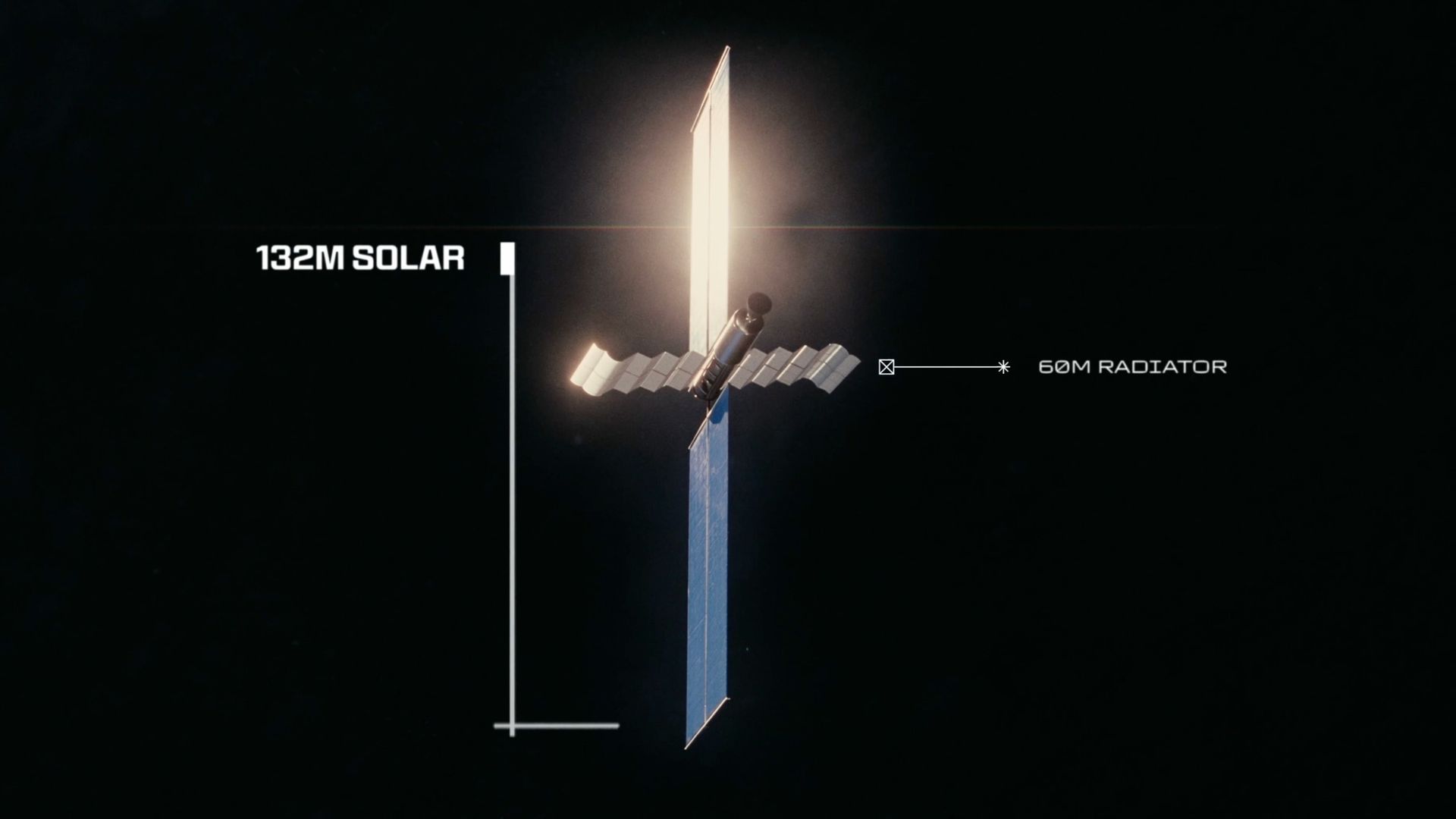
The upper stage, meanwhile, will stay in orbit as a Big Iron satellite. The spacecraft will tip the scales here on Earth at about 33,000 pounds (15,000 kilograms), and, after unfurling its solar panels, it will be about 433 feet (132 m) long.
The payload fairing that protected the satellite during launch will morph into a radiator, which will dump into space the prodigious heat generated by Big Iron's GPUs (general processing units). And there will be a lot of GPUs: Each satellite will carry five racks of them, Bhatt said, which will provide about 1 megawatt of compute payload.
Big Iron will therefore be much larger than an "imperial-class satellite" — Bhatt's term for SpaceX's planned Starmind AI data center spacecraft, each of which will have a solar wingspan of 246 feet (75 m) and boast about 250 kW of compute payload.
Illustration of Cowboy Space's Big Iron AI data center satellite. (Image credit: Cowboy Space)
Cowboy Space plans to operate about 20,000 Big Iron satellites in LEO, a constellation it calls Stampede. Each rocket will carry just one of these satellites to orbit, so it will take 20,000 launches to build Stampede — and, likely, several thousand more every year to maintain it at that number.
Cowboy Space therefore intends to launch very often — multiple times per day, from launch complexes it calls Trailheads. The company has not yet announced where these complexes will be, but each one will likely feature four active launch mounts, Bhatt said on Monday night.
And not all of these launches will serve Stampede. Toward the end of "Big Sky Rising," Bhatt announced that Big Iron will also launch payloads for customers, a service that Cowboy Space calls Big Iron Express.
The first flights of this new rocket are a few years away. Cowboy Space — which was founded in 2024 as the power-beaming company Aetherflux — is still building and testing its Clydesdale engine and says it aims to launch Big Iron for the first time in December 2028.
"Now, a lot of things have to go right for that to happen; it's not a guarantee," Bhatt said. "I think it's ambitious. But if it wasn't ambitious, I wouldn't be an entrepreneur."
Cowboy Space is operating one piece of space hardware at the moment, by the way — a satellite called Reason-1, which launched on SpaceX's Transporter-18 rideshare mission on Oct. 1.
"Its job is to prove out power beaming: using a high-power laser to transfer energy from low Earth orbit to a receiver on the ground," Cowboy Space said via X on Sept. 28. "If you want to build data centers in space, you have to master the optical systems between orbit and Earth. This is where that journey begins."
NASA has officially ended the mission of its Swift space telescope, after a private satellite failed in its bold bid to rescue the aging spacecraft.
That rescue mission was led by the Arizona company Katalyst Space Technologies, whose LINK spacecraft tried to meet up with Swift this summer to boost its orbit.
That didn't work out, however, so Swift continues its fall back toward Earth. The telescope is expected to reenter Earth's atmosphere "in the next few weeks," NASA said in a statement on Friday (Oct. 23).
That statement served primarily to announce the end of the Swift mission after more than 20 very productive years.
The telescope launched to Earth orbit in November 2004, tasked with studying gamma-ray bursts (GRBs) — the most powerful explosions in the cosmos. Swift was designed to operate for two years, but it continued studying the high-energy universe for more than two decades.
"In that time, Swift played a major role in advancing our understanding of the changing universe and was part of a revolution in astrophysics that showed how critical rapid-response observations are to the entire community," Shawn Domagal-Goldman, director of the Astrophysics Division at NASA Headquarters in Washington, said in the statement.
NASA had hoped to keep Swift going even longer. In September 2025, the agency awarded a contract to the Arizona company Katalyst Space Technologies to rescue the observatory, which was falling back to Earth thanks to atmospheric drag.
Swift has no thrusters capable of counteracting this drag. So Katalyst built a refrigerator-sized spacecraft called LINK, which aimed to rendezvous with Swift, grapple it with three robotic arms and boost it to a higher orbit, allowing the observatory to continue its science work.
NASA and Katalyst stressed from the start that success was far from guaranteed. After all, LINK's mission was unprecedented: No private spacecraft had ever captured and boosted a satellite that wasn't designed to be serviced in this way. And the rate of Swift's orbital decay demanded a rapid timeline: LINK launched on July 3, a little over nine months after Katalyst won the $30 million NASA Swift-rescue contract.
LINK was not able to execute its very challenging mission. About three weeks after liftoff, it suffered problems with its propulsion system and orientation-maintaining reaction wheels, which caused it to start spinning at an unexpected rate. These issues prevented LINK from capturing and boosting Swift, but the private craft did manage to get within 7.5 to 9.3 miles (12 to 15 kilometers) of the observatory and photograph it.
"From the beginning, this was a high-risk, high-reward mission," Domagal-Goldman said in a statement on Sept. 25, the day that LINK fell back to Earth.
"And while we'll be sad to see Swift's mission come to a close, we knew this boost effort would be worthwhile either way — advancing U.S. spacecraft servicing technology, challenging us to meet unprecedented mission timelines, and testing how we operate satellites to extend their time in low Earth orbit," he added.
Katalyst Space’s LINK robotic servicing spacecraft captured this view of one of its solar panels in Earth orbit in August 2026. (Image credit: Katalyst Space))
Swift — which was officially renamed the Neil Gehrels Swift Observatory in 2018, after its first principal investigator, who died a year earlier — gathered its last scientific data on Oct. 20, according to NASA's Friday update.
During its long and storied career, the space telescope observed more than 2,000 GRBs. And it did other work, too, studying more than 1,400 supernova explosions, as well as eyeing asteroids, comets and black holes and conducting an all-sky survey in X-ray light. The mission's data has contributed to about 7,000 published scientific papers to date, according to NASA officials.
And that number is sure to keep rising far into the future.
"Swift leaves us with an extraordinary archive of multiwavelength observations that will fuel new discoveries for decades more," Domagal-Goldman said in the Oct. 23 statement.
NASA just gave us our best look yet at its Artemis III moon-lander test flight.
The agency laid out a detailed concept of operations for Artemis III today (Oct. 23) during a press conference at Kennedy Space Center, stressing how important the flight is to its moon plans and how challenging it will be to make everything go right.
"We're launching three of the most powerful rockets in the world, and undertaking what is likely the most complicated launch campaign ever undertaken," Jeremy Parsons, NASA’s Artemis program manager, said during today's event, which lasted more than two hours.
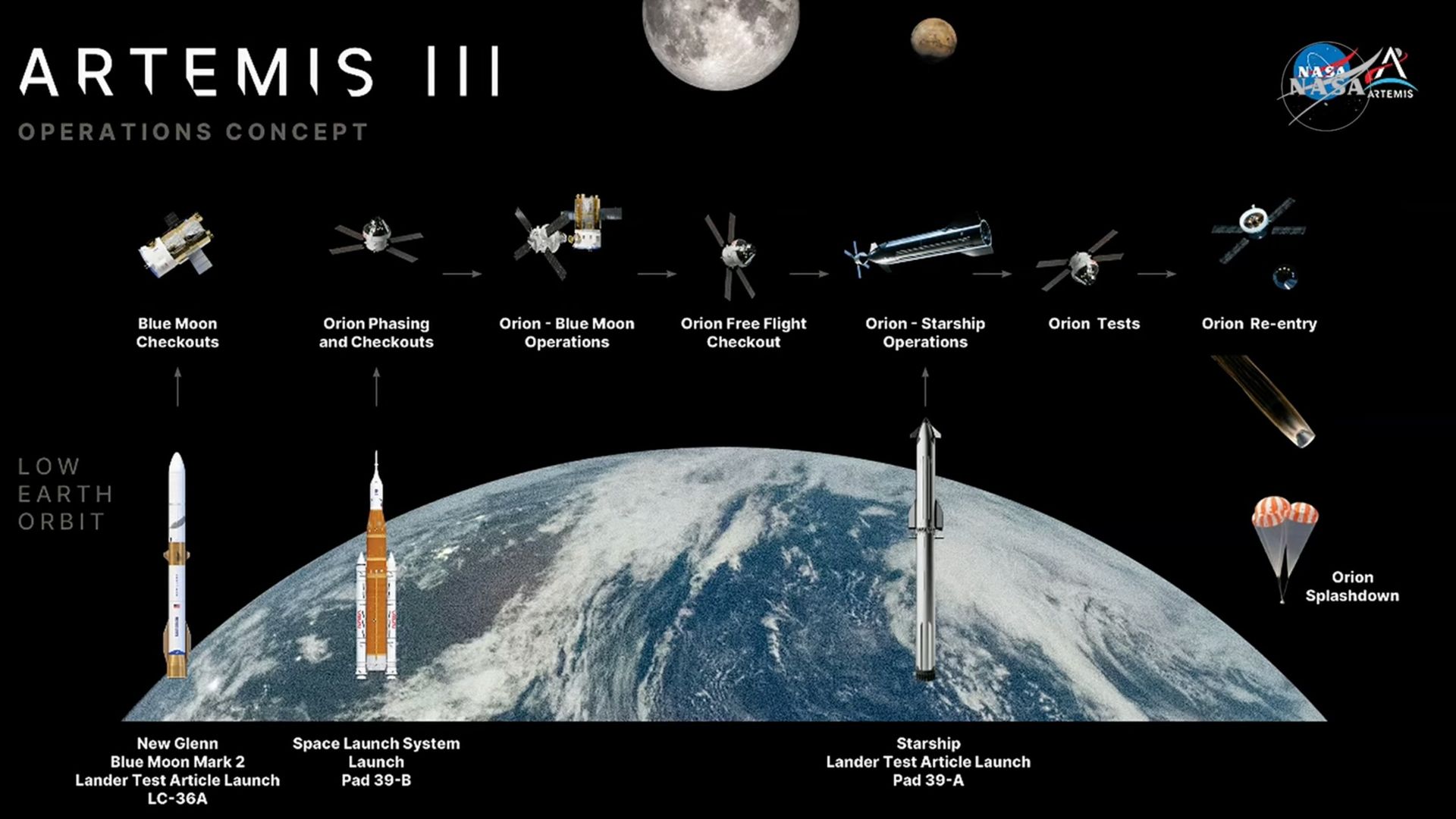
The baseline concept of operations for NASA's Artemis III docking test in low Earth orbit. (Image credit: NASA)
Those three rockets are NASA's Space Launch System (SLS), SpaceX's Starship and Blue Origin's New Glenn, all of which will fly from Florida's Space Coast.
If all goes according to plan, New Glenn will lift off first, carrying Blue Origin's Blue Moon lunar lander to low Earth orbit (LEO). SLS will go next, launching the Artemis III astronauts — NASA's Randy Bresnik, Andre Douglas and Frank Rubio, and the European Space Agency's Luca Parmitano — aboard NASA's Orion spacecraft.
SLS will deploy Orion into a highly elliptical orbit, one that gets as close to Earth as 18 miles (29 kilometers) and as far away as 1,122 miles (1,806 km), according to Parsons. The capsule will then maneuver itself into an orbit with an altitude of about 345 miles (555 km).
"That's really about getting thermal stability," Parsons said. "Orion was built as a deep-space vehicle, and so we're going to have to really manage the thermal environments, which are higher in a low Earth orbit."
The Artemis III crew will spend two days checking out Orion and its systems in LEO before meeting up with Blue Moon, which will take place on Flight Day 3 at an altitude of 273 miles (439 km).
"Over the next two days, the crew will conduct operations docked with Blue Moon," Parsons said. "They're going to open up the hatch. They're going to enter the lander. They're going to evaluate the environmental controls, the life support systems. We'll confirm that the spacecraft can maintain the right atmospheric pressure, and we're also going to test emergency scenarios, dual vehicle control, and we're going to put our Mission Control teams through their paces."
After those operations are complete — likely on Flight Day 6 or thereabouts — Starship will launch, with a specially built docking adapter on its nose.
The SpaceX vehicle — the 171-foot-tall (52 meters) upper stage of its fully reusable Starship megarocket — will meet up with Orion in LEO on Flight Day 8, at an altitude of about 237 miles (381 km). But this will be a very different encounter than the rendezvous with Blue Moon.
"The demonstration with Starship is shorter, about two hours," Parsons said. "The crew will not enter the Starship during the mission, but it gives us critical data and allows us to really understand the forces of docking, how we're going to push, how we're going to work together."
Artemis III will continue for another six to nine days after Orion undocks from Starship before finally heading back down to Earth for a parachute-aided ocean splashdown. (The nominal mission length is 14 days, Parsons said, but it could last as long as 17 days.)
During that time, the crew will evaluate their survival suits — something that didn't get done during the 10-day Artemis II flight around the moon this past April — and do a variety of other work as well, from detailed health assessments to scientific experiments and technology demonstrations. The main goal is to keep everything on track for Artemis IV, which will land astronauts near the moon's south pole in 2028, if all goes to plan.
"Everything we do on Artemis III is designed to reduce risk for our future lunar landing missions," Parsons said. "We're teaching these teams how to work together, how to make critical real-time mission decisions, all in an environment that is low Earth orbit, where if something goes wrong, we can come home much more quickly."
It's unclear at the moment which of these two privately developed landers — Blue Moon or Starship — will fly on Artemis IV, pulling off the first crewed lunar touchdown since Apollo 17 in 1972.
NASA is still preserving optionality, "to give both of our lunar landing partners the greatest opportunity for readiness in advance of astronauts landing on the moon in 2028," NASA Administrator Jared Isaacman said during today's event.
"We have no intention of surrendering a viable path to the surface before the data and schedule compels us to do so," he added.
No matter what decision NASA makes for Artemis IV, both Blue Moon and Starship should hit the gray dirt relatively soon, according to Parsons. "Regardless of who goes first, both providers are planning for lunar landing missions in 2028," he said.
And those missions will be quite different from each other. For example, on Blue Origin touchdowns, Orion will meet up with Blue Moon in lunar orbit. On SpaceX landings, however, Starship will likely dock with the NASA capsule in Earth orbit and propel it to the moon, Parsons said — the "push" he referred to above.
It remains unclear when exactly Artemis III will launch. NASA is targeting the summer of next year but may find it tough to meet that timeline: Last month, in an internal memo, Isaacman told agency employees that Artemis III was about 90 days behind schedule.
Some of the biggest challenges have involved the supply chain for the mission's lunar landers, Parsons said during today's event. But he and Isaacman both stressed that NASA is confident in its ability to work through such issues.
"We're moving with real speed and purpose right now," Isaacman said.
Rocket Lab launched a trio of private signals-intelligence satellites to orbit today (Oct. 23).
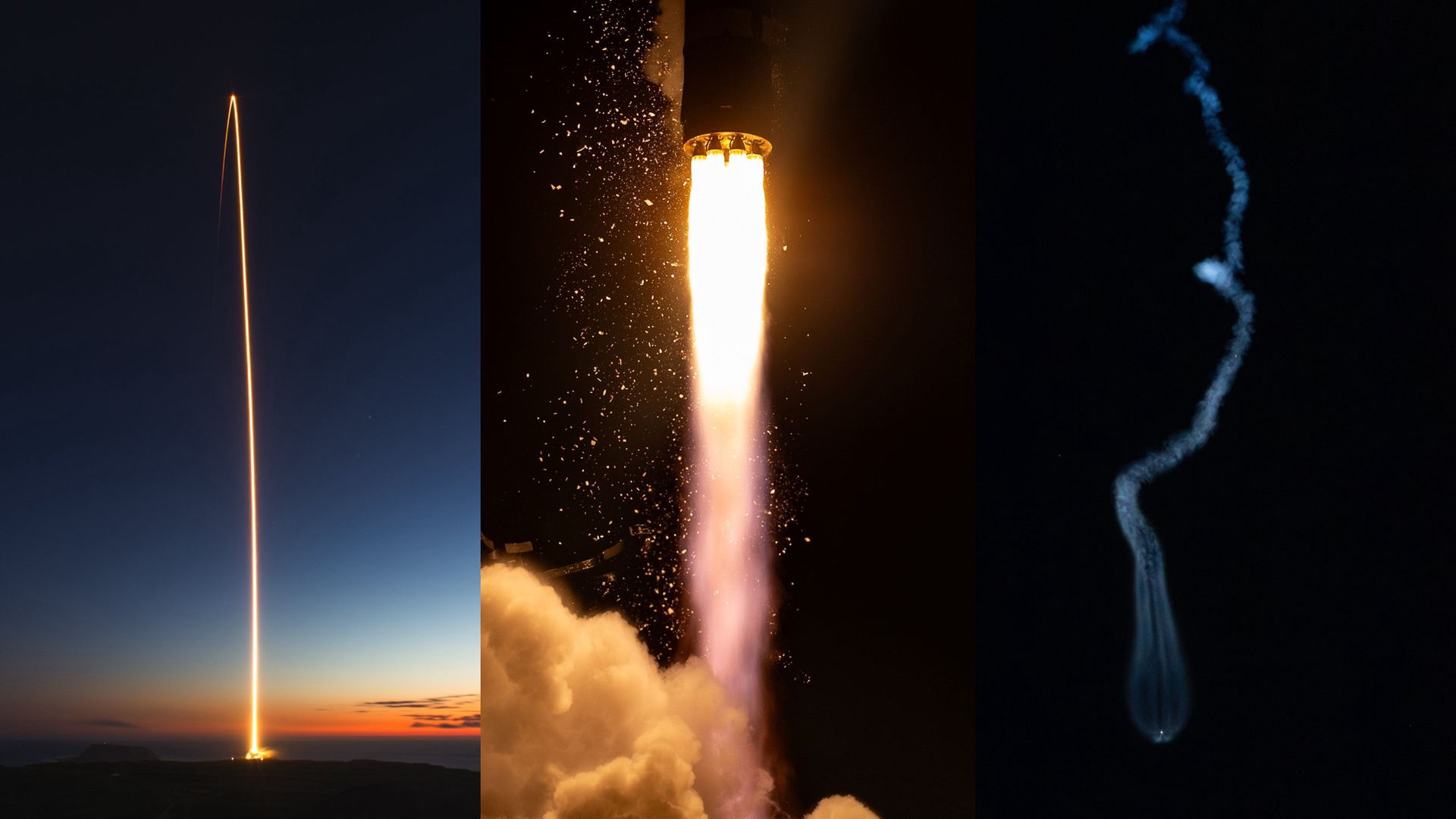
The mission lifted off aboard an Electron rocket from Rocket Lab’s New Zealand launch site today at 3:11 a.m. EDT (0711 GMT; 8:11 p.m. local time in New Zealand).
The Electron carried three "Hawk" satellites for the Virginia-based company HawkEye 360, which explains the name Rocket Lab gave to the mission: "We're Not Hawking Around."
Rocket Lab launched a trio of private signals-intelligence satellites to orbit today (Oct. 21), the 19th mission of the year for the California-based company. (Image credit: Rocket Lab)
If all goes according to plan, the three Hawks will be deployed into low Earth orbit (LEO), at an altitude of 323 miles (520 kilometers). Once up there and commissioned, the satellites will scan the globe for radio frequency (RF) emissions.
"Operating in clusters of three, HawkEye 360's satellites collect signal data from across the RF spectrum for maritime tracking, GNSS jamming detection, radar monitoring, communications mapping and space defense," Rocket Lab wrote in a mission description.
HawkEye 360 provides this data to the U.S. government and its allies "to enable faster, better decision-making," according to the company. "Our space-based collection, proprietary signal processing and AI-powered analytics transform knowledge of the RF spectrum into a strategic advantage."
The patch for Rocket Lab's "We're Not Hawking Around" mission. (Image credit: Rocket Lab)
HawkEye 360's first satellites launched in 2018, and the company has now sent nearly 50 of them to LEO. The most recent Hawk launch before "We're Not Hawking Around" came just two days ago; three of the satellites went up on SpaceX's Bandwagon-5 rideshare mission.
"We're Not Hawking Around "was Rocket Lab's 98th launch to date and its 19th of 2026 so far. Sixteen of this year's flights have been performed by the two-stage, 59-foot-tall (18 meters) Electron. The other three have been conducted by HASTE, a suborbital variant of Electron that allows customers to test technologies in a hypersonic flight environment.
Ukraine wants its own satellite-communication system, which shouldn't be surprising given the events of the past week or so.
The Ukrainian military just signed a letter of intent with two Finnish companies — the telecom giant Nokia and satellite maker ICEYE — to look into developing a sovereign satellite-communications network for Ukraine.
"Ukraine needs secure, sovereign and high-performance satellite communications systems that it controls," ICEYE cofounder and CEO Rafal Modrzewski said in a statement today (Oct. 22). "We have a proven track record of delivering sovereign missions at speed to help build that capability. ICEYE has proudly supported Ukraine since 2022, and we remain committed to continuing that support today."
Ukraine relies heavily on satellite-based communications and data to defend itself from Russia, which invaded the nation in February 2022 and continues to attack it with ground troops, missiles and drone strikes.
But Ukraine does not own those satellites. It primarily uses the services provided by SpaceX's Starlink megaconstellation in low Earth orbit (LEO) and Starshield, a military-grade, jamming-resistant version of Starlink employed by the U.S. government and its allies.
Starshield in particular is crucial to Ukraine, as it allows the nation to operate fast-moving drones over large distances in war zones. Ukraine has gotten very good at drone warfare, employing these little robots both in offensive and defensive capacities.
On Oct. 14, however, Ukrainian soldiers and officials reported a severe throttling of their access to Starshield services — a speed limit on terminal-carrying drones, which caused many of them to fall out of the sky.
It's not entirely clear who's behind the throttling. Some U.S. officials have apparently said the order came from Elon Musk, but the billionaire SpaceX founder and CEO put the ultimate responsibility on the Trump administration.
"Starshield systems are owned and controlled by the US government. Any limits on speed or usage are decided by the US military and ultimately POTUS," Musk said on Oct. 14 via X, the social media platform he owns.
Whoever made the call, it certainly wasn't Ukraine. And the Starshield throttling — which apparently is still in effect — has doubtless reinforced the nation's desire to control its own satellite-communications infrastructure.
"Nations need communications they can rely on in every situation. Satellite networks extend and protect connectivity when networks on the ground are disrupted," Mikko Hautala, Nokia's chief geopolitical and government relations officer and chairman of Nokia Defense, said in the same statement.
"This makes them a key part of any secure communications system," he added. "Through this Letter of Intent, together with Ukraine and ICEYE, we will explore how trusted, sovereign satellite communications can strengthen Ukraine's resilience and give it control over the connectivity it depends on."
Nokia and ICEYE announced on Oct. 1 that they plan to work together to help nations develop such sovereign satcom systems. The partnership with Ukraine follows on from that earlier agreement.
Russia's Luch-2 satellite approaches another geostationary satellite on April 12, 2024, as tracked by the French company Aldoria's observation stations. (Image credit: Aldoria)
ICEYE has already been aiding the Ukrainian defense effort. The Finnish company and its U.S. subsidiary jointly operate a fleet of Earth-observing satellites in LEO, which study our planet using synthetic aperture radar. Ukraine uses data from the ICEYE constellation for intelligence and planning purposes.
This relationship has put ICEYE — or one of its satellites, at least — in Russia's crosshairs. A Russian inspector satellite called Kosmos 2612 recently made an extremely close approach to ICEYE-X36, which is operated by ICEYE US.
The goal of the unsanctioned rendezvous is unclear. Russia may have wanted to assess the satellite's capabilities or interfere with it in some way. Or perhaps the nation simply wanted to send a message, letting ICEYE (and Ukraine) know that it could mess with satellites if it wanted to.
NASA will provide an update about its Artemis moon plans today (Oct. 23), and you can watch it live.
The news will come during a press conference at the agency's Kennedy Space Center in Florida, which starts today at 2 p.m. EDT (1800 GMT). You can watch it live here at Space.com, courtesy of NASA.
"The update will include details about NASA’s Artemis III mission that will send four astronauts to low Earth orbit next year to test critical systems needed for future lunar landings, and how plans to return American astronauts to the moon by 2028 are progressing," NASA officials said in an Oct. 14 media advisory.
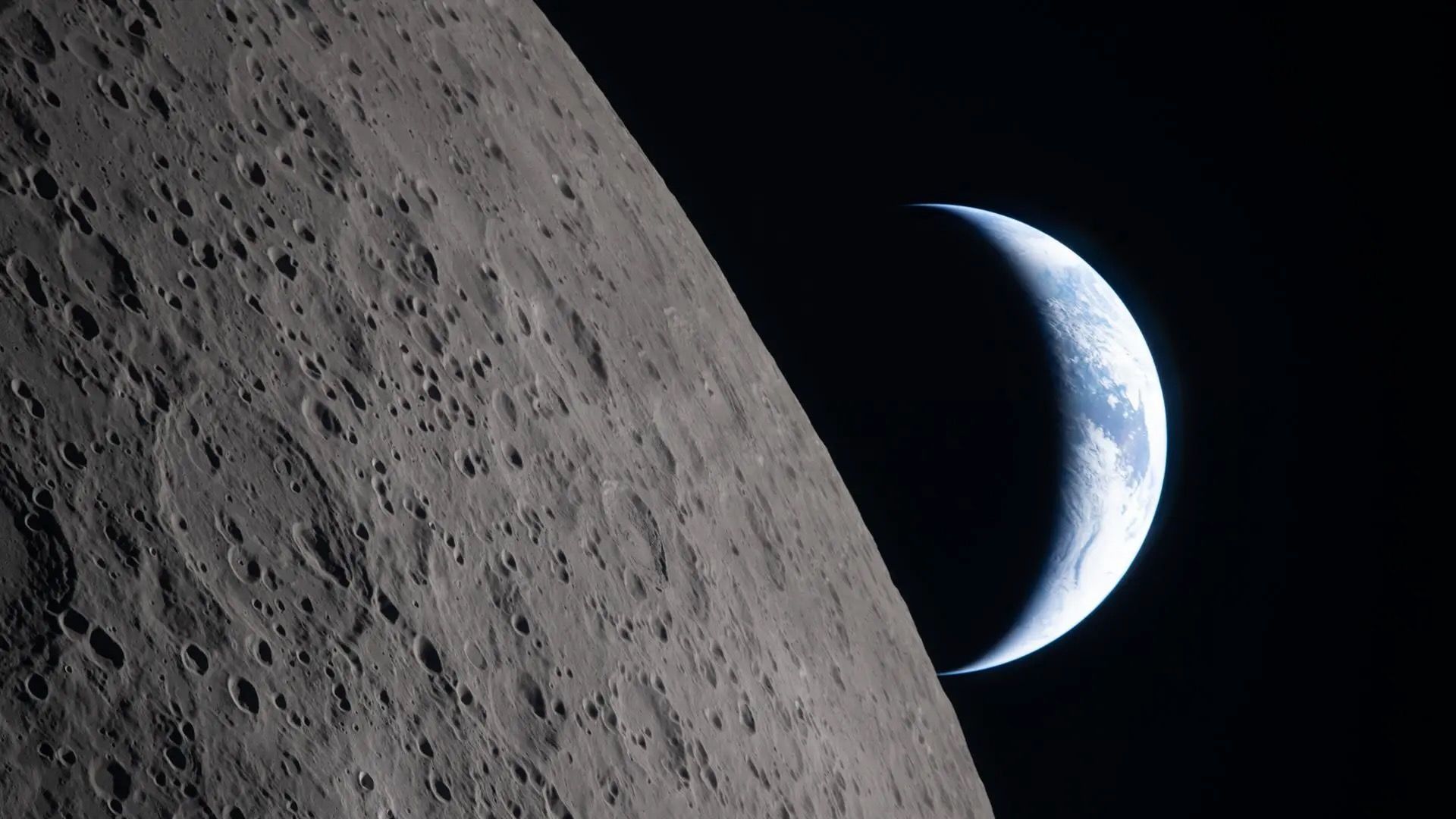
The crew of NASA's Artemis II mission captured this photo of a crescent Earth on April 6, 2026, as they began passing behind the moon. (Image credit: NASA)
Three agency officials will participate in Friday's "Artemis Acceleration" event. They are:
NASA is currently gearing up for Artemis III, which is targeted for mid-2027. The mission will test rendezvous and docking technologies between NASA's Orion capsule and one or both of the private spacecraft that NASA picked to be the Artemis program's crewed lunar landers: SpaceX's Starship and Blue Origin's Blue Moon.
After that will come Artemis IV, which will land astronauts near the lunar south pole in early 2028, if all goes to plan. That will be the first crewed moon touchdown since Apollo 17 way back in 1972.
It's unclear which lunar lander will fly on Artemis IV; that depends on how the development of each one progresses and what happens on Artemis III.
And there will be other landings after Artemis IV. NASA plans to establish a moon base via Artemis, and doing so will require a variety of missions, both robotic and crewed.
The agency feels some urgency in this quest, for China has similar goals. It's important that the U.S. wins this new space race, military and political officials have said, so that the nation can establish the norms of responsible behavior on Earth's nearest neighbor.