SpaceX just broke an uncharacteristically long Starlink launch drought.
The company sent 27 of its Starlink internet satellites to low Earth orbit (LEO) today (Oct. 12), launching them atop a Falcon 9 rocket from California's Vandenberg Space Force Base at 8:28 p.m. EDT (5:28 p.m. local time; 0028 GMT on Oct. 13)
It was the first Starlink mission for a Falcon 9 since Sept. 19, which was another 27-satellite liftoff from Vandenberg. For some perspective on this recent gap: Between Aug. 19 and Sept. 6, a span of 19 days, SpaceX launched seven Starlink missions with Falcon 9s.
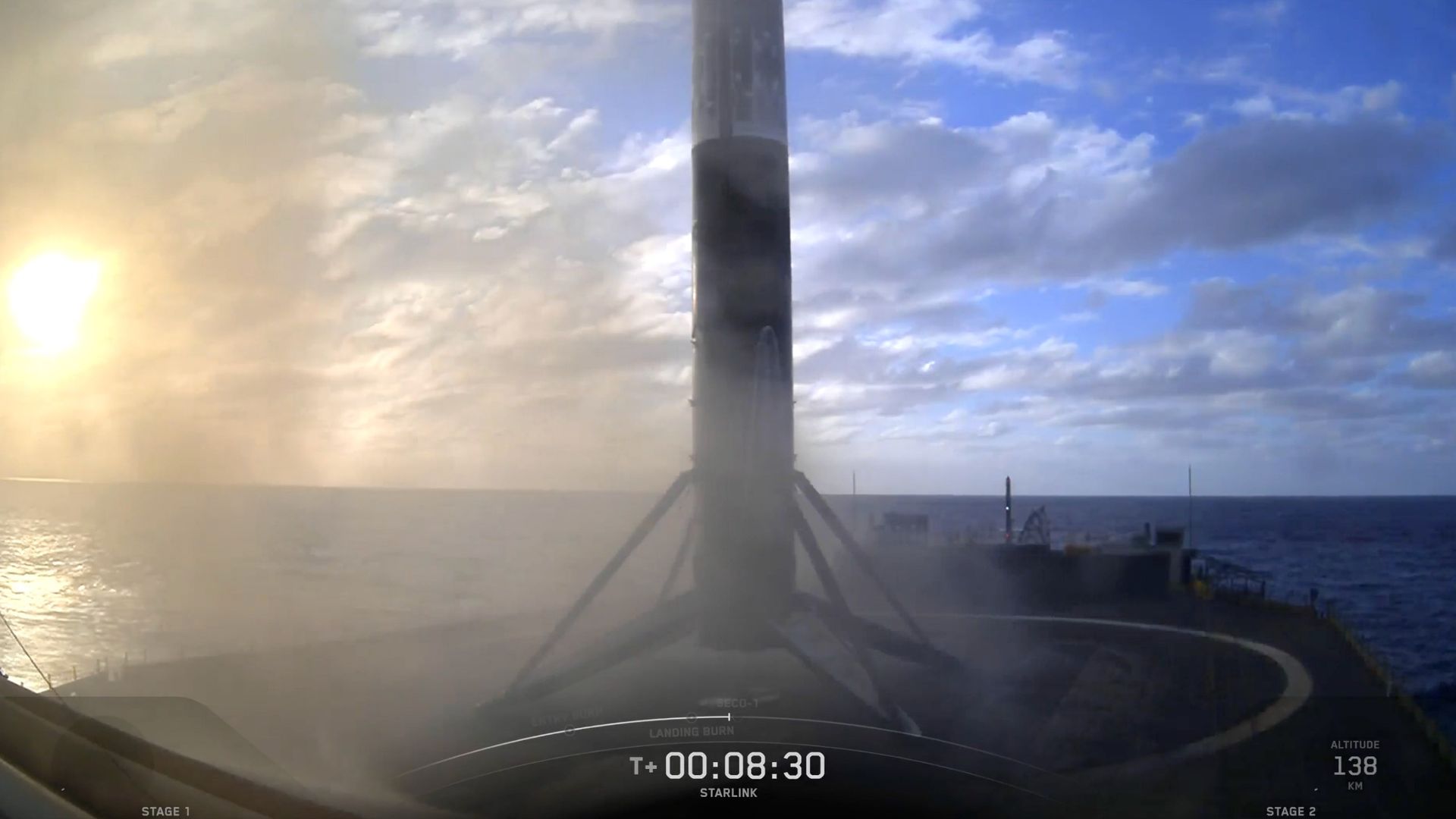
The Falcon 9's first stage rests on the deck of a ship at sea shortly after the Oct. 12 launch. (Image credit: SpaceX)
SpaceX did loft a batch of Starlinks after that, but it wasn't aboard a Falcon 9. The company's Starship megarocket carried 26 next-gen Starlink V3 craft on its 14th test flight, which took place on Sept. 28.
Starship reached orbit for the first time ever on Flight 14, and it deployed the Starlinks successfully as well. This will happen many more times going forward, if all goes to plan: The Starlink V3 constellation will eventually consist of about 100,000 satellites, all of which will fly on Starship, Elon Musk has said.
Indeed, SpaceX plans to sunset the Falcon 9 and its cousin, the Falcon Heavy, in the next few years, shifting their duties over to the fully reusable, far more powerful Starship, which remains in the test-flight phase.
That shift will be a big one for the spaceflight community, for the Falcon 9 is the workhorse rocket of its generation. In 2025, for example, it flew 165 times — roughly the same number as the rest of the world's orbital launchers combined. Nearly three-quarters of those Falcon 9 launches were Starlink missions.
Things have slowed down a bit in 2026. Today's flight was the 112th Falcon 9 liftoff of the year, and the 82nd in service of the Starlink megaconstellation, which currently consists of more than 11,100 active satellites.
All went according to plan on today's launch. The Falcon 9's first stage came back to Earth as planned, touching down about 8.5 minutes after launch on the drone ship "Of Course I Still Love You," which was stationed in the Pacific Ocean. It was the 20th launch and landing for this particular booster, which is designated B1088.
The rocket's expendable upper stage, meanwhile, delivered the 27 spacecraft to LEO, deploying them there 62 minutes after liftoff, SpaceX announced via X.
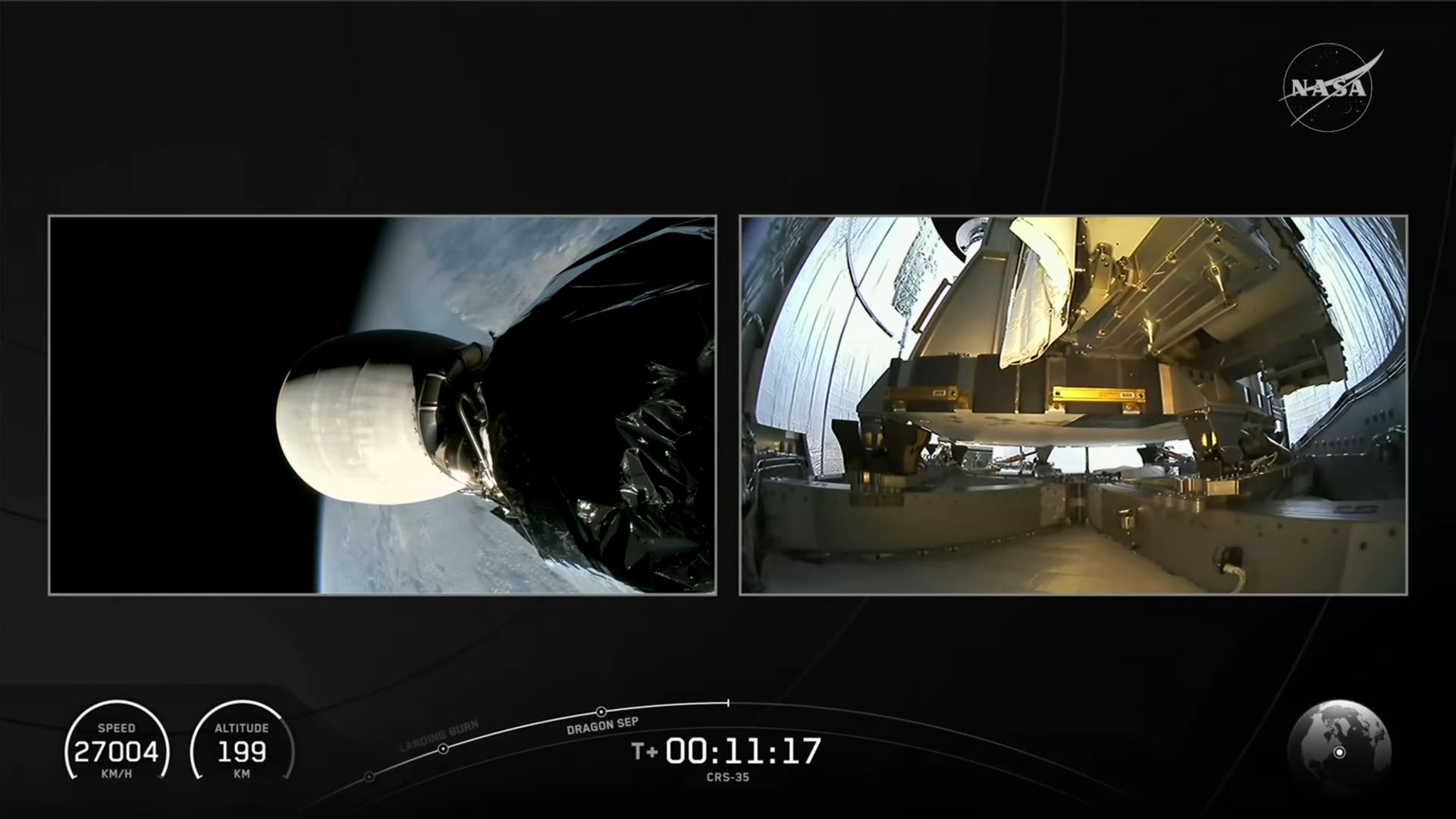
The launch kicks off the CRS-35 mission, so named because it will be the 35th thatSpaceX flies under a Commercial Resupply Services contract with NASA.
A side by side view of a rocket engine in space and the interior of a rocket fairing containing cargo bound for the International Space Station. (Image credit: SpaceX, NASA)
If all goes according to plan, Dragon will reach the International Space Station (ISS) on Thursday (Oct. 15), docking autonomously to the space-facing port of its Harmony module at around 11 a.m. EDT (1500 GMT). You can watch the arrival here at Space.com as well; coverage will start at 9:15 a.m. EDT (1315 GMT).
CRS-35 will deliver 6,300 pounds (2,860 kilograms) of supplies to the astronauts aboard the orbiting lab, including the final set of International Space Station Roll-Out Solar Arrays (iROSAs), which will boost the orbiting lab's energy budget.
There's also quite a bit of scientific gear heading up on the flight.
Dragon "will deliver hardware to manufacture artificial retinas in microgravity to help restore vision on Earth and 3D heart tissue models to advance large‑scale drug testing on future missions," NASA officials wrote in a CRS-35 launch preview on Oct. 7.
"The spacecraft will carry materials to study how a new type of glass forms in microgravity and brain organoids that could reveal treatment targets for neurodegenerative diseases, such as Alzheimer's, Parkinson's and multiple sclerosis," they added.
Dragon will stay attached to the ISS for about a month, then head back down to Earth with scientific experiments and other hardware. It will splash down safely under parachutes in the Pacific Ocean off the California coast.
SpaceX's Dragon is the only currently operational freighter that can carry cargo in the downward direction. The other three — Russia's Progress, Japan's HTV-X and Northrop Grumman's Cygnus XL — are all expendable, burning up in Earth's atmosphere after their time at the ISS is done.
Editor's note: This story was updated at 6:59 a.m. EDT on Oct. 13 with news of a successful launch.
SpaceX just sent another batch of satellites to orbit for the U.S. military.
A Falcon 9 rocket lifted off from California's Vandenberg Space Force Base today (Oct. 10) at 3:39 a.m. EDT (0739 GMT; 12:39 a.m. local time), hauling 21 "data transport" satellites to orbit for the U.S. Space Force's Space Development Agency (SDA).
That was five days later than originally planned. SpaceX tried to launch the mission on Monday (Oct. 5), but the Falcon 9 aborted that attempt in the countdown's final minute, for reasons that the company has not disclosed.
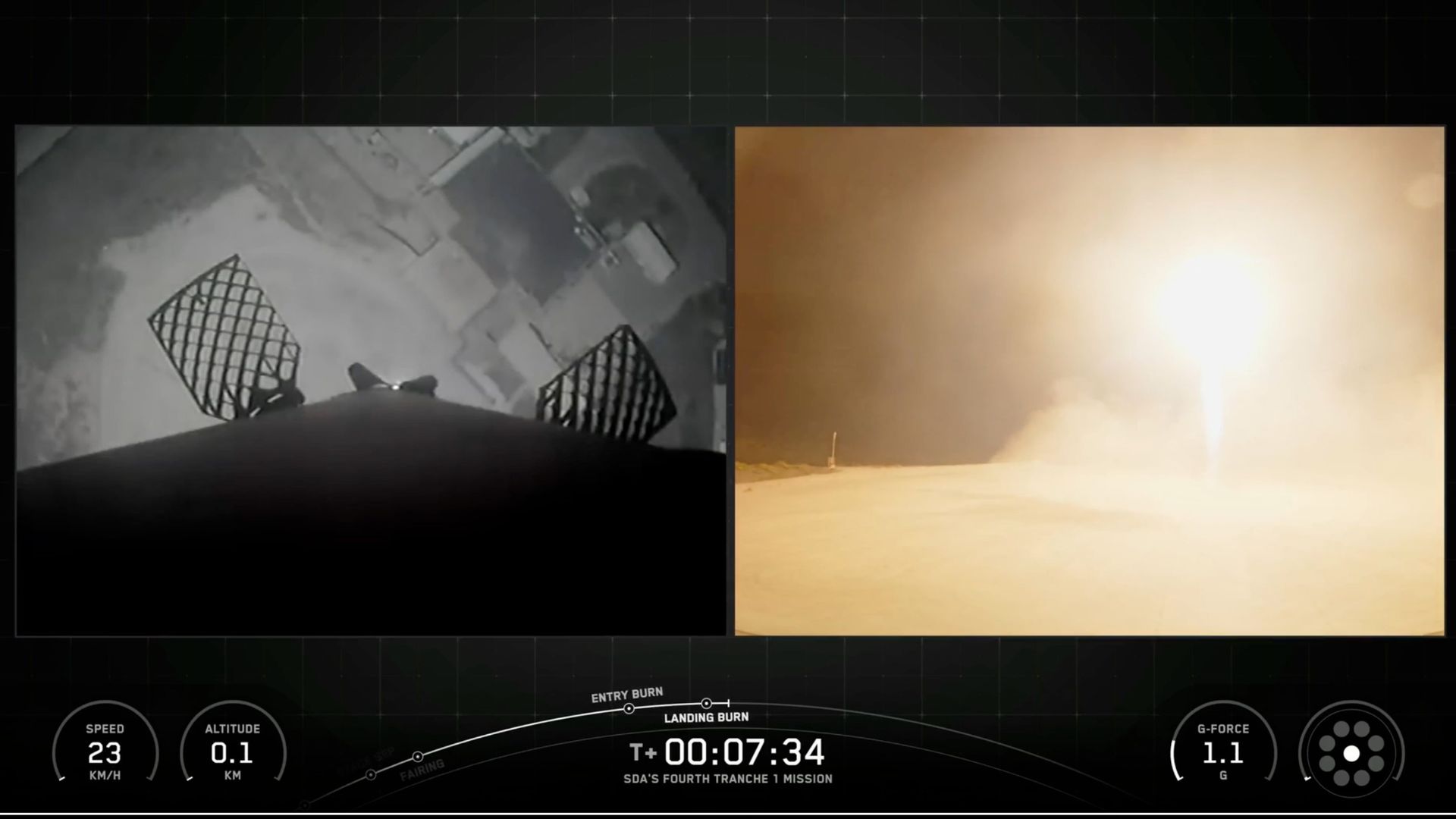
The Falcon 9's first stage comes down for a landing at Vandenberg on Oct. 10, 2026. (Image credit: SpaceX)
Today's launch helps build out the SDA's Proliferated Warfighter Space Architecture (PWSA), which SpaceX describes as "a mesh network of optically connected satellites in low Earth orbit [LEO] that enable global military tactical communications and missile warning, indication and tracking capabilities."
The liftoff was the fourth of nine that SpaceX will conduct to help assemble the architecture's Tranche 1 — the "initial warfighting capability tranche," according to the SDA.
Tranche 1 will eventually consist of 154 operational satellites in LEO — 126 data-transport spacecraft and 28 missile-tracking vehicles. There will also be four missile-defense test satellites, which will sport a "higher fidelity" infrared sensor than their tracking counterparts, SDA officials wrote. (Missile-tracking satellites generally hunt for the heat signatures these weapons produce during flight).
Eighty-four of the 126 data-transport satellites have now launched to date, all of them on Falcon 9s, which lifted off from Vandenberg in September 2025, October 2025, July of this year and today.
And, as its name suggests, Tranche 1 will be just the beginning, if all goes according to plan.
"SDA leverages spiral development to deploy and proliferate new capability into a new generation of the PWSA every two years, called a 'tranche,' to continually increase capability used by the warfighter," SDA officials wrote in a Tranche 1 fact sheet.
Everything seemed to go well on today's launch. The Falcon 9's first stage came back to Vandenberg for a landing a little over seven minutes after liftoff. It was the sixth mission for this particular booster, which is designated 1103. Its most recent flight was the July Tranche 1 mission for the SDA.
SpaceX ended its webcast shortly after booster touchdown, at the request of the SDA, so we did not get to see satellite deployment. But that's the norm for national security launches.
The satellites were successfully deployed in their target orbit, according to an Oct. 10 announcement by their builder, aerospace giant Northrop Grumman. The 21 spacecraft "will provide secure, resilient, low-latency communications and data transport in low Earth orbit," helping to connect warfighters with missile-tracking satellites, the company wrote.
Today's mission was the 111th Falcon 9 flight of the year. The vast majority of these — more than 70% — have helped build out SpaceX's Starlink broadband megaconstellation, which currently consists of more than 11,000 satellites.
Editor's note: This story was updated at 12:45 p.m. ET on Oct. 10 with news of successful satellite deployment.
The world's richest man just got some more hardware for his trophy room.
During a ceremony at the White House on Thursday (Oct. 8), President Donald Trump gave SpaceX founder and CEO Elon Musk the National Medal of Science, the highest honor the U.S. can bestow on a scientist or engineer.
Musk was recognized "for engineering achievements of extraordinary ambition and scale that have pushed the frontiers of space exploration, intelligence systems, communications and beyond, renewing American technological leadership and opening a new chapter in American manufacturing," an announcer said during the ceremony.
.@POTUS presents the National Medal of Science to Sergey Brin, @JensenHuang, @elonmusk, and @LisaSu, and the National Medal of Technology and Innovation to @MichaelDell and @satyanadella. https://t.co/8IGZV6s9OfOctober 8, 2026
A little bit more about those achievements and that ambition: Musk also leads the electric carmaker Tesla and owns the social media platform X. And he founded the Boring Company, which is drilling tunnels beneath cities to potentially ease traffic congestion; Neuralink, which builds implantable brain-computer interfaces; and xAI, which makes the chatbot Grok, among other things.
Musk wasn't today's only honoree. Trump also handed out science medals to Google co-founder Sergey Brin, Nvidia CEO Jensen Huang and Lisa Su, CEO of Advanced Micro Devices, a leading semiconductor designer.
The president also awarded the slightly different National Medal of Technology and Innovation to two other tech CEOs — Michael Dell of Dell Technologies and Microsoft's Satya Nadella for contributions in their fields.
Congress established the National Medal of Science in 1959. Honorees are chosen for their "outstanding contributions to knowledge in the physical, biological, mathematical, engineering or social and behavioral sciences, in service to the nation," according to the U.S. National Science Foundation (NSF).
"These broad areas include such disciplines as astronomy, chemistry, computer and information science and engineering, geoscience, materials research, and research on STEM education," NSF officials added.
The first National Medal of Science was awarded in 1963, to Theodore von Kármán, a mathematician, physicist and aerospace engineer who worked at the Jet Propulsion Laboratory in Southern California. He was a pioneer of the early space age; the widely recognized, 62-mile-high (100 kilometers) boundary where outer space begins is known as the Kármán line.
Before today, 529 people had received the medal, according to the NSF.
The National Medal of Technology and Innovation is a newer prize; Congress created it in 1980. There have been more than 240 laureates in the award's history.
Today did not mark Musk's introduction to the Trump administration. For example, in late 2024, the president tapped the tech billionaire to help lead the "Department of Government Efficiency," which aimed to slash regulations and costs across the federal government.
More recently, the Pentagon named Musk, former U.S. Speaker of the House Newt Gingrich and Anduril co-founder Palmer Luckey co-leaders of Project Meridian, a four-month study that aims to help the U.S. get ready for future wars.
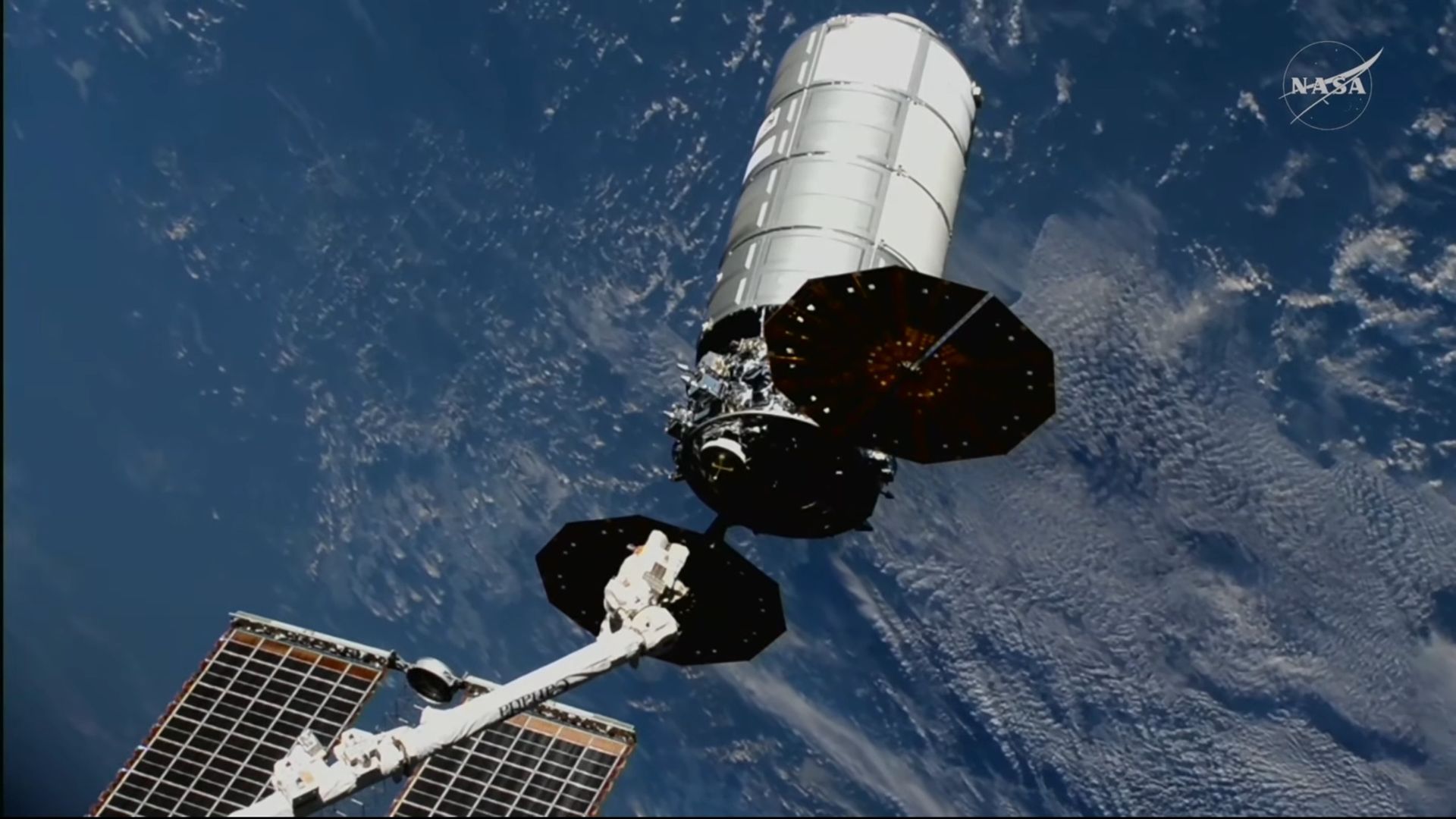
Northrop Grumman's robotic Cygnus XL spacecraft departed the International Space Station today (Oct. 9) after a six-month stay.
Northrop Grumman's uncrewed Cygnus XL freighter was released by the station's huge Canadarm2 robotic arm today at 12:44 p.m. EDT (1644 GMT), while the duo flew 260 miles (418 kilometers) above the Pacific Ocean.
The departing vehicle is the second of Northrop Grumman's "Cygnus XL" line of freighters but the 24th Cygnus of any type to fly cargo to the orbiting lab. The company named it the S.S. Steven R. Nagel, after a NASA astronaut who flew four space shuttle missions in the 1980s and 1990s.
Northrop Grumman's Cygnus XL cargo craft departs the International Space Station on Oct. 9, 2026. (Image credit: NASA)
The S.S. Steven R. Nagel launched atop a SpaceX Falcon 9 rocket on April 11, carrying 11,000 pounds (4,990 kilograms) of science gear and supplies to the International Space Station (ISS). It's carrying some stuff down as well — thousands of pounds of trash, which will burn up along with the Cygnus when it reenters Earth's atmosphere on Sunday (Oct. 11).
That's the usual fate for three of the four robotic ISS resupply vehicles in operation today — Cygnus XL, Russia's Progress and Japan's HTV-X. Only SpaceX's Dragon cargo capsule is reusable; it wraps up its orbital flights with parachute-aided ocean splashdowns.
Cygnus XL is different than Dragon in another way as well: The Northrop Grumman vehicle does not dock to the ISS on its own. Rather, it's grappled by Canadarm2, which berths it to the station and moves it around in other ways as necessary.
During today's operation, which was commanded from the ground, Canadarm2 detached the S.S. Steven R. Nagel from the Earth-facing port of the ISS' Unity module and then maneuvered it into position for release at 12:45 p.m. NASA astronaut Luke Delaney monitored these activities from the ISS.
"We're just really excited to have had the S.S. Stephen R. Nagel on board, and all the science and research, critical hardware," Delaney said shortly after the Cygnus was released.
"Appreciate all the teams that came together to make this complex operation a success, from assembly, launching, docking and now the undock," he added. "Thanks for continuing to push the boundaries of human knowledge and experiments on board, to include the research during this deorbit phase. These true are the building blocks of the future of space exploration."
And about that deorbit science: The S.S. Stephen R. Nagel is carrying heat shield prototypes that will get a test during the freighter's fiery reentry.
Editor's note: This story was updated at 1 p.m. ET on Oct. 9 with news of the Cygnus XL's departure from the ISS.
The great views of Starship's first orbital flight keep on coming.
The megarocket circled our planet for the first time ever on Sept. 28, its 14th liftoff to date. And Starship deployed some payloads when it got up there — 26 of the company's next-gen Starlink satellites, the first members of a broadband constellation that will eventually consist of 100,000 spacecraft, if all goes to plan.
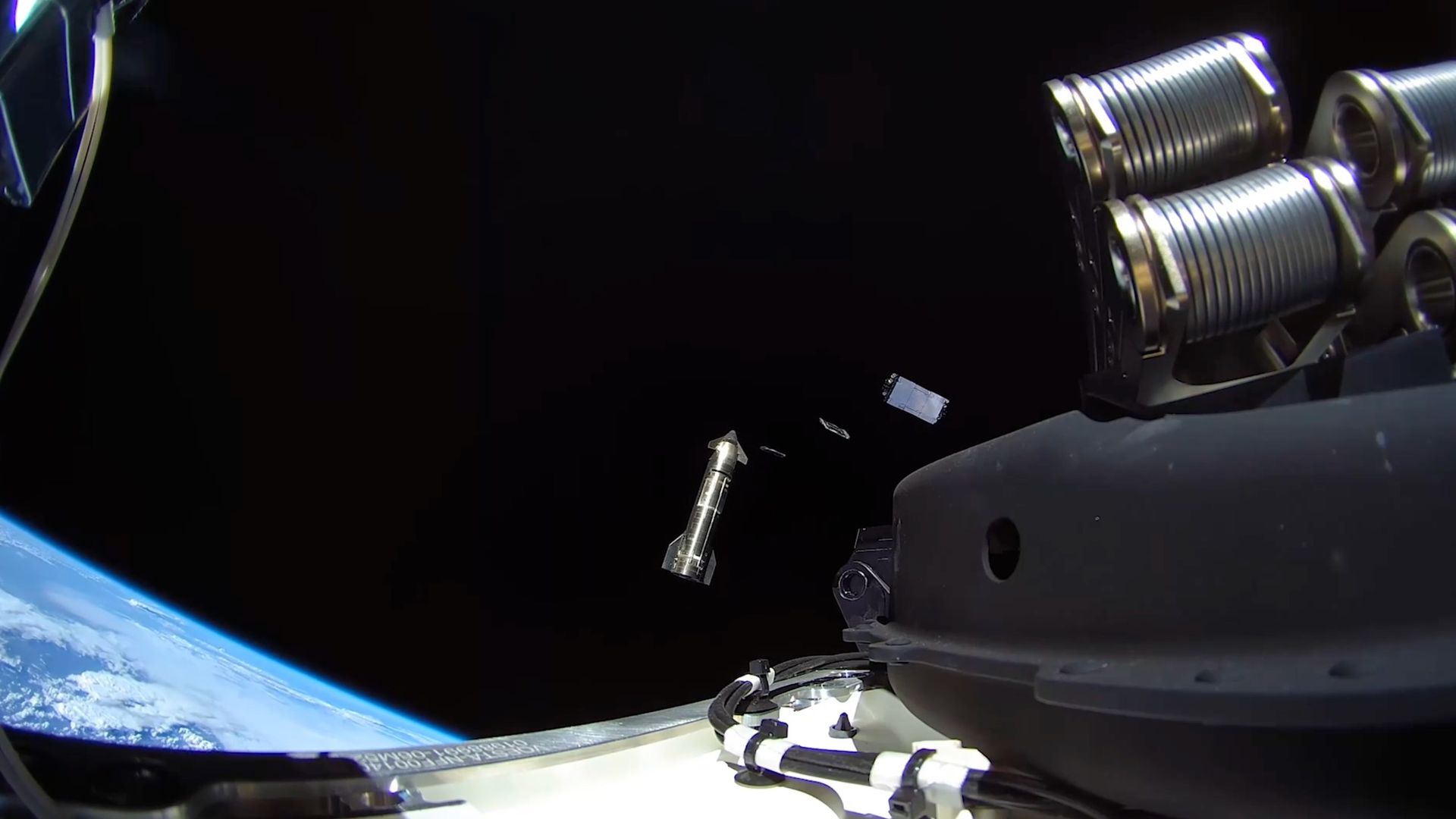
SpaceX already released still imagery of that historic deployment, which was captured by cameras on a few of the Starlink satellites. But on Tuesday, the company gave us something even better, releasing gorgeous video of Starlink craft popping out of the Starship upper stage's "Pez dispenser" slot.
Starship's Ship upper stage deploys Starlink V3 satellites during its first-ever orbital flight on Sept. 28, 2026. (Image credit: SpaceX)
"Constant communication is what makes autonomy like this safe," representatives of Starlink, which is a SpaceX subsidiary, said in a Tuesday X post that featured the deployment video.
"Early contact lets us take maneuvering responsibility, publish ephemeris faster than ground radar can catalog the object, and deorbit and keep commanding through demise if needed," they added. "We treat early communications as a requirement, not a nice-to-have."
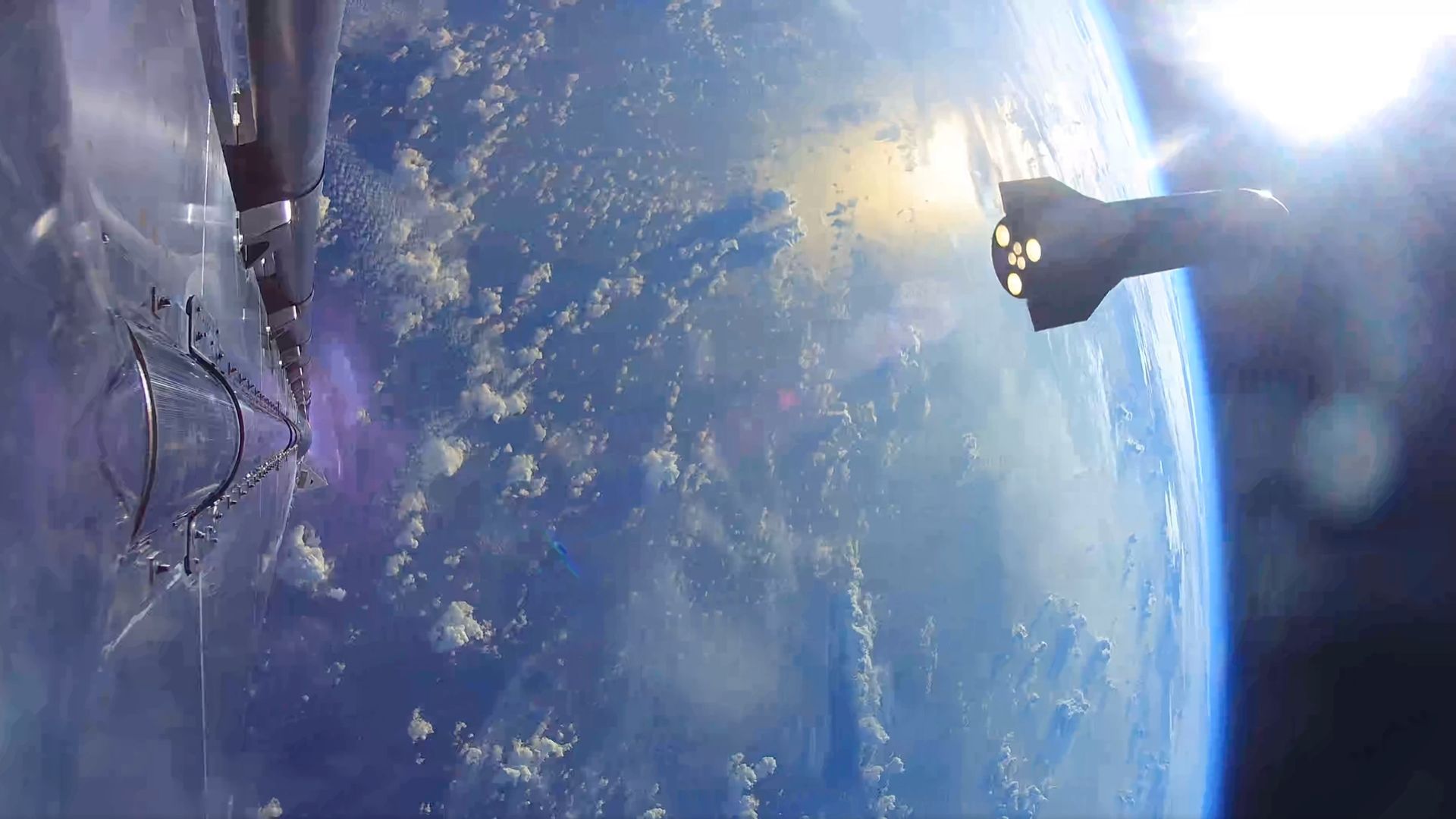
Starship's Ship upper stage (right) separates from its Super Heavy booster during Flight 14 on Sept. 28, 2026. (Image credit: SpaceX)
A few days earlier, on Oct. 2, SpaceX posted three short videos of another important Flight 14 milestone — stage separation, when the megarocket's 171-foot-tall (52 meters) Ship spacecraft began flying independently of its Super Heavy booster.
The footage captured the farewell from both perspectives. One video showed Super Heavy falling back toward Earth, while the other two revealed Ship powering its way toward orbit, its six Raptor engines glowing yellow-orange with the effort.
Super Heavy came down relatively quickly, steering itself to a splashdown in the Gulf of Mexico about seven minutes after liftoff. Ship stayed up for another three hours, circling Earth multiple times (and deploying those Starlink satellites) before meeting its own watery end in the northern Pacific Ocean.
Despite Flight 14's successes, Starship remains in the development phase and needs to tick a few other important boxes before it's fully operational.
For example, SpaceX still needs to demonstrate in-space refueling of Ship, which will be necessary on all Starship missions that venture beyond Earth orbit. And crewed versions of the vehicle will need a life-support system, which has yet to fly on any of the test missions to date.
The first Starship launch from Florida may be just a few months away.
All 14 of the SpaceX megarocket's test flights to date have lifted off from the company's Starbase site in South Texas — including the most recent, on Sept. 28, which saw Starship reach orbit for the first time.
But SpaceX is working hard to get three pads on Florida's Space Coast ready for Starship. And one of them, historic Pad 39A at NASA's Kennedy Space Center (KSC), is nearly there, according to the company.
"Things are going super well at 39A," Julianna Scheiman, director of NASA science and Dragon programs at SpaceX, said during a briefing on Oct. 1 that primarily discussed that day's launch of the Crew-13 astronaut mission to the International Space Station.
The pad's new Starship launch tower is nearly complete, as is most other essential construction at the site, according to Scheiman.
"We've essentially done a lot of the initial build of the structures and the systems needed for launching Starship, and we're beginning to step into the sort of acceptance testing and operational testing prior to activation," she said. "So, we're kind of through the main construction and going into the proofing, testing — activation testing."
The work at Pad 39A began in late 2021. The fact that it's taken so long shouldn't be surprising, for Starship requires some very specialized infrastructure. After all, it's the biggest rocket ever built, standing about 408 feet (124 meters) tall. For comparison, SpaceX's Falcon 9 and Falcon Heavy vehicles — the only rockets that have flown out of Pad 39A since SpaceX started leasing it from NASA in 2014 — are both about 230 feet (70 m) tall.
Starship is also designed to be fully and rapidly reusable, and its recovery operations are very different than those of the Falcon 9 and Falcon Heavy. The first stages of those two rockets touch down either on a ship at sea or on a designated landing pad close to the launch site. But Starship's two stages — its Super Heavy booster and Ship spacecraft — are designed to come back to the launch pad, where they will be caught by the giant tower's "chopstick" arms. So finishing construction of Pad 39A's new Starship tower will be a very big deal.
Starship also employs different engines than the Falcon 9 and Falcon Heavy — Raptors rather than Merlins. Raptors burn liquid methane and liquid oxygen (LOX), rather than rocket-grade kerosene and LOX like Merlins, so the new Starship-friendly 39A needs a new tank farm to feed in this different mix of propellant.
SpaceX plans to launch at least one more Starship test flight from Starbase before flying the megarocket out of KSC, Scheiman said on Oct. 1 — meaning the first Florida Starship launch come come as soon as Flight 16.
The company has not yet announced target dates for upcoming Starship launches, but provisional planning documents identify Oct. 19 and Oct. 30 as possible "no earlier than" dates for Flight 15 and Flight 16, respectively. Those dates may be a bit aspirational, but they suggest that SpaceX aims to fly Starship again soon, and to launch two missions in relatively quick succession. (For perspective: Starship has flown three times so far this year — on May 22, July 24 and Sept. 28.)
Whenever Starship breaks in the new Pad 39A, it will be something of a blast from the past. The launch complex was originally built in the 1960s to host launches of a different megarocket — NASA's Saturn V, which sent the Apollo moon missions skyward. Pad 39A was the jumping-off point for some of the most iconic Apollo flights, including Apollo 8 in December 1968 and Apollo 11 in July 1969.
This tradition will continue, if all goes according to plan: NASA picked Starship's Ship upper stage to be the first crewed lunar lander for its Artemis program, which aims to build a base near the moon's south pole over the next five years or so.
Ship is scheduled to fly for the Artemis program for the first time on Artemis III, a planned 2027 docking test in Earth orbit between the vehicle and NASA's Orion capsule. And that Ship liftoff will take place from Pad 39A, Scheiman said.
Illustration showing two of SpaceX's Starship rockets at Cape Canaveral Space Force Station's Space Launch Complex-37. (Image credit: SpaceX)
There's more pad work going on in Florida as well. Late last year, the U.S. Air Force gave SpaceX permission to fly Starship from two pads at Cape Canaveral Space Force Station, which is next-door to KSC. Those two pads — SLC (Space Launch Complex)-37A and SLC-37B — could eventually host 76 Starship liftoffs per year between them.
SpaceX has already made considerable progress on SLC-37A and SLC-37B, according to Scheiman. "If you look towards Launch Complex 37, you can see the beginnings of that Starship tower," she said on Oct. 1.
The vast majority of those liftoffs will serve to assemble two SpaceX megaprojects in Earth orbit: the next-gen Starlink broadband network, which will consist of about 100,000 satellites, and Starmind, an AI data center constellation that will feature a million spacecraft, according to Elon Musk.
South Korea just launched its first orbital mission of the year.
The milestone came on Tuesday night (Oct. 6), when the homegrown Nuri rocket lifted off from the nation's Naro Space Center, carrying 15 satellites skyward.
Liftoff occurred at 11:25 p.m. EDT (0325 GMT and 12:25 p.m.local time on Oct. 7). Almost everything went well: All but one of the payloads was successfully delivered to low Earth orbit as planned, according to the state-run Korea Aerospace Research Institute (KARI).
Five of those payloads are microsatellites for South Korea's nascent New-space Earth Observation Satellite Constellation for National Safety (NEONSAT) network.
"Each NEONSAT weighs less than 100 kilograms [220 pounds] and carries an electro-optical camera capable of distinguishing objects as small as 1 meter [3.3 feet] in black-and-white images and 4 meters [13.1 feet] in color images," South Korea's Yonhap news agency wrote in a prelaunch preview.
"The satellites will monitor the Korean Peninsula and surrounding areas for national security and disaster response," Yonhap added.
Two NEONSAT satellites had launched before today, both aboard Rocket Lab Electron vehicles. The first went up in April 2024, and the second flew in January of this year. Five more will launch atop a Nuri next year, rounding out the constellation, according to Yonhap.
The other 10 satellites that went up tonight are cubesats, which were provided by a variety of operators. And it was one of these cubesats that experienced difficulty on Tuesday night: PERSAT02, which was developed by the South Korean company Quaternion, failed to deploy, KARI wrote in an X post about two hours after launch.
[누리호, 5차 발사 성공!]오늘 10월 7일 12시 25분 발사된 누리호가계획된 비행 절차를 정상적으로 수행하며5차 발사 임무를 성공적으로 마쳤습니다.누리호는 목표 태양동기궤도에 정상적으로 진입한 뒤,주탑재위성인 초소형군집위성 2~6호 5기를계획된 절차에 따라 성공적으로 분리했습니다.또한 큐브위성 10기 중 9기가 정상적으로 분리되었으며,쿼터니언이 개발한 ‘퍼샛’ 1기는 미사출된 것으로 최종 확인되었습니다.13시 08분경에는 남극 세종기지에서초소형군집위성 6호와의 최초 교신에도 성공했습니다.이번 5차 발사를 통해여러 기의 위성을 한 번의 발사로 정밀하게 궤도에 배치하는누리호의 우주수송 임무 수행 역량을 한 단계 더 높였습니다.누리호의 성공적인 비상을 위해따뜻한 관심과 성원을 보내주신 국민 여러분께진심으로 감사드립니다.#한국항공우주연구원 #항우연 #KARI #누리호 #누리호5차발사 #KSLVII #우주수송 #국민_여러분_감사합니다October 7, 2026
The 155-foot-tall (47 meters) Nuri, also known as KSLV-II (Korean Space Launch Vehicle-II), is South Korea's first fully homegrown orbital launcher. It is jointly operated by KARI and the company Hanwha Aerospace.
The three-stage rocket failed during its debut mission in October 2021 but is now riding a streak of four straight successes.
"Through this 5th launch, we have further elevated the Nuri rocket's capability to perform space transportation missions by precisely deploying multiple satellites into orbit in a single launch," KARI wrote in the same X post. "We sincerely thank all citizens for your warm interest and support for the successful flight of the Nuri rocket."
The U.S. military must be ready to engage the enemy farther from home than ever before, according to its highest-ranking officer.
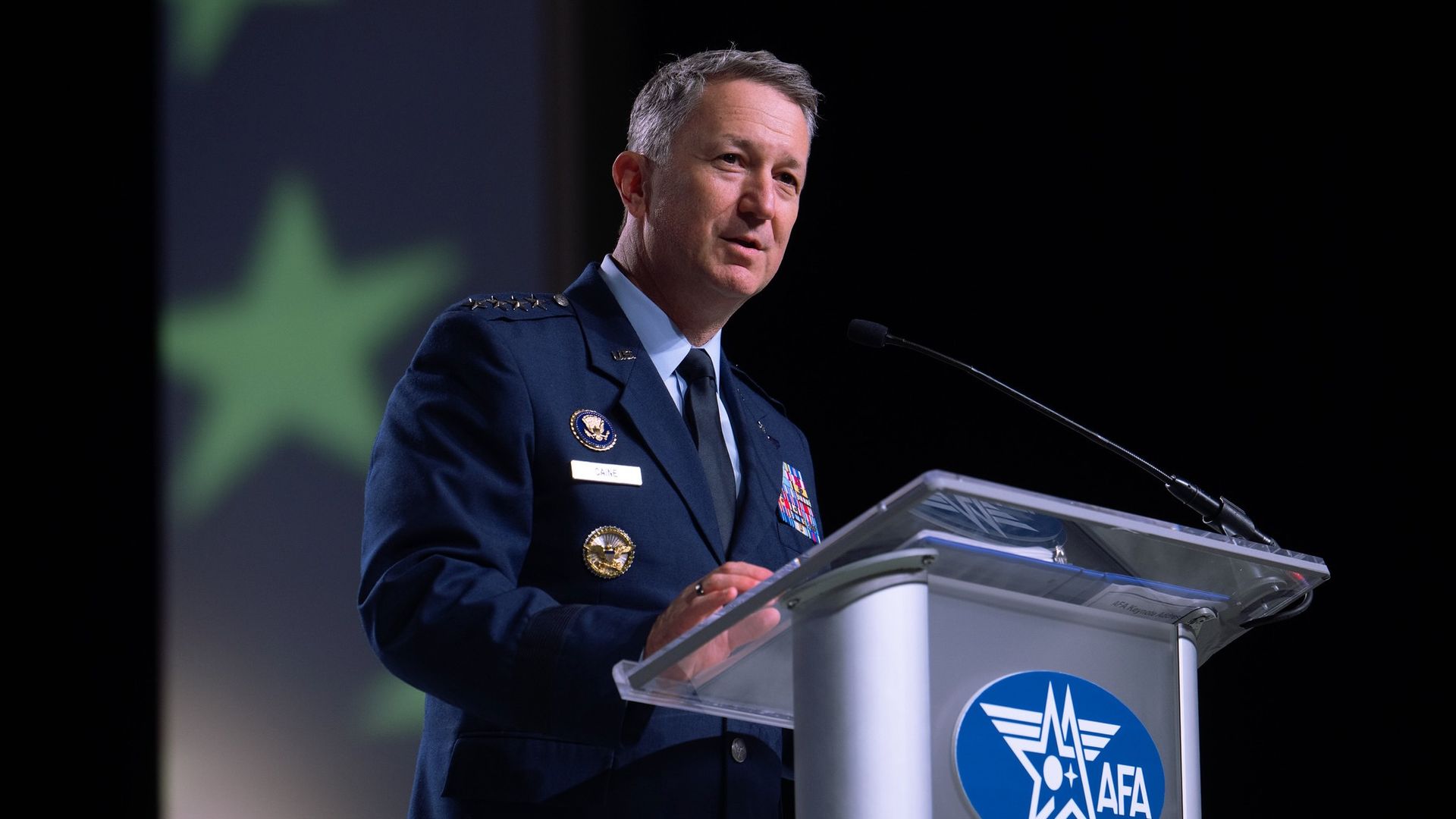
"Today's modern battlefield operates from the seabed to cislunar space," Gen. Dan Caine, the chairman of the Joint Chiefs of Staff, said Wednesday (Sept. 16) during a keynote address at the Air & Space Forces Association's Air, Space & Cyber Conference in National Harbor, Maryland.
Cislunar space extends from Earth all the way out to the orbit of the moon and includes the lunar surface. For several years now, military officials have been stressing the strategic importance of this huge region, which could get quite a bit busier in the next decade or so.
Gen. Dan Caine, chairman of the Joint Chiefs of Staff, speaks at the Air & Space Forces Association’s Air, Space & Cyber Conference in National Harbor, Maryland, on Sept. 16, 2026. (Image credit: Craig Hudson, for Air & Space Forces Association)
For example, both the United States and China plan to build bases near the moon's south pole, which is thought to harbor large amounts of water ice. Winning this new moon race is critical, U.S. officials have stressed, because whoever does so will be able to establish norms of behavior on and around Earth's nearest neighbor.
China has already demonstrated impressive capabilities in the lunar sphere. In 2019, the nation's robotic Chang'e 4 mission pulled off the first-ever soft landing on the moon's mysterious far side. In 2024, Chang'e 6 returned far-side samples to Earth — another first.
Caine didn't cite such missions or even mention China by name. And he provided no details about what conflict on the cislunar battlefield might look like (though presumably it would be entirely robotic, with satellites seeking to take out adversary craft via jamming or blinding).
But he invoked the cislunar battlefield twice and noted that U.S. military branches cannot assume continued dominance of their various domains.
"Future conflicts will demand that we operate without the assumptions of uncontested access, secure rare areas or uninterrupted or uncontested sustainment," Caine said. "Our task, my friends, is to adapt right now, so the joint force is prepared to fight, endure and win in global contested environments, from the seabed to cislunar space."
The United States' long-held advantage in the final frontier will be key to securing such victories, he added.
"We must continue to ensure that the United States of America can strike anywhere on the globe at the time and place of our choosing, and sustain that force," Caine said. "Our United States Space Force must provide unrivaled space superiority and sustain the associated networks, domain awareness [and] data advantage that the joint force needs to win in space, both now and in the future."
We now know that part of the Space Force's strategy for maintaining that crucial superiority is the operation of weapons in Earth orbit. The branch's chief, Gen. Douglas Schiess, admitted as much during an address at the same conference on Tuesday (Sept. 15).
"Let me be crystal clear: Today, guardians operate on-orbit weapons that can defend the joint force against space-enabled attacks,” Schiess said during his speech. ("Guardian" is the official name for a member of the Space Force, just as members of the U.S. Navy are called sailors and members of the Army are soldiers.)
Schiess provided few details about these weapons but, later in the speech, implied that they are electromagnetic rather than kinetic in nature. That is, they're probably designed to knock out key systems of adversary satellites rather than destroy the entire spacecraft (which would create a cloud of potentially troublesome debris).
It's no surprise the U.S. possesses and employs such technology; the newsworthy bit is that a top official said it so openly. The nation's chief rivals in the space domain, China and Russia, possess advanced counterspace technologies as well. For example, both have destroyed defunct satellites with missiles and conducted close approaches of spacecraft with "inspector" vehicles.
The winners of the first-ever Neil Armstrong Space Prize just got their hardware.
Those awardees — the people who developed and mastered the famous landing capability of SpaceX's Falcon 9 rocket — were announced in April. But they didn't actually receive the prize until Tuesday night (Sept. 15), when it was bestowed during a ceremony at the Cosmos Club in Washington, D.C.
And it was richly deserved, according to Purdue University, which created the international award and named it after perhaps its most famous alumnus. (Purdue is known as the "cradle of astronauts," because 30 of its graduates have flown in space or been selected as NASA astronaut candidates.)
"Neil Armstrong's achievement rested on extraordinary engineering, teamwork and the courage to attempt what had never been done before," Mark Lundstrom, the John A. Edwardson Dean of the College of Engineering at Purdue, said in a statement on Tuesday.
"The Falcon 9 Booster Landing Team carries that spirit forward," he added. "By making rocket reuse practical at unprecedented scale, they changed the economics of spaceflight and opened new possibilities for science, exploration and commerce. It is especially fitting that they are the first recipients of the Neil Armstrong Space Prize."
Purdue wants the annual prize to become a sort of Nobel for space science and exploration. The inaugural honorees are five SpaceX employees, who represent the much larger Falcon 9 landing team:
Lars Blackmore, senior principal Mars landing engineer
Shana Diez, senior director of Starship reliability
Jon Edwards, senior vice president of Falcon & Dragon projects
Yoshiaki Kuwata, principal guidance, navigation and control engineer
Eduardo Velazquez, director of Crew Starship engineering
The two-stage Falcon 9 debuted in June 2010. The rocket was always envisioned to have a reusable first stage, though making that happen took a while.
"On a simple hand calc, I thought, 'Oh, this would work,'" said Kuwata, who joined SpaceX in 2012.
"But then the difficult part is going from this hand calculation to the reality, and there are a lot of nuances that we learned on the way," he told Space.com. "And on paper, I think it would have been done in like six months. But it took like three, four years to actually get it to work."
The milestone moment occurred on Dec. 21, 2015, on the 20th Falcon 9 flight to date: The rocket's first stage came back to Earth for its first-ever vertical touchdown, landing at Florida's Cape Canaveral Air Force Station (now known as Cape Canaveral Space Force Station) after sending 11 satellites to orbit for the company Orbcomm.
The Falcon 9 ticked another big box on April 8, 2016, acing a touchdown on a SpaceX "drone ship" stationed in the Atlantic Ocean.
These eye-popping sights have now become commonplace; to date, SpaceX has landed boosters more than 650 times during orbital missions. And these rockets don't stay on the ground for long. Six different Falcon 9 first stages now have more than 30 launches and landings under their belt, led by Booster 1067, which has flown a whopping 37 times.
Such extensive reuse has helped make the Falcon 9 the dominant rocket flying today. In 2025, the vehicle flew 165 missions — about half of the global total — and all of them were successful.
This success has inspired copycats. For example, two different Chinese rockets have landed successfully in the past few months, one of which employs foldable landing legs just like a Falcon 9 first stage.
But the imitation doesn't bother Velazquez.
"I think this is great," he told Space.com. "I mean, we didn't start from scratch, right? If you look at a cross section of our engines and the engines from the '60s, they're all very similar. So we're all kind of cribbing from the same place. But the fact that we are able to advance the bar so that everybody else is landing first stages is just great. I think we all move forward together, and we need more entrants in the field to really have a big kind of spacefaring economy and civilization."
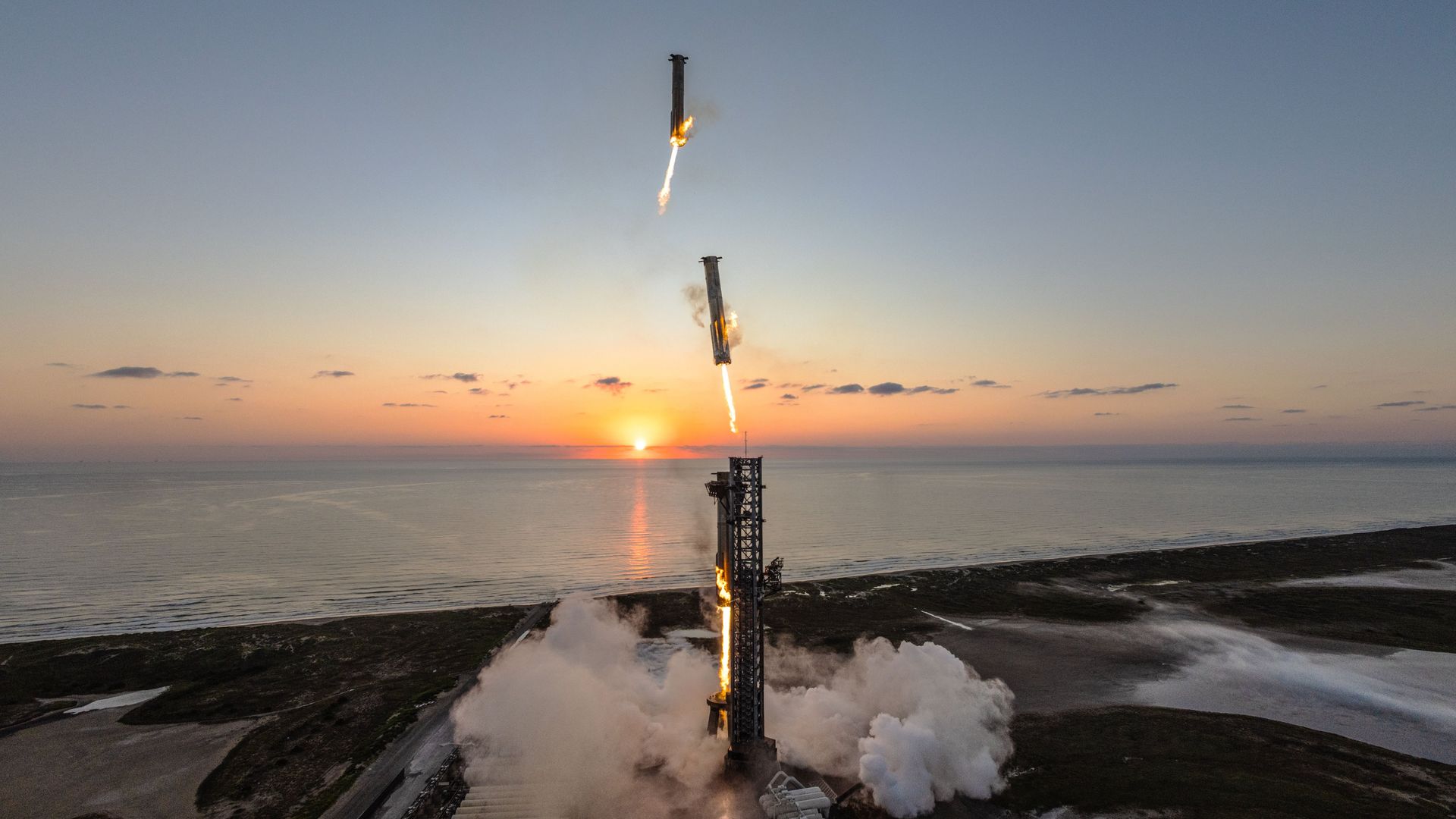
Composite photo showing the Super Heavy booster of SpaceX's Starship megarocket coming in for a landing on the launch mount on Oct. 13, 2024. (Image credit: SpaceX via X)
SpaceX is planning to sunset the Falcon 9 in the relatively near future in favor of Starship, the fully reusable megarocket it's developing to help humanity settle the moon and Mars, among other exploration tasks.
Starship has flown 13 test flights to date, all of them suborbital. SpaceX has already successfully recovered the giant vehicle's Super Heavy first stage on three occasions, catching the booster with the "chopstick" arms of the launch tower at its Starbase site in South Texas.
Such success follows quite naturally from the experience the company built up with the Falcon 9 (and its cousin the Falcon Heavy). But landing and reflying Starship's upper stage, known as Ship, is a different animal. (Falcon upper stages are expendable.)
"The bigger step change for Starship is the stage two — Ship upper stage — reusability," Kuwata said.
"In Monte Carlo simulations, [Ship landings] work well," he added. "And then we kind of demonstrated that pinpoint landing, precision landing, on the ocean many times. But I feel we will find out more things along the way by trying many times."
"Yeah, the 'trying many times' I think is kind of key," Velazquez said. "And I think we're getting pretty close to to catching a Ship."