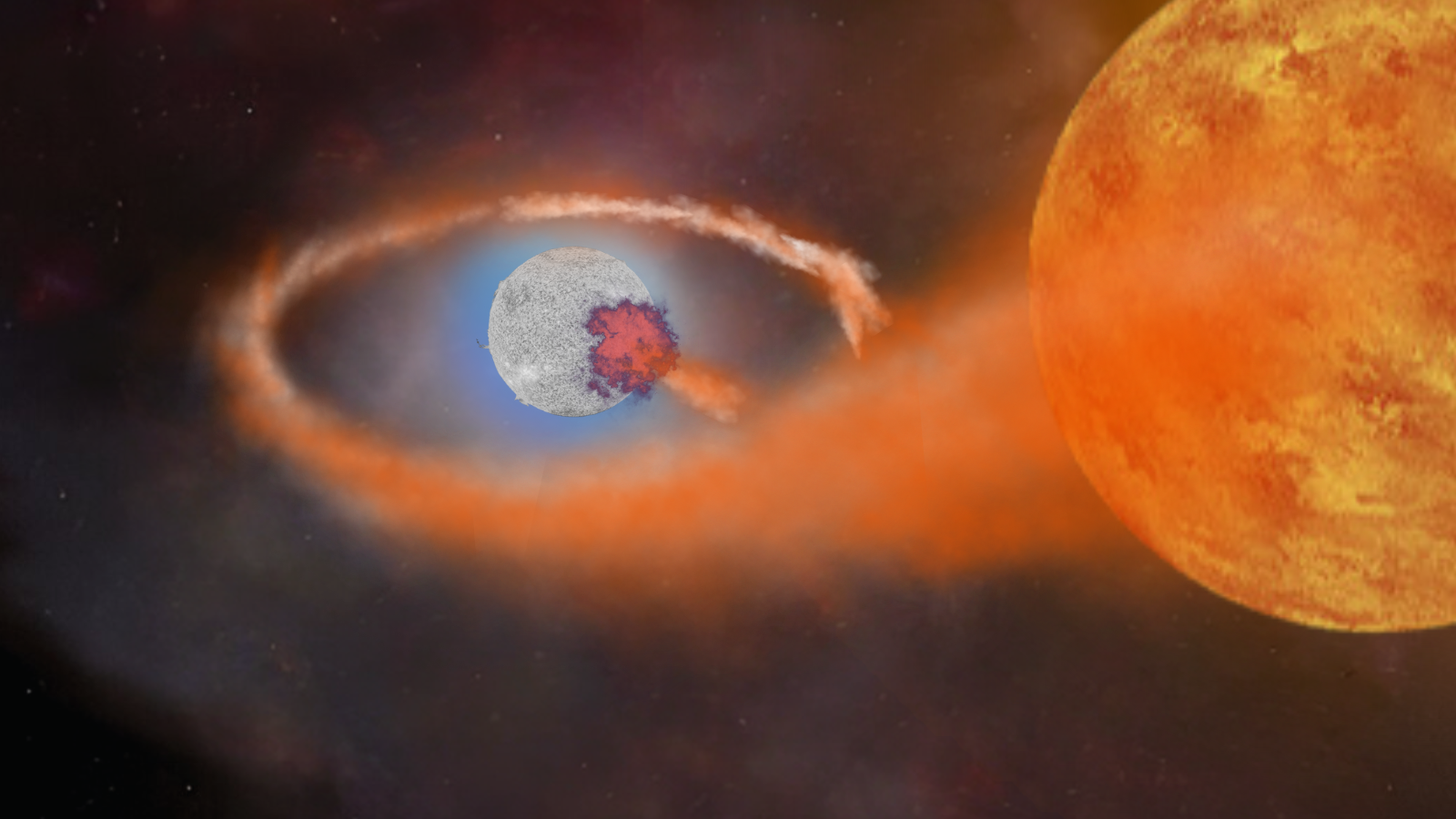
Astronomers discover two stars that joined together to form a binary system just 60 years ago

Using the ALMA (Atacama Large Millimeter/submillimeter Array) radio telescope, astronomers have watched as two stars come together to form a massive stellar binary. The observations revealed that these stars didn't form from the same collapsing cloud of gas and dust, as most binary stars are assumed to form, but instead came together later in their infancy.

Here on Earth, we are slightly prejudiced by our single sun to view stars as somewhat solitary bodies. However, around half of sun-sized stars in the Milky Way have a companion star. This percentage of stellar partnership rises to around 90% of massive stars. Eventually, these massive stars go supernova and shape their cosmic surroundings. Thus, understanding these binary systems is vital to our understanding of stars and of galaxies in general.

The team behind this research initially observed the still-growing massive stars, or protostars, in the binary system IRAS 07299−1651, located around 5,300 light-years away in 2019. At first, the researchers didn't see anything that suggested these stars didn't form from the same disk-shaped cloud of gas and dust that later fragmented. However, one thing really stood out: the disks of material surrounding and feeding these protostars are oddly misaligned.

Over the course of eight years, the team mapped subtle shifts in the position of the stars using ALMA in addition to the Very Large Array (VLA), as well as infrared images from the James Webb Space Telescope (JWST) and the Very Large Telescope (VLT).

"For the first time, we were able to watch two massive stars move around one another while they were still being born," team leader Yichen Zhang of Shanghai Jiao Tong University, China, said in a statement.

The team was able to reconstruct the full 3-dimensional structure of IRAS 07299−1651 for the first time, obtaining details about how the stars orbit each other, the way their disks are aligned, and the angle at which they blast jets into space.

"Each telescope revealed a different piece of the puzzle," team member Rubén Fedriani, of the Instituto de Astrofísica de Andalucía (IAA) in Granada, Spain, said. "The combination of radio and infrared observations provides the most exquisite detail on the formation of this massive protobinary system."

Unexpected chaos

The team's observations took them by surprise. They were expecting these stars to orbit each other in neat, near-circular orbits. Instead, the orbits were found to be highly flattened or "eccentric," almost parabolic.

If the stars had formed from the same disk of material, then even after it fragmented, the individual disks surrounding the stars would be aligned. However, that wasn't the case; the disks are tilted at a sharp angle to each other and to the orbits of the stars.

"It felt like solving a three-dimensional puzzle," team member Yao Wang of Shanghai Jiao Tong University said. "Each new observation added another piece, and eventually the orbit, disks, and jets all came together into a single, coherent picture."
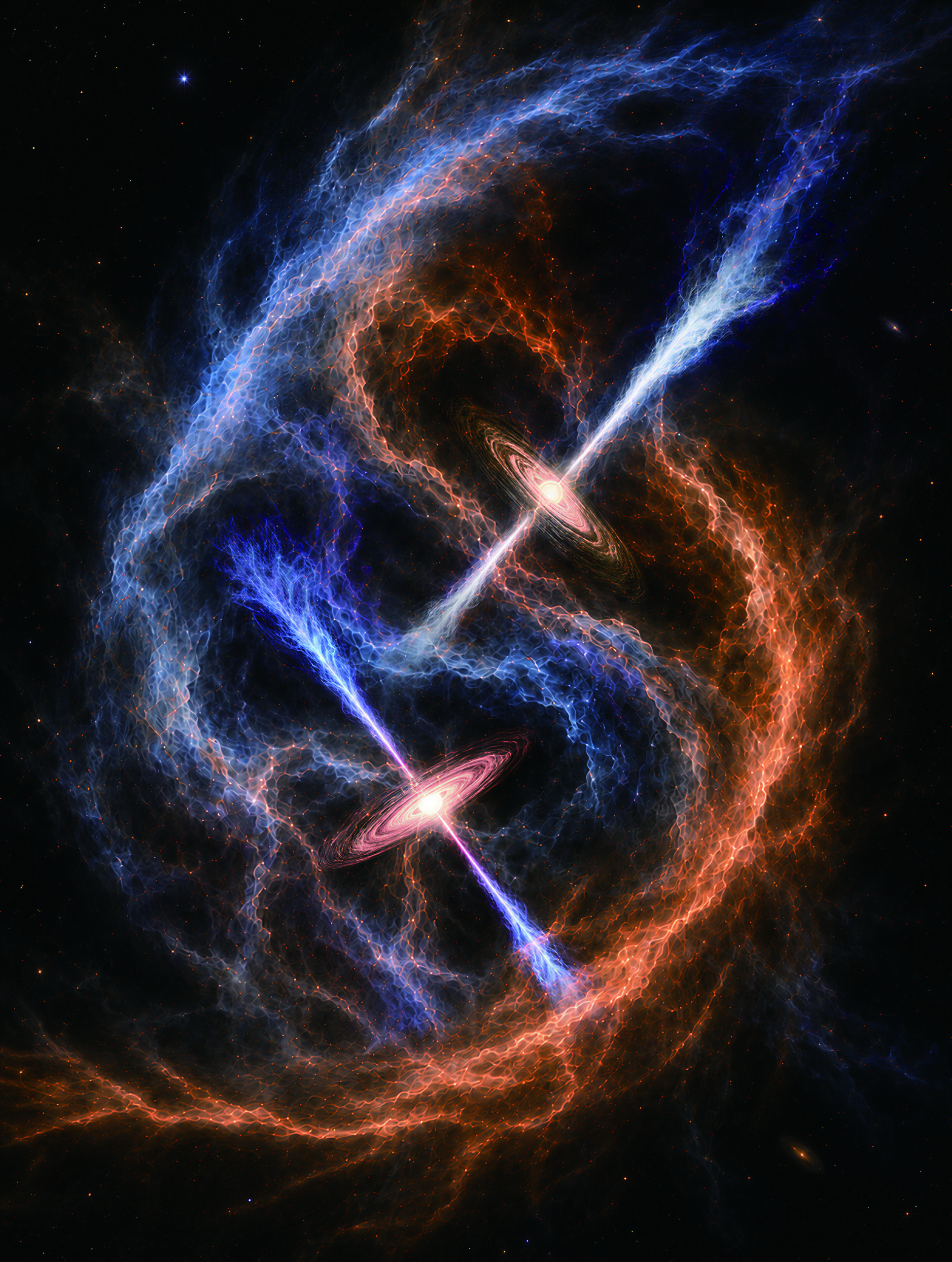
two orange disks with blue jets streaming from their centers

An artist’s impression of the formation of a close massive binary system, showing misaligned disks around two young stars. (Image credit: Y. Zhang)

The chaotic structure of IRAS 07299−1651, as observed by the team, is difficult to explain if the two stars emerged from the same disk of material.

Instead, the researchers theorize that the two stars were born in individual clouds of gas and dust, before a chance encounter brought the two infant stars and their respective natal cocoons together.

Tracing back the orbits of the stars, the researchers found that this encounter likely occurred around 60 years ago. Considering stars live for billions of years, that is an instant on a cosmic timescale. The disk-shaped pockets of material around the stars have thus far survived the encounter, retaining their well-defined structures.

"This study demonstrates that the early lives of stars can be quite chaotic, with a chance encounter leading to this gravitational dance and stellar coupling," team member Jonathan C. Tan of the University of Technology and the University of Virginia said.
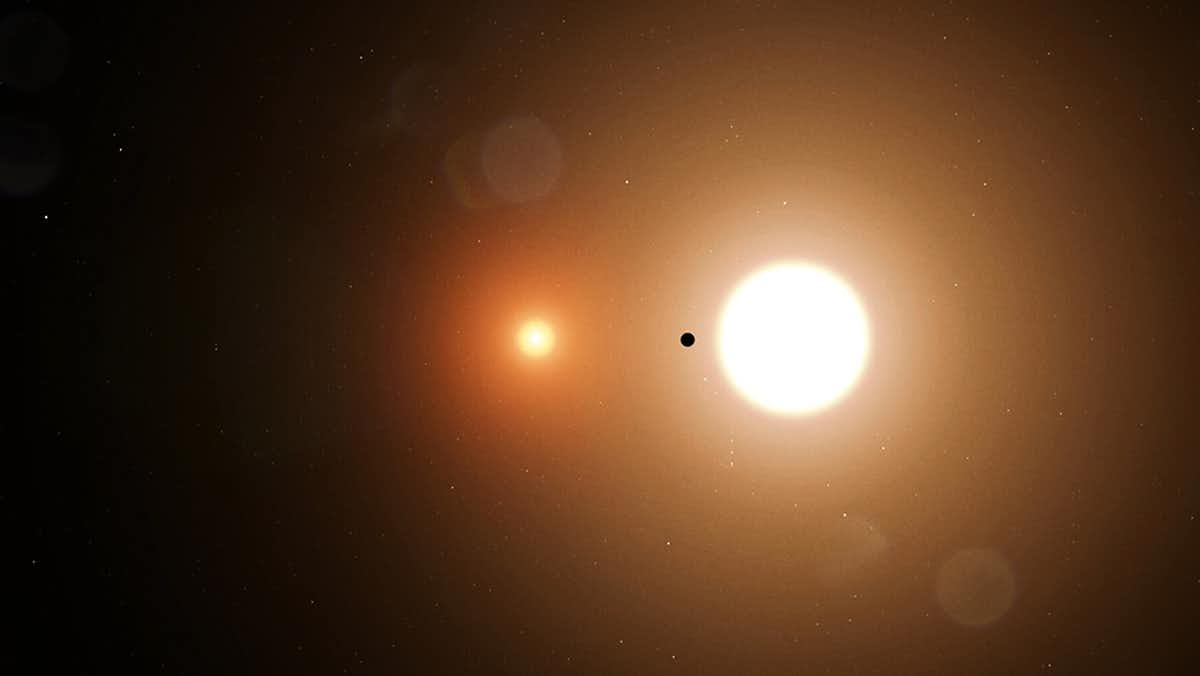
A large yellow sphere next to a smaller red sphere

A binary star system, is IRAS 07299−1651 destined to settle to form such a system? (Image credit: NASA)

What the team can't yet establish is whether these stars are destined to stick together or if they will eventually move apart. Indeed, this fate may not have been sealed yet; interactions with the surrounding gas could determine what shape this system takes in the future.

The team hopes that further observations of IRAS 07299−1651 will help to better understand what the future holds for these stars.

In the meantime, the long-term monitoring approach adopted by the researchers could provide scientists with a powerful new way of investigating other young massive binary systems. This could reveal how common encounters like this are and if more binary systems are composed of stars brought together by chance encounters.

The team's research was published on Tuesday (Sept. 8) in the journal Nature Astronomy.
A photon from the biggest cosmic explosion since the Big Bang appears to have defied Einstein. Scientists may finally know how

A photon, or particle of light, from the biggest cosmic explosion since the Big Bang, nicknamed "the BOAT" (for the brightest of all time), should not have reached Earth. That is, unless it defied rules defined by Einstein. Now scientists may know how it did this, with new research suggesting how the high-energy photon may have survived a journey of more than two billion light-years without being absorbed.

The BOAT, a gamma-ray burst officially designated GRB 221009A, was first detected on Oct. 9, 2022. Among the ocean of photons from the event that rained down on our planet was the highest-energy photon ever detected originating from a gamma-ray burst. It was detected by Carpet, an ultra-high-energy cosmic-ray detector located at the Baksan Observatory in the Russian Caucasus.

The problem is, according to all current rules of physics, a particle with such high energy shouldn't reach Earth from an explosion occurring such a vast distance away. That's because space isn't empty; it is filled with a "fossil" radiation field of photons left over from just after the Big Bang called the cosmic microwave background (CMB). It should be virtually impossible for a high-energy photon to travel 2 billion light-years without interacting with a CMB photon and being transformed. And still it came.

"We started from a very simple question: how did this photon survive a journey that, according to known physics, should have destroyed it?" team leader Giorgio Galanti from the Italian National Institute for Astrophysics (INAF) said in a statement. "The new data from the Carpet experiment showed us that the explanations proposed so far were no longer sufficient.

"We therefore looked for a theoretical scenario capable of consistently describing what we observe, without resorting to arbitrary corrections to the equations."

A hypothetical transformation

To investigate the mystery of how this high-energy photon reached our planet, Galanti and colleagues turned to incredibly light hypothetical particles called axion-like particles (ALPs).

ALPS could serve as a solution to this puzzle via a mechanism that would allow photons to transform into ALPs as they travel and then convert back into photons as they reach the Milky Way. The problem is that this still can't account for such a high-energy photon.

This team combined the idea of ALPs with a proposed violation of one of the fundamentals of Einstein's 1905 theory of special relativity called "Lorentz invariance."

In short, Lorentz invariance says that observers moving at different speeds should experience the same physical laws. The team tested the idea that Lorentz invariance could be violated at high energies, thus changing how photons propagate through space.

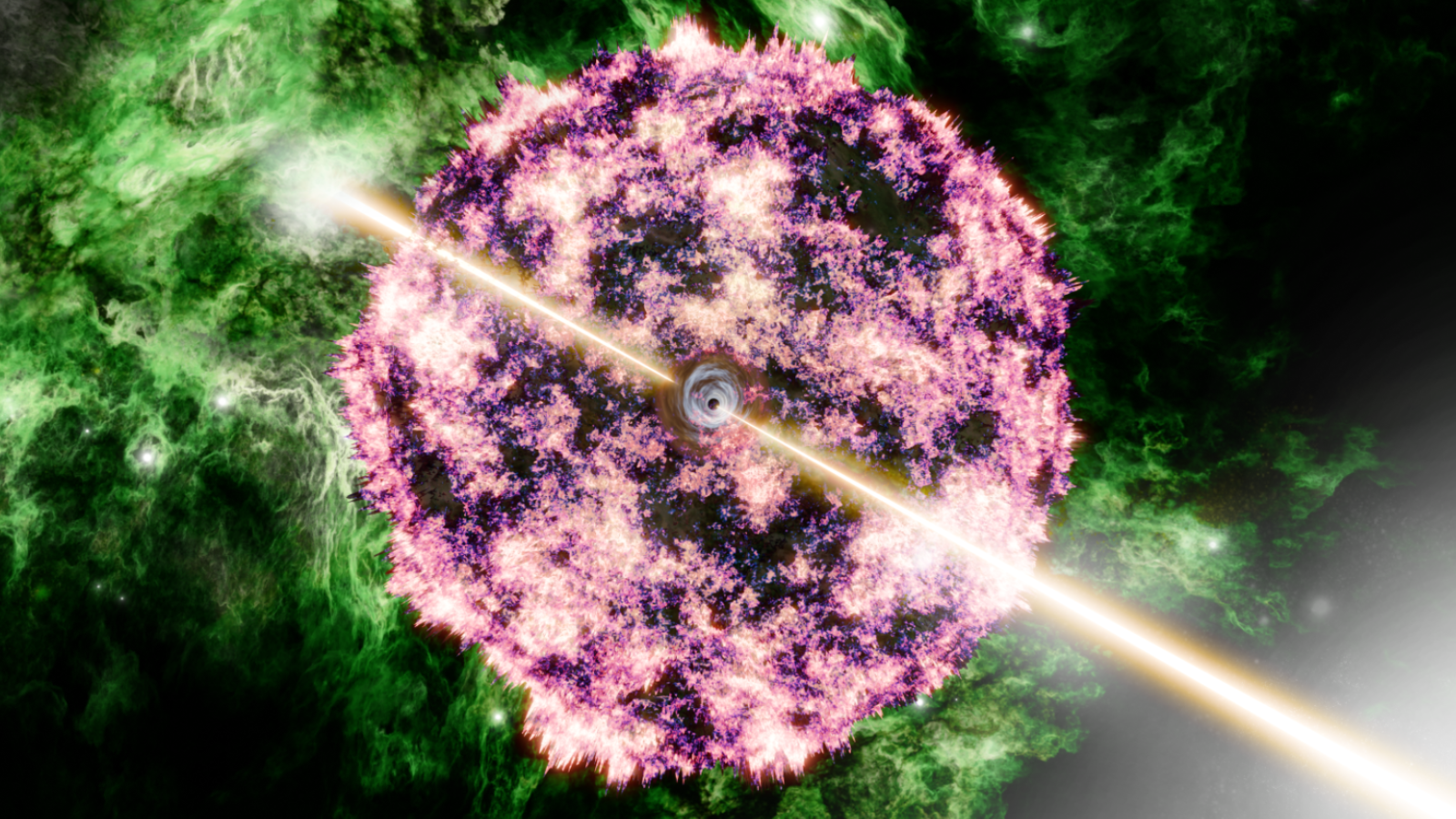
A purple sphere against a green background with two yellow beams emerging from it

An illustration of the supernova that launched teh BOAT, the gamma-ray burst that is the most powerful cosmic explosion since the Big Bang (Image credit: Aaron M. Geller / Northwestern / CIERA / IT Research Computing and Data Services.)

In the scenario devised by the team the photon would have avoided being wiped out by interactions with the CMB as it would avoid interactionc with these fossil photons.

The new research therefore implies that at high enough energies, photons can take a "fast lane" through a transparent universe, dodging the physics that would normally force their destructive transformation.

Interestingly, there is some evidence relating to the BOAT that seemingly backs this theory. According to the picture developed by the team, this high-energy photon should have arrived at Earth around one hour after lower-energy particles of light originating from the BOAT. Indeed, that is exactly what happened.

"The most interesting aspect of our work is that, for the first time, it brings together two ideas that until now had been developed separately," team member Marco Roncadelli of the National Institute for Nuclear Physics (INFN) said. "If future observations confirmed this scenario, the universe would become a natural laboratory for studying quantum gravity at energies enormously higher than those achievable by any accelerator built on Earth."

The team's research is available on the repository site arXiv and has been accepted for publication in the journal Physical Review Letters.

Did Venus eat its own moon?

Scientists may finally know why Venus, Earth's twin, lacks a moon, finding that the hottest planet in the solar system may have consumed its own natural satellite.

Venus is often referred to as Earth's twin due to its size, mass, rocky composition, and distance from the sun, but there are some glaring differences between the two planets. Aside from Venus' blisteringly hot temperature, which could melt lead, incredible surface pressure, violent high-speed winds, and clouds of sulfuric acid, one of the key differences between Earth and Venus can be seen from afar. While our planet has a constant companion in the form of the moon, Venus lacks a moon of its own. In fact, the only solar system planets lacking moons are Venus, the second planet from the sun, and Mercury, the closest planet to the sun.

One question that scientists have puzzled over for years is whether Venus always lacked a moon, or if the hottest planet in the solar system once had a natural satellite and somehow lost it. Now, a team of researchers may have arrived at an answer, determining the fate that would have befallen a hypothetical moon orbiting Venus.

"I have always had a fascination with moon formation and evolution in the solar system, and particularly with Venus since my research is centered around its evolution and potential for past habitability," team leader Stephen R. Kane of the University of California, Riverside told Space.com. "Venus is Earth's twin, and both are nearly identical in size, mass, and composition. However, Earth has a large moon, and Venus has no moon at all, not even a small captured satellite.

"Venus undoubtedly experienced large impacts, just as Earth has, and so has had as much, if not more, opportunity to form a moon similar to what we see in our own skies."

Kane and colleagues constructed a simulation to test their ideas of what could have become of the Venusian moon.

"The work involved going back to fundamental physics and creating the simulation from the ground up, which I validated by ensuring I could reproduce the evolution of the Earth-moon system," Kane said. "The moment I realized that our model provided a complete explanation for Venus not having a moon was an exciting one!"

Did Venus consume its own moon?

The team modelled a gravitational tug-of-war between Venus, a hypothetical moon, and the sun, following this forward over billions of years.

"This is the same physics that governs our own moon, which is slowly drifting away from Earth. We ran the calculations across a wide range of possibilities for how fast Venus was spinning and how massive its moon might have been, using two independent mathematical descriptions of how tides work," Kane explained.

The researcher said that this was done so the conclusions reached wouldn't hinge on one set of assumptions. They found in most cases a Venusian moon would not drift safely outward the way ours does. Instead, the modelling showed that a moon orbiting Venus would eventually reverse its course and spiral inward, causing it to be torn apart by the planet's gravity.

Kane and colleagues found that possessing an intimidating size wouldn't guarantee a Venusian moon's survival, either.

"An interesting aspect is that a heavier moon is destroyed faster, since a massive moon would drain Venus's spin so efficiently that it hastens its destruction," Kane added.

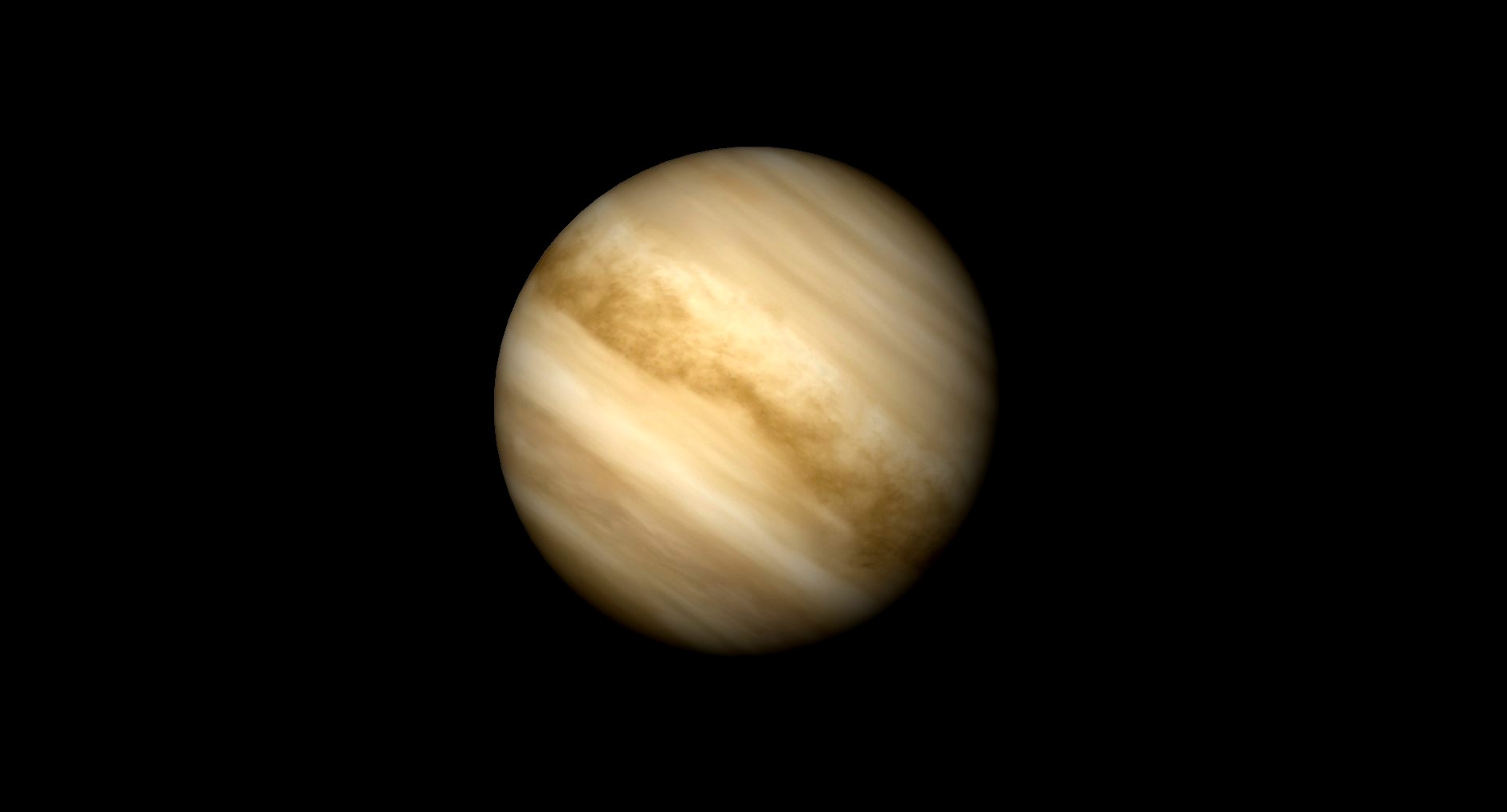
A striped brown sphere against a black background

Venus as seen from Earth may look peaceful, but up close, it is a hellish world that may have destroyed its own moon. (Image credit: Starry Night)

But are there any circumstances under which a Venusian moon could have survived?

"Survival came down to two main things: Venus had to be spinning fast when the moon formed, with a day shorter than about 12 hours, and the moon couldn't be too massive, up to roughly the mass of our own moon," team leader Stephen R. Kane of the University of California, Riverside told Space.com. "In that narrow window, the moon migrates outward and stabilizes, much as Earth's did. Outside that range, the moon is unfortunately doomed to be consumed by Venus.

"So a surviving moon would have had to be modest in size, orbiting a rapidly spinning early Venus, which are conditions that don't match what we think early Venus was actually like."

We may never conclusively know if Venus has indeed destroyed its own moon, as Kane thinks that collecting direct evidence from astronomical observations will be very difficult.

"Finding direct observational evidence is pretty tough. A moon lost billions of years ago would leave little to no direct trace we can point a telescope at today, so we can't observe the event itself," Kane said. "However, there are indirect avenues. For example, if a moon was destroyed and its debris rained down on Venus, it could have left a chemical fingerprint in the planet's surface or atmosphere, and upcoming missions to Venus, including NASA's DAVINCI (Deep Atmosphere Venus Investigation of Noble gases, Chemistry, and Imaging) probe, will measure atmospheric composition in detail."

If missions such as DAVINCI could help us develop a better understanding of the Venusian interior, then this would also improve the models such as the one used in this research. That is because the outcomes of such models depend on properties of Venus's interior, which aren't currently well understood.

"There's a broader test beyond our solar system because our results predict that slowly rotating, Venus-like planets around other stars should generically lack large moons, so as astronomers begin searching for moons around exoplanets, that's a prediction that can eventually be checked against real data," Kane said.

A spherical silver spacecraft against a fiery orange background

An artist's depiction of the DAVINCI probe nearing the surface of Venus. (Image credit: NASA's Goddard Space Flight Center)

Kane and colleagues don't intend to rest on their laurels while further data from Venus or even Venus-like exoplanets are delivered. They have plenty to work on in the meantime.

"There are numerous implications of our work that I would like to explore further. These include the compositional and atmospheric effects of a Venusian moon consumption event that may be testable now," Kane concluded. I would also like to explore similar effects for Mercury and Mars, and conduct further studies on exoplanet cases where such moon collision scenarios may have occurred."

The team's research is available as a pre-peer-reviewed paper on the repository site arXiv.

The rise of ‘quantum gravity?’ Einstein’s theory seen in the quantum realm for 1st time

Scientists have spotted the first hints that Albert Einstein's formulation of gravity operates in the quantum realm.

The hints have to do with observations of a falling quantum object, and though this may not seem like a huge deal (literally, we are talking about atoms here), it could be an important step on the road to a theory of ... everything.

To start, we have to go back to the early years of the 20th century. Consider Einstein's iconic theory of gravity, general relativity, and the elusive realm of quantum mechanics. While the former describes the universe on scales of planets, stars and black holes, even demonstrating how galaxies and galaxy clusters formed, the latter describes the counterintuitive physics found on scales smaller than atoms. But there is a problem: these two important theories don't play well together.

There is no quantum theory of gravity. However, scientists think we're getting closer to one.

A team of researchers has performed an experiment to find the point where quantum mechanics and general relativity meet. Namely, how the quantum properties of atoms change as those atoms fall under the influence of gravity.

"This is a unique paper, in the sense that it combines a hard experiment with a far-reaching theoretical interpretation, about one of the most fundamental questions in physics: How can gravity, described by Einstein's theory of relativity, and quantum theory, be unified into one understanding of the universe?" team leader Ron Folman of the Ben-Gurion University of the Negev said in a statement. "These two pillars of modern physics have so far eluded all attempts at a unified theoretical framework, but this complex experiment gives more hints as to how such a unification may be achieved."

Elevators and equivalence

At the cornerstone of the team's experiment is an important element of general relativity called the equivalence principle.

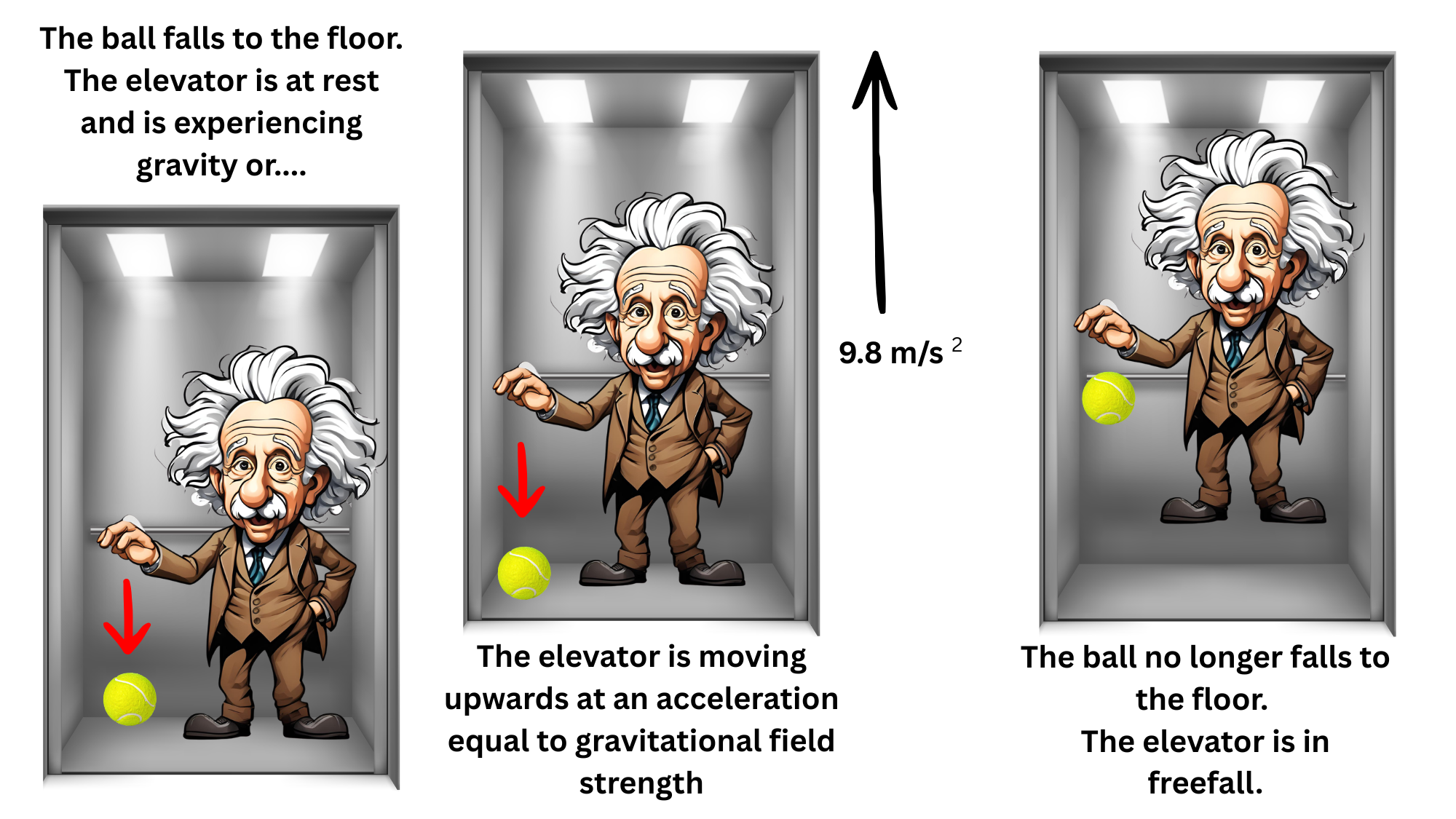
The equivalence principle states that, for an observer in free fall, gravity should disappear. If that sounds confusing, consider this popular analogy: You are inside a closed elevator with no view of your surroundings. You feel heavy. You might drop a ball, and it would fall to the floor of the elevator. Why would these things happen? Well, there are two options.

You might be sitting stationary on the ground floor, or the elevator could be moving upwards at an acceleration equal to the gravitational field strength of Earth, 9.8 meters per second squared. You can't tell the difference between gravity and acceleration. That's the equivalence principle.

Now, let's shake that up. Suddenly, you can't feel weight anymore. You drop the ball, and it floats. Gravity has disappeared, or the upward acceleration has ended. Inside the elevator, two things may have happened, and you can't distinguish between these two either. The elevator cable may have snapped, and you may now be in free fall, or the upward acceleration may have carried you to space and then ceased.

The ball falls to the floor. The elevator is at rest and is experiencing gravity or the elevator is moving upwards at an acceleration equal to gravitational field strength. The ball no longer falls to the floor. The elevator is in freefall.

A demonstration of the equivalence principle. (Image credit: Robert Lea (created with Canva))

The big question now is: How do you test this on a quantum scale, especially for particles that behave as waves as they travel?

Wave hello to quantum gravity?

To measure the equivalence principle at a quantum scale, the researchers turned to a piece of equipment called the Quantum Galileo Interferometer. This allowed them to split the quantum wave associated with a traveling atom into two paths. One was held in place while the other was allowed to fall freely.

The team then reunited the wave to observe the changes gravity had introduced to the falling wave.

For the experimental subjects, the team chose a cloud of rubidium atoms, which they cooled to just above absolute zero. These were placed close to the surface of a specially designed atom chip. Using microwave pulses, the scientists placed the atoms in what is known as a quantum superposition.

A superposition is one of those really weird things unique to quantum physics, effectively allowing a quantum system to simultaneously exist in two or more contradictory states. In this case, the superposition allowed each atom to travel along two different paths at the same time.

Magnetic fields generated by the atomic chip applied an upward push along one path, counteracting the downward pull of gravity and holding it stationary. The other path was subjected to magnetic pulses pushing the atoms upwards. The pulses were then shut off, allowing the atoms to fall freely under gravity like a ball thrown into the air.

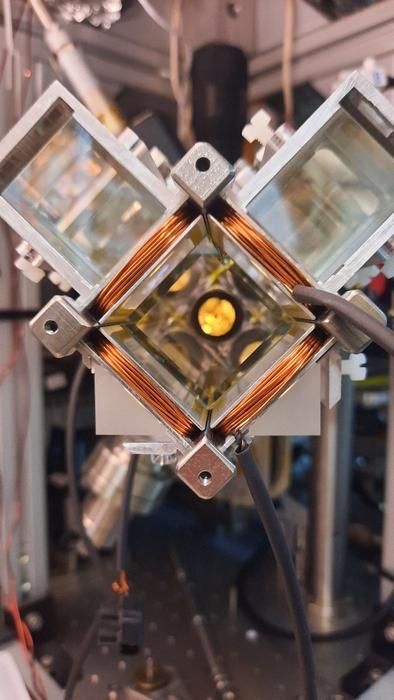
A metal structure with orange coils on it and a yellow circle at its center.

The 2D MOT apparatus which feeds the science chamber with cold atoms. At the center is a glass cell held under vacuum between coils producing magnetic fields. The atoms go into the science chamber through the tiny hole that may be seen in the center of the yellow (reflecting) surface. (Image credit: Or Dobkowski.)

When the waves were reunited, the team used an effect called interference, which occurs when the peaks and troughs of two misaligned waves meet, to measure changes in the free-falling wave.

This represented the first time that the effects of gravity and free fall on the phase of a quantum wave had been measured.

However, while this is an effective demonstration of Einstein's equivalence principle in the quantum realm, it isn't a demonstration of quantum gravity. Yet it remains a step along a frustratingly long road physicists have been traveling down for over a century with no end in sight.

"We have no consistent theory telling us why quantum physics should fail," team member Vlatko Vedral said in the statement. "This experiment pushes quantum mechanics into one of its most intriguing frontiers, gravity, and shows that, once again, its predictions hold."

The team's research was published on Wednesday (Sept. 2) in the journal Science Advances.

Scientists detect signals of hydrogen from billions of years ago. Could this help us map out the universe?

Astronomers have used the MeerKAT radio telescope to detect hydrogen gas billions of light-years away from us — from a period when the cosmos was billions of years younger than its current age of 13.8 billion years.

The research may provide astronomers with a new way of mapping the large-scale structure of the universe. The technique would rely on charting out where hydrogen, the universe's lightest and most abundant element, is located across the cosmos. It's known as hydrogen intensity mapping.

Neutral hydrogen emits a faint radio signal that astronomers call the 21-centimeter line. As the cosmos expands under the influence of dark energy, the wavelength of this radio signal is stretched, or "redshifted." The extremity of the redshift allows astronomers to determine how long a particular signal has been travelling to us and thus what period of the universe the hydrogen that emitted it existed in.

Using the 21-centimeter line, hydrogen intensity mapping allows astronomers to trace radio emissions from hitherto unseen galaxies and build a 3D picture of the largest structures in the universe. Up until this point, however, this technique has relied on combining radio wave detection with observations from galactic surveys operating with visible light, or electromagnetic radiation our eyes have evolved to see.

This new research defies that trend, building a hydrogen intensity map using radio waves detected by the MeerKAT radio telescope, made up of 64 antennas in the Meerkat National Park in the Northern Cape of South Africa.

"This is a very exciting milestone," team leader Sourabh Paul said in a statement. "Hydrogen intensity mapping has long been seen as a promising way to map the universe efficiently, but the signal is extremely faint and difficult to isolate from foreground emission, human-made radio-frequency interference, and instrumental effects.

"Detecting it directly with MeerKAT shows that this technique is becoming a practical tool for cosmology."

Mapping with MeerKAT

The team behind this research analyzed around 96 hours of MeerKAT observations, finding signals from hydrogen dating back 4 billion to 5 billion years. This hydrogen spans distances of many million light-years, similar to the distance between the Milky Way and our neighbor galaxy, Andromeda.

The achievement represents a step forward in the usefulness of hydrogen mapping.

"Neutral hydrogen is one of the key ingredients for understanding how galaxies form and evolve," team member Zhaoting Chen of the University of Edinburgh said in the statement. "With intensity mapping, we do not need to detect every individual galaxy. Instead, we can measure the collective signal from hydrogen across large cosmic volumes, giving us a new way to study both galaxy evolution and the underlying matter distribution of the universe."

Future cosmological surveys could greatly benefit from the advancement of hydrogen mapping. This will be a major factor when the Square Kilometre Array Observatory (SKAO), currently under construction in the Murchison region of Western Australia and the Karoo region of South Africa.

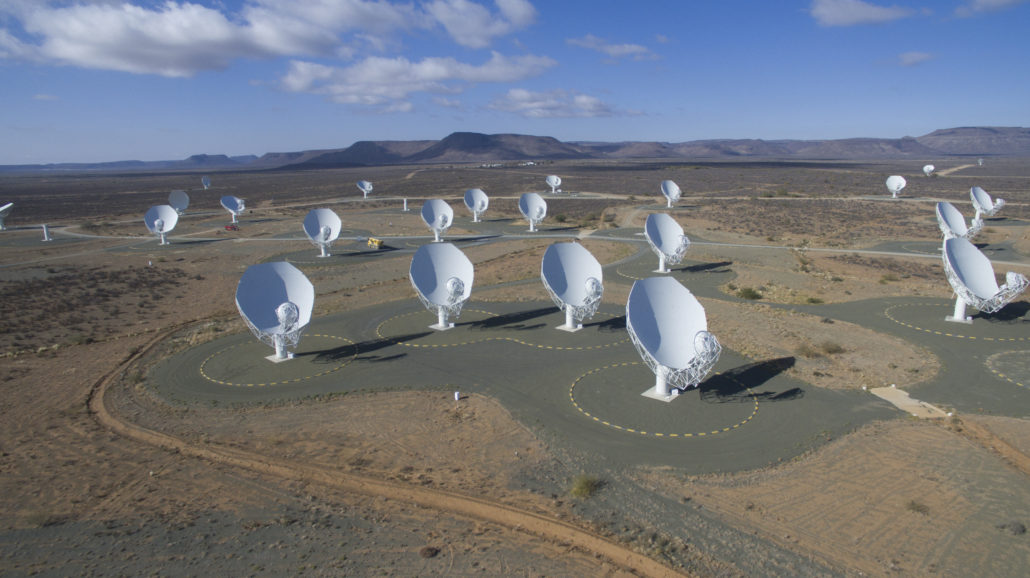
An overhead view of South Africa's MeerKAT radio-telescope array while it was under construction. The 64-dish network was inaugurated in July 2018.

An overhead view of South Africa's MeerKAT radio-telescope array. (Image credit: SKA South Africa)

"MeerKAT continues to open new windows for cosmology," team member Laura Wolz of the University of Manchester in the U.K. said in the statement. "The fact that this signal can be extracted from observations that were not originally designed for hydrogen intensity mapping is very encouraging. It shows the enormous scientific value of MeerKAT data and points the way to future observations with SKAO."

The team will now focus on collecting further observations with MeerKAT that cover larger areas of the sky over longer periods of time. This should provide astronomers with even more detailed hydrogen maps that could, in time, help understand how the largest structures in the cosmos took shape over the course of billions of years.

"This was a challenging data analysis process, requiring a detailed understanding of the many sources of contamination that can affect such a faint measurement," team member Mario G. Santos of the University of the Western Cape, Australia, said in the statement. "It is particularly remarkable that the data used in this study were taken in 2018, when MeerKAT had only just started science operations.

"There is now a rich trove of MeerKAT data waiting to be explored with this method."

The team's research was published in the July edition of The Astrophysical Journal Letters.

Stars forge and deliver the elements that make up your body — and scientists may finally know how

Scientists are closer than ever before to understanding how stars forge the elements that comprise our planet, bodies and pretty much everything else around us — and they're gaining a clearer picture of where star explosions fit into the story.

New research reported in two different papers looks at how stars forge elements as they explode and how these supernova explosions spread those elements — and other elements stars have forged during their lifetimes — throughout the cosmos.

Astronomers have been studying the bright supernova deaths of massive stars for centuries, but they still don't quite understand how these explosions proceed.

The first paper looked at one way to investigate supernovas. It uses a radioactive element produced by these explosions called titanium-44, which lingers long after supernovas fade. Researchers have now collected experimental evidence that determines how much titanium-44 is created in a supernova, finding that these cosmic explosions produce 35% more of this element than expected.

With this knowledge in hand, scientists can now develop robust computer models of supernovas and compare these models with astronomical observations. This could bring them much closer to understanding how these explosions progress.

"It's exciting to see just how far the field has come," Christopher Cousins, a postdoctoral researcher in the University of Surrey's Nuclear Physics Group, said in a statement. "A measurement like this would have been considered out of reach only a couple of decades ago, but it now gives us new insight into one of the biggest unanswered questions in astrophysics."

An illustration shows a

An illustration shows a "vampire" neutron star feeding on a close companion star. (Image credit: Robert Lea (created with Canva))

The second paper honed in on a particular brand of stellar explosion called a Type I supernova. These occur when a dense stellar remnant called a neutron star drags material from a companion stellar body. The intense gravitational influence of the neutron star — a stellar corpse that has one to two times the mass of the sun crammed into a body about 12 miles (20 kilometers) wide — means that, when this stolen stellar matter hits their surfaces, a thermonuclear explosion is triggered.

These blasts forge heavy elements and release incredible amounts of energy, some in the form of X-ray bursts.

The authors of this paper, hailing from the Facility for Rare Isotope Beams (FRIB) in Michigan, studied the nuclear reaction that triggers X-ray bursts in greater detail than has been possible before.

This revealed the long-debated role of the so-called nickel-copper cycle, the temporary trapping of nuclear material during supernovas. Scientists previously didn't know if material was trapped in the nickel-copper cycle during X-ray bursts.

This research reveals that this does happen, but only in small proportions. It gives scientists a clearer picture of how Type I supernovas proceed.

An illustration shows a supernova explosion bombarding Earth with neutrinos

An illustration shows a supernova explosion bombarding Earth. (Image credit: Super-Kamiokande Collaboration)

"Despite decades of research, we still don't fully understand the nuclear reactions that power some of the universe's most spectacular stellar explosions," said Gavin Lotay of the University of Surrey.

"These two studies give us a much clearer picture of how these explosions happen, allowing us to compare our models more closely with astronomical observations and bringing us closer to understanding how the chemical elements are created and spread throughout the universe," he added.

The two papers were published in the July edition of the journal Physical Review Letters.