‘We got it done!’ Spacewalking astronauts finish installing next-gen ISS solar arrays

Just as NASA is preparing to demonstrate "Max Power" on the ground, two astronauts on a spacewalk have provided the International Space Station (ISS) with the same.

Expedition 75 flight engineers Anil Menon of NASA and Joshua Kutryk of the Canadian Space Agency installed and deployed the eighth and final ISS Roll-Out Solar Array (iROSA) on Thursday (Nov. 5), augmenting the space station's legacy solar array wings to produce as much as 30% more electricity.

"We got it done!" said Menon at the end of the 6-hour-and-59-minute spacewalk. The EVA (extravehicular activity) began at 8:36 a.m. EST and ended at 3:35 p.m. EST (1336 to 2035 GMT).
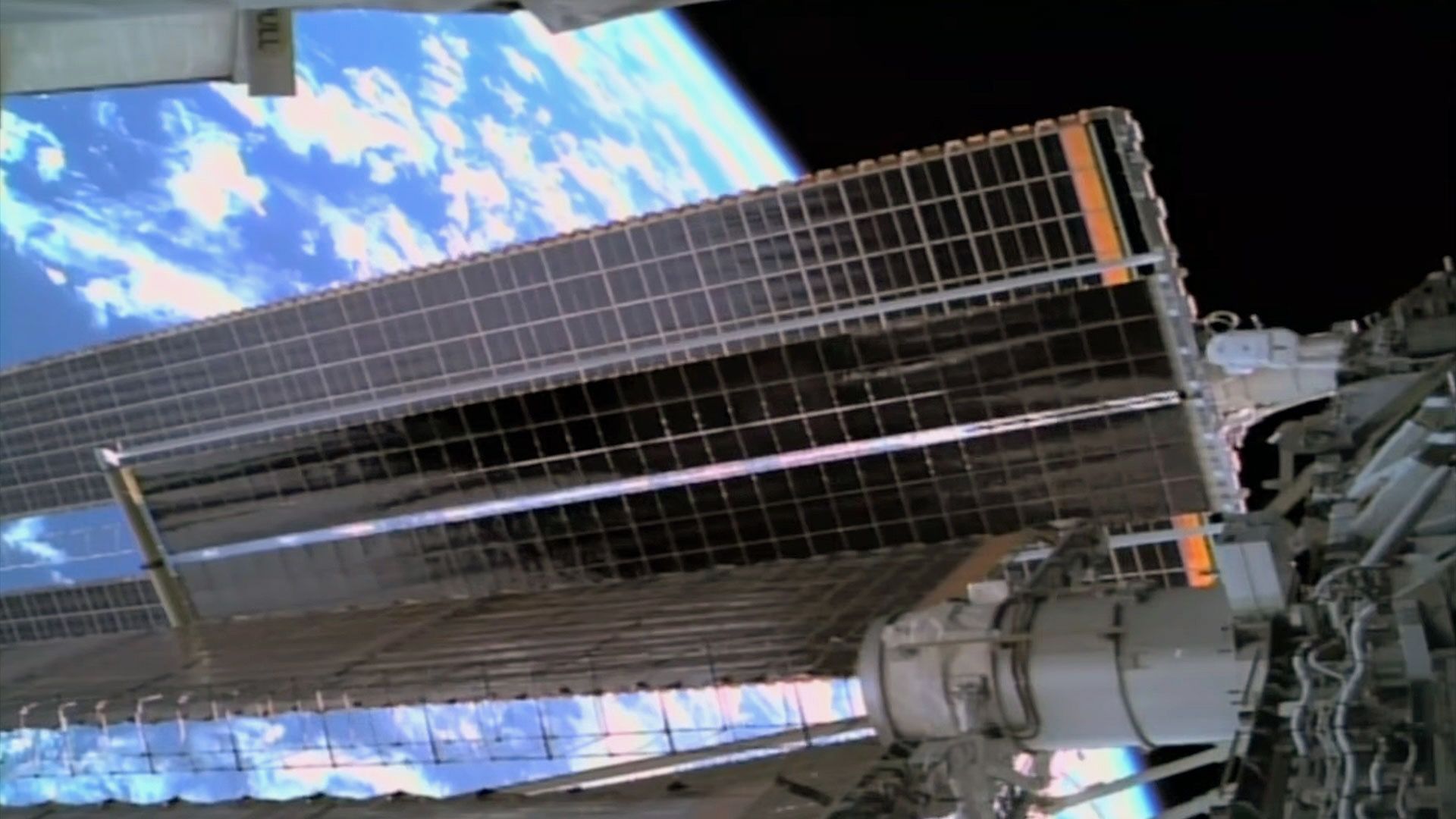
an astronaut in a white spacesuit works on a long, rectangular solar array during a spacewalk with earth visible in the background

NASA astronaut Anil Menon (at far right) is seen at the base of the newly-deployed eighth and final International Space Station Roll-Out Solar Array (iROSA) during a spacewalk on Nov. 5, 2026. (Image credit: NASA)

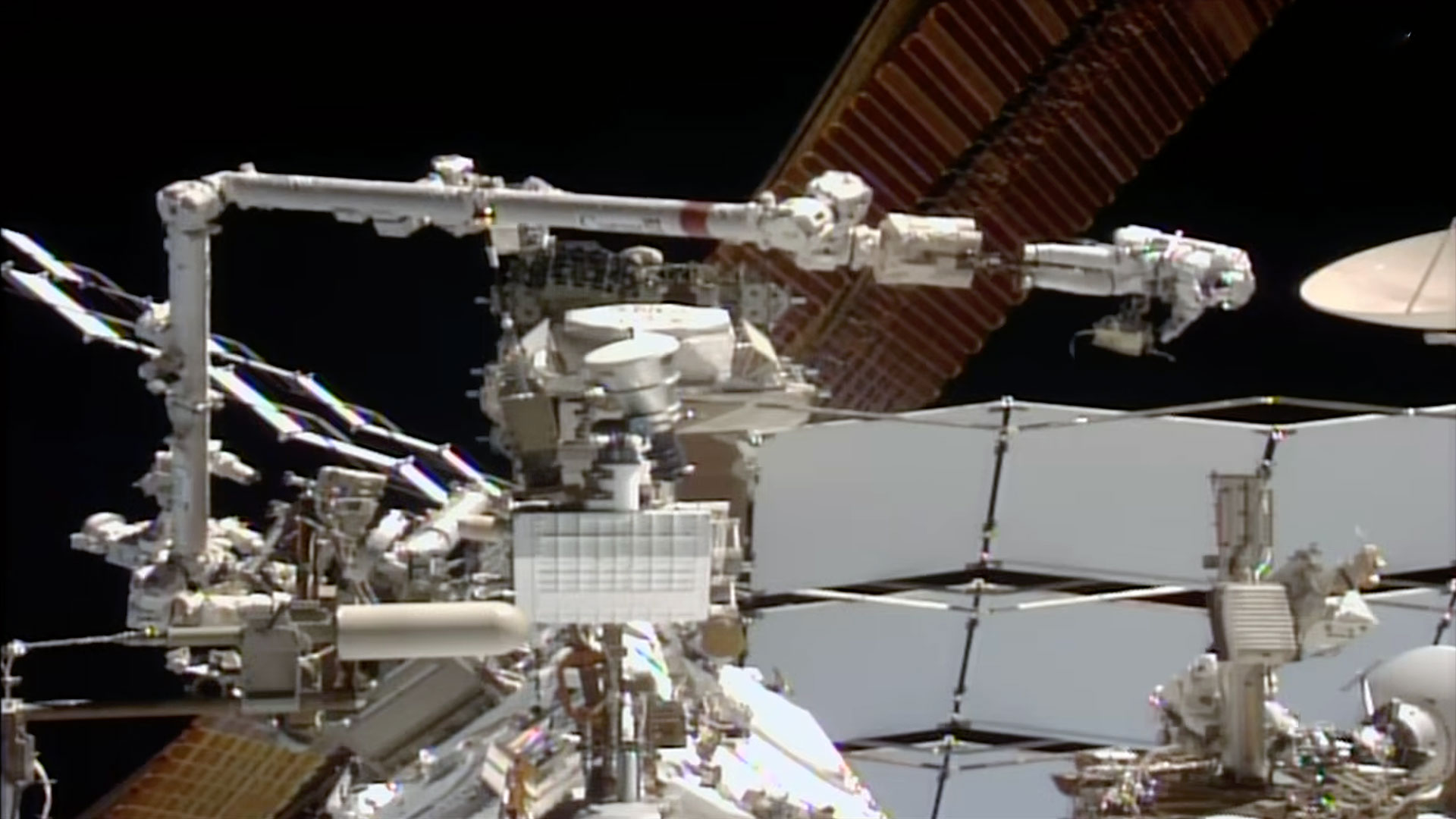
Repeating many of the same tasks as they did on an Oct. 29 spacewalk that added the penultimate iROSA, Menon and Kutryk worked this time on the starboard side of the station's backbone truss on the 3B power channel. The two retrieved the 750-pound (340 kilograms) iROSA assembly from a temporary stowage platform, carried it to the worksite by way of the Canadarm2 robotic arm and mounted it to its previously assembled bracket kit.

Menon then attached the cables to tie the iROSA into the station's systems but ran into a problem.

"We are seeing half of the expected shunt current that we want," radioed Nichole Stilwell, a NASA astronaut serving as the spacewalk officer in Mission Control. "In this current config, we are not necessarily going to deploy."

To address the issue, the connectors needed to be inspected. Out of safety concerns — given that the arrays generate electricity whenever lit by the sun — the astronauts needed to wait for the space station to enter the shadow of Earth to see what could be done. In the interim, they spent the time cleaning up their worksite and returning the Canadarm2 to its park site as they would have done after the deployment.

Fortunately, they were able to clear the issue.

"We are seeing good shunt currents on the ground, so we are go for deploy," said Stilwell.
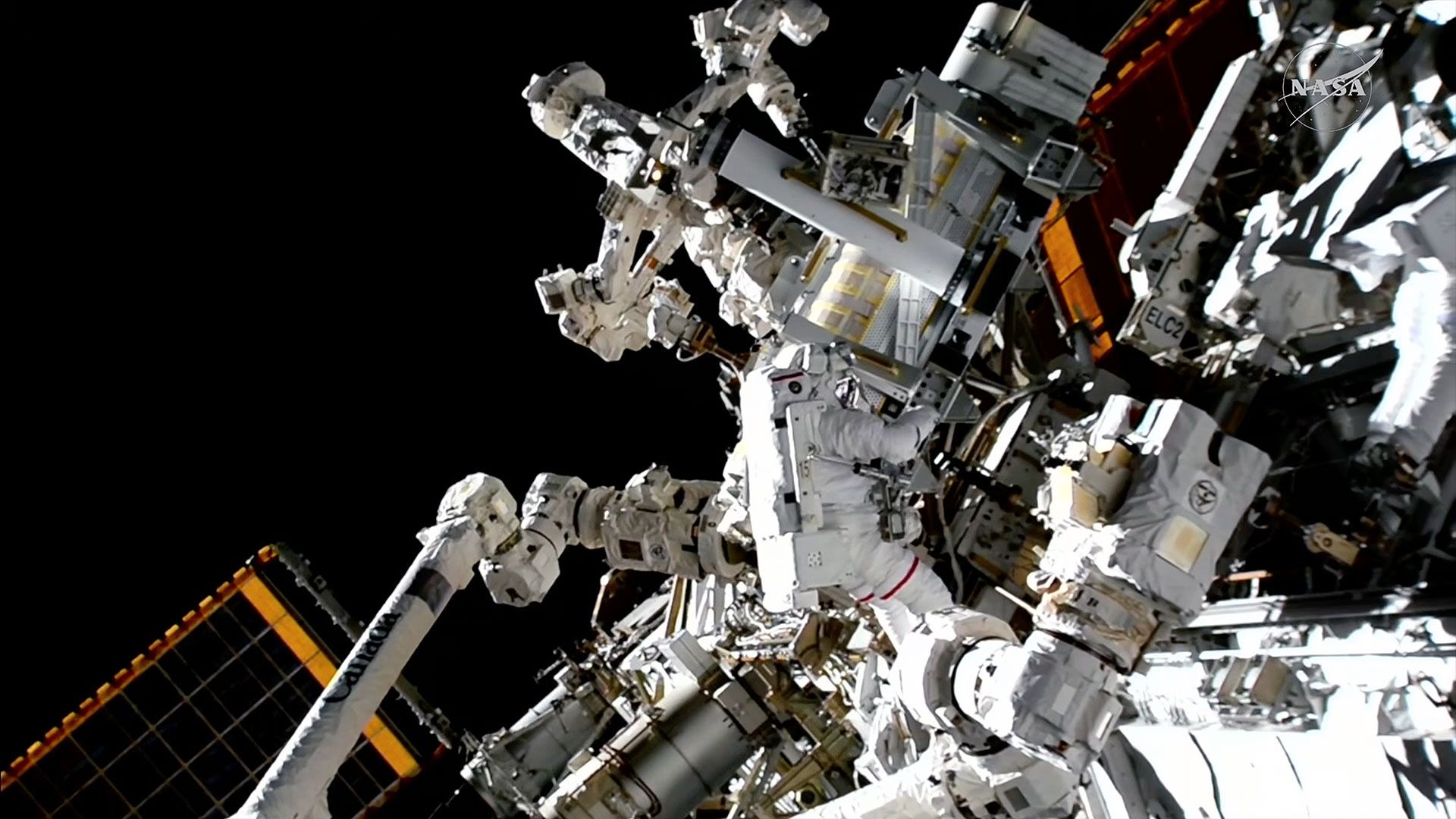
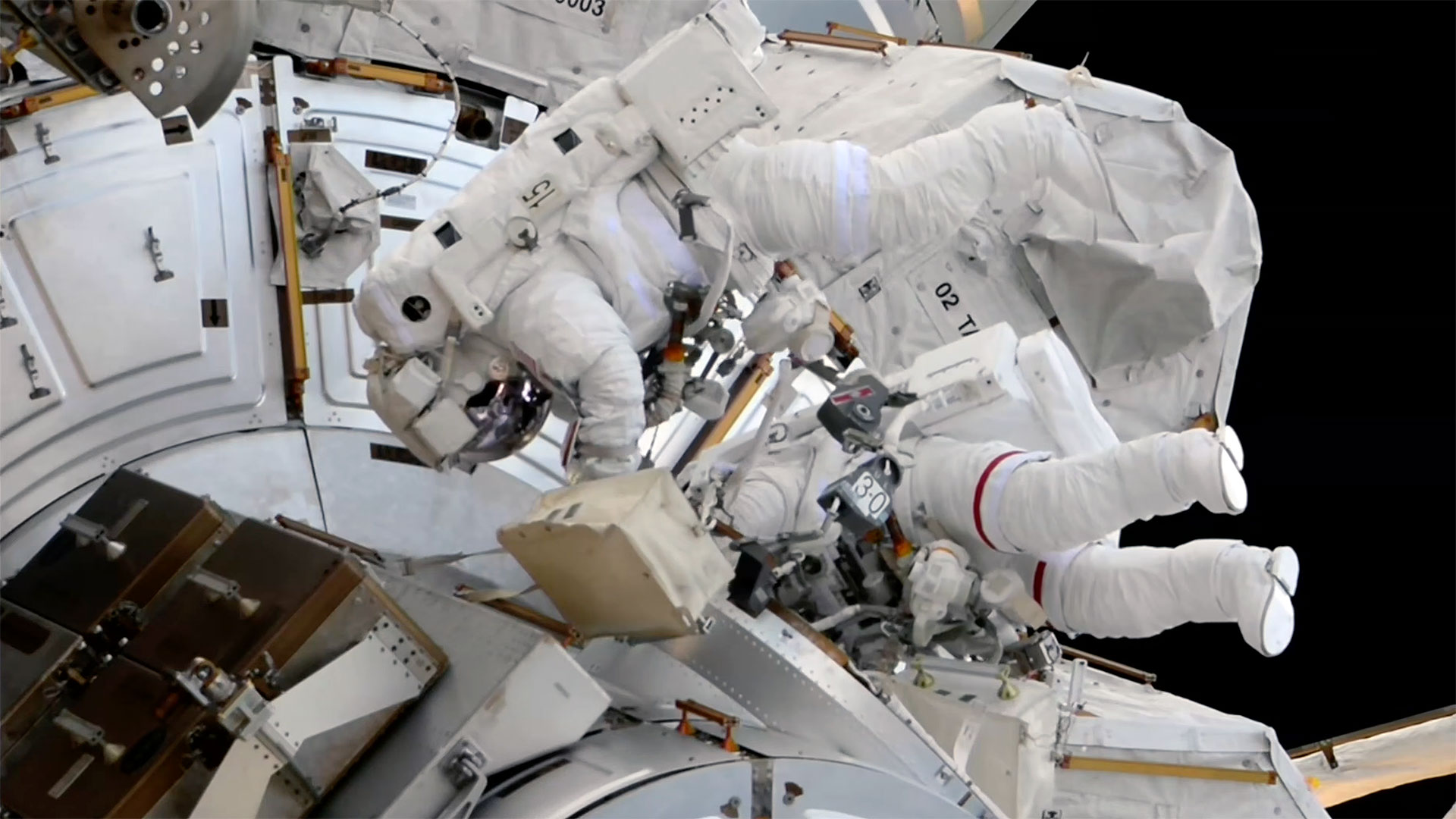
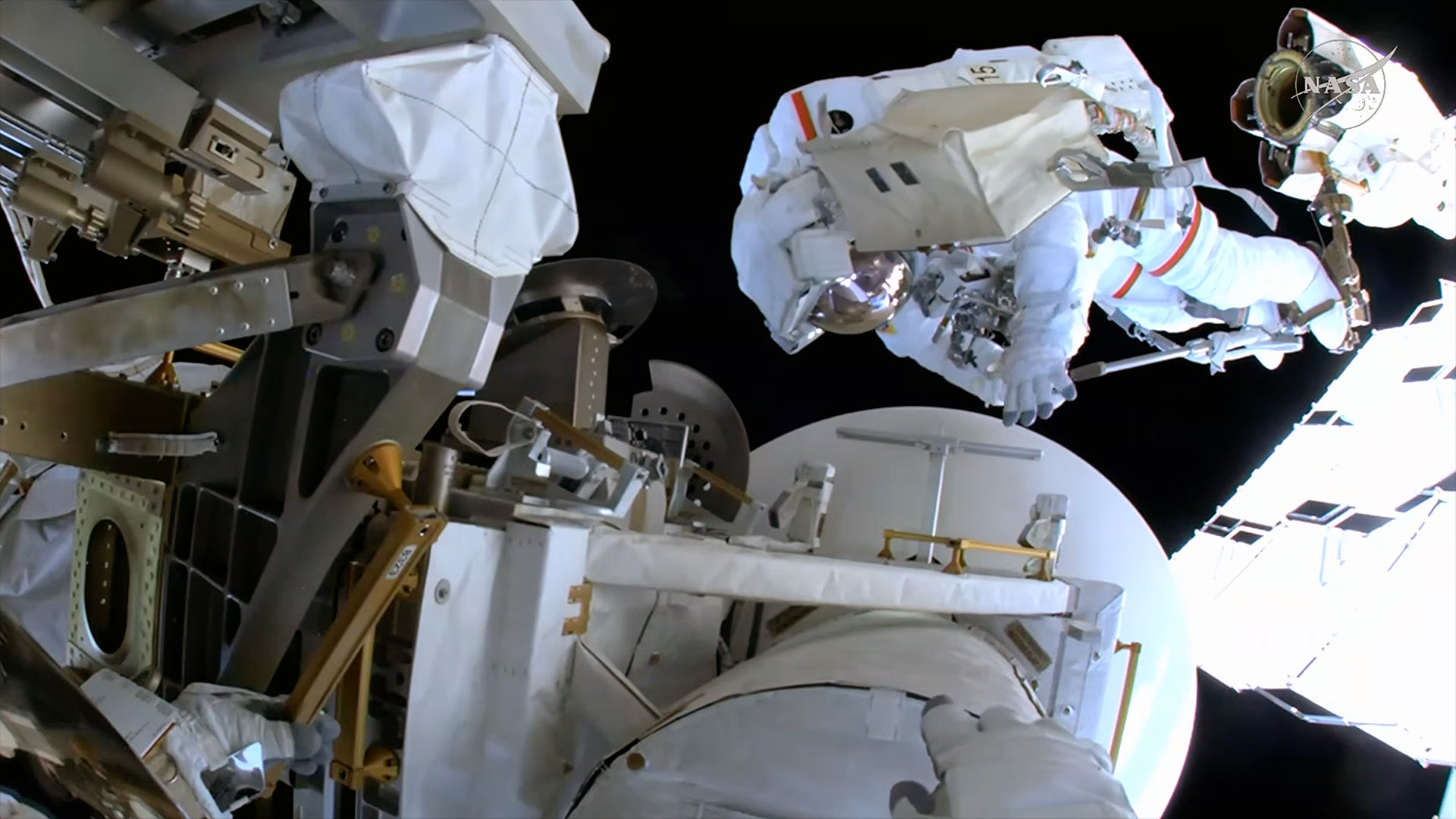
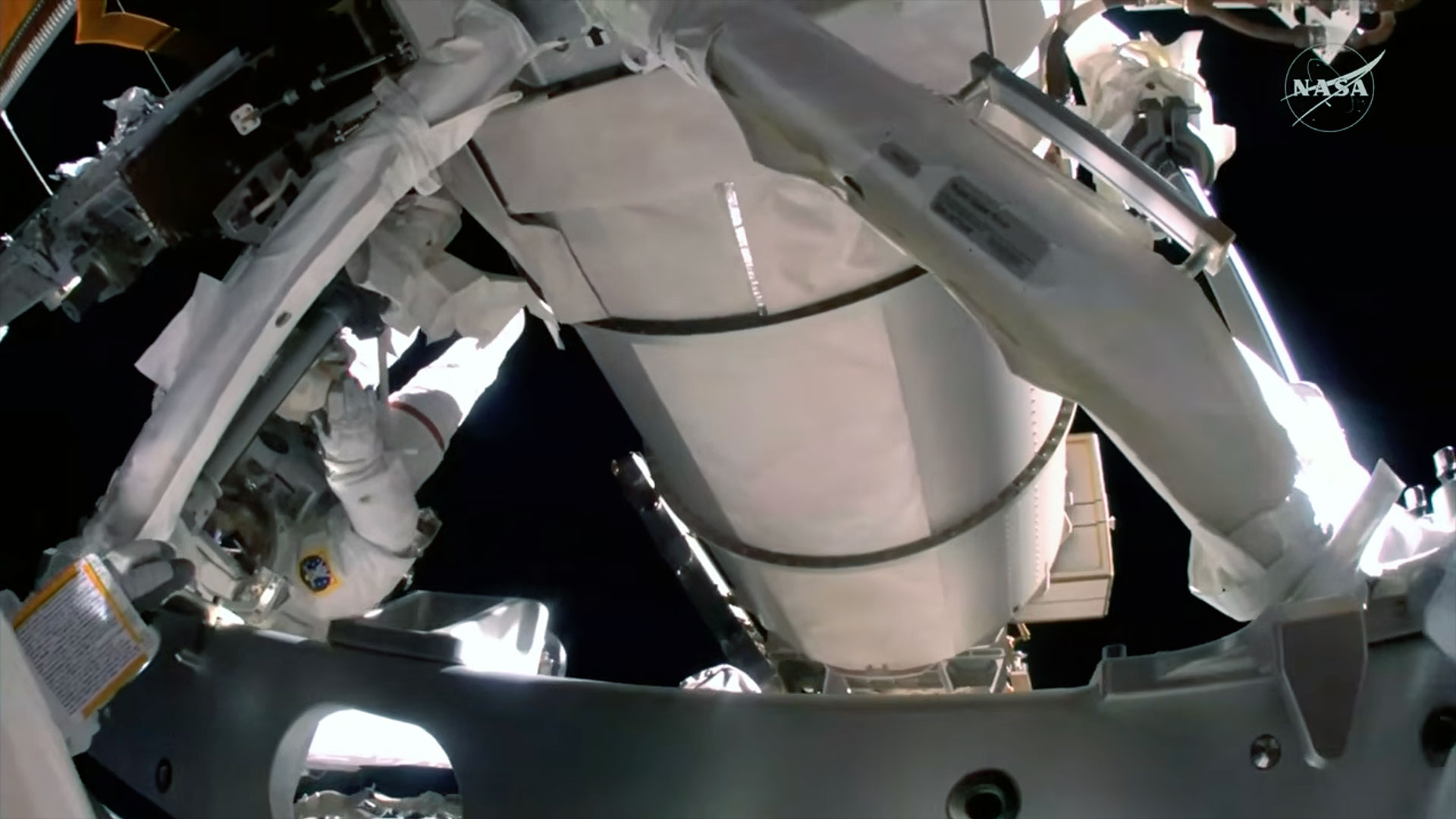
two astronauts in white spacesuits work outside a space station against the blackness of space

Canadian Space Agency astronaut Joshua Kutryk (at center) works on mounting the eighth and final International Space Station Roll-Out Solar Array (iROSA) during a spacewalk on Nov. 5, 2026. (Image credit: NASA)

After releasing two bolts, Kutryk and Menon watched as the array started to unfurl to its full 63-foot (19 meters) length. No motor was needed; the iROSA, as designed, used only the potential energy stored by its rolled-up carbon composite booms to extend itself. The entire process took about 10 minutes.

"Today marks the completion of not just one solar array but, over 15 years after its development, eight arrays," said Menon at the close of the spacewalk. "These solar arrays are incredible. Half the size of the old ones and bringing 40% more power."
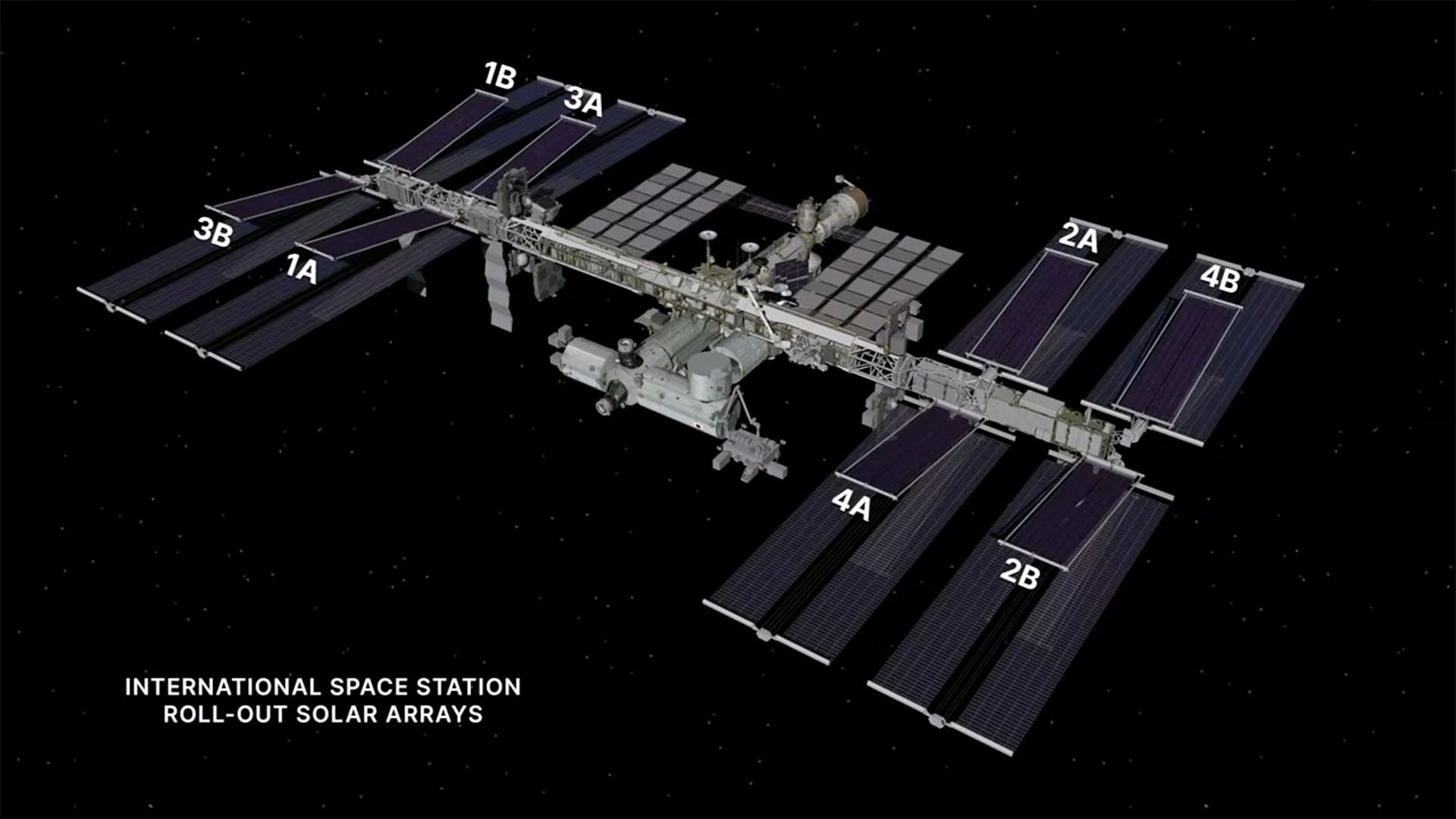
graphic showing a space station, seen from above, highlighting its eight long, rectangular solar arrays

NASA graphic showing the location and power channel for all eight now-deployed International Space Station Roll-Out Solar Arrays (iROSAs). (Image credit: NASA)

Each of the eight iROSAs and their mounting assemblies were delivered to the space station by SpaceX Dragon cargo spacecraft. Beginning in June 2021, four teams of two astronauts did as was done on Thursday to deploy each array. In addition to Kutryk and Menon's work on the 2A and 3B power channels, the spacewalkers included Shane Kimbrough of NASA and Thomas Pesquet of the European Space Agency for the 2B and 4B channels; Josh Cassada and Frank Rubio, both with NASA, on 3A and 4A in December 2022; and NASA's Steve Bowen and Woody Hoburg on 1A and 1B in June 2023.

The need for the iROSA augmentations was discovered by flight controllers when the space station's eight original arrays began to show degraded power output as they exceeded their 15-year design life. The iROSAs provide the additional electricity needed to support ISS operations through its retirement and controlled deorbit, which are currently scheduled to occur in late 2030.

"Congratulations to you all on your stellar work to finish the last of the roll-out solar arrays and the upgrades to the ISS power system that will take it to the end of its journey," said Stilwell, addressing Menon and Kutryk. "It is fitting that we just surpassed 26 years of constant human presence on the International Space Station, and you all showed us what the best of humanity looks like executing one of the most difficult and dangerous [things] humans do and making it look easy. Congratulations!"

Menon has now logged 33 hours and 30 minutes on four spacewalks, while Kutryk has tailed 14 hours and 10 minutes on two EVAs. Thursday's spacewalk was the 101st U.S. EVA at the International Space Station without a space shuttle being present and the 286th overall in support of ISS assembly, maintenance and upgrades. It was the ninth spacewalk of 2026 and the sixth conducted by the station's 75th resident crew.
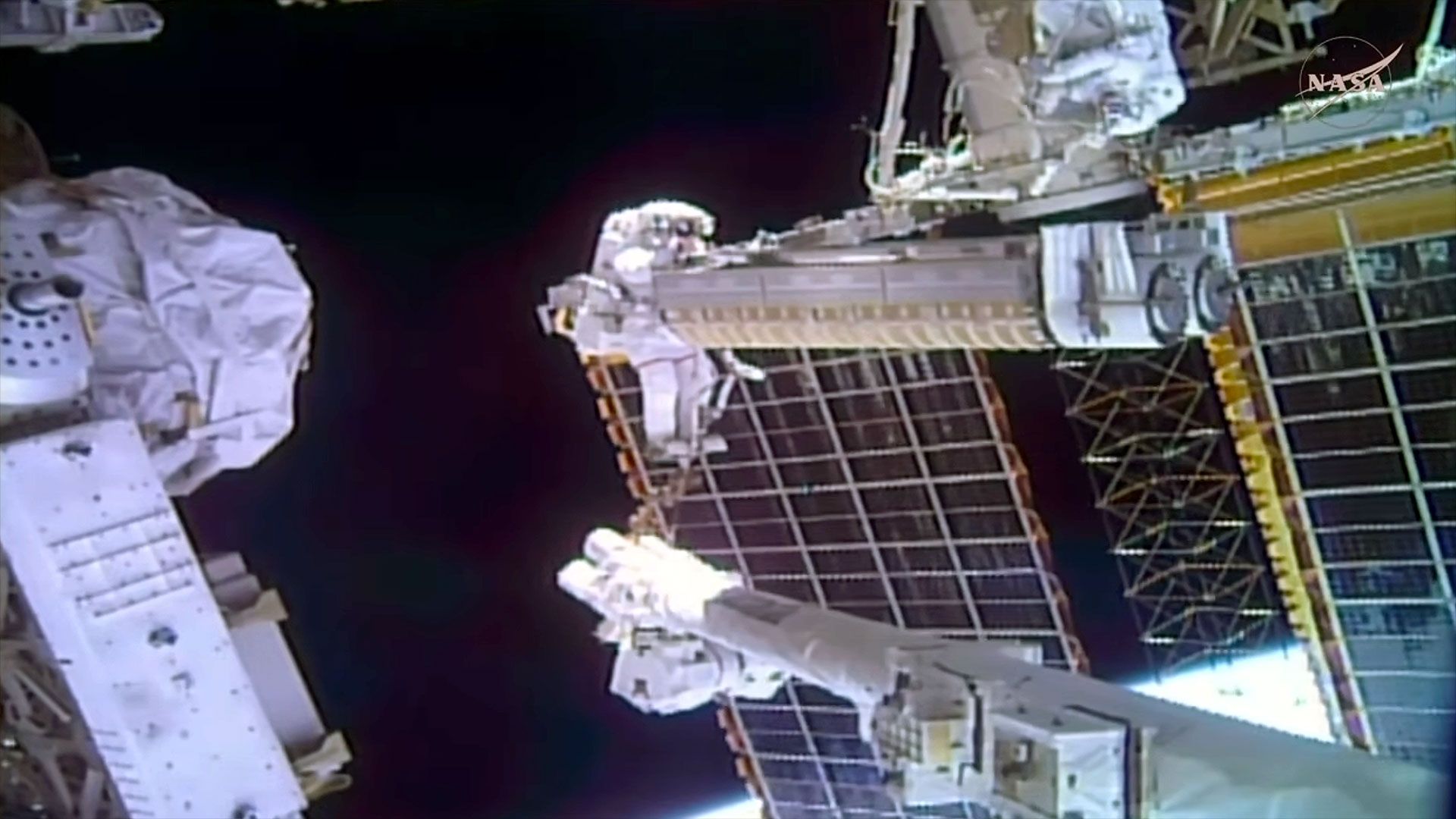
Astronauts deploy solar array on 100th US spacewalk by International Space Station crew members

Two astronauts successfully installed and deployed the second-to-last upgraded solar array for the International Space Station (ISS) during the 100th U.S. spacewalk from the orbiting outpost.

Anil Menon of NASA and Joshua Kutryk of the Canadian Space Agency (CSA), both ISS Expedition 75 crewmates, completed the 7-hour-and-11-minute extravehicular activity (EVA) at 3:08 p.m. EDT (1908 GMT) on Thursday (Oct. 29). The spacewalk began and ended inside the U.S. Quest airlock, with both astronauts wearing NASA's extravehicular mobility unit (EMU) spacesuits.

It was the first spacewalk by a Canadian astronaut since April 2019, when David Saint-Jacques ventured into the void with NASA's Anne McClain.

a spacesuited astronaut is seen holding a large piece of cargo while riding at the end of a robotic arm outside of a space station

NASA astronaut Anil Menon carries a rolled-up solar array to the site where it will be deployed while riding on the end of the Canadarm robotic arm during a spacewalk outside the International Space Station on Thursday, Oct. 29, 2026. (Image credit: NASA)

Once outside, Menon and Kutryk worked on unbolting the ISS roll-out solar array (iROSA) from a temporary stowage platform. The 10-by-2-by-4-foot (3-by-0.6-by-1.2-meter) rolled-up assembly was delivered to the space station inside the unpressurized trunk of SpaceX's Dragon cargo capsule earlier this month, on the company's 35th ISS resupply mission for NASA.

Menon then secured himself at the end of the Canadarm2 robotic arm and carried the 750-pound (340-kilogram) iROSA to the space station's port side, where he and Kutryk next installed it on the 2A electrical power channel. Kutryk made his way to the worksite along the station's backbone truss.

Using bolts to mount the IROSA in place and connecting its electrical cables to tie it into the station's power system (during a night pass, out of safety concerns), the array was ready to be extended. No motor was needed to deploy the iROSA to its 63-foot (19-m) length. The potential energy held by the assembly's rolled-up carbon composite booms was enough to fully unroll the panel.

"And we see the iROSA deploying now," reported Mission Control four hours and 23 minutes into the spacewalk.

About 12 minutes later, the array had fully extended, draping over about half of the larger but less capable legacy panel on the P4 truss. The station's eight original arrays are showing degraded power output as they have exceeded their 15-year design life. The iROSAs, when used in tandem with their older counterparts, have increased the station's power supply by 20% to 30%.

The additional power is needed to support ongoing and planned station operations, including its safe and controlled deorbit, which is currently scheduled for 2030.

Having worked ahead of their schedule, Menon and Kutryk removed some of the beams holding the final iROSA in place on its temporary platform and rotated two launch locks that were used in its delivery on Dragon.

Thursday's EVA was the 100th U.S. outing from the space station without a now-retired space shuttle docked to the complex. Overall, it was the 285th spacewalk in support of ISS assembly, maintenance and upgrades, including 66 EVAs out of the Russian segment of the station and 119 by visiting shuttle crews.

a rolled-up solar array is seen unfurling outside of a space station

The seventh and penultimate International Space Station (ISS) roll-out solar array (IROSA) is seen unfurling after its installation by two spacewalkers on Thursday, Oct. 29, 2026. (Image credit: NASA)

The first U.S. spacewalk outside of the Quest airlock was made by Expedition 4 crewmates Carl Walz and Daniel Bursch on Feb. 20, 2002. The 5-hour-and-47-minute EVA mostly tested Quest's systems and completed "housekeeping chores."

"Being outside, I can say it is always sunny in space," said Menon at the conclusion of Thursday's EVA. "I find it incredible what we have been able to do to provide new solar arrays to the space station. In fact, we have been ... doing complex operations like this for over 26 years."

"This is USOS [United States Operating Segment] EVA 100, which is an incredible milestone. I think it really signifies how much we have done," he said.

This was Menon's fourth spacewalk and Kutryk's first. Menon has now logged 26 hours and 31 minutes working in the vacuum of space during his current stay on the space station.

Kutryk is the fifth Canadian astronaut to conduct an EVA. He and Menon are scheduled for another EVA on Nov. 5, when they are expected to install the eighth and final iROSA, completing the five-year process to upgrade the station's power supply.

‘Mission: 60s’ event promises passport back to the Space Age

Your invitation to revisit the Space Age has arrived.

Whether you miss the days when people got dressed up to fly or you wish your "other" ride was a rocket, Mission: 60s has a *space* reserved for you.

"This is a three-day celebration of Apollo, aviation, space exploration and 1960s culture," reads a promo for the Oct. 23 to 25 event in New York. "You will be fully immersed in the sights, sounds and spirit of the 1960s Space Age."

"The weekend features astronauts, Apollo flight directors, Mission Control engineers, Star Trek legends, space artists, a Saturday Spacefarer Soiree with live music (1960s attire encouraged!), and a Sunday NASA Artemis keynote."

Organized by Luna Replicas, a company specializing in vintage space gear, and Space for Humanity, a nonprofit that underwrites spaceflight experiences, Mission: 60s is aimed at being the bridge between the last time humanity reached for the moon and today's "second space race" to do it again — this time to stay.

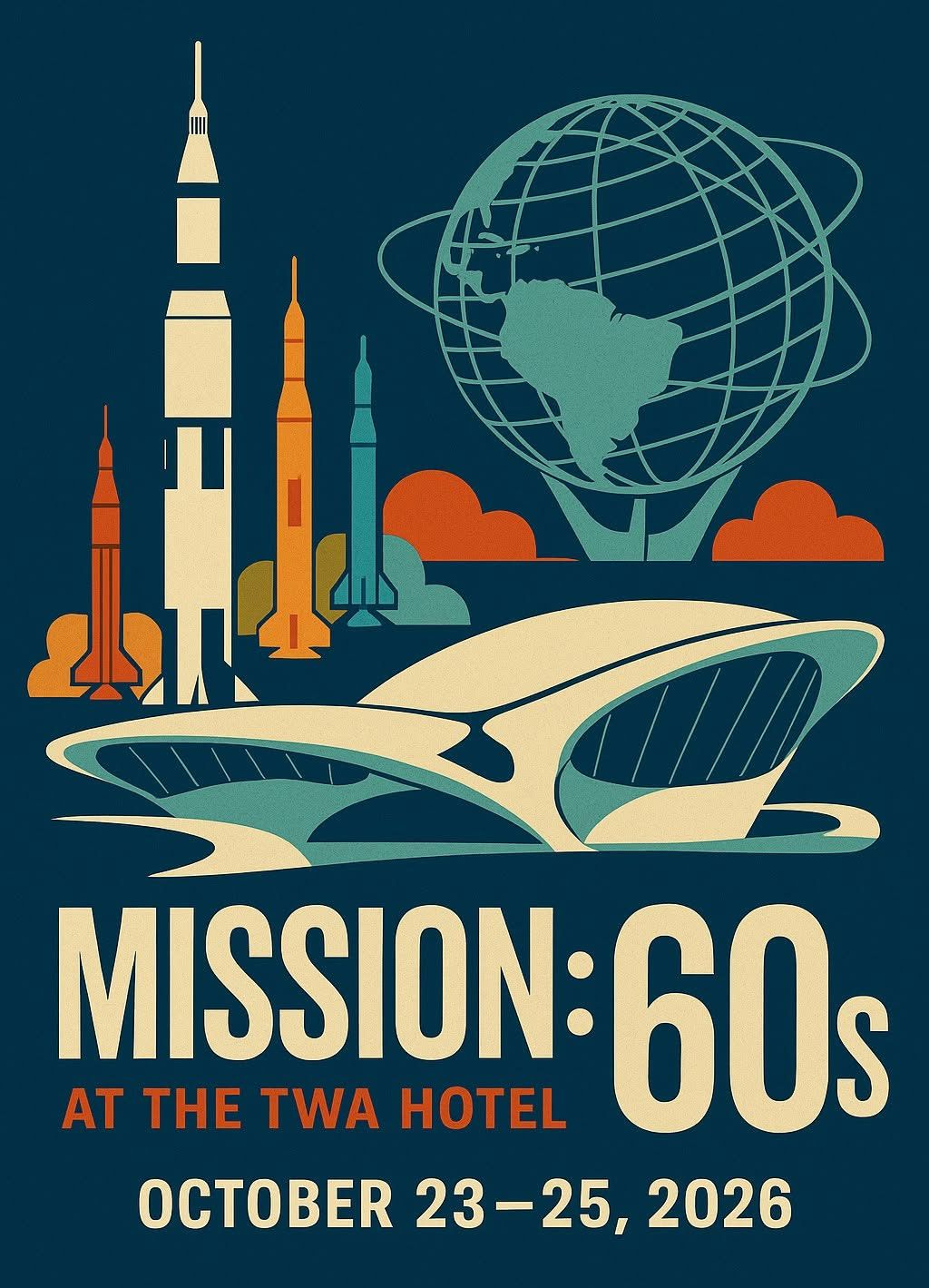
an event poster depicting rockets, a large Earth globe and an airport terminal

Mission: 60s at the TWA Hotel, Oct. 23-25, 2026, includes a tour of the 1964 World's Fair site and its NASA Apollo-era rocket displays. (Image credit: Mission 60s)

Launch pad

Your journey back to the 60s begins when you check into the TWA Hotel at the John F. Kennedy International Airport (JFK) in New York.

Once a functioning terminal for Trans World Airlines (as featured in the 2002 movie "Catch Me If You Can"), the TWA Flight Center has been reimagined as a hotel like no other.

"At the center of the hotel is Eero Saarinen's iconic TWA Flight Center, where restaurants, bars and retail outlets have taken flight. Two hotel wings, designed to reflect and defer to the landmark TWA Flight Center, sit behind the historic building and contain 512 guest rooms with views of JFK's runways and the TWA Flight Center," reads the hotel's website.

The TWA Hotel is only the first sight straight out of the past that guests will encounter. On Friday (Oct. 23), Mission: 60s begins with a guided tour of the 1964 World's Fair site in Flushing Meadows. Today the home to the New York Hall of Science, the outdoor exhibits includes the Rocket Park, where Gemini-Titan II and Mercury-Atlas D rockets and a Saturn V F-1 engine still stand.

"The space age was less than 10 years old when rockets like these powered incredible missions to outer space," reads the description on the museum's website. "Visitors will learn about the history of these vehicles as well as the United States' mission to reach the moon."

Also on view at the World's Fair site is the Unisphere, a spherical stainless steel representation of Earth, and the Astro-View Observation Towers (later reimagined as actual flying saucers in the 1997 movie "Men in Black").

The first day concludes with Space For Humanity's (separately-ticketed) "Celestial Soiree" and a Mission: 60's pool party on the hotel's rooftop.

MCC, ILC and ILM

Saturday and Sunday at Mission: 60s will bring together members of Mission Control (MCC), spaceflight experts (including ILC Dover, makers of the Apollo spacesuit) and representatives from the Hollywood community who brought about the 60s-era visions of space exploration (including Industrial Light & Magic [ILM]) for a series of engaging panel discussions.

Among the various topics scheduled for the two days of talks are:

  • Apollo Mission Control & Flight Operations
  • Apollo to Artemis & Beyond
  • Women in Aerospace
  • Apollo Communications: The Sights & Sounds From the Moon
  • SciFi Inspires
  • The Overview Effect
  • Making Space Real: Art & Visual Effects That Sold Humanity on Space
  • Space Advocacy

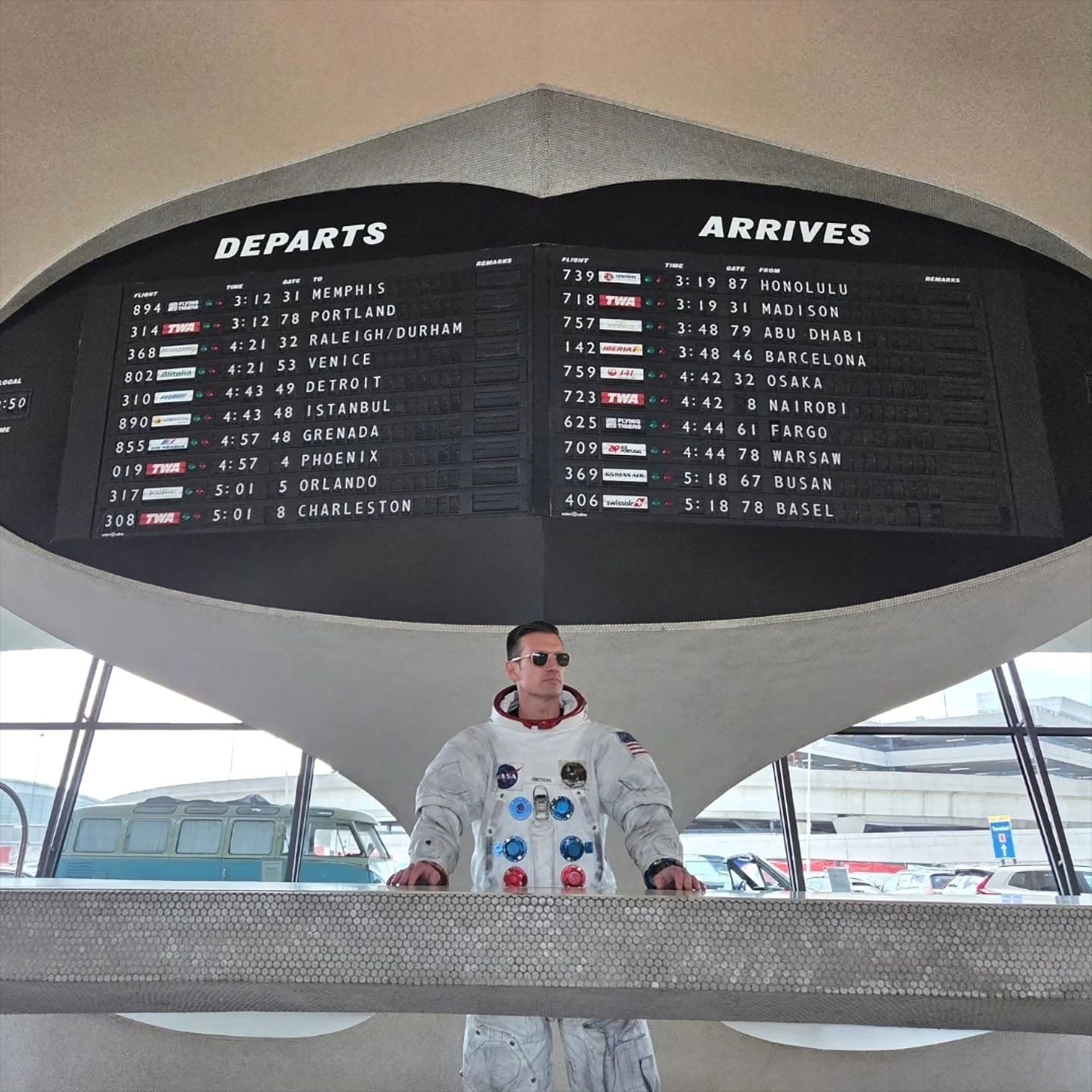
a man wearing a white spacesuit and sun glasses stands inside a retro airport terminal under a flight schedule board

Mission: 60s includes two full days of discussion panels spanning topics such as the Apollo spacesuit to the role of sci-fi in inspiring space exploration. (Image credit: Mission 60s)

Featured speakers and moderators include Apollo flight director Gerry Griffin, TIME Magazine science editor Jeffrey Kluger, former NASA astronauts Nicole Stott and Ron Garan, "Star Trek" actor Bob Picardo and researcher Frank White.

On Saturday evening, there will be a second gala, "The Spacefarer Soiree," featuring a limited meet and greet aboard a Lockheed Constellation airliner and music by Bonnie Gordon. Set in 1969, attendees are encouraged to come wearing their finest period clothing.

Then, on Sunday afternoon, Uplift Aerospace will host a shared "Overview" VR experience for up to 50 people participating together.

Both days will include a vendor and artists' hall, with guests signing autographs and their books, as well as companies such as NASA's official patch provider A-B Emblem, selling Apollo-themed souvenirs and memorabilia.

A weekend pass is $150 per person, with add-ons for VIP access, the galas and Friday's World Fair excursion. Single-day admission is $85.

Two astronauts replace ISS camera and docking aid on 6th-ever all-female spacewalk (video)

Two astronauts replaced a spacecraft docking aid and a video camera during a successful spacewalk outside of the International Space Station on Tuesday (Sept. 1).

NASA astronaut Jessica Meir and ESA (European Space Agency) astronaut Sophie Adenot got through most of the tasks set out for them even in light of Adenot's spacesuit developing a mobility issue late in the extravehicular activity (EVA), which lasted six hours and 49 minutes.

After beginning the spacewalk from the U.S. Quest airlock at 8:40 a.m. EDT (1240 GMT), Meir and Adenot set about the first and most important activity of the outing: replacing the planar deflector on the forward port of the station's Harmony Node 2. The retroreflector is used to support navigation during rendezvous and docking operations by visiting spacecraft. The older reflector that they replaced had become coated in thruster residue from earlier spacecraft arrivals and departures.

two astronauts in white spacesuits are seen outside a space station during a spacewalk

NASA astronaut Jessica Meir (at left) and ESA astronaut Sophie Adenot (in spacesuit with red stripes) are seen outside the Quest airlock during a spacewalk at the International Space Station on Tuesday, Sept. 1, 2026. (Image credit: NASA)

They also replaced the Camera Port 3 (CP3) high-definition (HD) camera on the station's truss.

"And it's off!" reported Meir after freeing the spent camera assembly that was swapped out for spare. Her words were met by applause in Mission Control at NASA's Johnson Space Center in Houston.

"That worked, great!" she said.

From there, Adenot headed off to continue an ongoing scientific study by swabbing areas on the exterior of the airlock and her gloves for possible microorganisms. Meir, meanwhile, rode one end of the Canadarm2 robotic arm to a site near the Alpha Magnetic Spectrometer (AMS), torquing 46 bolts in preparation for future maintenance of the particle physics detector.

Meir also relocated power and thermal jumper cables and an articulating portable foot restraint for use on a later spacewalk.

There were some other tasks planned, time permitting, but toward the end of the EVA, Adenot reported losing mobility in her left shoulder joint. Erring on the side of caution, Mission Control called for Adenot to wait where she was until Meir could follow her back to the airlock.

Once there, Meir was able to unzip a portion of Adenot's extravehicular mobility unit's (EMU's) upper arm assembly to inspect what was happening. In doing so, she freed the kink that had limited Adenot's motion.

"I think it was where the cable got caught in between the shoulder MLI [multi-layer insulation] and the rotation [joint]. I don't think it was held up by anything but some friction," said Meir.

The two Expedition 75 crewmates then proceeded back into the airlock to complete the EVA at 4:29 p.m (2029 GMT).

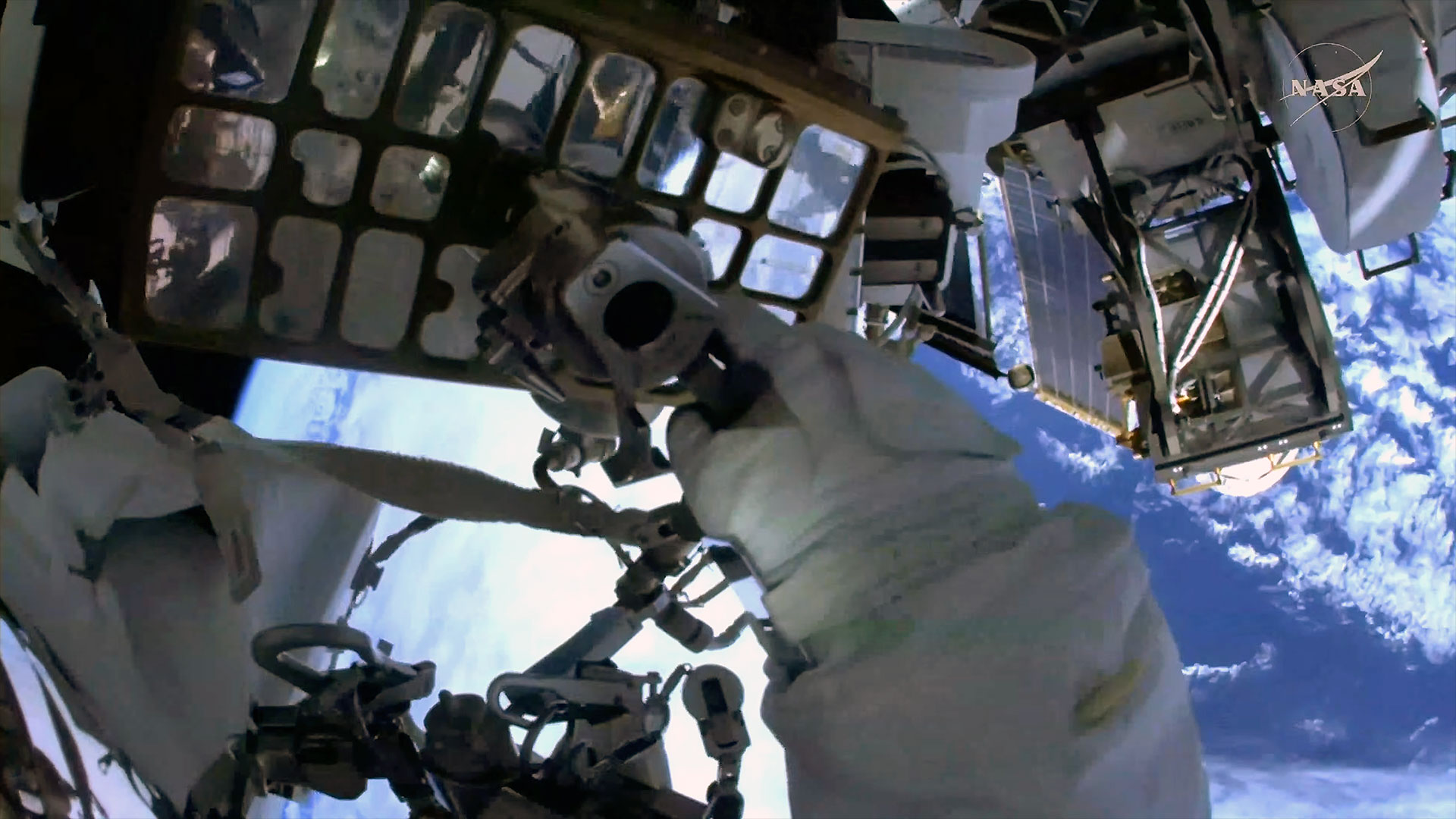
An astronaut's glove is seen from a helmet mounted camera during a spacewalk outside a space station in Earth orbit

In a view from her helmet-mounted camera, NASA astronaut Jessica Meir holds a spent HD video camera before installing its replacement outside of the International Space Station on Tuesday, Sept. 1, 2026. (Image credit: NASA)

Tuesday's spacewalk was Meir's seventh and Adenot's third. Meir, who has a total of 49 hours and 22 minutes on EVA, now ranks third among all women astronauts at NASA for total number of spacewalks. She trails only Peggy Whitson with 10 and Suni Williams at 9.

Adenot now has spent 19 hours and 42 minutes working in the vacuum of space.

This spacewalk was the 284th supporting the International Space Station's assembly, maintenance and upgrades. It was the seventh spacewalk this year, fifth EVA for Expedition 75 and the sixth all-female spacewalk in history.

‘You just saved the video dish’: Two astronauts complete spacewalk to replace ISS antenna

"Houston, we have a working comm link again."

Thanks to the efforts of two astronauts, such a call is possible again using one of two Space-to-Ground antennas outside the International Space Station (ISS). The pair finished the replacement of a faulty dish assembly during a spacewalk on Tuesday (Aug. 25).

Anil Menon of NASA and Sophie Adenot of the European Space Agency (ESA), who previously removed a faulty dish during a spacewalk on Aug. 18, installed a spare in its place and moved the broken assembly from a temporary to more permanent storage location along the station's backbone truss.

an astronaut in a white spacesuit with red stripes works alongside a large antenna dish outside of a space station

As seen from a camera mounted on ESA astronaut Sophie Adenot's helmet, fellow Expedition 75 crew member Anil Menon of NASA works to mount a replacement Space-to-Ground antenna during a spacewalk outside of the International Space Station on Tuesday, Aug. 25, 2026. (Image credit: NASA)

With Menon positioned at the end of the Canadarm2 robotic arm and Adenot traversing by handrails to join him, the two Expedition 75 crewmates first retrieved a spare Space-to-Ground Antenna (SGANT) from an external stowage position. Menon and the spare dish were then maneuvered to the Z-1 truss, where it was mounted and connected to the station's power and data systems.

Menon and Adenot then retrieved the faulty antenna, which they had stowed on the Z-1 truss during the prior spacewalk. Menon (on the arm) moved it to external stowage platform-3 (ESP-3) on the starboard side of the truss.

The replacement work became necessary after the SGANT ceased being able to track NASA's data and relay satellites, rendering it unusable, beginning last November. A second antenna has been in use since, continuing the transmission of voice and critical data, but this repair re-established redundancy to the system.

"On behalf of CAPCOM and I, we're going to count down like a bolt: '3, 2, 1… You just saved the video dish, you just saved the video dish,'" sang astronaut Anne McClain from Mission Control at NASA's Johnson Space Center in Houston, parodying the The Buggles' 1979 hit "Video Killed the Radio Star."

"Oh my god, it is hard to top that," replied Menon, who could be heard laughing along with Adenot. "I want to thank the entire team on executing this complex, time-critical operation successfully."

Tuesday's spacewalk began at 8:27 a.m. EDT (1227 GMT) and was completed exactly 6.5 hours later, at 2:57 p.m. EDT (1857 GMT).

The extravehicular activity (EVA) was the 283rd in support of ISS assembly, maintenance and upgrades. It was Menon's third EVA, increasing his total spacewalking time to 19 hours and 20 minutes. It was the second time that Adenot worked in the vacuum of space, raising her time on EVA to 12 hours and 53 minutes after becoming the first woman and fifth citizen of France to perform a spacewalk.

This was the sixth outing from the International Space Station this year, the third EVA for Expedition 75 and the 98th spacewalk using U.S. extravehicular mobility unit (EMU) spacesuits at the station.

NASA astronaut and 1st female French spacewalker remove failed ISS antenna but run out of time for replacement

Two astronauts — including the first French woman in history to perform a spacewalk — worked outside of the International Space Station (ISS) on Tuesday (Aug 18), becoming temporary TV repairpersons. Just like what frequently happens on Earth, the work required more time than the "appointment" allowed, requiring a second visit to be scheduled.

NASA astronaut Anil Menon and ESA (European Space Agency) astronaut Sophie Adenot were tasked with the removal and replacement of a Space-to-Ground antenna that since November had ceased being able to track NASA's data relay satellites, rendering it unusable. A second antenna has been in use since, continuing the transmission of critical data and enabling high-speed communications with Mission Control Houston.

Spacewalk planners had allocated about six and a half hours for the work to be completed. The two Expedition 75 crewmates were successful in removing the failed Space-to-Ground antenna from its mount on the station's truss but ran into delays disconnecting its electrical connections and and locking down gimbal bolts, or pins, to secure the large dish assembly during its transport to its temporary stowage location.

"We got into this with the mindset that we wanted everything to go perfectly," said Menon as the spacewalk came to an end. "Things were a lot different than expected, but what I would say that I am really impressed with is that all of those contingencies were well thought out."

As such, flight controllers had the astronauts tether the failed antenna to the truss and waived them off installing the replacement antenna, leaving it for a future extravehicular activity (EVA) still to be scheduled. Mission managers will decide whether to add that task to a spacewalk already planned for next Tuesday (Aug. 25) or to leave it for a later outing.

"We are looking at times," radioed Mission Control to the spacewalkers. "We are going to go directly to the long-duration tie-down of this SGANT on the Z-1 truss."

an astronaut wearing a white spacesuit appears to be sideways (in relation to the camera) as he is moved by a large robotic arm outside of a space station.

NASA astronaut Anil Menon is maneuvered outside of the International Space Station by the Candarm 2 robotic arm, Tuesday, Aug. 18, 2026. (Image credit: NASA)

Menon and Adenot began the spacewalk at 8:29 a.m. EDT (1229 GMT) when they switched their spacesuits to battery power. Their EVA ended once they were back inside the U.S. Quest airlock and re-pressurization began at 2:52 p.m. EDT (1852 GMT).

Their total time logged on this spacewalk was 6 hours and 23 minutes.

Tuesday's spacewalk was the 282nd in support of ISS assembly, maintenance and upgrades. It was Menon's second EVA since making his first outing with fellow NASA astronaut Jessica Meir on Aug. 6, increasing his total spacewalking time to 12 hours and 50 minutes.

It was the first time that Sophie Adenot ventured into the vacuum of space, making her the first female and fifth citizen of France to perform a spacewalk after Jean-Loup Chrétien, Jean-Pierre Haigneré, Philippe Perrin, and Thomas Pesquet.

"What a day!" said Adenot. "My deepest gratitude to everyone who made this possible — the pioneers who came before us, but also the incredible teams working behind the scenes today."

This was the fifth spacewalk conducted out of the International Space Station this year, the second for Expedition 75 and the 97th using U.S. extravehicular mobility unit (EMU) spacesuits at the space station.

‘One more step’: NASA astronauts conduct 6.5-hour spacewalk to prep ISS for solar array upgrade

Two NASA astronauts installed the seventh and final set of mounting hardware for new sets of solar arrays during a successful 6.5-hour spacewalk outside of the International Space Station.

Jessica Meir and Anil Menon on Thursday (Aug. 6), assembled the modification kit for one of the space station's eight power channels, which will allow for the future addition of a new ISS Rolll-Out Solar Array (iROSA). Since 2021, astronauts on prior spacewalks have deployed six of the iROSA assemblies, leaving now just two awaiting delivery to the station later this year.

Like building a giant erector set, Meir and Menon worked to assemble and bolt together the triangular brackets on the 3B power channel, located on the far right, or starboard (S6) segment of the station's backbone truss. Menon was positioned on an articulating portable foot restraint (APFR) atop a worksite interface (WIFEX), providing a stable angle to work from the truss.

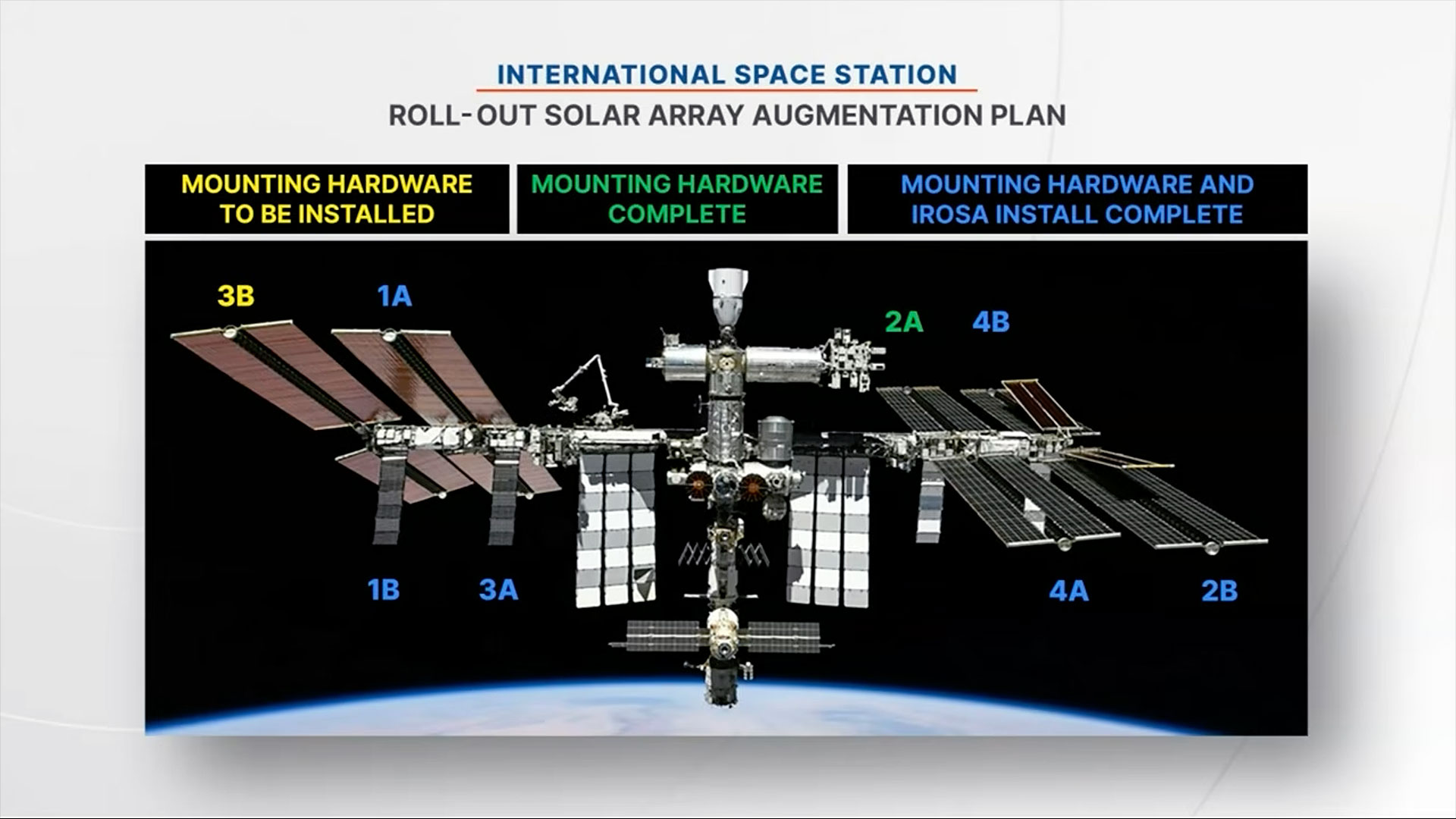
Diagram showing a space station and install locations for advanced solar arrays.

NASA graphic showing the augmentation plan for the ISS Roll-Out Solar Arrays (iROSAs), including where work has been completed and where work is still needed prior to a spacewalk that installed the mounting hardware on power channel 3B on Thursday, Aug. 6, 2026. (Image credit: NASA)

Once the modification kit structure was built and secured to the 3B mast canister, the two spacewalkers routed cabling that will carry the electricity from the future iROSA into the 3B power channel and then covered the struts with multi-layer insulation to protect them from micrometeoroid strikes.

The iROSA wings sit forward of the legacy solar arrays, augmenting their electricity generation rather than replacing it. The station's eight original arrays began showing degraded power output as they exceeded their 15-year design life. When used in tandem with the new iROSA wings, the upgraded system will increase the station's electricity supply by 20% to 30%.

The other power channel currently without an iROSA deployed is 2A on the left, or port side, of the station.

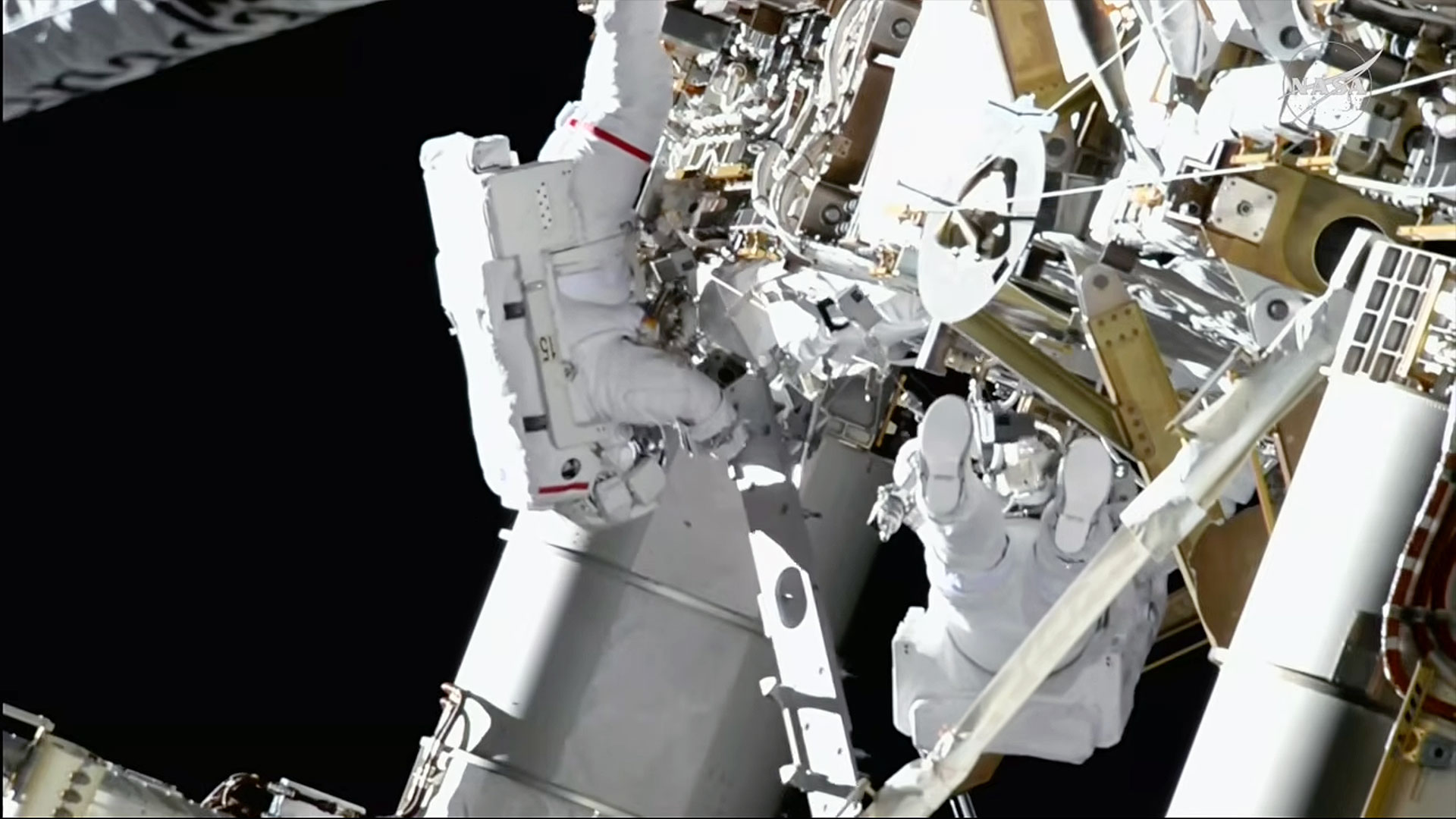
Two astronauts in bulky white spacesuits work outside a large space station, backdropped by the blackness of space.

NASA astronauts Jessica Meir (at left) and Anil Menon (with feet to camera) installed solar array mounting hardware during a spacewalk outside of the International Space Station on Thursday, Aug. 6, 2026. (Image credit: NASA)

"Anil, you can see the moon to the — well, I am not sure what way you're facing, but…," said Meir, taking a short break during the spacewalk to notice NASA's next destination for astronauts under its Artemis program.

"To my right. Yeah, I see it — thanks for the heads-up," said Menon. "I can see a future moon base there."

"I can see it, too!" Meir said.

Meir later turned her attention to Mars with her closing words of the day.

"On this day in 2012, NASA's robotic rover Curiosity successfully landed on the surface of Mars with the goal of understanding if the planet could have fostered life. Curiosity achieved that goal within a year," she said. "One day, humans will visit Curiosity, propelled by the groundbreaking science, technology demonstrations and operations conducted here on the International Space Station for almost 26 years now."

"Today, we made one more step toward expanding the ISS power system, further sustaining our human presence in low Earth orbit, as we prepare to take those next steps," said Meir.

A view from an astronaut's helmet-mounted camera shows the worksite for a spacewalk and a fellow spacesuited astronaut nearby.

A camera mounted on NASA astronaut Anil Menon's spacesuit helmet captured this view of NASA astronaut Jessica Meir (at left) and the worksite where they assembled and installed mounting hardware for a new solar array outside of the International Space Station on Thursday, Aug. 6, 2026. (Image credit: NASA)

Thursday's spacewalk began at 8:33 a.m. EDT (1233 GMT) when Meir and Menon switched their spacesuits to internal battery power. After collecting their tools and reentering the Quest airlock, the spacewalk, or extravehicular activity (EVA), concluded at 3:00 p.m. EDT (1900 GMT), 6 hours and 27 minutes after it began.

This was the 96th U.S. EVA and 281st spacewalk overall in support of the International Space Station's assembly, maintenance and enhancement. It was the first career spacewalk for Menon and the sixth for Meir, bringing her total time on EVA to 42 hours and 33 minutes.

This was the first spacewalk for the space station's Expedition 75 crew. There are two more U.S. outings scheduled for this month: EVA 97 will work to replace a space-to-ground antenna on Aug. 13, and EVA 98 will connect power channel cables and data relay systems as part of ongoing maintenance, including preparations for the station's future deorbit, as well as replace a navigational aid used for spacecraft docking on Aug. 25.

SpaceX’s Falcon 9 wasn’t the first rocket to crash into the moon. Here’s a rundown

A spent rocket body hitting the moon made headlines this week, but the reality is that the unplanned collision by a SpaceX upper stage was just the latest in a long history of human-made objects meeting their end by impacting the lunar surface.

Astronomers around the world kept their telescopes trained on the moon early Wednesday morning (Aug. 5), when the rocket stage from a January 2025 U.S. commercial lunar landing mission was calculated to strike the celestial body. Though the fate of the SpaceX Falcon 9 part was unintentional — solar activity and gravitational forces caused the stage to slam into the moon — the impact offered a rare opportunity to try to observe the flash from the impact and the plume of lunar material it sent flying.

By noon (EDT) on Wednesday, there were no confirmed reports of the impact being caught on film, but a telescope in Chile spotted the debris plume, according to the Associated Press.

"This rare occurrence has decades of history, going back to the Apollo era," wrote Jared Isaacman, NASA's administrator, in a post to his social media accounts. "The reality is that meteoroids strike the lunar surface hourly, with impacts comparable to this upper stage occurring roughly every six days."

Inventorying the impacts

The moon is peppered with the scattered metal remains of missions that missed their mark, came down too quickly or were purposefully sent careening into the regolith to learn more about the makeup of Earth's natural satellite.

In fact, the very first mission to successfully fly by the moon was intended to be an impactor. The former Soviet Union's Luna 1 probe was designed to hit the moon but instead zoomed past its target and entered orbit around the sun on Jan. 2, 1959.

Luna 2, launched nine months later, became humanity's first object to reach the lunar surface, purposefully slamming into Sinus Lunicus ("Bay of Lunik"), along the southeastern edge of Mare Imbrium, on Sept. 14, 1959.

The U.S. followed suit, though not as NASA intended, with the Ranger 4 probe impacting the far side of the moon on April 26, 1962. The mission had included an impactor, but both it and its lander failed to operate due to a failure to deploy the spacecraft's solar arrays.

Once humans began arriving on the moon with NASA's Apollo program, scientists found another reason to direct spent rocket and spacecraft stages into a collision course with the surface. Beginning with Apollo 11 in 1969 and concluding with Apollo 16 in 1972, seismometers were placed on the moon to measure natural "moonquakes" and the effects on the moon when the missions' Saturn SIV-B stages and Apollo lunar module descent stages made hard landings.

The data collected helped geologists learn more about the interior makeup of the moon, including that a rocky mantle exists under the outer crust.

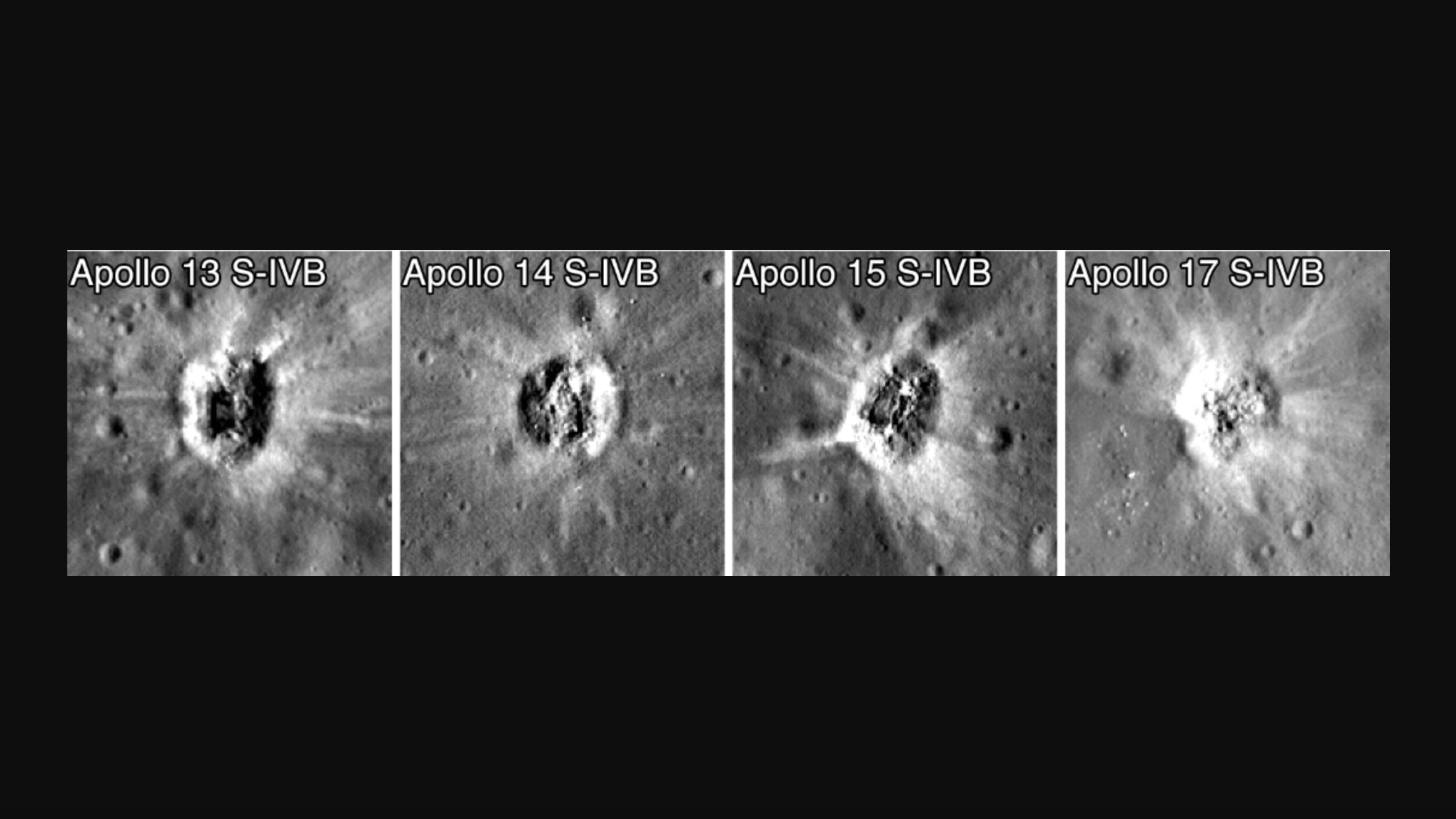
four side-by-side images of moon craters, seen from space by a lunar orbiter

These four images, captured by NASA's Lunar Reconnaissance Orbiter, show craters formed by impacts of Apollo SIV-B stages. Crater diameters range from 35 to 40 meters (38.2 to 43.7 yards) in the longest dimension. (Image credit: NASA/Goddard/Arizona State University)

After Apollo, planned impacts (and missions) slowed down, if not outright stopped, but the SpaceX collision on Wednesday was not the first in more than 50 years. Between 1993 and today, 11 probes — four from China, three from Japan, two from the U.S. and one each from India and the European Space Agency (ESA) — were intentionally deorbited at the end of the end of their missions around the moon.

Some of these impacts were performed to discard the craft, but others — like Lunar Prospector, LCROSS and Chandrayaan-1 — helped confirm the presence of water by examining the resulting plume.

Unintentional collisions are fewer in number, as are rocket stages, but are not unprecedented. A rocket body that hit the moon's far side in March 2022, leaving behind a small double crater, was later identified as a Long March 3C rocket that launched China's Chang'e 5-T1 mission around the moon in 2014.

Litter versus liability

Without a large human population on the moon, the risk that these planned and unplanned impacts present at current is minimal. But the concern rises as NASA and other world space agencies, as well as commercial interests, begin to increase the pace on establishing their now-planned sustainable facilities for astronauts to live and work on the lunar surface.

"The future lunar base will incorporate reusable spacecraft that not only deliver astronauts and payloads, but also become part of the infrastructure itself," Isaacman said in his post, referring to how reuse can be a way to reduce the number of vehicles needed to be discarded of on the moon.

The Artemis Accords, an internationally agreed-upon set of standards led by NASA and currently signed onto by 70 countries, also includes a provision for its members that spacecraft and their associated rocket components must be disposed of safely.

‘A very busy mission’: SpaceX on track to launch 4 astronauts to the ISS on Sept. 12

The next crew, spacecraft and rocket to fly to the International Space Station are on schedule to meet their mid-September launch date, mission managers and the astronauts told reporters on Monday (Aug. 3).

SpaceX's Crew-13 astronauts — commander Jessica Watkins and pilot Luke Delaney of NASA, mission specialist Josh Kutryk with the Canadian Space Agency and mission specialist Sergey Teteryatnikov of Russia's federal space corporation Roscosmos — will become only the second crew to fly aboard the Dragon spacecraft "Grace" when they lift off no earlier than Sept. 12 from Space Launch Complex-40 at Cape Canaveral Space Force Station in Florida.

They will then dock with the space station the following day to begin a seven-month stay on the orbiting outpost, as part of the Expedition 75/76 crew.

"We expect a very busy mission with lots of station maintenance, both internal and external, with a few EVAs [extravehicular activities, or spacewalks] on the docket," said Watkins, who is the only member of Crew-13 to have flown into space before and will become the first active NASA astronaut to fly on Dragon twice. "[We also expect] visiting vehicle capture and stowage operations, lots of science — very interesting science experiments that will be flying with us as well — and plenty of outreach."

Kutryk will be the fourth Canadian to serve on an ISS crew and the second from his country to fly this year, after Jeremy Hansen launched around the moon on the Artemis II crew in April.

"Personally, myself, I grew up on a cattle farm in Canada. It's a long way from being here with this mission in front of us, but the one thing that has resonated at every twist and turn in that journey has been the complexity of these missions and the enormity of the teams that go into pulling missions like this off," said Kutryk. "So, we need to say thank you to everyone."

Cybertrucks, spacesuits and mudflats

"Every time we do a human spaceflight mission, it gives us an opportunity to strengthen our understanding of low Earth orbit. It gives us an opportunity to broaden our international relationships and an opportunity to showcase to the world what we can do in low Earth orbit for human spaceflight," said Joel Montalbano, NASA's deputy associate administrator for human spaceflight.

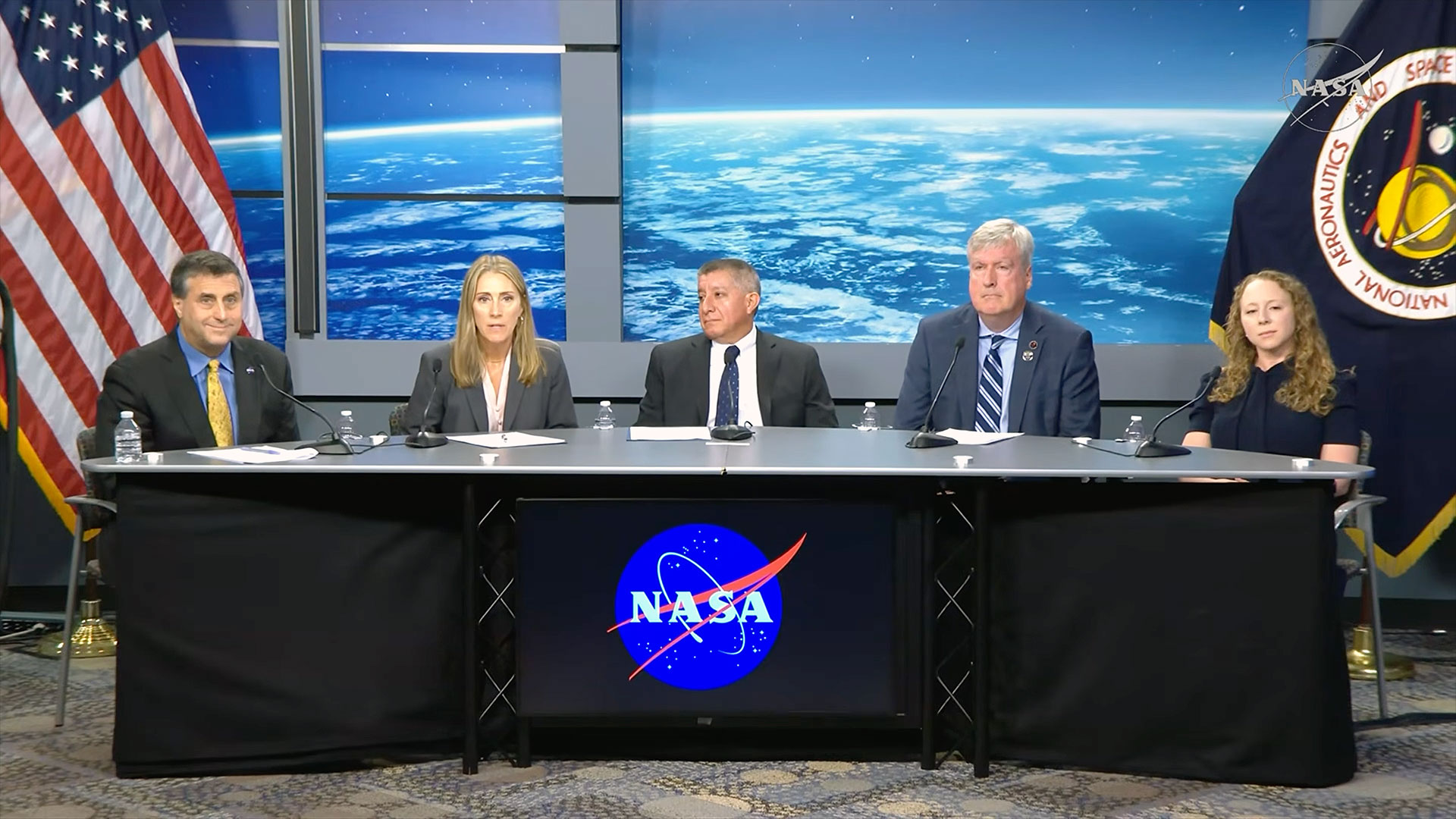
two women and three men sit wearing business attire sit at a table with a NASA logo during a press conference

Crew-13 mission managers take part in a pre-flight press conference on Monday, Aug. 3, 2026 at NASA's Johnson Space Center in Houston. From left to right: Joel Montalbano, deputy associate administrator, Human Spaceflight Mission Directorate, NASA Headquarters; Dana Weigel, manager, Low Earth Orbit Program, NASA Johnson; Richard Jones, deputy director, NASA's Commercial Crew Program; Mathieu Caron, director, Astronauts, Life Sciences, and Space Medicine, CSA; and Julianna Scheiman, director, NASA Science and Dragon Programs, SpaceX. (Image credit: NASA)

During the mission, Watkins, Delaney, Kutryk and Teteryatnikov will take part in research to combat heart disease and Parkinson's disease by studying human stem cell-derived tissues. They will also explore crop production that's important for longer-duration spaceflight missions, and help improve scientists' understanding of blood flow abnormalities that are seen on long missions. The crew will also test new diagnostic medical equipment for keeping an eye on their overall health.

First, though, they must get to space.

"Final integration of the Dragon is complete. The capsule was stacked on the trunk just last week and mission preparations are proceeding well for a mid-September launch," said Dana Weigel, NASA's manager for its low Earth orbit program. "Falcon 9 booster maintenance will kick off this month. That same booster was flown on Crew-12. We are not tracking any major issues for this mission campaign."

This Friday (Aug. 7), the crew will don their SpaceX suits — the first "Rev. 3" models with improved donning and doffing capabilities, as well as adjustments to account for spinal growth on orbit — and get their first chance to board "Grace," their ride into orbit and back. This "test drive" will help them gain some muscle memory — some familiarity within the the vehicle mission — and provide them a very big psychological boost, managers said.

"Grace" will also sport new metal "mud flaps" for its Draco abort thrusters, replacing earlier carbon fiber models. In addition, should the crew encounter an emergency before launch, they will be evacuated from the launch pad area for the first time by Tesla Cybertrucks operated by SpaceX, reducing conflicts when SpaceX and NASA want to launch crewed flights at the near or same time.

"There was a lot of certification that had to go into making sure those Cybertrucks would start up with a gloved hand. There were a lot of tests in terms of making sure you could egress the vehicle with a bulky suit on," Richard Jones, deputy program manager of NASA's commercial crew program, said in a response to a question from collectSPACE and Space.com. "All of those things were proven to be already intact, and they're going to configure those Cybertrucks to be ready."

Departures and arrivals

The four members of Crew-13 will be sharing their time on the space station with outgoing and incoming Russian Soyuz crews, who will launch and land with members of Delaney's astronaut candidate class, "The Flies," selected in 2021.

"It's really exciting to see the class fly," said Delaney. "We're going to be meeting Anil [Menon] up there. He's part of our class. Deniz [Burnham] will come up right behind to replace him. Working closely with both of those two throughout astronaut training, it's really just satisfying."

"I'm slightly hoping we get delayed a little bit, so we have some overlaps, so that way we can have three Flies back to back, he said.

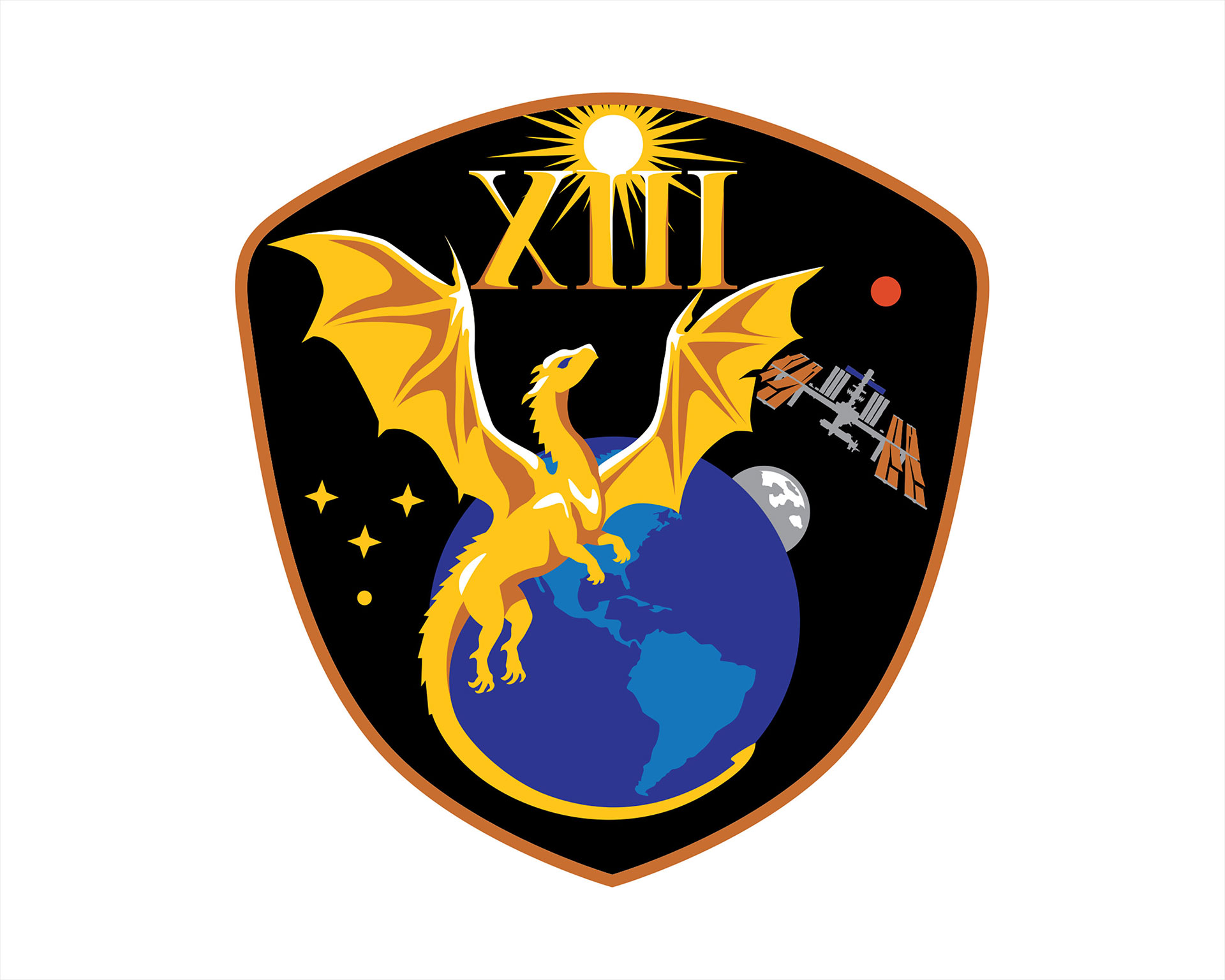
a gold, blue and back emblem with artistry symbolic of aspects of a space mission

The central golden dragon on NASA’s SpaceX Crew-13 patch harkens back to Apollo 13, embodying resilience and gazing upward to the dawn of a new era of discovery. (Image credit: NASA)

For Kutryk, some timing just cannot be controlled.

"It's about midway through — pretty much perfect timing. That's sarcasm," said Kutryk, referring to the upcoming birth of his third child, who is expected to come into the world while he is on the space station.

"It's been done a couple times before," he said, referring to NASA astronaut Mike Fincke and Randy Bresnik, who both had children born while on the ISS. "I think that my family is ready. I have a wonderful, huge support network, from my wife outwards, around us, and we're looking forward to that challenge and to the uniqueness of this experience."

SpaceX launches 24 Starlink satellites to orbit in wake of Starship test flight (video)

SpaceX launched 24 more satellites for its Starlink network on Saturday (July 25), a day after demonstrating it could do the same on its next-gen rocket.

A Falcon 9 rocket carrying Starlink group 17-51 lifted off at 11:51 a.m. EDT (1521 GMT or 8:51 a.m. PDT local time) on Saturday from Space Launch Complex 4 East at Vandenberg Space Force Base in California.

About an hour later, the 24 broadband internet satellites were deployed into low Earth orbit (LEO), as planned.

Previous Booster B1100 launches

NROL-105 | 6 Starlink missions

The launch marked the eighth flight of the Falcon's 9 first stage (Booster 1100), which touched down on the "Of Course I Still Love You" droneship, stationed in the Pacific Ocean.

The successful launch raised the total number of active Starlink satellites to 10,865, according to satellite tracker Jonathan McDowell. That number had been 20 units higher for about 20 minutes on Friday, when SpaceX conducted a deployment and operations trial during the 13th test flight of its Starship launch vehicle.

The Starship test was planned to be short-lived but was successful in providing data to support NASA's decision to fly Starlink systems on its Artemis III crewed mission to LEO, which is scheduled to fly next year.

Saturday's launch was SpaceX's 87th Falcon 9 mission of the year.