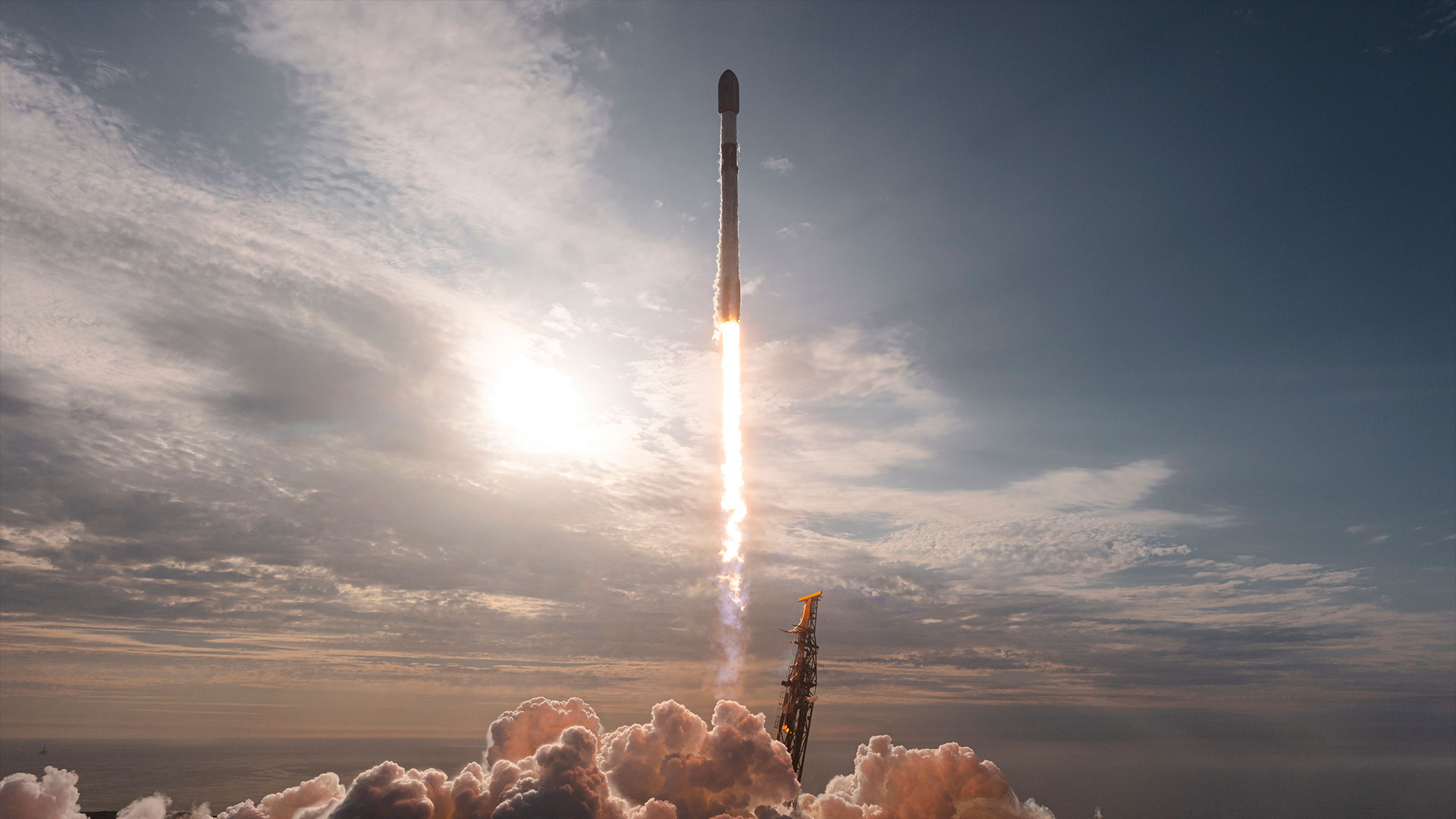
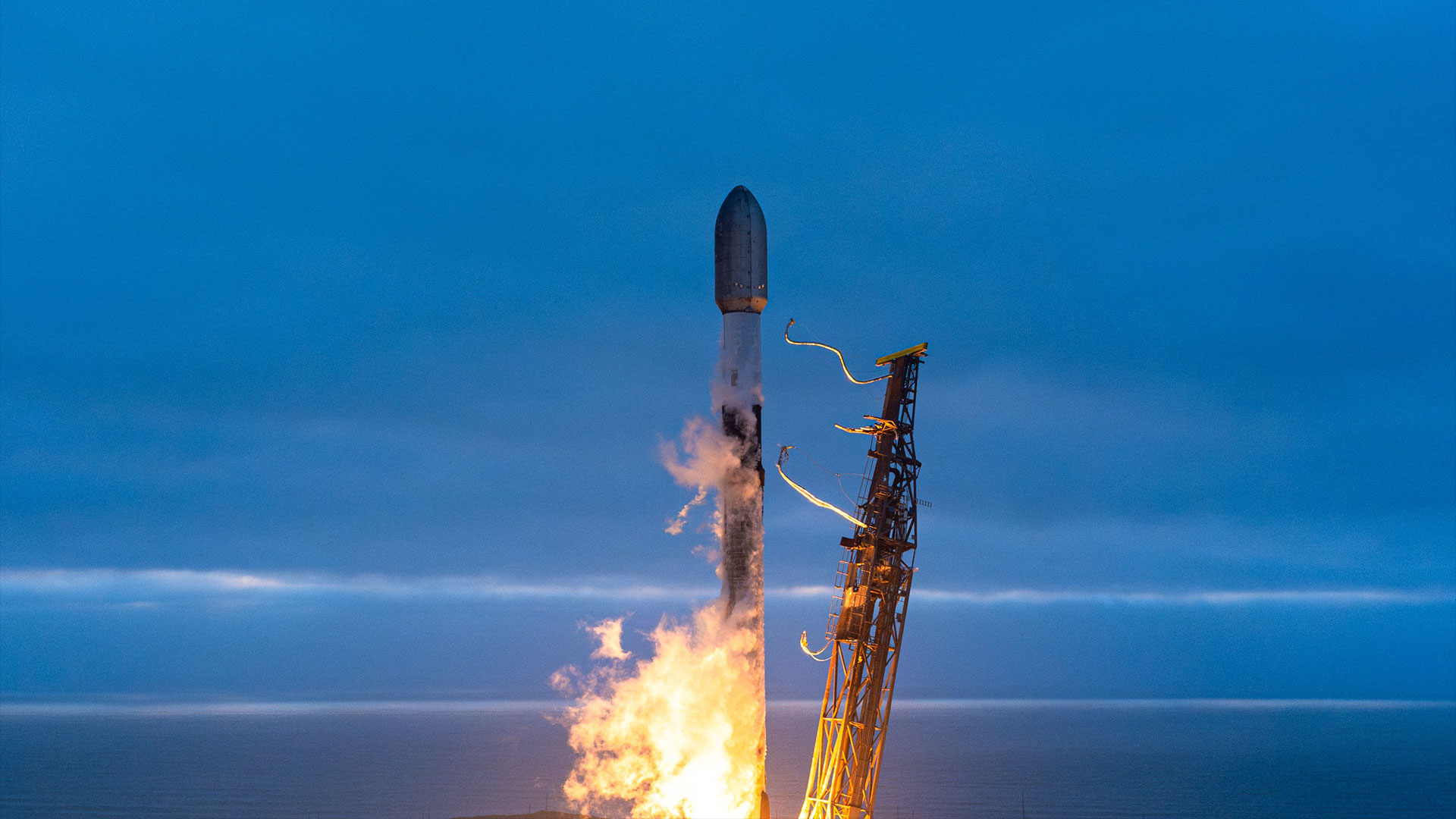
Twenty-four Starlink satellites reached low Earth orbit on Tuesday (July 21), a day later than originally scheduled due to a last-second rocket engine abort.
SpaceX at first tried to launch the broadband internet relay units on a Falcon 9 rocket on Monday morning (July 20), but an unexpected engine cutoff at the point of ignition scrubbed the day's attempt. The company did not provide a reason for the abort.
By Tuesday, whatever the problem was had been addressed and the Falcon 9 was ready to fly. It liftoff off at 10:49 a.m. EDT (1449 GMT; 7:49 a.m. PDT local time) from Space Launch Complex 4 East at Vandenberg Space Force Base in California. About an hour later, after a normal ascent, the new Starlink batch (Group 17-39) were deployed into their intended orbit.
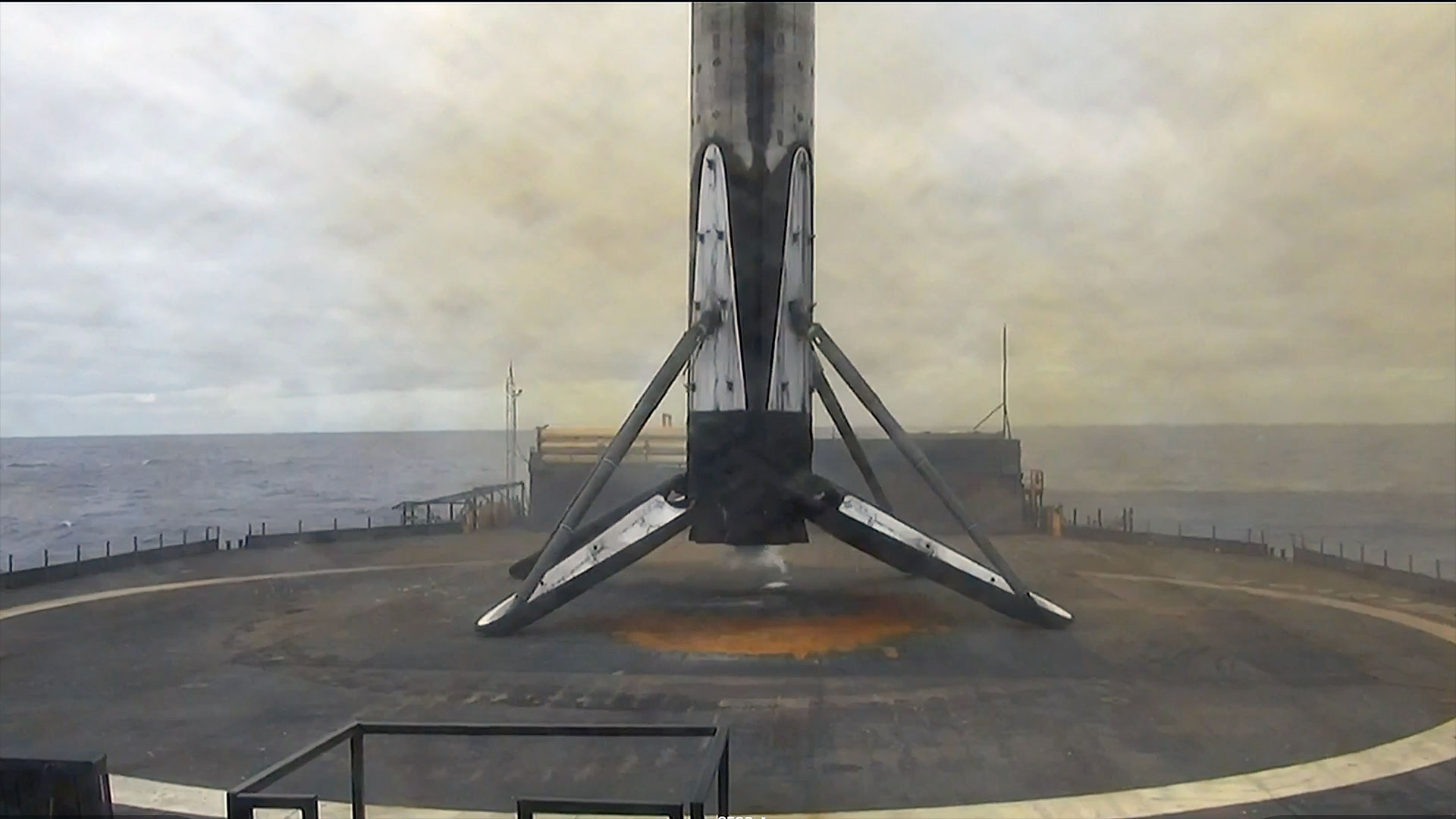
The Falcon 9 rocket's first stage, Booster 1082, completed its 23rd mission by touching down atop the droneship "Of Course I Still Love You" positioned in the Pacific Ocean.
The Starlink network provides worldwide access to the internet, especially to areas where other means of connection are not possible. The megaconstellation also enables in-flight wifi and direct-to-cell services for select providers.
Tuesday's Starlink launch was SpaceX's 85th Falcon 9 launch of the year. SpaceX experienced a similar but unrelated last-second abort on its first attempt at launching its 13th test flight of its Starship megarocket on Thursday (July 16). That flight has now been rescheduled for Thursday (July 23).
SpaceX reached a milestone with its latest Starlink launch, sending the satellites into orbit on its 600th flight of a flight-proven booster.
The sexacentennial launch came on the second of two Falcon 9 missions that lifted off less than eight hours apart overnight from Monday to Tuesday (July 13 to July 14). The first flight, with Starlink batch 15-14, launched at 9:28 p.m. EDT (0128 GMT or 6:28 p.m. PDT local time) from Space Launch Complex 4 East at Vandenberg Space Force Base in California.
Both flights also successfully recovered their Falcon 9 first stage boosters. B1093, launched from Florida, completed its 15th flight. B1080, launched from California, achieved its 28th mission. The record for a single Falcon 9 first stage's re-flight stands at 36 launches.
The addition of 56 more Starlink satellites to SpaceX's megaconstellation brought the total active number of broadband internet relay units to 10,839, according to tracker Jonathan McDowell.
In addition to Tuesday's launch being the 600th launch of a flight-proven Falcon 9 stage, SpaceX now stands at 83 Falcon 9 missions this year to date.
SpaceX grew its Starlink network by 24 more satellites on Wednesday evening (July 1) with a launch from California.
A Falcon 9 rocket carrying the two dozen new relay spacecraft (Group 17-46) lifted off from Space Launch Complex 4 East at Vandenberg Space Force Base at 10:58 p.m. EDT (0258 GMT on July 2 or 7:58 p.m. PDT local time). About an hour later, SpaceX confirmed the satellites were successfully deployed in low Earth orbit.
A SpaceX Falcon 9 rocket carrying 24 Starlink satellites launched from Vandenberg Space Force Base in California on Wednesday, July 1, 2026. (Image credit: SpaceX)
The Falcon 9's first stage (Booster 1100) completed its seventh flight to space and back, landing on the drone ship "Of Course I Still Love You" positioned in the Pacific Ocean.
SpaceX's Starlink megaconstellation now totals more than 10,700 active satellites, according to tracker Jonathan McDowell. The service supports connectively around the globe, as well as in-flight and direct-to-cell services.
Wednesday's launch was SpaceX's 79th Falcon 9 liftoff of the year.
Two NASA astronauts gave a robotic arm a hand up — or rather, a replacement wrist joint — during a successful spacewalk outside the International Space Station on Tuesday (June 30).
Chris Williams and Jessica Meir, both flight engineers on the station's Expedition 74 crew, spent seven hours and 20 minutes repairing the Canadarm2 remote manipulator system (RMS) after it was observed drawing current but not moving as expected in late May. The 58-foot-long (18 meters) arm has been in regular use since it was installed on the orbiting outpost in April 2001.
"For over 25 years, the Canadarm2 has been a crucial part of the International Space Station. The arm was key to our orbiting laboratory and continues to be a workhorse that we rely on. Whether it is performing maintenance or replacing equipment, moving and operating payloads, catching cargo vehicles or helping us out during spacewalks, the arm has played and will continue to play an essential role in our work on orbit," Williams said as the spacewalk ended.
Expedition 74 flight engineer Chris Williams peaks out from behind the International Space Station's Canadarm2 robot arm during a spacewalk on Tuesday, June 30, 2026. (Image credit: NASA)
"It is also a testament to international cooperation," he added. "Canada, the U.S. and the world have come together to make this program a success. We are honored … that we were able to give the arm a helping hand."
Williams and Meir, each wearing a NASA extravehicular mobility unit (EMU), ventured outside the Quest airlock soon after switching the spacesuits to battery power at 8:20 a.m. EDT (1220 GMT) on Tuesday. They made quick work of transitioning to their work station, where they retrieved a spare wrist joint by using a power tool (pistol grip unit) to unbolt it from an exterior equipment panel.
They then turned their focus to the arm, which was positioned nearby. They removed the old unit and installed the new joint (no. 5), bolting it in place. Williams and Meir brought the faulty joint back into the space station to be returned to Earth for analysis and possible refurbishment.
The astronauts completed their work on the arm by reattaching its latching end effector, or hand, which the arm uses to grapple objects and inchworm across the exterior of the station. Mission Control confirmed that the arm had good power connections after the astronauts' work.
Williams and Meir returned to the Quest airlock and began its depressurization at 3:40 p.m. EDT (1940 GMT), marking an end to the spacewalk.
Tuesday's EVA (extravehicular activity) marked the fourth time in history that spacewalkers have worked to service the Canadarm2. Previously, another wrist joint was replaced and both of the arm's end effectors were swapped out for spares.
Expedition 74 flight engineer Chris Williams (at center, as identified by the red stripes on his extravehicular mobility unit, or EMU, outside of the International Space Station during a spacewalk on Tuesday, June 30, 2026. (Image credit: NASA)
"We are thrilled to have repaired the mighty Canadarm2 just in time for Canada Day tomorrow! We hope that all in Canada and everyone around the globe can celebrate this achievement," said Meir.
Expedition 74 flight engineers Jack Hathaway of NASA and Sophie Adenot of the European Space Agency assisted Williams and Meir by helping them to don and doff their spacesuits and maneuvering Canadarm2 into position for the astronauts' repair work.
This was Williams' second spacewalk and the fifth for Meir. Williams has now logged 14 hours and 22 minutes, including a previous EVA with Meir. Meir has totaled 36 hours and 6 minutes, including the first all-female EVA in 2019.
Tuesday's spacewalk was the 280th in support of International Space Station assembly, maintenance, and upgrades since 1998.
SpaceX launched 24 more of its Starlink satellites into low Earth orbit on Sunday (June 28), continuing to expand its broadband internet relay network.
A Falcon 9 rocket carrying the new batch (Group 17-40) launched from Space Launch Complex 4 East at Vandenberg Space Force Base in California. Liftoff took place at 12:09 p.m. EDT (1609 GMT or 9:09 a.m. PDT local time).
The Starlink satellites reached orbit about nine minutes after leaving the ground and were on track to be deployed by the Falcon 9 upper stage about an hour later.
The first stage of a SpaceX Falcon 9 rocket is seen after landing on its four legs atop the autonomous droneship "Of Course I Still Love You" in the Pacific Ocean off the coast of California on Sunday, June 28, 2026. (Image credit: SpaceX)
The rocket's first stage (Booster 1088) completed its 17th flight, touching down on the autonomous droneship "Of Course I Still Love You" positioned in the Pacific Ocean.
The 24 satellites increased the total number of active relays in the Starlink network to more than 10,700, according to tracker Jonathan McDowell. The Starlink service provides access to the internet to people around the world, as well to in-flight wifi and cell-to-satellite service providers.
Sunday's launch was SpaceX's 75th Falcon 9 mission in 2026.
A SpaceX Falcon 9 rocket carrying 29 Starlink satellites lifted off from the Cape Canaveral Space Force Station in Florida on Monday, June 8, 2026. The first stage booster flew for a record 35th time.