Using the James Webb Space Telescope (JWST), astronomers have studied 72 young, sun-like stars. As a result, they found that forming planets is a real race against time.
This is because the material that serves as the building blocks for planets is constantly escaping the swirling platters of gas and dust, orprotoplanetary disks, that wrap around infant stars. Some types of planets may find their formation window closing sooner than others.
The team's research represents the most in-depth investigation yet into how matter escapes these protoplanetary disks and how this escape gives rise to different stages of planet formationaround sun-like stars. All in all, the study helps paint a better picture of how and why our solar systemtook the shape it did around the infant sun around 4.6 billion years ago.
"Gas giants like Jupiter must assemble their massive atmospheres while the disk is still substantial enough to supply them, before winds and jets carry that raw material away into space," team leader Naman Bajaj from the University of Arizona said in a statement.
An ill wind blows around infant stars
The team conducted its research using data collected by the JWST’s Mid-Infrared Instrument (MIRI). The scientists tracked matter loss by following the movements of molecular hydrogen, one of the most common molecules in protoplanetary disks. Each of the stars involved in the investigation represented a different stage in the early life of a star system. That meant putting these snapshots together allowed the researchers to create a "movie" detailing the early life of a planetary system.
One of the most important findings of this approach is the mechanisms for material loss from protoplanetary disks seem to evolve and switch dominance as an infant star ages.
This is important because gas giants like Jupiter and Saturn have vast atmospheres. They thus require more raw material to form than smaller rocky worlds like Earth do. Understanding matter loss allows scientists to determine at what stages of protoplanetary disk evolution gas giants can form.
"What is exciting about this study is that we can now see, across a large sample of young systems, how the mechanisms that remove gas from planet-forming disks change with time," team member Uma Gorti from the SETI Institute said in the statement. "Disk dispersal sets a fundamental clock for planet formation: once the gas is gone, the opportunity to build gas-rich planets is essentially over."
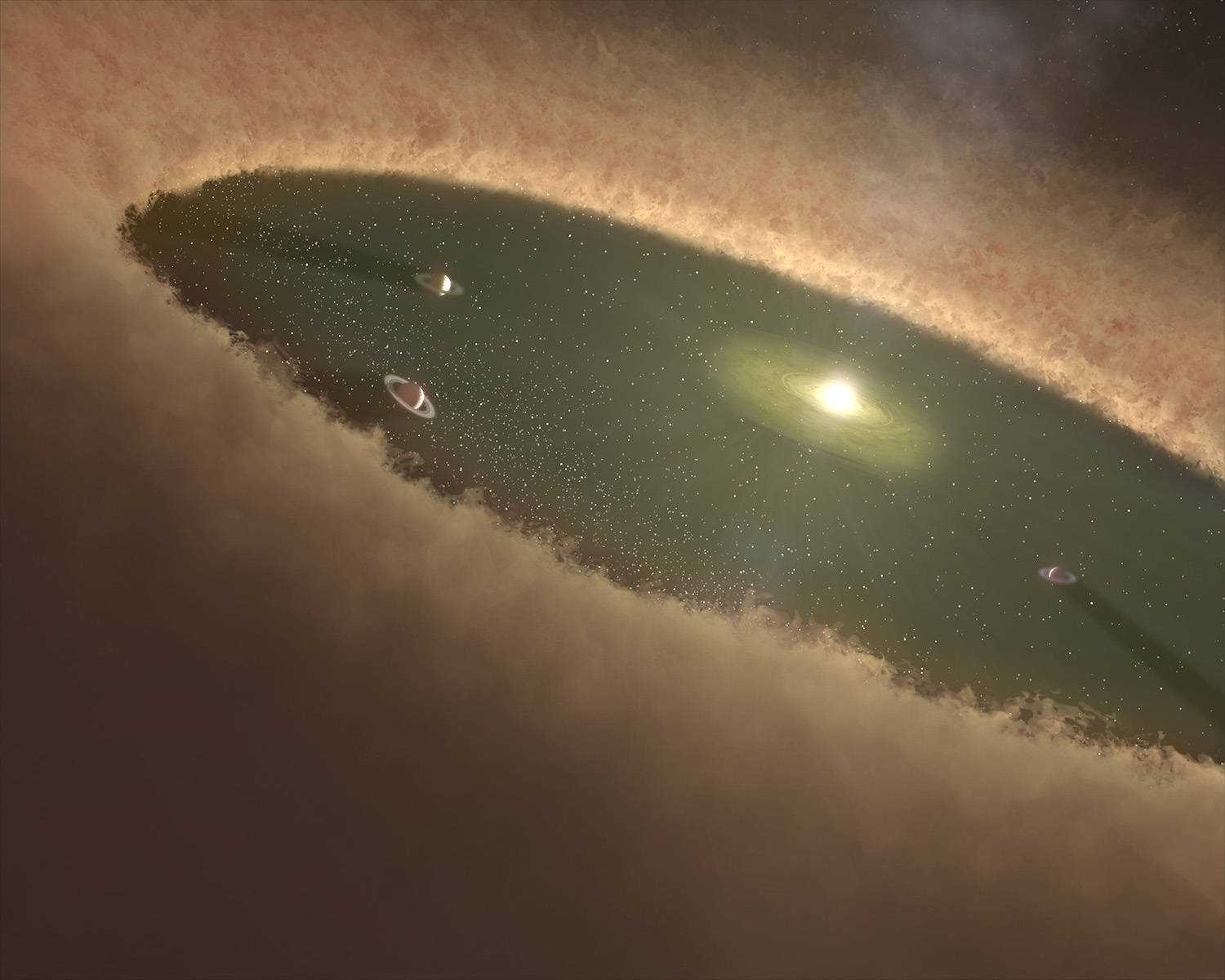
An illustration of an evolved protoplanetary disk in which material close to the infant star has been dispersed (Image credit: NASA/ JPL-Caltech/ T. Pyle (SSC))
The researchers found that early in the evolution of protoplanetary disks, powerful, magnetically driven jets and winds dominate mass loss. These jets and winds are powered by magnetic fields that weave through protoplanetary disks.
Later, as the disk thins and starlight can pass through it more easily, these winds and jets weaken, and magnetic processes are dominated by high-energy radiation from the infant star ionizing gas and blowing it into space. The latter process is called photoevaporation.
All this reveals there is no one single process responsible for stripping planet-forming material from around infant stars. The research also demonstrates the JWST is more than capable of studying the dispersal of gas and dust around individual infant stars.
The next step for the team is to discover just how much material these different mechanisms shift. The scientists could also look into the areas of the disks in which the mechanisms studied operate. Down the line, this will help develop a model to reveal just how rapidly planet-formation is shut off — and in which regions of a protoplanetary disk different types of planets are most likely to form.
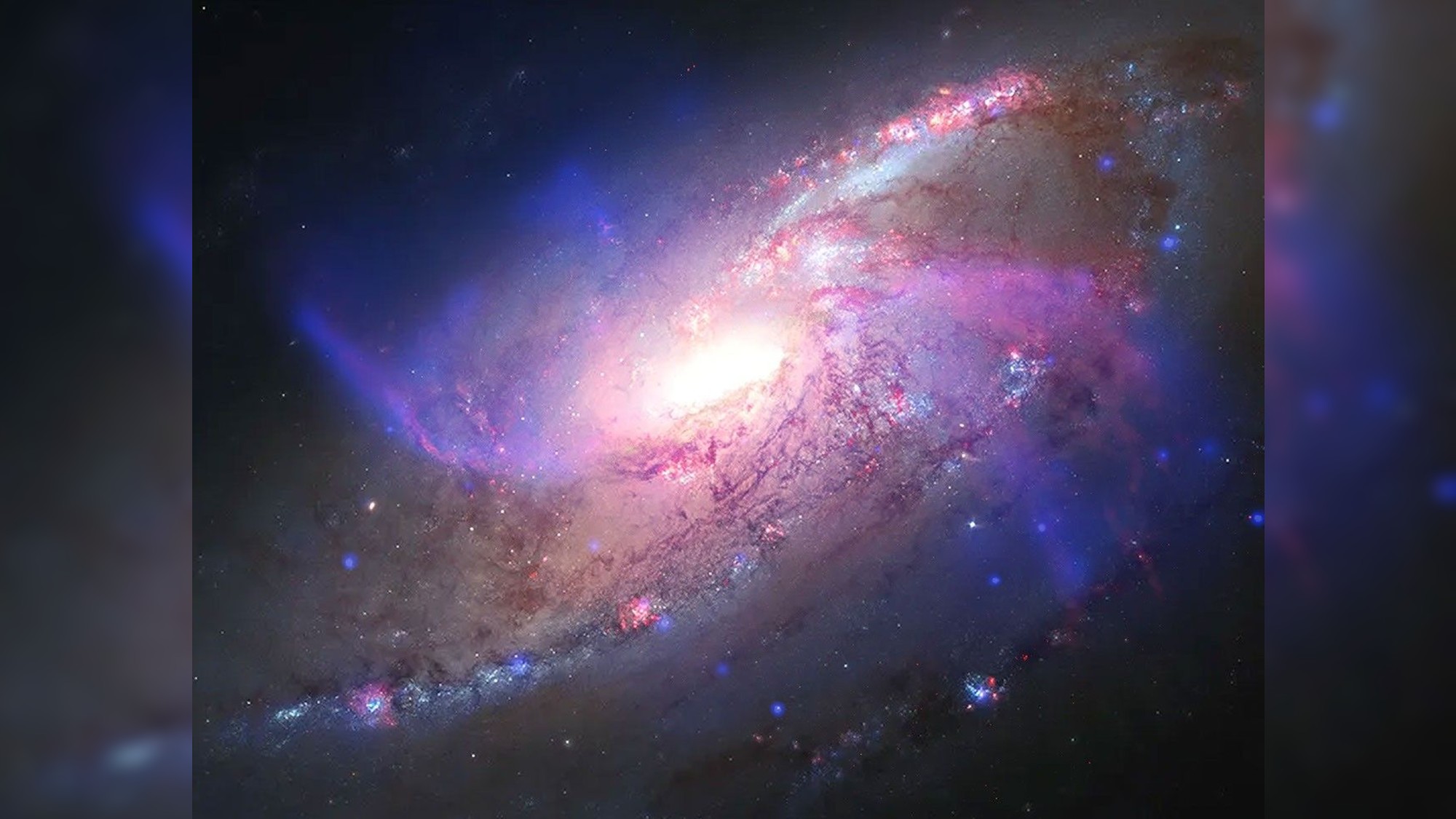
An image of this spiral galaxy NGC 4258 that combines X-ray observations from NASA's Chandra X-ray observatory (seen here in royal blue), optical light gathered by the Hubble Space Telescope (red, yellow and pale blue), and infrared light seen by the James Webb Space Telescope (bright orange). (Image credit: X-ray: NASA/CXC/SAO; Optical: NASA/ESA/STScI; Infrared: NASA/ESA/CSA/STScI; Image Processing: NASA/CXC/SAO/L. Frattare)
A trio of NASA space telescopes teamed up to capture a gorgeous new look at the glowing spiral galaxy NGC 4258 and its two anomalous extra arms.
What is it?
This image shows NGC 4258, also known as Messier 106, a spiral galaxy located some 24 million light-years away in the constellation Canes Venatici, the "Hunting Dogs." It is a fairly bright galaxy and can be viewed in the spring sky in the Northern Hemisphere with most telescopes.
Messier 106 is noteworthy for having two "anomalous" extra arms, the long curved regions of bright gases, dust and young stars that are characteristic of all spiral galaxies. But while most spiral galaxies have only a pair of arms, Messier 106 has two pairs. According to NASA, the extra set is composed of hot gases that are churned away from the galactic center by the supermassive black hole at the heart of NGC 4258.
Why is it incredible?
This image shows off the incredible teamwork that NASA's flagship orbital observatories can pull off. It combines X-ray observations from NASA's Chandra X-ray observatory (seen here in royal blue), optical light gathered by the Hubble Space Telescope (red, yellow and pale blue), and infrared light seen by the James Webb Space Telescope (bright orange).
By combining multiple types of light into one image, NASA is able to reveal the complete picture of what this energetic galaxy is made of.
The image also shows the incredible power of the black holes found at the centers of galaxies. "M106 helps show how supermassive black holes can create structural features that mimic star-bearing spiral arms, influencing a galaxy's evolution," NASA wrote in a statement accompanying the image.
This image was part of a NASA release of 16 new "galactic gems" captured by Chandra and other observatories.
NASA took the guts out of old spy satellites to build the groundbreaking Nancy Grace Roman Space Telescope – but how? And why?
Years of hard work and anticipation are culminating as we sit on the verge of NASA's launch of its next-generation space telescope. Set to lift off this upcoming Sunday (Aug. 30) aboard a SpaceX Falcon Heavy rocket, the Roman Space Telescope will push astronomy into the future, exploring the mysteries of dark energy, studying far-off worlds and expanding our understanding of the universe around us. But to get to this point, NASA used some … unexpected technology.
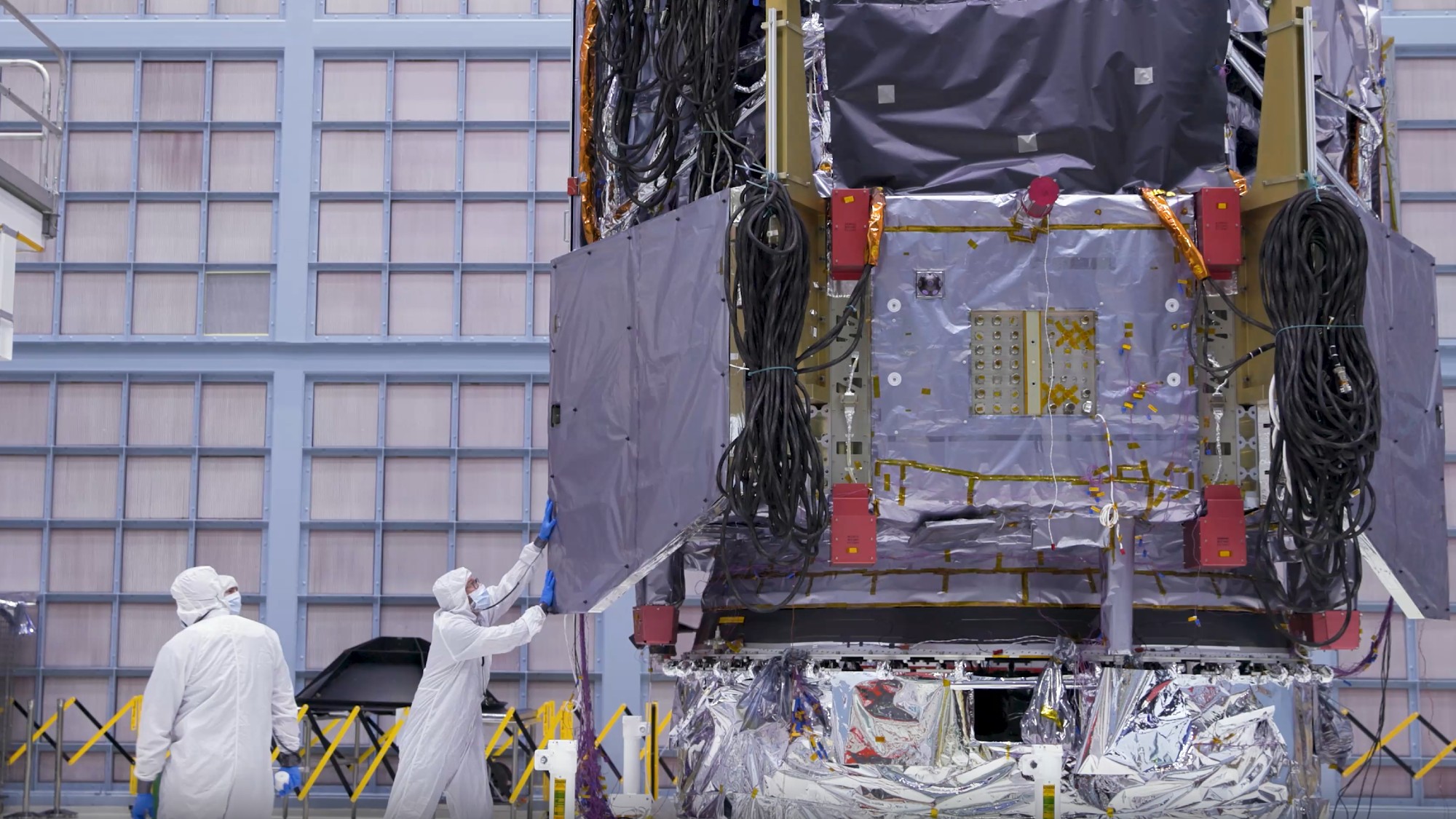
At the core of the observatory lies the Optical Telescope Assembly. This houses the telescope's primary mirror, its main mechanism through which it surveys the cosmos, nine additional mirrors, supporting structures and various sorts of electronics. But where did all of this tech come from? The National Reconnaissance Office (NRO), which builds spy equipment for U.S. agencies like the CIA. That's where.
In 1999, the NRO stood up the multibillion-dollar "Future Imagery Architecture" program, which contracted out new spy satellites. The NRO contracted Boeing for the project, having the company design a whole suite of new optical and radar imaging reconnaissance satellites. They're basically spy satellites. In 2001, in a post-9/11 America, this effort continued to ramp up with national security concerns at an all-time-high. However, this flurry of spy satellite development was short-lived. And with billions of dollars in overrun costs from Boeing, the project closed in 2005.
At the time, the New York Times called the program "perhaps the most spectacular and expensive failure in the 50-year history of American spy satellite projects."
But one program's spectacular failure is another program's free space tech treasure.
Years later, in 2012, the NRO donated two unused space telescopes from this program to NASA. With optics said to be similar to the Hubble Space Telescope's, two free telescopes presented the agency with a tantalizing opportunity. This donation happened just a couple of years after Roman (then known as WFIRST) was originally proposed — and even though it would cost money to rework the hardware and build the rest of the space telescope out, this provided the possibility of a serious cost alleviation to the mission.
After considering the possibility, the team decided it was the right call. And in 2011, years before Roman (WFIRST) was even formally designated as a mission by NASA, the agency announced that they would be reusing this spy satellite technology. This decision followed the 2010 National Academy of Science Astronomy and Astrophysics Decadal Survey, which pointed to Roman as its highest priority.
While this donated spy satellite part came withtop-tier optics, it was also free. The most recent space telescope to launch was the James Webb Space Telescope (JWST), which lifted off in 2021 but was in development since the mid-1990s. The JWST garnered significant public attention and scrutiny for being both well behind schedule and way over budget, ultimately costing a whopping $10 billion.
Scientists working on the Roman Space Telescope. (Image credit: NASA/Sophia Roberts)
As the JWST was grappling with these budget issues, Roman was already in development. So, it's not a shock that when a high-tech space telescope landed on their doorstep, NASA took full advantage of the opportunity, though the Roman team would still have to replace the electronics in the telescopes that the NRO removed. Thus, in the end, did the NRO telescopes actually save NASA money? It's not clear. Each donated telescope was said to beworth at least $250 million, but experts at the time of development were torn in their estimates for whether repurposing this old hardware would actually save or eat up costs in the end.
A few quirks also came with the free hardware. In addition to having to replace the electronics and rework a telescope someone else built, the Roman team had to learn about the telescope with some, well, restrictions. When the details about the telescopes were given to the mission team, there were large chunks of information fully blacked out, the Washington Post reported at the time. But while the Roman team was handed something quite strange to work with, the mission has remained about as on schedule and on budget as we've seen with a space telescope of this magnitude.
NASA still has the second telescope from the NRO, though the agency has not said what they might do with the equipment. However strange and unexpected this series of events may have been, it did result in a completed space telescope that now sits at the launch site, ready to uncover the mysteries of the universe. Join us this upcoming Sunday (Aug. 30) to see a telescope made with spy satellite tech travel beyond our planet.
Astronomers have discovered a new ocean world outside the solar system that orbits extremely close to its parent star. This means that the extrasolar planet, or "exoplanet," is in hot water, both literally and figuratively.
The exoplanet orbits the star HD 176071 located around 335 light-years away, and is about two and a half times the size of Earth, but has about eight and a half times the mass of our planet. That indicates to scientists that this planet is about 50% water. At a distance from its star of just under 1.5 million miles (about 1.6% of the distance between the Earth and the sun) and with a year lasting just 14 hours, HD 176071 b is a rare example of a "hot water world."
That close distance to its star means the planet experiences extreme tidal forces due to the pull of the star's gravity. These forces are driving the planet, designated HD 176071 b, towards a rapid and inexorable fatal encounter that will see it eventually violently devoured by its host star.
The exoplanet is also a rare occupant of what scientists call "Neptunian Desert" a term which describes a lack of Neptune sized worlds orbiting very close to their host stars. This is thought to be because intense stellar radiation strips planets of their gaseous layers effectively shrinking them. However, HD 176071 b seems to defy this suggestion, as this water world possesses surprisingly a dynamic atmosphere that hasn't been stripped away.
"Comparing historical data from the Kepler space telescope with new TESS (Transisting Exoplante Survey Satellite) observations six years later, we noticed an unexpected phase shift in the modulation of the reflected light," lead researcher Sylvain N. Breton of the Italian National Institute for Astrophysics (INAF) said in a statement.
"This tells us that we are not looking at a static photograph, but a living and changing atmosphere, in which dense, highly reflective clouds form, evolve, and move along the planet's coldest edges."
That isn't the only extraordinary thing about HD 176071 b. The way the ocean exoplanet was initially discovered is pretty special too.
This ocean world doesn't cross its stellar parent
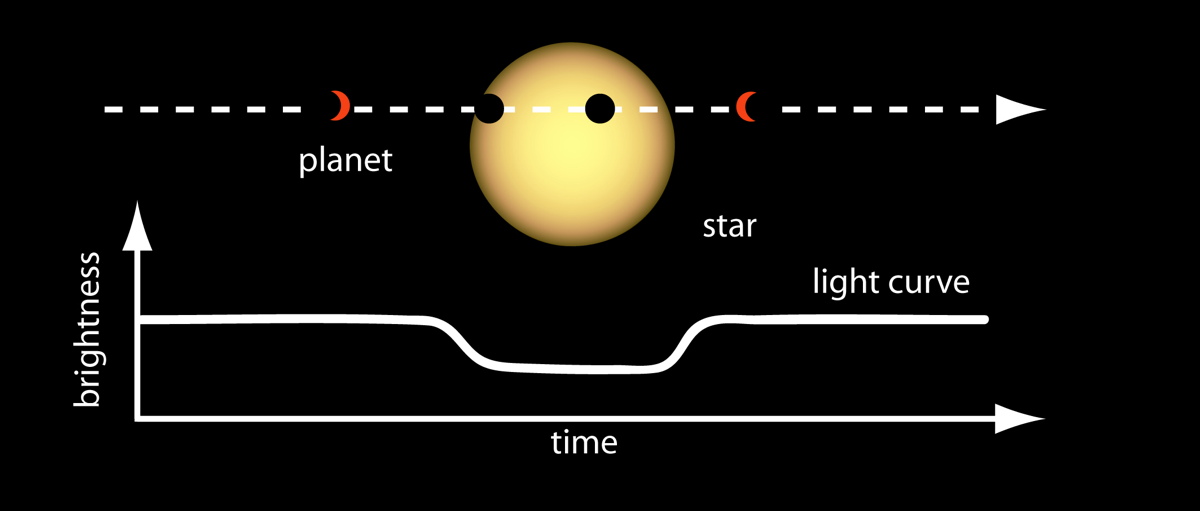
Currently NASA's catalog of confirmed exoplanets has over 6,000 entries with thousands more worlds beyond the solar system awaiting conformation. The vast majority of these were discovered when they passed in from of their host star and caused a tiny dip in starlight reaching us from that stellar body in what's known as the transit method of exoplanet detection.
Thus, the transit method requires the planet to pass between its star and Earth. As you may imagine, that's a really fortunate arrangement for astronomers to find new planets in. Most known planets in the Milky Way don't do that.
"The vast majority of planets in the universe never transit in front of their star from Earth's perspective, making them virtually invisible," Breton said.
HD 176071 b is just such a world, with this geometric hinderance, so Breton and colleagues had to be crafty to discover this water world.
A diagram shows how the transit method of exoplanet detection works (Image credit: NASA)
The team still used the starlight of the parent star of HD 176071 b to detect the exoplanet, but instead hunted for tiny fluctuations in brightness caused when the light from this star was reflected from the planet. HD 176071 b is tidally locked, meaning it has a permanent "dayside" facing its star, and a perpetual "nightside" facing out to space. The variations in brightness result because sometimes the nightside of the planet faces us, and other times our instruments see its dayside.
"Thanks to the dataset acquired with the HARPS-N instrument on the Galileo National Telescope, we have managed to overcome this geometric obstacle: by measuring with extreme precision how the light reflected by the planet varies throughout its orbital journey, we can not only detect these elusive worlds, but also begin to characterize their structure and atmosphere, opening a fundamental window onto previously almost inaccessible planetary populations," Breton said.
The discovery of HD 176071 b shows that current astronomy techniques are sophisticated enough to characterize the atmosphere and internal structure of worlds beyond the solar system. That is a big boost for the detection of worlds that don't pass between Earth and their host star.
In late June 2023, on a morning train commuting to work in New York City, David Hendel was scrolling through a recent astronomy paper on his phone when a half-page image caught his eye.
The image, captured a year earlier by the Hubble Space Telescope, showed UGC 9050-Dw1, a dwarf galaxy some 115 million light-years from Earth. It appeared as little more than a faint, diffuse smudge of bluish-white light that astronomers call an ultra-diffuse galaxy — a type of galaxy so sparsely populated with stars that most of its mass is thought to be dark matter, the invisible substance that makes up more than 80% of the matter in the universe but has yet to be directly detected.
What made Hendel pause was not the galaxy itself but a thin, fragile ribbon of stars trailing off from it, so dim it nearly disappeared among the other smudges of light crowding the frame. Hendel, a former astronomer who had studied thousands of similar structures, immediately recognized the subtle interplay of the arc's features, including the shared color of the stars and their curved trajectory pointing toward a tiny, matching bright knot along its track. Together, those clues matched a stellar stream tearing from a tight ball of stars called a globular cluster, pulled apart by the gravity of UGC 9050-Dw1.
If Hendel's reading was correct, it would be the first such stream ever found outside the Milky Way.
"It almost seemed too good to be true," Hendel told Space.com. "At this point I felt the excitement of a discovery to such a degree that I recall looking up and around the train for someone to tell!"
This discovery would give researchers a pristine new laboratory for probing dark matter, and one far less contaminated by competing astrophysical forces that muddy similar searches within our own galaxy. Hendel, who now works in finance but still follows research from his former field, ran a quick literature search to see whether anyone had already documented the feature. No one had.
The right person to tell was not on the train, of course. Before reaching his stop, Hendel took a screenshot, sketched a rough circle around the arc and sent it to Sarah Pearson, an associate professor of astrophysics at Technical University of Denmark's DTU Space, and his friend since their graduate school days at Columbia University.
That message kicked off the collaborative effort that would ultimately confirm the find, led by Pearson and Julie Kiel Holm, a Ph.D. student at the Niels Bohr Institute at Denmark's University of Copenhagen.
The team's paper gives the stream the name Oyashio (pronounced "oh-yah-shee-oh"), Japanese for a cold Pacific current, following a tradition of naming these faint stellar trails after bodies of water in Indigenous languages to honor cultures worldwide with long astronomical traditions, including in Australia, Chile and India.
An image of the Hubble Space Telescope. (Image credit: NASA)
Within the Milky Way, astronomers have so far identified roughly 100 stellar stream candidates shed by globular clusters, but finding one around another galaxy is extraordinarily rare. Streams that form when a whole dwarf galaxy is torn apart are relatively easy to spot, since they emerge in the sparse outskirts of a larger galaxy. But globular cluster streams form deep inside their host galaxy, where they are washed out by brighter, more crowded starlight. Oyashio's detection was possible in part because UGC 9050-Dw1's already-sparse stellar population meant a dimmer backdrop gave the stream just enough contrast to be seen, Holm told Space.com.
Oyashio's discovery is "a very exciting step forward," Emily Cunningham, an assistant professorat Boston University who studies stellar streams and dark matter halos and was not involved in the new study, told Space.com. "Using techniques like those described in this paper, we will detect many more streams around other galaxies with upcoming observations from facilities such as the Vera Rubin Observatory and the Nancy Grace Roman Space Telescope."
A sufficiently large catalog of such streams in different galactic environments would allow them to tease out the subtler perturbations that dark matter is predicted to cause at the smallest scales, the researchers say.
"This is one of the most promising avenues for new astrophysical constraints on dark matter's nature," said Hendel.
No Eureka! moment
UGC 9050-Dw1 was first identified in 2017 in images taken by the Canada–France–Hawaii Telescope atop Mauna Kea in Hawaii, as part of a survey for diffuse dwarf galaxies. A follow-up study in 2023, drawing on the same Hubble images in which Hendel later spotted Oyashio, catalogued an "exceptionally high" population of globular clusters near the galaxy. Its authors concluded that UGC 9050-Dw1 likely formed from the merger of two comparably sized galaxies roughly 10 billion years ago, one gentle enough that gas from both survived and ignited a burst of star formation, which would also explain the clusters' uniform color. That 2023 study did not flag Oyashio.
In the new study, Holm and her colleagues recovered Oyashio independently in archival data from both Hubble and the Canada-France-Hawaii Telescope, ruling out the possibility that it was an artifact of telescope imaging or subsequent data processing.
The team then ran thousands of simulations, testing which combinations of globular cluster properties and dark matter distributions could reproduce the stream's observed brightness and shape. The best-fitting models produced new estimates of the UGC 9050-Dw1's total mass and how that mass is spread throughout it, suggesting the galaxy harbors far more dark matter than its sparse stellar population would imply, consistent with expectations for such a diffuse galaxy.
A ring of dark matter (seen by the Hubble Space Telescope in false color), its location inferred from its gravity, around the galaxy cluster ZwCl0024+1652, which is 5 billion light-years away. (Image credit: NASA/ESA/M. Jee and H. Ford (Johns Hopkins University).)
In the study, the team also weighs a range of alternative explanations and lays out why none quite fit the evidence. The arc could be, for instance, a chance alignment of unrelated stars, the product of gravitational lensing from a background galaxy, or a dusty region that happens to mimic a stream's shape. None of those scenarios, the team says, accounts on its own for the key pieces of evidence, chiefly the stars' consistent color, their alignment along a single curved track and that track's connection to what appears to be the globular cluster progenitor.
"It was an interesting process in the sense that there wasn't a specific moment where we're like, 'Okay, now we know what it is,'" Holm told Space.com. "We started with the assumption that just by looking at it, it looks like it could be something. How many different ways can we try to prove that it can't be?"
Still, in the interest of rigor, the team acknowledges it cannot fully exclude every alternative explanation. "There's still the possibility that some stars just randomly fall in this pattern," said Holm, "But again ... for all these things to line up as nicely as they do would require a lot of coincidence."
Dark matter clues
The payoff of that caution lies in what Oyashio can reveal about the universe's invisible scaffolding. As a globular cluster is shredded over billions of years, the stars it sheds fan out along its former orbit rather than scattering randomly, preserving, in effect, a pristine record of the gravitational forces that shaped them. If a clump of dark matter too small to host stars of its own — a "subhalo," in the language of cold dark matter theory — passes through that stream, its gravity can tug stream stars off course and carve out a gap.
"Streams that form from globular clusters are particularly sensitive to these perturbations," said Cunningham.
The challenge lies in isolating the cause, and one stream is not enough to draw firm conclusions about the astrophysical process responsible. Inside the Milky Way, any disturbance in a stream of stars could just as easily come from the galaxy's central bar of stars or from nearby dwarf galaxies falling into the Milky Way, like the Magellanic Clouds. UGC 9050-Dw1 has none of those features, so any gap found in Oyashio would stand as a more confident signature of dark matter at work, Holm said.
"If a gap is observed in a single stream, it is very difficult to say for certain which astrophysical process is responsible," said Cunningham. "However, if we can build up a sufficiently large sample of streams in different galactic environments, we can start to disentangle these effects."
"To do this, we need to look beyond the Milky Way," she added.
New instruments coming online could help do just that. Astronomers are particularly excited for the launch of the Nancy Grace Roman Space Telescope, scheduled for launch Aug. 30 from the Kennedy Space Center in Florida, which has a field of view at least 100 times larger than Hubble’s. In its five-year primary mission, with a possible five-year extension, Roman is expected to measure light from a billion galaxies, according to NASA.
"You would be able to do this kind of research in different galaxies at once with the same exposure, basically," said Holm. She hopes Roman, along with the European Space Agency's Euclid space telescope, which launched in 2023, will turn up more galaxies like Oyashio, "so we can start to put together a more generalized image of how these things work and what they can tell us."
Some of those discoveries could even come to light the way Oyashio did, as a product of pure scientific curiosity applied to data already sitting in an archive. Hendel said he read the 2023 paper mostly because he was intrigued by the team's conclusion that UGC 9050-Dw1 likely formed through a dwarf galaxy merger. "I had no aim when opening it except to satisfy my curiosity," he said.
That he was able to spot a rare feature hiding inside an image collected for a completely different research project speaks to the value of the scientific community's long-standing practice of making data publicly available, Holm said.
"Anyone can come along with another idea and actually find something also interesting with the same data that you didn't know was hiding in it," said Holm. "I think that's also a really cool part of this."
The team's paper was published on Aug. 12 in the journal Nature.
Unlike the James Webb Space Telescope, which trades panoramic views for a narrow field of view to peer deeply into small, specific patches of the sky, Roman is built for scale. Its field of view is 100 times larger than the Hubble Space Telescope's, meaning that in just the five years of its primary scheduled mission, it will capture more than 50 times as much sky as Hubble did in its first 30 years. With that kind of reach, Roman is expected to map roughly 20 billion stars, measure light from more than a billion galaxies, and turn up as many as 200,000 new exoplanets, according to NASA.
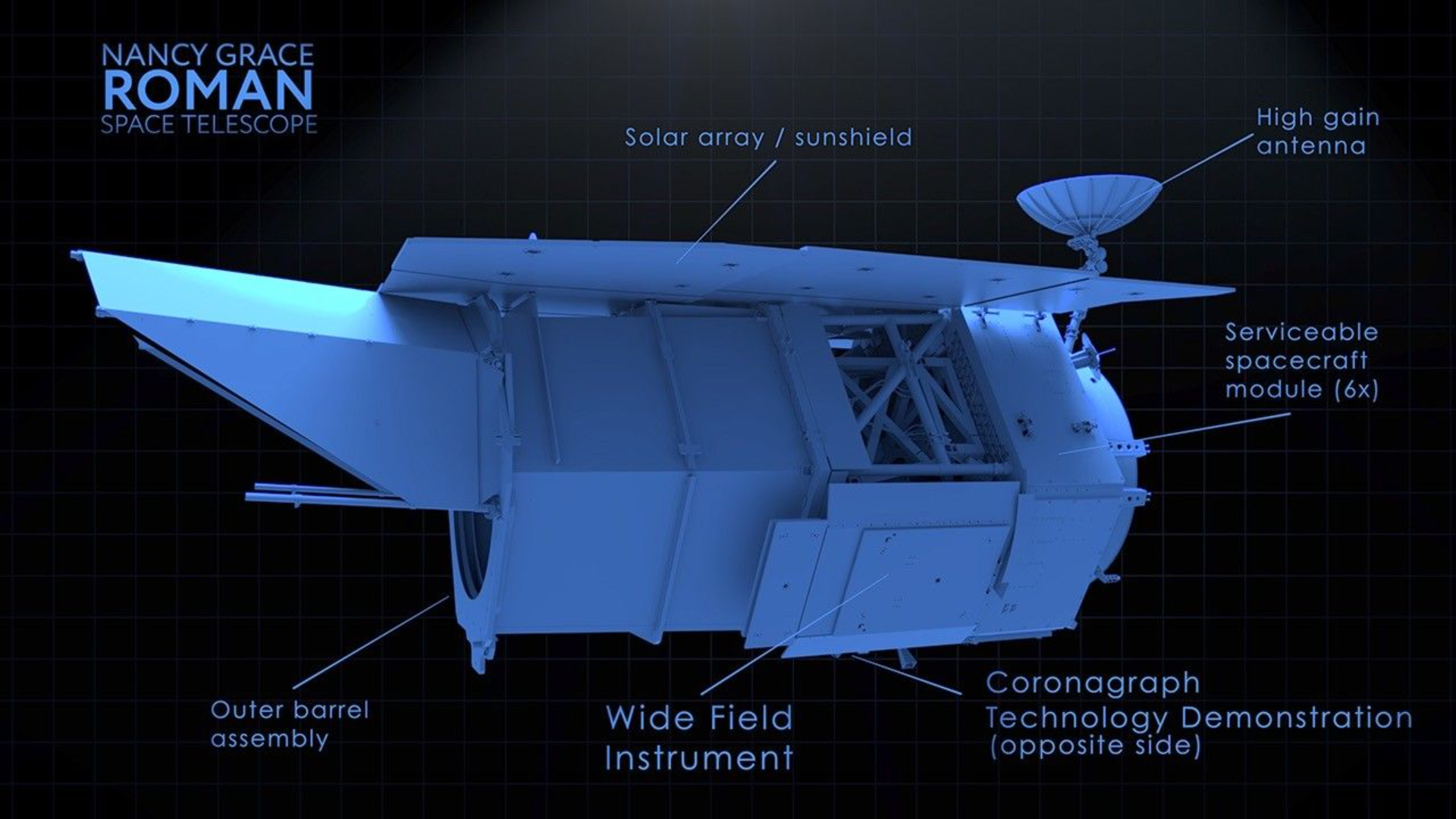
The instruments that will make this mission possible are tucked inside the observatory that looks, oddly enough, like a helicopter frozen mid-flight. With a nose-like front end housing the telescope, a pair of flat solar panels stretched out to either side and an antenna perched on top, the resemblance turns out to be a handy way to understand the key instruments that make Roman's mission possible.
The telescope
Just like a helicopter's nose holds critical navigation and visibility instruments, the front of Roman is home to the telescope, which gathers starlight and sends it to the science instruments behind.
At the heart of the telescope is a primary mirror 7.9 feet (2.4 meters) across, the same size as Hubble's, while a smaller secondary mirror that's just under 2 feet (0.5 meters) wide sits in its front. Both mirrors are kept cold, chilled to about 19 degrees Fahrenheit (-7 degrees Celsius), to prevent heat from the telescope itself from interfering with observations, according to NASA.
A diagram showing the Roman Space Telescope and its various instruments. (Image credit: NASA Goddard Space Flight Center Scientific Visualization Studio)
The telescope is also kept in optimal optical working condition with the help of the Deployable Aperture Cover, or DAC. Located at the very front of Roman, this hat-like shade pops open once the observatory reaches orbit, blocking stray light from entering the telescope barrel and helping protect the telescope's sensitive optics throughout the mission.
Solar Array Sun Shield
A helicopter's wings would look a lot like the flat panels stretched out on either side of Roman — except these panels are built for power, not lift.
The Solar Array Sun Shield, or SASS, consists of six solar panels. Two remain fixed to the spacecraft, while four more will unfold after Roman reaches orbit. Angled toward the sun, the array generates the electricity needed to power the observatory. It also throws shade over much of the spacecraft, helping keep the sensitive instruments at the low temperatures they need to operate.
The Roman Space Telescope's solar panels. (Image credit: NASA/Jolearra Tshiteya)
The Wide Field Instrument
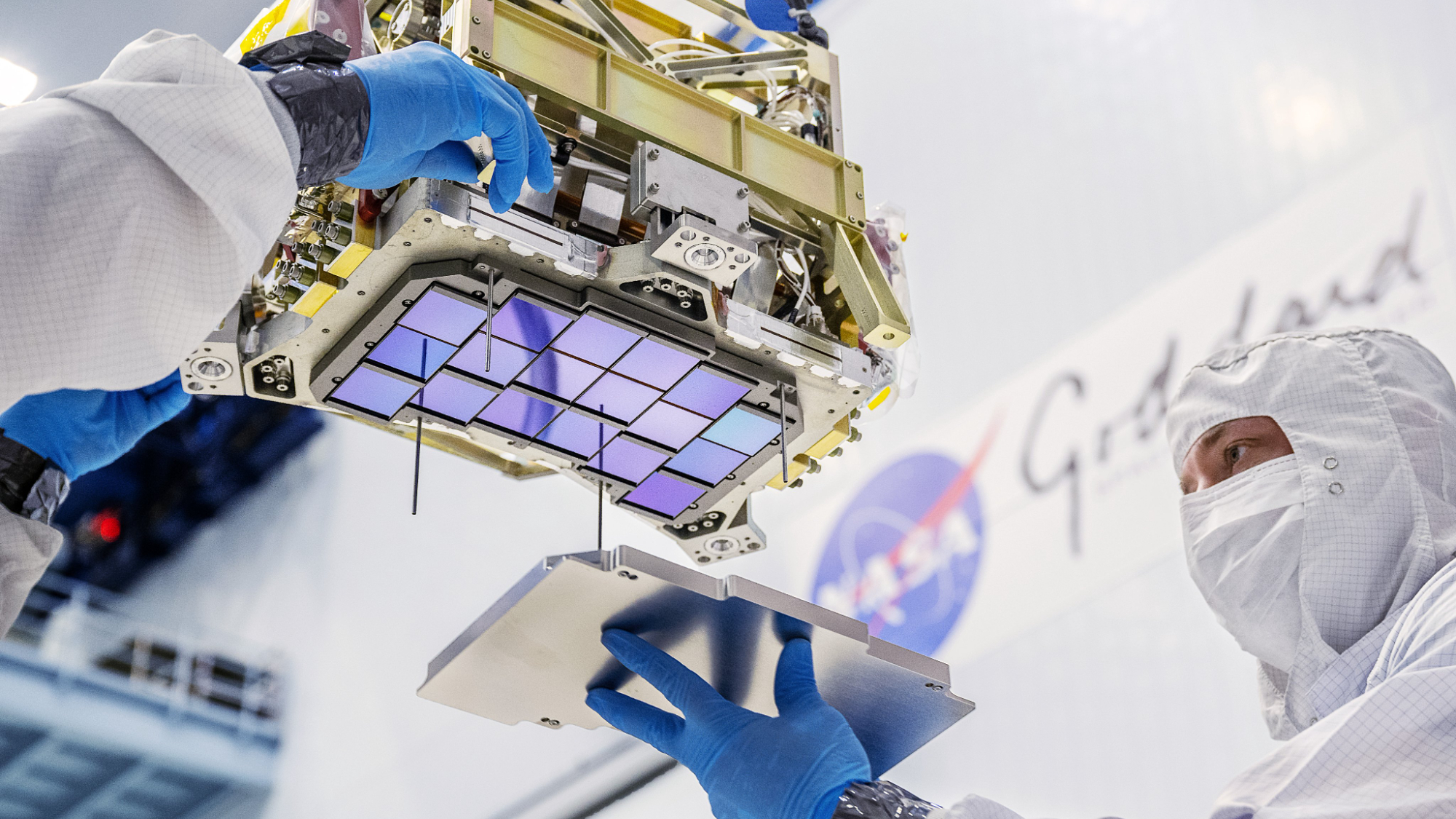
The workhorse of the mission is the Wide Field Instrument, of WFI, which is essentially a giant infrared camera with so much power and sensitivity that each image it takes captures a slice of sky bigger than the full moon as seen from Earth.
It can do this thanks to a mosaic of 18 detectors arranged in an arc, each packing more than 16 million pixels, which collect light from astronomical sources and convert it into electrical signals that can ultimately be turned into images. Because each image covers such an enormous field of view, scientists expect virtually every exposure to be packed with information.
Principal technician Billy Keim installs a cover plate over the WFI detectors at NASA's Goddard Space Flight Center in Maryland on Feb. 8, 2021. (Image credit: NASA/Chris Gunn)
The data will help scientists uncover new insights into planetary systems around other stars and map how matter is structured and distributed throughout the cosmos, offering fresh clues about the elusive nature of dark energy.
The Coronagraph
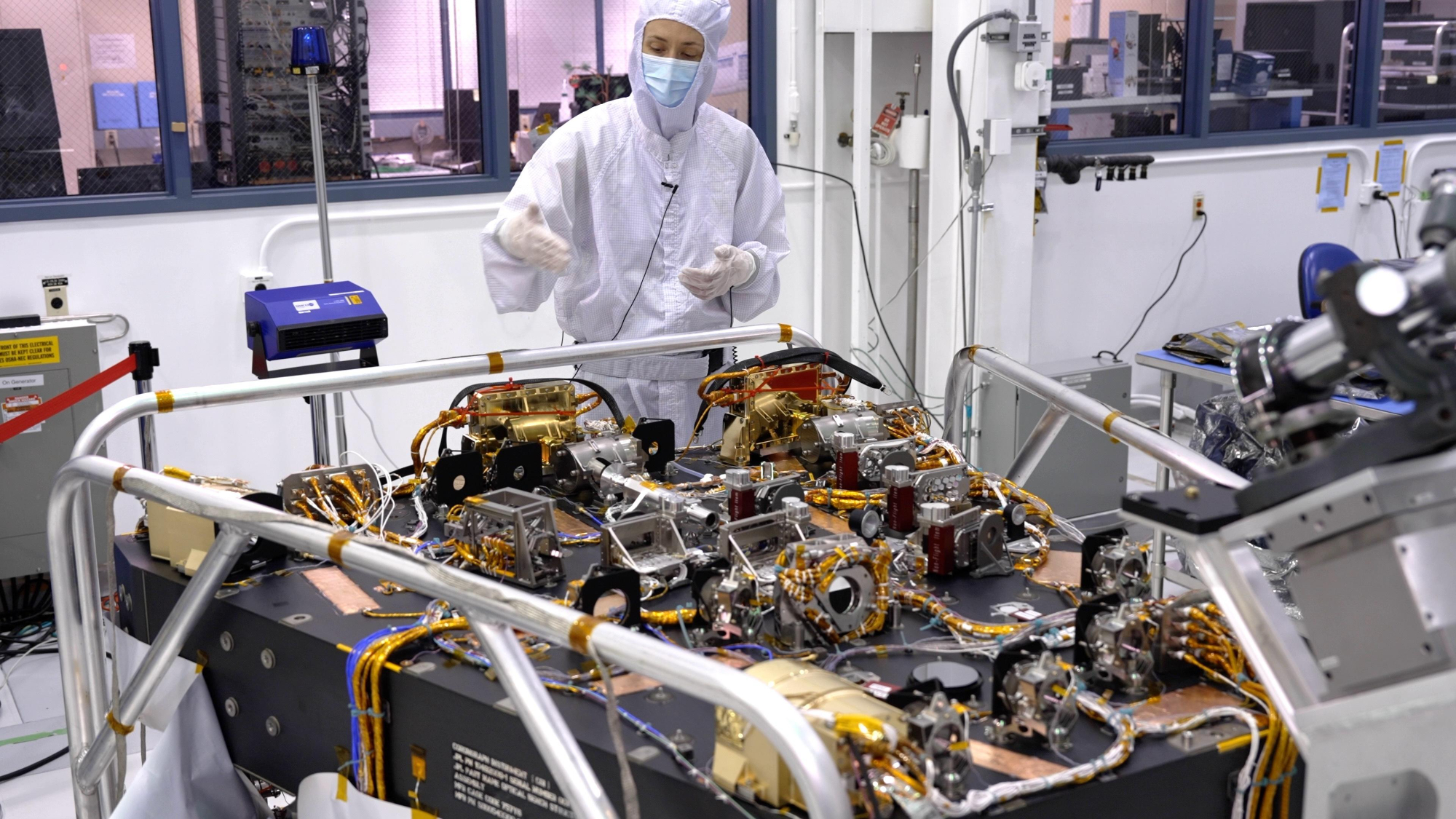
The coronagraph, nicknamed "Starglasses," is designed to block the glare of stars so that planets orbiting them can come into view — including those far fainter than what scientists can currently see.
The instrument works by using two deformable mirrors equipped with thousands of tiny actuators. As starlight streams through the telescope, those actuators subtly reshape the mirrors in real time, correcting for imperfections in the telescope's optics smaller than the width of a strand of DNA. Specialized masks work alongside the mirrors to suppress the way light bends around internal edges such that together, the system dramatically dims a star's glare while allowing some of the much fainter light from an orbiting planet to shine through.
"I think of this as doing magic with physics," Julie McEnery, Roman senior project scientist, said during a press conference in July. We're taking advantage of the wave properties of light to cancel out the light from a star, so that we can image planets next to it."
In a clean room at NASA’s Jet Propulsion Laboratory in Southern California in Oct. 2023, scientist Vanessa Bailey stands behind the Roman Coronagraph. (Image credit: NASA/JPL-Caltech)
Scientists expect this capability to allow Roman to directly image Jupiter-size planets around sun-like stars, as well as capture sharp images of fledgling planetary systems still surrounded by the dusty disks where planets are forming.
As a bonus, the whole instrument also doubles as a proving ground for future missions, including NASA's planned Habitable Worlds Observatory, which aims to directly image Earth-like planets around nearby stars.
High-Gain Antenna
Standing in for a helicopter's rotor is the antenna dish on top of Roman. The roughly 6-foot (1.8-meter) dish high gain antenna, or HGA, is the observatory's communications link to Earth, handling routine spacecraft data as well as high-speed science-data downloads. It is meant to transmit information home at speeds of up to 500 megabits per second.
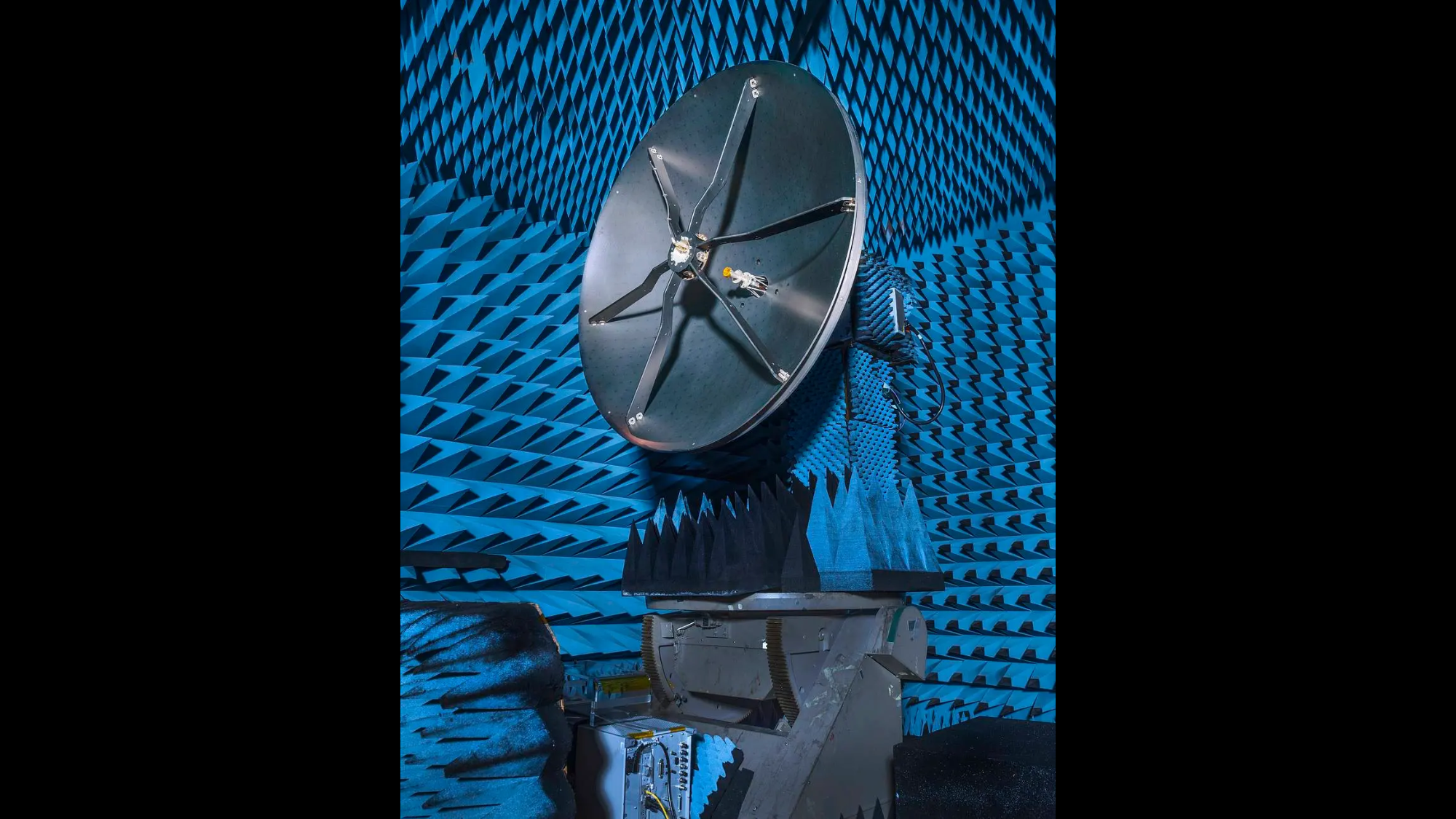
The high-gain antenna for the Nancy Grace Roman Space Telescope during testing. (Image credit: NASA/Chris Gunn)
Motorized gimbals allow the dish to swivel and remain locked onto ground stations even as Roman turns to look at different parts of the sky, ensuring that the enormous amounts of data collected by the telescope can make their way back to Earth.
If all goes to plan, once Roman is at its station in space, Lagrange Point 2 (L2) these components together will give the observatory both the breadth and precision needed for its ambitious survey of the universe, from mapping billions of galaxies to hunting for distant planets and probing one of cosmology's biggest mysteries, dark energy.
Betelgeuse may be a well-known and often-studied stellar object, but that doesn't mean astronomers aren't capable of capturing this doomed star in a completely new light.
A team of scientists examined the doomed red supergiant star with the Atacama Large Millimeter/submillimeter Array (ALMA), gaining new, highly detailed insights into its turbulent surface.
Betelgeuse, located around 600 light-years away, captured the public's attention a few years ago when the rapid and dramatic dimming of the infamous highly evolved star led some scientists to hypothesize that it was about to explode in a spectacular supernova. That hasn't happened, and scientists are now less convinced that this explosion is immediately imminent, but Betelgeuse remains the subject of intense scientific scrutiny.
"Its eventual fate as a supernova makes it fascinating to know what it actually looks like now," team leader Bill Dent, an astronomer at the European Southern Observatory (ESO), said in a statement.
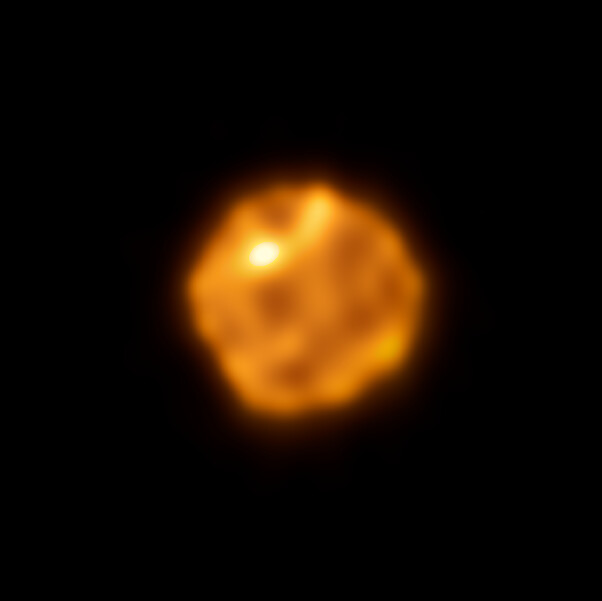
The newly released ALMA images of Betelgeuse, captured in 2023, show bright hotspots on the star's surface and an almost corrugated texture arising from vast amounts of plasma shifting through the star, which has around 20 times the mass of our sun, but is puffed out to around 800 times the size of our star.
The observations show the red supergiant has an atmosphere with a temperature of around 3,680 degrees Fahrenheit (2,030 degrees Celsius), but possesses at least two regions even hotter than this. One of these areas is 980 degrees Fahrenheit (530 degrees Celsius) hotter than the plasma surrounding it.
ALMA image revealing irregular shape and regions of hotter gas on Betelgeuse. The brightest hotspot, toward the northeast, appears at the same location in ALMA observations separated by more than seven years, meaning some structures can survive longer than predicted (Image credit: ALMA (ESO/NAOJ/NRAO)/W. Dent et al.)
The uneven nature seen by ALMA is likely the result of massive convective movements in the star, hot plasma rising through the star and generating shockwaves that erupt in the star's atmosphere, creating bright and hot regions.
The familiarity of Betelgeuse to astronomers doesn't mean the star isn't capable of delivering surprises too. When the team compared images collected in 2023 to observations from 2015, they were surprised to see a hotspot in the northeast of the stellar disk has persisted for at least seven years, that is much longer than predicted by current stellar models.
Astronomers will continue to monitor the hotspots of Betelgeuse with ALMA to determine how fixed they are and how their evolution relates to things like mass loss, and the structure of the star's atmosphere.
That investigation will likely continue until Betelgeuse finally ends its life in a supernova explosion.
The team's research has been accepted for publication in the journal Astronomy & Astrophysics and is available on the paper repository site arXiv.
Even if you aren't the kind of person who often looks up the latest space images, it's hard to navigate life (especially on the internet) without running into a few. Try choosing a new iPhone background and you'll have your pick of sharp, gray moon portraits. Watch an old "Star Trek" episode and you may not realize how many of those translucent nebulas outside the spaceship's windows were based on real, hard data.
When it comes to space, we're spoiled. Mind-bending objects light-years away from us have managed to become integrated into our everyday lives — and though we're still a ways away from understanding the true nature of the universe, we're also the closest we've ever been. It's in large part thanks to how impeccable our fleet of space telescopes is. In seconds, you can find a Hubble Space Telescope Deep Field with luminescent galaxies warped along the curvature of spacetime and James Webb Space Telescope images of strange hazy red objects from just after the dawn of time.
Moreover, what's tremendously exciting is this fleet is constantly growing. Indeed, very soon, a new space telescope will launch from NASA's Kennedy Space Center in Florida. It's called the Nancy Grace Roman Space Telescope, and it should be able to unlock a new level in the astronomy layer of our lives. It will show us new types of images, reveal new types of data and lead us in directions we may not yet know are possible.
What is Roman?
To put it succinctly, the Nancy Grace Roman Space Telescope is an approximately 42-foot-long (12.7-meter-long), cylindrical metal observatory scheduled to lift off from our planet on Aug. 30 aboard a SpaceX Falcon Heavy rocket.
Across a five-year-long mission (a 10-year-long one if everything goes well), Roman is meant to use two powerful instruments — the Wide-Field Instrument (WFI) and Coronagraph Instrument — to image huge swaths of the cosmos and tackle some crucial questions. It will help scientists probe the mysteries of dark matter and dark energy, directly image exoplanets near and far, witness an extensive amount of stars exploding in colossal supernovas and more.
But whether or not it's a fair thought, it's hard not to want to compare the specifications of this space telescope to some of the others that have brought the cosmos down into our daily lives. This is particularly true for two of the major players right now: the James Webb Space Telescope and the Hubble Space Telescope.
What can Roman do that these two cannot?
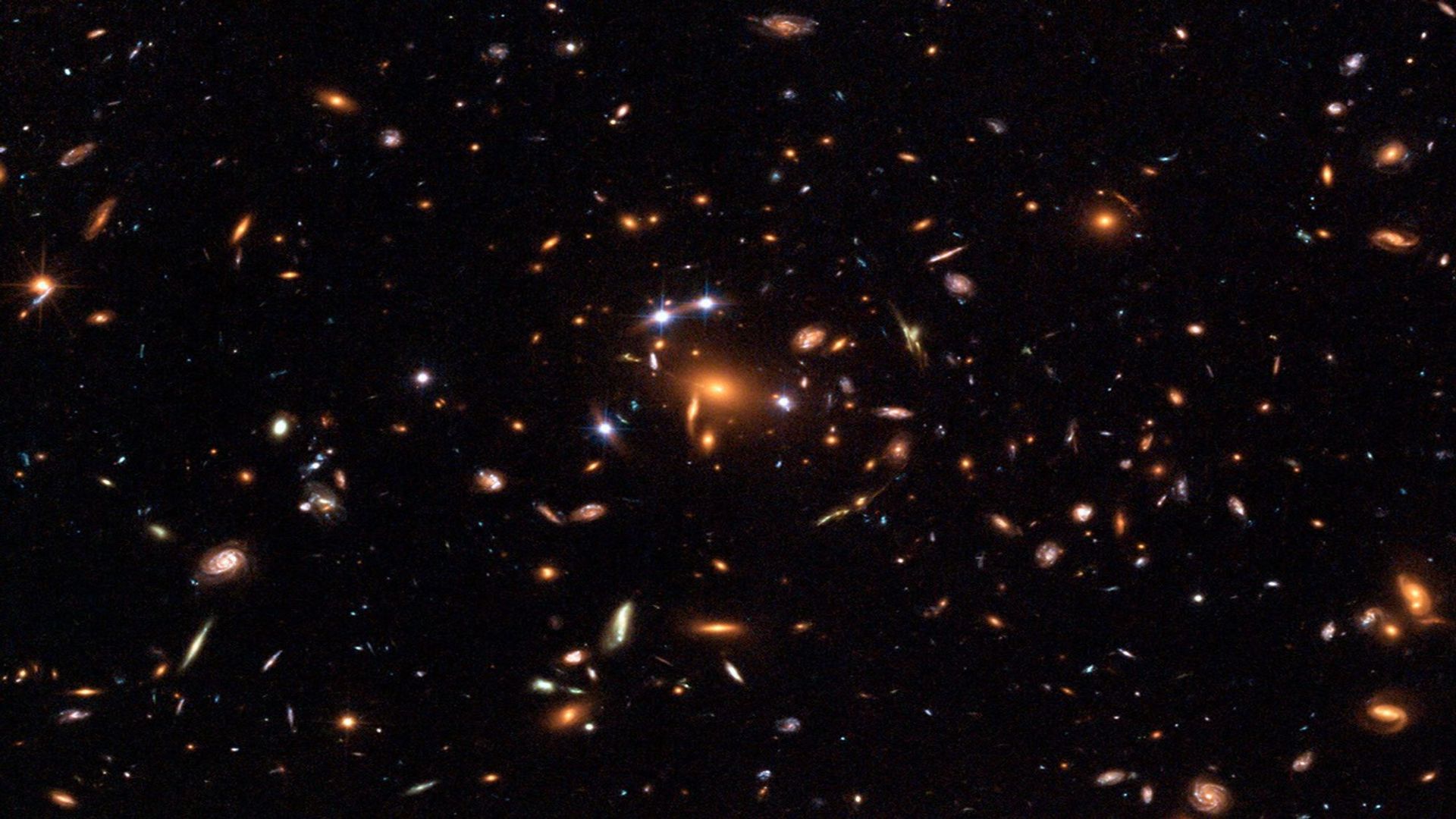
The multiple-image effect seen in this Hubble picture is produced by a process called gravitational lensing, a quirk of warped spacetime in which the gravitational field of a massive object bends and amplifies light from a background object. (Image credit: ESA, NASA, K. Sharon (Tel Aviv University) and E. Ofek (Caltech))
Roman vs. Hubble
To start, one of the biggest benefits of Roman over Hubble is its processing power.
By numbers, that means Hubble has managed to gather about 400 terabytes of data over its approximately 35 years of service so far. Roman is expected to be able to create 500 terabytes of data every single year.
"Its surveying capabilities are over 1,000 times faster than Hubble, and can chart 200 times more sky in a single image," NASA administrator Jared Isaacman said during a press conference about Roman in April. "What would take Hubble 2,000 years to process, Roman can do in a year — the images it captures will be so large there is not a screen in existence large enough to show them."
Roman's primary mirror is about 7.9 feet (2.4 meters) wide, which is actually the same as Hubble's. Primary mirrors are arguably the most important aspect of a space telescope, because it's how an observatory manages to gather light coming from the universe. Bigger mirrors can collect more light, which allows them to see dimmer or more distant objects. Interestingly, Roman's primary mirror is also about 80% lighter than Hubble's. Roman has a secondary mirror as well; it's just under 2 feet (0.5 meters) wide. Hubble's secondary mirror is very similar at exactly 12.2 inches (0.3 m) in width.
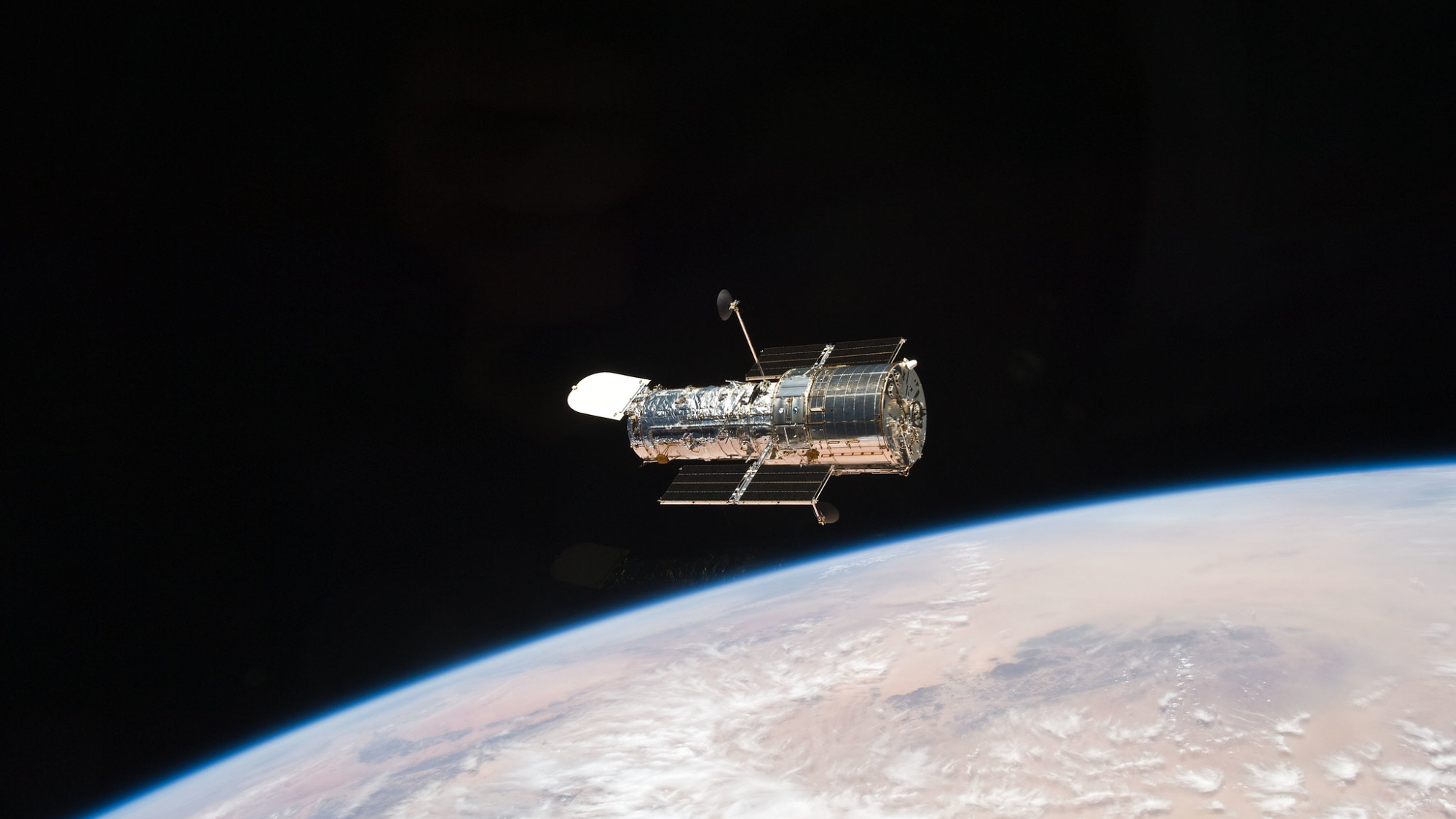
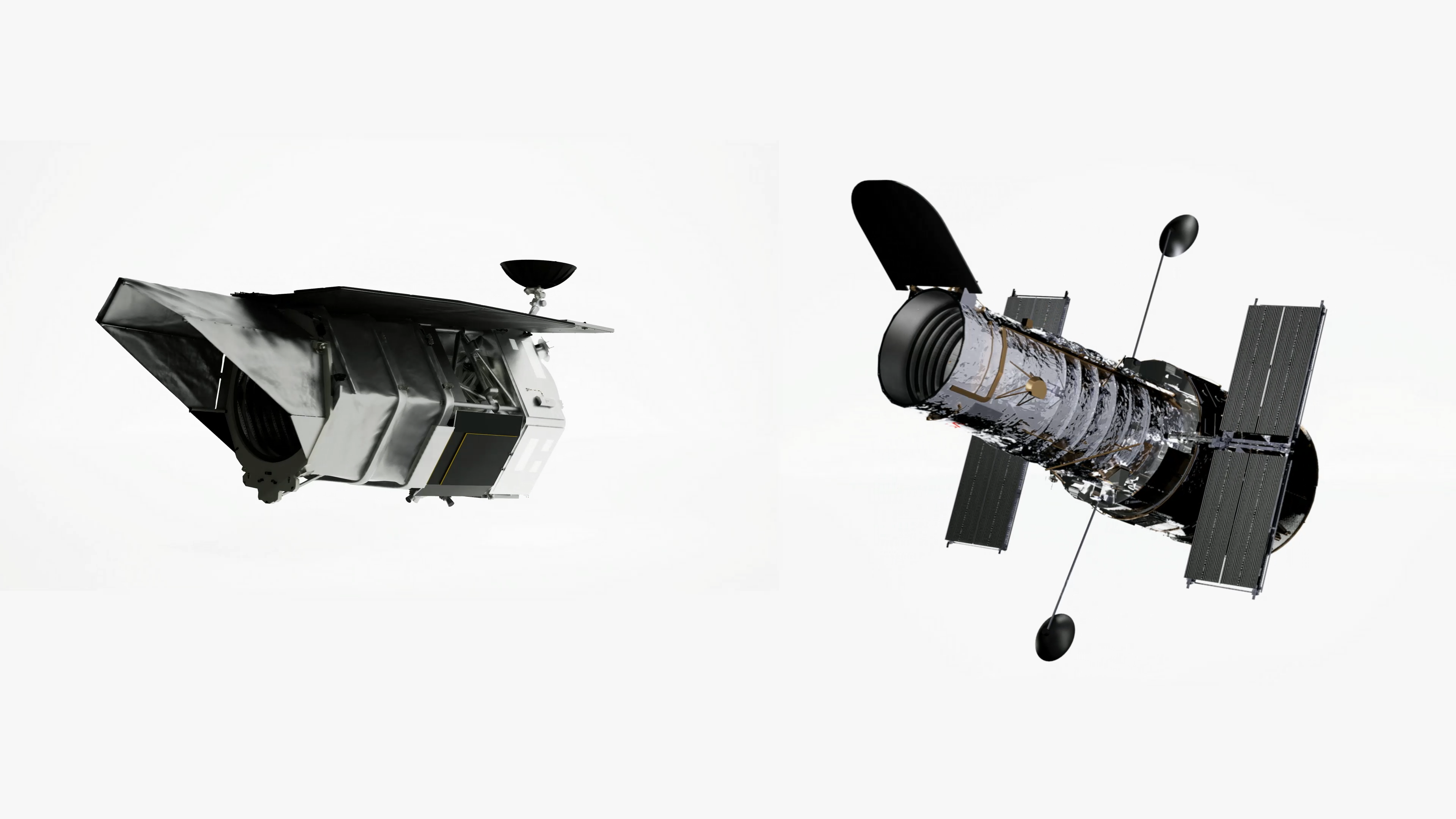
On the left, the Roman Space Telescope. On the right, Hubble. (Image credit: NASA’s Goddard Space Flight Center)
Yet even though Roman's mirrors are so comparable to Hubble's, because of Roman's processing power as well as the capabilities of its WFI, it will be able to image a far wider stretch of sky than Hubble can.
Though Roman does have some visible light capabilities like Hubble, WFI specializes in infrared light — actually the kind of light the JWST works with, but we'll get to that telescope comparison shortly — so we should compare it to Hubble's infrared instrument. The WFI's field of view is about 100 times greater than the Hubble infrared instrument's field of view.
According to NASA, this view will allow Roman to measure light emanating from a billion galaxies and billions more cosmic phenomena over its years of service.
"Both observatories will perform spectroscopy," NASA explains, "which involves splitting light into individual colors to study patterns that reveal detailed information. But Roman's spectral studies will have lower resolution over a large area, while Hubble's has higher resolution over a small area."
This concept really sums up the difference between the two telescopes, and in fact foreshadows what we'll soon discuss about the JWST.
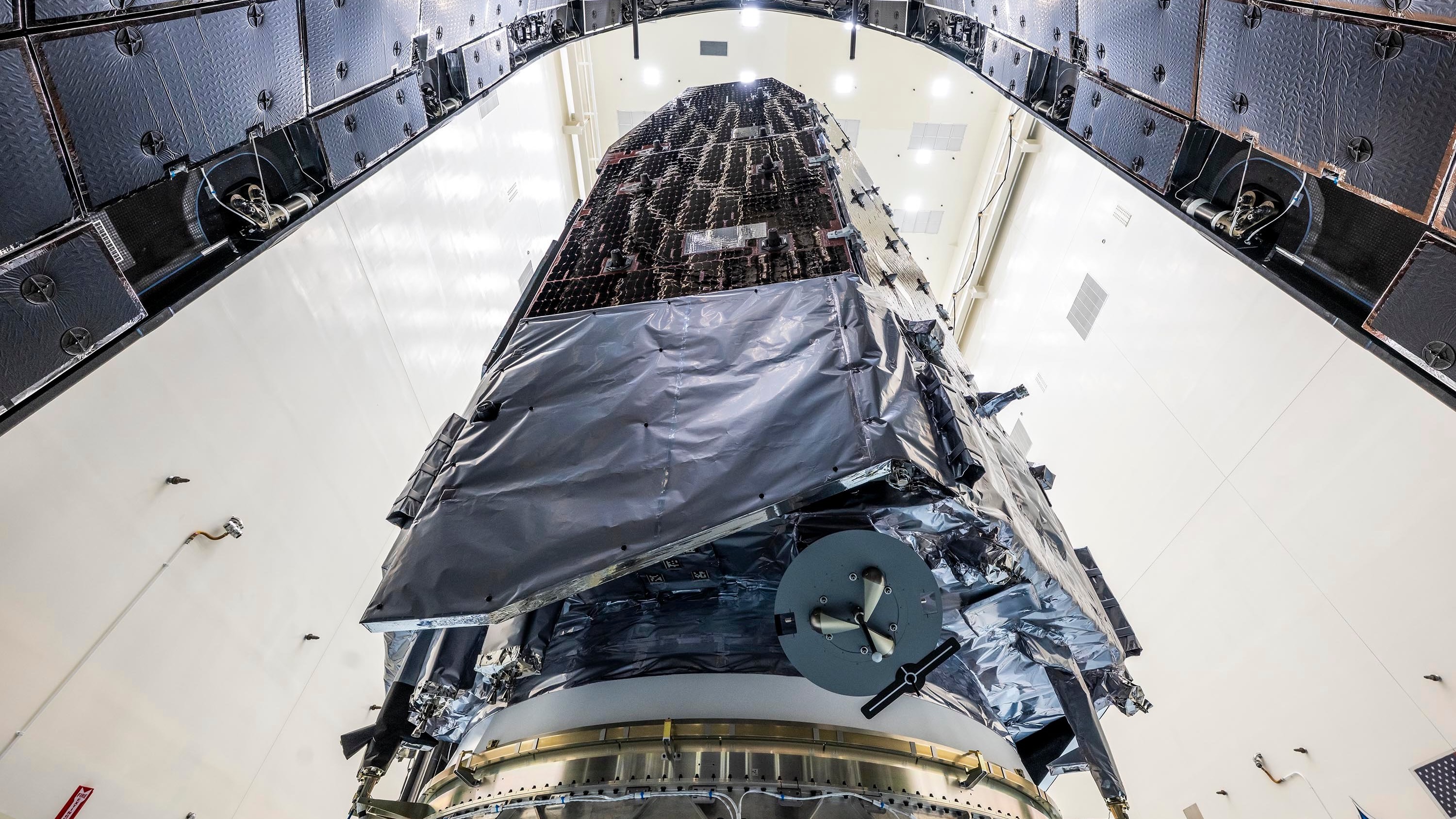
NASA's Nancy Grace Roman Space Telescope is encapsulated in the payload fairing of its SpaceX Falcon Heavy rocket. (Image credit: SpaceX)
Roman vs. the JWST
The main similarity between the Roman Space Telescope and the JWST is those infrared light goggles.
Infrared light, unlike visible light, is invisible to human eyes. You can think of it more like a heat signature. Firefighters, for instance, use infrared trackers on burning buildings from the outside to see where the source of the fire might lie within. And when it comes to astronomy, infrared light is priceless — that's why the JWST's strong infrared capabilities give it an advantage over Hubble.
Infrared light's role in astronomy observations has to do with the way light moves throughout the universe. As light from a distant region of space moves toward us — through a continuously expanding universe, no less — those light wavelengths stretch out from tight, bluer ones into long, redder ones. Eventually, the wavelengths stretch out into the infrared region of the electromagnetic spectrum, which is the part of the spectrum we cannot see with our own eyes. Plus, any objects in our line of sight that are hidden behind dense clouds of interstellar dust or gas can only be seen via their infrared emissions.
What this means is that very, very distant objects as well as concealed objects in space are pretty much invisible to us, hiding in the infrared part of the spectrum. We therefore need infrared decoders, like the JWST's suite of tools or Hubble's infrared instrument, to reveal them.
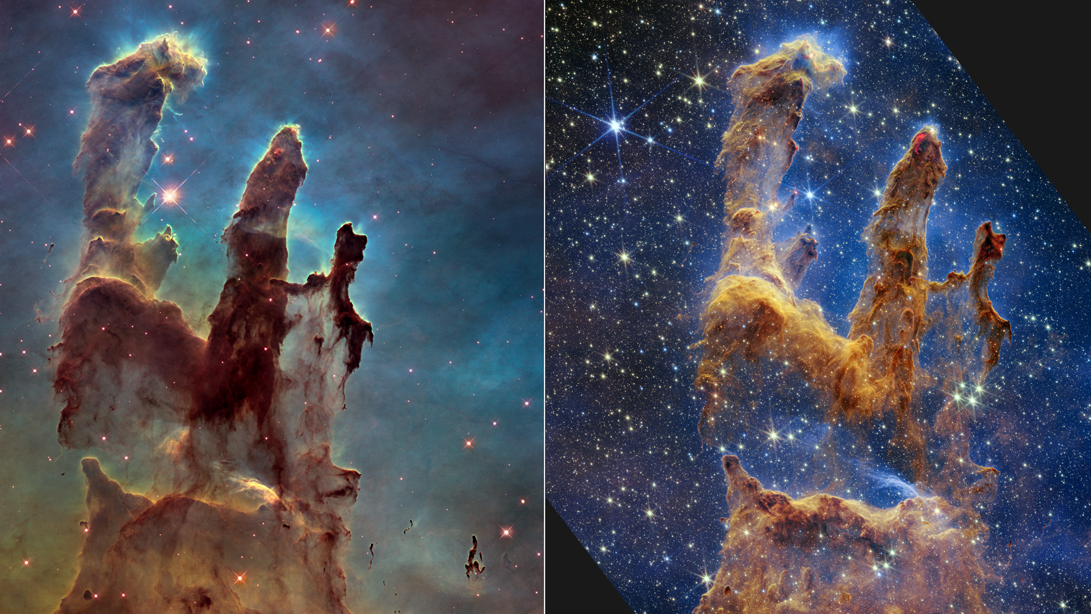
The JWST has already made absolute strides in this regard, revealing to us peculiar objects from the early years of the universe, consistently breaking its own record while finding the most distant galaxies we've ever seen and revamping Hubble portraits like the spectacular Pillars of Creation with its infrared filter. It's even reintroduced us to our own solar system with crisp views of Neptune's frail, oft-forgotten rings and Saturn's big, bright ones.
The JWST's view of Neptune and its rings. The world looks so small when seen this way. (Image credit: ESA/NASA)
When it comes to mirrors, the JWST's iconic golden primary mirror made of 18 hexagonal segments is a beautiful 21 feet and 4 inches (6.5 meters) across, which is much larger than Roman's. This means the JWST can collect tons more light than Roman can, which makes a lot of sense because it was built to see as deep into the ancient universe as possible.
But where the JWST lacks is, you guessed it, its field of view. This is on purpose. The whole point of JWST is to pierce into the universe with a highly narrow view in order to get great resolution on whatever it's looking at. Roman definitely won't be getting that same resolution, as its images will be shallower than the JWST's, but its WFI will see a region 50 times wider than what the JWST can see.
A view of the James Webb Space Telescope's giant mirror. (Image credit: NASA)
The Roman Space Telescope's mirror. (Image credit: NASA/Sydney Rohde)
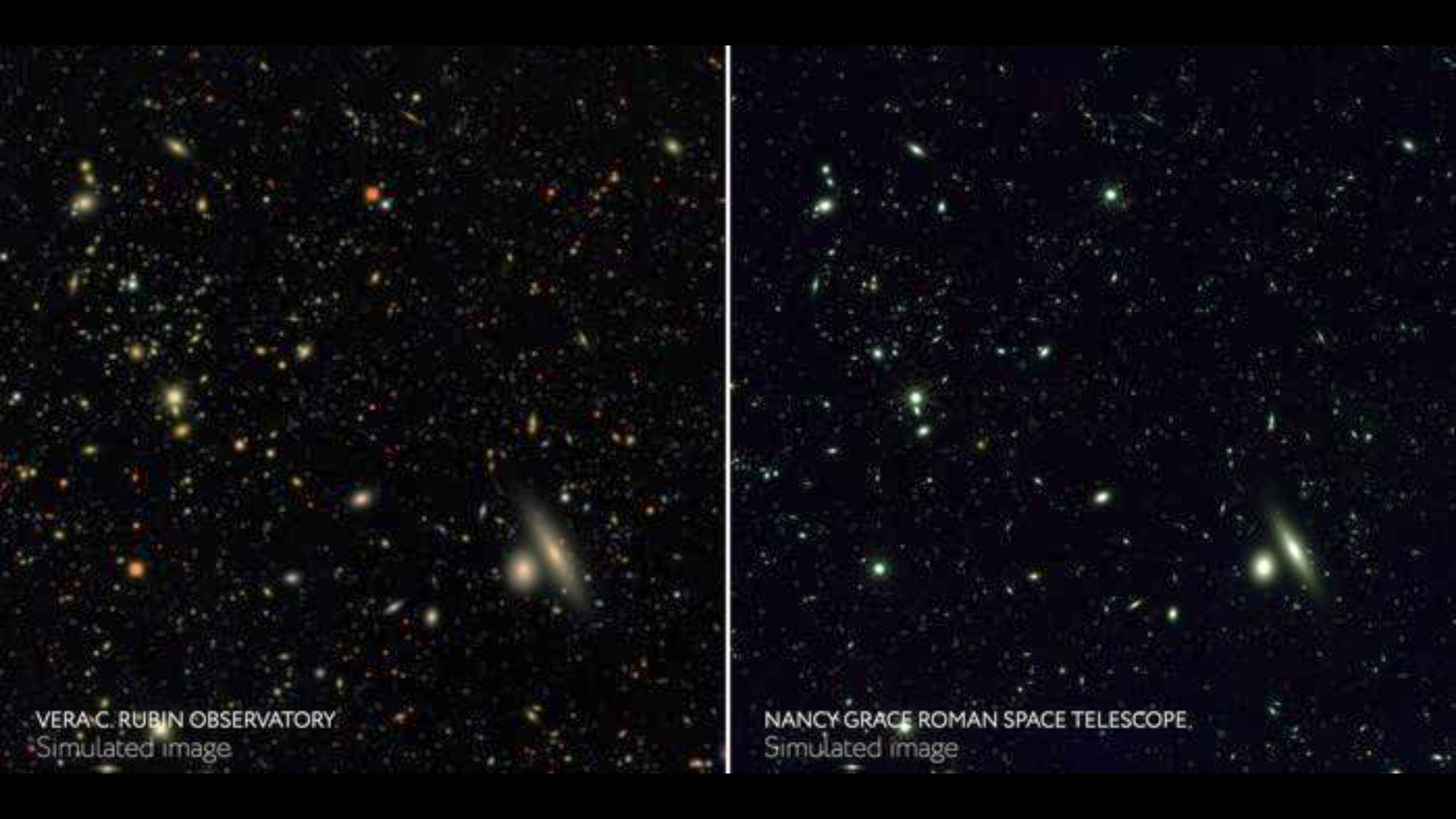
To be clear, there are indeed other survey telescopes that are able to image huge amounts of the sky at once, but Roman's version of doing this is expected to be with higher clarity. For example, the ground-based Rubin Observatory is revolutionary for the vast amounts of data it's able to collect while scanning a new section of the sky every 40 seconds. However, Rubin is on the ground. A space telescope sits above Earth's atmosphere, and therefore has less atmospheric interference to sift through. This makes the observations way better.
Okay, you've probably figured out the moral of the story at this point: Roman's reach is shallower than Hubble's and the JWST's, but extremely wide. So, what's the benefit of this enormity?
Simulated views of what a section of space would look like from the Rubin Observatory and the Roman Space Telescope. Because it has to peer through Earth’s atmosphere, Rubin’s images won’t always be sharp enough to distinguish multiple, close sources as separate objects. (Image credit: J. Chiang (SLAC), C. Hirata (OSU), and NASA’s Goddard Space Flight Center)
The promise of Roman
Imaging huge amounts of the universe in one go is of foremost importance because things in the universe happen simultaneously. A supernova on one end might be worth checking out, but a fleeting fast radio burst buzzing on the other end of the cosmos could be just as vital to study. Yet, with a narrow field of view, you'd have to select which target to zoom in on. And if you aren't sure which targets are even options, while perusing an ancient black hole with immense resolution you will most definitely miss an even older one that lurks 50 frames or so away.
With Roman, scientists won't have to be as selective about which parts of the sky they scan. Roman is designed to be able to capture the supernovas, fast radio bursts, black hole emissions and warped galaxy candidates all at once. For example, NASA explains how Roman will be able to spot colliding neutron stars — stellar corpses so dense a tablespoon of one is equal to the weight of Mount Everest — with its infrared view. The JWST would likely never even come across such an event due to its tunnel vision.
Of course, Roman won't be able to image these objects with as much depth as the JWST or Hubble — or several other telescopes for that matter, like maybe SPHEREx or Euclid — but it will be able to notice that these objects exist.
The next step would be to have one of those other telescopes follow up on the targets. You can think of Roman as creating the Google Maps of hotspot locations in the universe that the JWST, Hubble or another telescope may want to examine someday.
Big field of view means big science
Furthermore, capturing information from billions of objects in such a short period of time will enable specific kinds of research, such as the hunt for the truth about dark matter and dark energy. Despite collectively making up about 95% of the universe's contents, dark matter and dark energy aren't visible to us. However, we know dark energy exists because it appears to be applying a force that accelerates the expansion of our universe and we know dark matter exists because it seems to be the glue around galaxies that prevents them from falling apart like horses on a merry-go-round spinning too fast.
What this means is imaging tons of galaxies at once could allow scientists to have a better picture of how those interactions between the dark universe and our regular universe play out. Roman will also be able to create time-lapse "movies" of the universe in three dimensions and offer scientists the chance to see how other observations fit into that picture.
It would also be remiss not to mention what Roman's other instrument can do: the coronagraph. The telescope's coronagraph is actually one-of-a-kind. You can think of it like a special artificial eclipse that brings objects into view that would otherwise be obscured by bright starlight. No other space observatory in service right now has the ability to directly image exoplanets like Roman will be able to using that coronagraph. It would take an entire other article to explain the awesome complexities of this instrument — an article that you can definitely expect soon — but to go through the basics, this tool will block out the glare of distant stars and then measure the polarization of light around them in order to help scientists tease out exoplanets orbiting those stars.
A side by side view of the Hubble Telescope's view of the Pillars creation and the JWST's. (Image credit: NASA, ESA, CSA, STScI, Hubble Heritage Project (STScI, AURA), Joseph DePasquale (STScI), Anton M. Koekemoer (STScI), Alyssa Pagan (STScI))
According to NASA, Roman's coronagraph will be able to detect planets 100 million times fainter than their stars. That capability is about 100 to 1,000 times better than existing space-based coronagraphs. This will give scientists the opportunity to study planets beyond our solar system that are dimmer, colder, farther and more elusive than what we're currently able to see.
With all this in mind, there is an important concept to remember.
When the JWST first entered service in the year 2022, everyone (including me) started comparing it to Hubble and thinking of it as Hubble's upgrade. It's hard not to, especially when the images rolling out of a shiny new telescope are so utterly gorgeous. But "upgrade" couldn't be farther from reality. The JWST is just different. Impressive, sure, but different. The goal is for all of these telescopes to work together, each one giving us a new sheet of the universe to explore. Stack up all the sheets, and you'll get the full picture.
Roman will simply be offering us one breathtaking new sheet.
Unpopular opinion time, but someone has to say it: I think Pluto being reclassified as a dwarf planet was a great thing for our understanding of the solar system and for the former planet itself. Let me try to convince you, too.
First, a little background. The Pluto planet controversy began exactly 20 years ago on Aug. 24, 2006, when the International Astronomical Union (IAU) reclassified the solar system's (former) ninth planet as a dwarf planet.
The reason for the change was the result of the discovery of worlds similar to Pluto in the Kuiper Belt, the ring of icy bodies and debris extending out beyond the orbit of Neptune. It suddenly became necessary to determine if these bodies are planets or whether the definition of what a planet is needs to be reshaped. The IAU decided on the latter. Pluto took the hit.
The 2006 definition developed for the IAU by the Uruguayan astronomers Julio Ángel Fernández and Gonzalo Tancredi says a planet is "a celestial body in the solar system that is in orbit around the sun, has sufficient mass to assume hydrostatic equilibrium [it is round or nearly round], and it has 'cleared the neighborhood' around its orbit."
That meant a new definition had to be introduced for large round bodies orbiting the sun, one that meets these first two criteria, but fails to meet the the third. Thus, dwarf planets were defined by the IAU as: "an object in orbit around the sun that is large enough to pull itself into a nearly round shape but has not been able to clear its orbit of debris."
Pluto fell out of the planet category and into the dwarf planet category because, as it orbits the sun out beyond Neptune, other bodies cross its orbital path. Thus, Pluto hasn't cleared its neighborhood. Not a planet then, sorry.
But don't feel too bad. It is a good thing, honestly.
Pluto helped put dwarf planets on the cosmic map
The redefinition of Pluto has had a strange effect on the general public and even some scientists, who seem to "feel sorry" for the former planet, almost as if it has somehow been demoted. There are several Change.Org petitions and petitions on other sites that demand to restore Pluto's planethood. One of these, established in 2024, has over 1,000 signatures.
Some petitions to make Pluto a planet again fundamentally misunderstand why Pluto isn't a planet anymore. Take this one on slightly tongue-in-cheek petition on iPetitions, which states: "Pluto should not have its planet rights taken away form {sic] it just because it is small, so is Daniel, but that doesn't make him not a human anymore! This is a very urgent matter! This is an EMERGENCY!!"
I don't know who Daniel is, but I do know that Pluto being reclassified as a dwarf planet really exemplified how diverse the solar system actually is.
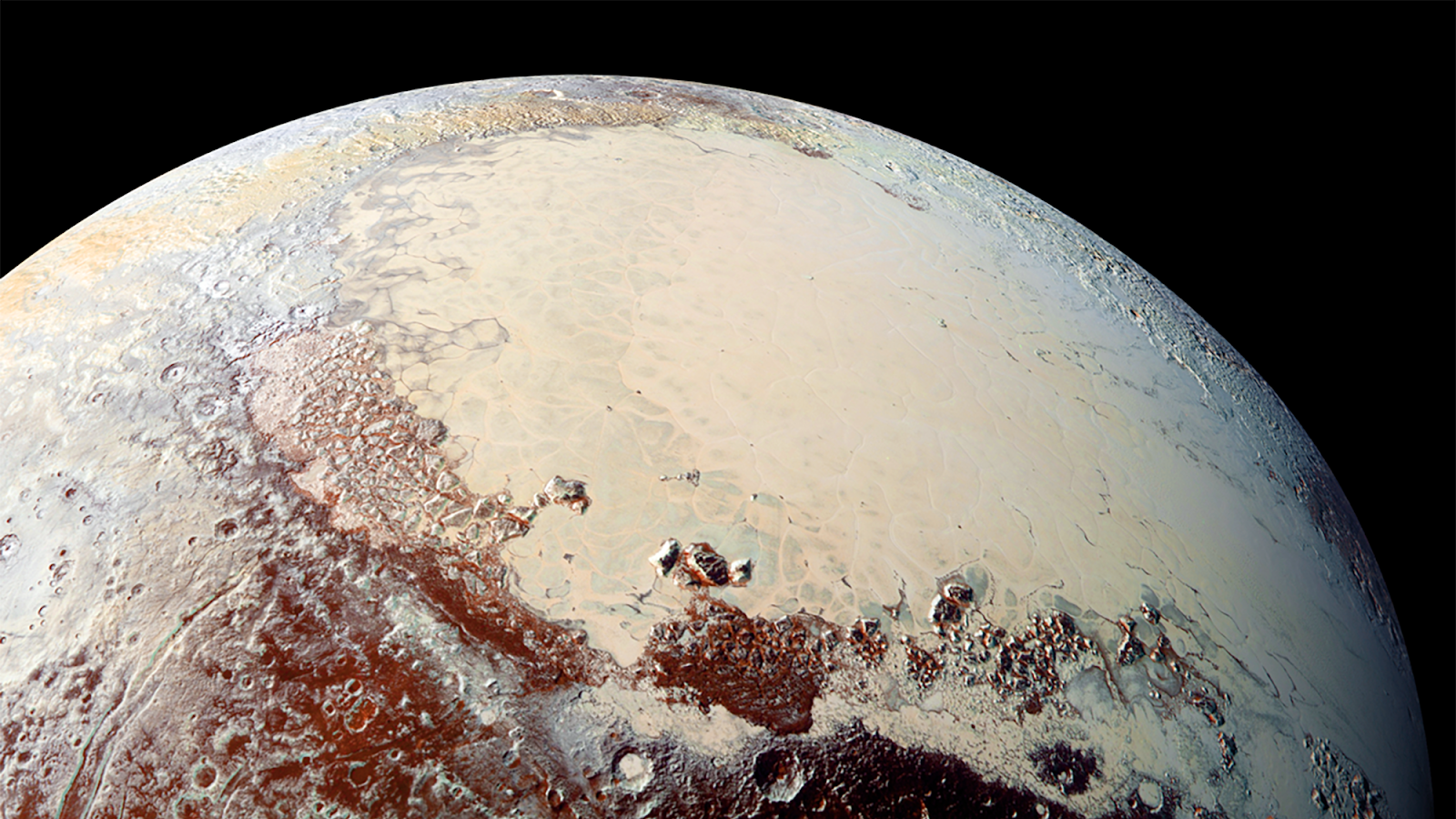
Pluto as seen by NASA's New Horizons spacecraft in 2015. (Image credit: NASA/Johns Hopkins University Applied Physics Laboratory/Southwest Research Institute )
When we think of the solar system, we think of the planets orbiting the sun, and the moons orbiting their planets. Maybe we picture the occasional visit by an asteroid or comet. The reclassification of Pluto ensures that the general public can't really ignore the fact that there are many solar system bodies with sizes between planets and asteroids that are no less important than the planets themselves.
Many of these dwarf planets exist far from the sun, and don't visit the inner solar system — meaning they don't get blasted by high levels of solar radiation. Likewise, they generally haven't been affected by geological processes, meaning that the material they are composed of is unspoiled. Thus, dwarf planets could act as time capsules that allow us to study the matter that existed in the solar system when planets like Earth started to form.
We shouldn't ignore dwarf planets when we talk about the solar system, and as the king of the dwarfs, Pluto ensures we can't. Its change in status made the study of Kuiper Belt objects seem equally as important as the study of moons and planets.
There is also a really simple and logistical reason not to make Pluto a planet again. Though the IAU currently recognizes only five dwarf planets — Ceres, Pluto, Haumea, Makemake and Eris — astronomers think there are as many as 100 of them still waiting to be discovered.
If we let Pluto back into the planet party, then all these other dwarf planets should be allowed back in too, right? Keeping Pluto a dwarf planet better defines what a planet is and prevents an awkward situation in the future in which schoolchildren (and the rest of us) would have to remember upwards of 100 planets.
Don't 'feel sorry' for Pluto
If you are going to feel sorry for any dwarf planet, maybe it should be Ceres. The closest dwarf planet to Earth, it was discovered in 1801, 129 years before Pluto, and was therefore the first dwarf planet to be discovered (though it was not defined as such initially).
Pluto has really stolen Ceres' thunder as the solar system's most prominent dwarf planet.
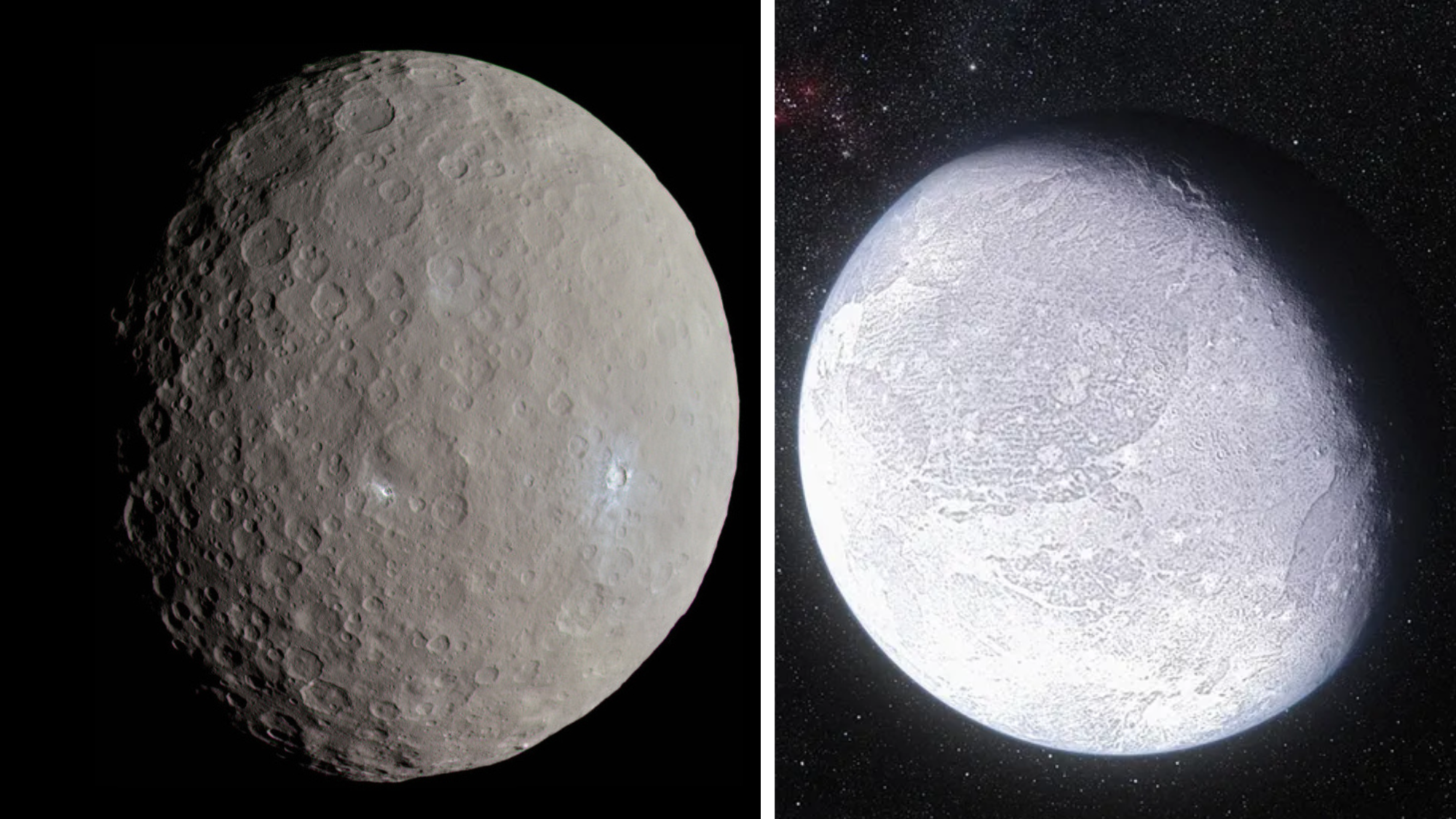
Spare a thought for Erisas well. Also located beyond the orbit of Neptune, this dwarf planet is 1,445 miles (2,326 kilometers) wide, making it just a hair smaller than the largest solar system dwarf planet, Pluto, which is 1,477 miles (2,377 km) across. But Eris is actually more massive than Pluto, making it the most massive dwarf planet in the solar system, and Eris never even got the chance to be called a planet.
Where is the petition for Ceres or Eris, eh? Nowhere, that's where.
Spare a though for Ceres (left) and Eris (right) important dwarf planets that have never been classified as planets. (Image credit: NASA/ESO/L. Calçada)
But seriously, there is something crucial to remember in all this: The redefinition of Pluto as a dwarf planet took away none of the former planet's wonder or beauty.
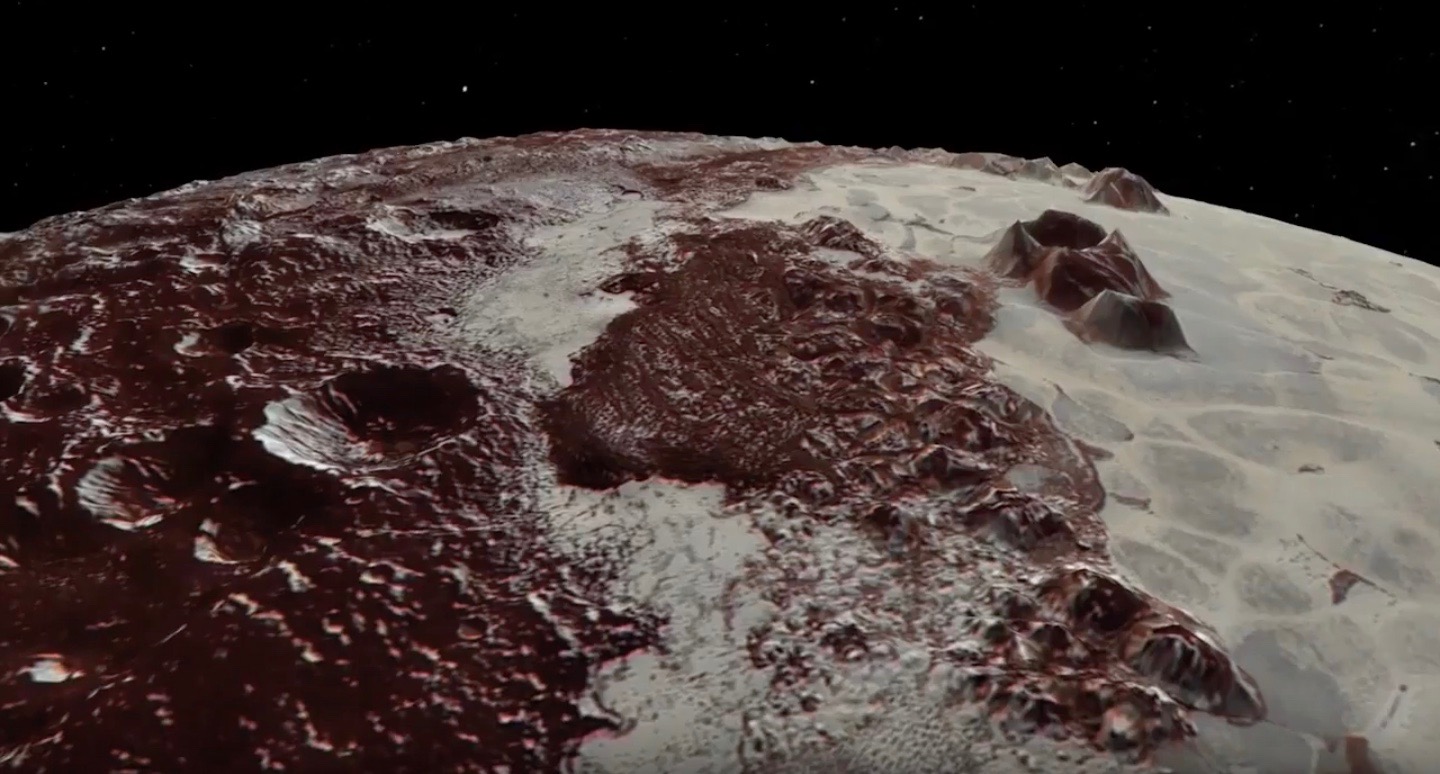
Is the bright heart-shaped plain of Sputnik Planitia, composed of squishy nitrogen ice, any less spectacular because it belongs to a dwarf planet? Are the towering 11,000-foot-high (3,350 m) ice mountains of Pluto any less majestic because they rise from the surface of a dwarf planet, not a planet?
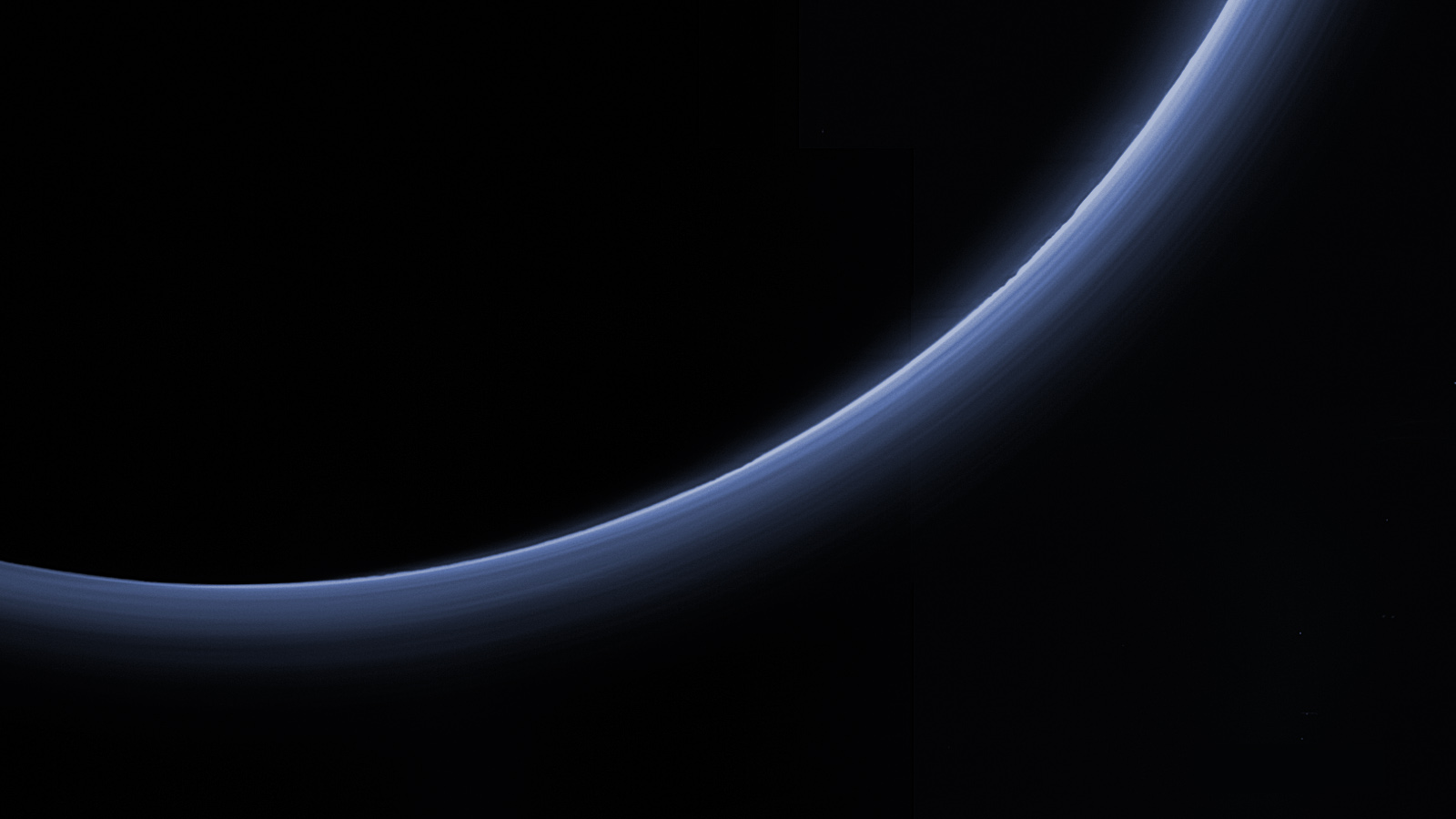
What about the blue haze that envelops the dwarf planet? Or Pluto's regions of shifting ice that show the former planet to be far more active than we once thought? Are they less scientifically fascinating?
New Horizons' view of Pluto, as seen in a new NASA video released on July 14, 2017. (Image credit: NASA/JHUAPL/SwRI/Paul Schenk and John Blackwell, Lunar and Planetary Institute)
Were the observations made by NASA's New Horizons spacecraft less monumental for humanity, or less of an impressive scientific achievement, because this was only a nine-year trip to a dwarf world?
Of course, the answer to all of the above questions is definitely no.
Pluto may not be the ninth planet, but it still sits at the forefront of dwarf planets in our minds and helped to define a whole population of solar system bodies.
Twenty years after Pluto lost its planetary status, people are still arguing about it.
This spring, NASA Administrator Jared Isaacman publicly threw his support behind "make Pluto a planet again," reigniting the familiar debate. Social media threads are filled with people arguing over whether Pluto should be grandfathered into the planetary club, whether dwarf planets are simply another kind of planet, and whether the distinction matters at all.
The disagreement dates to August 24, 2006, when members of the International Astronomical Union adopted a definition of a planet that placed Pluto in the dwarf-planet category. The scientific debate over how best to define a planet has continued in the years since, and the public has many thoughts, too — many people still cling to Pluto's identity as a planet. But why?
The planet we grew up with
From its discovery on February 18, 1930 to its demotion, Pluto belonged to one of the first maps of the universe that students learned: our solar system. There were nine planets, usually memorized in order through classroom diagrams, models and mnemonics such as "My Very Elegant Mother Just Served Us Nine Pies."
Deana Weibel, a cultural anthropologist at Grand Valley State University, says those childhood associations have staying power long into adulthood. As a planet, Pluto was also particularly memorable: the farthest planet, the smallest planet, and a relatively recent addition to the solar system. "It was the knowledge that new planets could be added, with its story of being discovered in the 20th century," says Weibel.
For people who absorbed that version of the solar system as children, the 2006 decision required replacing something that had been an established fact. Laurie Groh, a licensed psychotherapist and owner of Shoreside Therapies in Milwaukee, says that helps explain why the change could provoke an emotional reaction disproportionate to its effect on everyday life. "People aren't grieving a planet," says Groh. "They're grieving the idea that what they learn is permanent. It isn't. Science changes and evolves."
The haze around Pluto captured by NASA's New Horizons probe. (Image credit: NASA/JHUAPL/SwRI)
That attachment may fade as generations raised with eight planets get older — but there's not a black-and-white cutoff date. Rob Crotzer, founder and editor of OuterSpaceTrip.com, has watched his own nine-planet upbringing filter down to his daughter Emily, who was born well after Pluto's reclassification. She learned about Pluto from him, her grandmother, and an astronomy atlas published before the 2006 vote. "My daughter was born into the eight-planet solar system," Crotzer says, "yet she has decided that eight isn't enough."
Why our brains resist recategorization
Nostalgia isn't the only force at play. "Our brains work via comparison and categories. That's how we make sense of anything and everything," says Matthew Leahy, a licensed clinical psychologist who studies memory and cognition. Humans rely on categories to organize enormous amounts of information, and changing an established category requires revising a framework that was already functioning perfectly well.
But Pluto presents an especially curious case because the stakes for most people are so low — its planetary status hardly affects the general public day-to-day. "The emotional meaning of a category can sometimes matter much more to us than its practical importance," says Leahy.
Groh also points to the way the change happened. Unlike Pluto's naming, when the public suggested monikers for the new planet, the public didn't participate in the scientific process of its recategorization. Changes imposed quickly from outside, Groh says, can invite resistance even when there is a solid reason behind them.
Rooting for the underdog
Then there is Pluto itself: small, distant, and lonely. "For many people, the issue is less about astronomy and more about rooting for the little guy, the underdog," says Kevin Schindler, historian and public information officer at Lowell Observatory, where Clyde Tombaugh discovered Pluto in 1930.
The language surrounding the change encourages that interpretation. Pluto is routinely described as having been "demoted," rather than simply reclassified, turning a technical distinction into something that sounds punitive. "We don't like the idea of the 'little guy' getting kicked out," Groh says. "We personify Pluto when we have that reaction."
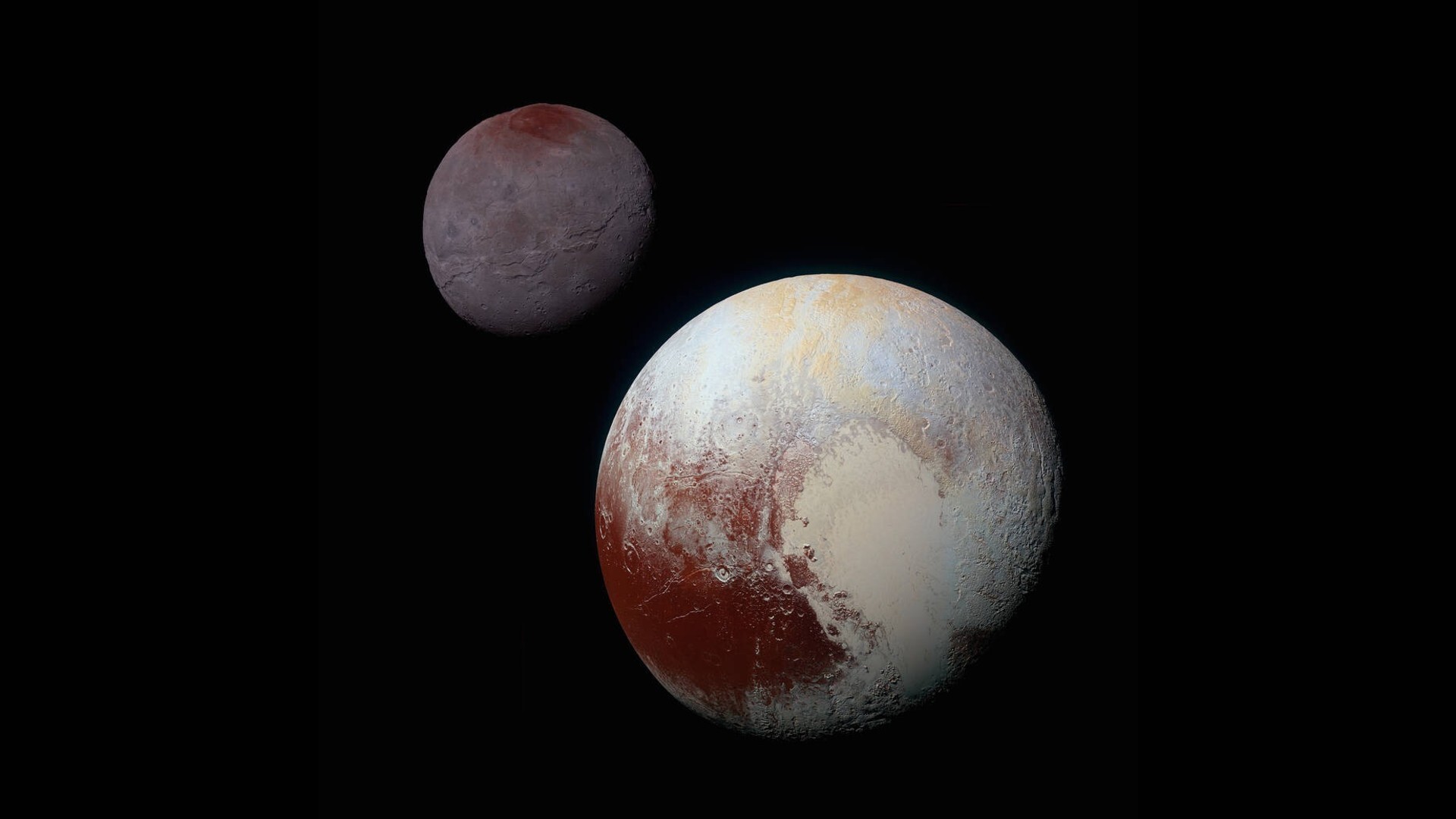
An image showing Pluto and Charon, the world's moon. (Image credit: NASA/JHUAPL/SwRI)
That personification has helped give Pluto a cultural life all its own. At Lowell Observatory, affection for the dwarf planet is strong enough to inspire the annual I Heart Pluto Festival, a multi-day celebration of its discovery, science, and history. Nearly a century after Tombaugh first spotted Pluto from Flagstaff — and two decades after its reclassification — people still gather specifically to celebrate it.
In other words, becoming a dwarf planet didn't necessarily diminish Pluto's popularity; if anything, it gave people another reason to rally behind it.
Does it matter what Pluto is called?
Scientifically, yes, it does matter how we classify Pluto. Jessica Libby-Roberts, an assistant professor and exoplanet scientist at the University of Tampa, points to Pluto's unusual orbit, small size, and similarities to other Kuiper Belt objects as reasons the dwarf-planet classification makes sense. Categories allow researchers to compare objects and make sense of how the solar system formed.
But Libby-Roberts doesn't view its exclusion from the eight planets as a knock against Pluto. "Honestly, I think Pluto would rather not be grouped in with the boring rule-abiding planets anyway," she says. "It seems much happier doing its own thing."
A scientific label doesn't determine whether Pluto is interesting, either. Libby-Roberts notes that the 2015 New Horizons mission overturned expectations of a relatively generic, cratered world, instead revealing a dynamic one with mountains, glaciers, and an atmosphere.
"In some ways, it doesn't matter what Pluto is called because regardless of what label we humans assign to it, Pluto will keep orbiting the sun and doing its thing," Schindler says.