However, the three Russian cosmonauts living on the ISS will have to clock in as usual.
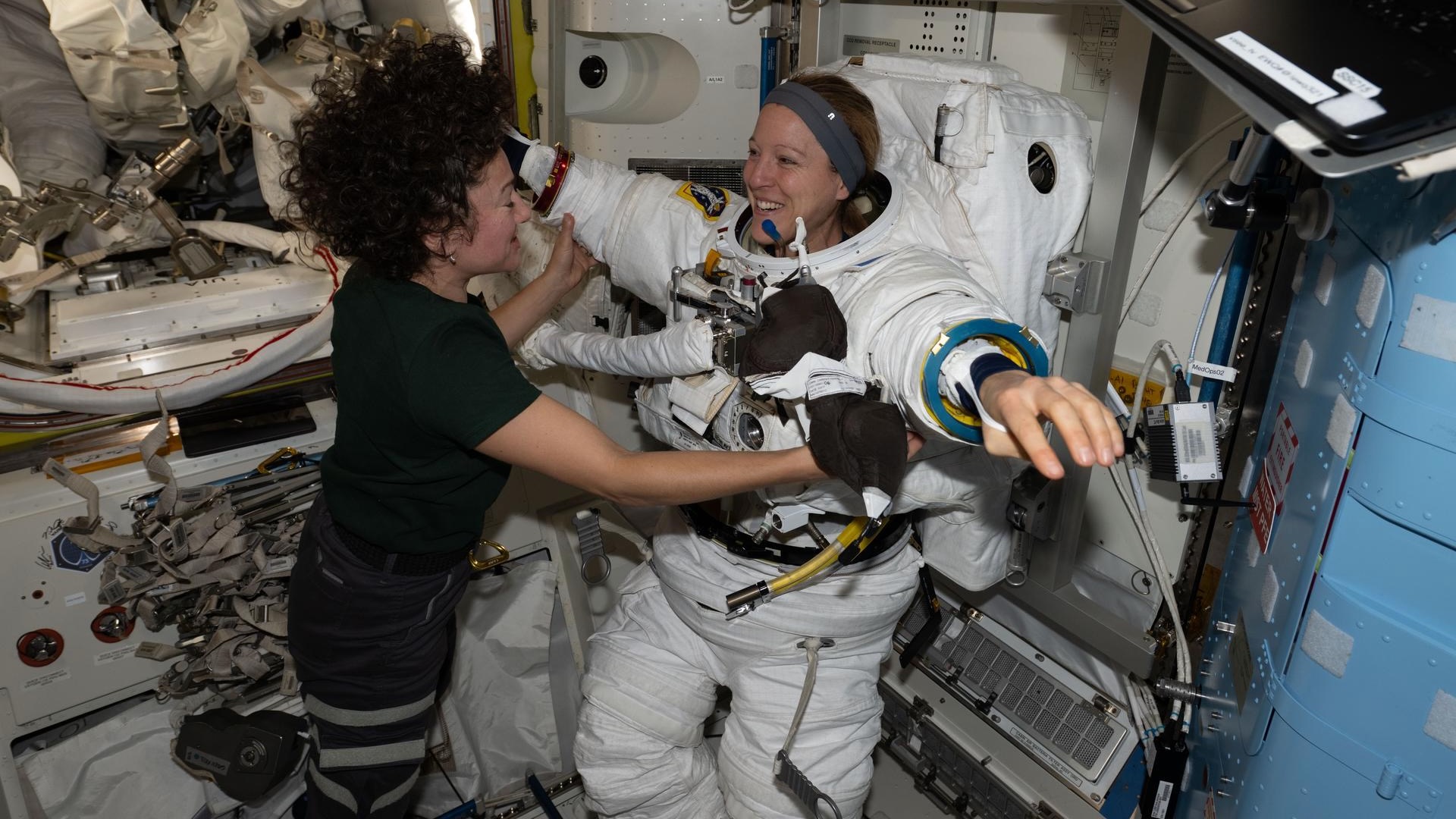
NASA astronaut Jessica Meir (left) and the European Space Agency's Sophie Adenot work together inside the International Space Station’s Quest airlock during spacesuit fit and leak checks. (Image credit: NASA)
The trio — Pyotr Dubrov, Andrey Fedyaev and Anna Kikina — "will be busy monitoring the Progress 94 resupply spacecraft when it undocks on Monday, packed with trash and obsolete gear, from the Poisk module," NASA officials said in an update on Friday.
"It will be replaced by the Progress 96 resupply spacecraft after it launches from Kazakhstan's Baikonur Cosmodrome on Sept. 9 for an automated docking two days later to Poisk’s vacated port," they added.
Adenot, Feyaev, Hathaway and Meir arrived at the ISS in mid-February on SpaceX's Crew-12 mission. Dubrov, Kikina and Menon are relative newcomers, reaching the station aboard a Russian Soyuz spacecraft on July 14.
NASA astronauts on long-duration missions to the ISS generally work a relatively normal schedule, getting weekends and major holidays off. Such downtime is crucial to mission success, as it helps the spaceflyers stay happy, healthy and productive.
They may not be able to mark the holidays in exactly the same ways we do here on Earth, however. For example, the astronauts won't be grilling any hamburgers or hot dogs today, as open flames are verboten on the ISS.
As today's schedule shows, international crewmates do not always have the same days off in orbit. But they try to celebrate major holidays like Christmas together, both to cement the bonds that exist between them and to take the sting out of being so far away from family and friends.
Two astronauts replaced a spacecraft docking aid and a video camera during a successful spacewalk outside of the International Space Station on Tuesday (Sept. 1).
NASA astronaut Jessica Meir and ESA (European Space Agency) astronaut Sophie Adenot got through most of the tasks set out for them even in light of Adenot's spacesuit developing a mobility issue late in the extravehicular activity (EVA), which lasted six hours and 49 minutes.
After beginning the spacewalk from the U.S. Quest airlock at 8:40 a.m. EDT (1240 GMT), Meir and Adenot set about the first and most important activity of the outing: replacing the planar deflector on the forward port of the station's Harmony Node 2. The retroreflector is used to support navigation during rendezvous and docking operations by visiting spacecraft. The older reflector that they replaced had become coated in thruster residue from earlier spacecraft arrivals and departures.
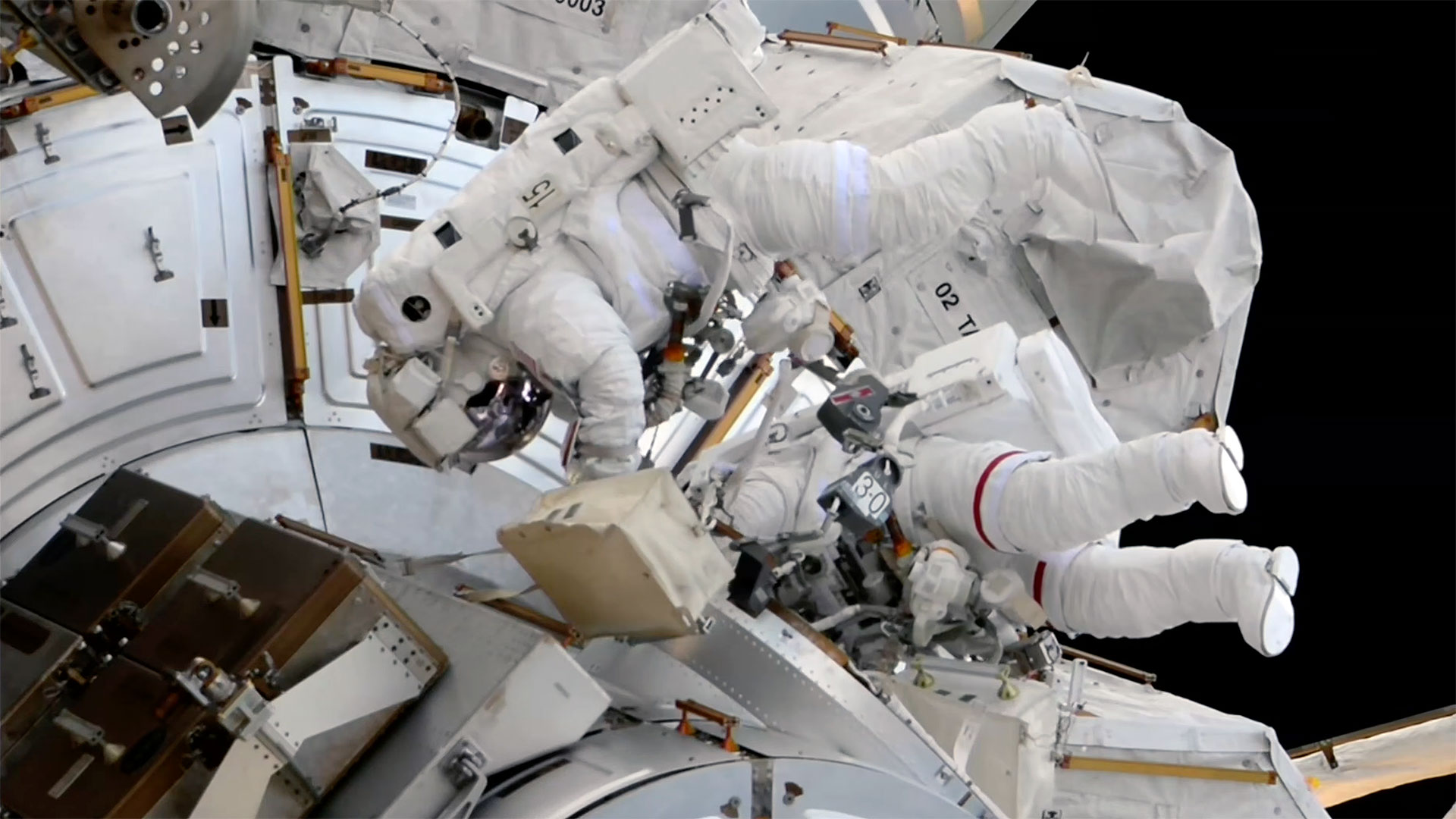
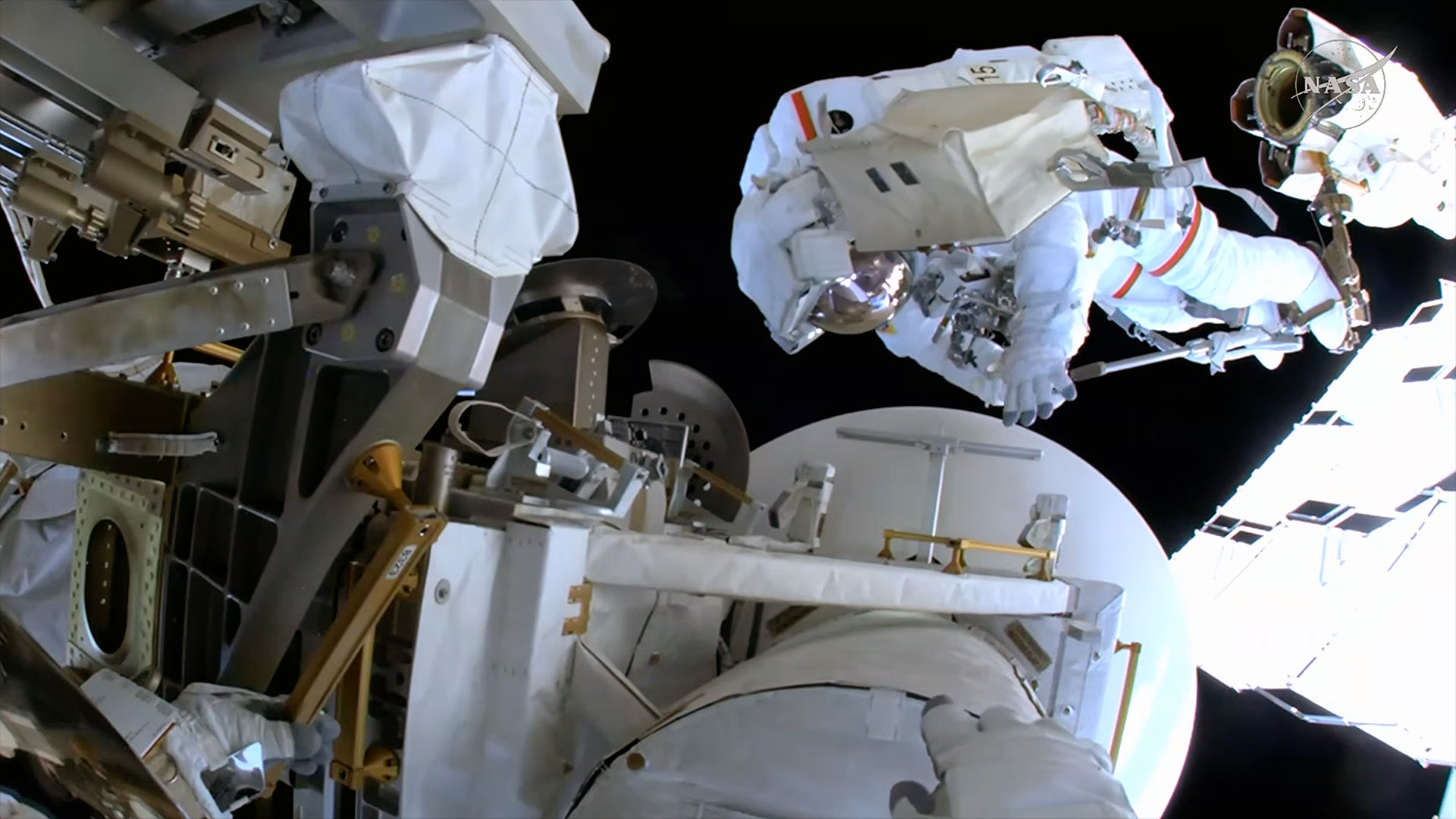
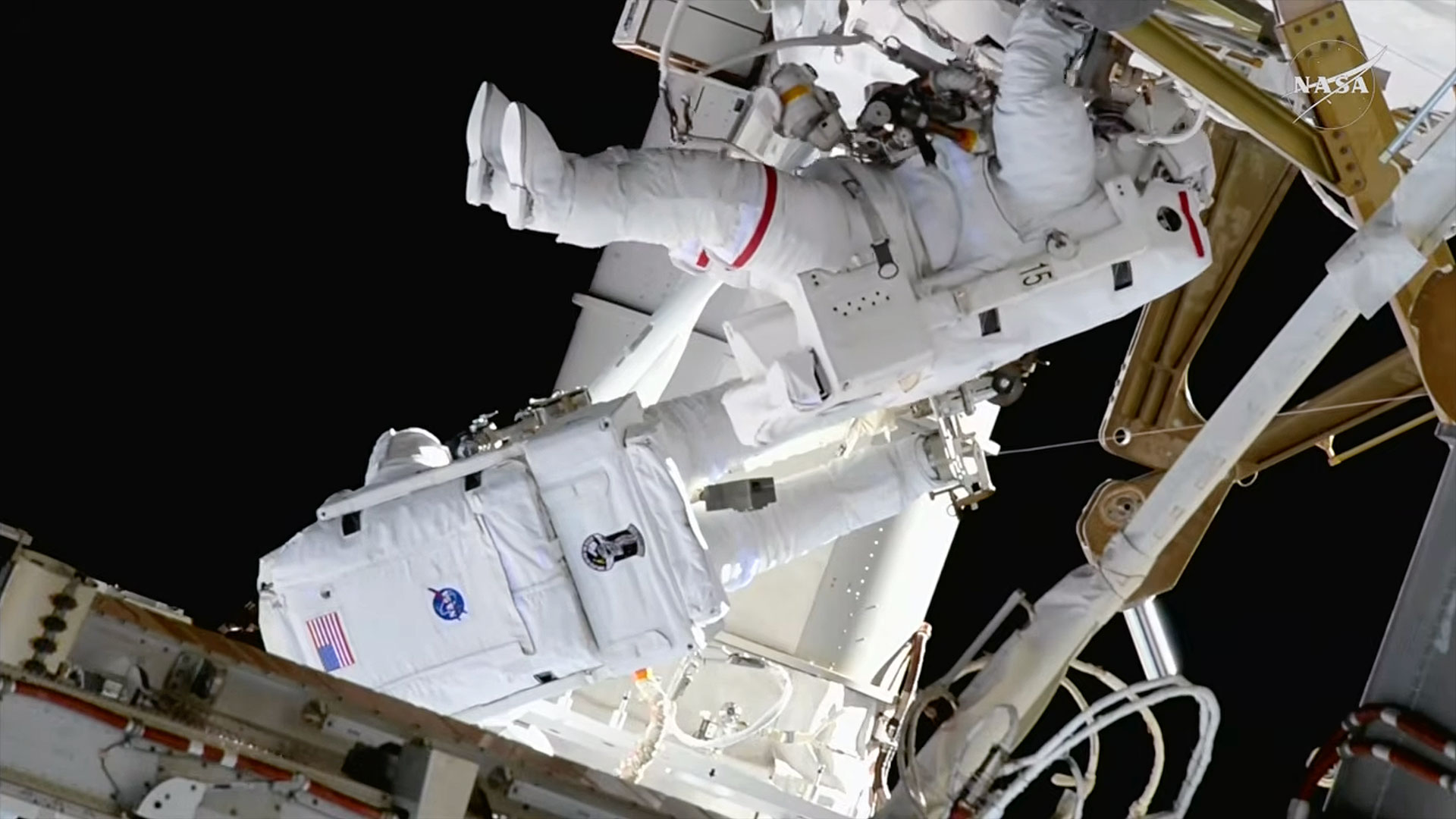
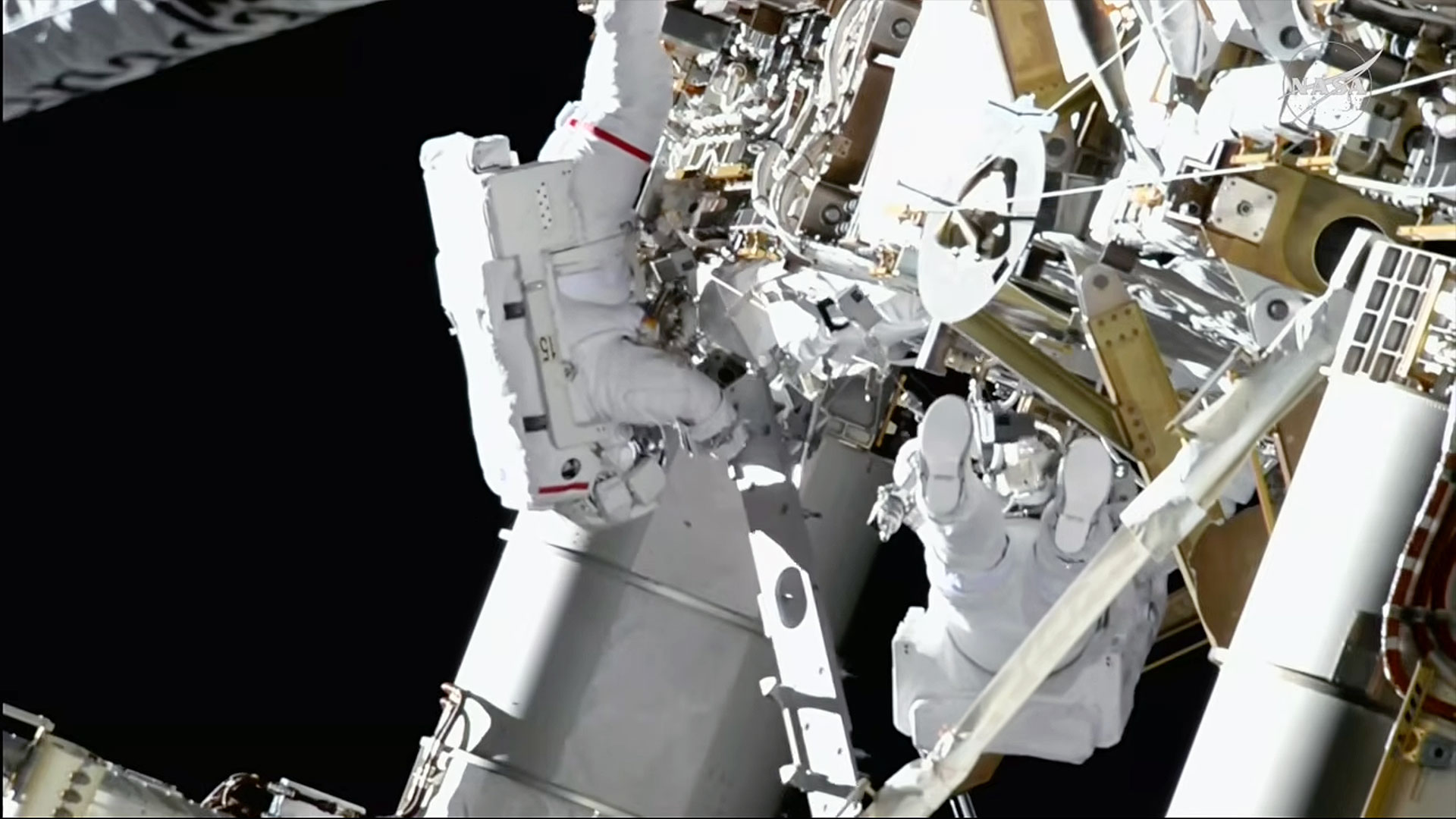
NASA astronaut Jessica Meir (at left) and ESA astronaut Sophie Adenot (in spacesuit with red stripes) are seen outside the Quest airlock during a spacewalk at the International Space Station on Tuesday, Sept. 1, 2026. (Image credit: NASA)
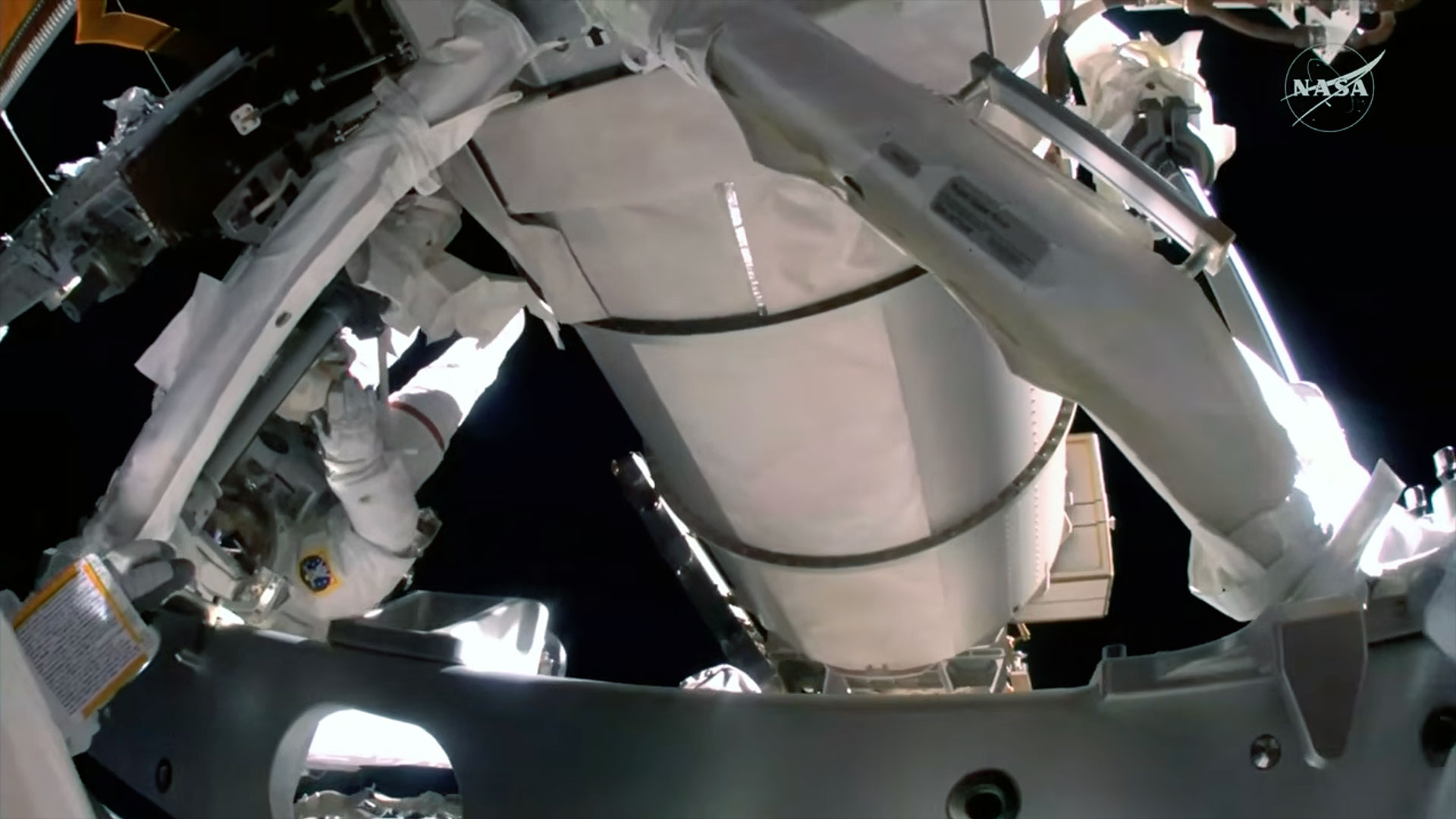
They also replaced the Camera Port 3 (CP3) high-definition (HD) camera on the station's truss.
"And it's off!" reported Meir after freeing the spent camera assembly that was swapped out for spare. Her words were met by applause in Mission Control at NASA's Johnson Space Center in Houston.
"That worked, great!" she said.
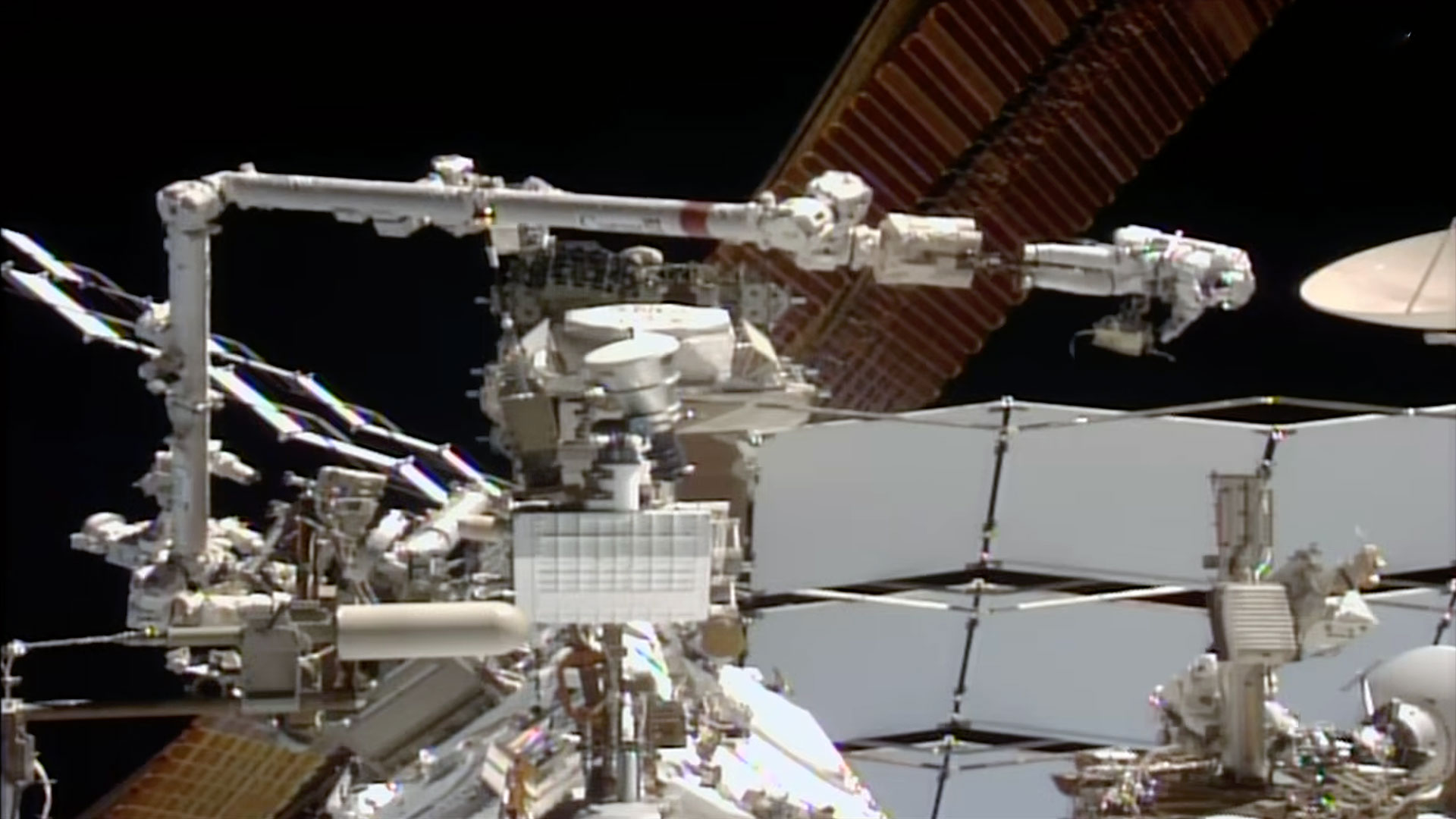
From there, Adenot headed off to continue an ongoing scientific study by swabbing areas on the exterior of the airlock and her gloves for possible microorganisms. Meir, meanwhile, rode one end of the Canadarm2 robotic arm to a site near the Alpha Magnetic Spectrometer (AMS), torquing 46 bolts in preparation for future maintenance of the particle physics detector.
Meir also relocated power and thermal jumper cables and an articulating portable foot restraint for use on a later spacewalk.
There were some other tasks planned, time permitting, but toward the end of the EVA, Adenot reported losing mobility in her left shoulder joint. Erring on the side of caution, Mission Control called for Adenot to wait where she was until Meir could follow her back to the airlock.
Once there, Meir was able to unzip a portion of Adenot's extravehicular mobility unit's (EMU's) upper arm assembly to inspect what was happening. In doing so, she freed the kink that had limited Adenot's motion.
"I think it was where the cable got caught in between the shoulder MLI [multi-layer insulation] and the rotation [joint]. I don't think it was held up by anything but some friction," said Meir.
The two Expedition 75 crewmates then proceeded back into the airlock to complete the EVA at 4:29 p.m (2029 GMT).
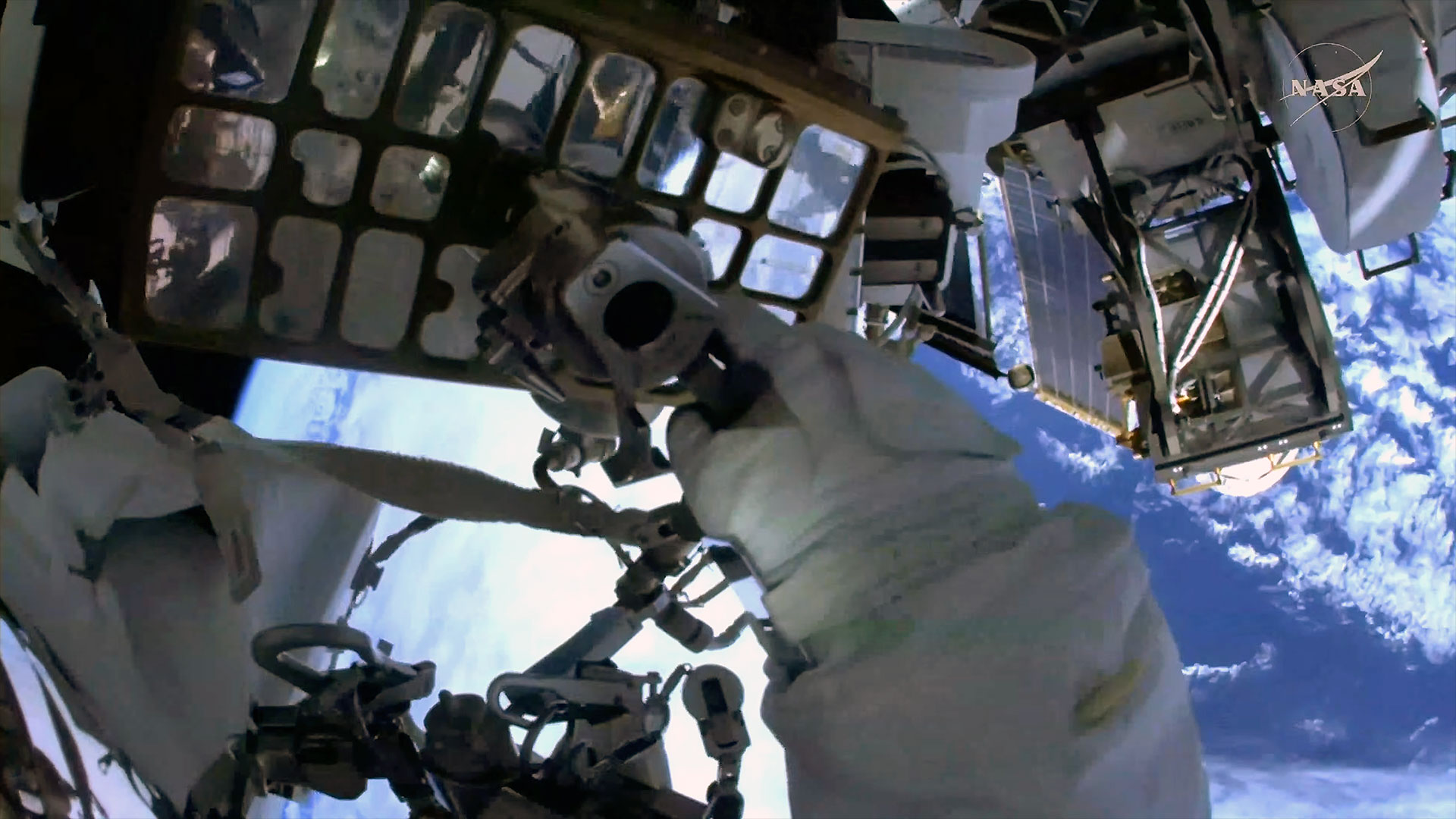
In a view from her helmet-mounted camera, NASA astronaut Jessica Meir holds a spent HD video camera before installing its replacement outside of the International Space Station on Tuesday, Sept. 1, 2026. (Image credit: NASA)
Tuesday's spacewalk was Meir's seventh and Adenot's third. Meir, who has a total of 49 hours and 22 minutes on EVA, now ranks third among all women astronauts at NASA for total number of spacewalks. She trails only Peggy Whitson with 10 and Suni Williams at 9.
Adenot now has spent 19 hours and 42 minutes working in the vacuum of space.
This spacewalk was the 284th supporting the International Space Station's assembly, maintenance and upgrades. It was the seventh spacewalk this year, fifth EVA for Expedition 75 and the sixth all-female spacewalk in history.
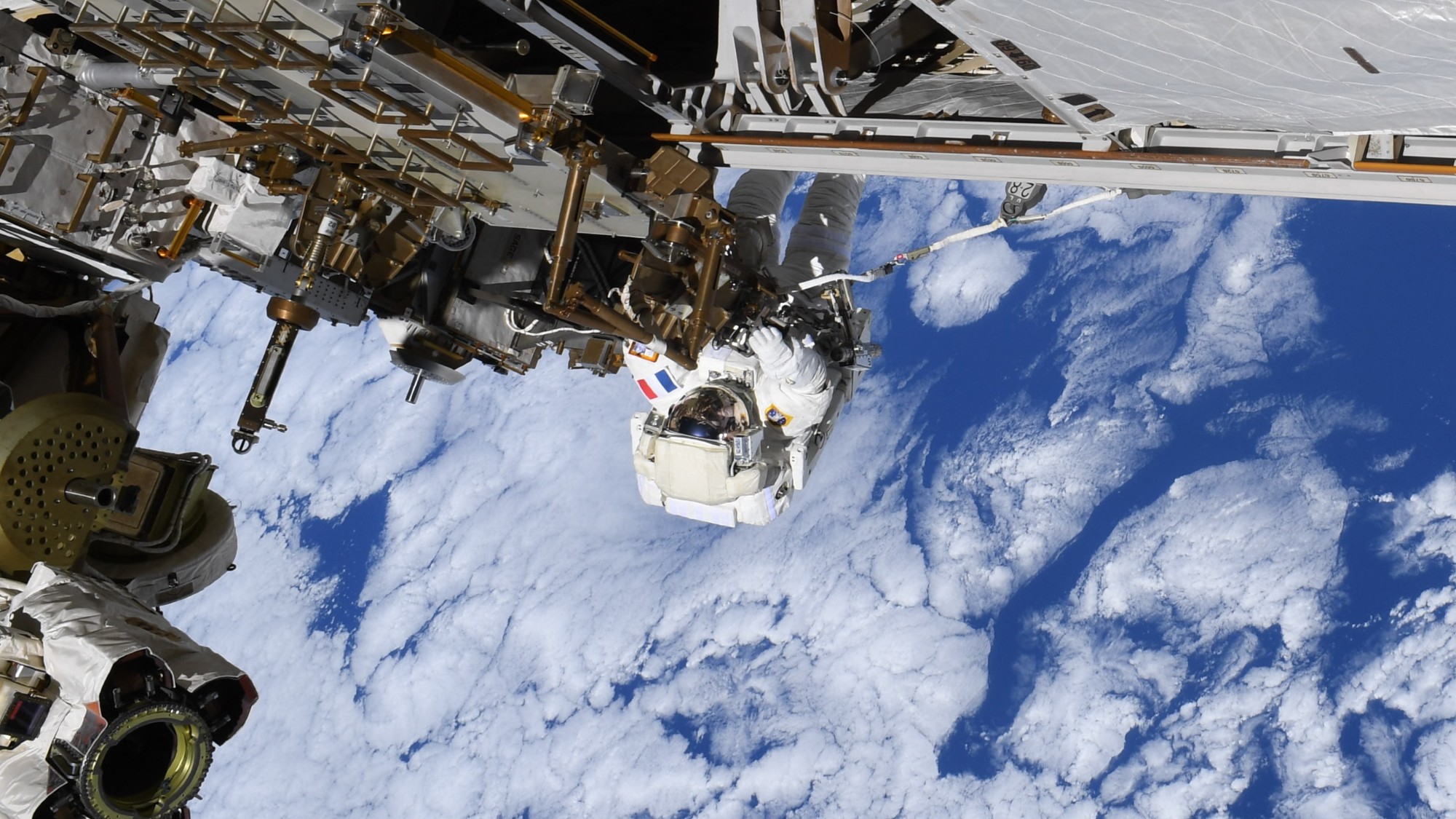
ESA astronaut Sophie Adenot on the outside of the International Space Station during an extravehicular activity on Aug. 25, 2026. (Image credit: ESA/NASA)
Repairing an engineering marvel like the International Space Station is no easy feat by itself, but it's even more impressive when it's done 250 miles (400 kilometers) up.
The photo was taken while Adenot and NASA astronaut Anil Menon were conducting a 6.5-hour spacewalk, or extravehicular activity (EVA), to replace one of two Space-to-Ground antennas on the outside of the ISS.
This was the second EVA that Adenot and Menon performed to replace the antenna. During a previous spacewalk a week earlier, the pair ran out of time before the new antenna could be installed.
With that first spacewalk, Adenot became the first woman from France to ever conduct an EVA.
Why is it incredible?
It can be hard to conceptualize just how high up the ISS orbits until you see a photo like this one; few people on Earth have ever flown as high as 250 miles (400 km), so that altitude can feel a bit abstract. Seeing an astronaut like Adenot clinging to the space station with the clouds and blue oceans of Earth below puts things into perspective.
At that height, the ISS orbits at quite a high rate of speed. The orbital laboratory zips around Earth at 17,500 mph (28,000 kph), meaning it circles the planet 16 times a day. This photo was taken on day 194, or orbit 3010, of Adenot's mission, which began in February when she launched to the ISS as part of NASA's Crew-12 mission.
Two astronauts will conduct history's sixth all-female spacewalk today (Sept. 1), and you can watch it live.
NASA's Jessica Meir and Sophie Adenot of the European Space Agency will venture outside the International Space Station (ISS) at around 8:30 a.m. EDT (1230 GMT) on an excursion expected to last about 6.5 hours.
You can watch it here at Space.com, courtesy of NASA, or directly via the agency. Coverage will start at 7:00 a.m. EDT (1100 GMT).
NASA astronaut Jessica Meir and the European Space Agency's Sophie Adenot work together inside the International Space Station’s Quest airlock during spacesuit fit and leak checks. (Image credit: NASA)
During today's spacewalk, Meir and Adenot "will replace a retroreflector on the forward port of the space station's Harmony module to support spacecraft navigation during rendezvous and docking operations," NASA officials said in a media advisory.
"After installing the reflector, the crew will work to install jumper cables for the data-relay systems, prepare the Alpha Magnetic Spectrometer's radiator for future maintenance, and replace a high-definition camera on the station's truss," they added.
Adenot will be "crew member 1" on today's spacewalk and will wear a suit with red stripes, NASA officials said. Meir will wear an unmarked suit and serve as "crew member 2."
It will be the third spacewalk for Adenot, who two weeks ago became the first French woman ever to perform an extravehicular activity (EVA). It will be the seventh for Meir, which will put her third among female NASA astronauts behind Peggy Whitson (10 EVAs) and Suni Williams (nine).
There have been just five all-female ISS spacewalks to date, and Meir has been part of three of them — the first three, in fact. She conducted those with fellow NASA astronaut (and Artemis II crewmember) Christina Koch on Oct. 18, 2019, Jan. 15, 2020 and Jan. 20, 2020.
Thanks to the efforts of two astronauts, such a call is possible again using one of two Space-to-Ground antennas outside the International Space Station (ISS). The pair finished the replacement of a faulty dish assembly during a spacewalk on Tuesday (Aug. 25).
Anil Menon of NASA and Sophie Adenot of the European Space Agency (ESA), who previously removed a faulty dish during a spacewalk on Aug. 18, installed a spare in its place and moved the broken assembly from a temporary to more permanent storage location along the station's backbone truss.
As seen from a camera mounted on ESA astronaut Sophie Adenot's helmet, fellow Expedition 75 crew member Anil Menon of NASA works to mount a replacement Space-to-Ground antenna during a spacewalk outside of the International Space Station on Tuesday, Aug. 25, 2026. (Image credit: NASA)
With Menon positioned at the end of the Canadarm2 robotic arm and Adenot traversing by handrails to join him, the two Expedition 75 crewmates first retrieved a spare Space-to-Ground Antenna (SGANT) from an external stowage position. Menon and the spare dish were then maneuvered to the Z-1 truss, where it was mounted and connected to the station's power and data systems.
Menon and Adenot then retrieved the faulty antenna, which they had stowed on the Z-1 truss during the prior spacewalk. Menon (on the arm) moved it to external stowage platform-3 (ESP-3) on the starboard side of the truss.
The replacement work became necessary after the SGANT ceased being able to track NASA's data and relay satellites, rendering it unusable, beginning last November. A second antenna has been in use since, continuing the transmission of voice and critical data, but this repair re-established redundancy to the system.
"On behalf of CAPCOM and I, we're going to count down like a bolt: '3, 2, 1… You just saved the video dish, you just saved the video dish,'" sang astronaut Anne McClain from Mission Control at NASA's Johnson Space Center in Houston, parodying the The Buggles' 1979 hit "Video Killed the Radio Star."
"Oh my god, it is hard to top that," replied Menon, who could be heard laughing along with Adenot. "I want to thank the entire team on executing this complex, time-critical operation successfully."
Tuesday's spacewalk began at 8:27 a.m. EDT (1227 GMT) and was completed exactly 6.5 hours later, at 2:57 p.m. EDT (1857 GMT).
The extravehicular activity (EVA) was the 283rd in support of ISS assembly, maintenance and upgrades. It was Menon's third EVA, increasing his total spacewalking time to 19 hours and 20 minutes. It was the second time that Adenot worked in the vacuum of space, raising her time on EVA to 12 hours and 53 minutes after becoming the first woman and fifth citizen of France to perform a spacewalk.
This was the sixth outing from the International Space Station this year, the third EVA for Expedition 75 and the 98th spacewalk using U.S. extravehicular mobility unit (EMU) spacesuits at the station.
Two astronauts will do some repair work outside the International Space Station today (Aug. 25), and you can watch the action live.
NASA's Anil Menon and Sophie Adenot of the European Space Agency will conduct a spacewalk today (Aug. 25) to replace a space-to-ground-antenna. The extravehicular activity (EVA) is expected to start around 8:35 a.m. EDT (1235 GMT) and last 6.5 hours.
You can watch it live here at Space.com, courtesy of NASA, or directly via the space agency. Coverage will start at 7:00 a.m. EDT (1100 GMT).
NASA astronauts Jessica Meir (at right) and Anil Menon (facing away from camera) completed a 6.5-hour spacewalk to install solar array mounting hardware outside of the International Space Station on Thursday, Aug. 6, 2026. (Image credit: NASA)
This will be the third spacewalk for Menon and the second for Adenot, the first French woman ever to conduct an EVA. Her history-making first excursion occurred on Aug. 18, when she and Menon removed a failed space-to-ground antenna, a relay link that enables high-speed communications between the International Space Station (ISS) and Mission Control at Johnson Space Center in Houston.
The duo ran out of time before they could install a replacement antenna, however. They'll finish the job today, if all goes to plan.
"If time allows, Menon and Adenot also will attempt a get‑ahead task to replace a retroreflector on the forward port of the space station's Harmony module, which will improve navigation data for visiting spacecraft," NASA officials wrote in a spacewalk preview.
Adenot arrived at the ISS in February as part of SpaceX's Crew-12 mission, which also includes NASA astronauts Jack Hathaway and Jessica Meir and cosmonaut Andrey Fedyaev.
Menon came aboard on July 14, making the trip on a Russian Soyuz spacecraft along with cosmonauts Pyotr Dubrov and Anna Kikina. Menon performed his first-ever spacewalk on Aug. 6, with Meir.
Menon will be "crewmember 1" on today's spacewalk, and Adenot will be "crewmember 2." The EVA will be the 283rd in the history of the ISS, which has been continuously occupied by rotating astronaut crews since November 2000.
HOUSTON — What does NASA's astronaut training hub look like these days, as the agency aims to bring more commercial space stations into the fold?
It's an interesting mix of government and private companies, of space agency personnel and of contractors, all working together to keep U.S. and international astronauts flying through the end of the ISS — currently expected around 2030 — and the new breed of commercial space stations expected to take its place.
Canadian reporters like myself were invited on a tour of Johnson Space Center (JSC) on Aug. 4 ahead of the launch of SpaceX Crew-13, which launches no earlier than Sept. 12. Canadian Space Agency astronaut Josh Kutryk is a mission specialist on the Crew Dragon spacecraft, which also includes NASA commander Jessica Watkins, NASA pilot Luke Delaney and Roscosmos mission specialist Teteryatnikov.
The ISS remains an active program for at least a few years; NASA managers reiterated in a press conference here on Aug. 3 that they are still targeting an end-of-operations in about 2030 — but they are prepared to extend the lifetime of the station if directed by Congress (which wants to keep going at least another two years).
The space station has had a leak on the Russian side for several years, and astronauts recently and briefly sheltered in a Crew Dragon during discussions of a fix. At the press conference, NASA added the situation is under control as Roscosmos agreed to essentially seal off that area. Major station systems, they added, are otherwise in good health.
But as spaceflight takes planning, teams are already thinking about "lessons learned" when the ISS retires for a new generation of mission planners, which would include an even greater focus on companies. NASA's Commercial LEO (Low Earth Orbit) Destinations or CLD program aims to have private space stations for astronauts by the time the ISS retires, and handed out early-stage contracts valued at about $415 million in 2021 to three teams led by Nanoracks, Blue Origin and Northrop Grumman. After NASA briefly considered changing the program's scope, after input from industry a new request for proposals advancing CLD should be out soon.
Meanwhile, companies like Vast Space have their own self-funded modules almost ready to fly, while Bigelow Aerospace has an inflatable module on ISS that is being tested, long-duration wise, to make sure the concept holds up for a future free-flying destination. No matter who hosts astronauts, however, NASA officials on the tour said they are prepared to offer expertise and help — and there is no other visible demonstration of that expertise to the public than the ISS Mission Control, which is often shown live on NASA+ during a selection of space station operations.
Mission Control: 'We have all of those disciplines'
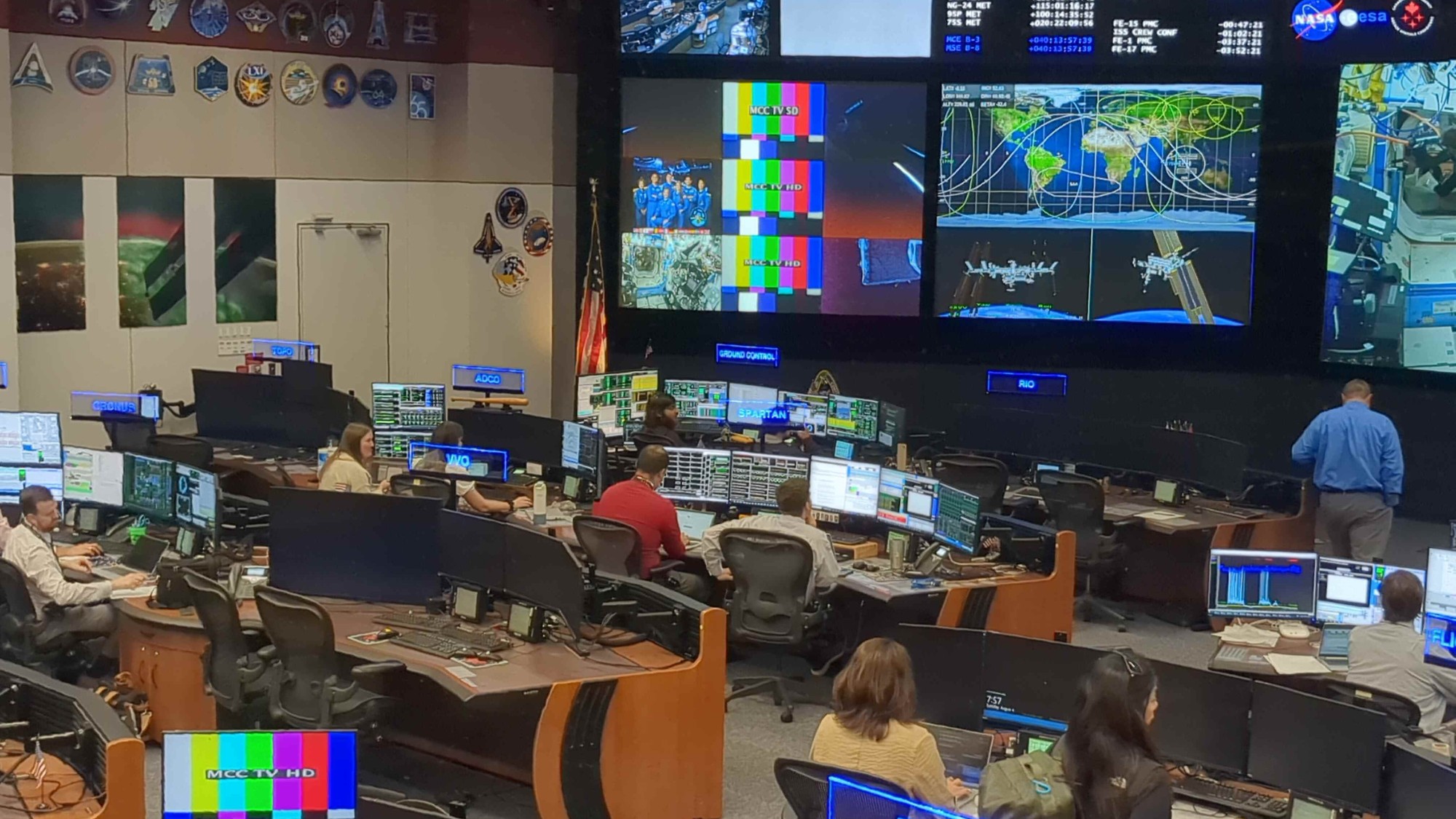
The mission control room at Johnson Space Center in Houston. (Image credit: Elizabeth Howell/Future)
The Mission Control building holds several dedicated control rooms for different mission purposes, including an historic Apollo control center and another room alternately used for Boeing Starliner and Artemis missions. I've been lucky enough to visit all of these in the past. Our only stop in the building Aug. 4, however, was the iconic ISS mission control.
On screen at the front of the room, the Expedition 75 astronauts were awake and active, occasionally zooming by a camera mounted inside the Destiny U.S. lab sandwiched between two station "nodes" leading to other modules. Flight director Diane Dailey told us the controllers are watching for things like if the astronauts are loaded down with equipment, which indicates that would not be a good time to call unless urgent. "We usually have that live camera view just up for awareness. It just helps us understand," she said.
Speaking of calls, an open laptop screen, deliberately positioned within view of the camera, showed all "green" on the comms channels—which helps ground controllers figure out if the crew can hear them, as the station flies in and out of satellite and ground station views all the time. (A flight map, also at the front of the room, also allows for tracking the station and its communications capabilities as it flies around the world.)
While it was hard not to keep gazing at these screens, what was almost as mesmerizing was watching the quiet group of ISS controllers positioned in front of their own laptops and occasionally holding side conversations about their systems. SpaceX now has its own Mission Control in California for its spacecraft, while Boeing chose to integrate theirs with NASA's. Whatever pathway companies choose, however, Mission Control will remain an important example of "division of labor" for future space stations.
"You're going to see different consoles that specialize in different aspects of spacecraft operations," Dailey said. "I like to kind of think of it in terms of, 'What are all the capabilities you'd need on any given spacecraft', right? You'd need propulsion. You'd need communications. You'd need computers. All of those things. So, we have all of those disciplines and all those areas in the spacecraft represented here."
Building 9: What to do 'when you no longer have gravity assisting you'
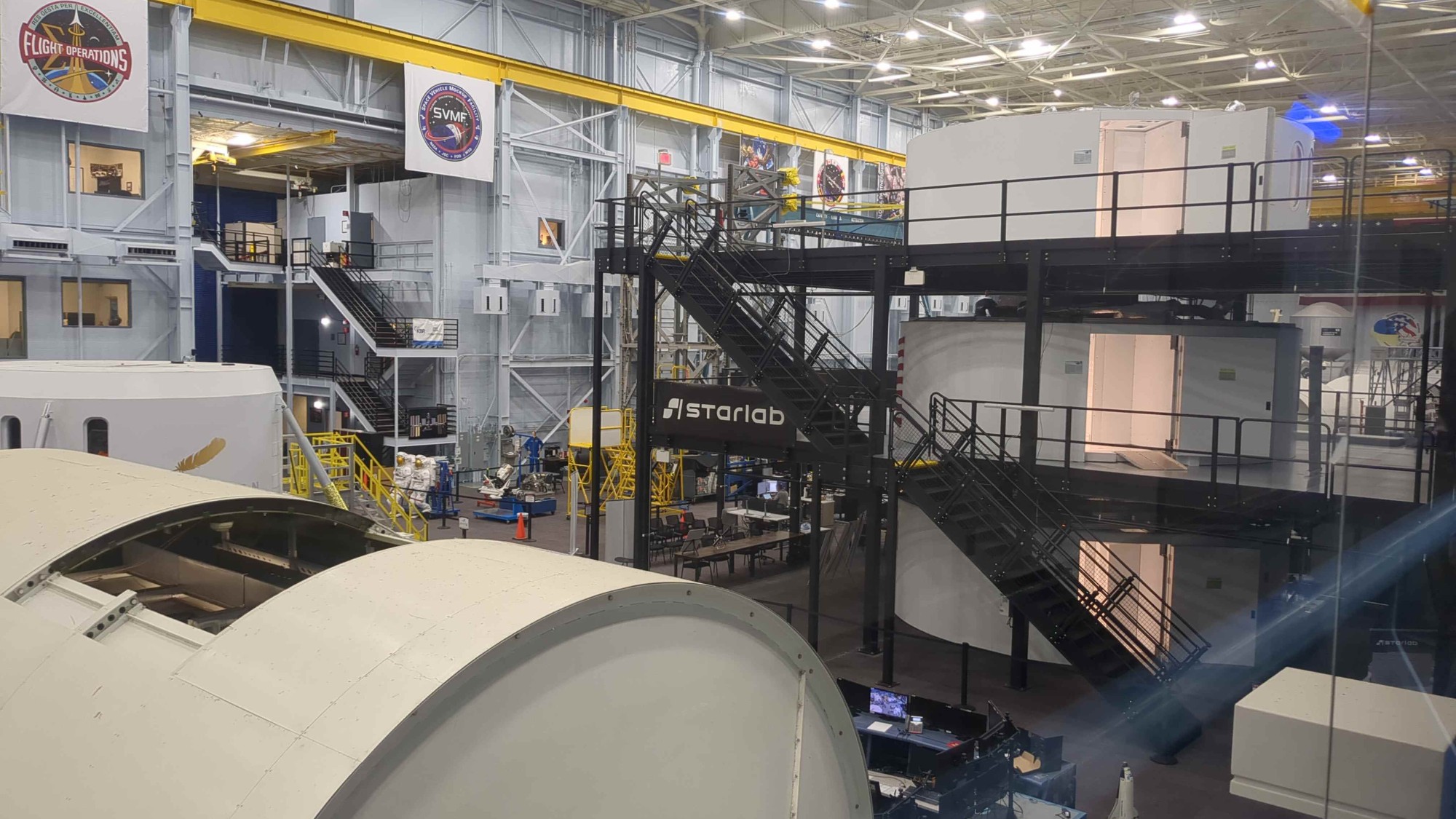
The Space Vehicle Mockup Facility — known to JSC workers as Building 9 — is constantly in flux, because modules constantly shift in and out of the facility for different missions. The facility's goal these days is not only to support NASA missions, but also private industry, by providing the physical space and hardware to simulate problems in space if they arise.
When it comes to astronaut training, one example is learning how to do CPR: "CPR is hard enough when you have gravity. When you no longer have gravity assisting you, they [astronauts] have to learn to 'strap in'," said Mathieu Caron, the CSA's director of astronauts, life sciences and space medicine, who accompanied reporters on the tour of Building 9.
That's only one example of an emergency, of course. Another one is fire alarms—in which the astronauts learn how to quickly gather their team in a "safe haven" with communications and computers available to talk with Earth, then to make sure everyone is there before assessing the situation and figuring out how to deal with it (which could mean fighting the fire, or heading to an escape vehicle.)
When astronauts are training for fire alarms in Building 9, Caron said, there's an extra step involved: letting nearby personnel know that the simulated fire alarm in the ISS area is not the actual fire alarm for the building. "Like, if you hear this specific bell, it's because they're just practicing that training," he explained.
The emphasis of our visit was on ISS operations, given that we were visiting in association with Crew-13, but the facility's website also mentions "commercial space flight companies and exploration programs" among the customers.
While walking the perimeter of the building alongside NASA and CSA, we could see some distant glimpses of other companies' hardware — from SpaceX and Blue Origin, for example, as well as the Starlab Space consortium's multi-floor space station mockup. As NASA very much intends to be the customer on future CLD destinations, surely more of these companies will be occupying the floor of Building 9 after the ISS retires.
A view inside Building 9 at NASA's Johnson Space Center in Houston. (Image credit: Elizabeth Howell/Future)
Neutral Buoyancy Laboratory: 'The better they get, the more we treat it like the real world'
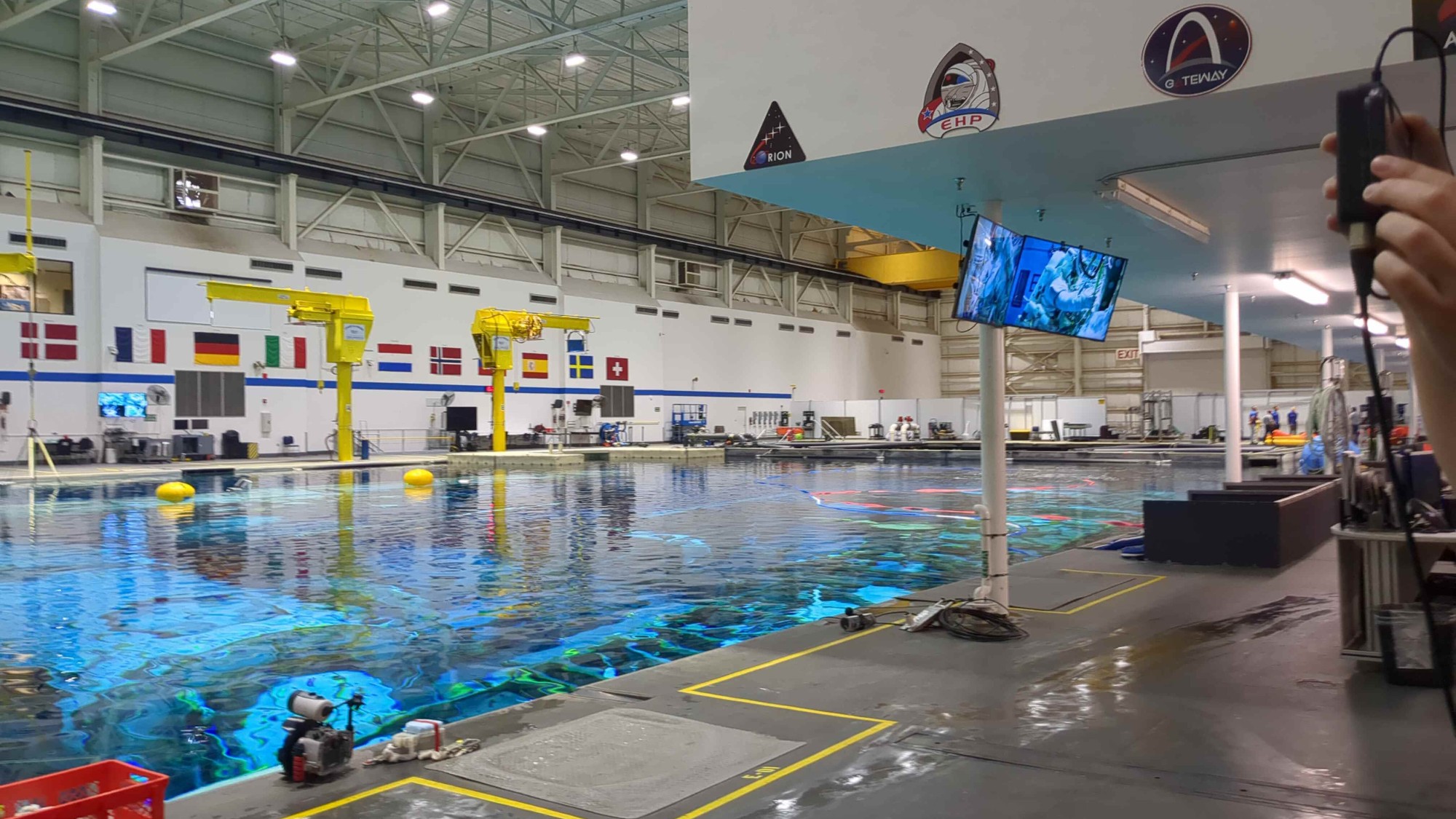
Our last stop on the Gilligan-like three-hour tour was the Neutral Buoyancy Laboratory, which is part of JSC's Sonny Carter Training Facility and about a 15-minute drive from the heart of the NASA campus. Most space people would easily recognize this place as the spot where astronauts rehearse spacewalks, clad in adapted spacesuits simulating what they'll feel for real the moment they step out the hatch.
I spent much of my childhood in community center pools, learning how to swim, and when I walked beside the football-field-sized pool for the first time the humidity — and the echoes on the ceiling and walls from noises — felt somewhat like old times. The scale, however, was strange. The echoes were happening much further away from me, while the humidity was less intense given the expanse of the huge facility. It was hard for my mind to settle, as the setting felt both familiar and unfamiliar.
We only spent a few moments poolside, however, as getting up on the catwalks allowed a much better view of the scene. In one zone were the ISS module mockups inside the pool, through which a couple of astronauts were training while surrounded by divers. (You could track the team's progress by watching the bubbles and hoses on the surface.)
"When they [astronaut candidates] first start, we help them a lot," the NBL's Tim Hall told our media group. "The more mature they get in their training, and the better they get, the more we treat it like the real world — and let them execute on their own."
NASA's Neutral Buoyancy Laboratory at Johnson Space Center in Houston. (Image credit: Elizabeth Howell/Future)
In another was an area where the Orion spacecraft for the Artemis 2 moon mission was put through its paces during training: Could the arriving divers handle waves? What if the spacecraft landed upside-down? All of these things were simulated repeatedly to ease recovery operations.
"Have you ever watched 'Apollo 13'?" Hall asked us. (It's the movie that sparked my interest in space when I saw it on VHS in 1996, so yes.) "If you're a fan, at the end of the movie, you'll see them at 'Stable 1'," he continued — that means the spacecraft is upright in the water.
"We have Stable 1, 2, 3, 4. Those are all the positions of the vehicle when it's laying in the water. So, this thing is actually training for the crew. … we can rotate [the spacecraft], so they train the crew how to get in and out of it in the different stable conditions."
The deep-ocean capabilities are not only useful for spacecraft, but for applications like the oil industry: the pool has been used in past years to simulate offshore work and fire training for the engineers on distant rigs, for example. Private space companies also have had their own time in the pool for spacesuit applications, such as what Axiom Space advertised in 2025 to test the Axiom Extravehicular Mobility Unit (AxEMU) spacesuit that NASA astronauts are expected to use on the lunar surface.
Could more companies come in as the ISS program winds down? Hall says right now a lot of the spare capacity is taken up by the U.S. Navy, but the NBL does expect to offer more of these commercial services in future — as it's already advertised on their website.
"We're open to that for sure," Hall said. "We haven't had anybody out here yet for, like, a recovery or anything on training like that from a private space [company], but that's definitely something we'll address."
Two astronauts — including the first French woman in history to perform a spacewalk — worked outside of the International Space Station (ISS) on Tuesday (Aug 18), becoming temporary TV repairpersons. Just like what frequently happens on Earth, the work required more time than the "appointment" allowed, requiring a second visit to be scheduled.
NASA astronaut Anil Menon and ESA (European Space Agency) astronaut Sophie Adenot were tasked with the removal and replacement of a Space-to-Ground antenna that since November had ceased being able to track NASA's data relay satellites, rendering it unusable. A second antenna has been in use since, continuing the transmission of critical data and enabling high-speed communications with Mission Control Houston.
Spacewalk planners had allocated about six and a half hours for the work to be completed. The two Expedition 75 crewmates were successful in removing the failed Space-to-Ground antenna from its mount on the station's truss but ran into delays disconnecting its electrical connections and and locking down gimbal bolts, or pins, to secure the large dish assembly during its transport to its temporary stowage location.
"We got into this with the mindset that we wanted everything to go perfectly," said Menon as the spacewalk came to an end. "Things were a lot different than expected, but what I would say that I am really impressed with is that all of those contingencies were well thought out."
As such, flight controllers had the astronauts tether the failed antenna to the truss and waived them off installing the replacement antenna, leaving it for a future extravehicular activity (EVA) still to be scheduled. Mission managers will decide whether to add that task to a spacewalk already planned for next Tuesday (Aug. 25) or to leave it for a later outing.
"We are looking at times," radioed Mission Control to the spacewalkers. "We are going to go directly to the long-duration tie-down of this SGANT on the Z-1 truss."
NASA astronaut Anil Menon is maneuvered outside of the International Space Station by the Candarm 2 robotic arm, Tuesday, Aug. 18, 2026. (Image credit: NASA)
Menon and Adenot began the spacewalk at 8:29 a.m. EDT (1229 GMT) when they switched their spacesuits to battery power. Their EVA ended once they were back inside the U.S. Quest airlock and re-pressurization began at 2:52 p.m. EDT (1852 GMT).
Their total time logged on this spacewalk was 6 hours and 23 minutes.
Tuesday's spacewalk was the 282nd in support of ISS assembly, maintenance and upgrades. It was Menon's second EVA since making his first outing with fellow NASA astronaut Jessica Meir on Aug. 6, increasing his total spacewalking time to 12 hours and 50 minutes.
It was the first time that Sophie Adenot ventured into the vacuum of space, making her the first female and fifth citizen of France to perform a spacewalk after Jean-Loup Chrétien, Jean-Pierre Haigneré, Philippe Perrin, and Thomas Pesquet.
"What a day!" said Adenot. "My deepest gratitude to everyone who made this possible — the pioneers who came before us, but also the incredible teams working behind the scenes today."
This was the fifth spacewalk conducted out of the International Space Station this year, the second for Expedition 75 and the 97th using U.S. extravehicular mobility unit (EMU) spacesuits at the space station.
Sophie Adenot will make spaceflight history today (Aug. 18).
The European Space Agency (ESA) astronaut will become the first French woman ever to conduct a spacewalk, an activity she'll undertake with NASA astronaut Anil Menon.
The duo are scheduled to step outside the International Space Station (ISS) for a 6.5-hour excursion today at around 8:35 a.m. EDT (1235 GMT). You can watch it live here at Space.com, courtesy of NASA. Coverage starts at 7 a.m. EDT (1100 GMT).
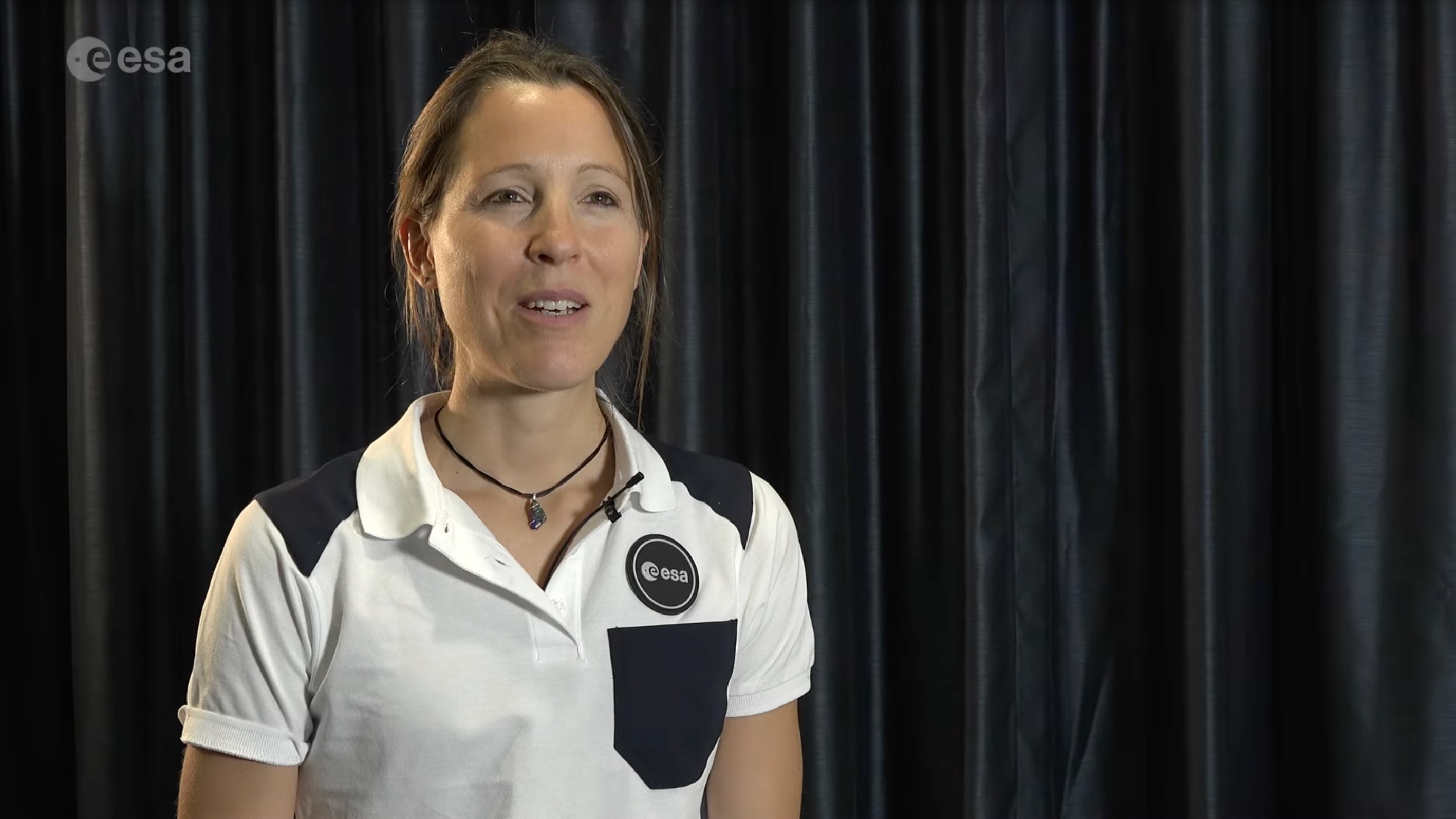
Sophie Adenot is part of the European Space Agency's 2022 astronaut class. (Image credit: ESA)
Adenot and Menon will "replace a space-to-ground antenna on the orbital complex," NASA officials wrote in a spacewalk preview.
"The antenna is a critical communications link NASA uses to transmit data, enabling high-speed communications between the Mission Control Center in Houston and the space station," they added.
This will be the second spacewalk for Menon; his first one, conducted with fellow NASA astronaut Jessica Meir, occurred on Aug. 6. During that extravehicular activity (EVA), a carbon dioxide sensor on Menon's spacesuit gave "an unexpected data reading," NASA officials wrote in an Aug. 7 update.
The sensor returned to normal after Menon doffed the suit, but NASA took some extra time to make sure there was no serious issue. As a result, the agency pushed his second spacewalk back a few days — from the originally planned Aug. 13 to today.
Today's spacewalk will be the 282nd overall in the long history of the ISS. Menon, who reached orbit on a Russian Soyuz spacecraft on July 14, will be "crewmember 1" on the EVA. Adenot — a member of SpaceX's Crew-12 mission, which reached the orbiting lab in February — will be "crewmember 2."
Adenot won't be the first French person overall to conduct an EVA. That distinction goes to Jean-Loup Chrétien, who performed a spacewalk outside the then-Soviet Union's Mir space station in 1988.
Other male French astronauts, including Philippe Perrin and Thomas Pesquet, later spacewalked outside the ISS. Pesquet also became the first French person to command an ISS mission, taking the reins in October 2021.
Two NASA astronauts installed the seventh and final set of mounting hardware for new sets of solar arrays during a successful 6.5-hour spacewalk outside of the International Space Station.
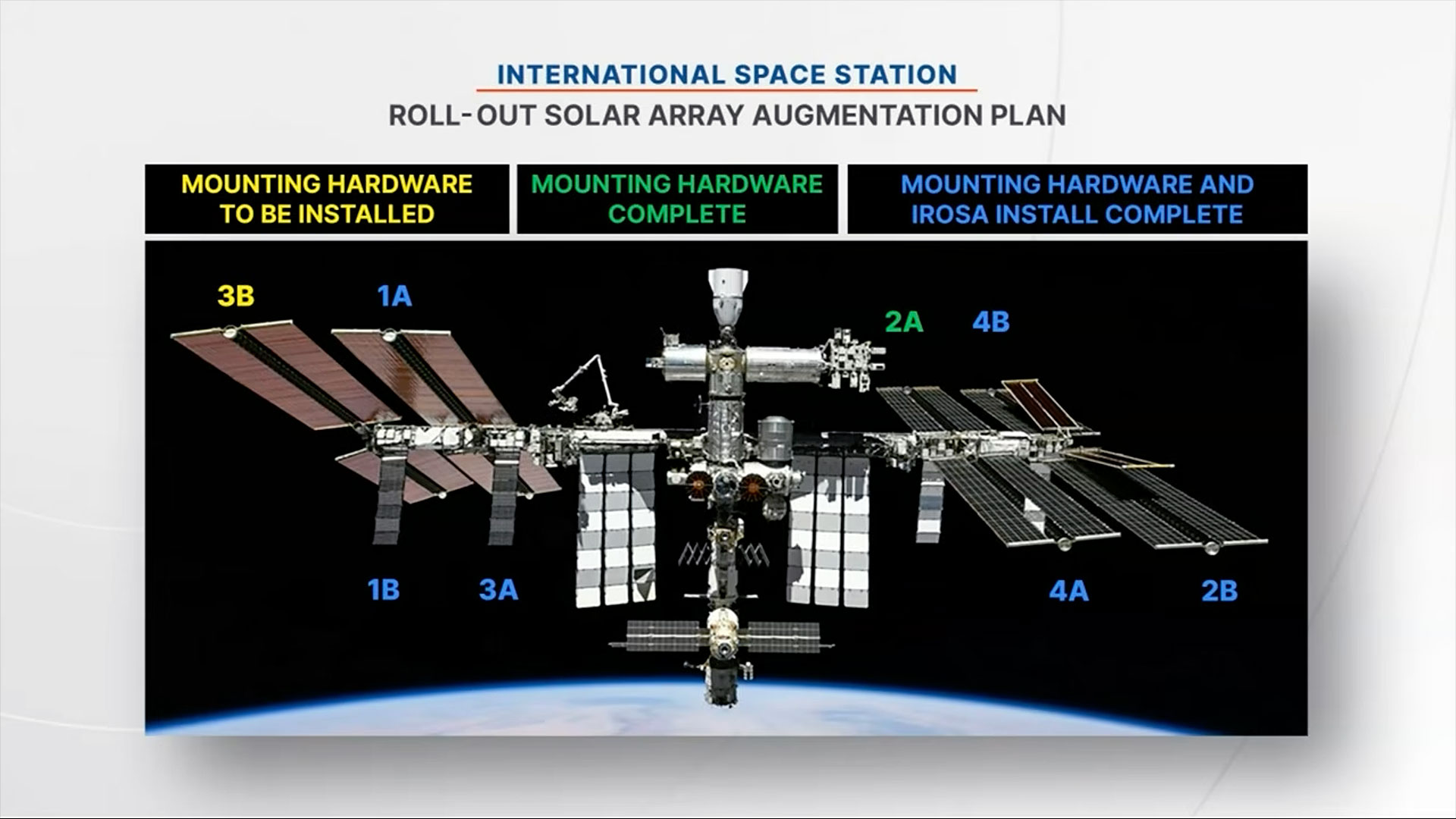
Jessica Meir and Anil Menon on Thursday (Aug. 6), assembled the modification kit for one of the space station's eight power channels, which will allow for the future addition of a new ISS Rolll-Out Solar Array (iROSA). Since 2021, astronauts on prior spacewalks have deployed six of the iROSA assemblies, leaving now just two awaiting delivery to the station later this year.
Like building a giant erector set, Meir and Menon worked to assemble and bolt together the triangular brackets on the 3B power channel, located on the far right, or starboard (S6) segment of the station's backbone truss. Menon was positioned on an articulating portable foot restraint (APFR) atop a worksite interface (WIFEX), providing a stable angle to work from the truss.
NASA graphic showing the augmentation plan for the ISS Roll-Out Solar Arrays (iROSAs), including where work has been completed and where work is still needed prior to a spacewalk that installed the mounting hardware on power channel 3B on Thursday, Aug. 6, 2026. (Image credit: NASA)
Once the modification kit structure was built and secured to the 3B mast canister, the two spacewalkers routed cabling that will carry the electricity from the future iROSA into the 3B power channel and then covered the struts with multi-layer insulation to protect them from micrometeoroid strikes.
The iROSA wings sit forward of the legacy solar arrays, augmenting their electricity generation rather than replacing it. The station's eight original arrays began showing degraded power output as they exceeded their 15-year design life. When used in tandem with the new iROSA wings, the upgraded system will increase the station's electricity supply by 20% to 30%.
The other power channel currently without an iROSA deployed is 2A on the left, or port side, of the station.
NASA astronauts Jessica Meir (at left) and Anil Menon (with feet to camera) installed solar array mounting hardware during a spacewalk outside of the International Space Station on Thursday, Aug. 6, 2026. (Image credit: NASA)
"Anil, you can see the moon to the — well, I am not sure what way you're facing, but…," said Meir, taking a short break during the spacewalk to notice NASA's next destination for astronauts under its Artemis program.
"To my right. Yeah, I see it — thanks for the heads-up," said Menon. "I can see a future moon base there."
"I can see it, too!" Meir said.
Meir later turned her attention to Mars with her closing words of the day.
"On this day in 2012, NASA's robotic rover Curiosity successfully landed on the surface of Mars with the goal of understanding if the planet could have fostered life. Curiosity achieved that goal within a year," she said. "One day, humans will visit Curiosity, propelled by the groundbreaking science, technology demonstrations and operations conducted here on the International Space Station for almost 26 years now."
"Today, we made one more step toward expanding the ISS power system, further sustaining our human presence in low Earth orbit, as we prepare to take those next steps," said Meir.
A camera mounted on NASA astronaut Anil Menon's spacesuit helmet captured this view of NASA astronaut Jessica Meir (at left) and the worksite where they assembled and installed mounting hardware for a new solar array outside of the International Space Station on Thursday, Aug. 6, 2026. (Image credit: NASA)
Thursday's spacewalk began at 8:33 a.m. EDT (1233 GMT) when Meir and Menon switched their spacesuits to internal battery power. After collecting their tools and reentering the Quest airlock, the spacewalk, or extravehicular activity (EVA), concluded at 3:00 p.m. EDT (1900 GMT), 6 hours and 27 minutes after it began.
This was the 96th U.S. EVA and 281st spacewalk overall in support of the International Space Station's assembly, maintenance and enhancement. It was the first career spacewalk for Menon and the sixth for Meir, bringing her total time on EVA to 42 hours and 33 minutes.
This was the first spacewalk for the space station's Expedition 75 crew. There are two more U.S. outings scheduled for this month: EVA 97 will work to replace a space-to-ground antenna on Aug. 13, and EVA 98 will connect power channel cables and data relay systems as part of ongoing maintenance, including preparations for the station's future deorbit, as well as replace a navigational aid used for spacecraft docking on Aug. 25.