A SpaceX rocket just inched closer to the record books.
A Falcon 9 vehicle lifted off from Vandenberg Space Force Base in California tonight (July 10) at 11:01 p.m. EDT (8:01 p.m. local time; 0301 GMT on July 11), carrying 29 of SpaceX's Starlink broadband satellites toward low Earth orbit (LEO).
It was the 35th flight for this rocket's first stage, a booster designated B1071. The SpaceX record is 36, set just a few days ago by B1067 on another Starlink mission.
A SpaceX Falcon 9 rocket launches 29 Starlink satellites from California's Vandenberg Space Force Base on July 10, 2026. (Image credit: SpaceX)
And, there will likely be more flights for B1071 down the road. The booster came back to Earth for a touchdown tonight as planned, landing in the Pacific Ocean on the SpaceX droneship "Of Course I Still Love You" about 8.5 minutes after launch.
The Falcon 9's upper stage, meanwhile, continued carrying the 29 Starlink satellites aloft. They're scheduled to be deployed in LEO about 62 minutes after launch.
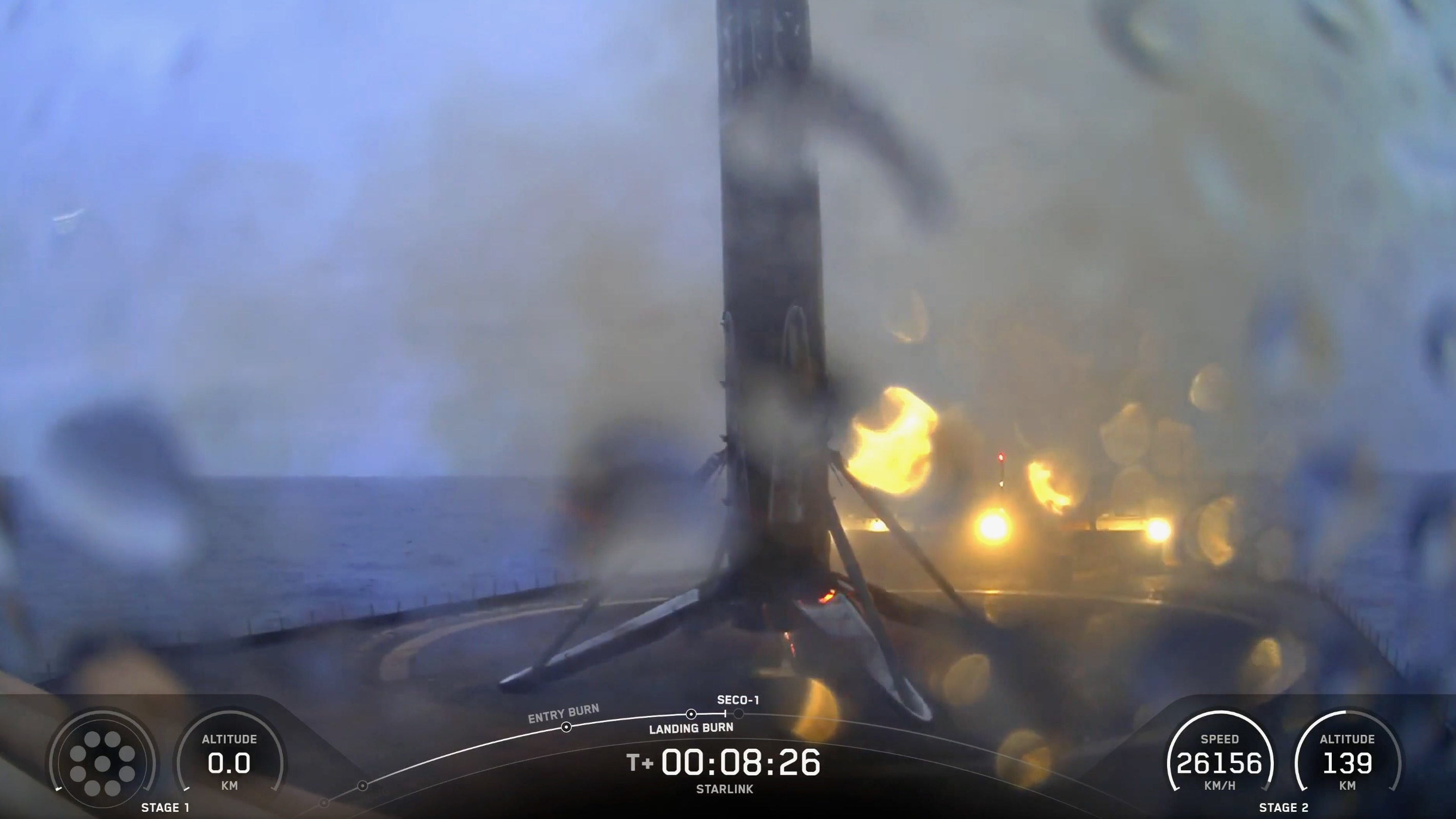
A Falcon 9 first stage rests on a ship at sea shortly after launching 29 Starlink satellites from California's Vandenberg Space Force Base on July 10, 2026. (Image credit: SpaceX)
The Starlink megaconstellation currently consists of more than 10,700 active satellites, according to tracker Jonathan McDowell. The network is growing all the time, however, and it could eventually get very large indeed; SpaceX recently applied for approval to operate 100,000 of the spacecraft in LEO.
Tonight's launch was the 81st Falcon 9 mission of 2026. About 80% of them have been Starlink flights.
German company Isar Aerospace is expanding its operations overseas after signing an agreement with Canada's Maritime Launch Services for use of its Spaceport Nova Scotia.
The deal allows Isar to design and operate the pad infrastructure based on the company's needs, in order to launch its Spectrum rocket. In return, Maritime Launch Services (MLS) will provide the pad and surrounding facilities for vehicle stage and payload integration, testing and a mission control hub for launch operations.
The agreement grants Isar a $150 million, 10-year lease for the MLS launch site, with the option to extend up to an additional 10 years. Development of the facility is scheduled to begin later this year, with Isar targeting 2028 for its first orbital launches from the new site.
"Canada is the next step in our roadmap to bring full end-to-end launch capability to sovereign nations," Alexandre Dalloneau, Isar's mission and launch operations vice president, said in a company statement on Tuesday (July 7). "And we are proud to be doing it here in, and together with, Canada.”
By 2029, Isar hopes to be able to support up to 40 launches from the new Canadian site. “By combining Isar Aerospace’s launch vehicle, Spectrum, with Spaceport Nova Scotia’s licensed infrastructure, we are creating the conditions for reliable orbital launch services from Canada," MLS President and CEO Stephen Matier said in the same statement.
MLS has positioned Spaceport Nova Scotia as a multi-user launch center, designed for expansion based on future customer needs. It's one of Canada's first-ever facilities designed to support orbital launches — Canadian company NordSpace is constructing a launch pad of its own with a similarly flexible framework, but neither it nor Isar has yet carried out a successful orbital launch.
Isar has tried, however. Spectrum launched for the first time in March 2025, from Europe's Andøya Spaceport in Norway, but the rocket began to tumble shortly after clearing the tower and fell back to Earth in a fiery explosion. Since then, the company has rolled Spectrum out several times for a second launch opportunity but has run up against either weather or technical delays that have scrubbed each attempt.
Still, that hasn't slowed the company's efforts. Dalloneau sees Isar's success as one of international importance.
“While every nation needs data from space, almost no nation has the end-to-end capability to access it independently. This makes launch capacity one of the most consequential bottlenecks in defense and intelligence today, and we are here to close it," he said.
It looks like SpaceX's next Starship flight is on the horizon, and it may lift off sooner than you might think.
SpaceX today (July 10) completed a brief static fire of the Starship Super Heavy booster tapped to launch the 13th test flight of the massive, mega-lift vehicle.
Booster 20 — the latest Super Heavy to roll off the assembly line — was transported to the pad at SpaceX's Starbase, Texas, facility yesterday (July 9) and hoisted onto its support stand using the launch tower's stalwart "Mechazilla" chopstick arms. By early Friday, SpaceX began preparations leading up to the prelaunch engine test, including closing Boca Chica beach around 8 a.m. EDT (1200 GMT) and transferring fuel to the pad's tank farm ahead of loading propellant onto the vehicle.
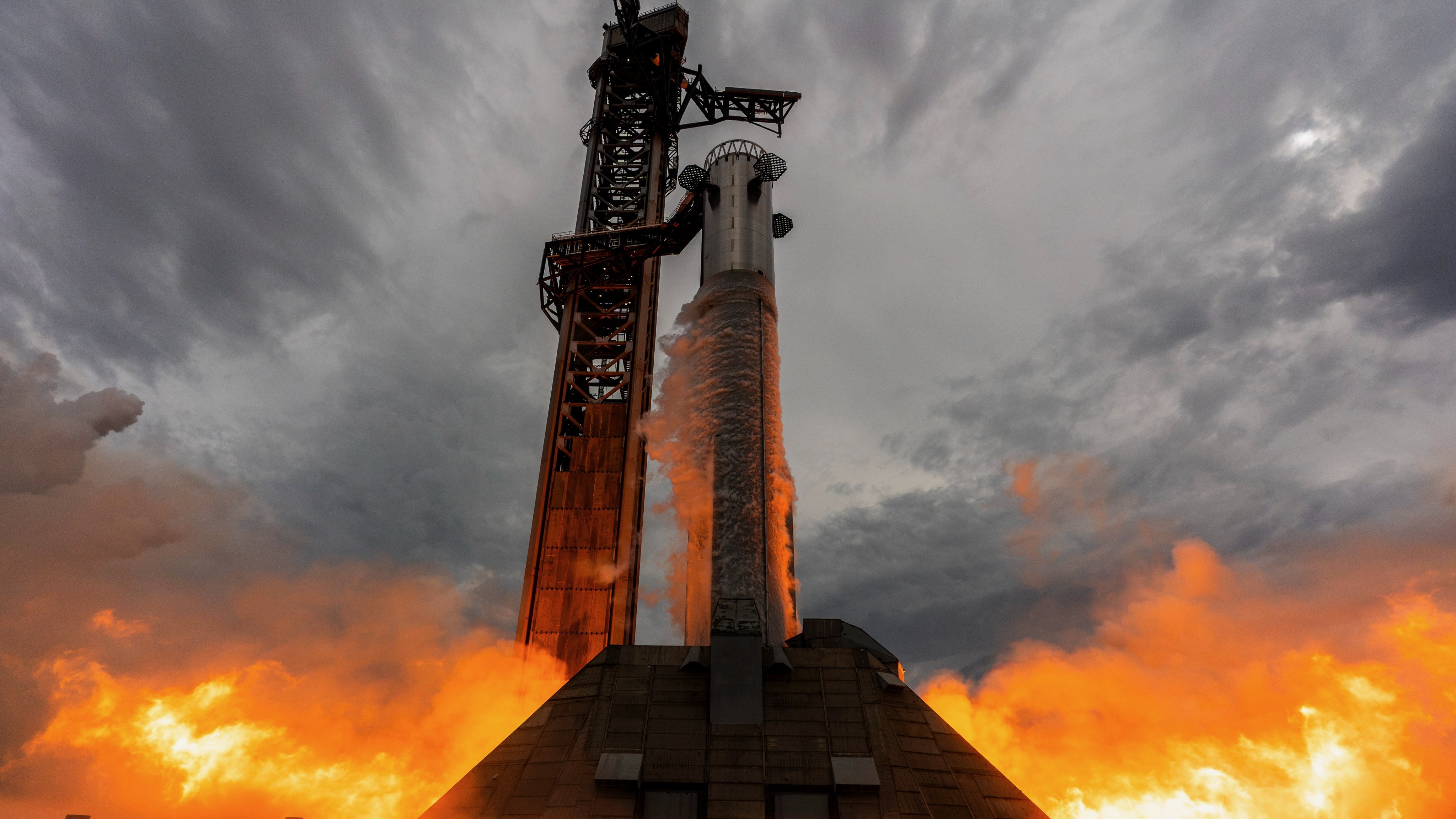
SpaceX conducts a static fire test with a Super Heavy booster on July 10, 2026, to gear up for the upcoming 13th test flight of its Starship megarocket. (Image credit: SpaceX)
This is the second "Version 3" (V3) booster to reach the pad at Starbase for testing, and is equipped with 33 of SpaceX's upgraded Raptor 3 engines. Those engines ignited in a blazing heat on Friday just before 11 a.m. EDT (1500 GMT), and underwent a roughly 25-second burn simulating on the launch stand the duration and flight conditions for an actual launch.
The successful completion of Booster 20's static test fire paves the way for Starship's upcoming test launch, Flight 13. That could launch as early as Wednesday (July 15), according to a notice from the Federal Aviation Administration.
Compared to Version 2 (V2), Starship V3 packs a much stronger punch. The rocket was upgraded with enhanced avionics to reduce mass and increase launch capacity, a taller fuel tank with a larger volume, and equipment for transferring propellant between spacecraft, which will be needed to fulfill many of the missions Starship is being designed to carry out.
A handful of those missions will be for NASA's Artemis program, and the agency's plans to return to the moon. Starship is one of two lunar landers currently contracted to deliver astronauts to the lunar surface, so, its success and timely demonstration of the technologies needed to do so are coming under a microscope as the timeline for those missions shrinks.
Flight 13 will follow the same basic timeline as Flight 12, which lifted off in May with mixed success. Flight 12 was the first launch of Starship V3, and prompted SpaceX to fly a slightly more conservative mission than many previous tests, which have built on previous successes with increasingly expanding goals. Starship's last flight sent the vehicle's upper stage, Ship, on a suborbital trajectory with a soft splashdown in the Indian Ocean. SpaceX ran into some issues, though, when the rocket's Super Heavy booster (Booster 19) failed to maneuver itself for a soft ocean splashdown of its own. Ship (Ship 39) also ran into an engine anomaly that caused SpaceX to forgo the stage's in-space engine relight demonstration.
Ship 40 and Booster 20, the Starship vehicles that will fly on Flight 13, will follow the same set of mission objectives to shake out the remainder of kinks in Starship V3. Spacex hopes the mission will pave the way for further technology demonstration tests the vehicle needs to complete before reaching full operational status. That includes the retrieval of both stages back at their Starbase launch pad, for refurbishment and reuse on future flights.
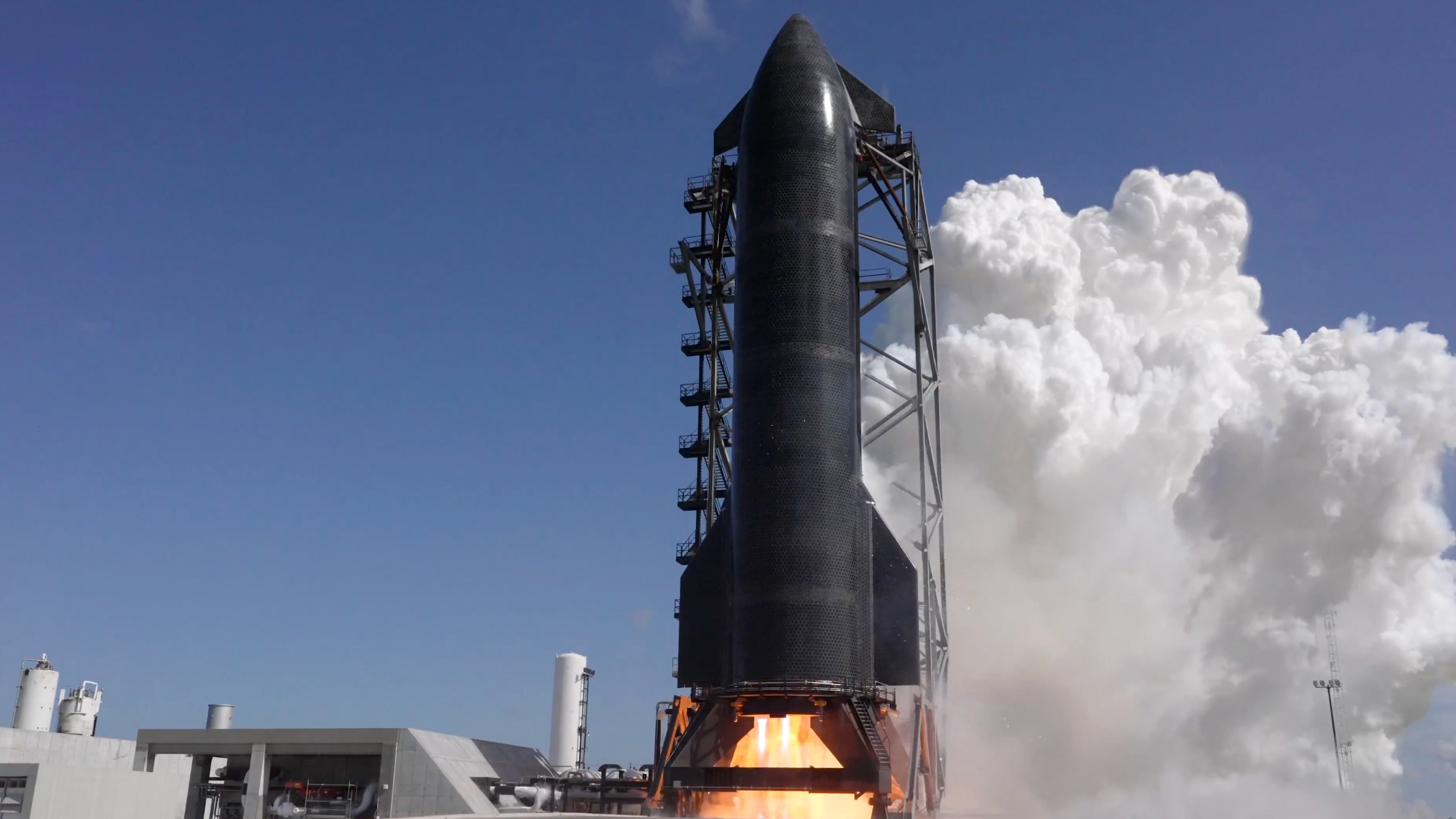
SpaceX conducts a static fire test on July 2, 2026, with Ship 40, the upper-stage spacecraft slated to fly Starship's 13th test flight. (Image credit: SpaceX)
Starship is designed to be fully reusable, and capable of delivering over 100 tons to low Earth orbit. Once the rocket begins regularly delivering payloads, Ship and Super Heavy will be able to both return to Starbase to be caught by the Mechazilla arms on both of the site's two launch towers. SpaceX has succeeded in a handful of V2 Super Heavy catches during its previous flight tests, and managed to launch two of those recovered boosters on subsequent missions, but has not yet attempted to do the same with a Ship upper stage.
That's because landing Ship is much different than landing Super Heavy. SpaceX has a lot of practice landing and reflying rocket boosters. The company's workhorse Falcon 9 rocket launches several times a month, and is routinely recovered, refurbished and reflown within a short few weeks. A batch of Starlink satellites recently launched on one of SpaceX's most-flown Falcon 9 boosters, which broke a reflight record as it touched down for the 36th time after delivering its payloads to orbit. Though it lacks the landing legs of Falcon 9, Super Heavy's descent back to Earth is very similar to a Falcon 9 booster, and therefore less complex an engineering question to have to solve compared to Starship's upper stage.
Ship drops through the atmosphere belly-first, allowing the black, hexagonal heat shield tiles that cover half the vehicle to absorb the blazing temperatures of reentry. Fins near the spacecraft's nose and base control its orientation and attitude, which remains mostly horizontal during its freefall. To an extent, Ship's descent profile is not very unlike the space shuttles, except for its actual touchdown, which differs significantly.
As Ship's altitude decreases toward sea level, the vehicle performs a "flip and burn" maneuver that swings the whole stage upright and arrests its descent for a soft touchdown — eventually back at the Starbase pad on future launches, but once again in the Indian Ocean for Starship's upcoming mission.
Flight 13 will give SpaceX a chance to demonstrate that descent profile again using Ship 40, while also working through the booster and engine issues encountered during Flight 12. If all goes according to plan, the launch will bring Starship V3 closer to more ambitious tests, including orbital insertion, propellant transfer and the recovery of both stages back at Starbase.
The nation has recovered a rocket during an orbital launch for the first time ever, pulling off the feat during the Long March 10B's maiden liftoff on Friday (July 10). And that recovery was unique: The rocket's first stage nestled softly into a net-like structure carried by a ship at sea.
"This mission marks my country's first successful controlled recovery of a launch vehicle and the world's first network-based recovery of a launch vehicle," the China Aerospace Science and Technology Corporation (CASC) announced via social media shortly after the launch. (Translation by Google.) "It signifies a historic breakthrough for my country in the field of reusable rocket technology and will lay a solid foundation for accelerating the improvement of my country's space access capabilities."
The first stage of a Chinese Long March 10B rocket comes down for a landing at sea after successfully sending a satellite to orbit on July 10, 2026. (Image credit: CCTV)
The Long March 10B is a two-stage rocket that stands about 207 feet (63 meters) tall, according to the state-owned CASC, the main contractor for China's space program.
The vehicle's first stage burns kerosene and liquid oxygen (LOX) propellants, whereas the second stage uses LOX and liquid methane. In reusable mode, the Long March 10B can loft about 16 tons of payload to low Earth orbit.
And the rocket flew with a payload on its debut liftoff — a satellite that successfully reached "its predetermined orbit," according to the CASC update. That post did not provide any details about the spacecraft or its orbit. It did give a brief rundown of the first-stage recovery, however.
"Approximately 6 minutes after the first and second stages separated, the first stage returned vertically and was successfully recovered at a sea-based recovery platform using a net system," CASC officials wrote, noting that launch occurred from the Hainan Commercial Space Launch Site on Friday at 12:15 a.m. EDT (0415 GMT; 12:15 p.m. Beijing time.) "The launch and first-stage recovery missions were a complete success."
China plans to refly the first stage by the end of the year, they added.
Until now, vertical landings of orbital-class rockets had been performed only by SpaceX, which does them on a regular basis. Indeed, Elon Musk's company has landed orbital rockets more than 600 times to date.
Such extensive reuse has allowed SpaceX to fly more cheaply and efficiently than its competitors and dominate the launch market — something that China is working hard to emulate.
The Long March 10B's "reusable configuration significantly reduces launch costs, offering advantages of large payload capacity and high cost-effectiveness," CASC officials wrote in the post-launch update.
Other partially reusable Chinese rockets are in the works as well, including CASC's Long March 12A and the Zhuque-3, a vehicle built and operated by the Beijing-based company Landspace. Both of those rockets debuted this past December, with similar results: They reached orbit as planned, but their first stages didn't stick the landing.
The Chinese companies CAS Space, Galactic Energy and Deep Blue Aerospace are developing reusable vehicles of their own — Kinetica-2, Pallas-1 and Nebula 1, respectively. So, before too long, Chinese rockets could be returning to Earth with a frequency that rivals SpaceX's workhorse Falcon 9.
The United States government is looking into launching commercial rockets from sea-based launch sites, but some ocean advocacy experts say the move is part of a larger trend of allowing the spaceflight industry to use the ocean as a dumping ground.
The U.S. Bureau of Ocean Energy Management (BOEM) on Tuesday (July 7) announced a Request for Information (RFI) to look into launching rockets and recovering spacecraft from the Outer Continental Shelf (OCS), a region of the United States that extends 200 nautical miles (370 kilometers) out from America's coastlines. "Offshore launch, reentry, and recovery infrastructure could expand operational flexibility, increase capacity, reduce constraints on growing launch demand, and strengthen the nation's commercial and national security space capabilities," acting BOEM Director Matt Giacona said in a bureau statement announcing the RFI.
But while BOEM lauds the development of facilities on the continental shelf as a way to bolster America's space economy and support its ambitious space exploration goals, at least one ocean conservancy group says the plan could have disastrous effects on the ocean.
According to the RFI, BOEM is looking for ideas from private industry on how to use existing offshore infrastructure such as oil and gas drilling platforms, as well as how to establish "new, purpose-built offshore facilities dedicated to commercial space launches, space re-entry, and related activities" on the Outer Continental Shelf. BOEM has jurisdiction over some 3.2 billion acres (1.3 billion hectares) of the shelf.
The announcement builds on a White House Executive Order signed in December 2025 titled "Ensuring American Space Superiority" that aims to boost investment in the American space industry and "unleash commercial development and lay the foundation for a new space age."
The order does not list offshore launches specifically, but it does aim to increase the frequency of launches and reentries through "new and upgraded facilities" and policy reforms.
A map of the Outer Continental Shelf extending from the U.S. coastline. (Image credit: Minerals Management Service)
But some critics are already speaking out against the idea. "Space junk and rocket explosions have already been trashing our coastal wildlife refuges, and now Trump wants to expand that destruction farther into our oceans," said Miyoko Sakashita, oceans program director at the Center for Biological Diversity, a nonprofit based in Tucson, Arizona.
Sakashita added that the initiative is "likely another Trump excuse for allowing the oil industry to leave its rusty old junk in the ocean" and avoid imposing regulations on the energy sector.
"The whales, sea turtles and other marine wildlife off our coasts deserve better than to suffer for Big Oil and the pet projects of trillionaires and billionaires," she said. "It's the administration's job to protect our public waters, not turn them into playgrounds for pipe dreams and profit."
BOEM's RFI will be open for 30 days, closing on Aug. 7, 2026.
This particular booster, known as 1067, had already completed 35 orbital missions, more than any other SpaceX rocket in history. The overall record is held by NASA's space shuttle Discovery, which flew to orbit and back 39 times.
Thursday's flight extended Booster 1067's company record. The rocket returned to Earth about 8.5 minutes after liftoff, landing on the SpaceX drone ship "A Shortfall of Gravitas" stationed in the Atlantic Ocean.
This SpaceX Falcon 9 rocket launched for a record-breaking 36th time on July 9. (Image credit: SpaceX)
The Falcon 9's upper stage, meanwhile, hauled the 29 Starlink satellites to LEO and deployed them there 63.5 minutes after launch as planned.
Thursday's launch was the 80th Falcon 9 mission of the year already. About 80% of the rocket's 2026 flights have been devoted to building out Starlink, by far the largest satellite network ever assembled.
The megaconstellation currently consists of more than 10,700 active satellites, according to tracker Jonathan McDowell. And, as Thursday's launch shows, that number is growing all the time.
Editor's note: This story was updated at 5:40 a.m. ET with news of successful rocket launch and landing.
ispace is expanding its already extensive moon plans to include SpaceX's Starship megarocket.
The Tokyo-based company announced today (July 8) that it has booked 1,100 pounds (500 kilograms) of cargo capacity on Starship, the biggest and most powerful rocket ever built, for a moon mission that could launch as soon as 2030. The deal is worth $50 million, according to Tokyo Brief.
"We are very pleased to be able to offer the new Lunar Access Integration service utilizing Starship's payload space through our collaboration with SpaceX," ispace founder and CEO Takeshi Hakamada said in a statement today. "High-capacity, relatively low-cost lunar transport, such as that provided by Starship, is essential to realizing the sustainable lunar economy that ispace aims to create."
As that quote suggests, ispace may become a regular Starship customer over the years, using the giant vehicle to carry its new "Mobile Cargo System" to the lunar surface. The MCS is a pallet-like flat rover capable of transporting up to 1,100 pounds (500 kg) across the lunar terrain.
The newly announced Mobile Cargo System moon mission aboard Starship will launch no earlier than 2030, according to ispace. The timeline will depend largely on SpaceX's ability to progress Starship into an operational vehicle. (Starship has flown 12 test flights to date, all of them suborbital.)
ispace has flown with SpaceX before; Falcon 9 rockets launched the Japanese company's robotic HAKUTO-R moon rover in both 2022 and 2025. Both times, HAKUTO-R reached lunar orbit successfully but crashed during its landing attempt.
Starship is SpaceX's super-heavy-lift launch vehicle, which is designed for full reusability and capable of launching up to 150 tons (136 metric tons) to low Earth orbit. The rocket has been in development for a while; SpaceX founder and CEO Elon Musk first announced the vehicle during the International Astronomical Congress in Mexico in 2016. Expectations for its operational readiness have been an ever-moving goal post.
In 2021, for example, SpaceX was targeting sometime "before 2024" for the spacecraft's first mission to the moon, but development delays have continually pushed that date back. 2024 was also the year NASA originally targeted for the first crewed lunar landing mission of the agency's Artemis program, though that's no longer the plan.
NASA contracted Starship as the lunar lander for that touchdown, which is now slated to take place during Artemis IV in late 2028. Agency officials have cited Starship as part of the reason that Artemis' schedules have slipped.
NASA and ispace aren't the only customers that have signed up for a Starship ride to the moon. For example, Japanese billionaire Yusaku Maezawa announced the #dearMoon project in 2018, booking Starship to fly himself and a handful of artists on what would have been the spacecraft's first crewed mission around the moon. As Starship delays continued to mount, though, Maezawa canceled the flight in 2024.
But momentum is building for Starship moon missions. After all, NASA now has two successful Artemis missions in the books — the uncrewed Artemis I to lunar orbit in late 2022 and the four-person Artemis II flight around the moon this past April. The agency is gearing up for Artemis III, which will test rendezvous and docking operations with NASA's Orion capsule and two crewed lunar landers — Starship and Blue Origin's Blue Moon — in Earth orbit in mid-2027, if all goes to plan.
So ispace is positioning itself to be a key player in a possible lunar goldrush.
"The emergence of rockets with the capability of transporting large-scale payloads to the moon is expected to accelerate deployment of lunar infrastructure, including power, communications, construction, data and mobility," ispace said in today's statement.
"The establishment of this core infrastructure on the lunar surface will reduce barriers hindering subsequent infrastructure projects, leading to a rapid expansion in the transport of relatively small lunar payloads for purposes such as technology validation, exploration and business development," the company wrote, adding that, as mission demand grows, so too will the payload capacity of its Mobile Cargo System units.
In addition to the new Mobile Cargo System design, ispace is also planning three lunar landing missions with its ULTRA Lander vehicle, which are scheduled for 2028, 2029 and 2030.
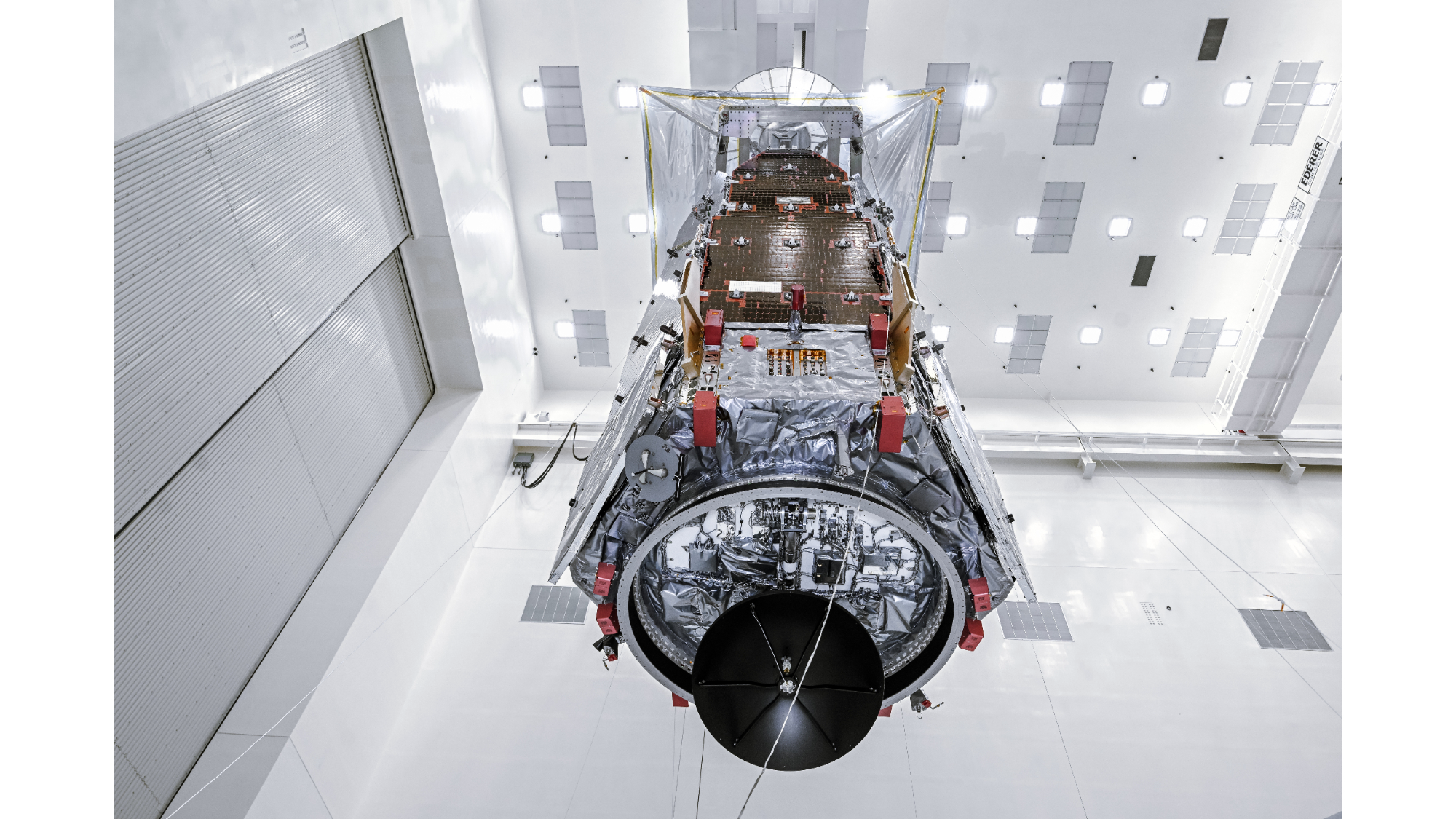
The Nancy Grace Roman Space Telescope in the clean room at NASA's Kennedy Space Center in Florida on June 26, 2026. (Image credit: NASA/Sydney Rohde (Rocz))
Roman is NASA's next big flagship mission, designed to explore the universe like we've never seen it before. And with just over a month and a half until its expected launch on Aug. 30, it is in the home stretch to liftoff.
After recently leaving NASA's Goddard Space Flight Center in Maryland, where the telescope was assembled and tested, Roman made its way to KSC, from where it will launch. In this new photo, snapped on June 26, we can see Roman seemingly floating in mid-air, hanging inside the Payload Hazardous Servicing Facility, a secure clean room at KSC where spacecraft are fueled, tested and otherwise prepared for flight. In this moment, technicians and engineers were using a crane to lift Roman into the air into a specialized stand, where the telescope can rest while it is worked on.
Why is it incredible?
Roman — named for the pioneering astronomer Nancy Grace Roman, who served as NASA's first chief of astronomy and expanded our understanding of the universe — is a mission that scientists have been waiting for for a long time.
With a field of view at least 100 times larger than the iconic Hubble Space Telescope, Roman will be able to capture immense views across the universe. The mission will explore dark matter and dark energy, and with its tech demonstration the Roman Coronagraph Instrument, it will snap images of exoplanets, offering direct looks at worlds far from our solar system.
NASA's New Horizons probe has woken up in good health nearly 6 billion miles away beyond Pluto after spending nearly a year in hibernation.
Traveling such vast distances between our solar system's most remote objects means New Horizons often cruises for months at a time with little to do other than passively collect data. During these periods, the probe goes into a hibernation mode in which its instruments still collect data, but most other systems power down.
New Horizons entered just such a hibernation period last August, and has now woken up in "good health", according to a NASA statement. The spacecraft is 5.9 billion miles (9.5 billion kilometers) from Earth, so far away that it takes around 9 hours for its radio signals to reach us. Now that it's awake, New Horizons will begin transmitting the data it has collected over the last 321 days and letting its controllers on the ground know how its systems are faring in the cold, dark reaches of deep space.
So far, the probe appears to be in perfect health. "Every status report through this hibernation period was 'green,' meaning all was well aboard New Horizons each and every week," said Alice Bowman, the New Horizons mission operations manager at the Johns Hopkins Applied Physics Laboratory (APL) in the NASA statement.
New Horizons is the first and only flyby spacecraft to conduct a flyby of the Pluto system, which it did in 2015. Four years later, the plucky probe studied the most distant object ever explored in our solar system, the snowman-shaped planetesimal Arrokoth, while it was one billion miles (1.6 billion kilometers) past Pluto.
Since then, the long-distance voyager has been probing the edge of our sun's influence and studying objects in the Kuiper Belt, the cold, donut-shaped ring of icy objects that circles the outer solar system beyond Neptune.
A processed image made from data gathered by NASA's New Horizons spacecraft on Jan. 1, 2019 during its flyby of Kuiper Belt object 2014 MU69, known as Arrokoth. (Image credit: NASA/Johns Hopkins University Applied Physics Laboratory/Southwest Research Institute)
New Horizons is currently speeding away from Earth at a rate of 300 million miles (483 million km) per year, according to NASA.
Three weeks from now, New Horizons will begin conducting a study of hydrogen in the outer heliosphere, the region of space influenced by the stream of charged particles blowing outward from the sun, known as the solar wind.
The data the probe is collecting at the farthest reaches of our solar system is the first of its kind. It could help scientists understand what happens at the boundary between the sun's region of influence and interstellar space, known as the "termination shock."
Only two spacecraft have crossed this boundary before, NASA's twin Voyager probes. However, those far-flung explorers weren't equipped with the same scientific instruments as New Horizons, which enable it to conduct more sensitive measurements of this distant region of the solar system.
"The data from the termination shock encounter will be a treasure trove for space physicists worldwide who are eager to understand how this vast boundary works," Pontus Brandt, New Horizons project scientist at APL, previously told Space.com. "All these discoveries from pioneering missions like Voyager and New Horizons teach us how little we know about what lies beyond."
The world's first commercially built nuclear-powered satellite has reached orbit aboard a SpaceX Falcon 9 rocket.
The BOHR (Betavoltaic Orbital High-Reliability) satellite, built by Florida-based company City Labs, launched to space early this morning (July 7) on SpaceX's Transporter-17 rideshare mission.
Transporter-17's Falcon 9 rocket, which was carrying a total of 81 payloads, lifted off early this morning from the SpaceX pad at Vandenberg Space Force Base in California, and began delivering its payloads to their various orbits about 50minutes later.
BOHR is a novel cubesat demonstration mission from City Labs, which is testing out its proprietary "NanoTritium" betavoltaic micropower source in space for the first time. Similar to how spacecraft like NASA's Voyager probes' radioisotope thermoelectric generators produce power from the heat emitted from their plutonium cores, City Lab's NanoTritium device harnesses the beta particles emitted from the radioactive decay of tritium, which can be converted directly to electricity using a semiconductor.
“This is a historic step for commercial nuclear power in space,” said City Labs CEO Peter Cabauy in a statement.
BOHR is designed as a pathfinder mission to test the feasibility of City Labs' new technology, which is meant to provide continuous power to spacecraft without a reliance on solar energy. Though its tritium core isn't actually BOHR's power source — the cubesat is still dependent on solar power for general operations — City Labs' technology could help introduce new vehicles capable of exploring places that current spacecraft can't operate for long periods of time, like permanently shadowed regions at the moon's poles.
The moon's south pole, specifically, has come into focus as the target region for NASA's Artemis lunar landing missions. An abundance of water ice there, and its potential for extraction as a resource, makes the lunar south pole particularly suited to support long-term habitation of the moon, and NASA is actively funding the development of nuclear reactor technology to support that goal.
"City Labs’ BOHR arrives as the first commercial answer to that challenge," the company said in a statement. Though the cubesat's NanoTritium power source cannot produce nearly enough energy to power something like a moon base, City Labs sees its application scaling to eventually be able to do so.
One benefit of using tritium as the basis for a power system is the low radiation levels it emits. "City Labs’ tritium-based power systems… are engineered for safe handling, transportation, and integration within standard commercial launch environments," the company stated.
BOHR, and City Labs' tritium development, was funded under a Department of Defense contract. It's also the first nuclear-powered mission to be greenlit under the Federal Aviation Administration's nuclear launch approval under Trump's National Security Presidential Memorandum-20, which was issued in 2019.
City Labs hopes the success of this mission will pave the way for more nuclear-powered spacecraft to support national defense as well as private space missions in the future.
"BOHR demonstrates that safe, compact, and regulatory-approved nuclear power systems are ready for routine commercial deployment," Cabauy said.