I’m not an astronaut, but I went to the International Space Station (sort of)

NEW YORK — I'm the kind of person who, every so often, falls into accidental daydreams about the concept of space. Usually because I'm listening to some sort of sad girl Spotify playlist, I start feeling infuriated that we may never learn the true meaning of the cosmos and become embarrassingly poetic about our isolation on Earth. I tend to ponder how strange microgravity is and begin Googling things like "what lies beyond the edge of the universe best evidence we have" and "when commercial rocket launch become same price JetBlue flight."

I'm pretty sure I've lived in these clouds ever since I got past the Freddi Fish and Microsoft Paint phase of my internet literacy — but then, a month before my 30th birthday, something huge happened. On a random Tuesday, I woke up, brushed my teeth, made myself an espresso, sauntered over to the Franklin Avenue C, and went to the International Space Station.

Once I got there, it was bizarre to float through the corridors and living quarters I've written about for so long as a science journalist and thought about for even longer. The walls felt lived in. The station's speed in orbit seemed a little too fast for comfort. The highly esteemed cupola — a protruding corner of the station with seven windows arranged in the shape of a daisy — was far larger than I imagined. In fact, the entire ISS was way more enormous than I can explain. Solar panels tower over you like rust-colored billboards and the station's floors threaten to collapse any second, fooling you as you gaze down at Earth. It's a little scary to be so exposed to the void of space, and that's true even when you're there in virtual reality.

Yes, unfortunately (or fortunately, depending on your caution levels) I launched to the ISS through a virtual reality experience called "Space Explorers: The ISS Experience" shown at Eclipsio in Manhattan. It's probably the closest I'll ever get to the real thing, until of course my dream of a cheap RocketBlue economy seat becomes possible. And most importantly, I'm here to tell you that if you're ever able to do the same, you should do it, too.

Here's what you'd see

The way it works is you put on some VR glasses and follow instructions in your headset to walk a certain direction or move your hands a certain way — your "hands" in the digital world look like floating yellow outlines of hands that correspond to the movements of your actual hands. To be transparent, my glasses were a bit glitchy. My digital hands were quite a bit unstable, for example, which did distract me a little bit but it was easy to get over.

Okay, once you're in the world of space, which is simply darkness, a few things happen (which I won't spoil). Eventually, a life-size structure of the International Space Station (ISS) appears. Suddenly, you're within the station. The interior of this structure isn't totally accurate to reality, to be clear. It's a gray, translucent rendering of the ISS's insides that you can explore. Still, the size is meant to be true to life.

Two people with VR glasses in a white room holding hands.

People walking around the Eclipsio space during the show. (Image credit: Space Explorers: The ISS Experience)

Along the way, you can touch giant floating orbs that bring you a short snippet of video to watch. It is because of these snippets that I think this show is 100% worth it.

Each one corresponds to the location in which the orb sits — a cupola orb might show you a couple of astronauts floating around and looking out the window, while one near the gym equipment might bring you straight into a training session with Artemis II mission specialist Christina Koch. Perhaps you'd like to venture "outside" and float eye-level with the station's robotic arm. In your periphery to the left, a spacewalker traverses the exterior of the station. To the right, the Earth is majestic. In front of you, sunlight hitting the laboratory's worn white walls causes a realistic glare. You can't help but squint.

And the reason these snippets are outstanding is that they are made with real footage from the ISS.
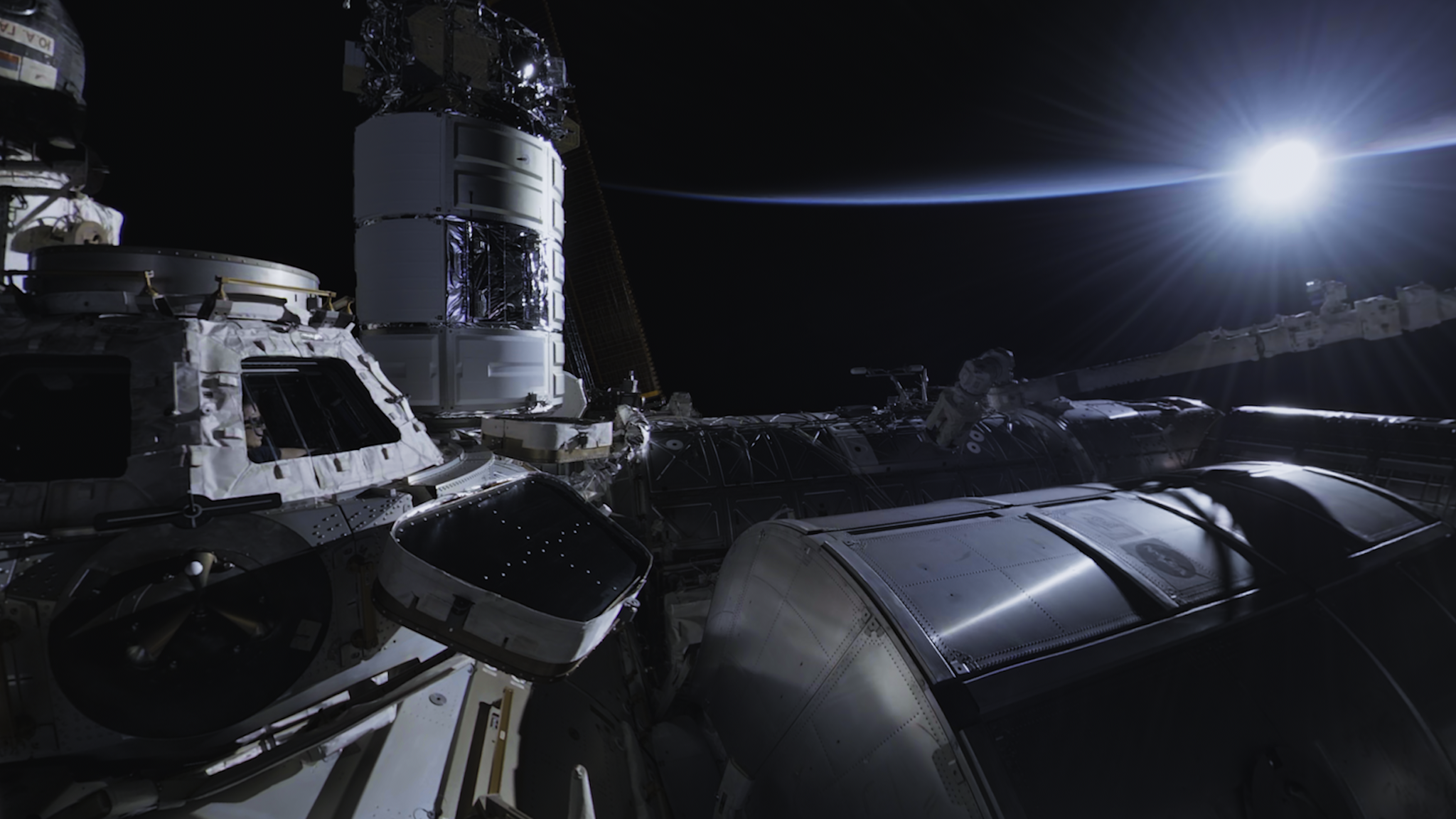
A photo of the exterior of the ISS with the sun shining in the background.

A still from Space Explorers: The ISS Experience. (Image credit: Space Explorers: The ISS Experience)

A show made by astronauts

I sat down with Félix Lajeunesse, co-founder of Felix & Paul studios — the organization behind the exhibit — to learn how this was possible. What does it take to recreate the ISS with this level of detail, and this level of soul?

"It took about a year and a half to two years to just prepare for this project, and eventually cameras were sent up there in space," he said. "That was the beginning of a three year production."

More specifically, the footage you see in this VR show was filmed across six NASA expeditions and involved shipping three cameras to space — two cameras operating inside the ISS and one camera designed to function in the vacuum of space. That latter camera was attached to the Canadian robotic arm on the exterior of the station and operators on the ground could remotely control it to achieve the cinematic quality they wished. The astronauts first put it on the sliding table of the ISS's Japanese module. Then, the camera was egressed from the station and the robotic arm could pick it up.

When it came to the interior cameras, however, that's where the astronauts themselves stepped in.

"It's not a traditional camera — it's a virtual reality camera," Lajeunesse said. "So, if you're going to be around a table, for example, having coffee together in the morning, well, this camera is not going to be in the middle of the table because no one would ever be there. It will be at the same height as the rest of you around the table because in the end it's going to be replaced by a person being there with you."

"This kind of anthropomorphic idea that the camera is a person really resonated with them," he added.
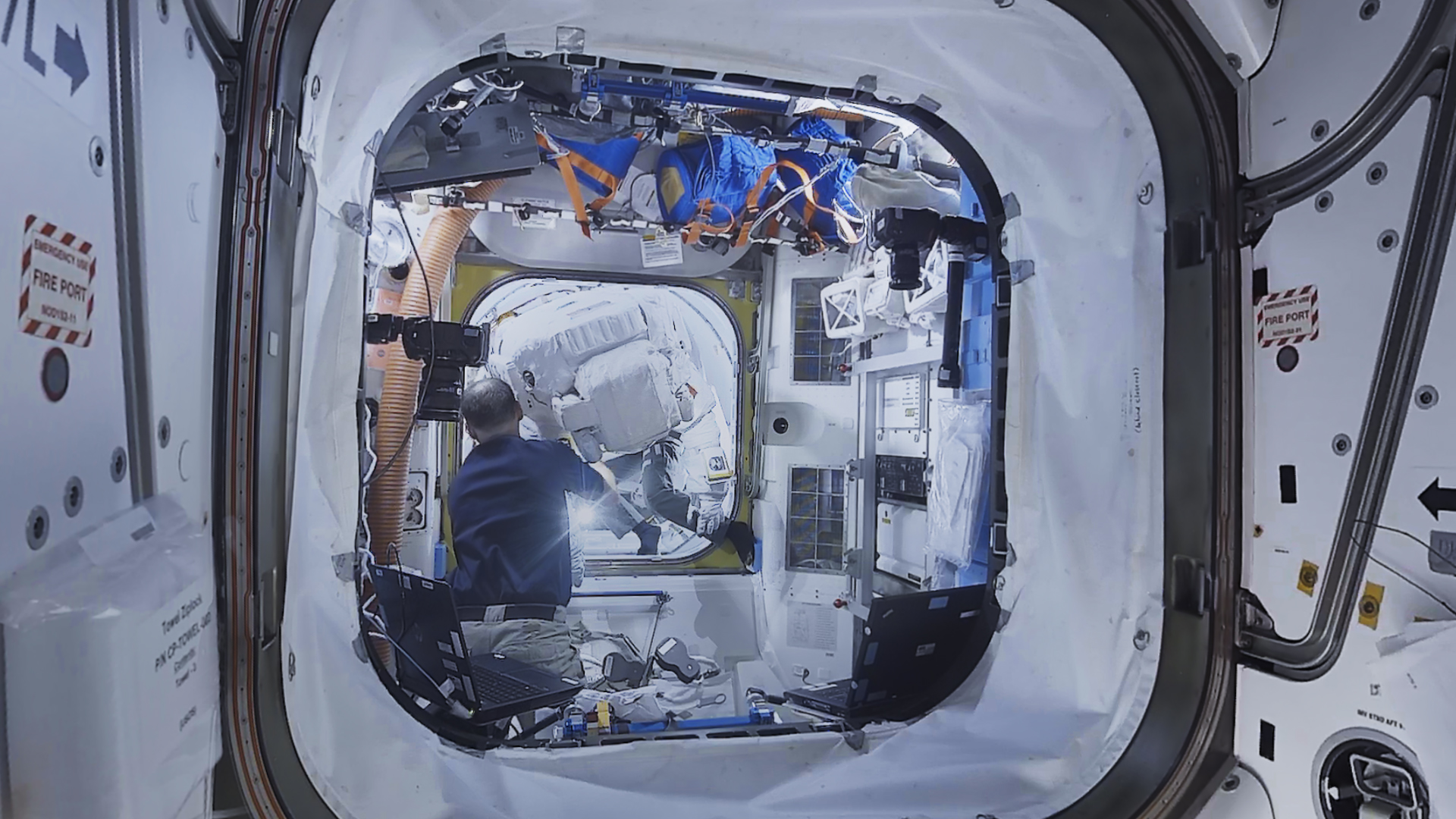
A photo of the interior of the ISS, showing a person within white walls.

A still from Space Explorers: The ISS Experience. (Image credit: Space Explorers: The ISS Experience)

In order to ensure the camera didn't interfere with the many experiments and procedures on the station Lajeunesse and his team made sure to send the astronauts what he calls a "shooting script" for each day of work. This script explained which different camera positions were desired; if anything wasn't possible, the astronauts would offer suggestions of better locations. "We had this ongoing conversation with them during the production, as if it was on a real set, essentially," Lajeunesse said.

And speaking with Lajeunesse, it became remarkably clear that this show wouldn't have been as heartfelt as it is without the astronauts' own desire to create it. It seems like the astronauts wanted to be able to share their indescribable experience of living beyond our planet with those stuck on it. This is a way for them to show their families the place they used to call home.

The team even made sure to premiere the U.S. version of the show at Houston, Texas, often called "Space City" because that's where NASA astronaut training happens at the agency's Johnson Space Center.

"Our first audience in the United States were the astronauts," Lajeunesse said. "It was quite an extraordinary and emotional turnout — almost all of them referred to experiencing this as going back home."
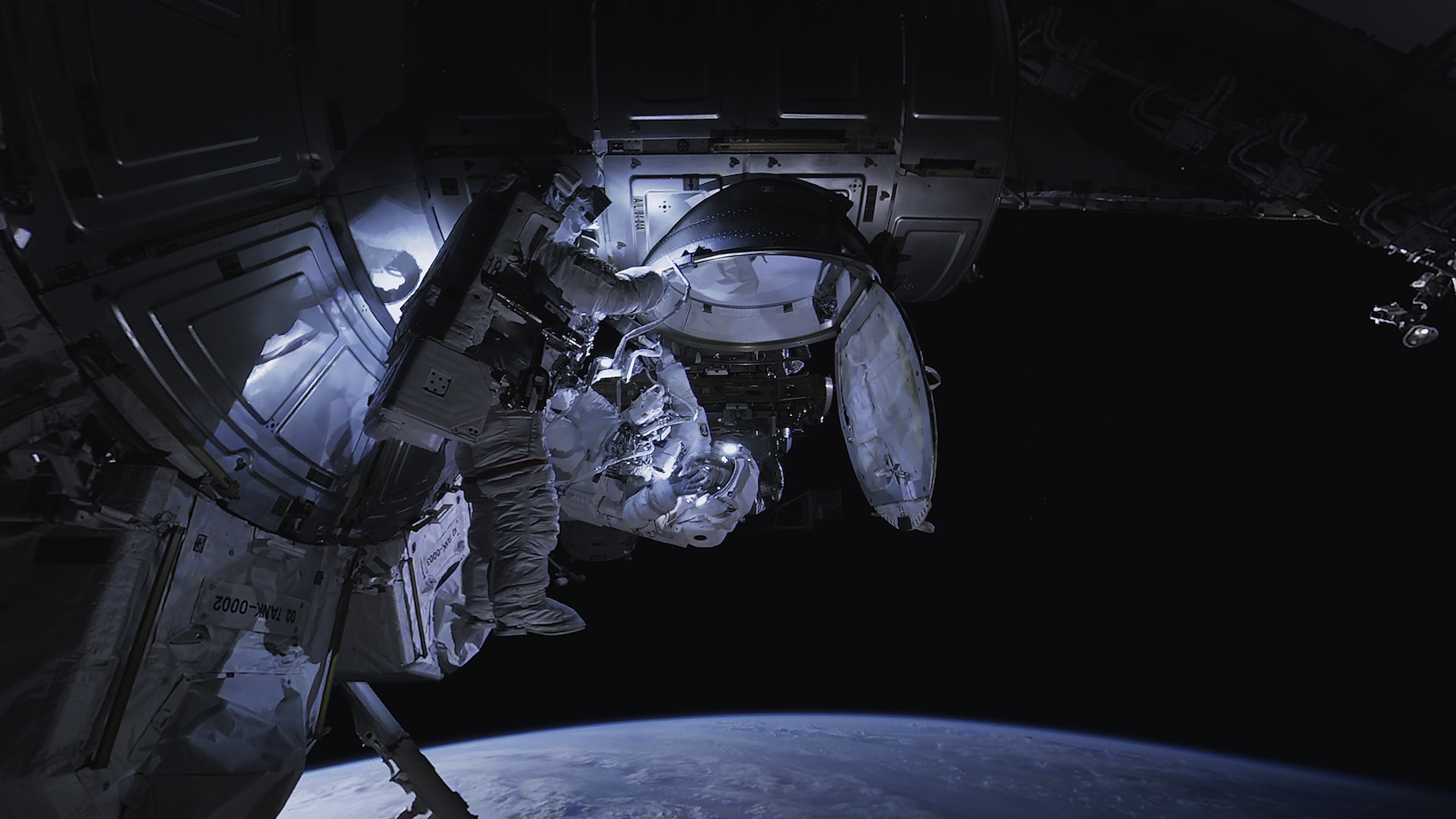
A photo of spacewalkers outside the ISS. The Earth is below.

A still from Space Explorers: The ISS Experience. (Image credit: Space Explorers: The ISS Experience)

A time capsule for future generations

As upsetting as it is, the International Space Station isn't forever. Unless a potential boosting mission reaches fruition, it'll be de-orbited and mostly lost in the flames of reentry in the year 2030. Its charred remnants will probably be placed in museums. One day, those museums will be visited by people who never lived during a time when you just knew the iconic lab was up there somewhere in the sky.

When that day comes, this ISS show will grow in sentimental value. It may end up offering the only way for ISS astronauts to go "home."
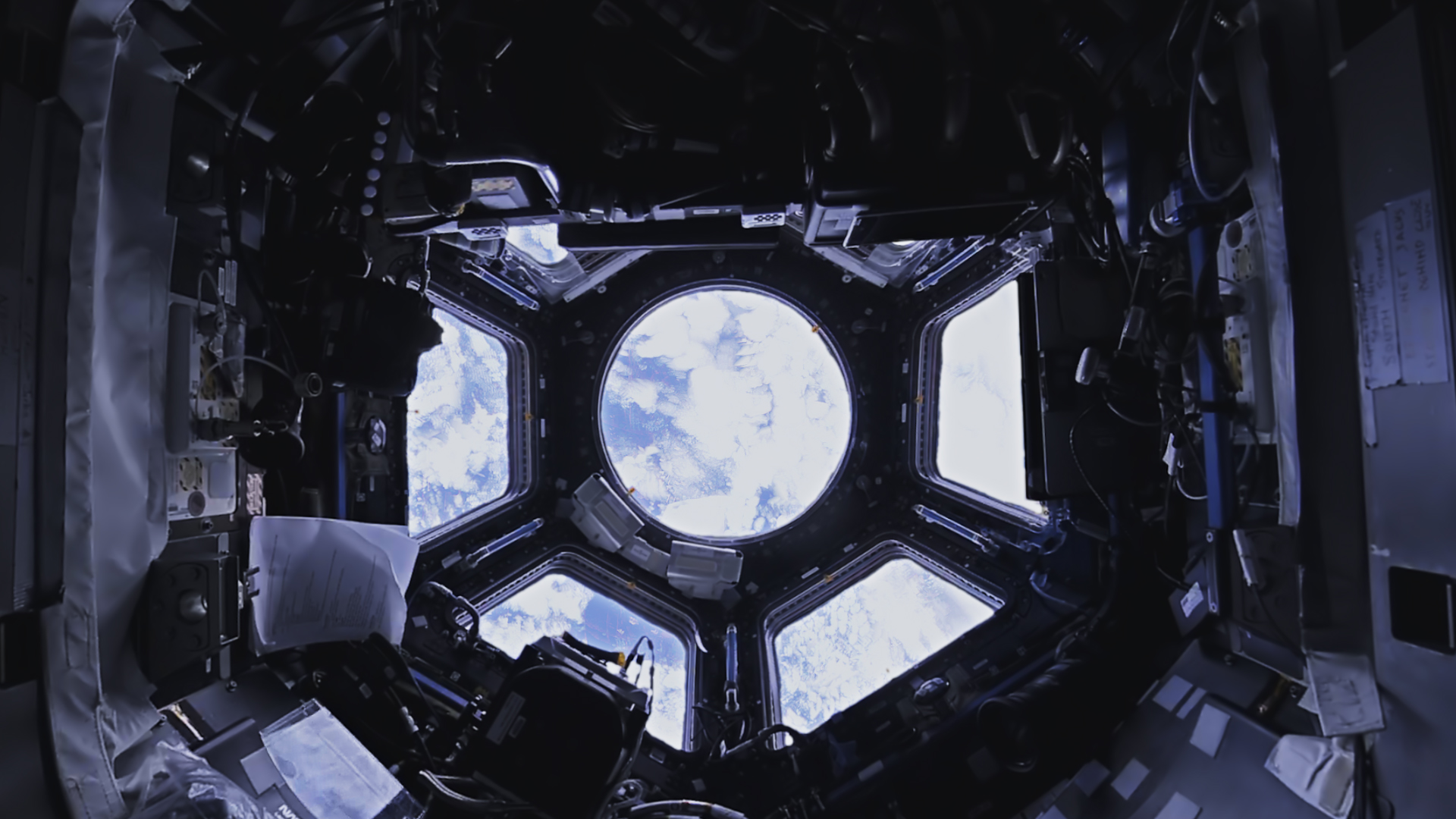
A view of the cupola. Through the windows, you can see the Earth.

A still from Space Explorers: The ISS Experience. (Image credit: Space Explorers: The ISS Experience)

"VR points to the capacity to create simulations that are just as rich and vibrant and open and possibilities than reality itself." Lejeuneusse said, comparing it to console video games or movies. "I think it's probably the most human medium there's ever been."

He hopes that, someday, VR will improve to the point where it becomes possible to generate open worlds that we can all be a part of together. Perhaps, he says, artificial intelligence will be a big part of that.

"This feeling of witnessing the Earth, this sense of the overview experience is something pretty special, pretty emotional for people, and something that could not be communicated through any other media," he said.

As for what's next? The team is working on a show in Las Vegas called Interstellar Arc, a science fiction futuristic VR experience that Lajeuneusse says is even more interactive than this International Space Station one. But still, he emphasizes that while future VR shows may continue to increase in capabilities, there will always be something profound about the ISS project.

"You know, the International Space Station is one of the most extraordinary examples of human collaboration; human cooperation. It's many different countries, some of them which are opponents at the political stage, that kind of all came together to build this enormous structure in space habitat where humans can go and live," he said. "It was all built through cooperation, and it's all maintained through cooperation."

"When they're up there, they're kind of like a microcosm of humanity," he added. "Just the fact that it exists, just the fact that it continues to exist. We should marvel at that."
Vulcan Centaur swapped out again: NASA goes with SpaceX Falcon Heavy rocket for launch of space weather mission

NASA is shaking things up for its next mission to research the sun.

The six satellites of NASA's Sun Radio Interferometer Space Experiment (SunRISE) mission are poised to launch to Earth orbit soon, to serve as an early warning system for incoming solar storms. They were originally slated to lift off on a United Launch Alliance (ULA) Vulcan Centaur rocket but have now been assigned a SpaceX Falcon Heavy, according to a NASA mission update.

SunRISE will fly to space as part of a rideshare mission sponsored by the U.S. Space Force's (USSF's) Space Systems Command (SSC). Though it's not stated specifically in the NASA release, that may be a hint as to why the mission's rocket was changed. On its most recent launch, USSF-87, Vulcan experienced an anomaly in one of its solid rocket boosters — the second such incident to occur during the rocket's four launches to date.

Vulcan succeeded in delivering the USSF-87 payload to its designated orbit on that launch, but the recurrence of the booster issue during ascent prompted the Space Force to pause national security launches on Vulcan until it could be addressed. Which mission SunRISE will be manifested on has not yet been released, but SSC has already shifted other launches between Vulcan and SpaceX's Falcon 9, so NASA's change in rockets for SunRISE could indicate either that the mission has been remanifested on a different SSC rideshare, or that another SSC mission has been shifted from Vulcan entirely.

SunRISE is a heliophysics study under the NASA Science Mission Directorate's "missions of opportunity" umbrella and is part of the Explorers Program run by Goddard Space Flight Center in Greenbelt, Maryland. It consists of six small satellites, each about the size of a mailbox. The mini-constellation's mission is led by scientists at the University of Michigan and will be managed out of NASA's Jet Propulsion Laboratory in Southern California.

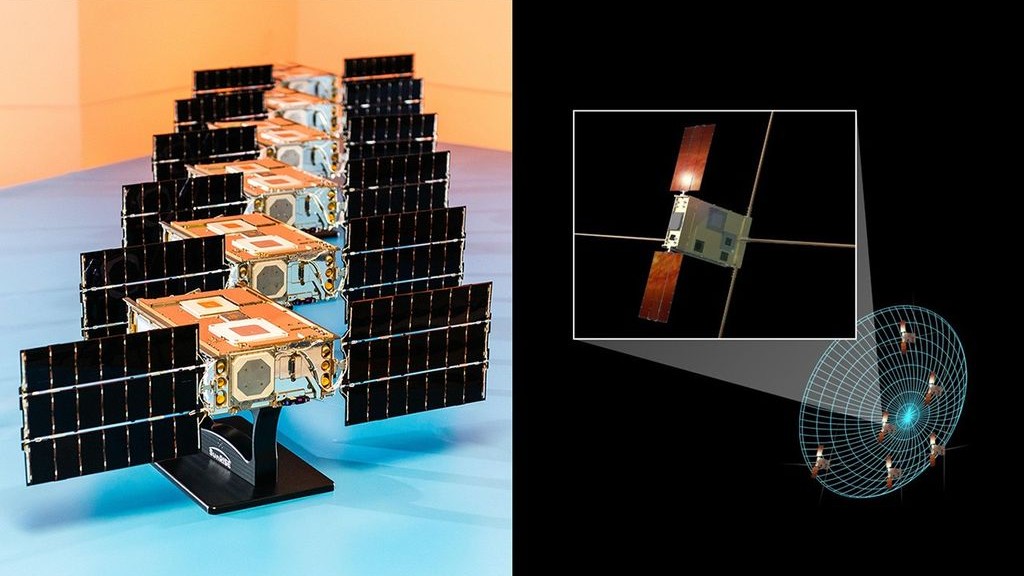
The half-dozen smallsats will be delivered to an orbit about 22,000 miles (35,000 kilometers) above Earth — just above a geostationary parking altitude — and fly in a giant 10-mile (16-km) "X" formation, each extending its roughly 10-foot (2.5-meter) antenna booms to act as a single large radio telescope to track solar radio bursts. These kinds of bursts travel faster than the energetic particles from a solar storm, and precede their arrival when shot towards Earth.

Powerful solar storms, like the one that hit Earth in January, are capable of disrupting or disabling satellites by interfering with onboard electronics, sensitive instruments and communications systems. If a storm is severe enough, it can pose a radiation threat to astronauts in orbit and even airborne passengers flying near Earth's poles, where the planet's magnetic field is weaker.

The SunRISE satellites, seen at left, will fly in formation, illustrated on the right, working as one large radio telescope in Earth orbit. (Image credit: NASA/JPL-Caltech)

SunRISE will help researchers better understand the behavior of incoming solar radio bursts, but the mission won't serve as an alert system by itself. Instead, scientists will use data collected by the spacecraft to improve prediction models for impending space weather, which in turn could lead to mitigation plans to better thwart the effects of such solar events on orbital infrastructure.

Falcon Heavy is SpaceX's heavy-lift launch vehicle, capable of launching up to 58,860 pounds (26,700 kg) to geostationary transfer orbit. It's a triple-booster rocket that consists of three modified Falcon 9 first stages, and has launched 12 times since it debuted in 2018. Four of those have delivered national security payloads to orbit, with the most recent of those, USSF-52, launching in December 2023. Falcon Heavy's most recent flight overall occurred this past April, when it sent the Viasat-3 F3 telecom satellite to orbit.

Falcon Heavy's next mission will lift off with NASA's Nancy Roman Space Telescope, currently set for no earlier than Aug. 30. SunRISE is scheduled to launch later this year, but a more specific launch window has not yet been announced.

Should Artemis IV astronauts actually land near the moon’s south pole? Artemis II pilot says the lunar equator might be better

The moon's south pole has long been the target of NASA's Artemis lunar landing missions, but one Artemis astronaut is questioning if that's still the best plan.

NASA's Victor Glover, who piloted the Artemis II mission around the moon this past April, proposed a different approach while speaking at the NASA Exploration Science Forum at the agency's Ames Research Center in California on July 21, according to a report published on Space News. "I think we need to be realistic and work our way to the south pole, and maybe not try to go there first," Glover said.

Instead, Glover suggested aiming closer to the moon's equator, where missions can land in areas not at risk of falling out of daylight, and in regions reachable by orbits that allow for quick transfers back to Earth in case of an emergency, according to Space News. That argument aligns with other recent Artemis program changes that NASA has introduced to gradually expand successive mission goals, but whether space agency officials will take his advice depends on what the top priority for Artemis moon landings is deemed to be.

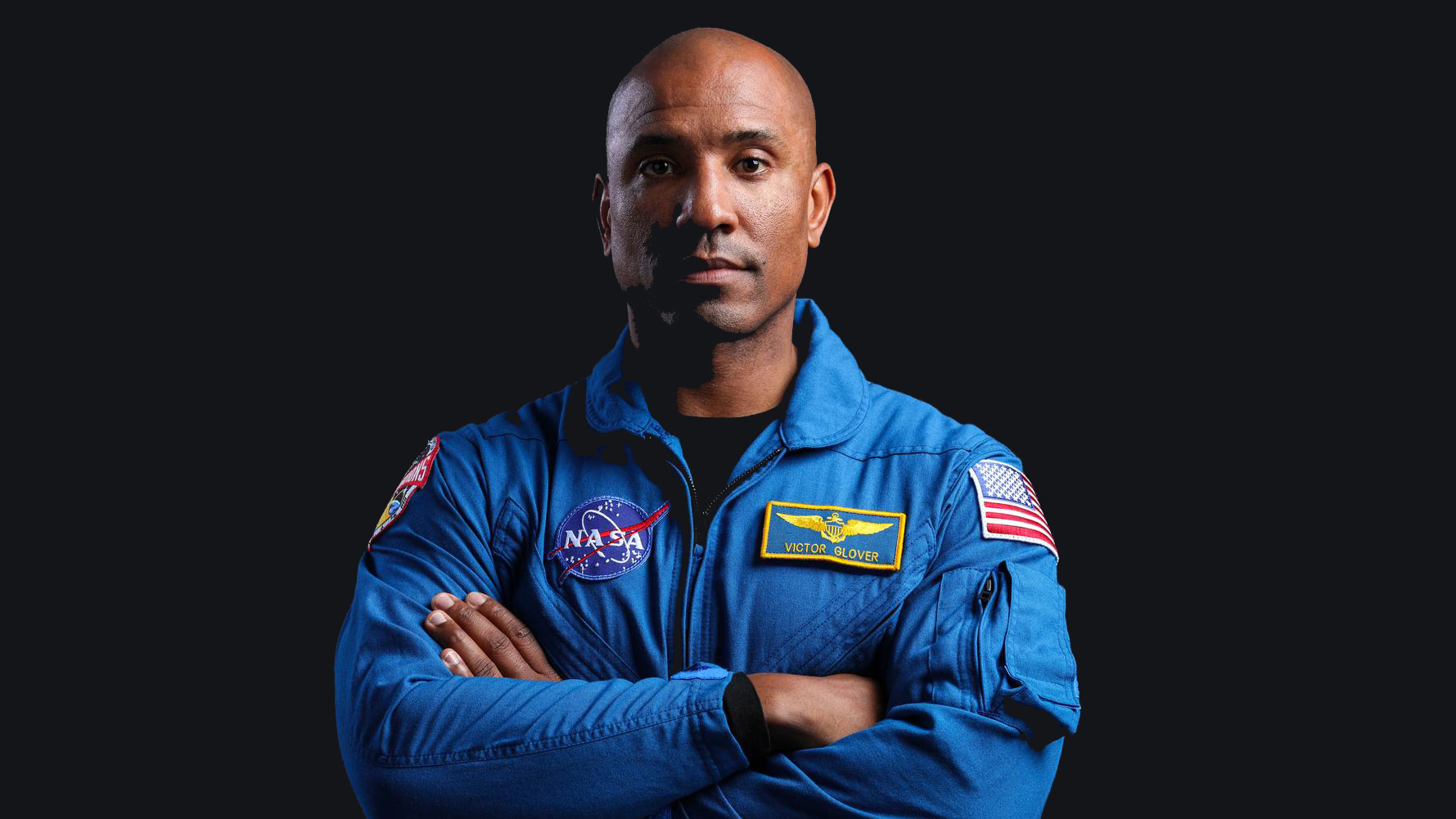
a male astronaut wearing a blue flight suit stands with his arms crossed against a dark background

NASA astronaut Victor Glover, the pilot of the Artemis II moon mission. (Image credit: NASA)

NASA has long targeted the lunar south pole due to its abundance of water ice. Permanently shadowed areas inside craters in this region are believed to harbor large ice deposits, which scientists believe can be used as a resource in the production of several space-travel essentials, like potable water, radiation shielding and rocket fuel. That goes a long way toward achieving the Artemis program's ultimate goal of creating a sustainable, long-term base on the surface of the moon, and using the lessons learned in building that outpost to enable the eventual occupation of Mars.

There is, however, a secondary motivation behind NASA's ramped-up urgency to see its Artemis missions succeed in a timely manner. China has also set its sights on the lunar surface, stoking fears in some U.S. officials about the implications of Chinese astronauts staking some sort of claim at the moon's south pole before American astronauts are able to get there.

During a Senate Commerce Committee hearing last year, several space industry experts, including former NASA Administrator Jim Bridenstine, urged lawmakers not to let that happen. Mike Gold, president of civil and international space at Redwire, told senators that China beating the U.S. back to the moon would mean "a global realignment that will impact our economy, our tax base, our ability to innovate and our national security."

If not just getting back to the moon first, but being the first with boots on the ground at the south pole, is the priority, Glover's suggested approach may not get NASA there in time. China is making fast progress with its lunar program; it has already demonstrated robotic landings and sample returns on both the moon's near and far side and begun developing hardware for a crewed landing by 2030.

NASA's next Artemis mission, Artemis III, is scheduled for next year. It will launch four astronauts aboard the Orion space capsule for rendezvous and docking tests with the program's two commercial lunar lander vehicles, SpaceX's Starship and Blue Origin's Blue Moon. If all goes according to plan on that mission, NASA is targeting late 2028 for the program's first moon landing on Artemis IV. To pull that off, one of the two landers has to be up to the task, and both have faced significant delays that have raised questions about their readiness on NASA's timeline.

To facilitate south pole landings, NASA previously laid out a lunar near-rectilinear halo orbit (NRHO) — a high-altitude, elliptical polar orbit — where Orion would dock with the lunar Gateway space station, and then crews would transfer to and undock aboard one of the Artemis landers to descend to the surface. Gateway is no longer part of the picture, however; the agency has sidelined that outpost to push ahead with a surface base.

But NRHO on its own also introduces some complications that SpaceX and Blue Origin have raised while developing their lunar landers, as well as safety concerns for astronauts facing a potential emergency situation on the moon's surface. Because of its highly elliptical shape and long orbital period, opportunities to launch from the moon's south pole to rendezvous with Orion in NRHO open up just once a week.

To highlight the potential risks imposed by relying on an NRHO, Glover brought up a hypothetical situation — an astronaut health issue that requires a medical evacuation just after landing at a lunar south pole moon base.

"You’re stuck for a week," Glover said. "That’s a big deal to me, and I don’t like that plan … The equator gives me opportunity to save that person."

If the point of Artemis' returning astronauts to the moon as soon as possible is landing there at all, then there's no need for the first of those missions to aim for the south pole, Glover argued. "If you want to go fast, go familiar … If we want to land soon, familiar, daylight, equator."

"I think we need to be realistic and work our way to the south pole, and maybe not try to go there first," he added.

SpaceX is also eyeing an equatorial orbit when Starship flies on the Artemis IV mission, and NASA may already be quietly shifting the mission's landing site to a higher latitude. During a June 9 event that revealed the Artemis III, SpaceX Customer Operations and Integration Vice President Jessica Jensen outlined an Artemis IV mission plan with Starship that didn't involve NRHO.

"We have an updated plan with NASA that includes docking Starship with Orion in Earth orbit instead of NRHO, and then we use Starship to actually do the translunar injection with Orion attached," Jensen said, stressing the same benefits that Glover expressed during the July 21 forum.

"The crew can also abort off the lunar surface nearly any time, versus waiting up to days from NRHO," she said. "In addition to improving crew safety, these new Artemis IV orbits also significantly lower the amount of propellant Starship needs to aggregate in space, since we now just have a more direct route to the moon, and this lower schedule risk overall."

Artemis III astronauts will beam 4k video from Orion to Earth using SpaceX Starlink lasers

Orion is getting an upgrade on Artemis III, and the astronauts aboard are getting WiFi (sort of).

NASA is partnering with SpaceX to equip the Orion spacecraft for Artemis III with a pair of Starlink mini laser terminals, designed to operate on SpaceX's existing Starlink network. The two panels will be installed on Orion's exterior, and will augment the spacecraft's existing communications systems.

The added capability is expected to provide a greater data capacity from Orion to NASA's mission control in Houston, which may include high-definition live video from orbit. The mission is currently scheduled for the second half of 2027, and will also include another sizable contribution from SpaceX: a Starship rocket.

SpaceX currently operates more than 10,000 Starlink spacecraft in LEO, which provide satellite internet coverage across nearly the entire globe to commercially-available wireless terminals about the size of a laptop. Combined, those more than 10,000 and counting satellites are equipped with over 25,000 lasers currently in operation in LEO to maintain the network's interconnectedness, according to a NASA update.

The company previously demonstrated the Starlink constellation's use as a communication relay network during the privately funded Fram2 mission that launched the first human into a polar orbit around Earth in 2025. SpaceX frequently utilizes its high-data capabilities to stream high-definition live views of its Falcon 9 and Starship rocket launches from orbit.

Artemis III is the third in a program of NASA missions with the goal of returning astronauts to the moon and establishing a permanent base on its surface. Artemis III is designed as a practice run for NASA's Orion capsule to rendezvous and dock with the program's commercial lunar lander vehicles, Starship, and Blue Origin's Blue Moon spacecraft, in low Earth orbit (LEO). That's a lot closer to home compared to the Artemis II mission that NASA launched in April of this year.

Artemis II was Orion's first flight with astronauts onboard, and flew a 10-day mission around the far side of the moon. NASA used laser communications during Artemis II as well, using terminals on Orion and ground stations at NASA's Jet Propulsion Lab in California and White Sands Complex in New Mexico to transmit data loads too big for the agency's Near Space and Deep Space radio networks. With flight sticking to LEO during Artemis III, communication limitations become a lot easier to surmount.

If all goes according to plan during Artemis III, NASA has scheduled the first Artemis moon landing on the following mission, Artemis IV. NASA is targeting 2028 to launch Artemis IV, and has selected Starship as the lunar lander that will return astronauts to the lunar surface.

Four astronauts, 3 spacecraft, 2 weeks in orbit: Artemis III will be NASA’s most complicated mission ever

NASA has never flown a mission like Artemis III, and it's shaping up to become one of the most elaborate spaceflights in history.

NASA has provided more details about the Artemis III flight scheduled for next year, and, if all goes according to plan, the objectives the astronauts will be checking off their list will contain more than a few "firsts" for the Artemis program and human spaceflight overall. That includes the first crewed NASA mission to rendezvous and dock with two separate designed to carry crews of their own.

Artemis is NASA's next-generation program to return astronauts to the surface of the moon. Artemis III is designed as a test run for NASA's Orion spacecraft in which it will dock and perform operations with the program's two commercial lunar landers — SpaceX's Starship and Blue Origin's Blue Moon. The mission will launch a crew of four aboard Orion on NASA's Space Launch System (SLS) rocket into Earth orbit, where the capsule will rendezvous with each lander separately over the course of about two weeks. Their success will set the stage for a crewed moon landing on Artemis IV, but NASA must first master the complicated demands of Artemis III in order to confidently set its sights on the lunar surface.

"Artemis III will be a highly choreographed dance with a demanding launch sequence across multiple launch pads and equally demanding mission operations for our ground and flight crews, making it one of the most complex and ambitious missions NASA has ever undertaken," said Artemis Program Manager Jeremy Parsons in a NASA update on July 15.

Only one mission in the course of human spaceflight has flown astronauts to rendezvous with multiple spacecraft capable of supporting crews of their own: Soyuz T-15 in 1986, which launched cosmonaut Leonid Kizim to the Salyut 7 space station, and then flew him to, what was at the time, the Soviet Union's MIR space station.

America's space program has come close to such a milestone. NASA's Gemini 10 mission in 1966 launched NASA astronauts John Young and Michael Collins to rendezvous and dock with the uncrewed Agena 10 probe. After undocking, they flew their Gemini capsule to rendezvous with Agena 8, but did not dock with the probe. Two shuttle missions, STS-72 and STS-51A, also managed to rendezvous with separate satellites during their missions, but none of these required the complex coordination and multiple launch vehicles lined up to pull off Artemis III.

Orion, Blue Moon and Starship are all designed to launch on different rockets from different launch pads at NASA's Kennedy Space Center (KSC) and the Cape Canaveral Space Force Station (CCSFS), which will all require cross-agency and commercial collaboration for range availability, resource use constraints like nitrogen gas availability across the various ranges and the alignment of several other overlapping hierarchies of infrastructure in order to ensure Artemis is successful.

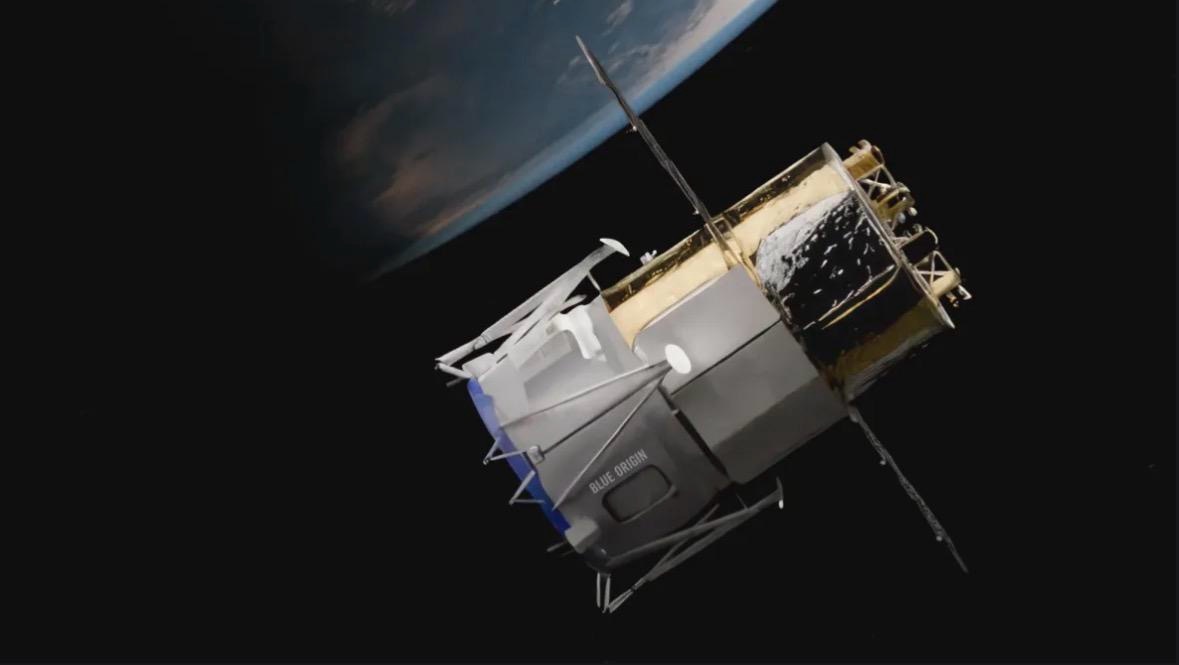
A lunar lander flies above Earth.

Render of Blue Origin's Blue Moon lander in low Earth orbit. (Image credit: Blue Origin)

Blue Moon will launch on Blue Origin's New Glenn rocket from Space Launch Complex-36 (SLC-36), which it leases from the Space Force at CCSFS. Blue Moon is the first of the three spacecraft set to make it to orbit, and is capable of remaining in space for up to 30 days, according to the NASA update. That will give Blue Origin and NASA an opportunity to confirm the lander's condition and functionality before committing the Artemis III crew and Orion to launch and join it on orbit.

SLS will be next to get off the ground, lifting off from KSC's Launch Complex-39B carrying the Orion spacecraft. Orion will rendezvous with Blue Moon in low Earth orbit (LEO), and will spend about two days docked with the lander. Part of the purpose of Artemis III is to give both lunar lander providers the chance to mature their designs based on actual in-flight data, so neither the Blue Moon nor Starship that fly on the mission will be the spacecrafts' final, landing-capable versions.

Blue Origin will launch the Blue Moon Mark 2 (Mk2), a graduated design of the company's smaller Mk1 cargo lander, which was scheduled to launch a demonstration mission this year. That may be delayed, however, due to an explosion of one of the company's New Glenn rockets during an engine test at SLC-36 in May. With repairs now well underway, Blue Origin CEO Dave Limp has voiced confidence that New Glenn will return to flight by the end of 2026.

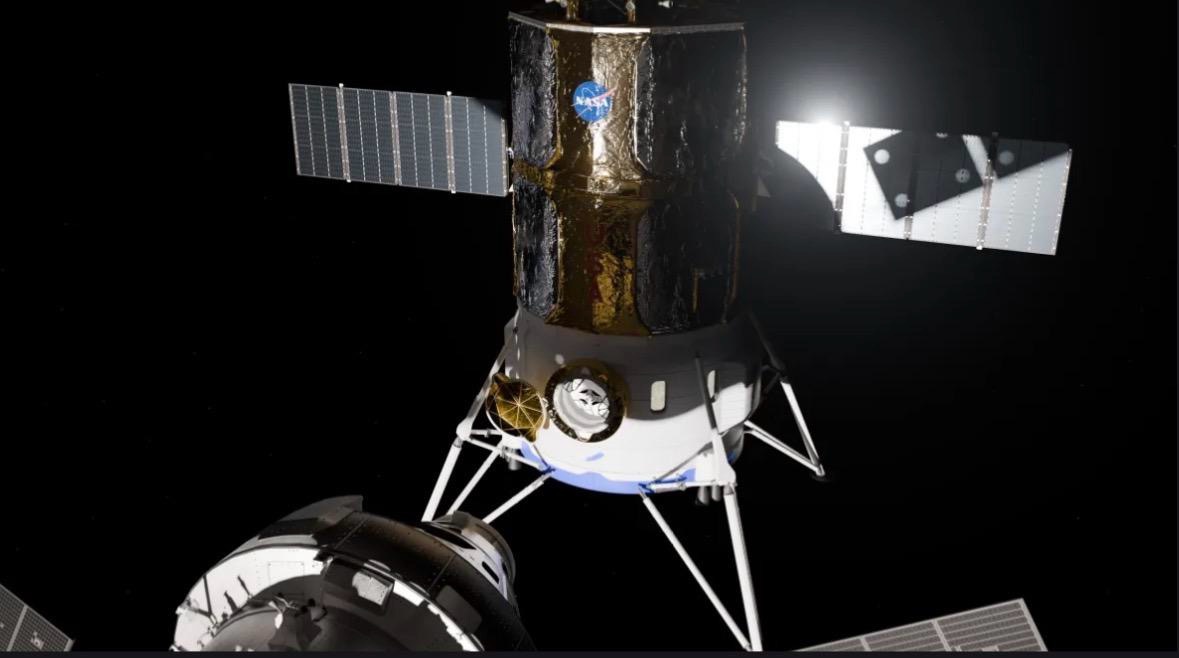
A lunar lander rendezvous with Orion in space.

Render of Blue Origin's Blue Moon lander and Orion prior to docking in low Earth orbit. (Image credit: Blue Moon)

Completing that Mk1 mission this year will be just as critical to NASA's moon plans as the launch of Blue Moon Mk2 will be during Artemis III. Among the list of requirements each lander must meet in order for NASA to certify the vehicles to land astronauts on the moon, successfully demonstrating an uncrewed lunar landing is of chief importance.

"SpaceX and Blue Origin have put forward a list of aggressive objectives and goals intended to complement upcoming uncrewed demonstration missions at the moon so that we can gain both understanding and confidence in the spacecraft and launch vehicles prior to a crewed landing," said NASA's Steve Creech, Artemis' Human Landing System program manager, in the mission update.

Once Orion docks with Blue Moon on Artemis III, two of the mission's astronauts will be able to board the lander to test out its environmental control systems, avionics and the interoperability between the two spacecraft in flight. A test article EVA (extravehicular activity) spacesuit designed to mirror what astronauts will wear during future excursions across the lunar surface will launch aboard the Artemis III Blue Moon, and provide engineers data about how the suit will interact within the lander's crew cabin.

Starship won't launch until after Orion and Blue Moon have undocked. SpaceX is currently constructing two Starship towers on Florida's Space Coast, one at KSC's LC-39A, and another at SLC-37, but it's not yet clear which pad will support Artemis III. NASA contracted SpaceX to design a lunar lander version of the spacecraft to deliver astronauts to the surface of the moon on Artemis IV, but SpaceX has that and more in mind for the massive vehicle.

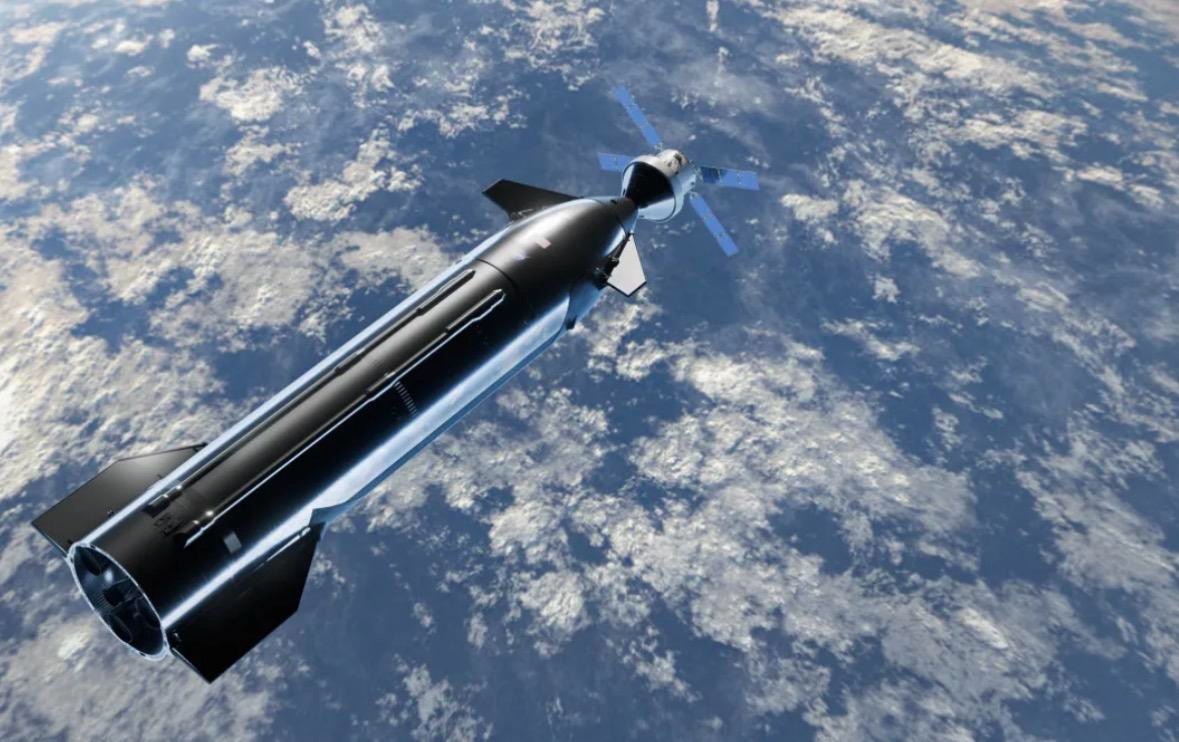
A giant chrome rocket and a small space capsule dock in low Earth orbit.

Render of SpaceX Starship and Orion docked in low Earth orbit. (Image credit: SpaceX)

SpaceX has performed test flights of its Super Heavy booster and Ship upper stage, collectively known as Starship, since 2023. The rocket is designed to be fully reusable, and will provide SpaceX a big upgrade from the company's workhorse Falcon 9 rocket. Once operational, SpaceX says Starship will be capable of delivering more than 100 tons to LEO. But SpaceX is still chasing that operational status.

Despite its dozen launches to space, and counting, Starship is still very much in a developmental stage, and has yet to meet many of NASA's requirements to fly a crewed lunar landing. SpaceX introduced the "Version 3" (V3) Starship on its Flight-12 launch in May, and intends to fly the same design when it launches Starship on Artemis III, with a docking adapter for connecting with Orion. For the astronauts, that means no crew cabin to enter. Instead, Orion and Starship will test communications and maneuvering systems between both vehicles.

Starship's V3 upgrade includes hardware that will be needed for an actual moon landing mission, like docking ports to perform propellant transfers in space — Starship requires refueling from tanker Ships on orbit in order to fly beyond LEO, and NASA estimates at least 15 Starship refueling launches will be needed for Artemis IV. Transferring and storing those cryogenic fuels in space is another capability Starship (and Blue Moon) needs to demonstrate before it can perform crewed lunar landings.

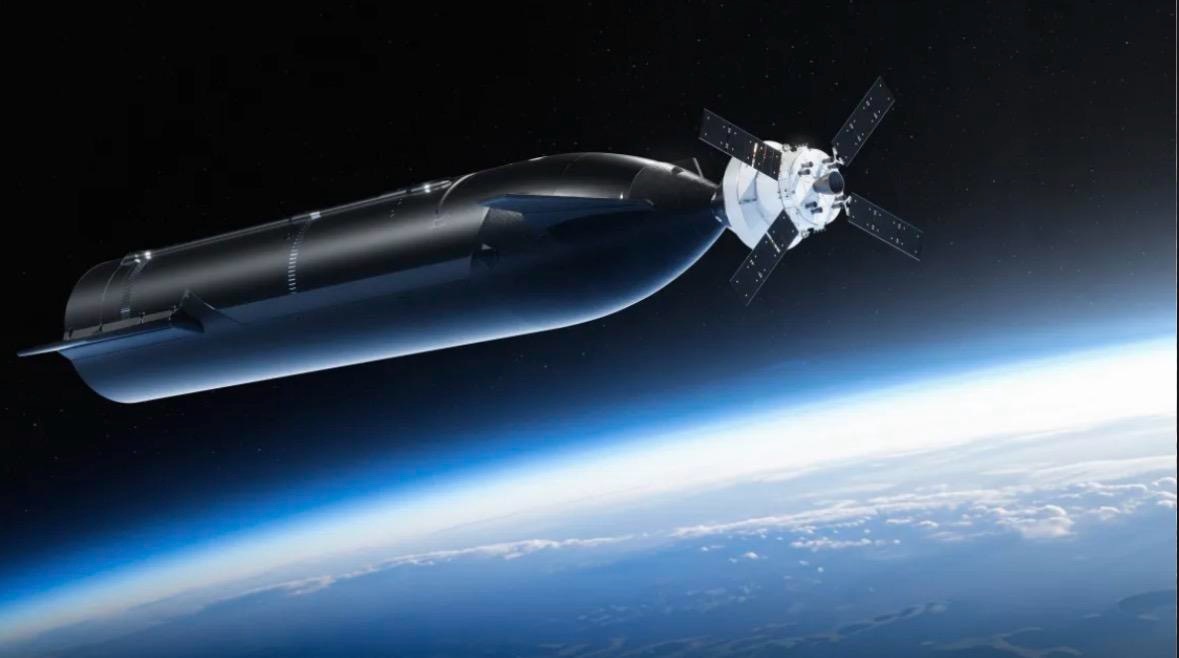
A giant chrome rocket and a small space capsule dock in low Earth orbit.

Render of SpaceX Starship and Orion docked in low Earth orbit. (Image credit: SpaceX)

For Artemis III, though, Starship and Blue Moon will each only require one launch to get the job done, and NASA wants to give them ample room to do so. "All three rockets will have more launch opportunities than are available for a lunar mission and will be able to reach the designated mission altitude in a single launch," the NASA update said.

Orion and the Artemis III crew will stay docked with Starship for about a day before detaching to begin preparations for their return to Earth. Similar to the return of Artemis II in April, the Artemis III astronauts will target a parachute-assisted splashdown aboard Orion in the Pacific Ocean, off the United States' West Coast.

Successful operations with both landers on Artemis III would pave the way for NASA's lunar landing plans on Artemis IV, currently scheduled for 2028. Barring any development delays or complications during Artemis III, Starship is the vehicle NASA has selected to carry out the Artemis IV moon landing, the first return of astronauts to the lunar surface in more than half a century.

Artemis II was an incredible reminder of our shared humanity just when we needed it most (op-ed)

For ten glorious days starting on April 1, 2026, one human endeavor captivated our home planet across continents and time zones: the NASA Artemis II mission to orbit the moon, the first crewed mission to cislunar space since 1972. In an Easter-Passover week that had especially demoralizing headlines on global conflicts, this mission presented a powerful vision of what journeying together and taking enormous risks for a shared purpose towards a shared future could look like.

Much has been spoken and written about the scientific and personal achievements of the Artemis II mission and its trailblazing astronauts. Their humanity, and what it did for humankind at large, is perhaps a quieter yet just-as-celebratory achievement.

In a time of trillion-dollar AI IPOs, when the seemingly planned obsolescence of humanity itself looms on our collective horizon, the Artemis II astronauts reminded us that they considered it the honor of a lifetime to do this for us - and as us - while transmitting daily that they couldn’t wait to come home to us. As Christina Koch shared at the end of the translunar injection burn (TLI) on day 2, while Artemis II set its course to leave Earth's orbital space for the moon as well as its return trajectory: "With this translunar injection burn, we do not leave Earth. We choose it."

From their morning wake-up music playlists (which inspired many to enquire about submitting their compositions for future crewed missions), to the reading out of their menus and details of their daily workouts or sleep schedules, we were reminded that these astronauts were navigating with us in real time the humdrum work of staying alive while conducting amazing science. This signal reached Earth as a continuous invitation to fellowship, and the record-breaking viewership of Artemis II built like a slow cooker feast, with global engagement increasing from launch to splashdown.

The Artemis II livestream introduced many viewers to the unavoidable aspects of spaceflight missions, such as the timing lag and blackouts in communications that will endure regardless of future technological advancements.

Sometimes this was wonderfully funny, like when the Canadian Prime Minister Mark Carney sought reassurance from the Artemis II astronauts that they preferred maple syrup to Nutella over their pancakes, with the astronauts bursting into laughter a few seconds after the media in-room chuckles.

At other times, it was the quiet anticipation of unprecedented history like the 40-minute communications blackout when the Orion spacecraft traveled behind the moon, or the heart pounding nailbiters of the 6-minute blackouts during the TLI or re-entry to Earth. In an era that rewards instantaneity over pauses, the globe watched and waited together. Such communication lags will compound dramatically for more distant worlds we explore, yet will still tether us profoundly in real time to one another despite our attention- and time-deprived schedules.

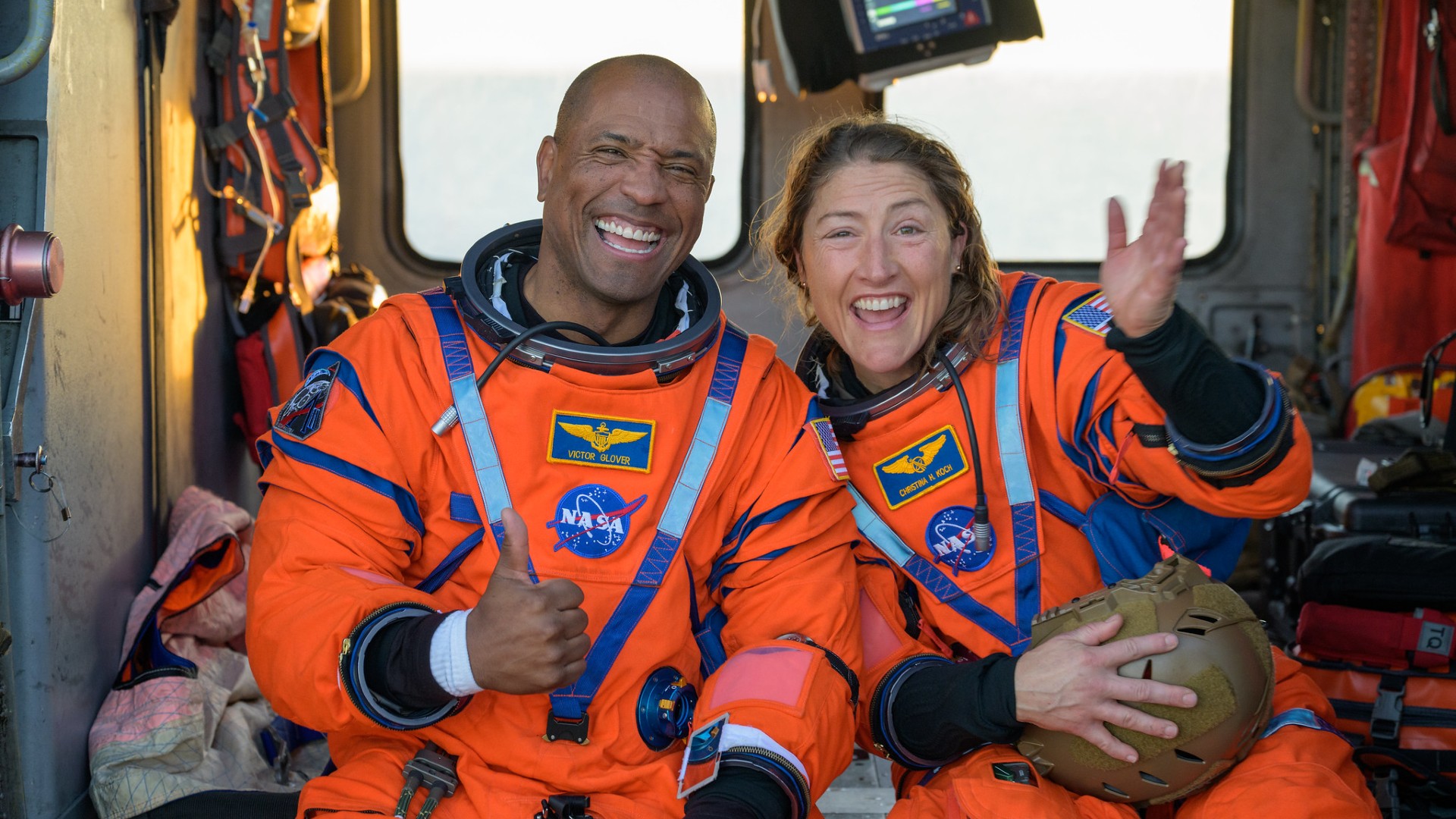
two people in bright orange spacesuits smile and wave inside a helicopter on the deck of a ship at sea

Artemis II astronauts Victor Glover and Christina Koch smile after being recovered onto a U.S. Navy vessel following splashdown. (Image credit: NASA/Bill Ingalls)

The Artemis II livestream also brought home the challenges of human bodily functions far from home. An inordinate amount of media attention and communications airtime was devoted to the brand new model of NASA toilet which developed issues just hours after launch and later became unfunctional on day 3 of the mission. Panels of NASA and space studies experts were asked by journalists about whether the astronauts were able to do either one or both of "#1" or "#2", or why the toilet gave off burning smells, highlighting the very human realities of boldly going where no one has gone before.

We also saw the rocking of the Orion capsule framed by the darkness of space and the background of the moon or Earth. We watched as each astronaut took their turn with the mandatory daily exercise routine to prevent bone density loss, cardiovascular issues and other health declines in a microgravity environment (only one astronaut can work out at a time, owing to space restrictions and to prevent buildup of exhaled carbon dioxide in an enclosed environment).

artemis 2 thumbs up

The Artemis II crew give a group thumbs-up inside their Orion capsule. (Image credit: NASA)

The Artemis II mission was full of deeply personal experiences and observations shared by the astronauts, made even more powerful by their unscripted nature. Commander Reed Wiseman's impromptu words of gratitude to the thousands of engineers and staff involved with the successful TLI, and the spontaneous naming of craters on the far side of the moon including - as the astronauts wept and hugged - one for his deceased wife Carroll, connected us in real time to their, and therefore our, evolving scientific and human perspectives.

This gratitude was echoed in a recent interview at the Kennedy Space Center, in which Wiseman shared that he had just received a handwritten note at the airport written on a boarding pass, stating "Thank you for reminding us about joy and hope in the universe again", which he expanded on to thank all the hands that helped the Artemis II mission succeed.

There were also moments during the mission when they simply ran out of words, like when they saw shades of colors on far-side lunar craters on what appears from Earth as a gray barren world. They called for new language to describe what they were seeing.

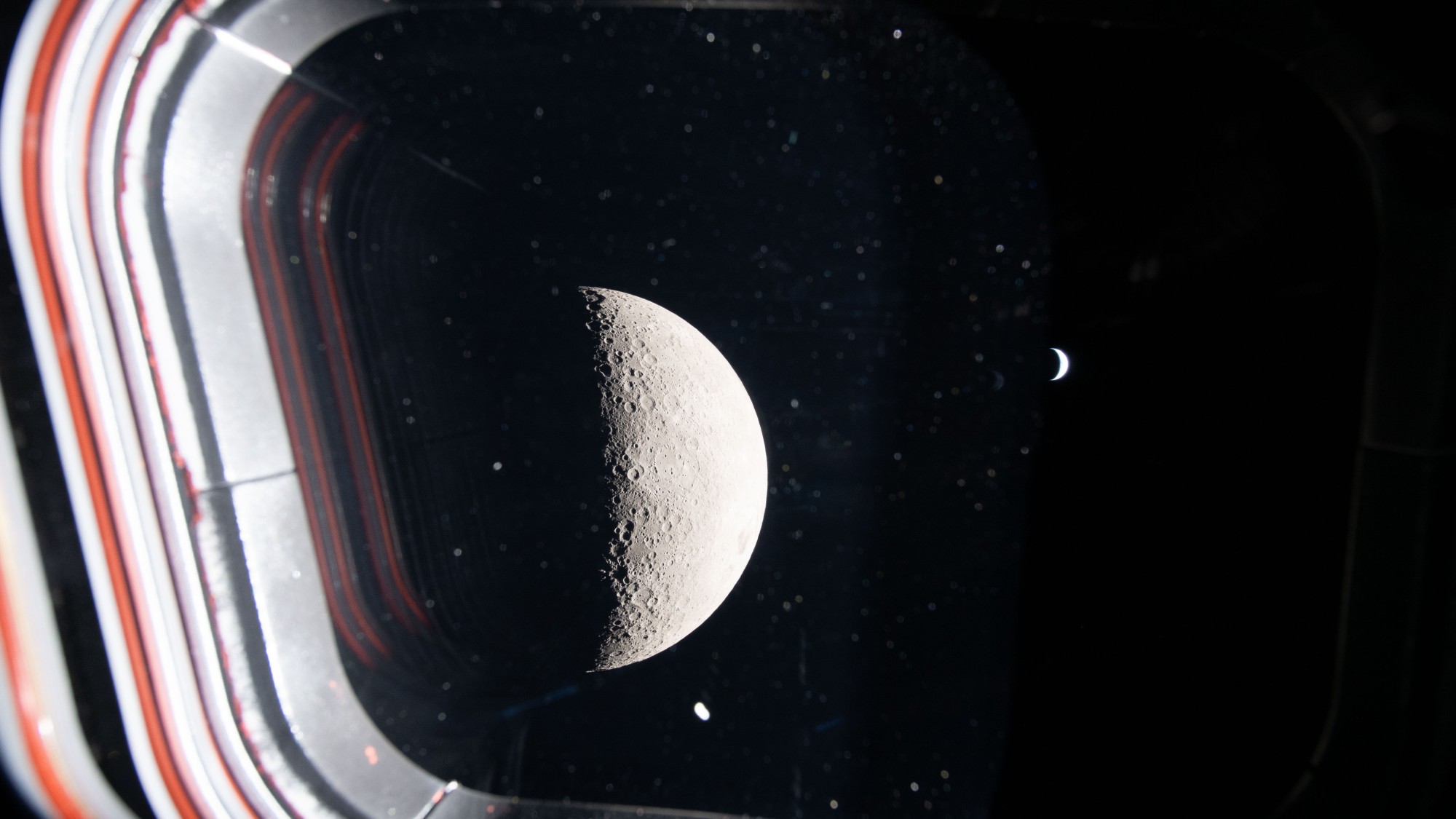
a pockmarked grey orb and a bright crescent seen on a starry background through a window

The moon and earth as seen through the window of the Artemis II crew's Orion spacecraft (Image credit: NASA)

NASA recently issued a call for filmmakers, documentarians, songwriters, and poets to contribute to mission storytelling, especially encouraging in the wake of the cancellation of the artist-focused dearmoon mission. Perhaps a Dictionary of the Moon and an Embassy of the Moon, as Dutch artist Marjolijn van Heemstra has proposed, will become possibilities in the future.

Towards the end of the 1997 movie "Contact," based on the 1985 book by Carl Sagan, astronaut and SETI scientist Dr. Ellie Arroway (played by Jodie Foster) is overcome by the experience of interstellar travel and the dazzling views it brings. She says in a choked voice "they should have sent a poet."

In the case of Artemis II, we sent four.

Scientists told them, ‘No, it’s too dangerous,’ but they did it anyway: Inside Japan’s super-close asteroid flyby

Japan's Hayabusa2 spacecraft returned spectacular images of a near-Earth asteroid following a super-close flyby on July 5, but heated debate was needed before teams signed off on the daring attempt.

When images of the asteroid Torifune arrived on the morning of July 6 Japan time, Makoto Yoshikawa and his team at the Japan Aerospace Exploration Agency (JAXA) got two surprises at once. Torifune turned out to be a contact binary, in which two chunks of rock have come together under gravity, and the returned images were also larger than hoped.

"We did not imagine such a contact binary," Yoshikawa, former mission manager of Hayabusa2, told scientists gathered at the Asteroids, Comets and Meteors conference in Poznan, Poland, on July 10. "Originally, we didn't think we could have such a very big image. Maybe we will take a very small one, but the image was much larger than we expected."

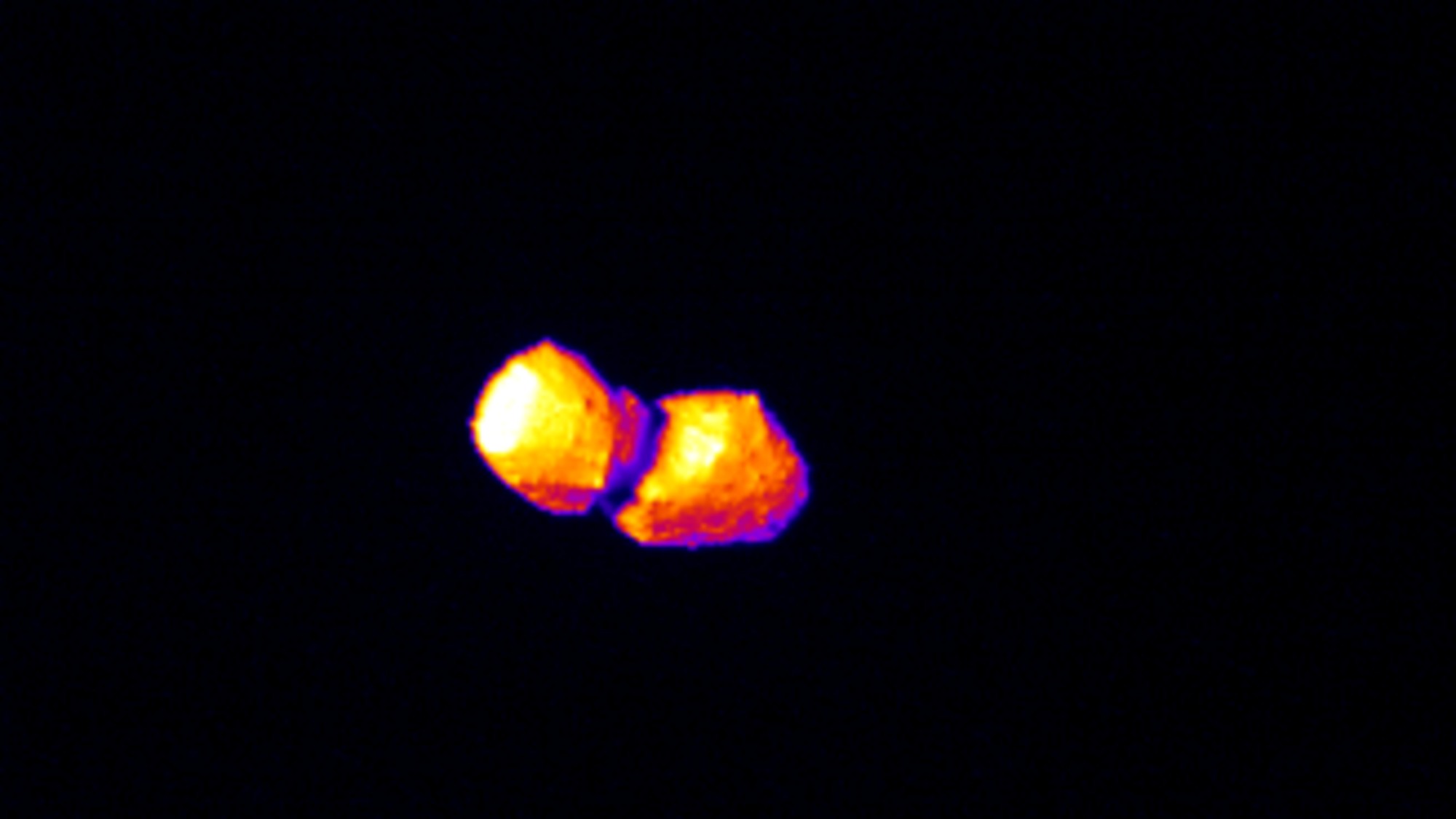
a double-lobed space rock on a black background, depicted in a gradient of false colors ranging from white-yellow to deep violet

The asteroid Torifune as seen by Hayabusa2's Mid-Infrared Camera during the July 5 flyby. (Image credit: JAXA)

The double surprise was the payoff of months of debate between science and engineering teams, and a last-minute proposal that alarmed some of the scientists it was meant to serve. In the end, the flyby was so close as to be at the very edge of what the aging spacecraft was designed to conduct.

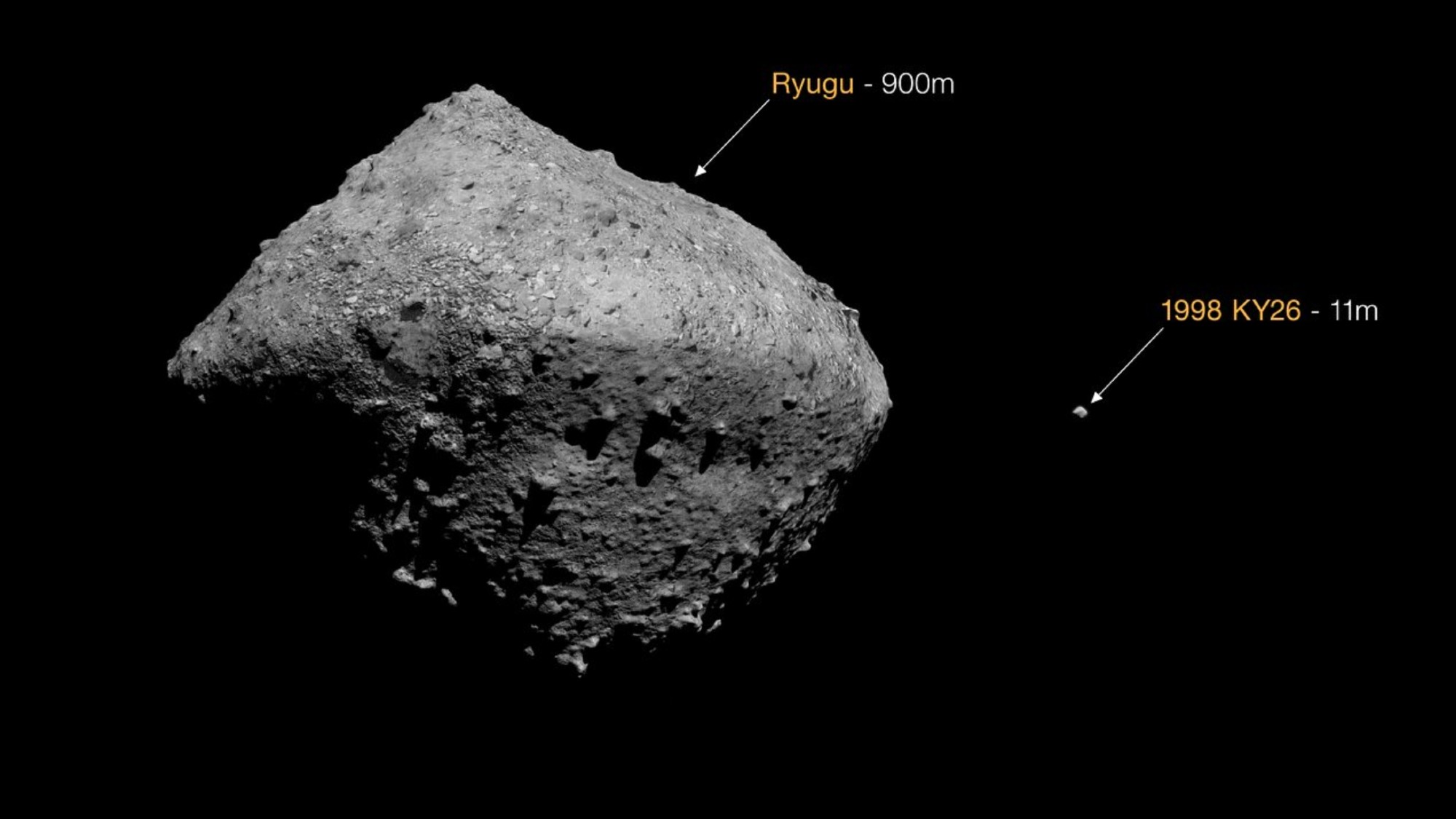
Hayabusa2 launched in December 2014 and rendezvoused with the asteroid Ryugu four years later. The spacecraft collected samples and delivered them to Earth in 2020, completing its primary objectives. JAXA then made plans for an asteroid flyby and a rendezvous with the tiny asteroid 1998 KY26 in 2031.

Usually for flybys, the closest distance is 100 kilometers (62 miles), Yoshikawa said, but in Hayabusa2's case this would not be close enough to gather good images. Hayabusa2 was designed for rendezvous and proximity operations, including hovering, correcting and landing — not for a high-speed pass at 5.3 kilometers per second (3.3 miles per second). Its cameras were also not designed for high-speed slewing.

According to Yoshikawa, science team members pushed back. At a distance of 100 kilometers, Hayabusa2's cameras would barely resolve the asteroid's global shape. Engineering responded with a proposal of 10 kilometers (6.2 miles). Science said that was acceptable, but the team kept pushing. Eventually, engineers confirmed they could get to within 1 kilometer (0.6 miles) of the asteroid's center. "Science people were very happy, because they could have a nice photo," Yoshikawa said.

Then, just one month before the flyby, extended mission team leader Yuya Mimasu proposed going even closer. "Yuya Mimasu said the closest distance should be 800 meters," Yoshikawa recounted. "Some science people said 'No, it's too dangerous,' and a very heated discussion started."

One major issue was the unknown size and dimensions of Torifune and the safety of the spacecraft. The team had assumed a worst-case asteroid size of 1,400 meters by 400 meters (4,600 by 1,300 feet) based on ground-based observations. A pass 800 meters (2,625 feet) from the center of the target would sit just outside that exclusion zone. The spacecraft's optics had also been affected by dust from sampling Ryugu. The final navigation analysis put the targeting error ellipse at around 200 meters (656 feet). "The distance fixed is 800 meters," Yoshikawa said, "but this is quite a big challenge for us."

Hayabusa2 detected Torifune on June 19. The spacecraft used ground-based guidance up to three hours before the flyby, before switching to onboard guidance. "This is quite new," Yoshikawa said. "We developed software for this, and we sent it to the spacecraft."

The result was the stunning, up-close imagery of the dual-lobed Torifune, captured by the probe's Optical Navigation Camera Telescope (ONC-T). But all four of Hayabusa2's science instruments returned data. The Thermal Infrared Imager (TIR) captured nine seconds of thermal imaging between 09:29:50 and 09:29:59 GMT on July 5, just a second before closest approach, independently confirming the contact binary structure in heat emission.

two lumpy grey rocks on a black background; the one on the left is hundreds of times larger than the one on the right

A size comparison between asteroid Ryugu, which was visited by Hayabusa2 in 2020, and its next target, 1998 KY26. (Image credit: ESO/M. Kornmesser. Asteroid models: T. Santana-Ros, JAXA/University of Aizu/Kobe University)

The Near Infrared Spectrometer (NIRS3) and laser altimeter (LIDAR) also got data, with the latter delivering what Yoshikawa described as possibly the first successful LIDAR ranging measurement during an asteroid flyby. But while the most urgent 25 MB of data was downlinked, teams will need to wait months for the rest of the 300 MB of total science data. Hayabusa2's ion engine system restarted on July 9 to begin the cruise toward two Earth flybys in 2027 and 2028 and will fire for around four months. Only after this can the rest of the data be sent to Earth.

Yoshikawa explained that the Torifune flyby was more than just a bonus milestone and photo and science op. The successful super-close flyby means that "JAXA has acquired the technology to collide spacecraft with a small celestial body," he said in his closing remarks at ACM, drawing a parallel to NASA's DART mission. "This flyby mission can be said to serve as a demonstration of the fast reconnaissance concept in planetary defense," verifying the ability to characterize an unknown asteroid rapidly — a capability that could provide crucial information ahead of an impactor mission.

This is not the end for Hayabusa2. The ultimate destination for the spacecraft's extended mission is the tiny asteroid 1998 KY26, a roughly 36-foot-wide (11 m), rapidly rotating rock with which it is scheduled to rendezvous in 2031.

‘Full steam ahead’: NASA ramps up prep for Artemis III astronaut launch in 2027

NASA is picking up the pace on its Artemis III mission preparations, pressing forward on multiple fronts to assemble launch vehicle hardware and beginning routine simulations inside Artemis mission control.

The agency is "full steam ahead," according to a July 13 NASA update. Across Kennedy Space Center (KSC) in Florida, components of Artemis III's Space Launch System (SLS) rocket are coming together, undergoing tests and awaiting transportation for final integration ahead of next year's launch. NASA is targeting mid-to-late 2027 for Artemis III, which will launch four astronauts into low Earth orbit (LEO) aboard the Orion spacecraft. It will be the second crewed mission of NASA's Artemis program, which aims to establish a permanent human presence on the moon.

Artemis III will be a critical stepping stone in NASA's lunar landing architecture, despite the mission not actually flying to the moon. Instead, SLS will launch Orion and its four-person crew into LEO for rendezvous and docking operations with the program's two commercial lunar lander vehicles: SpaceX's Starship and Blue Origin's Blue Moon spacecraft.

With the completion of the massively successful Artemis II mission that flew astronauts around the moon in April and the second half of 2026 beginning to count down, NASA has shifted into full gear to complete assembly and testing of the hardware that will launch Artemis III.

Several components for the mission's SLS rocket have arrived in the Vehicle Assembly Building (VAB) at KSC. The SLS core stage was delivered at the end of April, and it was connected with the rocket's engine block section in May. The first two of the core stage's four RS-25 engines arrived in June and will be installed on the SLS engine block once the remaining two are delivered, after which NASA plans to begin integration with the mobile launch platform (MLP) and launch operations tests. A temporary weather cap was also delivered in June, which will protect the stage when NASA transports it to the launch pad for tests before the full vehicle is stacked.

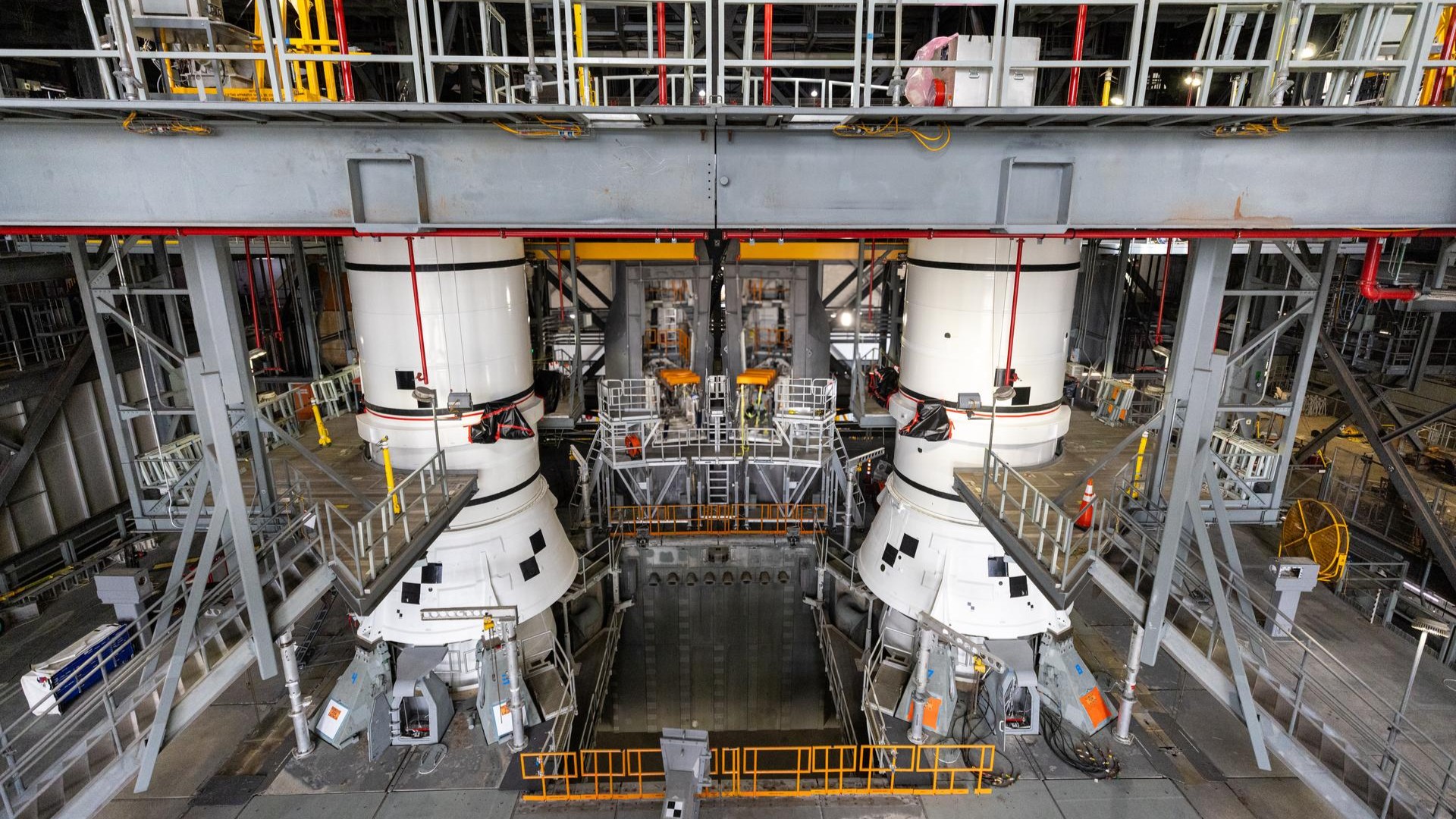
The bottom segments of both SLS solid rocket boosters (SRBs) were delivered over the last week, and they have been mounted on the MLP, according to NASA's update. The upper SRB segments arrived at KSC via train in June and will undergo inspection and testing before the twin boosters are fully stacked.

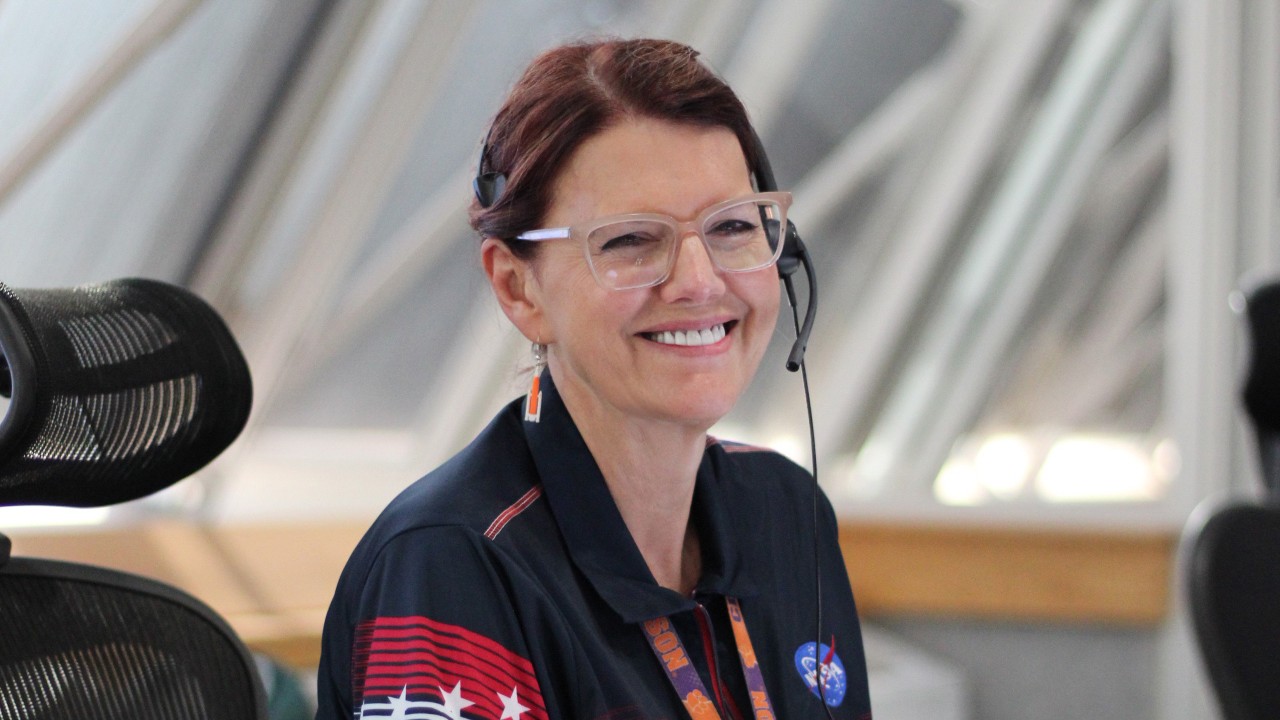
Artemis launch director Charlie Blackwell-Thompson participates in the launch countdown simulation on July 2, 2026, in Firing Room 1 of the Launch Control Center.
Per NASA: Artemis launch director Charlie Blackwell-Thompson participates in the launch countdown simulation on July 2, 2026, in Firing Room 1 of the Launch Control Center.NASA/Chad Siwik
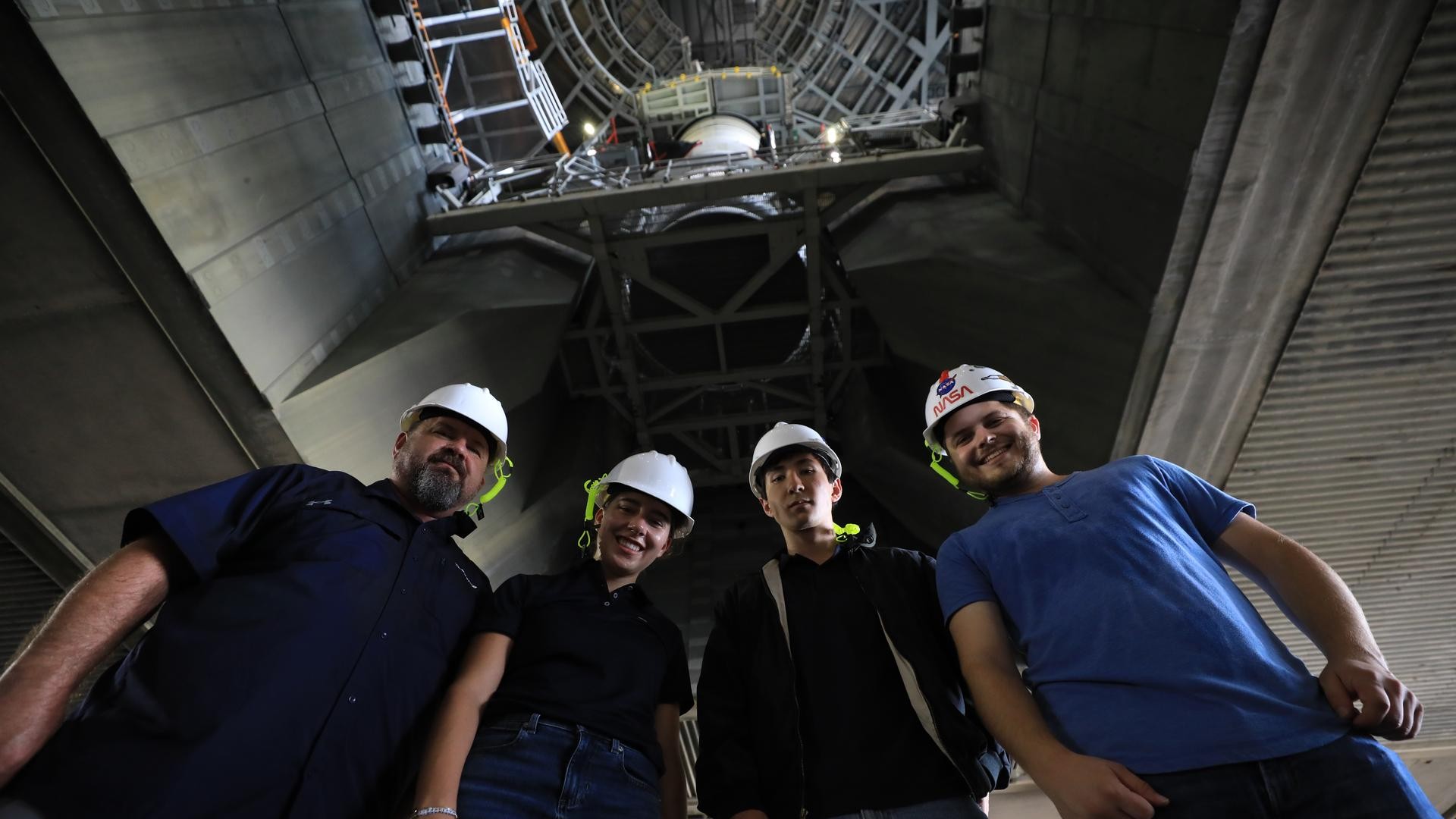
Employees pose for a photograph following work inside the VAB to secure the left-hand aft assembly solid rocket booster segment to the mobile launcher at the VAB on July 9, 2026.
Per NASA: Employees pose for a photograph following work inside the VAB to secure the left-hand aft assembly solid rocket booster segment to the mobile launcher at the VAB on July 9, 2026.NASA/Ben Smegelsky
The left-hand and right-hand aft assembly solid rocket booster segments for NASA’s Artemis III SLS (Space Launch System) rocket are secured to the mobile launcher at the agency’s Vehicle Assembly Building at NASA’s Kennedy Space Center in Florida on July 11, 2026.
Per NASA: The left-hand and right-hand aft assembly solid rocket booster segments for NASA’s Artemis III SLS (Space Launch System) rocket are secured to the mobile launcher at the agency’s Vehicle Assembly Building at NASA’s Kennedy Space Center in Florida on July 11, 2026. NASA/Frank Michaux
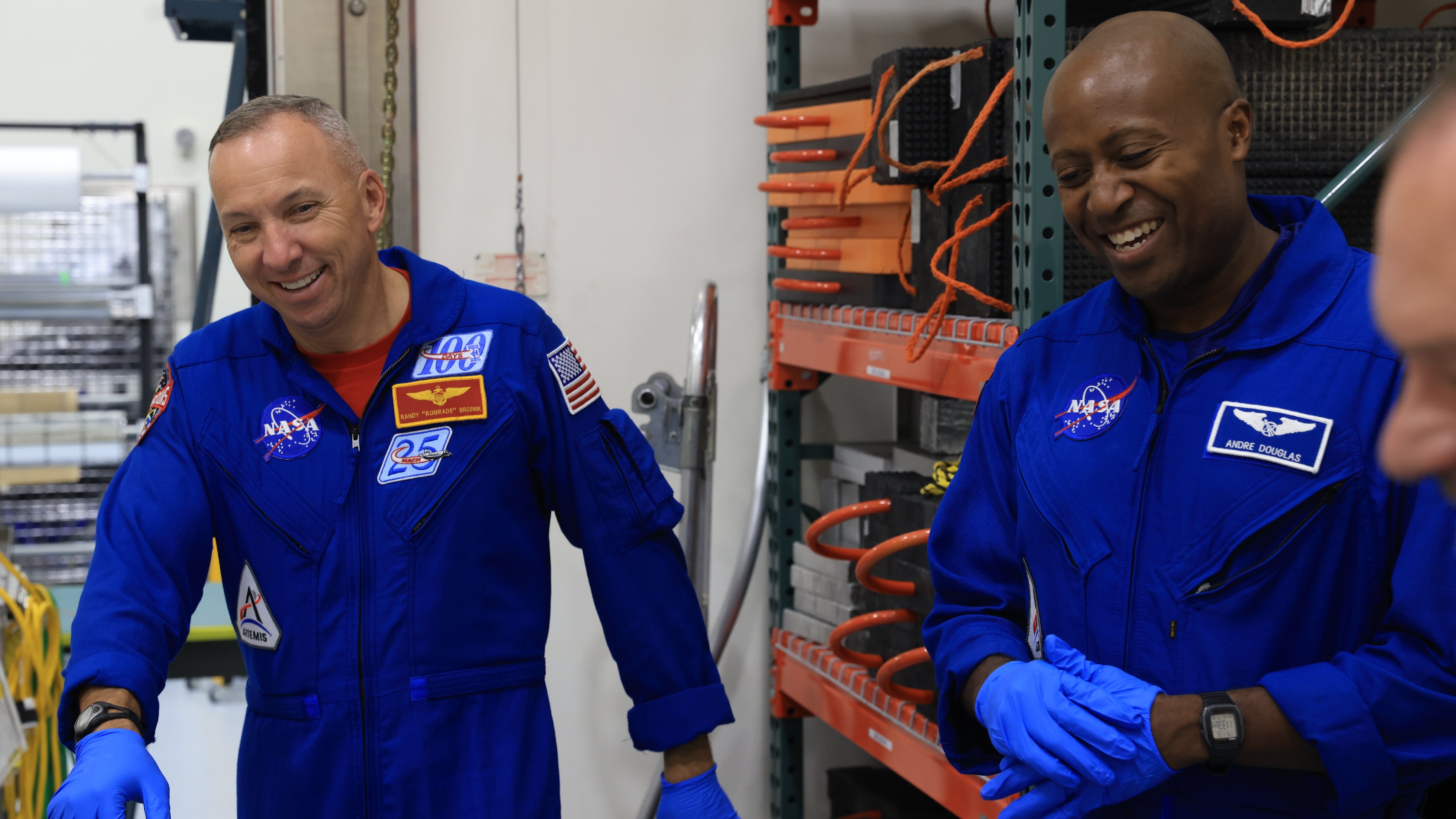
Artemis III astronauts Randy Bresnik and Andre Douglas visit the Multi-Payload Processing Facility at NASA's Kennedy Space Center on July 10, 2026.
Per NASA: Artemis III astronauts Randy Bresnik and Andre Douglas visit the Multi-Payload Processing Facility at NASA's Kennedy Space Center on July 10, 2026.NASA/Cory Huston

Inside KSC's Neil Armstrong Operations and Checkout Building, the Artemis III Orion is making significant progress — engineers have now finished installation of the spacecraft's heat shield.

Artemis III will be the first Orion mission to use an upgraded heat shield, featuring design improvements gleaned from analysis of unexpected wear on the heat shield flown on Artemis I. Orion's service module is also currently inside the Operations and Checkout Building and recently completed acoustic testing. Both the service module and Orion capsule are now being prepared for joining and eventual transportation to the VAB for stacking.

On the personnel side of things, Artemis III team members at KSC have begun monthly launch simulation tests to hone procedures for SLS propellant loading, terminal count operations (the final 10 minutes prior to liftoff) and launch day operations. Those tests will continue regularly leading up to Artemis III's launch next year, according to NASA.

As teams across NASA are busy readying all the pieces for Artemis III, others are looking ahead to the program's first lunar landing, planned for Artemis IV. That mission, scheduled for late 2028, will deliver a crew of astronauts to the surface of the moon for the first time since 1972. The SLS that will get them there is also coming together piece by piece.

The liquid oxygen (LOX) tank for the Artemis IV SLS core stage was recently relocated within NASA's Michoud Assembly Facility in New Orleans, positioning the tank for testing as it enters its next phase of production.

NASA begins stacking rocket ahead of 2027 Artemis III astronaut launch (photos)

The assembly of NASA's next Artemis rocket is well underway, with the recent arrival of one of the launch vehicle's solid fuel booster sections to the agency's integration facility at Kennedy Space Center in Florida.

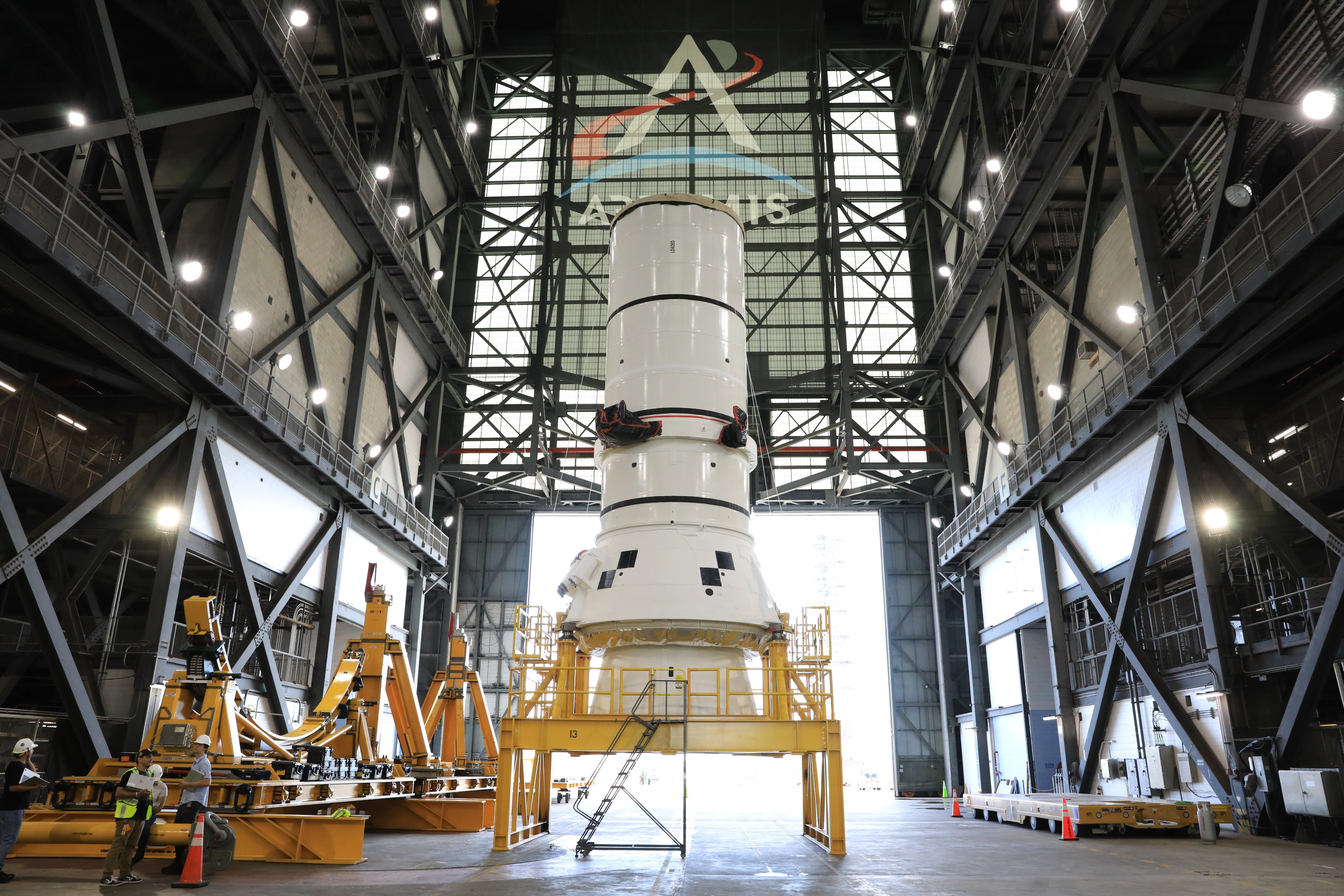
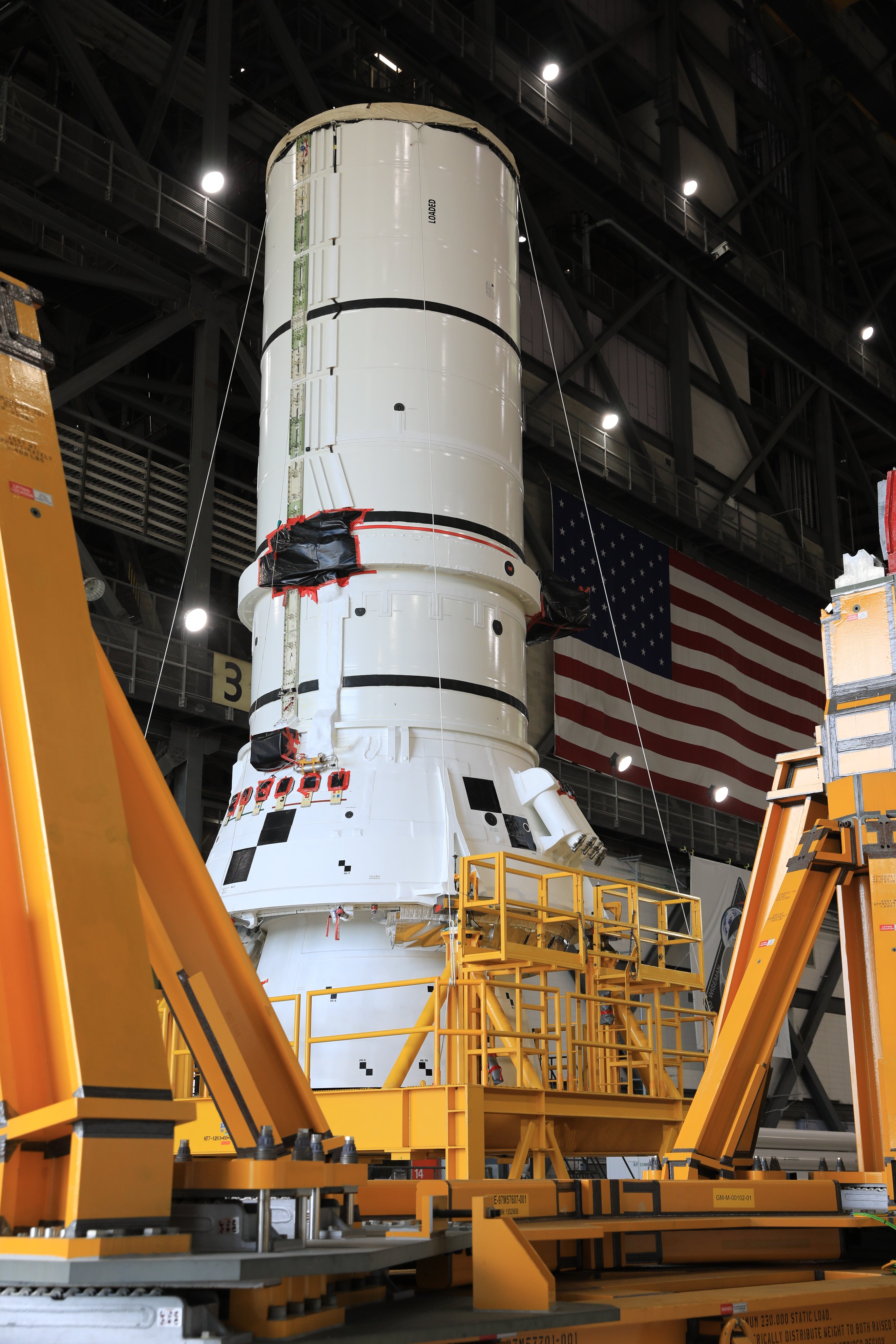
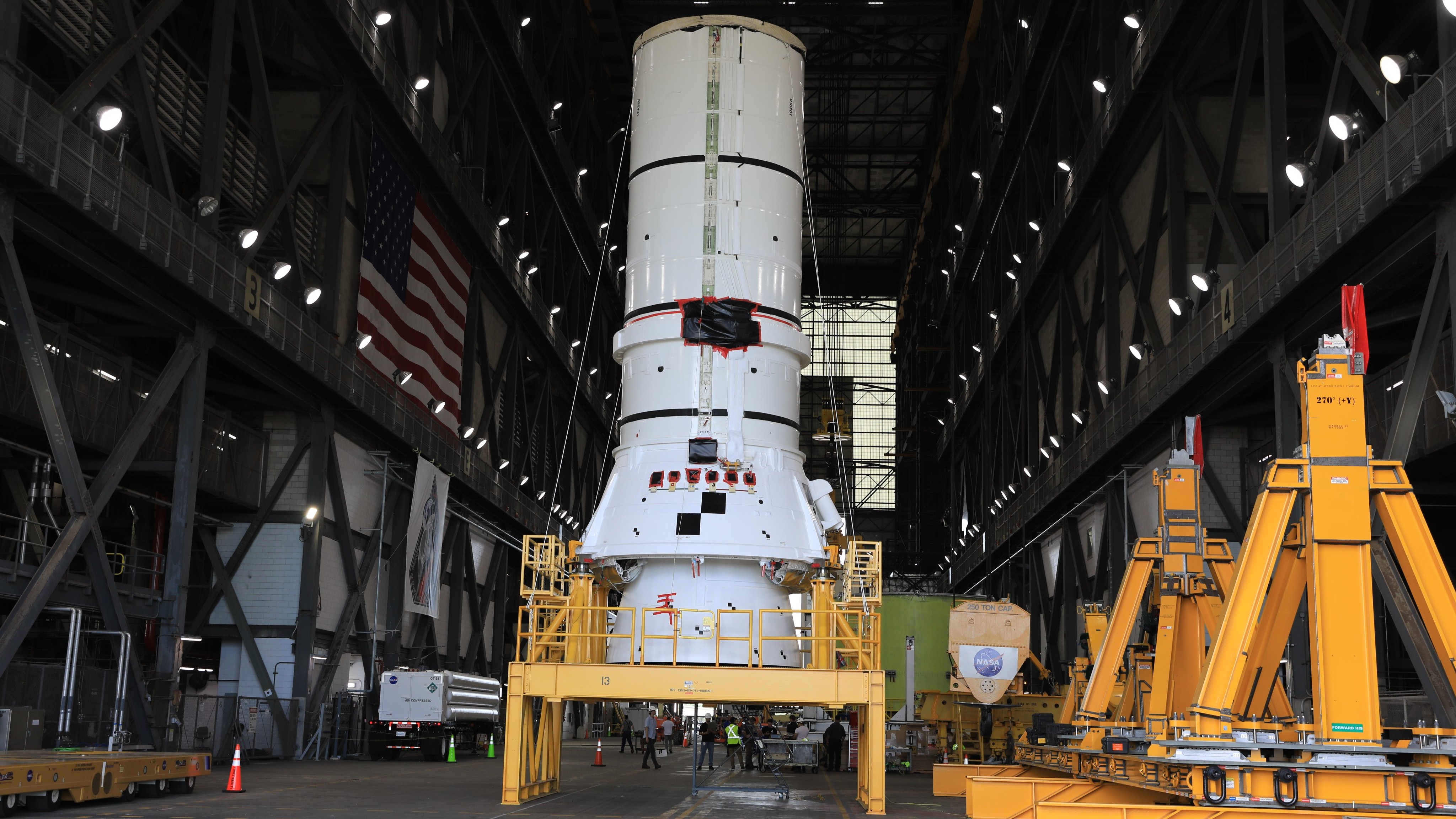
The bottom segment of the left-hand solid rocket booster (SRB) that will help launch Artemis III was transported to KSC's Vehicle Assembly Building (VAB) this week, according to a NASA social media post. It's one of two SRBs that will be affixed to either side of NASA's Space Launch System (SLS) rocket, which together provide a combined 7.2 million pounds of force — more than 75% of the rocket's power at liftoff.

"Soon, assembly of the rocket will begin as we prepare to send crew aboard Orion to test the rendezvous and docking capabilities needed for future lunar landings," the NASA post said.

It took about one year for NASA to stack the Artemis II SLS once each of the rocket's components were delivered to the VAB. The same timeline gives Artemis III a small amount of wiggle room, as it progresses toward a targeted launch in mid-to-late 2027 — and stacking of the entire rocket may not begin immediately.

The Artemis III SLS core stage arrived in the VAB in May. Unlike the core stage's arrival for Artemis II, Artemis III's was delivered without the engine section. Once that's attached, it may be some time before other components are stacked onto the main vehicle. NASA Administrator Jared Isaacman has said that the agency aims to complete a wet dress rehearsal on the rocket before the end of the year. In the meantime, other SLS components and SRB segments will continue arriving at the VAB.

Each SRB stands about 177 feet (54 meters) tall. They're packed with polybutadiene acrylonitrile (PBAN), ammonium perchlorate, and aluminum powder, which bring their combined weight to 3.2 million pounds (1.45 million kg). Unlike liquid-fueled rocket engines, once the SRBs' solid propellants ignite, they cannot be turned off. Without them, the four RS-25 engines on SLS's core stage would not be powerful enough to lift the rocket off the launch pad.

The bottom segment of a white solid rocket booster stands on a yellow support inside a giant rocket hangar.
NASA
The bottom segment of a white solid rocket booster stands on a yellow support inside a giant rocket hangar.
NASA
The bottom segment of a white solid rocket booster stands on a yellow support inside a giant rocket hangar.
NASA

Artemis III will be the second crewed mission of the Artemis program — NASA's next-generation push to return astronauts to the moon. And, while Artemis III itself won't actually fly to the moon, it will help progress the hardware and spacecraft technologies the space agency needs to ensure success on future missions to the lunar surface.

Like Artemis II, which flew four astronauts on a 10-day mission around the moon in April, the Artemis III astronauts will launch on SLS aboard the Orion spacecraft — but they won't fly beyond low Earth orbit this time. Instead, the four-person crew will spend about two weeks testing out rendezvous and docking procedures with prototypes for the two Artemis moon landers, both of which have been privately contracted by NASA.

The space agency has partnered with SpaceX and Blue Origin for those vehicles, each of which is expected to launch once the Artemis III crew are on orbit. They'll first meet up with Blue Origin's lander, Blue Moon. After docking, the astronauts will have the opportunity to enter Blue Moon's crew cabin, where they will also have the chance to test parts of the Artemis extravehicular activity (EVA) suit designed for astronauts to wear on the lunar surface.

A rendezvous with SpaceX's Starship will follow Orion's stint with Blue Moon. SpaceX has indicated it will fly a boilerplate Starship V3 (Version 3) vehicle equipped with a docking adapter, but it will not have a crew cabin. V3 is SpaceX's newest version of Starship, which has been upgraded for high launch efficiency and capacity, but it will lack a fully developed life support system in time for the Artemis III launch next year.

If all goes according to plan and NASA is able to maintain its current mission timeline, the first moon landing of the Artemis program will take place on Artemis IV, scheduled to launch in late 2028.

149 million views! Artemis II moon mission breaks NASA’s streaming record

Nearly 150 million people shared in the "moon joy" of Artemis II on NASA channels, setting a new agency record in the process.

NASA numbers indicate that 149.4 million people used agency platforms in March and April to follow the four astronauts of Artemis II as they prepped for their mission, lifted off aboard the Space Launch System rocket, flew by the moon and finally splashed down in the Pacific Ocean. The viewership figure includes the mission's 24/7 livestreams of mission activities and views from the Orion spacecraft.

"Artemis II's human‑spaceflight narrative, real‑time crew updates, and highly visual moments drew millions of new followers across platforms," the agency stated of the historic lunar flyby mission, which ran from April 1 to April 10.

On board were NASA astronauts Reid Wiseman, Victor Glover and Christina Koch as well as Canadian Space Agency astronaut Jeremy Hansen. The quartet flew farther than any human before them while making the first journey to the moon since Apollo 17's landing in 1972.

Glover, Koch and Hansen became the first Black person, woman and non-American, respectively, to fly beyond low Earth orbit, and the crew engaged repeatedly in live events with politicians, journalists, students and other audiences from afar.

The live broadcast drew praise on social media for showing the work of the astronauts, including struggles with toilet venting, the crew's descriptions of the lunar surface and a moving group hug when the crew suggested naming a lunar crater after Wiseman's late wife, Carroll.

Launch (April 1)

NASA's official Artemis II launch webcast reached a peak of nearly 3.67 million simultaneous viewers. That's a record, surpassing other big launches in recent agency history, NASA stated, including that of the uncrewed Artemis I mission to lunar orbit in November 2022 or the James Webb Space Telescope in December 2021. (The agency did not disclose in the release how many views each event received.)

Roughly 16.6 million people watched the Artemis II launch live across agency platforms, with that number rising to 23.9 million views when taking into account those who tuned in after the fact. NASA's Spanish-language broadcast alone received a "landmark peak" of 458,366 simultaneous views, which has since risen to 2.8 million total views, according to the agency.

Lunar flyby (April 6)

NASA's lunar flyby broadcast alone "delivered one of the largest peak audiences ever recorded," according to the agency. As many as 1,471,069 people tuned in at the same time. Nearly 900,000 of those folks watched on YouTube, and about 190,000 viewers tuned in via X or Twitch.

the silhouette of the moon sits in front of a glow of sunlight

The Artemis II crew saw a solar eclipse from beyond the moon's far side. (Image credit: NASA)

Splashdown (April 10)

The dramatic reentry, splashdown and recovery of the four Artemis 2 astronauts generated a peak of 3,838,418 live viewers on agency platforms — nearly 5% higher than the liftoff's peak viewership.

NASA attributed the increase to interest in the "riskiest moments" that some global news outlets highlighted about the mission, "particularly Orion's re-entry and heat‑shield performance." (Unexpected issues with Artemis I's heat shield drew concerns from some when the agency flew the same design on Artemis II — although all turned out well, partly because NASA modified Artemis II's reentry trajectory.) Some news outlets, however, have said global interest came because the astronauts showed "worldly harmony" and shared their experiences with "heartfelt words."

Total, non-simultaneous live views of the splashdown on agency platforms clocked in at 24.1 million, which rises to 29.5 million when taking into account people who tuned in after the fact. But when bringing in a selection of the major broadcasters who covered the landing, NASA said that viewership rose to "hundreds of millions of potential viewers worldwide."

The agency focused on select streaming platforms in its analysis, including HBO Max, Netflix, Peacock and Amazon Prime Video. News networks were not included. The streaming platforms released subscriber numbers, but not mission viewership numbers. HBO Max had between 120 million and 150 million global subscribers during the mission, Netflix 325 million paid global subscribers (as Netflix allows some account sharing), Peacock between 36 million and 41 million U.S. subscribers, and Amazon Prime Video up to 275 million global subscribers, according to NASA.

Websites

NASA said a "major surge" came in agency website traffic because of Artemis II.

  • Entire mission: NASA.gov received 125.1 million page views during the mission, which was a 150% increase over the 50 million who logged in during the entire month of March. A website showing Orion's orbit, called "Artemis II Mission in Real Time," or AROW, "surpassed" 11 million cumulative views since launch, although NASA did not say whether the AROW views continued to be counted after the mission concluded.
  • Launch day (April 1): The mission's debut brought 17.6 million page views across all NASA sites, from 8.3 million individual visitors.
  • Lunar flyby (April 6): More than 16.5 million page views came to NASA websites from 6.2 million individual visitors. As a part of the total page views, the NASA homepage got 2.3 million, while AROW showed 1.9 million.
  • Splashdown (April 10): More than 6.1 million people logged on to NASA websites on splashdown day, generating 16 million page views. Of that figure, AROW alone generated 1 million page views.

Social media

NASA tracked 261 million individuals engaging with its social media accounts (which were not specified) between March 27 and April 13. Splashdown was the only milestone selected for individual analysis, with 35 million engagements shown on April 10.

"Public reaction to NASA's Artemis II mission remained largely steady across launch week, with neutral and positive posts dominating the online conversation. Neutral sentiment consistently led daily discussion, ranging from 47 to 60%, while positive reactions accounted for 30 to 42%, fueled by excitement over the crew's historic lunar journey, striking mission imagery, and renewed interest in deep space exploration," the agency stated of the engagement.

NASA also noted "strong amplification" on social media from "major news outlets, brands, and international partners." The Canadian Space Agency, working with other Canadian government departments and agencies, was the major international partner on Artemis II because of Hansen and backup CSA astronaut Jenni Gibbons (who also served as CAPCOM during lunar flyby), among other mission contributions. CSA hosted several live mission events in Canada, and had extensive social media engagement. The European Space Agency, which contributed the service module for Orion, also posted frequently during the mission.

NASA experienced "major social media growth" through Artemis II, with these figures below said to encompass the milestones between liftoff and splashdown. "Collectively, these gains highlight how Artemis II's human‑spaceflight narrative, real‑time crew updates, and highly visual moments drew millions of new followers across platforms," the agency stated.

  • NASA's Instagram added 4.6 million followers. (The agency did not include the baseline number of followers during the mission in April, but as of July 7 it stands at 104 million).
  • NASA's Artemis account on Instagram grew by 2 million, which was said to be "a 66 percent increase" while the mission was ongoing.
  • The agency also noted "significant gains" on X, Facebook and YouTube. Numbers were not released for X. YouTube subscribers increased by 2 million during the mission in April; the baseline number was not disclosed, but as of July 7 numbers stand at 15 million. Facebook reached 1.7 million more people; as of July 7, the agency has 28 million followers on that platform.

Artemis 2 astronuats wave after CSA media event on april  5 2026

The Artemis 2 crew during their historic moon mission. (Image credit: NASA)

Miscellaneous

NASA also highlighted a selection of its campaigns before and during the mission to engage the public's interest but released few metrics about how these contributed to overall viewership and engagement.

  • The moon-mascot campaign: Thousands of people from 50 countries contributed ideas for a zero-gravity indicator for Artemis II, which ultimately ended up being "Rise" from eight-year-old Lucas Ye.
  • Sending public names to the moon: Rise carried an SD card containing 5.6 million names submitted, from individuals around the world, to fly around the moon.
  • Other partnerships: Artemis II was also highlighted on a Google Doodle on April 1, a Spotify playlist that featured the crew's wakeup songs, and on Merriam-Webster's Facebook page.